




Abstract
In semi-presidential regimes presidents need to strike a balance between representing the nation and sharing power with prime ministers. The coexistence of the executives may pose challenges to the presidents, but it could also strengthen their public standing. Yet we lack information on how party-political shifts and clashes between the executives shape public opinion on presidents. Covering the period 2000–2020 and including presidents from the Czech Republic, Finland, France, Poland and Portugal, this article reveals that presidential popularity is influenced by the political weakness of the government, as both weak and strong presidents’ popularity ratings increased during minority governments, and by the constitutional strength of the presidency, as people seem to tolerate more confrontational involvement mostly from those presidents with stronger constitutional powers. The impact of cohabitation, in turn, appears to be more context-specific, sometimes benefitting the president’s public standing, while at other times harming it. The results thus suggest that being politically opposed to the government may boost the president’s political capital, but only under certain circumstances.
Introduction
Semi-presidentialism, ‘where a popularly elected fixed-term president exists alongside a prime minister and cabinet who are responsible to parliament’ (Elgie, 1999: 13), is currently the most common regime type in Europe, covering a very heterogeneous group of countries (e.g. Anckar, 2022). The ‘dual executive structure’ within the regime type allows different types of arrangements between the executives, of which some are potentially more beneficial for the president than others. Research on semi-presidentialism has mainly focused on the definitions of the regime type, democracy, powers, intra-executive and executive-legislative relations, and parties (Åberg and Sedelius, 2020), yet we lack information on whether intra-executive dynamics (changes in intra-executive relations), for example party-political shifts and clashes between the president and the prime minister, impact public opinion on presidents.
This article contributes to the field by exploring public opinion on presidents in semi-presidential regimes while considering the special power structures within the regime type. It focuses on the association between presidential popularity and various aspects of intra-executive relations – cohabitation, intra-executive conflicts, the constitutional strength of the president, and the political weakness of the government. This should broaden our understanding of the president’s position in the public eye. The specific research question is, ‘are presidents more popular when being politically opposed to the government?’. The empirical analysis includes five semi-presidential countries: the Czech Republic, Finland, France, Poland and Portugal, varying from fully consolidated democracies to post-communist countries that experienced a transition to democracy in the 1990s. The case selection is based on the heterogeneity of the countries in terms of their constitutional framework and different level of presidential powers, offering a possibility to examine whether similar dynamics in the relationship between the president and the government explain variation in presidential popularity ratings across different semi-presidential countries. Another reason is data availability. 1
Studies on presidential popularity have mainly focused on presidential systems with constitutionally powerful head executives. Consequently, the popularity patterns have not been discussed nor tested comparatively in semi-presidential (or parliamentary) systems where the president shares power with the prime minister and seems to enjoy higher popularity ratings than other political actors. In the context of semi-presidentialism, I argue that intra-executive dynamics, by changing the position of the president in relation to the prime minister, should impact public evaluations of the president. Moreover, there are various motivations for people to ‘reward’ and ‘punish’ the presidents, but the direction of these attitudes should depend on how close or distant the president is from the government, both constitutionally and practically.
The empirical findings reveal that while both weak and strong presidents experience a popularity boost during minority governments, if the president is weaker, a more neutral position benefits her or his popularity, and if stronger, people reward the president’s active involvement. The results thus suggest that although presidents in semi-presidential regimes, to some extent, enjoy the ‘benefits’ of the office, they are not always favoured over the prime minister. Furthermore, being opposed to the government does not automatically provide the president an advantage and turn into public support. Instead, the level of president’s constitutional powers and the president’s own actions appear to be particularly significant. This has important implications for understanding political accountability and public attitudes towards the executives in systems where power is shared by the president and the prime minister.
Theory and Hypotheses
Common Explanations of Presidential Popularity
Presidential popularity is primarily studied in the context of the U.S. presidency. Many refer to the seminal work of Mueller (1970), who showed that after the first couple of months in office (also known as the honeymoon effect), presidential popularity decreases over time (the cost of ruling effect), international crises and events cause short-term boosts in presidential popularity (the rally around the flag effect), and rising unemployment harms presidential popularity. For example, Erikson (2012: 37) summarised the findings of the U.S. studies as follows:
‘Presidents start with a honeymoon of exceptional popularity, which inevitably fades with time. Their approval levels rise following “rally events” (9/11 being the prime example) and deflate following scandals (Watergate being the prime example here). The variable that is followed most closely as an augur for the president’s popularity, however, is the state of the economy’.
The economy has indeed received the most attention in studies on vote and popularity functions (e.g. Nannestad and Paldam, 1994). These studies indicate that a bad economic situation harms presidents’ popularity ratings more than a good economic situation helps them (Magalhães, 2020). Otherwise, the results of the economic variables have varied quite heavily (Berlemann and Enkelmann, 2014), and the overall importance of economy as an explaining factor has notably faded, with more recent studies focusing on the partisan dimension, that is the association between party support and executive approval (e.g. Carlin et al., 2023; Donovan et al., 2023). Scholars should thus be careful not to exaggerate the impact of economy on public opinion presidents.
Outside the U.S., presidential popularity has been studied in Latin America, mostly through country-level analyses, such as in Mexico (e.g. Buendía, 1996), Brazil (e.g. Ferreira and Sakurai, 2013), Costa Rica (e.g. Pignataro and Cascante Matamoros, 2019), Peru (e.g. Arce, 2003; Weyland, 2000) and Uruguay (e.g. Carlin and Hunt, 2015). Comparative aggregate-level studies are rarer, and most of them include only presidential countries (e.g. Carlin, 2018; Carlin and Singh, 2015; Jung and Oh, 2020), although recently, some studies have also incorporated semi-presidential countries (e.g. Hellwig and Singer, 2023; Kujanen, 2024). Otherwise, from European semi-presidential countries, presidential popularity has almost solely been examined in France (e.g. Conley, 2006; Lafay, 1985; Turgeon and Bélanger, 2017; Turgeon et al., 2015; and more recently, Grossman and Guinaudeau, 2023) or in Portugal (e.g. Veiga, 1998; and more recently Aguiar-Conraria et al., 2023). As in presidential systems, studies on semi-presidential countries have mainly focused on international events, electoral cycle, time spent in office and economic determinants, but also on cohabitation, ‘where the president and prime minister are from opposing parties and where the president’s party is not represented in the cabinet’ (Elgie, 2011: 12), an important variable in the literature on semi-presidentialism.
Semi-Presidentialism and the Dual Executive
In semi-presidential regimes, the executive powers are divided between the president and the prime minister (government). In most European semi-presidential countries, the constitutional prerogatives of the president are often limited to foreign policy and international affairs, leaving domestic politics to the prime minister. However, the ‘dual executive structure’ within the regime type also allows different types of practices between the executives, strengthening or weakening the president in relation to the government.
The question of power relates to the debate over the definition of a semi-presidential regime and whether a certain level of presidential powers should be included in it. For example, Duverger (1980: 166) classified a country as semi-presidential when the president possesses ‘quite considerable powers’, while the definition by Elgie (1999), which has become widely accepted in the literature (Anckar, 2022), has been criticised for not considering the power dimension. Within the same regime type, there is, for example, France, where the president is the chief executive both in domestic and foreign policy, and Finland where the president’s powers are concentrated almost exclusively to foreign policy and where the prime minister is the political leader of the country. The heterogeneity of the regime type becomes even clearer when including presidents in the post-communist region in Central and Eastern Europe, where semi-presidentialism is particularly popular, and where the presidents are often quite active in domestic politics despite their limited constitutional powers (e.g. Brunclík and Kubát, 2019; Gherghina et al., 2023; Raunio and Sedelius, 2020).
In addition to these debates, the literature on semi-presidentialism has largely focused on the negative features of the regime type and tensions between the executives (Åberg and Sedelius, 2020). Many refer to Linz’s (1990, 1994) arguments about the perils of presidentialism and its effects on the functioning of the political system. In the context of semi-presidentialism, these concerns relate to the impact of president-parliamentarism, ‘where the prime minister and cabinet are collectively responsible to both the legislature and the president’ (Elgie, 2011: 28; see also Shugart and Carey, 1992) on democratic performance and survival (e.g. Elgie, 2011; Sedelius and Linde, 2018; Shugart and Carey, 1992). More recently, Ganghof (2021) argued that semi-presidentialism is affected by executive personalism, which means that constitutional executive power is focused on a single person, which might have negative consequences for the system, especially when the separation of powers between the executives is not clear enough. Again, these features concern mainly the president-parliamentary type of semi-presidentialism (Ganghof, 2021), yet presidents in premier-presidential regimes, ‘where the prime minister and cabinet are collectively responsible solely to the legislature’ (Elgie, 2011: 28; Shugart and Carey, 1992), are also often seen as ‘culprits’ when intervening in government’s work and initiating intra-executive conflicts (Raunio and Sedelius, 2020).
Intra-executive conflicts usually occur when presidents confront the prime minister about the institutional prerogatives of the executives or about disagreements over policy issues (Protsyk, 2005; Sedelius and Ekman, 2010). Such conflicts emerge especially during cohabitation, when the president and the government are more likely to have different policy preferences (Köker, 2017; Tavits, 2009). Cohabitation is often indeed seen as a ‘danger’ for the system, causing tensions between the executives, yet not necessarily if it occurs under premier-presidential form of semi-presidentialism with a weaker president, “in the context where it is easiest to manage” (Elgie and McMenamim, 2011: 632).
So far, it has remained unclear how people react when the dynamics between the executives change, or, more specifically, whether changing governments or a conflict between the executives boost or harms public opinion on presidents across semi-presidential systems. For example, political disputes between the president and the prime minister may harm decision-making or coordination, yet not necessarily the popularity of the president. Instead, distancing herself from the government, actively or passively, may provide the president an opportunity to raise her profile. At the same time, the constitutional strength of the presidency, on the one hand, and the political weakness of the government, on the other, could significantly impact public opinion on the executives.
Intra-Executive Dynamics and Presidential Popularity
This article therefore argues that party-political shifts and clashes between the executives, that is, factors shaping intra-executive relations, should be considered when studying public opinion on presidents in semi-presidential regimes. Why? Because sharing power with a prime minister involves dynamics that should impact the public position of the president and, consequently, shape the position of the president in the public eye. How? It probably depends on people’s preferences regarding the public role of the presidents, that is whether people prefer ‘ruling’ or ‘non-ruling’ presidents, but also on the actual level of presidential powers, considering that the constitution should ideally set boundaries for the presidents.
On the one hand, if we assume that presidents are viewed more as symbolic leaders with a neutral appearance, increased presidential activism and a more assertive public role might turn against the incumbent office-holder, especially if the president exceeds her or his constitutional prerogatives. On the other hand, if people prefer more active and politically powerful presidents, tensions between the executives and active use of powers might raise the profile of the president and result in higher popularity ratings, or at least not decrease them, especially if the constitution gives more room for the president. To address this puzzle, the focus in this article is on key variables shaping the relationship between the executives in semi-presidential regimes: intra-executive conflicts, cohabitation, constitutional strength of the presidency (presidential powers) and political weakness of the government (minority governments).
Intra-executive conflicts are treated as a direct measure of increased presidential activism, as they usually result from president’s initiatives to challenge the government (Raunio and Sedelius, 2020). The impact of such conflicts on presidential popularity might be twofold. Tavits (2009) and Brunclík and Kubát (2019) have for example argued that presidents’ more active and ‘partisan’ positions might backfire and harm their popularity ratings. However, if presidents are expected to influence domestic politics by challenging the government, people might reward the presidents for their activism, particularly in situations where the president and the prime minister are publicly opposed to each other. It is thus possible that by publicly criticising the government, the president ends up harming the position of the prime minister (Sedelius and Ekman, 2010) and boosting her or his own standing. Furthermore, president’s public appearances might be viewed as more acceptable than those of the prime minister, and during political disagreements, citizens may support the president rather than the prime minister.
This relates to the discussion over political accountability, that is, who people ‘credit’ or ‘blame’ – the president or the prime minister – and do these views match the responsibilities of the institutions (e.g. Arceneaux, 2006). Both the president and the prime minister are usually highly visible political figures, yet the role of the president as the guardian of national unity and national interests might benefit the president in terms of popularity. It has indeed been argued that presidents’ limited powers and their position as standing ‘above political parties’ may somewhat explain their high popularity ratings as prime ministers are held responsible for unpopular decisions and other issues of day-to-day politics (e.g. Duvold and Sedelius, 2022; Raunio and Sedelius, 2020; Tavits, 2009). This beneficial position of the president seems to be, however, contingent on the level of presidential powers rather than the regime type, as weaker presidential powers are associated with stronger presidential popularity (Kujanen, 2024), reflecting the responsibility theory (Nannestad and Paldam, 1994; Stegmaier et al., 2017).
As described, intra-executive conflicts are likely to happen under periods of cohabitation, when the president and the prime minister are from opposing parties, and the president should have more incentives to challenge the government. Yet, even without any confrontation, cohabitation itself should shape power dynamics between the executives – whereas intra-executive conflicts are signs of political battles between the president and the prime minister, cohabitation indicates ‘ideological’ distance between the executives. Studies of French presidents suggest that cohabitation benefits the president (e.g. Conley, 2006; Turgeon et al., 2015). According to Turgeon et al. (2015), this effect either stems from the reduced role of the president as the prime minister, which is the main target of public criticism or from the efforts of the president to collaborate with the prime minister. Conley (2006) argued similarly by emphasising the opportunity for the presidents to raise or ‘reformulate’ their profile. A potential argument challenging this perspective would be that under cohabitation, the president is more sidelined and could be seen as a weak actor not being able to pursue her or his policies, which in turn may result in dissatisfaction with her or his performance. However, this is presumably a less likely scenario as during cohabitation, the public seems to place more pressure on the prime minister, who is almost solely being held accountable for domestic issues, and this should protect the president (e.g. Hellwig and Samuels, 2007, 2008; Samuels and Hellwig, 2010; Turgeon and Bélanger, 2017).
However, cohabitation may not itself lead to changes in presidential popularity, but through shaping intra-executive dynamics it may have an impact. In other words, rather than directly influencing presidential popularity, the effect of cohabitation might be more indirect, affecting who people hold accountable for example on economic issues, the president or the prime minister. Turgeon and Bélanger (2017: 27), for example, argued that French citizens ‘punish (reward) only prime ministers for bad (good) times during cohabitation over domestic issues like inflation or major strikes because prime ministers are sole “first head” in those times’. Similarly, studying economic voting and electoral accountability in semi-presidential and parliamentary systems, Hellwig and Samuels (2008: 78) found that
‘voters reward or punish incumbent presidents to far greater extent than they reward or punish parliamentary parties in semi-presidential systems, but only under conditions of unified government. In contrast, under cohabitation, in presidential elections the coefficient on Economy is negative and imprecisely estimated. Cohabitation shields presidents from blame for poor outcomes (and credit for good ones)’.
In a nutshell, the more distanced the president is from the government in terms of party representation, the easier it is for the president to disassociate herself from the government’s policies, and the less likely it is that the public would blame the president for divisive issues. The effect should be boosted especially during cohabitation, when the distance between the responsibilities of the prime minister and the president is clearer. This line of argument includes the idea that under a unified government, the public should ‘attribute responsibility’ (Turgeon and Bélanger, 2017) also to the president, and under cohabitation only to the prime minister.
At the same time, cohabitation may have different effects depending on the constitutional or practical powers of the president. In France, after the early 2000s, the schedules of presidential and parliamentary elections were synchronised, and periods of cohabitation have not occurred, yet earlier during cohabitation, the executive powers tended to shift from the president to the prime minister, while in countries with a weaker presidency, there is no shift as the president does not possess such policy-making powers, to begin with (Elgie, 2018; Elgie and McMenamim, 2011). This does not mean that cohabitation would be irrelevant in the context of systems with weaker presidents, but the logic might be slightly different. Even without clear power shifts, periods of cohabitation could offer possibilities for weaker presidents to raise their profile; should the president publicly intervene in domestic politics, such as in the management of the economy, vetoing legislation or getting involved in government formation, it would probably happen when the president represents different party and ideologies than the prime minister, also in systems with a weaker president. The same logic should apply during politically weaker minority governments, as described by Tavits (2009: 39): ‘The minority status of the cabinet is a sign of political weakness that presidents recognize and are likely to capitalize on. In the absence of strong and coherent majority governments, the president’s ambitions for political power become more easily realized’. Consequently, the president might be viewed as a stronger actor and in a more positive light than the prime minister during a minority government.
The core hypothesis is that the more distanced the president is from the government politically, i.e., during cohabitation, minority governments or intra-executive conflicts, the more support the president should enjoy (H1). Intra-executive conflicts reflect increased presidential activism against the government, cohabitation of more general party-political distance between the president and the prime minister, and minority government political weakness of the cabinet. These three factors work as proxies for the political distance between the executives and are expected to raise the president’s profile and benefit her or his popularity. An important question is whether the president seeks to disassociate herself from the government’s (unpopular) policies and appear as a more neutral actor or to stand out with an opposing political agenda. I argue that weaker presidents should have less incentives to implement the first, more neutral strategy, since they have more to ‘lose’, while strong presidents are possibly more eager and even expected to be more active. Hence, the level of presidential powers is considered as an intervening factor, having the potential to impact relations between the executives and, consequently, public opinion. To address this perspective, the following hypotheses are formulated: if the president is constitutionally weak and not expected to overstep her/his prerogatives, a more neutral position of the president should benefit her/his popularity and a more active role harm it (H2), and if the president is constitutionally strong, people may tolerate or even reward the president’s active involvement but punish her/him for being more passive (H3).
Operationalisation of the Variables
Presidential popularity, the dependent variable, is not measured only as absolute values but also in relation to the popularity of the government. With this approach, it is possible to examine whether the dynamics between the president and the government boost the popularity of the president at the expense of the government. If the effect is positive, it would emphasise the favourable position of the president even further. This stems from the index of presidential leverage, which measures the president’s political capital by comparing presidential approval with general trust in the government (Ponder, 2018). According to Ponder (2018), presidential approval should be examined relative to public trust in the government, rather than in isolation. Ponder (2018: 2) asked ‘Why would a president with high approval have any greater leverage with the public if that same public holds the rest of the government in similarly high esteem?’. In other words, higher popularity ratings of the president in relation to the popularity of the government should boost the president’s political capital. The primary dependent variable is thus the absolute level of presidential popularity, that is the proportion of positive opinions towards the president (positive opinions/total sample), and the secondary dependent variable is presidential leverage, that is the relative ratio between the individual popularity ratings (positive opinions on president/positive opinions on government).
The key independent variables are cohabitation, intra-executive conflicts and minority governments. The level of presidential powers works as an intervening factor, included in the interaction terms (see description of the methods in section ‘Data and methods’). Cohabitation is understood as a situation where the president’s party is not represented in the cabinet, based on a list by Elgie (2018) and complemented with data from the ParlGov database (Döring et al., 2023). For an additional robustness test, ideological distance between the president and the prime minister is included to replace cohabitation in some of the models (see description of the models in section ‘Empirical analysis’). The variable consists of the left-right and GAL-TAN (green/alternative/libertarian – traditional/authoritarian/nationalist) dimensions associated with the presidents’ and prime ministers’ parties in the Chapel Hill Expert Survey data by Jolly et al. (2022). Intra-executive conflicts refer to significant conflicts between the president and the prime minister, based on expert surveys by Elgie (2018) and Sedelius and Mashtaler (2013). Minority governments refer to governments with less than 50% of the seats in the parliament, and the data is from the ParlGov database (Döring et al., 2023). For the constitutional strength of each presidency, I use presidential power scores by Siaroff (2003), including nine different sources of powers. These power scores have been used by many scholars (e.g. Elgie, 2011; Kim, 2015; Van Cranenburgh, 2008) and, in the context of public opinion on presidents, produce similar results when compared, for example, to the scores by Doyle and Elgie (2016; Kujanen, 2024).
Finally, the economy and the honeymoon period, two key aspects in earlier studies, are included as control variables, as they have the potential to cause repeating patterns in the popularity ratings. 2 The honeymoon period boosting presidential popularity at the beginning of the presidential term is expected to last roughly three months after the elections, while weakening economy, specifically rising unemployment and inflation, is expected to harm presidential popularity (e.g. Berlemann and Enkelmann, 2014). However, the impact of these factors seems to be conditioned by the level of presidential powers, assuming that the public does not punish the president for the bad economic situation and only the government is held responsible for day-to-day politics, that is, if the roles of the president and the prime minister are clearly delineated in domestic affairs (Kujanen, 2024), which is taken into account in the analysis. Descriptions, sources and coding of the variables are in Table A1 in Appendix A (available online), and descriptive statistics are in Table A2.
Data and Methods
This article employs a dataset covering 5 countries and 14 presidents over a period ranging from 2000 to 2020. All countries are members of the European Union and represent the same form of semi-presidentialism, premier-presidentialism. Poland became semi-presidential in the 1990s, and the Czech Republic after the introduction of direct presidential elections in 2012. Finland adopted a semi-presidential constitution already in 1919, France in 1962 after the introduction of direct elections, and Portugal in 1976 following a long period of authoritarianism and the Carnation Revolution of 1974 (Elgie, 2011; 2018). Information on the presidents and time periods in the dataset is in Table 1.
The Presidents and Time Periods in the Dataset.
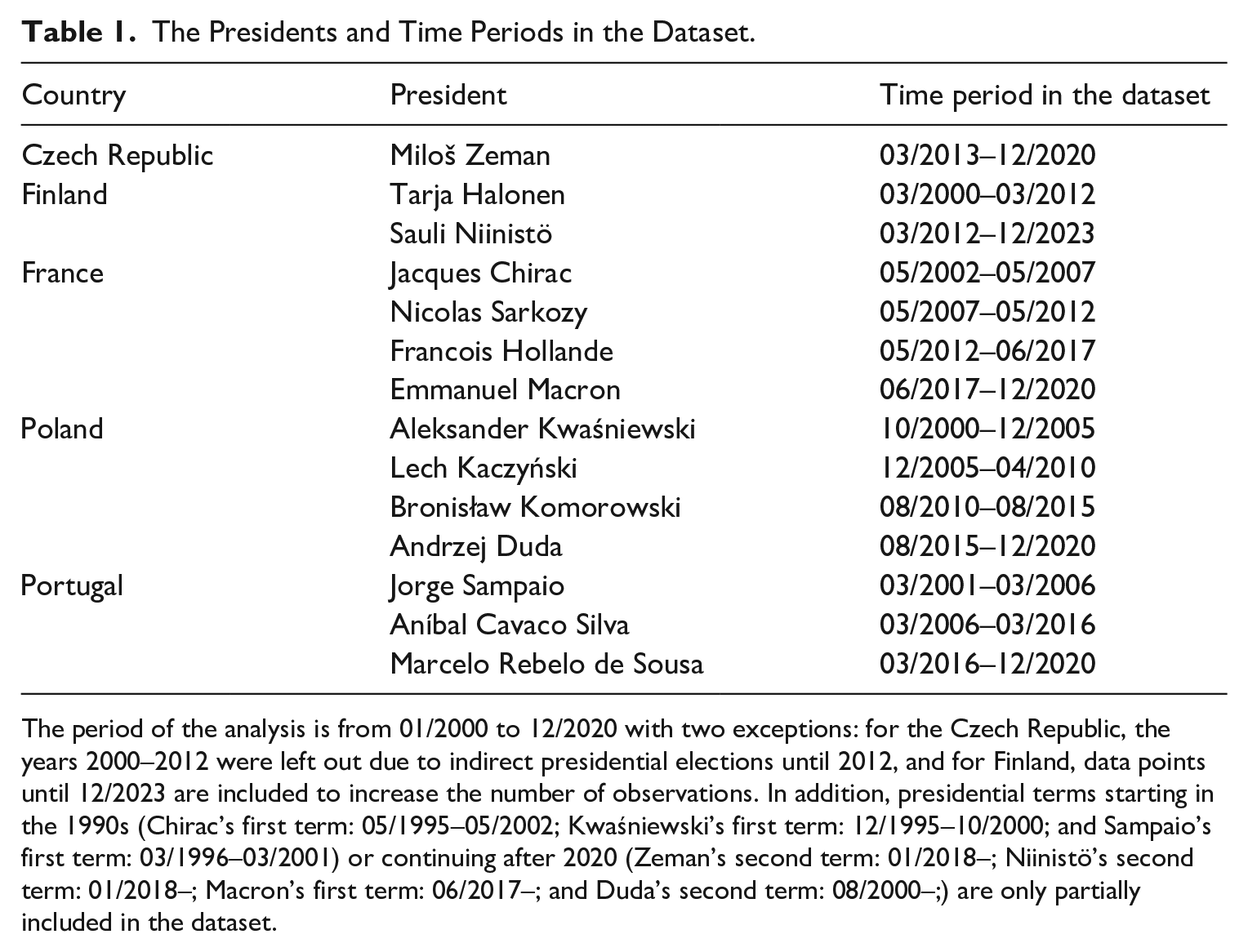
The period of the analysis is from 01/2000 to 12/2020 with two exceptions: for the Czech Republic, the years 2000–2012 were left out due to indirect presidential elections until 2012, and for Finland, data points until 12/2023 are included to increase the number of observations. In addition, presidential terms starting in the 1990s (Chirac’s first term: 05/1995–05/2002; Kwaśniewski’s first term: 12/1995–10/2000; and Sampaio’s first term: 03/1996–03/2001) or continuing after 2020 (Zeman’s second term: 01/2018–; Niinistö’s second term: 01/2018–; Macron’s first term: 06/2017–; and Duda’s second term: 08/2000–;) are only partially included in the dataset.
Due to lack of comprehensive cross-national data, the popularity ratings were gathered from country-specific opinion surveys carried out by national public opinion polling companies, and some of the data is from the Executive Approval Project (Carlin et al., 2019). The country-level surveys include very similar questions about the performance of the president and trust in the president, yet the time periods and the frequency of the polls are somewhat different. In Finland, for example, presidential popularity is measured only every six months by one polling company, while in France, it is monitored every month by several companies. The analysis takes, however, into account the different survey intervals in the operationalisation of the variables, controls for the country differences in the regression models and runs the models also by excluding the ‘outlier cases’, in this case, France (due to the constitutional and practical strength of the presidency and relatively low presidential popularity) and Finland (due to the number of observations and relatively stable and high popularity ratings). From the available opinion polls, I have selected the most frequent surveys from each country covering most of the time period from 2000 to 2020. 3 Although the survey techniques slightly vary between countries, variation of popularity ratings is analysed mostly within countries and not between them. At the same time, different questions from other available sources produce very similar trends, as showed by Figure A1 in Appendix A. The average number of respondents per survey is 1071, with a minimum of 505 and a maximum of 2630.
The empirical section starts with a descriptive analysis of presidential popularity ratings between the countries, followed by a regression analysis with more detailed results of the effects of intra-executive dynamics on presidential popularity. The descriptive part of the analysis includes time series figures of the two dependent variables and their correlations. The regression analysis consists of four models including interaction effects for the constitutional strength of the presidency and intra-executive dynamics (presidential powers × cohabitation; presidential powers × intra-executive conflicts; presidential powers × minority governments) as hypothesised in H2 and H3. All models include country dummies for fixed effects. Fixed effects regression model is used since it controls for the effect of groups and time (Allison, 2009; Gil-García and Puron-Cid, 2013). With this approach, country-specific contextual effects are controlled, and the results are not violated by varying survey questions in the five countries.
Empirical Analysis
Starting with descriptive statistics, Figures 1–5 present time series of the two dependent variables in each country. They also report the results of the Pearson correlation tests between the two series, showing that in France, Poland, and, to some extent, the Czech Republic, presidential popularity (absolute values) and presidential leverage (relative ratio) are strongly correlated. This indicates that in these countries, presidential leverage follows a similar path to presidential popularity, that is popular support for the president is to some extent related to the popularity of the government. In contrast, in Finland and Portugal, the series seem to be not dependent on each other.
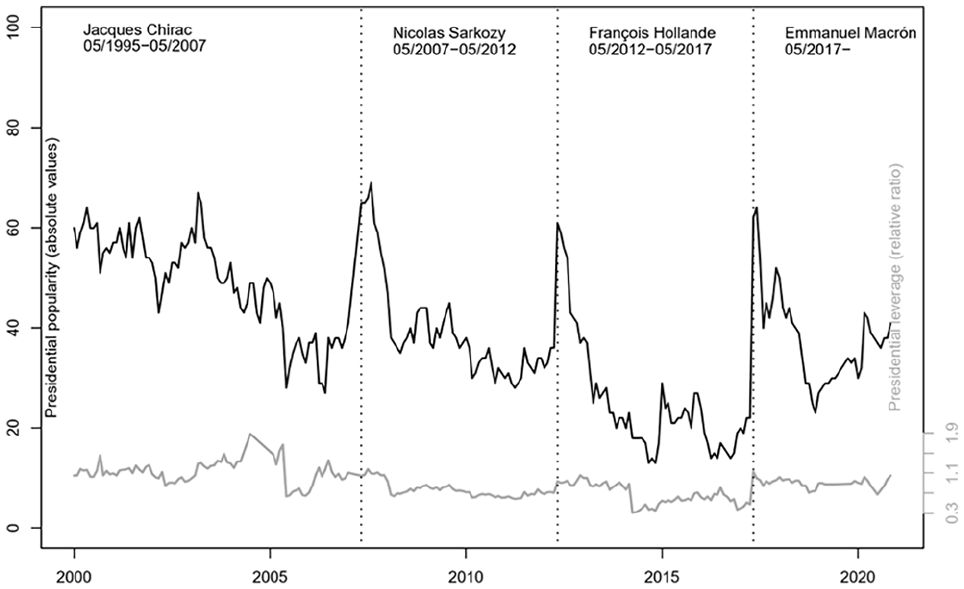
Presidential Popularity and Leverage, France 2000–2020.
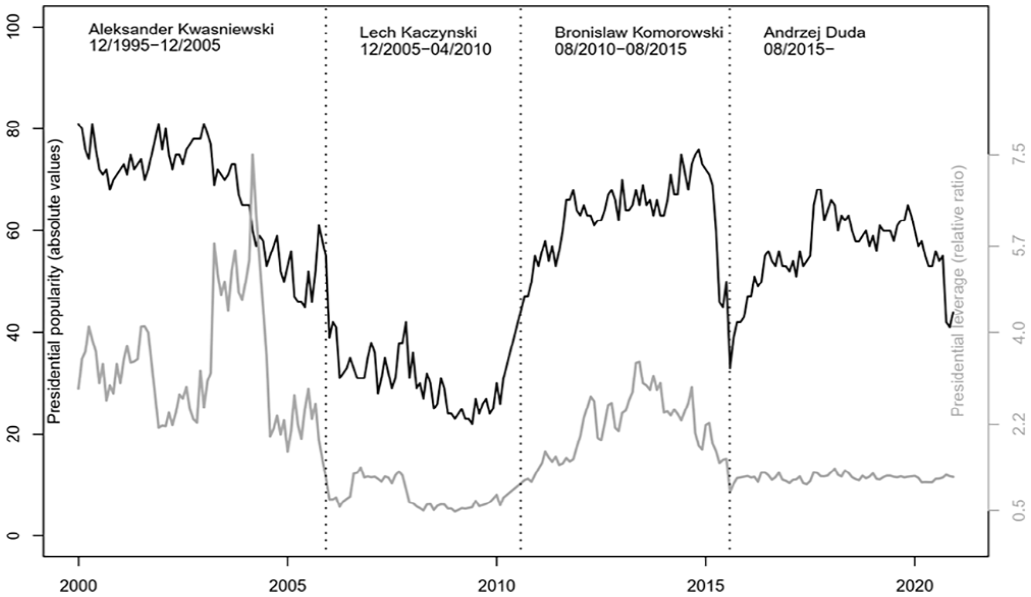
Presidential Popularity and Leverage, Poland 2000–2020.
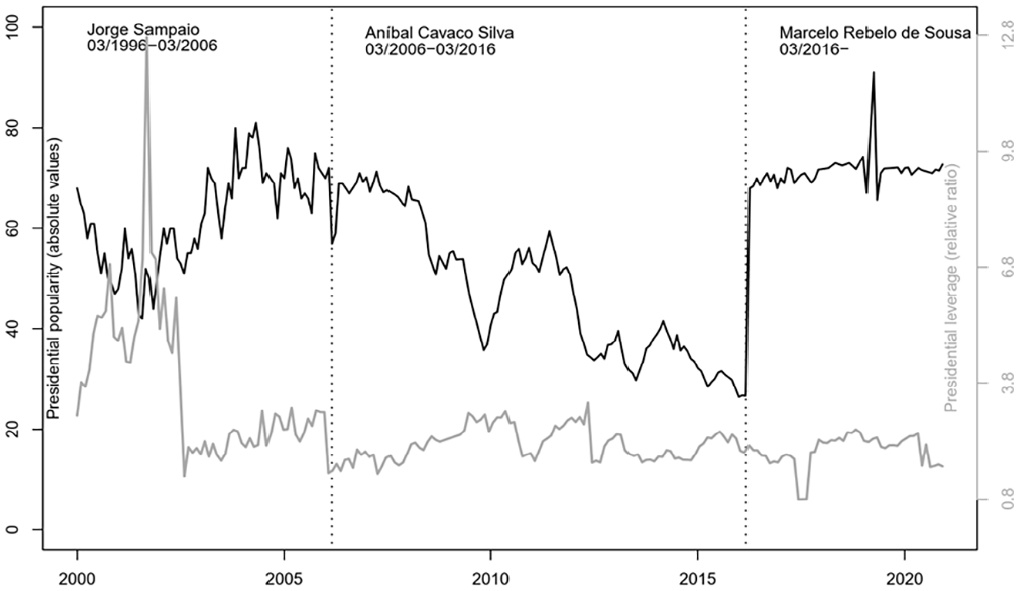
Presidential Popularity and Leverage, Portugal 2000–2020.
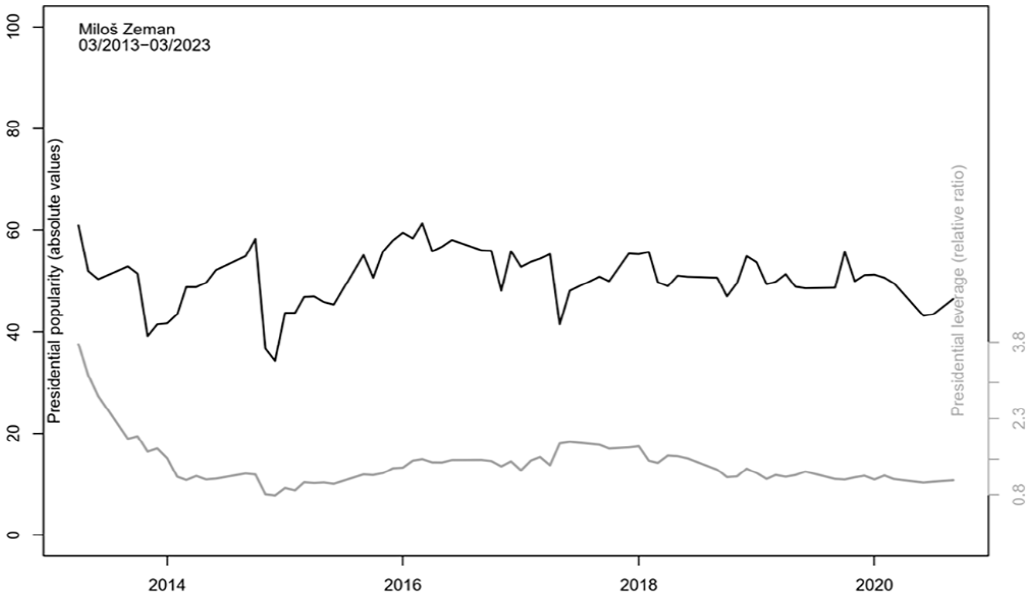
Presidential Popularity and Leverage, Czech Republic 2013–2020.Correlation coefficient: 0.321** (p < 0.01).
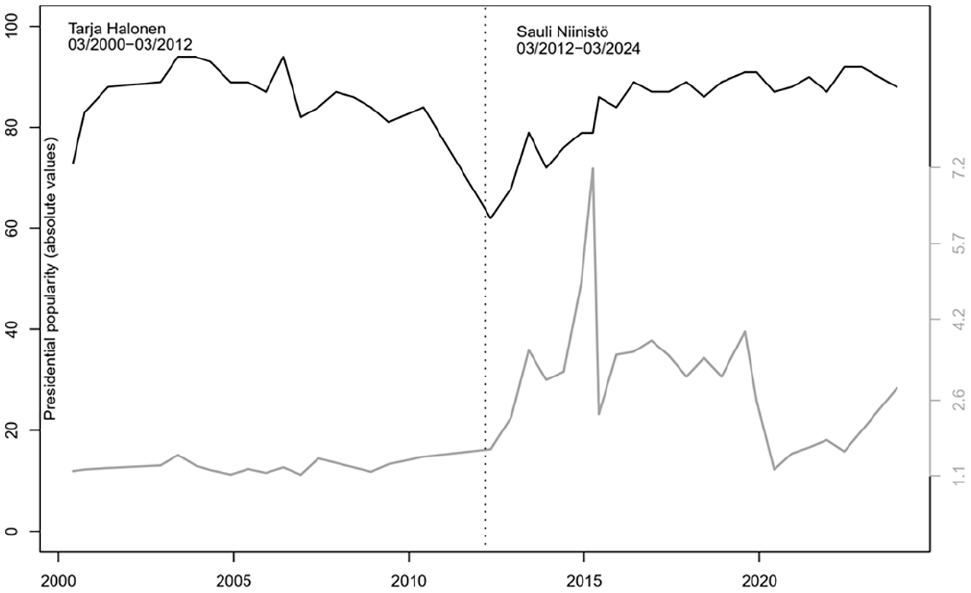
Presidential Popularity and Leverage, Finland 2000–2023.
Overall, the level of presidential popularity is highest in Finland and lowest in France. Especially the Finnish presidents, representing one of the weakest presidencies among semi-presidential countries, stand out with their extremely high and stable popularity ratings. Both Halonen (2000–2012) and Niinistö (2012–2024) were very popular throughout their terms in office, and their popularity ratings stayed above 70%, with peaks of even over 90%. At the same time, Finnish governments’ popularity ratings have varied quite heavily, which can be observed by following the level of presidential leverage in relation to the stable popularity ratings (see also Appendix A, Figure A2 for the governments’ popularity as absolute values). In contrast, the popularity ratings of the French presidents, representing a relatively strong presidency with constitutional and practical powers also in domestic politics, have stayed relatively low and mostly below the popularity ratings of the government, as the level of presidential leverage has stayed closer to 0 than 1. In the other three countries, presidents are systematically more popular than governments, although the relative difference has varied.
In France, the popularity ratings follow a common pattern: all presidents enjoy the highest peaks at the very beginning of their terms, followed by a collapse and a small rise before the next elections. In the other countries, the honeymoon effect is not that clear, and we can see both a downward trend (e.g. both Silva’s terms, 2006–2016, Sousa’s first term 2016– in Portugal, Kwaśniewski’s second term, 2000–2005, and Kaczyński’s term 2005–2010 in Poland) and an upwards trend (e.g. Komorowski’s and Duda’s terms in Poland and Niinistö’s term in Finland). The popularity ratings of Zeman (2013–2023), who is the only Czech president included in the analysis because of the change of the electoral system in 2012, stayed under 60 percent throughout his presidency, while those of the indirectly elected Klaus (2003–2013) were systematically higher, around 70 percent (see Appendix A, Figure A2). Likewise, Kaczyński’s popularity scores are the lowest among Polish presidents. Brunclík and Kubát (2019), for example, note that Zeman’s terms in office were affected by numerous scandals, events and controversial statements. Similarly, they suggest that Kaczyński’s low ratings may also stem from his conflictual behaviour, while Kwaśniewski, Komorowski and Duda, with fewer ambitions for more power, were more popular. In Portugal, both Sampaio and Silva have been significantly less popular than Sousa, whose ratings stand out clearly. The difference between Silva’s last polls and Sousa’s first polls was even over 50 percentage points.
This comparison suggests that presidential popularity varies quite heavily between countries and between individual presidents. Despite the limited number of cases, the findings also provide support for previous studies suggesting that presidents are more popular than governments (e.g. Duvold and Sedelius, 2022; Hloušek, 2013; Mishler and Rose, 1997; Raunio and Sedelius, 2020; Tavits, 2009), and that presidents with weaker constitutional powers are more popular than presidents with stronger constitutional powers (Kujanen, 2024), as presidents in Finland receive the highest popularity scores and presidents in France receive the lowest, and the Czech, Portuguese and Polish presidents situate between them. Furthermore, all countries expect France to show clear differences between the popularity ratings of the president and the government, boosting the president’s political capital.
Interestingly, the popularity ratings of the president and the government move in the same direction in many of the countries (see Appendix A, Figure A2). In addition to various external factors impacting public opinion in general, in France, the similarities might be explained by the closeness of presidential and parliamentary elections resulting in ideologically more united leadership, or in Poland, when the president and the prime minister represent the same party (e.g. Duda and his party Law and Justice). During Komorowski’s term, however, although he represented the same party as the prime minister (Civic Platform), the popularity ratings of the president and the government moved more or less in opposite directions.
The results of the regression models are in Table 2. The analysis consists of four fixed effects models with country dummies to control for the heterogeneity of the countries. Two models are conducted for both dependent variables (presidential popularity and presidential leverage). Models 1 and 3 are the base models examining the individual effects of all independent variables, and the interaction effects enter the models in the second stage. More specifically, Models 2 and 4 measure the interactions between presidential powers and the key independent variables (cohabitation, intra-executive conflicts and minority governments). Lagged variables for presidential popularity, unemployment, and inflation are included as the Ljung–Box test reveals autocorrelation in the residuals of the dependent variable and the Dickey-Fuller (ADF) test indicates that the time series of presidential popularity and the economic variables are cointegrated.
Intra-Executive Dynamics and Presidential Popularity in Semi-Presidential Regimes, Regression Coefficients.
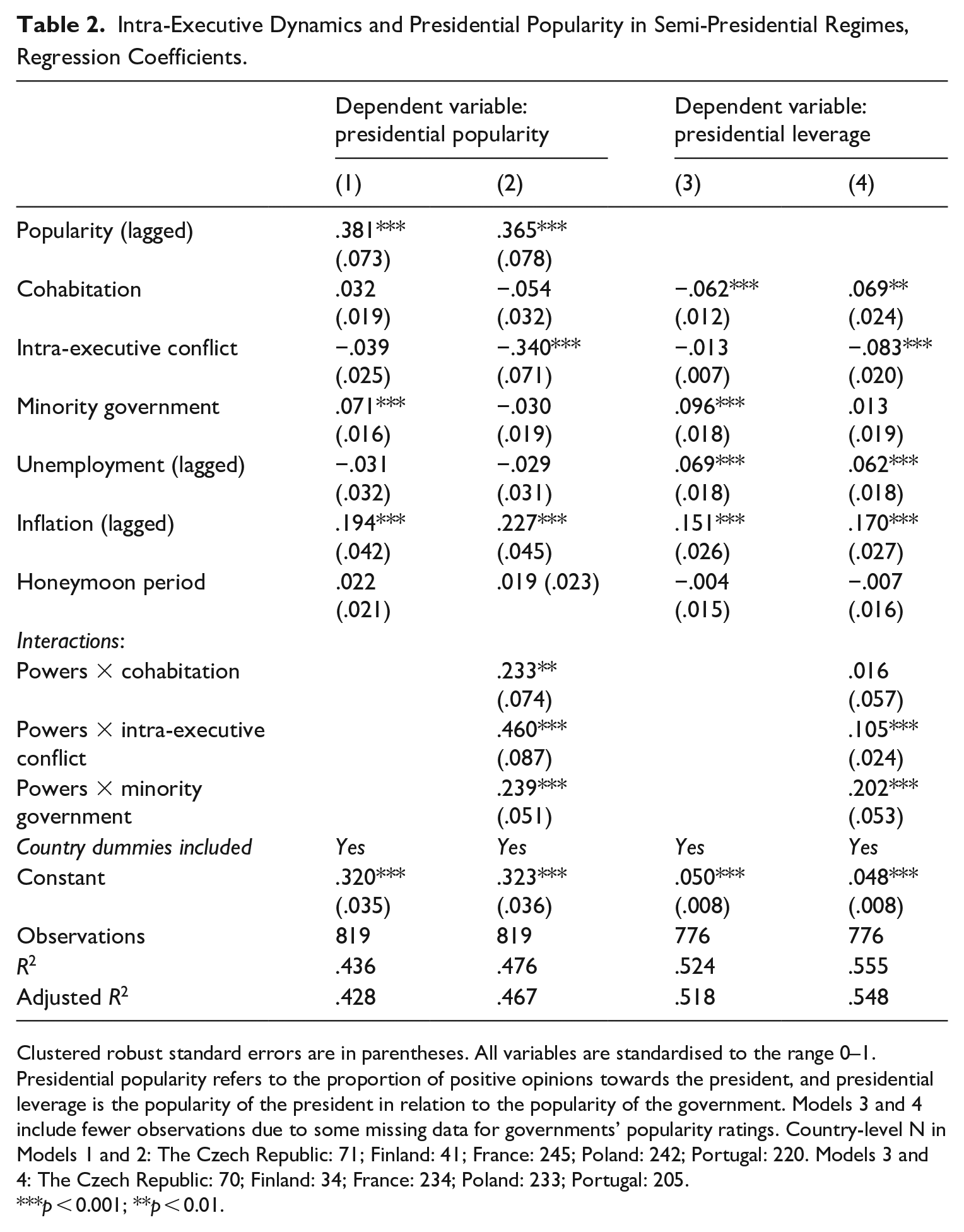
Clustered robust standard errors are in parentheses. All variables are standardised to the range 0–1. Presidential popularity refers to the proportion of positive opinions towards the president, and presidential leverage is the popularity of the president in relation to the popularity of the government. Models 3 and 4 include fewer observations due to some missing data for governments’ popularity ratings. Country-level N in Models 1 and 2: The Czech Republic: 71; Finland: 41; France: 245; Poland: 242; Portugal: 220. Models 3 and 4: The Czech Republic: 70; Finland: 34; France: 234; Poland: 233; Portugal: 205.
p < 0.001; **p < 0.01.
The results of the base models show that both absolute and relative presidential popularity ratings increase during minority governments, that cohabitation has a decreasing impact on presidential leverage but not on absolute popularity, and that the impact of intra-executive conflicts turns out to be statistically insignificant. However, when considering the conditioning effect of presidential powers, all three key variables turn positive and statistically significant (except for cohabitation in Model 4), indicating that constitutionally stronger presidents benefit from conflicts with the prime ministers when representing different party ideologies, and when the government is generally weaker. It thus seems that being distanced from the government boosts presidential popularity, but only under certain circumstances.
From control variables, higher level of inflation seems to even increase both presidential popularity and leverage, and higher unemployment rate increases the latter. This indicates that it is indeed the prime minister and the government who are ‘punished’ from weakening economy, not the president. The honeymoon period does not show statistically significant effects, which confirms the observation from the descriptive figures that some of the common cyclical patterns found in the context of stronger presidents in presidential systems, such as popularity fading after the first couple of months in office, may not apply in the context of semi-presidentialism.
Several robustness tests were conducted to strengthen the validity of these findings. First, it is possible that the key variables are intertwined and that the predicted positive effects of weaker cabinets and disputes between the executives are conditioned by party-political distance between the executives. This is because under unified government or when representing the same party, the president is more attached to the prime minister, and criticism of policy outcomes may more easily target the president as well. Thus, to account for the possibility that minority governments and intra-executive conflicts boost presidential popularity, especially under cohabitation, two additional interaction terms were introduced (cohabitation × intra-executive conflict; cohabitation × minority government) (see Appendix B, Table B1). As a result, cohabitation and intra-executive conflicts interact with each other by causing decreases in presidential popularity but not in relation to the government. This may indicate that the popularity of the government decreases as well during such conflicts. In addition, the interaction between cohabitation and minority government has negative consequences on presidential leverage but not on presidents’ absolute popularity ratings. This suggests that, from the perspective of public opinion, being politically distanced from the prime minister and government does not automatically give the president a ‘permission’ to stand against them. Thus, cohabitation produces relatively mixed results in relation to the theory, as such political distance between the executives does not seem to boost the president’s profile but causes a negative effect.
Second, cohabitation was replaced with ideological distance (left-right/GAL-TAN) between the executives to measure their political differences more broadly. The results show that in terms of presidents’ absolute popularity ratings, the individual effect of the executives’ ideological distance is positive yet rather weak (coefficient = 0.028*; standard error = 0.011), and it does not interact with intra-executive conflicts, minority governments or presidential powers. In addition, the variable does not have an individual statistically significant impact on presidential leverage either, and it has a negative effect with minority governments (−0.288***; 0.038) but a positive effect with intra-executive conflicts (0.209***; 0.015). This indicates that when the president and the prime minister are ideologically further apart from each other, the president benefits from the situation more than the prime minister. Finally, in terms of presidential leverage, the ideological distance interacts with presidential powers (0.101***; 0.022), boosting stronger presidents’ political capital when being politically distanced from the government. In sum, it seems that cohabitation and more general ideological differences measure similar distance between the executives, but ideological distance may have more potential to boost presidential popularity.
Third, as the main models indicated that inflation is positively connected to both presidential popularity and presidential leverage and that higher level of unemployment boosts the latter, six additional interactions (unemployment × cohabitation; unemployment × intra-executive conflict; unemployment × minority government; inflation × cohabitation; inflation × intra-executive conflict; inflation × minority government) were introduced to test for the possibility that weakening economy impacts only the government and offers presidents an opportunity to appear in a more positive light when the dynamics between the executives change. The results (Appendix B, Table B2) show that while the interaction between inflation and intra-executive dynamics does not produce statistically significant results, the interaction between unemployment and cohabitation decreases presidential popularity but not presidential leverage, and the interaction between unemployment and both intra-executive conflicts and minority governments boosts presidential popularity. This indicates that when the president’s party is not represented in the government, a higher unemployment rate decreases presidential popularity but not as much as it decreases the popularity of the government. At the same time, during a weakening economic situation, presidents have a better chance to raise their profile, as both intra-executive conflicts and minority governments boost their popularity ratings.
Fourth, the base models (Table 2, Models 1 and 3) were also run in an Ordinary Least Squares (OLS) setting without country dummies. This enabled the testing of the individual effects of presidential powers alongside the main independent variables in the analysis. The results are in Appendix B (Table B3), and they show that both presidential popularity and leverage are lower among stronger presidents, which justifies further the utilisation of the variable in the interaction terms.
Finally, the base models were run separately without France and Finland to examine whether the results regarding the key variables change when excluding the ‘outlier cases’ from the analysis (see Appendix B, Table B4). In both cases, similarly, as in Table 2, the individual effects of the periods of minority governments boost presidential popularity but not presidential leverage, unemployment boosts presidential leverage but not presidential popularity, and inflation boosts both. However, whereas the individual effect of cohabitation was positive and statistically significant on presidential popularity and negative on presidential leverage in the main models, when France is excluded, it turns out to be more positive, which may result from the lack of cohabitation periods in France during the period of analysis. At the same time, the impact of intra-executive conflicts is more negative, echoing the finding that the conflicts may boost only more powerful presidents’ popularity ratings. Finally, the honeymoon period seems to have even a negative impact on presidential popularity, which further supports the conclusion that many presidents in semi-presidential regimes enjoy their highest level of popularity later during their terms.
Overall, the results revealed interesting patterns between intra-executive dynamics and public opinion on presidents. First, regardless of their constitutional powers, presidents enjoy higher popularity ratings during minority governments, which is a logical finding as such situations reflect the political weakness of the government. However, the effect turns negative under cohabitation, indicating that being detached from the government might sometimes even turn against the president. Second, the positive effects of both cohabitation and intra-executive conflicts on presidential popularity are conditioned by the level of presidential powers, indicating that the tensions between the executives benefit the presidents mostly when they are constitutionally more powerful. In other cases, such conflicts may more likely harm presidential popularity, and even representing different political parties or ideologies than the prime minister does not seem to provide additional leverage to weaker presidents. These findings give mixed support for H1 but confirm H2 and H3. Finally, even though scholars have debated the importance of economic variables on presidential popularity, it seems reasonable to note that a weakening economy does not systematically harm the presidents in semi-presidential regimes. Instead, the president may become even more popular at the expense of the government.
Discussion
This article has examined patterns of presidential popularity in five semi-presidential countries. The results suggest that public opinion on presidents in semi-presidential regimes cannot be studied without considering the power dynamics between the president and the government. The results confirm that party-political shifts and clashes between the executives impact public opinion on presidents and that these effects are conditioned by the constitutional strength of the presidency. Moreover, being politically opposed to the government does not automatically provide the president an advantage and turn into public support, but it may benefit more powerful presidents. In the empirical analysis, this was reflected in how presidential powers conditioned the impact of intra-executive conflicts and cohabitation on presidential popularity. At the same time, both weak and strong presidents were viewed in a more positive light during minority governments.
Some of the most studied explanations of presidential popularity, that is the economy and the honeymoon period, produced opposite effects in semi-presidential regimes, although the popularity ratings of the French presidents displayed more similar patterns to those of presidents in presidential regimes such as in the United States or in Latin American countries. This is quite logical since France stands out from the other examined countries with its relatively strong presidency, which was also controlled in the main analysis and with an additional robustness check. Instead of expecting a decrease in popularity after the beginning of their terms, presidents in semi-presidential regimes may become more popular over time, and even during economic decline, while the popularity of the government decreases, presidential popularity may even increase. This emphasises the division of powers and responsibilities between the executives; constitutionally, the president should not be held responsible for the development of the economy in most semi-presidential systems, and the public seems to be aware of this.
Returning to the theory of presidential leverage and the argument that only relative popularity increases the president’s political capital and is therefore more important than just the level of presidential popularity (Ponder, 2018), this article has illustrated that future studies should indeed measure presidential popularity specifically in relation to the popularity of the government (or prime minister). For example, both absolute and relative popularity ratings were boosted quite systematically under minority governments, and when controlling for the level of presidential powers, intra-executive conflicts did not just increase presidential popularity but also increased presidential popularity in relation to the government. This should offer a real advantage to the president.
This study has offered new perspectives for exploring presidential popularity – and not just in semi-presidential countries, as some of the dynamics between the president and the government may also occur in parliamentary systems with a prime minister and an indirectly elected president. Moreover, despite constitutional rules, presidential activism may be a strategic choice by the president to gain more popularity, and increased popularity may help the president to achieve policy goals (e.g. Köker, 2017), although we must remember that popularity ratings are beyond presidents’ control and presidents cannot ‘choose to be popular’ (Gilmour, 2002: 207). A logical step for future research would be to include new measurements of presidential powers (constitutional and practical) and different types of presidential activism (formal and informal).
To some extent, it has been assumed here that people are mostly rational and that they follow the changes in the national political environment. Similarly, it is possible that citizens overestimate the formal powers of the presidents, for example, in domestic politics, and end up approving actions that push the constitutional prerogatives of the presidents, while simultaneously supporting the practice that presidents do not overstep their constitutional prerogatives. However, this study revealed that both the level of presidential powers and the president’s own actions matter when people evaluate the executives: the presidents seem to benefit from being distanced from the government but get punished if they abuse their powers (applies for weaker presidents) or do not use them (applies for stronger presidents). In that sense, the public seems to hold both weak and strong presidents politically accountable, although not necessarily in terms of the economy or as much as they hold expectations towards the governments. Furthermore, the dual executive structure within semi-presidentialism seems to produce power dynamics that benefit the president more than the prime minister, yet the presidents cannot get too comfortable, as people seem to react to changes in these power dynamics.
Supplemental Material
sj-docx-1-psx-10.1177_00323217241275305 – Supplemental material for Intra-Executive Dynamics and Presidential Popularity in Semi-Presidential Regimes
Supplemental material, sj-docx-1-psx-10.1177_00323217241275305 for Intra-Executive Dynamics and Presidential Popularity in Semi-Presidential Regimes by Maarika Kujanen in Political Studies
Footnotes
Acknowledgements
The author thanks Tapio Raunio and Thomas Sedelius for their help and support throughout this process, as well as her colleagues at Tampere University for their feedback on the early versions of this article. She also thanks the two anonymous reviewers for their valuable comments, which improved the work significantly.
Declaration of Conflicting Interests
The author(s) declared no potential conflicts of interest with respect to the research, authorship and/or publication of this article.
Funding
The author(s) disclosed receipt of the following financial support for the research, authorship and/or publication of this article: The work was funded by the Academy of Finland (grant no: 333013).

Supplemental Material
Supplemental material for this article is available online.
Appendix A: Descriptive data and figures. Table A1. Variable description. Table A2. Descriptive statistics of the dependent and the independent variables. Figure A1. Presidential popularity ratings from different sources, 2000–2020. Figure A2. Presidential popularity and government popularity, 2000–2020. Appendix B: Additional models. Table B1. Fixed effects models with interactions between cohabitation and other key variables. Table B2. Fixed effects models with interactions between intra-executive dynamics and economic variables. Table B3. Ordinary Least Squares (OLS) regression analysis, base models with individual effects of presidential powers. Table B4. Fixed effects regression, base models, France and Finland excluded.
Notes
Author Biography
References
Supplementary Material
Please find the following supplemental material available below.
For Open Access articles published under a Creative Commons License, all supplemental material carries the same license as the article it is associated with.
For non-Open Access articles published, all supplemental material carries a non-exclusive license, and permission requests for re-use of supplemental material or any part of supplemental material shall be sent directly to the copyright owner as specified in the copyright notice associated with the article.
