




Abstract
Do party or candidate campaigns boost momentum? Momentum in election campaigns is significant because it indicates a greater perception of the likelihood that a party or candidate will perform well, and also because that brings with it an improvement in credibility as a viable contender. Existing explanations of changes in the perception of popularity of candidates and parties over an election campaign relate largely to the impact of media coverage and opinion polls. What is frequently absent is any discussion of the impact of party and candidate campaigns. This is a curious omission since it effectively ignores the central actors in electoral contests – the parties and the candidates. This article seeks to address this lacuna by assessing whether campaign efforts deliver electoral momentum. Using data from three British general elections, we find strong evidence to indicate that campaign efforts at the constituency-level play a key role in delivering momentum.
Introduction
Do party or candidate campaigns boost momentum? Momentum in election campaigns is significant, not only because it indicates a greater perception of the likelihood that a party or candidate will perform well, but also because it brings an improvement in credibility as a contender. For Lanoue and Bowler (1998: 361–362), the electoral viability of a candidate or party is essential to attract votes. Not only are more voters inclined to support popular candidates or parties, but there is a greater perception that the candidate or party may perform well. Indeed, campaign momentum may be a critical component of electoral success (Lanoue and Bowler, 1998: 362). This perception may be shared both by those who support and those who oppose a candidate or party, creating greater potential for strategic or expressive choices by voters. As Collingwood et al. (2012: 236) note (in the context of US Presidential primaries): ‘Change in candidate evaluations over time may be especially relevant, as this captures how voters alter their perceptions of candidates as various primary contests unfold’. And with the perception of improved chances of victory comes growing electoral credibility. Thus, candidates who run effective campaigns will enhance their credibility as the prospect of a strong performance grows. This may imply potential victory, but equally, campaign momentum is not dependent upon a triumphant outcome – merely that, over the course of a campaign, the perceived chance of a strong performance is greater than at the start. Of course, with greater credibility may come greater scrutiny, which may either reverse or continue campaign momentum.
What then explains the changes in the perceived popularity of candidates and parties over the course of an election campaign or candidate nomination? A significant literature focuses on bandwagon effects and to a lesser extent, campaign momentum, typically captured by changes in opinion poll ratings. The emphasis of most work on campaign momentum and bandwagon effects relates to the impact of media coverage and opinion polls, the focus being whether more favourable coverage of candidates or parties, or the ratings they have in opinion polls affects popularity, perceptions of likely performance and, ultimately, how voters cast their ballot. What is frequently absent is any discussion of the impact of party and candidate campaigns on building momentum. This is a curious omission since it effectively ignores the central actors in electoral contests – the parties and the candidates and their own efforts to deliver campaign momentum, suggesting either that they are regarded as innocent bystanders in the process, or perhaps that they are the forgotten actors. This article seeks to address this lacuna by assessing whether campaign efforts at the constituency level deliver electoral momentum captured by change in the perception of a party or candidate’s potential electoral performance. Using panel data collected at three British general elections, we find strong evidence to indicate that parties’ campaign efforts play a key role in delivering momentum.
Defining Campaign Momentum and Why It Matters
To assess whether campaign efforts deliver momentum, it is first necessary to develop a clear definition of campaign momentum. The idea of momentum is intrinsically dynamic: in physics it is a vector quantity, having both magnitude and direction. Reflecting this, and drawing on Barnfield’s (2020: 559) distinction between static and dynamic measures of popularity, where dynamic measures capture the change in popularity of options (rather than information about overall popularity – static effects), we define campaign momentum as:
The aggregate change in the individual level perceived probabilities that a candidate will win.
Campaign momentum is generally positive – signalling an expected improvement in performance. And, if the candidate’s probability of winning increases, then opponents’ perceived chances are also likely to be affected – usually negatively (Aldrich, 1980: 656). The simple logic for this is that, in theory at least, if a voter thinks the chances of one party is increasing then she will normally expect a competitor to have a reduced chance (i.e. expectations will normally be zero-sum). In reality, this is unlikely to always be the case: first, as discussed below, voters do not always have a mathematically sound notion of relative probabilities. Second, the fortunes of some parties may be linked. This may be because they have something in common, such as a similar demographic profile.
Perhaps the most important reason that momentum matters is that it can affect behaviour, potentially leading to bandwagon effects as voters flock to the increasingly popular candidate. But, it may also affect strategic choices, improving the chance of tactically supporting a party or candidate. In a majoritarian electoral system, for example, there is significant potential for strategic tactical voting – supporting a candidate or party that is not the voter’s first choice, but which has a better chance of defeating the candidate of a party or candidate to which the voter is opposed (Alvarez and Nagler, 2000; Cain, 1978; Eggers and Vivyan, 2020; Fieldhouse et al., 2007; Fisher, 2004). The increasing perception that a candidate or party has the capacity to win enhances or creates party/candidate credibility. Those parties or candidates who can demonstrate their capacity to win enhance perceptions of their relative efficiency in generating public goods if elected (Cukierman, 1991: 182). The impact of campaign momentum on strategic choices draws on the psychological impact of Duverger’s classic study of electoral systems (Duverger, 1954): especially (but not exclusively) in simple plurality elections voting for a third (or worse) placed party may be considered a wasted vote. For a strategically minded voter, the calculation underlying this may be altered by positive momentum, making a potentially wasted vote into a viable option.
Equally, voter choice may be influenced by the potential of campaign momentum to increase the expressive benefits of voting for their first-choice party (Schuessler, 2000). As an object of identification – such as a political party – becomes more popular, the benefits are accrued by expressing that identity (by voting for it). The voter develops a psychological affinity with fellow voters supporting the same candidate or party. This may be enhanced by intense electoral campaigning by their favoured party or candidate which may compensate for the lack of information about other voters’ likely behaviour. Crucially, the benefits accrued to group members (i.e. party supporters) are affected by the popularity of the object of identity (the party) (Schuessler, 2000).
Campaign momentum can also create the conditions to affect a variety of other significant outcomes. The extant literature points to several potential consequences. First, positive campaign momentum can generate additional resource (either financial or human), whereas negative campaign momentum may deliver the reverse – a reluctance to contribute – what Henshel and Johnson (1987) refer to as ‘indirect bandwagon effects’.
Second, momentum may affect candidate or party strategy (Aldrich, 1980: 653) – potentially both for the candidate or party experiencing campaign momentum and their opponents. Fisher et al. (2011), for example, show in the British case how campaign momentum affects how national parties distribute resource to constituency-level campaigns, becoming more offensive or defensive. A good example of this phenomenon occurred in the British General Election of 2010 when following a successful appearance by their leader in televised debates, Liberal Democrat campaign momentum grew. As a result, the Liberal Democrats expanded their number of target seats (unwisely as it turned out, as their campaign resources became over-stretched and the party ultimately made net seat losses).
Third, campaign momentum may influence levels of media coverage – again either positively or negatively (Bartels, 1987; Mcgowen and Palazzolo, 2014). This in turn may influence candidate competitiveness. In the US context, Haynes et al. (2016) show that weaker candidates drop out earlier if they receive little media coverage.
Critically, however, momentum is not the same as a bandwagon effect. While campaign momentum concerns perceptions of the likelihood of winning, a bandwagon effect refers to resulting changes in behaviour: that is, voters moving towards a party or candidate on account, initially at least, of that party’s or candidate’s popularity. For example, Barnfield (2020: 554) suggests that a bandwagon effect is characterised by a positive individual-level change in vote choice or turnout decision towards a more popular or an increasingly popular candidate or party, motivated initially by this popularity A bandwagon may therefore be defined as:
The sum of individual-level changes in vote choice which result from corresponding changes in individual-level perceptions that a candidate will win an election.
Thus, while campaign momentum may produce a bandwagon effect, they are quite different concepts. While campaign momentum refers to a change in the expectation of electoral performance of candidates or parties, a bandwagon effect implies a change in the probability that an elector will vote for a party as a result of a change in expectation of victory (based on the premise that voters are more prepared to vote for more popular candidates). This may be driven by reactions to opinion polls or intense campaigning.
Of course, campaign momentum and bandwagon effects are related. Momentum is unlikely to occur without any changes in individual behaviour. One of the main reasons momentum is gained is that people see improvements in opinion polls, which are, by definition, reports of behavioural change in voters more generally. Similarly, voters may receive second-hand reports of changes in behaviour – friends or family, for example, may report changes in their vote intention. However, reports of behavioural change are not solely responsible for momentum. The British Election Study (BES) reports reasons underlying respondents’ perceptions of the chances of different parties winning locally. Using these data Mellon (2022) found that, apart from direct static reasons for their expectations (i.e. past results) voters were guided by talking to others, coverage in the media, party campaigns, as well as opinion polls. Thus, a sense of momentum could be generated in the absence of behavioural change.
It is also important to note that while campaign momentum may lead to changes in voter behaviour, unlike the bandwagon effect, campaign momentum does not necessarily imply any behavioural change. In other words, a voter may perceive a change in the relative standing of candidates but not change her vote choice. More generally, as Barnfield (2023: 3) notes, voters do not see themselves as being susceptible to bandwagon effects, but think that other voters are, thus underpinning the perception of electoral momentum. Indeed, a person could conceivably perceive momentum in a campaign in which they could not themselves vote, whereas a bandwagon effect only involves voters. This distinction between momentum and bandwagons is critically important, though these concepts have, on occasions, been conflated in the literature – see Mutz (1997: 105), Kenney and Rice (1994) and Schuessler (2000: 117–118), for example. Treating the concepts interchangeably risks missing important conceptual differences and, hence, useful insights into both.
Momentum, then, is the change in perceptions that a candidate will win. It may matter significantly: providing incentives for both instrumental and expressively focused voters, mobilising voters, promoting bandwagon effects, affecting party strategy, and generating additional resource and media coverage as well as greater scrutiny. The question then becomes, what delivers campaign momentum?
Explanations of Momentum – Why Electoral Campaigns May Matter
Existing explanations of campaign momentum focus principally on the impact of opinion polls, partisanship and knowledge of prior election results, largely ignoring any effects – particularly at the local or constituency level – of party or candidate campaign efforts. A core theme in much of the literature on bandwagon effects (and where differentiated, campaign momentum) on what may affect voters’ perceptions is the impact of opinion polls and their reporting in the media (Barnfield, 2020; Cukierman, 1991; Stolwijk et al., 2016). The impact of exposure to polls will not necessarily directly affect vote choice, however (Stolwijk et al., 2016). Anxiety and enthusiasm mediate the effect of poll exposure. Polls may invoke key emotions. Using affective intelligence theory (AIT), they suggest that enthusiasm reinforces existing attitudes and leads to habitual behaviour, while anxiety monitors new threats and leads to a reconsideration of attitudes and behavioural intentions (p. 555). Polls are important because what matters is that [parties] are portrayed as a winner (Stolwijk et al., 2016: 556, 558–559). Faced with this, enthusiasm can grow for another party (p. 559), though this will depend on party or candidate affect – it is more likely to happen if electors are less hostile in general to alternative parties or candidates (Bartels, 1987; Meffert et al., 2011).
More nuanced effects are observed by Cantú and Márquez (2021). Using a survey experiment in the 2018 Mexican Presidential elections, they find that exposure to polling information does not sway voters towards one particular candidate. Rather, exposure to this information leads respondents to be more likely to declare their vote choice as being undecided (Cantú and Márquez, 2021). Equally, campaign momentum may not always be cumulative. Candidates or parties may sustain it, but equally what began as positive campaign momentum can become negative during the course of a campaign (Mcgowen and Palazzolo, 2014). Campaign momentum may be both linear or curvilinear.
Partisanship may also play a role. Partisans are more optimistic (Meffert et al., 2011) and are more like to interpret politically relevant information in line with party preferences (Plescia, 2019: 801) – they may be wishful thinkers. However, this will vary depending on levels of political knowledge and education. Political motivations, which may include partisanship, generally improve the accuracy of electoral expectations, especially when levels of political knowledge and education are higher (Meffert et al., 2011). Expectations may be moderated based on experiences of previous elections (Plescia, 2019: 810). Certainly, voters will also react to objective information (Blais and Bodet, 2006). Abramowitz (1989: 984), for example, found that partisanship and candidate preferences did not determine which Republican candidates were regarded as the frontrunners in the 1988 Presidential primaries, with voters’ opinions informed by results of earlier contests and media interpretation of those results. Prior election results may be used as a benchmark for upcoming elections and evaluating the election result itself (Collingwood et al., 2012: 244–245; Mellon, 2022; Plescia, 2019: 800, 810). Indeed Lanoue and Bowler (1998) find in the Canadian case that voters use data such as these to project party viability. Critically, in this case, it is viability at the district rather than the national level that is assessed. Expectations of party performance will be affected if the parties’ standing in regions or districts differs politically from the national picture (Meffert et al., 2011). Indeed, when looking at assessments of election outcomes, Stiers et al. (2018: 28) find that a positive outcome at the district level can soften the blow of a national loss. Geography matters in terms of both projections of viability and assessments of election outcomes (Abramson et al., 2018).
Notwithstanding, the use of objective information such as prior election results and opinion polls – information externalities (Schuessler, 2000: 41) – is likely to vary according to how well-informed voters are (Blais and Bodet, 2006; Cukierman, 1991; Meffert et al., 2011; Stiers et al., 2018). There is likely to be a stronger link between such objective information and perceptions of winning among more informed voters, not least because uninformed voters cannot interpret the information in polls perfectly (Cukierman, 1991: 189). This suggests that other factors, such as campaign effects may be of more significance in voters estimating the chances of a party’s victory.
These existing explanations, however, largely overlook the potential for party or candidate campaigns to generate momentum. While some authors do acknowledge that ‘micro-level processes’ may impact evaluations of likely success or changing popularity, only a handful recognise the roles played by candidates and parties. Hodgson and Maloney (2013) fleetingly note that a possible reason for the growing popularity of candidates in an election campaign could be related to a ‘. . . (presumably more convincing) message’, while Gelman and King (1993: 435) note that (presidential) campaigns are important sources of information for voters to make decisions and were they to be unbalanced (such that one candidate campaigned significantly less intently), the relative levels of support would be likely to change. Lanoue and Bowler (1998: 367) and Evrenk and Sher (2015) additionally, seek to capture whether or not parties have contacted voters, by using simple binary measures – whether voters were contacted or not overall, or whether selected contact modes were employed.
Notwithstanding these examples, the omission of party and candidate campaign effects from the vast majority of the literature is curious. A significant literature across both majoritarian and proportional systems demonstrates that more intense campaigns – particularly at the district or constituency level – have the capacity to affect electoral outcomes, both in terms of vote choice and turnout (André and Depauw, 2016; Fieldhouse et al., 2020; Fisher et al., 2011, 2019; Gschwend and Zittel, 2015; Karp et al., 2008; Sudulich et al., 2013). A more effective campaign should therefore boost the perception that the party or candidate can win. This, in turn, provides a plausible mechanism by which campaigns can affect vote share, by mobilising existing support, promoting bandwagon effects, and providing both instrumental and expressive incentives for voters. There are a variety of reasons, therefore, why we would expect more intense campaigns to impact on perceptions of potential electoral performance.
It is widely assumed in economics that actors behave rationally, and normative theories of rationality explicitly argue that actors ‘constantly interpret and understand our own and other people’s behavior as goal oriented’ (Bicchieri, 1992). Insofar as voters assume that political parties behave rationally and are goal oriented in their use of campaign resources, voters may use this as a heuristic to assume that those parties which campaign most intensively must have a good chance of winning. Certainly, there is repeated evidence that campaigns tend to be strongest in constituencies where parties perceive that they have the greatest chance of victory (Fisher et al., 2019). The use of this heuristic is likely to involve an availability bias (Tversky and Kahneman, 1973) whereby, in the absence of accurate local polling information, voters will use campaign materials – the most available relevant information – to make judgements about the different parties’ chances of winning.
There will also be a tendency for voters to overestimate the chances of those for whom information is more available: that is, those whose campaign information is most visible and available. The more likely voters are to see a poster, talk to canvassers and receive information from a party leaflet, the more likely they are to believe it is credible. Repeated information is often perceived as being more truthful than new information (Unkelbach et al., 2019). This is because repetition increases processing fluency – the ease or difficulty with which information can be processed (Schwarz, 2004) – and memory coherence. Therefore, the more information that is repeated, the more fluently it is processed (fluency acts as a proximal cue) and as such it is perceived to be more truthful (Unkelbach and Stahl, 2009). Parties’ own (possibly exaggerated) claims about their own electoral violability in their campaigns may therefore generate positive voter perceptions of viability. Campaigns at the constituency level often make significant claims about their local popularity or chances of victory via campaign material such as leaflets, window posters and yard boards. Perhaps the best-known example in the British context is ‘Liberal Democrats Winning Here’ – a familiar slogan seen on yard boards, even where based on prior results, a victory may be unlikely. And, in a practical guide to campaigning, Pack and Maxfield (2021: 227) put it succinctly: ‘. . . posters make you look like a winner’.
Parties’ campaign efforts provide both public and private public information to inform these judgements about the likelihood of success. Publicly, they are the main and most accessible source of local information about the parties’ level of popularity, In the absence of regular (or even any) constituency-level opinion polls, campaign intensity therefore may be taken as a surrogate for information about current levels of popularity within the constituency, alongside national-level information from opinion polls. For example, Schuessler (2000: 143) suggests that ‘. . .individuals will derive an estimate of candidate support by observing the behaviour of people around them’. This can produce common knowledge as if a campaign is more intense, more people will know about the party or candidate, and high aggregate levels of support serve as an uncostly proxy source of information to the individual voter about a candidate’s likely quality (Schuessler, 2000: 71–72, 114). Indeed, Mellon (2022) reported that more than 15% of British voters cited political party campaigns as informing them of their perceptions of parties’ chances of winning locally (a larger proportion than national opinion polls).
Parties’ campaign efforts may also generate private information. A voter may experience more intense contact in a campaign than other voters, possibly on account of their potential to switch parties. This will generate ‘. . . individual political perceptions that might be correlated across voters, but are not common knowledge’ (Garro, 2019: 913). The impact of private information (such as campaign efforts) on electoral momentum will be greater when public information (such as constituency-level polls) is scarce, such that ‘. . . private information is precise relative to public information’ (Garro, 2019: 919–920). And, both the public information generated by visible campaign efforts, and the private information, generated by targeted campaign efforts, have the potential to generate cues through neighbourhood effects – voters discussing their perception of electoral performance with other voters in their locale, though principally for those strongly embedded in the local community (Harteveld and van der Brug, 2023).
Taken together, we would expect that the levels of campaign effort would impact voters’ perceptions of party or candidate fortunes or viability. More intense party effort (manifested through more intense campaigns) projects electoral viability to voters. This principal source of information provides an important cue for voters when evaluating viability, and may generate contagion, such that voters collectively deliver a more positive evaluation of a party’s electoral chances in a constituency, particularly if they perceive other voters doing so (Mutz, 105-106).
We hypothesise therefore that a more intense local constituency campaign will enhance voters’ perceptions of a party’s chance of winning. Through their campaigns, parties seek to actively generate electoral momentum, which can, in turn, manipulate perceived levels of aggregate support (Schuessler, 2000: 141–142). This is not the same as the perception that a party or candidate will win, but a perception of the chance of that happening thus, for example, making expressive attachment more attractive, or instrumental strategic choices potentially more likely.
The logic, therefore, is that a more intense local constituency campaign will improve perceptions of a party or candidate’s electoral chances. Thus, if a voter experiences an intense campaign by Party A, they are more likely to think that the electoral prospects of Party A are better. This may not make the voter more likely to cast her ballot for Party A (since the voter may be a partisan for either Party A or a different party – Party B) or the voter may already have decided how to cast her ballot. But we predict that a more intense campaign will suggest to the voter that the party is capable of improving its electoral position. Equally, a stronger campaign by an opposing party may depress expectations of a party’s electoral potential following the logic of Abramowitz (1989). Thus, if a voter experiences an intense campaign by Party A, that voter may lower their expectation of the likely electoral performance of Party B. This reasoning draws on the principle of viability and the perception of credibility in the production of public goods (Cukierman, 1991). Continually good or improving party performance will enhance voters’ opinions of that party when they come to make electoral choices (Nadeau et al., 1994: 376).
Our two hypotheses are therefore as follows:
H1. More intense campaign contact from a party will increase the perception of likely victory by that party in the constituency.
H2. More intense campaign contact from a party will reduce perceptions of likely victory by other parties in the constituency.
Data and Method
To examine our research question and test our hypotheses, we utilise the six waves of the BES (Fieldhouse et al., 2022), examining the general elections of 2015, 2017 and 2019. The panel design of the BES allows us to assess change at the individual level. In the case of each election, we utilise the wave collected before the campaign proper starts (the pre-wave), and the wave collected during the campaign (the campaign wave). Thus, for 2015, we utilise Waves 4 and 5; for 2017, Waves 11 and 12; and for 2019, Waves 17 and 18. Measuring campaign momentum as a dynamic variable is vital (Collingwood et al., 2012; Mcgowen and Palazzolo, 2014: 444) and we adopt a similar approach as that used by Stolwijk et al. (2016: 560).
In each wave, there is a question asking respondents to assess the chances of each party of winning that district (or constituency) on a scale of 0–100, similar to earlier Canadian studies (Lanoue and Bowler, 1998: 365). Our dependent variable is therefore the chances of a particular party winning the constituency in the second wave under consideration (Waves 5, 12 and 18). To control for existing perceptions of likely victory, we employ a lagged endogenous variable – voter perceptions of that party’s chance of victory before the campaign proper begins (Waves 4, 11 and 17). This allows the robust assessment of the change in perceptions of victory attributable to campaign intensity by controlling for the perception of the party’s chance of victory before the campaign proper begins, and maps onto our conceptual definition of campaign momentum. These estimates of chances of winning are likely to lack precision. Meffert et al. (2011: 808) note, for example, that even well-informed respondents may provide estimates for multiple parties that collectively do not add up to 100. In keeping with a common rather than statistical understanding of probability, respondents may, very reasonably, give multiple parties a high chance of winning. Moreover, what we are capturing here is not the absolute level of estimated chances of success, but a change in those estimates over time. Whereas responses may be arbitrarily scaled in terms of the likelihood of winning, we can capture whether those estimates increase, decrease or stay the same.
We also control for two possible confounding constituency variables – the vote share achieved by the party in question in the relevant district or constituency at the previous general election and whether that party’s candidate is the incumbent. Vote share at the previous election may be used as a benchmark for upcoming elections (Plescia, 2019) and also provides an objective indication of electoral competitiveness, where in the more competitive seats, demand for political information from voters is likely to be higher (Larcinese, 2007: 252). In respect of incumbency, numerous studies point to the electorally beneficial aspects of personal incumbency and aggregate studies of campaign effects also point to the independent effects on vote share (Fisher et al., 2019). For similar reasons, or simply as a heuristic, it seems reasonable that voters may be more likely to expect an incumbent to win (other things being equal). Finally, we control for existing party preference using an 11-point Party Like score (0–10). This allows us to control for the phenomenon of ‘wishful thinking’ (Abramowitz, 1989: 979–980; Blais and Bodet, 2006), whereby partisans may be more likely to perceive their preferred party or candidate performing well and underestimating the chances of those whom they do not favour, sometimes regardless of any other evidence (Lanoue and Bowler, 1998: 366). 1
Our ‘treatment’ variable is the intensity of the parties’ local constituency campaigns. This is captured by seven binary indicator variables – whether the respondent was contacted by the party by telephone, leaflet/letter, on the doorstep, in the street, by email, by social media or by any other means. We combine contact data from each of the two waves for each election as existing work on constituency campaigning shows that more intense campaigns also contact voters in advance of the campaign proper. The more contacts a voter experiences, the more intense the campaign. Of course, some of the contacts experienced by respondents (such as leaflets) may be generated locally or nationally. However, the level of nationally generated contact will reflect the level of locally generated campaign intensity (Fisher et al., 2019).
In order to produce a scale of campaign contacts (and therefore campaign intensity) for each respondent, we use item response theory (IRT). Sometimes referred to as latent response theory, IRT is a family of mathematical models that seeks to explain the relationship between unobserved (latent) traits which can be measured on a continuum (e.g. math ability). We fit a two-parameter logistic model (as we have binary response variables) in which the latent trait of interest is the propensity of a respondent to be contacted by each political party and the items are different types of contact. In a two-parameter model, the parameters that define the model are item difficulty and item discrimination. For example, in a maths test, some items (or questions) are more difficult than others, such that easy items best discriminate between students at the low end of the ability scale and hard items discriminate between students at the higher end of the scale. In our case, the difficulty threshold for each item reflects the extent to which only respondents with a high propensity for contact by a party would be contacted in a particular way (such as a home visit), while other forms of contact (e.g. leaflets) may be received by respondents with relatively low propensity to be contacted. The discrimination parameter (in our math example) determines the rate at which the probability of endorsing a ‘correct’ item changes given the level of math ability (i.e. the slope). Thus, in our model, the discrimination parameter describes the level of precision with which a form of contact discriminates between respondents with a high and a low propensity for contact. An item with a lower discrimination score has a flatter slope, and so is less good at distinguishing the point on the latent scale (and vice versa). The results of the IRT models are provided in the online appendix. The advantage of using this method is twofold. First, unlike a simple additive scale of each variable, it does not treat all contacts as being of equal weight, thereby providing a more realistic representation of campaign exposure. Second, it accommodates missing responses, thereby maximising the number of cases. We calculate a score for each of the three major GB parties: Conservative, Labour and the Liberal Democrats. This approach represents a significant improvement in the methodology to capture campaign intensity using individual-level data.
In addition to these variables, we also include a variable capturing media use, reflecting the dominant narrative in the literature about exposure to polling results and demand for political information. This variable is derived from four separate variables capturing the average daily use of the following to follow politics: television, newspapers, radio and the Internet. As with the party contact scale, we utilise IRT to produce a scale of media consumption as it relates to politics. The method is the same as for party contact except that we use a graded response model because information sources are measured on a five-point scale rather than a binary variable, such that the categories are ordered and each item has a (constant) discrimination parameter but each category has a different difficulty threshold. The latent trait represents the amount of news about politics and current affairs which is consumed across different platforms (television, newspapers, radio and the Internet). Because the responses are constrained to be ordered, it is always the case that the difficulty level rises as the amount of time spent consuming news from any given source increases.
Of course, survey responses are not collected simultaneously and, in the BES, respondents are sampled (by design) on a daily basis. To control for this (and to further capture the dynamics of the campaign) we include the number of days before the election that the respondent completed the survey. If there is positive campaign momentum that is independent of the campaign, we would expect that the coefficient for time will be negative – indicating that the closer to polling day the survey was completed, the greater the perception of a party’s chances of victory in the constituency. Finally, in the models for 2017 and 2019, we control for whether or not the respondent voted Leave in the 2016 referendum on Britain’s membership of the European Union. Existing work on the 2017 and 2019 elections demonstrates the impact of the electoral shock of the Brexit vote on voter behaviour (Fieldhouse et al., 2019) and the efficacy of campaigns (Fisher et al., 2024) and this variable, therefore, controls for that shock.
Because we wish to examine both the positive effects of campaigns by a party and the negative effects of other parties’ campaigns, we restrict the analysis to constituencies in England only, where all three parties field candidates in almost every seat. In Scotland and Wales, there are different patterns of party competition, reflecting the fact that the two national parties – the Scottish National Party (SNP) and Plaid Cymru – stand in every seat in their respective countries, 2 and in Scotland in particular where the SNP was electorally dominant in all three elections under examination. While the data are focused on one country, we expect the findings to be significant across a range of other democracies. As we have seen, a significant literature across both majoritarian and proportional systems demonstrates that campaigns – particularly at the district or constituency level – have the capacity to affect electoral outcomes, both in terms of vote choice and turnout (André and Depauw, 2016; Fieldhouse et al., 2020; Fisher et al., 2011, 2019; Gschwend and Zittel, 2015; Karp et al., 2008; Sudulich et al., 2013). It is therefore reasonable to assert that if greater campaign intensity generates positive campaign momentum in the English context, then we would expect to observe similar patterns in countries using proportional systems as well as other countries using majoritarian systems.
Our model of perceived win chance to test H1 and H2 is therefore as follows. The Vote Leave variable is used for the two elections held after the 2016 referendum. 3 The terms t and t-1 reference the campaign wave (t) or the pre-wave (t-1)
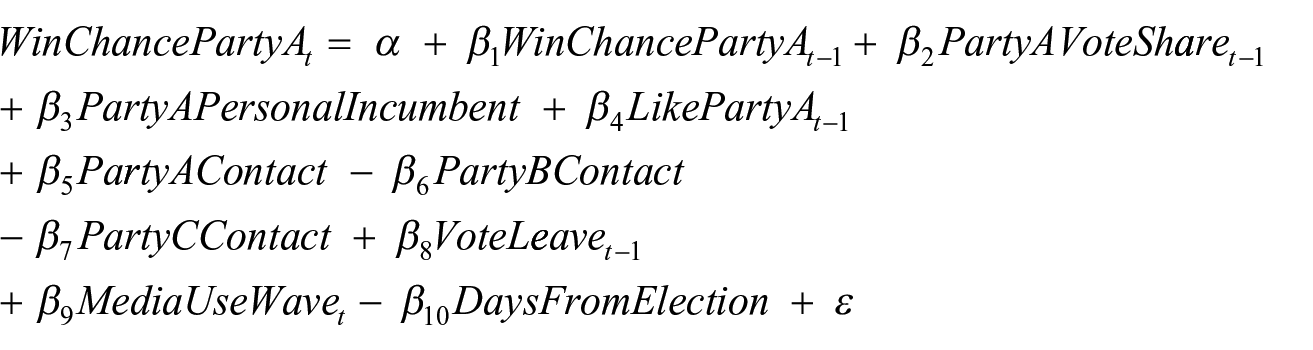
In our model, we are assessing the impact of each of the parties’ campaigns simultaneously. We therefore utilise seemingly unrelated regression (SUR) as our modelling approach as ordinary least squares (OLS) regression is unsuitable for analysing party win estimates in multiparty elections (Cutts and Shryane, 2006; Tomz et al., 2002). SUR has particular advantages because it overcomes the problem of unbounded predicted values and issues of non-independence. OLS regression predictions are unbounded so it is possible that such models could predict win estimates in excess of 100 or negative estimates. OLS also assumes that each party’s win estimates are independent of each other, when in reality they are negatively correlated with each other. Simply put, if one party’s win estimate is high then other parties’ win estimates will be relatively lower or vice versa (Katz and King, 1999). To offset the problem of non-independence of party win estimates the SUR method specifies three equations: one each for the dependent variables to be jointly modelled, which allows the error terms to be correlated across equations. We expect the residuals to be strongly positively correlated, which will result in large residual variances in the equations. Using SUR overcomes these OLS deficiencies and is therefore preferred here. Breusch–Pagan tests of independence confirm that SUR is the appropriate modelling technique. To allow for the impact of correlations between the expectations of respondents in the same constituency, we calculate clustered standard errors by constituency using the suregr package in Stata (Kolev, 2021).
Results
The results for each of the three elections testing H1 and H2 are shown in Tables 1–3, with additional illustrations of the average marginal effects of each party’s campaign contacts in Figures 1–3. Table 4 summarises the results. First, we observe that in all but one case, the impact of increased campaign contact positively enhances perceptions of likely victory – the more campaign contacts from a particular party a voter received, the greater the improvement in their perceptions of the possibility of that party winning in the constituency. This is true for Labour and the Liberal Democrats in all three elections, and for the Conservatives in two (2015 and 2017). Only in 2019, do we observe a null effect in one case. The impact of Conservative campaigns is correctly signed (positive) but fails to reach statistical significance. Notwithstanding, in eight out of nine cases H1 is supported. More intense campaign contact from a party improves the perception of likely victory by that party in the constituency.
The Impact of Campaign Contacts 2015 (SUR) (n = 16,240).
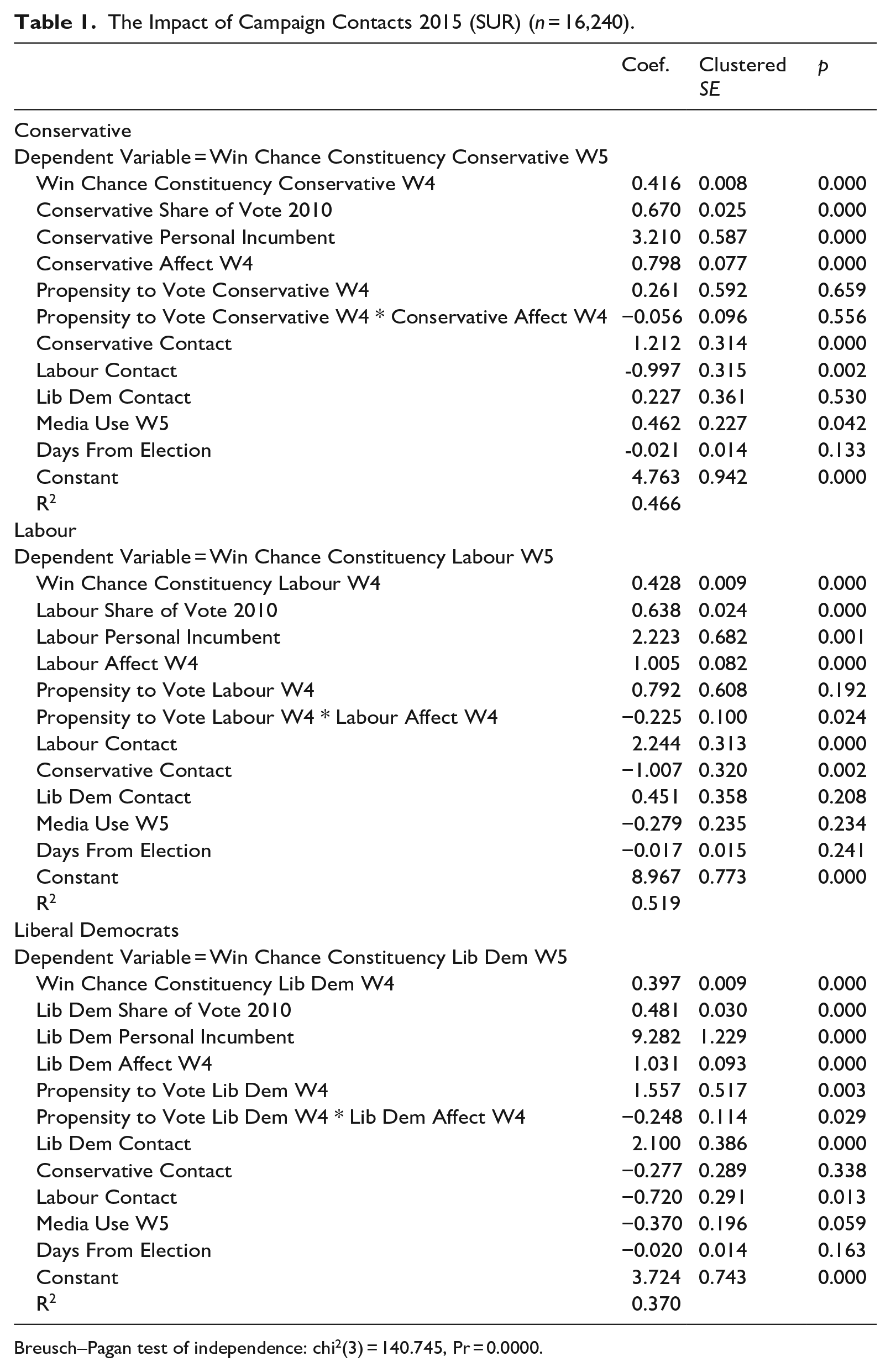
Breusch–Pagan test of independence: chi2(3) = 140.745, Pr = 0.0000.
The Impact of Campaign Contacts 2017 (SUR) (n = 15,666).
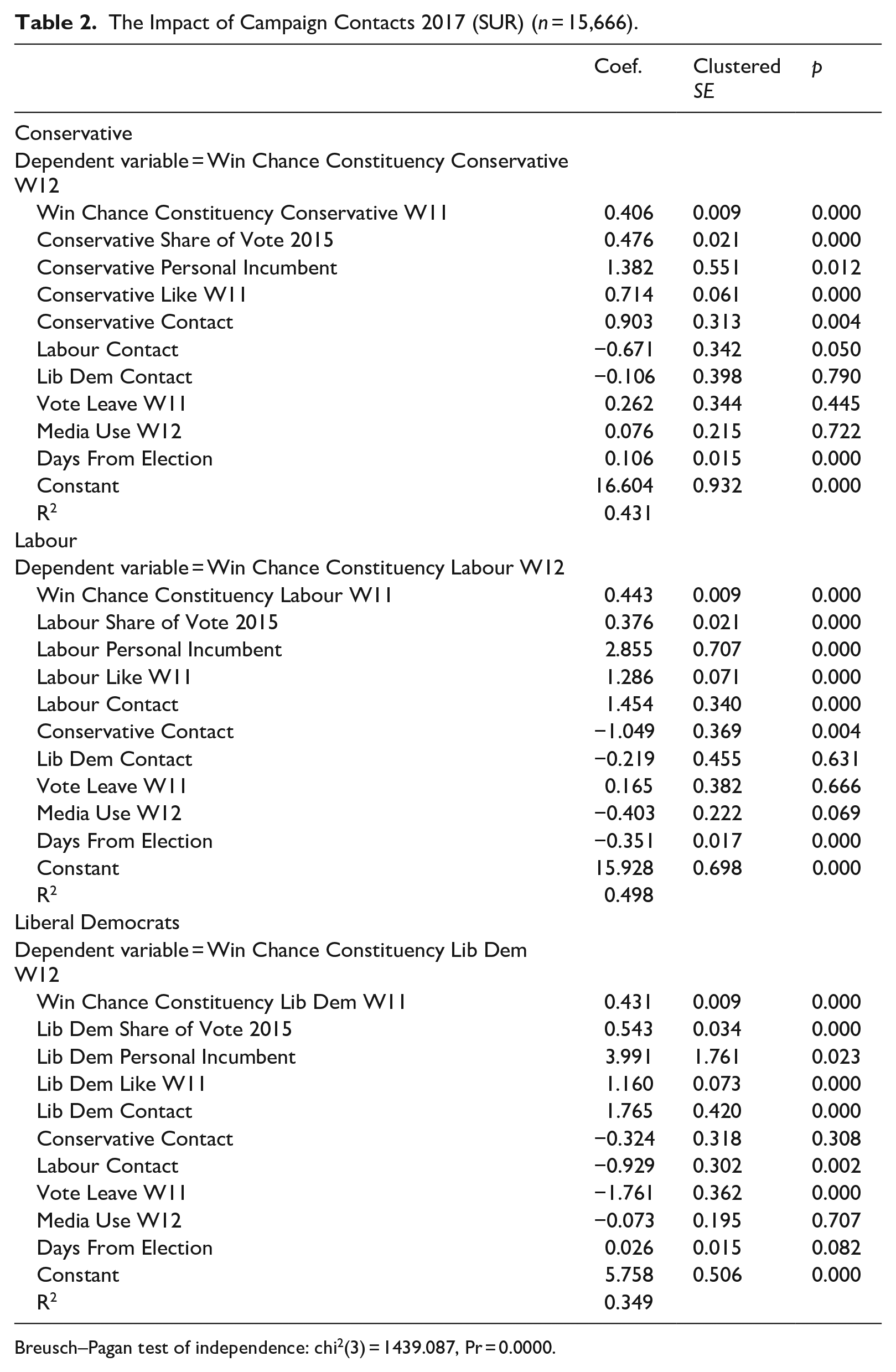
Breusch–Pagan test of independence: chi2(3) = 1439.087, Pr = 0.0000.
The Impact of Campaign Contacts 2019 (SUR) (n = 15,362).
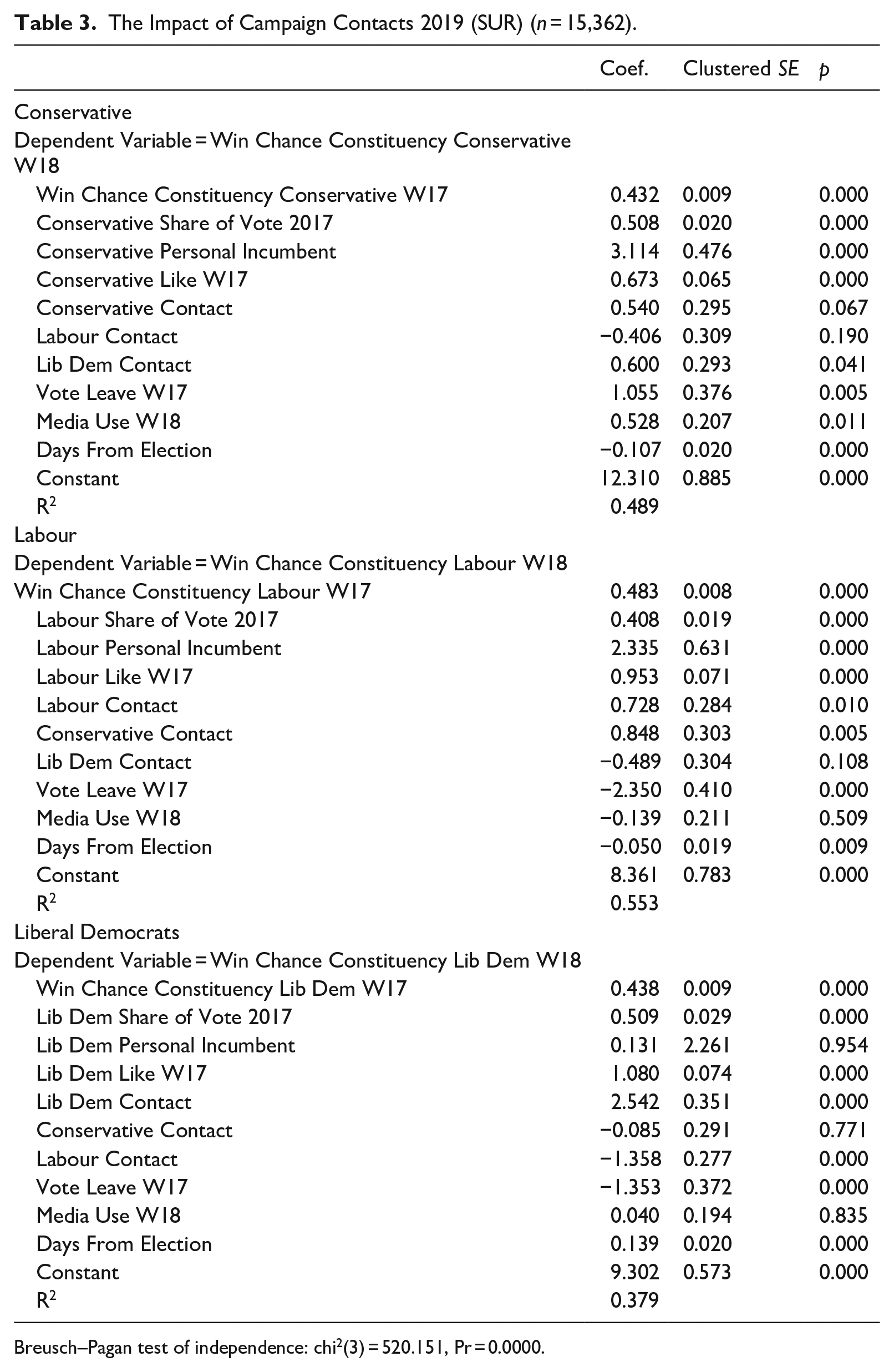
Breusch–Pagan test of independence: chi2(3) = 520.151, Pr = 0.0000.
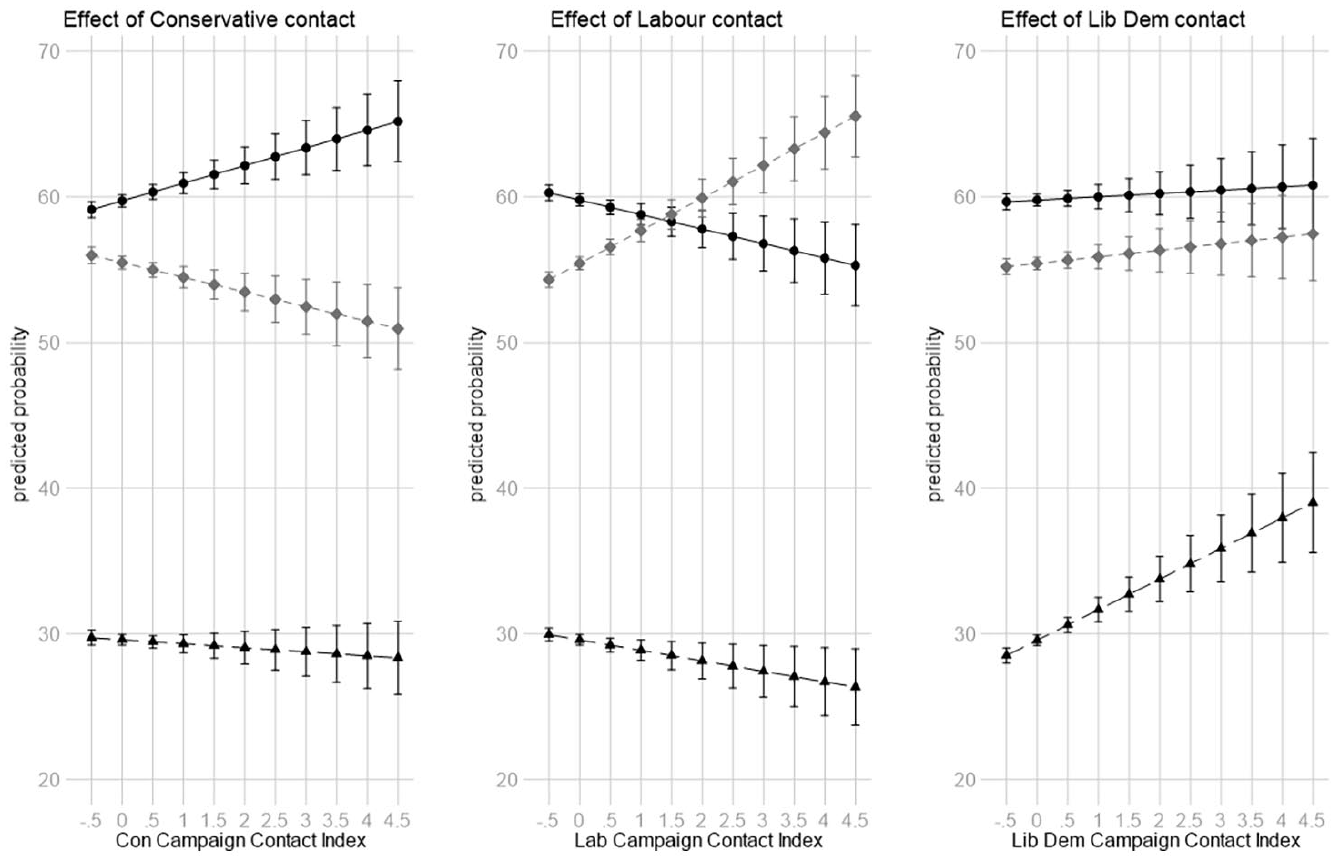
Predicted Perceived Chance of Victory by Campaign Index, 2015.
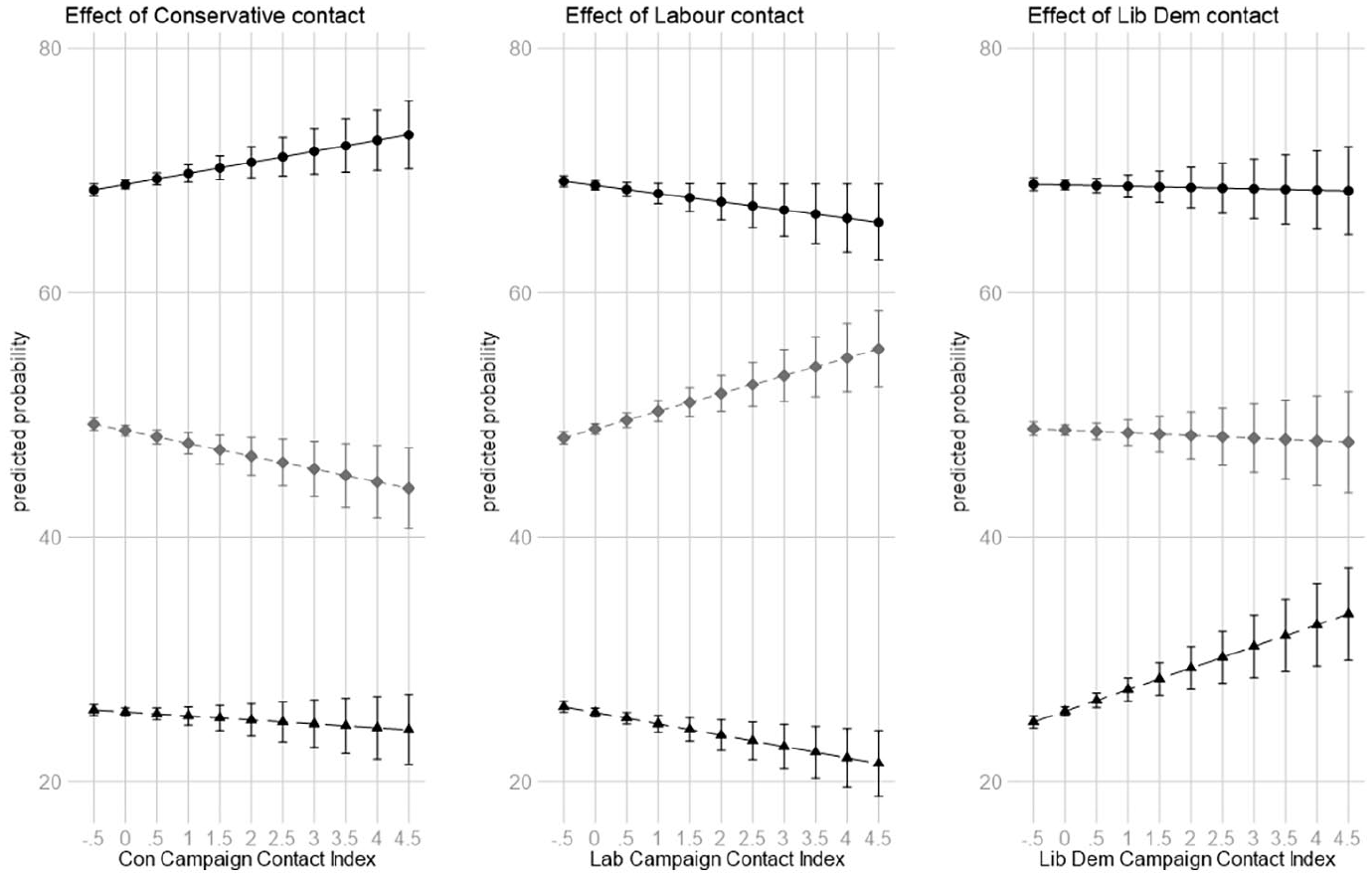
Predicted Perceived Chance of Victory by Campaign Index, 2017.
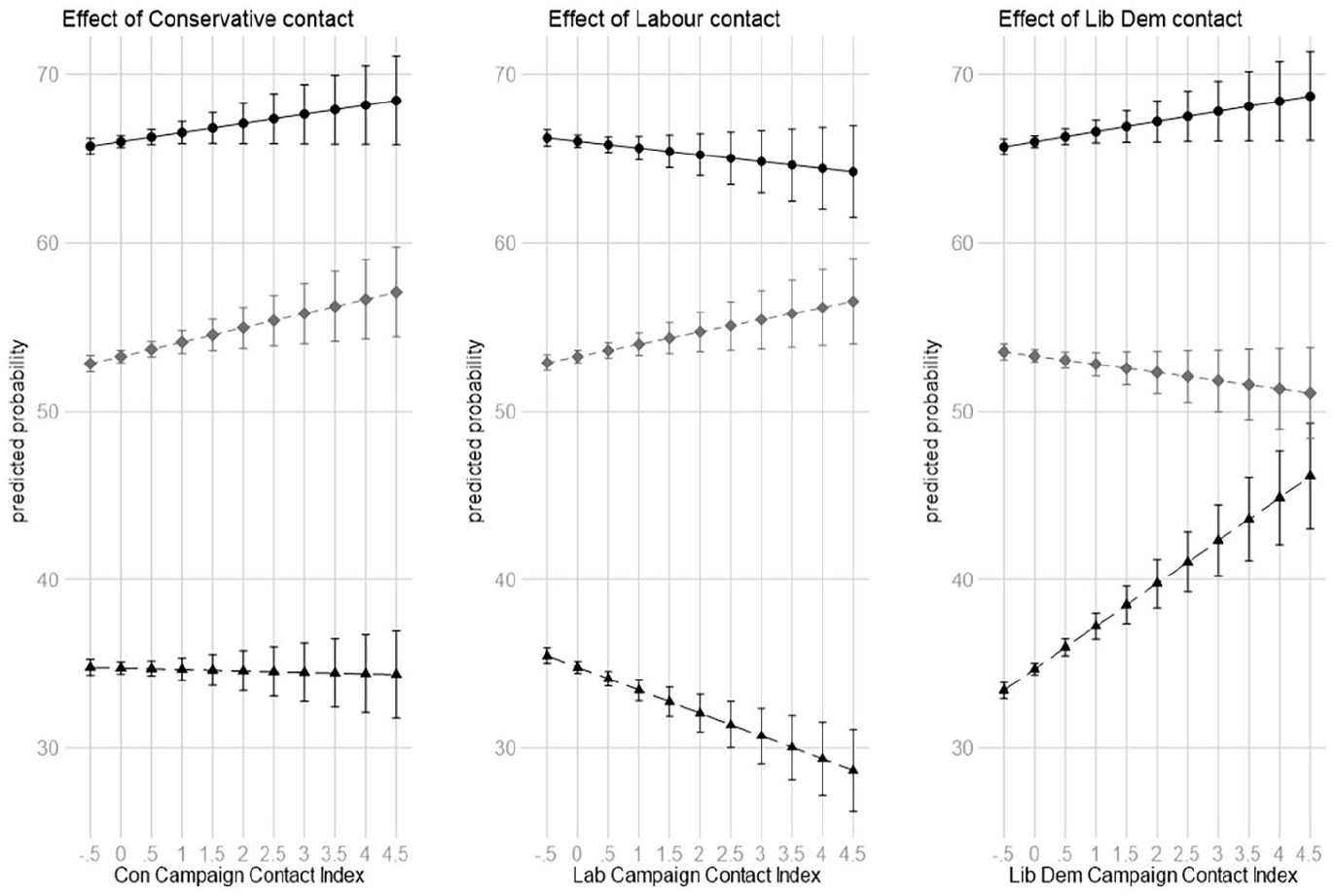
Predicted Perceived Chance of Victory by Campaign Index, 2019.
Summary Results – Campaigns.
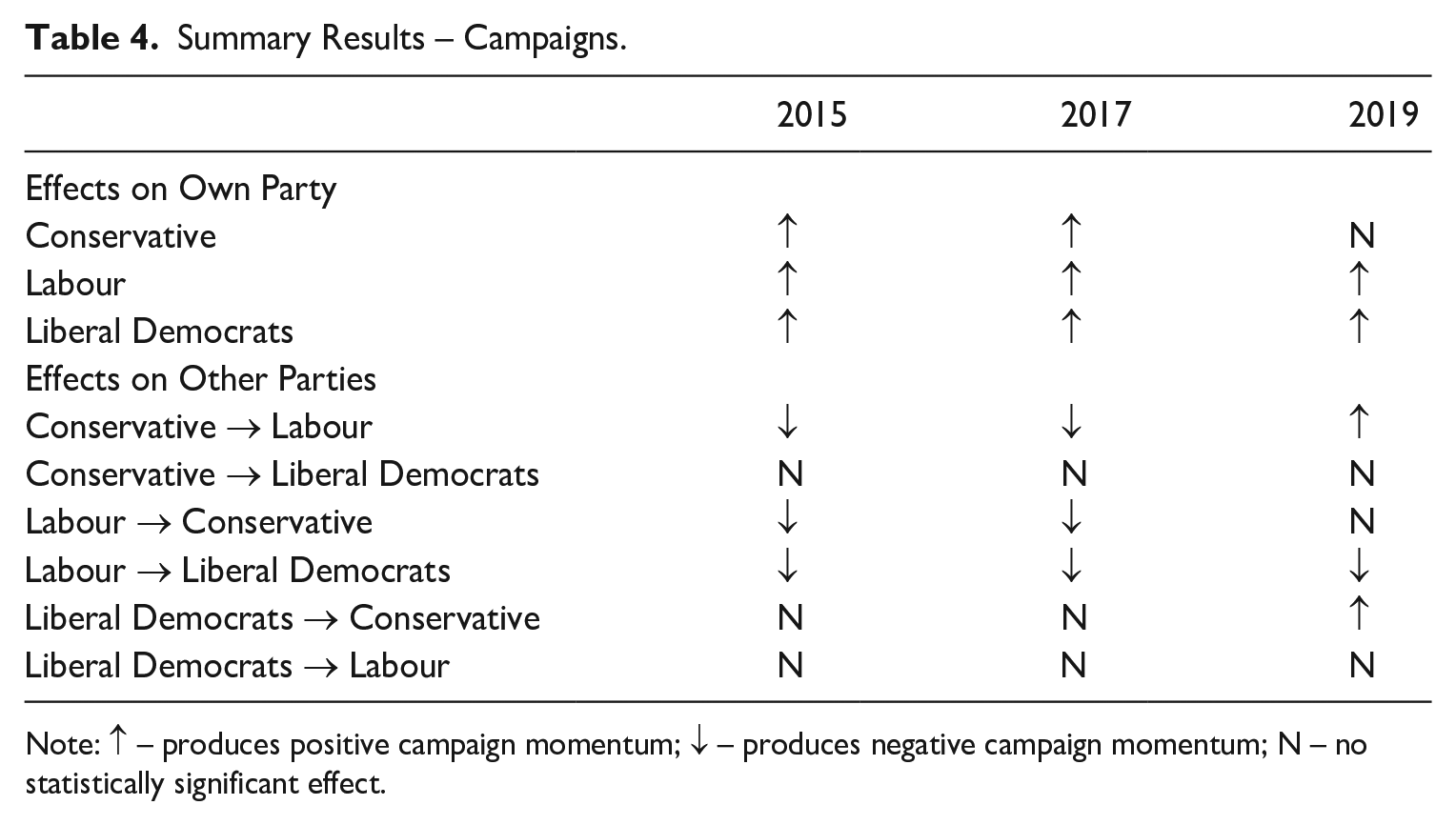
Note: ↑ – produces positive campaign momentum; ↓ – produces negative campaign momentum; N – no statistically significant effect.
In terms of effect sizes (illustrated in Figures 1–3), those of the Liberal Democrats are generally the largest. Comparing the effects of a change in the campaign index at the lowest level of campaign exposure with the greatest, the improvement in the perception of potential election performance was 10.5, 8.8 and 12.7 points in 2015, 2017 and 2019, respectively. For Labour, the comparable point increases were 11.2, 7.3 and 3.6. while for the Conservatives, they were 6.1, 4.5 and 2.7 (though as noted above, the 2019 effect was not statistically significant).
In respect of H2, the results are more mixed. As predicted, increased Labour campaign contacts depress the perception of Liberal Democrat victory in all three elections – most notably in 2019 when the difference between the lowest level of Labour contact and the highest, reduced the perception of potential Liberal Democrat performance by 6.8 points. Similarly, increased Labour contacts depress perceptions of Conservative victory in the constituency in 2015 (by 5 points when comparing the highest and lowest levels of Labour contact) and 2017 (but not in 2019). The reverse in those elections is also true – increased Conservative campaign contacts depress perceptions of Labour’s chances in both 2015 and 2017 (in both cases by around 5 points when comparing the highest and lowest levels of Conservative contact). Campaigning by other parties can therefore depress momentum indicating some support for H2.
However, Liberal Democrat campaigns fail to depress perceptions of other parties in all cases and Conservative campaigns similarly fail to depress perceptions of the chances of Liberal Democrat victory in all three elections. In addition, the 2019 election – which was dominated by questions surrounding Brexit – produces two unexpected results. In that year, increased campaign contacts by the Liberal Democrats improved the perception of likely victory in the constituency by the Conservatives. Similarly, increased Conservative contacts boosted perceptions of Labour’s chances. These two findings in 2019 are counterintuitive 4 but coupled with the consistent null effects of Conservative campaigns on perceptions of Liberal Democrat performance, and of Liberal Democrat campaigns on any other party, suggest that the impact of campaigns on perceptions of other parties’ performance is complex. This is likely in part to be a function of campaigning in a multiparty setting, meaning that while the positive effects of campaigns on the same party are almost always as predicted (as per H1), the negative effects of campaigns on perceptions on other individual parties’ performance are far less predictable. For example, if Party A campaigns negatively against Party B, this may help Party C. 5 Overall then, the support for H2 is mixed: H2 is supported in seven of our 18 cases, but rejected in eleven.
In sum therefore, there is strong support for positive campaign momentum as a result of parties’ campaigns as predicted by H1, but there is less overall support for the negative campaign momentum predicted by H2, and these findings hold, even when including other factors that may influence momentum in our models, including partisanship, incumbency, prior election results and media exposure. These covariates suggest that prior electoral results and partisanship continue to impact perceptions of potential electoral performance. In respect of incumbency, this is also the case in all three elections for the Conservatives and Labour. For the Liberal Democrats, this is the case in 2015 and 2017, but not 2019. This confirms that even when accounting for the positive effects of incumbency, including recognition and potentially better-resourced campaigns, the positive impact of campaign intensity continues to exert an effect on momentum. Perhaps most notable is that in contrast with many other studies, the impact of media exposure is very limited, only continuing to exert a statistically significant effect on perceptions of potential electoral performance in two instances – positively for the Conservatives in 2015 and 2019, but not negatively for either Labour or the Liberal Democrats in any of the three elections. Such findings are significant as they represent an important new understanding of campaign momentum, and point further to the significance of campaigning at the district or constituency level.
Discussion and Conclusion
Campaign momentum matters, both for the impact it may have on campaign resources, media coverage and the credibility of candidates, but also on the conditions it creates, which may lead to strategic or expressive choices by voters. But much of the literature related to campaign momentum (which largely refers to bandwagon effects) seemingly overlooks the importance of party or candidate campaigns in generating momentum. Parties and candidates are core to campaigns, yet most analyses of campaign momentum ignore their own efforts. They are the forgotten actors. But, just as campaign efforts frequently deliver electoral payoffs, so we demonstrate here that they also impact upon campaign momentum, repeatedly delivering positive momentum for their own campaigns, and sometimes negative campaign momentum for their opponents. Parties are not innocent bystanders in campaigns – they are front and centre. This matters because a more effective campaign should boost the perception that the party or candidate can win. This, in turn, provides a plausible mechanism by which campaigns can affect vote share, both by mobilising existing support and providing both instrumental and expressive incentives for voters.
Nor should campaign momentum only be considered at the national level. As Stiers et al. (2018) show, voter perceptions of election outcomes matter at both district and national levels. In a country like England, where the geographic distribution of party support varies significantly, it is especially important to capture perceptions of likely victory at the district or constituency level. And, while opinion polls typically provide information necessary to assess party standing at the national level, the intensity of district or constituency-level campaigns may act as a surrogate in constituencies. Such a phenomenon is not, of course, unique to England. Yet, until now, only Lanoue and Bowler (1998) and Evrenk and Sher (2015) have sought to capture the impact of district campaign effects on campaign momentum. They use a single, binary measures of campaign contact rather than the scale of multiple items employed, here which captures intensity rather than just the presence or absence of campaign contact, or selected contact types.
Campaign momentum also needs to be captured over time. The unique design of the BES allows us to do this, with waves before and during the campaign, and sufficient respondents to capture change in all districts or constituencies. And finally, this article tests our hypotheses over three separate elections, giving greater certainty to the finding that parties’ campaign efforts almost always deliver positive campaign momentum, and sometimes deliver negative campaign momentum to their opponents.
What is also noteworthy about these results is the more muted effects of media exposure. A common complaint from parties of the left is that media exposure damages their cause. True, our analysis shows that greater media exposure can benefit the main party of the right (in this case, the Conservatives in 2015 and 2019), even when accounting for parties’ own campaign efforts. But factoring in campaign contacts reveals no significant negative impact on any of the parties analysed, here, suggesting that even if the media was biased against a party, negative effects can be counteracted by a party’s own efforts. Just as free campaigning can mitigate against the effects of differential party wealth (Fisher et al., 2014), so this article shows that citizens do respond to campaigns and this is reflected in positive campaign momentum.
Overall, parties and candidates have been the forgotten actors in discussions of campaign momentum. We demonstrate here that in fact, the campaign efforts of parties and candidates can have a very significant effect on generating positive campaign momentum for themselves, and on occasion depressing the perceptions of campaign momentum for others, thereby laying the foundations for improved electoral performance. Momentum matters, and party campaigns are significant generators of such momentum.
Supplemental Material
sj-docx-1-psx-10.1177_00323217241274893 – Supplemental material for Innocent Bystanders or the Forgotten Actors?: The Role of Parties and Candidates in Building Electoral Campaign Momentum
Supplemental material, sj-docx-1-psx-10.1177_00323217241274893 for Innocent Bystanders or the Forgotten Actors?: The Role of Parties and Candidates in Building Electoral Campaign Momentum by Justin Fisher, Edward Fieldhouse and David Cutts in Political Studies
Footnotes
Correction (September 2024):
This article has been updated with minor grammatical or style corrections since its original publication.
Declaration of Conflicting Interests
The author(s) declared no potential conflicts of interest with respect to the research, authorship and/or publication of this article.
Funding
The author(s) disclosed receipt of the following financial support for the research, authorship and/or publication of this article: Economic & Social Research Council (ES/M007251/1; ES/R005052/1; ES/T015187/1).

Supplemental Material
Additional Supplementary Information may be found with the online version of this article.
Notes
Author Biographies
References
Supplementary Material
Please find the following supplemental material available below.
For Open Access articles published under a Creative Commons License, all supplemental material carries the same license as the article it is associated with.
For non-Open Access articles published, all supplemental material carries a non-exclusive license, and permission requests for re-use of supplemental material or any part of supplemental material shall be sent directly to the copyright owner as specified in the copyright notice associated with the article.
