




Abstract
Leaders’ visits are now an integral part of British general election campaigns. Yet, outside of a few cross-sectional explorations of leaders on the campaign trail, it remains under-explored. Here, we redress this imbalance. Using a unique data source collected by the authors over the four most recent British general elections, we explore where leaders visit, what determines these visits and whether the reasons have changed over time. For the first time, we also put forward an original typology of leader visits in England. Our findings detail how the type of visit varies over time according to the electoral context, by respective campaign strategies, closeness to election-day and how it is often shaped by the personalities of the leaders themselves. In the final part, our evidence suggests that leaders’ visits impact party support although the effects vary for parties across elections.
Leaders’ visits are now an integral part of British general election campaigns. With 24-hour rolling news, where leaders go and what they do fills news channels, column inches and leads to social media scrutiny in equal measure. Leaders increasingly use such vehicles to reach volatile and/or politically unsophisticated voters who in turn increasingly use leaders’ images and political messaging from the campaign trail as a heuristic short-cut to determine who to vote for. Campaign visits provide leaders with the political space to compress policy positions into ‘bite-size’ targeted straplines enabling leaders to provide vital cues to voters. For voters, it reduces the cost of acquiring information. Beneath the surface of a photo opportunity, leaders’ visits in British elections can tell us a lot about a party’s electoral strategy, prescribed role of the leader in the ‘air campaign’ and how a party is seeking to set the news agenda (Middleton, 2021). Yet, historically, the leaders’ visit literature draws heavily from North America, predominantly (but not exclusively as shown by evidence from Africa and Latin America) from Presidential elections in the United States, Democratic or Republican presidential primaries or presidential visits during midterm elections. Here, the focus is on where leaders’ visits and why, the type of visit and its impact (Carty and Eagles, 2005; Heersink and Peterson, 2017; Mellen and Searles, 2013; Sellers and Denton, 2006). In the British context, outside of a few cross-sectional explorations of leaders on the campaign trail it remains under-explored (Middleton, 2014, 2015, 2019).
This article seeks to redress this imbalance. Using a unique data source collected by the authors over the four most recent British general elections and combining this with British constituency election data, we explore where leaders visit, what determines these visits and whether the reasons have changed over time. In the second part of the article, for the first time, we put forward an original typology of leader visits in England. We detail how the type of visit varies over time according to the electoral context, by respective campaign strategies, closeness to election-day and how it is often shaped by the personalities of the leaders themselves. The final part of the article addresses whether they have a positive impact on party support.
Where Leaders’ Visit and Why
For three weeks or more of a British election campaign, following a party leader on the campaign trail becomes a media obsession. The location and itinerary of party leaders’ visits are far from random (Middleton, 2021). But where do leaders go and why? Much of the literature stems from the United States and focuses on presidential visits – during presidential campaigns, midterm elections or running to be the Democratic or Republican presidential nominee (Cohen and Powell, 2005; Eshbaugh-Soha and Nicholson-Crotty, 2009; Mellen and Searles, 2013). Presidential visits are framed in terms of their strategic motivations and returns. Two broad theories persist. The first stresses how presidential visits are an integral part of a permanent campaign in which the President engages throughout their tenure. In regard to midterms, presidential visits are commonly considered to be about self-interest and preservation where presidents primarily seek to further their own re-election chances, garner public support and raise funds for future races (Eshbaugh-Soha and Nicholson-Crotty, 2009). Alternatively, the second approach stresses how presidential visits are principally about enhancing the number of potential co-partisans in state legislatures and Congress (Cohen and Powell, 2005). The more co-partisans in Congress, the greater the chance of the presidents’ legislative agenda being successfully passed and implemented which could potentially impact re-election chances.
In order to accomplish either or both goals, presidents and presidential candidates have to strategically determine where to visit and why. In the US context, this depends on whether the campaign perceives that the leaders’ visit will impact the local candidate’s election prospects (McClurg and Bryan, 2009). Others suggest that presidential visits are determined by the lure of maximum reward, typically choosing locations with high numbers of Electoral College votes (Lang et al., 2011) and competitive races in large states (Charnock et al., 2009). Evidence from presidential visits during midterms also stress the competitiveness of the race (Eshbaugh-Soha and Nicholson-Crotty, 2009; Herrnson and Morris, 2007; Mellen and Searles, 2013) alongside previous legislative support where the president rewards the incumbent who supported their legislative agenda in Congress with a visit at election time (Herrnson and Morris, 2007; Vaughn, 2004) although this is contested by some (McClurg and Bryan, 2009). Multiple races occurring at the same time or focusing on States with the highest number of competitive races can also be a deciding factor in the location of presidential visits (Hoddie and Routh, 2004).
In Britain, assessing where and why leaders visit constituencies is far more limited. Cross-sectional studies do hint that competitiveness or the marginality of the seat is a driving factor of whether a leader visits or not (Middleton, 2021). Yet, increasingly, previous marginality in the constituency (based on the prior election) seems to be just one indicator of where a party targets resources during an election campaign. All parties now use key performance indicators which measure the extent and intensity of campaigning outside the 3- to 4-week election period (Fisher et al., 2019). National strategists will use and continuously monitor these to determine where to target resources – irrespective of marginality – and this could include selecting seats for leader visits. Such seats are likely to be the focal point of intensive grassroots campaigning and high levels of local party spending during the final weeks of an election campaign. In light of this, and the earlier literature, we put forward the following hypotheses:
H1: The more competitive the seat, the more likely the leader will visit, after accounting for all other factors.
H2: Leader visit locations are significantly more likely to be in seats where parties’ constituency campaign effort is most intense.
The importance of marginality in British elections is increasingly contested. The location of visits can vary for both or either the incumbent and opposition leader considerably during the election as expectations change (Cook, 2017). Existing research in Britain delineates between defensive and expansionist visits, although it is far too simplistic to assume that governing party leaders predominantly focus on seats they want to hold, while opposition leaders are always on the offensive visiting other parties’ seats (Middleton, 2015). Since the 2015 British election, the leader of the governing party has only spent roughly half of the campaign in their own seats (Middleton, 2019). Adding to the complexity, third parties such as the Liberal Democrats have traditionally faced the problem of ‘tight targeting’ where they simultaneously had to defend a number of seats with small margins while the majority of held seats weren’t safe enough to neglect (Cutts et al., 2023). As such, leaders would visit incumbent seats alongside constituencies where they had the possibility of making gains (Cutts et al., 2010). Leaders’ visits are also likely to reflect the national electoral context – the overall competitiveness of the election. In highly competitive elections where the final result is still uncertain, visits (predominantly those by Conservative and Labour leaders) are likely to be focused on marginal constituencies and seats where local party campaigning is most intense. In uncompetitive national elections, we would expect visits to be far less focused on these close local contests. As regards the four general elections examined in this article, both 2010 and 2015 were arguably more competitive contests than 2017 and 2019. In 2010, the Conservatives led Labour by a relatively small margin at the start of the campaign, while 5 years later both parties were virtually tied in the polls 4 weeks from polling day. In 2017, the Conservatives held a large lead prior to the campaign which diminished markedly as the campaign progressed. The general expectation before and throughout the campaign was a Conservative victory which duly occurred, albeit the party did not secure an overall majority. Two years later, the polls before the campaign were universal in their pronouncement of a Conservative victory. Based on the evidence provided, we construct the following hypothesis:
H3: Leaders’ visits (particularly for the main two parties) will be far more focused in marginal constituencies and seats where campaign effort is most intense in highly competitive elections (2010 and 2015) than in less competitive national contests (2017 and 2019).
In the two most recent British general elections, the decision to leave the European Union following a referendum in 2016 has dominated political discourse during the election campaign. With bitter divides becoming entrenched along the leave–remain axis and parties positioning themselves to court these voters in key seats to gain a competitive advantage, it is likely that visit locations have been strategically devised to get these messages across to those that mattered. Given its high salience in 2017 and particularly in 2019, party leaders were the focal point of the main parties’ pitch – something which Theresa May failed to capture through her ‘fulfilling Brexit’ message. Jeremy Corbyn got it badly wrong 2 years later while Boris Johnson successfully embodied it through the ‘Get Brexit Done’ message. While there is some circumstantial evidence that Brexit patterns are observable on the campaign trail in 2017 and 2019 (Cook, 2017; Middleton, 2021), just how much it determines where leaders’ visit remains contested when all other factors are considered. Based on the evidence above, we put forward the following hypotheses:
H4a: Conservative leaders are significantly more likely to visit Leave voting seats after controlling for other influences.
H4b: Labour and Liberal Democrat leaders are significantly more likely to visit Remain voting seats after controlling for other influences.
H4c: Conservative leader visits are significantly more likely to be in Leave voting seats in 2019 than 2 years earlier after controlling for other influences.
H4d: Labour and Liberal Democrat leaders are not more likely to visit Remain voting seats in 2019 than 2017 after controlling for other influences.
Type of Visits
It is evident that there is a symbolic element to leaders’ visits. Leaving aside for one moment what the leader says, the chosen setting, the backdrop of placard-waving supporters and activists or meeting carefully selected members of the public, is strategically designed to implicitly double-down on a simplified core message while promoting leader authenticity and personality to both a local and national audience. Visits, therefore, can have two underlying frames of meaning that are not necessarily mutually exclusive. On the one hand, the goal and messages emanating from the visit may be solely packaged and reported for a national audience where knowledge about the local setting as a salient backdrop is not required. On the other hand, while leaders’ visits may seem outdated and symbolic in a digital age, the importance of connecting with a local area and candidate remains crucial where every seat can matter. In such circumstances, the location becomes integral to the policy launch or message not only for those locally but also the wider public. It is not only the locations they visit that are shaped by the local context, but the actions they perform when they arrive. Locations are the theatres of performance but the backdrop to the visit – in a hospital or school, walking onto a stage to address hundreds and thousands of supporters, posting leaflets through letterboxes or walking through crowded town centres – set the parameters for how messages are delivered and interpreted by the voter (Middleton, 2021).
Rallies stand-out as one of the more universal types of campaign trail activity that we encounter both in the United States (Wood, 2016) and beyond, particularly in African and Latin American electoral politics. Rallies have a historical legacy in Africa as an integral part of mobilization against colonial rule (Branch and Mampilly, 2015). Nowadays, they serve as a critical political space for accountability, face-to-face contact and wider engagement with citizens (Paget, 2019) and provide a vehicle for leaders’ to legitimize their rule (Bob-Milliar and Paller, 2022). Research in Ghana suggests that rallies are used more typically by the incumbent party (leader) in areas where they are already popular, while evidence from the 2016 election found that they constituted 80% of all visits (Bob-Milliar and Paller, 2022). Rallies are also vital campaign tools in Tanzania and Kenya through which leaders seek to build broad-based support (Horowitz, 2016, 2019; Paget, 2019) and in Benin as a vital medium for policy discussion leading to significantly higher levels of voter turnout (Wantchekon, 2017). Across Latin America, rallies are also a significant part of leaders’ face-to-face campaigning – alongside campaign walks, street campaigns, motorcades and car parades – providing an opportunity for leaders to signal electoral strength and engage directly with voters (Borges Martins da Silva, 2019; Speck and Mancuso, 2015).
Likewise in the United States, Presidents and presidential candidates will hold rallies where they can attract large crowds, raise campaign funds and often where high proportions of Electoral College votes are up for grabs (Jones, 1998; Lang et al., 2011; Mellen and Searles, 2013). Rallies remain the centrepiece of US election campaigns for all prospective leadership candidates but more recently have become a pivotal weapon for Donald Trump during his presidential campaigns. They have provided the perfect backdrop for Trump from which to construct a political performance and discourse predominantly built around a narrative of personal stories and experiences which connect with sections of the electorate which in turn evoke emotional responses and reactions (Hochschild, 2016; Polletta and Callahan, 2017; Wahl-Jorgensen, 2018). Such connections lead to spectacles typified by personal dialogue, gestures and chanting of campaign straplines that market Trump’s electoral brand. Rallies are the means through which this political performance plays out and how the leader not mobilizes and engages loyalists but tailors messages to appeal (through local mainstream and social media) to lean partisans, independents and genuine undecideds (Epstein, 2018).
The British case is once again distinctive, with rallies being comparatively rare; the open-air meetings Corbyn held during the 2017 election campaign are the exception (Middleton, 2018). Old-fashioned unstructured walkabouts are also increasingly unusual unless carefully choreographed. As such, it is possible to differentiate between outward-facing visits – through grandstanding or policy-orientated visits where the aim is to appeal far more to a national audience–and inward-facing visits – so-called cheerleading visits which include speeches to local activists and campaigning visits to boost local activism and morale – where appealing to a local audience is the primary goal (Middleton and Cutts, 2019). Yet, it is unclear whether these types of visits have become nationally focused in their orientation, vary over time, by party and during a campaign or if the nature of the visit is shaped heavily by the character of the leaders themselves. One possibility is that inward visits are more likely to occur in more marginal contests or where the most intensive campaigns are taking place because they are locally orientated and pitched at supporting local activism. As such, leaders’ visits are likely to be heavily featured by local news outlets encompassing pictures with the local candidate thereby raising his or her profile. Interviews with local media enable leaders to address pressing local issues and tailor the national policy pitch to the local seat. Outward visits are less dependent on the constituency focus as their goal is to speak to the national audience. Therefore, one might not expect the same relationship with marginality or seats with intensive grassroots campaigning. Moreover, the closer it gets to polling day, we would expect leader constituency visits to be far more inward facing with an emphasis on boosting local activist morale and supporting the local candidate in their final push to win as many voters as possible. Whistle-stop strategic visits are a common feature of the last week of any election campaign as parties seek to gain a competitive edge of their rivals. We, therefore, put forward the following hypotheses:
H5: Befitting the increasing centralization and national orientation of party campaigns, leaders’ visits have increasingly become more outward-facing since 2010.
H6: Inward leader visits are more likely to be in marginal constituencies or seats where a party spends more.
H7: Leader visits are more likely to be inward- rather than outward-facing the closer it gets to polling day.
Do Visits Matter?
Existing literature, predominantly but not exclusively from the United States, is not universal in identifying all visits by all leaders as equally useful – they can shift the course of the campaign (Holbrook, 2002), have a significant impact (Althaus et al., 2002; Campbell, 2000; Jones, 1998) or have very little effect at all (Holbrook and McClurg, 2005). Heersink and Peterson’s (2017) seminal study of leader visit effects in the 1948 Presidential election found that Harry Truman’s vote share was 3.1 points higher where he visited while leader appearances by his opponent Thomas Dewey did not have any significant impact on his support. Even if Dewey had increased his number of visits, any campaign trail effects would have made little impact (Heersink and Peterson, 2017: 63). Evidence from the 1996 Presidential election found that Bill Clinton’s visits during the latter part of the election campaign had a significant impact on vote share, whereas visits by Bob Dole (his Republican opponent) had no impact on support (Herr, 2002). Like Truman, Clinton’s ability as an effective campaigner to connect with the public reinforced scholarly wisdom that leader visit effects reflected the quality, not just the quantity of visits (Heersink and Peterson, 2017; Herr, 2002). In 2016, while some evidence suggests that both visits by Trump and Hilary Clinton had no effect on vote share (Devine, 2018) others found that Trump appearances in rallies increased support over Hilary Clinton by around 4.5 percentage points on average (Snyder and Yousaf, 2020) albeit such effects were short-lived (Heersink and Peterson, 2017; Wood, 2016). However, the same authors found that rally visits had no impact for other Presidential candidates such as Barack Obama or John McCain in 2008 or Obama and Mitt Romney 4 years later (Snyder and Yousaf, 2020). Evidence from Presidential primaries is also mixed. Using a field experiment where they randomized Rick Perry’s schedule of visits in the 2006 primary campaign, Shaw and Gimpel (2012) found visible leader visit effects and evidence of durability while other studies using alternative methods found that 2008 and 2012 primary visits by Hilary Clinton and Romney, respectively, also significantly impacted vote choice (Wendland, 2017). Yet, the same study found null effects for Obama, McCain or Romney in 2008.
Evidence from Canada has a more positive take on the impact of leaders’ visits net of other influences on party performance (Bélanger et al., 2003; Carty and Eagles, 2005; Cross and Young, 2011). They also demonstrate how the Canadian trail largely serves for mobilizing existing party supporters, which ultimately shape party strategy as leaders tend to visit their own territories. When parties did not adopt this defensive strategy (as Bloc Quebecois did in the 2000 election), this tends to drive lower levels of support (Carty and Eagles, 2005). As in the United States, where contagion from the main visit has been found in neighbouring counties (Heersink and Peterson, 2017), evidence from Canada suggests that the spillover effect of a leaders’ visit is worth approximately half that of an actual visit (Carty and Eagles, 2005). Outside of North America, evidence from Australia is far more negative with little evidence that single visits by political leaders had any impact on performance in the 2013 Federal Elections. Multiple visits – particularly two – did reveal positive results but even if the political strategy had been different to maximize impact, it was unlikely to have had a dramatic effect on the outcome (Davis, 2016).
In Britain, whether leaders’ visits impact party choice in Britain remains inconclusive (Middleton, 2021). The continuous national media coverage of the leaders’ campaign trail has embedded visits in British general elections as a key contributor to the ‘air war’ or national campaign. Yet, they are fundamentally place-specific and as such remain an integral part of a party’s local campaign. Leaders’ visits are likely not only to be covered extensively by local media – involve leaders engaging with local as well as national issues – but, increasingly given the advent of social media, will reach a wider local audience and be the subject of discussion on local online forums. They will also have knock-on effects in the ground campaign through local party literature (pictures of the leader with candidates and activists in the seat) and, depending on the type of visit, (whether inward- or outward-facing) could involve face-to-face contact with the public. Our expectation is that these will have local connotations on party support. We put forward the following hypotheses:
H8: Leaders’ visits will have positive effect on party performance
Finally, reflecting shifting visit types (towards more inward style visits), we anticipate that visits and their impact on party support will vary by party and election. We anticipate that the Conservatives’ decapitation targeting strategy and the utilization of David Cameron to ‘rally the troops’ in key local contests may have positively impacted party performance in 2015 compared to 2010. The impact of Conservative leaders’ visits in 2017 is likely to be negative given the consensus around Theresa May’s somewhat lacklustre leadership during the election campaign (Bale and Webb, 2018; Fieldhouse et al., 2021). Moreover, Johnson’s visits did not follow any pre-conceived electoral strategy – more ‘a tour of seats’ – so it is difficult to assess whether his visits had a direct impact on party performance, so we do not express a clear expectation.
For Labour, Ed Miliband’s emphasis on reaching ‘five million conversations’ with voters and Corbyn’s campaigner style in 2017 and 2019 is more likely to have boosted local support when compared to the uninspiring campaign under Brown in 2010. We also anticipate that Farron’s emphasis on grassroots activism may have yielded similar effects in 2017 when compared to 2010. On the face of it, in 2015 and 2019 Liberal Democrat leader visits could be framed as ‘outward looking’. Nonetheless, it is difficult to envisage leader visits in 2015 stemming the electoral tide against the party. Given that party performance declined most in seats where the Liberal Democrats were previously strong, we expect leader visits to have a negative impact (Cutts et al., 2023). Swinson’s unpopularity in 2019 suggests a similar effect; however, leader visits were primarily in small subset of target seats (particularly at the mid to latter stage of the 2019 election campaign) where the party was gaining ground so it is possible that such unpopularity was more muted in these seats. It is, therefore, difficult to make an expectation either way. We, therefore, put forward the following hypotheses:
H9a: The impact of Conservative leader visits on party performance will vary by election year with positive effects in 2015 and negative effects in 2017 when compared to 2010.
H9b: The impact of Labour leader visits on party performance will be positive at all elections – 2015, 2017 and 2019 – when compared to 2010.
H9c: The impact of Liberal Democrat leader visits on party performance will vary by election year with negative effects in 2015 and positive effects most evident in 2017 when compared to 2010.
Data and Methods
To examine party leaders’ visits over time, we use data that have been compiled by the authors across elections since 2010 (Middleton, 2014, 2015, 2019; Middleton and Cutts, 2019). This involves a painstaking trawl of different sources to detail location, visit type, timing and wider information about the visit itself. The information is collated by party but for the purposes of this analysis we focus on the Conservatives, Labour and the Liberal Democrats and on England only. 1 Over the course of four elections from 2010 to 2019, our data show that there were more than 600 visits by leaders of the three main parties to English constituencies. A third of these visits involved two or more leaders going to the same constituency (see Supplemental Appendix Table A1). There were more leader visits in 2010 and 2017 than 2015 and 2019 although the volume of visits doesn’t vary hugely from election to election. The number of constituencies visited by more than one leader has declined since 2015, dropping to 21 in 2017 and 2019 from 31. This drop-off coincides with the recent travails of the Liberal Democrats. Following their collapse in 2015, many previous Liberal Democrat strongholds ceased to remain battlegrounds and as a consequence fewer visits from both Conservative and Liberal Democrat leaders ensued. Visit data are collected at the aggregate level and this is merged with constituency-level data containing socio-demographic variables, incumbency, marginality, local party spending and other salient measures such as the percentage who voted ‘Leave’ and ‘Remain’ in the 2016 EU referendum (Hanretty, 2017). To examine party performance, we use party vote share of the electorate which not only effectively measures party support but also takes account of turnout (Denver et al., 2003: 555). It is worth noting that the unit of analysis – constituencies – is unchanged from 2010 to 2019 so observations are nested within constituency over four time periods. This has implications for the statistical models used which are discussed later in the article.
Electoral Competitiveness and Leaders’ Visits in England
Our prior expectation is that leaders’ visits would be primarily focused in marginal seats (H1). However, descriptively speaking the evidence is mixed. On the one hand, there were more visits to marginal seats (ultra-marginal and marginal combined) in 2015 than in any of the other three elections (see Table 1). In 2019, all leaders’ visits to ultra-marginal seats matched the 2015 figure. However, the 2017 election seems to be an outlier with a third of all leaders’ visits to marginal constituencies compared to more than 60% two years earlier. Since 2015, an increasing number of all leaders’ visits were in ultra-safe seats with more than 37% recorded in 2019. Though there were far more marginal seats in 2010 and 2015 than in the two most recent elections, the number of ultra-safe seats has increased significantly since 2010. If you take account of the constituencies that were marginal at each election, then 51% of these seats were visited by the three main leaders in 2017 and 2019 compared to 41% in 2015 and 42% in 2010. Of course, strategic or resource issues may explain the difference while time limitations are also likely to have played a part. The higher the number of marginal seats, the more difficult for leaders’ to visit these constituencies within a 3- to 4-week time frame. Unsurprisingly, there were far fewer ultra-marginals in 2017 than in 2010, but of these leaders visited 65% of them in 2017 as opposed to 35% in 2010. As regards ultra-safe constituencies, the opposite trend occurred. In 2015, only 8% of ultra-safe seats were visited by one of the three main leaders. Four years later, although the number of ultra-safe constituencies had increased by more than a hundred, leaders visited 13% of these seats.
All Leaders Visits by Marginality in England, 2010–2019.
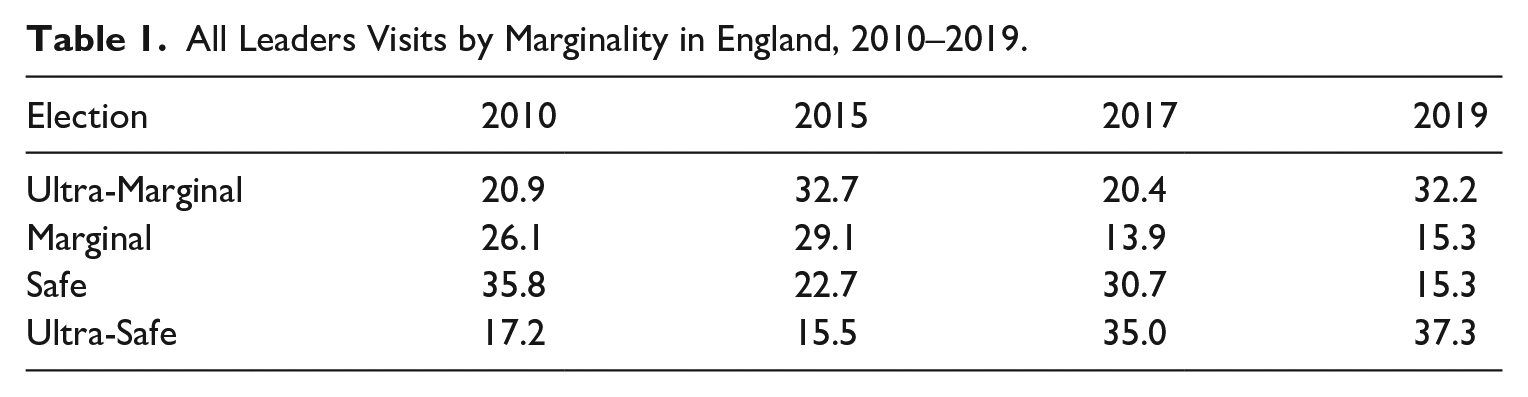
Table 2 breaks down leader visits from 2010 to 2019 by party. For the Conservatives, visits were far more focused on marginal seats in 2015 than in any of the other four elections. In 2010 and 2017, the majority of Conservative visits were in safe or ultra-safe seats while in 2019 more than two fifths of Conservative leader visits were to seats where the incumbent majority was in excess of 20%. In 2010, 93% of all Conservative leader visits were to non-incumbent seats (all visits to marginal constituencies were expansionist). As the main opposition party seeking to make significant electoral headway, an expansionist leader visit strategy is not entirely unexpected. Five years later, nearly 60% of leaders’ visits were to seats the party already held with a number of the expansionist visits to close contests where the Liberal Democrats were the incumbents. Being in coalition muddied the waters for the Conservatives. To gain a majority, the party needed to hold off Labour in tight contests where they were the incumbent while winning the odd seat from Labour where the electoral context was favourable, and capitalizing on the Liberal Democrats’ vulnerability where they were the main challenger. Leaders’ visits, therefore, reflected this dual strategy. In 2017, the Conservatives were on the offensive with two thirds of all visits to non-incumbent seats, including both marginal and safe seats. Nearly 60% of May’s visits were to Labour seats although such expansionist expectations completely backfired with close allies blaming campaign targeting failures and an ill-suited presidential style campaign (Hope, 2017). Two years later, when the polls suggested a Conservative victory, the leader visit strategy was predominantly defensive. Of all the visits to marginal constituencies, nearly two-thirds were to seats that the party already held.
Party Leaders’ Visits by Marginality, 2010–2019 (England Only).
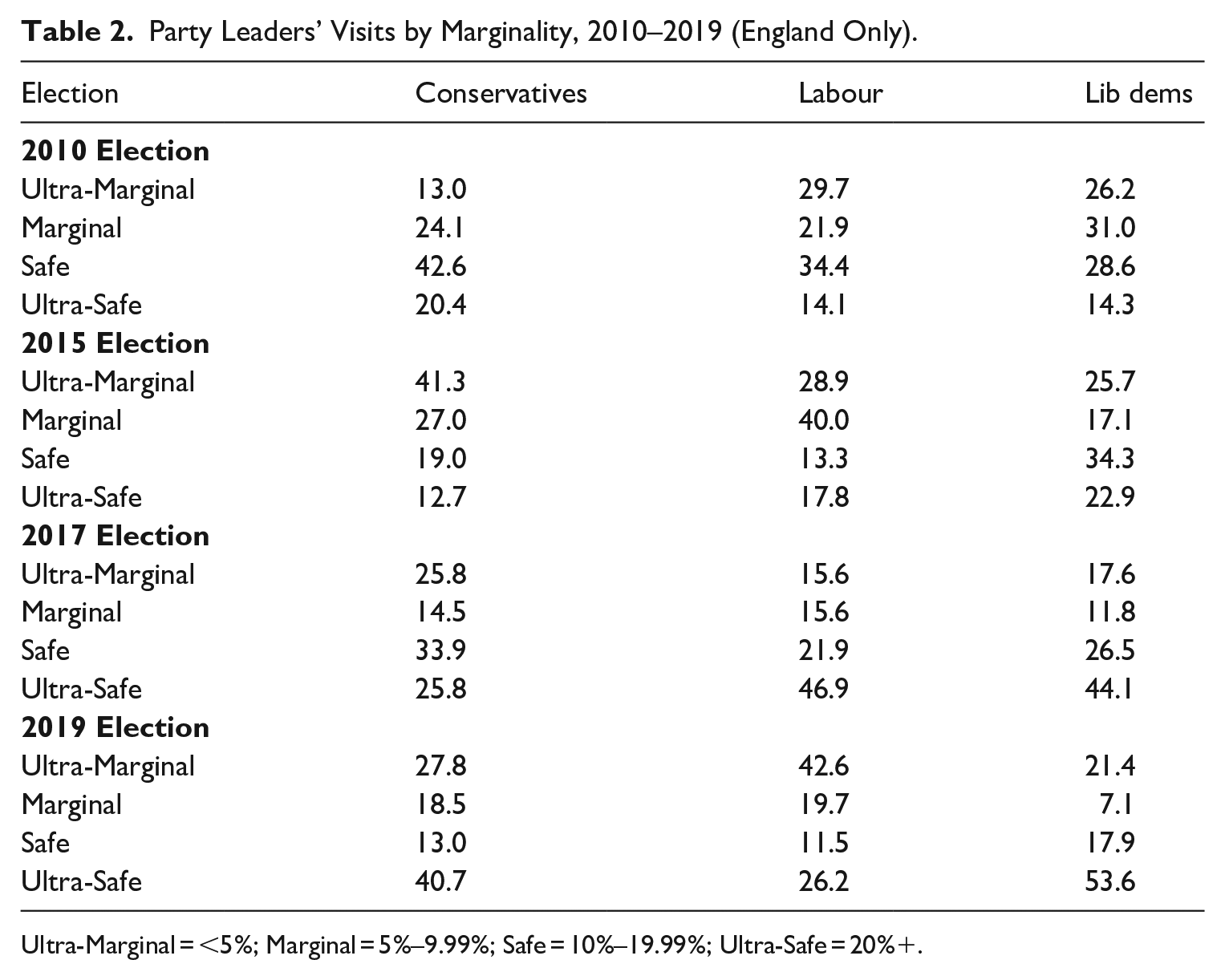
Ultra-Marginal = <5%; Marginal = 5%–9.99%; Safe = 10%–19.99%; Ultra-Safe = 20%+.
Unlike the Conservatives, nearly 70% of Labour leader visits in 2015 were in marginal seats. Of all visits to marginal constituencies, 90% of these were to targets that the party did not hold. Two years later, the reverse was true with leader visits predominantly in safe seats. Yet, the strategy was not overly defensive. Of all the marginal seats visited by Corbyn in 2017, 90% of these were not held by the party. In 2019, the visit strategy was more mixed. On the one hand, more than 45% leader visits were to ultra-marginal seats (nearly 70% of these were expansionist) while at the same time a quarter of visits were to ultra-safe constituencies (more than 90% of these visits were defensive).
The trend is fairly predictable for the Liberal Democrats and reflects their electoral fall from the top table of British politics to the electoral wilderness. At the height of ‘Cleggmania’ in 2010, nearly 60% of seats visited by the leader were marginal constituencies. Of all the seats visited, more than three quarters were not held by the party. Five years later, there were more visits to safe rather than marginal constituencies. Overall, two thirds of leaders’ visits were defensive. Going into the 2017 and 2019 general elections the Liberal Democrats had been reduced to a ‘rump’ of Westminster seats. The overwhelming majority of leader visits were to key targets that the party did not hold, many of which had been lost in 2015.
What Drives Leaders’ Visits in England?
In order to probe further whether marginality drives leaders’ visits in England, we run a series of conditional fixed effects logistic regressions. Our aggregate data are effectively a panel as the unit of analysis does not change across the four elections. Therefore, the observations are nested in constituency and are not independent. The dependent variable (visited by a leader or not) is measured on four occasions for each constituency. Our key explanatory variables of interest are marginality (H1) and spending (H2) which act as viable proxies of electoral competitiveness (see Supplemental Appendix Table A1). 2 We also control for tenure in office, first-time incumbency and whether the incumbent has retired or not. 3 All these variables change across time for a significant number of constituencies. By using fixed-effects models, we control for the effects of stable characteristics even though these effects are not measured or estimated. These models are also less vulnerable to omitted variable bias than random effects models. We also run a Hausman test on all our models to determine whether the unique errors are correlated with the regressors. In all cases, we obtain a significant p-value therefore rejecting the null hypothesis that the unobserved unit-level effects are uncorrelated with the other covariates. This reinforces the use of the fixed-effects estimator instead of the random effects estimator. 4
Model 1 includes a prior marginality variable and year dummies for each general election where the 2010 election is the base. It is not possible to derive marginal effects for a panel fixed effects logistic model because only the slope coefficients are identified while the fixed effects cannot be estimated (Kemp and Santos Silva, 2016). As such, we present the coefficients (log of the odds) in Table 3. As expected, prior marginality has a significant impact on leaders’ visits – the closer the contest going into an election the more likely a leaders’ visit (H1). In model 2, we include party spending and a number of controls specified above. We also interact marginality by year to establish the difference in the effect over each election year compared with the first election year (2010 election). Spending also seems to matter – seats where the campaign is more intensive are also significantly more likely to get a visit from one of the main party leaders (H2). The election year coefficients are all comparisons with 2010 and are all insignificant – all things being equal, leaders’ visits are not more likely in later elections. Our expectation (H3) was that leaders’ visits would be less targeted in close contests if the election was uncompetitive (as in 2017 and 2019) and more focused on electorally competitive constituencies if the general election was much closer (as in 2010). Yet, the coefficients for the interactions are clearly insignificant in 2015 and 2017, and narrowly so in 2019, compared with 2010. Put simply, we find no evidence that the safer the seat in 2017 and 2019 compared with 2010 the more likely the leaders’ visit (H3).
Conditional Fixed Effects Logistic Regression of Marginality on All Leaders’ Visits (Conservative, Labour and Liberal Democrat Visits Combined).
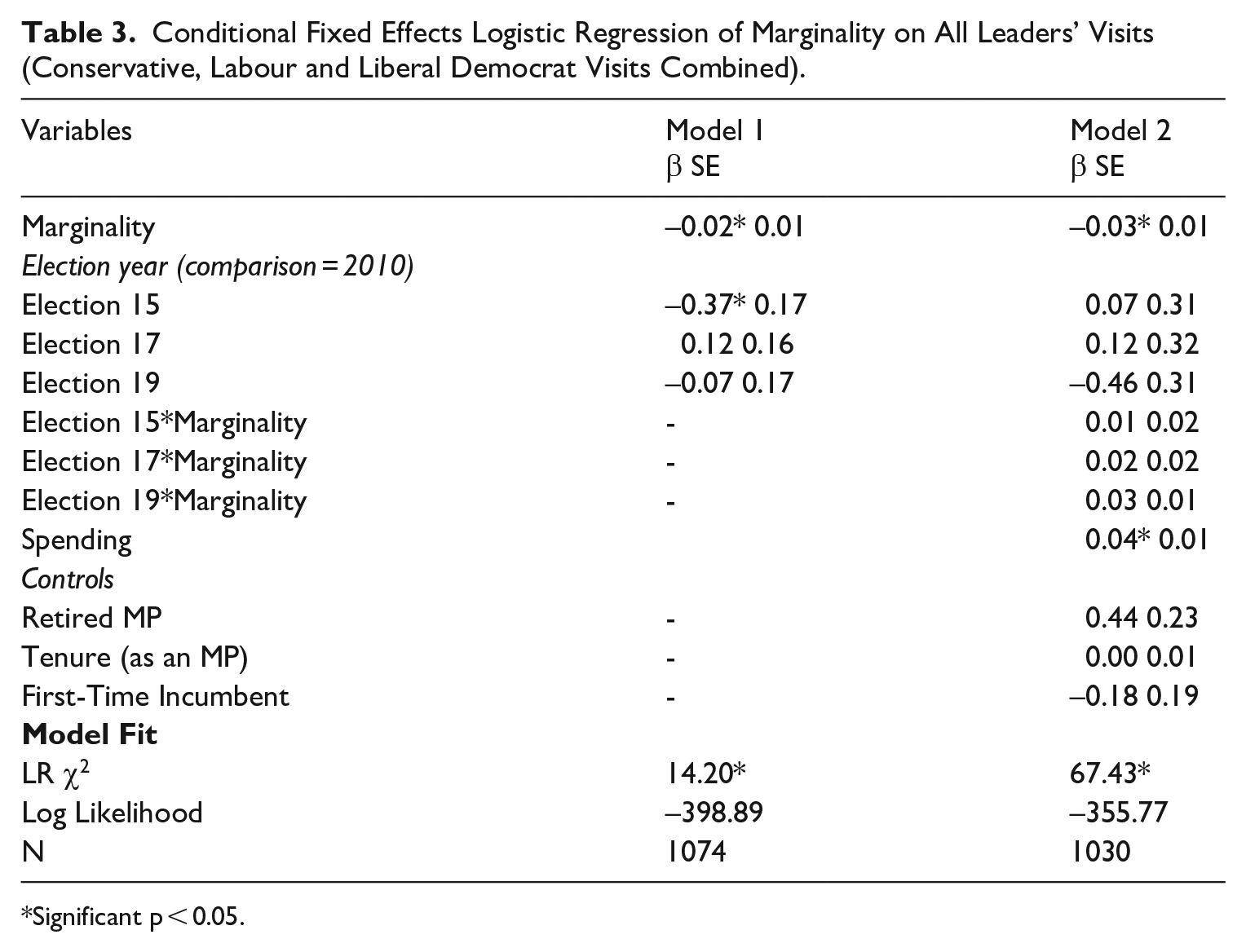
Significant p < 0.05.
To gain a deeper insight, we break leaders’ visits down by party and run conditional panel fixed effects logistic models of Conservative and Labour leaders’ visits (see Table 4). 5 Model 1 includes party marginality and year dummies, while in Model 2 we add a party spending variable to assess whether activism within the election campaign itself influenced where party visits took place. 6 Two key findings stand out. For the Conservatives, spending during the campaign significantly affects where a leaders’ visit took place while marginality proved to be insignificant. The more intensive the Conservatives grassroots constituency campaign the more likely the leaders’ visit (H2). For Labour, there is evidence that both prior seat marginality and local spending have a significant impact on Labour leader constituency visits. This supports both H1 and H2. 7
Conditional Fixed Effects Logistic Regression of Party Marginality and Spending on Conservative and Labour Leader Visits.
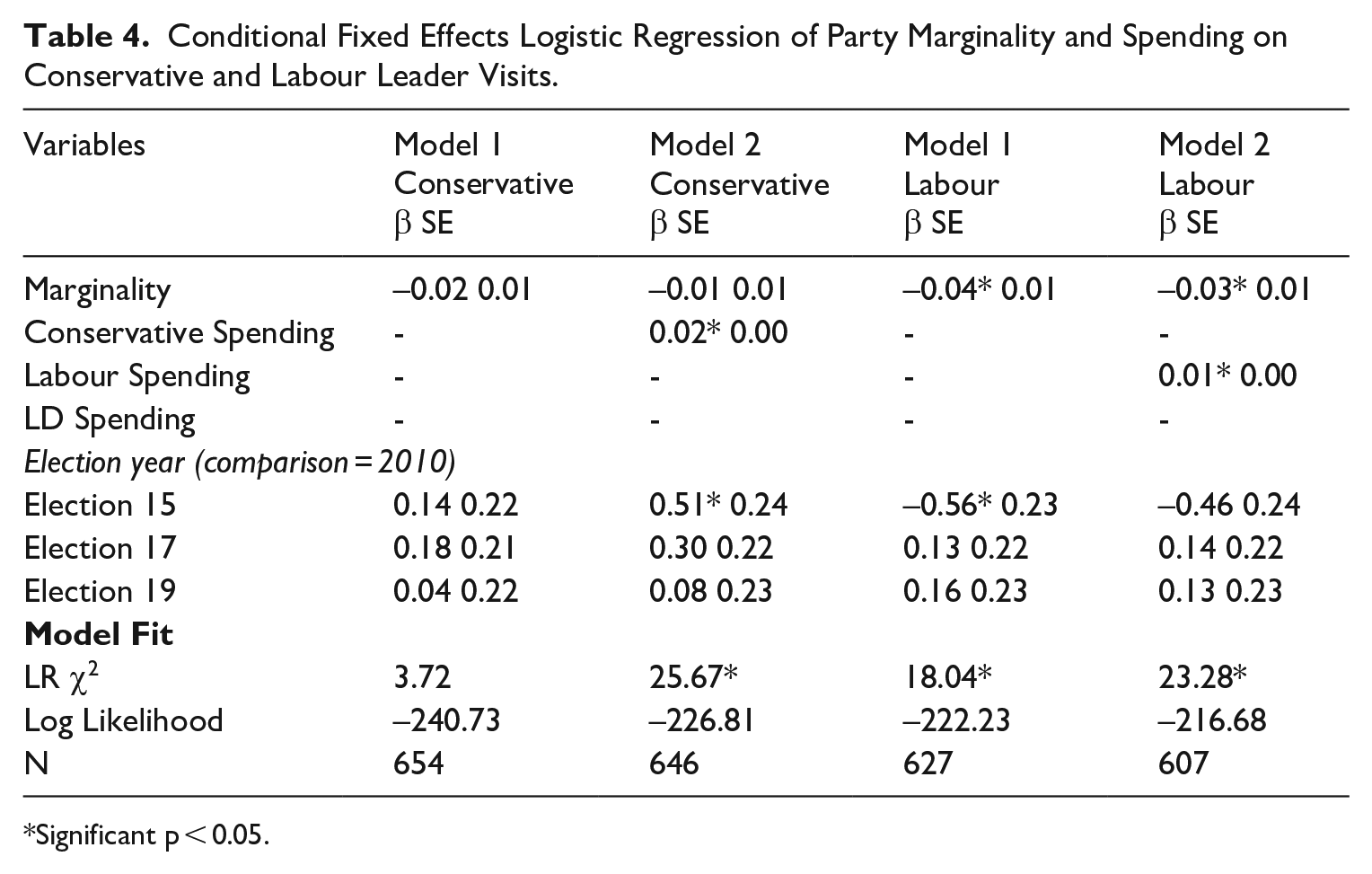
Significant p < 0.05.
But is there any evidence that the national electoral context – competitiveness of the general election – matters? To test this, we repeat model 2 in Table 3 and add other parties’ spending to capture local constituency campaign intensity and competitiveness and then interact party spending with election years to derive the difference in the party spending effect over each election year compared with the 2010 general election. The results are provided in Table 5. For Conservative leader visits, the significant effect for Conservative grassroots campaigning and Labour spending are the effects in 2010 but the insignificant interactions suggest that there are no differences in the effect of spending and marginality over subsequent general elections compared with 2010. For Labour, the effect of party spending in 2010 is insignificant but marginality remains strongly significant alongside Conservative campaigning. Both are unsurprising given the context of 2010 – Labour on the defensive – and as such leader visits were likely to be in places where contests were tight and Conservative grassroots activism was intensive. In addition, we find that the safer or less competitive the seat in 2017 the more likely a Labour leader will visit. This provides some corroborative evidence that in a less competitive national election party leader visits (in this case Labour) were significantly more likely in safer seats (H3). Evidence from Supplemental Table A2 (model 3) also suggests that Liberal Democrat visits in 2019 were more likely in safer seats when compared with 2010. Yet, given the conclusions from the all leader combined models, support for H3 is far from conclusive and it clearly varies by party.
Conditional Fixed Effects Logistic Regression of Party Marginality and Spending (Inclusive of Interactions; Controls Variables) on Conservative and Labour Leader Visits.
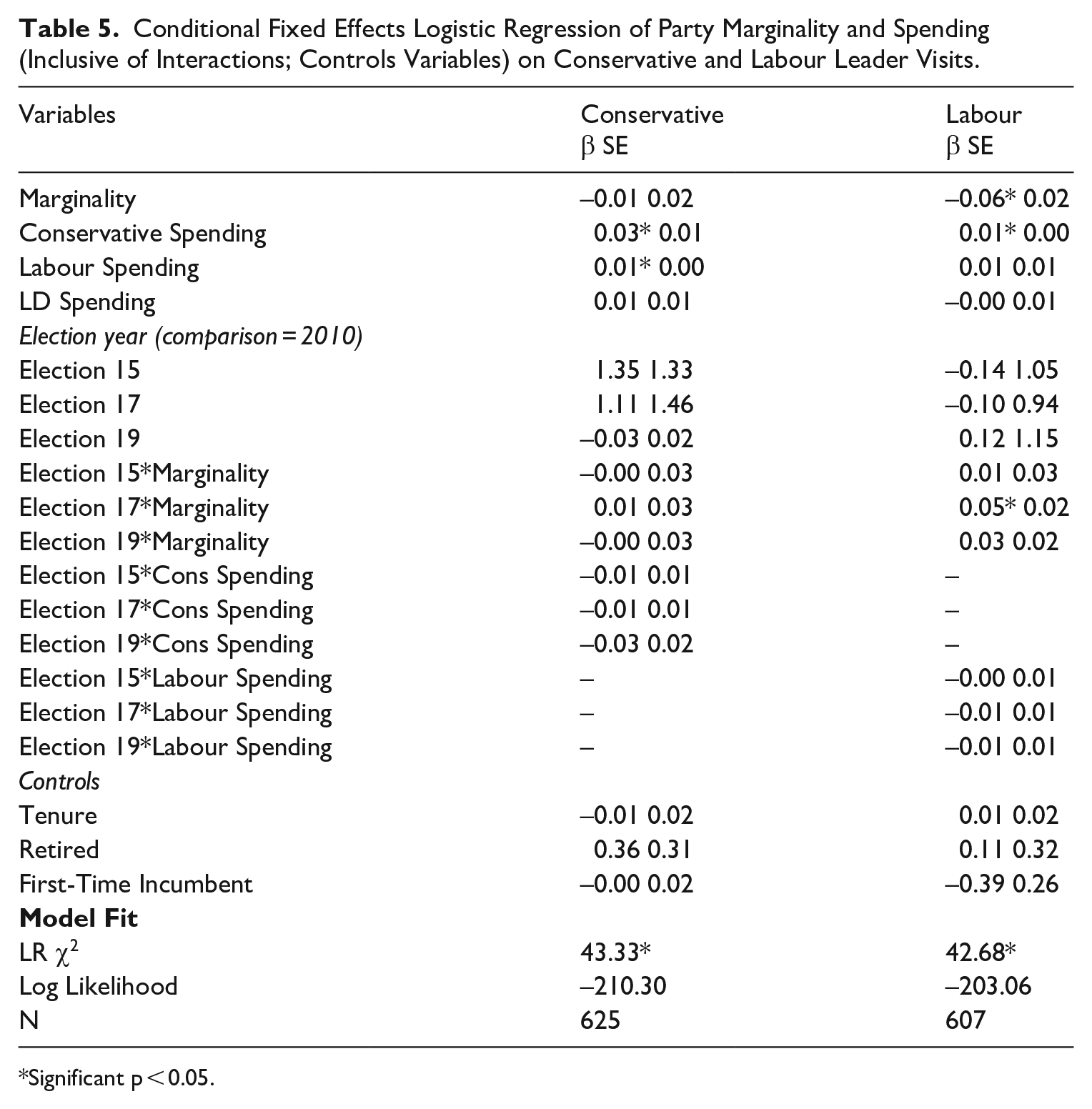
Significant p < 0.05.
Has Brexit Affected Leaders’ Visits?
The decision to leave the European Union (Brexit) in 2016 had dramatic consequences on British politics, arguably resulting in an electoral realignment in 2019 (Cutts et al., 2019). We expect Brexit to have influenced party strategy in 2017 and 2019 with Conservative leaders more likely to visit ‘Leave’ constituencies who were now far more receptive to the party’s discourse (H4a). Despite some ambiguity over Labour’s position on Brexit in 2017 and 2019, many in the party either advocated a ‘softer Brexit position’ or pushed for a second referendum. Labour’s electoral hopes relied on holding onto ‘Leave’ traditional voters in their strongholds while simultaneously building a coalition of ‘Remain’ voters in these seats – to repel any Conservative threat – and elsewhere to topple Conservative incumbents. This proved unsuccessful but along with the Liberal Democrats who were overtly pro-European and leapt from supporting a second referendum to ‘revoking Brexit’ over the course of two elections, our expectation was that Labour and Liberal Democrats leaders’ visits would likely to be focused on ‘Remain’ leaning seats (H4b).
In the 2019 election, ‘Get Brexit Done’ became the centrepiece of the Conservatives campaign and electoral pitch to voters. While many within the Labour parliamentary party either supported a ‘softer Brexit’ or even a second referendum, the Labour leaderships’ position was much vaguer in 2019 than in 2017. By contrast, the Liberal Democrats’ revoke policy was an explicit attempt to draw support from disillusioned ‘Remainers’ (Cutts et al., 2023). Our expectation is that Conservative leader visits were more likely to be focused in ‘leave’ constituencies in 2019 than 2 years earlier in an attempt to woo over-frustrated Brexit voters (H4c). We anticipate no likely shift in Labour and Liberal Democrat leader visits – while our expectation is that visits are more likely to be in ‘Remain’ seats, we have no reason to suspect it would be greater in 2019 than 2017 (H4d).
Given that the Brexit variable is time invariant, a fixed effects model is inappropriate, so we pool constituency data from 2017 and 2019 and run a pooled logistic regression model on party leader visits. Model 1 includes the percentage Remain recorded in each constituency and controls for party marginality and spending. Model 2 adds the controls in the earlier models alongside an election year dummy for 2019, interaction between percentage Remain and 2019 election year and socio-demographics.
The findings of the key variables for models 1 and 2 are reported in Table 6 (see Supplemental Appendix Table A3). There is no evidence that Brexit significantly influences Conservative visit strategy. This seems statistically robust as we find no bivariate relationship or evidence (see Figure 1) that there is an additional effect in 2019 compared with 2017 (any interaction with the 2019 election year proves to be insignificant). We, therefore, reject both H4a and H4c. One possible explanation for the findings, particularly in 2019, reflects the Conservatives’ dual targeting strategy of using visits to win over voters in traditional Labour seats like Darlington and Stockton South who overwhelmingly voted Leave while simultaneously holding onto voters in Conservative held strong Remain seats such as Cities of London and Westminster and South Cambridgeshire. For Labour, the more Remain leaning the constituency, the more likely they received a leader visit (H4b). There is also a significant bivariate relationship between Liberal Democrat leader visits and whether the seat voted Remain in 2016. Like Labour, this holds when marginality and spending are added (see Table 6, model 1). However, as expected, the predictive margins illustrate that the probability of Labour and the Liberal Democrat leader visits wasn’t more likely in Remain leaning seats in 2019 compared with 2017 (see Table 6, model 2 and Figure 1). We therefore confirm H4d.
Pooled Logistic Regression of % Remain on Party Leaders’ Constituency Visits (2017 and 2019 Elections; England Only).
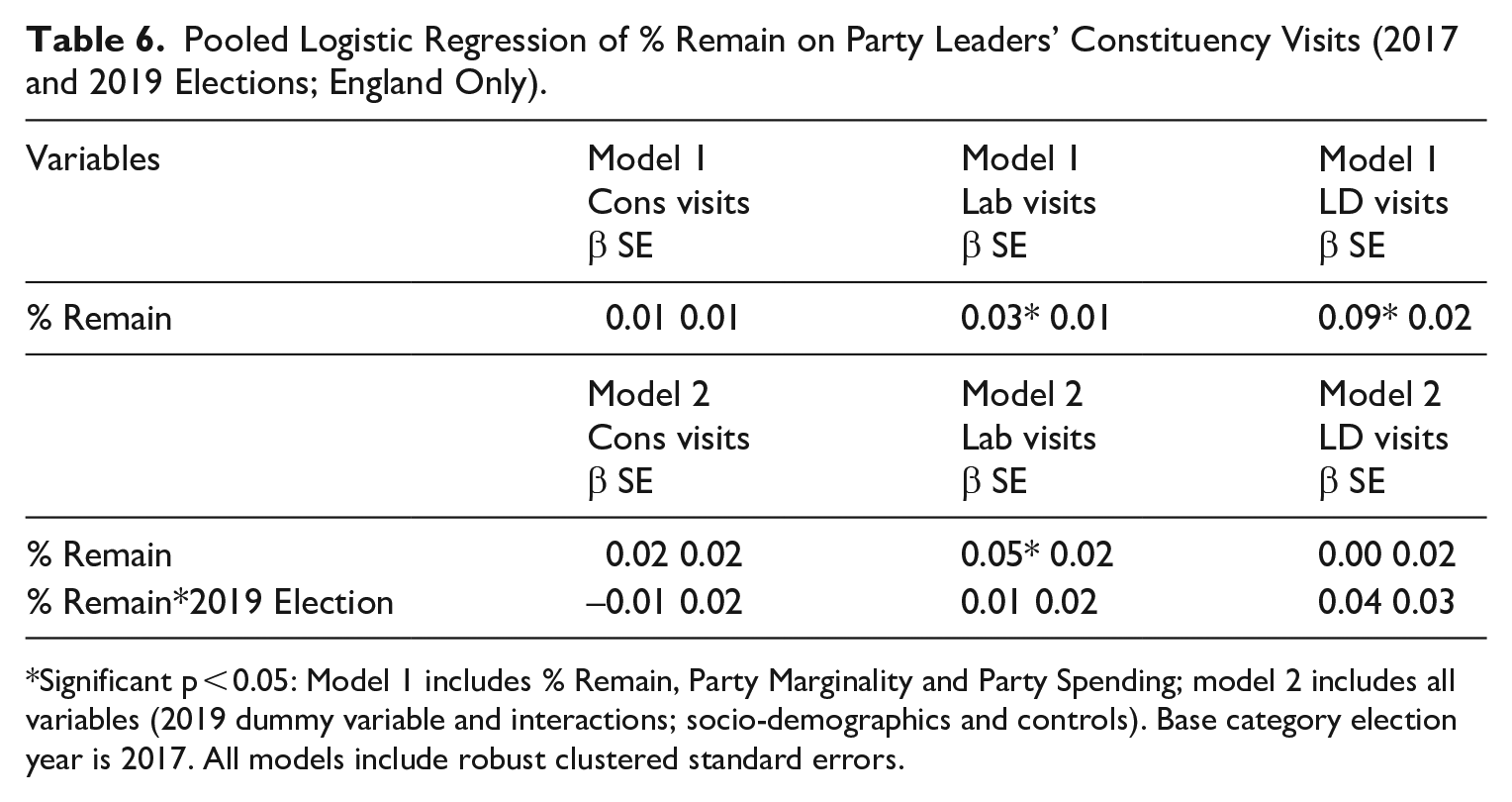
Significant p < 0.05: Model 1 includes % Remain, Party Marginality and Party Spending; model 2 includes all variables (2019 dummy variable and interactions; socio-demographics and controls). Base category election year is 2017. All models include robust clustered standard errors.
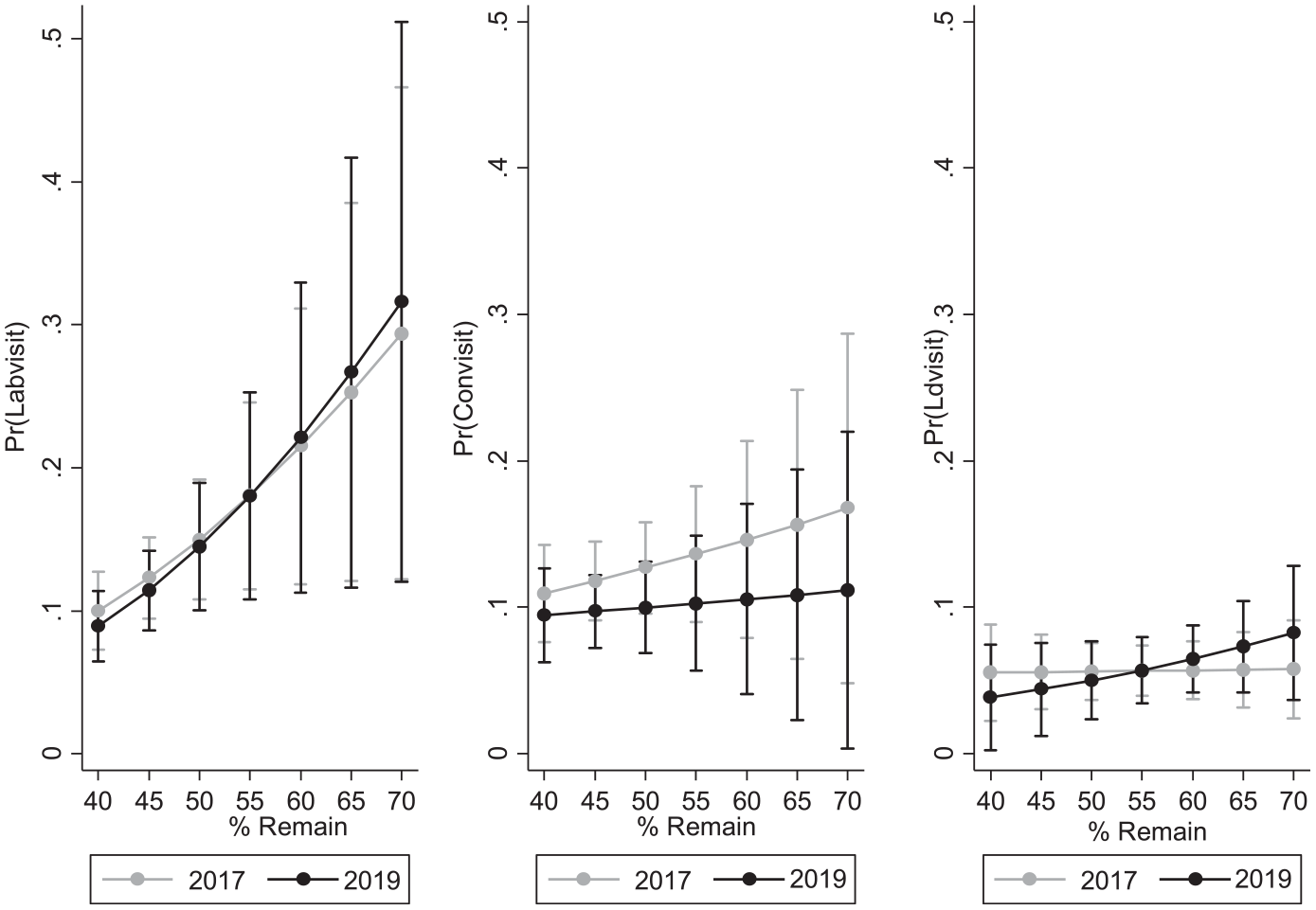
Predictive Margins: Probability of Party Leaders’ Constituency Visits by % Remain in 2019 Election Compared with 2017 (Model 2: England Only).
Types of Visit
Using data compiled over four elections from 2010 to 2019, our goal was not only to document where leaders visited but also when and the purpose of the visit. Regarding the latter, for the first time we are able to typologize leader visits in England into four main categories: grandstanding, policy-orientated, campaigning and cheerleader visits. We classify grandstanding and policy-orientated visits as outward-facing, ostensibly part of the ‘air war’ and geared to the national campaign. Grandstanding visits take place in conference settings and have little connection to the constituency where they take place. They often involve the leader making a formal speech or policy statement to exude governing competence with the goal of presenting the leader as ‘winner’. Policy-orientated visits often use the local setting – from meeting the local candidate and local people to visiting a local hospital or speaking to children in a classroom at the local school – as the arena through which to advance and reiterate a carefully constructed message which is designed to have national resonance. Such visits may involve a formal speech on policy or using the setting to capture photographs for national newspaper or social media feeds. It is ostensibly outward-facing. By comparison, we categorize campaigning and cheerleader visits as inward-facing. Both are embedded in the local. The former includes the traditional walkabout in a town centre or engaging in campaign activities such as delivering leaflets or doorstep canvassing voters alongside the local candidate. Here, the leader is exposed to ‘real voters’ to demonstrate approachability albeit nowadays walkabouts in British general elections are increasingly staged to reduce the risk of embarrassing confrontations and voter hostility. The goal of cheerleading visits is to build enthusiasm and provide a morale boost to local constituency workers and activists. They typically resemble a local rally where the leader gives a formal speech in front of a local friendly audience, surrounded by placard-waving supporters. The speech uses national branded policy messages tailored to the local context. Cheerleader visits also double up as an opportunity for the leader to speak to local journalists and media outlets thereby reinforcing its inward status.
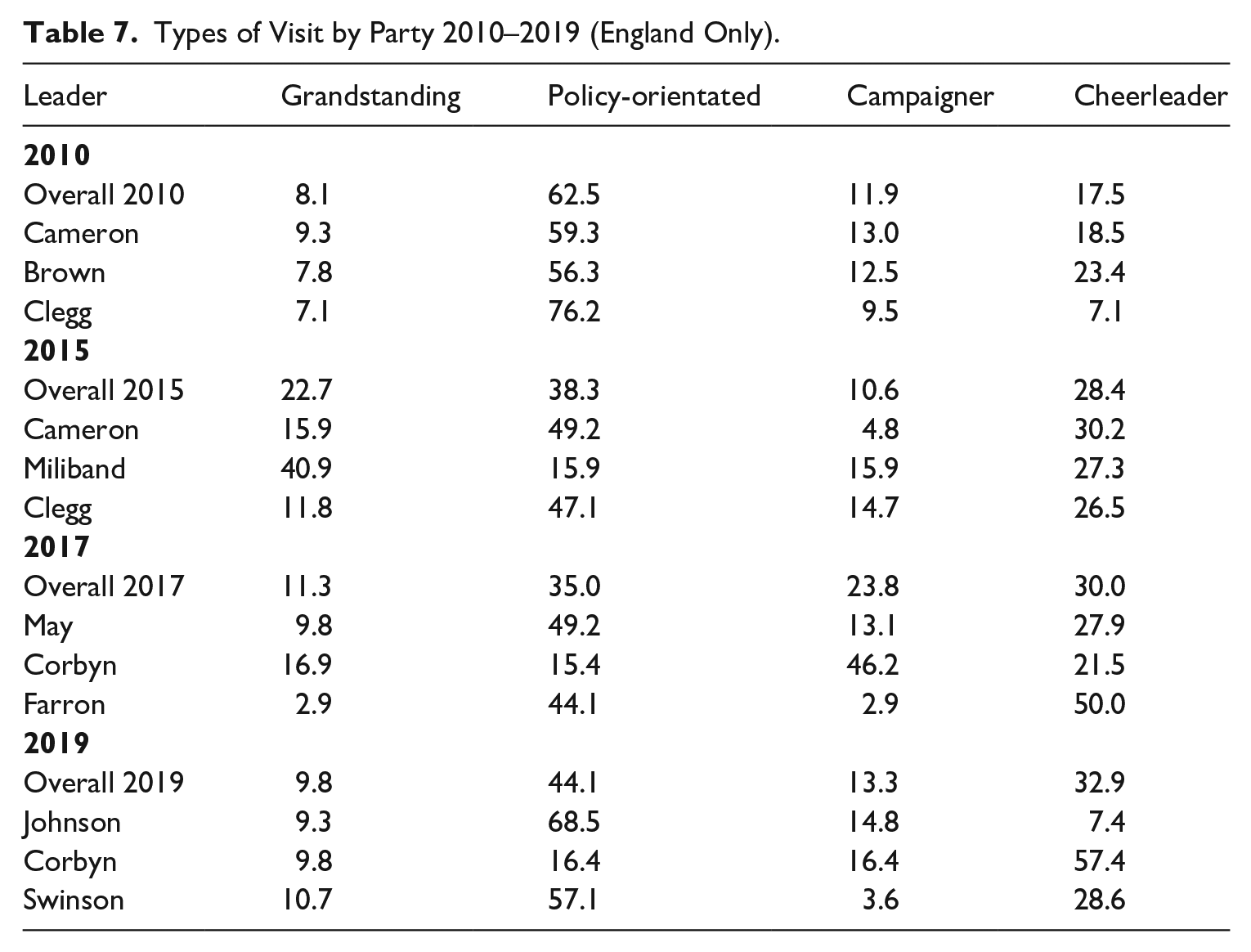
So have visits becoming more outward-facing over time (H5) and how do they vary by party? Contrary to expectations, overall, leader visits have become far more inward-facing since 2010 (see Table 6). There was a slight uptick in outward visits in 2019 compared to 2017 but even then, overall, the split is fairly even. Two years earlier, there were more inward than outward visits. This was primarily driven by Corbyn and his use of local rallies and visits to boost activist morale and support local campaigning. Yet, even under Miliband, Labour had begun to rely less on outward-orientated visits, albeit the growth in ‘grandstanding’ visits to portray Miliband as a ‘leader in waiting’ does somewhat blur this apparent trend. The change in Liberal Democrat leadership – from Clegg to Farron – post 2015 marked a return to its traditional grassroots community politics roots. Farron epitomized this with half of his visits categorized as ‘cheerleader’ designed to build activist enthusiasm and invigorate the ‘ground campaign’ in key seats. However, it is worth noting that evidence of a sea-change in strategy predates this with inward-orientated visits rising considerably in 2015 when compared to 2010. In 2019, Swinson’s ‘presidential leadership style’ meant a return to the 2010 election ‘Clegg script’ of third-party leader visits. In three of the four election studied, overall, Liberal Democrat leader visits have been primarily outward-facing. While the proportion of Conservative outward visits did drop over three elections from 2010 to 2017, these themed visits still remained in the majority. In 2019, nearly 80% of leader visits by Johnson were outward-facing. Breaking this down, it is clear that policy-orientated themed visits dominate Conservative leader strategy. And outside of Farron’s emphasis on cheerleading visits in 2017, they remain the main purpose of Liberal Democrat constituency visits. As a third party battling to get air time and exposure of their policy positions, this isn’t surprising. Even under Farron, more than two fifths of Liberal Democrat leader visits were policy-orientated. Aside from 2015, where the proportion of grandstanding visits increased for all parties compared to 2010, over the four elections, it remained the least favoured themed visit. The other notable trend is the steady growth of cheerleader visits which in 2019 reached nearly third of all constituency visits as opposed to just over 17% at the start of the decade (see Table 7). Our descriptive evidence, therefore, does not support H5.
Types of Visit by Party 2010–2019 (England Only).
What explains changes in the type of visit over time? Are inward visits more likely in marginal seats where parties spend more (H6) and are such leader visits significantly more likely the closer it gets to polling day (H7)? For the purpose of this analysis, we examine only constituencies where leaders’ visited from 2010 to 2019 and classify these as ‘outward’ or ‘inward’ based on the type of visit using our classification explained above. Only 15 constituencies were visited at every election by one of the three main party leaders. Consequently, we run a series of pooled logistic regressions to establish the key drivers of inward visits including the same variables as above with two notable additions. First, we take account of whether the visit was defensive (to a constituency where the party already held the seat). Not only does this act as proxy for the electoral context facing the party – where a party is trailing in the polls or has suffered a number of electoral reversals during the electoral cycle, it is likely that the electoral strategy would be primarily focused on preserving the seats they have – but defensive visits by their very nature are to seats where the party has a strong local presence so it is possible that these are more likely to be inward- rather than outward-orientated. Second, to test H7, we take account of when the visit took place. Here our expectation is that inward leader visits are far more likely in the final week of the campaign than in the 3 weeks before it.
Our findings reveal that the closeness of the seat and the intensity of the local campaign had no significant impact (see Supplemental Appendix Table A4). The trend over time is clearly reinforcing the descriptive findings noted earlier. Inward visits are significantly more likely in 2015, 2017 and 2019 when compared against the 2010 election. To ease interpretation, we estimate the discrete change in the probability for each of the values averaged across the observed values (the average marginal effects (AMEs)). As Figure 2 shows, on average the probability of an inward as opposed to an outward visit is 14 percentage points higher in 2015, 26 percentage points higher in 2017 and increases by 17 percentage points when compared to 2010, cementing campaigner- and cheerleader-orientated visits as a staple part of British election campaigns. Supporting H7, we find that the probability of an inward leader visit is 21 percentage points higher in the final week than at other times of the election campaign.
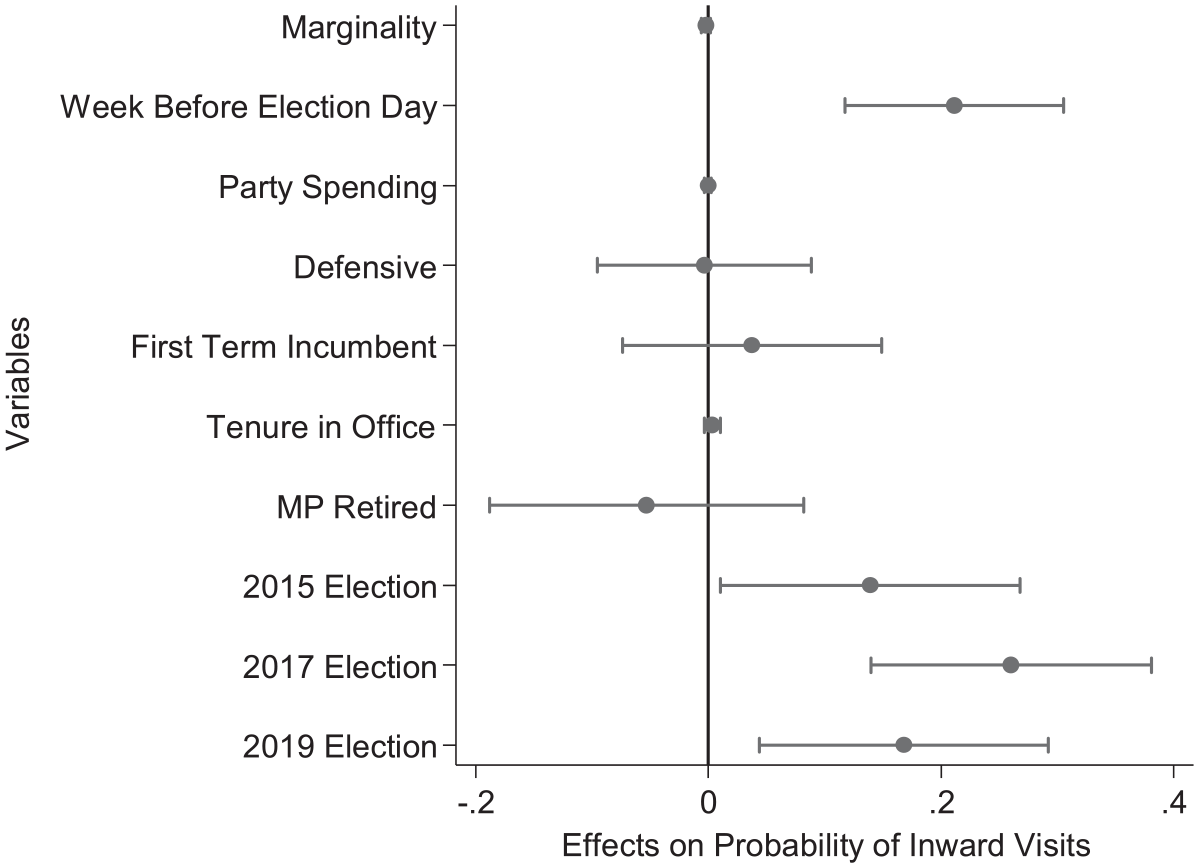
Average Marginal Effects of All Inward Visits 2010–2019.
For all three parties, inward leader visits are significantly more likely in the final campaign week than in the 3 weeks prior. On average, the probability of a Labour leader visit in the days closest to polling day is 22 percentage points higher than earlier in the campaign. For the Conservatives, it is 20 percentage points higher while for the Liberal Democrats the probability increases by 26 points holding all variables constant (H7). As expected, Labour leader (Corbyn) visits were far more inward-orientated in 2017 and 2019 than in 2010. The probability of inward visits compared with 2010 increases by 36 percentage points in 2017 and is 41 points higher in 2019. Likewise, both the Conservatives and the Liberal Democrats in 2017 were significantly more likely to conduct campaigner- and cheerleader-orientated visits (21 and 36 percentage points higher respectively than in 2010). Interestingly, we find no evidence that the Miliband ‘5 million conversations’ strategy led to more inward Labour leader visits in 2015 than 2010. Instead, the growth prior to 2017 is primarily driven by the Liberal Democrats. Earlier in the descriptive analysis (see Table 6), we noted that in 2015 more than 40% of Liberal Democrat visits were inward-orientated compared to roughly 17% five years earlier. Unsurprisingly, the probability of inward Liberal Democrat visits is 28 percentage points higher than in 2010. With the party’s local electoral base decimated during the coalition years, and an embattled Clegg seeking to shore up as many votes as possible where they were strongest, it is somewhat predictable that the leader visit strategy would be inward- rather than outward-orientated (Cutts et al., 2023). The insignificant finding in 2019 reflected the more outward looking ‘presidential’ strategy of Swinson which was an ‘about turn’ from the Farron years.
Impact of Visits: Did Leader Visits Matter?
For all the razzmatazz, paper column inches and round the clock media scrutiny of leaders’ visits, the key question remains whether they actually make any difference to party support? And given the volatility of recent elections, when compared with the 2010 election, did any impact vary by party and by election? To gauge whether party leaders’ visits matter, we examine their impact on a combined measure of party support and turnout (party vote share of the electorate) over the four elections from 2010 to 2019. We use the same party spending, marginality, seat visit variables and election year dummies as outlined above and also control for party incumbency. We then interact these party leader visit variables by election year to contrast the impact of visits against the reference category 2010 election on party support. The goal of constituency campaigning (and in our case one of the purposes of a leaders’ visit) is to maximize the proportion of the local electorate which votes for the local party candidate and as such parties not only seek to attract core partisans but also persuade and mobilize new voters and those electors who have a history of abstaining. This dependent variable captures these effects.
The first set of results from each party-specific fixed effects linear models are shown in Supplemental Appendix Table A5. We report the AMEs in Figure 3 below. All three main parties’ leader visits had a significant positive effect on their respective party performance after controlling for other covariates (H8). While Liberal Democrat visits had a detrimental effect on Labour performance. The models themselves operate largely as expected with party performance appreciably higher for the Conservatives in 2017 and 2019 and across the three elections – 2015, 2017 and 2019 – for Labour when compared against the 2010 general election. Contrastingly, Liberal Democrat support is significantly lower post-2010 after going into coalition with the Conservatives and their failure to reach the high electoral ‘watermark’ achieved during the height of ‘Cleggmania’ in 2010. The party campaigning and incumbency variables also align as anticipated. But do leader visits vary by party and election when contrasted with 2010? Supplemental Appendix Table A6 provides full details of the model inclusive of party visit and election interactions. The coefficient for party leader visit is the effect in the 2010 election and the coefficients on the interactions are the difference in the effect over the three subsequent elections contrasted with the 2010 election. Figure 4 contrasts the predictive margins of party leader visits at these elections with the 2010 election.
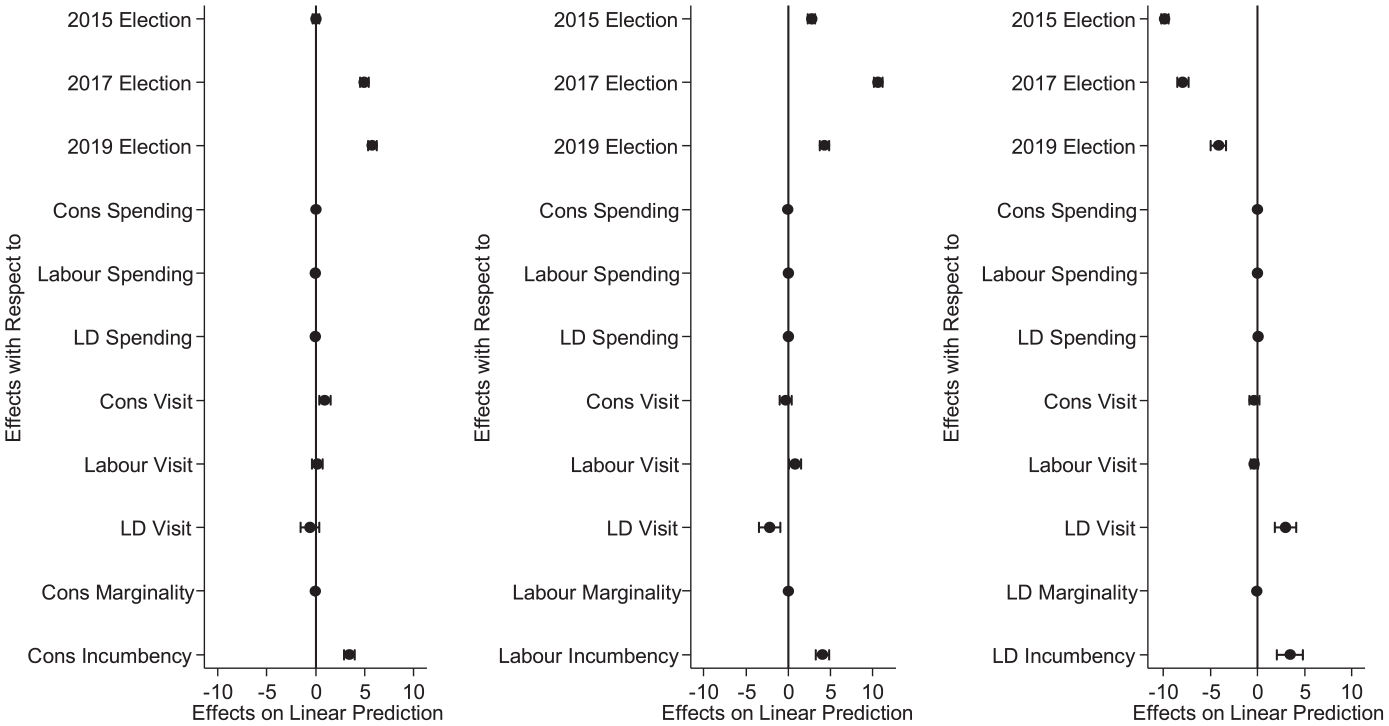
Average Marginal Effects with 95% Confidence Intervals from Fixed Effects Model of Party Leader Visits on Conservative, Labour and Liberal Democrat Performance (2010–2019).
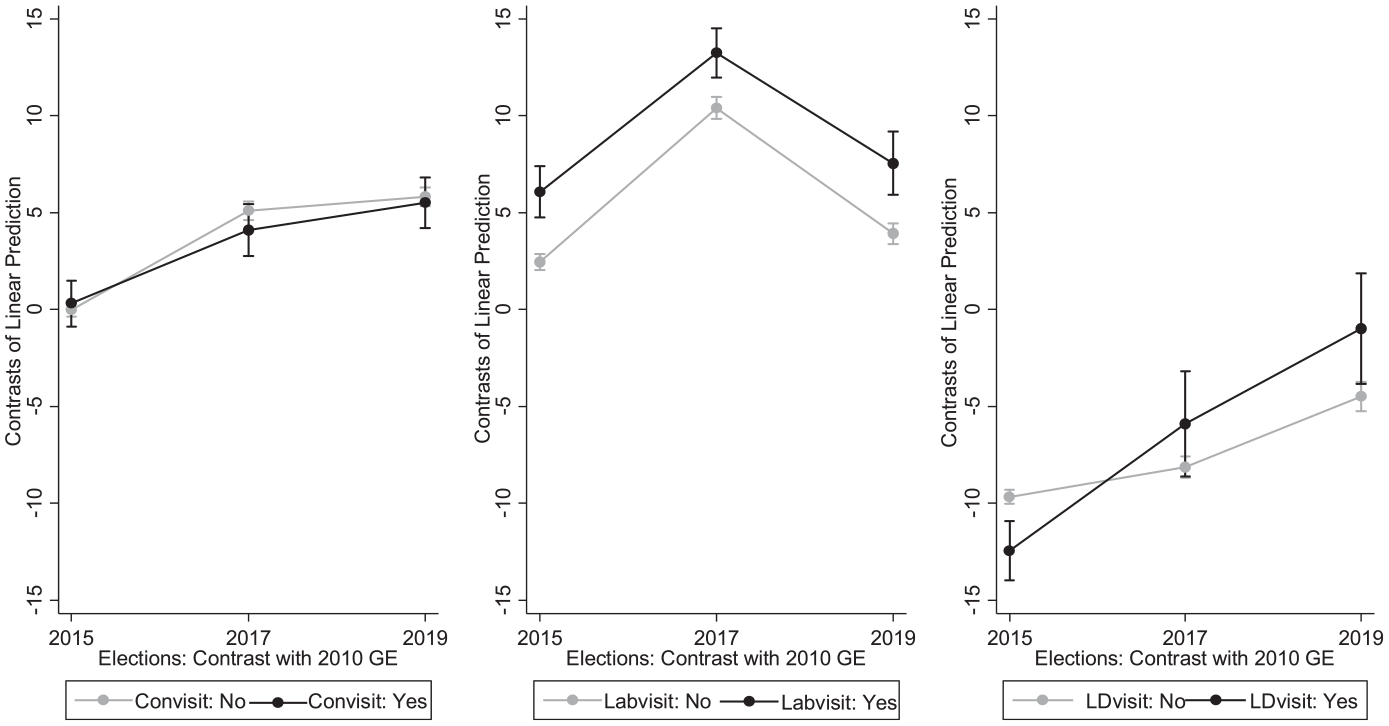
Contrasts of Predictive Margins of Party Visits by Election on Party Vote Share of the Electorate with 95% Confidence Intervals from Fixed Effects Model: 2010 Election (Reference Category).
For the Conservatives, our expectation was that Cameron’s ‘decapitation visit strategy’ in 2015 would have positively impacted party performance compared to 2010. Similarly, the negative narrative of the 2017 Conservative campaign, from making a weak candidate in May the focus of a ‘presidential style’ pitch, the somewhat robotic messaging of ‘strong and stable’ to the misjudged targeting strategy where a sizable number of visits took place in relatively safe Labour areas would prove detrimental (H9a). As Figure 4 shows, we actually find no significant differences at any of the elections when contrasted with the 2010 election. We therefore reject H9a.
For Labour, unsurprisingly leader visits – under Miliband in 2015 and Corbyn in 2017 and 2019 – had a positive and significant impact on party performance when compared with Brown’s overwhelmingly defensive (H9b). The opposite is true for the Liberal Democrats. When contrasted with Clegg’s outward-facing style, Farron’s grassroots community politics ethos did not have a significant positive effect on party performance. We, therefore, partially reject H9c. In 2015, Clegg ceased to be an electoral asset and was unpopular among sizable sections of the electorate who had supported the Liberal Democrat leader 5 years earlier. With leader visits primarily focused in seats where the party previously had relied on the lent support of these voters to oust predominantly incumbent Conservatives, it is unsurprising that in contrast to 2010, Liberal Democrat visits had a negative effect on party support. At first glance, the positive finding in 2019 is somewhat surprising. Swinson’s presidential style, however, does overshadow the reality of Liberal Democrat visits in 2019 which was confined to a specific set of winnable seats and a small number of constituencies they were defending, both of which were subject to intensely focused activism. Moreover, even though Swinson’s style of leadership was far more outward-facing than Farron in 2017, the number of Liberal Democrat inward leader visits were double that of 2010 with around 3 times as many Cheerleader visits in 2019 than under Clegg in 2010.
Conclusion
Leaders’ visits have become a ‘staple diet’ of British general election campaigns. Yet, they remain under-explored. To redress this imbalance, we focused on three broad themes. Initially, we examined what drives leaders’ visits? Our findings suggest that visits are more focused on electorally competitive seats but not exclusively so and that this varies by party and the electoral context. Indeed, it is difficult to diagnose a discernible trend over time as parties increasingly have adopted dual leader visit strategies – targeting marginal seats both offensively and defensively and opponents’ relatively safe seats – within an election. Nonetheless, our prior expectation that marginality or party activism in the seat remained a key factor in determining leader visits’ was realized in the statistical models once other factors were controlled for. However, our expectation that it would vary by party and the competitiveness of the election was less apparent. Aside from the Conservatives, amid the null findings there were exceptions. Predictably, only in 2017 for Labour did we find that leader visits were more likely in safer seats when compared to 2010 and similarly in 2019 for the Liberal Democrats who post-2015 had become stuck between seeking to defend what they had and also looking to expand where they could. The impact of the Brexit vote on which constituencies leaders visited in 2017 and 2019 also provided mixed results. Despite the Conservatives’ strong ‘Leave’ credentials, we find no evidence that it influenced party visit strategy and no additional ‘Brexit’ effect in 2019 compared with 2017. For Labour and the Liberal Democrats, the more Remain-leaning the constituency, the more likely they were to receive a leader visit. However, neither Labour nor the Liberal Democrat leaders were more likely to visit Remain seats in 2019 compared with 2017 despite the salience of the issue.
For the first time, we provided a typology of leaders’ visits which we simplified into inward and outward visits. Contrary to our expectations, while outward visits slightly increased in 2019 compared to 2017, overall, leader visits have become far more inward-facing since 2010. Inward-orientated visits for all parties were significantly more likely in the latter stages of the campaign as polling day neared. We find strong evidence of a ‘Corbyn effect’ for Labour but the trend towards inward visits actually predates the Labour leader as epitomized by Clegg’s sea-change in strategy in 2015 compared to his ‘presidential approach’ 5 years earlier.
Finally, regarding party performance, for all three main parties’ leader visits mattered. Despite hypothesizing positive effects of Conservative leader visits in 2015 and a negative impact in 2017 when compared to 2010, we found no significant differences at any of these elections. The findings for Labour under Miliband in 2015 and Corbyn in 2017 and 2019 were as anticipated when contrasted with Gordon Brown in 2010. For the Liberal Democrats, contrary to expectations, Farron had no effect on party performance. And while Clegg’s visits had a negative effect on party performance in 2015 when compared with 5 years earlier, Swinson’s positive impact is somewhat surprising given her outward-facing style of leadership. Yet, while Swinson did adopt a ‘presidential style’, her inward leader visits were double that of Clegg in 2010 and clearly affected party performance in 2019.
Our analysis has given us a deeper understanding of what influences a leaders’ visit, its purpose and whether it drives party performance across elections but there remains gaps in our knowledge which could be the focus of future research. Moving forward, given the continuous nature of local campaigning across the electoral cycle, taking account of local election performance in the seat and the intensity of activism outside of the election campaign period may provide additional explanations for why leaders’ visit a seat or not. Drilling down further into the type visits – across policy areas, the leaders’ role ‘behind the scenes’ to boost local activism and interaction with local media – would add greater depth to our understanding of how parties strategize visits at certain periods of the campaign. The role and influence of the media (both nationally and locally) remain another under-explored aspect of leaders’ visits. How visits are reported, where and by whom and the discourse generated from speeches and photo opportunities need to be examined further in the British electoral arena. Future work could embrace individual-level panel data to assess whether leaders’ visits impact perceptions of winning the constituency during the election campaign which may indirectly influence partisans to turn out and affect tactical considerations which in turn may affect vote choice. Alongside other items which make up the ‘air war’, future research could assess how visits impact party choice, whether it differs by election and if it influences conversion from an opposing party during the campaign itself. In addition, further research could assess whether leaders’ visits affect how voters evaluate leaders and if through leaders they have an indirect effect on party performance (Middleton, 2021). With every vote and seat now ‘up for grabs’, examining leaders’ visits is likely to matter more than ever. Put simply, where they go, why, when and the purpose of the visit could either reaffirm or change voters’ perceptions and in a close contest be the difference to getting over the winning line or not.
Supplemental Material
sj-docx-1-psx-10.1177_00323217241255025 – Supplemental material for Where Do They Go and Why, How Do They Vary and What Is Their Impact: Assessing Leaders’ Campaign Visits in England 2010–2019
Supplemental material, sj-docx-1-psx-10.1177_00323217241255025 for Where Do They Go and Why, How Do They Vary and What Is Their Impact: Assessing Leaders’ Campaign Visits in England 2010–2019 by David Cutts and Alia Middleton in Political Studies
Footnotes
Declaration of Conflicting Interests
The author(s) declared no potential conflicts of interest with respect to the research, authorship and/or publication of this article.
Funding
The author(s) received no financial support for the research, authorship and/or publication of this article.

Supplemental Material
Supplemental material for this article is available online.
Notes
Author Biographies
References
Supplementary Material
Please find the following supplemental material available below.
For Open Access articles published under a Creative Commons License, all supplemental material carries the same license as the article it is associated with.
For non-Open Access articles published, all supplemental material carries a non-exclusive license, and permission requests for re-use of supplemental material or any part of supplemental material shall be sent directly to the copyright owner as specified in the copyright notice associated with the article.
