




Abstract
Many citizens are frustrated with their democracy, particularly with elected representatives and political parties. In some contexts, citizens have taken steps to disrupt the status quo and push forward their own novel democratic reforms. Research on these ‘citizen-led democratic innovations’ has focused primarily on how political crises mobilise citizens to form social movements that then go on to devise or co-produce novel participatory institutions. This article expands these existing understandings in two novel directions. First, it challenges the assumption that for citizens to lead democratic reform they first need to mobilise a large protest movement. Second, it expands procedural understandings of ‘democratic innovation’ by considering how citizens are innovating in and around the core institutions of representative democracy. The article draws empirical insights from extensive qualitative research into Australia’s Community Independents Movement, which reveals a place-based, locally led political movement pursuing democratic change to improve local representation in national politics.
Keywords
Introduction
Many citizens around the globe are dissatisfied with the quality and performance of their democratic systems. Recent surveys reveal worryingly low levels of citizen trust particularly in elected representatives, political parties and legislatures (e.g. OECD, 2022). 1 In some contexts, citizens are so frustrated with their democratic institutions that they have taken steps to challenge and change the status quo. Well-known pathways that citizens travel here include the mobilisation of large protest movements to disrupt and advocate for political reform, such as 15M in Spain (Hughes, 2011), or the formation of alternative political parties, such as Podemos in Spain (Font et al., 2021) and UKIP in the United Kingdom (Ford and Goodwin, 2014).
As the gap between citizens’ expectations of democracy and their experience of it widens, we are also witnessing the rise of so-called ‘citizen-led democratic innovations’, where social movements devise or co-produce novel participatory institutions in response to a political crisis (della Porta and Felicetti, 2022). Well-known European cases here include the Saucepan Revolution in Iceland that emerged in response to the government’s failed handling of the financial crisis, which led to a crowd-sourced proposal for Constitutional reform (Bergmann, 2016; Landemore, 2015); and the protest movement in Belgium that formed in response to a parliamentary crisis and led to the formation of the G1000 citizens’ assembly (Caluwaerts and Reuchamps, 2018). Experiments in citizen-led democratic innovation reveal that while social movements are well-placed to mobilise popular support for participatory reforms, they struggle to produce change in representative institutions because their initiatives are either too close to the state (and thus captured), or too far away (and thus ignored) (della Porta and Felicetti, 2022: 78).
In this article, we enrich these debates on citizen-led democratic innovation by presenting a case in which citizens have led ambitious and impactful democratic innovation in the heart of mainstream representative institutions. Our empirical case extends existing conceptualisations of citizen-led democratic innovation in two novel ways. First, it expands existing ideas of what it means for citizens to lead democratic reform. Current accounts of citizen-led democratic innovation conflate ‘citizen-led’ with ‘movement-led’, and thus they infer that for citizens to lead democratic reforms they require mass mobilisation of a protest movement. Moreover, there is an assumed causal relationship between social movements and democratic innovation, whereby popular protests lead to the formation of a social movement which then organises or co-produces a participatory institution (della Porta and Felicetti, 2022). We challenge this causal understanding by presenting a case where locally led reform groups connected to form networks, from which a national movement for political change emerged. In other words, the movement we analyse here was not a precursor to democratic innovation, but instead it co-evolved with and through local democratic innovations. Second, our case expands existing notions of what innovative democratic reform entails. The citizens we discuss in this article are realising democratic change through local place-based efforts to strengthen connections between constituents and elected representatives, rather than devising or co-producing a novel participatory institution. Here we depart from procedural conceptions of democratic innovation, 2 and join a nascent body of scholarship drawing attention to the myriad of ways that citizens are innovating in and around democratic institutions, from reclaiming existing participatory spaces (Bua and Bussu, 2023), to grassroots problem-solving (Hendriks and Dzur, 2022), through to small-scale repairs of conventional democratic practices and governance (Burnett and Nunes, 2021; Hendriks et al., 2020).
Our analysis centres on Australia’s Community Independents Movement (CIM), which is a collective term for a range of local community groups that have been self-organising since 2012 in over 40 of 151 federal electorates. Citizens in this popular movement have a simple yet ambitious goal: they want the system of representative democracy to work for people not parties. To realise this vision, citizens in the movement self-organise into local groups that engage community volunteers in various place-based reforms aimed at strengthening the quality, integrity and impact of local political representation. 3 In many federal electorates across Australia citizens have taken their local reform efforts into the electoral process by selecting or endorsing a community independent (non-party) electoral candidate, thereby providing voters with an alternative to the candidates of the major political parties.
Although citizens in the movement focus on local interventions, their collective impact on Australian electoral politics is unprecedented. During the 2022 federal election CIM’s place-based efforts disrupted Australia’s stable two-party system and resulted in key changes to the composition of the Australian Parliament, both in the House of Representatives and in the Senate (see Holmes à Court, 2023; Turner, 2022). More broadly, CIM has fundamentally changed Australia’s contemporary electoral landscape by disrupting established patterns and practices of candidate selection, election campaigning and constituency work around the nation.
CIM is a globally significant case of ambitious citizen-led democratic innovation that strikes at the heart of representative democracy. Citizens in this movement are not simply experimenting with democratic reform; they are realising it. They are taking practical steps to address a number of pressing democratic problems on which scholars and practitioners of democratic innovation have had surprisingly little to say, including declining support for party politics, the problem of safe seats, divisive elections and inauthentic constituency engagement. Indeed by actively reshaping the practices and outcomes of electoral democracy, citizens in this movement are tackling some of the most dysfunctional aspects of representative institutions today such as the weakening representative capacity of political parties and the declining legitimacy of electoral politics (Heidar and Wauters, 2019; Wolkenstein, 2019). By looking closely at CIM, we learn more about the possibilities and challenges of citizens leading democratic reform, particularly from within the existing institutions of representative democracy.
In what follows, we present an in-depth analysis of CIM and examine the motivations, approach and impact of this novel democratic reform movement. Our approach is interpretive, aimed at exploring the lived experiences and interpretations of a range of participants and local groups in the movement. We draw on diverse qualitative data collected over an 18-month period (between July 2021 and January 2023), during which we were able to capture insights before, during and after the May 2022 Australian federal election. 4 Our specific data sources include as follows:
Over 40 semi-structured interviews with convenors of local CIM groups, community independent candidates and campaign managers to explore motivations, engagement activities, candidate selection processes, campaign strategies and broader reflections;
Interviews with key interlocutors, strategists and funders in the movement;
Participant observation of over 20 community events, campaign efforts and public meetings in diverse electorates;
Text analysis of relevant parliamentary speeches, press releases, media articles and digital resources including webinars, websites and social media platforms.
We begin with a brief overview of the movement’s history and democratic impact. Next, we examine how citizens in the movement have sought to repair local electoral representation. Our analysis, which considers four overlapping stages of reform work, draws attention to how citizen-led approaches within the movement varied between electorates and over time. In the final sections, we draw out the key lessons that CIM holds for contemporary debates on citizen-led democratic innovation and identify areas for future research.
The Community Independents Movement (CIM)
In early 2022, there was an unusually high level of international interest in an Australian federal election. The big news story both in Australia and abroad was the fact that over 20 community independent candidates were standing in the May federal election, and most of these were professional women – doctors, lawyers, executives – contesting safe Liberal Party-held (conservative) electorates in Sydney, Melbourne and Perth. Some of these non-party female moderates were posing a real electoral threat to senior conservative government figures, such as the treasurer at the time, Josh Frydenberg (see Saville, 2022).
The widespread electoral challenge from independent candidates around the nation was completely novel in Australian politics. Conventionally, political representation in Australia is dominated by two major parties – the Australian Labor Party (ALP; progressive) and the Liberal Party of Australia (conservative; in coalition with the National Party) (Gauja, 2015). Support for the major parties has been in slow decline since the 1970s, with some voters drifting over to support smaller parties and independents (Cameron et al., 2022). 5 Notwithstanding Australia’s declining partisanship, its majoritarian electoral system in the House of Representatives biases outcomes towards the major parties, and consequently minor party and independent candidates struggle to get elected. 6
Behind these headline items is a broader story of democratic renewal driven in large part by local community groups that have self-organised to strengthen electoral representation in almost one-third of Australia’s 151 federal electorates. 7 Most of these reform groups have formed around the geographical area of their federal electoral division, which range in size from less than 50 km 2 to over 1 million km 2 (almost twice the size of France). Groups emerged in diverse metropolitan, regional and rural electorates around the nation, with a large number concentrated in the two most populous states of New South Wales and Victoria.
Citizens leading and participating in these local reform groups are ideologically positioned in the centre; on the whole they are well-educated ‘moderates’ increasingly frustrated with diverse aspects of Australian politics, including the failure of elected representatives to engage, listen and represent constituents; the personalised, combative and divisive nature of party politics; perceived low levels of integrity in politics; successive policy failures, especially to address climate change; and poor treatment of women. 8 Like other social movements, CIM emerged out of a perceived democratic crisis; though not one affecting the entire political system. Here, the crisis was perceived as one of failed leadership both at the electorate and federal level from a deeply disliked Liberal-National party Coalition government.
Some of these local reform groups were established to start community conversations on how to strengthen local representation (often under the label of ‘Voices’ groups), while others formed to find and endorse a community independent candidate. 9 Notwithstanding these variations, a common aspiration across all groups is to ensure their local federal member (MP) is answerable to their community and not beholden to the interests of political parties; a representative who listens to the local community, and is trustworthy and engaged with constituents. Many local groups also focused on two specific policy issues of growing popular concern: (1) improving integrity and trust in politics and (2) acting on climate change. Voters, including moderate Liberals, were increasingly fed up with the Morrison government’s poor handling of both issues (see Gauja et al., 2023).
The first local reform group that actively sought to challenge a disconnected party MP emerged in 2012 in the federal electorate of Indi in rural north-eastern Victoria (Hendriks, 2017). The group, Voices for Indi, effectively seeded the CIM movement. It engaged people in a series of discussion and listening sessions (Kitchen Table Conversations (KTCs)) to explore what kind of political representation Indi wanted. Out of this process the group decided to select and support a community independent candidate, Cathy McGowan, who won the seat at the 2013 election, and again in 2016 (McGowan, 2020). Inspired by Indi, a number of local groups joined forces in the northern Sydney waterside electorate of Warringah to lead a strong community election campaign for community independent Zali Steggall in the 2019 federal election. Steggall won the seat against the high profile, conservative, sitting Liberal MP and former prime minister, Tony Abbott. These methods and successes inspired other communities around Australia to self-organise to improve political representation in, and of, their federal electorates (see Voices For Indi, 2023).
From 2020 onwards, there was a rapid expansion of similar groups self-organising in electorates around the nation (for details, see Hendriks and Reid, 2023). By the federal election of May 2022, it is estimated that there were over 40 such local groups (Howard and Ginnivan, 2022). These locally led democratic reform efforts began to attract national media attention, and in the 6 months before the 2022 election commentators variously referred to them as ‘the voices movement’ or ‘the independents movement’, and later in the election as ‘the Teals’ – with this final label sticking. 10
Part of the media’s fascination with these local groups was the support and resources they received from external funders. Particularly controversial was the role of Climate 200, which describes itself as ‘a community crowd-funded initiative that supports political candidates committed to: [a] science-based response to the climate crisis; [r]estoring integrity to politics; and [a]dvancing gender equity’ (see Climate 200, 2022b; see also Holmes à Court, 2023). The founder of Climate 200, Simon Holmes à Court, attracted significant media attention and was a lightning rod for criticism from opponents. 11
In the 2022 federal election, a self-declared ‘community independent’ candidate stood in 22 of 151 electorates. 12 Eight of whom were successfully elected (six new and two re-elected) to form part of the largest crossbench ever in the lower chamber, with a further community independent elected to the Senate. 13 Another six community independent candidates were the primary challenger, coming second after preferences, and thereby putting on notice a number of MPs in formerly safe seats. 14 This was an election when the two major parties received their lowest ever primary vote, with one in three voters supporting either a minor party or an independent candidate (Cameron et al., 2022: 17; see also Gauja et al., 2023). Beyond raw election results, our analysis in the following section shows how the local reform groups that make up CIM have fundamentally changed the political landscape in many electorates around Australia, particularly in terms of broader political engagement and empowerment.
An Emergent, Place-Based Approach to Citizen-Led Democratic Reform
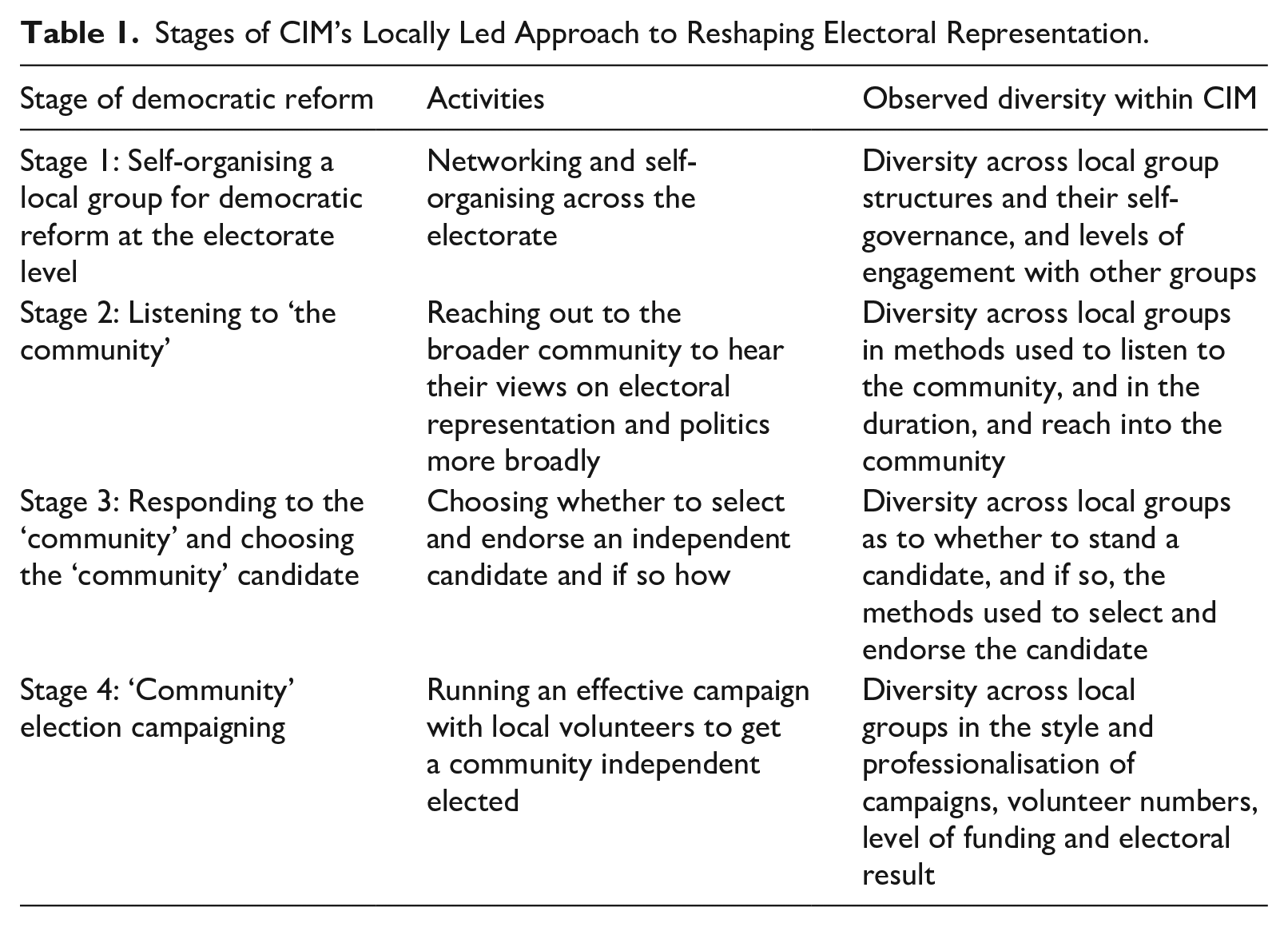
CIM’s approach to democratic reform is not to reach for a one-off participatory experiment but to embark on a process of strengthening representation at both the local and national levels. This is a case of local democratic reform work that is entangled in national motivations and impact. Local reform groups act with autonomy in their work, not only tailoring their efforts to their specific electoral context but also adapting the nature of their reform work over time. Below, we analyse this place-based and temporal diversity within the movement by considering four overlapping stages of citizen-led democratic reform, identified inductively through our interpretive research. In each stage we discuss local groups’ approach to reform, and show how this work varied between place and time. Table 1 summarises our key findings for each stage.
Stages of CIM’s Locally Led Approach to Reshaping Electoral Representation.
Stage 1: Self-Organising a Local Group for Democratic Reform at the Electorate Level
In the first stage of reform, interested individuals and groups looking to affect democratic change in their electorate coalesced and strategised. Here the central tasks were to self-organise and then empower others to join the group through networking. This process of community organising and mobilisation occurred at the electorate level – which is a constructed place of electoral politics. It is important to note that most federal electorates in Australia are not natural spaces for community organising or place-based politics. Electoral names are not always easy to recognise because many are not named after familiar place names or localities. Moreover, electoral boundaries can appear arbitrary because they cut across pre-existing administrative or biophysical boundaries; they are also fluid and can change from election to election with redistributions. For the purposes of democratic reform local reform groups accepted their constructed ‘place’, and in most instances had to work hard to bring diverse pre-existing ‘communities of place’ together. This was equally true in metropolitan and rural seats, though the latter had to work especially hard to connect people from diverse townships over vast distances.
Connections at this point often occurred through existing local community organising networks, such as environmental groups, and through social media platforms, such as Facebook groups and X (formerly Twitter). Most of those involved in the self-organising stage were already politically active, albeit to varying extents, in local groups centred on issues such as the environment, climate action or women’s safety (e.g. involvement with the March4Justice). This is consistent with the work on spontaneity by Flesher Fominaya (2015), which finds that many movements for political reform do not emerge spontaneously but rather build on existing activist and mobilisation networks.
In this first stage of reform work, citizens leading each local group faced numerous questions and choices about how best to self-organise. For example, they had to determine the organisational structure of their group (e.g. a company or registered charity, paid membership or not and so on); establish governance procedures and protocols; determine their strategic aims, plans and values; and, consider what sort of initial funds were required, and then decide how best to raise those. For some groups we interviewed these were complex issues to resolve, particularly during 2020 and 2021 when many of the local reform groups formed – a period when many Australian communities faced ongoing or intermittent lockdowns due to the COVID-19 pandemic. As one group organiser explained: ‘we’ve been in lockdown pretty much all year so that was our first hurdle, first big hurdle, you have all these lovely plans of town hall meetings and all those sorts of things, well that all went out the window’ (Interview 4).
In this stage of self-organisation, citizen leaders and their group members were empowered in several ways. First, in addressing the more administrative-type questions citizens were empowered to reflect on their goals and values, and to specify what aspects of the democratic system they were seeking to improve, and how. Second, through networking, both with members of their local community and with members from other communities, citizens were provided opportunities to share their grievances, frustration and hopes about the state of representative democracy in Australia. Such networking not only provided channels for voicing views and being listened to, but also enabled citizens to learn about the different reform pathways taken by local groups. Third, once a group was formed, members then established mechanisms to mobilise others to join the group, and in so doing they sought to activate and build a local community of democratic repairers.
Citizens leading local groups often took inspiration and advice from democratic reformers in other electorates. Many groups emulated aspects of citizen-led reform in Indi and Warringah, for example, by adopting a similar name (‘Voices of’/‘Voices for’), using a similar organisational structure, borrowing principles or community engagement methods and by following campaign advice. To be clear, these two electorates provided inspiration rather than a template that was directly replicated. As one interviewee explained: ‘we were modelling ourselves, obviously, on being inspired by the previous success of Indi, primarily, and learning from them’ (Interview 4).
Most local actors we interviewed were cautious about borrowing only what made sense from experience and lessons elsewhere, and adapting these to the specific context of their electorate and communities. They cited specific features of their federal electorate that had shaped their own local approach including geography, political context and local issues, community dynamics, population distribution and broader demographic profile, people and financial resources, and the speed and duration of, and capacity for, community organising and mobilisation. As one interviewee reflected, the key was to ‘know and respect your electorate’ (Interview 5). The strong desire to lead a place-based approach to democratic reform resulted in an important diversity within the movement in terms of how local groups self-organised, their governance structure and how they engaged with their community.
While all of these emergent reform groups were seeded and driven by local community members, some individuals and organisations stepped outside their local area to facilitate connections and knowledge sharing between groups around the nation. For example, behind the scenes some community leaders from both Indi and Warringah have provided informal mentoring and advice to fledgling groups in other electorates (for example, see Ginnivan and Howard, 2023; Turner, 2022).
A more public venue for building a national network of citizens interested in democratic reform emerged in late 2020 when four women from Indi and Warringah formed the Community Independents Project (CIP). This is a small yet high-impact volunteer-run group that connects locally-led reform groups with other interested citizens around the nation through a series of online conferences, seminars and events that have run intermittently since early 2021 (see Hendriks and Reid, 2023). In the lead-up to the 2022 election, CIP played a key role in crafting a ‘movement’ narrative in public discourse to describe various local groups working more or less independently. The ‘movement’ label drew media and political attention to growing momentum around the nation of communities self-organising to strengthen political representation.
Stage 2: Listening to ‘the Community’
In this stage local reform groups listened to what the broader community thought about the current state of democracy in their electorate and their ideas on how it should be improved. Many groups adopted ‘thick’ (interactive) participatory methods to reach out to, and facilitate discussion and listening with, their community on democracy. 15 Several local communities replicated the KTCs model as used in Indi. KTCs are small discussion groups, either in-person or online, in which people share views on set questions in a moderated dialogue (Crooks and McPherson, 2021). Running KTCs over an entire electorate (especially in a pandemic with its associated lockdowns and restrictions on face-to-face gatherings) involved slow iterative work. As one interviewee reflected: ‘Of course we were running KTCs during 2021 and there were lockdowns every now and then [. . .] and even when it wasn’t a lockdown lots of people were reluctant to come along to in-person events’ (Interview 6). Many groups we interviewed ran between 10 and 20 KTCs with people in their electorate over a period of several months.
A central goal for groups in this stage is to provide the broader local community an opportunity to share their views on a range of issues affecting their electorate. Part of this work involves creating a safe and respectful environment for listening and understanding. In a KTC participants share and listen rather than form an agreement or reach consensus. Key discussion points, quotes and themes emerging from each KTC were typically noted by a scribe, which then fed into a citizens’ report (more on this below). Beyond sharing, listening and data collection, KTCs were an opportunity for individuals to determine what responsibility they would take to improve their democracy. In other words, KTCs provided a participatory space where local people were activated into democratic reform.
Several reform groups we examined chose not to run KTCs, preferring instead to take an approach to exploring public views they felt more appropriate for their group and electorate. These groups used ‘thin’ (non-interactive) methods of participation, such as online opinion surveys, to gauge the views of their communities on the issues of importance to them. For some groups, this was due to the time pressures of the impeding election – as one interviewee said, ‘there wasn’t time’ (Interview 5).
During this stage of listening to the community, many local groups also sought to build a common electoral identity among the different localities within the electorate. One of the challenges of representative democracy in many countries, including Australia, is that many citizens do not identify closely with their federal electorate. In some areas where there are frequent, or at least recent, changes in electoral boundaries many citizens do not know which electorate they are in. Federal systems can further complicate things with local, state and federal electorates. According to the convenors of many local reform groups, building an electoral identity among the different localities or suburbs within the electorate was challenging, especially in those that were large or heterogeneous. Local groups invested time in developing a ‘brand’ and logo for the electorate so that they could build a broader community awareness of the electorate name, and the locations within it. Many groups made maps of the electorate an important part of their website and reports, others used t-shirts which listed the names of all the suburbs in the electorate, and promoted local awareness using stickers and bags.
The listening stage – whether through KTCs or surveys – generated considerable data for groups on the key issues for people in the electorate. The listening stage also served to build numbers, expanding on the community mobilisation efforts of the first stage – the activities of the first stage being predominantly those of more seasoned and networked activists. Importantly, many groups began to activate hundreds of citizens that had no prior background in activism, advocacy or party politics. The publication of findings from KTCs or surveys – in the form of a formal report – helped to raise broader public awareness of key policy issues within the local community, and to document the ‘community’s’ preferred next steps to improve local representation and policy outcomes.
Stage 3: Responding to the ‘Community’ and Choosing the ‘Community’ Candidate
In the next stage, local reform groups determined how best to redress the community’s specific democratic concerns. We identify two main areas of activity at this stage: (1) running community events and (2) choosing a ‘community’ candidate. The events conducted by groups often served multiple purposes including political and policy education (such as panel discussions with policy experts), networking and building momentum for political change. Some groups, as a result of the listening stage, chose not to follow the path of identifying and supporting an independent candidate and instead focused their efforts on events and continuing to engage with their communities.
However, in the lead-up to the 2022 election most groups decided that the most effective way to improve local representation was to pursue electoral change by supporting an independent candidate from the community. At this point, a number of communities established a specific group for this purpose. 16
The process of candidate selection varied significantly between groups. Some candidates emerged from within the community organising work in their local groups. In other cases, the local group sought prospective candidates either by (1) identifying ideal candidates and then approaching them or (2) by advertising for expressions of interest through various media. Some electorates used multiple strategies to find a candidate, for example, by encouraging particular people to put themselves forward while simultaneously also running a more public call-out. Finally, a small number of groups were approached by individuals seeking to be endorsed by the group as the community candidate.
In electorates where multiple candidates nominated, the local group then went through a process to select and endorse the final candidate. Processes were varied and included closed interview-based processes; a group deliberative process or some form of group vote; and public acclamation with no formal vote taken. With the popularity of CIM increasing throughout 2021, and tensions within the selection processes of certain groups, in some electorates more than one ‘community-minded’ candidate emerged. In contrast some groups found it difficult to find even one suitable candidate willing to run. This significant variety in approach demonstrates clearly the place-based nature of CIM. Although broad patterns or ‘types’ emerged, each local community group developed their own pathway to reform.
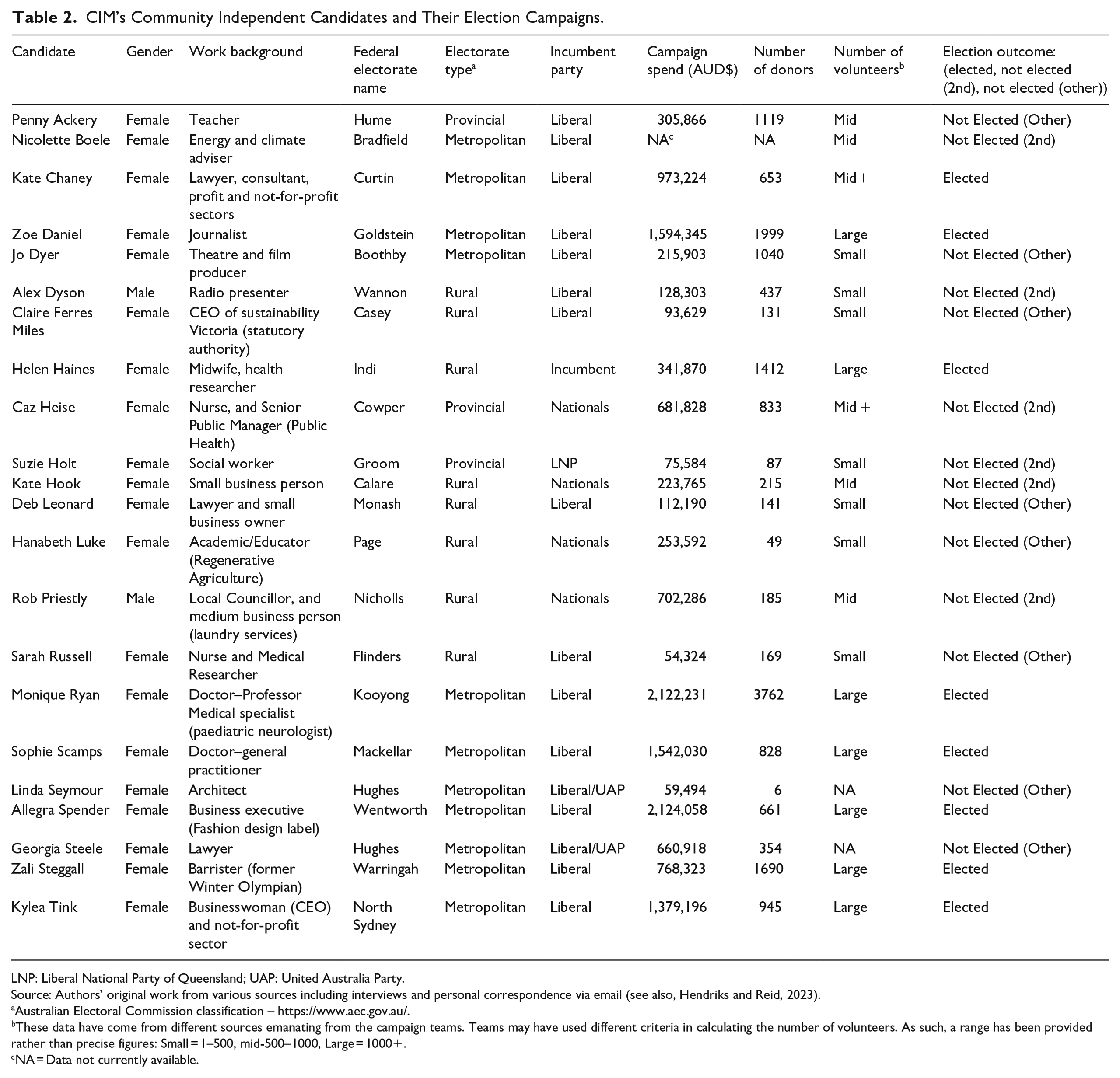
As shown in Table 2, there were 22 self-described community independent candidates standing in the 2022 federal election. 17 They stood in a mix of inner-metropolitan, provincial and rural seats. There was a notable absence of community independent candidates in Labor-held seats, and in outer metropolitan seats which may be attributed to the motivating factor of having a local member associated with the unpopular Morrison government. However, as our research has focused on electorates with groups, we are unable to answer exactly why this is, a question deserving of further inquiry.
CIM’s Community Independent Candidates and Their Election Campaigns.
LNP: Liberal National Party of Queensland; UAP: United Australia Party.
Source: Authors’ original work from various sources including interviews and personal correspondence via email (see also, Hendriks and Reid, 2023).
Australian Electoral Commission classification – https://www.aec.gov.au/.
These data have come from different sources emanating from the campaign teams. Teams may have used different criteria in calculating the number of volunteers. As such, a range has been provided rather than precise figures: Small = 1–500, mid-500–1000, Large = 1000+.
NA = Data not currently available.
Despite the fact that local groups applied varying selection methods, selected community independent candidates shared a number of commonalities. As shown in Table 2, all but two were highly educated, professional women aged between 40 and 65 years old. The selected candidates stem from diverse professional backgrounds and came from a variety of political backgrounds, but all were local members of their communities standing on a platform of independence from political parties. Importantly, none were rogue former party MPs or former advisors or technocrats from the political establishment (although two had familial links with previous generations of Liberal MPs and minsters). Local reform groups intentionally selected a candidate that was a local person. According to several interviewees, it was also important to ensure that the community candidate would be viewed by voters as ‘representative-worthy’; a likeable listener and collaborator who could effectively advocate for their electorate in Canberra.
Stage 4: ‘Community’ Election Campaigning
At the 2022 federal election the activities of local reform groups diverged into those not directly supporting an independent candidate and those either backing or running a ‘community’ campaign. Some groups that did not support an independent candidate, chose alternative ways to engage in the election process, for example, by holding candidates forums. These forums provided opportunities for citizens to engage with candidates and to ask them directly about issues of personal importance. In several cases, electorates had more than one local group; for example, with one focusing on selecting and endorsing an independent candidate, and the other focusing on broader issues of local political representation.
Of the local reform groups that existed in the lead-up to the 2022 election, the majority chose to support a ‘community’ independent. Once a candidate was selected or endorsed, the campaign was conducted under the candidate’s name rather than under the banner of the local reform group. While often officially these groups went dormant during the election, in practice many of their members joined the election campaign as volunteers, with some taking key roles such as the campaign manager, communications officer or volunteer coordinator.
As in other reform stages, there was significant variation between electorates in terms of how communities ran their campaigns, as detailed in Table 2. For example, there was large variance in volunteer numbers (from low hundreds to thousands), funding sources (between local and external), and campaign spending (ranging from AUD$54,324 to AUD$2,124,058). 18 The number of donors ranged from 6 to 3762. Most local campaign groups received support and resources from external funders including the climate action advocacy group, Climate 200. The involvement of Climate 200 was a mixed blessing for the movement. On one hand, it provided vital strategic funds and knowledge resources (such as electoral-level pre-polling data) to many of the local campaigns. Yet, on the other hand, its strong emphasis on climate action was not well-received by more conservative voters, particularly those in rural and regional seats. Climate 200 financial backing of most CIM candidates also tainted their perceived independence – critics sought to discredit CIM arguing that if elected these candidates would be beholden to Climate 200 and climate activists more broadly.
As shown in Table 2, there was significant variation in the electoral outcomes of the Community Independent candidates. However, candidates can be placed in three categories: those who were elected, those who were the closest competitor to the incumbent party (not elected, 2nd) and those who were not electorally competitive (not elected, other). It is important to note that Community Independents were only elected in Coalition-held seats – indeed, only seats held by the Liberal Party, in some cases for decades. In addition, none of the provincial and rural Community Independent candidates was elected, except in Indi, where McGowan and then Haines had built strong voter support.
Notwithstanding significant diversity in reform approaches within the movement, our research suggests that two distinct approaches to community campaigning emerged during the 2022 federal election. These two approaches differ in terms of scale and in terms of how they engage and work with volunteers and the broader community.
In the first approach, groups undertook a ‘campaign transition’, whereby they were required to change from leading democratic reform through open, empowered community organising, to a more strategic, focused and often top–down way of working in pursuit of the goal of electoral success. Communities shifted their ways of working with the community in order to compete against candidates from well-organised and well-funded political parties. As volunteers from the community moved into ‘campaign mode’, the nature of their democratic reform work shifted from being discursive, open and exploratory, with an emphasis on listening, to a more strategic and top–down approach, with an emphasis on messaging. Sue Barrett, Zoe Daniel’s campaign manager in Goldstein and founder of Voices of Goldstein, captures this strategic campaign transition as the change from .org to .com (Turner, 2022: 160).
The ability of communities to drive forward a more strategically driven campaign was based on a variety of local factors and resources but also reflected the make-up of groups and the professional backgrounds of the candidates and volunteers. One interviewee reflecting on groups without the necessary skillsets needed to accomplish such a strategic transition, explained that they: ‘don’t know how to sell stuff and market stuff [. . .] they don’t know how to pull that together on steroids [. . .] they were at sea’ (Interview 1).
Some groups were reluctant or unable to manage successfully the ‘campaign transition’. Instead they promoted their local candidate with limited numbers of volunteers and financial resources. These campaign efforts were far more decentralised, and less influenced by ‘corporate’ styles of public communication and messaging. When viewed from the sole perspective of electoral outcome, these bottom–up campaigns were less successful in the 2022 election. However, when considered from the lens of democratic reform they were highly effective at creating locally driven autonomous campaigns that drew on the resources available to the local community. Both campaign approaches empowered and engaged volunteers but in different ways. In the top–down approach to campaigning, volunteers were deployed, managed and ‘plugged-in’ to a predetermined campaign strategy. The more decentralised bottom–up community campaigns gave volunteers more autonomy and capacity to be self-directed.
Although there were two distinct approaches to community campaigning, they shared some notable commonalities. First, community independent campaigns challenged and critiqued the party system by promoting the idea that an independent can deliver better representation than a party representative. Community campaigns made the ‘failure’ of the party system to deliver for their communities central to their message. For example, Rob Priestly in Nicholls argued ‘I will push hard for the outcomes the community wants, and the party system is not delivering’ (Francis and Stainkamph, 2022: 4), and Zoe Daniel in Goldstein deployed to great effect ‘Same isn’t Safe’ (Turner, 2022). These campaigns presented themselves as ambitious but necessary attempts to reform Australia’s politics through a change in representative with a focus on delivering the political style and policy substance wanted by their communities, and in contrast to the performance of political party representatives.
A second common feature across all CIM campaigns was the strong focus on mobilising and engaging volunteers. This is fundamental, as one interviewee said: . . . so many people felt isolated before they knew this [CIM] existed, right, they didn’t belong to a union, they weren’t belonging to a political party, they knew something was wrong but they thought they were the only ones feeling it, and then all of a sudden they realised there were other humans out there and then you became like this tribe (Interview 1).
These volunteers, many of whom were women, were often mobilised to engage formally with politics for the first time, with a substantial number never having volunteered previously for a political party.
All 22 community independent candidates adopted a strong community-based approach to campaigning. They engaged their volunteers and the broader public in the electorate through festivities, social events, public outreach and social media. Some campaigns were especially experimental with how they engaged with their communities; for example, some used flash mobs in public spaces, or created visual spectacles such as dancing with umbrellas or gathering in the ocean on surfboards. Other groups decided against such spectacles on the basis that these kinds of activities might not resonate with their local communities or volunteers. Within all the campaigns the community was constructed and depicted through images as large groups of everyday people gathering and socialising to support the candidate and having fun. The faces of the volunteers and the supporters were a crucial part of the overall messaging and perceived community connectivity of all the community independent campaigns.
A Case of Ambitious and Disruptive Citizen-Led Democratic Innovation
Having considered CIM’s place-based and emergent approach to democratic reform, we turn now to discuss its impact on Australian democracy. Many local reform groups had a direct and significant impact on the electoral outcomes of the 2022 federal election. The most noteworthy electoral impacts include (1) eight community independent candidates were successfully elected to the House of Representatives and one to the Senate and (2) in six seats there were significant swings with community independents listed second in the final distribution of preferences (i.e., they were the closest competitor to the winning party candidate), turning formerly safe seats into more marginal ones. Collectively the elected community independents are part of the largest crossbench ever in the Australian House of Representatives, and while they do not hold the balance of power, they are playing a leading role in key national debates, for example, on tax reform, Indigenous recognition, and climate change.
CIM’s impact on Australia’s political parties is noteworthy, especially given its stable two-party system (Gauja and McSwiney, 2019). In a broader climate of major party disaffection, the presence and effectiveness of the CIM movement has contributed to the erosion of major party control over seats in the parliament. 19 Voting results from the 2022 election reveal that Australia’s two major parties received their lowest primary vote since 1949 (Cameron et al., 2022). While all the new community independent MPs were from former Liberal party seats, the CIM poses an electoral threat to any sitting MP. As a result of the confluence of a rise in support for independents, and also smaller parties such as the Greens, the Labor Party’s campaign director, Paul Erickson (2022) stated: ‘there’s no such thing as a safe seat’. It is too early to predict the impact of CIM on how all MPs are engaging and representing with their constituents, but in the current political climate any MP that is not seen to listen actively to, and represent the voices of local constituents, risks electoral defeat at the next election.
CIM has activated the political engagement of thousands of Australians. All local reform groups seek to awaken, activate and empower their volunteers and broader communities in democratic participation. In the federal election alone, it is estimated that local groups collectively engaged around 20,000 volunteers, with Climate 200 claiming that the independent campaigns it supported had 18,953 volunteers alone (Climate 200, 2022a). 20 Local campaigns offered an alternative type of representative and an alternative type of local and national politics, giving electors in these traditionally safe Coalition seats an opportunity to be heard. This must have beneficial effects on our democracy, as Germann et al. (2022: 6) argue ‘there is considerable evidence that opportunities for voice tend to increase legitimacy perceptions in the political sphere’.
CIM’s remarkable impact on political representation and participation in Australia needs to be appreciated within the political context in which the movement evolved. CIM was seeded by local community groups during the 2013 and 2016 elections, but it gained national momentum in 2020–2021. At this time, a long-term and increasingly unpopular conservative government, lack of action on climate change, and concern about issues of integrity and good conduct, contributed to a strong feeling for change among traditionally electorally stable electorates. This mood connected with significant donations from both local community and nation-wide funds. This contributed to the electoral viability of a range of contests by community independents.
There are also particular elements of Australia’s electoral system that may have contributed to CIM’s impact on electoral outcomes at the federal level, including single-member districts and compulsory voting. Both these features create conditions and strong incentives for elected representatives to engage and connect with their constituents (Arter, 2018). Most importantly, compulsory preferential voting means that voters (1) must vote, (2) are able to provide preferences (cf. first-past-the-post) and (3) must provide preferences (cf. optional preferential voting). The funding rules also allow for no limit in terms of fundraising and spending, enabling previously low-profile figures to build awareness through significant spending. This is not to suggest that a movement like CIM might not emerge elsewhere, but rather to highlight that citizens will develop their own reform approach depending on their political system and political context. In contexts where non-party actors, such as independents, are gaining more electoral traction, for example, in Ireland (Weeks, 2016) or in local politics in the United Kingdom (Burnett and Nunes, 2021), a CIM-type movement could potentially emerge. However, in political systems where there are limited opportunities for non-party actors, citizens are unlikely to emulate CIM’s staged approach to democratic reform. Instead, they might develop an alternative pathway to reform, as seen at the subnational level in the United States where different groups of citizens have successfully advocated for gerrymander reforms, voting rights for former felons and changes to campaign financing. 21
Insights for Debates on Citizen-Led Democratic Innovation
Notwithstanding our awareness of a set of contextual features which shaped the evolution of CIM, we contend that the movement holds a number of important insights for current debates on the form and function of citizen-led democratic innovation. These broader reflections make clear that citizens do not need a mass mobilisation in order to realise impactful democratic reform. Instead the decentralised nature of CIM demonstrates the strength of locally led interventions that are sensitive to local resources and political dynamics.
Citizens Leading Place-Based Democratic Change
CIM is a case of a place-based democratic reform led by local citizens rather than coordinated by a national movement. CIM works through emergent local groups (formed in federal electorate areas) that drive forward their own bottom–up approach to strengthening relationships between constituents and their elected representatives. Our analysis shows how in the lead up to the 2022 federal election, local citizens self-organised around pre-given electoral boundaries and focused their democratic reform work within this electorally defined ‘place’. In the first instance, local democratic reformers sought to build a sense of identity and community around constructed ‘places’. In large electorates this work involved connecting communities across diverse townships and localities, over hundreds of kilometres. 22
CIM’s place-based approach enables groups to undertake their own local democratic reform work with considerable autonomy and agency. As the analysis above showcases, local reform groups adopted diverse approaches to strengthening their local representative relationship. Some communities had access to a range of professional and financial resources which enabled a certain type of electoral campaign. For other communities, the broader appetite for change might not have been present or the goals of the local community group might not have been in the realm of competitive participation in the electoral process. Local groups make use of their own local networks, activities and spaces of connection. All of this involved extensive relational work that is often facilitated by networks and key figures in the movement who act as mobilisers, advisers and in some cases funders. Over time networks have formed, evolved and connected-up into a national movement.
Our temporal analysis of CIM challenges dominant conceptualisations in the scholarship on citizen-led innovation, particularly on the relationship between movements and democratic change. In much of the scholarship there is an implied causal relationship between movements and democratic change; frustrated citizens form a movement which goes on to advocate for, or realise democratic change (see della Porta and Felicetti, 2022). What we see in CIM is a far more entangled relationship between the citizens in the movement and democratic reform – local level citizen-led democratic repair efforts co-evolved with an emerging movement. Local reform groups intervened in their own electoral landscapes and through their placed-based work and connections with other groups, a national movement formed which existed alongside of, not on top of, the work of local groups. In other words, in CIM democratic change was not something separate from a movement, or something that the movement advocated for, the two were intertwined.
CIM’s entanglement of the local and the national can be seen as a product of the fact that the local groups were engaged in a representative electoral process which itself has both a local and national focus through the local election of representatives to the national parliament. With the work of local groups on improving local representation having national implications in terms of the composition of the national legislature. While there are many examples of local-level interventions in representative politics, such as in Frome, United Kingdom (see Burnett and Nunes, 2021), CIM’s innovation lies in trying to reshape representation at both the local and national levels. It challenged the dominance of political parties at both levels through local, place-based campaigns for a community independent and a national movement for change in policy direction, political culture and the broader functioning of representative politics.
CIM’s place-based approach to democratic reform has implications for understandings of design and replicability in democratic innovation. Local groups in the movement do not simply replicate a reform approach but instead take inspiration and adapt elements to their local context and needs. While there are elements that travel easily from one electorate to the next, most groups we interviewed recognised the unique context in which their reform-work was taking place (e.g. geography, political context, community dynamics, resources, local issues, timing, etc.). More modular approaches to democratic renewal, for example, that rely on participatory or deliberative forums, are less sensitive to such place-based variation.
Systemic and Dynamic Democratic Innovation
The case of CIM challenges current scholarly meanings of citizen-led democratic innovation. To date scholars have tended to frame innovation in institutional terms; for example, citizens might create or advocate for constitutional reform, or promote novel participatory structures to improve voice and representation (see della Porta and Felicetti, 2022). Yet the democratic innovations we observe in CIM are more systemic in nature. Specifically, citizens within CIM are trying to make representative politics work by connecting communities with both their local MP, and the broader representative process. Here democratic innovation is not a static rule change or a once-off participatory forum, but rather it involves a dynamic approach to democratic renewal that draws on diverse repertoires of repair, including processes to select and build electoral support for a local community independent candidate, mechanisms to strengthen connections between communities and their elected representatives such as candidate forums, political and policy education, networking and community-building, listening-centred practices (e.g. KTCs), surveys and reports. All these repertoires aim to provide meaningful opportunities for communities to come together to improve politics in general, and representation in particular.
CIM engages in democratic innovation throughout multiple stages and areas of their work, and as our analysis demonstrates, this work evolved and changed over time. For the most part local community groups leading democratic change within CIM focus their work on local change, but these efforts can result in the election of a community independent, and thereby impact national politics.
Risks of a More Localised Approach to Citizen-Led Democratic Reform
While CIM’s localised approach to democratic reform fosters autonomy and agency, there are some important democratic risks to consider as well. There is much to say here; we focus on three themes.
First, the place-based approach to democratic reform taken by local reform groups is resource intensive. It requires local citizens not only to self-organise, but to develop and realise a local approach for strengthening political representation. This reform work demands skills, knowledge, time and funds and not all citizens or communities have access to these resources. This speaks of the issue of diversity of citizens within CIM. While we lack detailed data on the exact membership of local reform groups, our observations of local and national meetings found participants to be overwhelmingly white, well-educated and middle-aged (on this broader issue see Schlozman et al., 2012). Some notable demographics not well-represented in the movement (based on observations of the authors and interviewees) include people from diverse ethnic backgrounds, from low socio-economic groups or other marginalised populations. This speaks of the risk of such a community-led approach exacerbating inequalities within and between communities. It is telling that most of the communities that successfully elected a community independent candidate in the 2022 federal election were from some of the richest and most well-educated electorates in the nation. Beyond socio-demographic data, our research comparing metropolitan and regional/rural electorates has found that there were wide variations between electorates; some communities are better equipped than others to self-organise and lead a community group, and drive forward successful community-based election campaigns.
Second, without centralised control, movements such as CIM run the risk that their democratic reform approach is adopted strategically by actors with limited or no community connections. In our research, we identified a few ‘community independents’ that made strong claims to represent ‘the community’, but whose community links were very informal or weak, and there was no identifiable community group that selected or supported them. A related risk is that communities are divided in their view over who should stand as the community candidate. This occurred in several electorates where two ‘community’ candidates emerged, splitting volunteers and the community, and confusing voters.
Third, CIM reveals that some conventional democratic practices are immutable to citizen-led reforms. While CIM was able to participate and change the outcomes of elections in several electorates, it has not (yet) been able to reform some key problems with electoral democracy in Australian federal politics, such as unlimited campaign finance. Paradoxically CIM’s pathway to democratic reform involves travelling through competitive electoral processes which thrive on the kind of ‘old-style’ politics that the movement explicitly rejects; for example, money-fuelled election campaigns with excessive advertising, limited policy content and slick, polished, public performances. The 2022 federal election results revealed that some local reform groups and their candidates were better skilled and resourced to travel successfully through this competitive electoral process than others. So rather than challenging all problematic aspects of contemporary representative democracy, in some respects CIM leans into and arguably exacerbates some its more dysfunctional elements. Consider, for example, the comparatively large campaign funds that some local reform groups raised from crowd-sourcing and funders. So rather than challenging the political economy of electoral politics, CIM’s crowd-sourced funding draws it into a growing industry of political strategists, marketers and pollsters.
Conclusion
Our in-depth interpretive analysis of Australia’s CIM demonstrates that citizens can initiate and progress significant change in the heartland of representative democracy. CIM has not only created spaces of active political participation for a growing number of Australians frustrated with the failure of party politics to represent communities, but it has provided voters with a non-party alternative in the form of a highly skilled, local, independent candidate that is well-supported to win. Collectively, CIM has been able to disrupt and reshape the representative landscape and ongoing practices of Australia’s federal parliament.
Like all movements, CIM continues to evolve. Today, the successfully elected community independents in the House of Representatives and the Senate provide a formal institutional platform for the movement. A number of these elected representatives continue to engage actively in the movement, for example, by presenting at national forums, or by visiting electorates where an unsuccessful independent candidate remains politically active. Yet it remains unclear whether the movement can sustain momentum under an Albanese-led, left-of-centre, Labor government, that to-date seems to lack the deep unpopularity of the previous Coalition conservative government. In ongoing research we are studying the impact of community independents on the policy and representative work of Parliament and further research is needed to understand the long-term effects of CIM on political participation and democratic institutions in Australia.
While CIM does not offer a replicable ‘blueprint’ for how citizens elsewhere can reform electoral democracy, it does hold significant insights for current understandings of how citizens can realise democratic change. The case of CIM challenges dominant conceptualisations of movement-led democratic change and the innovations they might advance. CIM is not a movement of angry protestors motivated by anti-establishment and anti-politics sentiments trying to dismantle or supplement formal representative institutions. Instead the citizens within CIM see themselves as locally based doers and fixers working within the system and taking practical steps to strengthen their democratic system in ways they can.
We recognise that CIM’s highly pragmatic approach to democratic reform is less radical than other movements. Indeed there are even elements of CIM’s approach that fuel (rather than challenge) problematic aspects of electoral politics, such as high levels of campaign funding. Yet from this case we learn that innovative citizen-led democratic reforms can involve so much more than novel participatory experiments. In CIM citizens use their local knowledge, networks and relationships to build public awareness of their electorate as a place, and mobilise citizens to engage in conversations and activities to improve the representation of their ‘place’ in national politics. By working through local communities at the electorate level, CIM has sought to reshape representative politics at both the local and national level in Australia. The ability of CIM to have broad reach into Australia’s electoral system and parliament lies in the empowerment of local communities acting with autonomy and agency to undertake democratic reform work on their own terms.
Our analysis of CIM also demonstrates that citizens leading democratic reform do not necessarily face a binary choice between working outside or inside the state; they can also choose to reconfigure the state. In CIM citizens effectively reconfigured elements of the state not by forming an alternative political party but by shaping who is elected into formal power, and how they represent their communities on an electorate by electorate basis. In the course of this reform work CIM has been able to disrupt established patterns and practices of candidate selection, election campaigning, and since the election, constituency work. Here we see how citizens are taking steps to strengthen some of the core elements of representative democracy that have been largely overlooked by scholars and practitioners of democratic innovation. We contend there is much more to learn about novel pathways and resources for democratic reform by studying how citizens themselves are seeking to transform their democracies.
Footnotes
Acknowledgements
The authors thank all those who generously agreed to be interviewed as part of this research. The authors also thank Anika Gauja, Darren Halpin and the two anonymous reviewers for reading earlier versions of this article and providing valuable feedback. All errors, of course, remain those of the authors.
Declaration of Conflicting Interests
The author(s) declared no potential conflicts of interest with respect to the research, authorship and/or publication of this article.
Funding
The author(s) disclosed receipt of the following financial support for the research, authorship and/or publication of this article: The authors acknowledge the support of the Australian Research Council Special Research Initiative (ARC SRI) Grant: Transforming Democracy in the Bush: A Study of Politics in Rural Australia (SR200200385).
