




Abstract
Recent studies in democratic countries suggest that voters generally prefer candidates with specific personal attributes, such as being female and young. However, some of these patterns cannot necessarily be explained by voters’ expectations of candidates’ competence. Building on a growing body of literature that addresses populist attitudes as an important factor influencing voters’ political preferences, this study hypothesizes that candidates’ personal attributes shape voters’ perceptions of their populist attitudes and that such perceptions mediate the relationship between personal attributes and voter preferences. A conjoint experiment conducted in Japan showed that several personal attributes substantially influenced candidates’ perceived anti-elitism and people-centrism. An additional experiment to disentangle causal mechanisms suggested that, albeit inconclusive, young candidates were more likely to be preferred because of voters’ expectations of their populist tendencies. Methodologically, this study illustrates advancements in the conjoint experiment design to elucidate causal mechanisms, with a careful discussion of necessary assumptions.
Searching for the determinants of vote choice has long been a fundamental problem in political behavior research, and candidate evaluation is undoubtedly one of the most influential determinants in elections in which citizens cast their votes for individual candidates. 1 Politicians’ personal attributes and background status (e.g. gender, age, ethnicity, educational attainment, hometown, and work experience; hereafter, personal attributes) appear to affect voters’ evaluation of their qualifications, thereby leading to personal votes.
If the electorate has a general preference for politicians with specific personal attributes, there may be substantial political consequences because these attributes relate to politicians’ behavior in legislatures and government. For example, female legislators make more speeches on female-related issues in assemblies (Clayton et al., 2017; Osborn and Mendez, 2010); furthermore, an increasing number of female legislators leads to an increase in expenditure for education and welfare (see Hessami and da Fonseca, 2020 for a review). Older legislators are more likely to sponsor bills related to senior issues in the U.S. Congress (Curry and Haydon, 2018), and younger mayors tend to increase expenditure on long-term investment in Japan (McClean, 2022). Educated leaders can attain better conditions for states in terms of economy and education (Besley et al., 2011; Lahoti and Sahoo, 2020), and working-class politicians generally try to represent the interests of working-class voters (Carnes and Lupu, 2015; O’Grady, 2019).
Prior studies have revealed general trends in voter preferences over candidate attributes in democratic countries. For example, voters tend to favor female, young, highly educated, and experienced politicians (e.g., Eshima and Smith, 2022; Hainmueller et al., 2014; Horiuchi et al., 2020; Schwarz and Coppock, 2022). The literature also suggests that voters use candidates’ personal attributes as a cue to estimate their issue competences and positions (e.g., Arnesen et al., 2019; Dolan, 2014; McClean and Ono, 2024; Pedersen et al., 2019). Individuals may cast their votes for candidates with attributes similar to their own based on demographic affinity and expectations of self-interested benefits. However, considering that voters’ own demographics, policy preferences, and policy priorities vary, it remains unclear why voters, on average, tend to support candidates with such specific personal attributes. Of course, it is reasonable for voters to use certain attributes as a sign of qualification—they should expect highly educated and experienced candidates to be competent as politicians. Still, candidates with other attributes, such as female and young candidates, may not inherently be expected to perform better than those without these attributes.
I address this puzzle by focusing on people’s demand for populist politicians. The prevailing view in recent years holds that populism is a kind of ideology (e.g., Mudde, 2004). Incorporating populist attitudes into spatial theory suggests that if the majority of, albeit not all, voters prefer candidates they expect to be populist to non-populist ones when other factors are constant, and if people tend to associate particular personal attributes with populist candidates, they will choose candidates with these attributes even if the candidates do not necessarily seem to be qualified in other ways.
I applied this argument to the Japanese case, where previous studies have demonstrated that the electorate strongly favors certain personal attributes, and conducted two survey experiments. The first conjoint experiment involved respondents rating hypothetical candidates’ expected anti-elitism and people-centrism, revealing that Japanese voters inferred these characteristics of candidates based on various personal attributes. The second was a conjoint study using an experimental design to disentangle causal mechanisms proposed by Acharya et al. (2018), and the results suggested that voters’ positive evaluations of young candidates were mediated by their expectations of such candidates having high populist attitudes.
Although the results of the second experiment should be interpreted with caution, they highlight the role of a candidate’s personal attributes, especially their age, in influencing voter choices. The findings advance our understanding of the inferences voters make about politicians from their personal attributes and present insights into the literature on representation. Furthermore, methodologically, this study indicates the potential effectiveness of Acharya et al.’s (2018) extension of the conjoint experiment design but also emphasizes the need for caution in its application owing to challenges in fulfilling underlying assumptions.
Politicians’ Personal Attributes and Favorability
The effects of politicians’ personal attributes on voter preferences have been of great interest in the literature. This scholarly trend was accelerated by the novel application of conjoint (more generally, factorial) experiments (Hainmueller et al., 2014) as a basis for a causal interpretation with randomized treatments. A meta-analysis of 67 experiments from various countries showed that female candidates are 1.8 percentage points more likely to be chosen than male candidates in candidate choice experiments (Schwarz and Coppock, 2022). Another meta-analysis of 16 experiments revealed that voters tend to dislike older candidates, and this tendency was pronounced in an experiment in Japan in which respondents penalized the oldest (70-year-old) candidates although they were only one year older than the second oldest (69-year-old) candidates (Eshima and Smith, 2022). Although they have not yet undergone meta-analysis, several other patterns emerge; for example, voters prefer highly educated candidates (e.g., Bansak et al., 2018; Blackman and Jackson, 2021; Hainmueller et al., 2014; Horiuchi et al., 2020; Magni and Reynolds, 2021) and those with more political experience (e.g., Carnes and Lupu, 2016; Horiuchi et al., 2020; Kirkland and Coppock, 2018; Magni and Reynolds, 2021). Moreover, dynastic candidates are widely unpopular in Japan, the country of focus in this study (Horiuchi et al., 2020; Miwa et al., 2023).
Why do voters generally prefer candidates with specific personal attributes? One straightforward explanation for this phenomenon is that voters use personal attributes as a cue to infer candidates’ competence for lawmaking or managing the government. This hypothesis seems plausible for voter preferences for educated and experienced candidates because, presumably, such candidates will perform better after being elected than those with less education and experience. However, it is not self-evident that female, young, and non-dynastic politicians perform better than male, aged, and dynastic politicians. Rather, older politicians may be able to apply their wealth of experience in their careers to politics. Dynastic candidates can use their networks to benefit their electorate, as shown in an empirical analysis (Asako et al., 2015). In addition, stereotypes about female politicians are not necessarily advantageous for being perceived as competent by voters.
Another line of research has demonstrated that voters use stereotypes to estimate politicians’ policy and ideological positions from their personal attributes. Female (Arnesen et al., 2019; Dolan, 2014) and well-educated (Arnesen et al., 2019) politicians and those with blue-collar backgrounds (Pedersen et al., 2019) are likely to be seen as more liberal or leftist. 2 Issue competences and priorities are also inferred from personal attributes. For example, women are likely to be seen as better at handling so-called female issues (e.g., welfare) but less competent regarding so-called male issues (e.g., economy) (Dolan, 2014), and young politicians are expected to prioritize childcare but neglect elder care (McClean and Ono, 2024). Also, people are likely to assume that politicians will be competent around issues related to their work experience (Coffé and Theiss-Morse, 2016). These inferences lead to voting based on demographic affinity to achieve not only descriptive but also substantive representation.
This body of literature, though insightful, does not sufficiently explain the advantage of certain personal attributes because it addresses position issues on which voters’ preferences are not permanently lopsided. Issue priorities are also diverse within the electorate. Moreover, issue stereotypes do not explain previous studies’ findings that politicians’ personal attributes retained a powerful influence on people’s preferences even when information about politicians’ party affiliations and issue positions was provided.
Indeed, there may be specific reasons for each attribute. For example, voters may try to elect female and young politicians to reduce women and young citizens’ underrepresentation in politics. Another possible explanation is that people expect the “Jackie Robinson effect” (Anzia and Berry, 2011) to occur; that is because female, young, and non-dynastic candidates face disadvantages when running for elections, once they have managed to do so, they are expected to be more talented than their counterparts.
People’s Demand for Populist Politicians
This study does not deny the above alternative explanations but focuses on another factor: the demand for populist politicians. Recently, populism has come to be understood as an ideology, the essence of which is a Manichean view in which the “good people” are contrasted with the “evil elites” (e.g. Mudde, 2004). Studies based on this view mostly agree that populism consists of at least two components: anti-elitism and people-centrism. This scholarly trend is called an “ideational approach,” and a growing body of research has tried to measure the positions of political actors, such as parties (e.g., Hawkins and Castanho Silva, 2018; Meijers and Zaslove, 2021), politicians (Andreadis and Ruth-Lovell, 2018), and voters (e.g., Akkerman et al., 2014; Castanho Silva et al., 2018; Schulz et al., 2018), and applied a spatial theoretic interpretation to studying populist voting in the same manner in which the left-right ideology is studied (e.g., Akkerman et al., 2014; Van Hauwaert and Van Kessel, 2018).
My argument is based on the premise that the majority of voters prefer politicians with populist tendencies in the ideational sense to those without such tendencies when their host ideology is constant. Because “populism is a normative response to perceived crises of democratic legitimacy” (Hawkins et al., 2017: 268), populists have a normative advantage once they succeed in framing the country’s political circumstances as a crisis of democracy. The statement that the people’s will should be fully reflected in politics, rejecting elites’ arbitrary rule, is attractive to ordinary citizens in countries in which citizens view privilege and corruption as prevalent among the establishment. This characteristic distinguishes populism from traditional left-right ideology and position issues that have often been tied to specific personal attributes in previous research.
This view may be controversial because populism is considered an ideology, not a valence. Studies measuring voters’ populist attitudes have presumed that voters do not necessarily have high populist attitudes and thus do not necessarily favor populist politicians. I accept this claim, but while the measurement of populist attitudes and succeeding studies based on spatial theory focus on an individual’s relative orientation to populism, my argument concerns the absolute distribution of opinions on populism.
To confirm this argument, I analyzed data from the Comparative Study of Electoral Systems (CSES) Module 5, which contains survey items that measure respondents’ populist attitudes using a five-point scale. I used the Fourth Advance Release data (Comparative Study of Electoral Systems, 2022), which includes 37 countries and regions. I recoded six populist attitude items to make larger values represent higher populist attitudes and computed their means for each country and region. 3
The results are shown in Figure 1. Dots represent the point estimates. 4 ISO alpha-2 codes are used for country labels, with the exception of “BF” and “BW,” which refer to Flanders and Wallonia in Belgium. Following Jungkunz et al.’s (2021) interpretation, Q2, Q3, Q4, and Q6 measure anti-elitism, Q5 measures people-centrism, and Q1 measures Manichean worldview. A panel in the bottom row shows the country average of the individual average scores of the six items. 5
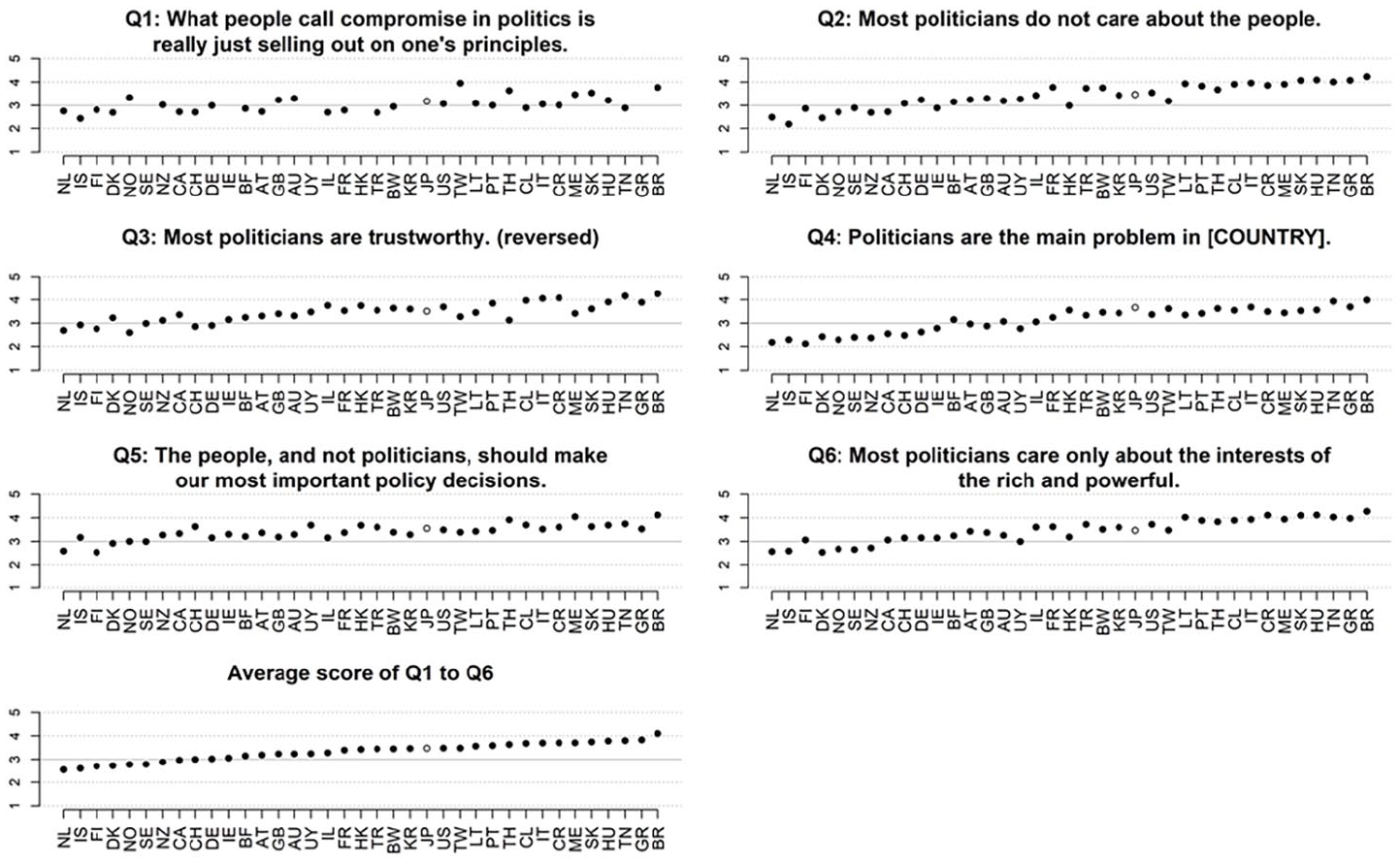
Country Average of Populist Attitudes Items in the CSES Module 5.
The average responses are above the middle point of the scale (“neither agree nor disagree”) in most countries analyzed here for all items except for Q1. Moreover, the overall average is greater than the middle point for approximately three-fourths of the countries. The case in this study, Japan, is no exception; rather, the averages are above the middle point for all six items, and the overall average is in the top two-fifths. Indeed, this conclusion depends on the wording of the populist attitude items in the CSES. However, we can conclude that, when measured by these items, the populist attitudes (especially regarding anti-elitism and people-centrism) of ordinary citizens are generally high in absolute levels in many countries, including Japan. More specifically, voters are broadly dissatisfied; they feel that politicians ignore them and desire policy decisions that emphasize the general will.
Another potential criticism of my argument could arise from recent studies that conducted conjoint experiments to examine the effects of candidates’ populist appeals on voters’ candidate preferences. These studies revealed two key findings. First, populist appeals were not necessarily effective in garnering support. Second, even though some populist appeals had positive effects, they did not interact with respondents’ populist attitudes (Castanho Silva et al., 2023; Dai and Kustov, 2023; Neuner and Wratil, 2022). Concerning the first point, I suspect that these studies’ treatments of populist appeals might have failed to sufficiently update respondents’ perceptions of candidates’ populist tendencies because of the ways in which the appeals were presented (in the form of “political priority” or campaign rhetoric), which may have appeared as mere cheap talk. In contrast, as will be discussed later, the present study’s experiment described candidates’ backgrounds and behaviors to ensure manipulation and confirmed their effectiveness through pilot surveys. Regarding the second point, I interpret the results as suggesting that the favorability of candidates’ populist tendencies is universal among most voters, which aligns with my argument. 6
It is important to note that this study does not intend to challenge the importance of the “host” ideology or to compare the influence of perceived populist tendencies and the “host” ideology on people’s preferences. Previous candidate choice experiments have demonstrated that the effects of personal attributes tend to diminish when people obtain party or policy cues (e.g., Arnesen et al., 2019; Kirkland and Coppock, 2018). Nonetheless, party or policy cues do not completely overshadow personal attributes, and these results do not undermine the significance of the puzzle that this study seeks to address. While I acknowledge the importance of the “host” ideology, I believe that this study has important implications, especially considering that many voters remain uninformed in real-world elections and that personal attributes often serve as easily accessible cues for them.
Expectations and Research Strategy
Anticipated Mechanisms
Voters who wish to elect populist politicians should make inferences about candidates’ populist tendencies using various information about them, including their party affiliation and policy pledges, and one potential cue for such inferences should be personal attributes. From the politicians’ perspective, one of the important elements of populist communication is an appeal for closeness to the people (Wirth et al., 2016), and personal attributes form a useful tool for such communication. Experimental evidence from Germany suggested that populist politicians could lose support when they revealed that they had a personal background that differed from that of ordinary citizens, such as having lived abroad, being from an upper-class background, or being in a polygamous partnership (Müller and Denner, 2021).
I expect that politicians with personal attributes frequently observed in the establishment are unlikely to be seen as populists—such politicians are perceived as having entrenched self-interest and not understanding people’s will. In many democracies, such attributes include being male, elderly, highly educated, and upper-class. Moreover, in the Japanese context, dynastic status is also a negative attribute that keeps politicians from being perceived as populist—engaging in pork barreling (Asako et al., 2015; Muraoka, 2018) becomes a disadvantage in this context. In contrast, voters expect politicians with outsider-like attributes, such as being female, young, less-educated, working-class, and non-dynastic persons, to have anti-elitist and people-centrist minds. These expectations are consistent with previous findings that female politicians are likely to be perceived as less corrupt (e.g., Barnes and Beaulieu, 2014; Dollar et al., 2001) and that young politicians are likely to be expected to engage in anti-corruption policy (McClean and Ono, 2024). As shown above, because most voters possess high populist attitudes in an absolute sense in many countries, voters prefer outsider-like candidates when they expect such candidates to have high populist tendencies.
Two Surveys
This study examines the above discussion by conducting two preregistered survey experiments. Study 1 concerns the fundamental assumption of my argument that voters infer candidates’ populist tendencies—more specifically, anti-elitism and people-centrism—from their personal attributes. This study relies on a conjoint experiment covering various attributes: gender, age, educational attainment, prior occupation, dynastic status, political experience, and party affiliation. The study is descriptive in nature, with no specific hypotheses for each attribute and level, but, overall, outsider-like candidate profiles are expected to be evaluated as anti-elitist and people-centrist.
Study 2 tests the hypothesis that voters’ expectations of candidates’ populist tendencies are at least partially an intermediate factor in the causal relationships between candidates’ personal attributes and voter preferences. I adopt a novel conjoint experiment to address this challenge. As will be explained later, the critical quantity is the eliminated effects (EE), representing the extent to which the causal effects of personal attributes are reduced by providing additional, more direct information about candidates’ populist attitudes. My hypothesis predicts that the EEs of outsider-like attributes are positive, and those of insider-like attributes are negative. The reasons for these predictions will be discussed later.
Japan as a Case
The above two survey experiments were conducted in Japan. As cited earlier, several works demonstrate that Japanese voters generally share preferences for candidates’ personal attitudes, including being young, highly educated, and experienced, with other countries (e.g., Eshima and Smith, 2022; Horiuchi et al., 2020; McClean and Ono, 2024; Miwa et al., 2023). Moreover, as confirmed in Figure 1, people’s demands for populist politicians in Japan are high, though not exceptional on a global scale.
A notable feature of Japanese politics in the context of this study is that populism is not as prevalent in national politics as it is in Western countries; indeed, several scholars and journalists pointed out the inconspicuousness of populism in Japan (Fahey et al., 2021). Japan’s party system has revolved around the Liberal Democratic Party (LDP), which has established a long-lasting dominance under free elections since 1955 with very few exceptional periods. The LDP disenchanted voters and lost power in 2009, but the rising force at that time was not a populist party but another mainstream one, the Democratic Party of Japan (DPJ; the current de facto successor is the Constitutional Democratic Party). The LDP remained popular after regaining power in 2012 until the surveys in this study were conducted (2021), even though its government’s approval rate sometimes plunged. While a new right-leaning party, the Japan Restoration Party (later rebranded as the Japan Innovation Party), was founded in 2012 by Toru Hashimoto, whom Fahey et al. (2021) identified as populist with international definitions, this party later settled into a third force without distinct populist positions. Instead, the party is known for its collaborative stance toward the mainstream LDP. A few parties with a blatant populist appeal—Reiwa Shinsengumi and the NHK Party—emerged recently, but their presence in the Diet remained marginal.
The biggest reason for the lack of populism in Japan’s national politics seems attributable to the LDP’s strong presence and people’s satisfaction with it. Surveys in 2021 and 2022 reveal that the LDP was the most preferred party, even among respondents who had high populist attitudes (Jou, 2023). Other than that, scholars ascribe the absence of populism in Japan to several factors, including its strict regulation policy for trade and immigration (Lind, 2018), the print media’s negative stance toward populist actors (Steel and Kohama, 2022), and the relative lack of perceived economic inequality (Jou, 2023).
Scholars have found that populist politicians and parties are more common in local politics—Hashimoto and his party Osaka Ishin (One Osaka) in Osaka, Takashi Kawamura and his party Genzei Nippon (literally “tax reduction in Japan”) in Nagoya, and Yuriko Koike and her party Tokyoites First in Tokyo. This relative prevalence of populism in local politics is said to be imputed to the institutional structure of Japan’s local government, which seduces governors and mayors to attack the local assembly as evil elites to garner public support, especially in urban areas (Yoshida, 2020). However, though the aforementioned politicians overshadow others, their influence is limited to specific areas in Japan. Moreover, some scholars criticize the arbitrariness of tagging them as populists and doubt whether they genuinely fit the international definition of populists (Fahey et al., 2021; Klein, 2023). Furthermore, voters’ support for these local politicians and their parties is not explained by their populist attitudes (Hieda et al., 2021; Ito, 2023; Zenkyo, 2018, 2021), which suggests that Japanese citizens do not recognize these actors as populists. 7
While these features of Japanese politics may raise doubts concerning the generalizability of this study’s results, the Japanese case has the advantage that voters’ guesses on candidates’ populist attitudes are less likely to rest on party affiliation. Although they may not explicitly make populist statements, many Japanese politicians have begun to employ certain aspects of populist rhetoric in recent years (Fahey et al., 2021), indicating that the “populist” label is not owned by a limited group in Japan. For example, former prime minister Junichiro Koizumi of the LDP, who served from 2001 to 2006, often used anti-old-LDP rhetoric, and the DPJ’s government, from 2009 to 2012, put forward the slogan “people’s life first” and had hostile relations with bureaucrats. Subsequently, Shinzo Abe, who served as the president of the LDP and the prime minister from 2012 to 2020, occasionally contrasted “ordinary Japanese” with liberal opposition and media. In summary, though political figures that match the template exactly are rare, partial application of populist-style communication is fairly common in recent Japan. This situation makes it easier to clarify the relationship between candidate attributes other than party affiliation and candidates’ perceived populist attitudes.
Voter Perceptions of Candidates’ Populist Attitudes
Experimental Design
For Study 1, I conducted an online survey from August 7 to 9, 2021. I recruited participants aged 18–69 years via Lucid Marketplace and set quotas for gender (male and female), age (18–29, 30–39, 40–49, 50–59, and 60–69), education (high school or less, vocational school/technical college/junior college, and college or higher), and region (Hokkaido/Tohoku, Kanto, Chubu, Kinki, Chugoku/Shikoku, and Kyushu) to fit the marginal distributions of these variables to the census distribution as much as possible. I located two trap (directed) questions incorporated with eight unrelated items in a matrix form at the beginning of the survey and excluded respondents who did not correctly answer the trap questions. I stopped data collection once 1,000 respondents who had passed the attention checks submitted responses.
I embedded a randomized conjoint experiment into the survey. 8 Before the conjoint tasks, I asked respondents to answer a battery of items to measure populist attitudes developed by Castanho Silva et al. (2018) for subgroup analysis. I repeated five conjoint tasks per respondent. Each task shows respondents’ randomized profiles of the hypothetical House of Representatives (HoR, Japan’s lower house) election candidates. I measured respondents’ perceptions of both candidates’ anti-elitism and people-centrism using a six-point bipolar scale without numbered labels. The labels for the ends of the scales were: “desire to maintain the existing way of the society” and “being active in breaking vested interests” for anti-elitism; and “placing importance on the opinions of politicians and experts” and “placing importance on the opinions of the general public” for people-centrism. I randomized the order of these two questions across respondents. 9
Referring to Horiuchi et al. (2020), who conducted a candidate choice conjoint experiment focusing on candidates’ personal attributes in Japan, I set the following conjoint attributes: gender, age, educational attainment, prior occupation, dynastic status, experience as a legislator, and party affiliation. Regarding party affiliation, I randomly split respondents into two groups and showed conjoint tables containing candidates’ party affiliation to one group (N = 509) and conjoint tables without it to another (N = 491). I conducted analyses for these two groups separately. 10 The order of attributes in conjoint tables was randomized across respondents. The levels of each attribute are shown in Table 1. To improve external validity, I employed a paired conjoint design (Hainmueller et al., 2015) and used a non-uniform distribution that mimics the marginal profile distribution of the 2017 HoR candidates for randomization (de la Cuesta et al., 2022). 11
Attributes and Their Levels in a Conjoint Experiment in Study 1.
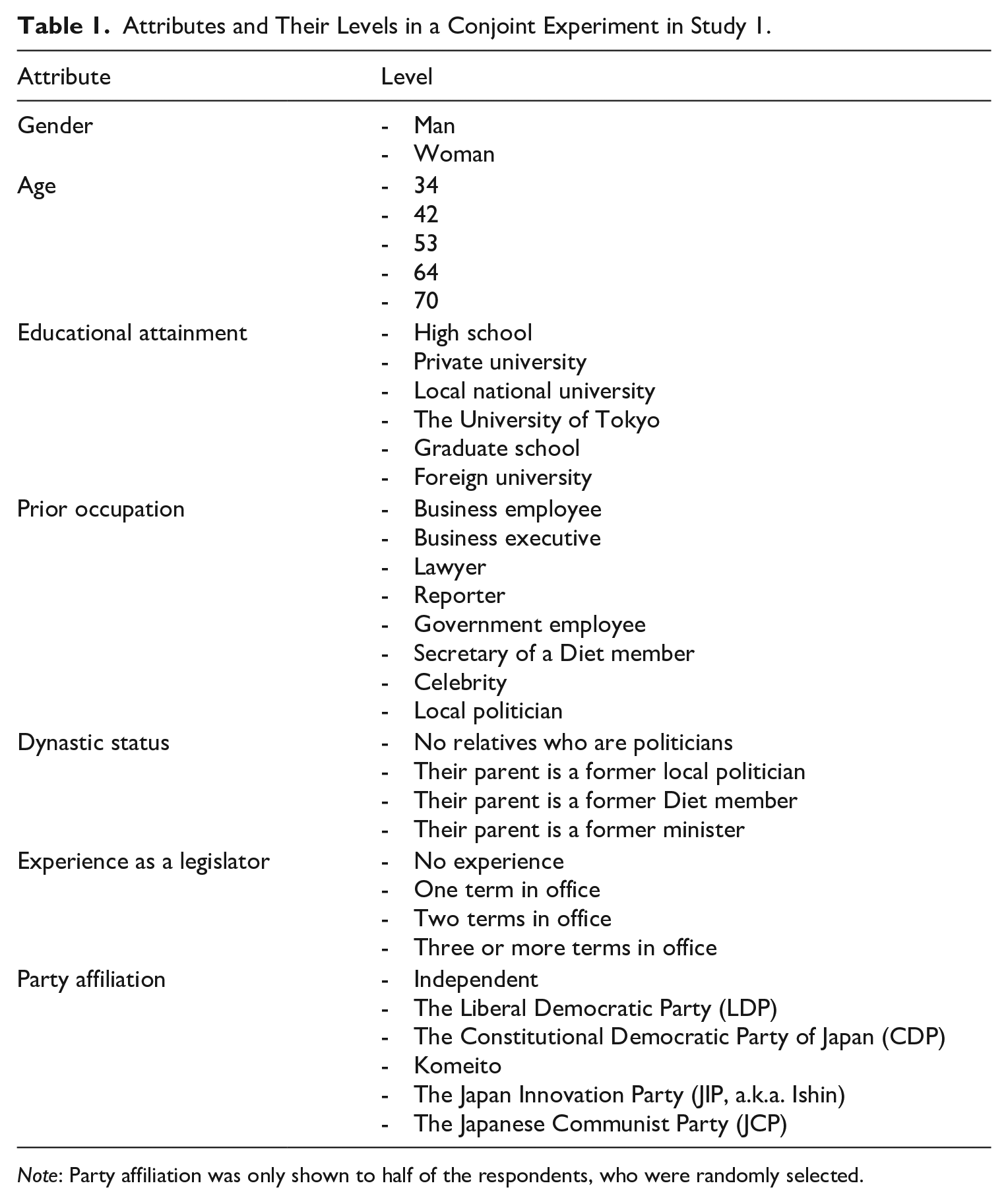
Note: Party affiliation was only shown to half of the respondents, who were randomly selected.
Statistical Inference
I adopted marginal means (MMs) as the quantity of interest, suitable for descriptive analyses and subgroup comparison (Leeper et al., 2020). I treated respondents’ perceptions of candidates’ anti-elitism and people-centrism measured by six-point scales as continuous variables and set the minimum value to zero and the maximum value to five. I estimated the MM of each attribute-level by conducting a linear regression in which the outcome values are regressed on an intercept using the data for candidates with the corresponding attribute-level. I used the CR2 standard errors clustered by respondents to evaluate estimation uncertainty.
To test whether each attribute affected voters’ perceptions of candidates’ anti-elitism and people-centrism, I ran a linear regression for the standard estimation procedure of the average marginal component effects (AMCEs), in which the outcome variable was regressed on the dummy variables of the levels of all attributes (Hainmueller et al., 2014; hereinafter called “the standard regression”), and conducted the F-test of joint significance of coefficients for each attribute.
When testing whether the relationship between the attributes and the perceptions of their anti-elitism and people-centrism vary by respondents’ populist attitudes, I conducted the F-test to compare two regression models for each attribute: (i) the standard regression plus populist attitudes and (ii) Model (i) plus the interaction terms of the corresponding attribute-level dummies and populist attitudes. I created respondents’ scores of the three subdimensions of Castanho Silva et al.’s (2018) populist attitudes scale—people-centrism, anti-elitism, and Manichean view—using confirmatory factor analysis with acquiescence correction. 12 Following Wuttke et al. (2020), I defined respondents’ populist attitudes score by the minimum value of these subdimension scores.
Results
Figure 2 shows the MMs of respondents’ perceptions of candidates’ anti-elitism and people-centrism. Due to space constraints, I only report the results for respondents who have observed candidates’ party affiliation in the main text, although the implications from MM estimates without party affiliation are substantially similar. 13 Dots represent the point estimates of MMs, and segments represent their 95% confidence intervals. Black color indicates that the p-value of F-tests for the effects of the attribute was less than 0.05, and gray indicates otherwise. 14 Although the substantive magnitude of the effects is difficult to interpret because the outcome variables are measured by an abstract scale, Cohen’s (1988) rule of thumb demonstrates that, based on the fact that the standard deviation of the outcome values is about 1.46 and 1.44 for perceived anti-elitism and people-centrism, respectively, a difference in MMs by approximately 0.29 can be interpreted as a small effect and approximately 0.73 can be interpreted as a medium effect.
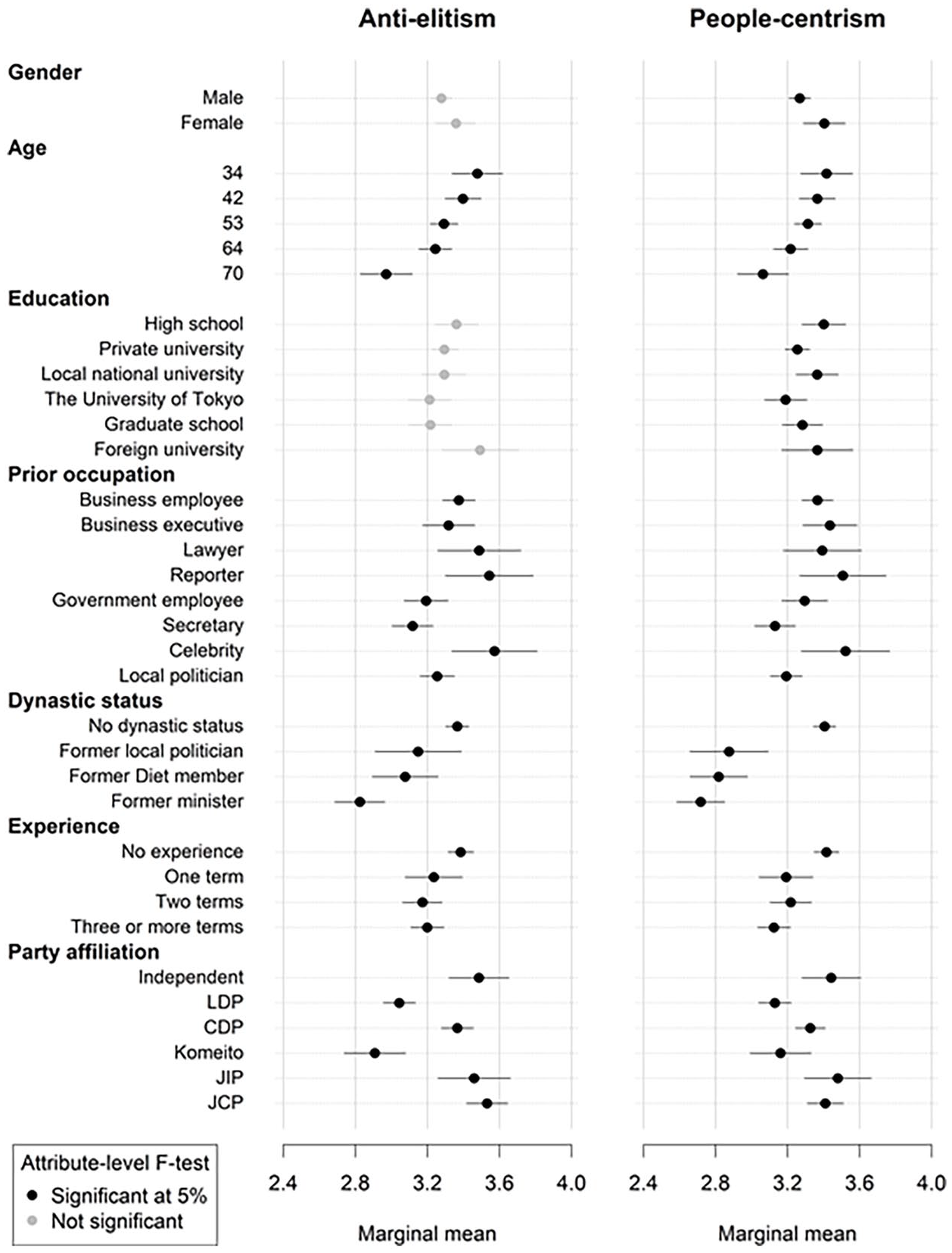
MMs of Candidates’ Personal Attributes (With Party Affiliation) on Perceptions of Their Anti-Elitism and People-Centrism.
These figures clearly indicate that most attributes affect respondents’ perceptions of candidates’ anti-elitism and people-centrism. Female, younger, non-dynastic, and less-experienced candidates tend to be expected to break vested interests and reflect the general public’s interest in politics. Regarding occupation, candidates who served as a secretary of a Diet member or a local politician were perceived as less populist. The effects of educational attainment were small, but respondents evaluated that graduates from a foreign university would be more likely to challenge the establishment than others, albeit the insignificance of the attribute-level F-test, and that candidates with a bachelor’s degree from the University of Tokyo (UTokyo, the top university in Japan) would place less importance on the will of the people than those who had not attended university. Candidates nominated by the LDP and Komeito, the government parties, were less likely to be seen as anti-elitist and people-centrist than the opposition party and independent candidates.
Overall, respondents’ perceptions reacted to each attribute in a similar manner for the two subdimensions of populism. Moreover, it is noteworthy that the results suggest that people do not simply identify a candidate who they find preferable as anti-elite and people-centrist because prior studies in Japan showed that former celebrities and inexperienced candidates are generally not favored (Horiuchi et al., 2020; Miwa et al., 2023). This possibility is also negated by the fact that respondents used candidates’ personal attributes as cues even when their party affiliation, which should be a strong determinant of respondents’ candidate preference, was manifested.
When I examined how the effects of the attributes differed by respondents’ populist attitudes, contrary to the expectation, the effects of most attributes did not significantly vary depending on respondents’ populist attitudes. However, when only party information was not provided, candidates’ dynastic status seemed to have been more importance for respondents with high populist attitude scores in evaluating candidates’ populist tendencies than respondents with low populist attitudes. This implies that those with high populist attitudes were likely to use candidates’ dynastic status as a cue to infer their party affiliation, which was associated with the expectation that they would have populist tendencies. The effect of several other attributes had significant interaction with respondents’ populist attitudes score, but their patterns of interaction were hardly interpretable. 15 These nearly homogeneous cue-takings across populist and non-populist voters are compatible with recent findings that they respond to politicians’ populist appeals in similar ways (Castanho Silva et al., 2023; Dai and Kustov, 2023; Neuner and Wratil, 2022).
Summary
Study 1 substantiates that Japanese people utilize candidates’ personal attributes to infer their populist tendencies. Generally, candidates with outsider-like attributes, such as being female, young, having an occupational background unrelated to politics, and having political inexperience, tend to be seen as highly populist. This tendency hardly differs between the perceptions of anti-elitism and people-centrism and is not negated by adding information on candidates’ party affiliation. These results underpin the premise of my argument that politicians’ perceived populist attitudes mediate the relationship between their personal attributes and voters’ preferences for politicians.
Mediating Role of Respondents’ Perceptions of Candidates’ Populist Attitudes
Experimental Design
In Study 2, I adopted the experimental design and analytical framework proposed by Acharya et al. (2018) to elucidate causal mechanisms through a survey experiment (for other applications of this design to voters’ evaluation of politicians, see Clifford, 2020; Portmann, 2022a, 2022b). Because several abbreviations of technical terms will be repeatedly used in this section, Table 2 summarizes them to improve readability.
Abbreviations Used in Study 2.
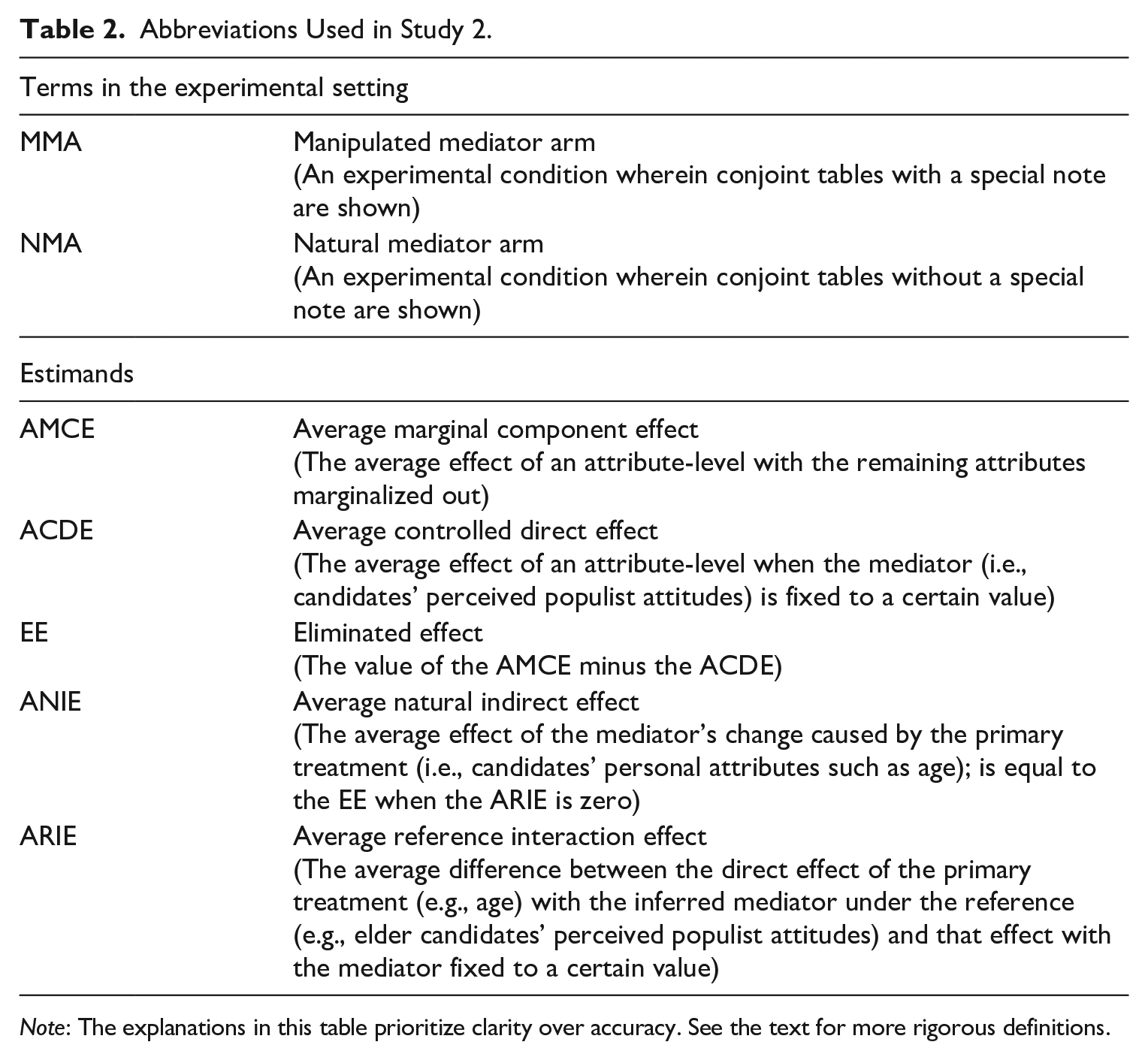
Note: The explanations in this table prioritize clarity over accuracy. See the text for more rigorous definitions.
I conducted a conjoint experiment similar to Study 1 with candidates’ favorability as an outcome variable. I measured respondents’ preferences for hypothetical candidates using a six-point bipolar scale without numbered labels, the ends of which were labeled as “being quite undesirable as a member of the HoR” and “being very desirable as a member of the HoR.”
The attributes are basically the same as in Study 1 except for the “special note” attribute, which will be explained later. I included party affiliation for all respondents to increase the validity of the assumption of manipulation exclusion restriction (discussed below) as much as possible. As shown in Table 3, I limited the levels of each attribute to make interpretations easier and increase statistical power. Based on previous studies, I expected that levels listed in an upper row for each attribute would generally be favored by respondents. 16 Unlike Study 1, I used a uniform distribution for randomization because reducing the number of levels made it difficult to mimic the real-world profile distribution (e.g. it is pointless to attempt to reproduce the genuine distribution of candidates’ educational backgrounds when the attributes are only “the University of Tokyo” and “high school”). That is, I prioritized internal validity to elucidate causal mechanisms over external validity in Study 2. To improve readability, while I randomized the order of the other attributes in conjoint tables across respondents, special notes were always located at the bottom of the tables.
Attributes and Their Levels in a Conjoint Experiment in Study 2.
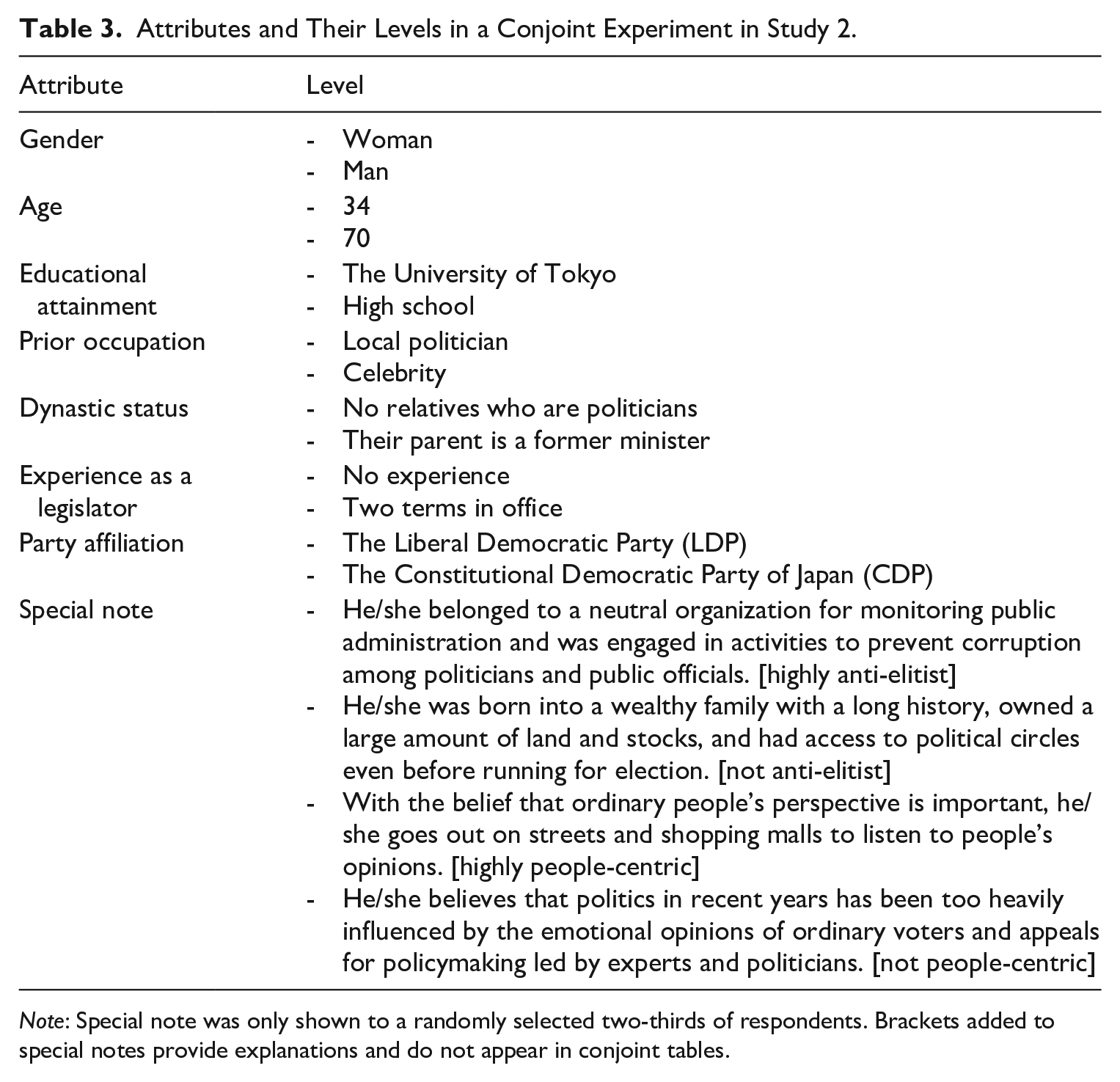
Note: Special note was only shown to a randomly selected two-thirds of respondents. Brackets added to special notes provide explanations and do not appear in conjoint tables.
Acharya et al.’s (2018) experimental design involves randomly splitting the respondents into two groups. I showed one group conjoint tables containing not only the personal attributes used in Study 1 but also a special note expected to manipulate the respondents’ perceptions of the candidates’ populist tendencies. This experimental condition is called the manipulated mediator arm (MMA). Another group was shown conjoint tables without such notes, called the natural mediator arm (NMA). I set the probability assigned to the MMA group to 2/3. I conducted blocked randomization based on respondents’ gender (men, women, and others), age (18–34, 35–54, and 55–69), and ideological self-placement (liberal, middle-of-the-road, and conservative); thus, 27 blocks were created.
I prepared four versions of special notes: one note that is expected to make candidates seem highly anti-elitist, one not anti-elitist, one highly people-centrist, and one not people-centrist (as shown in brackets in Table 3). 17 However, I found it difficult to manipulate respondents’ perceptions of candidates’ anti-elitism and people-centrism separately using these cues in pilot surveys (i.e. some notes tended to affect both perceptions). Study 1 also suggests that Japanese voters perceive candidates’ anti-elitism and people-centrism with little distinction. Therefore, as per the preregistration, I did not distinguish between anti-elitism and people-centrism and combined two high-populist notes into one category and two low-populist notes into another in the primary analysis of Study 2. Because it is unnatural for respondents to see the same specific notes multiple times, each of these four notes is presented only once per respondent in a randomized order in the MMA group instead of being assigned through simple randomization with replication. Consequently, each respondent completed conjoint tasks only twice. To align with the MMA group, the number of tasks for respondents assigned to the NMA group was also two.
Owing to the experimental design explained above, respondents’ perceptions of candidates’ populist tendencies were expected to be randomly manipulated in the MMA group, and such perceptions were expected to affect respondents’ preferences for candidates. Respondents might still shape their preferences for candidates based on the information of their personal attributes. However, such causal paths would be unlikely to run through perceptions of populist tendencies. In contrast, respondents in the NMA group inferred candidates’ populist attitudes only from their personal attributes; thus, personal attributes directly and indirectly affected respondents’ preferences via perceptions of populist tendencies. A comparison of the effects of each attribute-level between the two groups enabled me to test whether voter perceptions of candidates’ populist attitudes contribute to the causal relationship between candidates’ personal attributes and their perceived favorability. 18
For example, let us assume that we want to know how perceptions of candidates’ populist tendencies mediate the effect of age on people’s preferences for candidates. Following previous studies (Eshima and Smith, 2022; McClean and Ono, 2024), we expect respondents in the NMA to rate young candidate profiles higher than older ones. This causal relationship consists of two pathways: an indirect path via their demand for populists (voters are likely to favor young candidates because they expect that young candidates have high populist tendencies) and a direct path (voters are likely to favor young candidates for other reasons). If respondents are assigned to the MMA and see profiles in which a candidate is young but is born into a wealthy family and has access to political circles, they do not expect such candidates to have high populist attitudes—the indirect path is blocked. By contrast, older candidates may not be as harshly penalized when they are revealed to be wealthy and have access to political circles because they are not expected to have populist tendencies. Thus, differences in favorability between young and older candidates is smaller in the MMA than in the NMA, and this reduction of the favorability gap corresponds to the indirect effect through perceptions of populist tendencies. However, we should be cautious, as this explanation prioritizes clarity and ignores some important assumptions that will be discussed later.
The experiment mentioned above was embedded in an online survey conducted from August 14 to 17, 2021. I recruited 3,636 respondents. Other survey details, including the measurement of respondents’ populist attitudes, were the same as in Study 1.
Quantities of Interest, Statistical Inference, and Assumptions
I analyzed each attribute separately. I also separated the data of profiles with high- and low-populist notes in the MMA. In analyzing high-populist (low-populist) notes, I used the combined data of NMA tasks and high-populist (low-populist) MMA tasks.
Let

where
Following Acharya et al. (2018), Table 4 summarizes the relationship between the quantities of interests and parameters in Model (1). Comparing expected favorable and unfavorable levels in the NMA yields the AMCE of attribute
Relationship Between the Quantities of Interests and Parameters in Model (1).
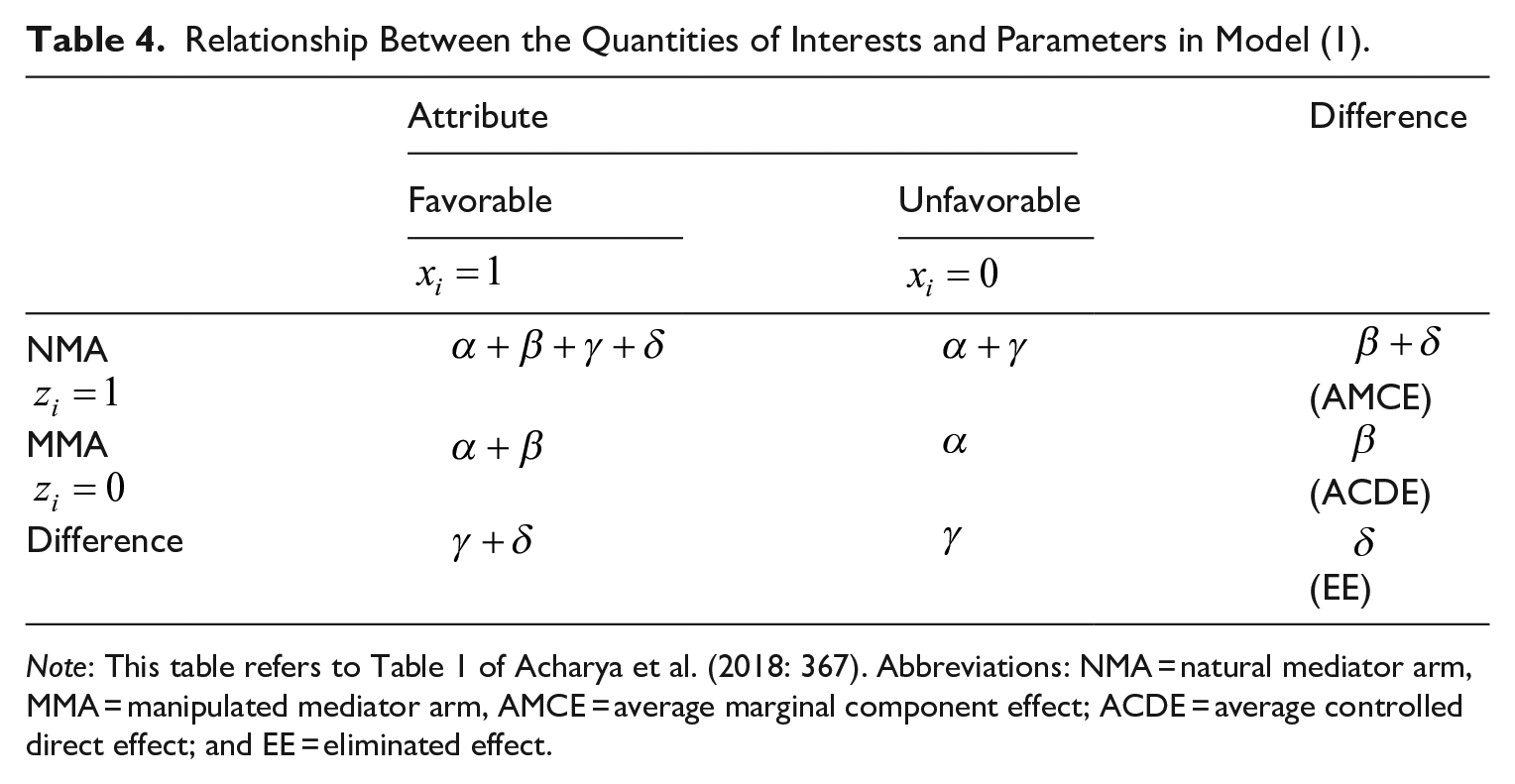
Note: This table refers to Table 1 of Acharya et al. (2018: 367). Abbreviations: NMA = natural mediator arm, MMA = manipulated mediator arm, AMCE = average marginal component effect; ACDE = average controlled direct effect; and EE = eliminated effect.
In addition, to test whether the size of the EEs differs by respondents’ populist attitudes, for each attribute, I added the respondents’ populist attitudes score, which I denote
To claim that this experiment plausibly identifies the causal mechanisms, I made several assumptions in addition to those usually required for experiments such as successful random assignment (Acharya et al., 2018). 19 First, the manipulation exclusion restriction assumption requires that the special notes affect respondents’ preferences for candidates only through their perceptions of candidates’ populist tendencies. Although simultaneously displaying other attributes could mitigate this possibility (Dafoe et al., 2018; e.g., it was unlikely that the special notes changed the perceived ideological positions of candidates because their party affiliation was fixed), some might suspect that this assumption was violated because the special notes were too specific and might have changed respondents’ perceptions about other elements of candidates (e.g., candidates who belonged to a neutral organization for monitoring public administration should be more diligent than candidates who did not). I admit that this is a limitation of this experiment, but there was a trade-off between this and other issues.
Second, it was desirable that the special notes perfectly manipulated respondents’ perceptions of candidates’ populist attitudes. I deliberately gave respondents specific information through the special notes to make this manipulation as strong as possible because making candidates simply state their beliefs (e.g., “I will respect the general public’s will”) would have resulted in a perception of cheap talk and would not be able to sufficiently manipulate candidates’ perceived populist tendencies. The pilot studies confirmed that the notes could manipulate candidates’ perceived populist attitudes as much as or even more successfully than the other personal attributes. 20 Nevertheless, it is unrealistic to assume perfect manipulation. However, when we can assume that the special notes monotonically manipulate respondents’ perceptions (e.g., the high-populist notes do not decrease perceived populist attitudes), we can make interpretations similar to the intention-to-treat approach. I consider the monotonicity assumption plausible in this case and interpret that this study’s results tend to be conservative.
Third, an additional assumption is required if we interpret the EE as the indirect effect of the concerning attribute through candidates’ perceived populist attitudes. 21 More rigorously, the quantity in concern here is the average natural indirect effect (ANIE), which means, in this case, the difference in preferences for candidates between when respondents guess the level of candidates’ populist tendencies based on a favorable attribute and when they guess it based on an unfavorable attribute, holding the actual candidates’ attribute constant. To identify the ANIE with the EE, we must assume that the average reference interaction effect (ARIE) is zero. The ARIE denotes the average difference between the direct effect of the concerned attribute with inferred populist tendencies under the reference (favorable or unfavorable) attribute and the controlled direct effect. This assumption holds if populist attitudes inferred by the reference attribute are constant. Unfortunately, this condition cannot be empirically validated. However, I believe it is safe to assume that most respondents infer low populist attitudes from the unfavorable characteristic of the attribute, which indicates that the ARIE can be ignored.
Results
Figure 3 shows estimated AMCEs, ACDEs, and EEs of candidates’ personal attributes on perceived desirability as a member of the HoR. A level in parentheses in each panel’s subtitle represents the baseline. Dots represent point estimates, and segments represent their 95% confidence intervals. Filled dots indicate that the NMA was compared with the high-populist MMA, and open dots indicate that the NMA was compared with the low-populist MMA. The results using high-populist and low-populist notes are very similar; thus, I only refer to the results of low-populist notes for conciseness.
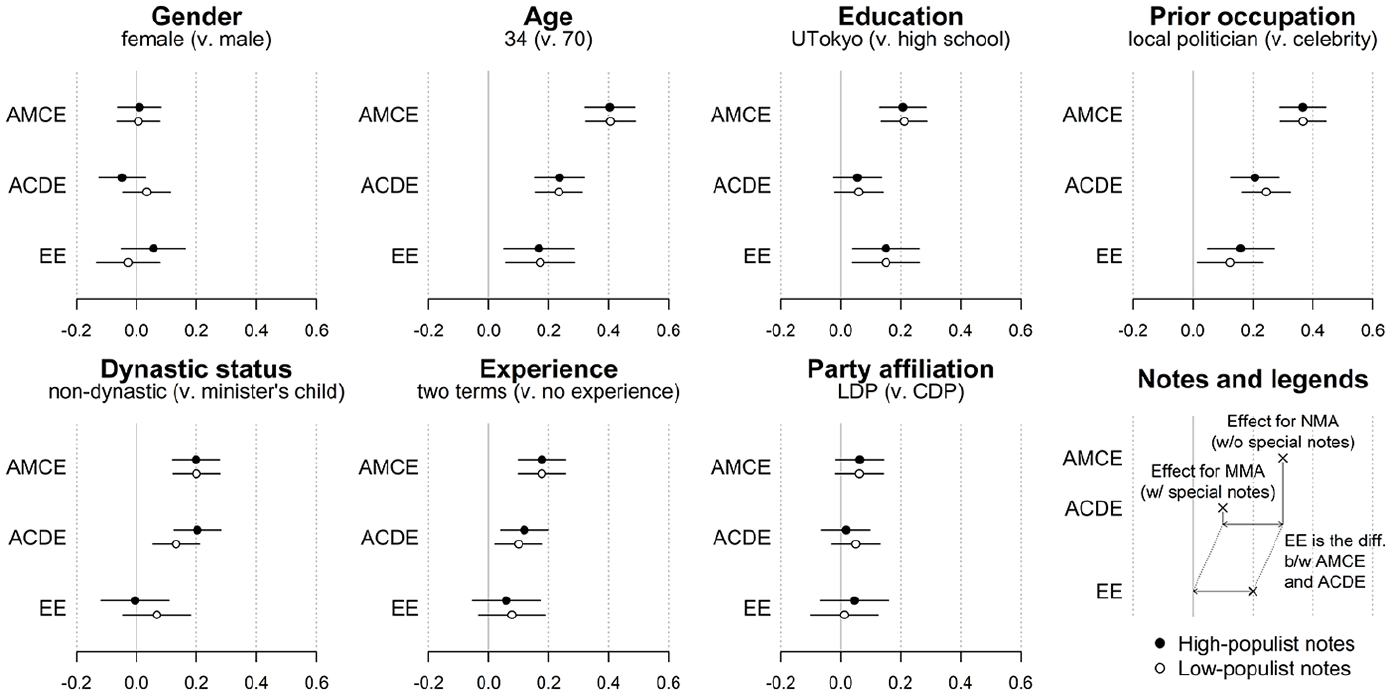
AMCEs, ACDEs, and EEs of Candidates’ Personal Attributes on Perceived Desirability as a Member of the HoR.
At first, contrary to expectations, the AMCEs of gender and party affiliation were not significantly positive. 22 As for the remaining attributes, the EE was significant only for age, educational attainment, and prior occupation. My expectation was correct for age. The advantage of 34-year-old candidates over 70-year-old candidates was 0.41, but it was reduced to 0.23 when respondents received cues expected to make them perceive that the candidates had high populist attitudes. The EE was 0.17, which corresponds to 42% of the AMCE.
In contrast, the educational attainment and prior occupation results contradict my expectations. If voters’ expectations that candidates who are UTokyo graduates and candidates who have served as local politicians have low populist attitudes suppress these candidates’ advantages, their advantages become greater once information about candidates’ populist attitudes is provided; thus, the EEs should be negative. However, the estimated EEs of educational attainment and prior occupation were positive (0.15 = 71% of the AMCE for educational attainment and 0.12 = 34% of the AMCE for prior occupation). 23
When I tested whether respondents’ populist attitudes conditioned the size of EEs, the coefficient of the third-order interaction term was not significant for most combinations of attributes and the MMA (both low-populist and high-populist). 24 The only exception was that when paired with high-populist MMA, the EE of experience as a legislator significantly depended on respondents’ populist attitudes. However, this result opposed the hypothesis—the EE of experience as a legislator was positive (though not significant) on average, contrary to the prediction, and it was greater for those with higher populist attitudes. Alongside Study 1, the absence of meaningful interaction is consistent with recent studies demonstrating the irrelevance of people’s populist attitudes.
Discussion
Why were the EEs of educational attainment and prior occupation found to be positive? I discuss several possible explanations. Based on the results of Study 1, I assume that UTokyo-graduate candidates and candidates who have experience as local politicians were more likely to be perceived as having low populist attitudes than their counterparts in the experiment.
First, while I presumed that perceptions of candidates’ high populist tendencies led to support, if the opposite is true, the EEs of educational attainment and prior occupation should be positive. However, this view cannot explain the fact that the EE of age was also estimated to be positive. Thus, I reject this possibility.
Second, the positive EEs may be attributable to the violation of the manipulation exclusion restriction assumption caused by the general tendency of conjoint experiment participants to answer questions by solely focusing on the attributes that they consider important (Jenke et al., 2021). Specifically, once cues about expected candidates’ populist tendencies were provided, respondents may have formed their preferences only based on these cues and ignored the remaining attributes; in other words, the special notes crowded out the effects of other attributes. Figure 4 illuminates why this crowding-out effect causes the violation of manipulation exclusion restriction. Panel (a) shows a causal graph that Acharya et al.’s (2018) experimental design assumes: the difference in information provision between the NMA and the MMA (i.e. special notes) affects the outcome only through the mediator (candidates’ perceived populist attitudes). However, more rigorously speaking, information on candidates’ personal attributes comes into effect only when it has respondents form their perceptions of candidates’ personal attributes. The crowding-out effect means that respondents become unconcerned about personal attributes once information on the mediator is provided. That is, information manipulation has an influence on the outcome through (un)perceived personal attributes, which is illustrated in Panel (b). This panel clearly displays a typical exclusion restriction violation in causal inference.
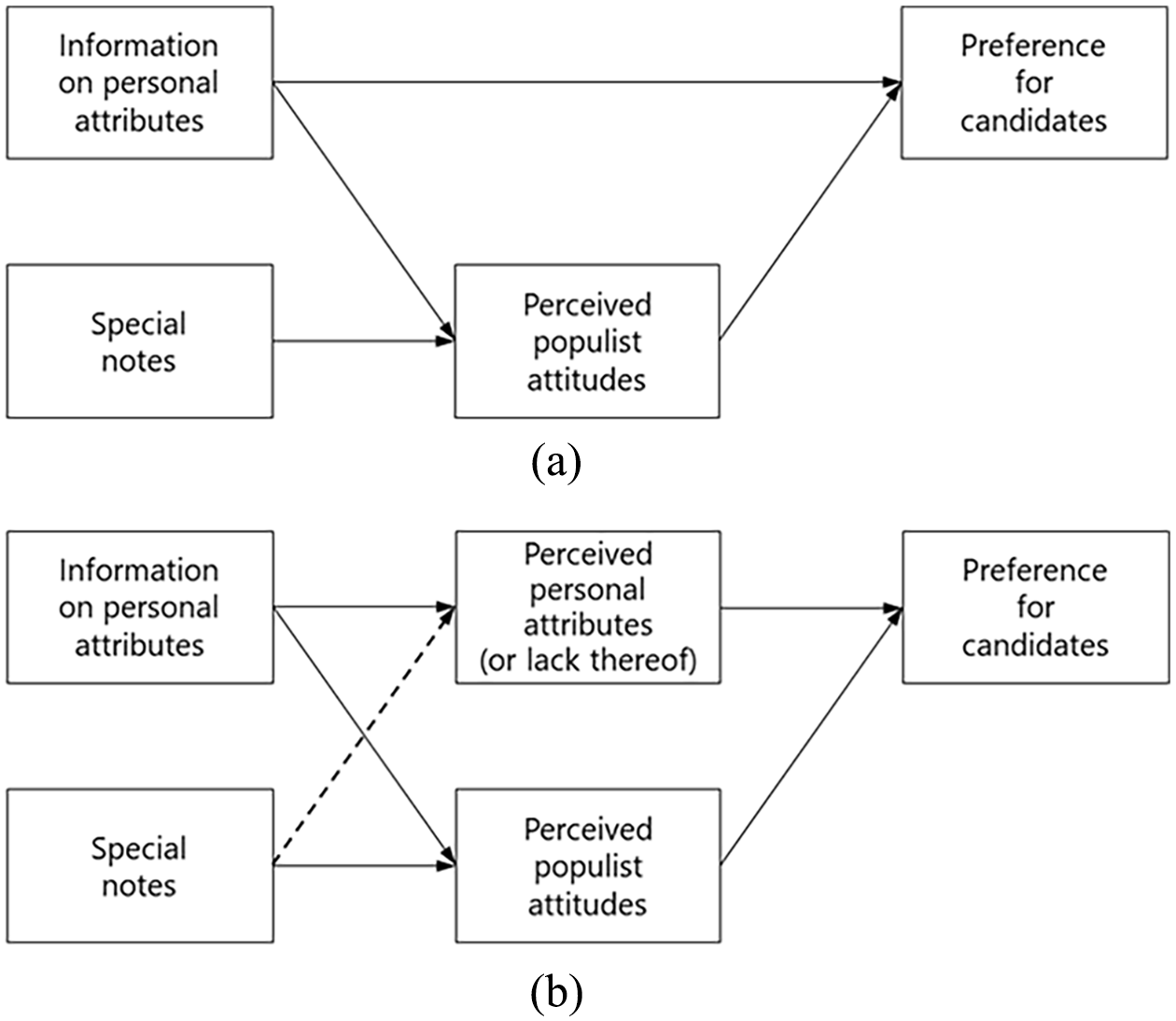
Causal Diagram Illustrating the Manipulation Exclusion Restriction Assumption.
However, additional analysis suggests that respondents do not necessarily consider the special notes in forming their preferences; that is, a dashed arrow in panel (b) does not exist. When I estimated the AMCE of each special note, while the two high-populist notes had a significantly positive AMCE, the two low-populist notes did not. 25 Therefore, the low-populist notes should not have affected respondents’ preference formation, implying that the low-populist notes were not sufficiently strong to crowd out the effects of educational attainment and prior occupation. 26 Furthermore, because the results of the high-populist MMA were nearly the same as those of the low-populist MMA, as shown in Figure 3, it was also doubtful that the crowding-out effect caused unexpected results for the high-populist MMA.
Third, the most plausible explanation is that the effect of the special note on respondents’ perceptions of candidates’ populist attitudes varies with candidates’ personal attributes. Panels (a) and (b) of Figure 5 illustrate this problem using the case of the effect of educational background and the low-populist note. Panel (a) shows the originally expected outcome. In the NMA, while UTokyo-graduate candidates are generally preferred, high-school-graduate candidates are estimated to be populist, and UTokyo-graduates are not. In the MMA, the low populist note dispels people’s expectations for high school graduates’ populist attitudes and exacerbates the difference in favorability. This widened difference constitutes the expected negative EE. However, if UTokyo-graduate candidates with wealth and connections to political circles are more likely to be perceived as having even lower populist attitudes than their counterparts who only completed high school, as illustrated in panel (b), their favorability can plunge to erase their advantage over high school graduates, which yields a positive EE. Similar results are found if, for example, candidates who served as local politicians and preferred technocratic politics are inferred to have lower populist attitudes than a technocracy-oriented celebrity candidate. 27
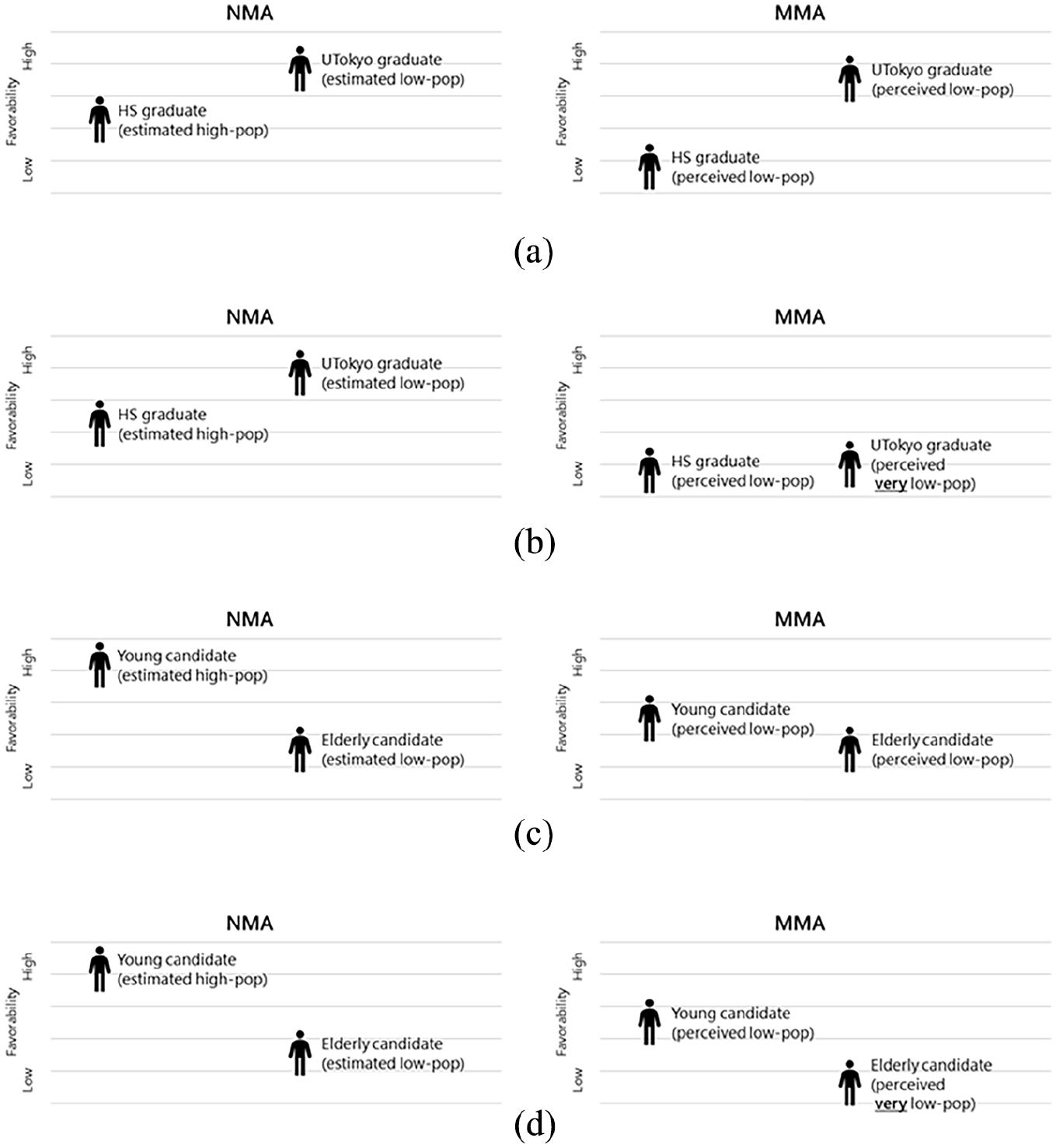
Illustration of the Consequence of Heterogeneous Manipulations.
Nonetheless, this problem of heterogeneous manipulation does not affect the interpretation of the positive EE of age. If candidates with insider-like personal attributes were likely to be perceived as having even lower populist attitudes than those with outsider-like attributes when given low-populist notes, the effect of these notes would be greater for politically connected or technocracy-oriented 70-year-old candidates than their 34-year-old counterparts. If this is the case, the EE is biased in a negative direction, as illustrated by the comparison between Panels (c) and (d) of Figure 5. However, the EE of age is still estimated to be positive, indicating that the indirect effect of age through perceived populist tendencies was undoubtedly positive. In other words, the results imply that voters prefer younger candidates over older ones because they anticipate that younger candidates will hold more populist qualities.
Given that people’s preferences for younger candidates are attributable to their demands for populists, what do they expect from representation by younger candidates? Although the current experiment was not designed to fully address this question, I conducted a non-preregistered exploratory analysis wherein I estimated the EE of candidates’ age conditioned by their party affiliation. I found that, though not statistically conclusive, the effect of age seemed to be mediated to a greater extent for LDP (a governing party) candidates than CDP (an opposition party) candidates. 28 This finding implies that people do not intend to elect young politicians merely as a protest against the status quo but hope that their anti-elitist and people-centrist stances will lead to policy changes. Because this argument is based on an exploratory analysis with only suggestive evidence, future work is required to further address this issue of people’s expectations of populists’ representation.
Summary
Study 2 suggests that Japanese voters’ preferences for young politicians are explained at least 42% by their expectations that these politicians have anti-elitist and people-centrist positions. However, this study did not confirm such expectations’ mediating role regarding other outsider-like attributes whose popularity has been shown in previous studies—being female and having non-dynastic status. Moreover, though I expected that their populist-like semblance would mitigate the disadvantage of less-educated and less-experienced politicians, the results do not align with this expectation; however, this is likely due to flaws in the experimental design. Although this study does not unequivocally clarify the questions it sought to address, it sheds light on the critical role of people’s demand for populist politicians to account for their inclination to support politicians with specific personal attributes.
Conclusion
This study addressed the puzzle of why voters prefer politicians with specific personal attributes that do not necessarily seem to ensure good performance. I considered voters’ expectations that politicians with outsider-like attributes would be populist as the key to solving this question, given that the majority of voters exhibit a preference for populist politicians in many democratic countries. I conducted two survey experiments in Japan, the first of which revealed that voters inferred political candidates’ anti-elitism and people-centrism based on various personal attributes such as gender, age, education, and dynastic status. The second experiment suggested that the causal relationship between candidates’ age and voter preferences is partially mediated by voters’ expectations of candidates’ populist tendencies. However, this is not the case for gender and dynastic status.
These results have several implications for real-world politics and future research. First, we should care about whether it is desirable for voters to elect young politicians in anticipation of their populist stance. Viewed from the opposite angle, the second experiment indicates that young incumbents are likely more severely penalized once they come to be perceived as elitist and technocratic, which may bind their policies and communication style. While improving the diversity of political arenas in terms of generations may be beneficial, it should be achieved by institutional reforms, not solely by voters’ expectations for populist politicians, to keep young politicians’ positions unbound after being elected.
Second, the results of the first experiment help explain why candidates with generally non-desired attributes, such as a politically inexperienced former TV personality, sometimes win a landslide victory in elections. Seemingly non-desired candidates can gather support if they have outsider-like attributes and succeed in framing issues using populist rhetoric. This explanation is likely to be applicable in primary or non-partisan elections, even in countries with a strong influence of parties.
Third, this study advances the study of voters’ cue-taking from politicians’ personal attributes and the theory of representation. While studies have focused on how candidates’ various characteristics affect voter perceptions of their left–right and specific issue positions (e.g. Carnes and Lupu, 2016; Däubler et al., 2021; Pedersen et al., 2019), this research is the first to clarify voters’ cue-taking about candidates’ positions on populist scales, which is an important dimension overlooked by previous studies. In addition, the second experiment offers the insight that people can use such cues to have politicians represent their preferences. This study’s methodological framework also suggests new directions for the literature investigating how people’s desire for descriptive representation leads to substantive representation (Arnesen et al., 2019).
Several limitations should be addressed. We should note that my interpretations of the results of the second experiment depend on several assumptions, the validity of which cannot be tested. Moreover, considering that large sample size is generally required to test interaction (Sommet et al., 2023), the second experiment might be underpowered for some attributes, the AMCEs of which were small. Still another limitation of this study is the absence of the Manichean element of populism in the experiments, and better incorporating it into the measurement of voter perceptions is worthy of consideration in future research.
In addition, the generalizability of this study’s results outside of Japan requires careful discussion. 29 As discussed earlier, populism is not very prevalent and populist strategies are not owned by specific parties in Japan. Thus, Japan might be an easy case in which people’s demand for populists forms their preferences for politicians with specific personal attributes. More specifically, in countries in which populist styles are common, the influence of personal attributes may be drowned out by information about candidates’ party affiliations. Nonetheless, the tendency to dislike elderly politicians is widespread in other countries (Eshima and Smith, 2022), and this study presents the first step in elucidating its reasons and paves the way for similar questions concerning other attributes such as gender.
Finally, this study demonstrated the possible effectiveness of Acharya et al.’s (2018) experimental design in conducting candidate choice experiments and provided lessons for the application of this design. As the proponents of this design applied it to the study of public preferences for U.S. Supreme Court nominees (Acharya et al., 2018), this approach has a high potential to uncover the psychological mechanisms underlying voters’ preference and belief formation for political actors. However, this approach relies on several assumptions that are difficult to justify empirically and thus require great care in designing a survey and crafting its expressions. My discussion about the unexpected results of the second experiment clarifies how the crowding-out effect and heterogeneous manipulation by mediator information can make it difficult to identify the indirect effect of the variable of interest. The primary methodological takeaway is that we should design the mediation manipulation to change respondents’ perceptions of the mediators as strongly as possible, but at the same time to change other perceptions as little as possible. Future studies should explore ways to more effectively utilize this design, and this study’s findings should be replicated with improved experimental settings.
Supplemental Material
sj-docx-1-psx-10.1177_00323217241263295 – Supplemental material for Why Voters Prefer Politicians With Particular Personal Attributes: The Role of Voter Demand for Populists
Supplemental material, sj-docx-1-psx-10.1177_00323217241263295 for Why Voters Prefer Politicians With Particular Personal Attributes: The Role of Voter Demand for Populists by Hirofumi Miwa in Political Studies
Footnotes
Acknowledgements
An earlier version of this article was presented at the Annual Meeting of the Japanese Political Science Association on September 26, 2021. I am grateful for the helpful comments provided by Airo Hino and the session participants. I also thank Akira Inoue and Akito Yamaguchi for their comments, which improved the Japanese translations of survey items used to measure populist attitudes. In addition, I extend my gratitude to anonymous reviewers whose insights and suggestions have significantly enhanced this article.
Declaration of Conflicting Interests
The author declared no potential conflicts of interest with respect to the research, authorship, and/or publication of this article.
Funding
The author disclosed receipt of the following financial support for the research, authorship, and/or publication of this article: This work was supported by the Japan Society for the Promotion of Science KAKENHI Grant Numbers JP19H00584 and JP22H00810, and by a grant from Gakushuin University.

Supplemental Material
Notes
Author Biography
References
Supplementary Material
Please find the following supplemental material available below.
For Open Access articles published under a Creative Commons License, all supplemental material carries the same license as the article it is associated with.
For non-Open Access articles published, all supplemental material carries a non-exclusive license, and permission requests for re-use of supplemental material or any part of supplemental material shall be sent directly to the copyright owner as specified in the copyright notice associated with the article.
