




Abstract
Many multitier polities have some scheme of territorial-based redistribution, which plays a crucial role in mitigating territorial inequality. This article looks at the public opinion on inter-regional transfers and argues that: (1) perceptions of aggregate electoral support for interpersonal redistribution in the region affect support for inter-regional redistribution independently of perceptions about the region’s economic conditions and (2) perceptions of high electoral support for interpersonal redistribution among the region’s affluent can lead them to favor territorial transfers, because these transfers may work as a mechanism for local redistribution cost displacement. We test our argument using a survey experiment in which we provide information about regional economic conditions and aggregate demand for interpersonal redistribution. Our contribution highlights that the aggregate demand for interpersonal redistribution within regions is not necessarily endogenous to regions material conditions, and that the perception of this aggregate demand by the affluent affects their inter-regional redistributive preferences.
Introduction
Territorial transfers are important policy instruments in political unions to mitigate inequality of living standards across territories (Boadway et al., 2003; Boadway and Shah, 2009; Dellmuth, 2011; Sellers et al., 2017). Attitudes toward those transfers play a central role in political economy models that explain why some countries succeed more than others in adopting territorial-based redistribution (Beramendi et al., 2017; Bolton and Roland, 1997; Rodden, 2002). For instance, Beramendi et al. (2017) argue that in developing federations such as Mexico, Argentina, and Brazil, a combination of malapportionment, the territorial structure of inequalities, and voters’ preferences resulting from that structure, bias redistribution toward inter-regional transfers—one of the main policies to reduce inequality in these countries.
This article focuses on the argument regarding the formation of public attitudes toward inter-regional redistribution. We conduct a large-scale survey experiment to investigate the effect of perceptions among the affluent of the aggregate support for interpersonal redistribution in their region. The experiment randomly assigns information about the region’s economic profile and aggregate levels of support for redistribution. We call the former an economic information treatment since it refers to the economic conditions of their region, and the latter a political information treatment since it refers to information about political opinion in their region. Our experiment evaluates the effect of these two information treatments on people’s support for inter-regional redistribution separately to compare their magnitude and test if they have independent effects.
Political economy models often endogenize demand for interpersonal redistribution, demand for inter-regional redistribution, and economic conditions (wealth and inequality) of the regions (Beramendi, 2012; Bolton and Roland, 1997). For instance, Beramendi et al. (2017) argue that affluent individuals, ceteris paribus, always prefer low interpersonal transfers. But affluent individuals in poor regions “have a strong preference for [inter-regional transfers] that grows stronger the higher the level of inequality” in their region because these policies “liberate them of some of the burden imposed by [interpersonal] redistribution in the region, by transferring resources away from the rich in the rich region.” But although demand for interpersonal redistribution, demand for inter-regional redistribution, and economic conditions of the regions can endogenously affect each other, we emphasize that levels of aggregate demand for interpersonal redistribution in the regions can vary even if wealth and inequality levels remain constant. For instance, demand for interpersonal redistribution increases if leaders, interest groups, and organizations successfully mobilize attention around this issue and present it as a viable solution for social problems (Campbell et al., 1960; Huber and Stephens, 2012; Przeworski, 1986). As an example, in Brazil, both states of Rio Grande do Norte (RN) and Sergipe (SE) are relatively poor and have high levels of inequality, but the demand within the region for interpersonal redistribution is relatively greater in the latter. Hence, although economic conditions and redistributive demands (interpersonal and inter-regional) are connected, we should expect some variation in aggregate levels of public demand for interpersonal redistribution across regions with similar levels of wealth and inequality. The open question we address here, then, is whether an independent variation in the demand within the region for interpersonal redistribution affects attitudes of the affluent in the region toward inter-regional redistribution. More precisely, we set out to answer if people’s perceptions of the levels of aggregate demand for interpersonal redistribution in their region can affect attitudes toward inter-regional redistribution, independently of people’s perception of the economic situation of their region, and how it compares with the effect of peoples’ perceptions of region’s economic conditions.
We conduct a nationwide experiment to answer these questions. The experimental manipulation of information on region’s demand for interpersonal redistribution (political information) and economic conditions (economic information) provides the internal validity we need to access the causal effect of these two pieces of information and compare their magnitude. Experimental designs have become common in many areas of political science, but to the best of our knowledge, it has been used only occasionally to investigate underlying assumptions of political economy models of preferences on inter-regional transfers. Although scholars have used experimental designs to evaluate the effect of information about regions’ economic conditions (Balcells et al., 2015), no one has investigated how political information, that is, perceptions of the electoral demand for redistribution, affects voters’ attitudes toward territorial-based redistribution. Our experiment was conducted in Brazil. This is a particular case of interest because inter-regional transfers play an important role in the inequality reduction of subnational government spending capacity, and although our study focuses on a single country, our findings and research design can motivate similar studies in other federations or political unions and help to advance comparative studies on the politics of territorial inequality.
Our results show that voters’ perceptions about (1) their own regions’ economic profiles and (2) their own region’s electoral support for interpersonal redistribution have similar effects on support for inter-regional redistribution, but the latter is stronger; (3) that these effects can occur independently of each other, and (4) that they differ by income group. Upon learning that demand for interpersonal redistribution is higher in their own region than in the rest of the country (a political information), the average support for territorial redistribution among the affluent reaches higher average levels than among lower-income groups.
Theoretically, our findings touch on a long-lasting controversy between the effect of self-interest and symbolic politics on preference formation. Previous studies have shown that territorial transfers are not always politicized domestically and, in the European Union, for instance, the effect of territorial transfers on attitudes about integration depends on education and identity-related factors, suggesting that voters do not always link actual transfers to their own material self-interest (Chalmers and Dellmuth, 2015). Second, scholars have argued that some political orientations and attitudinal factors, such as ideology and party identification, often outweigh the effect of information and self-interested motivations (Sears et al., 1980). Others have argued otherwise, that information (Bullock, 2011) and self-interest motivations (Slothuus and Bisgaard, 2021) affect the formation of policy positions when the former is provided, and the latter is clearly at stake. While our study does not solve that controversy, we provide internally valid causal evidence and clearly identified a causal effect of political and economic information on attitudes toward territorial redistribution. The information we provided affects the preferences of the affluent on average in a way that is consistent with self-interest arguments. The mobilization of self-interest can be triggered by both information on the economic and political fronts, and they can happen independently of each other.
We begin by examining the theories about preferences toward territorial redistribution, focusing on the role of information in that process. We then discuss how the political information (i.e. aggregate demand for interpersonal redistribution in the regions) aspect of the theories has been articulated in previous work, and we present our argument to fill the gap we identify. Finally, we discuss the broader implications of our findings in the final section.
Theory
Virtually all multitier polities combine interpersonal and inter-regional schemes of redistribution. The former refers to policies to reduce income inequality between individuals and families. Examples are cash transfer programs, such as the PROGRESA in Mexico, Bolsa Familia in Brazil, and Social Security in the United States. Interregional transfers refer to redistribution that takes place at a territorial level, for instance, transferring fiscal resources from some states to others by means of centralized revenue collection and redistribution. Examples are the Federal Fund for States in Brazil and the Structural Funds in the European Union.
Territorial-based transfers take place in unitary and federal polities (Boadway et al., 2003; Sellers et al., 2017) and represent the major source of territorial inequality reduction in many countries (Beramendi et al., 2017; Dellmuth, 2011). Inequality across jurisdictions is a widespread phenomenon even among rich and developed countries. It entails differences in a region’s capacity to provide similar services to citizens, and as a result, demands for policies to reduce place inequality are part of shared-rule territorial politics. “Unfunded mandates” can hinder regional economic growth (Rodríguez-Pose and Vidal-Bover, 2022) and territorial transfers help to mitigate such problems, although their effectiveness can vary (Rodríguez-Pose and Muštra, 2022). It is not surprising, then, that political contentions around territorial redistribution have been documented in various countries such as Belgium and Germany (Holm and Geys, 2018), Italy (Franchino and Segatti, 2019), the United Kingdom (Kuhn, 2019), Spain (Balcells et al., 2015; Solé-Ollé and Sorribas-Navarro, 2008), Argentina (Calvo and Moscovich, 2017), Brazil (Leme, 1992; Samuels, 2003; Souza, 2007), Canada (Lecours and Béland, 2010), India (Khemani, 2007), Mexico (Diaz-Cayeros, 2006), and Russia (Ravallion and Lokshin, 2000).
In this article, we focus on the preferences of regional voters regarding inter-regional redistribution. We argue that individuals’ perception of regional electoral support for interpersonal redistribution has a distinct influence on their support for inter-regional transfers, irrespective of their perceptions of the economic conditions in the regions. Specifically, we posit that perceptions of a high electoral demand for interpersonal redistribution within a region can independently contribute to an increase in support for inter-regional redistribution among affluent individuals in that region.
The rationale is straightforward. If there is high support for interpersonal redistribution in the region, there is pressure on local politicians to increase local resources to tap into that demand. These resources can come from local taxes or inter-regional transfers. As by the very nature of redistributive policies the affluent pay proportionally more taxes than they receive immediate benefits from these policies, inter-regional transfers can work as a cost displacement mechanism. In other words, inter-regional transfers can increase the local budget for policy provision without increasing local taxes. Therefore, we should expect that information indicating high electoral support for interpersonal redistribution in a region will increase support for inter-regional redistribution among the affluent in that region. We discuss below the predictions for the poor in the region. Based on this argument, we set out to answer three questions: (1) whether the perception of aggregate regional electoral support for interpersonal redistribution affects support for inter-regional redistribution; (2) if that effect varies by income groups in the region; and (3) whether these effects occur independently of people’s perceptions of the region’s economic conditions.
Our argument and empirical analysis contribute to our understanding of the politics of inter-regional transfers in at least three major ways.
First, our study connects to a broader political economy literature on the politics of territorial transfers and helps to mitigate the scarcity of empirical studies focusing on voters’ preferences when inter-regional redistribution is at stake. There is a rich literature focusing on the institutional factors affecting political unions’ adoption of inter-regional redistribution (Bosch et al., 2010; Snoddon and Wen, 2003). For instance, Rodden (2010) argues that overrepresentation of some regions in the national legislative and the separation of power in presidential systems, as opposed to the concentration of power in parliamentary ones, make it harder for low-income regions to form a horizontal coalition to push the inter-regional redistribution agenda, reducing the overall levels of inter-regional transfers.
Many of these political economy models place significant emphasis on the importance of electoral politics and the preferences of regional voters (Beramendi, 2012; Bolton and Roland, 1997; Rodden, 2002). For example, González (2016) argues that the redistribution of resources between regions is influenced not only by political institutions, but also by the relative power of presidents and governors, which in turn depends on their electoral support in their respective regions. When governors and presidents in impoverished regions have strong electoral support, they are able to resist pressures from wealthier regions that oppose inter-regional redistribution. They can also form a progressive/redistributive coalition to increase the allocation of territorial transfers to poorer localities. Solé-Ollé (2013) provide evidence that districts with a higher number of swing voters receive greater investment in infrastructure from the central government. Beramendi et al. (2017) argue that inter-regional transfers result from a combination of factors, including malapportionment, the territorial structure of inequalities, and voters’ redistributive preferences that are shaped by this structure. Overall, these studies illustrate the key role played by electoral politics and regional voter preferences in shaping inter-regional redistributive policies.
Despite the significance of voters’ preferences in these models, the majority of research tends to focus on political elites or institutional aspects of inter-regional redistribution politics. Schneider (2017) conducted a comprehensive review of the political economy literature on regional integration and observed that a “fundamental principle in these [democratic multitier] polities is that voters exercise some sort of influence on policy through the leaders they elect.” She also highlighted the lack of empirical knowledge concerning the distribution of public preferences in this area, which is surprising considering the crucial role that these preferences play in models of regional integration. A similar argument can be made regarding studies on the politics of inter-regional redistribution preferences (González, 2016). This article helps to advance the literature on this area.
A second and core contribution of our article is our argument regarding the significance of understanding the impact of voters’ perceptions of aggregate levels of support for interpersonal redistribution in their region, as opposed to their perceptions of their own region economic conditions. This is essential for three reasons: (1) actual aggregate levels of support for interpersonal redistribution in a region can vary due to factors other than the current distribution of personal and regional income; (2) from a material self-interest perspective, we should expect that such a variation in aggregate support for interpersonal redistribution in the region will affect regional voters’ inter-regional redistributive preferences, especially among the affluent; and (3) previous literature in political economy has primarily focused on deriving material self-interest preferences for inter-regional transfer from voters’ personal and regional income distribution, rather than their perceptions of aggregate levels of support for interpersonal redistribution in their region.
Let us consider item (1) first. Aggregate demand for interpersonal redistribution within regions can vary across regions with similar levels of economic conditions. In other words, even if the demand for interpersonal redistribution emerges under unequal economic conditions, the former cannot be subsumed into the latter. Other factors can affect that demand, including political or group interest organizations’ capacity to mobilize voters around redistribution goals (Huber and Stephens, 2012; Przeworski, 1986). Without these factors, electoral support for interpersonal redistribution, for example, among the non-affluent, can remain low despite highly unequal within-region conditions. As a consequence, regions with very similar levels of economic development and inequality can yet present very different levels of aggregate public attitudes toward interpersonal redistribution.
Figure 1 shows evidence in that direction across Organisation for Economic Co-operation and Development (OECD) countries. The lines are fitted values from a regression of regional-level demand for interpersonal redistribution on the interaction between regions’ inequality (Gini) and average income per capita. The dependent variable is individuals’ support for the statement that the government should reduce differences in income levels between rich and poor people, aggregated at the NUTS-2 level. NUTS-2 matches exactly or approximately countries’ states or provinces. Individual-level data comes from round seven of the European Social Survey, a well-established academic survey conducted in OECD countries (available at https://www.europeansocialsurvey.org/). We matched that data with NUTS-2 income and inequality data available at the Eurostat website (https://ec.europa.eu/). The NUTS-2 codes of the regions used in the estimation are shown in the figure. It clearly shows that aggregate levels of support for interpersonal redistribution in the regions vary independently of regional levels of inequality or wealth, even within countries. For instance, in Austria, Steiermark (AT22) and Tirol (AT33), marked in boldface in the figure, have relatively low inequality and are relatively poor, but the aggregate demand for interpersonal redistribution is larger in the latter region. The same goes for Wien (AT13) and Karnten (AT21). In sum, regions’ levels of aggregate demand for interpersonal redistribution can vary independently of regions’ wealth and inequality, even though, at the individual level, they may be related.
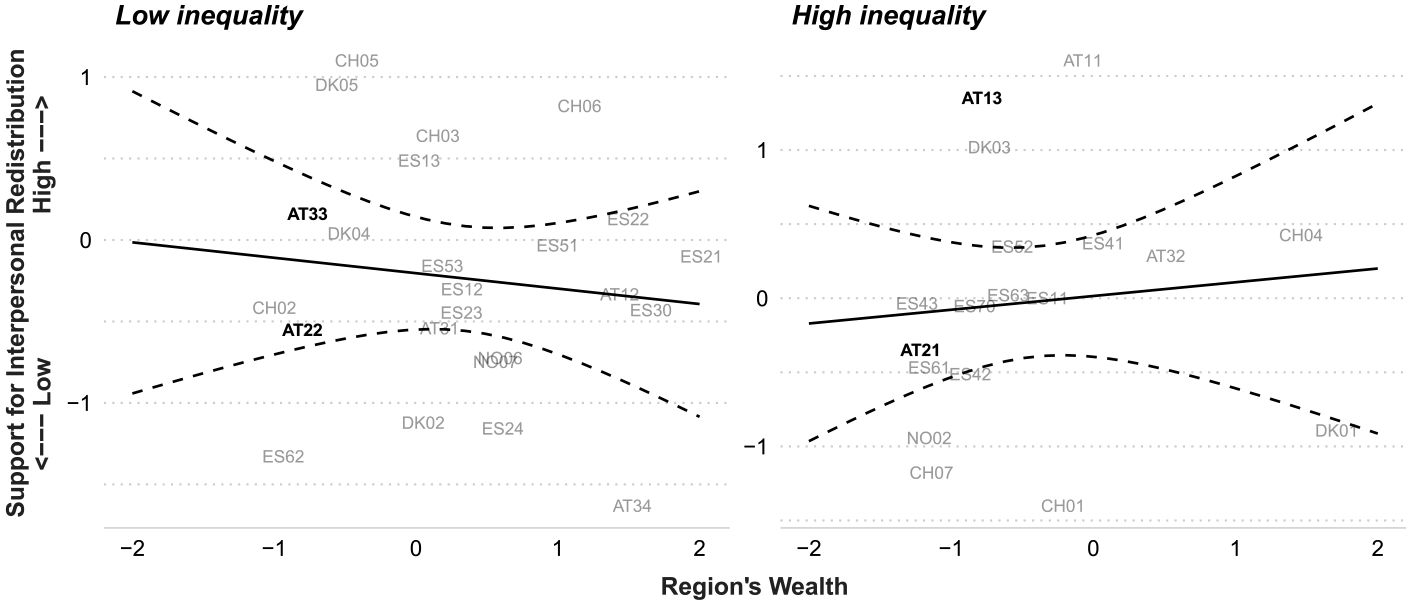
Fitted Values of Regression of Regions’ Support for Interpersonal Redistribution on Wealth, Inequality, and the Interaction Between the Two.
Next, consider the item (3) listed above. Many political economy models ascribe redistributive preferences to individuals and regions based on personal and regional income distributions. The underlying assumption is that people and regions have preferences that are driven by their material self-interest in the outcomes of redistribution. Broadly speaking, these models state that the potential net benefit from redistribution, either interpersonal or territorial-based, is determined by individuals’ and regions’ positions in the income distribution. For instance, the argument predicts that rich people in poor regions favor fiscal transfers because resources from other areas can alleviate tax burdens on local taxpayers (Beramendi and Rehm, 2016), and that preference “grows stronger the higher the level of inequality” (Beramendi et al., 2017).
Recent studies have investigated the self-interest argument about the formation of inter-regional redistribution preferences using experimental designs in which people are informed about their own region’s economic conditions, and evaluated how this information affects participants’ attitudes and behavior. For instance, Balcells et al. (2015) investigate experimentally if information about regions’ relative income position affects redistribution preferences in Spain. As they show, information that the region is relatively poor (rich) increases (reduces) average support for inter-regional transfers.
Our main hypothesis is derived from the same basic underlying assumption that informs these models, namely that material self-interest informs people’s preferences. Our contribution to this literature is to note that once we allow the relative independence between aggregate levels of support for interpersonal redistribution and the economic condition of regions, as shown in Figure 1, it becomes important to understand how the public support for inter-regional redistribution is affected when one receives information about the relative demand for interpersonal redistribution in one’s region, as opposed to information about relative economic conditions.
This distinction further refines previous predictions regarding inter-regional redistributive preferences. Existing models, which are based on the income distribution, suggest that wealthier individuals in affluent and less unequal regions will have similar preferences for low levels of interpersonal and inter-regional redistribution, due to their own material self-interest (Beramendi, 2012). In addition to that argument, we argue that if one region shows high levels of support for interpersonal redistribution while others, with similar economic profiles, show low levels of support, as we see in many cases in Figure 1, informing the affluent individuals in the high-support region about the high aggregate demand for interpersonal redistribution in their region can increase their support for inter-regional redistribution.
Table 1 illustrates our argument in more details. We focus on regions’ relative wealth because it suffices to advance our main point, but the argument could be easily extended to include regions with different levels of inequality, as well. The upper-right corner of Table 1 represents cases in which the region is poor and there is a relatively high demand for interpersonal redistribution. When confronted with either information that their region is poor or that there is a relatively higher public demand for interpersonal redistribution in their region than in the rest of the country, for the affluent, the option for paying welfare expenses with pooled resources—that is, inter-regional transfers—should trump the alternative option of no territorial transfers and provision only with local resources. This reasoning can take place more or less intuitively, and it does not require any sophisticated knowledge about taxation. In that case, we expect that both political and economic information will lead to the same effect of increasing support for inter-regional redistribution among the affluent.
Regions’ Profiles and Our Theoretical Expectations About the Effects Among Affluent Voters of Political Information About the Demand for Interpersonal Redistribution in the Region, Versus Economic Information About the Regions’ Wealth.
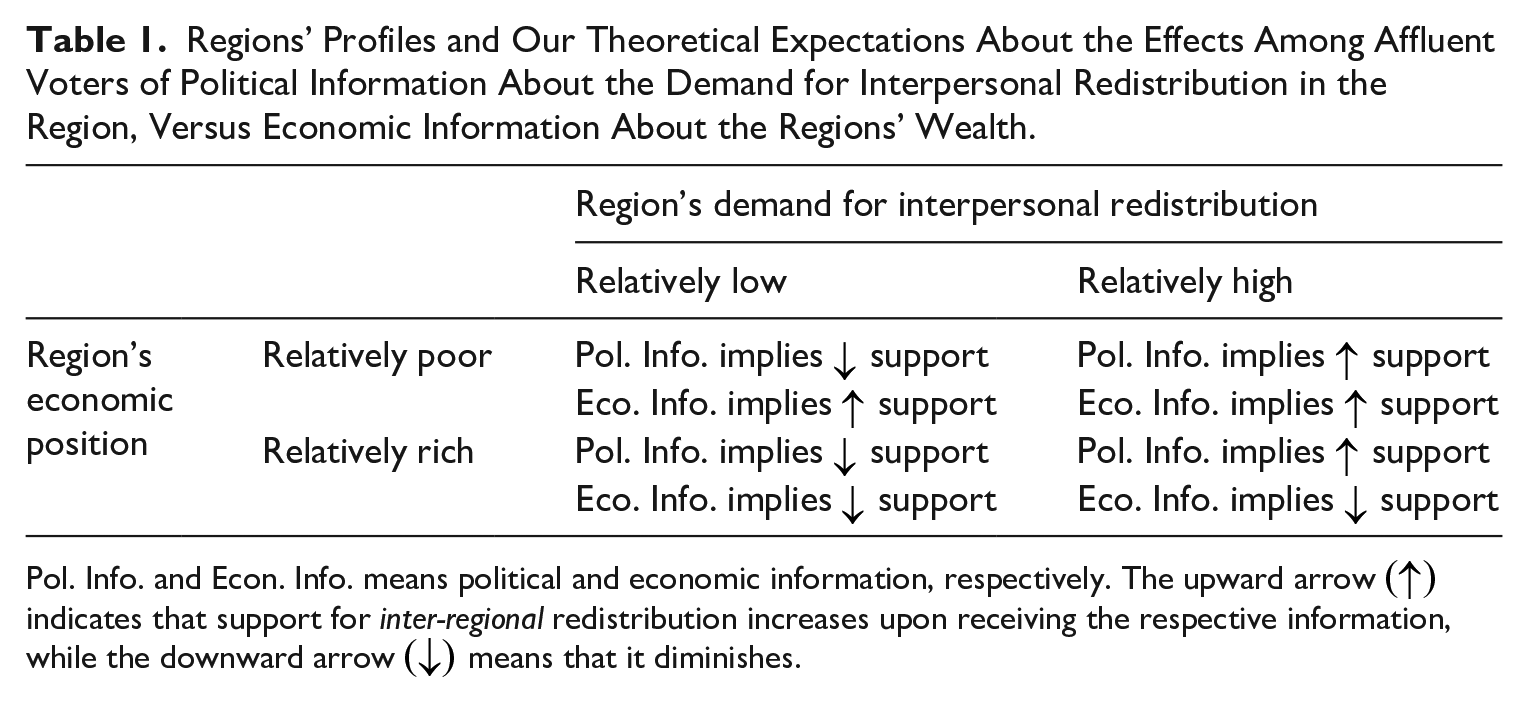
Pol. Info. and Econ. Info. means political and economic information, respectively. The upward arrow (↑) indicates that support for inter-regional redistribution increases upon receiving the respective information, while the downward arrow (↓) means that it diminishes.
However, we expect that affluent people in rich regions with high demand for redistribution (lower left corner) will react differently depending on the type of information they receive. Economic information that the region is rich will decrease support for inter-regional redistribution, but information that the demand for redistribution in the region is high will produce the opposite effect. As long as there are regions in the upper left or lower right corners of Table 1, distinguishing between the effect of economic (regions’ wealth) versus political (regions’ demand for interpersonal redistribution) information is essential. And as Figure 1 shows, this appears to be a quite common situation. The strategy of parties to mobilize the support of affluent voters for projects to reduce territorial inequalities can depend crucially on the type of information the parties articulate.
Our argument focuses on the affluent because our theoretical expectations about the attitudes of this group are straightforward and follow the same logic of other models of inter-regional redistribution politics discussed above (Balcells et al., 2015; Beramendi, 2007). But theoretical expectations about the effect of economic and political information on the poor are not as straightforward. As long as the benefits are the same, it does not matter who bears the costs of redistribution, the local (in cases with no inter-regional transfers) or the distant (in cases with inter-regional transfers) taxpayer (but see Beramendi, 2012; Beramendi et al., 2017 for a different perspective on the preferences of the poor). The poor are not politically threatened by high aggregate demand for interpersonal redistribution, provided they do not have reasons to expect their tax burden will increase in the future.
The third contribution of this article lies in our emphasis on the impact of information, instead of solely relying on the actual economic profiles of individuals and regions, or the actual levels of aggregate demand for redistribution in those regions. While we do take these factors into account in our analysis, our focus on the effect of information allows us to avoid a common criticism of political economy approaches that derived public redistributive preferences from the actual economic conditions of individuals and regions. The objection states these models often assume a level of public political sophistication that the general public does not possess. They require that people have information about policies and their consequences, and perceive relatively accurately their own and their region’s relative economic conditions, contradicting the misperception and uninformed voter literature, which states that the mass public tends to be uninterested, pays little attention, and knows very little about political concepts, facts, and policy issues (Carpini and Keeter, 1996; Converse, 1964; Lewis-Beck et al., 2008; Zaller et al., 1992). In line with that objection in the context of opinions in Europe, Chalmers and Dellmuth (2015) found that transfers affect attitudes about European integration when interacting with national or territorial identity and education, suggesting that “only some survey respondents have a sound understanding about the relationship between fiscal redistribution through regional organizations and their material self-interest,” conditioning the impact of the latter on opinion formation. This is even more pronounced when it comes to complex issues related to supranational blocks or political and fiscal relations in political unions (Jacoby, 1994; Schneider et al., 2011; Schneider and Jacoby, 2003, 2013). The overall picture of this literature is that the general public is “inapt” to reason about policies (Sniderman et al., 1986), and often uses other means to form their issue opinions, such as party cues and heuristics (Bartels, 2002; Hamill et al., 1985; Lau and Redlawsk, 2001; Lupia, 1994; Mondak, 1993; Mutz, 1992; Sniderman et al., 1993) rather than information about the policies and their consequences. Scholars have shown that not only is the public uninterested and possesses little information, but also that perceptions about levels of inequality (Bavetta et al., 2019; Choi, 2019; Engelhardt and Wagener, 2017), macro-economic conditions (Evans and Andersen, 2006; Ferrari, 2021; Hopkins et al., 2017), and peoples’ own economic positions (Nair, 2018) vary by social groups, and often do not match objective indicators, regardless of how they are constructed (Bavetta, 2019; Engelhardt and Wagener, 2017). Hence, based on arguments about misperceptions and the “inapt voter” thesis, we would expect no meaningful opinion connecting the actual structure of inequality and income distribution and complex policy issues (Bishop, 2004; Page, 2007), territorial transfers featuring among them.
In our view, this objection highlights the importance of understanding the impact of being exposed to information deemed important by the theory. For if voters are ill-informed and misperceive aspects of their social and economic environment, a relevant question is how they react when they are exposed to information that has potential implications for their welfare. The absence of information does not imply that information has no effect. Nor that, once informed, people would not react as expected by the theory. Bullock (2011) shows evidence in that direction. The author shows that information affects position-taking even when other heuristic mechanisms, such as party cues, matter. Therefore, it is crucial to investigate the reactions of voters to pertinent information in order to fully grasp the implications of their exposure.
Finally, it is important to note that the overall level of support for welfare provision in the region can stay the same even if our hypothesis is correct. In other words, there is nothing in our argument that says that the affluent will favor welfare policies or interpersonal redistribution in general if they know that the demand for those policies in their region is high. In that sense, information about the relative demand for welfare provision in the region can be seen as an exogenous factor affecting the preferences of the affluent for inter-regional redistribution. Second, note that our distinction between the effect of political and economic information does not mean we are proposing a distinction between political and economic underlying motivations. Our argument is consistent with previous political economy models positing that material (i.e. economic) self-interest can drive public support. Our argument differs from previous accounts, however, because we propose that information of different natures (political vs economic) can affect support for inter-regional transfers among the affluent, even though both can trigger economically self-interested responses. Finally, we are concerned with affluent people’s reaction to their perceptions that the demand for interpersonal redistribution in their region is low or high. Hence, as already noted, our argument does not conflict with models in which interpersonal and inter-regional redistribution policies and economic conditions are endogenously defined (Beramendi et al., 2017).
In sum, we focus on the effect of information on support for inter-regional redistribuion, and the main theoretical contribution of this article is to highlight that information about aggregate public demand for interpersonal redistribution in one’s region (political information) needs to be distinguished from information about one region’s economic condition (economic information), and that both should have independent effects on preferences about territorial cross-regional transfers. Distinguishing between these two pieces of information is crucial because regions with similar economic profiles can exhibit different levels of aggregate support for interpersonal redistribution, as illustrated in Figure 1. Those pieces of information should affect mainly the affluent, who have self-interested reasons to become more inclined to support inter-regional transfers upon learning that the demand for redistribution in their region is relatively high. We examine this argument using an experimental design, which we now discuss.
Data and Research Design
We investigate people’s attitudes toward inter-regional redistribution using a nationally representative survey with 1522 interviews in which we experimentally manipulate information about regions’ relative demand for interpersonal redistribution and economic conditions. We used quotas for education, gender, and age groups to match the census proportions of those factors in the population. The survey was administered between March and June 2018 in Brazil using a computer-assisted telephone interviewing (CATI) system. Telephone surveys are more expensive, but much easier to check and ensure attention than online questionnaires because the interviewers can draw the respondent’s attention to the information that will be provided. Research shows that differences in responses between CATI and online surveys are small (Berrens et al., 2003; Groves and Mathiowetz, 1984), and telephone surveys can provide higher quality responses, lower margins of error, better representation, and reduced number of fabricated interviews than web surveys (Larrea et al., 2021; Lee et al., 2018). We recorded all interviews with respondents’ authorizations, and the principal investigators personally evaluated the quality of all interviews in a pilot test (not used for the analysis) and a randomly selected sample of the recordings during the final data collection. All anonymized data and replication scripts are available at https://doi.org/10.55881/CEM.db.sur001. Details of the data collection, transparency, and compliance with principles of ethical research are in the supplementary material.
Brazil is an interesting case for two reasons. The first is its large territorial economic inequality and the role of inter-territorial transfers in mitigating territorial disparities. Brazil is a federation with 26 states and a Federal District. The states are grouped into five macro-regions (North, Northeast, South, Southeast, and Middle West), each with a very different economic profile. Living standards vary substantially across the Brazilian territory, affecting the need for services and policies to address local economic conditions. The supplementary material contains detailed information on regions’ profiles. Inter-regional transfers between states play a crucial role in reducing the inequality of resources for states’ welfare spending, mitigating the negative consequences of what Rodríguez-Pose and Vidal-Bover (2022) defined as “unfunded mandates.” Inter-regional transfers are one of the main equalizing instruments to compensate for regional disparities (Sellers et al., 2017). In Brazil, they have been on the political agenda since the integration of the nation-state (Arretche, 2005), and were one of the main contested issues in the framing of the 1988 Constitution (Ferrari, 2013; Souza, 1997). For example, constitutional mandates guarantee that at least 47% of the tax collected by the Union in different states must be transferred to states and municipalities as block grants; 21% of that share must be distributed exclusively to states, and no less than 85% of that amount goes exclusively to poorer states (Ferrari, 2013; Leme, 1992). Without these inter-regional transfers, many states would not be able to provide the same levels of welfare policies without substantially increasing the tax burden on the local affluent.
A second reason is that Brazilian regions follow the same pattern shown in Figure 1 for OECD countries. In Brazil, too, the aggregate demand for interpersonal redistribution across states varies with some degree of independence regarding states’ inequality and wealth. Figure 2 shows the fitted values from a regression of support for interpersonal redistribution on regions’ wealth, inequality, and the interaction between the two. The dependent variable is support for the statement: “The government should reduce inequality between rich and poor people.” It uses observational data collected in 2013 from a nationally representative survey in Brazil, which informed our experiment.
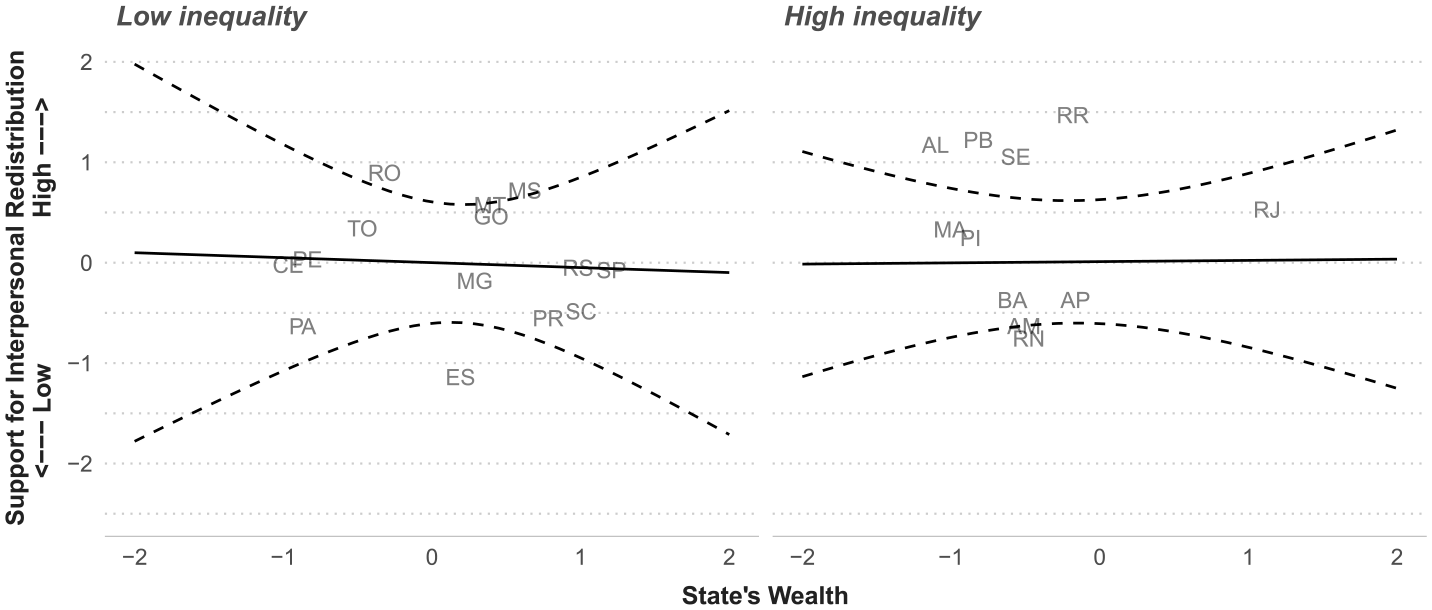
Fitted Values of Regression of Individuals’ Support for Interpersonal Redistribution on States’ Wealth, Inequality, and the Interaction Between the Two.
As we can see in Figure 2, states with similar levels of wealth (x-axis) are scattered across the y-axis—which captures states with relatively high and low demand for interpersonal redistribution—regardless of the level of inequality (left and right panels). For instance, Paraná (PR) and Mato Grosso do Sul (MS) are both rich and low-inequality states, but the aggregate demand for interpersonal redistribution is higher in the latter.
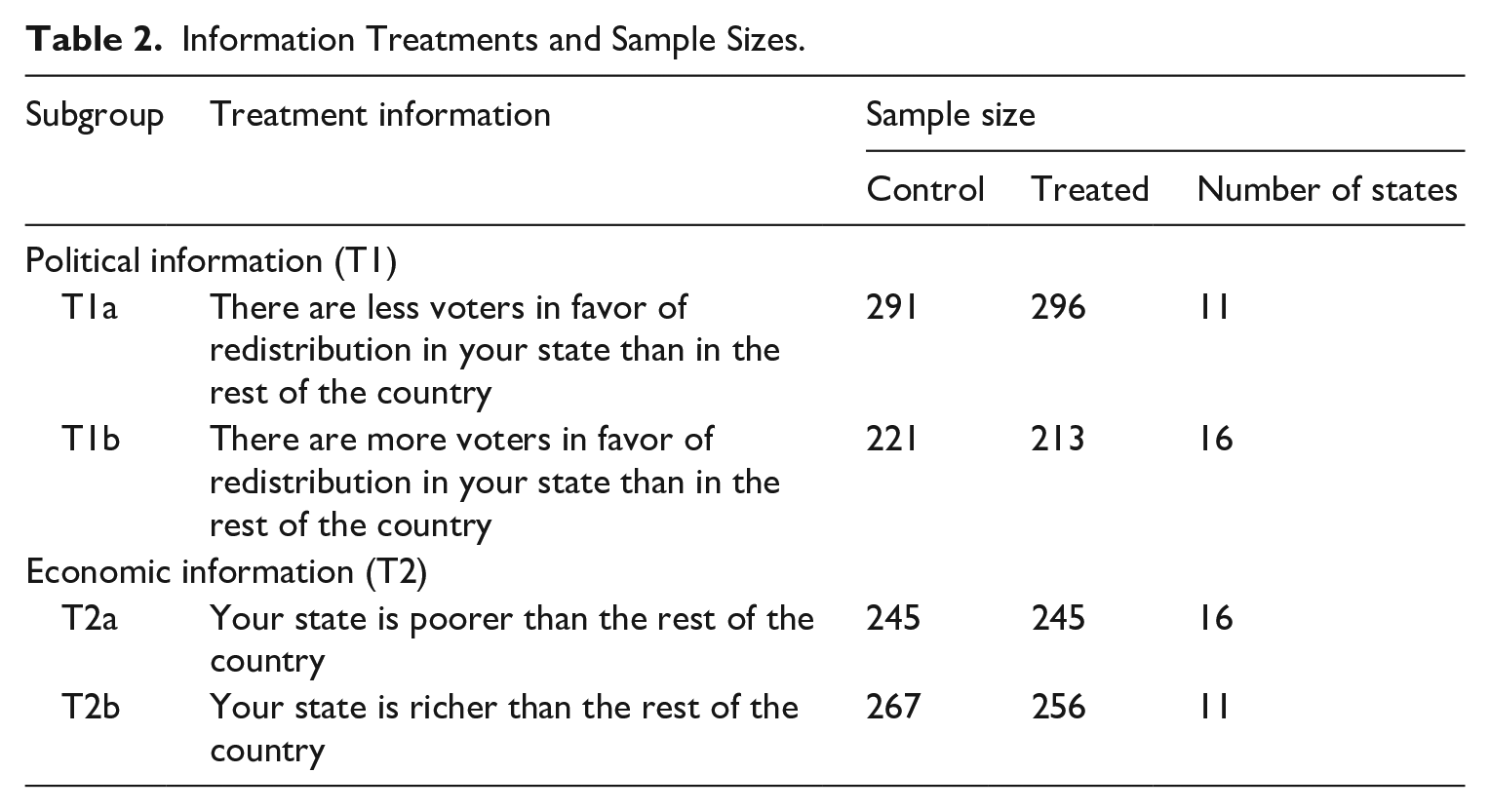
Figures 1 and 2 illustrate why it is important to evaluate the effect of economic (e.g. state’s wealth or within-state inequality) and political (aggregate demand for interpersonal redistribution) information separately. To evaluate these effects, we randomly assigned respondents to one of five possible treatment conditions capturing different informational environments: being exposed to political information, economic information, or neither (control group). The political information treatment group (T1) was informed about the electoral demand for interpersonal redistribution in their respective states. We subdivided that treatment into two subgroups. The first subgroup (T1a) was informed that such a demand was lesser in their state than in the rest of the country. The second subgroup (T1b) was informed that it was greater. The economic information treatment group (T2) was subdivided into two subgroups as well. The first subgroup received information that their state was poorer (T2a) than the rest of the country, and the second subgroup was informed that it was richer (T2b). The control group received no information about their own state’s demand for redistribution or relative economic position. This covers the four cells presented in Table 1. Due to limitations imposed by our sample size, we evaluate the effect of each information treatment separately and leave the investigation of combinations of different types of information for future research. Table 2 summarizes the treatment conditions and shows the sample size in each case. The exact wording we used for the treatment is in the supplementary material. We provided detailed instructions for the interviewers to make sure they had the attention of the respondents when the former read the information treatments, which was facilitated by the telephone survey mode that we adopted for this research. All the details and procedures we followed are in the supplementary material.
Information Treatments and Sample Sizes.
We focus on situations where voters receive either no information or accurate information. The reason is that, first, this is sufficient for our goals of evaluating the effect of political and economic information separately, comparing them, and testing if political information has an effect on its own. Second, it avoids the problem that respondents could reject deceptive information. Hence, there is no deception in our experiment. We also didn’t want our treatment effect to be based on source credibility because that is not the purpose of this investigation. That is, this is an information experiment, not a framing or endorsement one. Hence, we do not manipulate the source of information; the experiment states that the information provided is based on research from well-known institutions. Our goal is to evaluate if support for inter-regional redistribution changes with some information of a specific type (political or economic).
Randomization was performed within groups of states with the same characteristics conveyed by the information. Table 3 shows the states that belong to each group. Among the 26 states and the Federal District in Brazil, 10 states and the Federal District have a larger gross domestic product (GDP) and income per capita than the national average and the other 16 states. Those 10 states, alongside the Federal District, were classified as relatively richer in our experiment, and people from those states were randomly selected to either receive the respective information or no information at all. Likewise, the randomization of political information was performed accordingly after grouping the states based on their level of support for interpersonal redistribution. Classification of states in this dimension was based on the average agreement of the population in the state to the question, “It should be a governmental obligation to reduce inequality between rich and poor people” collected in a prior independent survey with a representative sample (see also Figure 2), and then validated in our main survey. A total of 11 states have a lower public demand for redistribution than the rest of the country, and for 16 of them (including the Federal District), that demand is relatively greater. People who randomly received information that the demand for redistribution is relatively high in their state were randomly sampled from the states in the column “Relatively high” of Table 3. That includes states with different economic profiles (rich and poor). This allows us to optimize the sample size for each treatment group, evaluate the average effect of political information for a broad range of states with different economic profiles, and simultaneously control for the effect of these economic profiles. The same logic applies to the economic information treatment. For instance, people who received information that their state was rich (or poor) were randomly sampled from the states on the row “Relatively rich” (“Relatively poor”) of Table 3. The control group was distributed across all groups of states equally.
Distribution of States Based on their Relative Economic Position and Levels of Voters’ Demand for Redistribution.
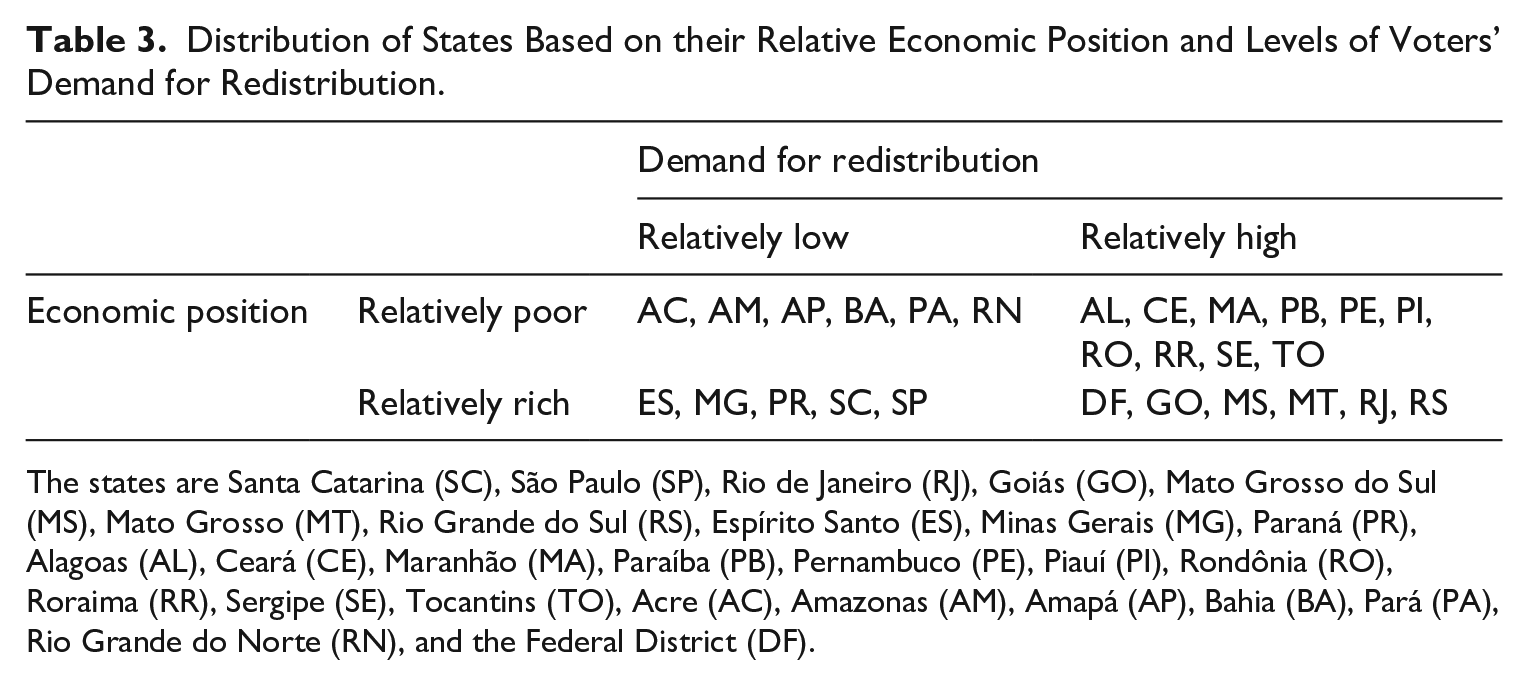
The states are Santa Catarina (SC), São Paulo (SP), Rio de Janeiro (RJ), Goiás (GO), Mato Grosso do Sul (MS), Mato Grosso (MT), Rio Grande do Sul (RS), Espírito Santo (ES), Minas Gerais (MG), Paraná (PR), Alagoas (AL), Ceará (CE), Maranhão (MA), Paraíba (PB), Pernambuco (PE), Piauí (PI), Rondônia (RO), Roraima (RR), Sergipe (SE), Tocantins (TO), Acre (AC), Amazonas (AM), Amapá (AP), Bahia (BA), Pará (PA), Rio Grande do Norte (RN), and the Federal District (DF).
Although we cannot evaluate the treatment effect in each state or region separately because of the sample size of each treatment group, we can adjust our estimation by the four groups of states in Table 3. Overall, Tables 2 and 3 combined show that our design covers a broad range of variation in terms of the two relevant informational dimensions of our study.
We instrumentalize our main dependent variable—people’s attitudes toward inter-regional redistribution—in two ways, as both can have implications for the politics of redistribution. The normative goal behind inter-regional redistribution is to reduce territorial inequality, and inter-regional transfers are a policy instrument to achieve that goal in practice. People may support a goal in principle, but not the policy instrument to achieve it in practice, or vice versa. One possible reason is that support for a policy principle implies no concrete cost, while a policy instrument usually elicits winners and losers of redistribution. This is oftentimes called policy-principle paradox and occurs in policy areas such as anti-discrimination (Bobo, 2004 [1988]; Sniderman et al., 1993; Wodtke, 2016) and distribution fairness (Peterson, 1994). As scholars have found differences in those other areas, we investigate both types of support for inter-regional redistribution, that is, support in principle (i.e. for reducing territorial inequality) and in practice (i.e. for territorial transfers from rich to poor states). We measure support in principle by asking voters if they agree that “the government should approve legislation to ensure that people have equal public services in all states.” We measure support for the underlying policy instrument to achieve that goal by asking voters if they agree that “part of the wealth of rich states must be transferred to poor states.” Answers were measured on a 5-point scale from strongly disagree, coded as −2, to strongly agree, coded as 2. The two questions were asked in random order. Our goal was to measure the average attitudes toward territorial redistribution, so we intentionally avoided any explicit reference to subpopulations of beneficiaries (e.g. gender, race, ethnicity), and emphasized only the territorial aspects in the questions.
Our survey collected data on some key demographic characteristics, including age (between 18 and 82 years old), gender (male vs female), education (10 levels), race (white vs non-white), and income. The latter was measured in nominal values, and we used a standardized version of the variable with household income per capita in the empirical analysis. Age and education were also standardized. We also measured respondents’ identity attachment to their own states (Holm, 2016). Details are in the supplementary material. The literature has shown that these socio-demographic and regional identity factors are associated with attitudes toward welfare and territorial transfers (Arretche et al., 2016; Balcells et al., 2015; Henderson et al., 2013; Holm, 2016; Jeffery, 2009; Moreno, 1997; Roemer, 1998; Shayo, 2009). States’ wealth and inequality should also affect people’s attitudes toward inter-regional redistribution (Beramendi et al., 2017), so we collected information of states’ average income levels and inequality (Gini coefficient) and adjusted our estimation using these variables. We present results with and without adjusting for those covariates.
We estimate the regression model described in equation (1), where

One problem that can arise with our design is ensuring that people who received the treatment “took” the information they received, and checking whether the control group knows the information, even if it was not provided to them in the experiment. This issue emerges in all experimental designs that randomly assign information, and ours is not an exception. We followed the recommendations in the literature to address this problem (Kane and Barabas, 2019) and included manipulation checks in the survey. We used two questions to evaluate if the information we provided changed the respondents’ perception of their state’s relative demand for redistribution and their state’s relative economic position. We asked if the respondents thought that the economy in their state was better or worse than the rest of the country. We also asked, “Comparing your state with the rest of the country, which population do you think most desires government intervention to reduce inequality?” The supplementary material shows that, on average, the treatment groups answered these questions differently than the control group in accordance with the treatment they received. For instance, those who received information that their state was relatively poor (or rich) were more likely than the control group to answer follow-up manipulation check questions accordingly, which gives us confidence in our treatment manipulation.
Another important issue, in this case, specific to our design, has to do with a possible “contamination” of the treatments. One may object that political (economic) information can trigger economic (political) perception. For instance, it is possible that those who were informed that there is a relatively large demand for redistribution in their state (which is a piece of political information) infer that their state is relatively poor (an economic perception). Likewise, those informed that their state is relatively poor (economic information) may infer that the demand for redistribution is relatively large in their state (a political feature). It matters for our argument to evaluate which perception—about states’ economic or political status—was triggered by which treatment, and if the treatment affected attitudes toward inter-regional redistribution through these perceptions. To evaluate these mechanisms, we conduct a path analysis using linear structural equation models in which perceptions of states’ relative economic situations and level of demand for redistribution are intermediate variables connecting the information treatments to voters’ attitudes toward inter-regional redistribution. The results are discussed below, but for space reasons, we left formal details about the path analysis, including regression models and path diagrams, in the supplementary material.
Data Analysis
All descriptive statistics and tables showing that the randomization successfully produced the expected balance of observed covariates across the treatment groups are in the supplementary material. An analysis of the manipulation checks is also included. Due to limited space, this section shows results for our question about in-principle support for territorial redistribution. The online supplement contains a detailed comparison of the effects across the two types of outcomes we considered. Essentially, that comparison shows that the results are qualitatively the same when we repeated the analysis using our other indicator, measuring in-practice policy support, which explicitly prompts transfers from rich to poor states. Some differences worth noting for in-practice support was that a significant effect was found for
Table 4 shows the ordinary least squares (OLS) point estimates of the linear regression described in equation (1) (Model 4), which properly controls for individual and state-level characteristics. Models 1–3 are included to show the robustness of the results to the inclusion/exclusion of control variables. As we can see, income consistently has a negative effect on support for inter-regional redistribution (Models 2–4) among the no-information group. However, that negative effect changes when people receive information that demand for interpersonal redistribution is relatively high in their state (row Income × T1b). There is a similar effect when participants were given economic information that their state is relatively poorer than the rest of the country (row Income × T2a). The interactive effect of these pieces of information and income is positive and statistically significant in all cases (Models 2–4). The treated group—who were given information that demand for redistribution is relatively high in their state, or that their state is relatively poor—is significantly more in favor of inter-regional redistribution as income increases as compared with the control group (no information provided), even after controlling for states’ wealth, inequality, and voters’ demographics.
Estimates of Regression Equation (1).
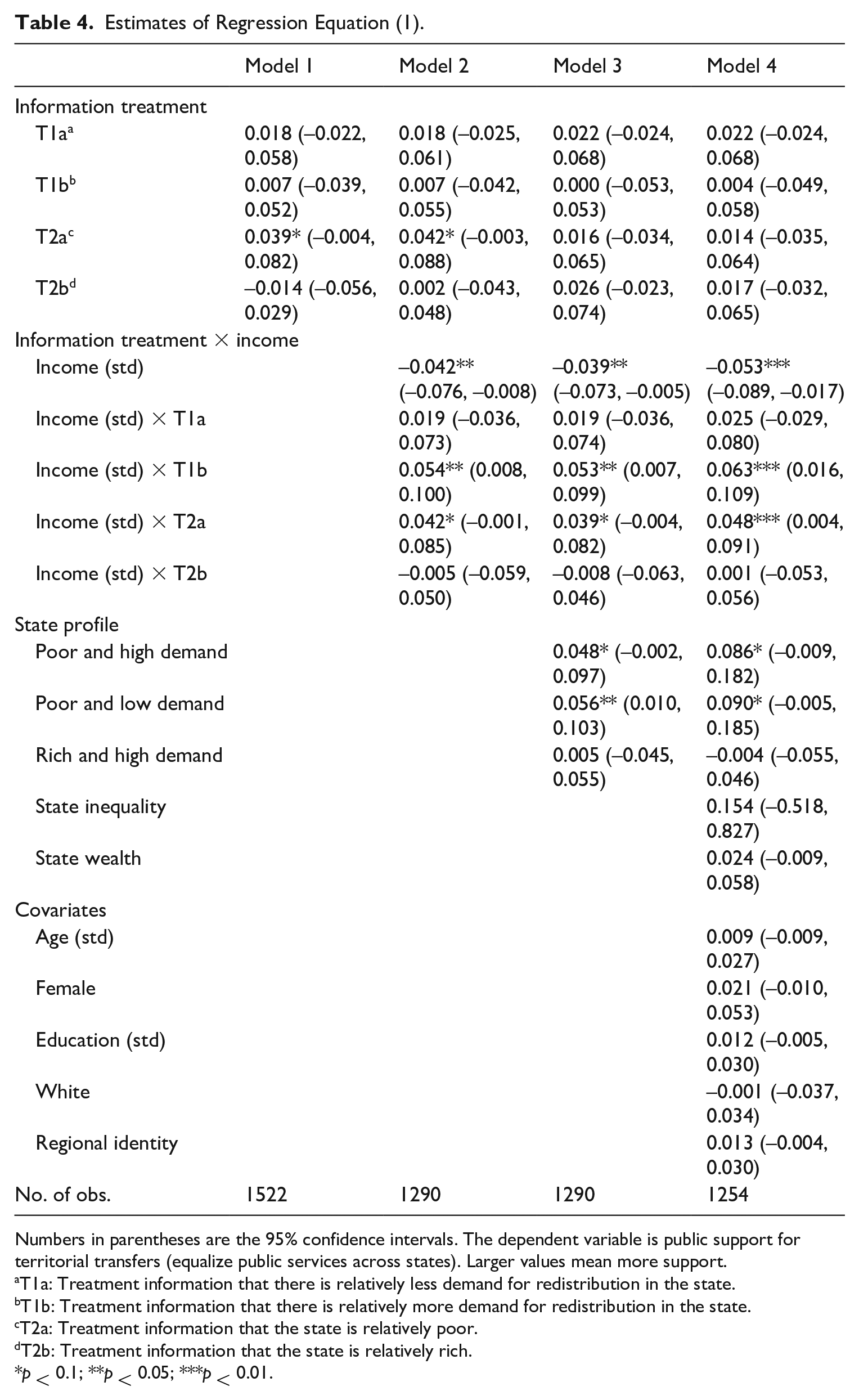
Numbers in parentheses are the 95% confidence intervals. The dependent variable is public support for territorial transfers (equalize public services across states). Larger values mean more support.
T1a: Treatment information that there is relatively less demand for redistribution in the state.
T1b: Treatment information that there is relatively more demand for redistribution in the state.
T2a: Treatment information that the state is relatively poor.
T2b: Treatment information that the state is relatively rich.
p < 0.1; **p < 0.05; ***p < 0.01.
Figure 3 helps to illustrate the interactive effect of income and the treatments. It shows that the predicted value of supporting inter-regional redistribution decreases with income (left panel); it does so to a lesser degree when people receive economic information (are informed that their state is relatively poor), but it increases with income when people are treated with political information, that is, are informed that the support for overall redistribution in their state is relatively greater than in the rest of the country (right panel).
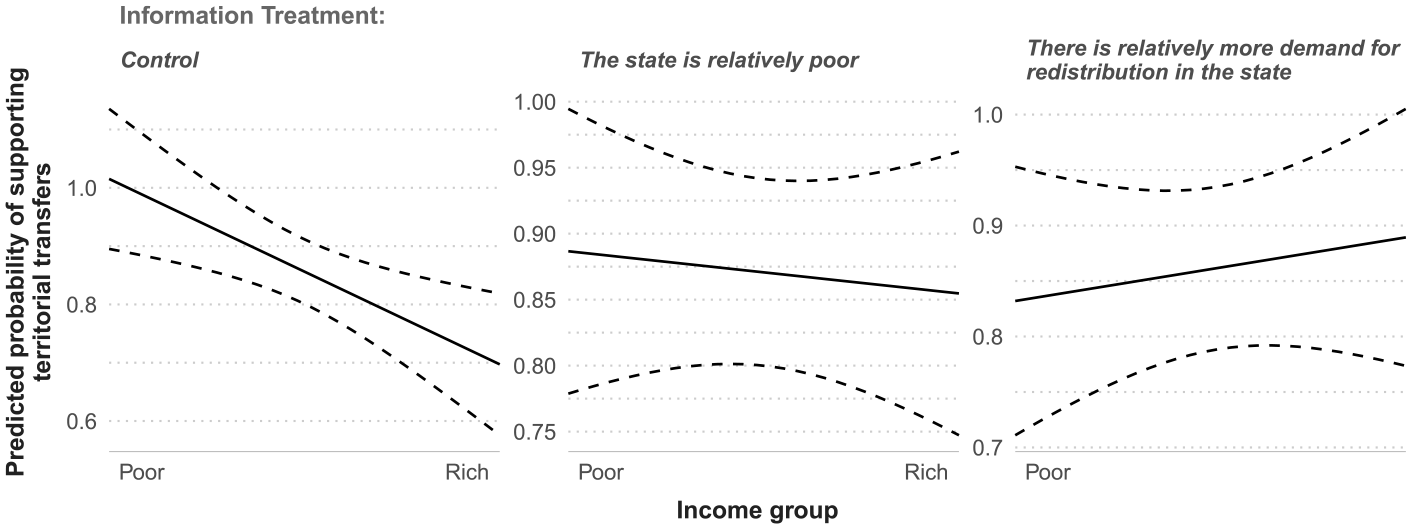
Predicted Probability of Supporting Inter-Regional Redistribution (y-axis) Across Income Groups (x-axis) for Different Information Treatment Conditions (Panels).
These findings favor our hypothesis. A further exploration of the results presented in Table 4 and Figure 3 can provide more insights. Our hypothesis says that (1) political information on the aggregate demand for interpersonal redistribution within one’s region matters, and (2) it affects mostly the affluent. The positive effect of the interaction between income and political information we see in Table 4 and Figure 3 show evidence for part (1) of our argument, but not part (2). For instance, Table 4 and Figure 3 show a positive and significant effect of the interactive effect of income and political information on the high aggregate demand for interpersonal redistribution in the state (T1b). However, this result does not provide information about which specific income group in the data is responsible for causing the positive slope. It is possible that the political information reduces support for inter-regional redistribution among the poor relative to the poor in the control group, while support among the affluent remains unchanged. This scenario is not consistent with our hypothesis. Alternatively, it could be that the positive slope is driven by increased support for redistribution among the affluent exposed to information relative to the affluent in the control group, while support among the poor remains the same in both cases. This is in line with our hypothesis. In both cases, we would observe the same positive and significant interactive effect (positive slope), but the interpretations of what that slope means would be quite different.
To investigate this possibility, we compare the average support for inter-regional transfers within and across different combinations of treatment and income groups. Figure 4 summarizes the relevant results. The purpose of Figure 4 is to closely examine the effects found in Table 4. Due to space constraints, we focus on the significant findings of Table 4, specifically
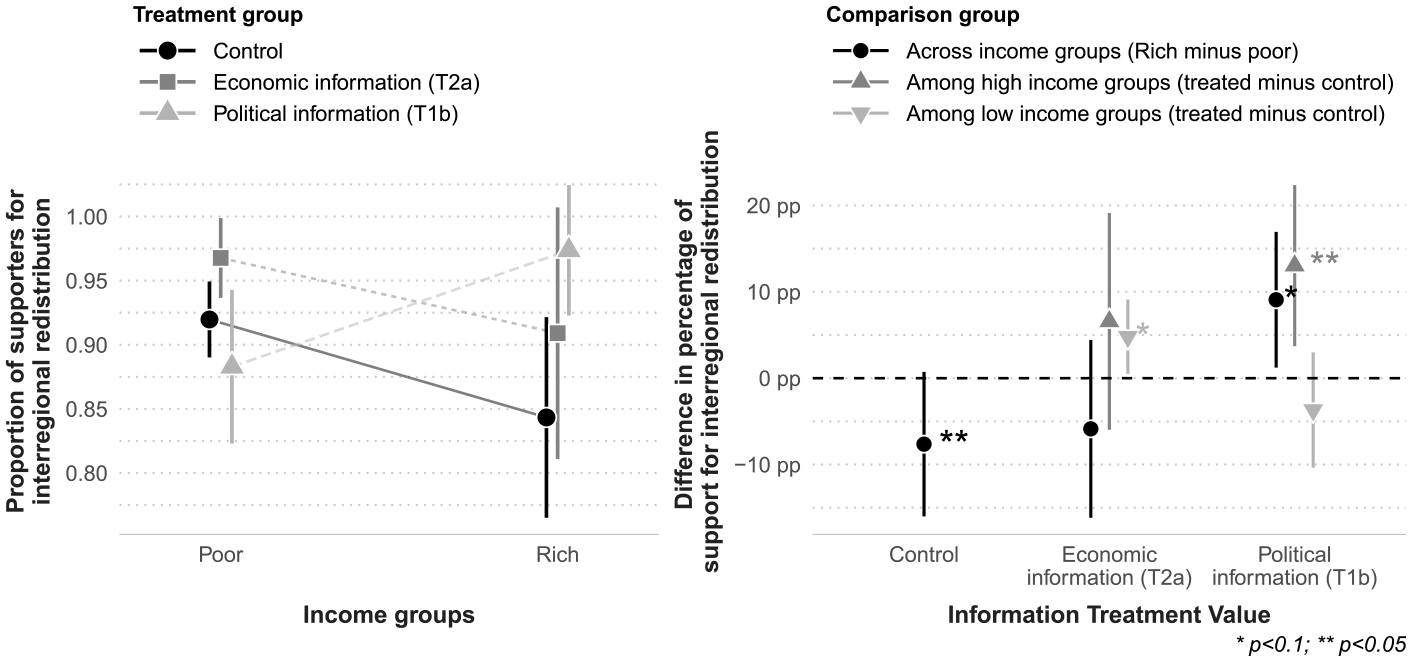
Left Panel: Average and 95% Confidence Intervals of Support for Inter-Regional Redistribution Among Income and Treatment Groups; Right Panel: T-Test for Difference in the Percentage of Support Across Treatment and Income Groups.
Figure 4 shows six groups based on their information environment and family level income conditions. Let us consider the left panel of Figure 4 first. It shows simple averages and their 95% confidence intervals of the proportion of supporters for territorial redistribution. It provides many insights into the effect of these two pieces of information on the attitudes of poor and affluent individuals captured in Table 4 and Figure 3. First, the average support for inter-regional transfers among the poor is high overall, regardless of their treatment condition. Second, the average is also high among the rich voters, but higher if they receive either one of those pieces of political (T1b) or economic (T2a) information. Third, the highest average support for inter-regional transfers among the rich voters emerged when they received the political information (T1b). Fourth, if we compare the average support for territorial redistribution across income groups but within each treatment condition, we clearly see that rich voters are, in general, less in favor of inter-regional redistribution than poor voters. The only exception occurred when political information (T1b) was provided. In that case, the support for inter-regional redistribution among the rich is greater on average than among any other group, including the poor at any treatment condition. This is remarkable. Substantively, it shows that political information has a larger effect than economic information on the preferences of the affluent. One political consequence of our findings is that this type of information can be used to obtain support for inter-regional redistribution among the affluent, opening the possibility of cross-class, within-region coalitions in favor of inter-regional transfers. Theoretically, it indicates the importance of disentangling the effect of political from economic information on voters’ opinions.
These insights are confirmed by the t-tests shown on the right panel of Figure 4. The tests compared differences in the proportion of support for territorial transfers across the treatment and income groups. First, let us compare support within treatment groups but across voters’ income levels. The dark dots compare the difference in the percentage of support for inter-regional transfers between affluent and poor voters in each treatment group shown on the x-axis. In the control group, the average support among the affluent is around eight percentage points (p.p.) lower than among the poor (dark dot on the right panel at the control information treatment value). This difference is statistically significant at a 0.05 significance level (p-value 0.0349). However, that same support is nine p.p. higher among the affluent who received political information (T1b) than among the poor who received that same information (the dark dot at the T1b treatment group), which is significant at 0.1 (p-value 0.09). The difference across income groups for the economic treatment is not significant (the dark dot at T2a treatment condition).
Consider now the average support within voters’ income levels but across treatment status. The dark gray upward triangles show the differences in percentages of support among the affluent people in the control group and the two treatment groups shown in the x-axis. Again, the political information treatment (T1b) significantly increased the support among the treated affluent by 13 p.p. (p-value 0.0375), relative to the affluent in the control group. That difference is not significant for the affluent group treated with economic information. However, the economic information that the state is poor (T2a) significantly increases support for inter-regional transfers among the poor (p-value 0.0691).
These results are consistent with our hypothesis. It shows that (1) political and economic information has independent effects; (2) information that support for interpersonal redistribution is high in the state affects mostly the affluent, who become more willing to support inter-regional transfers, and; (3) these effects remain significant even after controlling for regions’ wealth and inequality, and voters’ characteristics, including education and territorial identity, as shown in Table 4.
Finally, we analyze the path connecting these information environments to voters’ inter-regional redistribution attitudes. The goal is to check if political (or economic) information affected support for inter-regional redistribution because it triggered perceptions about states’ economic (or political) conditions. For instance, one may object that informing voters that the demand for interpersonal redistribution in their own state is high makes voters believe that their state is poor, which then increases support for inter-regional transfers. Our experimental design does not allow us to fully investigate this problem because, as discussed, states can be rich (poor) and yet have relatively high (low) support for interpersonal redistribution, and due to sample size limitations, we opted for providing political and economic information separately. Ideally, one could evaluate the effect of different combinations of both types of information provided simultaneously. That would allow one to estimate how voters respond when they receive information that their state is rich (poor) and yet that there is high (low) support for interpersonal redistribution.
Despite that limitation in our study, we conducted a path analysis to investigate how information affected the outcomes. Table 5 summarizes the relevant results. The complete details with tables and path diagrams are in the supplementary material. The first row shows the direct (non-mediated) effect of political information on perceptions that the demand for redistribution in the state is high (column A), perceptions that the state is relatively rich (column B), and attitudes in favor of territorial redistribution in principle (column C). In the latter case, the effects include interaction with income, as before.
Path Analysis of the Direct, Indirect, and Total Effect of Political and Economic Information.
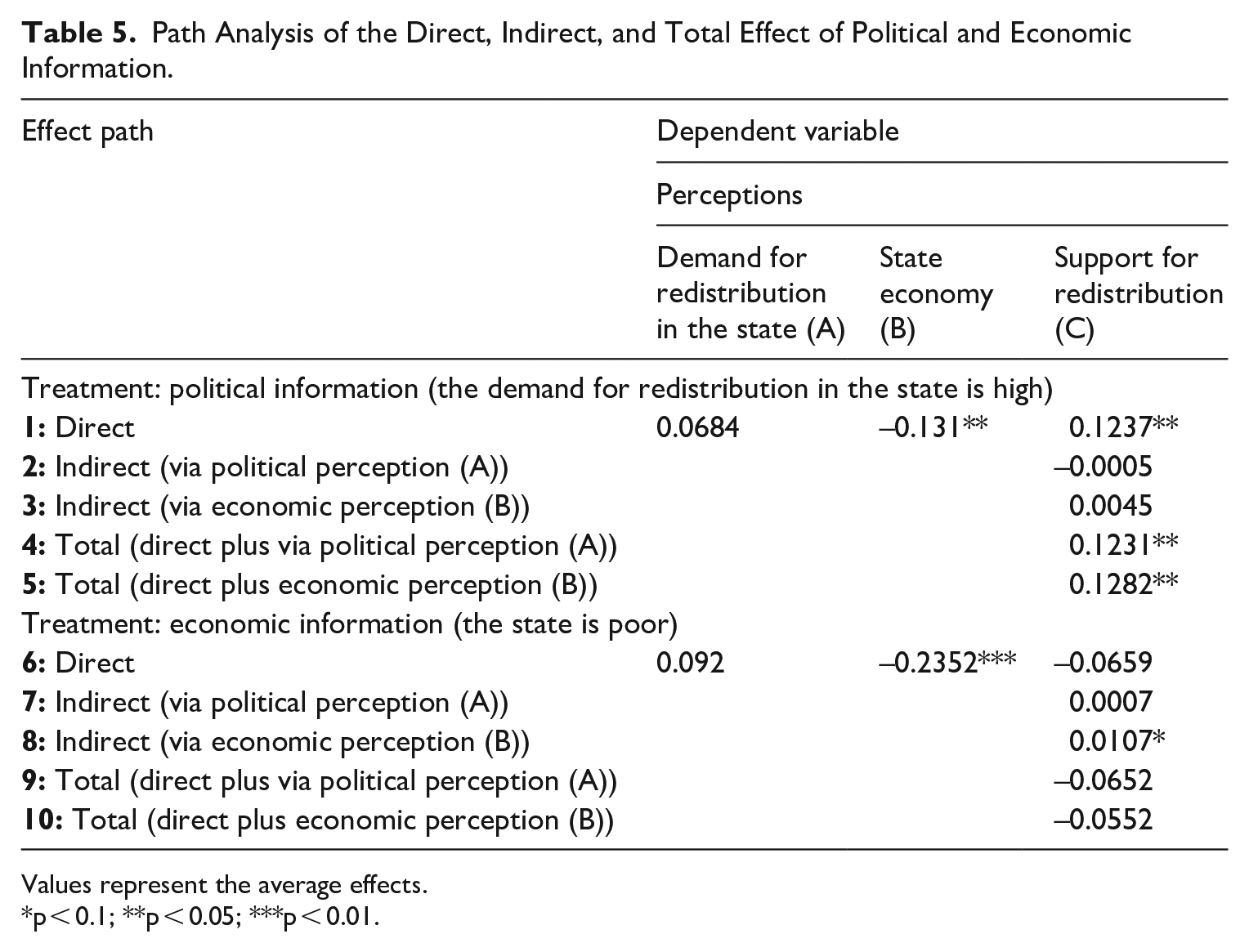
Values represent the average effects.
p < 0.1; **p < 0.05; ***p < 0.01.
We see that informing people that the demand for redistribution in their state is relatively high increases the corresponding perceptions (A), as we should expect, but the result is not significant at 5%. It did lead people to think that their state is relatively poor (B). However, none of these mechanisms seem to account for the effect of political information on the outcomes. In other words, the political information treatment affected the voters’ attitudes toward territorial redistribution (first row, column C), but not due to its effect on perceptions about the state economy. On the other hand, economic information affected preferences toward territorial redistribution through perceptions of the state-level economy, as we should expect. People who receive the treatment that their own state is relatively poor became more likely to perceive the state accordingly, a perception that increased support for territorial redistribution. Note that the interaction between the treatments and income affected the outcome in the t-tests and regression models (Table 4 and see supplementary material), so the total effects are robust across very different model specifications. In sum, in terms of the effect of the treatment on the outcome (preference for inter-regional redistribution), it shows that political information is not economic information in disguise. In other words, political information does not affect support for inter-regional redistribution because it is affecting individuals’ perception of the economic conditions of the state. A possible “contamination” between the treatments does not account for their effect on the outcome, which reinforces our argument that these two pieces of information do have independent effects in their own right.
To summarize, these results support our argument that interregional redistribution preferences and aggregate support for interpersonal redistribution, or information about that latter support, should not be treated purely as endogenous to economic conditions in political economy models. When affluent people receive political information that support for interpersonal redistribution in their state is relatively high, they become more favorable to territorial redistribution in principle by supporting equalization of policy provision across states (Tables 4 and 5), and in practice, by supporting policies to transfer revenues from rich to poor states (see supplementary material). This is true even after controlling for states’ wealth and inequality. Such information affects support for inter-regional redistribution not because it makes people think that their state is relatively poor (Table 5). This is important considering that wealth, inequality, and aggregate public support for interpersonal redistribution can vary more or less independently in actual or perceived terms.
Final Discussion
Our study showed that affluent people tend to favor inter-territorial transfers when they learn that the demand for interpersonal redistribution in their own region is greater than in the rest of the territory. Given that we were able to identify this causal effect, our results raise the question of whether information about the demand for redistribution can help mobilize voters to support candidates who put pressure on redistribution issues. Recent studies have shown that media coverage of elite debates on political and economic issues moderates the relationship between people’s partisan identity and issue preferences (Dancey and Goren, 2010). Hence, although our study did not evaluate any receptivity bias by varying the source of the message, our results question if leaders or media outlets who reinforce information about demands for interpersonal redistribution or economic conditions can potentially mobilize the affluent to support candidates who favor the reduction of inequality through territorial transfers. This issue is at the core of some political economy models of inter-regional redistribution (Beramendi et al., 2017). The dynamics of electoral support can have an impact on the power resources of regional political actors in both poor and wealthy regions. This, in turn, can influence the formation of regional coalitions and ultimately affect the outcomes of inter-regional redistribution efforts (González, 2016).
Our analysis focused on the Brazilian case. The generalization of our findings to other unions is an empirical question that requires further investigation. However, as we discussed, regions within a political union do not only differ in their economic profile but also in their overall “ideological” orientation toward interpersonal redistribution. It is possible for regions to have similar economic profiles and yet exhibit varying levels of aggregate support for interpersonal redistribution. This phenomenon is not exclusive to Brazil but can be observed in other unions as well. Consequently, we have grounds to suspect that our findings is applicable to other cases. At the very least, our argument and findings can provide insights for similar studies conducted in different contexts.
In any case, the results in this article have important normative implications. They highlight how institutional arrangements can create conditions for the emergence of preferences among the affluent in favor of inter-regional redistribution, even when that group is acting toward their own material self-interest. Instead of purely opposing interpersonal redistribution, the affluent in a poor region, or a region with relatively high aggregate support for interpersonal redistribution—probably concentrated among the non-affluent—can support inter-regional transfers as a way to satisfy that demand without bearing the costs. Without this cost displacement provided by inter-regional redistribution, the alternative to avoid local costs would be to oppose any redistribution. If the source of redistribution does not matter for the poor, inter-regional redistribution can facilitate a cross-class coalition between the affluent and the poor toward redistributive schemes that otherwise would be more difficult to achieve. In other words, although the translation of these preferences into policy depends on the distribution of power in the political institutions, federalism and inter-regional transfers can enact, at least at the level of public opinion, favorable attitudes among some affluent groups in some regions toward alternative redistributive policies (inter-regional transfers) that can reduce overall inequality.
Supplemental Material
sj-pdf-1-psx-10.1177_00323217241232056 – Supplemental material for The Effect of Information About Local Demand for Redistribution on Support for Territorial Transfers Among Affluent Groups
Supplemental material, sj-pdf-1-psx-10.1177_00323217241232056 for The Effect of Information About Local Demand for Redistribution on Support for Territorial Transfers Among Affluent Groups by Diogo Ferrari and Marta Arretche in Political Studies
Footnotes
Declaration of Conflicting Interests
The author(s) declared no potential conflicts of interest with respect to the research, authorship, and/or publication of this article.
Funding
The author(s) disclosed receipt of the following financial support for the research, authorship, and/or publication of this article: This project was financed by the Center for Metropolitan Studies (CEM) and the São Paulo Research Foundation (FAPESP).
Supplemental Material
Additional supplementary information may be found with the online version of this article.
Contents
A.Compliance with the Principles and Guidance for Human Subjects Research.
B.Descriptive Statistics 2.
B.1. Demographics.
Table B.1. Distribution of Income by Region in the Sample.
Table B.2. Distribution of Education by Region in the Sample.
Table B.3. Distribution of Gender by Region in the Sample.
Table B.4. Distribution of Age by Region in the Sample.
Table B.5. Distribution of Cases by Treatment and Income Groups.
Table B.6. Sample Size Collected in Each Region and State Oversampled in Brazil Alongside their Gini and DGP.
B.2. Covariate Balance.
Table B.7. Descriptive Statistics and Balance of Covariates on Treatment Groups.
C.Regression Tables and In-Practice Versus in-Principle Support 5.
Table C.1. Regression Estimates. Numbers in Parentheses are the 95% Confidence Intervals. The Dependent Variable is Public Support for Territorial Transfers (Transfer from Rich to Poor States). Larger Values Mean More Support.
Table C.2. Generalized Least Squares (GLS) Estimates of a Stacked Regression Model. The “In-Practice” Interactive Terms Capture Whether the Effects Vary from In-Principle to In-Practice Support. The Reference Category is in-Principle Support. Standard Errors Were Clustered at the Outcome Type Level.
Figure C.1. Top Panel: Raw Average In-Practice (Top Left) and In-Principle (Top Right) Support for Inter-Regional Redistribution, along with the Corresponding 95% Confidence Intervals, Across Income and Treatment Groups. Bottom Panel: Average Effects from Model 4 of Table C.1.
Figure C.2. Point Estimates and Confidence Intervals of a Stacked Regression (Model 3 on Table C.2). It Captures Whether the Effect of the Treatments and their Interaction with Income Changes Based on the Type of Outcome. The Reference Outcome Category Used is in-Principle Support. The Standard Errors were Clustered at the Outcome Type Level.
D.Path Analysis 11.
Figure D.1. Simplified Diagram (Omitting Adjustment Covariates) Capturing the Path Analysis of the Effect (Arrow and Arrow Labels) of the Treatment (T) on Support for Inter-regional Redistribution (Y) through Perceptions of the Economic Conditions that their State is Rich (E) and Perceptions of High Demand of Interpersonal Redistribution in the State (R). Stars Represent P-Values Smaller than 0.1 (*), 0.05 (**), and 0.01 (***). The Political Information Treatment is Shown on the Left Diagram (a) and the Economic Information Treatment on the Right Diagram (b). The Numbers and Letters in Parentheses (e.g. (1: C)) Correspond to (Row:Column) Values in  of the Main Manuscript.
E.Manipulation Checks 12.
Figure E.1. Manipulation Checks. The Left Panel Shows the Percentage of Voters Who Responded that the Demand for Redistribution is Greater in Their State or Country (y-Axis) for Each Political Information Treatment Level (x-Axis). The Right Panel Shows the Percentage of Answers About the Relative Economic Situation of the State (y-Axis) for Each Economic Information Treatment Level (x-Axis). Vertical Bars Represent the 95% Confidence Intervals.
F.Survey and Survey Experiment 13.
F.1. Treatment Information Wording.
F.2. Measuring Territorial Identity.
Author Biographies
References
Supplementary Material
Please find the following supplemental material available below.
For Open Access articles published under a Creative Commons License, all supplemental material carries the same license as the article it is associated with.
For non-Open Access articles published, all supplemental material carries a non-exclusive license, and permission requests for re-use of supplemental material or any part of supplemental material shall be sent directly to the copyright owner as specified in the copyright notice associated with the article.
