




Abstract
Although political trust has long been linked to political participation, its effects remain elusive. Trust in political institutions may enhance levels of participation, diminish political engagement, or yield distinct effects depending on the activity. This article examines these diverging effects through a rational choice framework, with which we theorize and test whether political trust functions as a resource or a (dis)incentive to participate. Specifically, we assess the direct effects of political trust on intended participation and its moderating effects on outcome-related motivations and activity type. To this end, we use a factorial survey experiment in the Netherlands and the United Kingdom to isolate the effects of outcome-related motivations and to disentangle participation from the effectiveness of action and the effect of activity type, factors that remain confounded in existing survey measures of participation. Overall, our findings suggest that political trust operates as a (dis)incentive, rather than a resource spurring participation.
Introduction
Despite the long-held view that political trust is “necessary to ensure the stability of democratic political systems” (Marien and Hooghe, 2011: 267), its consequences are far from clear. Its effects on political participation remain particularly elusive. Some scholars argue that political trust leads to more participation because it reflects a sense of civic attachment to the state (Almond and Verba, 1963). Others argue that political trust discourages participation because it reflects satisfaction with politics and reduces the need to make one’s voice heard (Hibbing and Theiss-Morse, 2002). These alleged opposing effects of political trust on political participation makes one wonder about the mechanisms at play. However, the field is rather underdeveloped in that regard: theorizing on the role of political trust remained sporadic and rather implicit.
Theorization is further hampered by a tendency to focus on the characteristics of participants, while the specific conditions of the act at hand have remained out of sight. On one hand, this is perfectly understandable, given the dominant research design which employs cross-sectional data and standard participation measures to improve external validity. However, this does not help disentangle opposing expectations, as in the case of political trust.
In this article, we apply one of the most established mechanisms of participation, namely, rational choice theory (RCT), to contribute in various ways. First, we use the RCT framework to argue that previous assumptions on the effects of political trust fall in two categories. While some scholars expect political trust to function as a resource for participation (mainly in the case of institutional participation), the work of others instead treat it as a disincentive (mainly in the case of non-institutional participation). However, empirical findings are inconclusive. Some studies underline these accounts (Bäck and Christensen, 2016; Braun and Hutter, 2016; Hooghe and Marien, 2013; Norris, 1999a), while others do not (Dalton et al., 2010; Hooghe and Quintelier, 2012; Norris et al., 2005; Parry et al., 1992; Smets and van Ham, 2013; Steenvoorden, 2018).
Second, we examine the explanatory value of RCT with regards to conditions of participation. Despite the scholarly consensus that cost and benefits affect participation, to our knowledge these mechanisms have only been studied indirectly by looking at the recourses of participants. In this article, we examine two conditions of participatory acts that, in line with RCT, should affect peoples’ willingness to participate, namely, material benefits of participation and success chance of participation.
Third, we examine the interplay between political trust and conditions of participatory acts. Teasing out these interactions is particularly relevant to examine whether trust functions as either a resource or a (dis)incentive. People may concurrently weigh resources, (dis)incentives and various outcome-related motivations against each other when choosing to take part in politics. Hence, understanding whether trust primarily operates as a resource or a disincentive may boil down to specifying and testing expectations about its interaction with such motivations.
To examine the role of political trust, conditions of participatory acts, and their interactions, we employ a rather novel research design to this field, namely, an experiment. The design allows us to better control for possible confounding factors, such as network or issue topic than retrospective, observational cross-sectional research designs that the overwhelming majority of previous studies use. It also enables us to directly compare the effect of political trust and conditions of participatory acts (material benefits and success chance) across types of participation.
We fielded our factorial survey experiment on intended participation in the Netherlands and the United Kingdom and manipulated the probability of influencing an outcome, outcome benefits and options of activity type. We assess the direct effects of trust on intended participation and its moderating effect on both outcome-related motivations and activity type. In the following sections, we briefly review the role of resources and incentives in spurring political participation and discuss existing literature on political trust and political participation. We provide an overview of our research design, present our results and discuss the implications of these findings.
Theory
Political Participation: Costs and Benefits, Incentives and Resources
Although there is no “encompassing conceptualization” of political participation, it “can be loosely defined as citizens’ activities affecting politics” (van Deth, 2014: 351–353). And of the variety of ways one may affect politics, “acts that aim at influencing governmental decisions” are among the most recognizable (Verba and Nie, 1987: 2)
According to rational choice theories, political participation is a function of the costs and benefits associated with political action (Downs, 1957). People conduct a “calculus” of participation. They are most likely to get engaged in politics when the benefits of achieving an outcome, B, and the probability of influencing that outcome, P, outweigh the cost of participation, C (Downs, 1957):
P*B > C
Scholars have long debated the plausibility and rationality of this “calculus” (Olson, 1965). Since any individual’s action is likely to be insignificant, individuals may gain more utility by free-riding off the participation of others. 1 On one hand, this casts doubt on the relevance of outcome benefits (material or immaterial), the probability of influence and the costs of action as true determinants of participation. However, the “puzzle of participation” is more pronounced when participation is voluntary and benefits are collective. As Verba et al. (1995a: 100) argue: “the respondent who seeks to clear up a tax problem or to get a pothole fixed does not have the option of free riding.” In various political contexts, the calculus of participation based on the probability of influence, the outcome benefits, and costs, remains relevant.
If we apply RCT to political participation, it gives ground to theorize about different conditions of participatory acts that matter, namely, the B (benefit) and P (probability). While only the literature on electoral participation has empirically studied the effect of benefits (as candidate preferences), this B term might just as well affect any other type of participation. We assume that benefits may entail any policy fallout or gains with direct personal consequences. In this study, we focus on tax policy that imposes threats to one’s personal material interest. Such policy fallout provides a clear benefit for action and a cost of inaction. Previous findings suggest that “hikes in local taxes are linked to increased municipal voter turnout” (Broms, 2021: 1). Following this logic, we hypothesize about the benefit (as lower taxes):
H1. Material benefits increase political participation.
Furthermore, the probability P of influencing an outcome also serves as an important incentive for participation. Existing scholarship mostly discusses this concept in terms of internal and external efficacy (Craig and Maggiotto, 1982; Niemi et al., 1991). Internal efficacy reflects individuals’ beliefs about their ability to understand and participate in politics and is associated with higher levels of participation (Hooghe and Marien, 2013; Valentino et al., 2008). External political efficacy refers to the perceived responsiveness of the state, and also enhances political participation (Karp and Banducci, 2008; Sjoberg et al., 2015) (de Moor, 2016). People participate in politics when they believe that their action will be impactful either because they feel able to influence the system, or because the state is willing to hear their concerns and/or able to act on them (de Moor, 2016; Hooghe and Marien, 2014). This leads us to expect that the following:
H2. The success chance of an action increases participation.
Political Trust: Resource or (Dis)Incentive?
Not only B and P, but also R (resources) and I (incentives) play an important role in RCT on participation. Central in this function of participation are both (material and psychological) resources at peoples’ disposal (Verba et al., 1995c), as well as (dis)incentives they have to participate (Pattie et al., 2004). 2 It is precisely because political participation is costly that it requires both material resources such as time, money and civic skills (Brady et al., 1995) and psychological resources such as political interest and political efficacy that fuel political engagement (Verba et al., 1995b). Without these resources (R) people are unable to respond to offset the costs that participation requires.
P*B + R > C
(Dis)incentives (I) also influence the “calculus.” Because political participation is costly, people “must have a desire to take part” in politics (Teorell, 2006: 800). Indeed, scholars have long attempted to resolve the participatory puzzle by incorporating various incentives in the calculus (Olson, 1965; Whiteley, 1995).
P*B ± I > C
Without incentives there is little reason for people to make use of the resources they have and to bear the costs of involvement in politics. These incentives can be ideological and/or material, such as incentives stemming from the value individuals place on achieving a certain policy outcome (Schlozman et al., 1995; Verba et al., 1995a), or out of one’s own material interest (Olson, 1965). They can be grievance-based, as dissatisfaction spurs collective action (Opp, 1988; Shadmehr, 2014); expressive, purely reflecting the act and thrill of participation itself; or altruistic (Fowler and Kam, 2007; see Pattie et al., 2004: 140–144 for an overview). The common thread is that people consider (dis)incentives when choosing whether or not to participate in politics.
It is with this framework of resource and incentives that we examine the role of political trust in political participation. Theoretically trust stands on the edge of a fence; neither fully recognized as a resource for participation nor as a disincentive to participate. While this juxtaposition of resource and disincentive is rarely discussed explicitly, it is implicit in the contrasting role that scholars theoretically assign to political trust and in empirical studies of its relationship with participation.
On one hand, scholars who hypothesize trust to increase participation seem to assume that it operates as a resource. An example is Almond and Verba’s (1963) description of a civic culture, in which political participants expressed more positive orientations toward political authorities and fellow citizens (Almond and Verba, 1963: 253–257). Similarly, the civic voluntarism model (CV model) of political participation, emphasizes the relevance of material and psychological resources (Verba et al., 1995c). Although the model does not incorporate trust in empirical tests political trust is theoretically aligned with psychological engagement factors it proposes, such as political efficacy (Verba et al., 1995b). Together, these theories suggest both that trust reflects a sense of civic attachment and/or positive orientation to the state, and that it serves as a reservoir of goodwill to work with instead of against political actors.
Conversely, grievance theories posit that political discontent constitutes a powerful incentive spurring political participation (Gamson, 1968; Opp, 1988; Shadmehr, 2014). This implies that positive orientations such as political trust function not as resources, but as disincentives. As Citrin and Stoker (2018: 62) argue, “the trusting may be satisfied with government and view it as needing little monitoring, so trust could weaken the impulse to participate in politics.” Similarly, Hibbing and Theiss-Morse (2002: 159) argue that “the more the public trusts elected officials to make unbiased decisions, the less the public participates in politics.” The case for trust as a disincentive is perhaps best made from the perspective of distrust. A long tradition in scholarship emphasizes the virtues of distrust in authorities (see Bertsou, 2019: 215–218 for an overview; Norris, 1999b) and theoretical research emphasizes the relevance of distrust for participation and vertical accountability (Rosanvallon, 2008).
Political Trust and The Type of Activity
The opposing views on the role of trust in participation dovetail with a dominant distinction between types of participation in the literature, namely, between institutional and non-institutional participation. In this literature, “institutionalized participation refers to . . . acts that are, directly, or indirectly, linked to the functioning of political institutions” (Hooghe and Marien, 2014: 538), while non-institutionalized forms of participation “have no direct relation with the electoral process or the functioning of the political institutions” (Hooghe and Marien, 2013: 134).
While the literature on voter turnout and institutional activities views trust as a resource (Almond and Verba, 1963), scholars studying protest behavior and other non-institutional activities pointed to the role of distrust as an incentive and trust as a disincentive to participate (Gamson, 1968). The main rationale used to explain these diverging expectations is that trusting respondents prefer to participate in activities that are embedded within the current institutional framework and shun participation in activities that are outside the bounds of pre-existing structures or that serve an elite-challenging purpose.
Supporting evidence for both political trust as a resource and political trust as a disincentive remains mixed (see Gabriel, 2017: 235–237 for an overview). Although various studies find the hypothesized positive link between political trust and institutional participation (Bäck and Christensen, 2016: 187–189; Hooghe and Marien, 2013; Mattila, 2020; Norris, 1999a; Steenvoorden, 2018), others find null and inconsistent results (Hooghe and Quintelier, 2012; Parry et al., 1992). Likewise, tests of the relationship between political trust and non-institutional activity have also led to inconsistent findings. While some scholars find the hypothesized negative relationship (Braun and Hutter, 2016; Christensen, 2017; Hooghe and Marien, 2013; Hooghe and Quintelier, 2012; Kaase, 1999; Mattila, 2020; Norris, 1999a), others do not (Dalton et al., 2010; Norris et al., 2005). In addition, when effects are found they tend to be weak and/or inconsistent across activity types (see Steenvoorden, 2018 who differentiates protest from consumerism). So the question remains whether the same attitude indeed works differently depending on the type of participation.
Based on the literature, we propose three explanations as to why trust may have diverging effects on political participation. First, trust could (a) alter preferences for distinct types of action, leading some to prefer certain acts more than others. Second, trust could diminish the urge to participate by (b) raising one’s tolerance for costly policy outcomes that would otherwise encourage participation. Third, trust could increase the urge to participate by (c) influencing one’s beliefs about the effectiveness of one’s action. And yet, due to common methodological limitations, few studies rigorously test these diverging yet plausible expectations about the effects of trust on participation. Specifically, reliance on standard survey questions measuring retrospective political participation do not allow scholars to pull apart preferences for specific types of participation, the benefits to be gained by participating and the effectiveness of participation, which people perceive differently (Hooghe and Marien, 2014). In failing to disentangle such factors, current research designs are unable to examine whether trust operates as a participatory resource or as a disincentive.
Our research design not only allows us to disentangle these factors, it also does a better job at controlling for other, possible confounding factors such as network or issue topic correlated with both trust and participation. This means our research design enables us to test hypothesis that are not new to the literature, but about which we find inconclusive results. H3a specifies the CV model, which envisions trust as a resource which stimulates people to be focused on existing institutions, not to circumvent them through non-institutional participation. H3b also departs from the CV model, which does not provide clear-cut expectations of how trust relates to non-institutional participation. In this model, a lack of trust can lead to apathy and abstention. Yet, while trusting individuals may prefer institutional activities, this does not imply that they partake less in non-institutional activities than their distrusting counterparts:
H3a. Political trust has a positive effect on institutional participation.
H3b. The effect of political trust on participation is stronger for institutional participation, than for non-institutional participation.
In contrast, grievance theories do assume a link between political trust and non-institutional participation, namely, that trust reduces the need to participate by making it easier to accept policies even when they are against one’s personal benefit (Gamson, 1968; Hetherington, 2005). This implies that in the absence of trust, people are less likely to accept policy outcomes, and therefore more likely to engage in politics, whereas trusting people have little reason to do so. Moreover, distrusting individuals may be more willing to participate outside the bounds of pre-existing structures whereas such motives may be particularly weak among trusting individuals who have few reasons to get involved in politics (Hooghe and Marien, 2013). Hence, we would expect the following:
H4. Political trust has a negative effect on non-institutional participation.
Does Political Trust Moderate Outcome Benefits and Success Chance?
We can further assess whether trust functions as a resource or a disincentive by looking at its interaction with other factors that influence participation: the B and the P. From the theories above, political trust can be assumed to have different effects on the extent to which benefits matter, and how much people are affected by success chance, depending on whether it acts as a resource or a disincentive.
Following the political trust as resource line of thought, we would expect it to reinforce the effect of benefits and success chance. The presence of these benefits/higher success probability among highly trusting respondents may yield more political participation than among less trusting respondents who lack the resources to respond to such incentives. Hence, if trust operates as a resource we expect the following:
H5a. Political trust increases the effect of material benefits on political participation. 3
H6a. Political trust increases the effect of success chance on political participation.
Grievance theory, on the other hand, suggests the exact opposite relationship, for two reasons. Trusting individuals may not only have weaker incentives reasons to become politically active, but they may also be more willing to bear both material and ideological costs of policy changes (Hetherington, 2005). This means that we would expect (lack of) benefits to play a stronger role among people who are aggrieved and distrustful and a weaker role among trusting respondents who are accepting the costs that decision-making elected officials ask of them.
And similarly, if trust operates as a disincentive that reflects a willingness to bear the costs of policy choices, it is likely to do so by moderating the effect of success chance on participation. People, who are willing to bear the costs of policy change, don’t need to consider their chance of influencing that outcome. Accordingly, we expect the following:
H5b. Political trust reduces the effect of material benefits on political participation
H6b. Political trust reduces the effect of success chance on political participation.
Data and Methods
Survey and Experimental Design
To test these expectations, we need a research design that addresses three challenges. First, we need to measure individual-level participation across various political acts. Ideally our research design would allow us to disentangle levels of participation from both preference for distinct activities and the effectiveness of these activities. Given that these three factors are intertwined, our research design should simultaneously isolate the effect of activity type and activity effectiveness on levels of political participation while minimizing risks of spuriousness. A second challenge is the need to manipulate both outcome benefits and the probability of influencing an outcome independently of trust attitudes and to estimate their effects on political participation. Finally, we need individual level measures of political trust to assess the effect of trust on participation across different activities and to estimate the moderating effect of political trust on outcome benefits and success chance.
To address these challenges, we embedded a factorial (vignette) experiment in a nationally-representative survey fielded in both the United Kingdom and the Netherlands among ~3200 respondents (1600 in each country). Fieldwork took place between late January and early February 2021. The experiment consists of a 2 × 3 × 4 design with 24 unique vignettes. Each respondent rated three distinct scenarios resulting in a cross-over design with a between-person and within-person component. The between-person element minimizes the risks of rationalization and benchmarking, while the within-person element allows for more robust measurement in which each person serves as their own control. As a robustness check, we disentangle these within and between elements, yet both effects point in the same direction.
Operationalization
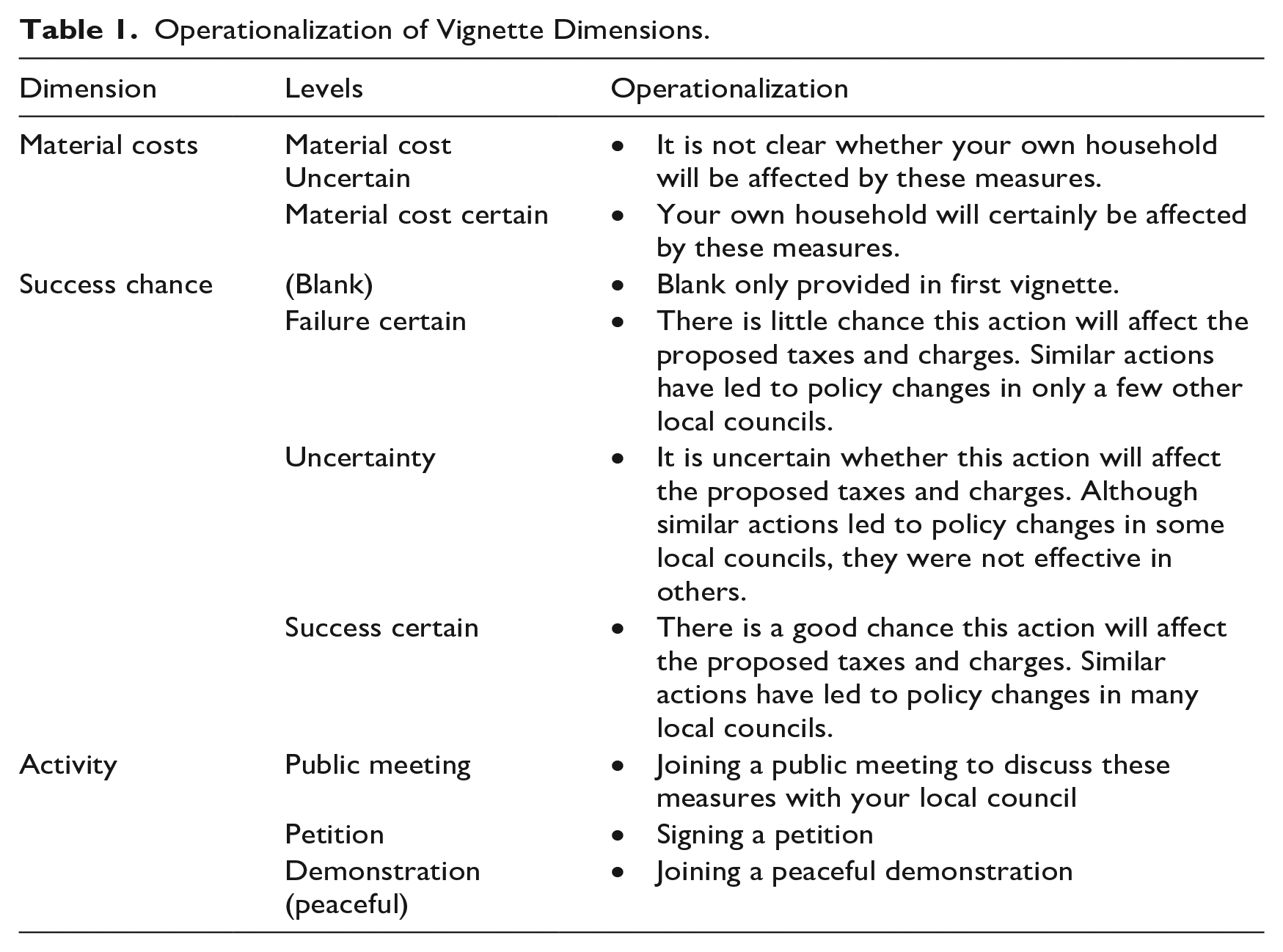
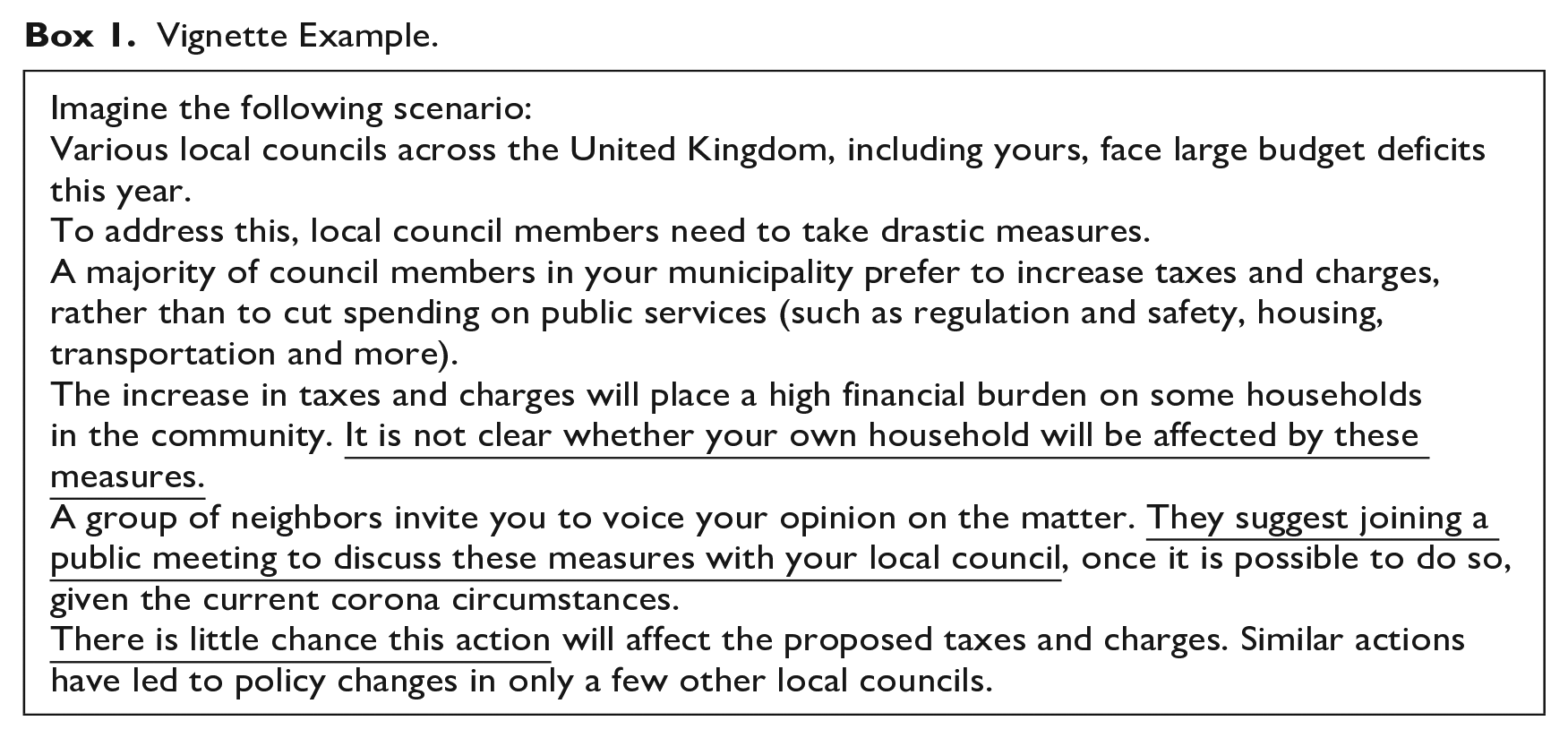
The factorial experiment prompted respondents to consider a hypothetical policy proposal in their municipality and subsequently measured their willingness to take action in various political acts. Respondents rated three scenarios in which we randomly manipulated three factors (see Table 1 for an overview). The outcome benefits to be gained from participation had two variants, namely, that the policy proposal would lead to personal material cost, or that this was unclear. The activity type through which respondents could voice their opinion had three variants, one for institutional participation (attending a meeting with the local council), and two for non-institutional participation (engaging in a demonstration, or signing a petition). The estimated success chance of the action had four variants, ranging from an action that yields little chance of influence to an action leading to a good chance of influence. We included an attention check after the first vignette to ensure that respondents properly read the scenario. Approximately, 74% of respondents respondent correctly. Box 1 presents an example of an actual vignette.
Operationalization of Vignette Dimensions.
Vignette Example.
Dependent Variable
Our dependent variable measures participatory intent on a four-point scale. We asked respondent “How likely is it that you would join . . . initiative?.” Response options varied from (1) “I would not . . . under any circumstances” to (4) “I am quite certain I would join . . .” Although participatory intent is distinct from actual participation, it is theoretically prior and empirically linked to actual behavior (Quintelier and Blais, 2016). If trust matters for participation, it is likely due to its effects in shaping willingness to participate in politics.
Political Trust
We operationalized political trust, our independent variable, as a pre-treatment covariate. The measure relies of a battery of items measuring trust in a set of representative institutions and actors (Parliament, Government, Political Parties and Politicians). Each item consists of a five-point scale ranging from (1) strongly distrust to (5) strongly trust (we treat don’t know responses as missing, which correspond to 1.1%, 0.8%, 0.7% and 0.6% for the four trust items, respectively). 4 Political trust consist of the average value on these items. Operationalizing trust as a pre-treatment covariate allows us to estimate its effects on participation across the three different activities in the experiment as well as its moderating effect on outcome benefits and success chance.
Controls
Our models control for variance across various sociodemographic factors including age, gender, education levels and occupation. Levels of trust, considerations of outcome benefits and success chance and participation are likely to vary across education levels and type of occupation. In addition, we also adjust for political interest and political efficacy (internal and external) when assessing the direct and moderating effects of political trust since these variables are known to influence political participation and are closely related to political trust (Boulianne, 2019; Hooghe and Marien, 2013; Norris, 1999a).
Methods
We rely on hierarchical varying intercept models to estimate both vignette effects and those of pre-treatment covariates and controls (Auspurg and Hinz, 2015). As each individual rated three unique vignettes, we nest vignette effects (Level 1) in individuals (Level 2). We control for design factors, namely, the effect of receiving subsequent vignettes and we also control for country-level differences. We limit our analytical sample to respondents who correctly answered the attention check (see Online Appendix for models on the full sample). We visualize these results via marginal effects. Full regression models are included in Online Appendix.
Results
We discuss our findings in incremental manner. We first review the experiment’s treatment effects and then discuss the direct and moderating effects of political trust. Overall, the experimental manipulations worked as expected. Figure 1(a) provides an overview of the average marginal effects for all vignette elements, as well as the political trust covariate and political attitudes controls (see Table 2 Model 1 for model coefficients).
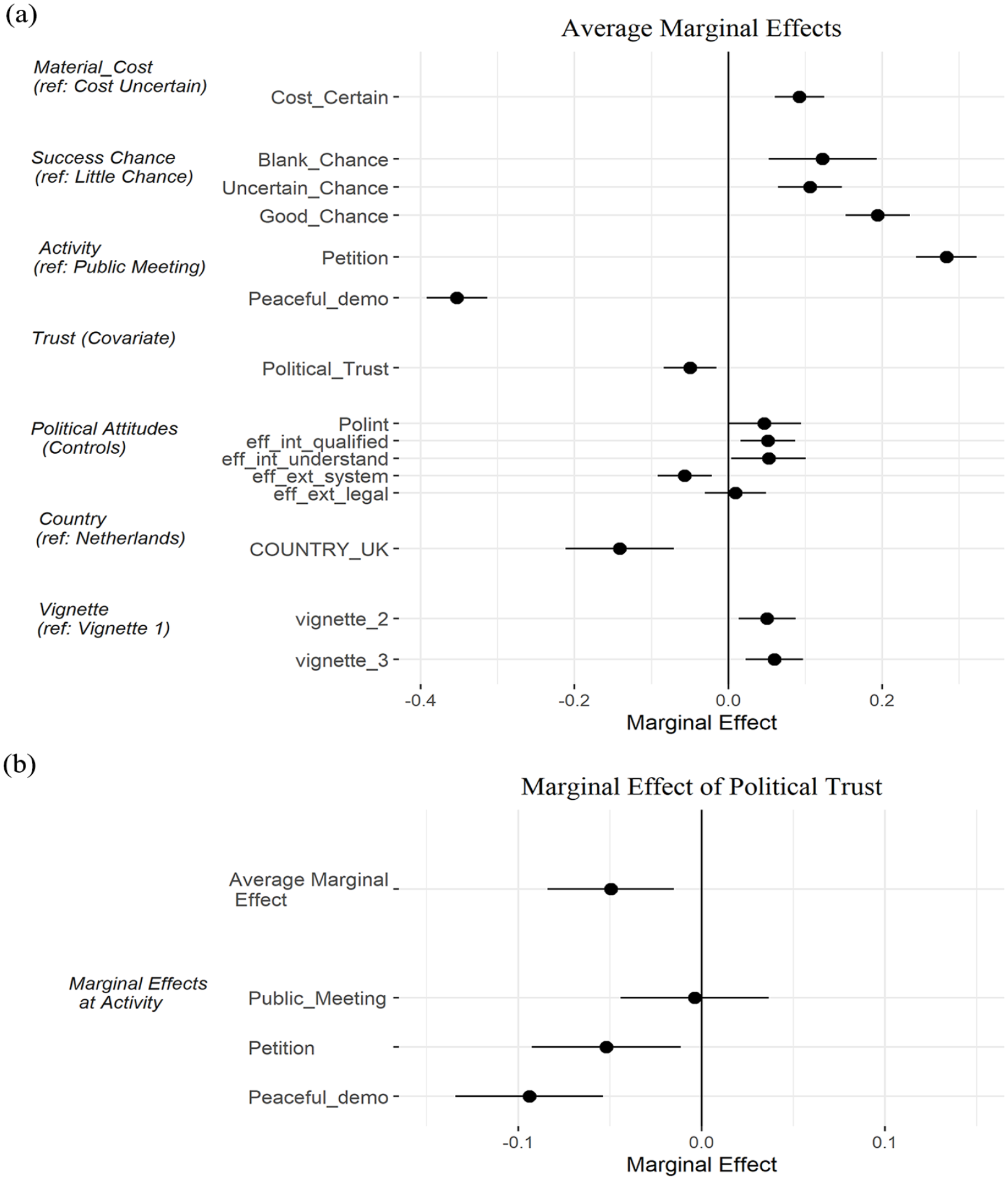
(a) Average Marginal Effects. (b) Marginal Effect of Political Trust.
Hierarchical Model Explaining Intended Participation.
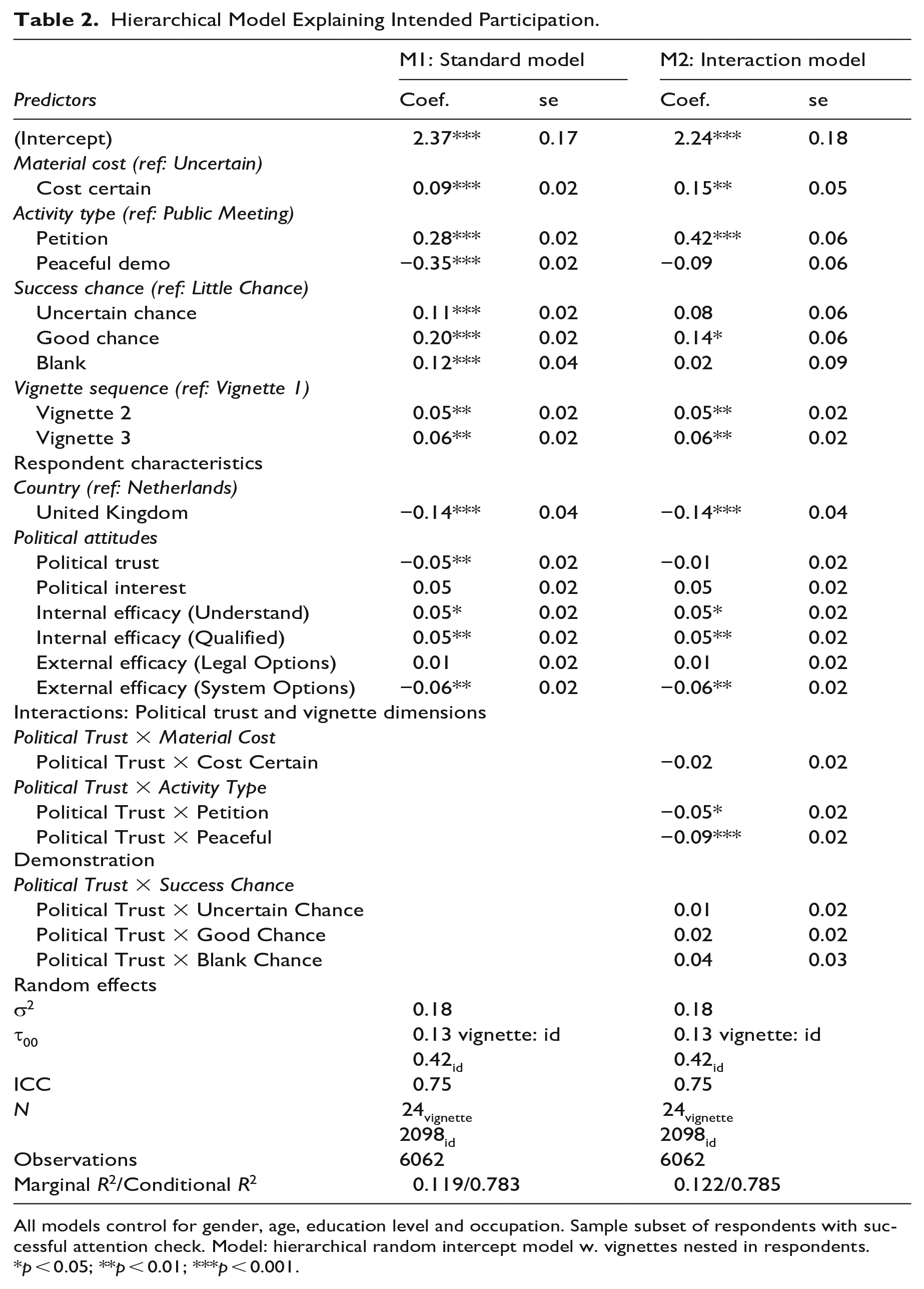
All models control for gender, age, education level and occupation. Sample subset of respondents with successful attention check. Model: hierarchical random intercept model w. vignettes nested in respondents.
p < 0.05; **p < 0.01; ***p < 0.001.
First, both material costs and success chance increased intended participation (Figure 1(a)). In line with H1, respondents were more willing to participate when faced with personal material costs ensuing from the policy proposal. Given that the baseline scenario in all vignettes is that some household in the municipality would face financial difficulties, these effects can be interpreted as the effects of personal costs over and beyond collective costs. The threat of these personal material costs led to a 0.09 point increase in intended participation. Second, our results also align with H2. Success chance leads to higher levels of intended participation. Compared to respondents evaluating a scenario with little chance of success, those who received a vignette with an uncertain chance of success were more willing to participate (+0.11 point). Those who rated a vignette with a good chance to influence the policy expressed even higher willingness to participate (+ 0.2 point). Incidentally, in the absence of an explicit statement about the chance of success, respondents were just as willing to participate as those who were told the initiative had an uncertain chance of affecting the policy proposal.
Finally, the third randomized factor, the type of activity respondents were asked to join, also had strong effects on participatory intent. Compared to those invited to join a public meeting, respondents were more willing to participate when invited to sign a petition and much less willing to attend a peaceful demonstration. This corresponds to a 0.28-point increase and a 0.35-point decrease, respectively, in participatory intent.
Political trust has a net negative effect on participatory intent (see Figure 1(a) and Table 2 Model 1). A unit increase in political trust on a five-point scale is associated with a 0.05-point decrease in intended participation. This effect is sizable as it implies a 0.25-point decline between the most distrusting respondents and the most trusting respondents in our sample. This remarkable finding is robust when controlling for other attitudinal resources such as political interest and internal efficacy, which show the commonly found positive effect on participation. But external efficacy also has a negative or an insignificant effect (see Table 2 Model 1).
The effect of political trust does differ across distinct forms of participation. Figure 1(b) shows both the average marginal effect and the conditional marginal effects of trust across activities. Our results challenge the expectations we specified in H3a and H3b. First, in contrast to H3a, political trust has a null effect on intended participation in the institutional activity (e.g. attending a public meeting with local officials). Moreover, in contrast to H3b, this null effect challenges the expectation that trust has stronger effects on participation in institutional activities than in non-institutional ones. Instead, our results align with H4. Political trust has a strong negative effect on intended participation when respondents are asked to partake in non-institutional activities (e.g. signing a petition and joining a peaceful demonstration). Trust has a marginal effect of −0.05 among respondents invited to sign a petition and −0.09 among respondents invited to join a peaceful demonstration. These results are robust against various specifications including controlling for potential interactions between trust and closely related political attitudes. 5 Furthermore, the results show that the effect of political trust is stronger for demonstrating than for signing petitions. Although we do not hypothesize about this, the result aligns with a RCT perspective in which more time-consuming activities, like attending a public demonstration, are linked more strongly to incentives (i.e. distrust).
Figure 2(a) and (b) visualize the interaction between political trust and both material costs and success chance via average marginal and conditional effects. Surprisingly we find little evidence that political trust moderates either of these factors. First, the interaction between trust and personal material cost is insignificant (see Table 2 Model 2 for interaction terms). As shown in Figure 2(a) the average marginal effect of material cost is positive. While this marginal effect varies slightly across trust levels, these variations are not significant. People respond to material costs in similar ways regardless of their political trust levels. These findings counter our expectations in H5a and H5b.
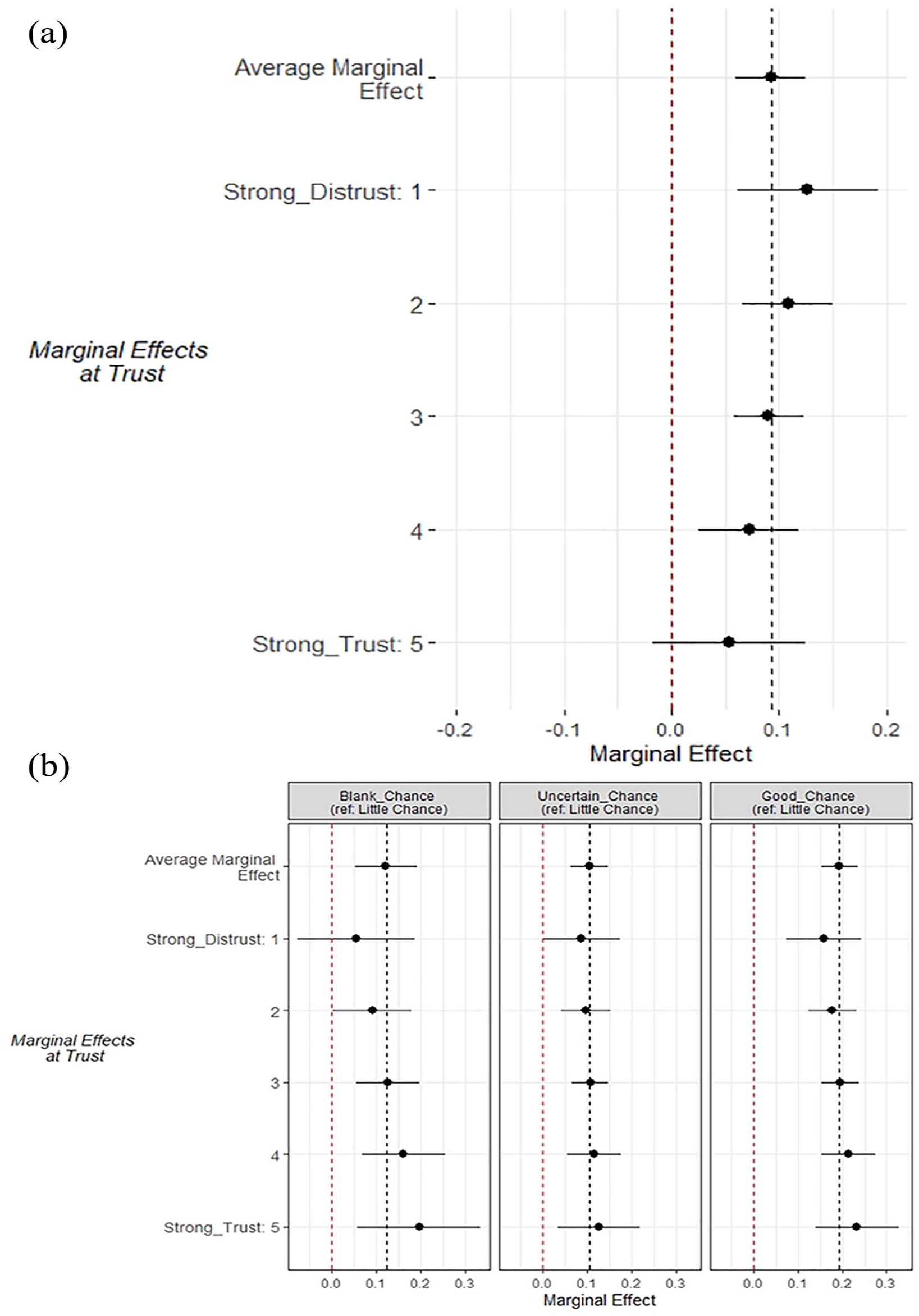
(a) Marginal Effects of Material Cost (b) Marginal Effects of Success Chance.
Our findings also challenge our expectations about success chance in H6a and H6b. Although success chance enhances intended participation, it does so independently of trust attitudes (see Table 2 Model 2). As shown in Figure 2(b), the marginal effects of both an uncertain chance and a good chance do not vary significantly across levels of political trust. People express more willingness to participate when they have a high chance of success regardless of their trust levels. While material cost and success chance spur participation, we find little evidence that political trust attitudes moderates their effect.
Robustness Checks
These substantive findings are robust against various checks and model specifications. First, carry-over effects from the vignette do not influence these results. While respondents rated the second and third vignettes more positively than the first they encountered, this pattern does not influence any of the effects presented in this article (see Online Appendix). Second, cross-country differences across the United Kingdom and the Netherlands do not change the substantive conclusions we draw. Third, different modeling techniques such as the separation of between-person effects (based on the first vignette via ordinary least square (OLS)) and within-person effects (based on all vignettes via fixed effects models) do not change our conclusions.
Discussion and Conclusion
Existing research about the relevance of political trust for participation provides two plausible yet divergent expectations. Trust may either facilitate participation or diminish it. In this article, we revisit these divergent expectations through the lens of a rational choice model in which trust may either serve as a resource to participate or a disincentive to get involved in politics. To this end, our research design sought to tease out whether political trust attitudes function primarily as a participatory resource or (dis)incentive. We did so by assessing both the direct effects of trust on intended participation, its varying effects across different activities, and its moderating effect on material benefits and success chance.
Our findings cast doubt on the view that trust functions as a resource facilitating participation. First, in contrast to expectations drawn from the civic voluntarism model, trust has a net negative effect on intended participation in this scenario. Political trust can hardly be considered a participatory resource that reflects civic attachment if those who trust political actors are less engaged under conditions that encourage participation. This negative effect is all the more striking when considering the positive effect of other attitudes such as political interest, and internal political efficacy. While political interest (non-significant) and internal efficacy stimulate participation, in accordance with the civic-voluntarism model, political trust has the opposite effect (as does external efficacy). Both trusting respondents and respondents who believe the political system provides opportunities to make political actors listen were less willing to participate. In this sense, our findings seem to align with theories of stealth democracy which suggest that people do not necessarily want to be actively involved in politics, but primarily due so out of distrust of elected officials (Hibbing and Theiss-Morse, 2002: 159).
Second, the varying effects of political trust across different activities challenge the view that it functions as a participatory resource. The civic voluntarism model yields the expectation that trust enhances institutional participation, or at least, that the effects of trust are more pronounced for institutional activities than non-institutional ones. We find the opposite pattern. The negative effect of trust is primarily driven by the fact that trusting individuals are less likely to participate in non-institutional activities. Those who distrust are more willing to participate in non-institutional activities. Moreover, trust does not yield higher intended participation in the institutional activity in our experiment. Rather, it has a null effect. Trusting individuals were no more likely to attend a public meeting with local officials than distrusting individuals. Instead of a participatory resource, our findings align with the view that trust operates as a (dis)incentive as expected by grievance theories.
When it comes to influencing policy outcomes, those with little political trust are more likely to be engaged and appear willing to use a wider repertoire of actions to achieve their goals.
Third, if at first sight our findings suggest that trust operates as a (dis)incentive, the mechanisms underlying this relationship remain unclear. Hetherington’s (2005) trust-as-a-heuristic approach provides a plausible explanation as to why trust may operate as a disincentive for action: trusting individuals are more willing to bear the material costs of policy change. Therefore, we expected the moderating effects of political trust on outcome benefits and success chance to shed light on whether trust reflects a resource or a (dis)incentive. However, despite both material cost and success chance increasing intended participation, political trust did not significantly moderate these effects. It neither amplified nor diminished the salience of material cost and success chance for intended participation, challenging both the trust-as-resource and trust-as-disincentive theories. Lower intended participation among trusting individuals cannot be attributed to their willingness to bear material costs or differences in perceiving the chance to influence outcomes. Instead, trust primarily moderates different types of activities. While the direct effects of trust imply that it primarily functions as a disincentive, further research is needed to replicate these findings and explore the underlying causal mechanism.
The innovative methodological setup of this article has two important theoretical implications for the literature. First, the survey experiment provides a better understanding of the effect of political trust by embedding participation within a specific context, and by fixing and controlling various factors known to influence participation, namely, the issue at hand and the recruitment process leading to participation. Too often, research linking trust to levels of participation is disconnected from the context, aims and goals of individuals’ action. While cross-sectional designs with broad retrospective measures of participation enable generalizability, they sacrifice information about the context in which participation occurs.
Second, the experimental framework narrows down possible explanations for the relationship between trust and distinct forms of political participation. Political trust may influence preferences for distinct forms of participation through various other pathways including preferences for collaboration (e.g. collective vs individual action), costs of involvement (little effort to more extensive involvement), and perceptions of activity effectiveness. While we are unable to pinpoint the exact mechanisms linking trust to distinct forms of participation, our findings suggests that trusting and distrusting respondents prefer distinct forms of participation even when we control for the success chance of their action. Future studies may adopt research designs to test the specific mechanisms underlying this relationship.
Yet our findings face some limitations and raise a number of questions and promising avenues for future research. Our choice to use a rational choice framework, although well aligned with classic definitions of participation (Verba and Nie, 1987), does not fit forms of political participation with less instrumental aims (Fowler and Kam, 2007; Hamlin and Jennings, 2011; van Deth, 2014). While we find political trust to operate as a disincentive when respondents are faced with a choice to voice an opinion or to defer to political actors, it may operate differently when the context of participation and its goals are different. Future research is needed to assess heterogeneity in the effects of trust under these circumstances and to test the generalizability of these findings.
Finally, the mechanisms linking political trust to participation remain underexplored in the literature. Our research design enables us to test diverging expectations about the role of trust, but it is not well suited to test the underlying mechanisms by which trust influences participation. Future studies may develop and test specific mechanisms by which political trust influences both levels and forms of political participation. Testing these mechanisms is all the more important given the body of research pointing to participation as a determinant and not a cause of political trust attitudes (Hooghe and Dassonneville, 2018; Quintelier and van Deth, 2014). Dissecting this causal chain may further clarify whether and why trust influences political participation.
Supplemental Material
sj-docx-1-psx-10.1177_00323217231194820 – Supplemental material for The Elusive Effect of Political Trust on Participation: Participatory Resource or (Dis)incentive?
Supplemental material, sj-docx-1-psx-10.1177_00323217231194820 for The Elusive Effect of Political Trust on Participation: Participatory Resource or (Dis)incentive? by Ebe Ouattara and Eefje Steenvoorden in Political Studies
Footnotes
Acknowledgements
This project benefited from helpful feedback from members of the “Challenges to Democratic Representation” program group at the Amsterdam Institute for Social Science Research (AISSR). Thanks to audiences at the annual conferences of the International Political Science Association and the Political Science Workshops of the Low Countries.
Declaration of Conflicting Interests
The author(s) declared no potential conflicts of interest with respect to the research, authorship, and/or publication of this article.
Funding
The author(s) disclosed receipt of the following financial support for the research, authorship, and/or publication of this article: This research project was funded by the Dutch Research Council (NWO), grant no. 452-16-001.

Supplementary Information
Additional supplementary information may be found with the online version of this article.
Contents
Table A1. Dependent Variable and Experiment. Table A2. Respondent Descriptives and Attention Check. Robustness Checks. Robustness Check #1. Attention Check —Focusing on Attentive Respondents (Tables A1 and A2). Table A3. Hierarchical Models—Attention Check. Table A3b. Hierarchical Models—Experiment among Inattentive Sample. Robustness Check #2. Table A4. Vignette 1 Between—Person Effects—Attentive Sample. Table A5. All Vignettes Within—Person Effects—Attentive Sample. Modeling Notes on Robustness Checks 3 to 6. Robustness Check #3. Assessing The Positive Effect of Vignette Number (Table A6 also Table A7). Table A6. Effect of Vignette Number—Full Experiment. Robustness Check # 4. Country-Level Analysis (Table A7). Table A7. Country-Level Analysis. Robustness Check #5. Full Interactions with Political Attitudes (Table A8). Table A8. Hierarchical Models—Interactions—Attention Check. Robustness Check #6. Three-way Interactions (Political Trust, (Success Chance or Material Benefits), Activity Type (Tables A9 & A10). Table A9. Hierarchical Models—3-way Interactions [Sacrifice × Trust × Activity]—Attention Check. Table A10. Hierarchical Models—3-way Interactions [Success Chance × Trust × Activity]—Attention Check.
Notes
Author Biographies
References
Supplementary Material
Please find the following supplemental material available below.
For Open Access articles published under a Creative Commons License, all supplemental material carries the same license as the article it is associated with.
For non-Open Access articles published, all supplemental material carries a non-exclusive license, and permission requests for re-use of supplemental material or any part of supplemental material shall be sent directly to the copyright owner as specified in the copyright notice associated with the article.
