



Abstract
This study argues that political participation is a key factor when explaining levels of political trust among citizens. It explores how this relationship is moderated by the socio-economic status (i.e., household income and educational level) of citizens. The article contributes to the field of political trust by employing European Social Survey data from 2016 and 2018. Two findings stand out: firstly, whereas political participation through institutionalized channels is positively related to higher levels of trust among citizens with high socio-economic status, this effect is not present among citizens with lower levels of socio-economic status. Secondly, citizens that highly engage in non-institutionalized modes of political participation and with lower levels of socio-economic status are the ones with lower levels of political trust.
Introduction
Citizens’ trust in politics has become a ubiquitous and multi-faceted phenomenon. Defined as the extent to which citizens perceive political institutions as reliable (Levi and Stoker, 2003), political trust gives us an indication of the state of our democracies and the level of acceptance of key political institutions of our governance systems (Easton, 1971; Norris, 2011; Putnam, 1993). As shown in a recent meta-analysis, “trust is importantly and robustly related to what people want from their political systems and how they interact with it” (Devine, 2024: 1). Citizens with higher levels of political trust are more likely to comply with political decisions and contribute to the public good (Marien and Hooghe, 2011). Yet, low levels of trust may enhance populist movements that exploit and strengthen the rift between citizens and political institutions (Keefer et al., 2021)—ultimately threatening the functioning of western democracies. In other words, political trust is strongly associated with good or bad democratic governance (Putnam, 1993). As such, it is important to unveil its drivers (Schmidthuber et al., 2021) and the reasons for its apparent decline (Kettl, 2019; Levi and Stoker, 2003).
In this article, we argue that political participation is an important factor when explaining levels of political trust among citizens. Political trust is informed by citizens’ traits, attitudes, and behaviors towards democratic political processes, of which political participation is a key dimension (Dalton and Klingemann, 2007; Van Der Meer and Van Erkel, 2023). Through this political engagement, and particularly when citizens feel truly involved and heard by political actors, political trust is likely to increase because citizens perceive political institutions as more democratic, accountable, and responsive (Halvorsen, 2003; Kim, 2010; Ma and Christensen, 2019; Wang and Van Wart, 2007). Yet previous research has also shown that participation can negatively affect citizens’ trust in politics or lead to no significant effect (Devine, 2024; Wang, 2001). To shed new light on these complex relationships, we distinguish between institutionalized and non-institutionalized modes of political participation and hypothesize opposite expectations for each of them (Hooghe and Marien, 2013; Lee and Schachter, 2018). While institutionalized modes of participation are more likely to generate higher levels of trust, citizens that participate through non-institutional mechanisms are expected to have lower levels of political trust. Nonetheless, as highlighted by Ouattara and Steenvoorden (2024), the relationship between both modes of participation and political trust has, so far, led to inconsistent findings. Therefore, the question of whether and how different modes of political participation affect political trust remains (Holum, 2023).
One core contribution of this article is to unpack the moderating role that socio-economic status (SES), operationalized as household income and education level, plays in the relationship between political participation and trust. Extensive research has demonstrated that SES is highly related to both political trust (e.g., Schattschneider, 1960; Verba et al., 1995) and citizen participation in politics (John, 2009). One frequent observation is that citizens with lower SES are more likely to have low levels of political trust. In other words, the problem of trust in government is deeply rooted in income and social inequality, and citizens with lower SES tend to have lower levels of trust in politics (Kettl, 2019; Noordzij et al., 2019, 2021a; Uslaner and Brown, 2005). As noted by Piketty (2014), “the level of (socio)-economic inequality within societies is at least partially dependent on political decisions that have been made” (Goubin and Hooghe, 2020: 220). Accordingly, it could be argued that if political decisions are made with the participation of citizens with low SES, societal inequalities might be mitigated, increasing political trust across the board. This observation calls for a systematic examination of the moderating role that SES has on the relationship between political participation and political trust.
This study intends to examine this issue by asking: How does political participation affect political trust; and how does SES moderate this relationship? By analyzing how different modes of political participation affect trust in politics and the moderating role of SES, this article makes several contributions. First, it further explores the drivers of political trust at a time when societal trust is declining and populist trends are on the rise (Kettl, 2019). Second, it specifically examines how the interaction between different modes of political participation and SES affects political trust with a large-N dataset from two European Social Surveys (2016 and 2018 waves). Third, it provides new normative insights into the quality of our democratic systems on the basis of the results obtained.
Political participation and trust
Political participation is defined as any activity conducted by a citizen that is aimed at influencing or shaping the development of a public policy or a political event, or to contribute to the debate and discussion of the content of a public policy (for a discussion, see Van Deth, 2014). Aligned with a long-standing stream of literature, we focus on the relationship between non-electoral participation and trust (e.g., Kaase, 1999; Kutuk and Usturali, 2023; Waeterloos et al., 2024). Due to increased pressure on public officials and a greater number and diversity of ideas, non-electoral participation may result in a better expression of the will of the people, particularly if representation is of poor quality (Shybalkina, 2021). Through non-electoral political engagement, citizens can exert pressure on legislators to consider (specific) information when formulating public policies (Marien and Hooghe, 2013). Moreover, this form of political participation can promote the public spirit of those who participate and strengthen social capital among citizens (Mill, 2004). 1
As noted by Citrin and Stoker (2018: 50), [t]rust always has an object or target (B), which could be a person, group, or institution, and a domain of action (X) where trust is given or withheld. The foundation of trust is that [an individual] A judges B to be trustworthy, that he or she will act with integrity and competence and with A's interests paramount.
In that regard, political trust involves citizens’ assessments of political authorities’ compliance with the normative expectations held by the public (Miller and Listhaug, 1990). Low levels of trust therefore imply that people do not think the government is acting in their best interests (Lee and Schachter, 2018; Wang and Van Wart, 2007). In contrast, citizens with high levels of trust in politics are likely to feel that their preferences are defended, protected, and advanced by political institutions.
By conceptualizing trust as a reciprocal (bidirectional) phenomenon, we argue that it is not only political participation affecting trust; it can also be that the more one participates in politics the higher (or lower) the levels of trust in politics will be. If trust is a “socially learned and socially confirmed expectation that people have of each other and of the organizations and institutions in which they live” (Barber, 1983: 164–165), it also means that trust is being built and developed through time in a reciprocal manner, and thus cannot be conceived as a unidirectional relationship.
Related to this bidirectional conceptualization of trust, the literature linking political participation and trust can be divided into two broad streams. On the one hand, literature coming from political science scholars has examined how trust affects political participation (e.g., Almond and Verba, 1963; Dahl, 1998; Hooghe and Marien, 2013; Ouattara and Steenvoorden, 2024). The main hypothesis put forward by this stream of literature is that citizens’ degree of trust in politics will determine whether they engage in political participation. More specifically, it is expected that trust is positively related to institutionalized participation and negatively related to non-institutionalized participation (Hooghe and Marien, 2013); however, the empirical research produced so far remains inconsistent (Ouattara and Steenvoorden, 2024).
On the other hand, this article takes the perspective of public administration research and investigates the effect that political participation has on trust (He and Ma, 2021; Halvorsen, 2003; Jo and Nabatchi, 2021; Kim and Lee, 2012; Wang and Van Wart, 2007; Yang and Pandey, 2011). Aligned with social capital literature, it is presumed that civic engagement (i.e., political participation) “not only stems from trust (Stolle, 1998) but also can lead to greater trust” (Uslaner and Brown, 2005: 872). Accordingly, this stream of literature builds upon the core assumption that public participation could be used to restore declining levels of public trust because engaged citizens will perceive political institutions as more democratic, accountable and responsive (Ma and Christensen, 2019; Wang and Van Wart, 2007). However, as argued below, we expect an inverse relationship between institutionalized and non-institutionalized modes of political participation and trust, which is mostly explained by the expectations of engaged individuals and the potential responses of politicians to citizens’ political participation.
Institutionalized and non-institutionalized modes of participation and trust
Institutionalized forms of political participation encompass the activities directly related to the electoral and institutional process (i.e., directly contacting public officials or working in a political organization). In contrast, non-institutionalized modes of political participation are less formalized and do not have a direct relation with the electoral process or the functioning of the political institutions (i.e., demonstrations, signing petitions, boycotts, and voicing preferences through social media platforms). As discussed below, we expect the two modes of participation's respective relationships with political trust to go in opposite directions.
Citizens are more likely to trust politics when they participate through institutionalized modes of participation because this engagement increases the responsiveness of governments and their ability to adequately address citizens’ needs and demands (Neblo et al., 2010). Through this involvement, citizens interact with political institutions and develop a sense of co-creation, familiarity, and mutual feeling of connection that leads to group-think and ultimately increases the levels of trust (Schmidthuber et al., 2021). The core argument here, related to the idea of political efficacy, is that people who are empowered to influence public policy and are involved in decision-making are more likely to have political trust (He and Ma, 2021; Wu et al., 2017).
Accordingly, citizens’ institutionalized political participation and trust in politics are expected to go hand in hand (Arshad and Khurram, 2020). However, this expectation is built upon two key assumptions: first, that political participation is done effectively; and second, that it is done in good faith (Wang and Van Wart, 2007). The former implies that political participation leads to clarity, consensus, and good policies, instead of confusion, frustration, or poor policy output (Wang and Van Wart, 2007). Citizens need to see their preferences recognized and addressed through participatory processes (He and Ma, 2021). The latter means that citizens engage in institutionalized forms of political participation with the possibility of having a real impact on political issues, not only on minor effects and superficial or cosmetic changes that do not address the substantive preferences of citizens’ input (Wang and Van Wart, 2007). Similarly, Jo and Nabatchi (2020: 142) highlight that institutionalized modes of participation can have a positive influence on trust in politics when citizens are able to (1) get information and express opinions, and (2) contribute to policy outputs. If these two assumptions are met, then we can expect a positive relationship between institutionalized modes of participation and political trust. Failing to meet these expectations can lead to lower levels of trust among citizens (Schmidthuber et al., 2021; Wang and Van Wart, 2007).
Importantly, the literature examining political trust as a dependent variable has focused on institutionalized modes of political participation. As a result, the effects of non-institutionalized modes of participation on political trust have not yet been sufficiently theorized or examined. Political scientists examining the effect of trust on non-institutionalized modes of participation argue that activities such as protest movements and demonstrations go hand in hand with low levels of political trust (Hooghe and Marien, 2013; Marien and Hooghe, 2011; Norris, 2011). However, as recently noted by Devine (2024: 6–7), non-institutionalized modes of political participation and trust “are negatively related in some countries, positive in others and unrelated still in others.”
To argue that non-institutionalized participation has a negative effect on trust, we rely on the same assumptions put forward for institutionalized participation. But first, it is important to stress that this mode of participation keeps “some distance from the political system by trying to have an indirect impact on political decision making or by circumventing the political system altogether” (Marien et al., 2010: 188). In doing so, non-institutionalized modes of participation are often used to confront the political elite and challenge the status quo (Knudsen and Christensen, 2021; Marien et al., 2010). Consequently, it is less likely that these activities lead to a productive exchange of information between citizens and political actors that generate “clarity, consensus, and good policies,” which violates the assumption of getting information and expressing opinions (Jo and Nabatchi, 2021). Moreover, as empirically observed by Marien and Hooghe (2013), non-institutionalized modes of political participation like demonstrations and protests are perceived as less effective tools to influence public policy when compared to institutionalized modes such as joining a political party. It is thus likely that citizens engaging in non-institutionalized modes of political participation do not see their preferences reflected in public policies – which is at odds with the idea of “contributing to policy outputs” and “good faith” (Jo and Nabatchi, 2021; Wang and Van Wart, 2007). Therefore, we expect that citizens involved in non-institutionalized modes of participation will have lower levels of trust in political institutions such as politicians, the parliament and political parties. H1a: Citizens who engage more strongly through institutionalized modes of political participation will have higher levels of trust in politics than those that are less engaged through institutionalized modes of political participation. H1b: Citizens who engage more strongly through non-institutionalized modes of political participation will have lower levels of trust in politics than those that are less engaged through non-institutionalized modes of political participation.
The moderating role of SES
We argue that the relationships presented above are affected by the SES of citizens. According to Mueller and Parcel (1981: 14), “socio-economic status is the relative position of a family or individual in a social system in which individuals are ranked according to their access to or control over wealth, power and status.” Previous research has shown how citizens with low SES have lower levels of trust in politics (Schattschneider, 1960; Verba et al., 1995), whereas those with high SES have higher levels of trust (Foster and Frieden, 2017; Hooghe et al., 2015). As noted by Putnam (2000: 138), the connection between political trust and SES might be ascribed to the fact that “the better-offs have been materially successful, so why should not they trust social arrangements that have served them well?” Furthermore, trust is also a question of representation—the idea being that citizens who feel politically represented also feel more trustworthy towards those who represent them. In sum, the often confirmed economic and elite hypotheses stipulate that economically and socially affluent citizens are more represented by political elites and thus have higher levels of trust in politics than the socio-economically disadvantaged (e.g., Noordzij et al., 2021b; Schakel, 2021; Schakel and Hakhverdian, 2018).
When it comes to SES and political participation, and despite pluralist assumptions of equal political participation (Dahl, 1998), we know that political participation varies significantly across different groups of citizens. Research has shown a clear relationship between political participation and socio-economic factors such as education, income and occupation (Dalton, 2017). However, we still do not know how SES affects the relationship between the two types of political participation and political trust.
We expect that SES will have a reinforcing effect on the relationship between the two modes of political participation and political trust. That is, when citizens have high SES the positive relationship between institutionalized modes of participation and trust is likely to be steeper; and the same applies with the negative relationship between non-institutionalized modes of participation and trust when citizens have low SES.
Focusing on institutionalized modes of participation, we know that citizens with lower SES are less likely to participate in politics through institutionalized channels (Brady et al., 1995; Dalton, 2017; Schlozman et al., 2012, 2015; Verba et al., 1995). In contrast, higher SES citizens are more likely to participate because they have access to resources that make it easier (Dalton, 2017). If citizens’ likelihood to engage in political participation is a function of the costs of participation relative to the expected benefits (Singh and Dunn, 2015), citizens with higher SES are likely to participate more in politics because the benefits outweigh the costs (Nie et al., 1996). Moreover, the possession of time, money, skills, cognitive abilities and social capital are crucial factors that encourage institutionalized modes of political participation (Dekker and Uslaner, 2001; Persson et al., 2015), and these factors are often related to high SES (Dalton, 2017).
More importantly, we argue that people with higher SES are likely to reinforce the relationship between institutionalized modes of participation and political trust. As discussed above, a key assumption that explains the positive relationship between institutionalized modes of participation and political trust is the ability of citizens to be heard and taken into account by policymakers. Considering that citizens with higher SES are more likely to develop higher levels of political efficacy when compared to those with lower SES (He and Ma, 2021), we expect that the relationship in H1a will be accentuated when citizens have higher levels of SES. We expect a milder effect for low SES citizens. Even if they are actively involved in institutionalized modes of political participation, their limited political efficacy (Brown-Iannuzzi et al., 2017) affects their ability to influence decision-making. This generates a feeling of dissatisfaction with political outcomes, decreasing the levels of political trust.
Similarly, we expect that citizens with low SES will steepen the negative relationship between non-institutionalized modes of participation and political trust. More specifically, citizens with lower SES are more likely to be disenchanted citizens that “come from among the poor and dispossessed, who may have the most legitimate cause to feel that their interests are neglected by the established political system” (Norris, 2011: 193). As a consequence, citizens with lower SES have important incentives to engage in politics through non-institutionalized modes of participation. However, when comparing across levels of SES, previous results show that citizens with high SES are also the ones that more often engage in non-institutionalized modes of political participation (Quaranta, 2015). In that regard, the same costs discussed for institutionalized modes of political participation are likely to apply for non-institutionalized modes and negatively affect the involvement of citizens with lower levels of SES.
Citizens engaging through non-institutionalized modes are more likely to be dissatisfied with political institutions, yet low levels of SES are likely to accentuate this feeling of distance from political institutions (Van Stekelenburg and Klandermans, 2018). Because of this detachment from political institutions, citizens that engage in non-institutionalized modes and have low SES are less likely to engage in productive discussion with policymakers that contribute to policy outputs and good faith (Jo and Nabatchi, 2021; Wang and Van Wart, 2007), which results in lower levels of political trust. In other words, the more citizens get involved in non-institutionalized modes of participation, the lower their level of political trust; but this effect is likely to be stronger among citizens with low SES in comparison to citizens with high SES, as the latter have stronger connections with the political system. H2a: The positive relationship between institutionalized modes of political participation and trust is accentuated among citizens with higher levels of SES when compared to those with lower levels of SES. H2b: The negative relationship between non-institutionalized modes of political participation and trust is accentuated among citizens with lower levels of SES when compared to those with higher levels of SES.
Research design and measures
To examine the effects of political participation and SES on political trust, this study focuses on the region of Europe. The focus on European countries is of particular relevance in our current times when democratic backsliding and populism have become a prominent topic across the continent (e.g., Gora and De Wilde, 2022). These two phenomena, together with decreasing levels of trust in politics among European citizens, make this a particularly interesting case study.
Empirically, we make use of the eighth and ninth waves of the European Social Survey (ESS) for individual-level data (ESS8, year 2016 and ESS9, year 2018) (European Social Survey European Research Infrastructure, 2021). 2 This database offers a wide range of relevant indicators to capture our main variables (i.e., political trust, modes of political participation, and SES). These two rounds are the first ones to include political participation through online channels, which, in the way it is operationalized in this study, represents an important indicator to capture non-institutionalized participation. The survey provides opinion data on key indicators of this research, as well as participant-level information on characteristics such as age, education, and gender. We supplemented the ESS dataset with data on the Gross Domestic Product (GDP) and the Gini coefficient of each country from the year 2018—data retrieved from the World Bank. After combining the two datasets, we have data available for 31 European countries. 3
Dependent variable: Political trust
As a multifaceted concept, our measure of political trust relies on different items included in the ESS surveys. Citizens were asked to rank on a Likert-scale (0–10) whether they did “not trust at all” or had “complete trust” in the following institutions: country's parliament, politicians, and political parties. The aggregated index is based on the results of a principal component analysis (PCA) that factors together these three items which, from a theoretical perspective, can be also considered as a valid measure of political trust (see the Online appendix). More specifically, our measure of political trust includes elements related to actors in a representative party-democracy and its institutions (i.e., parliament, politicians and political parties). We exclude items related to what has been called “institutions of the Rechtsstaat,” namely the police and the judiciary system (Proszowska et al., 2022). Furthermore, we excluded measures on trust in the European Union and United Nations, as they measure a different underlying concept (i.e., international instead of national political trust). To combine the three individual Likert-scale items, we took the average of the three.
Independent and moderating variables
Aligned with our theoretical framework, we differentiate between institutionalized and non-institutionalized forms of political participation and operationalize these two concepts differently. To do so, we conducted a PCA with all ESS questions that tap into political participation, and the results further support this differentiation by clustering responses into two underlying factors that closely overlap with the dimensions suggested by the theory (see the Online appendix).
Based on these analyses, we include three questions into our measure of institutionalized modes of participation. These questions ask whether, in the last 12 months, the respondent has (1) contacted a politician, government or local government official; (2) worked in a political party or action group; or (3) worked in another organization or association. As for the non-institutionalized forms of participation, we include four questions from the ESS: whether, in the last 12 months, respondents have (1) signed a petition, (2) taken part in a lawful public demonstration, (3) boycotted certain products, or (4) posted or shared anything about politics online, for example on blogs, via email or on social media such as Facebook or Twitter. Last, we exclude the item “wearing a badge” as it does not clearly fall into either one of these two dimensions.
In contrast to previous studies (i.e., Hooghe and Marien, 2013), both types of political participation are measured on a continuum rather than using a binary operationalization—meaning that institutionalized participation is measured on a scale from 0–3 and non-institutionalized participation on a scale of 0–4. By doing so, we add nuance to how intensely respondents are engaged in these types of political participation rather than measuring whether they participate in either type at all. This means that we are able to measure how the intensity of political engagement in both types of participation influence levels of trust.
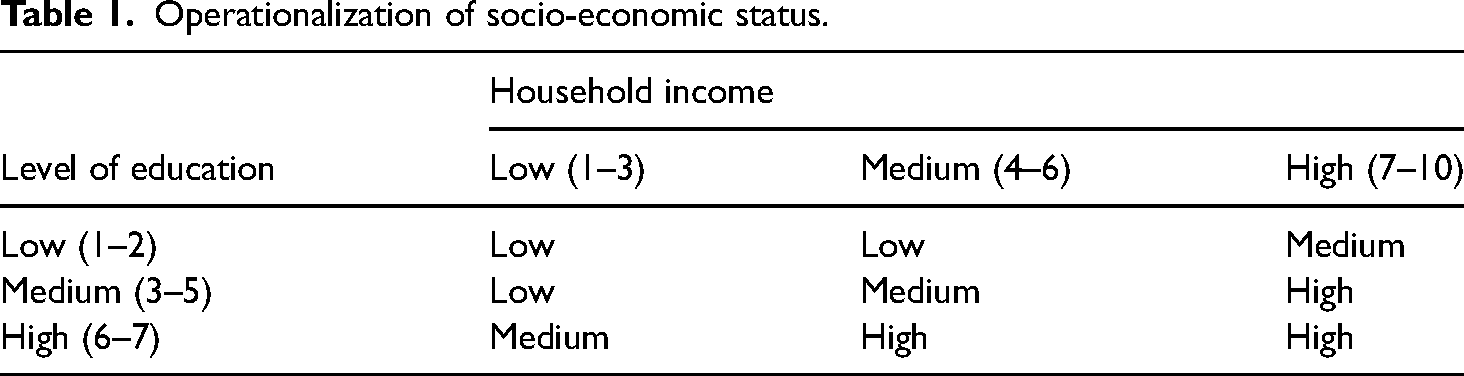
Second, we measure SES by combining the household income level with the educational level of respondents (for a similar approach, see Freeman et al., 2016). Respondents can indicate their income range as part of the survey. The income ranges are adapted to each country and are based on deciles of the actual household income range in the given country (based on national register data or representative countrywide surveys). Notably, the midpoint (top of the fifth decile) is the median income of the country. The deciles are reported in the national currency of the country. This approach makes a comparison across countries possible. More specifically, we split the 10-point scale into three groups, low-income (from 1 to 3), medium-income (from 4 to 6), and high-income (from 7 to 10). The level of education is measured on a 7-point scale, where lower values represent lower levels of education and higher values indicate high levels of education. This variable is also recoded in three levels: low education (values 1 and 2), medium level of education (values 3, 4, and 5), and high levels of education (values 6 and 7). Subsequently, the two variables are combined as presented in Table 1, resulting in a categorical variable with three levels (i.e., low, medium and high SES).
Operationalization of socio-economic status.
Control variables
To adequately test our hypotheses, we control for several factors that are related to or can affect our main variables. In that regard, we include several individual-level variables that are known to affect political trust. First, gender and age are relevant variables whose relationship with trust is at least mixed (Kestilä-Kekkonen and Söderlund, 2016). Considering the non-linear relationship between age and trust, we take the logged transformation of the variable. Secondly, employment situation, i.e., being unemployed and not actively looking for a job in the past 7 days, is likely to negatively affect the degree of trust in political institutions (Giustozzi and Gangl, 2021). Thirdly, being part of a minority group and being the first generation of non-European immigrants is likely to negatively affect political trust (for a discussion, see André, 2014). The level of religiosity is also related to political trust, yet in different ways (Verba et al., 1995). Finally, respondents’ confidence in their ability to participate in politics has been found to positively affect levels of trust (Hooghe and Marien, 2013). We also control for whether the data comes from the eighth or the ninth ESS wave. Furthermore, at the country-level, we control for the GDP of each country from the year 2018. In our models we use the logarithm of the GDP as it increases the model fit (see also, Huijts et al., 2010). Last, we control for the intra-country inequalities by using the Gini coefficient from 2018. Importantly, higher values of the Gini coefficient indicate more internal inequalities at the country level. The Online appendix presents an overview of the descriptive statistics of the dependent, independent, moderating and control variables.
Analyses and results
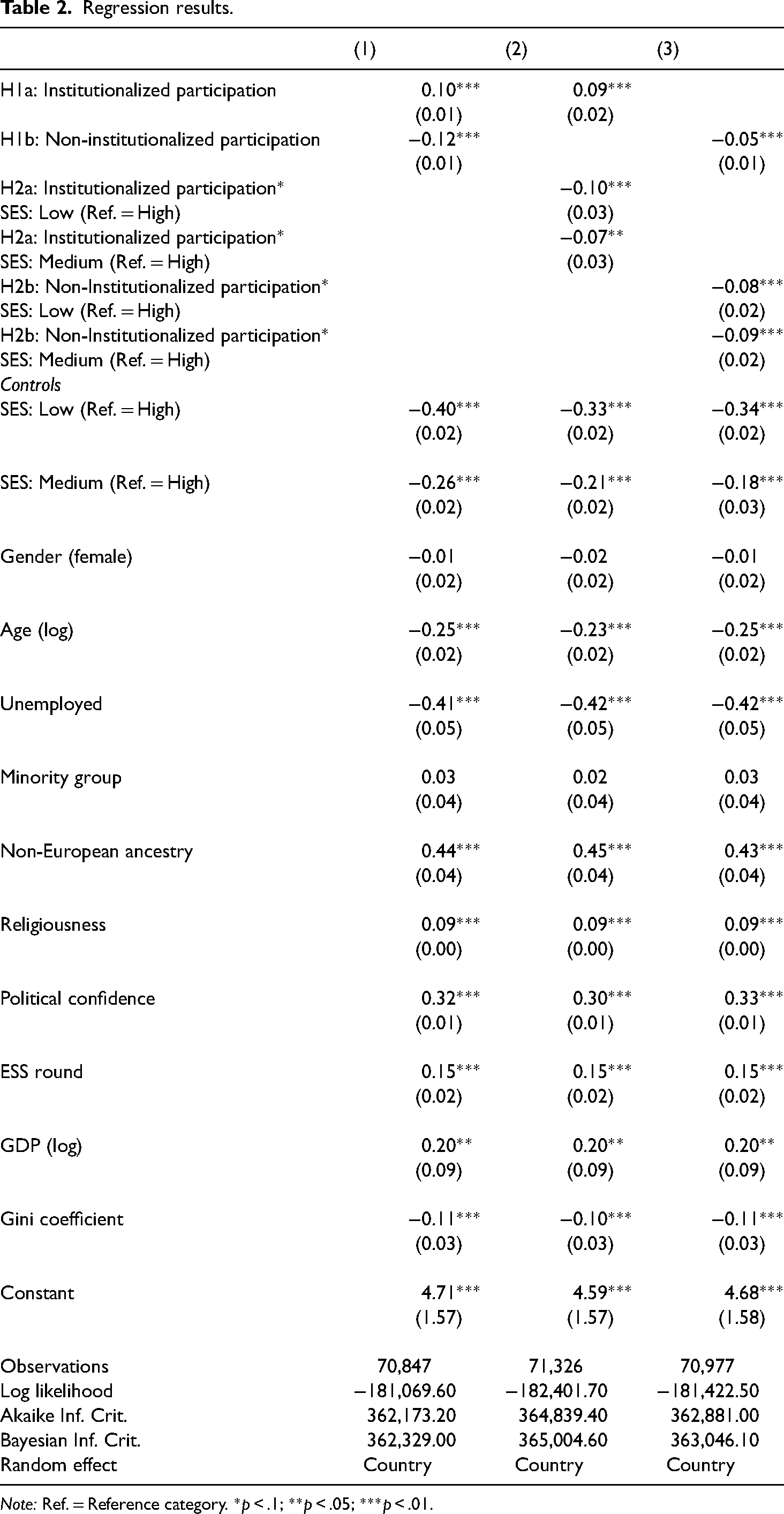
Due to the nested nature of the dataset (respondents nested in countries), we use linear mixed effect models to analyze the data. 4 All attributes are measured at level 1 except the Gini coefficient and the GDP, which are measured at level 2. Table 2 shows the results of the models. Model 1 tests H1a and H1b, while models 2 and 3 test H2a and H2b, respectively. Due to the unequal inclusion probability of European citizens across the participating survey countries, we have applied survey weights to our analysis. More specifically, we use the “Analysis weight” provided by the European Social Survey, which is the product of the post-stratification weight and the population weight—as recommended by the survey authors (European Social Survey, 2022).
Regression results.
Note: Ref. = Reference category. *p < .1; **p < .05; ***p < .01.
All models contain a random effect for countries and treat trust as the dependent variable. Model 1 provides support for H1a: citizens that are more engaged via institutionalized ways of participation have more trust than those citizens that are less engaged via these means. This holds across all socio-economic levels. Conversely, and aligned with our H1b, citizens who are more engaged via non-institutionalized modes of political participation have less trust in politics than citizens who use them less often.
Before moving to hypothesis 2, it is worth noting that, aligned with previous research, higher levels of SES lead to higher levels of political trust. The model confirms this assumption: both individuals with low and medium SES are projected to have lower trust than the reference category, namely individuals with high SES. This trend is also confirmed by the more complex Models 2 and 3.
Model 2 provides support for H2a in that the political trust difference between citizens with low and high SES is accentuated when individuals engage in institutionalized modes of political participation. The interaction effect between these two variables is statistically significant and progressively more negative (lower SES corresponding to a lower coefficient of the interaction effect), thus it can be said that the positive relationship between institutionalized political participation and trust is accentuated among citizens with higher levels of SES compared to those with lower SES. As reported in Figure 1, citizens with high levels of SES who do not take part in institutionalized tools of political participation have a predicted level of trust of 4.17. This level of trust rises to 4.45 for high level SES citizens who make maximum use of institutional tools of participation, causing a difference of 0.28 points. The same comparison for citizens with low SES causes a negative difference, from 3.85 to 3.80, i.e., −0.05, points of trust. In other words, the levels of trust decrease among people with low SES that engage more in institutionalized participation.
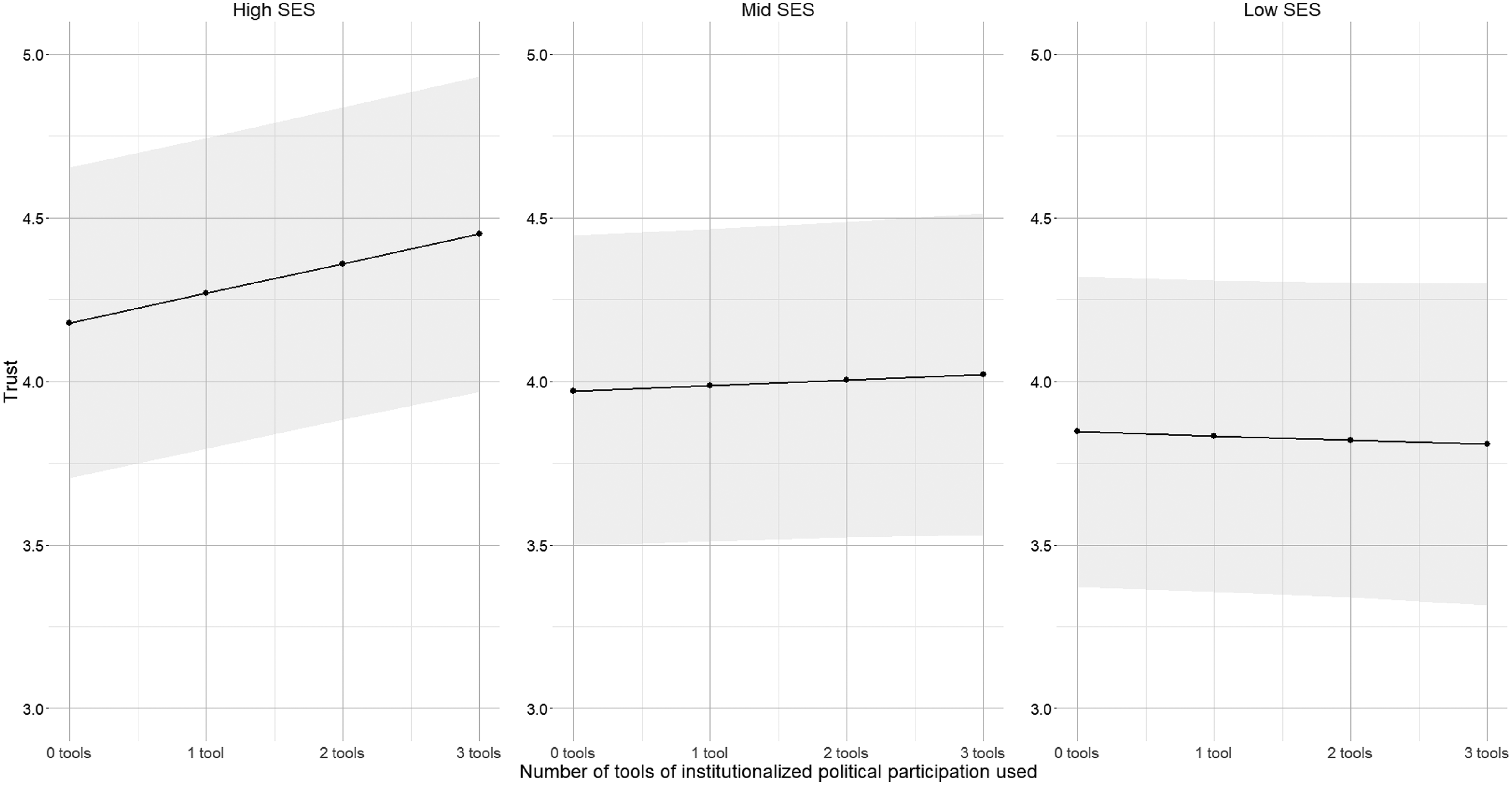
Moderating effect of SES on the relationship between institutionalized modes of participation and trust.
Lastly, model 3 tests H2b. When distinguishing by SES, we observe that more involvement in non-institutionalized modes of political participation negatively affects political trust particularly among citizens with low SES. As shown in Figure 2, this effect is less pronounced when focusing on citizens with high levels of SES. More specifically, the predicted value of political trust when high-level SES citizens engage in zero non-institutionalized tools of political participation is 4.25, compared to 4.04 for high level SES citizens who participate in the maximum number of non-institutionalized tools—leading to a drop of 0.21 points of trust. When comparing the same two groups among the low-level SES citizens, we observe a starker drop of 0.55 trust points (from 3.91 to 3.36). This means that the negative relationship between non-institutionalized modes of political participation and trust is more pronounced among citizens with low levels of SES when compared to those with higher levels of SES (H2b confirmed).
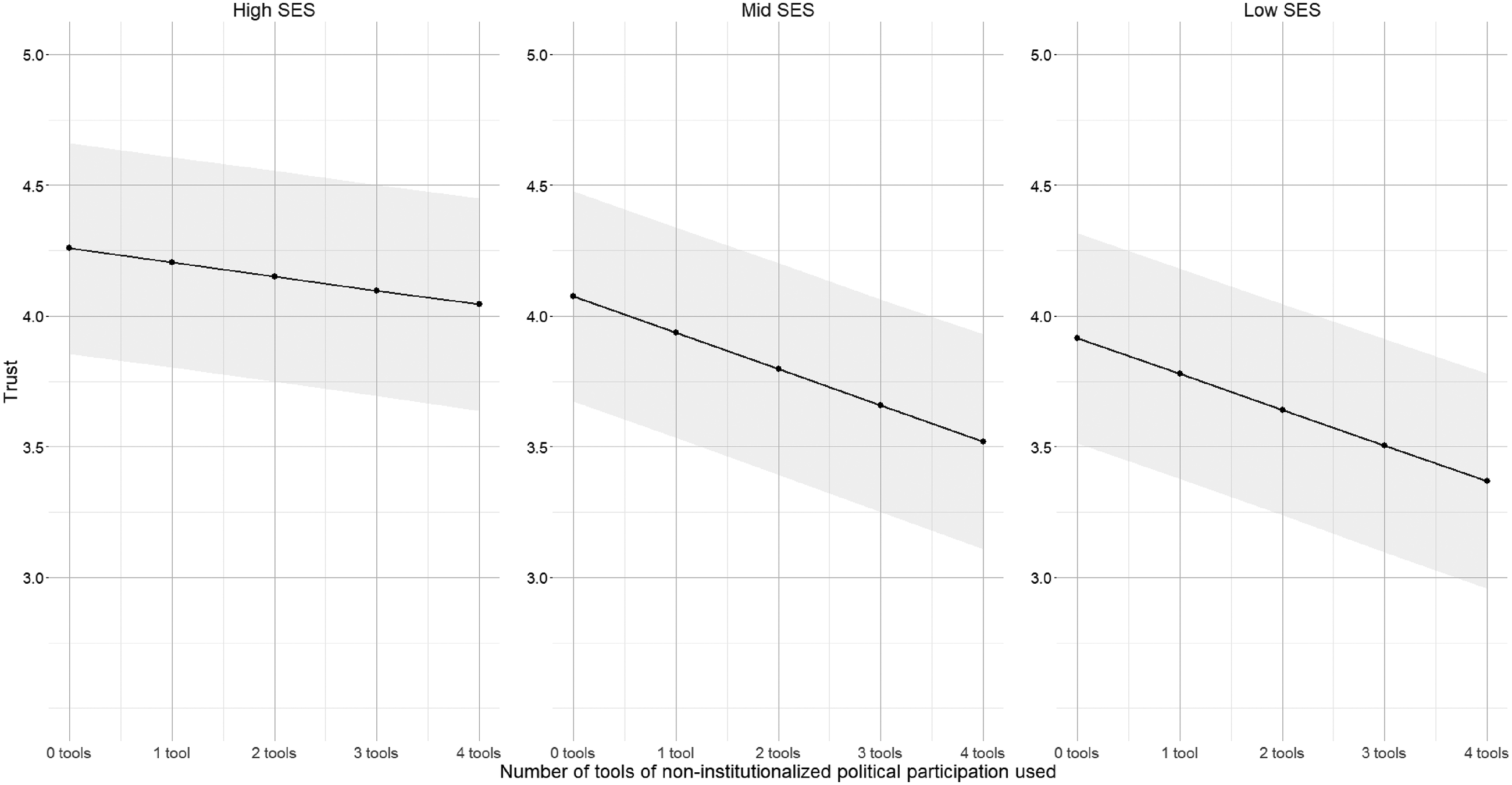
Moderating effect of SES on the relationship between non-institutionalized modes of participation and trust.
Lastly, some results related to the control variables are worth highlighting. First, at the individual level, the only variables that are not significantly related to political trust are gender and belonging to a minority group. Regarding the other individual level variables, we observe that older citizens and being unemployed are negatively related to levels of political trust. Hence, contrary to some traditional assumptions, older people do not necessarily have higher levels of trust when compared to younger citizens, on the contrary (for similar findings, see John Smith Centre, 2020). In contrast, having non-European parents, higher levels of religiosity and having political confidence are positively related to political trust. The finding related to non-European parents is particularly interesting as it might relate to the “honeymoon effect,” whereby migrants have an overconfidence of their country of destination (Röder and Mühlau, 2012). Although this honeymoon effect has been shown to decline in second generation migrants, our findings seem to indicate that they still hold when comparing first generation of migrants with the population with European ancestors. At the country level, our two variables have a significant relationship with political trust: richer countries (in terms of GDP) and countries with low levels of internal inequality (measured with the Gini coefficient) are more likely to report higher levels of political trust.
To further validate our results, the Online appendix reports several robustness checks. First, we run the same analyses while considering our moderating variable as a continuous factor that adds up household income (10-point scale) and educational level (7-point scale). This leads to a variable that ranges from 2 to a maximum of 17. The four hypotheses are confirmed. 5 Second, we examine the same relationships while splitting our measure of SES into household income and educational level. Again, the results hold. Third, the Online appendix also reports the results while including voting as an item into the institutionalized mode of political participation. Although the results hold, we observe how the trends change slightly. Whereas the change in trust among low-SES citizens when only considering non-electoral participation is negative, when including voting we observe how trust increases when low-SES citizens engage in more institutionalized forms of participation. Finally, we present the results while only considering the 21 countries that appear in both survey waves (i.e., 2016 and 2018). The significant coefficient for the moderating effect between low and high SES holds, yet the interaction effect of SES for institutionalized participation is not significant for the group “SES: middle.”
Discussion and conclusions
Our study contributes to furthering our understanding of political trust by linking it to different forms of political participation. Aligned with our expectations, we find that institutionalized modes of participation are positively related to political trust, whereas non-institutionalized modes of participation are negatively linked to political trust.
One key contribution of this article is that it examines the combined effect that political participation and SES have on political trust. In doing so, we show how the effects of political participation on trust are not homogenous across the different levels of SES. If we center on institutionalized modes of participation, we observe, as expected, that citizens with higher SES who also engage in these participatory mechanisms have higher levels of trust. Intriguingly, this positive effect on political trust is not present among citizens with low SES. On the contrary, we observe how the predicted values of trust slightly decrease the more low-SES citizens engage in institutionalized modes of participation. From a normative standpoint, this is highly problematic as the trust gap between citizens with high and low SES increases together with their involvement in institutionalized modes of political participation. As discussed, the effect of institutionalized modes of political participation on political trust is based on two key assumptions that might not apply among citizens with low SES (Wang and Van Wart, 2007). First, despite their involvement in institutionalized modes of political participation, low-SES citizens might not see an improvement in terms of clarity and consensus and, instead, perceive an increased confusion and frustration out of their participation. Second, citizens expect to have an impact as a result of their participation and if that does not happen, their levels of trust might be negatively affected.
Regarding the interaction between non-institutionalized modes of participation and SES, our results show that engaging in non-institutionalized modes of participation decreases political trust across the board. However, the most pronounced effect is among citizens with low SES, where trust significantly decreases when comparing low-SES citizens that do not engage in this mode of participation with those that engage in the four mechanisms related to non-institutionalized participation. This finding is aligned with previous research examining trust among demonstrators (Van Stekelenburg and Klandermans, 2018). More precisely, the authors find that despite participating in the same activity (i.e., non-institutionalized mode of participation), citizens “come from different social strata and are pushed onto the streets by different motivational mechanisms. The distrusting demonstrators are less educated, more often from the working class, and have less resources at their disposal than trusting demonstrators” (Van Stekelenburg and Klandermans, 2018: 789). More importantly, and as expected, this result supports the assumption that citizens with low SES who highly engage in non-institutionalized participation become more distant from political institutions because they are less likely to have an impact on policy outcomes.
Overall, these findings are problematic for several reasons. First, as noted by Van Der Meer and Zmerli (2017: 51), “in times of rising economic insecurities and right-wing populism that exploits and strengthens feelings of distrust toward out-group members, those who are at the losing end of society appear to be more vulnerable than winners to endorse undemocratic demands.” Second, the fact that citizens with high SES participate more than those with low SES can be highly problematic from a representative democracy perspective because high- and low-status citizens possess different agendas of what they consider important topics (Traber et al., 2021). Third, the fact that political trust among citizens with low SES does not improve when they participate through institutionalized modes of political participation seems problematic. One would assume that citizens who contact politicians or engage in politics through political organizations would increase their levels of trust. If that is not the case, it means that those who try to engage through institutionalized means of participation become even more disappointed about how the political system works. As highlighted by Dalton and Klingemann (2007), an increase in (institutionalized) modes of participation “may mask a growing social-status bias in citizen participation and influence, which runs counter to democratic ideals.” Fourth, citizens with higher SES will have relatively high levels of trust in politics regardless of their engagement in non-institutionalized modes of political participation. Yet low-income citizens will become more cynical, skeptical and distant from politics the more they engage in non-institutionalized modes of participation.
Alongside our findings, we disclose certain limitations of our methodological approach that should be addressed in future research. First, we study a large variety of countries with inherently different political contexts. Our findings are very robust across the whole sample, but our multi-country approach might mask certain nuances that are specific to individual countries. For instance, citizens in countries with a larger degree of political polarization might be influenced in different ways when it comes to political trust than in countries with a more homogenous political landscape. Political campaigning in individual countries could also affect how citizens’ SES relate to levels of political trust. Second, we rely on two cross-sectional surveys of the European Social Survey. Despite the large N of our analyses, this study remains cross-sectional, which impedes us from claiming any sort of causality between our explanatory factors and the dependent variable. In that regard, future studies should implement longitudinal approaches that better unpack the bidirectionality between political participation and trust. Last, since our results are mostly constrained to European democracies, future research should examine these relationships beyond Europe and in democracies where internal socio-economic inequalities are more acute.
This study has demonstrated the relevance of examining political participation in combination with SES to study political trust. In doing so, we demonstrate that the political trust gap across types of political participation is widened when accounting for different levels of SES. All in all, our findings call for political actions that address this political trust gap. First, it is necessary to keep promoting policies that reduce socio-economic inequalities within countries as this has been found to widen the political trust gap across modes of political participation. Promoting equality is not only paramount to reduce the political trust gap and promote a healthy governance; it is also key to protecting democratic societies from deepening divisions and devaluating the democratic values and principles of western societies. Second, when citizens participate in institutionalized modes of political participation, their political trust should increase—rather than decrease—, yet this is not the case when looking at citizens with low SES. In that regard, policymakers should be particularly attentive to the demands of less favored sectors of society and make sure that their preferences are reflected in policy outputs. In doing so, politicians will be promoting healthier and more inclusive democracies.
Supplemental Material
sj-docx-1-eup-10.1177_14651165251318207 - Supplemental material for Widening the gap? How socio-economic status moderates the relationship between political participation and trust
Supplemental material, sj-docx-1-eup-10.1177_14651165251318207 for Widening the gap? How socio-economic status moderates the relationship between political participation and trust by Adrià Albareda and Moritz Müller in European Union Politics
Supplemental Material
sj-zip-2-eup-10.1177_14651165251318207 - Supplemental material for Widening the gap? How socio-economic status moderates the relationship between political participation and trust
Supplemental material, sj-zip-2-eup-10.1177_14651165251318207 for Widening the gap? How socio-economic status moderates the relationship between political participation and trust by Adrià Albareda and Moritz Müller in European Union Politics
Footnotes
Acknowledgements
The authors are grateful to Kjell Noordzij, Jacob Alabab-Moser, and Katie Senneville for their comments on previous versions of the study. The authors also thank the anonymous reviewers for excellent comments on this article.
Funding
The authors received no financial support for the research, authorship, and/or publication of this article.

Supplemental material
Supplemental material for this article is available online.
Notes
References
Supplementary Material
Please find the following supplemental material available below.
For Open Access articles published under a Creative Commons License, all supplemental material carries the same license as the article it is associated with.
For non-Open Access articles published, all supplemental material carries a non-exclusive license, and permission requests for re-use of supplemental material or any part of supplemental material shall be sent directly to the copyright owner as specified in the copyright notice associated with the article.
