




Abstract
This study examines how the growing competition over immigration and welfare between social democratic parties and populist radical right parties impacts electoral outcomes. The study argues that the historical legacies of the social democratic and conservative welfare regimes influence how voters respond to this competitive struggle. The findings support this argument. In the social democratic regime, populist radical right parties gain more support when they compete over welfare, although Nordic social democratic parties can mitigate this trend by appearing tough on immigration. However, populist radical right parties’ emphasis on welfare is the main source of electoral mobilization, particularly among voters with anti-immigration sentiments. In the conservative regime, the competitive dynamic is less connected to immigration, and populist radical right parties’ welfare discourse appeals primarily to economically vulnerable voters, while social democratic parties lose votes by taking a strict stance on immigration. These results have important implications and suggest that welfare regimes shape voting behaviour differently today than in previous eras.
Keywords
Introduction
Social democratic parties (SDPs) increasingly seek to mitigate the challenge from populist radical right parties (PRRPs) by accommodating their anti-immigration position (Hjorth and Larsen, 2022; Krause et al., 2022; Spoon and Klüver, 2020). However, research often overlooks that also PRRPs employ competitive strategies that target their opponents’ core issues (cf. Meguid, 2008). The present study sheds light on a policy area where this has become apparent in recent decades: PRRPs’ attempts to challenge SDPs’ traditional role as the most committed defenders of the welfare state (Harteveld, 2016; Loxbo, 2022). The aim of the study is to investigate the electoral consequences of PRRPs’ challenge to SDPs in the domain of welfare politics when also considering SDPs’ efforts to (partly) co-opt PRRPs’ anti-immigration position.
The study’s main argument is that the outcomes of this competitive struggle should vary between welfare regimes (Esping-Andersen, 1990a, 1990b; Schmidt and Spies, 2014). However, in contrast to previous studies, I argue that welfare regimes moderate electoral appeals in new ways when considering the present-day competition between SDPs and PRRPs. To test this argument, I compare how party discourse shapes vote decisions in the universal social democratic and the contribution-based conservative welfare regimes between 2002 and 2018. 1 Empirically, I build on nine rounds of the European Social Survey (ESS) in 10 countries combined with manifesto data (Marpor).
Previous literature suggests that the universal welfare states of the social democratic regime provide SDPs with a competitive edge in elections (Esping-Andersen, 1990a; Korpi and Palme, 2003) and that the inclusive social democratic legacy hampers xenophobic attitudes (Larsen, 2008, 2020). In contrast, scholars have argued that the exclusive logic of the conservative regime creates an institutional division between ‘insiders’ and ‘outsiders’ that PRRPs can exploit (Afonso and Rennwald, 2018: 179; Crepaz and Damron, 2009; Manow et al., 2018; Van Der Waal et al., 2013). However, I go beyond previous studies and maintain that we should expect a different logic when considering competition between PRRPs and SDPs in the current age of large-scale migration. Specifically, I argue that nativist politicians should have better opportunities to exploit the tension between welfare and immigration in universal systems with legacies of strong in-group solidarity than in equity-based systems that lack such legacies (Ennser-Jedenastik, 2018).
The study supports this argument empirically. The results show that PRRPs’ emphasis on welfare is a significant challenge to SDPs in the social democratic regime. While Nordic SDPs also can win votes by appearing tough on immigration, PRRPs’ emphasis on welfare is the main source of electoral mobilization, particularly among voters with anti-immigration sentiments. In contrast, in the conservative regime PRRPs’ emphasis on welfare primarily attracts economically exposed voters. Additionally, SDPs risk losing votes if they adopt a tough stance on immigration, while PRRPs have little to no prospects of utilizing welfare politics to mobilize its core electorate. These results have important implications as they indicate that the historical legacies of welfare regimes live on but moderate voting behaviour in new ways in the contemporary populist landscape compared with previous eras.
Electoral Competition Between SDPs and PRRPs
Saliency theory holds that parties primarily compete over the issues they ‘own’ instead of opposing other parties’ core issues (Budge, 1999). The present study focuses on two other aspects of party competition – when parties (1) compete by adopting similar issue positions (positional competition) and when they (2) compete by emphasizing the same issue-dimension (issue competition) (Meguid, 2008: 25–28).
As previously stated, SDPs’ competition over immigration is an example of positional competition – so-called accommodation. This is because SDPs signal that they take a similar position as PRRPs on immigration (Hjorth and Larsen, 2022). Specifically, since SDPs do not ‘own’ the divisive immigration issue, their accommodative strategy aims to make PRRPs’ position appear less distinctive, thereby reducing the saliency of the issue and shifting voters’ attention to other matters (Krause et al., 2022). In contrast, PRRPs’ competition over welfare is as an example of issue competition – that is, a strategy to heighten issue saliency. Unlike SDPs, PRRPs advance welfare chauvinistic ideas and combine pro-welfare stances for natives with pro-retrenchment stances for the ‘undeserving’ immigrants (Busemeyer et al., 2022). While research shows that PRRPs rarely present concrete ‘welfare chauvinistic’ policies (Ennser-Jedenastik, 2018; Fenger, 2018; Mudde, 2007: 130–132), their overall discourse on welfare is firmly nativist (Afonso and Rennwald, 2018: 177; Loxbo, 2022). Accordingly, PRRPs’ increased emphasis on welfare is not a strategy to accommodate SDPs’ position, but rather an attempt to challenge SDPs’ issue ownership and raise the salience of a different, nativist-authoritarian type of welfare state (Busemeyer et al., 2022). In summary, I argue that (1) PRRPs compete over welfare when they emphasize their version of the welfare state to the same extent or more than SDPs emphasize their version, and (2) SDPs compete over immigration when they signal to the electorate that they partly share PRRPs’ critical view (Dahlström and Sundell, 2012).
In this study, I argue that the success of these two competitive strategies varies between the social democratic and conservative welfare regimes. The welfare state literature posits that the countries within welfare regimes cluster on distinct welfare policies because they also cluster on politics (Manow et al., 2018: 6–7; Shalev, 2007: 289). This interplay between institutions and politics creates enduring feedback mechanisms through the electorate that generate perceptions of normality (Larsen, 2020: 50) and path-dependent legacies (Esping-Andersen, 1990a, 1990b; Larsen, 2008). In the sections that follow, I hypothesize that the varying legacies of the social democratic and conservative welfare regimes generate different opportunities for SDPs and PRRPs when competing over welfare and immigration.
The Legacy of the Social Democratic Regime: Competition With High Stakes
In the social democratic regime, the welfare model embodies the principle of ‘inclusive solidarity’ and extends equal social benefits to all citizens. This model emerged in Scandinavia in the early twentieth century and was a product of SDPs’ ability to form cross-class alliances in support of the universal welfare state (Esping-Andersen, 1990a, 1990b). As a result, the median voter developed stakes in expanding/preserving the universal system (Esping-Andersen, 1990a: 117; Korpi and Palme, 2003: 443), and SDPs emerged as the undisputed ‘owners’ of the welfare state issue (Jensen and Seeberg, 2014).
However, alongside the inclusive legacy, the social democratic regime also has an exclusive tradition. Although SDPs adopted pro-immigration positions in the 1980s (Kitschelt, 1994), they played a key role in establishing a ‘welfare nationalist’ legacy decades earlier (Kuisma, 2007). For example, in the 1930s the Swedish SDP took over the conservative term ‘Folkhemmet’ (the People’s Home) to establish a link between inclusive welfare and an exclusive national identity (Spektorowski and Mizrachi, 2004). Likewise, SDPs made similar associations between the homogeneous ‘people’ and the welfare state in Denmark (Siim and Meret, 2016), Norway (Kuisma, 2007), and Finland (Keskinen, 2016).
The welfare nationalist legacy appears to have shaped ‘perceptions of normality’ in the social democratic regime (Larsen, 2020). Nordic citizens still show tendencies of combining a high degree of in-group solidarity with a lower solidarity with ethnic outsiders (Eger, 2010; Finseraas, 2008; Schmidt and Spies, 2014: 526). Thus, while some scholars argue that the countries in the social democratic regime can ‘absorb immigrants with less groaning and moaning from [. . .] native populations’ (Crepaz and Damron, 2009: 456), it seems equally plausible to assume that the legacies of universalism and welfare nationalism have collided with the high levels of immigration in the Nordic countries in recent decades (Brochmann, 2022).
Universal welfare, in principle, implies that natives and non-natives receive equal benefits, while native-to-non-native redistribution is significant (Ennser-Jedenastik, 2018). Accordingly, immigration can lead to increased costs that potentially threaten existing benefits (Kitschelt and McGann, 1995: 269). Consequently, while immigrants’ degree of inclusion differs within the social democratic regime (Beramendi and Rehm, 2016; Borevi, 2014), it is likely that many Nordic voters perceive a conflict between immigration and the conventional view of the welfare state as a crucial aspect of national identity (Kuisma, 2007). Therefore, rather than assuming that universalism breeds tolerance, it is reasonable to expect that the exclusive legacy of the social democratic regime has enhanced a feeling of ‘relative gratification’ among the citizens (Mols and Jetten, 2016: 278) – that is, a belief that the Nordic in-group is more deserving of welfare than immigrants, coupled with fears that immigrants threaten existing benefits. Against this background, I argue that we should see two competitive dynamics emerging in the social democratic regime.
The first dynamic relates to welfare politics. PRRPs in the social democratic regime strongly endorse the redistributive pillars of the welfare state (Enggist and Pinggera, 2022; Jungar and Jupskås, 2014), and argue that a homogeneous nation-state is essential for maintaining them (Loxbo, 2022). Moreover, to politicize the trade-off between universal welfare and immigration, a key slogan of both the Danish People’s Party and the Sweden Democrats is that they are the only genuine carriers of the social democratic welfare tradition (Meret and Siim, 2013: 138; Norocel, 2016). Thus, the welfare discourse of Nordic PRRPs mimics some of SDPs’ traditional stances (Loxbo, 2022) and explicitly seeks to undermine their credibility as defenders of the welfare state in the current age of migration. Put differently, PRRPs exploit (and distort) the legacies of exclusive national solidarity that upheld SDPs’ cross-class alliances in support of the welfare state (cf. Rennwald and Pontusson, 2021: 15). Therefore, given the welfare nationalist legacies of the social democratic regime, PRRPs’ discourse on the welfare state appears well suited to evoke feelings of relative gratification among the median voter and is, consequently, likely to have similar effects across various socio-economic groups (Siim and Meret, 2016). Specifically, if support for PRRPs’ welfare politics is rooted in a cultural legacy of strong in-group solidarity, it should transcend class boundaries and be less influenced by individuals’ economic interests or grievances. Therefore, I argue that that the more PRRPs’ emphasize welfare relative to SDPs, the higher the probability that they undermine SDPs reputation as the primary welfare party and appear as a credible alternative themselves. This leads to the first hypothesis for the social democratic regime:
H1a. The more PRRPs emphasize welfare relative to SDPs, the higher the probability that they win votes and that SDPs lose votes.
The second dynamic relates to immigration. If the inflow of immigrants is the catalyst that enables PRRPs to challenge SDPs’ reputation in the welfare policy domain, SDPs should be able to retain some credibility among the voters if they, at least partly, accommodate PRRPs’ anti-immigration position. While some scholars argue that this is a risky and counterproductive strategy (Krause et al., 2022), others show that it has the potential to strengthen support for the left bloc as a whole (Hjorth and Larsen, 2022). It also appears as if this strategy has been successful in Denmark, where the Danish SDP has adopted a tough stance on immigration and the Danish People’s Party imploded in the last elections (Etzerodt and Kongshøj, 2022). Accordingly, while SDPs generally run the risk of repelling pro-immigration voters if they accommodate PRRPs’ anti-immigration position, I argue that the legacies of the social democratic regime should imply that the net effect is positive. Therefore, the second hypothesis for the social democratic regime is:
H1b. The more SDPs accommodate PRRPs’ anti-immigration position, the higher the probability that SDPs win votes while PRRPs lose votes.
The Legacy of the Conservative Regime: Competition With Lower Stakes
The historical legacies of the conservative regime have generated a different competitive logic. With few exceptions, the construction of these welfare states resulted from consensual bargains in ‘red-black coalitions’ between Christian democratic parties and SDPs after World War II (Manow et al., 2018: 6–7). However, as SDPs participated less frequently in governments, primarily Christian democratic parties became central to the construction of the welfare state. Thus, SDPs in this context have no apparent ‘ownership’ over the welfare state issue, and PRRPs’ strategies in this policy domain are just as likely – or even more likely – to target Christian Democratic parties (Abou-Chadi et al., 2022).
Moreover, social benefits in the conservative welfare regime were (are) tied to individual contributions that differed between professions and, therefore, resulted in a ‘labyrinth of status-specific insurance funds’ (Esping-Andersen, 1990a: 108). Hence, as benefits depend on individual contributions, the welfare state structure is less sensitive to immigration and provides little appeal to the in–out group conflict that PRRPs exploit in the social democratic regime (Ennser-Jedenastik, 2018; Reeskens and van Oorschot, 2012: 127). While this implies that electoral competition over welfare between PRRPs and SDPs should be less prominent in the conservative regime, I argue that we should see intensified competition in the margins of the electorate.
Research shows that the somewhat fragmented provision of welfare in the conservative regime makes economically exposed people more likely than in universal welfare systems to demand economic compensation when immigration increases (Finseraas, 2008: 414; Leibrecht et al., 2011; Schmidt and Spies, 2014: 524). While SDPs traditionally appeal to these voters, they have increasingly turned their focus to the investment-oriented welfare demands of the middle class (Gingrich and Häusermann, 2015; Rennwald, 2020; Rennwald and Pontusson, 2021). By contrast, PRRPs exclusively focus on consumption-oriented policies of redistribution (Busemeyer et al., 2022; Enggist and Pinggera, 2022). While PRRPs in practice tend to see economic outsiders as ‘undeserving’ (Rathgeb, 2021: 654), research shows that economic grievances have grown in importance as a predictor of radical right support (Abou-Chadi et al., 2022: 380). Additionally, research shows that voters in precarious economic situations are particularly prone to experience feelings of ‘relative deprivation’ and make unfavourable comparisons with immigrants (Im, 2021; Stoetzer et al., 2023). Given that PRRPs in the conservative regime often claim that they seek to expand social benefits for the ‘common man’ (de Koster et al., 2013; Ennser-Jedenastik, 2016: 414; Fenger, 2018), while rolling them back for undeserving immigrants (Rathgeb, 2021), they simultaneously target the economic grievances and desires to exclude immigrants among such voters. Therefore, I expect that PRRPs’ emphasis on welfare should enable them to compete with SDPs for the votes of people who feel economically left behind. Thus, the first hypothesis for the conservative regime is:
H2a. The more PRRPs emphasize welfare in elections, the higher the probability that they can challenge SDPs among economically exposed voters.
However, competition over immigration should be a different story in the conservative regime. The equity-based welfare state structure implies that immigration and social benefits are more separate political issues than in the social democratic regime. Therefore, SDPs should only marginally appeal to people who care about preserving the welfare state if they adopt a tough stance on immigration (Ennser-Jedenastik, 2018). Accordingly, given that SDPs in the conservative regime lack a ‘welfare nationalist’ legacy to fall back on, it is reasonable to assume that they will alienate more voters than they convince if they proceed down this road (Krause et al., 2022). When considering SDPs’ competition over immigration in the conservative regime, we should, therefore, expect that:
H2b. The more SDPs accommodate PRRPs’ anti-immigration position, the more they lose votes.
Welfare, Immigration, and the Mobilization of Anti-Immigrant Voters
Scholars have noted that anti-immigration attitudes are the most important reason why people vote for PRRPs, whereas economic factors, including the welfare state issue, only play a minor role (Ivarsflaten, 2008; Mudde, 2007; Rovny and Polk, 2020). However, the importance of voters’ anti-immigration attitudes is likely to vary when considering how competition between PRRPs and SDPs impacts voting across the regimes. Specially, I contend that anti-immigration attitudes moderate the strength of the previously hypothesized associations within the social democratic regime (H1a–H1b) but not within the conservative regime (H2a–H2b).
Within the social democratic regime, H1a posits that PRRPs’ emphasis on welfare exploits the long-standing belief that the welfare state is a defining characteristic of national identity and, therefore, raises alarms over the trade-off between immigration and welfare (Meret and Siim, 2013; Siim and Meret, 2016). The suggested micro-logic is the belief that out-groups may undermine the existing welfare state structure, leading to a sense of relative gratification. Therefore, it stands to reason that these concerns would be more pronounced the more people disapprove of immigration. Specifically, within the social democratic regime, I suggest that the strength of voters’ anti-immigration views is an underlying mechanism explaining the probability that they will support PRRPs in response to these parties’ attempts to compete over welfare with SDPs. Hence, we can expect that PRRPs’ competition with SDPs over welfare mobilizes people with anti-immigration attitudes.
However, while I argued that SDPs can win votes by accommodating PRRPs’ anti-immigration position (H1b), they proceed cautiously in this direction due to the risk of alienating pro-immigration voters (Hjorth and Larsen, 2022: 950–951). Consequently, even if SDPs adopt an accommodative strategy, it is unlikely to be enough to sway voters holding strong anti-immigration views. Thus, when considering how anti-immigration attitudes relate to competition between PRRPs and SDPs over welfare and immigration, we should expect the following outcome in the social democratic regime:
H3. Anti-immigration attitudes predict increased support for PRRPs, the more PRRPs compete over welfare with SDPs, while anti-immigration attitudes are less efficient predictors of support for SDPs, the more SDPs accommodate PRRPs’ immigration position.
Anti-immigration attitudes are more prevalent in the conservative regime compared with the social democratic regime (e.g. Crepaz and Damron, 2009; Larsen, 2008; Van Der Waal et al., 2013). However, there are two reasons why I argue that the degree of competition between SDPs and PRRPs is largely unrelated to the voting behaviour of people holding anti-immigration attitudes in the conservative regime.
First, the contribution-based welfare state structure should make it difficult for PRRPs to convincingly argue that immigrants are ‘fortune seekers’ who exploit the system (Reeskens and van Oorschot, 2012: 127), and, consequently, that PRRPs protect the welfare state against ‘mass immigration’ and the multiculturalist left. Moreover, while PRRPs’ proposals to exclude ‘undeserving’ immigrants might appeal to voters with anti-immigration attitudes (de Koster et al., 2013; Ennser-Jedenastik, 2016: 414, 2018; Rathgeb, 2021), this rhetoric is unlikely to significantly impact the credibility of SDPs, whose welfare policies primarily resonates with other electorates (Enggist and Pinggera, 2022: 116–117, 119–121).
Second, previous research shows that centre-right parties (CRPs) stand out as PRRPs’ main opponents when competing over the votes of anti-immigrant voters, while vote transfers between SDPs and PRRPs generally are rare (Abou-Chadi et al., 2022: 370; Rennwald and Pontusson, 2021: 12). Therefore, it is unlikely that SDPs will attract anti-immigrant voters by adopting a tough stance on immigration (Krause et al., 2022), while such a strategy should only marginally affect the popularity of PRRPs, if at all. Thus, when considering how voters holding anti-immigration attitudes react to competition between SDPs and PRRPs in the conservative regime, we should expect that:
H4. The vote probabilities of people holding anti-immigration attitudes are not influenced significantly by either PRRPs’ attempts to compete with SDPs over welfare or by SDPs’ attempts to accommodate PRRPs’ anti-immigration position.
Data, Methods and Measures
The study matches ESS-data (https://www.europeansocialsurvey.org) from the 10 countries in the social democratic and conservative regimes with measures of party competition constructed from the data in the Manifesto Research on Political Representation (Marpor) (see below). I utilize multinominal logistic regression to compare the probability that respondents vote for SDPs or PRRPs with the probability that they instead vote for the other main contenders in West European party systems. The models estimate four outcomes – votes for Left and Green parties (LGPs) (1), SDPs (2), PRRPs (3), and CRPs (4) (Table S4 shows the included parties). In the models, voting for CRPs (4) is the baseline outcome and the estimated coefficients show the log risk ratios of a unit’s change in a given independent variable, relative to this outcome. All models include standard errors clustered by country, and fixed effects for countries and ESS-surveys to account for the temporal trends towards increased votes for PRRPs and immigration (Figure S7). I test the hypotheses by interacting measures of party competition with individual-level covariates (explained below), and I utilize a subsampling procedure to compare outcomes in the social democratic regime (40.415 respondents) and the conservative regime (54.739 respondents) (for a similar subsample design, see Abou-Chadi and Wagner, 2019).
Following Esping-Andersen (1990b: 74–75), I categorize the social democratic regime as the four Nordic countries – Denmark, Finland, Norway, and Sweden – and the conservative regime as six continental European countries – Austria, Belgium, France, Germany, the Netherlands, and Switzerland. 2 However, it is important to stress that welfare regimes are crude measures (Gingrich and Häusermann, 2015). As politics and welfare provisions have become increasingly diverse within welfare regimes (Beramendi and Rehm, 2016), several scholars question the analytical usefulness of these categories (Loxbo et al., 2021). Yet, the hypotheses in this study concern the effect of historic legacies (Crepaz and Damron, 2009; Larsen, 2020) and not de facto welfare provisions. Therefore, Esping-Andersen’s conceptualization of welfare regimes – that is, clusters of countries – is more suitable for testing the hypotheses than measures of, for example, welfare spending (Burgoon and Rooduijn, 2021) or generosity (Korpi and Palme, 2003).
Still, an analytical strategy that treats different countries as regime clusters neglects heterogeneity within them. To tackle this concern, I control all results for jackknife analyses that estimate the effects when dropping the countries within the welfare regimes one at a time. I only make inferences about ‘regime-effects’ if they are robust to these procedures. Additionally, I performed a range of other robustness tests to assess the reliability of the main findings (presented under robustness tests).
Measuring Electoral Competition Over Welfare and Immigration
As previously stated, I argue that PRRPs challenge SDPs by emphasizing the welfare state issue, whereas SDPs compete with PRRPs by accommodating their anti-immigrant position. To operationalize these competitive strategies, I build on the party manifestos coded by the Marpor (Volkens et al., 2020).
First, issue saliency denotes the relative importance parties attach to a whole issue dimension, regardless of their position (Budge, 1999). Following the standard approach in the literature (see, for example, Abou-Chadi and Wagner, 2019; Wagner and Meyer, 2016), I measure welfare saliency using a logit scale measure of each party’s combined emphasis on the positive category ‘welfare state expansion (per504)’ and the negative category ‘welfare limitation (per505)’ (Lowe et al., 2011: 133–134). I then operationalized PRRP welfare competition as these parties’ emphasis on the whole issue dimension of welfare relative to SDPs’ emphasis – that is, a proportional measure where higher values imply that PRRPs’ emphasis approach or surpass SDPs’ emphasis.
Horn et al. (2017: 409–412) show that the item ‘welfare expansion’ is a valid measure of parties’ pledges to expand or preserve redistributive policies such as pensions, elderly care, and health care. 3 However, by also including the item ‘welfare limitation’ – that is, pledges to reduce social security and services – I seek to account for PRRPs’ ambition to roll back benefits for certain segments of the population. While the measure of PRRPs’ welfare competition provides no information about SDPs’ or PRRPs’ exact proposals on welfare I maintain that it is one of the few available measures that can approximate how much PRRPs challenge SDPs by emphasizing welfare state issues (Below, I account for alternative measures from the Chapel Hill expert survey (CHES)).
Moreover, given that the Marpor coding categories covers opposite sides of the same issue (e.g. pro/anti welfare), it is important to note that a logit measure of saliency becomes more similar (ultimately identical) to a logit scale of position, the more one-sided a party’s issue-emphasis is (Lowe et al., 2011: 133). Section B in the supplementary material provides more details on the logit measure of saliency and how it relates to logit scales measuring parties’ position. 4 Additionally, I provide robustness tests showing that models with positional measures produce qualitatively similar results as those with the saliency measure (Figure S3).
Second, I measure SDPs’ and PRRPs’ immigration position as logit scales of position (Lowe et al., 2011: 131) – the proportion of negative mentions of ‘multiculturalism’ relative to positive mentions (Krause et al., 2022: 3; Spoon and Klüver, 2020). Based on this, I operationalize the variable, SDP immigration competition (accommodation) as SDPs’ position (coded in a negative direction) relative to PRRPs’ position – thus, higher values represent more accommodation.
While the difference between the negative and positive categories of ‘multiculturalism’ does not perfectly cover all mentions of immigration in parties’ manifestos (Wagner and Meyer, 2016: 90), they account for the core of nativist ideology – cultural homogeneity, assimilation, and the rejection of minority rights (Abou-Chadi, 2016: 425). Moreover, I compared the logit scales above to the measures constructed by Dancygier and Margalit (2020), which explicitly focus on immigration (but in fewer countries and a shorter time frame than this study). The results show that the measures employed here correlates with Dancygier and Margalit’s measures of parties’ position on integration – SDPs (r = 0.75) and PRRPs (r = 0.8). Thus, when SDPs accommodate PRRPs’ position on immigration, they seem to primarily adapt to PRRPs’ focus on stricter measures for immigrants already living in the country.
Finally, I also test the same models using measures from the CHES; I operationalized welfare competition as the relative difference between PRRPs’ and SDPs’ position on redistribution (Harteveld, 2016), and immigration competition as the relative difference between SDPs’ and PRRPs’ position on multiculturalism. Given that the Marpor measures of saliency and position are qualitatively similar (for PRRP welfare competition), it is reasonable to argue that the CHES-measures of position are alternative indicators of the same competitive dynamic. Also, the robustness test show that the models with CHES-measures report very similar results as those with Marpor measures, even though the CHES-measures do not cover Norway and Switzerland (see Supplement E and robustness tests).
Independent Variables and Controls
I utilize three individual-level variables from the ESS to operationalize the hypotheses. First, to test hypotheses H1ab–H2ab, I interact the measures of competition with an ESS-measure that separates between economically exposed people – individuals who, during the last week, were unemployed and/or permanently sick or disabled – and all other voters. When considering the social democratic regime, H1a–H1b expects similar effects for both groups, whereas H2a (conservative regime) only expects a positive effect of PRRP welfare competition among the most economically exposed (H2b expects a negative effect for both groups). Additionally, I also test these hypotheses by interacting with voters’ social class. This variable separates between working-class (all skilled craftspeople and all unskilled, routine employees) (1) and all others (0) (Oesch, 2006).
Second, to test H3–H4, I follow previous studies and measure anti-immigration attitudes as a composite scale (Harteveld et al., 2021; Schmidt and Spies, 2014), based on respondents’ responses to the following two questions: ‘Would you say it is generally bad or good for [country]’s economy that people come to live here from other countries?’; ‘Would you say that [country]’s cultural life is generally undermined or enriched by people coming to live here from other countries?’ The items scale well (α = 0.74), and I recoded the variable to run from 0 to 10.
The analyses also include standard socio-demographic controls such as gender, age, education (in years), and residence unit (city, town, suburb, village). Moreover, I control for respondents’ left-right placements, 5 and pro-redistribution attitudes. 6 Additionally, while immigration has been high in all countries, I control for Eurostat’s data on the crude rate of net migration in all countries for each year between 2002 and 2018. Finally, Abou-Chadi et al. (2020) show that parties’ positional shifts reflect changes in issue saliency in the party system. Therefore, I utilize the same operationalizations as above to control for all other parties’ mean emphasis on welfare and immigration. Table S3 presents summary statistics.
Results
While recent studies focus on SDPs’ efforts to accommodate PRRPs’ anti-immigration position, few have acknowledged that PRRPs also compete over welfare with SDPs. Figure 1 illustrates the relationship between these strategies – based on manifesto data – in both the social democratic and conservative regimes. The trend lines demonstrate that, across the 10 countries, PRRPs’ competition over welfare (as defined in this study) is a considerably more coherent trend than SDPs’ competition over immigration (a one-way analysis of variance (ANOVA) confirms that this difference is statistically significant). 7 Accordingly, while the extent to which SDPs move to the right on immigration vary substantially between countries (also within regimes), Figure 1 indicates that PRRPs’ competition over welfare is a more consistent pattern.
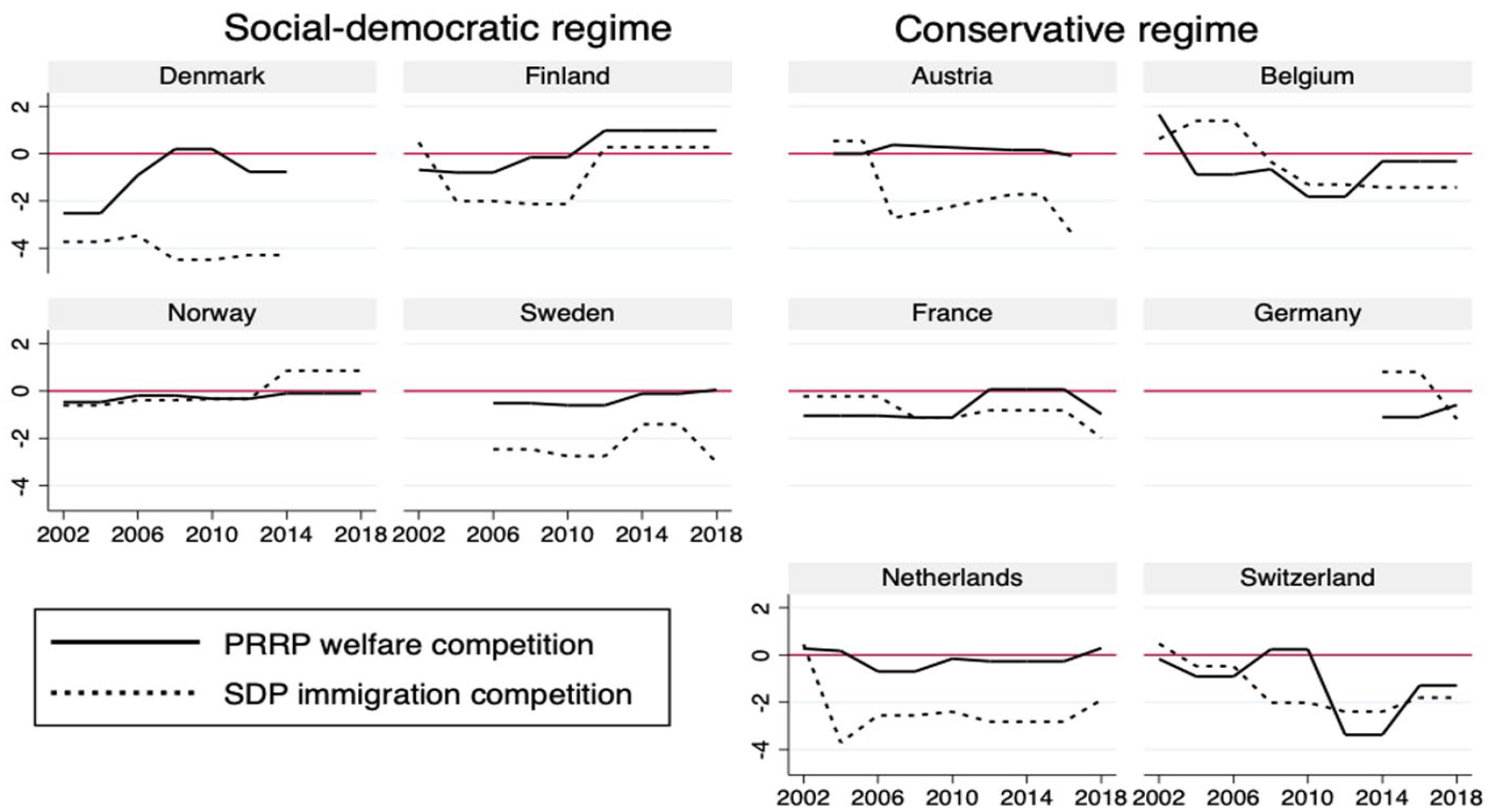
Trends in PRRP Welfare Competition and SDP Immigration Competition in the Social Democratic and Conservative Regimes.
Figure 1 illustrates that PRRPs in the four countries in the social democratic regime place equal or even greater (Denmark and Finland) emphasis on welfare than SDPs do (values above 0 indicate more emphasis). Furthermore, Figure S6 in the supplementary material confirms that PRRPs and SDPs hold similar positions on welfare in all four countries. These findings reveal clear similarities between countries, despite the varying ideological traditions of PRRPs in this context. For example, while the Sweden Democrats have roots in right-wing extremism (Jungar, 2016), they share similar positions on welfare with the less radical Danish People’s party, Norwegian Progress Party, and the True Finns (Jungar and Jupskås, 2014).
Figure 1 shows greater heterogeneity within the conservative regime. Still, it is primarily the traditionally retrenchment-oriented Swiss SVP (Schweizerische Volkspartei) that deviates from the overall pattern (Afonso and Papadopoulos, 2015; Afonso and Rennwald, 2018: 176). In addition, there is a decreased and fluctuating emphasis in Belgium after the Vlaams Blok was replaced by the Vlaams Belang in 2004 (for details on these parties’ positions, see Figure S6). Nevertheless, the welfare emphasis of the Austrian Freedom Party (FPÖ) (Ennser-Jedenastik, 2016; Rathgeb, 2021), the French FN (Rassemblement National) (Otjes et al., 2018: 284) the German AFD (Goerres et al., 2018), and the Dutch Freedom Party (de Koster et al., 2013) all seem to follow the same trajectory as their Nordic counterparts.
In summary, PRRPs’ attempts to compete over welfare are a coherent pattern in the social democratic regime and a slightly less consistent one in the conservative regime. By contrast, SDPs’ attempts to accommodate PRRPs’ immigration position vary between countries (Figure S7). The following section tests the hypotheses and seeks to explain the electoral implications of these trends.
Testing the Hypotheses: Do Welfare Regimes Shape Electoral Outcomes?
As previously stated, the statistical models estimate the probability of four vote choices – LGPs, SDPs, PRRPs, or CRPs (baseline outcome). To test the hypotheses, the models assess whether the impact of the two competitive strategies depends on one another, and, therefore, include interaction-terms with PRRP/SDP competition simultaneously. However, given that regimes are studied separately, we get a total of 24 models. Therefore, I present the table of results in the Supplementary material (Table S1) and base the conclusions on marginal effects that are independent of the baseline outcome (unlike the coefficients in the tables). To ensure that single countries do not drive the ‘regime-effects’, all analyses control for jackknife analyses (Tables S6 and S7, Figures S10–S16). At the end of this section, I further discuss the robustness of the findings referring to additional studies in the Supplementary material.
Within the social democratic regime, H1a posits that PRRPs win votes (while SDPs lose votes), the more PRRPs emphasize welfare relative to SDPs. Conversely, H1b suggests that SDPs can turn the tables around by accommodating PRRPs’ position on immigration. As for the conservative regime, H2a posits that PRRPs’ competition over welfare enables them to compete with SDPs over the votes of the most economically exposed, while H2b posits that SDPs generally lose votes, the more they seek to accommodate PRRPs’ anti-immigration position.
Figure 2 tests these hypotheses by comparing marginal effects among voters classified as economically exposed (1) and not (0) (Figure S1 shows main effects and Figure S2 shows interactions with social class). When analysing Figure 2, I first discuss PRRPs’ welfare competition (H1a and H2a, upper panels) and then proceed to SDPs’ competition over immigration (H1b and H2b, lower panels).
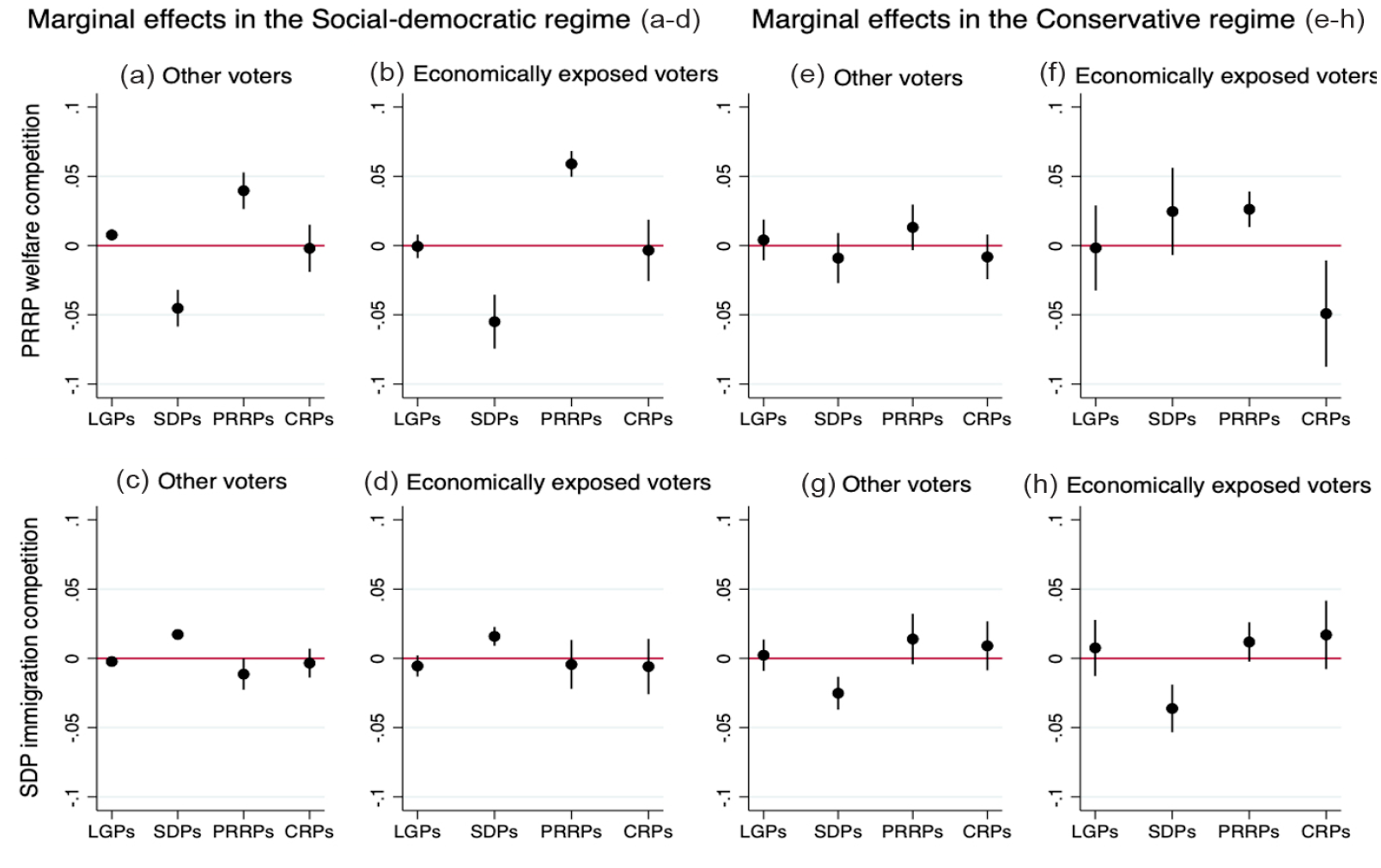
Marginal Effects of PRRP Welfare Competition (a–b, e–f) and SDP Immigration Competition (c–d, g–h) by Other (0) and Economically Exposed (1) Voters.
The marginal effects in panels (a) and (b) in Figure 2 support H1a. Within the social democratic regime, we observe a 5–6% increase in the probability of citizens in different economic situations (others and economically exposed) voting for PRRPs, along with a similar decrease in the probability of these groups voting for SDPs (main effects are shown in Figure S1). These effects occur if PRRPs move one unit towards more emphasis on welfare relative to SDPs. However, as we can infer from the trendlines in Figure 1, the ‘true’ effects are likely to have been even greater. For instance, if a PRRP moves one standard deviation from the mean towards more welfare competition, we observe an increased probability of around 14% of a vote for PRRPs (voters in general), and an of 8% decrease in the probability of a vote for SDPs (resulting in a difference of ~ 22% between PRRPs and SDPs).
Similarly, the findings in panels (e) and (f) provide support for H2a in the conservative regime. The marginal effects indicate that when PRRPs’ competition over welfare intensifies, the probability of economically exposed people voting for them increases by around 2.5% (~7% of the sample in the conservative regime are categorized as economically exposed). Yet, in contrast to the social democratic regime, marginal effects are positive but not significant for SDPs, while CRPs appear to lose support (Abou-Chadi et al., 2022). Nonetheless, if a PRRP in the conservative regime increases its emphasis on welfare with one standard deviation towards more, as in the estimation above, we observe a 6% increase in the probability that economically exposed will vote for PRRPs and a statistically significant 4% increase in the probability of them supporting SDPs. Thus, both SDPs and PRRPs stand out as potential winners.
When comparing the two welfare regimes in Figure 2, electoral responses differ rather systematically. In the social democratic regime, PRRPs’ emphasis on welfare (relative to SDPs) has similar effects across different social groups (also with social class, depicted in Figure S2). This suggests that PRRPs’ welfare emphasis undermines the strong standing of SDPs in this policy domain, disrupting their cross-class alliances around the welfare state. However, the results in the conservative regime indicate that economic grievances among small groups drive the outcomes. These regime-differences are robust to jackknife resampling at the country-level (as shown in Figure S11), indicating that countries within regimes do not drive the results. 8 Consequently, Figure 2 reveals a consistent difference between the welfare regimes, aligning with both H1a and H2a.
Turning to the lower panels (c, d, g and h) in Figure 2, the results also support H1b and H2b. The marginal effects in panels (c) and (d) indicate that SDPs in the social democratic regime gain votes, as they adopt PRRPs’ anti-immigration position. A unit’s change in this direction leads to an estimated increase in the probability of an SDP-vote with ~ 2% in both groups (H1b). However, in the conservative regime, the results in panels (g) and (h) show that SDPs lose votes when pursuing this strategy (H2b). Still, jackknife analyses reveal that only the effects for the most economically exposed voters remain significant in both regimes (panels D and H in Figure S11). Thus, while the results back H1b and H2b, support is less conclusive than for H1a and H2a.
The remaining hypotheses concern how competition between SDPs and PRRPs interacts with anti-immigration sentiments. In the social democratic regime, H3 posits that the strength of anti-immigration attitudes increases the probability of voting for PRRPs, the more PRRPs emphasize welfare relative to SDPs, but that these attitudes are weak predictors of voting for SDPs when SDPs accommodate PRRPs’ immigration position. In contrast, H4 predicts null-effects in the conservative regime. Figure 3 illustrates the marginal effects that test these hypotheses.
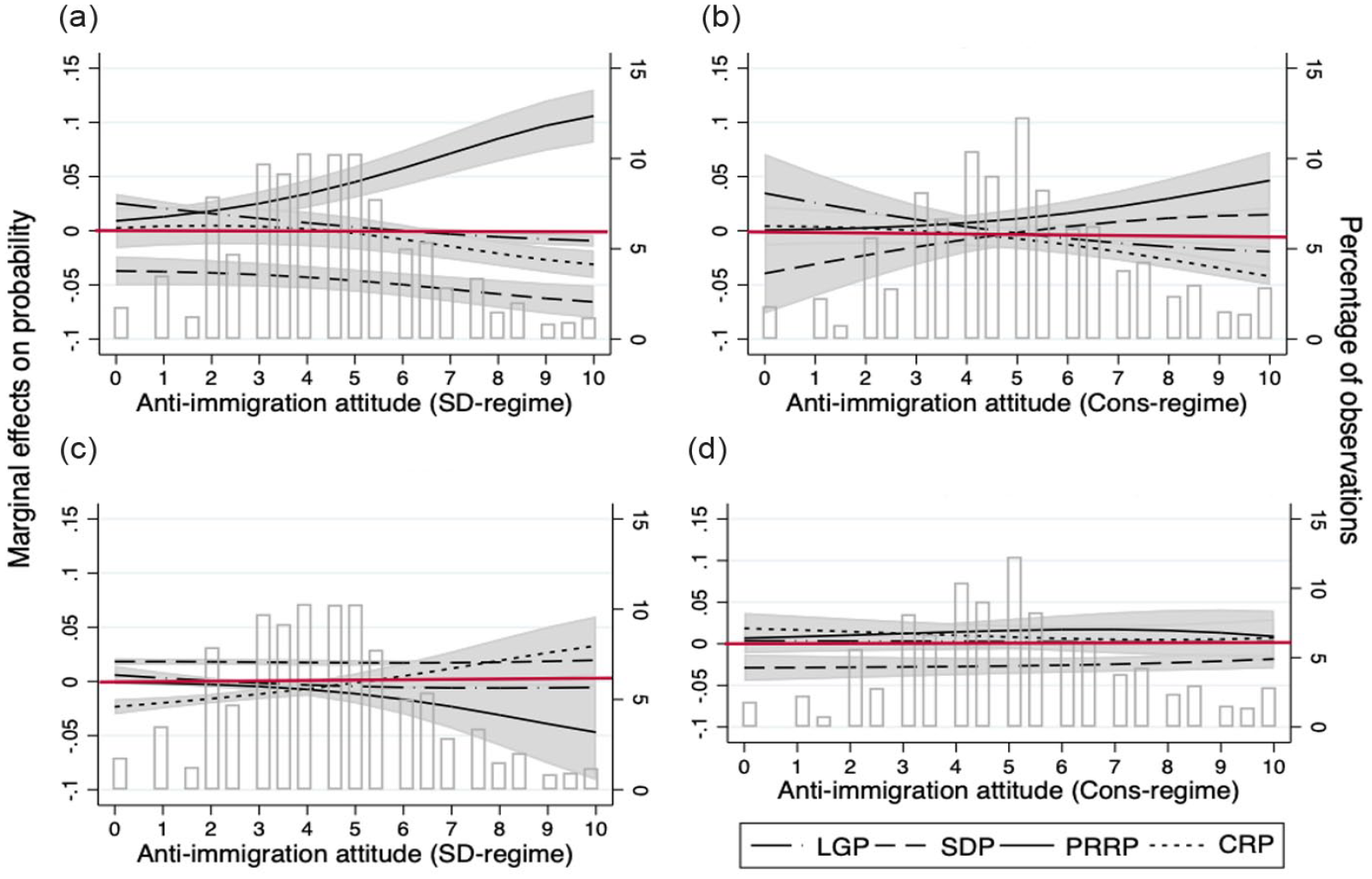
Marginal Effects of PRRP Welfare Competition and SDP Immigration Competition by Anti-Immigration Attitudes: (a) Social-Democratic Regime (PRRP Welfare Comp), (b) Conservative Regime (PRRP Welfare Comp), (c) Social-Democratic Regime (SDP Immigration Comp) and (d) Conservative Regime (SDP Immigration Comp).
The findings in Figure 3 align with H3–H4. Specifically, the results demonstrate that the only clear effects concern PRRPs’ competition over welfare in the social democratic regime. As shown in panel (a), one unit’s increase in PRRPs’ emphasis on welfare relative to SDPs emphasis leads to a higher probability of a PRRP-vote among voters who are more critical of immigration. Notably, we see the most substantial effects among people with the strongest anti-immigration sentiments (+ 12% probability of a vote for PRRPs) but also that significant effects occur already around the mean value of anti-immigration attitudes (+ 5%). In contrast, probabilities of voting for SDPs are constantly negative, with a weak association to voters’ views on immigration (~ 6% below 0).
The findings in panel (a) hold up to jackknife analyses (Figure S13) and a range of other robustness checks (outlined below). Consequently, we can conclude that PRRPs’ competition over welfare with SDPs is a significant factor in mobilizing the core electorate of PRRPs within the social democratic regime. In addition, the findings in panel (c) confirm the expectation set forth in H3 that SDPs’ attempts to compete with PRRPs over immigration have only a minor impact on the voting probabilities of people with anti-immigration attitudes. Although we observe a small positive effect in panel (c), it is unrelated to the intensity of anti-immigration attitudes. Moreover, the effect does not withstand jackknife analyses, and, consequently, cannot be applied to all countries in the social democratic regime. Thus, the evidence supports H3.
Turning to the conservative regime, effects are largely consistent with H4 (a null-effect). Panel (b) indicates a tendency for both PRRP and SDPs to gain when PRRPs compete over welfare, while panel (d) suggests that SDPs lose votes when attempting to co-opt PRRPs’ anti-immigration position. However, jackknife analyses reveal that single countries drive both effects and, therefore, that the findings cannot be generalized to the entire conservative regime.
Robustness Tests
I subject the analysis in the previous section to an extensive set of robustness checks. First, (as shown above) the most important findings hold when using jackknife resampling at the country level (Table S6, Figures S10–S16) and the remaining analyses in Supplement D show that they also hold when using jackknife resampling at the survey (ESS) level (Table S7). Second, mixed-effects models with a dependent variable that only separates between votes for SDPs (1) and PRRPs (0) (Abou-Chadi et al., 2022: 374) do not alter the findings depicted in Figures 2 and 3, although marginal effects differ somewhat when other voting alternatives are excluded from the analyses (Table S5, Figures S8 and S9). Third, in Supplement E, I substituted the Marpor measures with measures of competition based on parties’ positions on redistribution and multiculturalism from the CHES (Table S8). The marginal effects depicted in Figures S17 and S18 show the same findings as Figures 2 and 3. However, the CHES-measures indicate that SDPs in both regimes can benefit from taking a tough stance on ‘multiculturalism’ (but this effect is not robust to jackknife analyses). Fourth, the analyses in Supplement F control for time-variant effects by estimating the same models as those in Table S1 before (ESS 1–4) and after (ESS- 5–9) the 2008 economic crises. The main findings remain unaltered, but the results provide additional insights into the development of the conservative regime. In this context, the results (Figure S19) indicate that PRRPs only become a serious competitor for the votes of the economically exposed after the 2008 economic crisis. This finding aligns with research showing that economic grievances have grown in importance as a predictor of radical right support (Abou-Chadi et al., 2022: 380). Fifth, Supplement G tests whether the electoral dynamics shown in this study are unique to SDPs and PRRPs, or if similar patterns emerge when studying competition between CRPs and PRRPs. The analyses in Figures S21 and S22 show that the effects in the study are unique in the social democratic regime. However, PRRPs’ competition with CRPs follows a similar pattern to their competition with SDPs in the conservative regime (Abou-Chadi et al., 2022). Finally, in Supplement H a mixed model tests if PRRPs’ attempts to compete over welfare influence the intensity of voters’ anti-immigration attitudes, when also controlling for PRRPs’ stance on immigration (Table S9). Although these analyses go beyond the scope of this study, the results further support the main argument. Within the social democratic regime, the findings indicate that PRRPs’ competition over welfare is a more significant factor in predicting anti-immigration views than their position on immigration, while the opposite holds within the conservative regime.
Conclusion
This study examined how the legacies of the two dominant West European welfare regimes – the social democratic and conservative regimes – shape electoral competition between SDPs and PRRPs. Specifically, I explored the electoral impact of PRRPs’ attempts to compete over welfare politics with SDPs when also accounting for SDPs’ increased tendency to co-opt PRRPs’ core issue of anti-immigration. The results show that the electoral impact of these competitive strategies differs systematically between the two welfare regimes. Two main findings summarize the analyses.
The study’s first main finding is that electoral competition between SDPs and PRRPs has a significant impact on voting behaviour in the social democratic regime. The more PRRPs compete over welfare, the higher the probability that they win votes, while SDPs lose support. Although the study finds that SDPs can also win votes by accommodating PRRPs’ view on immigration, the results show that PRRPs’ focus on welfare has a more profound and consistent impact on voting behaviour. Moreover, the study demonstrates that stronger anti-immigration views enhance voters’ support for PRRPs, the more these parties compete over welfare with SDPs. This indicates that PRRPs’ focus on welfare politics within the social democratic regime is a crucial reason why voters with anti-immigration views mobilize and vote for the radical right. Supplementary analyses even indicate that PRRPs’ focus on welfare is a critical predictor of stronger anti-immigration views also when accounting for PRRPs’ electoral position on immigration.
The study’s second main finding is that the competitive dynamic differs in the conservative regime. In this context, PRRPs’ emphasis on welfare is primarily relevant to a small group of economically exposed voters, while SDPs generally lose support if they accommodate PRRPs’ anti-immigration position. However, also in the conservative regime, the most robust results concern welfare competition. The results show that PRRPs’ emphasis on welfare enables them to compete with SDPs over the votes of people who are economically left behind. Yet, this association is unrelated to these voters’ immigration attitudes. Moreover, unlike the stable effects in the social democratic regime, the results in the conservative regime show that the welfare emphasis of PRRPs only became a challenge to SDPs after the 2008 economic crisis. This further underscores the difference between the two regimes. In the conservative regime, welfare competition between SDPs and PRRPs is primarily relevant to economically marginalized voters, and increasingly so. In contrast, in the social democratic regime, welfare competition is more firmly relevant to the median voter.
While the data in this study do not allow us to study individual-level mechanisms directly, the observed differences between the welfare regimes are robust and align with the hypotheses. In the social democratic regime, we observed a pattern where voters across different social groups respond similarly to PRRPs’ nativist discourse on welfare, and to SDPs’ attempts to appear tough on immigration (to a lesser extent). This suggests that many voters, regardless of their class-backgrounds, associate welfare with immigration and that PRRPs effectively exploit fears of losing the specific Nordic welfare state (Siim and Meret, 2016). In other words, relative gratification appears to be a plausible mechanism underlying electoral responses in the social democratic regime (Mols and Jetten, 2016). In contrast, in the conservative regime, the results indicate that economic grievances are the primary driver of electoral outcomes. Therefore, relative deprivation is a more plausible mechanism in this context (Stoetzer et al., 2023).
The findings have two important implications. First, the study reveals that the moderating effect of welfare regimes on voting behaviour is different in today’s context compared with the golden age of working-class mobilization (Esping-Andersen, 1990b, 1990a). Moreover, the results move beyond the aggregate-level explanations of previous studies in this field. By accounting for the interaction between party discourse and voters’ demand within welfare regimes, the findings challenge the argument that the inclusive logic of the social democratic regime reduces xenophobic attitudes, while the exclusive logic of the conservative regime enhances them (Crepaz and Damron, 2009; Larsen, 2008, 2020; Van Der Waal et al., 2013). Instead, the results of this study suggest that the welfare nationalist tradition of the social democratic regime actually works to the advantage of the radical right.
Second, the findings indicate that the success of SDPs’ and PRRPs’ competitive strategies depends on the political landscape in which they operate (Fenger, 2018: 204). Therefore, the results indicate that research treating party strategy as a constant in country-comparative studies risks obscuring Esping-Andersen’s (1990a, 1990b) insight that the varying legacies of the past create varying opportunities for the future.
Supplemental Material
sj-docx-1-psx-10.1177_00323217231173399 – Supplemental material for Electoral Competition between Social Democracy and the Populist Radical Right: How Welfare Regimes Shape Electoral Outcomes
Supplemental material, sj-docx-1-psx-10.1177_00323217231173399 for Electoral Competition between Social Democracy and the Populist Radical Right: How Welfare Regimes Shape Electoral Outcomes by Karl Loxbo in Political Studies
Footnotes
Acknowledgements
The author would like to thank the editors of Political Studies and the reviewers for very helpful comments. The author would also like to thank Brigitte Pircher, Jonas Tallberg and Jan Teorell for helpful comments. The author also expresses his gratitude to the participants of the panel ‘Social Rights and Welfare Policies in the European Union: Attitudes, Policies, and Politics’ at the 28th International Conference of Europeanists (CES) in Lisbon, July 2022.
Declaration of Conflicting Interests
The author(s) declared no potential conflicts of interest with respect to the research, authorship and/or publication of this article.
Funding
The author(s) disclosed receipt of the following financial support for the research, authorship and/or publication of this article: The research behind this article was funded by the Swedish Research Council (dnr. 2014-1246).

Supplemental Material
Additional Supplementary Information may be found with the online version of this article.
A. Main models, summary statistics, and parties.
Table S1. Multinominal logistic regression in the social-democratic and conservative regimes.
Table S2. Multinominal logistic regression in ten West European countries.
Table S3. Summary statistics.
Table S4. Parties in the analyses.
Figure S1. Main marginal effects.
Figure S2. Marginal effects by other (0) and working-class (1) voters.
Figure S3. Marginal effects of PRRP welfare competition, utilizing measures of position.
Figure S4. Marginal effects (Figure 2) PRRPs’/SDPs’ emphasis welfare/position immigration.
Figure S5. Marginal effects (Figure 3) PRRPs’/SDPs’ emphasis welfare/position immigration.
B. Trends in the independent variables.
Figure S6. Trends in SDPs’ and PRRPs’ welfare position and emphasis on welfare.
Figure S7. Trends in SDPs’ and PRRPs’ immigration emphasis and position (panel above) net migration (panel below) in the countries.
C. Alternative model specification.
Table S5. Voting for SDPs (1) or PRRPs (0).
Figure S8. Replications of interactions in Figure 2 (main text) (DV: PRRP = 0; SPD = 1).
Figure S9. Replications of interactions in Figure 3 (DV: PRRP = 0; SPD = 1).
D. Jackknife analyses.
Table S6. Jackknife resampling at the country level
Table S7. Jackknife resampling at the ESS-survey level.
Figure S10. Main effects (Figure S1) after jackknife resampling at the country level.
Figure S11. Marginal effects (Figure 2) after jackknife resampling at the country level.
Figure S12. Marginal effects (Figure S1) after jackknife resampling at the country level.
Figure S13. Marginal effects (Figure 3) after jackknife resampling at the country level (only social-democratic regime).
Figures S14–S16. Results from jackknife-like procedures (excluding selected countries).
E. Alternative measures from the Chapel Hill expert survey.
Table S8. Models with alternative measures from the Chapel Hill expert survey.
Figure S17. Marginal effects (Figure 2) with CHES-measures.
Figure S18. Marginal effects (Figure 3) with CHES-measures.
F. Controlling for time-effects.
Figure S19. Marginal effects (Figure 2) before (ESS 1–4) and after (ESS 5–9).
Figure S20. Marginal effects (Figure 3) before (ESS 1–4) and after (ESS 5–9).
G. Competition between PRRPs and CRPs.
Figure S21. Competition between PRRPs and CRPs (same interactions as Figure 2).
Figure S22. Competition between PRRPs and CRPs (same interactions as Figure 3).
H. Welfare and anti-immigration attitudes.
Table S9. Welfare, immigration, and anti-immigration attitudes.
Figure S23. Marginal effects of PRRP welfare competition and PRRP immigration position by periods.
Notes
Author Biography
References
Supplementary Material
Please find the following supplemental material available below.
For Open Access articles published under a Creative Commons License, all supplemental material carries the same license as the article it is associated with.
For non-Open Access articles published, all supplemental material carries a non-exclusive license, and permission requests for re-use of supplemental material or any part of supplemental material shall be sent directly to the copyright owner as specified in the copyright notice associated with the article.
