




Abstract
In this article, we investigate how external election interventions influence satisfaction with democracy. We expect that mere knowledge about a foreign intervention will not affect system support. Instead, only those who believe that the external influence campaign had a decisive impact on the election outcome should see a reduction in democratic satisfaction. Furthermore, since electoral winners are likely to think that their preferred party provides superior policy outputs, supporters of winning parties should be less affected by their beliefs in the decisiveness of an influence campaign. Finally, we expect that those who place a high value on in-group loyalty will be more likely to engage in motivated reasoning. Thus, in-group loyalty should cause electoral winners to discount the substantive impact of a given electoral intervention, whereas it should have the opposite effect for losers. Our analysis relies on US survey data, and it uncovers broad support for our theoretical expectations.
Keywords
Introduction
This article explores the effects of partisan electoral interventions on political attitudes. More specifically, we investigate how one country’s interference in another polity’s democratic process influences satisfaction with democracy. External electoral interventions are quite common phenomena in global politics. Levin (2019b: 89), focusing on the period between 1946 and 2000, finds that the US and Soviet Union/Russia alone have “intervened in about one of every nine competitive national-level executive elections.” As such, understanding the effects of these policies on democratic system support in target states is relevant for both academics and policy-makers alike.
Political science scholarship has largely ignored the effect of electoral interventions on public opinion. With few exceptions (Bush and Prather, 2020; Corstange and Marinov, 2012; Shulman and Bloom, 2012; Tomz and Weeks, 2020), scholars interested in these empirical phenomena have tended to focus on other dependent variables such as prevalence of terrorism and regime type in a given target state (Levin, 2019a, 2020b). As a result, we still know fairly little about how domestic audiences react to outside interventions in their country’s elections.
In this article, we assess the effect of external electoral interventions on individual-level assessments about how democracy works in practice. Theoretically, we make three main arguments. First, we expect that mere knowledge about an attempted foreign electoral intervention in one’s country will not affect micro-levels of system support. Instead, we anticipate that only those who believe that the external influence campaign had a decisive impact on the election outcome will see a reduction in democratic satisfaction. Second, we argue that party ID will act as an important moderator in this context. On average, supporters of winning parties should be less affected by their beliefs in the decisiveness of a foreign influence campaign. Since electoral winners are likely to maintain that their preferred party provides superior policy outputs, even those who attribute their electoral victory to foreign meddling should not experience a steep decrease in democratic satisfaction. Third, we argue that people’s beliefs about the decisiveness of an electoral campaign can be explained by deep-rooted psychological predispositions. Building on Moral Foundations Theory (MFT), we expect that those who place a high value on in-group loyalty will be more likely to engage in motivated reasoning and align opinions with partisan identities. As such, in-group loyalty should cause electoral winners to discount the substantive impact of a given external electoral intervention, whereas it should have the opposite effect for electoral losers.
Our empirical analysis is based on original survey data collected in the United States in April 2020. Partnering with Qualtrics, we collected a nationally representative online sample and asked respondents a number of questions about their (1) knowledge regarding Russian meddling in the 2016 elections, (2) satisfaction with the democratic process, (3) general demographic backgrounds, and (4) various psychological characteristics. As expected, we find that mere knowledge of Russia’s role in the 2016 elections does not influence democratic system support. Indeed, those who are aware of the influence campaign to support Republican candidate Donald Trump do not score higher/lower on our dependent variable than those who do not possess this information. At the same time, beliefs about the substantive impact of Russia’s role do have a major influence on people’s political attitudes. More specifically, Democrats (but not Republicans or Independents) who believe that the electoral intervention was decisive (i.e. that it made a difference for the election outcome) have lower levels of satisfaction with democracy than their counterparts who think that Russia’s role was inconsequential. Finally, we find that people whose moral values emphasize in-group loyalty are more likely to engage in partisan motivated reasoning; high-loyalty Democrats are more likely to attribute Trump’s electoral victory to Russia’s influence campaign than voters who place less emphasis on loyalty as a moral value. Among Republicans, an increase in loyalty reduces the probability that a given respondent believes that Russia’s role was decisive. Taken as a whole, our article makes significant contributions to scholarship in political science and international relations. In particular, our work enriches our understanding of the attitudinal effects of electoral interventions, it contributes to our knowledge of how people form beliefs about difficult-to-evaluate political claims, and it provides novel insights about the individual-level dispositions that influence people’s propensities to engage in politically motivated reasoning.
The remainder of this article has five sections. First, we discuss previous research on the determinants of democratic satisfaction and the attitudinal effects of external election interferences. Second, we present our theory and develop a number of testable hypotheses. Third, we describe all survey questions that we used to measure our variables of interest. Fourth, we test our theoretical expectations and discuss statistical results. The fifth section concludes.
Previous Research on Satisfaction with Democracy and Foreign Election Interferences
Over the course of the past few decades, research on satisfaction with democracy has proliferated in political science. The concept refers to individual-level evaluations of regime performance, that is, how well a given country’s democracy operates in practice (Singh and Carlin, 2015). As such, it is distinct from diffuse support for democratic principles as well as specific support for domestic political actors (Linde and Ekman, 2003; Norris, 1999: 10).
Extant analyses suggest that individual-levels of satisfaction with democracy are influenced by a variety of short- and long-term processes. For instance, short-term changes in system support have been shown to track people’s economic evaluations (Kestilä-Kekkonen and Söderlund, 2017) and trust in representative institutions (Kölln and Aarts, 2021). By contrast, democratic quality (Christmann, 2018), country-level electoral rules (Anderson and Guillory, 1997), and executive lawmaking power (Singh and Carlin, 2015) have all been found to exert long-term effects on democratic satisfaction.
Election-related variables also have lasting influences on system support. Loveless (2021) finds that those who voted for electorally successful parties tend to be consistently more satisfied with the political process than supporters of opposition candidates. 1 Most relevant for our present purposes, previous research has demonstrated that people’s perceptions about electoral integrity (which tend to be quite durable, see Daniller and Mutz, 2019) have strong effects on democratic satisfaction. According to Norris (2019: 7), “free and fair elections, meeting international standards of electoral integrity and leading to the orderly and peaceful transfer of power, are likely to strengthen public assessment of democratic performance in general.” This claim has been empirically corroborated in several quantitative studies across the world (e.g. Fortin-Rittberger et al., 2017). In these contributions, electoral integrity is usually operationalized with survey data. Daniller and Mutz (2019), for instance, measure the concept by asking respondents about their perceptions of the fairness of recent elections.
While previous studies offer important insights, they do not consider the role of external partisan interventions. This is an important oversight. Existing measures of electoral integrity focus exclusively on the procedural aspects of democracy. In other words, they are based on people’s views about how domestic actors (such as polling officials or politicians) influence election outcomes. By contrast, we still do not know to what extent foreign election meddling (i.e. actions by outside powers) influence people’s evaluations of their country’s political system.
As noted, external electoral interventions are common phenomena in the realm of international politics. In a neutral intervention, a country seeks “to primarily affect the broad institutions and processes within which politics occurs in a state” (Shulman and Bloom, 2012: 450). By contrast, a partisan/biased intervention (the focus of our article) is a case in which a country specifically tries to aid a given political candidate, party, or ideological movement. In these cases, states use their resources to change the outcome of an election, not just the underlying process. Partisan electoral interventions have only recently begun to attract the attention of political scientists. Levin’s (2019b) “Partisan Electoral Interventions by the Great Powers” (PEIG) data set codes instances: in which one or more sovereign countries intentionally undertakes specific actions to influence an upcoming election in another sovereign country in an overt or covert manner which they believe will favor or hurt one of the sides contesting that election and which incurs, or may incur, significant costs to the intervener(s) or the intervened country (Levin, 2019b: 90).
Using this definition, the author identifies 117 partisan interventions by the US and the Soviet Union/Russia between 1946 and 2000. Similarly, Bubeck and Marinov (2019) sample 262 competitive elections in the post-World War II period. The authors find that, in more than half (53%), an outside power attempted to influence the winner of the election.
Existing research on partisan electoral interventions primarily explores their effects on various policy outcomes. For example, Levin (2019a) shows that covert interventions have a negative effect on a given target’s democracy score. While existing research has thus taught us a lot about the institutional and policy outcomes of external election meddling, we still know relatively little about how audiences in target states respond to partisan interventions in their states’ democratic processes. Shulman and Bloom (2012) analyze 2004 survey data from Ukraine and analyze how much individuals approve of Russian and Western interventions, conditional on their own political views. The authors find that voters generally dislike interference in their country’s electoral process, irrespective of their own partisan preferences. Nevertheless, voters in pro-Western regions of Ukraine disapprove more of Russian election meddling than of Western involvement while the opposite holds true for citizens located in the pro-Russian parts of the country. Subsequent research builds on these findings. Corstange and Marinov (2012) demonstrate that one-sided interferences by an outside force polarize voters toward the intervener. More specifically, voters prefer closer bilateral relations with states that intervene on behalf of their favored political party, and they desire more reserved relations with outside actors that back domestic opponents. Similarly, Bush and Prather (2020) find that individuals are also more likely to advocate for deeper economic engagement with countries that support their preferred political candidates. Taken as a whole, these findings demonstrate that election meddling has the potential to influence people’s general political attitudes. At the same time, none of these studies investigate if or how election meddling shapes people’s attitudes toward democracy.
More recently, Tomz and Weeks (2020) assess the effects of external interferences on a wider range of political attitudes. 2 Corroborating earlier research, the authors find that voters are more likely to approve of foreign election meddling on behalf of their preferred party than in support of their domestic political opponents. Moreover, Tomz and Weeks (2020) also demonstrate that external election interferences depress people’s views toward their own democratic system. In particular, election meddling increases the likelihood that a voter loses (1) trust in the results of a given election, (2) faith in democracy, and (3) motivation to cast a ballot in future elections.
To date, Tomz and Weeks’ (2020) analysis constitutes the most comprehensive examination of the attitudinal effects of external electoral interventions. However, while this article contributes much to our understanding of the subject matter, it leaves several important questions unanswered. First, in order to investigate the causal effect of election meddling, Tomz and Weeks (2020) rely on a series of survey experiments in which they give subjects information about a fictious US presidential election in the year 2024. While this creative research design has obvious advantages, the reliance on such a hypothetical scenario does not account for the possibility that survey respondents might rely on different cognitive processes when they think about a “real” (and thus highly salient) case. Second, the authors’ experimental treatment does not allow for any perceptual ambiguity about whether an electoral intervention did/did not sway the outcome of the election. This, however, removes a potentially important variable from the analysis, which could have important effects on democratic system support. In this article, we address some of these remaining issues.
The Attitudinal Effects of Election Meddling in Target States
The Effects of External Interference Beliefs on Democratic Satisfaction
Information about foreign election interference is generally not evenly distributed among members of the public in target states. Even in countries with a past of externally compromised elections, knowledge about this history varies significantly among citizens.
Conceptually speaking, public attitudes about foreign electoral interventions vary along two different dimensions. First, citizens differ in their knowledge of the relevant historical facts. In other words, there is likely to be some domestic disagreement about whether or not an electoral intervention attempt did/did not take place. For instance, according to a 2018 opinion poll in the United States, almost 40% of respondents were unaware of Moscow’s support for the Trump campaign. 3 Second, even among those who believe that that their country was targeted by an electoral intervention, there is generally significant disagreement about the effect of these measures. Thus, even citizens who are aware that their country’s elections were compromised by foreign interference often do not agree about the substantive impact of this operation. This disagreement is fueled by the difficulty of establishing causation in complex sociopolitical contexts and the inability to observe counter-factual outcomes. Here too, the case of the US Presidential election in 2016 is instructive. While some observers (such as former Director of National Intelligence James Clapper) 4 and academics (Jamieson, 2020; Levin, 2020a) suggest that Russia successfully “turned the election” in favor of Trump, other commentators 5 and scholars come to the opposite conclusion. For instance, Sides et al.’s (2019) comprehensive account of the 2016 election “lean[s] toward skepticism” that Russian meddling affected the outcome of the Presidential race. Still others (such as former CIA Director Michael Hayden) point out that the effect of Moscow’s influence campaign is ultimately not just unknown, but “unknowable.” 6
Theoretically, we expect these two variables to have differing effects on system support. Taken by itself, mere knowledge of an attempted electoral intervention in one’s country should not influence political attitudes. Considered in isolation, the existence of a foreign endeavor to “tip the scales” in a democratic contest does not necessarily undermine the legitimacy of the electoral process. Indeed, it is possible that some voters might even become more confident in their political system if they conclude that domestic institutions proved resilient and external efforts were unsuccessful in shaping election outcomes. By contrast, perceptions about the decisiveness of a given electoral intervention attempt should have important effects 7 on system support. In general, democratic political arrangements are based on the idea that citizens choose their leaders and preferred policies independently in a national electoral process. If voters are skeptical that electoral results are truly the outcome of domestic deliberative process, they should also be unlikely to think that the political system as a whole operates properly. Put differently, if people believe that one political party or candidate only came to power through support of an outside entity, they should perceive significant weaknesses in the integrity and quality of their country’s democracy. These considerations allow us to formulate our first two hypotheses.
Above, we have argued that citizens who believe that a foreign actor swayed the election in their home country should be less democratically satisfied than individuals who do not hold that view. There are strong reasons to predict that this effect is not uniform across a country’s population. As Tomz and Weeks (2020: 859) point out, “partisan electoral interventions create domestic winners and losers: they help one candidate or party at the expense of others.” Indeed, the authors show that experimentally “treating” individuals with cues about an attempted external meddling campaign has “especially corrosive effects on the democratic confidence of citizens whose party was attacked” (Tomz and Weeks, 2020: 860). 8 While this finding is important, it leaves one important question unaddressed: Do electoral winners and losers react differently to the perception that a foreign entity successfully decided the outcome of an election? In this article, we go beyond Tomz and Weeks’ analysis by investigating this question. Theoretically, we expect party ID to moderate the effect of perceived foreign influence.
Previous studies suggest that individuals believe that their preferred party generates higher quality policy outputs than non-preferred parties (Singh et al., 2011). Furthermore, people’s evaluations of governmental policy have been identified as strong predictors of democratic system support. Among electoral winners, these dynamics should create two countervailing psychological cross-pressures. Any reduction in system support (induced by the conviction that a foreign actor decided an election in one’s country) should be at least partially offset by satisfaction increases caused by the higher perceived competence of the ultimately victorious party. In other words, electoral winners should be less troubled by the belief that an outside power decided the election in their country since they regard the overall outcome to be beneficial. Focusing on electoral losers, the psychological dynamics should be different. For these voters, a successful external electoral intervention has no positive side effects. Thus, voters who think that a foreign actor tipped the scale against their preferred party are likely to think that (1) the election revealed significant weaknesses in their country’s democracy and (2) brought to power a low-performing government. Taken as a whole, this discussion implies that people should be less concerned about a decisive electoral intervention on behalf of their preferred party than an operation that tipped the scale in favor of their political opponents.
Finally, self-identified Independents are likely to harbor weaker feelings about the outcome of a given election than major party supporters. This, in turn, should also reduce the effect of a decisive meddling campaign on democratic system support. If individuals are only weakly invested in the results of a particular election, their beliefs about the substantive impact of a foreign interference campaign should have comparatively smaller effects on political attitudes. This expectation is in line with earlier research by Tomz and Weeks (2020: 866) who find that foreign meddling causes “independents to sour on democracy, but not to the same degree as citizens who witnessed interference against their own party.”
The Causes of External Interference Beliefs
Why do some people believe that a given interference campaign had a decisive influence on an election while others consider the intervention to be inconsequential? Empirically determining the substantive impact of an interference campaign (such as Russian meddling in the United States’ 2016 Presidential race) would require establishing how many voters were reached by a given interference operation and how many of them changed their voting behavior as a result of the outside actor’s efforts. In practice, these questions are very hard (and potentially impossible) to answer for citizens and experts alike.
Given these challenges and the highly salient nature of the underlying issue, individuals are likely to rely on directionally motivated reasoning to form their beliefs about the decisiveness of a given influence campaign. Extant research shows that voters are often less motivated to arrive at accurate political beliefs and more likely to adopt directional processing goals, which means they gravitate toward conclusions that align with existing political beliefs or relevant social identities (Taber and Lodge, 2006). Nyhan and Reifler (2019: 222) even label directionally motivated reasoning as the “default way in which people process (political) information.”
One of the most common drivers of motivated reasoning is party ID (Bolsen et al., 2014). Put differently, in the context of contentious domestic political issues, partisanship is a particularly powerful identity marker, and it provides an important lens through which people interpret domestic political events in general and election outcomes in particular (Sides et al., 2019). As Bisgaard (2015: 849) notes, “citizens’ identification with a political party directs their thinking about reality in striking ways.” Nevertheless, while partisan identities are an important cause of motivated reasoning, not all people are equally likely to adopt directional processing goals in their formation of political attitudes. Instead, partisan reasoning has been shown to be a function of psychological predispositions. For instance, extant analyses suggest that motivated reasoning is more likely among those who score (1) low in science curiosity (Kahan et al., 2017) and (2) high in political sophistication (Taber and Lodge, 2006).
In this article, we build on this literature, and we point to differences in people’s moral orientations as a major moderating variable for partisan motivated reasoning. Over the past few years, scholars have demonstrated that people’s moral values have significant impacts on their formation of political attitudes (Kertzer et al., 2014). More specifically, according to MFT, individuals can be differentiated by how important five different “moral concerns” are to them: harm, fairness, loyalty, authority, and purity. These concepts represent different dimensions along which human morality can be measured, and they are the result of different adaptive challenges that humans had to master during their evolutionary history (Haidt, 2012). The loyalty foundation is most relevant for our present purposes. It captures how strongly individuals value in-group loyalty and cohesion, and it corresponds with someone’s base tendency to develop strong ties to their social in-groups. As such, high-loyalty individuals feel a heightened sense of belonging to whichever identity groups they identify with (Clifford, 2017). Taken as a whole, this foundation helps us understand why some people are more sensitive to external challenges to their social identity groups (including their partisan identities) than others. Individuals with high scores on this dimension are particularly likely to (1) consider the protection of their groups as a moral imperative, (2) favor their own group members, and (3) discriminate against social out-groups. By contrast, humans who fall near the low end of the loyalty spectrum are less likely to apply these group-based considerations to their daily lives (Haidt, 2012).
Given that “directional reasoning is [. . .] often driven by an individual’s desire to be loyal to [. . .] one’s own party” (Bolsen et al., 2014: 237), we expect MFT’s loyalty foundation to influence how much supporters of winning and losing parties engage in motivated reasoning, and—in so doing—shape mass attitudes about electoral interference. We start the discussion by outlining our theoretical expectations for supporters of winning parties.
High-loyalty winners (i.e. supporters of winning parties who score high on the loyalty foundation) should be especially motivated to defend the status and legitimacy of their political in-group in their country’s political discourse. As such, we expect high-loyalty supporters of successful parties to be particularly likely to deny the claim that the outcome of a given election was caused by an external interference campaign. Adopting this position enables high-loyalty winners to bolster the validity of their party’s victory and its current political status. By contrast, for electoral winners who place no emphasis on in-group loyalty, the defense of their preferred party in public discourse is less important. As a result, we should expect these voters to be less committed to any particular belief about the causes of their party’s electoral victory. On average, we thus anticipate that dispositional in-group loyalty will reduce the perceived impact of external election meddling among electoral winners. It is worth noting that this claim is in line with existing research. As Simas et al. (2020: 260) show, individuals who are highly empathetic toward their political in-group are more prone to political polarization and more likely to reject “antagonistic outpartisan viewpoints” than those who score low in empathy. Thus, our theoretical predictions echo earlier studies in political psychology.
Turning to electoral losers, we also expect an increase in the moral value of loyalty to cause greater commitment to engage in partisan motivated reasoning. However, high-loyalty losers should be particularly likely to profess that the outcome of the election was the result of external meddling. Embracing this claim allows them to simultaneously question the fairness of their opponent’s victory while justifying (and thus defending) the loss of their preferred party. For losers at the low end of the loyalty spectrum, protecting the status of their political in-group is less essential. Thus, among these voters should be more ambivalence about the substantive impact of a given election meddling campaign. These considerations motivate our final set of hypotheses.
Data and Methods
Case Selection and Survey Procedure
In order to test our hypotheses, we rely on original survey data, collected in April 2020. We partnered with Qualtrics and collected a nationally representative online sample (n = 1520) balanced by age, gender, education, income, and census region. Prior to launching our survey, we obtained our institutional review board’s (IRB) exemption for our research project. The questionnaire contained a wide range of items tapping into people’s political attitudes, knowledge, and beliefs about Russian interference in the 2016 Presidential elections, and general sociodemographic characteristics.
Choosing the United States as a case study provides important advantages. First, the country has been the target of a Russian “influence campaign” in the run-up to the 2016 Presidential elections. As such, examining US public opinion data enables us to go beyond hypothetical survey questions and assess the effect of election meddling in a concrete policy environment. Second, while many instances of external election interferences are secret and only partially known to the interested public (Levin, 2019b), this case has been well researched and documented by scholars, government agencies, and investigative journalists (Jamieson, 2020). This, in turn, enables us to create objectively valid measures for people’s knowledge about the extent of Russian election meddling in 2016. 9
Variable Measurement
Democratic satisfaction is measured with a standard survey question that asked respondents how satisfied they are “with the way democracy works in the United States.” Answer options are (1) not satisfied at all, (2) not very satisfied, (3) somewhat satisfied, and (4) very satisfied. While there is some debate in the literature about what this item captures (Canache et al., 2001), most scholars suggest that it provides an acceptable individual-level measure of perceived democratic regime performance (Linde and Ekman, 2003; Nemčok and Wass, 2021). Nevertheless, it is important to note that there are significant cross-national variations in the types of considerations people employ when they respond to this question. For instance, Ferrín (2015: 300) finds that respondent-conceptions of democracy strongly influence satisfaction levels in those countries “where citizens demand the most from democracy as an ideal [. . .].” Most relevant for our purposes, Dahlberg et al. (2015) suggest that input considerations (i.e. subjective assessments of how well a political system represents the views of the electorate) are particularly important to citizens in established democracies. Given these findings, survey respondents in the United States should also be quite likely to factor-in democratic inputs (such as electoral integrity) in their evaluations of regime performance.
Our first independent variable is a person’s level of knowledge about Russian election interference in 2016. In order to measure this concept, we presented respondents with the following statement: “The Russian government engaged in an ‘influence campaign’ involving the use of fake Facebook accounts and Twitter bots to spread disinformation in an attempt to affect the outcomes of the 2016 Presidential election.” We then asked two different questions in order to measure people’s knowledge about the case. 10 First, we inquired whether a given respondent had heard of this claim (yes/no) before. We use this as our first measure of individual-level knowledge about the operation. Second, we asked subjects whether they thought that the claim was true or false. Respondents could choose from the following answer options: (1) the statement is definitely false, (2) the statement is likely false, (3) I don’t know if the statement is true or false, (4) the statement is likely true, or (5) the statement is definitely true. This is the second survey item used to operationalize knowledge about election meddling.
We measure people’s beliefs about the substantive impact of the Russian interference campaign by asking our survey takers whether they think that Russia’s influence campaign decided the election for Donald Trump. Here too, respondents could choose from the same answer options listed above. 11 About 44.3% of respondents rated this claim to be likely or definitely false, 30.5% of survey takers rated it as likely or definitely true, and 25.2% of subjects declared that they were unsure.
According to our theory, people who place higher emphasis on the principle of in-group loyalty should rate the substantive impact of Russia’s influence campaign differently than people with lower scores on this dimension. We measure this variable by relying on the Moral Foundations Questionnaire, developed by Graham et al. (2008). This questionnaire allows researchers to measure all five moral foundations identified in humans: harm, fairness, authority, purity, and loyalty. Each dimension is measured with four separate survey items. Two items ask respondents to what extent various considerations are relevant to their thinking whenever they decide “whether something is right or wrong.” The relevant items for the loyalty foundation are “whether or not someone’s action showed love for his or her country” and “whether or not someone did something to betray his or her group.” Answer options ranged from 1 = not at all relevant (this consideration has nothing to do with my judgments of right and wrong) to 6 = extremely relevant (this is one of the most important factors when I judge right and wrong). The second set of items asks respondents to indicate their level of agreement with various statements on a 6-point scale. The loyalty items are “I am proud of my country’s history” and “people should be loyal to their family members, even when they have done something wrong.” The final loyalty variable is a respondent’s average score across all four relevant survey items. 12
It is worth emphasizing that our theoretical framework presented above only makes predictions about in-group loyalty. We have no strong ex ante expectations that individual-level beliefs about Russia’s interference campaign would be influenced by people’s (1) intuitive responses to suffering or need (harm foundation), (2) concerns about violations of reciprocal altruism (fairness foundation), (3) sensitivities to markers of rank or status (authority foundation), or (4) feelings about cleanliness and purity (purity foundation). Nevertheless, in order to isolate the effect of loyalty from other moral foundations, 13 we also control for the other four dimensions identified in MFT. Substantively, we treat the relationship between these correlates and people’s beliefs in Russia’s impact in 2016 as an empirical matter. All items that are part of the Moral Foundations Questionnaire can be found in the Supplemental Appendix.
In the analysis below, we introduce a robust set of control variables. To begin, we control for individual levels of nationalism. People who score high on this dimension are likely to be more attached to their country’s political institutions than other individuals. As a result, we should also expect this variable to have a positive effect on democratic satisfaction. Furthermore, we anticipate nationalism to have a negative impact on people’s perceptions that Russia tipped the electoral scales in favor of Trump. Theoretically, high levels of national pride should make it less likely that people believe that a foreign actor successfully undermined their country’s governmental system. We measure nationalism with a survey question adapted from Herrmann et al. (2009). In particular, we ask subjects how much they feel personally attacked “when someone says something bad about the American people.” Based on previous research, we also account for a respondent’s level of social trust. This concept refers to how much individuals give the benefit of the doubt to strangers. Extant analyses have found that this variable is a significant predictor of democratic satisfaction (Magalhães, 2016). Equally important, lack of interpersonal trust is an important precondition of conspirational thinking and negative perceptions of governmental processes (Miller et al., 2016). Based on these insights, we add a control variable to capture our survey takers’ levels of social trust. Respondents were asked how much they believe that most people can be trusted. Individuals could place themselves on a scale ranging from 0 to 10 where 0 meant that they believe one can’t be too careful in dealing with people and 10 indicated that they believed that most people could be trusted.
We also control for standard predictors from the public opinion literature: age, gender (male 1/0), education, income, ideology, political sophistication, race (White 1/0), and ethnicity (Hispanic 1/0). All survey questions used to measure these variables can be found in the Supplemental Appendix. Descriptive statistics for all correlates are provided in the Supplemental Appendix.
Data Analysis and Results
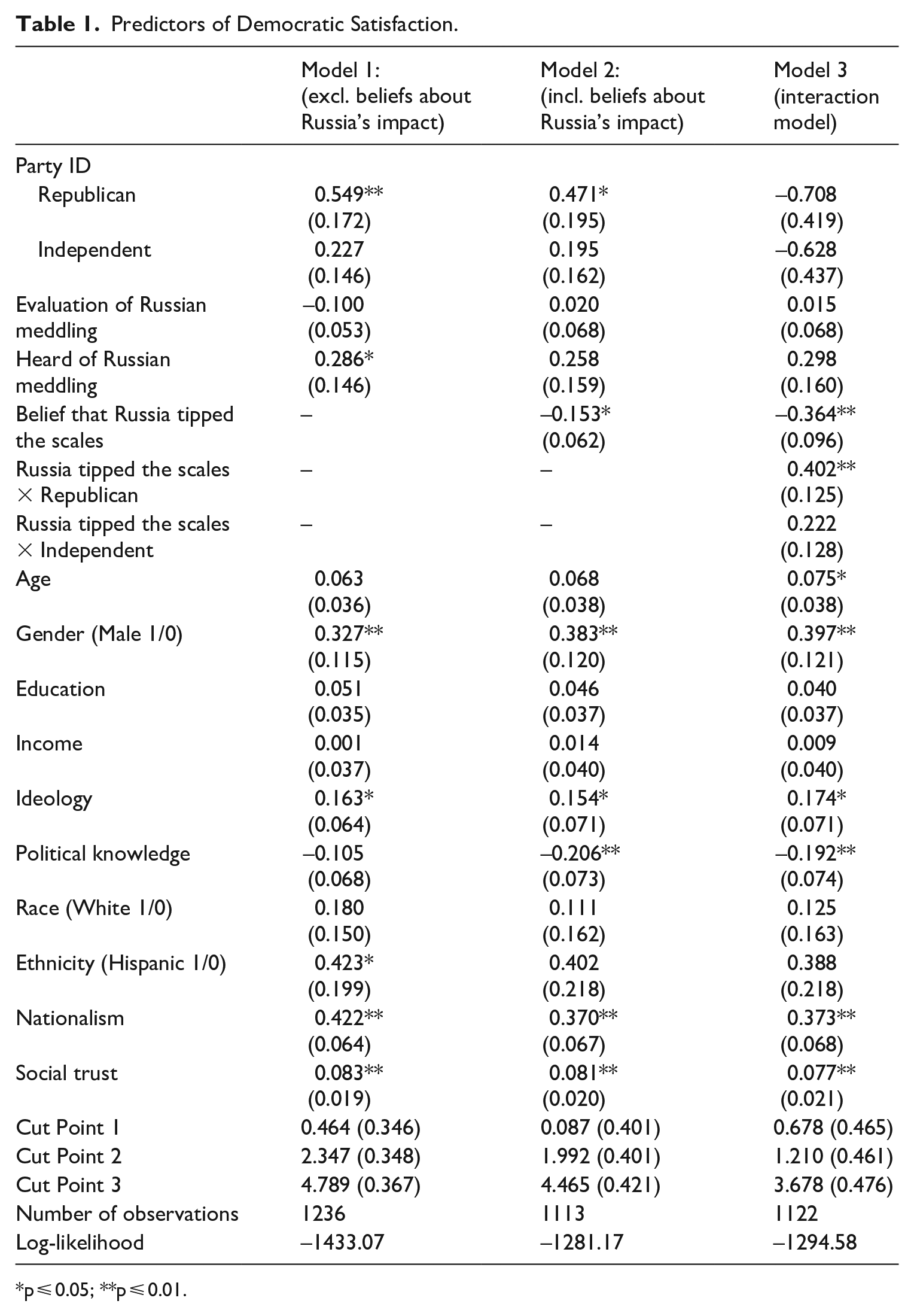
In order to test our hypotheses, we perform a series of ordered logistic regression analyses. First, we examine the effect of public beliefs about election interference on democratic satisfaction. Results are presented in Table 1.
Predictors of Democratic Satisfaction.
p ⩽ 0.05; **p ⩽ 0.01.
In Model 1, we estimate the effect of people’s knowledge about Russian election meddling on system support. We see that those who have heard of the claim that Russia interfered in the presidential election of 2016 are slightly more satisfied with US democracy than individuals who had not heard of this claim before. At the same time, respondent-beliefs about the veracity of this claim (Evaluation of Russian Meddling) do not seem to influence our dependent variable; the coefficient for this variable is statistically indistinguishable from zero (p = 0.06). However, Model 1 does not control for our main independent variable. In Model 2, we add the predictor that captures people’s beliefs about the substantive impact of Russia’s influence campaign. In line with our theoretical expectations, we see that subjects who think that Moscow’s meddling operation “tipped the scales” in favor of Donald Trump are significantly less satisfied with the state of democracy in the US than individuals who believe that the interference campaign was inconsequential. Furthermore, as expected, the perceived decisiveness of Russia’s influence campaign is the only significant predictor of system support. In other words, once the main independent variable of our article is added to the model, other beliefs about Moscow’s meddling operation move into the background. This finding is in line with Hypotheses 1 and 2.
In Model 3, we interact our main independent variable (people’s beliefs about the substantive impact of Russia’s meddling campaign) with our categorical party ID variable. This procedure reveals that there is a complex conditional relationship between these correlates. Substantive effects of interaction models are best displayed graphically. In Figure 1, we plot the average marginal effect of people’s belief in the decisiveness of Russia’s interference operation for Republicans, Democrats, and Independents.
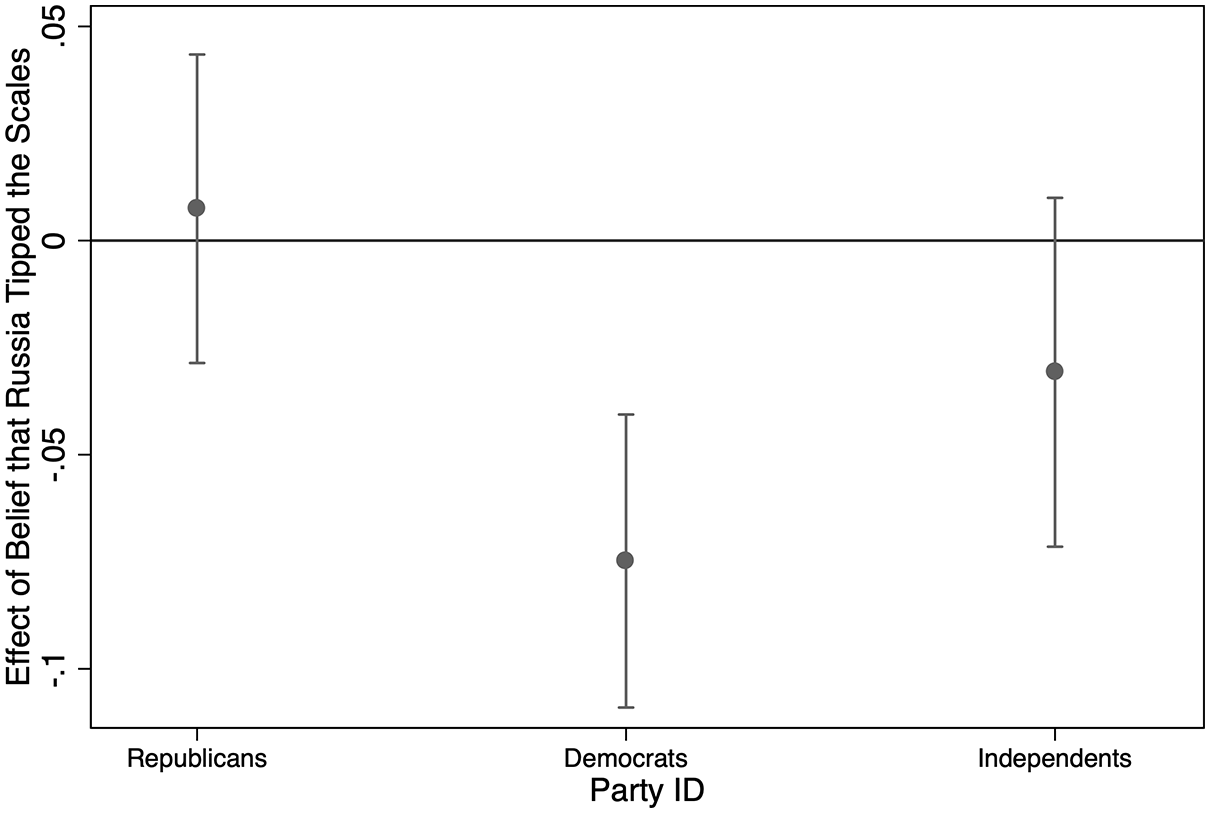
. Marginal Effects by Party ID (DV: Democratic Satisfaction).
We see that our main predictor has no statistical effect for Republicans. In other words, self-identified Republicans who think that Russia decided the election for Trump do not score higher/lower on our dependent variable than their counterparts who consider the Russian campaign to be unimportant. At the same time, Figure 1 also shows that beliefs about Russia’s influence in 2016 do affect democratic system support for Democrats. In particular, those who think that Moscow’s campaign successfully tipped the scales are less likely to fall into the upper half of our dependent variable than those who do not subscribe to this belief. Substantively, Democrats who think that Russia’s campaign did not decide 2016 election have a 73.7% probability of expressing high satisfaction with democracy. The corresponding value for Democrats who think that the operation “definitely” changed the election outcome is only 42.3%. This shows that our main independent variable has a statistically significant and substantively important effect on political attitudes in this voter group. Taken as a whole, the analysis presented in this section provides strong evidence for Hypotheses 1 to 3. 14
Model 3 also suggests that Independents are unaffected by their beliefs about the substantive impact of Russia’s influence campaign. As noted above, this finding is likely due to lower levels of emotional investment in the election outcome. Since members of this voter group do not neatly fall into the winner/loser framework, they should be less likely to base their views about their country’s political system on assessments about the most recent election in their country.
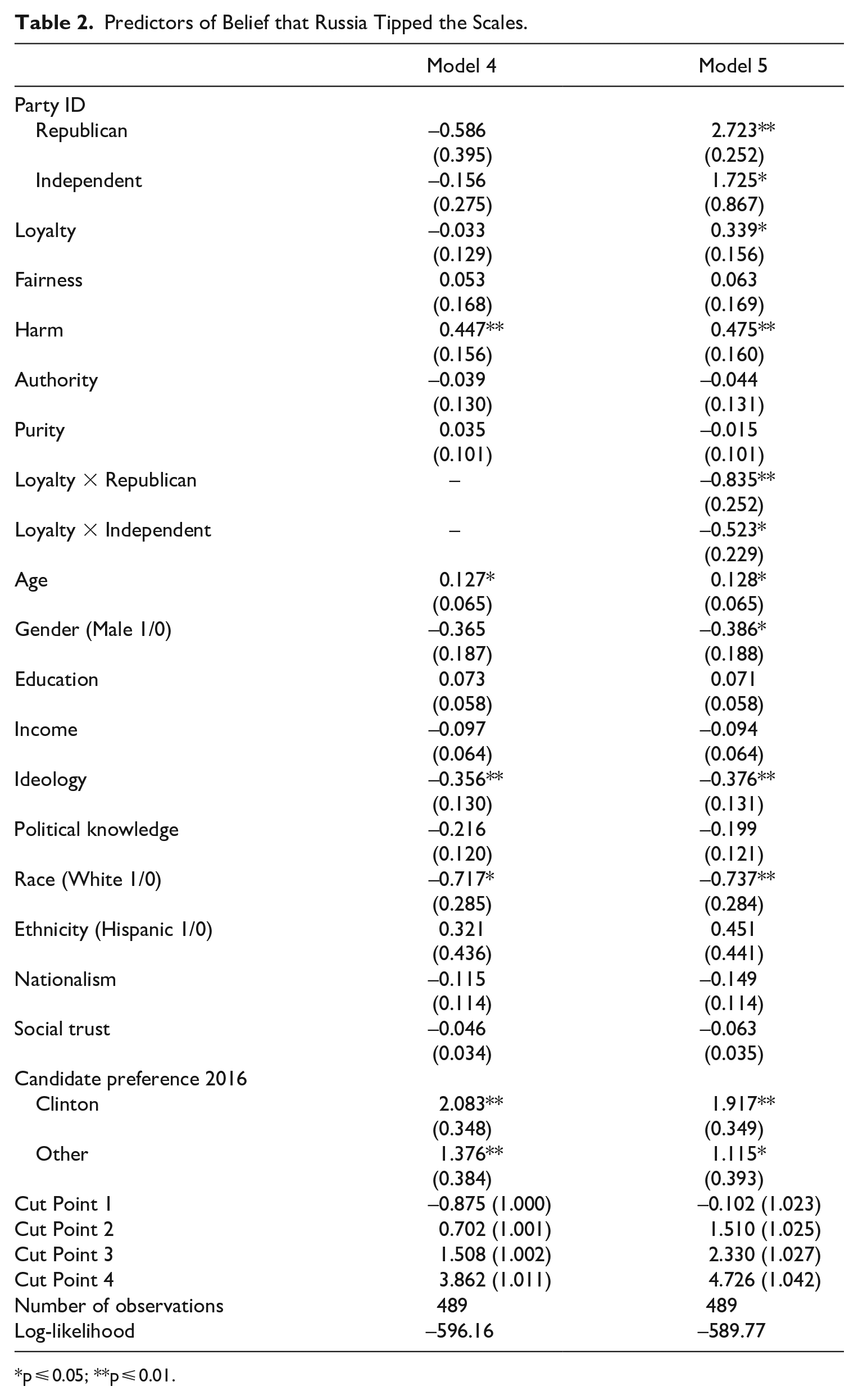
Why do some citizens think that Russia’s interference operation was decisive in 2016 while others hold the opposite belief? In Models 4 and 5, our dependent variable is the ordinal variable that captures people’s views on this question. Put differently, in this analysis, our dependent variable is our main predictor from Models 2 and 3. In addition to the correlates listed in Table 1, we now also control for a respondent’s preference during the 2016 Presidential election. This is necessary since people who preferred Trump would likely have strong psychological motivations to downplay Russia’s role in the 2016 elections. Moreover, in order to test Hypotheses 4 and 5, we also account for people’s scores on the five “Moral Foundations.” 15 Results of this analysis are listed in Table 2.
Predictors of Belief that Russia Tipped the Scales.
p ⩽ 0.05; **p ⩽ 0.01.
In Model 4, we see that people’s preference for loyalty does not influence scores on our dependent variable. The estimated coefficient for the moral foundation of loyalty falls well short of statistical significance (p = 0.74). This is not surprising given that Hypotheses 4 and 5 predicted a conditional relationship between people’s scores on the loyalty foundation and their partisan identities. As a result, in Model 5, we introduce an interaction term between these two variables. In line with our theoretical framework, we see that there is indeed a conditional relationship between party ID and people’s scores on the loyalty foundation.
We plot average marginal effects in Figure 2. The graph shows that an increase in loyalty leads to a decrease in the probability that a given Republican respondent attributes the 2016 election outcome to Russia’s meddling. This finding is in line with Hypothesis 4. It suggests that electoral winners (in this case, Republicans) become more dedicated to defending their political party in public discourse as their commitment to in-group loyalty increases. Next, Figure 2 shows that the empirical patterns are reversed for Democrats. For this voter group, an increase in the loyalty foundation leads to an increase in the belief that Russia’s meddling tipped the scale in favor of Trump. This finding is also in line with our theoretical framework (Hypothesis 5), and it shows that electoral losers become more committed to the claim that their preferred party lost due to improper foreign influence as their scores on the loyalty foundation increase. Finally, our analysis suggests that an increase in loyalty does not affect the probability that Independents attribute the election outcome to Russia. This is not surprising given that these voters have more weakly defined political in-groups. As a result, variations in in-group loyalty should be expected to have less direct effects on the propensity of these individuals to engage in politically motivated reasoning.
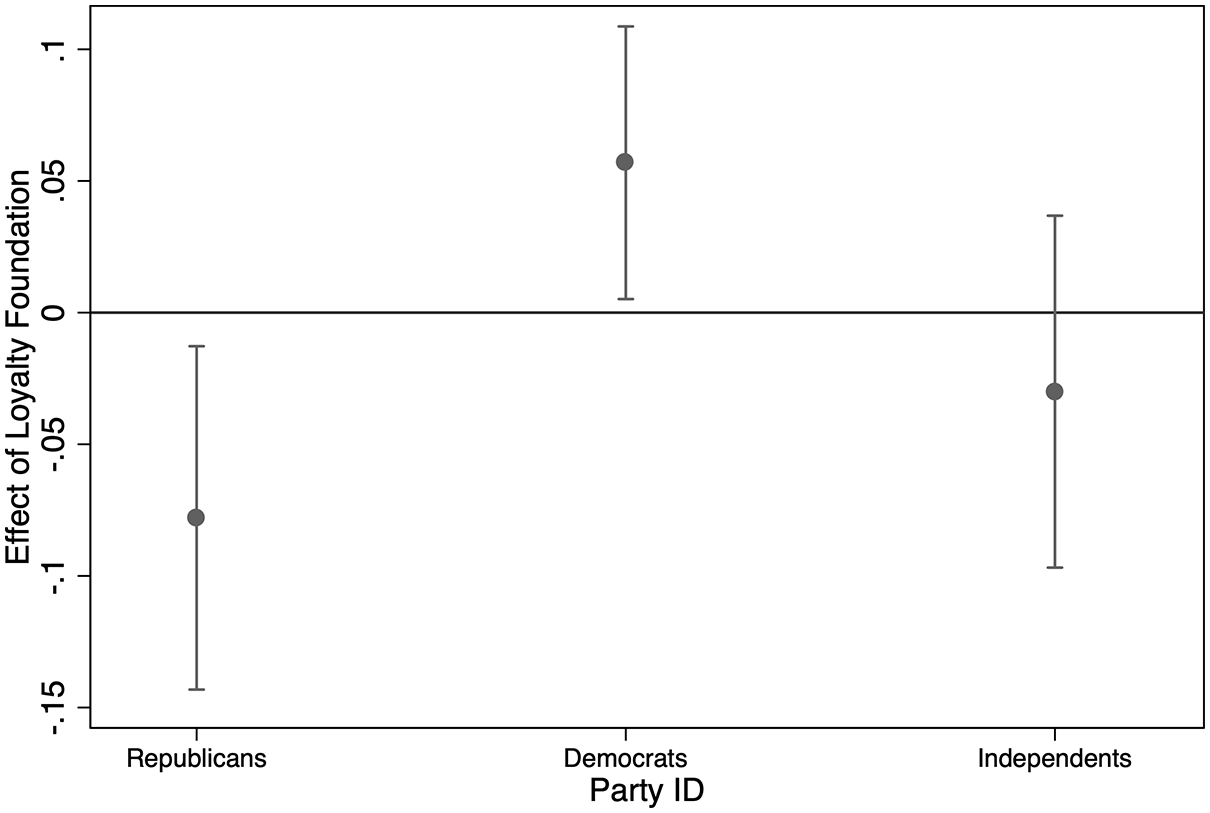
Marginal Effects by Party ID (DV: Belief that Russia Tipped the Scales).
Next, we estimated the probability that a given Republican/Democrat falls above the midpoint of our dependent variable (i.e. that he or she believes that Russia decided the election). Results are summarized in the top half of Table 3. We see that high-loyalty Republicans have a 15.1% probability of attributing the election outcome to Russian efforts. For GOP supporters at the low end of the loyalty scale, the estimated margin is significantly higher (58.7%). Focusing on Democrats, the probability of believing that Moscow’s campaign was decisive increases by 30% across the full range of the loyalty variable (from 48.8% to 78.8%). These calculations demonstrate that the moral value of loyalty has a strong substantive effect on opinion dynamics in the United States. 16
Predicted Probabilities.
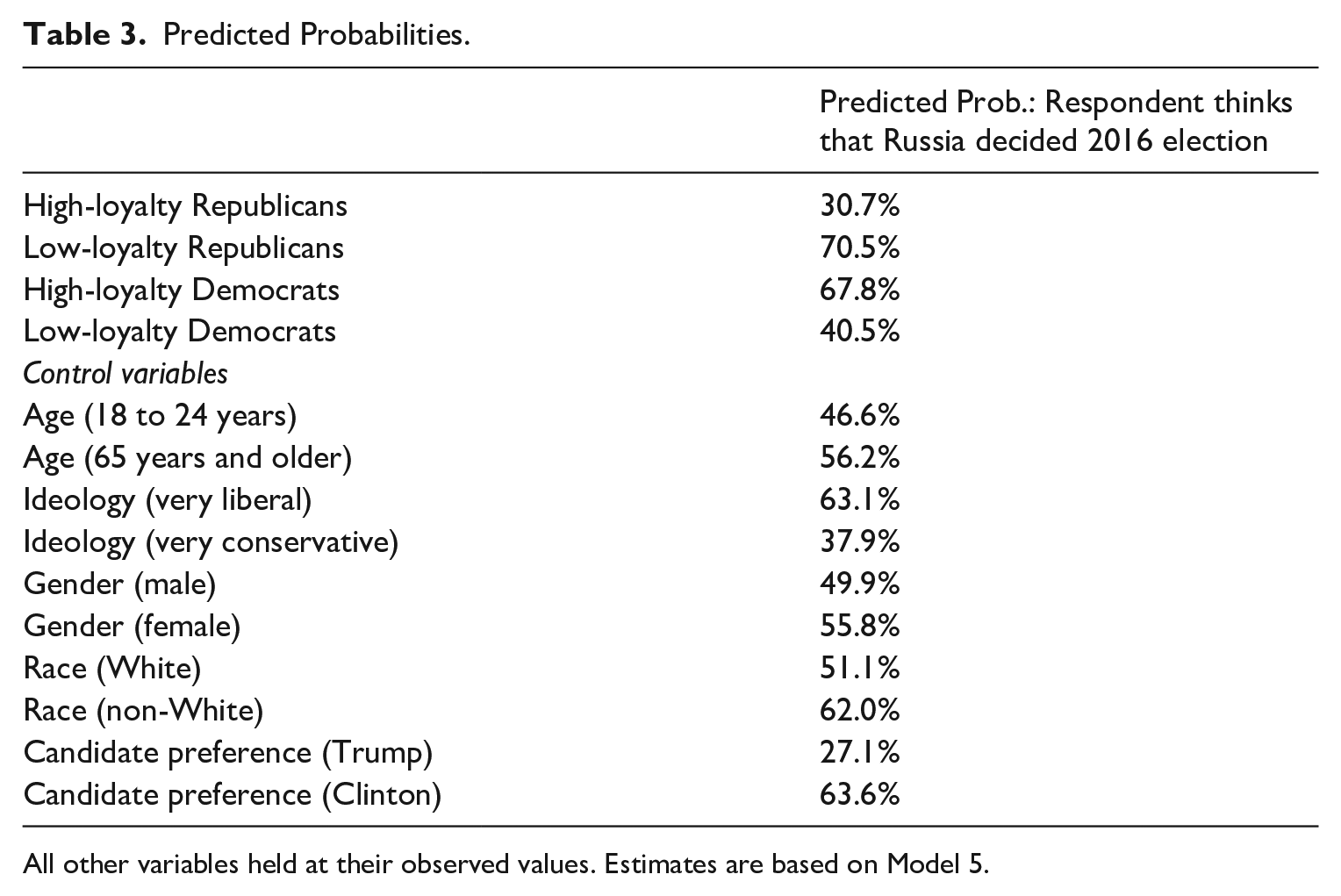
All other variables held at their observed values. Estimates are based on Model 5.
Turning to our control variables, Model 5 shows that people’s scores on the authority, purity, 17 and fairness 18 foundations have no effects on our dependent variable. By contrast, those whose morality is sensitive to concerns about harm are more likely to believe that Russia’s efforts decided the election. 19 While a conclusive interpretation of this finding is beyond the scope of our article, one possible explanation is that people’s scores on this foundation influence their intuitions that Russia’s interference campaign harmed the United States’ political institutions.
A few sociopolitical correlates also help us predict beliefs about Russia’s influence in 2016. In particular, age, gender, ideology, race, and candidate preferences all influence whether people attribute the election outcome to Moscow’s efforts. In our data set, the youngest individuals (18 to 24 year olds) have a 46.6% probability of adopting this belief. For respondents in the highest age category (65 years and older), the estimated margin is noticeably higher (56.2%). Our findings for political ideology mirror the results for party ID. We see that strong conservatives are substantially less likely to think that Russia tipped the scales than strong liberals (37.9% vs. 63.1%). Turning to our variable that captures people’s candidate preferences, we find that individuals who preferred Trump during the 2016 election have a 27.1% probability of attributing the election outcome to Moscow’s initiative. By contrast, for Clinton supporters, the estimated value is 63.6%. Finally, men (predicted probability 49.9%) and White respondents (predicted probability 51.1%) are somewhat less likely to believe that Russia decided the election than women (55.8%) and non-Whites (62.0%).
Conclusion
The main goal of this article was to assess the effect of external election interferences on mass attitudes. We expected that those who believed that a foreign government successfully undermined the election in one’s country would score lower on democratic satisfaction than other individuals. Furthermore, we anticipated that this effect would be weaker among supporters of winning parties. Finally, based on MFT, we theorized that individuals who place high value on in-group loyalty would be more likely to engage in partisan motivated reasoning. Substantively, this led us to hypothesize that an increase in in-group loyalty would make electoral winners less likely to attribute election outcomes to foreign meddling, and it would have the opposite effect on supporters of losing parties.
Our empirical analysis was based on survey data collected in April 2019 in the United States. In particular, we exploited individual-level variations in beliefs about Russian support for the Trump campaign. Our regression models provide broad support for our theoretical framework. As expected, mere knowledge of an attempted foreign electoral intervention in the United States does not affect individual levels of system support. Instead, only those respondents who believe that Russia successfully tipped the scales in favor of Trump experience a decline in democratic satisfaction. However, even this effect is not uniform. More specifically, self-identified Republicans do not become less confident about the state of US democracy if they believe that Moscow’s influence campaign was decisive in 2016. Our models also help us investigate the question of why some people consider Russia’s operation to be decisive while others believe that the meddling campaign was inconsequential. Consistent with previous research, we see that people engage in motivated reasoning. As such, Democrats are particularly likely to adopt the belief that Russia’s actions changed the outcome of the election while Republicans are very unlikely to come to the same conclusion. More significantly, we find that people’s views on the matter are further influenced by individual-level predispositions. Our analysis reveals that Democratic respondents who place high emphasis on in-group loyalty are particularly likely to believe that the 2016 election was decided by Moscow. By contrast, Democrats who consider in-group loyalty to be less important have a lower probability of adopting this view. For Republicans, an increase in loyalty makes it less likely that respondents attribute Trump’s electoral victory to Russia’s efforts.
Our article makes a number of important contributions to the existing literature. First, we build on previous work to demonstrate that people react first and foremost to perceptions about the substantive impact of a foreign meddling campaign. In other words, external actors only affect micro-levels of system support in a target state if their interference operations are perceived to successfully influence election outcomes. Moving forward, we hope that future work will build on our analyses and broaden the research agenda on the behavioral effects of foreign election meddling. Partisan interference operations can be based on numerous different tools including misinformation campaigns (Jamieson, 2020) and candidate funding (Bubeck and Marinov, 2019). Subsequent studies should investigate how domestic publics respond to these different types of strategies and thereby assess the generalizability of our research findings.
Second, our analysis shows that electoral winners are not only more forgiving of attempted electoral interventions on behalf of their preferred party (as suggested by Tomz and Weeks, 2020). Instead, our models show that supporters of successful parties even seem to forgive decisive external interventions in their country’s election process. These findings provide additional avenues for future research. In particular, follow-up studies should look beyond the United States and investigate how voters react to process-oriented interventions by external powers. Indeed, it is possible that externally sponsored election violence or foreign support for district gerrymandering undermine satisfaction with democracy in similar ways as direct partisan interventions on behalf of a particular candidate.
Third, our empirical analysis also provides important insights about the factors that shape people’s beliefs about political claims that are difficult to verify empirically. As expected, partisan motivated reasoning plays an important role in this type of context. Previous studies have pointed out that various individual-level characteristics (such as political sophistication) influence how frequently people rely on this psychological process in their daily lives (Taber and Lodge, 2006). Still, as Jerit and Zhao (2020: 88) point out, we still know fairly little about “how a person’s processing goals relate to stable individual-level traits.” As such, our study provides novel insights about the individual-level dispositions that influence people’s propensities to engage in politically motivated reasoning, and it points to people’s moral foundations as an important (and heretofore under-appreciated) predictor.
Supplemental Material
sj-docx-1-psx-10.1177_00323217221126300 – Supplemental material for Meddling in the 2016 Elections and Satisfaction With Democracy in the US
Supplemental material, sj-docx-1-psx-10.1177_00323217221126300 for Meddling in the 2016 Elections and Satisfaction With Democracy in the US by Florian Justwan, Bert Baumgaertner and Madeleine Curtright in Political Studies
Footnotes
Acknowledgements
A previous version of this paper was presented at the 2019 Meeting of the American Political Science Association. The authors would like to thank the Editors and anonymous Reviewers at Political Studies for their feedback and suggestions.
Author’s Note
Madeleine Curtright is now affiliated to McCourt School of Public Policy; Georgetown University.
Declaration of Conflicting Interests
The author(s) declared no potential conflicts of interest with respect to the research, authorship, and/or publication of this article.
Funding
The author(s) disclosed receipt of the following financial support for the research, authorship, and/or publication of this article: Research reported in this publication was supported by the National Institute Of General Medical Sciences of the National Institutes of Health under Award Number P20GM104420. The content is solely the responsibility of the authors and does not necessarily represent the official views of the National Institutes of Health.

Supplemental Information
Additional supplementary information may be found with the online version of this article.
Contents
Appendix A: Narrative Summary of Russian Election Meddling in 2016 Appendix B: Survey Questions. Appendix C: Descriptive Statistics. Appendix D: Construct Validity of Moral Foundation Scores. Table A1. Average Moral Foundation Scores across Political Ideology. Appendix E: Robustness Checks. Table A2. Robustness Checks—Predictors of Democratic Satisfaction (2016 Voters Only). Figure A1. Marginal Effects by Party ID—2016 Voters Only. Table A3. Robustness Checks—Predictors of Democratic Satisfaction (Heard of Russian Meddling Omitted). Figure A2. Marginal Effects by Party ID (Heard of Russian Meddling Omitted). Table A4. Robustness Checks—Additional Control Variables (News Consumption). Table A5. Robustness Checks—Five-Point Partisanship Variable. Figure A3. Marginal Effects by Partisanship. Appendix F: Follow-Up Analyses—Moral Foundations as possible moderators? Table A6. Interactive Models (Winner–Loser Status × MFT; DV: Dem. Satisfaction). Table A7. Interactive Models (Belief that Russia Tipped the Scales × MFT; DV: Dem. Satisfaction). Table A8. Interactive Models (Belief Russia Tipped Scales × MFT × Party ID; DV: Dem. Satisfaction). Appendix G: Follow-Up Analyses—Did Russia Tip the Scales? Additional Moderator Analysis. Table A9. Interactive Models (Party ID × MFT; DV: Belief Russia Tipped Scales).
Notes
Author Biographies
References
Supplementary Material
Please find the following supplemental material available below.
For Open Access articles published under a Creative Commons License, all supplemental material carries the same license as the article it is associated with.
For non-Open Access articles published, all supplemental material carries a non-exclusive license, and permission requests for re-use of supplemental material or any part of supplemental material shall be sent directly to the copyright owner as specified in the copyright notice associated with the article.
