




Abstract
Citizens who voted for a party that won the election are more satisfied with democracy than those who did not. This winner–loser gap has recently been found to vary with the quality of electoral democracy: the higher the quality of democracy, the smaller the gap. However, we do not know what drives this relationship. Is it driven by losers, winners, or both? And Why? Linking our work to the literature on motivated reasoning and macro salience and benefiting from the Comparative Study of Electoral Systems project—covering 163 elections in 51 countries between 1996 and 2018, our results show that the narrower winner–loser gap in well-established electoral democracies is not only a result of losers being more satisfied with democracy, but also of winners being less satisfied with their victory. Our findings carry important implications since a narrow winner–loser gap appears as a key feature of healthy democratic systems.
Keywords
The “winner–loser gap” is one the most robust relationships documented in political science. It refers to the fact that citizens who voted for a party that won the election are systematically more satisfied with the way their democratic regime works than those who voted for a party that lost the election (Anderson et al., 2005; Blais and Gélineau, 2007; Curini et al., 2012; Dahlberg and Linde, 2016; Martini and Quaranta, 2019; Nadeau and Blais, 1993). While the existence of this gap is well-established, it has been pointed out that its size may be context-dependent. In a pioneering study, Anderson and Guillory (1997) have shown that formal institutional settings explain part of the cross-country variation in the magnitude of the gap (see also Anderson et al., 2005). Many scholars have extended this kind of work by looking at other types of contextual features. Among others, scholars have studied the moderating roles of the age, the quality and performance of democracy (Aarts and Thomassen, 2008; Dahlberg et al., 2015; Dahlberg and Linde, 2016; Martini and Quaranta, 2019), the type of election (Singh et al., 2012), as well as the integrity of the electoral process (Fortin-Rittberger et al., 2017). Overall, this strand of literature suggests that the size of the winner–loser effect is indeed contingent on contextual factors.
In this article, we build on work that has linked the size of the winner–loser gap in satisfaction with democracy (SWD) to indicators of democratic quality (Dahlberg and Linde, 2016; Martini and Quaranta, 2019). Like Dahlberg and Linde (2016), we argue that the winner–loser gap should be mitigated when democratic quality is high. However, our research differs from earlier work on the conditioning effect of democratic quality on two important accounts. First, we explicitly link the observed variation in the size of the winner–loser satisfaction gap in high-quality and low-quality democracies to the literature on motivated reasoning and macro salience (Daoust and Nadeau, 2020; Kunda, 1990; Lodge and Taber, 2000, 2013; Nadeau et al., 2019; Rohrschneider and Loveless, 2010). Second, we evaluate in detail how both winners’ and losers’ level of SWD is affected by the quality of democracy. While insightful, research examining between-country differences (such as the papers cited above) does not tell us who—winners, losers, or both—contributes to the reduction of the winner–loser gap as the quality of electoral democracy improves. More specifically, this reduction in winners’ and losers’ evaluation of the functioning of democracy can be a result of losers being more satisfied in high-quality democracies, of winners being less satisfied in such contexts, or both.
To find out what are the factors that drive the moderation effect of quality of electoral democracy, we make use of the data from the Comparative Study of Electoral Systems (CSES) project, covering 163 elections in 51 countries between 1996 and 2018. A crucial advantage of this dataset compared to the ones used in previous work is that it offers, to our knowledge, more variance on this question in terms of contexts and, most importantly, in terms of quality of democracy.
Previewing our findings, we find evidence of a moderation effect of quality of democracy on the winner–loser gap. We also disentangle the drivers of that relationship and find that the narrower winner–loser gap in high-quality democracies is not only a result of losers being more satisfied, but also of winners reacting to victories less emphatically. This key result is robust to several alternative model specifications and various estimation strategies.
By shedding light on the mechanism behind the reduction of the winner–loser gap, these results deepen our knowledge of voters’ post-electoral reactions and nuance previous work that almost exclusively frames the moderating effect of democratic quality as resulting from variation in losers’ reactions to election outcomes. Our results also imply that officials seeking to bolster confidence in democratic institutions should not only strengthen civic education and improve the quality of the electoral administration but also communicate effectively with voters to reassure them about the integrity of the electoral process. Finally, our findings highlight the responsibility of all political candidates in the aftermath of elections to join their voices to reiterate their support for the electoral system.
Winning, Losing, and the Quality of the Electoral Process
When reviewing the literature on the contextual factors that moderate the size of the winner–loser gap in SWD or political support, two themes emerge. First, perceptions about the integrity of the electoral process appear very important in explaining citizens’ post-electoral reactions in democracies (Anderson et al., 2005; Birch, 2008; Fortin-Rittberger et al., 2017; Moehler, 2009; Norris, 2017, 2019). Second, the perceptions about electoral fairness are particularly important in explaining losers’ willingness to maintain a high level of SWD when facing a disappointed outcome (Anderson et al., 2005; Blais and Gélineau, 2007; Dahlberg and Linde, 2016; Nadeau and Blais, 1993; Wagner et al., 2009).
In contrast to the literature’s focus on the role of losers, we build on insights from motivated reasoning (Bolsen et al., 2014; Kunda, 1990; Leeper and Slothuus, 2014; Lodge and Taber, 2000, 2013; Redlawsk, 2002) to argue that the observed variation in the size of the winner–loser satisfaction gap in high-quality and low-quality democracies should depend on both winners’ and losers’ post-electoral reactions. The assumption that voters operate as motivated reasoners means that they attempt to hold on to their existing positive evaluations of political objects or outcomes. They can do so by only paying attention to new congruent information or by explaining away new incongruent messages to which they are exposed (Bolsen et al., 2014; Kernell and Mullinix, 2019; Kunda, 1990; Leeper and Slothuus, 2014; Lodge and Taber, 2000; Mullinix, 2016; Taber and Lodge, 2006).
We argue in this article that this process of motivated reasoning, that has been studied with a focus on different political objects, also offers a compelling framework to understand the emergence of post-electoral winner–loser gaps in levels of SWD (Kernell and Mullinix, 2019; Mullinix, 2016). Starting with the winners, a motivated reasoning framework leads to the expectation that this group of voters—who are satisfied with the outcome of the election—will seek for information that is consistent with their existing positive evaluations. Winners will seek information that confirms that their victory results from elections that were free and fair and discard evidence suggesting otherwise. Losers, on the other hand, should be more attentive to information that points out the unfairness of the electoral process and less receptive to evidence suggesting that they may have lost fair and square. Given that free and fair elections are central in citizens’ assessments of democracy, it follows that winners’ and losers’ different conclusions about the integrity of the electoral process will lead to different levels of satisfaction with the performance of their political institutions (Norris, 2019).
In sum, we argue that motivated reasoning will lead winners to search for information that is congruent with the idea that the electoral process is free and fair, resulting in higher levels of satisfaction with the performance of democratic institutions. The same type of motivations will reinforce doubts about the integrity of the electoral process in the minds of losers, which will lead them to report lower levels of SWD.
The Nature and Role of Information Environments in Low- and High-Quality Democracies
Oriented information quests should occur broadly, helping us to understand the presence of a winner–loser gap in SWD will appear across contexts (Anderson et al., 2005; Blais and Gélineau, 2007; Dahlberg and Linde, 2016). Proponents of the motivated reasoning approach, however, also acknowledge that voters’ information searches do not take place in a vacuum (Kernell and Mullinix, 2019; Lodge and Taber, 2013; Redlawsk et al., 2010). This means that motivated reasoners are likely exposed across time and space to different dosages of evidence that either comforts or challenges their existing beliefs and evaluations about the election outcome. We argue in this article that the observed variation in the size of the winner–loser gap in satisfaction across contexts crucially depends on the interaction between an individual-level psychological process, motivated reasoning, and the differences in the information environment in low- and high-quality democracies. With information environment, we mean the broader context in which information about the election is discussed, which includes media coverage, but also citizens’ direct experience and the unmediated communication of political, governmental, and non-governmental actors.
Scholars are well-aware of the role of contextual factors on citizens’ information environment. In the words of Rohrschneider and Loveless (2010: 1034), for instance, “macro conditions affect the [national] information environment.” Though this macro perspective has been mostly used to predict under what conditions citizens chiefly rely on economic or political considerations when assessing their level of SWD (Christmann, 2018; Daoust and Nadeau, 2020; Rohrschneider and Loveless, 2010), the argument is of general scope, a point that Dahlberg et al. (2015: 27) also made when they wrote that “different types of democracies face different challenges and we may assume that this has consequences for explanations of democratic discontent.” 1 Based on these insights, we think that the consequences of citizens engaging in motivated reasoning after an election will vary according to the quality of democracy, that is, how closely it matches the “ideal” liberal democracy, including most notably free and fair elections and freedom of expression (Dahl, 1971). This argument makes intuitive sense, given that the electoral process has often been characterized as nothing more than a “window dressing exercise for authoritarian politics” in low-quality democracies, whereas it is often praised in their high-quality counterparts as an efficient and fair mechanism “to ensure that political rulers are [. . .] accountable to the electorate” (Lührmann et al., 2017: 1).
The notion that information environments vary with quality of democracy is in line with a number of theoretical and empirical studies. First, starting with Przeworski (1991), a number of researchers have suggested that a democracy is “self-enforcing” when competing parties, and most evidently losers, prefer the outcome of elections to the violent confrontations that would otherwise ensue if they refuse to accept their defeat. 2 Second, the structure of incentives for parties to engage in electoral fraud or to raise doubts about the fairness of the electoral process differs markedly in high- and low-quality democracies. Hyde and Marinov (2014) show that fraudulent elections and overt defiance of electoral results are rarely witnessed in institutionalized democracies. They argue this reflects the fact that the probability of being caught is large in high-quality democracies, while the consequences of being portrayed as a sore loser may be highly detrimental. Incumbents in low-quality democracies to the contrary have “little incentive to push for clean elections because they might face accusations of fraud . . . regardless of their true behavior” (Hyde and Marinov, 2014: 329). Third, low-quality democracies are characterized by an incumbent’s informational advantage due to the government control over the counting of the vote and the release of results which is susceptible to produce, according to Chernykh and Slovik (2015: 408) “a failure of self-enforcing democracy.” In brief, because parties have no interest in stealing elections and contesting electoral outcomes in high-quality democracies, contestations remain rare and, consequently, the media have usually nothing to report about these types of events—the opposite being true in low-quality democracies. 3
The preceding arguments are consistent with the idea that differences in terms of quality of democracy should affect both the amount and the diversity of available information related to electoral fairness, such as attention for potential manipulations of the voting process or electoral administrative practices that benefit some contestants over others (Birch, 2008; Daxecker et al., 2019; Goodwin-Gill, 1994; Moehler, 2009; Mozaffar and Schedler, 2002; Norris, 2017, 2019; Norris et al., 2014). What are the implications for losers? In low-quality democracies, they will be exposed to larger amounts and more diverse pieces of information related to electoral integrity than in high-quality democracies. Hence, losers in such settings are more likely to be exposed to information that could strengthen their doubts about the fairness of the electoral process. In this way, losers may start to doubt the possibility of becoming tomorrow’s winners—hence, decreasing their level of satisfaction with the democratic regime (Anderson and Mendes, 2006; Daxecker et al., 2019; Moehler, 2009; Norris, 2019). The opposite is likely to be true in high-quality democracies. In the absence of information that questions the integrity of the election, partisans of defeated candidates are more likely to accept the outcome of the election and to “loose happily” (Dahlberg and Linde, 2016). For winners, we expect a similar effect of motivated reasoning differentially amplifying the effects of the election outcomes in low- and high-quality democracies. Winners in achieved liberal democracies are less likely to be exposed to information and cues that will prompt them to interpret the victory as the most decisive indication of the fairness of the electoral process than what holds in low-quality democracies (Carreras and İrepoğlu, 2013; McAllister and White, 2011; Moehler, 2009). Furthermore, in high-quality democracies, winning likely does not strengthen citizens’ assessments of the performance of the electoral system to the same extent than is the case in low-quality democracies. As a result, winning in achieved liberal democracies will not have the same impact on expressed levels of SWD as in low-quality democracies. 4
A key trait of the information environment is thus how much coverage there is about electoral fairness and to what extent views on this issue diverge. Differences between low- and high-quality contexts on this point are driven by the level of elite and media polarization about the integrity of the electoral process (Cantú and García-Ponce, 2015; Carreras and İrepoğlu, 2013; Moehler, 2009). In emergent democracies, winning and losing candidates, and media outlets that are ideologically close to either the winners or the losers, will tend to offer divergent interpretations about the meaning of electoral outcomes. Whereas winners will likely interpret the results as the legitimate outcome of a fair electoral process, and might portray their opponents as sore losers, defeated candidates are more likely to claim that the elections were fraudulent and to denounce their opponents’ victory as illegitimate. Carreras and İrepoğlu (2013: 630), for instance, conclude from their study of elections in Latin America that “political losers often exaggerate the electoral malpractices in order not to accept their own responsibility in the electoral defeat and to retain the support of their electoral bases.” This type of polarization around the election outcome stands in sharp contrast with the consensual tone of elite and media discourse in the aftermath of national elections in established democracies. In this case, losers, the media, and evidently winners, are in agreement and concur to recognize the legitimacy of electoral outcomes (Anderson et al., 2005; Corcoran, 1994; Esaiasson, 2011; Nadeau and Blais, 1993). 5
It should be noted that work studying motivated reasoning has shown that being exposed to incongruent messages can sometimes produce boomerang (or “backlash”) effects (Kunda, 1990; Redlawsk, 2002; Taber and Lodge, 2006). For instance, partisans may become even more positive about a candidate they like after learning something negative about that candidate (Lodge and Taber, 2013; Redlawsk et al., 2010). The implication is that winner–loser gaps should be larger in low-quality democracies than in achieved liberal democracies because both winners and losers are exposed to the discomforting messages that are communicated by opponents and to the confirmatory cues transmitted by fellow partisans. These messages should reinforce each other to bolster positive assessments of electoral and political institutions among winners and to strengthen the negative evaluations that losers hold. This combined effect should not occur in high-quality democracies, because voters in such settings will be largely exposed to the same messages from their preferred and rival candidates. That is, both groups of parties will recognize the fairness of the electoral process and the legitimacy of the election outcome. As the elites are basically in agreement about the integrity of the electoral process, voters are not exposed to partisan messages that are susceptible to polarize them.
In summary, we argue that information environments are crucial to the process of motivated reasoning and can either amplify or limit citizens’ efforts to find information that is consistent with their pre-existing beliefs about the state of democracy. In low-quality democracies, losers and winners will find more arguments in the elite and media discourse to strengthen or challenge their beliefs that the electoral process is unfair (for losers) or fair (for winners) than what holds in high-quality democracies. This reasoning implies that the observed variation in the size of the winner–loser gap in satisfaction across contexts crucially depends on the interaction between an individual-level psychological process driving losers’ and winners’ post-electoral reactions (i.e. motivated reasoning) and the differences in the information environment faced by both groups in low- and high-quality democracies. Furthermore, we have argued that similar mechanisms are at play for both winners and losers. The arguments presented above lead to our two hypotheses:
Hypothesis 1. The higher the quality of electoral democracy, the smaller is the positive effect of winning on citizens’ level of SWD.
Hypothesis 2. The higher the quality of electoral democracy, the smaller is the negative effect of losing on citizens’ level of SWD.
Data and Methods
To test our hypotheses, we use all available modules of the CSES project (CSES, 2015a, 2015b, 2015c, 2018). 6 The CSES includes information from a common module of questions that participating countries integrate in their respective national election study. A measure of SWD was included in each of the five modules, implying we are able to use a uniquely comprehensive dataset that includes 163 elections in 51 countries and that covers a time period of two decades (1996–2018). The main advantage of this dataset compared to the ones used in previous work (Dahlberg and Linde, 2016; Martini and Quaranta, 2019) is that it offers more variance in terms of contexts and, most importantly, in terms of quality of democracy.
Our dependent variable is citizens’ level of SWD. Theoretical work distinguishes between dimensions of political support that focus on different objects—including support for the principle of democracy, assessments of regime performance, and evaluations of specific institutions or actors (Easton, 1975; Linde and Ekman, 2003; Norris, 1999). Among the different dimensions of political support, SWD should be thought of as more concrete than measures that tap citizens’ views of democratic principles but as more diffuse than evaluations about the government in place or specific political actors. In this study, we rely on the conventional item of SWD used in the CSES project to assess citizens’ evaluations of how the democratic system as a whole, works in practice (Bernauer and Vatter, 2012; Claasen, 2020; Harteveld et al., 2021). The item reads “On the whole, are you very satisfied, fairly satisfied, not very satisfied, or not at all satisfied with the way democracy works in [country]?” We rescaled this item to run from 0 (not at all satisfied) to 3 (very satisfied). To ease the estimation and interpretation of the effects, we use mixed-effects linear regression models to explain variation in citizens’ levels of SWD.
As previously explained, we theorize that winners and losers will report different levels of satisfaction with the performance of the democratic regime, and that the extent to which they do so is context-dependent. To test our hypotheses, it is crucial that we distinguish between winners and losers and their informational environments. To do so in a straightforward way, we estimate their levels of SWD in comparison to that of a third category: Abstainers. This group is generally known to have lower levels of SWD (Rich and Treece, 2018), though there is some debate on the question whether their lower level of SWD is a cause or a consequence of their decision to vote or abstain (Kostelka and Blais, 2018). To measure voter turnout, we rely on respondents’ self-reported turnout in the election under study. 7 For distinguishing between winners and losers, we take a conventional approach and define winners as all those who voted a party that is part of the government, that is, that obtained at least one governmental portfolio (Stiers et al., 2018).
Our reasoning implies that the size of the winner–loser gap in SWD across contexts depends on the interaction between the motivated reasoning process driving winners’ and losers’ post-electoral reactions and the differences in the information environment faced by both groups in low- and high-quality democracies in the aftermath of elections. Based on the theoretical arguments and the empirical evidence presented in the last section, we argue that messages calling into question the fairness of the electoral process are more frequent and visible in low-quality democracies than it is the case in high-quality democracies.
To measure the quality of democracy of the countries covered by the CSES, we rely on the Varieties of Democracy (V-Dem) project (Coppedge et al., 2018b). In particular, we use their “Electoral democracy index” (v2x_polyarchy), which is meant to capture “the extent to which electoral democracy in its fullest sense [is] achieved.” The index accounts, among others, for the presence of electoral competition, extensive suffrage, freedom of association and expression, the presence of independent media, and clean elections (Coppedge et al., 2018a: 38). In the estimation sample, the mean score on the index that can theoretically vary between 0 and 1 is 0.82 (standard deviation = 0.14). All indicators are sources from the V-Dem dataset and are described in detail in the Online Appendix A.
Even though measures of the quality of the democratic process do not directly capture the extent to which citizens are exposed to messages denouncing electoral fraud, such indicators appear strongly correlated with electoral contestation. We note, for example, that electoral violence, captured by Daxecker et al. (2019), correlates strongly with our indicator of electoral democracy (Pearson’s r of −0.44 for the countries included in the Daxecker et al. dataset on electoral violence). Also telling is the correlation of −0.59 observed between the V-Dem measure with an indicator developed by Hyde and Marinov (2012, 2014, 2019) measuring the presence of concerns about the fairness of the electoral process before elections. All in all, these indications seem to indicate that the V-Dem indicator represents a useful way to differentiate the informational environments around elections faced by winners and losers in low- and high-quality democracies.
To test our hypotheses, we minimize an estimation bias by including several covariates. At the macro-level, we account for differences in economic growth and economic inequality (Christmann, 2018; Dahlberg et al., 2015; Donovan and Karp, 2017; Sirovátka et al., 2019; Solt, 2020). In particular, we add a measure of the annual gross domestic product (GDP) growth and the Gini index of inequality (both obtained from the World Bank). At the individual-level, we include controls for sex, age (linear), education (using the CSES harmonized scale with five categories), income (quintiles), and a variable distinguishing between respondents feeling close to a political party. Missing information on some of these controls imply that some country-years are excluded from the CSES data, we provide details on these exclusions in the Online Appendix B. Descriptive statistics of all variables are reported in Online Appendix C.
The data have a nested structure, which we account for by estimating mixed effect models with a three-level structure: individuals nested in elections nested in countries (Gelman and Hill, 2006). 8 We specify random intercepts at the election level and, given our interest in the cross-level interaction between winning/losing/abstaining and the level of democracy, we also specify random slopes for the variables that capture winning/losing/abstaining.
Results
The results of our analyses are shown in Table 1. We present two models, one that focuses on the main effects of winning and losing (compared to abstainers) on citizens’ SWD and one that includes cross-level interactions with our indicator of democratic quality. First, the estimates of Model 1 show that both winners and losers are significantly more satisfied with democracy than those who abstain from voting. Importantly, the coefficient for winners is almost five times larger than that for losers. This difference in winners’ and losers’ level of SWD is not surprising and confirms the presence of a substantial winner–loser gap in SWD in our data. These findings therefore suggest that the observations from Dahlberg and Linde (2016) can be generalized more broadly and do not apply to European democracies only. Furthermore, it is worth to note that the estimates for the control variables in Model 1 are in line with expectations.
Explaining Satisfaction with Democracy.
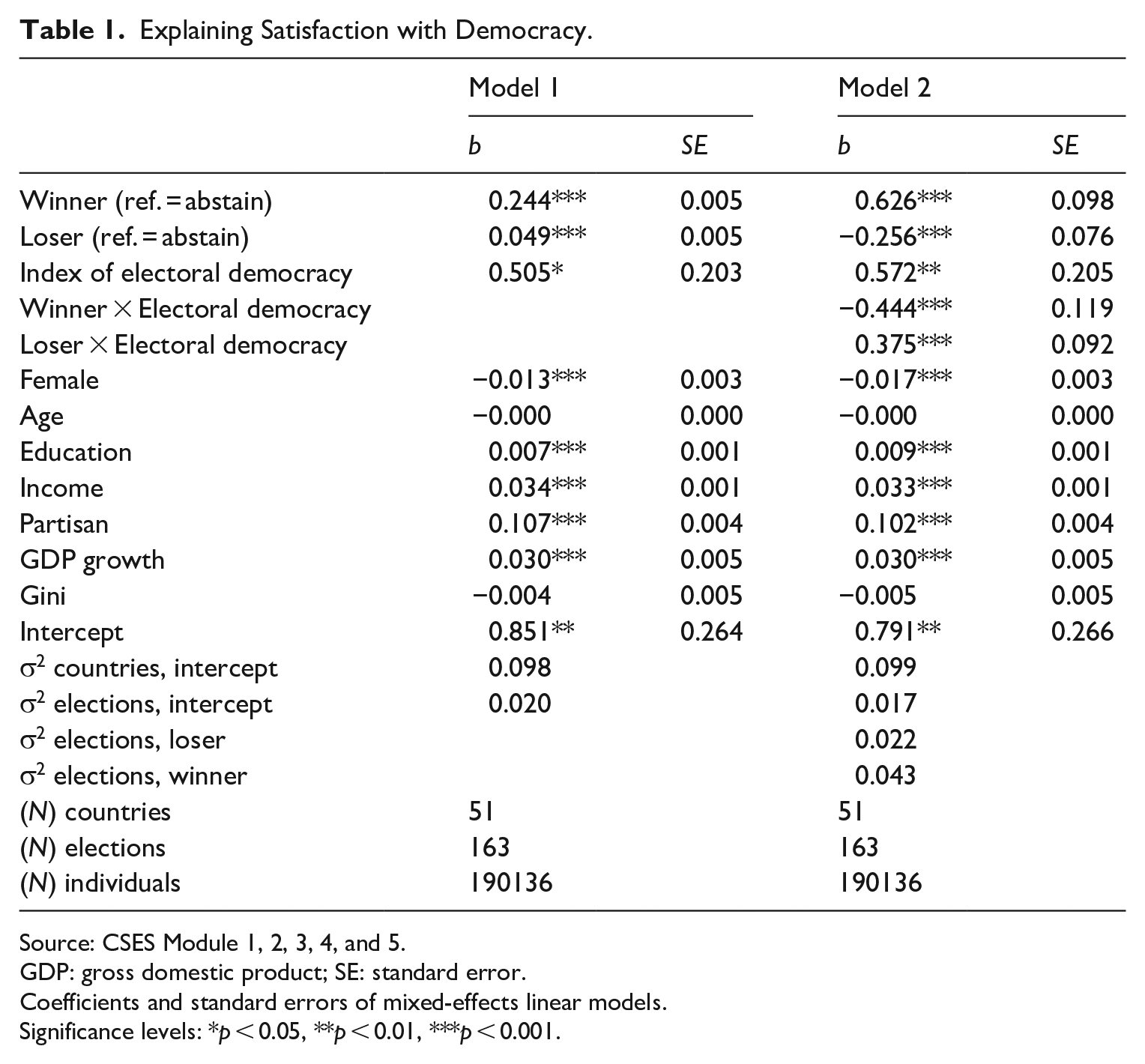
Source: CSES Module 1, 2, 3, 4, and 5.
GDP: gross domestic product; SE: standard error.
Coefficients and standard errors of mixed-effects linear models.
Significance levels: *p < 0.05, **p < 0.01, ***p < 0.001.
Model 2 includes interaction terms between the winner- and loser-variables and the indicator of electoral democracy. Their inclusion allows testing whether the effects of winning (versus abstaining) and losing (versus abstaining) are moderated by the quality of democracy. The coefficients of these interaction terms are in line with our hypotheses. First, the results show that the positive effect of winning on SWD is significantly reduced when the electoral democracy index is higher (i.e. a negative interaction effect, in line with H1). Second, the negative effect of losing on SWD as well is significantly smaller in settings with a higher electoral democracy score (i.e. a positive interaction effect, in line with H2). In other words, compared with what holds for low-quality democracies, losers in high-quality democracies are more satisfied with democracy and winners are less satisfied with democracy. We illustrate this effect in Figure 1 that shows the average marginal effect of winning (vs abstaining) and losing (vs abstaining) for different values of the V-Dem’s Electoral Democracy Index.
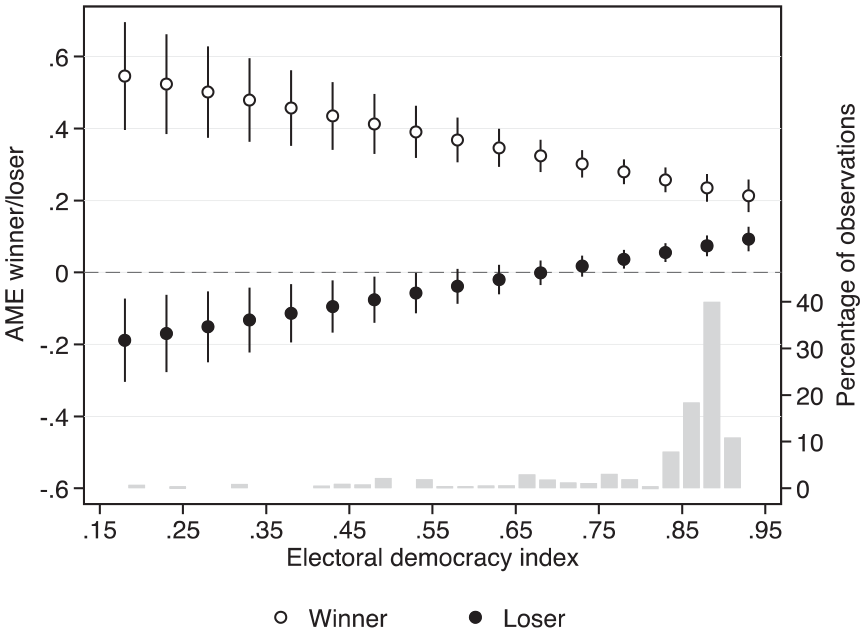
Average Marginal Effect of Voting for a Loser and of Voting for the Winner on SWD, by Level of Electoral Democracy.
Combined, the estimates of Model 2 in Table 1 offer strong support for our hypotheses: not only do losers lose less in high-quality democracies, but winners win less as well. The smaller winner–loser gap in high-quality democracies appears to be the result of a “scissors effect” shown in Figure 1, whereby the marginal effects of winning and losing move in opposite directions as the quality of democracy increases.
Robustness of the Results
The estimates that are presented in Table 1 and that are illustrated in Figure 1 are the result of carefully specified models. Still, some might be concerned that our results may be biased due to the selection of the V-Dem indicator as a moderating variable, the use of abstainers as a reference category, the limited number of controls (which raises the possibility of an omitted variable bias), or that they could be driven by particular elections or countries in the dataset. In this section, we address these concerns in turn.
First, in studying the conditioning effect of quality of electoral democracy, we have focused on a broad summary indicator of democratic quality, the V-Dem’s polyarchy index which combines information on freedom of association, freedom of expression, the share of the population that has the right to vote, the organization of free and fair elections, and whether the chief executive and legislative institutions are appointed through elections (see Online Appendix A for a detailed description presentation of these components). Arguably, not all indicators in this index are as theoretically relevant for the mechanisms we describe and test in this article. For example, we would not expect how wide suffrage in a country is to significantly moderate the size of the winner/loser gap. In contrast, freedom of expression and the presence of free and fair elections should have the expected moderating effect. A series of supplementary analyses, reported in Online Appendix D, show evidence that supports this expectation. We have also verified the robustness of our results when relying on alternative indicators of democratic quality. Online Appendix E replicates the analyses with a focus on three different indicators from the Sustainable Government Indicators; capturing quality of democracy, rule of law, and electoral democracy. These analyses replicate our main findings, consistently pointing out that winners win less and losers lose less, as democratic quality increases
Second, some might argue that using abstainers as a reference category also entails some limitations, in particular, because the share of abstainers varies with a country’s level of quality of electoral democracy (Pearson’s r between the share of abstainers and the V-Dem polyarchy index is −0.22). However, as can be seen from Online Appendix F, when excluding abstainers from the analyses, and contrasting losers and winners, we still find indications of a strong moderating effect of the quality of democracy on both groups post-electoral reactions.
Third, at the macro-level in particular, one may raise the concern that our models include few controls. To recall, in addition to the indicators of democratic variables, our specifications include two measures of economic performance—economic growth and inequality—that have previously been linked to the vote choice, as well as to SWD. We know, however, that system-level variables such as the political or electoral system are also correlated with SWD (Aarts and Thomassen, 2008). To ensure that heterogeneity in system-level variables and other omitted country-level variables does not drive the results, we have checked whether the results hold when including country fixed effects in the models. The inclusion of these country fixed effects implies that we are analyzing within-country variation in SWD. As can be seen from the results that are reported in Online Appendix G, our conclusions are robust to this very strong control. When examining within-country variation in the winner–loser gap over time, we also find that when democratic quality is higher, winners win less, and losers lose less.
Fourth, though the validity of the SWD measure as an indicator of regime support is generally accepted in a European context (Ferrín, 2016), there is more debate about cross-national variation in what the measure taps in other regions (see, for example, Canache et al., 2001). While we think the issue of measurement invariance is more problematic for work that is interested in comparing levels of SWD than for an analysis of winner/loser gaps in SWD, it remains important to acknowledge that between-country variation in the content of the SWD measure might bias our results. With respect to this point as well, it is important to highlight that our results remain intact when including country fixed effects (see Online Appendix G). In the same vein, even though it has been shown that SWD has remained fairly stable over time (Van Ham et al., 2017), we verify whether the results hold when accounting for temporal variation by means of the inclusion of module fixed effects. As can be seen from Online Appendix H, when accounting for differences in SWD between the five CSES-modules, our results still hold.
Furthermore, one might also question the absence of important individual-level variables in our models. For instance, we argue that the winner/loser gap varies with a country’s level of electoral democracy because citizens faced different post-electoral environments in low- and high-quality democracies characterized by noticeable differences in the balance and visibility of post-electoral communication flows about the fairness of the electoral process. Given the theorized role of citizens’ reactions to different information environments in our explanation of post-electoral winner/loser gaps, it could be argued that citizens’ level of political knowledge is an important omitted variable in our specifications, or that the effects reported in Table 1 are limited to high politically informed citizens. Additional analyses reported in Online Appendix I show that it is not the case—suggesting that these effects are not driven by a small group of highly informed citizens.
Finally, we verify the influence of single elections on our results by excluding one election at a time from the estimation sample (i.e. jackknife tests). The results of these tests, which are reported in Online Appendix J, show that the coefficients of the interaction terms “Winner × Electoral democracy index” and “Loser × Electoral democracy index” are very robust to excluding election-years from the analyses—signaling that the influence of specific elections on our results is limited. While the “Winner × Electoral democracy index” is not always significant at the 0.05 level, the size of the coefficient is substantively very similar across the 163 estimations.
Discussion
Our results confirm previous findings on the moderating role of democratic quality on the winner–loser gap in SWD. While there is some debate on this question (Dahlberg and Linde, 2016; Martini and Quaranta, 2019), our data—that include substantial variation in terms of democratic quality—suggest that previous findings can be generalized beyond Europe: when democratic quality is higher, the gap between winners’ and losers’ SWD is substantially reduced.
Most importantly, our results shed light on what drives the smaller winner–loser gap in high-quality democracies. While previous research has almost exclusively focused on the reactions of losers, our results suggest that both winners and losers contribute to reduction of the winner–loser gap. Therefore, when democratic quality is high, not only do losers lose less, winners also appear to win less. Winners’ reactions can theoretically drive the winner–loser gap as much as those of losers, depending on who moves and by how much. Our results reinforce the inclusion of winners in studies of public opinion toward the democratic regime.
These findings entail important implications at the empirical and the theoretical level. Empirically, the fact that we disentangle effects among winners and losers allows for a better understanding of the dynamics that explain the between-country variation in the winner–loser gap. Rather than speculating about the symmetry of the post-electoral reactions of winners and losers, or remaining agnostic about the distinctive behavior of both groups, our analytical approach allows opening the black box of the winner–loser gap (Rich and Treece, 2018).
Theoretically, our results confirm the relevance and the richness of conceptualizing citizens’ post-electoral reactions as the result of the interaction between the well-documented individual-level psychological process of motivated reasoning (Kernell and Mullinix, 2019; Kunda, 1990; Taber and Lodge, 2006) and the varying “informational environments around elections” they faced across time and space (Daxecker, 2019; Hyde, 2012; Hyde and Marinov, 2014; Kelley, 2012; Norris, 2019; Slovik and Chernykh, 2015). This fruitful perspective neatly suggests that the between-country variation in the winner/loser gap results from the interaction of winners’ and losers’ searches for comforting post-electoral facts and different informational environments.
That being said, recent events and instances of increasing affective polarization in established democracies (Gidron et al., 2020; Iyengar et al., 2019) ask for a certain amount of caution in the characterization of high-quality democracies as environments where the outcome of the election is always widely accepted and hardly debated. The aftermath of the US 2020 presidential election in particular is seemingly at odds with this characterization. As a matter of fact, following the 2016 US presidential election too, a significant number of American citizens were skeptical about the integrity of the electoral process (Norris et al., 2020). This point is important, as it suggests that even among what are generally considered “high-quality democracies” there can be variation in the extent to which election results are covered and interpreted in a consensual way. At the same time, it is worth noting that major disruptions in the perception of electoral integrity, like those following the 2020 US presidential election, should be captured by the indicators we rely on. It is reassuring in that regard to observe that the V-Dem’s polyarchy index for the US was in 2020 at its lowest level in over 40 years. To the extent that a surge in election contestations in recent years indeed occurs, that should thus be captured by the data, and result in larger winner/loser gaps in SWD. 9
Our results also carry important implications about the significance of the winner–loser gap as an indicator of a democracy’s vitality. A small winner–loser gap is a preferable outcome, as it signals that neither winners nor losers are interpreting electoral outcomes as serious indications of electoral fraud. Winner–loser gaps take an entirely different meaning in low-quality democracies. In such settings, winner–loser gaps are worrisome when “winners give their leaders the benefits of the doubt . . . and losers . . . assume the worst” (Moehler, 2009: 360). Neither of these reactions is good news for the stability and consolidation of democratic systems when “democracy is not the only game in town” (Linz and Stepan, 1996).
Our results finally provide a powerful reminder that citizens’ confidence in the electoral process represents a vital form of political support that should never be taken for granted, even in established democracies (Karp et al., 2018; Norris, 2017). Civic education programs and, above all, competent and credible third-party actors—electoral commissions, courts, and observers—are crucial for bolstering citizens’ trust in the electoral process (Hyde and Marinov, 2012, 2014; Norris, 2019; Slovik and Chernykh, 2015). But neither of these pre-requisites spares electoral officials from communicating effectively and political candidates from behaving responsibly in the aftermath of elections to strengthen citizens’ confidence in the fairness of the electoral process (Bowler, 2016).
Supplemental Material
sj-doc-1-psx-10.1177_00323217211026189 – Supplemental material for Winning, Losing, and the Quality of Democracy
Supplemental material, sj-doc-1-psx-10.1177_00323217211026189 for Winning, Losing, and the Quality of Democracy by Richard Nadeau, Jean-François Daoust and Ruth Dassonneville in Political Studies
Footnotes
Acknowledgements
We thank Elhadj Toure for the research assistantship as well as the participants for their comments. And the co-convenors of the Democracy and Elections Research Cluster at the University of Manchester (Nicole Martin and Rosalind Shorrocks) who invited us to present some preliminary findings. We also thank Susan D. Hyde and Nikolay Marinov for making their dataset publicly accessible. Any errors that remain are ours.
Declaration of Conflicting Interests
The author(s) declared no potential conflicts of interest with respect to the research, authorship, and/or publication of this article.
Funding
The author(s) received no financial support for the research, authorship, and/or publication of this article.

Supplementary Information
Additional Supplementary Information may be found with the online version of this article.
Contents
Appendix A. Information on the macro-indicators included in the analyses Table 1. Meaning of V-Dem indicators Appendix B. Reasons for exclusion of specific country-years Table 1. Reasons for exclusion: missing information for specific country-years Appendix C. Descriptive statistics Table 1. Descriptive statistics of variables included in the main analyses Table 2. Elections included in the main analyses Appendix D. Specific indicators of the quality of democracy—different dimensions of polyarchy Table 1. Explaining satisfaction with democracy, different aspects of polyarchy Appendix E. Alternative indicators of quality of democracy: Quality of Government data Table 1. Explaining satisfaction with democracy, the moderating role of Quality of Governance indicators Appendix F. Excluding abstainers from the analyses Table 1. Explaining satisfaction with democracy, excluding abstainers Appendix G. Accounting for omitted variables, country fixed effects Table 1. Explaining satisfaction with democracy, country FE Appendix H. Sensitivity, accounting for module fixed effects Table 1. Explaining satisfaction with democracy, module FE Appendix I. Accounting for political knowledge Table 1. Explaining satisfaction with democracy, the role of political knowledge Appendix J. Sensitivity, jackknife test Figure 1. Jackknife test, “Winner × Electoral democracy” interaction Figure 2. Jackknife test, “Loser × Electoral democracy” interaction
Notes
Author Biographies
References
Supplementary Material
Please find the following supplemental material available below.
For Open Access articles published under a Creative Commons License, all supplemental material carries the same license as the article it is associated with.
For non-Open Access articles published, all supplemental material carries a non-exclusive license, and permission requests for re-use of supplemental material or any part of supplemental material shall be sent directly to the copyright owner as specified in the copyright notice associated with the article.
