



Abstract
Across Europe there is growing concern about populism. In this article populism is analysed through the lens of Jonathan Haidt’s moral foundation theory. People make choices, including political choices, based on their morals. Political families also base their policies on moral foundations. The article analyses this phenomenon and identifies both the opportunities it provides for the European People’s Party (EPP) and the threats it poses. The opportunities have to do with a special feature of conservative parties: they address the entire spectrum of moral foundations while other political families specialise in one or just a few of those foundations—this is even truer of populists. This factor also forms the threat to the EPP: while others can specialise, the EPP family must stay balanced and broad. The other way to address populism is through subsidiarity—the closer people are to decisions, the less abstract they are and the less they are guided by moral foundations, and thus there is less opportunity for populism.
Introduction
Populism is becoming an increasingly large concern for mainstream political parties. Sometimes it seems to be receiving even more attention than poverty, unemployment, stagnant productivity, climate change, migration and foreign policy, among other issues.
This article provides an analysis of the roots of populism based on Haidt’s moral foundation theory. It will show that populism is successful because (a) it addresses the real concerns of voters and (b) it does so by relying on the moral foundations on which voters base their instinctive decisions. In the sections that follow, the article presents moral foundations theory and existing narratives about populism. It then uses this toolset to analyse political families in Europe and the various flavours of populism. Subsequently it looks at the different types of populism through the prism of subsidiarity, breaking down the analysis onto three levels—European, national and regional/city level. The paper concludes with some recommendations on how to address populism and in what way the principle of subsidiarity can be used as a tool to fight it.
Moral foundations theory
Moral foundations theory ‘proposes that several innate and universally available psychological systems are the foundations of “intuitive ethics”. Each culture then constructs virtues, narratives, and institutions on top of these foundations, thereby creating the unique moralities we see around the world, and conflicting within nations too’ (Moralfoundations.org 2016). The theory identifies six moral foundations (Haidt 2012):
On the care/harm foundation rest our feelings of compassion for the weak, our instinct to help our fellow people, our desire to care for the young and the elderly, and so on.
On the fairness/cheating foundation rest our feelings for what is fair, how much altruism we are willing to express, where the balance is between helping someone who is in need and not helping someone, and our ability to decide who is just looking for a free ride.
On the liberty/oppression foundation rest our dislike of being commanded and dominated, and our desire to be free, without interference in our lives.
On the loyalty/betrayal foundation rests the cohesion that groups—such as tribes and nations—exhibit.
On the authority/subversion foundation rests our respect for authority and leadership.
On the sanctity/degradation foundation rests our respect for the clean, the pure and the sacred. This includes the divine, but may also give foundation to environmental and sustainability concerns.
It is on these foundations that religions built their moral systems. The Ten Commandments, for example, could easily be mapped onto these foundations, as could the seven deadly sins or the seven virtues. There are evolutionary reasons for the emergence of each foundation. Groups and individuals that acted morally—that is, according to these foundations—had a competitive advantage over other groups. Not only could they teach their morals to a larger surviving young population, but these foundations are to some extent even genetically inherited. For example, the feeling of compassion for the suffering, which builds on the care/harm foundation, is common to mammals in general, not just humans. It is not learned, it is innate.
The moral foundations provide the bedrock on which the mostly intuitive (but also rational) decisions of individuals are made. They tell them what feels right and what feels wrong even before it can be rationally argued as to what is right and wrong. Political decisions and preferences, trust for some rather than other politicians and so on, are, as we know, often decided intuitively. Speaking to the hearts of the voters rather than their minds is one of the most frequent recommendations of political campaigning. Thus addressing the moral foundations means speaking to the heart.
Populism
Populism is not a well-defined concept. Mudde defines it as ‘a thin-centred ideology that considers society to be ultimately separated into two homogenous and antagonistic groups, “the pure people” versus “the corrupt elite,” and which argues that politics should be an expression of the volonté générale (general will) of the people’ (2004, 542–63).
The literature attributes three features to populism (Sözen 2010), but as we will see, they are not exclusive to populists.
Populism addresses problems emotionally and suggests that there are simple solutions—which, however, only work in the short term and fail in the long term. It speaks to instincts and looks for moral foundations, but so do traditional parties. Traditional parties are also not really known for their long-termism. This will be explored further below.
Populism creates two antagonistic camps: typically the people versus the elites. Laclau argued that ‘constructing a people is the main task of radical politics’ and that populists speak of ‘the people’ or ‘the little man’ (2006, 646–80). However, these two camps can also be us versus them, rich versus poor, makers versus takers or locals versus foreigners. These distinctions are also used by traditional parties.
If in power, populists would prefer efficiency over checks and balances, would be anti-pluralistic and would suppress views other than their own. Typically populists create a personality cult.
Across all three features it is hard to draw a sharp line between populists and non-populists. Every political party takes the actions above to some extent. In the end, as Krastev wrote, it is the self-declared anti-populists who define who is populist and who is not (Krastev 2007, 56–63). Furedi (2016) quips that the anti-populist elite can ‘displace its anxiety about its lack of legitimacy, its isolation from the public, and transform it into the public’s problem: the problem of populism.’
The left would present populism as a kind of fascism-lite and conservativism as a kind of populism-lite. Some on the left would see all three as a single enemy. This is a dangerous framing of the issue and one which the analysis in this article will refute.
The right sees populists as those that have rude, anti-democratic answers to acknowledged problems, while in contrast their answers are sophisticated and democratic. For technocrats, populists are those who can talk to people and rally the voters, a talent which they do not have. Populists themselves would quote Bell, who said that populism is ‘optimism about people’s ability to manage their own affairs relative to the ability of an elite to do so for them’ (Bell 1992, 3).
Roots of populism
A distinction needs to be made between the superficial reasons for the rise of populism and deeper issues. In the view of the author, the more superficial triggers of populism are (1) the economic crisis and the perceived stagnation for the working and middle classes; (2) migration and other security issues; and (3) the general state of well-being and security, in which voting decisions do not have much of an impact—the programmes, but even more so the execution of them by the traditional parties, leave little room for differences—voting the ‘wrong’ way carries little real-world risk.
The author believes that the deeper causes of populism include the following:
The increasing redistribution of wealth by the state. This creates the illusion that free lunches are possible, particularly when funded by borrowing. The proto-populist belief that miracles exist primes voters for other flavours of populism.
The increasingly technocratic character of governance on both the left and the right (with few real differences). Populists, at least, are different.
The cultural crisis, globalisation and multiculturalism. As a result of these and other developments, the safety of the familiar and of traditions has been disappearing.
The communication revolution, the Internet and social media. Not only is the political sphere flat—each person has one vote—but so too is the media sphere—each person can have a Facebook account or blog. Anyone can publish anything, not just the intellectual elite as was the case when the concept of democracy was defined.
The technocratisation of the mainstream political parties. In the hierarchies of the existing parties, those who have advanced through the ranks are not people who can naturally connect with voters, but those who are good at networking, winning petty office battles and getting public-relations support. As a result these parties have gradually lost touch with the voters.
Moral foundations and politics
Not all moral foundations are equally important to each person. What Haidt (2012) found was that the left (progressives, Social Democrats, socialists) build their attitudes mostly on the care and fairness foundations; the classical liberals and libertarians build theirs mostly on the liberty foundation; and the right (Christian Democrats, conservatives)—unexpectedly—gives rather equal importance to all six foundations. These foundations are universal. Vauclair and Fischer (2011) found that the variations within countries and cultures are much larger than the differences between them.
When investigating how they view their political opponents, those on the right were found to correctly believe that the views of the left are mostly based on the care and fairness foundation. Those on the left, however, were found to be wrong in their belief that the views of the right are based only on loyalty, authority and sanctity, and less on care, fairness and liberty. We can add that this misperception by the left is also reflected in the usual picture presented by the media about political agendas, where social policies are often presented as being the exclusive domain of the left. They are not, and the findings of moral foundations research can explain this.
This misperception has two consequences. First, it makes dialogue between the left and the right more difficult. The more dangerous consequence, however, is that consensus-driven politics is tempted to claim that, since the first three foundations are common to all political parties and understood by all people, this is what public policy should be about. Everything else (i.e. the foundations of loyalty, authority and sanctity) is ‘divisive’, and thus contributes to breaking down the harmony in society.
The fact that there is broad consensus about some moral foundations and less about others makes the ethics of reciprocity rather problematic. The golden rule—treating others as one would like to be treated—only works for the left. Everyone will treat others with care, fairness and liberty in mind. But conservatives will be deprived of reciprocity in acts which are founded in loyalty, authority and sanctity.
Moral foundations and populism
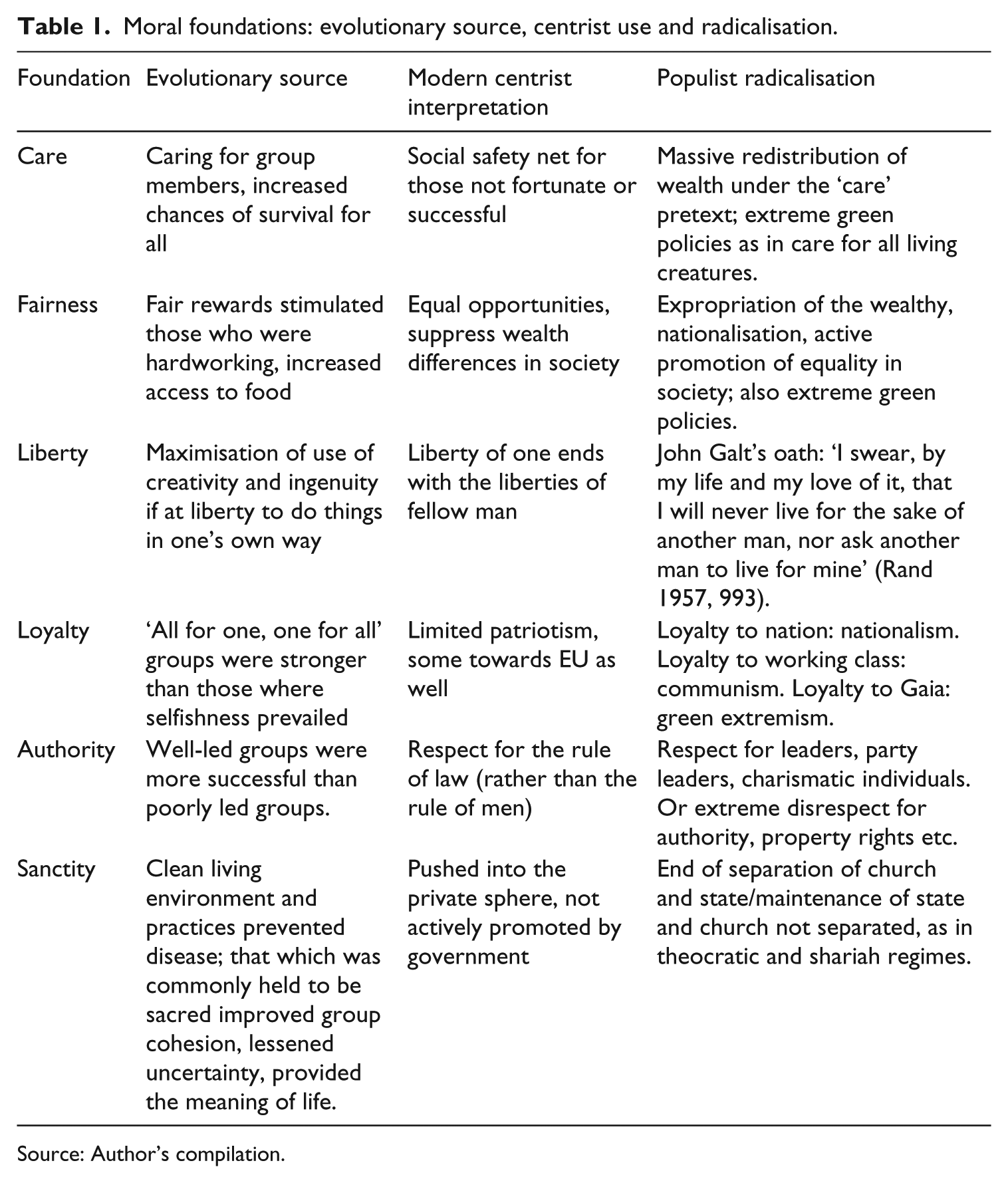
Table 1 presents the author’s analysis of the moral foundations and their relationships to populism, more specifically, to policies that stir up emotions, and exploit people’s prejudices and fears. These policies—addressing not the rational but the passionate side of people—have to be grounded in the same moral foundations as the basis for these emotions and prejudices.
Moral foundations: evolutionary source, centrist use and radicalisation.
Source: Author’s compilation.
Moral foundations and European political families
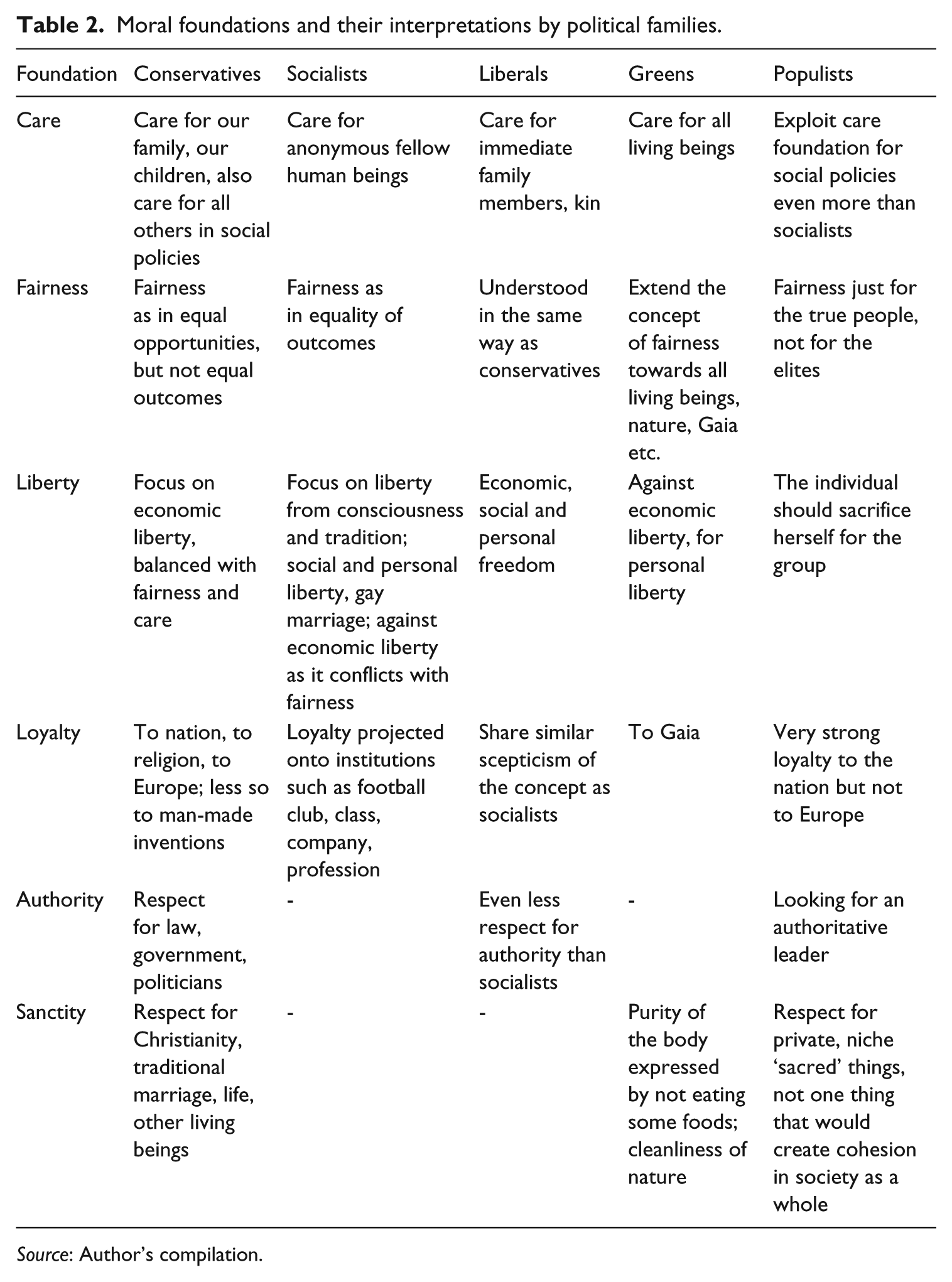
Table 2, below, summarises the attitudes of the political families according to the six moral foundations. Until the emergence of populists, the European People’s Party (EPP) was quite alone in building on loyalty, authority and sanctity. Its attitude towards the care foundation is not too dissimilar to that of the left, but it has a very different attitude to fairness than the left. With liberals it agrees partly on liberty and fairness, but much less on loyalty, authority and sanctity.
Moral foundations and their interpretations by political families.
Source: Author’s compilation.
Any analysis that uses moral foundations theory as its basis would identify populists within each of the foundations, because a key element of populism is playing to emotion.
Moral foundations, populism and subsidiarity
Subsidiarity is the political principle by which decisions are pushed down to the lowest level at which they can be made. In principle, the lower the level on which decisions are made, the more specific they are, particularly at the town and village level where they address tangible investments or particular local institutions. There should be less room for populism on this level. Of the issues listed above, the populists would have limited opportunity to exploit the economy and migration on a local level—for example where local security and jobs are at stake. Locally it is also more difficult to spread fake news and demagoguery about issues because people have first-hand information. The deeper causes listed (see the section on ‘Roots of populism’) have less relevance at the local level than at the national or even EU one. The only advantage populists have on the local level is that they may be more able to address the voters directly. But in general—taking the details of Tables 1 and 2 into account—populists have an easier job on the national level, and an easier one still at the European level. The European level is particularly vulnerable to protests, due to the potential votes by those who believe that politicians have ‘no skin in the game’, as described in trigger 3 and cause 2.
Therefore, Jan-Werner Müller is wrong to stress that ‘it is a matter of urgency to think about the way in which supranational institutions such as the European Union should try to defend liberal democracy from populists-in-opposition and populists-in-government’ (Müller 2013, 138–49). Indeed, it might be tempting for institutions known for their democratic deficit and distance from the voters to do what Müller suggests. If the EU institutions choose to try to save democracies from populists in member states this will (a) only give more strength to the populists’ argument about the undemocratic nature of the EU and (b) set a precedent for interventions from other directions should the populists grow stronger in Brussels. On the contrary, populists should be addressed and defeated using the subsidiarity principle, that is, at the lowest level possible. In this regard, the EPP with its broad moral foundations has some unique opportunities that will be addressed in the conclusion.
Conclusion
From the moral foundations perspective, the strength of the EPP is that it is the only large political family that can sincerely ground its policies on all six foundations. It can, in its messages, address the entire spectrum of beliefs and intuitions that people hold dear. The weakness of the EPP’s position is that it is presented by its competitors as only caring about the latter three foundations—loyalty, respect and sanctity. This is not correct. Its voters care for those as well, but could be won over by the left due to this false assumption. It is recommended that the EPP promotes a strong message about care, fairness and liberty, directed at the authentic interpretation of these foundations: also stressing care within families, fairness that does not support free rides and liberty which does not clash with the sanctity foundation.
The threat to the EPP lies in the trivialisation of the public discourse. Party families that focus on one or two foundations have an easier job of selling their ideas to the public. Also, more extreme and concentrated positions are more likely to go viral. Countering these issues should be dealt with in two ways—(1) stating that there is not one simple solution to everything and (2) acknowledging that reasonable differences should be debated—thus exposing the different understanding of care and fairness among socialists, and that liberty is not a panacea to the liberals. The threat of populism should be addressed by exposing it—as offering few workable solutions—and by using clear and passionate language to defend positive values that are based on all six foundations, not their populist caricatures.
At the first meeting of the Mont Pelerin Society—in 1947, just after the Second World War—Hayek warned of an ‘intolerant and fierce rationalism which in particular is responsible for the gulf which particularly on the Continent has for several generations driven most religious people from the liberal movement and into truly reactionary camps in which they felt little at home’ (von Hayek 1967, 145). In other words, the ‘fierce rationalism’ of the left, of the progressive liberals, and the abandonment of the loyalty, authority and sanctity foundations by the centre–right has driven some voters towards populism. It is the responsibility of the EPP to bring them back—through the use of subsidiarity at European, national and subnational levels.
Footnotes
Author biography