




Abstract
There has been much debate about the causes of trust in abstract groups of strangers such as foreign nations. Some scholars have highlighted the important role of personal experiences in shaping social trust, while others have largely dismissed such experiences. This article suggests that social psychological contact theory, which highlights one particular type of experience, has much to contribute to trust research: accordingly, people’s contact experiences with strangers lead them to generalise from these experiences and undergo a process of social learning. Using original survey data from Poland, this article shows that, consistent with contact theory, pleasant contact experiences with members of specific other nations increase trust in those nations, while unpleasant contact experiences decrease it. The characteristics of different objects of trust do not fundamentally challenge the universalist logic of contact theory. Ultimately, this supports the position that personal experience in adult life matters greatly in shaping trust.
Social trust, or the expectation that others will behave in a predictable and benign fashion (Inglehart, 1991: 145–146), is ‘social glue’. This is not only important within national societies, but also between them. Transnational trust in other nations promotes international cooperation and integration, as in the European Union (Delhey, 2007a; Inglehart, 1991; Verhaegen et al., 2017). It is also a key ingredient of ‘security communities’ that make war between their members virtually impossible (Deutsch et al., 1957). And it influences citizen preferences about foreign policy, such as a preference of internationalism over isolationism (Brewer et al., 2004).
Transnational trust in other nations is, therefore, of great consequence. But what are the causes of such trust? There has been much disagreement over the role of personal experience in stimulating trust. This article shows that we have much to learn from a social psychological theory of intergroup relations: contact theory. Contact theory focuses on the trusters, with particular regard to their contact experiences with members of other nations, and how these experiences influence trust in those nations.
This article outlines contact theory to derive two key hypotheses that will be tested using original survey data from Poland. Poland, like most countries, upholds mobility rights for its citizens and for visitors, and thus permits the main behaviour of interest, namely contact with other nations. At the same time, there is much useful variation in the country’s relationships with its neighbouring nations, which facilitates analysing how the structure of binational relations might impact the effect of contact on transnational trust. The focus is on four neighbouring nations – Germans, Czechs, Ukrainians, and Lithuanians – to hold constant geographical proximity. Including diverse objects of trust in the analysis presents a tougher test for contact theory, which seeks to make universally applicable predictions about human psychology.
The article proceeds as follows: the next section develops hypotheses from contact theory about the effects of contact on transnational trust. The third section introduces the Polish case. The fourth section describes the survey data that is used to test the hypotheses. The fifth section analyses the effects of contact experiences on trust, showing that contact theory correctly predicts that pleasant contact with members of specific other nations correlates with trusting attitudes towards these nations at large. Unpleasant contact has the opposite effect. Given crucial differences between the four neighbouring nations in question, the consistency of the results is truly striking. This constitutes powerful evidence in favour of contact theory’s claim to universalism. It also shows just how much contact theory has much to contribute to the study of social trust.
The Roots of Social Trust
Definitions
Social trust in other people is notoriously difficult to define, but a good starting point is to build on the truster’s expectations of others. For example, Kenneth Newton (2007) has defined it as ‘the belief that others will not deliberately or knowingly do us harm, if they can avoid it, and will look after our interests, if this is possible’ (p. 343). In a similar vein, trust is defined here as the expectation that other people will behave in a predictable and benign fashion (Inglehart, 1991: 145–146).
A distinction is generally drawn between ‘thick’ trust on one hand, and ‘thin’, more abstract social trust on the other hand. ‘Thick’ or particularistic trust focuses on specific individuals whom we know personally, such as family and friends or members of close-knit small communities. Conversely, ‘thin’ trust involves trusting more abstract, larger groups of strangers whom we do not know to be trustworthy (Newton, 1999, 2007). One of the core concepts in social science – general social trust, or the degree of trust in ‘most people’ – is a form of thin social trust, as it refers to an abstract group of people.
The distinction between thick and thin trust touches on the crucial question of where trust comes from. Thick trust is sometimes described as rational trust, as it is reasonable to trust people whom we have experienced to be trustworthy (Hardin, 1993). However, there is vociferous disagreement over the role of people’s personal experiences in shaping their ‘thin’ trust in others. Some scholars have virtually written off experience altogether. They treat trust as a personality trait or, at most, as a result of socialisation in childhood and early adulthood (Fukuyama, 1995; Uslaner, 2002).
In contrast, others have captured experience through indicators of life success and experiences in adult life, such as being a victim of a crime (e.g. Brehm and Rahn, 1997; Zmerli and Newton, 2011). Perhaps, most importantly, the social capital literature, which places heavy emphasis on trust, indicates that adults can be socialised into developing a sense of trust in ‘most people’. For example, Robert Putnam (2000) has highlighted the role of civic associations in spreading civic norms among their members. Accordingly, associational activity with other members of bowling leagues, birdwatching societies, or after-school clubs teaches individuals that most people are trustworthy (see also Brehm and Rahn, 1997). However, the causal direction between associational activity and general social trust is difficult to establish (Stolle, 2003; Uslaner, 2003; Whiteley, 1999), and empirical studies have found only weak links between civic activism and general social trust (Delhey and Newton, 2003; Wollebæk and Selle, 2003).
In short, it is difficult to identify the role of personal experience in stimulating general social trust (Newton, 2007). This is at least in part because the object of general social trust is so unclear. The standard survey question gauging trust in ‘most people’ is rather imprecise (Delhey et al., 2011; Nannestad, 2008; van Hoorn, 2015), and there is some evidence that different people interpret the ‘radius of trust’ implied by the question very differently (van Hoorn, 2015: 270; see also Delhey et al., 2011; Fukuyama, 2000).
Conversely, transnational trust in other nations is more specific with regard to its object, while still generally being deemed an example of ‘thin’ trust, as other nations are fairly specific groups comprised people who are not like us in at least one important respect, and they generally involve a lot of people whom we do not know personally. For example, Delhey et al. (2011) argue that trust in out-groups such as people of a different nationality approximates general social trust. Similarly, Newton (1999) has noted that increases in transnational trust over time are due to a shifting basis of social trust from ‘thick’ and particularistic to ‘thin’ and more abstract, again indicating that trust in other nations is a form of thin, abstract trust.
A focus on trust in specific nations permits analysing the causes of trust, specifically the role of personal experience. Such a focus allows us to analyse whether and how contact with members of specific other nations leads people to develop trusting attitudes towards these nations more generally (Boehnke and Rippl, 2012: 1089). There are good theoretical reasons to believe that contact is an important explanatory variable, and the next section outlines why this is the case.
The Role of Contact in Fostering Trust
Early theories of European integration, above all Karl Deutsch’s transactionalism, have important implications for the analysis of transnational trust. Deutsch et al. (1957) argued that spontaneous interactions between different nations would bring about shared interests and feelings of natural affection. With deepening integration, they expected that a sense of trust would develop, a we-feeling, and finally, a shared identity. Originally, transactionalists considered integration within a security context (Adler and Barnett, 1998; Deutsch et al., 1957; Puchala, 1970), but the theory has since been applied to European identity (Fligstein, 2008), support for European integration (Kuhn, 2015) and enlargement (Jones and van der Bijl, 2004), as well as transnational trust (Delhey, 2007b; Klingemann and Weldon, 2013; see also Díez Medrano et al., 2019).
However, some problems inherent in transactionalism limit its usefulness as a theory of transnational trust. The first is that the individual-level mechanisms that would result in transnational integration are never specified (Klingemann and Weldon, 2013). Some recent applications that focus on the individual-level aside (e.g. Díez Medrano et al., 2019; Fligstein, 2008; Kuhn, 2015), there is a heavy emphasis in transactionalist works on the aggregate level of analysis. Mail flows, tourism, or trade between countries are taken as indicators of the transactions expected to promote overall binational trust (Delhey, 2007b; Deutsch, 1954; Jones and van der Bijl, 2004; Klingemann and Weldon, 2013). This use of aggregate indicators makes it difficult to isolate the reasons for change at the individual level. Second, and more importantly, any type of contact is seen as conducive to the development of a community spirit, trust, and a shared identity. This ignores the possibility that some contact may be experienced negatively, which is more likely to hamper the development of trust.
A long-standing body of social psychological research into intergroup relations and prejudice – so-called contact theory – shares many similarities with transactionalism, notably its emphasis on interactions driving social change. At the same time, in its focus on the individual level, the theory explores the micro-level mechanisms for change, and directs the researcher’s attention to the quality of contact.
Originally developed by the influential psychologist Gordon Allport in the 1950s, contact theory focuses on prejudice between social groups and stipulates that personal contact diminishes such prejudice through a process of social learning. Accordingly, personal interactions between members of different – and previously hostile or alienated – groups lead those involved to revise their prejudices (Allport, 1979; Pettigrew and Tropp, 2011). This is the result of learning from the individual experience. And because people tend to generalise from such encounters (Brown et al., 1999; Pettigrew and Tropp, 2006), they will often develop more favourable attitudes towards these groups at large.
Contact theory began as a theory of relations between different ethnic groups in the United States. However, it has been shown to apply to other intergroup dynamics, including attitudes towards homosexuals (Herek and Capitanio, 1996; Lance, 1992), international student experiences (Mitchell, 2015; Visbal, 2009), contact with political opponents (Mutz, 2002), and transnational attachment in the European Union (EU) (Deutschmann et al., 2018). Trust researchers have certainly not been oblivious to contact theory (e.g. Deutschmann et al., 2018; Newton, 2007; Stolle et al., 2008), but have yet to take on board the lesson that, if correct, contact theory would provide yet more powerful reasons for taking personal experience seriously as a driver of trust, while drawing our attention towards the quality of that experience.
Contact theory identifies several favourable conditions under which contact improves group relations. Allport (1979: 262–263) himself listed 30 variables that would shape the effect of contact on prejudice, including among others its frequency and duration, the social status of the participants, the social atmosphere, and the personality of the participants. Many of these, such as the question of whether contact is between people of a comparable social status (Jackman and Crane, 1986) or whether the contact situation is competitive or cooperative (Sherif, 1966), have subsequently been analysed in great depth. Allport’s conditions and the later research into them would suggest that contact only has the anticipated effect under a highly selective set of circumstances. However, more recently, a meta-analysis has shown that ‘intergroup contact is universally useful in reducing prejudices across a great range of intergroup situations’ (Pettigrew and Tropp, 2011: 60, emphasis added) and that Allport’s conditions are facilitating, rather than necessary, conditions of social learning. Indeed, it was found that the only necessary condition is for contact to be perceived as positive, or pleasant (Pettigrew and Tropp, 2011; Pettigrew et al., 2011, see also Stein et al., 2000). Conversely, contact that is perceived as unpleasant – perhaps because the contact situation itself is seen as threatening – often leads to a deterioration in group relations (Amir, 1976). In other words, the state of the art in contact theory makes strong claims about universal human psychology, while emphasising that the quality of the experience is vital.
Two individual-level hypotheses can be derived from these considerations. First, contact theory clearly suggests that pleasant personal contact reduces prejudice. If there is any mileage in the notion that similar social learning and generalisation processes are at work in stimulating transnational trust, then one would expect the experience of pleasant contact with members of another nation to produce greater trust in that nation at large:
H1. Having experienced pleasant contact with members of another nation correlates with higher trust in that nation.
The most important prerequisite is that contact be pleasant to have the anticipated positive effect. Its frequency is of minor importance compared with this. Conversely, contact with members of other nations that is perceived as unpleasant will likely depress trust in those nations more generally:
H2. Having experienced unpleasant contact with members of another nation correlates with lower trust in that nation.
Theories of Differentiation
Social psychological explanations of transnational trust must focus on the truster. As shown in a meta-analysis (Pettigrew and Tropp, 2011), they are universalist, as they are expected to apply to any contact situation, with the quality of the contact as the main explanatory variable of interest. However, it follows that they tend to neglect the object of trust. In contrast, building on the work of Ronald Inglehart (1991) as well as Deutsch (1954), social scientists have argued that the object of trust is, in fact, crucial because people discriminate between distinct nations in their trust. The factors that contribute towards a nation’s image of trustworthiness include its modernity, culture, and perceived menace.
Modernity covers economic and political facets of development. Higher levels of socio-economic development tend to be associated with higher perceived trustworthiness (Delhey, 2007a; Genna, 2017; Inglehart, 1991; Klingemann and Weldon, 2013). Moreover, nations perceived as ‘modern’ are admired and, therefore, more trusted (Kleiner, 2014, 2016; Sztompka, 1999). For example, Jan Delhey (2007a) captured different dimensions of perceived modernity, including socio-economic development, political and civic liberties, as well as good governance, and found them to be positively related to trust.
Cultural similarity: A cross-national study by Inglehart (1991) showed the importance of ‘primordial ties’. In other words, nations regarded as culturally similar to one’s own are generally more trusted than those that are seen as more dissimilar (see also Delhey, 2007a, 2007b; Klingemann and Weldon, 2013). Language family and religion are particularly important indicators of this cultural similarity.
Threat: Inglehart (1991) noted that perceptions of threat would diminish trust. He showed that a large population, geographical size, and experience of past conflict would induce feelings of threat and thus diminish trust (see also Delhey, 2007a; Deutschmann et al., 2018).
Some scholars have used these attributes to explain their effect on trust in different nations directly (Delhey, 2007a; Kleiner, 2014; Klingemann and Weldon, 2013), but Inglehart (1991) also noted a possible influence of these three factors on social learning. Accordingly, perceptions of threat tend to hinder social learning from experience, while cultural similarity facilitates it. However, Inglehart (1991) also argued that cultural ties were gradually being superseded by commercial ties that were becoming more important in facilitating social learning, and thus that social learning would above all occur in dealings with economically more developed countries, as compared to less developed ones. Accordingly, processes of social learning, as also captured in contact theory, might affect trust in different nations differently, depending on their modernity, cultural similarity, and perceived menace. In all this, Inglehart implied that social learning would lead to increased trust. In other words, he overlooked the possibility that social learning from unpleasant experiences might depress trust, an oversight which vividly illustrates that contact theory tends to be a blind spot in trust research.
Theories of differentiation are important because they would seem to present a plausible challenge to contact theory. At the very least, any serious empirical analysis of the effects of contact experiences on transnational trust must ensure that there is variation in the objects of trust, in terms of modernity, cultural similarity, and threat. Including nations that are perceived as threatening, that are culturally dissimilar, and that have lower levels of socio-economic development – effectively to give contact theory the best chance of failure – makes for a more conservative test of this theory. In turn, passing such a test would constitute impressive evidence in favour of contact theory’s universalist claims.
The Polish Case
This study is based on a survey of Poles regarding their trust in four of Poland’s neighbouring nations – Germans, Czechs, Ukrainians, and Lithuanians. The focus is on neighbouring nations in order to hold constant geographical proximity, not least because cross-border contact is more likely between neighbouring countries (Deutschmann, 2016). Poland was chosen because its neighbouring nations vary significantly in terms of modernity, culture and threat. As Poland upholds mobility rights for citizens and visitors and thus permits the very behaviour of interest, namely contact with other nations, it makes for a useful test case of contact theory’s universalist claims about human psychology. However, even with a ‘typical case’ (Gerring, 2007) such as this, one must bear in mind a country’s idiosyncrasies that may limit its usefulness for generalising to a larger set of cases. Considering this, a short outline of the Polish case follows.
Renata Siemieńska (1994) has noted Poles’ generally low level of trust in other nations. However, past research with a focus on the concept of liking suggests that Poles draw clear distinctions between different nations: generally, there is a certain antipathy for nations from the former communist bloc, particularly Ukrainians (Bokczański, 2002), though this may have changed in light of Russia’s 2022 invasion of Ukraine. Czechs are the only exception to this rule, as they are generally well-liked in Poland (Bokczański, 2002). Traditionally, Germans are disliked. This is hardly surprising given that Germany’s brutal occupation of Poland during the Second World War forms part of Poles’ cumulative experience with Germans. However, there is evidence that liking of Germans has increased after the end of communism (Bokczański, 2002; Siemieńska, 1994). Liking is conceptually different from trust, but in light of theories of differentiation, it is to be expected that Poles will also differentiate between different nations in their transnational trust. In particular, the effect of contact on trust may differ between different objects of trust: for some nations, such contact may have little or no effect; for others, the effect could be considerable.
To take account of the issues identified by theories of differentiation, Table 1 displays 10 indicators of modernity, cultural similarity, and threat perceptions for each of the nations in question. Where appropriate, Poland is also included as the comparator.
Modernity, Culture and Threat Compared (2017).
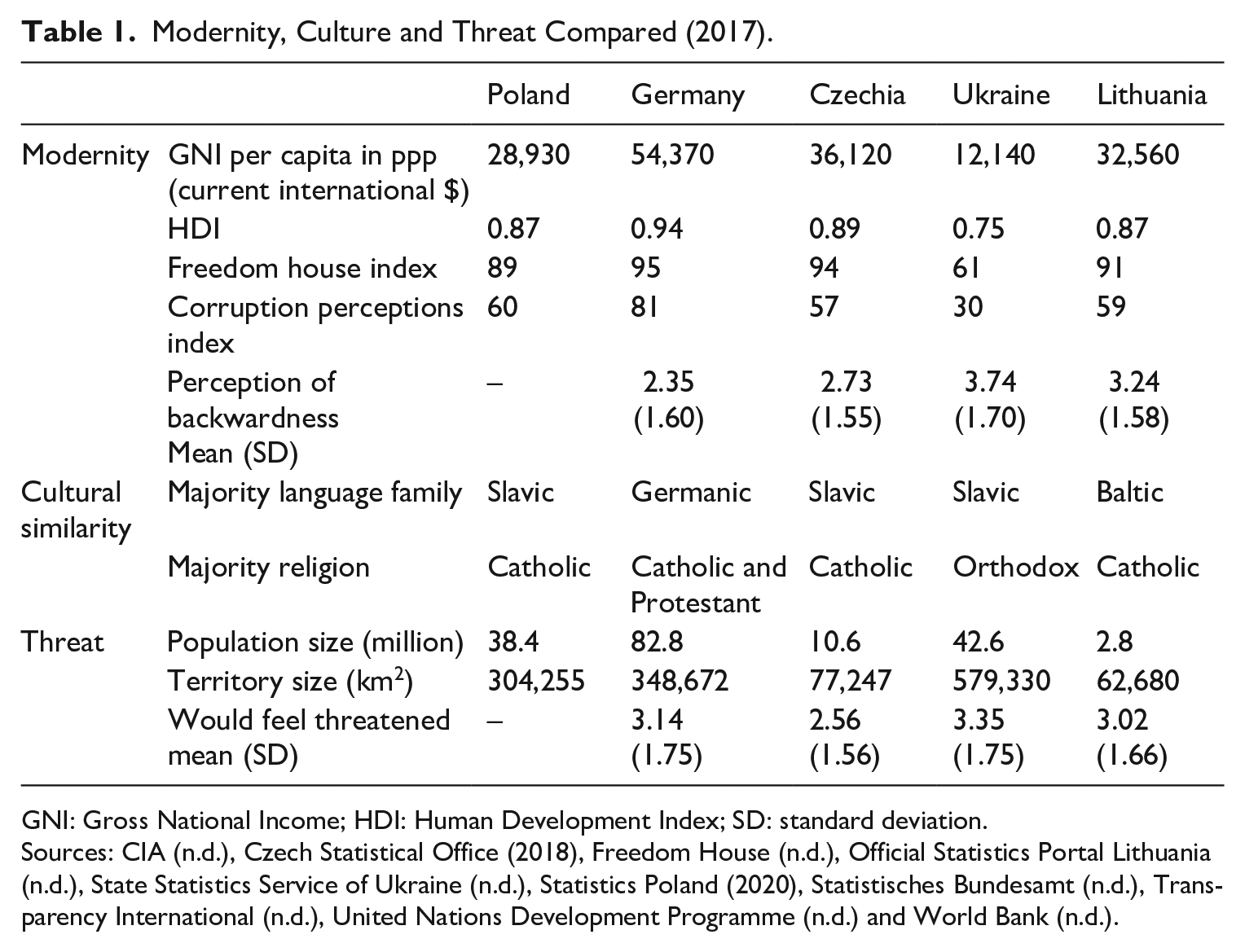
GNI: Gross National Income; HDI: Human Development Index; SD: standard deviation.
Sources: CIA (n.d.), Czech Statistical Office (2018), Freedom House (n.d.), Official Statistics Portal Lithuania (n.d.), State Statistics Service of Ukraine (n.d.), Statistics Poland (2020), Statistisches Bundesamt (n.d.), Transparency International (n.d.), United Nations Development Programme (n.d.) and World Bank (n.d.).
Table 1 shows that, in terms of modernity, Germany stands out as the country with the highest Gross National Income (GNI), Human Development Index, Freedom House score and a high score on the Corruption Perceptions, suggesting that it has very clean public sector. This is also reflected in a survey item, where Poles were asked to assess how backward they thought each nation was on a 1–7 scale. On this, Germans scored lowest, indicating they were seen as the least backward – that is, the most advanced – nation out of the four presented here. Conversely, Ukraine consistently scored lowest on all indicators of modernity, and Ukrainians were also seen as the most backward nation by Poles. Czechia and Lithuania are, in many ways, comparable to Poland. Czechs were seen as more modern than Lithuanians, though not to the same degree as Germans, who were clearly the nation perceived as the most modern out of the four.
Table 1 also shows that Czechs are the most culturally similar nation to Poles, as they speak a language from the same Slavic language family. Polish and Czech are not quite mutually intelligible but share numerous similarities. Like Poles, Czechs are also majority Catholic, though religiosity is considerably lower in Czechia than in Poland. The three other nations share some but not both indicators of culture with Poles, with Ukrainians speaking Slavic languages but being majority Orthodox, Lithuanians being mostly Catholic but speaking a Baltic language, and Germans speaking a Germanic language, with Protestantism and Catholicism being equally significant (or insignificant). This marks Czechs out as the most culturally similar nation to Poles out of the four presented here.
In terms of threat, both Germany and Ukraine are larger and more populous than Poland, which previous research suggests may make them appear more threatening (Delhey, 2007a; Deutschmann et al., 2018; Inglehart, 1991). Poland has been at war with all four nations in question in the twentieth century, but some memories are more likely to endure than others. For example, in contrast with the Polish-Czechoslovak War of 1919, the German attack on Poland in 1939 that started the Second World War and the ensuing brutal occupation period are still very much present in living memory (Snyder, 2002). The atrocities committed in the 1940s in what has been termed the ‘Polish-Ukrainian civil war’ (Snyder, 2002: 41) are also still remembered. Ukrainians score somewhat higher than Germans on a survey item measuring how threatened a respondent would feel during an encounter with Ukrainians (again measured on a 1–7 scale), but, on balance, Germans and Ukrainians are clearly seen as more threatening than Czechs or Lithuanians, which may preclude any social learning from contact experiences.
To be sure, a focus on four neighbouring nations – albeit analytically beneficial – brings certain limitations. Poles can likely draw on at least some knowledge of their neighbouring nations, even if they have had no personal experience. This may not be the case with nations from farther afield – such as Belizeans – that offer fewer historical and geographical reference points to at least some Poles. And while Germans, Czechs, Ukrainians, and Lithuanians differ in terms of their modernity, cultural similarity, and perceived threat, the variation is confined by the decision to focus on neighbouring nations. For example, all the nations in question share at least one cultural similarity with Poles, whereas nations that predominantly speak East Asian languages or predominantly adhere to faiths other than a form of Christianity, would be classified as culturally more dissimilar than the four presented in Table 1. Moreover, the variation on threat perception is limited by the exclusion of Russians, who have long featured prominently as a perceived threat in Poland, a perception likely to have been exacerbated by the 2022 Russian invasion of Ukraine.
Nevertheless, including Germans, Czechs, Ukrainians, and Lithuanians makes for a more conservative test of contact theory than including just one nation such as Czechs, who are culturally similar, perceived as unthreatening and quite modern. In other words, if it were found that pleasant contact has little effect on trust in the most threatening nations, this would constitute a powerful rebuttal to the universalist claims of contact theory. Likewise, if such an effect existed only for the most culturally similar or the most economically advanced nations, then this, too, would challenge these universalist claims.
Methods
The analysis is based on a computer-assisted face-to-face survey commissioned from Ipsos Poland among 1,502 Poles in 2016 and 2017. Sampling was carried out randomly within 223 pre-defined geographical strata at the municipal level to ensure a good spread of urban and rural municipalities of different sizes (see Figure 1).
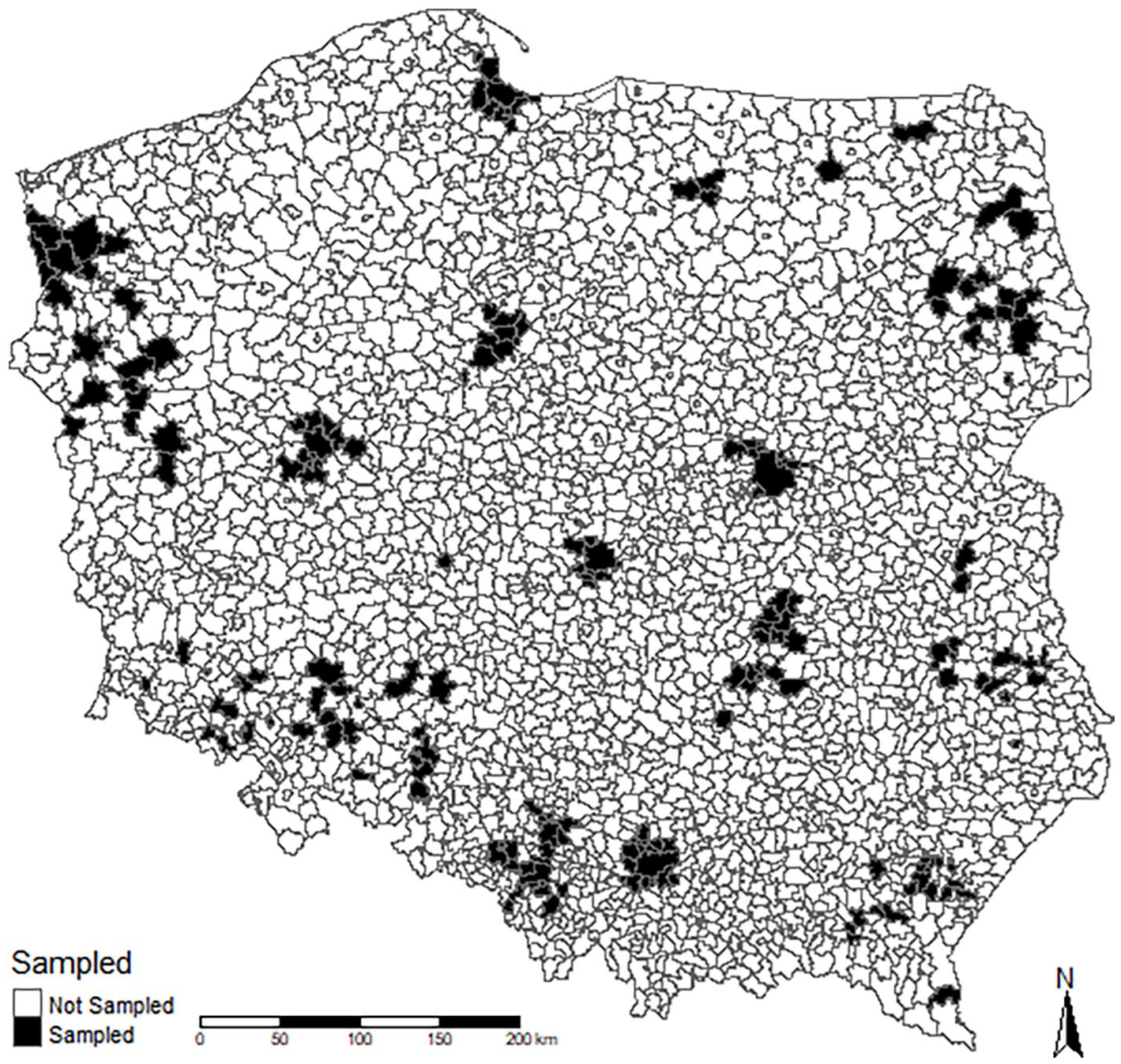
Map of Polish Municipalities Surveyed.
Ipsos interviewers visited participants’ homes and conducted computer-assisted personal (CAPI) interviews. The dependent, independent and control variables are outlined in turn below (see Online Appendix 1 for question wording and codes). 1
Trust: Respondents were asked to express their trust in people from Germany, Czechia, Ukraine, and Lithuania. Trust was measured on a four-point ascending scale.
Social proximity: A measure of perceived distance from (or, if reverse-coded, proximity to) different ethnic groups was first developed by Emory Bogardus (1933; see also Bogardus, 1958), and has been used successfully as an indicator of trust (Lancee and Dronkers, 2011). Bogardus’ social distance scale measures acceptance of these groups in various social roles, including as a colleague, as a close friend, or as a family member by marriage (Parrillo and Donoghue, 2005, 2013). In the present context, respondents were asked to express, on a four-point scale, how comfortable they would feel with a member of the nationality in question as a next-door neighbour, as a work colleague, as their boss, as a close friend, and as a family member through marriage. Responses were combined into a social proximity scale ranging from 1 (which means that the respondent is very uncomfortable with a member of this nation in all five roles) to 16 (which means that a respondent is very comfortable with a member of this nation in these roles). 2
Pleasant contact: Each respondent was asked how frequently he or she has had contact with members of each of the four nations in question. Those who have had such contact, either frequently or rarely, were also asked whether this contact was rather pleasant or rather unpleasant. 3 Based on the finding that contact being experienced positively is the only necessary condition for improved perceptions (Pettigrew and Tropp, 2011), an individual-level indicator of pleasant contact was created from these variables. This was dummy-coded to indicate whether a respondent has recalled mostly pleasant contact with members of the nations in question, regardless of how frequently, or not.
Unpleasant contact: As unpleasant contact is expected to depress trust (Amir, 1976), another individual-level indicator was created to indicate whether a respondent has recalled mostly unpleasant contact with members of the nations in question or not, regardless of how frequently.
Two individual-level control variables are particularly important in addressing any potential problems regarding the causal direction between contact and trust: general social trust and xenophobia. It is plausible that particularly trusting individuals would self-select into contact with members of other nations, rather than contact increasing trust. Moreover, it has been noted that a higher level of general social trust strongly pre-disposes people towards specific trust (Knippschild, 2008), raising the possibility that it is general social trust, rather than the contact experience, that stimulates transnational trust. Likewise, it is to be expected that individuals with xenophobic attitudes will avoid such transnational contact as much as possible. To address the potential endogeneity, it is necessary to control for prior attitudes such as people’s generally trusting disposition, as well as their overall stance on foreigners. As both of these are fairly general attitudes, and as the causal path usually goes from the general to the specific (Davis, 1985), this strategy makes it possible to isolate the relationship between contact with members of specific groups and attitudes towards these groups. Thus, the control variables are as follows:
General social trust: This was measured using the standard question from the World Values Survey which reads ‘Generally speaking, would you say that most people can be trusted, or that you can’t be too careful in dealing with people?’ with responses recorded on an 11-point scale.
Xenophobia: A scale measuring what one might call xenophobia was created from agreement with the following four statements:
• I try to stay away from foreigners.
• I would not want to move into an area where there are many foreigners.
• When jobs get scarce, we should send the foreigners who live in Poland back to where they came from.
• Foreigners who live in Poland should choose a spouse among their own country fellows. 4
Demographic control variables: These include respondents’ sex (noted by the interviewer) and age (calculated from their year of birth). As people who are more highly educated also tend to be more trusting (Brehm and Rahn, 1997), education was included as a control variable that was dummy-coded to distinguish between those who have a secondary education qualification and those who do not. Furthermore, it has been shown that ‘winners’ in society, such as the affluent, tend to have higher levels of trust (Zmerli and Newton, 2011). Therefore, a measure of subjective perceptions of income was included in the analysis. This is measured on a scale that is used in the European Social Survey and that ranges from 1 (‘finding it very difficult on present income’) to 4 (‘living comfortably on present income’).
Sampling took place in the following two stages: (1) a sample of 223 municipalities and (2) a sample of 1,502 individuals within these municipalities. Multi-level modelling is the ideal form of analysis for a two-stage sampling process, as well as an uneven number of observations within primary sampling units. Random intercepts models were chosen because they were generally the most efficient. Random slopes models were also run with pleasant and unpleasant contact as the random coefficients, but most of these models were not an important improvement over the random intercepts models, and they were often substantially less parsimonious, which is why they were relegated to Online Appendix 3 as additional robustness checks.
Results
The first dependent variable – straight trust – is measured on an ordinal scale. Thus, ordinal logit regressions were fitted, which model the odds of expressing a higher level of trust compared to a level of trust below or equal to category m. Underlying this type of model is the proportional odds assumption, which holds that the independent variables have the same effect across all comparisons of answer categories (O’Connell, 2006: 29). However, for the proportional odds models of straight trust, Brant tests indicated that several of the key independent variables violated the proportional odds assumption. Partial proportional odds models showed that the key shift was from Categories 1–3 to Category 4. Therefore, Categories 3 and 4 were merged for the final analysis, which resolved the issue, except for unpleasant contact with Lithuanians, which continued to violate the proportional odds assumption. 5
Table 2 presents the results of regressing this new three-point variable measuring trust on pleasant contact and unpleasant contact. The table displays a random intercepts model, where unobservable heterogeneity at the municipal level is accounted for in an additional error term, here expressed in terms of the variance of the intercept. 6
Random Intercepts Ordinal Models of Trust (3-Point Scale).
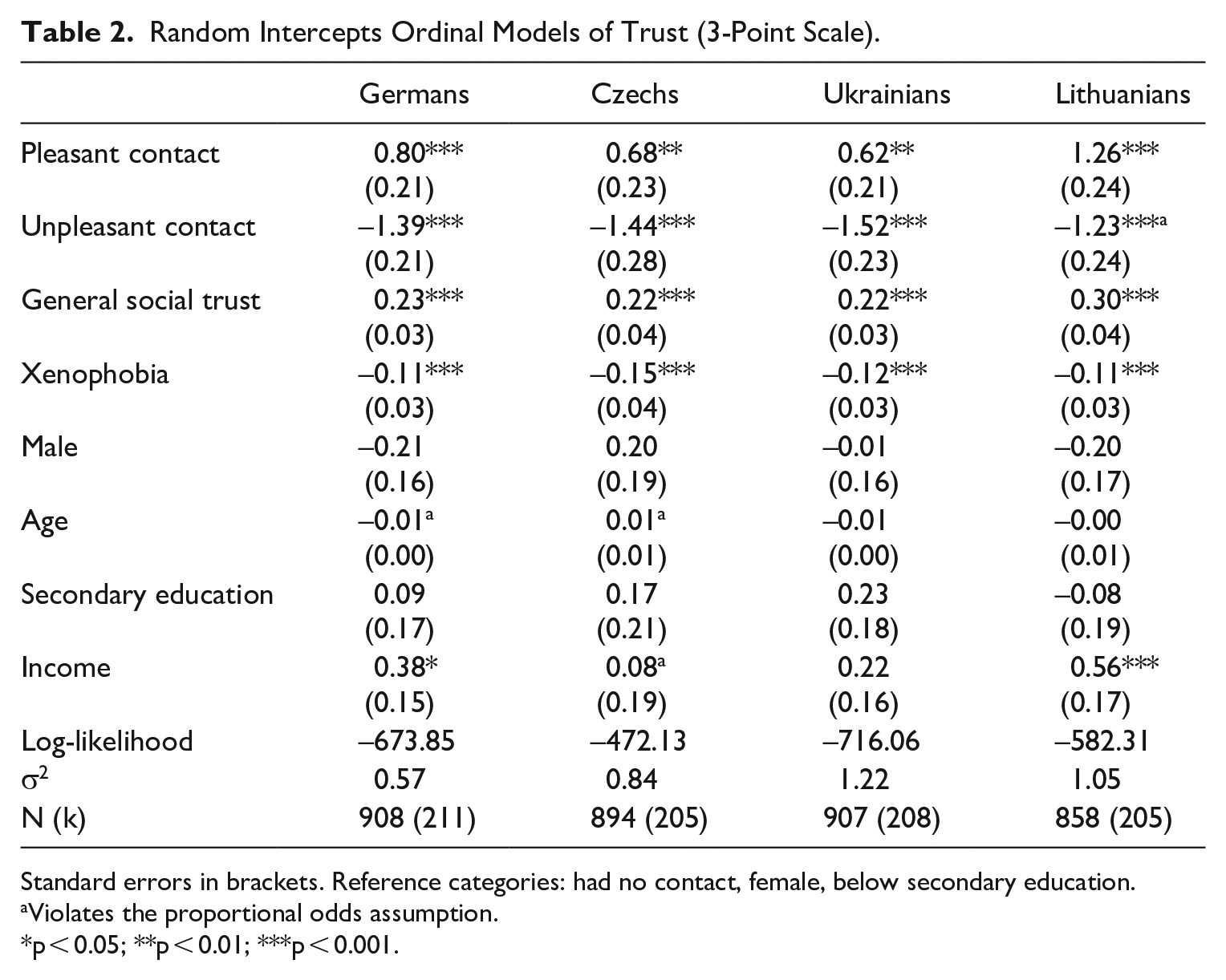
Standard errors in brackets. Reference categories: had no contact, female, below secondary education.
Violates the proportional odds assumption.
p < 0.05; **p < 0.01; ***p < 0.001.
The table shows that, consistent with H1, pleasant contact with the four nations in question correlates positively with trust in these nations. The effect is strongest for Lithuanians: having experienced pleasant contact with Lithuanians increases the logged odds of expressing a higher level of trust in them by 1.26. The effect of pleasant contact with Germans, Czechs, and Ukrainians also increases the logged odds of expressing a higher degree of trust, though to a lesser extent. Similarly, consistent with H2, unpleasant contact depresses trust. The effect is significant and negative for all nations in question, though strongest for Ukrainians and Czechs, followed by Germans and Lithuanians. The fact that the slope coefficients vary slightly between these four nations is hardly surprising, given that they are based on answers to survey questions about different nations, and given different samples resulting from missing data. 7
Among the control variables, higher levels of general social trust increase the logged odds of expressing a higher level of trust in Germans, Czechs, Ukrainians, and Lithuanians, while higher levels of xenophobia decrease them, as anticipated. None of the demographic controls have a consistent effect in the four regression models. Sex, age, and education have no statistically significant effect, while a higher income increases the chances of expressing trust, but only in Germans and Lithuanians.
Because the logged odds are difficult to interpret, Table 3 displays the changes in the probabilities of expressing ‘definitely no trust’, ‘rather no trust’ and at least some trust in the four nations for discrete changes (from 0 to 1) in pleasant and unpleasant contact. All the other variables are held at their mean or, for the categorical variables, their mode (Scott Long and Freese, 2014). The most immediately helpful information in Table 3 is in the right-hand side column indicating the changes in the probabilities of expressing at least some trust in these nations. All else being equal, the probability of expressing trust in Germans is 14 percentage points higher if someone has experienced pleasant contact with Germans compared to not having done so. For Czechs, it is 8 percentage points higher, for Ukrainians 11 percentage points, and for Lithuanians 19 percentage points. Correspondingly, the probability of expressing ‘definitely no’ or ‘rather no’ trust in these nations is lower across the board if someone has had a pleasant contact experience. These effects are all statistically significant.
Discrete Change in Probability of Trust Category m for Change from 0 to 1 in Pleasant and Unpleasant Contact.
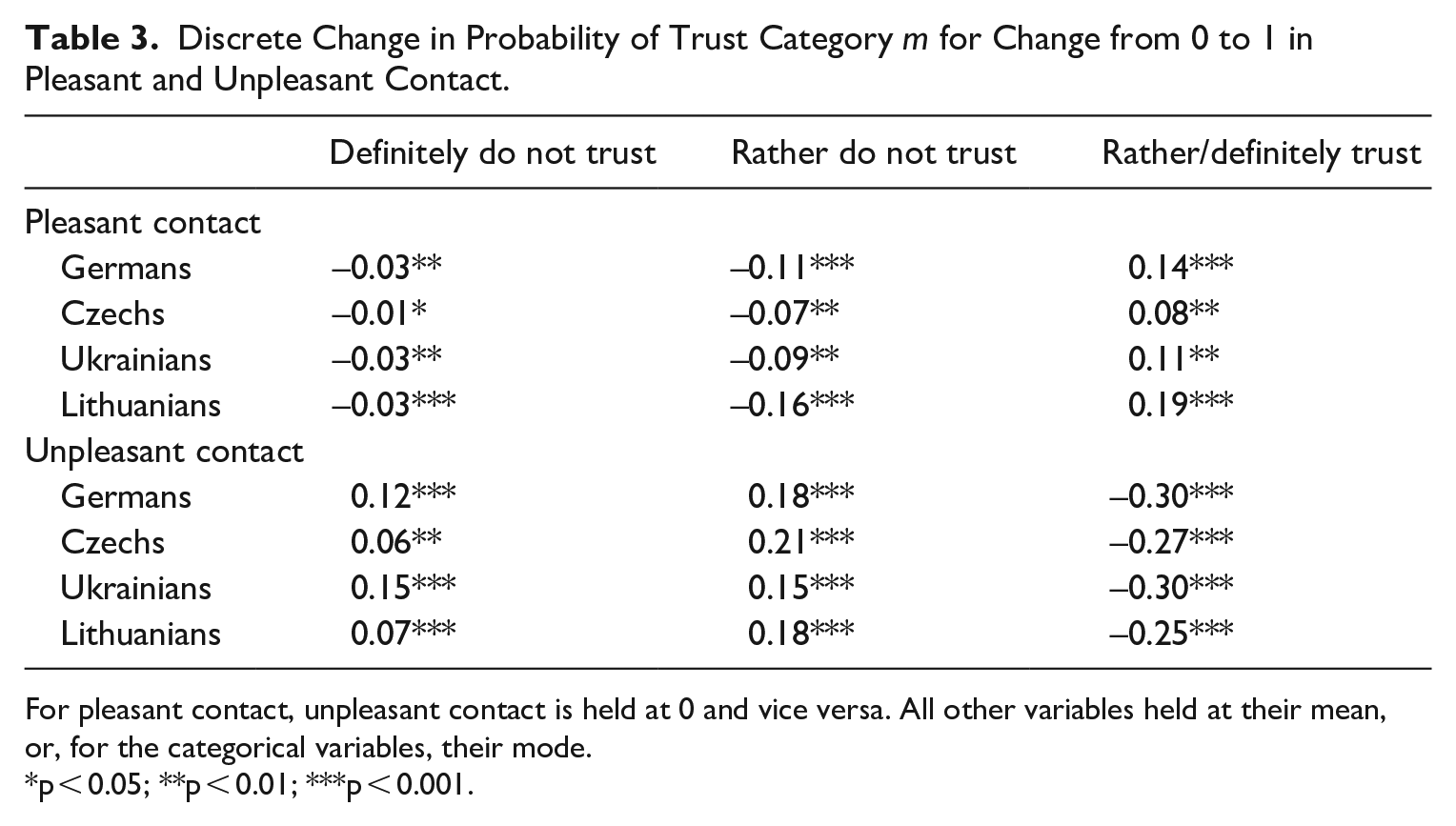
For pleasant contact, unpleasant contact is held at 0 and vice versa. All other variables held at their mean, or, for the categorical variables, their mode.
p < 0.05; **p < 0.01; ***p < 0.001.
Having experienced unpleasant contact with Germans and Ukrainians, in turn, is associated with probabilities of expressing trust in these nations that are 30 percentage points lower compared to people who have not experienced such unpleasant contact. For Czechs and Lithuanians, they are 27 and 25 percentage points lower respectively. This lends support to the key propositions of contact theory, namely that there is a positive relationship between pleasant personal contact and trust and a negative relationship between unpleasant contact and trust.
Therefore, H1 and H2 cannot be rejected. However, there is no evidence that would suggest any challenge to contact theory from theories of differentiation. There are no clear patterns suggesting that pleasant contact has any greater effect on trust in Czechs as the culturally most similar nation or on trust in Germans as the most modern one. The positive effect of pleasant contact on trust in other nations applies to all four nations. Nor does it appear that the greater perceived threat from Germans and Ukrainians makes social learning from contact with these nations more difficult than in the case of Czechs and Lithuanians. Indeed, the differences in effect sizes of contact (i.e. the effect on the logged odds of expressing a higher level of trust) on trust are fairly minor. This suggests that pleasant contact has a universally positive effect on trust at the individual level, and that neither of Inglehart’s stipulated relationships have any obvious bearing on social learning vis-à-vis the nations included in this analysis. It also suggests that, consistent with contact theory, unpleasant contact with members of other nations, depresses trust in these nations more generally. Again, this effect is universal across the four nations considered here.
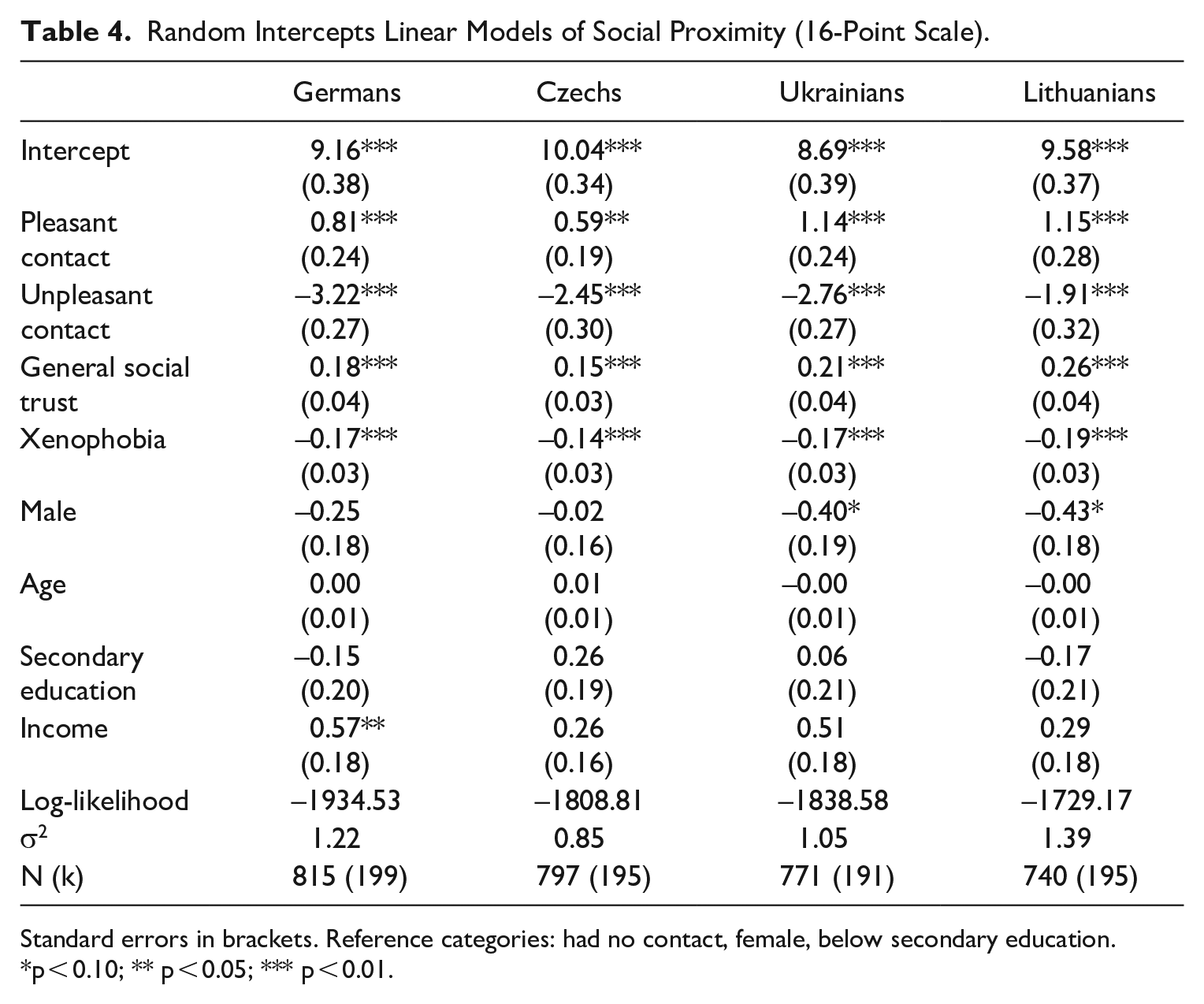
Social proximity has been used productively as an indicator of trust (Lancee and Dronkers, 2011). Table 4 and Figure 2 display the results of the linear regression of a sense of social proximity (measured on a 16-point scale) on pleasant contact and unpleasant contact, as well as the control variables. Table 4 again displays random intercepts models to allow for unobserved and unobservable heterogeneity at the municipal level.
Random Intercepts Linear Models of Social Proximity (16-Point Scale).
Standard errors in brackets. Reference categories: had no contact, female, below secondary education.
p < 0.10; ** p < 0.05; *** p < 0.01.
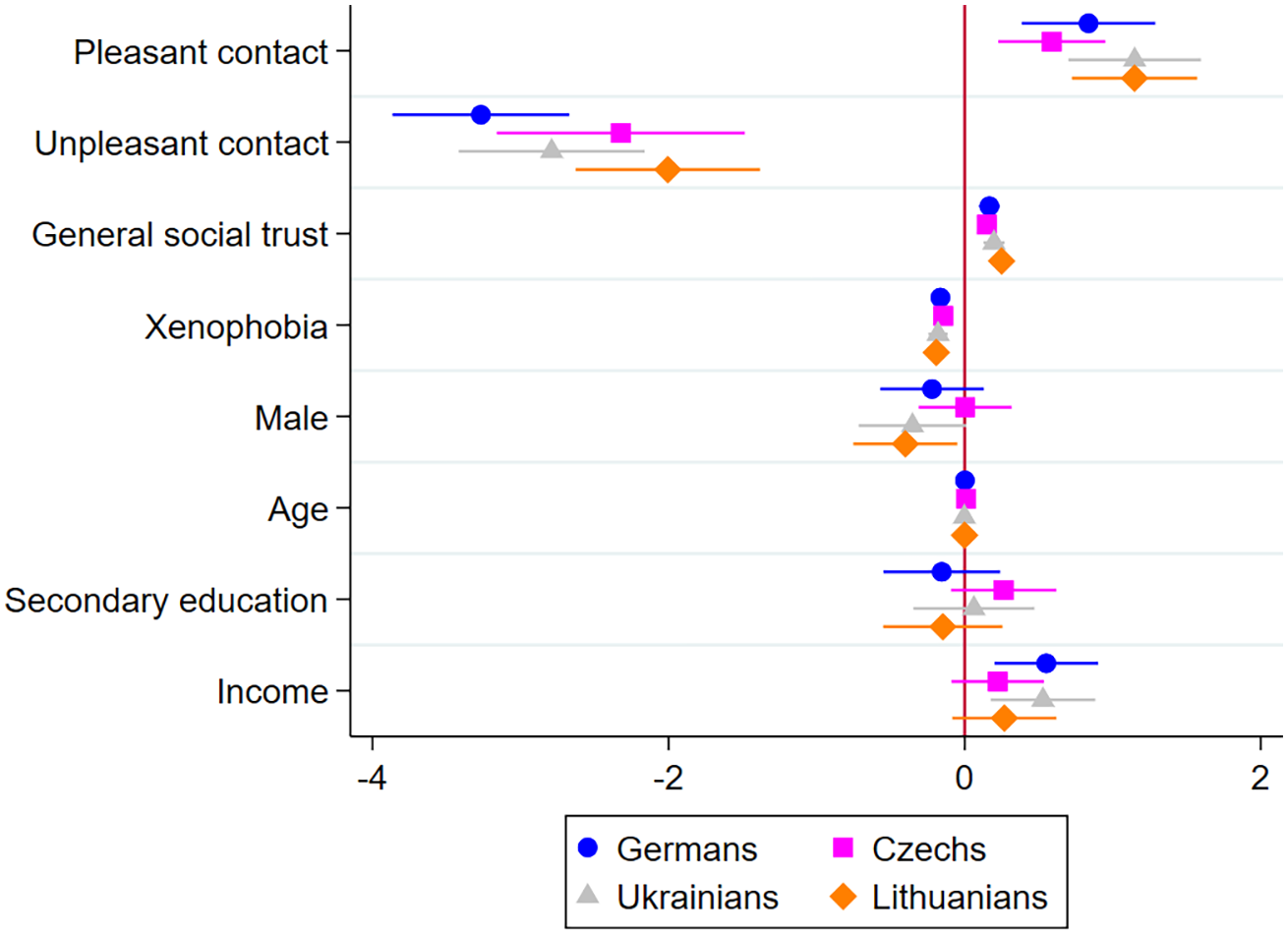
Effects on Social Proximity with 95% Confidence Interval.
These results closely mirror the patterns discovered in the analysis of trust. Having had pleasant contact increases a sense of social proximity with Lithuanians by 1.15, and by 1.14 for Ukrainians. At 0.81 and 0.59 respectively, the effect is smaller for Germans and Czechs but significant nonetheless. The effects of unpleasant contact are considerable: having had such unpleasant contact depresses trust (measured on a 16-point scale) by as much as 3.22 for Germans and 2.76 for Ukrainians, followed by Czechs and Lithuanians.
Table 4 and Figure 2, therefore, show similar patterns as before. Pleasant contact consistently has a significant positive effect on feelings of social proximity, while unpleasant contact has a significant – and rather large – negative effect in all cases. This suggests that H1 and H2 cannot be rejected. Again, though, modernity and culture must be rejected as challenges to contact theory, as there is no discernible pattern that would allow one to state with confidence that these factors have a differential effect on social learning through contact with other nations. The fact that unpleasant contact has a large negative effect on contact with Germans and Ukrainians might suggest that a sense of threat might amplify the effect. However, the differences between coefficients for all four nations are quite small, and the samples differ slightly for each model. This, and the fact that this pattern was not detected in models of straight trust (Table 2), means that threat perceptions as an alternative explanation are not supported here as a serious challenge to contact theory.
Among the control variables, general social trust consistently correlates positively with a sense of social proximity, while xenophobia correlates negatively with it. Respondents’ age and education have no statistically significant effect. A respondent’s income has a small but statistically significant effect on feelings of social proximity with Germans, though with none of the other nations. Being male has a small but statistically significant negative effect on a sense of social proximity with Ukrainians and Lithuanians but not with Czechs and Germans.
These patterns are quite striking: pleasant and unpleasant contact experiences shape trust in four nations that all share a border with Poland but that differ markedly in theoretically relevant ways, including their perceived threat, their modernity, and their cultural similarity with Poles. Across the board, having had personal contact with a member of a neighbouring nation is associated with more trusting attitudes towards that nation. This emphatically confirms the core proposition of contact theory when applied to transnational trust. Likewise, unpleasant contact has a negative effect on trust across the board, as also indicated by contact theory. The fact that we observe the same pattern again and again is powerful evidence in favour of contact theory’s claims to being universally applicable. Conversely, there is little evidence that the object of trust makes much of a difference: despite some differences in coefficient sizes for the effect of pleasant and unpleasant contact on trust in different nations, these effects are all significant and in the anticipated direction without exception.
Conclusion
This article is a contribution to the scholarly debate over the origins of social trust. There are those who hold that personal experiences in adult life have barely any influence on people’s general disposition towards trust. Others have stressed experiences such as associational activity or other life experiences as a crucial factor in stimulating trust in abstract groups of strangers.
This article clearly demonstrates that individual experience in the shape of transnational contact has a significant role in stimulating transnational trust in other nations, a form of ‘thin’ trust in abstract groups of strangers: having experienced pleasant contact with members of other nations has a positive effect on people’s trust in those nations more generally. Having experienced unpleasant contact has the opposite effect.
Poland was used here as an example of a country that permits contact with other nations, but the findings have wider significance. Given the comprehensive success of pleasant and unpleasant contact in predicting trust in all other nations included here, it is possible that similar results would be found in other countries that also hold up the mobility rights enabling transnational contact. This, at least, is what contact theory with its universalist claims would suggest. To be sure, one cannot generalise from a sample survey of one nation about four neighbouring nations, even if the theory claims to be universally applicable. Nevertheless, the results certainly suggest that further research with a broader sample would be a promising endeavour.
Theories of differentiation, in contrast, have not posed much of a challenge to contact theory in this study. Far from uncovering any patterns in how modernity, cultural similarity, and threat might influence the development of trust, the preceding analysis demonstrates that contact experiences influence transnational trust directly, and apparently universally. The aim here was not to test theories of differentiation per se but rather to include diverse objects of trust to give contact theory – with its rather lofty claims about universal human psychology – the best chance of failure. However, far from failing, contact theory withstood the test: the more universal influences of contact on trust are apparently not modified by the more specific structures of binational relationships.
To be sure, theories of differentiation have proven useful in large-scale comparative research into the factors that influence trust in other nations directly (Delhey, 2007a, 2007b; Kleiner, 2014; Klingemann and Weldon, 2013), and indirectly by shaping processes of social learning (Inglehart, 1991). The focus in this article was a very controlled one on four neighbouring nations, about whom Poles have a great deal of knowledge and with whom they have had a fair amount of contact. It is possible that casting the net wider by including more nations from farther afield will uncover important patterns in how modernity, culture, and threat impact social learning from the contact experience. However, it is also possible that the effects of modernity, culture, and threat that have been found in previous studies of transnational trust will diminish or even disappear once different types of contact are taken into account. More research is clearly needed to explore these scenarios.
The most significant contribution of this article is to show that social psychological theory has much to contribute to trust research. Previous studies into social trust have not yet fully taken on board the lessons of this theory, which stipulates that people’s contact experiences with members of other social groups, and especially the quality of these experiences, shape their attitudes towards those groups in general. There are broader lessons here for scholars studying trust in even more abstract groups of strangers, namely ‘most people’. Might people’s general social trust also be influenced by their experience with others? Delhey et al. (2011: 804) have argued that ‘To ask a long list of questions about trust in a set of named ethnic groups and nationalities is impractical, in particular for worldwide surveys’. Even if we eschew such an approach to measuring trust, in light of the findings presented here, it would be useful to start measuring people’s contact experiences with at least some subsections of the abstract concept ‘most people’. Including contact experiences with different nations, people of different ethnicities, and people of different religions – and the quality of these experiences – may well show that experience matters, after all.
Supplemental Material
sj-docx-1-psx-10.1177_00323217221117657 – Supplemental material for Experience Matters, After All: What Social Psychology Can Teach Us about Transnational Contact and Trust
Supplemental material, sj-docx-1-psx-10.1177_00323217221117657 for Experience Matters, After All: What Social Psychology Can Teach Us about Transnational Contact and Trust by Katja Sarmiento-Mirwaldt in Political Studies
Research Data
sj-dta-2-psx-10.1177_00323217221117657 – Supplemental material for Experience Matters, After All: What Social Psychology Can Teach Us about Transnational Contact and Trust
sj-dta-2-psx-10.1177_00323217221117657 for Experience Matters, After All: What Social Psychology Can Teach Us about Transnational Contact and Trust by Katja Sarmiento-Mirwaldt in Political Studies
Footnotes
Acknowledgements
The author would like to thank two anonymous reviewers, Nicholas Allen, Justin Fisher, Martin Hansen, and Steve Pickering for their helpful comments on earlier versions of this paper. All mistakes remain her own.
Declaration of Conflicting Interests
The author(s) declared no potential conflicts of interest with respect to the research, authorship and/or publication of this article.
Funding
The author(s) disclosed receipt of the following financial support for the research, authorship and/or publication of this article: This work was supported by the British Academy (grant no. SG152031).

Supplemental Material
Additional Supplementary Information may be found with the online version of this article.
Online Appendix 1: Variables and Codes.
Online Appendix 2: Stata Codes (ver. 17).
Online Appendix 3: Additional Analyses.
Table A1: Ordinal Models of Trust in Germans.
Table A2: Ordinal Models of Trust in Czechs.
Table A3: Ordinal Models of Trust in Ukrainians.
Table A4: Ordinal Models of Trust in Lithuanians.
Table A5: Logistic Models of Trust in Germans.
Table A6: Logistic Models of Trust in Czechs.
Table A7: Logistic Models of Trust in Ukrainians.
Table A8: Logistic Models of Trust in Lithuanians.
Table A9: Linear Regressions of Social Proximity with Germans.
Table A10: Linear Regressions of Social Proximity with Czechs.
Table A11: Linear Regressions of Social Proximity with Ukrainians.
Table A12: Linear Regressions of Social Proximity with Lithuanians.
Online Appendix 4: Stata (ver. 17) Codes for Additional Analyses.
Notes
Author Biography
References
Supplementary Material
Please find the following supplemental material available below.
For Open Access articles published under a Creative Commons License, all supplemental material carries the same license as the article it is associated with.
For non-Open Access articles published, all supplemental material carries a non-exclusive license, and permission requests for re-use of supplemental material or any part of supplemental material shall be sent directly to the copyright owner as specified in the copyright notice associated with the article.
