



Abstract
Social movements see participation formats of international organizations (IOs) with suspicion. They increasingly retreat from cooperation to contest IOs from the outside, because they fear co-optation without real policy impact. However, the Food and Agricultural Organization (FAO) was an exception to this trend because its opening up was seen as long-term dialogue facilitating discussions about the nature of food production, and because it created credible institutional mechanisms that were trusted by activists to give influence to farmers and peasant movements. Therefore, the food sovereignty movement participated within the FAO framework in a remarkably institutionalized way throughout the 2010s. But in 2019, when the United Nations (UN) announced to hold a food systems summit (United Nations Food Systems Summit (UNFSS)), this changed dramatically. The food sovereignty movement, many non-governmental organizations (NGOs), and eventually scientists, decided to boycott the summit, instead organizing an alternative Peoples’ Summit, and withdrawing from long-held institutional roles in the FAO. How can this be explained? This article traces the process from the announcement of the UNFSS to its implementation, stressing how institutional trust was damaged by several decisions in the process that undermined the good faith of activists. As we show in detail, the circumvention of established institutional mechanisms, and the feeling of betrayal on the side of the movement, was decisive for losing institutional trust. Importantly, a mixture of substantive and institutional changes in the context of UNFSS not only undermined the movement’s trust into the integrity and ability of the summit organizers, but thereby also provoked movement efforts to delegitimize UN food governance at large.
Introduction
The relationship of international organizations (IOs) and progressive social movements has been contentious for decades. 1 Particularly after the structural adjustment programmes in the 1980s, economic IOs were in the focus of social movements, often blaming them as main culprits in establishing unjust globalization with their neoliberal policies and undemocratic decision-making. International Relations (IR) scholars have found that many of these IOs have reacted to the latter point of critique by opening up their procedures and inviting their critics in (O’Brien et al., 2000; Tallberg et al., 2013). The evaluation of the effectiveness and normative value of this trend is ambivalent among academic observers (Agné et al., 2015; Dany and Freistein, 2016). Among the invited civil society actors themselves, we can observe different advocacy strategies, some trying to change the system from within, others scandalizing proceedings from the outside (Dellmuth and Tallberg, 2017; Pallas and Uhlin, 2014). Some activists are anxious about the dangers of co-optation, a reasonable worry given the divisions of social movements in the course of their interaction with open global governance institutions (Anderl, 2022). While many non-governmental organizations (NGOs) happily use the newly won privileges of IO access, social movements are thus more sceptical about the utility of inside lobbying. A comparative study has found that this is however contingent upon the trust that social movement actors have into the particular IO and its participation mechanism (Anderl et al., 2021). Activists ask themselves: is this institutional opening occurring in good faith, or is it fuelled by a strategy to co-opt adversaries? A movement’s assessment of this question will crucially affect its reaction to institutional opening up (Anderl et al., 2021: 1278). Institutional trust is therefore of central importance for the legitimacy politics of IOs, particularly for engaging with external critics.
Over the last 20 years, many social movements have increasingly lost trust into institutional cooperation with IOs because they perceived the latter’s opening as largely tactical, leading to little but the co-optation of the IOs’ challengers. However, there used to be one notable exception to this trend: the United Nations (UN) food governance institutions. Particularly, the Food and Agricultural Organization of the United Nations (FAO) was an exception because it credibly opened up with a plan to transform itself through dialogue (Anderl et al., 2021: 1288). Even though the FAO had been seen as an opponent rather than a partner until the food crisis in 2007–2008, the IO put serious effort into a process that was seen as credible by civil society actors, particularly farmers’ movements, because its opening up was interpreted as a long-term dialogue involving fundamental discussions about the nature of food production and representation of farmers. Duncan (2015) has shown how the FAO did not only invite civil society actors in, but reformed its Committee on World Food Security (CFS) in a way that institutionalized IO accountability towards civil society stakeholders who were widely trusted in the farmers’ movements and wider food sovereignty movement. The FAO thereby slowly shifted towards a paradigm of ‘human rights from below’ (Claeys, 2019), because these institutional spaces were designed according to the inputs and needs of farmers rather than setting them up once a year as talking shops. In 2015, Duncan described the resulting ‘enthusiasm’ on the side of the food sovereignty movement towards the reformed CFS that led to heightened engagement and, in turn, to state awareness on certain policy issues (Duncan, 2015: 214). Progressive peasant and farmers’ movements in effect trusted the FAO because it made considerable and long-term efforts to change itself through dialogue. It could therefore be understood as a special case of trusting IO–movement cooperation.
But then, all of that changed. In 2019, the UN announced to hold a major food summit, resembling the recurring climate summits. UN Secretary General António Guterres signalled that the food crisis would finally be taken seriously. The title of the event, United Nations Food Systems Summit (UNFSS), acknowledged that alternative, non-industrial food systems would play a role in future agricultural policies, a central goal of peasant movements. The summit’s announcement stressing the central role of farming in the climate crisis, many were hoping that the combination of these two topics would lay the groundwork for mainstreaming a new approach to agriculture across different UN agencies, and particularly its international financing structures. The conceptual framing sounded accordingly ambitious, aiming at the combination of hunger reduction and improvement of global food systems for preventing both the biodiversity and the climate crisis. But despite all these positive signals, peasant organizations, many NGOs, and scientists decided to boycott the summit, to organize an alternative Peoples’ Summit, and to withdraw from institutional roles in the FAO. How can this be explained? In the following, we trace the process from the idea of the UNFSS to its implementation, stressing how institutional trust was undermined by several decisions in the process that turned the good faith of social movement actors into its opposite, provoked contestation instead of cooperation, and undermined the long-term engagement of institutional actors in establishing trust between movement and IO.
Building on the literature of legitimation and delegitimation in global governance, and organizational sociology, we isolate corruption, the circumvention of established institutional mechanisms, and betrayal as three typical factors for the decline of institutional trust. In a systematic process tracing, we then show that particularly the latter two were decisive for the activists’ retreat. We highlight that through non-transparent decision-making and the side-lining of movement actors, scientists, and trusted institutional arrangements in the context of the UNFSS, the summit contributed to the delegitimation of the UN food regime at large by catering to corporate solutions to farming. We therefore highlight the combination of substantial and procedural changes that reduced the movement’s institutional trust. We suggest that the circumvention of established institutional mechanisms and the feeling of betrayal can be generalized to wider contexts of declining institutional trust, arguing that similar phenomena can be expected to happen to other IOs’ relations with their external critics. Therefore, this article offers crucial insights into the decline of trust in IOs beyond the case of food and agriculture. Contributing to the debate on the legitimacy of global governance, especially regarding the role of external critics such as social movements, we show that input legitimacy can decline rapidly in the eyes of such target audiences when they disagree with changes in political substance and perceive them as bypassing previously established institutional communication and/or decision-making channels.
Legitimacy and trust in IOs
It has long been established that IOs are evaluated not only in terms of what they deliver (output legitimacy) but also in terms of how they generate their input (e.g. already Beetham, 1991; Scharpf, 1999). Research on IO–civil society interactions has accordingly documented a massive increase in interaction between non-state actors and IOs during the last decades and especially since the 1990s (Pallas and Uhlin, 2014; Steffek, 2013; Tallberg et al., 2013, 2014). Specifically, the trend of IO opening up, that is, increased access to IOs’ decision-making processes for non-state actors, has received a lot of attention (Tallberg et al., 2013) and has been described as a potential ‘cure for the democratic deficit’ of global governance (Steffek et al., 2008). Yet, for social movements, this trend is far more ambivalent. Prior studies have shown that they only participate in institutional politics if they trust that these will seriously engage with their arguments, and not only use the engagement as a fig leaf for their unchanged policies (Anderl et al., 2021). In other words, input legitimacy is not achieved simply through opening up IO procedures. The beneficiaries of these openings need to trust that their inputs are taken seriously. Therefore, the issue of trust is central to understand the dynamics of legitimation and delegitimation between IOs and social movements.
Trust and legitimacy in IR
Given this centrality of trust and distrust, it is surprising that the issue has not yet received a lot of attention in the literature on the legitimacy of global governance. Implicitly, the concepts of legitimacy and trust are often connected in the concept of legitimacy beliefs. As Tallberg and Zürn (2019: 598) argue, IR scholars often use trust or confidence in political institutions as a proxy for such legitimacy beliefs. This is handy because that way the legitimacy of institutions can be measured in large-n surveys as an aggregate of individuals’ trust into these institutions. Usually, scholars would expect institutions that perform well to elicit the confidence of citizens. Those that perform badly or ineffectively, on the other hand, generate feelings of distrust and low confidence (Newton and Norris, 2000: 61). Legitimacy beliefs are therefore often studied through public opinion, usually drawing on individuals’ confidence or trust in a political institution (Dingwerth et al., 2019: 8; Tallberg and Zürn, 2019: 587). However, it is hard to isolate people’s beliefs in the legitimacy of a single institution. It will always be mediated by many factors. For instance, citizens’ legitimacy belief vis-à-vis IOs may be a by-product of trust into national political institutions, which they use as a heuristic when assessing less familiar international institutions (Tallberg and Zürn, 2019: 591). Social trust is mostly shaped by the performance of citizens’ national government as an antecedent factor for their legitimacy belief into international organizations (Dellmuth and Tallberg, 2020).
Trust is hard to measure. Therefore, those situations in which trust into institutions changes significantly can serve as epistemological access point, because they are observable and, in turn, may tell us something about the conditions under which institutional trust thrives (Christian and Peters, 2022). But if we look at changing trust over time, the picture is similarly blurry. While we can use the responses to surveys over time, for instance, in the Eurobarometer, to show that the number of respondents not trusting the European Union (EU) at one point in time exceeded the number of respondents who do trust the EU, this tells us little about the reasons for these changes that could similarly be influenced by a variety of factors (Dingwerth et al., 2019: 2). Even if such a loss in trust can be established convincingly, such as in the case of the EU in times of crises, Armingeon and Ceka (2014) find that this is equally mediated by heuristics from national legislatures. Strong variations in institutional trust are therefore hard to theorize, since ‘these types of changes are both unusual and difficult to document’ (Rothstein, 2005: 167).
IOs are dependent on the legitimacy beliefs of specific audiences rather than the overall population (Bexell et al., 2020). IOs address relevant audiences to gain their trust. In their respective ‘legitimacy struggles in global governance’ (Uhlin, 2019), they interact with those actors that criticize them directly. Building on findings from the IR literature, we therefore assume that legitimacy is not only a structural issue but rather a dyadic practice in that legitimation is actively pursued by IOs and countered by different kinds of delegitimation practices of critical actors such as social movements (Bexell et al., 2022; Gronau and Schmidtke, 2016; Steffek, 2003; Tallberg and Zürn, 2019). In this paper, we focus on one specific arena of interaction between a pair of actors in their legitimacy struggle, observing the contestation of global governance by analysing those who contest IO policies (O’Brien et al., 2000; Uhlin and Kalm, 2015).
We focus on a specific type of actor with a history of ‘opposing global institutions’ (Uhlin and Kalm, 2015): the transnational food sovereignty movement, a loose coalition of actors clustered around the social movement La Via Campesina, but also encompassing NGOs such as Food First International (FIAN), Transnational Institute (TNI) and a number of advocacy and research institutions connected to them (Claeys, 2015). Collectively, they constitute a ‘convergence space’ (Claeys and Duncan, 2019a, 2019b). These actors have a particular interest in IO performance in food governance. In pursuing this goal, they have been strongly connected to the CFS. In this interaction, they managed to appear as a collective actor, even though there are internal differences. Because of this shared intent and the directionality in their collective action, we conceptualize this coalition as ‘the food sovereignty movement’ in this article (Brem-Wilson, 2015; Dunford, 2015).
In the following, we analyse the dynamics of trust in global governance referring to the food sovereignty movement in its interaction with the institutions of UN food governance. This case is instrumental, because it conveys an episode during which a specific group’s trust levels into the IO deteriorated. The case is therefore promising to assess the reasons for changes in institutional trust that are otherwise hard to measure (see above). More particularly, we analyse a situation in which this social movement lost trust into the governance regime that it previously interacted with regularly and in good faith. The decline in trust occurred rapidly and without changes in IO output. Therefore, we assume that this case is related to input legitimacy, or changed legitimacy beliefs connected to input. Gregoratti and Uhlin (2018) find that there is a difference between diffuse protests that target an institution as a whole and specific protest targeting particular processes and policies of the institution. In the process we analyse, the food sovereignty movement is not opposed to food governance generally; rather, it has a long history of ‘critical but collaborative relationships with some groups within the FAO and the International Fund for Agricultural Development (IFAD)’ (Borras, 2008: 268). After initial scepticism regarding the participation in UN food governance (Liese, 2010), the food sovereignty movement learned to trust these governance spaces, particularly once they believed that these participatory processes were not just for show but actually connected to policymaking (Anderl et al., 2021; Canfield et al., 2021; Dunford, 2015). But after the UN announced to hold the UNFSS, this assessment suddenly changed, and the movement switched from critical cooperation to hostile opposition. They did not stop believing that food governance was necessary, and they also do not think that the UN is generally the wrong entity for doing so. But as we will show, the introduction of the UNFSS did not only elicit rejection of this summit, but also led to a decline of trust into the general UN food governance system. How social movements come to such an assessment is, however, a research gap in IR legitimation literature. Therefore, in the following, we draw on studies of institutional trust from other disciplines, particularly organizational sociology, to generate hypotheses on how trust is lost.
Why actors lose institutional trust
We understand trust as the belief in the reliability, truth or ability of someone or something. More applied to the case at hand, we understand trust as the precondition for social movements to consider an IO’s offer of participation as reliable, truthful and adequate for reacting to the policy problems at hand. ‘Trust for a trustee will be a function of the trustee’s perceived ability, benevolence, and integrity and of the trustor’s propensity to trust’ (Mayer et al., 1995: 721). However, how actors get to judge another entity as trustworthy is hard to establish empirically. It is, for instance, not easy to disentangle whether trust is driven by a belief in benevolence or integrity, or a mix of both (Christian and Peters, 2022). Torgler (2008), therefore, distinguishes between political and social trust, arguing that the local context matters in how far a specific political trait is interpreted as increasing or decreasing trust into IOs (see also Bornstein and Tomkins, 2015: 6).
Yet, most studies on political trust suggest that perceived corruption is one of the major drivers of losing institutional trust (Chang, 2013). In turn, (perceived) honesty is strongly connected to building and maintaining institutional trust (see also Grönlund and Settälä, 2012). Because of this aspect of ‘honest’ and noncorrupt officials, institutional trust is hard-to-isolate, let alone measure, 2 because trust into institutions can hardly be separated from the persons who represent these institutions (de Vries et al., 2019; Fuchs et al., 2011). Connected to this, faith into the reasonability of processes and the people who set them up seems to be equally important (Newton and Norris, 2000). This explains the strong rise of accountability mechanisms in global governance (Scholte, 2012; Ziai, 2017), particularly the idea and practice of involving the affected directly (Sändig et al., 2019). This focus on adequate institutional mechanisms is acknowledged in organizational sociology, suggesting that trust-building processes are influenced by institutional arrangements and need particular institutional mechanisms to build trust into an effective and transparent process by all involved parties (Bachmann and Inken, 2011). In turn, abolishing or circumventing such institutional mechanisms is a core predictor for the decline of institutional trust.
Summarizing the literature on how trust is lost, Christian and Peters (2022: 5) propose that trust often breaks down as a result of (perceived) deception or betrayal. Whereas trust builds slowly over time through experiences of successful joint action, or the introduction of trustworthy institutional processes (see above), it can dissolve suddenly. If a deception is uncovered, it leads to a reassessment of institutional trust, because it shows that a respective action or series of actions can no longer be reconciled with the assumption of trustworthiness into the institution. This will typically be interpreted as a ‘betrayal’. Importantly, the feeling of betrayal has a strong emotional dimension (Robinson et al., 2004: 336). We define betrayal as the conviction of being wronged by the other party through perceived lies or false promises that led to a personal investment in a process based on premises that in retrospect are regarded as false. This, in turn, can lead to subsequent interactions between the former partners becoming more heated and difficult, further exacerbating a ‘spiral of mistrust’ (Christian and Peters, 2022). In the following, we will analyse the withdrawal of the food sovereignty movement from institutionalized food governance at the UN. Tracing the process from the announcement of the UNFSS to this withdrawal, we will highlight loss of trust as the decisive reason for this change of course, investigating corruption, circumvention of established institutional mechanisms and betrayal as potential explanatory factors. Before we do so, we first describe the food governance system in which the food sovereignty movement participated in trusting cooperation.
UN food governance in the 2010s: how trust was built
The UNFSS was not the first international food summit to be boycotted. Already in 2009, the World Summit on Food Security became a battleground in which competing networks sought to leverage different international institutions and mechanisms to respond to the food crisis in 2007–2008 (Duncan, 2015). The food sovereignty movement organized a counter-summit, the People’s Food Sovereignty Forum, to challenge the inaction of powerful states and international institutions, and to denounce the human rights abuses of transnational corporations (Canfield et al., 2021: 183). In contrast to their perception of negotiations driven by corporate interest inside the summit, their counter-summit promoted grassroots solutions grounded in food sovereignty, the right to food and agroecology. The food crisis of 2007–2008 had opened a window of opportunity for the movement to mainstream these analyses. Through active listening to the movement actors who pushed for reform in the UN food regime, UN officials at the time became convinced that business as usual could not continue and thereby established movement confidence into their integrity (Canfield et al., 2021: 183; Duncan, 2015).
This external pressure led to a reform of the FAO which redesigned the CFS. The CFS was reshaped in line with the movement’s vision of democratic and inclusive multilateralism. It became a testing ground for a new form of global food governance, working with evidence-based decision-making and participation, establishing movement confidence into the body’s ability. Most notably, the reformed CFS included a science–policy interface, the High Level Panel of Experts (HLPE) and a multi-stakeholder structure that gave decision-making powers to states but allowed civil society, private sector, philanthropy, academia and international institutions to participate and make decisions together. Within this structure, civil society secured the right to organize its participation autonomously in the Civil Society and Indigenous Peoples’ Mechanism (CSM) in order to promote diversity, prioritize the most affected and speak with one voice in the CFS after their internal deliberations (Brem-Wilson, 2015; Canfield et al., 2021: 183).
From that point onwards, the CFS was widely seen as one of the most progressive ‘convergence spaces’ (Claeys and Duncan, 2019b) for food sovereignty, and as one of the most inclusive international platforms for stakeholders to work together. The reformed CFS ‘transformed the conditions through which authority and legitimacy were historically assembled in global food governance’ (Canfield et al., 2021: 183). By the same token, it changed activism and advocacy. For instance, La Via Campesina, a radical transnational peasant network at the core of the food sovereignty movement, shifted from radical activism outside to cooperation with the CFS and the HLPE inside (Anderl et al., 2021).
This shift in activism can be explained with the trust the movement gained into the IO. This trust was carefully built over the years. Already in 2003, the FAO accepted the International Planning Committee for Food Sovereignty (IPC) as a focal point for civil society, creating a considerable platform for La Via Campesina (Dunford, 2015: 15). After the 2009 summit, substantial effort was put into designing pathways of developing policy recommendations that included comprehensive knowledge assessments by the HLPE and inclusive negotiations that contributed to the authority of the CFS. Together, these new features have made the CFS an attractive new governance model and endowed the overall FAO with significant legitimacy among scientists and activists. Constituencies most affected by hunger and food insecurity self-organized in the CSM and managed to speak with one voice to influence CFS debates (Canfield et al., 2021: 183). As a result, the CSM has grown increasingly influential in promoting the human right to food and nutrition, agroecology, women’s rights, peasants’ rights and food sovereignty in the overall food regime (Claeys, 2015). In that constellation, the food sovereignty movement contributed to policy outputs and reports of the FAO. Importantly, in 2017, after years of lobbying by CSM, the CFS launched its own process to develop policy recommendations on agroecology (Canfield et al., 2021: 183). Building on years of trusted collaboration, La Via Campesina signed a partnership agreement with FAO in 2013, focusing on seeds and agroecology, a far-reaching step of institutional cooperation for a movement with a history of collective action, militant activism and anti-institutional politics. IPC has advocated for the adoption of an agroecology agenda by the FAO and supported a series of international and regional symposia on agroecology from 2014 to 2018. At the Human Rights Council, the food sovereignty movement successfully negotiated a new international legal instrument recognizing new rights for peasants from 2012 to 2018. The UN General Assembly subsequently adopted the UN Declaration on the Rights of Peasants and Others Working in Rural Areas in 2018 (Claeys and Edelman, 2019b).
How trust is lost: the UNFSS 2021 and the delegitimation of UN food governance
After years of trusting cooperation between the food sovereignty movement and different institutions of the UN food regime, the movement – with striking unity – announced that they would boycott the UNFSS and organize counter-summits. In a blink of an eye, UN food governance lost its special status. Why?
Sources and methods
In the following, we trace the process from announcement of the summit to its implementation and identify the factors that contributed to the decreasing trust of the food sovereignty movement into the UN Food regime and therefore provoked their abstention and organization of counter-summits. To do that, we analysed the official announcements of UNFSS and all statements by the movement about the UNFSS, as well as public exchanges at the summit. Furthermore, we analysed popular newspaper articles published from the time of the summit’s announcement until shortly after the summit. Additionally, we conducted interviews with key organizers of the counter-mobilizations via Zoom. 3 In all these sources, we searched for the theoretically derived categories corruption, the circumvention of institutional mechanisms and betrayal/deception while being open for additional themes.
One of the problems, heavily criticized at the counter-summits, was that the UNFSS invited a variety of actors to produce inputs, resulting in an almost unmanageable number of documents which were all put on UN websites, often without attributing authors. These documents were officially categorized by UNFSS in five ‘Action Tracks’, 15 ‘Solution Clusters’, and 146 ‘Game Changing Solutions’ which were spread across the tracks and clusters without a clear cataloguing system. We read and catalogued all these materials produced during the build-up of the summit. During the summit, we watched the official proceedings on livestream and took notes of contentious events or statements. We also analysed the two counter-summits to the UNFSS and took notes on their arguments regarding the boycott of the official summit. We started our data collection when the first protest letter to the UN Secretary General was sent by an NGO coalition (see below) and finished it after the actual summit. Initially, we expected this to be a typical episode of contestation but quickly found eroding trust levels into the summit, and later the governance structure as a whole. Sixteen months after the summit, we reached out to the interview partners once more to double-check whether their previous statements were made ‘in the heat of the moment’ or whether they still upheld their sentiments, thus increasing confidence into the reliability of the original data.
Origins of the summit and its contestation
The UNFSS has its roots in an agreement between the UN and the World Economic Forum (WEF) on a strategic partnership for the agenda 2030 (WEF, 2019). Even if a food summit is not mentioned in the agreement from 13 June 2019, the WEF was involved in planning the summit from the start and was attributed a central role in the future setup of the food regime: ‘The partnership between the UN and the Forum is well placed to facilitate and encourage the multi-stakeholder engagement necessary to accelerate progress on the 2030 Agenda’ (WEF, 2019: 3). Immediately after this agreement, a coalition of more than 400 organizations drafted an open letter to António Guterres, UN Secretary General. They demanded to ‘end the Partnership Agreement’, 4 arguing that it was at odds with the UN Charter and with intergovernmental decisions on sustainable development, the climate emergency and the eradication of poverty and hunger. They held that this public–private partnership would permanently associate the UN with transnational corporations, some of whose essential activities had caused or worsened the social and environmental crises that the planet faced: ‘This is a form of corporate capture’. Crucially, they argued that ‘the UN’s acceptance of this partnership agreement moves the world toward WEF’s aspirations for multistakeholderism becoming the effective replacement of multilateralism’. From the start of this debate, critics were therefore opposed to the multi-stakeholder approach put forward by the UN and WEF, because they saw the danger of a new (less accountable and less legitimate) system making redundant the sophisticated and legitimate system already in place.
Nevertheless, a concept note on the High Political Forum 2019 indicated that there would be a Food Systems Summit and that the WEF would organize it together with the UN Secretary General. This was confirmed during the 46th session of the CFS in preparation of the World Food Day (16 October 2019): António Guterres announced that he planned to hold a Food Systems Summit in 2021. 5 The announcement stressed that the summit had been jointly requested by the FAO, IFAD, the World Food Programme (WFP) and the WEF.
The next shock to the food sovereignty movement followed suit. Not able to stop the collaboration with the WEF, they tried to lobby behind the scenes on the shape of the summit. In principle, there was a wide agreement that such a high-level summit, resembling the multilateral climate summits (Conference of the Parties), was welcome, but there was fear about process and content (interview with Activist 2, 2021). And their fears were confirmed. On 16 December 2019, the very first action of the UNFSS process was the appointment of Dr Agnes Kalibata as Special Envoy for the summit. 6 Kalibata had been the President of the Alliance for a Green Revolution in Africa (AGRA), which was set up to spur the development of high-tech crops, high-yield commercial seed varieties and intensive farming, all of that funded by the who is who of neoliberal globalization, the World Bank, Shell and the Gates Foundation, among others. Actors in the food sovereignty movement reacted strongly to the appointment of Dr Kalibata. They saw this as a sign that the UNFSS was being shaped by a shadow network of global philanthropies, multinational corporations and powerful states (Canfield et al., 2021). The actors, in short, who have driven the original Green Revolution which - in the eyes of this movement - is the origin of the current misery in the food system. ‘Then, the bomb drops that the Secretary General has [. . .] put Ms. Khalibata on top of this. Ms Kalibata as you know, is the head of this failed program, multi-multimillion failed Gates program in east Africa’ (interview with Activist 1, 2021). Again, the procedural capture of private capital and the substance promoted by these actors were criticized by the movement.
Preparation phase and hardening fronts
On 1 January 2020, the new UN Special Envoy released a first information note on the preparation of the summit.
7
It clarified that, supported by FAO, IFAD and WFP and other stakeholders, the Special Envoy will begin to engage with the Member States of the United Nations, the EU and other multi-stakeholders to establish agile and innovative consultations, including regional consultations, guided by a multi-stakeholder Advisory Committee presided by the UN Deputy Secretary-General Ms. Amina Mohammed.
Shortly after that, apparently alarmed by being left out of the loop, the Chairperson of the CFS, Thanawat Tiensin, published a letter to the Special Envoy in which he diplomatically explained to Kalibata which institutional mechanisms were already in place in the FAO architecture and which trusted actors should be involved in the process: I understand that the Chair and Vice Chair of the HLPE Steering Committee have been in touch to offer their assistance and propose synergies between your work and ours. The HLPE is a core component of CFS, and serves as one of the UN system’s unique and valuable assets related to food security and nutrition knowledge.
8
This letter was received by Kalibata and a meeting took place between CFS chair and the Special Envoy on 10 February. Yet, apparently no shift in organization took place. Therefore, in March, a letter signed by more than 500 organizations connected to the food sovereignty movement was sent to the UN Secretary General in which they reiterated their ‘call to undo the UN-WEF partnership agreement and rethink the organization of the Food System Summit’. Most prominently, they requested to ‘build instead on successful innovations in democratic and multilateral food governance’ that were already in place and that they felt were legitimate: the CFS and the HLPE. 9
But these calls were in vain. On 16 April, 17 July and 29 October 2020, another three information notes were published by the Special Envoy. In the first of them, the summit governance was introduced: A Summit Advisory Committee, a Scientific Group, a ‘Champion Group’ and a UN-wide approach.
10
Notably, the HLPE was not mentioned in the information note, even though its function is hard to distinguish from those described for the newly invented scientific group. The reasons for this double structure, and the process in which individuals should be appointed to these groups, were left out of the note. The movement saw this as a circumvention of established institutional channels in which they had been promised influence, and therefore smelled betrayal: Commenting on how this setup undermined guidelines within the FAO, one activist said, CSM is seriously thinking to ask the CFS [. . .] to mend their procedures, or we will get out of the CFS altogether! [We don’t want] to be part of something where we have been promised to have influence and we don’t. We are deceiving ourselves. It’s delusional. (Interview with Activist 3, 2021)
There was in effect widespread disagreement and uproar about this setup which was openly communicated towards the Special Envoy. This was reflected in the following information note in July 2020 which partly reads like a retrospective justification.
11
In this note, Kalibata stressed the inclusive nature of UNFSS, highlighting that the Advisory Committee had widely consulted, and that they were planning a ‘People’s Summit’ and a ‘Solution’s Summit’. Mentioning CFS and HLPE for the first time, the note declared that the Special Envoy and the Summit Secretariat continue to proactively engage with a wide range of stakeholders, including those engaged in the Committee on World Food Security (CFS), to raise awareness and to lay the ground for an inclusive process ahead [. . .] with Member States and other stakeholders. Also including a range of partner-led events, such as the High-level Political Forum (HLPF) where the Special Envoy provided keynote remarks.
Interestingly, the CFS was met to ‘raise awareness’, and the HLPE was visited to ‘give remarks’ to the panel rather than hearing from it. In both cases, the summit organizers did therefore not obtain substantive input from the respective expert bodies. The next information note (October 2020) did again not mention these entities but announced new ones: a UN Task force, Food System Summit Dialogues, Action Tracks and a Summit Secretariat. On 4 October 2020, the newly appointed Task Force held its first two meetings, engaging 36 UN entities as well as the International Monetary Fund (IMF) and the World Bank. The information note explains that ‘following a series of open informational calls, a group of friends of civil society was established in September and has met twice’. To the already existing CSM that had been established to legitimately liaise with CFS, the question was: who are the ‘friends of civil society’? Until today, nothing official can be found about this group, nor was there a clear and accountable appointment process.
All of this enraged not only the network of activists, but also the officials within the UN system that had so far dealt with food matters. Many of them felt side-lined personally, but especially in terms of their topics of problems associated with food politics. Most notably, the UN Special Rapporteur on the Right to Food, Michael Fakhri, publicly criticized the setup of the summit. In October 2020, he expressed a major concern [. . .] over how the summit may detrimentally alter global food governance. What’s at stake is the fate of the U.N. Committee on World Food Security, or CFS, which has been the pre-eminent global venue where governments, international agencies, the private sector, and civil society coordinate their efforts to tackle hunger and malnutrition. Grounded in multilateralism and a human rights approach, CFS has become a unique forum for people to directly dialogue and debate with governments, holding them to account. (Fakhri, 2020)
In indirect response, Kalibata wrote to the CFS on 11 November 2020 with the subject line ‘Re Strengthening Collaboration with the CFS towards the Food Systems Summit’. She acknowledged the ‘important work’ of the CFS, suggesting to strengthen the role of CFS in the UNFSS by proposing institutional seats in each of the five Action Tracks for self-appointed members from both CSM and the Private Sector Mechanism (PSM), identifying ways to further leverage the independent evidence and thought leadership of the HLPE and ‘welcoming Your Excellency, as the CFS Chairperson, as a member of the Summit Advisory Committee’.
12
Eight days later, the Excellency replied, thanking for the invitation and acknowledging the shifts in organization of UNFSS, yet not without stressing that the substantial differences were not withdrawn:
13
Regarding the issues raised publicly by the CSM – and echoed by the Special Rapporteur on the Right to Food – I would recommend and encourage you and your Secretariat team to consider their arguments about including a stronger focus on human rights, especially the progressive realization of the right to adequate food, given that this is a fundamental and bedrock principle of the work and mandate of the CFS.
Additionally, CSM was not convinced that these measures were enough to change course. On their meeting on 23 November, they decided that in view of the multiplicity of problems identified, and seriously concerned about the course of the process, the CSM Coordination Committee, based on consultations with the Working Groups and Constituencies involved, decided to take the initiative towards an independent process of civil society and Indigenous Peoples.
In their statement,
14
they summarized several problems that they had repeatedly brought up in the previous months and that were – in their view – not reflected in the UNFSS setup, even after Kalibata’s rushed change the week before. Mainly, they argued that the process had ‘opened the doors for undue influence from the corporate sector, especially the World Economic Forum’. As a result, the human rights–based approach that had been a consensus in the CFS before (including the corporate representatives that were part of CFS) had not been taken seriously. As one activist told us in an interview, this betrayed the previously established institutional arrangement. There are real concerns from civil society about how the CFS is, you know, how relevant is it, and [will it] really fulfill its promise, but, what they [CSM] want to protect is this really unique kind of gain within the UN system of having this mechanism by which civil society can engage and participate. (Interview with Activist 2, 2021)
Central proposals of the summit revolved almost exclusively around the corporate agenda for the transformation of food systems in their view. A reaction to that statement by the Special Envoy was not received. In the information note 5 that was published 1 month later, civil society concerns were not addressed. Rather, it was announced that a Private Sector Guiding Group (PSGG) was established, ‘bringing together more than 30 business associations, including those of SMEs [small and medium-sized enterprises]’. 15
2021: mistrust and boycott
Given that set-up, an exchange evolved between the CFS, which was torn whether to accept the belated invitation to join the UNFSS process, and the CSM. The latter sent a letter to the CFS chair on 9 February 2021, outlining conditions under which the CSM could be involved in the Summit process. 16 Clearly stating that ‘the CSM cannot jump onto a train that is heading in the wrong direction’, the civil society and Indigenous Peoples representatives outlined several core issues they needed to be addressed:
Shifting away from corporate capture and re-grounding in individual and collective human rights and the experiences and knowledge of the people and Indigenous Peoples most affected;
Transformation of corporate food systems;
Defending democratic public institutions and inclusive multilateralism.
Detailing these demands, the CSM renewed their call on UN Secretary General to meet with social movements and Indigenous Peoples’ leaders on the matter of the UNFSS, the establishment of safeguard mechanisms, a change of the UNFSS decision-making bodies as well as many substantial points on the nature of food systems that were in the focus of the thematic working groups, stressing the private sector surplus in most of the innovations put forward in these groups. These demands were, however, not met. Neither the UN Secretary General nor the Special Envoy met with CSM representatives or changed course on the issues. That really frustrated the food sovereignty activists who felt betrayed because they had played along the previously established rules, only to be ignored: I mean, when we sent the first letter to the UN Secretary General we were open, we were actually requesting more or less a meeting with them. Are you really serious about completely sidelining us and all of that? And the letter was never replied. (Interview Activist 3, 2021)
This course of action remained, also in the UNFSS public communication, as can be seen in the next information note from March 2021. Longer than previous notes, the different activities were reviewed, but no major changes were announced. In the summary of the scientific group’s discussion, the note mentioned that ‘[a] few members recommended that the Summit build on the policy documents and tools that the CFS has developed over the years. These policy products should be better understood and promoted through the Summit’. 17
As a consequence of the substantial direction, as well as the circumvention of institutional channels which they perceived as a betrayal, the food sovereignty movement, and with it the CSM, decided to boycott the summit. The UN Special Rapporteur on the Right to Food, Michael Fakhri, wrote to Kalibata, criticizing the limited focus on science and technology, money and markets, rather than addressing ‘fundamental questions of inequality, accountability and governance’. Nevertheless, he decided to attend the summit, just as his predecessor Olivier de Schutter, both of them, however, arguing that ‘the table must be re-set’ (Vidal, 2021). Others were less patient. As a reaction to the skewed set-up, the CSM said they would boycott the summit and set up a parallel meeting. More surprisingly, several prominent scientists announced to stay away, too. They stated that the summit’s concept showed an ‘impoverished view of whose food system knowledge matters’. 18
The Special Envoy reacted to the increasingly vocal and widespread critique of the upcoming summit she was organizing. In a letter to the Guardian, Kalibata wrote that this food summit would be different: ‘Agro-ecology, indigenous knowledge and human rights are central to the summit’s work’. Furthermore, she highlighted the inclusivity of the summit: ‘[A]round a third [of the participants] are farmer and civil society organisations, the rest are comprised of academia, researchers, government representatives and youth organisations’, concluding that ‘everyone has a seat at the table’. 19 This statement was supported by an effort of the UN to reach out: On April 30, the UN Deputy Secretary General Amina Mohammed met the CSM Liaison Group on the UNFSS (see Figure 1). As the latter reported on their website, the ‘thoughtful and cordial conversation found areas of common concern, as well as key areas on which participants agreed to disagree’. The activists brought forward their view that legitimate inclusive multilateralism was undermined by the UNFSS and its multistakeholderism with lacking transparency and procedure. The Deputy Secretary General did not share this view. While acknowledging the problem of corporate accountability in the food sector, she announced that an additional action track on transforming corporate food systems, as demanded by the CSM earlier, would not be established. In turn, the CSM Liaison Group informed Amina Mohammed about the decision to participate in the counter-events to the Pre-Summit in July.
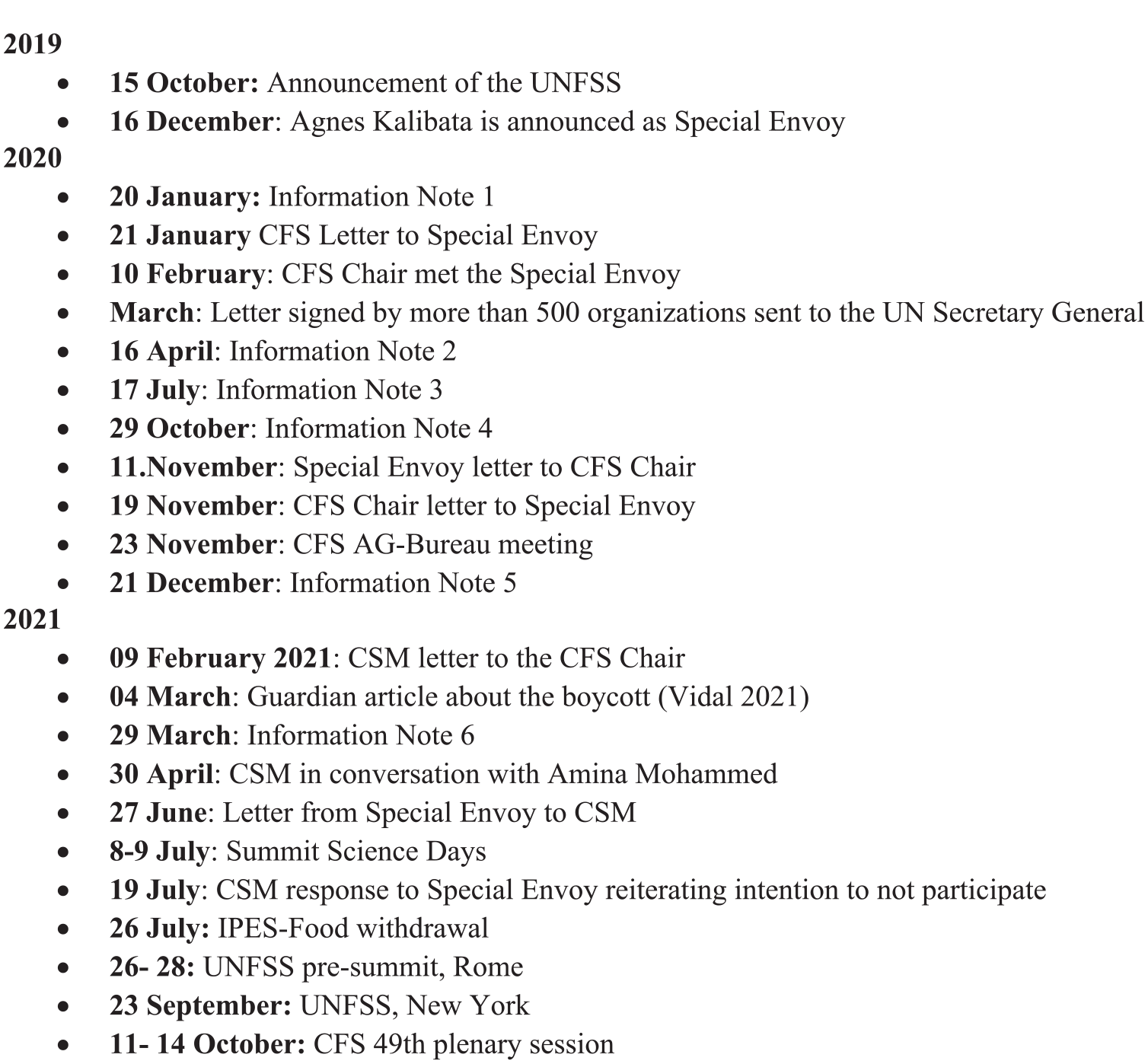
Overview of events leading to UNFSS (Authors).
The decision by CSM – a group of more than 500 civil society groups with more than 300 million members – to collectively withdraw from the process posed a serious challenge to the UNFSS process and its legitimacy. Particularly, it stated that ‘[t]he UN-WEF strategic partnership agreement signed in June 2019 casts a cloud on the integrity of the United Nations (UN) as a multilateral system’.
20
Therefore, 2 months later, the Special Envoy wrote a surprising letter to the CSM in which she outlined her view on the process and made another attempt at inviting the activists in. She suggested the CSM nominate a speaker to the Pre-Summit’s Synthesis Plenary on 28 July and to identify 11 representatives of the CSM constituencies to attend the Pre-Summit. She even tried to send a signal of inclusion in case the invitation would be declined: We are fully aware you are mobilizing a ‘counter event to the Pre-Summit’ from 25-27 July. While admittedly we would have preferred your voice within the process, we recognize your decision to mobilize independently, appreciate the unique opportunity that this counter event represents to hear more voices, and recognize its contribution to the global discussion on the future of transformed, more sustainable food systems. We would now like to invite you to directly share with other constituencies what emerges from these discussions in order to enrich and refine the Summit’s wider ambition and accelerate action moving forward in alignment with the 2030 Agenda.
21
The CSM responded to this letter on July 19.
22
Citing their February letter that outlined conditions under which the CSM could involve itself in the summit process, it concluded that the conversations in response to the CSM letter ‘had a clear outcome, from our point of view: the Food Systems Summit Secretariat was not willing to seriously consider our concerns and suggestions’. The letter concludes that [i]f the Summit Leadership had been truly interested in a meaningful participation of our constituencies, our voices and concerns would have been listened to much earlier and our demands for a profound redirection of the Summit process would not have been ignored. We conclude that there was no political will to listen and change, because the process was designed for other purposes, serving essentially the corporate agenda.
Consequently, the CSM organized a countermobilization to the Pre-Summit as a joint effort supported by peasants and smallholder farmers, women and youth, Indigenous Peoples, pastoralists and landless, agricultural and food workers, fisherfolks, consumers, urban food insecure and NGOs titled Food Systems for People (FS4P). 23 As a consequence of meeting outside the UN, the substantial challenges to the corporate agricultural system being discussed at the counter-summit were more radical. No concessions needed to be made to appear institutionally acceptable. In the eyes of many activists, the UNFSS functioned as a clean break between the food sovereignty movement and the UN Food System which they saw delegitimated and increasingly captured by corporate interest. As the CSM put it, the ‘corporate influence in the UNFSS has been astounding, infiltrating how the Summit was governed, structured, and its content’. 24
Scientists withdraw
As another sign of inclusivity and evidence-based procedures, the UNFSS was preceded by ‘Science Days’, a meeting particularly dedicated to promoting innovations in agriculture and food science, but also in its administration, delivery and social embedding. However, this event too was heavily criticized in the scientific community to only reflect the views of those scientists with close relations to the agro-food lobby and in support of industrialized, globalized agriculture rather than a more holistic view based on the many scientific critiques of the current industrialized food system, its corporate patent logic, dependency on genetically modified organisms and long supply chains. As a response to what they observed at the Science Days, the International Panel of Experts on Sustainable Food Systems (IPES-Food) decided to withdraw from the UNFSS, too. Communicated on the day of the pre-summit, this was a major blowback for the summit organizers, because in contrast to the activist perspectives of CSM that could easily be discredited by the UNFSS as ideological, IPES-Food is a prestigious institution of scientists and policy experts.
The experts officially withdrew, claiming that during the build-up of the pre-summit, ‘the concerns, raised so clearly and consistently by farmers’ organizations, social movements, civil society, Indigenous Peoples, and independent scientists, have not been addressed’. 25 They feared that the UNFSS threatened to replace democratic debate with increasingly unaccountable modes of decision-making. As they argued, their concerns became more serious ‘when the Summit organizers bypassed the UN Committee on World Food Security (CFS)’. Particularly, they criticized the summit’s rules of engagement which were determined by a small set of actors: ‘The private sector, organizations serving the private sector (notably the World Economic Forum), and a handful of scientific experts kick-started the process and framed the agenda’. Finally, they argued that the UNFSS Science Days had shown the summit to be ‘used to promote a new science panel – an “IPCC for Food” – that would undermine the HLPE and the body it serves, the CFS’.
The pre-summit had been scheduled so that all major substantial discussions were held on 26–28 July in Rome in order for the representative UNFSS on 23 September in New York to go smoothly. Yet, next to the IPES withdrawal, the pre-summit was overshadowed by two counter-summits, the FS4P and another one, run by a far-left coalition of farmers’ movements. Its institutional trust seriously damaged already after the pre-summit, the UNFSS main summit in New York happened without the participation of those who had been the most active civil society actors accompanying and shaping UN food governance during the previous decade.
Conclusion
After the food crisis of 2007–2008, the FAO had listened to its critics, innovated its procedures and installed credible ways of working collaboratively with civil society and scientists, thereby slowly shifting towards a paradigm of ‘human rights from below’ (Claeys, 2019). These institutional spaces were designed according to the inputs and needs of farmers, and they were cooperatively developed further. The CSM has become a credible tool for generating positions from peasants, farmers and affected people to influence the CFS, and thereby has contributed to establishing the food sovereignty movement’s trust into the FAO, and the UN’s food governance overall. This is reflected in its long and trusted cooperation with governance officials and has, among other things, resulted in the UN Declaration in the Rights of Peasants and other People Working in Rural Areas. Such an endeavour takes time and good faith from all involved actors. Trust was established through accountability and taking the positions of different stakeholders seriously. Most importantly, credible institutional mechanisms guaranteed a transparent and fair procedure of participation.
This trust into process was seriously damaged in the course of announcing and planning the UNFSS 2021. For this to happen, it was decisive that the existing structure which was widely trusted across civil society and private sector was first ignored, later side-lined and only acknowledged once the external pressure was too high. The CSM made it clear from the start that they would not cooperate with the UNFSS if it did not change its course (CSM, 2021). The summit organizers’ half-hearted reaction to this critique furthermore provoked the withdrawal of the scientists’ body (IPES). The Special Envoy and the CFS first met on 10 February 2020, 1.5 years before the actual summit. But only after external pressure from many organizations and high-ranking individuals such as Michael Fakhri, and a comparably aggressive letter from the CFS Chairperson Thanawat Tiensin to the Special Envoy, in which he essentially forced himself into the summit, did the UNFSS accommodate the CFS. While the food sovereignty movement mistrusted the process from early on and decided to boycott the UNFSS, the CFS thus asserted itself gradually, because its criticism could no longer be ignored. It received belated invitations to join the process. In response to this half-hearted integration, and under constant pressure from the CSM, CFS still could not define its relation to UNFSS even in August 2021, 1.5 years after the beginning of the process.
But how relevant is this in the bigger picture? A sceptical reader might ask whether this was just a case of a falling-out over a UN partnership with the WEF, which does not tell us much about significant shifts in the food governance system. But 1.5 years after the summit, we asked our interviewees again, and the fallout of UNFSS was still enormous. One central activist told us that ‘the FAO is significantly helping to weaken CFS, ignoring CFS policy work, and positioning itself as the main UN body on food security following a pro-corporate strategy’ (Activist 3, 2022). While the food sovereignty movement continues defending the vision spelled out in CFS after the last crisis in 2009, ‘our trust in CFS and FAO as they are now is massively shaken’. Another activist told us that the CFS was ignored in UNFSS and should have stood up more forcefully [. . .]. I still see quite dark. I think we are losing. The money is on the UNFSS side [. . .] and all the UN agencies rally around it [. . .]. Trust? No. We will have to fight for every inch. (Activist 1, 2022)
While this long-term impact gives us confidence into the robustness of our findings, there are limits to an analysis focusing on one specific process. The most notable analytical drawback is that the geopolitical context has changed significantly during the years of the summit and its aftermath. As activists noted, their relationship with both CFS and FAO has suffered not only because of the UNFSS as such, but also because of geopolitical shifts. This applies to agro-exporting powers such as Argentina, Brazil, United States and to some extent Russia that have a vested interest in weakening CFS, supporting unregulated global trade. Activists are lacking a champion defending the vision of the CFS reform of 2009. Despite these geopolitical shifts, we are confident that the factors isolated in tracing the process of the UNFSS did lead to a loss of trust into the institutional framework. Another alternative explanation is that the underlying factor leading to a decline of trust could have been internal to the movement. Social movements are unstable entities, and a shift in their composition or ideological focus could conceivably lead to a loss of trust into institutions. What if the decline in trust was spurred by such changes that were not in the focus of this study? 26 While there is always the chance that we missed a development in the movement under investigation, we submit that there was at least not a decisive one in this case. Despite asking activists about this and looking for other indicators such as movement splits or ruptures, repertoire changes and other potential observations of the overall movement behaviour, we could not identify any major internal developments that would explain a changed assessment of their institutional environment. Building on theories of institutional trust, we expected that the issues of corruption, circumvention of trusted institutional mechanisms and the perception of betrayal are important factures for a loss of institutional trust. In the case of the UNFSS, we did not find evidence for corruption. Even though sometimes the language of critics reminded of it, (the private sector ‘infiltrating’ the system), the food sovereignty movement did not make the case that UN officials would privately enrich themselves. Rather, they bemoaned the increasing institutional access for corporate actors because they assumed a negative policy impact. But more importantly, they claimed that this privileging of private sector actors circumvented and undermined trusted institutional mechanisms. This, in turn, was perceived as a betrayal, because they had invested a lot of work and credibility into these institutional mechanisms inside the FAO based on the ‘promise to have influence’ (Interview, Activist 3, 2021) that was not kept.
While we thus found evidence for the circumvention of institutional mechanisms and the feeling of betrayal, these two theoretically assumed factors cannot be separated well analytically, because the circumvention of established institutional mechanisms was itself interpreted as betrayal by activists. This, in turn, needs to be explained with regard to the political substance: Betrayal was not only the breaking of prior promises but also the perception of social movement activists that the principled consensus of where the organization is headed was broken. This is especially visible in the context of multistakeholderism. The IO did not abolish means of participation but geared it towards private sector influence. Undermining existing institutional mechanisms and a problematic substantial direction was coupled in the view of activists: ‘Bypassing the existing governance architecture, a summit [that was] captured or extremely biased in favor of corporate interests’ (Interview Activist 1, 2021). A combination of formal and substantive changes thus explains the ‘spiral of distrust’ (Christian and Peters, 2022) that also shaped how the movement interpreted later attempts by the Special Envoy to reintegrate parts of the movement: ‘viewed through the lens of distrust, you will tend to be interpreted as untrustworthy’ (Jones, 2019: 959).
This finding supports recent investigations into the (de)legitimation of global governance that highlight the significance of combining substance and procedure when investigating the input legitimacy (or its lack) of IOs: to the extent that an institution’s legitimacy hinges on a consensus on the goals that it should strive towards, [. . .] the purpose of governance – a dimension tied to an institution’s constitutive functions as well as a basis of common interest – is equally central. (Stappert and Gregoratti, 2022: 122)
Input legitimacy thus depends on stakeholders having confidence not only in the process as an empty shell, but also in the overall direction in which the IO is moving and to which their input should contribute.
The issue of distrust is likely to affect to a wider population of IOs in the future. As we have shown, the UNFSS had its roots in an agreement between the UN and the WEF on a strategic partnership for the agenda 2030. We have argued that this sparked the initial discontent of the food sovereignty movement because of fears that this joint venture would effectively replace multilateralism. This is not an isolated incident. Rather, this tendency has recently been identified with regard to several IOs by a collective called the People’s Working Group on Multistakeholderism (PWGM), consisting of many transnational NGOs. They compiled the report The Great Takeover: Mapping of Multistakeholderism in Global Governance (Brennan et al., 2021). The report describes a trend of ‘multistakeholderization’ of global governance, criticizing preferential access granted to multilateral companies within the UN system. They name the modality of public–private partnerships and recent treaties such as UN Global Compact as initiatives to push for more private sector governance. The report criticizes that systemic multistakeholderism is in fact taking over the governance of the world by dislocating the locus of the decisions from the multilateral system into these mixed mechanisms where the private sector rules, with the support of some states, international institutions and big philanthropists. (Brennan et al., 2021: 1)
While these NGOs originally welcomed multilateralism opening up for non-state actors to stake their claims, they argue that this logic is skewed not only because many serious problems being debated in these institutions were caused primarily by the transnational companies to begin with. These activists highlight that IOs and governments have recently been creating ‘a brand-new parallel set of institutions where the corporations sit with voice and vote to decide on key areas and issues of global policies that impact the planet and most importantly, its people’. They do not trust the process to create more democratic innovation but rather complain that it favours the rich and powerful. In the case of the UNFSS, discontent about one specific summit created mistrust into the overall food governance structure. The activists engaged in the CFS therefore warned the speaker early on that they might withdraw from the overall institutional mechanism should it be undermined in the process, stating that a serious food summit must strengthen, and in no way undermine, weaken or substitute the CFS or its components, particularly the independence of the High-Level Panel of Experts (HLPE) and the autonomy of civil society and Indigenous Peoples’ participation in this foremost inclusive intergovernmental and international global platform for food security and nutrition.
27
Importantly, therefore, the spiral of distrust led to a questioning not only of the summit but also of the established institutional mechanisms of the FAO (CFS, CSM, HLPE) that the food sovereignty movement had previously engaged with regularly. The distrust created in a temporary process led to the delegitimation of this IO’s long-standing participation mechanisms.
Footnotes
Funding
The author(s) received no financial support for the research, authorship and/or publication of this article.
