




Abstract
How can we explain variation in demand for redistribution among cross-pressured voters? We argue that redistributive preferences reflect an interaction between material self-interest and political ideology. The self-interest argument predicts growing opposition to redistribution as income increases, while the argument of ideologically driven preferences suggests that left-leaning citizens are more supportive of redistribution than right-leaning citizens. Focusing on cross-pressured voters, we expect that the difference in redistribution preferences between left- and right-leaning citizens is smaller at the bottom of the income hierarchy than at the top. Among the group of left-leaning citizens, the role of material self-interest is expected to be smaller than among right-leaning citizens. We provide evidence in line with our argument analysing data from the European Social Survey in 25 European democracies between 2008 and 2018.
Introduction
Self-interest-based models of redistributive preferences in comparative political economy are premised upon rational voters who derive their policy preferences from their position in the income distribution. Probably the best-known example is the Meltzer-Richard model, suggesting that preferences for redistribution are a function of the difference between the mean and the median income of the respective citizens. According to this theory, ‘the government’s share is set by the rational choices of utility-maximizing individuals who are fully informed about the state of the economy and the consequences of taxation and income redistribution’ (Meltzer and Richard, 1981: 915). Numerous analyses start from some refined version of the Meltzer-Richard model (Iversen and Soskice, 2006; Lupu and Pontusson, 2011; Rehm, 2016; Rueda and Stegmueller, 2016). Underlying these analyses is the assumption of self-interested citizens.
An alternative explanation of preferences for redistribution starts from political beliefs. By political beliefs – or, synonymously, ideology – we mean a coherent set of values, general convictions, and attitudes (Converse, 2006: 3). The ideological dimension of ‘left’ versus ‘right’ corresponds to different stances regarding public redistribution in order to correct market inequality. The political left is pro-state and in favour of redistribution; the political right opposes state intervention in markets and public redistribution from higher to lower income groups (see,for example, Kitschelt, 1997; Mair, 2007). Empirical studies confirm a strong exogeneous effect of ideology on redistribution support (e.g. Alesina et al., 2018; Jæger, 2008).
In this article, we argue that redistribution preferences are the joint product of political beliefs and material self-interest. Political beliefs are not independent from socio-economic position. They are the outcome of cultural (Lipset and Rokkan, 1967) and economic positions – such as income, labour market situation, precariousness of employment – and processes of learning and of socialization by family, groups, and organizations. Voting for the left has been seen as an expression of the democratic class struggle with class implying a common social and economic position and fate (Lipset, 1981). Therefore, it is difficult to disentangle the direct impact of income position and the direct effect of ideology on preferences for redistribution, since the latter is, at least in theory, correlated with relative income.
We do not consider the two explanations as mutually exclusive. Rather, following Margalit (2013), we assume interactive effects between ideology and self-interest. Right-leaning citizens are generally more opposed to redistribution then left-leaning citizens. Among the political right, self-interested motives enjoy greater legitimacy. This explains why poor right persons are more in favour of redistribution than rich right citizens. ‘Rich right’ citizens have no conflict between ideology and self-interest and can make a very clear decision against redistribution. However, ‘poor right’ citizens are cross-pressured in the conflict between self-interest (in favour of redistribution) and ideology (against redistribution) and tend to give ideology a greater impact in shaping the demand for redistribution. In contrast, among the political left, the pursuit of economic self-interest may conflict with social solidarity. For ‘poor left’ citizens, self-interest and ideology align and lead to high demand for redistribution. ‘Rich left’ citizens have a self-interest in less redistribution but cannot demand less redistribution for themselves, since this is at odds with the basic idea of being on the left. They solve the conflict between ideology and self-interest by giving ideology a greater weight and showing high levels of redistribution support.
Our empirical analysis provides evidence in support of an interaction between ideology and self-interest on preferences for redistribution derived from comparative data from the European Social Survey in 25 European democracies between 2008 and 2018. We show that support for redistribution is not unconditionally related to material self-interest. By including political beliefs as an exogenous variable, we can explain the puzzling variation in preferences for redistribution among cross-pressured groups where ideology and self-interest are in conflict. In doing so, we theoretically and empirically extend the argument that ideology operates as a filter on economically based policy preferences (Ansell, 2014; Margalit, 2013).
This article proceeds in the following way. In the next section, we discuss the relevant literature on income, political beliefs and demand for redistribution and develop our argument. We then describe our research design and subsequently report our findings from the comparative analysis.
The Argument
The basic argument of this article states that redistribution preferences reflect an interaction between economic self-interest and political ideology. Many political economy approaches build on the axiomatic model by Meltzer and Richard (1981) and expect that an individual’s position in the income distribution determines preferences for redistribution (for an overview, see Rueda and Stegmueller, 2019: chapter 2).
Recent research shows that the basic assumption of the Meltzer-Richard model has to be questioned since relatively precise knowledge about one’s own position in the income hierarchy is barely found in empirical analyses (Cruces et al., 2013; Engelhardt and Wagener, 2018; Fernández-Albertos and Kuo, 2018; Gimpelson and Treisman, 2018). Experimental studies demonstrate that views on income distribution – though not necessarily preferences for redistribution – change if voters are better informed about the actual income distribution (Kuziemko et al., 2015: 1480; Boudreau and MacKenzie, 2018). The lack of precise knowledge about one’s own location in the income hierarchy does not exclude the possibility that voters have a coarse idea about their position (e.g. whether they earn more or less than the median citizen), which allows them to deduct their self-interest in redistribution.
An alternative explanation for redistributive preferences is ideology. Arguably, the major ideological dimension in modern democracies is the left-right divide. For Anthony Downs (1957: 116), the crucial question was ‘how much government intervention in the economy should there be?’. Those who support market-correcting interventions are on the left; those who want to see the market operating with a minimum of public intervention are on the right. Other authors showed that for citizens the basic meaning of left and right is correlated with positions about more or less equality (Mair, 2007: 213). We use the standard left-right measure as an indicator of ideological beliefs on the choice between more state and redistribution and unbridled market and no government responsibility in correcting the income distribution. Being a ‘super-issue’ (Dalton, 2018: 136), the left-right orientation is not only concerned about positions on economic issues. There is also a libertarian/post-materialist-authoritarian/materialist dimension which is different from the state-market dimension (Kitschelt, 1994; Kitschelt and Rehm, 2014; Kriesi et al., 2008). However, the economic (redistribution, state-market) and the cultural dimension (libertarian-authoritarian), are hardly orthogonal (e.g. Hutter and Kriesi, 2017). Libertarian attitudes empirically correlate with pro-state attitudes, and the left-right scale is a rough representation of both dimensions (cf. Lachat, 2018).
The concept of left-right ideology can be fluid; it would be difficult to assume that all voters have developed clear-cut preferences on issues of economic equality. However, arguably it is the best available summary indicator of general ideological orientations being far more than just a summary of separate issue dimensions (Fuchs and Klingemann, 1989). The overwhelming majority of voters have no problems to situate themselves on a left-right scale, and both observers and researchers have few problems in classifying political parties and their programmes as right or left: In the surveys, we will use in this analysis, about 88% of respondents could locate themselves on the left-right scale, 1 and for expert surveys, Mair (2007: 208–211) reported that between 80% and almost 100% of all experts had no problems in applying this scale. This ideology is also a very useful heuristic in order to make vote choices or political demands. For left-wing respondents, equality is a major and very salient issue. They have few problems to demand redistribution from the rich to the poor. In contrast, citizens with right-wing ideological orientations care much less about equality and redistribution; rather, they are concerned with free markets and do not oppose hierarchies (see in particular Alesina et al., 2018). Therefore, support for redistribution is expected to be generally more pronounced among citizens who position themselves on the left side of the political spectrum compared to those on the right.
Some studies exclude left-right ideology from the analysis of redistribution preferences on the grounds of endogeneity concerns (e.g. Finseraas, 2009: 100). However, other authors have argued that ideology is an exogeneous determinant of support for redistribution (Alesina et al., 2018; Jæger, 2008, 2013; Margalit, 2013). Jæger (2008: 365) argues that left-right ideology is formed prior to attitudes towards redistribution as a result of political socialization during childhood. He uses an instrumental variables design, with parents’ education and father’s social class as instruments for left-right orientation. The underlying argument is that political socialization leading to a position in the left-right dimension is shaped by parent’s socio-economic background. Therewith, using parents’ socio-economic background introduces an ‘artificial’ time dimension into the analysis, and this socio-economic background ‘precedes’ left-right placements. He finds a strong causal effect of left-right ideology on redistribution preferences, and the effect is much stronger compared to analyses which do not endogenize left-right orientation.
Since Jæger analyses the European Social Survey, which we also use in our study, based on his results we are confident that endogeneity is not a major problem. 2 Other studies have also uncovered the role of ideology as a causal variable. Margalit (2013) finds a strong effect of ideological dispositions on changes in welfare preferences in a within-subject panel design. Alesina et al. (2018: 532) demonstrate a causal effect of ideology by experimentally manipulating beliefs about intergenerational mobility. They find that left-wing respondents become more supportive of redistribution when confronted with pessimistic information about levels of intergenerational mobility. This is not the case for right-wing respondents, whose redistribution preferences remain largely unchanged even as their views on mobility change.
In this study, we are not interested in isolating a separate causal effect of ideology. Rather, we combine both literatures on self-interest and ideology by focusing on the interaction between ideology and self-interest. Similar to other authors, we view ideology operating as a ‘filter on economically derived preferences’ (Ansell, 2014: 387) (own emphasis).
Another potential difficulty arises for the identification of causal effects because ideology and income conditions may not be independent of each other. For a long time, positions on the left-right scale were closely linked to being a member of the industrial working class and, by implication, to income: Workers were assumed to be left, high-income groups more to the right. However, this correlation between class, income and ideology has never been very strong. Conflicting additional political dimensions – such as Catholicism versus secularism – cut across the class divide (Korpi, 1983). Work situations have been found to be important determinants of ideological orientations: Well-educated and well-paid socio-cultural experts (teachers, social workers etc.) tend to left-libertarian positions. Likewise, globalization endangered the national industrial working class, making them losers of globalization, who reacted by requests for closure and nativist politics (Kriesi et al., 2008; Walter, 2017). Whenever there has been a correlation between left ideology, class and income, it has receded enormously (see also Piketty, 2020).
Summarizing political ideology is a complex outcome of a number of variables, and not just of class, income or a strong preference for redistribution. Rather, in addition to income and working class membership, it also reflects – among others – work situation, education, socialization, values, membership in groups and organizations, social identity (e.g. trusting trade unions or trusting big firms), individual learning processes, and personal idiosyncrasies (see also Freire, 2006). This also implies that we must separate the effects of income conditions and ideology. In a few cases, income and ideology may have reinforcing effects on redistribution preferences. In other cases, self-interest-based and ideological motives may conflict with one another.
Condensing these hypotheses about the effect of relative income, ideology, and preferences for redistribution, we arrive at the cross tabulation in Table 1.
Conditional Expectations of Ideology and Self-Interest on Preferences for Redistribution.
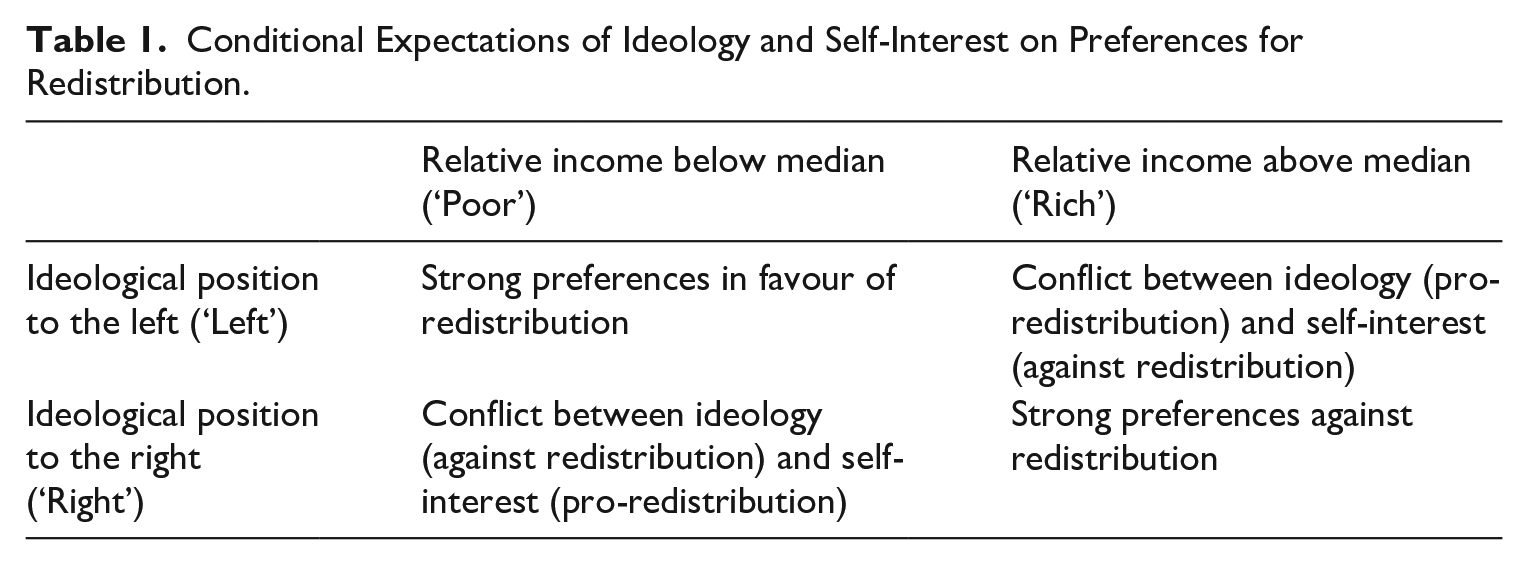
Two groups have no conflict between their ideology and their economic self-interest: the ‘poor left’ and the ‘rich right’. However, the two remaining groups are under cross-pressure: According to their ideology, the ‘rich left’ have to be in solidarity with low-income earners pleading for equality and therewith for higher taxes on their own income, which violates their material self-interest. Likewise, ‘poor right’ have a strong self-interest in redistribution, but this violates their ideology condemning equalizing public intervention into market and society. For these groups under cross-pressure, the crucial question is whether self-interest or ideology prove to be the stronger factor. There are two recent studies that analyse the solution to conflicts between self-interest and ideology. Julia Lynch and Mikko Myrskylä studied whether benefitting from social policies leads these individuals to greater support for the respective scheme. They found little empirical evidence for such a self-interest based model (Lynch and Myrskylä, 2009). Yotam Margalit analysed data from a panel survey before and after the Great Recession in the USA. While economic interests have a clear impact on social policy, this impact is temporary and withers away after some time, in contrast to ideological positions (Margalit, 2013). Building on these studies, our first hypothesis expects that, once in conflict, ideology is likely to trump self-interest for a given level of income:
H1: At any level of income, left-wing respondents are more supportive of redistribution than right-wing respondents.
However, this still leaves the possibility that self-interest motives are important for respondents within a given ideological group. Among left-wing citizens, we expect only a weak role for self-interest. Although rich left citizens are not net beneficiaries of redistribution, we expect that they are in favour of redistribution because of more general ideological concerns about the issue of inequality. To some extent, this can be traced back to other-regarding preferences (Dimick et al., 2018): In the US, for example, affluent Democrats have been shown to be significantly more altruistic than affluent Republicans (Gilens and Thal, 2018). Hence, we expect a weak association between relative income and redistribution preferences among left voters. In contrast, self-interest motives should be more legitimate among right-wing citizens. Individual self-interest aligns with the pro-market ideology of the political right, while general concern about inequality is low. Thus, we expect that rich right respondents are more strongly opposed to redistribution than poor right respondents. Poor right voters will not be enthusiastic about redistribution for ideological reasons, but they could still end up as net beneficiaries. Therefore, we expect a consistent relationship between self-interest (income) and support for redistribution among right voters.
In sum, among the cross-pressured groups, rich leftists are more willing to abandon their self-interest, while poor conservatives are not. We assume that self-interest is more legitimate among right-leaning citizens since for ideological reasons they care much less about solidarity across social strata. 3 This leads to our second hypothesis:
H2: The effect of income on redistribution preferences is weaker among left-wing respondents than among right-wing respondents.
Data
We use six waves (waves 4–9 between 2008 and 2018) of the European Social Survey (ESS), which is well known for its high quality of data collection, from 25 European democracies. 4
The first three ESS waves are excluded because income was recorded differently, making comparison difficult. Our dependent variable is support for redistribution, the major independent variables are household income and self-location on the left-right scale.
Redistributive preferences have been measured by the following standard question: ‘. . . please say to what extent you agree or disagree with each of the following statements: The government should take measures to reduce differences in income levels’ (strongly agree, agree, neither nor, disagree, strongly disagree). We generated a binary variable that indicates support for redistribution for respondents agreeing or strongly agreeing with the statement (‘don’t know’ or ‘no answer’ coded as missing). According to this operationalization, the country average of respondents favouring redistribution is 72%, with Denmark, Netherlands, the Czech Republic and Norway having the lowest values (<60%) and Portugal and Lithuania at the top (90% support for redistribution).
For our income measure, we recoded the ESS’s 10 categories of disposable household income into the midpoints of the income bands shown to respondents (in national currency), instead of assuming a constant distance between the categories. 5 For the top category, we applied the correction suggested by Donnelly and Pop-Eleches (2018: 359). Unlike many other studies, we also accounted for differences in household size by dividing income with the square root of number of household members. To allow for comparison between countries and years, we z-standardized the income variable within each country-year. More than 95% of respondents fall within 2 standard deviations from the country-year-specific mean. 6
The operationalization of ideology is based on the question ‘In politics people sometimes talk of “left” and “right.” Using this card, where would you place yourself on this scale, where 0 means the left and 10 means the right?’ We coded individuals placing themselves between 0 and 3 on the 0–10 scale as ‘left’. The country-specific shares of left voters vary between 13% and 14% (Estonia, Finland, and Poland) and 31% (Spain), with a country average of 21%. By using a binary variable for ideology, we account for the potential non-linearity of the relationship between ideological position and preferences for redistribution. This could be particularly a problem with regard to the right pole of the left-right-scale, where a one-unit increase on the scale does not lead to the same difference in the preference for redistribution compared with the respondents on the left side of the scale (Lachat, 2018). To assess the robustness of our findings, we employ an alternative measure that additionally distinguishes centrist and right-leaning respondents (0–3 as ‘left’, 4–6 ‘centrist’, and 7–10 ‘right’). A second alternative measure uses voting for left parties (party voted for in the last national election), instead of left-right self-placement. Following Rovny and Rovny (2017), we distinguish between voting for ‘major left’ parties (the major party representing the mainstream moderate left) and ‘radical left’ parties radically opposed to the capitalist system (see Supplemental Appendix 1 for a list of parties). These alternative measures corroborate our substantive findings.
Model
We use logistic regressions to estimate the probability of redistribution support (‘agree’ or ‘strongly agree’) as the dependent variable. An alternative is to use ordered logistic regressions, but the parallel regression assumption does not hold (Brant tests are statistically significant at p < 0.001). That said, the results are substantively similar if we use ordered logistic regressions, multilevel modelling, or a different dichotomization (see Supplemental Appendix 5).
We estimate pooled models with country and wave fixed effects and country-clustered standard errors. Our multivariate analyses of redistribution preferences include a range of socio-demographic characteristics (age, gender, educational attainment), as well as dummies for being unemployed, retirement status, and union membership. We also control for two standard macro-level variables, the unemployment rate and public social expenditure in percentage of gross domestic product (GDP) (Thewissen and Rueda, 2019).
Our major argument concerns the interaction of income and ideology for redistributive preferences. With non-linear models in particular, the significance of the interaction term is not the sole criterium for evaluating the effect of this interaction (Ai and Norton, 2003). Rather, the marginal effects of the model – based on both the constituent variables and the interaction term – together with their confidence intervals have to be interpreted (Brambor et al., 2006: 73–77). This interpretation should focus on the regions for which we have most data from respondents in our sample. Hence, in the following analysis, we will emphasize the messages which can be drawn from the marginal effects plots.
Findings
Table 2 presents the results of logistic regression models of support for redistribution, while Figure 1 visualizes the predicted probabilities of the interaction terms. The first noteworthy finding is that both income and left ideology are statistically highly significant predictors of redistribution preferences in comparative perspective. The more important finding is the existence of an interactive effect of ideology (Model 2). The interaction between income and left ideology (relative to non-left) is statistically significant at p < 0.001. This is of limited importance as long as this finding of an interaction cannot be substantiated by a plot of the marginal effects and the corresponding confidence intervals – which we provide in Figure 1.
The Conditional Effects of Income and Ideology on Redistribution Preferences.
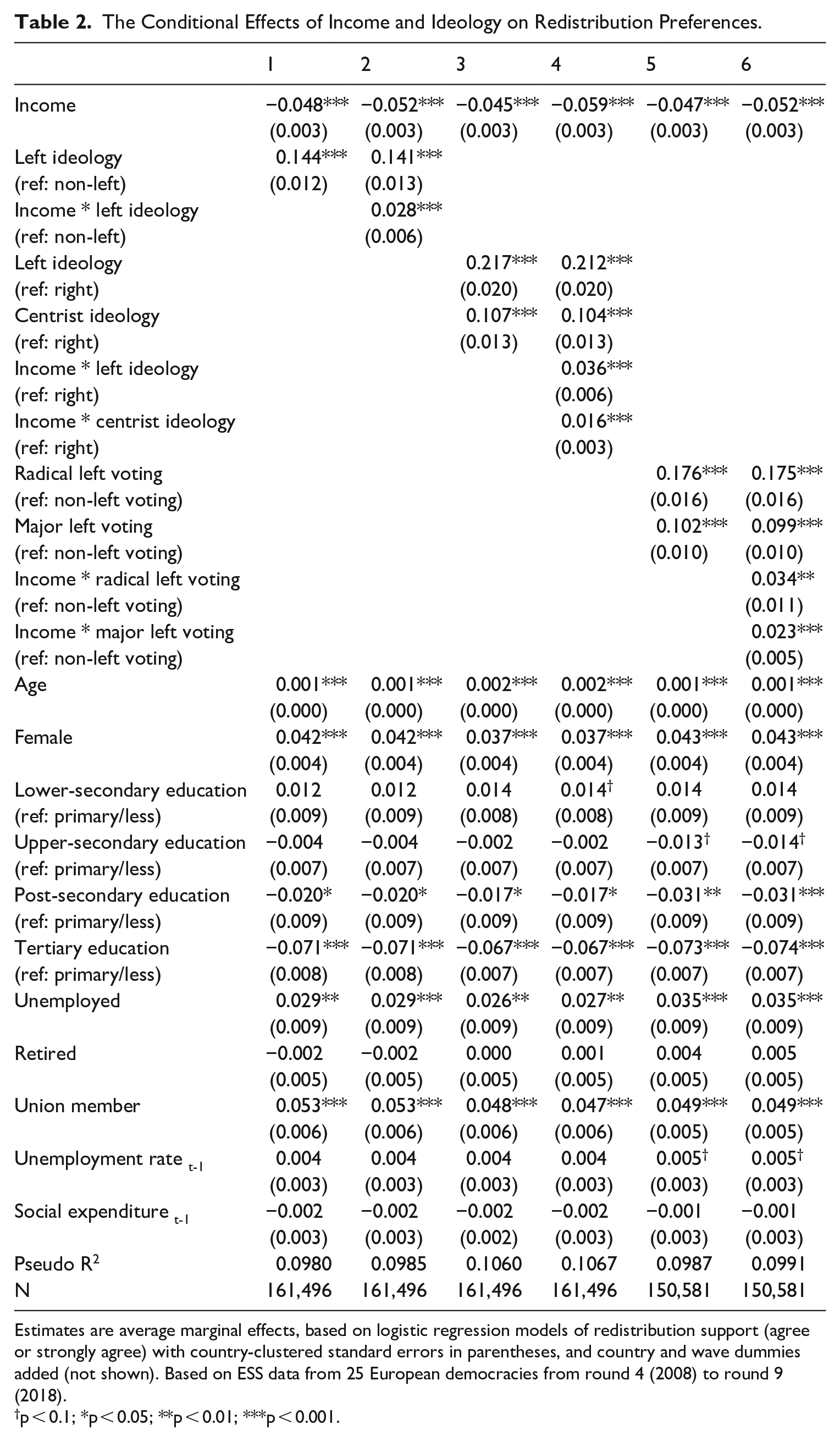
Estimates are average marginal effects, based on logistic regression models of redistribution support (agree or strongly agree) with country-clustered standard errors in parentheses, and country and wave dummies added (not shown). Based on ESS data from 25 European democracies from round 4 (2008) to round 9 (2018).
p < 0.1; *p < 0.05; **p < 0.01; ***p < 0.001.
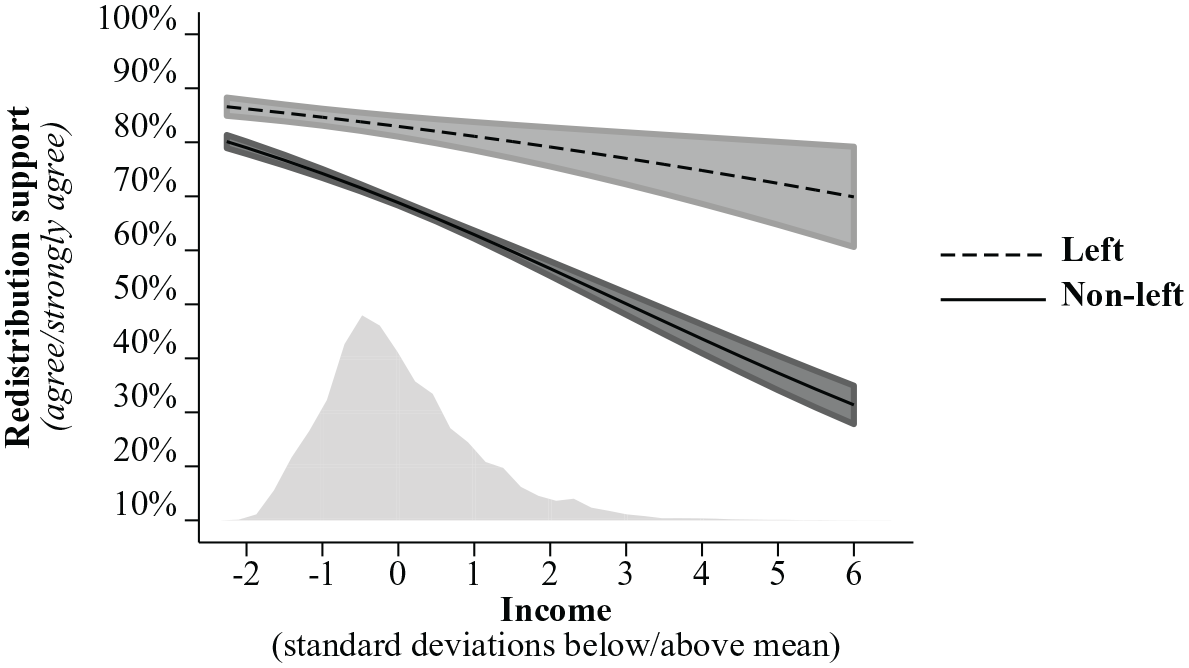
The Interaction between Income and Ideology.
The predicted probabilities in Figure 1 show that for any given income level, left-wing respondents are more supportive of redistribution than right-wing respondents (in line with hypothesis 1). However, while income has a strong negative effect on redistribution support among non-left respondents, it only has a weak association with redistributive preferences among left-wing respondents (in line with hypothesis 2). The slope of the regression line for non-left respondents is visibly more downwards-leaning than the almost flat slope for leftists. An increase in income from -1 to +1 standard deviations from the country-year-specific mean reduces the predicted redistribution support from 74.2% to 62.9% among non-left respondents, but merely from 84.6% to 81.1% among left-wing respondents. 7 These predicted probabilities and their confidence intervals are the ultimate criterium for the analysis of the interaction effect of income and ideology. Our argument is particularly strongly supported for the region for which we have data from most respondents (see the light grey diagram indicating the distribution of respondents).
The results are similar with the additional distinction between centrist and right-wing respondents (Models 3–4). The statistically significant interaction terms again indicate that self-interest plays less of a role among left-leaning citizens compared with centrists (4–6 on the left-right self-placement scale) and especially compared with right-leaning citizens (7–10). Furthermore, Models 5–6 show similar results if we measure ideology with voting for leftist parties. The conditional effects of income are weakest among radical left party voters, but also significantly weaker among major left party voters compared with respondents voting for non-left parties or abstaining. The predicted probabilities from the interactions in Models 4 and 6 are displayed in Supplemental Appendix 2. These analyses confirm that right-leaning citizens combine both ideology and self-interest, whereas ideological predispositions prevail among left-leaning citizens.
This result is supported by country-by-country analyses (see Supplemental Appendix 3). We replicated the analysis separately for different types of welfare states (Anglo-Saxon, Continental, Nordic, Mediterranean and Eastern European), which generally show the same pattern – with two exceptions. First, the interaction is not statistically significant in the Mediterranean countries (p = 0.165), which tend to be characterized by uniformly high baseline support for redistribution (85% of all respondents in Greece, Italy, Portugal and Spain agree to reduce income differences). Second, the interaction is not statistically significant in the Central and Eastern European countries (p = 0.640), where arguably left-right has another substantive meaning than in Western Europe. It turns out that the non-significant interaction is mostly due to the outlier of Slovenia; among the remaining seven Central and Eastern European countries, the interaction is statistically significant at p = 0.013. Overall, the pattern of a conditional effect of ideology and income on support for redistribution is remarkably robust across different contexts – in particular in the North-Western European countries.
The detailed data recorded in the ESS allow us to take into account that some social groups derive their ideology less over redistribution but more on the cultural, ‘second dimension’ of political conflict (Kitschelt, 1994). ‘Right’ ideology among the working class, for example, is associated with authoritarian and nativist attitudes on the cultural dimension, not opposition to redistribution (Kriesi et al., 2008). However, we find no evidence that the role of ideology for redistribution diminishes among groups susceptible to prioritizing second dimension issues. We show in Supplemental Appendix 4 that the interactions between income and ideology remain substantively similar for subsets of respondents holding anti-immigration or pro-immigration attitudes. Therefore, immigration is not the major confounder of redistributive preferences as a function of the interaction of income and ideology. 8
Finally, our results are robust to several alternative specifications (Supplemental Appendix 5). Using ordered logistic regression or multilevel modelling, following the linear random intercept specification used by Thewissen and Rueda (2019), yields substantively unchanged results. The same holds for coding only those ‘strongly agreeing’ (about 29% of respondents) as supportive of redistribution.
Conclusion
How can we explain variation in demand for redistribution among cross-pressured voters? In this article, we have argued that redistributive preferences reflect an interaction between economic self-interest and long-standing political dispositions. For some groups, ideology and self-interest are aligned: rich right-leaning citizens opposed to redistribution and poor left-leaning citizens in favour of it. Other groups, however, are ‘cross-pressured’ and are facing conflicting motives. Rich left-leaning citizens show high levels of redistribution support and tend to sacrifice self-interest for ideology. Poor right-leaning citizens demand more redistribution than rich right-leaning citizens (in line with self-interest) but less redistribution than poor left-leaning citizens (in line with ideology). Overall, the effect of ideology trumps the effect of self-interest: At all levels of income, left citizens are more in favour of redistribution compared with non-left citizens.
Our main contribution is to show that the role of economic self-interest needs to be understood in combination with political ideology. There is now significant evidence that voters have significant misperceptions of income inequality and biased knowledge about their position in the income distribution (Fernández-Albertos and Kuo, 2018; Gimpelson and Treisman, 2018). One way to address these issues is to take into account other-regarding or altruistic preferences alongside self-interest (Dimick et al., 2018). However, altruistic preferences are not randomly distributed across citizens and not exogenously given. Our article shows that self-interest-based considerations are easy to reconcile with policy preferences as long as they are in line with ideology. But as cross-pressured voters face a conflict between self-interest and political beliefs, ideology plays a much larger role than generally acknowledged in the existing research on the formation of redistributive policy preferences. Thus, we have to think about the interaction of actors’ political beliefs (even if they are based on ‘false consciousness’) with their objective self-interests.
As in almost all cross-sectional and non-panel datasets, endogeneity is a ubiquitous challenge. Based on Jæger’s (2008) instrumental variable analysis, we are confident that this is no major problem here. However, future surveys and data analysis may benefit from the inclusion of more – and even better – instrumental variables than those used by Jæger.
In this article, we focused on preferences. Preferences are typically expressed by participation in political movements or in votes during elections. Hence, our article bears important implications with regard to mobilization and voting for political parties that offer general programmatic orientations. In contrast, in the process of choosing between policy alternatives, citizens with given preferences are faced with trade-offs, such as whether taxes should be spent either for social equality or environmental protection. Popular votes on policy proposals in a direct democracy are a prominent case where citizens must choose between policy alternatives. This is a very different set-up which could lead to a very different conclusion: In case of trade-offs, self-interest trumps ideology (Armingeon and Bürgisser, 2020) – while in the case of preference formation, ideology trumps self-interest.
Supplemental Material
sj-pdf-1-psx-10.1177_0032321721993652 – Supplemental material for Objective Conditions Count, Political Beliefs Decide: The Conditional Effects of Self-Interest and Ideology on Redistribution Preferences
Supplemental material, sj-pdf-1-psx-10.1177_0032321721993652 for Objective Conditions Count, Political Beliefs Decide: The Conditional Effects of Self-Interest and Ideology on Redistribution Preferences by Klaus Armingeon and David Weisstanner in Political Studies
Footnotes
Acknowledgements
The title of the article was inspired by  : 106) (‘Votes count in the choice of governing personnel but other resources decide the actual policies pursued by the authorities’. Ali Bargu and Julia de Romémont provided excellent research assistance. We are grateful for the comments of participants at various conferences where we presented earlier versions of this article. Likewise, we are grateful for helpful comments by the anonymous reviewers and the editor.
Declaration of Conflicting Interests
The author(s) declared no potential conflicts of interest with respect to the research, authorship, and/or publication of this article.
Funding
The author(s) disclosed receipt of the following financial support for the research, authorship, and/or publication of this article: David Weisstanner acknowledges financial support from the John Fell Oxford University Press Research Fund.
Supplementary Information
Additional Supplementary Information may be found with the online version of this article.
Content
Appendix 1: List of parties coded as ‘major left’ and ‘radical left’. Appendix 2: Alternative measures of ideology. Appendix 3: Country group analysis. Appendix 4: Immigration attitudes. Appendix 5: Robustness checks.
Notes
Author Biographies
References
Supplementary Material
Please find the following supplemental material available below.
For Open Access articles published under a Creative Commons License, all supplemental material carries the same license as the article it is associated with.
For non-Open Access articles published, all supplemental material carries a non-exclusive license, and permission requests for re-use of supplemental material or any part of supplemental material shall be sent directly to the copyright owner as specified in the copyright notice associated with the article.
