




Abstract
Parties’ ideological responsiveness to public opinion is a key finding in the party politics literature. Leveraging the longitudinal coverage of public opinion and party position data, this research note shows that findings of left-right ideological responsiveness are limited to a specific time period. We find that since the mid-1990s, left-right shifts in public opinion are no longer significantly associated with party position changes on the same dimension. By examining over-time changes in responsiveness on more specific issue dimensions, we also uncover that at about the same time, a pattern of responsiveness on issues related to nationalism/immigration has emerged. These findings highlight the need to move beyond a focus on a single left-right dimension for studying public opinion and party behavior.
For representative democracy to function well, there must be a close link between public opinion and the views represented in parliament and government (Dahl, 1989). Citizens can contribute to such a connection by voting for candidates or parties that share their views and preferences (Powell, 2000). At the same time, political parties can help ensure a close match with citizens’ preferences by paying close attention to and following public opinion when it moves. Parties have electoral incentives to respond to public opinion—at least if we assume that taking a position close to the median voter is electorally rewarding.
A large literature has studied whether parties adapt their ideological positions in response to changes in public opinion (e.g., Adams, 2012; Adams et al., 2004). This work has pointed out that parties are responsive to public opinion shifts, but also that responsiveness is conditioned by party characteristics and context-level factors. For instance, mainstream parties are more responsive to the general public (Adams et al., 2006), while niche parties are more responsive to their own supporters (Ezrow et al., 2011). Extending this work, Bischof and Wagner (2020) and Ferland (2020) show that the underlying dynamic that conditions party responsiveness is the extent to which they are vote- versus policy-seeking. Others have shown that party responsiveness is conditioned by the balance of power between the party leader and party activists—with indications that leader-dominated parties are more responsive to changes in public opinion (Schumacher et al., 2013). Parties are also more likely to follow public opinion after an electoral loss (Somer-Topcu, 2009) and when turnout declines (Ezrow and Krause, 2023). Such conditioning effects notwithstanding, the party politics literature generally concludes that “mainstream parties (…) react strongly to changes in the electorate’s mean voter position” (Homola, 2019: p. 958). 1
In this research note, we draw attention to an observation that has been overlooked in previous work on party responsiveness. More specifically, we show that from about the mid-1990s onward, there is no evidence of mainstream parties moving in sync with left-right shifts in public opinion any longer. We then take this finding a step further and examine whether the decline of left-right responsiveness is counter-balanced by responsiveness on new dimensions or whether it can be found across the conflict dimensions that structure party politics in Europe. To assess this possibility, we analyze over-time trends in party responsiveness on economic, postmaterialist, and nationalist/immigration issues. To do so, we build on the work of O’Grady and Abou-Chadi (2019), who also examined responsiveness on these dimensions, but extend it by modeling over-time heterogeneity in these types of responsiveness. We find that parties have recently become significantly more responsive to public opinion on issues related to nationalism/immigration. In other words, instead of completely losing touch with citizens’ preferences, the focus of parties’ responsiveness seems to have shifted from broad left-right considerations to a more issue-specific dynamic. In addition to finding over-time change in party responsiveness, our results also indicate that estimates are sensitive to the geographical region in which scholars study responsiveness.
Before turning to our expectations, a few words on the terminology used. In line with previous work, in this research note we use the terms of responsiveness and dynamic responsiveness. It should be noted, however, that at an empirical level, previous work and our own analyses assess simultaneous changes in public opinion and party positions. While there are good theoretical reasons to assume that these changes reflect a reaction of parties to shifts in public opinion, causality could be reversed.
Expectations
While the literature on party responsiveness is extensive, most of this work has focused on the connection between parties and the public on the left-right ideological dimension (but see O’Grady and Abou-Chadi, 2019). There is evidence, however, that new fault lines increasingly structure party competition and that party politics is best described as multi-dimensional (Hooghe and Marks, 2018; Kitschelt and Hellemans, 1990; Kriesi et al., 2006). Researchers who study party competition through expert studies, for example, distinguish between an economic dimension and a second, cultural or social dimension that integrates immigration/nationalist issues and social/postmaterial values (Hooghe and Marks, 2018; Kriesi et al., 2006). In line with such findings, research that studies parties’ strategic behavior has also started to do so through a multi-dimensional lens (Koedam, 2022).
The evidence of change in the cleavages that structure politics is not limited to party-level research. Using data from the European Election Studies voter surveys, Dassonneville et al. (2024) show that between 1999 and 2019, citizens’ propensity to vote for parties is increasingly shaped by how distant they are from parties on the GAL/TAN dimension. They also find that there is stability in the extent to which distance on the economic left-right dimension structures vote propensities, implying that over time, citizens consider more ideological dimensions. On top of work showing that individuals’ and parties’ behavior are increasingly structured by multiple dimensions, research on public opinion has found indications that summarizing these different positions through a single left-right scale is increasingly inappropriate. If the meaning that citizens attach to left and right has changed over time (De Vries et al., 2013; Steiner, 2023) but citizens’ political preferences are still one-dimensional, we could still use an updated left-right dimension to study party responsiveness. There are indications, however, that citizens’ political preferences can no longer be summarized using a single dimension. For instance, Malka et al. (2019) show that citizens’ cultural and economic attitudes are not strongly correlated. 2
Work that studies voter-party congruence and its impacts on political attitudes and voting behavior has already moved toward a multi-dimensional perspective (see, for example Bakker et al., 2020; Stecker and Tausendpfund, 2016). Such findings inspired O’Grady and Abou-Chadi (2019) to examine party responsiveness to public opinion across multiple issue dimensions (economic, social/postmaterial, and immigration/nationalism). Doing so, they found no evidence of party responsiveness to citizens’ ideological positions.
While previous work has studied multidimensional party responsiveness already, it has done so without considering temporal heterogeneity. However, if the areas of party competition have changed over-time, the expectation would be that the focus of parties’ responsiveness to public opinion may have altered too. In particular, we might expect responsiveness on the left-right dimension to have decreased over the years and shifted to greater responsiveness on the rising cultural dimensions. Indeed, the increasing dimensionality of the political space in European countries (Hooghe and Marks, 2018; Kriesi et al., 2006) could have made it harder for parties to keep track of public opinion on the traditional left-right dimension. Moreover, issues related to nationalism/immigration and postmaterialist values, that are not integrated well into the left-right dimension, have gained salience in voters’ choices (Dassonneville et al., 2024; Marks et al., 2020). This would create electoral incentives for parties to be mindful of where public opinion is on other dimensions than the general left-right divide. Finally, the increasing popular support for far right parties, especially since 2005-2010 (Georgiadou et al., 2018), might have also led parties to adjust their behavior and consider more seriously associated policy issues. This could, for instance, strengthen party responsiveness on the immigration/nationalist dimension in particular.
Data and methods
In order to study party responsiveness over time, we need information on public opinion and estimates of parties’ positions on the same dimensions. We follow common practice in the party politics literature and match public opinion data from the Eurobarometer surveys 3 with estimates of parties’ positions on the left-right scale as provided by the manifesto project (Volkens et al., 2021). To capture parties’ left-right positions, we use the rile indicator, which we transform to range between 1 and 10. The rile indicator is constructed by combining 24 different categories from the CMP project. This includes a large number of economic categories, as well as categories relating to international politics, traditional norms, and law and order (see Appendix P for the list of categories).
We complement the responsiveness analyses on the left-right dimension with an examination of party responsiveness on more specific issue dimensions. We follow O’Grady and Abou-Chadi (2019) and connect party manifesto positions on specific issues to the public opinion estimates Caughey, O’Grady and Warshaw (2019) provide for the period 1981–2016. These estimates, which are obtained from IRT models of millions of survey responses of individuals in European countries, indicate the position of public opinion on four issue domains: absolute economic conservatism, relative economic conservatism, social conservatism, and immigration conservatism. Details on these measures can be found in Appendix A.
We consistently estimate the impact of public opinion shifts on party policy change using OLS regressions. In specifying the models, we take into account the insights of previous work.
First, we distinguish between mainstream and niche parties. We do so using a fairly standard approach that codes as niche parties all parties that the CMP project categorizes as members of the green, communist/socialist, and nationalist party families (Adams et al., 2006; O’Grady and Abou-Chadi, 2019). Second, we assess whether our findings hold when taking into account that parties are only expected to move when public opinion clearly moves away from them (Adams et al., 2004), when change decreases congruence (Ferland, 2020) and when controlling for previous electoral losses (Somer-Topcu, 2009). These results are reported in Appendixes B, C and D. Finally, we take into account heterogeneity in the presence and strength of party responsiveness between countries. Our main analyses focus on the eight countries that have been the focus of previous work that found evidence of party responsiveness (Adams et al., 2004, 2006; Somer-Topcu, 2009). 4 We also verify the generalizability of the patterns for this select number of countries by extending the analyses to include all European countries for which we have data, excluding and including post-communist democracies where we know party competition to work differently (Ezrow et al., 2014) (Appendix E).
Left-right responsiveness
Before modeling change in party responsiveness over time, we start by replicating the standard finding in the literature that shows evidence of party responsiveness on the left-right scale—among mainstream parties in particular.
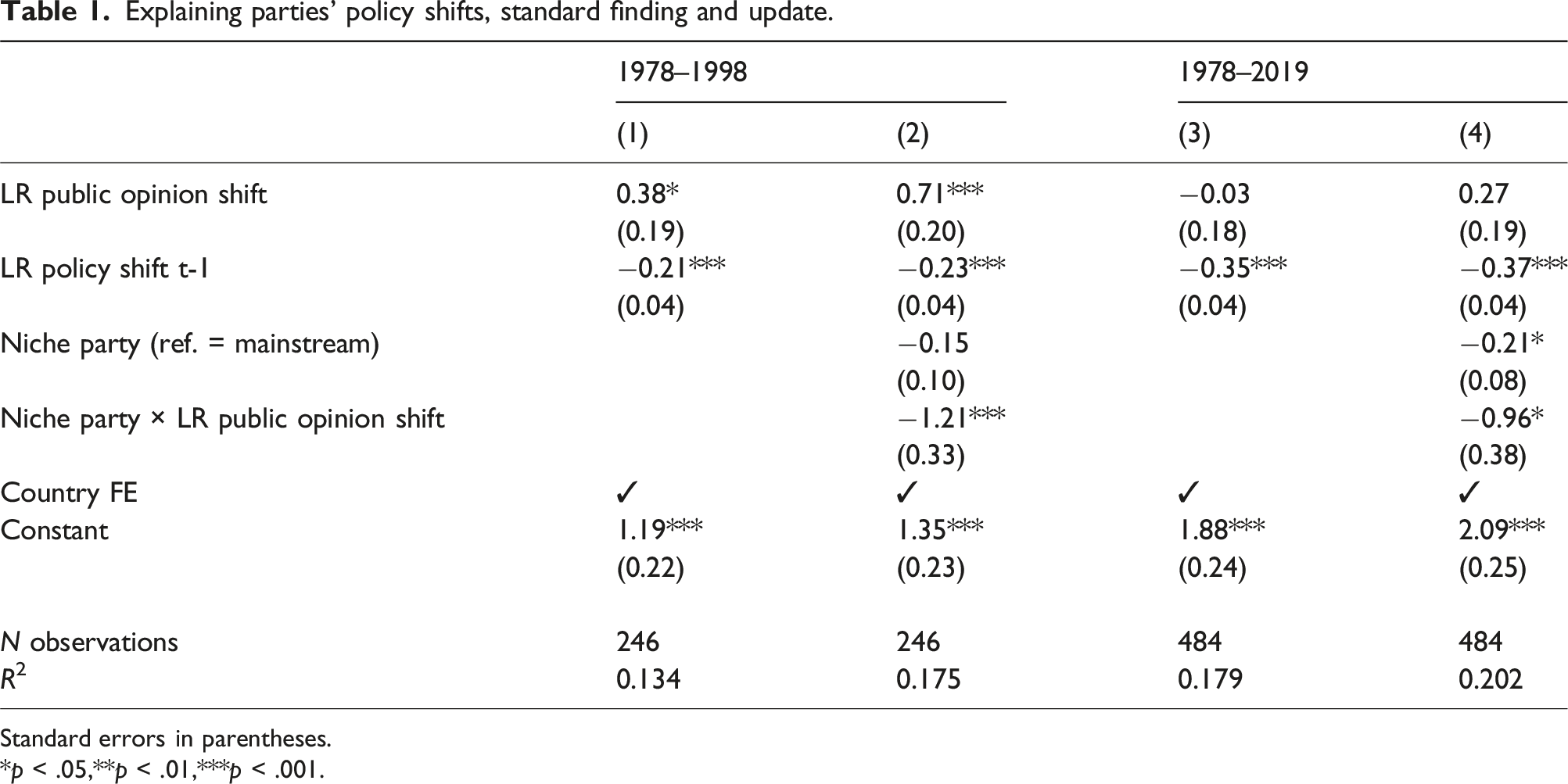
Explaining parties’ policy shifts, standard finding and update.
Standard errors in parentheses.
*p < .05,**p < .01,***p < .001.
Model one in Table 1 provides some indication of party responsiveness on the left-right scale. Specifically, a one-unit left-right shift in public opinion is associated with parties shifting their position 0.4 units in the same direction. This average estimate captures party responsiveness across both mainstream and niche parties. The estimates from Model two clarify that responsiveness is stronger among mainstream parties. This model includes an interaction term between a niche party dummy and the LR public opinion shift variable. The main effect of that variable hence captures party responsiveness among mainstream parties. This model provides strong support for mainstream party responsiveness. The estimate suggests that a one-unit public opinion shift on the left-right dimension is associated with mainstream parties shifting their position 0.7 units in the same direction. These findings closely mirror the results in Adams et al. (2006). However, as can be seen from the estimates of Models three and four, these conclusions change when we update the time series to include data until 2019. The pooled estimate of party responsiveness for both mainstream and niche parties in Model three is essentially zero (−0.03) when considering the full time period. Moreover, even when acknowledging that only mainstream parties are expected to be responsive to public opinion shifts in Model four, mainstream parties’ estimated effect of responsiveness in the full period is less than half of what it was for the period 1978–1998 (0.27 vs 0.71). Furthermore, the coefficient is no longer statistically different from zero.
In summary, previous work has provided strong evidence of patterns of party responsiveness—at least among mainstream parties. Extending the time frame covered by previous work to include more recent data alters conclusions. Models three and four in Table 1 offer very little evidence that (mainstream) parties respond dynamically to left-right shifts in public opinion. 8 Note that our conclusions are substantively the same when we use the log-transformed rile indicator (Lowe et al., 2011) to measure parties’ left-right positions (see Appendix F).
The results in Table 1 are indicative of an over-time change in patterns of responsiveness. We examine this more systematically by extending Model four to include an interaction with time.
9
The full results are shown in Appendix E, and we visually summarize them in Figure 1—focusing on the average marginal effect of a one-unit shift in public opinion on mainstream parties’ position-taking. Average marginal effect of LR public opinion shift on mainstream parties’ position shifts, 1978–2019. Note: Average marginal effect of a one unit change in LR public opinion. Estimates are for mainstream parties. 95% confidence intervals are added. Full estimates are shown in Appendix E.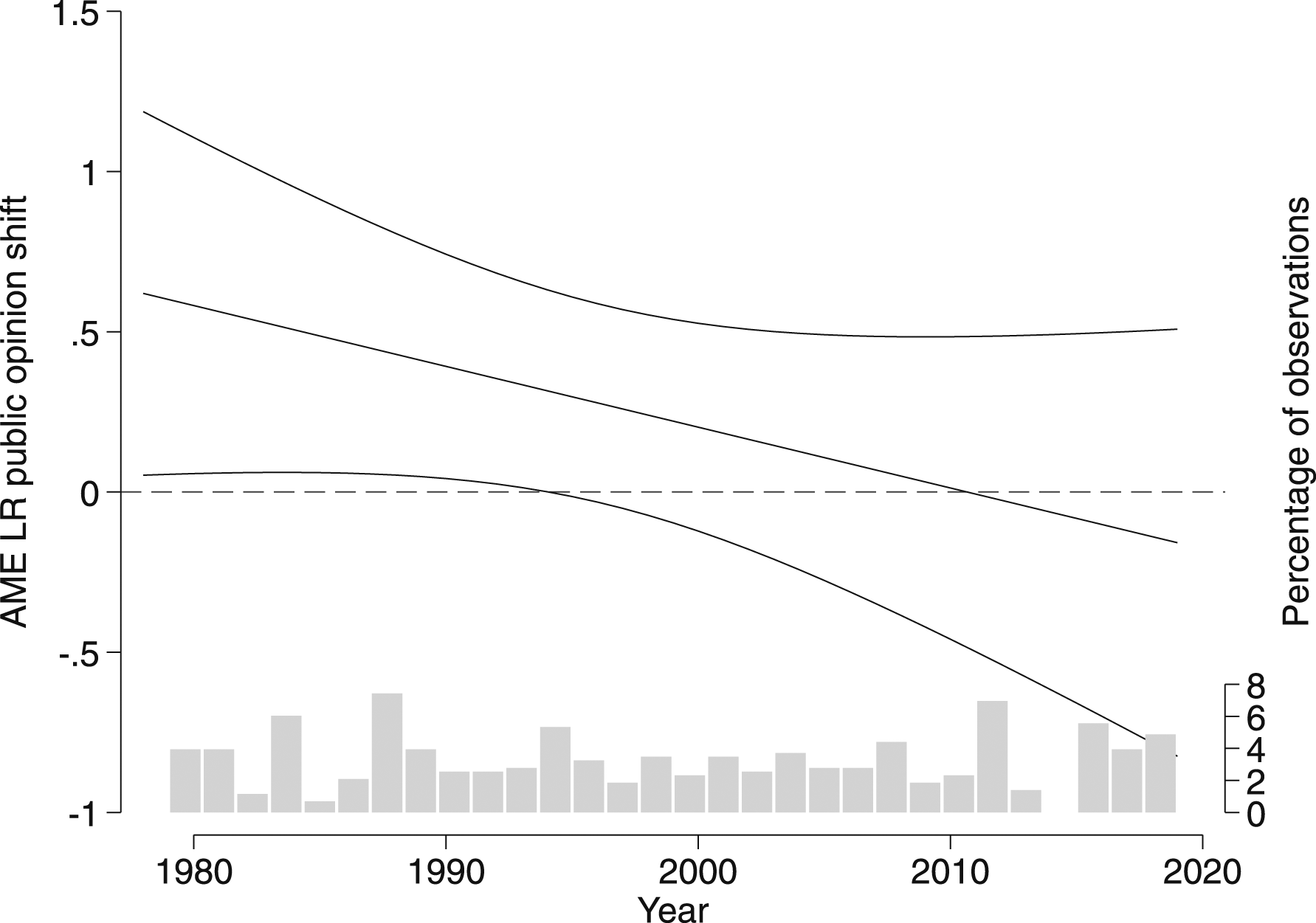
Figure 1 confirms and illustrates the over-time change that Table 1 already hinted at. Particularly, a pattern of left-right responsiveness to shifts in public opinion can be discerned at the start of the time series. In 1978, a one-unit shift in the public’s left-right position is associated with mainstream parties shifting their left-right position by 0.6 points. Over time, however, this coefficient declines in size, and it becomes indistinguishable from zero from about the mid-1990s onward. By 2010, the coefficient is essentially zero.
These results imply that a core finding from the party behavior literature is limited to a specific time period. Parties only seem to respond to left-right shifts in public opinion if we focus on data from the 1980s and 1990s, but not if we extend our analysis to include more recent data. A very similar pattern emerges when we extend the geographical scope to all non-post-communist or even to all European countries (see Appendix E). We also come to the same conclusions when modeling the impact of harmful public opinion shifts instead of all changes in citizens’ positions (see Appendix B). Examining whether the trend of change over time is non-linear (see Appendix G) further confirms that LR responsiveness is limited to the early time period.
There are concerns that CMP estimates are not well-suited to capture the positions of parties and even less to measure change in parties’ ideological positions. Unfortunately, our interest in studying change in responsiveness over an extended period of time implies that estimates from expert surveys are not a viable alternative. We can, however, cover a fairly long time period when we rely on data of citizens’ perceptions of parties’ positions as estimates of where parties are positioned. In Appendix C, we make use of the data collected by Ferland (2020) to study the connection between left-right public opinion shifts and perceived changes in parties’ positions. These results still point to a decline in left-right responsiveness over time.
Finally, for theoretical reasons and based on earlier work that has shown that niche parties do not tend to respond to shifts in public opinion, our main focus is on mainstream parties. Interested readers can consult the equivalent visualizations for the over-time AME among niche parties in Appendix K. These graphs highlight that the lack of niche party responsiveness holds for the full time period.
Under all these tests, we consistently find that responsiveness on the left-right dimension is substantively reduced in recent years. That main conclusion is illustrated in Figure 2 which summarizes the main results from the main analysis and the robustness tests of our core hypothesis. When reading the Figure, two pieces of information must be considered: first, the distribution of the coefficients (the black and white squares in the upper part of the figure) and, second, the model specification (indicated by the black and white circles in the lower part of the figure). As for the upper part of the Figure, the squares show the Average Marginal Effect (AME) of a one-unit left-right public opinion shift on mainstream parties’ position on the left-right dimension. The color refers to different points in time: black squares show the AME in 1980, and white squares show the AME in 2010. The strength of the correlation between public opinion and mainstream parties’ position varies across specifications. Those specifications are outlined in the lower part of the figure. Each row under “specification” and “coverage” represents a coding decision, with a black circle indicating the decision that was taken when estimating a specific model. For instance, the first coefficient from the left refers to the main analysis for the year 1980 (see a black circle next to the specification “main”) with a geographical coverage limited to eight West-European countries (see the black circle next to the label “Eight W-European countries”). While the estimate for 1980 is consistently positive and of roughly the same size across specifications, the estimates for 2010 are generally close to zero. The reduction in the magnitude of responsiveness thus holds across specifications. Figure 2 also clarifies that the strongest evidence for party responsiveness in the earlier time period comes from estimations that limit the analyses to the eight West-European countries on which much previous work has focused. As soon as a larger set of countries is included in the estimation, responsiveness is estimated with more uncertainty, and the AME is often not statistically different from zero—even in the earlier time period. Average marginal effect of LR public opinion shift on mainstream parties’ position shifts in 1980 (black squares) and 2010 (white squares). Note: Black squares show the AME of a one unit LR public opinion shift on mainstream parties’ LR position in 1980. White squares show the same effect in 2010. Spikes indicate 95% confidence intervals. Effects are shown for different specifications and different samples. Detailed estimates are reported in the Supplementary Materials.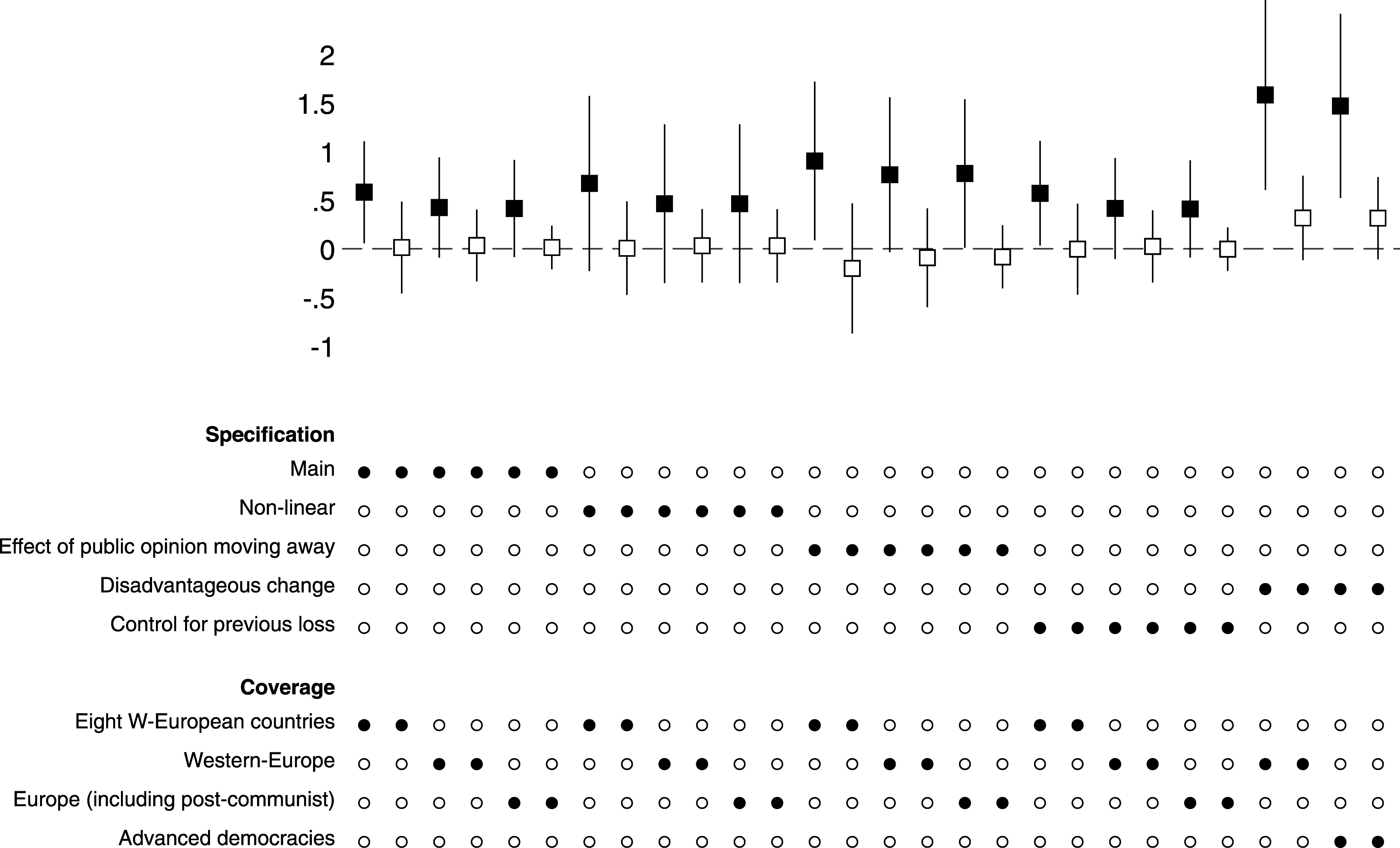
Responsiveness on specific issues
So far, we have studied party responsiveness by focusing on a single left-right ideological dimension. Previous work, however, has already cast doubt on the continued relevance of the general left-right dimension for describing party competition and public opinion in European democracies. In recent years, scholars have argued that party politics is best described as multi-dimensional. Hence, the observation of an over-time decline in party responsiveness could be specific to the left-right ideological scale. That is, it might be that parties are still adjusting their ideological positions in response to shifts in public opinion, but that they are not doing so for the left-right dimension anymore. However, much like what we found for left-right responsiveness, dimension-specific responsiveness might also be bound to certain time periods.
Therefore, as a next step, we follow the approach of O’Grady and Abou-Chadi (2019) to study dimension-specific party responsiveness, but we extend their analysis to include an interaction with time. That way, like we did for left-right responsiveness, we assess whether party responsiveness to shifts in public opinion on specific dimensions has changed over time. The estimates are reported in Appendix H, and we summarize them visually in Figure 3.
10
Average marginal effect of specific issue opinion shift on mainstream parties’ position shifts. Note: Average marginal effects of a one unit change in public opinion. Estimates are for mainstream parties. 95% confidence intervals are added. Full estimates are shown in Appendix H.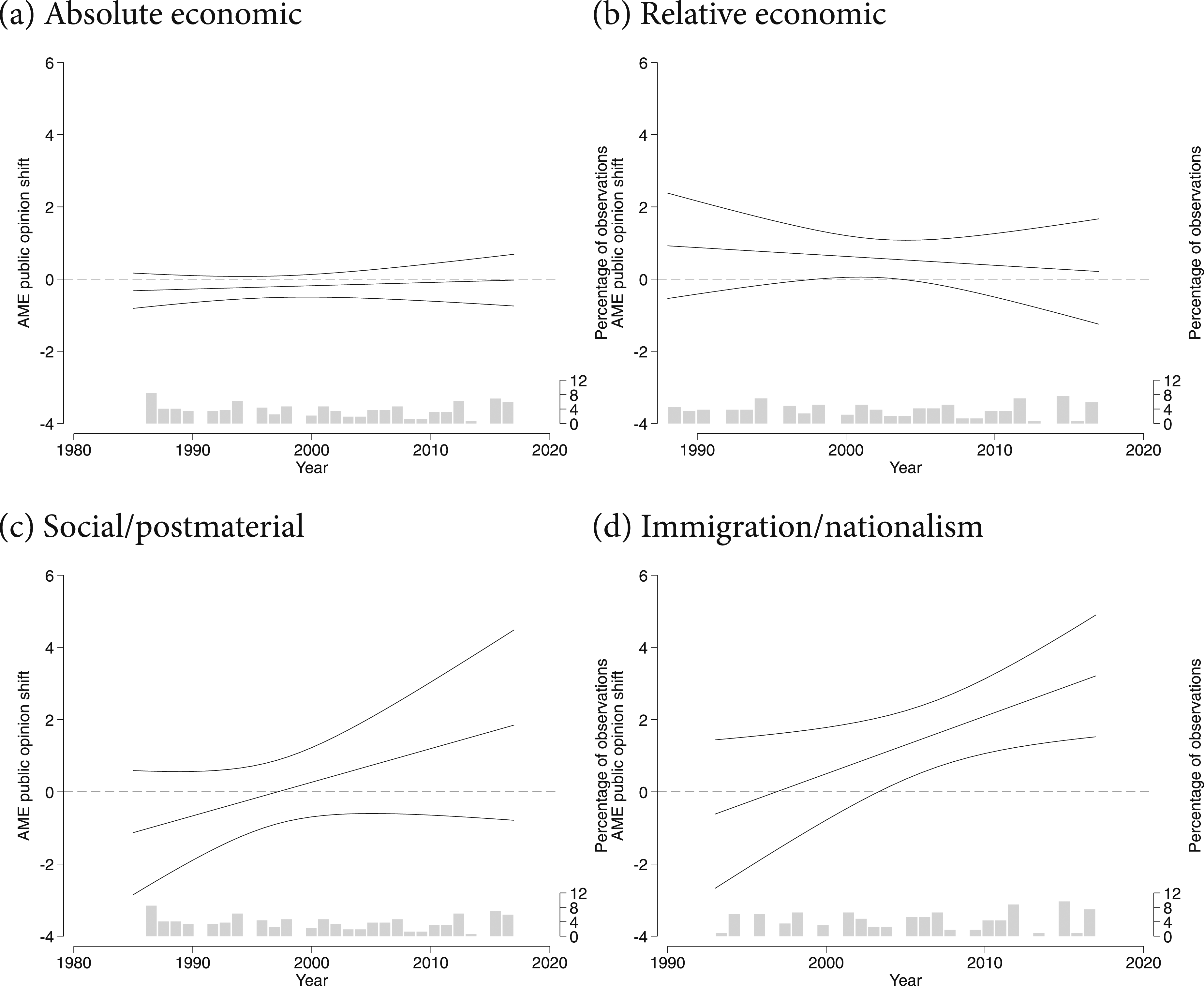
To ensure the estimates shown in Figure 3 are comparable to those of the left-right dimensions (Figure 1), they come from models estimated on data from the eight established democracies focused on in earlier work. As previously, the effects that are visualized are those that apply to mainstream parties.
Looking at the average marginal effects graphs (Figure 3), the top row offers few indications of an over-time change in party responsiveness to public opinion changes on economic dimensions. The average marginal effect of a one-unit change on these economic dimensions on party positions on the economy is essentially flat and close to zero. A different pattern emerges when turning to party responsiveness on the social/postmaterial dimension and on immigration/nationalism. For both dimensions, the trend is upward and indicates an increase of party responsiveness over time. The estimates are somewhat uncertain for the social/postmaterial dimension. However, for immigration/nationalism, a clearer pattern can be discerned. Specifically, the bottom right panel in Figure 3 suggests that in these eight established democracies, mainstream parties have gradually started to respond to public opinion shifts on immigration/nationalism. From the early 2000s onward, the average marginal effect of a unit change of public opinion on immigration/nationalism on mainstream parties’ positions on the same dimension is positive and statistically different from zero. The size of the effect, furthermore, increases substantially over time. In other words, whereas parties have become less responsive to public opinion shifts on the left-right dimension in recent decades, their responsiveness on issues related to immigration and nationalism has increased dramatically.
In Appendix I, we extend the geographical focus of the analyses to only exclude post-communist democracies or to include all countries for which there is data. The findings for the over-time change in responsiveness on immigration/nationalism replicate for these larger datasets. For change on the social/postmaterial dimension, trends are flatter when moving beyond the eight established democracies on which Figure 3 focuses. These additional analyses hint at an over-time decline in responsiveness on the relative economic dimension—though that change is much weaker than what is shown for the increase in responsiveness on immigration/nationalism.
Finally, given that previous research found that responsiveness is conditioned by the ideological leaning of parties (Adams et al., 2009) we explored whether the over-time changes in party responsiveness differ between left- and right-wing parties. Additional analyses, that can be consulted in Appendix J suggest that the decline in left-right responsiveness is driven by mainstream right parties no longer being responsive to left-right shifts in public opinion. For issue-specific responsiveness, the results suggest that the recent emergence of responsiveness on the immigration/nationalism dimension can be observed among both mainstream left and mainstream right parties.
Discussion and conclusion
The observation that mainstream parties respond dynamically to shifts in public opinion is one of the core findings of the party behavior literature. It is a finding that confirms the theorizing of these parties as strategic and vote-seeking actors. It is also a normatively important finding because party responsiveness can contribute to ensuring a close connection between public opinion and policy-makers.
Given the importance of party responsiveness, our finding that there is no longer evidence of left-right responsiveness by mainstream parties in recent times is worrying at first. However, by also exploring over-time changes in party responsiveness on more specific policy dimensions, we were able to show that there is no across-the-board decline in party responsiveness. While mainstream parties are no longer responsive to shifts in the left-right position of citizens, they have started to respond to public opinion shifts concerning immigration/nationalism. On this issue dimension, which arguably has gained salience over time, mainstream parties still behave consistently with vote-maximization theories.
Our main focus in this research note was on over-time changes in party responsiveness. Our analyses, however, also draw attention to the importance of the geographical coverage of research that studies party responsiveness. The strongest evidence for party responsiveness comes from analyses that are limited to eight West-European democracies. As soon as the estimation sample is expanded to include all countries in Western Europe, or both countries in Western Europe as well as postcommunist democracies, the estimated effect of a left-right shift in public opinion on party positions no longer reaches statistical significance. The selection of countries that is included in research on responsiveness, therefore, to some extent drives conclusions.
Our results lead to a more optimistic conclusion than that of O’Grady and Abou-Chadi (2019, p. 5), who summarized their research as showing “robust evidence that European parties do not respond to shifts in their citizens’ ideological positions” (emphasis added). When taking into account over-time heterogeneity in party responsiveness, it becomes clear that parties have started to respond to public opinion shifts on immigration/nationalism. It is only when explicitly modeling change in party responsiveness over time, as we do here, that this pattern of responsiveness on the immigration/nationalism dimension in the most recent time period becomes visible. The results of our analyses hence highlight—once more—the need to move beyond the left-right dimension in studies of party behavior and representation. Only analyzing left-right responsiveness would lead to the conclusion that mainstream parties no longer respond to citizens’ opinion shifts. However, on the increasingly important cultural dimension (De Vries et al., 2013), mainstream parties are updating their positions when citizens move.
Supplemental Material
Supplemental Material - Party responsiveness over time: From left-right to issue specific dimensions
Supplemental Material for Party responsiveness over time: From left-right to issue specific dimensions by Ruth Dassonneville, Nadjim Fréchet, Alexandra Jabbour, Benjamin Ferland and Jonathan Homola in Party Politics
Footnotes
Acknowledgements
Previous versions of this paper were presented in departmental seminars at the universities of Gothenburg, Southampton, Stuttgart, and Montréal. We thank participants for insightful comments and feedback. We also thank Lawrence Ezrow, Richard Nadeau, and Zeynep Somer-Topcu for comments on previous versions of the paper.
Declaration of conflicting interests
The author(s) declared no potential conflicts of interest with respect to the research, authorship, and/or publication of this article.
Funding
The author(s) disclosed receipt of the following financial support for the research, authorship, and/or publication of this article: This work was supported by the Canada Research Chairs (950 - 233132).

Supplemental Material
Supplemental material for this article is available online.
Notes
Author biographies
References
Supplementary Material
Please find the following supplemental material available below.
For Open Access articles published under a Creative Commons License, all supplemental material carries the same license as the article it is associated with.
For non-Open Access articles published, all supplemental material carries a non-exclusive license, and permission requests for re-use of supplemental material or any part of supplemental material shall be sent directly to the copyright owner as specified in the copyright notice associated with the article.
