




Abstract
Why do some associations provide members with an effective voice whereas others appear to have internal democracy in name only? We theoretically combine population ecology with Hirschman’s strategic response model. This leads us to hypothesize that in dense, competitive organizational environments, the effective alternatives available make it likely that dissatisfied members respond with exit rather than voice. However, in low-dense, monopoly-like situations dissatisfied members demand and receive effective voice options. We further hypothesize that the particular sets of incentives of firms and individuals as members moderates this effect. We assess our argument on the basis of the Comparative Interest Group elite survey among interest group leaders in five European countries and at the EU level. We control for the level of professionalization and use country dummies to identify country-level differences. We find strong empirical support for our theoretical argument. The contribution of this article is to theoretically connect macro-level population-level factors to micro-level intra-organizational processes and specifies the nature of the organizational link between interests in society and those represented in the interest group system.
Introduction
Interest associations are part of the backbone of any democratic society. Citizens and firms who seek to defend or advance their political interests often require associations to organize their joint activities and collectively decide on their internal priorities and policy positions. Strong societal organization, according to Acemoglu and Robinson (2019), provides critical checks on ‘illiberal’ control tendencies of states and guard against other forms of political instability. This systemically important responsibility presupposes that associational decision-making in a democratic system is essentially democratic. 1 As Truman (1951: 129, 138) notes ‘Associations in our culture are expected to be “democratic” and are given “respectability” and “legitimacy” through the “. . . broad participation by the membership in the group’s policy making, either directly or through a system of elected representatives”’.
Directly related to interest groups’ systemic function and as fora for collective interest definition, ‘democratic’ internal decision-making offers opportunities for membership participation, provides an effective justification for members to align or conform to decision-making outcomes, and fosters the recognition of effective and legitimate representivity (Warren, 2001). Warren (2003: 48) enthusiastically embraces the normative virtues of associational decision-making, ‘. . . the associational way of organizing common purposes is inherently legitimate, since people choose their collective projects and willingly engage with others’ and in voluntary associations ‘. . . freedom, commitment, non-coerced social relations, and collective action coincide’. These claims also justify the prioritized provision of policy access to ‘democratically’ organized interest associations (Grömping and Halpin, 2019).
As normatively desirable as it may be, not all interest groups are democratically organized. There is much variation in the amount of influence members have on internal decision-making within interest groups. Our research question therefore is: why do some interest organizations grant members substantial control over (political) decision-making, while in others leaders have relatively high levels of discretion and autonomy? Current studies emphasize internal efficiency arguments. It is frequently noted that many groups have adopted a specific organization form – that is, a professionalized ‘Protest Business’-type structure (Jordan and Maloney, 1997). Within this structure, supporters have few, if any, internal democratic rights, and campaigns, strategies and policies are centrally formulated by professional staff with supporters having little or no direct means of influence – exit is the only option (Warren, 2001). This is largely in line with classic views, such as Michels’ (1915) Iron Law of Oligarchy (Rucht, 1999), or the argument by Hannan and Freeman (1977: 948) that employing professionals allows organizations to become more flexible and increases ‘. . . their capacity to deal with a variable environment and the contingencies it produces’.
Herein, we develop a new and original account to explain why some groups choose to give members voice and others do not. The first part of our argument focuses on the variation among types of members who view ‘voice’ as a membership incentive. We posit that corporations view internal control as a benefit (Salisbury, 1969; Wilson, [1974] 1995), while the overwhelming majority of citizen group members see ‘voice’ as a cost (Jordan and Maloney, 1997; Maloney, 2009). This ‘pushes’ the leaders of business associations towards relatively democratic internal structures that include membership involvement and sees leaders of citizen groups (both identity and cause sub-sets) move in the opposite direction. Second, we follow Hirschman’s (1970) argument that in dense competitive organizational environments, the numerous alternative membership options available significantly increase the probability that dissatisfaction is met with exit rather than voice. Alternatively, in low-dense monopoly-like situations, dissatisfied members demand and receive effective voice. Third, we note that the difference between business and citizen groups is likely to be further accentuated when competition with similar organizations increases. In this circumstance, business groups are likely to include members to an even greater extent (i.e. increase the number and range of benefits to members), while citizens groups are even less likely to seek to include members in organizational decision-making.
Our study has important implications for the democratic content of organized interest’s politics. First, we demonstrate that business interest associations tend to function as more responsive voice-based associations, whereas the membership control that exists in citizen groups is largely predicated on exit. This contradicts the normative assumptions made about the democratic content of citizen groups in democratic societies (Warren, 2003). Second, we contribute to the classic debate on the internal organizational tension between professional management and internal democratic decision-making (Hannan and Freeman, 1977; Jordan and Maloney, 1997). Our study identifies the external organizational drivers, most notably competitive pressures, that shape the internal mode of decision-making. We show that competition may in fact be the root cause of the (more) limited availability of voice in citizen groups.
We test our argument on the basis of the Comparative Interest Group (CIG) survey of associational leaders. We analyse a sample of around 1200 business and public interest membership groups in six European countries (Belgium, Italy, Lithuania, the Netherlands, Slovenia and Sweden) and the European Union (Beyers et al., 2020). This is the largest dataset currently available on membership involvement within various types of interest groups. Moreover, the CIG survey includes a comprehensive battery of questions on internal structures group practices, ideas and characteristics. This allows us to rigorously look for ‘voice’ in business and citizen groups. We proceed as follows. First, we provide an overview of the literature on membership influence within interest groups. Then, we outline our hypotheses on the differences between business and citizen groups, both in general and in response to members’ exit opportunities.
Comparing Citizen and Business Interest Representation
We examine membership-based organizations and assess their internal democratic responsiveness (Voice) in two broad categories of interest groups: associations of businesses and citizens, respectively. Vogel (1996: 243) maintains that ‘. . . labour unions, many professional and trade associations, religious and charitable institutions and organizations – even public interest groups – all exercise political power, and none is governed according to democratic principles or precepts’. However, citizen groups are seen as vehicles for citizen participation beyond the ‘occasional vote’ and this normatively desirable quality commonly leads researchers to look for participation in these organizations. Citizen groups are generally portrayed as generators of numerous democratic benefits: surrogates – representing citizens who either lack the knowledge, expertise or resources to effectively engage in the policy-making process (e.g. disadvantaged citizens), or those who are unable to campaign on their own behalf (e.g. children, people with mental health problems); vehicles for citizen participation allowing those affected by a specific policy problem to be directly involved in its resolution – such participation is viewed as supplementary to, and an important extension of, representative democracy; and as countervailing challengers to the power of big business who have been seen as enjoying a ‘privileged’ position in the policy-making process.
The numerous potential democratic virtues of public interest groups may dwarf the claims that can be made on behalf of business interest organizations. Business interest associations have an important instrumental rather than normative claim in democratic societies – that is, the strategic decisions of corporations regarding investment, employment and technological development have important economic and political implications that necessitate acknowledgement in the policy process. In other words, the structural interdependent relationship between public and commercial decision-making requires instrumental interaction between business interest representatives and policy-makers (Lindblom, 1977). In addition to this, business associations may improve corporate citizenship by sensitizing their members to their political environment, developing self-governance arrangements and broadening the repertoire of policy alternatives (Schmitter and Streeck, 1985).
The exchange between political and business elites is partly predicated on business associations demonstrating their representative and democratic credentials – that is, having internally democratic facets, including constitutions, rules, procedures, voting, elected boards, chairs, secretaries, treasurers and so on. The instrumental quality of the business lobby’s public policy contribution – that is, helping to shape workable and implementable outcomes – depends heavily on the quality of the joint voice of business (Schmitter and Streeck, 1985). This relates to the extent to which corporations lobby on their own account or via associations (Aizenberg and Hanegraaff, 2020) – and more importantly for our argument, the quality of internal priority and preference formation within business interest associations. Akin to professionalized citizen groups, this works in two directions. First, business interest associations with national and international structures behave in ways that are similar to businesses (hierarchical and professionalized), rather than effectively creating participatory opportunities in local or functional chapters. Second, weakly institutionalized voice mechanisms within business interest associations are likely to reduce the value of the exchanges with policy-makers. Business representatives could misrepresent the political views of a given industry and could not credibly commit to particular outcomes (in terms of industry support or effective compliance). In other words, some business organizations can legitimately claim to be more democratic by virtue of having a membership imbued with full exit options and voice rights, whereas others have weaker representative claims, and therefore are more likely to distort policy information rather than improve it. The quality of voice matters greatly for both citizen and business interest groups; for the quality of policy outputs and the societal behaviour of citizens and businesses. Why some groups provide more voice to members is therefore a critical question.
Theoretical Proposition
Our starting assumption is that a large part of the behaviour, critical organizational features and external effectiveness of interest groups flows from the characteristics of the exchange relationship between members and leaders. This assumption is predicated on the ultimate need for organizational survival (Lowery, 2007) and is a relatively uncontroversial theoretical datum. The relationship between members and leaders is commonly conceived as exchange-based, with leaders providing a package of material, solidary, purposive and expressive incentives to members in exchange for membership fees and/or support (Berkhout, 2013; Bolleyer and Weiler, 2018; Salisbury, 1969; Schmitter and Streeck, 1999; Wilson, [1974] 1995). Moreover, this package is not easily produced, as Hansen (1985: 93) notes, ‘Developing membership benefits is extremely costly, and the larger the group, the more costly the organizing endeavour’. From the group perspective, membership participation can be seen as both a benefit and a cost. Members can provide their organization with information, evidence and data that can assist lobbying and advocacy activities. However, member involvement can also constrain the leadership’s manoeuvrability in areas including, internal policies, decisions, lobbying priorities or strategies. These assumptions lead us to conceptually focus on political considerations rather than the practicalities of organizing, such as the actual numbers of members of a group, committee work or voting arrangements at annual member meetings. 2 We develop three hypotheses in this section. First, we focus on group type, namely, whether or not business or citizen groups are organized more democratically. Second, the context in which organizations operate, most importantly, the competitive nature of their environments. Third, we combine both perspectives and explore whether different types of groups respond to competitive environments differentially.
We start with group type, namely, whether business or citizen groups provide their members with more voice over political positions and strategies. We distinguish between an Olsonian view in which members face participatory costs and a view in which members derive leader-designed selective benefits from their participation in internal decision-making. Both views eventually substantiate the idea that business associations have more internal ‘voice’.
To start, from Olson’s (1965) position, ‘voice’ or participation in internal associational decision-making can be seen by members as a cost and not a benefit. The collective action problem not only affects joining the decisions of members, but also relates to active participation in internal decisions because rational individuals eschew contributing to the collective good of internal democratic decision-making. The cost–benefit calculation of the membership decision is repeated in the choice of participation in internal decision-making: the time, commitment and other resources that individual members put into internal democratic decision-making are ‘costs’ that they would rather not bear (‘free-ride’). In less theoretical terms, it is frequently observed that for many members of citizen groups financially supporting the cause with limited or no involvement is what is being sought. The offer of active participation and involvement is a ‘turn-off’. Jordan and Maloney (2007: 158–159) quoted a group leader from the Campaign to Protect Rural England: We think we’d lose them if we did that (press for more active membership) because they’re people who want to give money and they don’t want to do any more than that . . . So, the whole task (of recruiting people) has to be geared around saying oh don’t worry, we’re not expecting you to come to meetings and things, we just want your support.
The theoretical proposition can be found through interest group studies, for example, Knoke (1986: 12), ‘. . . an absence of effective mechanisms to reinforce participation may conspire to restrict the effective scope of decision participation’. This line of argumentation implies that the likelihood that only narrow, specific interests, such as those of concentrated economic sectors with relatively few potential members/companies, will be organized in the first place, and have a participatory internal decision-making process that gives more effective voice to members than other interests. 3 Similarly, one would expect that within business interest associations, there are selective benefits from participating in internal decision-making, such as getting quick up-to-date market information and developing professional contacts (e.g. King and Walker, 1992: 405) that are much less pronounced in citizen groups (Olson, 1982).
The Olsonian view has been subject to challenge by scholars, such as Salisbury (1969), Wilson ([1974] 1995) and Hirschman (1982). Their challenge focuses on the incentives for individual citizens and largely maintains the theoretical validity of the Olsonian argument for business interest associations (see also Hansen et al., 2005). They argue that citizen participation within associations, including decision-making provides selective expressive and solidary benefits to individual members – who enjoy the ‘fun’ of taking part in discussions and shaping organizational strategic decisions. As Hansen (1985: 82–83) argues, ‘. . . a theory that looks only at rational benefits or costs misses a great deal of what is important’. For example, Verba et al. (2000: 267, 252) draw our attention to civic virtues and argue that ‘taking part makes activists feel good about themselves’, and that under particular circumstances ‘the more time, money, or effort is given, the higher the level of gratification’. Offering such ‘voice’-related benefits may therefore be an effective way to mobilize citizens for various causes (Muller and Opp, 1986: 485). Moreover, citizen group leaders require loyal membership commitment and provide involvement opportunities, for those who want it, for organizational survival purposes (Van Puyvelde et al., 2016).
This view is certainly more optimistic about the breadth of political participation in terms of the interests voiced than the Olsonian perspective. However, concerns remain about the variable internal practices and levels of voice and responsiveness inside citizens groups. Strolovitch (2007: 17–18) notes that the significant increase in the number of groups representing marginalized citizens has been accompanied by concerns that substantial inequalities arise from the internal politics in organizations. She highlights that there is broad agreement that these group have helped these populations, ‘However, a great deal of work suggests despite their potential, these organizations replicate the elite bias’. Strolovitch (2007: 18–21) cites Wilson ([1974] 1995) pointing out that ‘organizational maintenance and survival’ needs lead organizations to respond to ‘those who can contribute time and money’. This is also supported by studies on the demographics of membership of citizen groups (see, e.g. Hanegraaff et al., 2020a). Furthermore, numerous other studies have highlighted the impact of professionalization on leadership-dominated decision-making and less membership participation and involvement (Albareda, 2020, Halpin, 2006, 2010; Klüver and Saurugger, 2013; Maloney, 2015).
In this post-Olsonian view, do the membership incentive-packages of citizen groups leads to more voice than those of business interest associations? We identify two conceptual arguments that lead to the expectation that business groups to be more democratically organized than citizen groups. First, Wilson ([1974] 1995: 38) notes that ‘. . . the extent to which member opinions constrain executive performance with respect to the benefit-producing activities of the organization varies with the marginal value of the benefit’. Commonly, the value of the selective benefits provided to citizen members is relatively low in contrast to business organizations – for example, contrasting the expressive selective benefit of participation (i.e. entertainment and political ‘feel-good’) with the material selective benefit of professional accreditation from an association of lawyers. In the latter case, the marginal value of other selective benefits is high and members demand ‘voice’ within the organization. These members do not participate ‘for fun’ but are willing to pay the cost of membership in return for a valuable selective benefit. In the former case, leaders may find it easy to offer largely symbolic voice-related expressive benefits without effectively democratically organizing. The relatively narrow set of potential constituents and high marginal value of the package of selective incentives on offer, is likely to be more common for business interest groups than their citizen counterparts. Second, it is also important to note that there are internal power differentials between business and citizen group members – business members are highly likely to have more ‘democratic leverage’ compared with members of citizens groups for several reasons, including the authoritative information and data they possess, their economic power, the importance of their financial contributions to the organization and so on. Also, because membership incentives for individual citizens are based on non-material benefits, it is relatively easy for these organizations to offer ‘expressive benefit’, such as membership voice but offer very limited control over the leadership. This argument is supported by recent studies of citizen groups (Jordan and Maloney, 1997; Maloney, 2009), and demonstrates that the ‘marginal value’ of voice-related expressive benefits is relatively low and over time may become a burden for members, given the commonly diffuse character of the interest distribution, and the concentration of leadership power (Holyoke, 2013; Strolovitch, 2006). In other words, in citizen-based associations (but not in business-based associations) members may be effectively induced in ways that may only marginally reduce leadership control over the association.
As regards citizen-based groups, we further differentiate between groups that claim to represent interests of members such as the Automobile Association (AA) in the United Kingdom (‘identity groups’) from organizations (‘cause groups’) that are supported by individuals who act in solidarity with constituents who are unable to raise their voice, such as future generations, animals or other disenfranchised groups. Halpin (2010: 96) describes these organizations as ‘. . . dedicated to pursuing the interests of a third party – a constituency that is not affiliated to the group’ (see Passy, 2001). For these groups, internal democracy does not add a ‘representative mandate’ – the power of their claims are fully dependent on their surrogacy advocacy. In contrast, when, for instance, the AA makes the case against fuel duty, road pricing or parking tickets, it can convincingly refer to the preferences of constituents as voiced through the AA-Populus Motoring Panel or by volunteers in the AA-Streetwatchers network. The distinctive sets of incentives on the parts of both leaders and members of identity groups and cause groups lead us to expect stronger voice mechanisms in identity compared with cause groups.
The incentives of firms to seek to influence internal decisions in associations, and the ability of leaders of citizen groups to provide voice without consequences for political decision-making, lead us to expect that business groups are more democratically organized in terms of internal decision-making than identity groups, and even more so compared with cause groups.
H1. Business interest associations offer more voice opportunities than identity groups, and identity groups more than cause groups.
With regard to the context of leader–member relations, one of the most critical factors driving organizations to provide voice to members is the presence of similar (‘competitor’) organizations. This view is rooted in population ecology studies of interest groups (Gray and Lowery, 1996a, 1996b; Lowery et al., 2015 Witjas et al., 2020), which critically posits that the density of organizational domains or guilds has important implications for the likely success of new organizations (‘density dependence’) and the strategic opportunities groups employed (Hanegraaff et al., 2020b). Such effects are most relevant in situations where the ‘carrying capacity’ for organizations is fully realized and interest groups experience competitive pressures for survival. As Hannan and Carroll (1992: 30) note, ‘With intense competition, fewer resources go unclaimed, and markets are tightly packed’. Members are a key organizational resource providing income, expertise and enhance advocacy capacity and democratic legitimacy. 4
The competitive environment should have a significant effect on the incentive structure on both sides of the exchange relationship. For (potential) members, competition creates choice in terms of distinct packages of incentives offered by groups and may reduce the need for voice options. Yet, the attractiveness of the package of incentives on offer is dependent on the availability and appealing nature of alternative offers. For instance, if an individual is offered membership of an immigrant rights citizen group, and they are already a member of another immigrant rights organization, then the likelihood of them joining is somewhat reduced. However, there may be unique selling proposition differences between these organizations, such as emphasis on different geographical regions, policy priorities, and varying advocacy/lobbying strategies and tactics. This might entice a potential member to either leave one group and join another, or pay membership dues to both groups. Potential members will not have to work very hard – groups actively market themselves and present many (easy) joining opportunities (Jordan and Maloney, 1996, 1998).
The ‘exit option’ connects the environmental context to internal organizational politics and structures the member–leader exchange relationship. The availability of attractive exit options that flows from dense or competitive environments affects whether voice – that is, as expression of member discontent – is sufficient to stop members taking the exit option. For example, if there are no competitor organizations – say only one national dairy farmers or gin makers association – then the exit decision in this ‘monopoly’ situation is more difficult to take: if there are alternatives then the decision to leave would be less painful. In the monopoly context, ‘the voice option is the only way in which dissatisfied customers or members can react’. (Barakso and Schaffner, 2008; Hirschman, 1970: 33; see also Warren, 2011: 697). In other words, if there are no viable alternatives, exit is simply more challenging.
Accordingly, in low competitive environments, where members lack a formal voice or have hitherto not exercised their voice, they will demand control over organizational decision-making before taking the ‘nuclear’ exit option. Without external help, for instance, in the form of legally mandated compulsory membership of professional associations, leaders know that their organizations depend on membership dues that make it very difficult for them to repress voice in the long run. 5 In contrast, in relatively competitive environments, members have an effective choice, and they may find it hard to muster any enthusiasm to campaign for internal voice and simply look for another group that offers voice or more precisely matches their preferences. As long as there is some inertia in the exit mechanism, interest group leaders have sufficient room to strategically respond to a decline in membership. This can still be done without offering voice to members as long as other incentives are fruitfully employed. 6 This leads to our second ‘competition hypothesis’:
H2. Associations in competitive membership environments are less likely to offer meaningful voice options to members.
Finally, competition should not affect business association and citizen groups to the same extent. We expect business groups to maintain the ‘voice option’ in the face of competition, whereas citizen groups in competitive environments attempt to maintain membership through the provision of other types of selective incentives. The reason is that groups survive in competitive environments by focusing on particular membership niches (Browne, 1990; Gray and Lowery, 1996b). However, niches for business groups vary significantly from citizen groups, affecting the types of selective incentives they offer to members. To illustrate, a Scottish association of dairy farmers has Scottish dairy farmers as its potential membership base and does not compete for members with the Welsh Dairy Cattle Association. In this case, membership is only open to a particular set of geographically based companies. The relatively limited size of the ‘identity set’ of the Scottish Dairy Farmers – that is, the way in which organizations position themselves towards potential members (Dunleavy, 1991) – clearly limits the size of the recruitment pool, say compared with a UK-wide general environmental association. This makes it possible for the dairy farmers association to offer selective benefits that may allow it to secure a de facto monopoly and to ensure that the farmers are heard through voice options. This facilitates the recruitment of a very high proportion of the identity set because there are no competitors.
Associations with a less restricted identity set, such as broadly based cause groups, may choose to target their recruitment strategies on particular audiences because they operate in a crowded market-place and they only need to recruit a relatively small proportion of potential members to maintain a viable organization (Jordan and Maloney, 1996). For example, a group could target the relatively affluent and well-educated, or young people (through social media) or older citizens (by advertising tax-deducible charitable legacy donations). This suggests that there is a trade-off between the narrow or broadly scoped nature of the target audience, and the nature of the selective incentive on offer to members. In other words, the more restricted the potential membership of organizations, the greater the necessity to offer voice to members.
Accordingly, this leads us to hypothesize that business groups will offer voice options in response to increased competition, as they seek to maintain their ‘de facto monopoly’ partly by remaining responsive to their members. Identity groups will respond more quickly to competitive pressures with less emphasis on formal or institutionalized voice options than business groups. While cause groups will seek to differentiate themselves from other organizations by shifting the provision of particular incentives. However, given the broad target group of potential donors they are unlikely to prioritize voice mechanism as a ‘unique selling points’ compared with other identity groups. This leads to the following hypothesis:
H3. The negative effect of competitive pressures on voice is strongest for cause groups, followed by identity groups, and has the least effect on business interest associations
Research Design
We test our hypotheses on the basis of the CIG elite survey wherein research teams in different European countries mapped and surveyed the leaders of national interest groups. The key project idea was to compare interest group populations as straightforwardly as possible. Accordingly, sampling strategies were matched, and a translated version of the same questionnaire addressed the organizational characteristics and political activities and strategies of groups across the countries. This allows for a rigorous comparison of interest group structures and activities across a range of countries. Herein, interest groups are defined as membership associations of firms, citizens or (semi-)public bodies that engage in activities to influence policy outcomes (but are not political parties). The CIG project includes data from the European Union, Belgium, the Netherlands, Lithuania, Slovenia, Italy and Sweden, which were collected between 2016 and 2018. Overall, the response rate to the survey was 38%, which is relatively high, compared with other online interest group surveys (Marchetti, 2015). Moreover, it was relatively evenly distributed across the countries, from lowest to highest, this was: Italy (32%), Slovenia (36%), the European Union (36%), the Netherlands (38%), Lithuania (40%), Belgium (41%) and Sweden (42%; see www.cigsurvey.eu for more detailed information on the projects).
Turning to our variables (see Table 1 for an overview of all our variables). Our dependent variable is the ability of members to ‘influence the policy positions of interest groups’. We focus on the influence of members on group policy positions because this commonly involves several sub-sections of the association, and should therefore indicate the extent to which multiple viewpoints are routinely included in internal decision-making process. If interest groups claim to be democratically accountable to their members, it is not sufficient to be aware of member’s policy positions and priorities, but to have formal internal mechanisms to be effective democratic transmission belts. We asked interest group leaders the following question: ‘Thinking about your organization’s position on public policies, how would you rate the influence of your membership?’ Respondents could indicate that members were ‘very influential’, ‘somewhat influential’, ‘not very influential’ or ‘not at all influential’. As this is an ordinal scale, the analysis relies on an ordinal logistic regression. We considered social desirability bias among particular respondents; leaders of citizen groups may overstate membership influence whereas managers of business interest associations may be more honest. We are reasonably confident that this is unlikely to have heavily influenced our observations because this indicator is strongly correlated with a number of questions about the formal rights of members, such as the election of the organizational chair. We provide tests for other types of membership influence in the robustness checks section.
Summary Table.
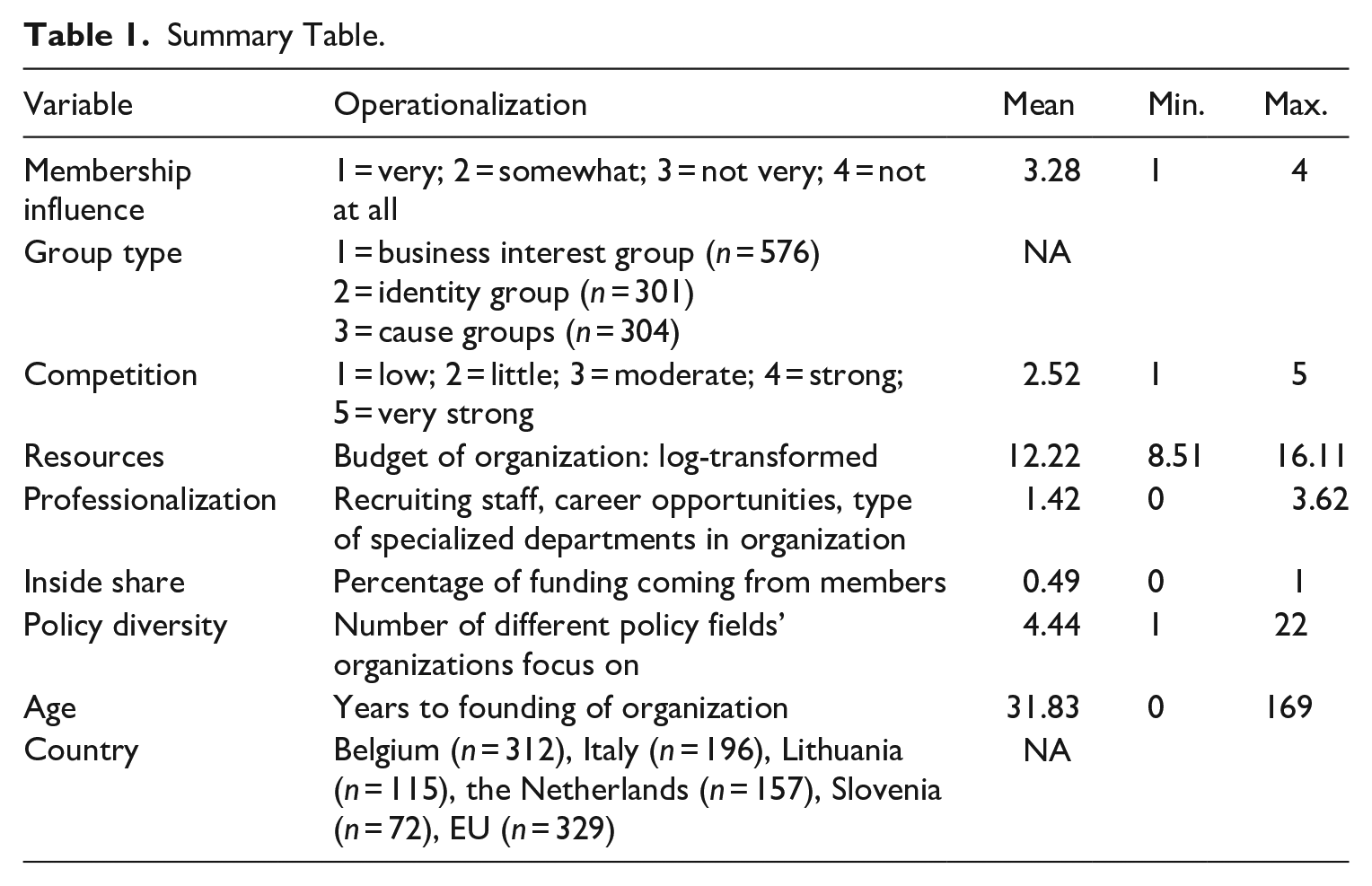
We have two independent variables. The first is group type, based on the INTERARENA coding scheme (http://interarena.dk/). In this article, we rely on a distinction between business interest associations and citizen groups. The latter includes identity and cause citizen groups, but not work-related, labour unions and professional associations. Business interest associations have individual firms as members. Identity groups defend the direct interest of their members, such as patient groups or groups representing minorities. Cause groups represent the interests of a certain cause which the constituency cares about but does not necessarily affect them personally. This may include causes such as child poverty, human rights or humanitarian aid. The second independent variable is the competition groups’ face in resource acquisition. For organizations in highly competitive and crowded environments, members have more exit options. To tap this dimension, we asked our respondents to indicate the level of competition they face from like-minded organizations to attract members, donations and subsidies. The organizational leaders responding could choose between ‘no’, ‘little’, ‘moderate’, ‘strong’ or ‘very strong’ competition (see Hanegraaff and Poletti, 2019 for more information regarding this variable).
Furthermore, we include several control variables. First, we control for ‘budget’. On this, we asked about the annual operating budget of the organization in 2016 in Euros; we log-transformed the values given the skewed distribution of this variable. For the second control variable, ‘professionalization’, we rely on several related indicators: decision-making, hiring policy, staff training and employees’ career prospects. Our variable is an average score based on each of these indicators. The next control variable is the type of lobbying strategies interest group employ (inside or outside). Policy-makers subject to inside lobbying may require their interlocutors to clearly demonstrate their formal members’ mandate to provide a demonstrable link between inside lobbying and membership voice. We operationalize this as the share of inside lobbying from total lobbying as reported by respondents (inside share). This is a specific question in the survey: ‘could you indicate what share of your total lobbying efforts is dedicated to inside – directly contacting policy-makers – and outside lobbying – lobbying indirectly such as through protest or via the media?’ Our fourth control variable is policy diversity: the number of policy field organizations focus on. Groups engaged in more than one policy field should find it more difficult to manage the expectations of members; hence, one should reasonably expect them to provide more input to members (Halpin and Binderkrantz, 2011). However, Halpin and Binderkrantz (2011: 214) note: . . . a high level of membership influence is found to lead to a more generalized pattern of engagement, which suggests that members may use their influence in ways that endorse groups to engage in a broad array of policy areas.
We also control for the age of an organization as groups may become less democratic over time (Michel’s ‘Iron Law of Oligarchy’; see also Rucht, 1999). Finally, we control for the country for cultural, legal and/or institutional differences in how associations involve members.
Empirical Analysis
First, we set out descriptive tables and then our multivariate regression models. Table 2 presents the distribution of our dependent variable across the countries. While country differences are not our main focus, it remains important to highlight any variations. The answers of the respondents are set out in the rows and the countries in the columns. Overall, we see that most interest groups provide members with some influence on policy positions. If we look at the first row, in a small number of groups members have no influence whatsoever. Belgium has the highest (negative) share with 7.1%, and the EU has the lowest with only 2.4%. In most organizations, members are somewhat or very influential in formulating political positions. In Italy, members are most influential (72.9% are ‘very influential’), and in Slovenia, members have the least influence (34.7% of members are ‘very influential’). To check that these country differences do not affect the outcomes of our main analyses, we control for country differences in the multivariate analysis below.
Membership Influence across Countries.
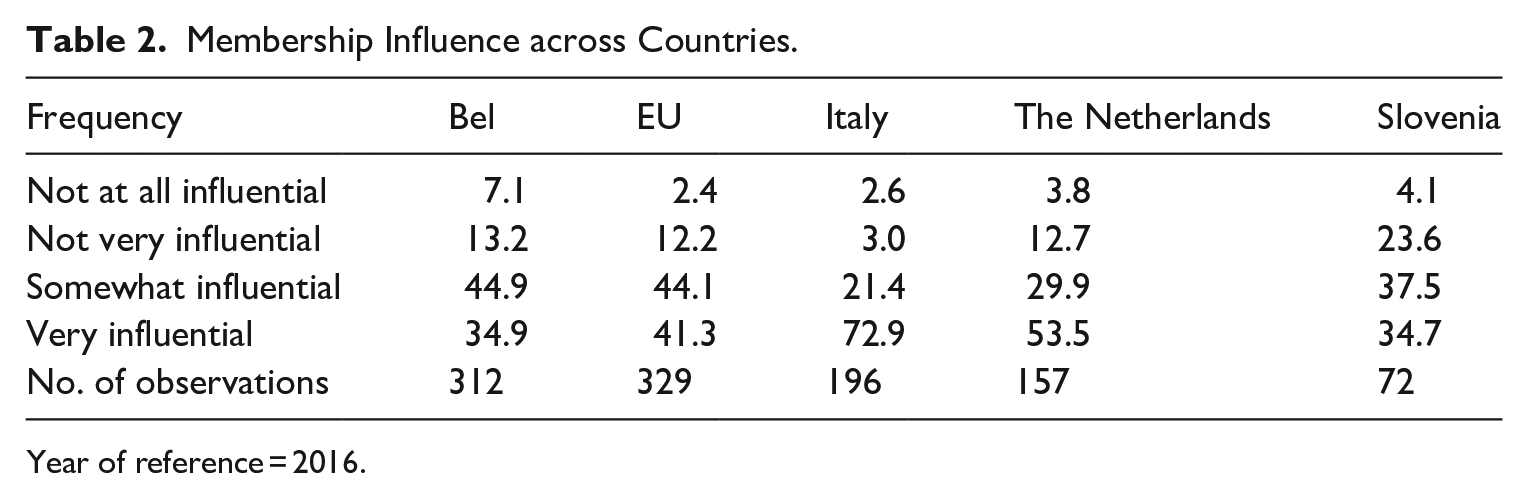
Year of reference = 2016.
Table 3 shows the distribution across group types. The left column reports the business membership group responses, the middle column – the identity group responses and the right column – the cause group responses. What are the main observations? It is clear that business groups are more responsive to members than citizen groups. Of all the business groups, only 2.4% state that members have no impact on the selection and formulation of policy issues. While over half (50.4%) says that members are very influential in this regard. For citizen groups, we see that 5.1% of identity groups members have no impact and 44.6% are very influential. Cause groups, as expected, provide the least ‘voice’ to members: 7.4% provide no influence to members and only 33.9% indicates that members were ‘highly influential’. The descriptive results are in line with our first hypothesis: citizen groups in general appear to be less responsive to members than business groups and identity groups provide more voice to their members than cause groups.
Membership Influence across Interest Groups.
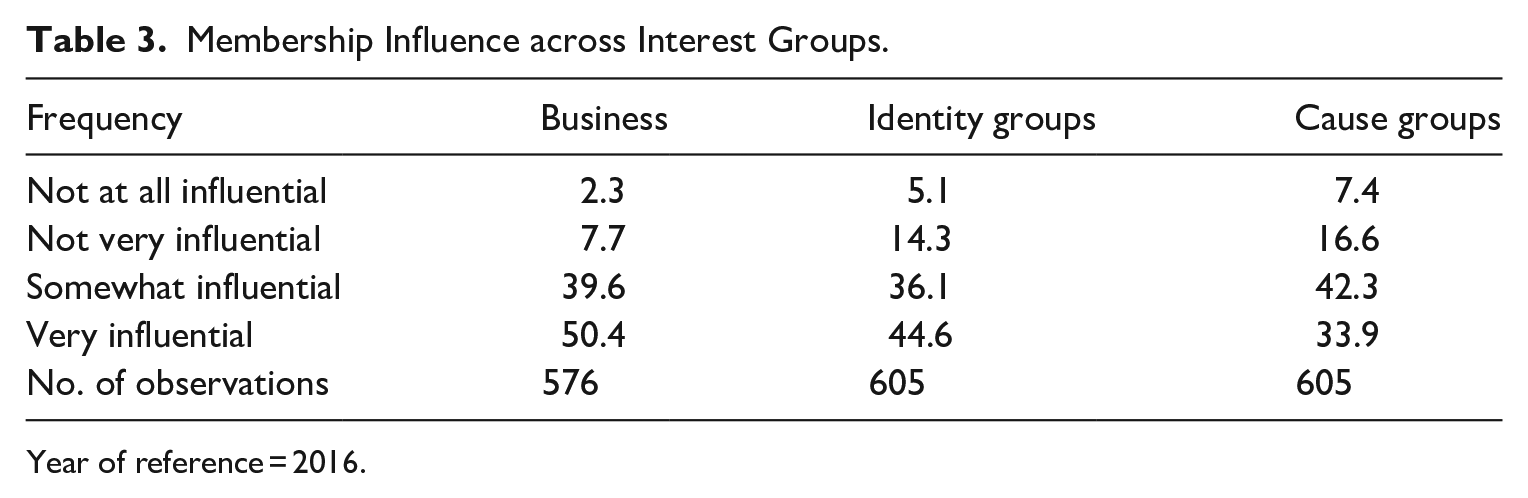
Year of reference = 2016.
Table 4 sets out our multivariate analysis. Our dependent variable is the influence that members have on the policy positions of interest groups. As this is an ordinal scale, we rely on ordered logistic regressions. Note that in the robustness checks we also check for alternative measures of the dependent variable. Our key independent variables are group type and competition with other interest groups to acquire financial resources. For Hypothesis 1, we compare business, identity and cause groups (Model 1). In the robustness checks, we also check for other group types. For Hypotheses 2 and 3, we provide an interaction between group type and competition (see Model 2). Our control variables are budget, professionalization, inside lobby share, policy diversity, age and country of origin.
Predicting the Level of Membership Influence (Ordinal Logistic Regression).
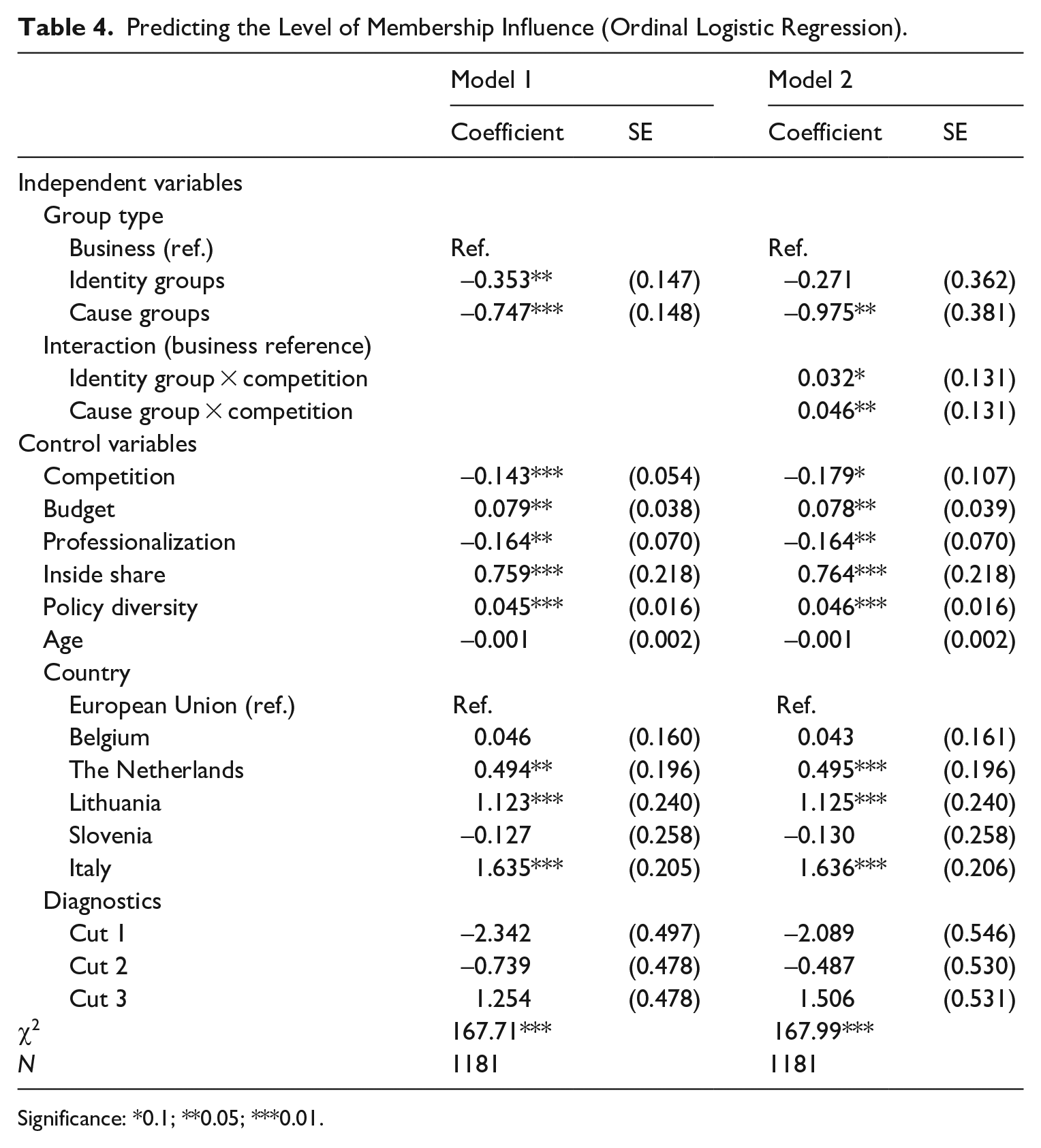
Significance: *0.1; **0.05; ***0.01.
With regard to Hypothesis 1, we find that business groups provide more voice on policy options for their members than identity and cause groups, and cause groups provide less voice than identity groups (see Model 1, Table 4). To provide a visual representation of this effect, we plotted the predicted values (see Figure 1). The results confirm our descriptive analysis. Business groups provide members with more influence on the selection and formulation of policy issues. More specifically, on a scale of 1–4 (ranging from limited influence to very much influence), business groups have a predicted score of 3.42; identity groups are in the middle with 3.26; and the cause groups bring up the rear at 3.16 (Figure 2). As argued in the theoretical section, this suggests that firms, as members of business interest associations, have a more influential voice in internal decision-making than individual members in citizen groups. And that identity groups are more responsive to their members than cause groups. This confirms Hypothesis 1.
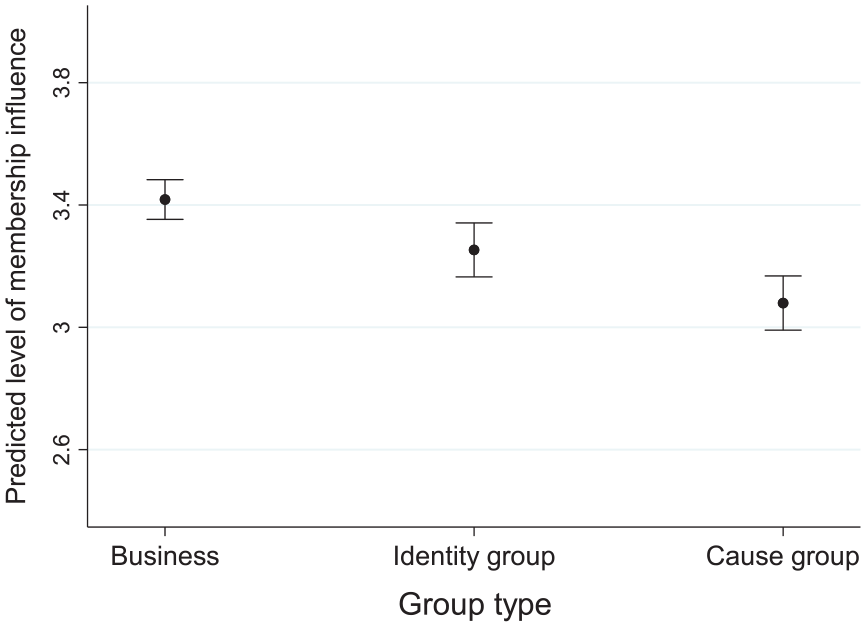
Predicted Level of Influence Members Have on Policy Positions of Organization across Group Types: Business and Citizen Groups.
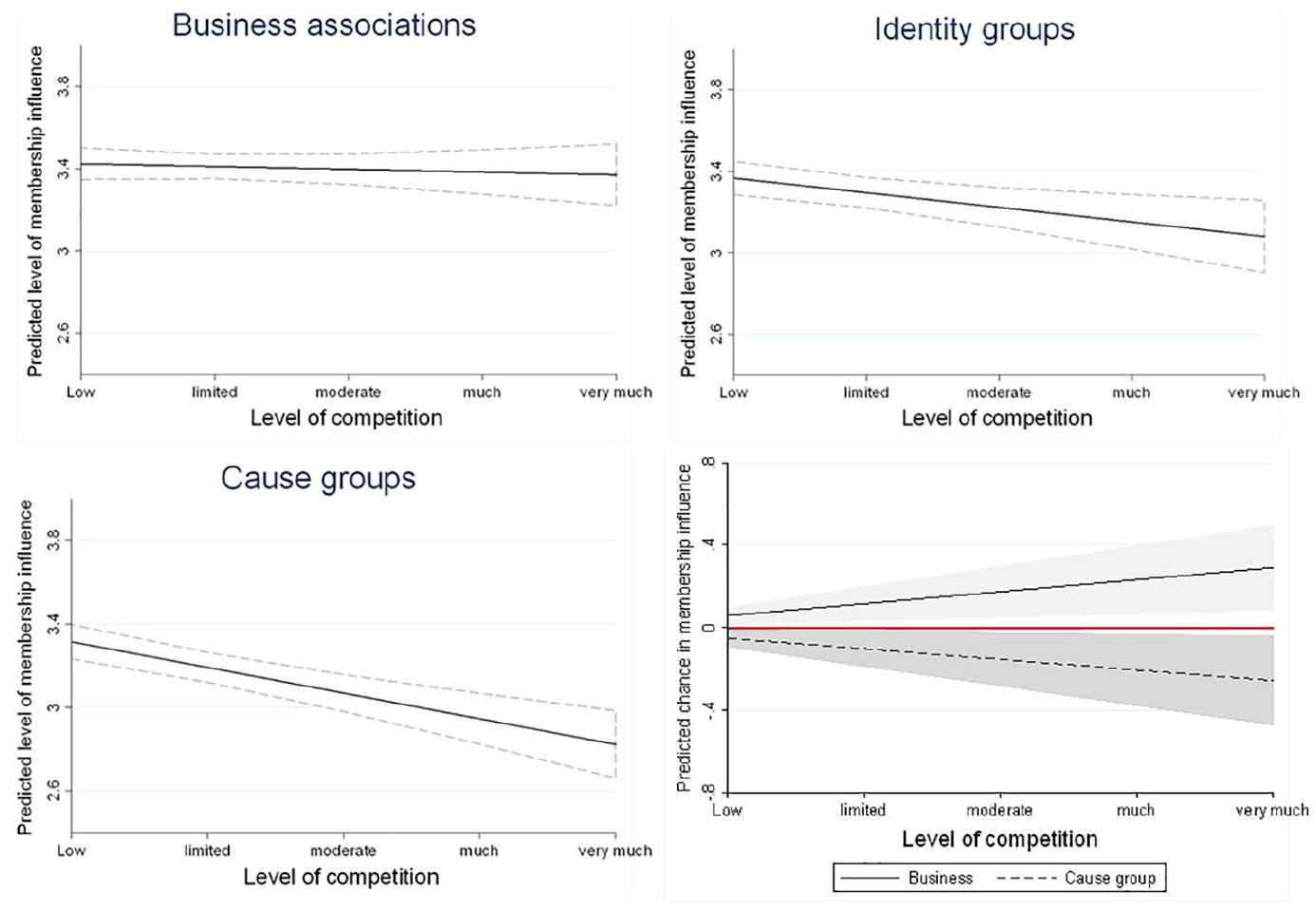
Predicted Level of Membership Influence (Top and Bottom Left Figures) and Marginal Differences (Bottom Right Figure) across Business Associations, Identity Groups and Cause Groups, by Various Levels of Membership Competition.
The results do, however, support Hypothesis 3: that business interest associations are largely shielded from competitive pressures. However, for both types of citizen groups, we do observe a sharp decrease of membership influence with increased competition. First, for identity groups, we see that the level of membership influence decreases from 3.40 (when no competition is reported by respondents) to a predicted score of 3 (in case of high competition: a substantial decrease). For cause groups, the decrease is even higher: from 3.4 under no competition to 2.75 when competition is high – these groups are under greater financial survival pressures and, thus, we see a very substantial decrease in membership influence. To check whether the differences between the group types are significantly different, we also plotted the marginal effects. This figure highlights the change in membership influence between the groups. Identity groups are the reference category (middle red line). We see clearly that the differences are significant when competition increases. The confidence intervals do not overlap when there is at least limited competition. In short, in line with Hypothesis 3, we observe that business groups do not respond to competitive pressures by excluding, or seek to reduce members influence, in their decision-making procedures. Identity groups limit the influence of members substantially, while cause groups respond to competitive pressures by providing the least influence to their members.
An interesting additional finding is that at very low levels of competition we see no difference between the three group types. All groups have a predicted score of 3.40 when no competition is reported by respondents. Given that citizen groups tend to operate in a more competitive environment than business groups, we can thus conclude that much of the differences in membership influence across business and, citizen groups are caused by the competitive pressures these groups experience. Citizen groups often face fierce competition and their members are likely to ‘exit’ rather than expend energy on seeking organizational reform. The lack of demand for voice appears to decrease membership influence. Business interest groups seem to manage competition via a combination of partitioning and associated selective material benefits. This leads them to be less affected by membership ‘exit’ threats, but produces a demand for internal voice on the associations’ policy.
For last figure (bottom right), identity groups are the baseline (red middle line). The figure indicates that business provides increasingly more influence to members when facing more competition to acquire resources for their survival than identity groups; cause groups, instead, provide increasingly less influence to members than identity groups when facing more competition to acquire resources.
Turning to our second and third hypotheses. Our expectation is that with increased competition we should observe less membership influence in general (H2), but especially for citizen groups and less so for business interest associations (H3 interaction). Moreover, we expect to find that members have less influence in cause groups compared with identity groups when facing increased competition. What are the results? First, we see that competition limits membership influence. In Model 1 (Table 4), we observe a significant effect and negative influence of competition on membership influence. This is in line with H2. Yet, if we analyse the effect of competition on the three group types, we see that not all groups are (equally) affected by competition. To visualize the precise effects, we plotted for each group type the predicted change in membership influence once competition increases (see the top two figures and bottom left). Here, we see that for business groups there is no change in membership influence when competition increases. Irrespective of the level of competition, business groups have a predicted level of membership influence of around 3.40. These results are not in line with H2 regarding the general negative effect of competition on voice in business organizations.
Robustness Checks
To ensure that our findings are robust, we conducted several statistical checks. First, in our theoretical framework and analyses, we rely on three group types, although we are well aware that there are more types of organizations engaged in lobbying. We therefore include a robustness check for all type of actors in our dataset (based on the INTERARENA coding scheme, see http://interarena.dk/). The results are presented in Appendices 1 (regression analysis) and 2 (predicted probability plots). Here, we can see that business organizations and labour unions score the highest on membership influence. However, only business groups are significantly different from other groups. It is also noteworthy that professional organizations, that is, groups representing professionals such as doctors or engineers, provide equal access to their members as identity groups. This may be a result of the fact that members of professional organizations, like members of identity groups, have an individual stake in their organizations and are directly affected by its actions. This appears to trigger a similar response regarding membership influence. More research is required to explore this mechanism further.
The second robustness check relates to the specific question we asked about membership influence on policy positions. Herein, we relied on a question asking about the relative influence of members on the formulation of organizational policy positions (see research design). In the survey, we asked about the decision-making procedures associated with the establishment of policy positions. Was it decided by: (1) consensus among members, (2) voting among the members, (3) consensus in the organizational board, (4) voting in the board or (5) senior staff taking these decisions? This ranking places membership influence on a sliding scale and included this as the dependent variable in the regression analysis. As set out in Appendix 3, the results correspond to those in the main analysis: both H1 and H3 are confirmed, while H2 is rejected.
Third, we asked respondents about the influence members have on other activities of the organization, namely, the budget, hiring of staff, appointing board members, appointing the chairperson, admission of new members, changes to statutory rules or the constitution, or adopting strategies to influence policy-making process. To assess whether our findings are generalizable to other types of membership influence, we created an index of all these activities and the level of membership influence (formula = sum score on membership influence on each activity/number of activities) and use this as the dependent variable (see Appendix 4). The results, again, correspond to the main analysis. This means that overall, citizen groups provide less influence to members than business groups, and this effect is strongly driven by the competitive pressures on these groups to acquire financial resources. This also confirms both the robustness and generalizability of our findings on multiple types of membership influence.
Fourth, one potential alternative explanation relates to the size of the membership. Collective action theories explicitly state groups’ size affects the way in which groups are able to offer members more involvement opportunities. We did not include this variable in the main analysis as we have several missing values. We therefore opted to add it as a robustness check to see whether it changed the results, so we have a broader sample underlying our main mode. As can be seen in Appendix 5, the inclusion of this variable does not affect our results. Yet, it is in itself significant, indicating that groups with a more limited membership base provide more influence to their members.
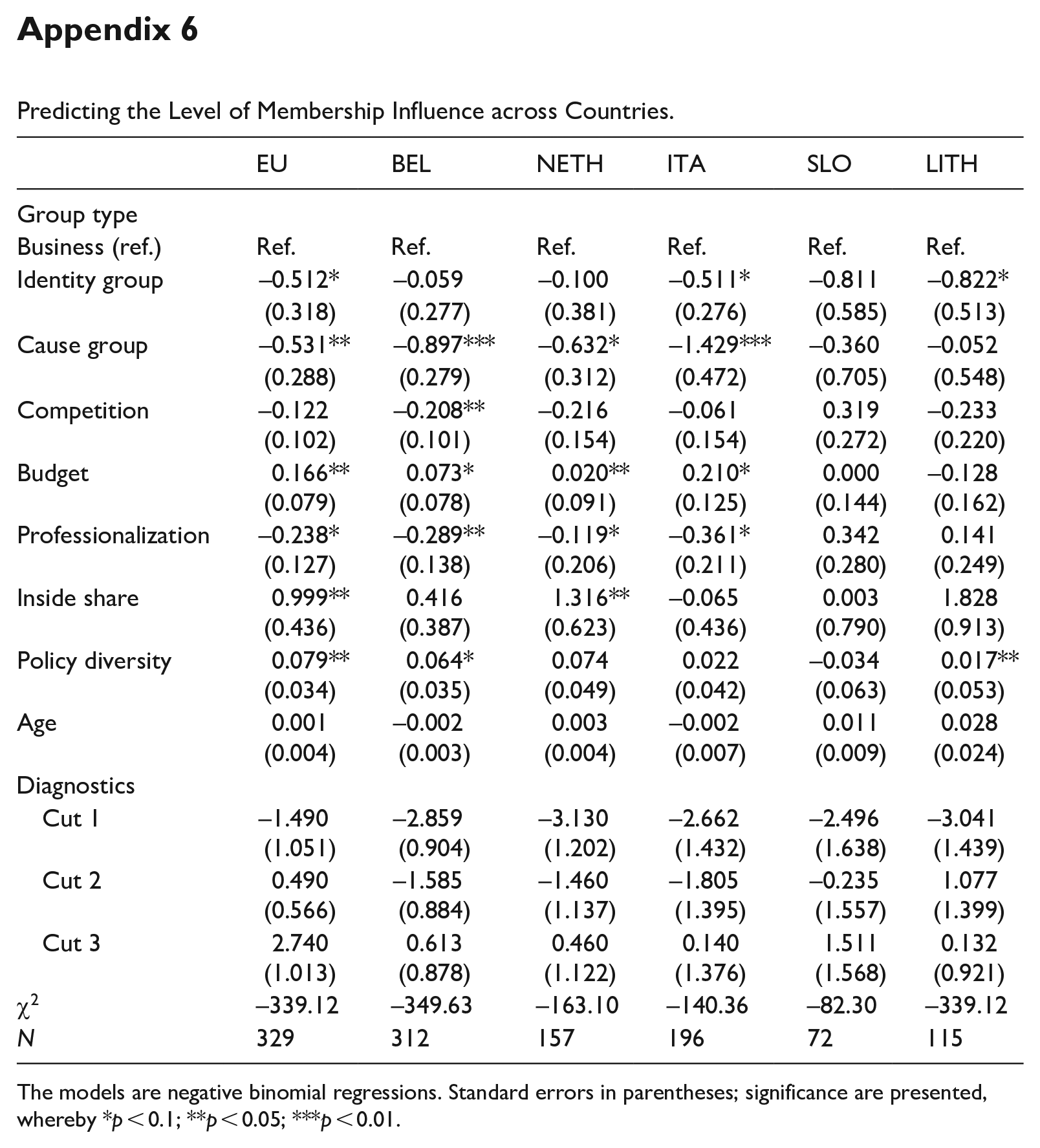
Finally, herein, we included five countries and the EU. While it goes beyond the purpose of our article to include country differences, as a robustness check we added a separate analysis for each country (see Appendix 6). This check shows our results are robust, but there are interesting differences across countries. First, in all Western countries, cause groups are the least likely to provide voice to members; yet the difference between identity groups and business groups is not always significant (although the sign of the coefficient is always in the right direction). This means that identity groups in some countries behave similarly to business groups, a finding worthy of further exploration in future research. Second, for the two Eastern European countries, we see that there is only limited or no difference between business groups and citizen groups – that is, the sign of the coefficient is in the expected direction, but the differences are not significant. There are two potential interpretations/explanations: on the one hand, it may be that the sample sizes in these countries are not large enough because the differences are close to significant. On the other hand, there may be country differences. Interest systems in Eastern European countries are less mature which could affect how groups respond to competitive pressures. More research is needed to flesh out these country differences. For now, it affects the generalizability of our results: it holds in Western democratic countries, but care is needed when seeking to extrapolate our findings to consolidating democracies.
Concluding Discussion
In this article, we investigated why some interest groups are more responsive to members and give them an effective voice over the political course of their organizations. We theoretically argued that business groups were likely to be more responsive to their members for two main reasons. First, the membership incentives lead members of business groups to be more likely to demand voice within their organizations. Second, business groups are more likely to maintain or increase voice options in the face of increasing competitive pressures; whereas citizen group leaders in competitive environments, attempt to maintain members through the provision of other types of incentives. Our findings were in line with these expectations: (1) business interest association members have greater voice rights and, by extension, are likely to have a bigger influence over organizational structures and processes, policy priorities, lobbying/advocacy tactics and strategies; (2) crowded and competitive interest group environments actually reduce voice opportunities; and (3) these crowded and competitive areas have a bigger impact on citizen groups than business organizations.
Our article makes three contributions to the literature. First, in contrast to earlier work, we directly compare the democratic tendencies of business and citizen interest groups, respectively. Given that both organizational types have democratically important transmission belt functions it is apposite to jointly study these associations in a coherent theoretical framework. Moreover, as we have shown, we can employ similar concepts (e.g. on incentives, exchange relations, and organizational environments) and operationalizations for both types. However, we observe fundamentally different empirical outcomes/implications, as business groups are much more open to the input of members, than citizen groups. This is a significant finding as it questions the ability of citizen groups to function as democratic agents (effective transmission belts) in political systems and potentially warrants more critical attention to the positions they take in democratic politics. To what extent do they adequately represent citizens? Do some citizens feel systematically under-represented?
This brings us to our second main contribution. We have shown that the competitive organizational environment is a critical factor limiting the democratic function of civil society groups. This view extends traditional research foci on internal dynamics, such as professionalization (Jordan and Maloney, 1997, 2007) and the oligarchical tendencies of elites (Rucht, 1999). Our results highlight that much of these developments are caused by increased competition over scarce resources leading citizen groups to abandon voice options for members. This is an issue of concern because many governments have decreased funding for citizen groups, thereby increasing organizational survival pressures. One unwanted effect of such policies is that it weakens the representative and democratic base of citizen groups – the opposite of what is demanded by government agencies when seeking input from these interest groups.
Third, we contribute to the literature by demonstrating that the population ecology approach matters beyond a narrow focus on organizational systems. We show that competitive pressures arising from the dense organizational environment of interest groups feedback into structural internal organizational choices. This finding aligns with a recent wave of studies emphasizing the importance of competitive pressures for interest group strategies (Dür and Matteo, 2016), policy positioning (De Bruycker et al., 2019) and access (Hanegraaff et al., 2020b). Clearly, to understand why groups act or function the way they do, an assessment of the competitive environment is crucial. More broadly, the connection between macro-interest (populations of groups) and micro-interest (voice options) group phenomena in this article addresses Holyoke’s (2009) concern regarding the ‘bifurcation’ and lack of ‘general progress’ in the study of interest groups (see also Halpin and Jordan, 2009; Lowery et al., 2015).
There are some limitations to our study. The first is related to normative consequences. The assumption is that if citizens’ groups offer limited voice opportunities for members, then democracy is weakened – that is, the transmission belt is not functioning effectively. However, that is not the whole story. It could be argued that there is some democratic content in the exit option – there may be some democracy in the choice of organization memberships. If citizens do not like one group, then they can, in most cases, readily and easily find another to support. Members’ exit power can shape the behaviour of group leaders in a way that is akin to the buying power of consumers. Accordingly, even in organizations where members have no voice, as Hirschman (1970: 21) notes: . . . the exit option is widely held to be uniquely powerful: by inflicting revenue losses on delinquent management, exit is expected to induce that “wonderful concentration of the mind” akin to the one Samuel Johnson attributed to the prospect of being hanged.
In other words, members may occupy an ‘empty seat’ in many decision-making forums; there may be an anticipated reaction (Simon, 1953) forced by the exit option of members. Indeed, organizations have extensive tools to pick up clear signals about supporters positions and views (e.g. surveys of members, focus groups, public opinion polls and engage with members via Facebook pages, Twitter accounts, web discussion groups, etc.) – these also help to shape members’ views. The information gathered from these sources may inform or even justify selected advocacy/lobbying priorities and strategies and tactics. This means that ‘. . . where there is a variety of organizations, the mechanisms of entrance and exit provide the means for individuals to project their voices’ (Warren, 2011: 698). Future research should therefore analyse whether interest groups, which effectively rule out voice options to members, defend more narrow societal or economic claims, than groups which have a broad pallet of voice options available to members. This goes beyond the aim of this article, but is critical in any assessment of the democratic function of interest groups.
A second potential limitation is that our study relied on the views of organizational elites and they may not have been completely open, frank and self-critical in their assessment of the organizations they lead – that is, providing socially acceptable answers. We are confident that this is no more likely in the CIG survey than many other political sciences surveys. In any case, further study is needed on actual internal decision-making power. What voice rights are on offer and what is the take-up rate? It may necessarily be the case that in most organizations leaders have strong incentives to make their working lives as unproblematic as possible and to limit membership interference/control.
Finally, we draw our discussion to a close where we began, with Hirschman (1970: 124) who notes: . . . the short-term interest of management in organizations is to increase its own freedom of movement; management will therefore strain to strip the members-customers of the weapons which they can wield, be they exit or voice, and to convert, as it were, what should be a feedback into a safety valve. Thus, voice can become mere ‘blowing off steam . . . And exit can be similarly blunted.
If we are looking for voice in groups, then it is less likely to be found in the more ‘normatively friendly’ citizen groups and more likely to be found within ‘less likeable’ business groups. In any case, the potential ineffectiveness of either voice or exit as a mechanism for leadership control implies that group leaders may require additional stimulus to be ‘reminded’ of their position of responsibility. As noted by Truman (1959: 489–490), the loose collective of leaders in the intermediate system, as ‘holders of power and privilege’, tend to be unaware that ‘their positions have special vulnerabilities’. In more concrete terms, interest group leaders, preferably driven by ‘a pragmatic, humanist assessment of consequences’ (Truman, 1959: 491) should allow for the free expression of (internal) demands and criticisms, and be sensitized to other, new or competing organizations within society. In this way, they ensure that the mechanisms of both voice and exit are not fundamentally blunted.
Overall, we hope this study will act as a catalyst for more research into the democratic functioning of interest groups in political systems. In each country, thousands of interest groups claim to represent large numbers of citizens and the business community. However, to what extent can this claim be substantiated? And why are there variations among groups? To maintain trust in the quality of our democratic systems, this research is critical.
Footnotes
Appendix
Predicting the Level of Membership Influence across Countries.
| EU | BEL | NETH | ITA | SLO | LITH | |
|---|---|---|---|---|---|---|
| Group type | ||||||
| Business (ref.) | Ref. | Ref. | Ref. | Ref. | Ref. | Ref. |
| Identity group | −0.512* | −0.059 | −0.100 | −0.511* | −0.811 | −0.822* |
| (0.318) | (0.277) | (0.381) | (0.276) | (0.585) | (0.513) | |
| Cause group | −0.531** | −0.897*** | −0.632* | −1.429*** | −0.360 | −0.052 |
| (0.288) | (0.279) | (0.312) | (0.472) | (0.705) | (0.548) | |
| Competition | −0.122 |
−0.208** |
−0.216 |
−0.061 |
0.319 |
−0.233 |
| Budget | 0.166** |
0.073* |
0.020** |
0.210* |
0.000 |
−0.128 |
| Professionalization | −0.238* |
−0.289** |
−0.119* |
−0.361* |
0.342 |
0.141 |
| Inside share | 0.999** |
0.416 |
1.316** |
−0.065 |
0.003 |
1.828 |
| Policy diversity | 0.079** |
0.064* |
0.074 |
0.022 |
−0.034 |
0.017** |
| Age | 0.001 |
−0.002 |
0.003 |
−0.002 |
0.011 |
0.028 |
| Diagnostics | ||||||
| Cut 1 | −1.490 |
−2.859 |
−3.130 |
−2.662 |
−2.496 |
−3.041 |
| Cut 2 | 0.490 |
−1.585 |
−1.460 |
−1.805 |
−0.235 |
1.077 |
| Cut 3 | 2.740 |
0.613 |
0.460 |
0.140 |
1.511 |
0.132 |
| χ2 | −339.12 | −349.63 | −163.10 | −140.36 | −82.30 | −339.12 |
| N | 329 | 312 | 157 | 196 | 72 | 115 |
The models are negative binomial regressions. Standard errors in parentheses; significance are presented, whereby *p < 0.1; **p < 0.05; ***p < 0.01.
Declaration of Conflicting Interests
The author(s) declared no potential conflicts of interest with respect to the research, authorship and/or publication of this article.
Funding
The author(s) received no financial support for the research, authorship and/or publication of this article.
