




Abstract
The question of whether high immigration produces anti-immigration hostility has vexed researchers across multiple disciplines for decades. And yet, understanding this relationship is crucial for countries dependant on immigrant labour but concerned about its impact on social cohesion. Absent from most of this research are theories about the impact of early-years socialisation conditions on contemporary attitudes. Using the British sample of the European Social Survey (2002–2017) and two innovative approaches to modelling generational differences – generalised additive models and hierarchical age‒period‒cohort models – this paper shows that rather than producing hostility to immigration, being socialised in a context of high immigrant-origin diversity is likely to result in more positive attitudes to immigration later in life. This implies that through generational replacement, countries like the UK are likely to become increasingly tolerant of immigration over time. Importantly, however, a context of high-income inequality may diminish this effect.
The large-scale movement of people across borders is one of the defining political issues of the twenty-first century. Immigration is dividing western societies (McLaren, 2012), disrupting established party systems (Arzheimer and Carter, 2006; Golder, 2016; Pardos-Prado, 2015), and producing surprise referendum outcomes like the UK’s decision to leave the European Union. We face momentous questions about the future prospects for western democracies, most of which appear to be reliant on migrant labour for vital services and the smooth functioning of their economies: Will anti-immigration hostility continue to rise if migration continues to increase? Will this result in further increases in support for anti-immigration parties and leaders? Will the issue of immigration continue to divide western democracies for the foreseeable future, or is it possible that this issue will eventually no longer be of great concern?
Evidence-based answers to these questions are largely elusive, as evidence on the relationship between immigrant numbers and public attitudes to immigration is extremely mixed. On the one hand, as would be argued by classic ethnic threat approaches, increasing numbers of migrants have been shown to be associated with more negative attitudes to immigration (McLaren, 2003; Quillian, 1995; Scheepers et al., 2002; Schneider, 2008; Semyonov et al., 2008). On the other hand, as might be predicted by intergroup contact theory, increasing numbers have also been shown to produce more positive attitudes to immigration (Hewstone and Schmid, 2014; Wagner et al., 2006; Weber, 2019) or to have no impact due to the likelihood of threat and contact cancelling one another out (Evans and Need, 2002; Sides and Citrin, 2007; Strabac and Listhaug, 2008). Questions about the impact of ethnic diversity on social cohesion have similarly divided social capital research (Van der Meer and Tolsma, 2014).
Despite the fact that scholarly work has emphasised the importance of socialisation experiences for subsequent attitudes, values and behaviours (Krosnick and Alwin, 1989; Neundorf et al., 2013; Sears and Valentino, 1997), the vast majority of research on the immigration numbers-attitudes relationship tends to focus on relatively contemporary levels of (or relatively short-term changes in) diversity (see Coenders and Scheepers, 1998 for a rare exception; see also, Weber, 2019). Much of this existing research has overlooked a crucial factor in understanding how attitudes to immigration are formed – and change – within a population through generational replacement. Replacement of older generations with younger ones implies that trends in immigration attitudes would change substantially if, for example, older generations hold systematically different attitudes to immigration than younger generations. The scarcity of research on this topic is not a minor omission, as understanding generational differences in attitudes to immigration is likely to provide insight into the contradictory findings that have puzzled this body of research for more than two decades. It also has significant effects on our ability to provide answers to the sorts of policy-oriented questions raised above.
Until recently, data and modelling limitations made investigating the impact of early-years macro-level socialisation experiences extremely difficult. Drawing on advances in modelling cohort effects, this paper uses two state-of-the-art approaches – generalised additive models (GAMs) and hierarchical age‒period‒cohort (HAPC) models – to investigate whether attitudes to immigration are persistently different across birth cohorts. We also investigate whether any potential cohort differences are related to different macro-level diversity conditions experienced by each generation. Our model is investigated using the British sample of the European Social Survey (ESS), rounds 1–8, conducted between 2002 and 2017. This dataset allows us to follow groups of birth cohorts that were socialised from 1935 to 2010. We match these individual-level data with early-years macro-level diversity using census data, and with other early-years contextual data – in particular, economic data – as well as contemporary contextual data, to analyse the impact of all of these on current attitudes to immigration. 1 The incorporation of economic data allows us to examine whether any impact of diversity as a socialisation effect could be moderated by economic conditions, as emphasised by ethnic threat theories (e.g. Golder, 2003; Quillian, 1995). In addition to the economic conditions normally incorporated in the ethnic threat literature (unemployment and gross domestic product (GDP)), our analysis examines the effect of an important economic condition argued by social capital research to produce particularly divisive conditions – economic inequality (Uslaner, 2002).
The findings suggest that even controlling for potentially confounding factors such as aging, changing education levels, and diversity and economic conditions at the time of each wave of the survey, younger generations are increasingly more positive about immigration, and these generational differences are related to the level of diversity in the UK in a cohort’s early (impressionable) years. Robustness tests show that these findings are unlikely to simply be a result of a more general increased tolerance among younger cohorts. The findings also reveal that one particular economic condition in the early years – level of income inequality – may moderate the positive impact of diversity: high levels of income inequality appear to reduce the positive effect of macro-diversity.
This paper makes several contributions. First, the paper draws attention to generational differences in immigration sentiments and attempts to establish empirically (and systematically) whether generations differ in their views towards immigrants, thus adding to a small but growing body of research on this topic (Coenders and Scheepers, 1998; Ford, 2011; Gorodzeisky and Semyonov, 2018; McLaren and Paterson, 2019; Wilkes and Corrigall-Brown, 2011). Much of this existing research is unable to incorporate early-years diversity into its analyses, however, and so the paper’s second contribution is to shift the analysis of the impact of macro-level diversity from contemporary to past diversity, to show how a context of relatively high diversity in the country during an individual’s formative years may ultimately produce more positive immigration attitudes later in life (though this may be dependant on inequality conditions, as noted above). Finally, focusing on the drivers of generational differences provides us with insights into potential future trends in attitudes to immigration. 2 Our findings thus have significant implications for understanding anti-immigration sentiment, as well as issues connected to it such as social cohesion.
Generational Differences in Attitudes to Immigration
Central to this paper’s argument is the idea that birth cohorts are likely to vary in their attitudes to immigration. Birth cohorts are groups of individuals who have shared experiences due to prevailing conditions at the time they were socialised (Neundorf and Niemi, 2014). There are several reasons to expect differences in attitudes to immigration across birth cohorts. First, research on the development of individual-level political attitudes and behaviours has long emphasised the impressionable or formative years – the time between childhood and adulthood – in influencing subsequent attitudes and behaviours. 3 Young people (so the argument goes) are not yet set in their ways and are thus more easily influenced by external factors (Alwin and Krosnick, 1991; Grasso et al, 2019; Jennings, 1989; Sears and Valentino, 1997). Particularly if cohorts have faced differing macro-level societal conditions during their early years, they may display dissimilar values, attitudes and behaviours. Inglehart’s contention that economic security during individuals’ formative years leads to long-lasting post-materialist values is perhaps the most seminal example of the impact of macro-level conditions on values later in life (Inglehart, 1977, 1997; but see, for instance, Clarke and Dutt, 1991); other research also confirms that early-years macro-level socialisation conditions impact values and attitudes later in life (Giuliano and Spilimbergo, 2014; Neundorf and Soroka, 2018).
A second reason that we might expect to find cohort differences in attitudes to immigration is that there is strong evidence of the existence of generational differences in values that are related to attitudes to immigration such as authoritarianism, with younger cohorts apparently becoming less authoritarian (Norris and Inglehart, 2019). In addition, research on the relationship between age and attitudes to immigration points to the possibility of cohort differences: while some studies show very minimal effects of age (Crepaz and Damron, 2008; Weldon, 2006), many others find that older individuals consistently display less tolerance towards immigrants than younger individuals (Citrin et al., 1990; Coenders and Scheepers, 1998, 2008; Ford, 2011; Quillian, 1995; Semyonov et al., 2006).
The ability to draw inferences about generational differences in attitudes and behaviours has, however, largely been limited by cross-sectional research designs or an inability to account for all potentially confounding factors (e.g. age). Despite these limitations, some have concluded that the effects described above are not simply aging effects – that is, individuals becoming more conservative, authoritarian, and/or intolerant as they grow older – but that generational, or cohort, differences are, in fact, likely (e.g. Ford, 2011). The small body of research that systematically investigates this topic in the context of immigration attitudes (see Coenders and Scheepers, 1998; Ford, 2011; Gorodzeisky and Semyonov, 2018; Wilkes and Corrigall-Brown, 2011) indicates that significant cohort differences are indeed likely – though most of these studies have been limited by an inability to analyse the impact of early-years diversity on these differences. Our first hypothesis is, therefore:
H1: Cohorts display distinct (significantly different) immigration attitudes, even when controlling for age effects and all other relevant factors.
To our knowledge, providing an empirical test of this hypothesis presents the first documentation of generational differences in immigration attitudes in the British population.
Early-Years Socialisation Conditions and Attitudes to Immigration
Despite the potential importance of socialisation conditions for values and attitudes, scholarly studies of immigration attitudes in Europe tend to focus on relatively contemporaneous factors that influence contemporary attitudes, or at best, the impact of relatively short-term fluctuations of these (e.g. Semyonov et al., 2006). We do not contest the importance of short-term factors in explaining variation in attitudes to immigration – indeed, we control for these in our models below – but contend that macro-level socialisation conditions may be crucial and largely overlooked. That is, much of the existing research on the topic of diversity and attitudes to immigration fails to grapple with the possibility that contemporary attitudes to immigration are determined by macro-level circumstances that prevailed many years previously and that current conditions may matter far less than these early socialisation experiences.
Within the body of research on generational differences in values and attitudes, including the small number of studies specifically on immigration attitudes, the focus has generally been on early-years macro-economic conditions. However, it is potentially equally – if not more – important that birth cohorts in European democracies have faced very different diversity-related conditions during their most impressionable years. In most of these countries, cohorts of individuals who were born in the 1930s, 1940s, and even 1950s would have been socialised at times of relatively low diversity, which then became much higher when these cohorts were already in their 50s, 60s, and 70s. For most of these cohorts, large-scale immigrant-origin diversity would have, therefore, been less prominent in their daily lives (e.g. people they meet in the streets, their friends, celebrities on television and in cinema, to name a few) during their impressionable years compared to cohorts born in the 1970s and beyond. The increased diversity by the time the younger birth cohorts were being socialised would have meant an increased likelihood of experience with immigrant-origin diversity being a daily part of life, either actually (e.g. via friends, schools, and co-workers) or virtually (e.g. via the media).
Understanding the UK Context
In the case of the UK, for cohorts born in the early 1930s, only approximately 3% of the UK population would have been foreign-born during key socialisation years (i.e. adolescence); by the time of socialisation for the early-1970s birth cohorts, this figure had more than doubled, and it continued to increase for subsequent cohorts (see Figure 1). In addition, while early migrants to the UK lived predominantly in London and a few other major port cities, by the early 1970s, the geographical locations of immigrants and immigrant-origin minorities had broadened significantly (Holmes, 1991: 217).
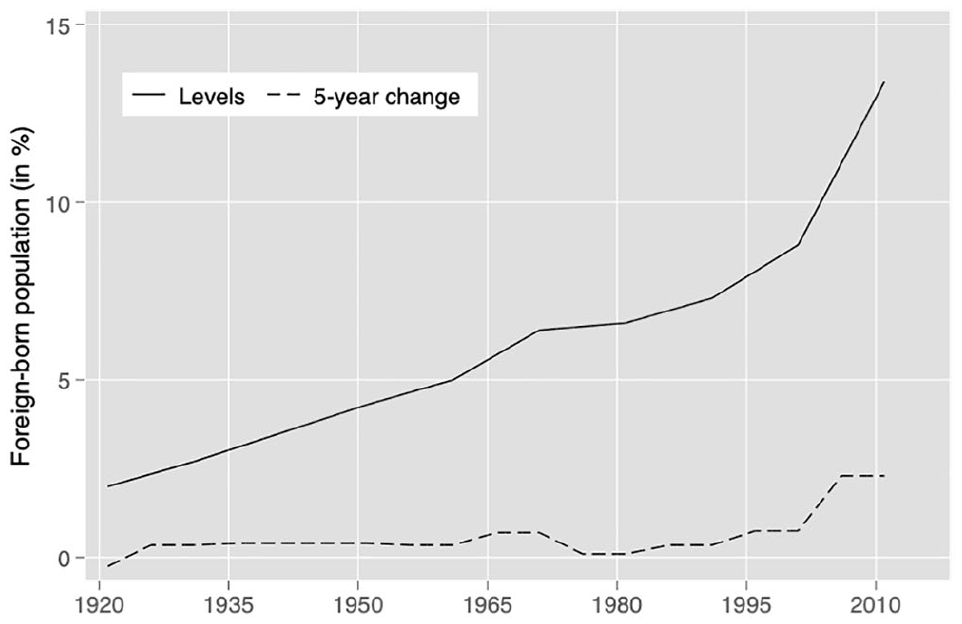
UK Foreign-Born Population.
Perhaps more important from a macro-diversity perspective was a ‘normalisation’ of visible immigrants and their descendants via increasing inclusion in British culture. Sport and the media are two pertinent examples. England’s 1966 World Cup winning squad was uniformly white, and England’s first black player, Viv Anderson, was not recruited until 1978. However, by the 1989–1990 football season 11.5% of all English Football League players were black (McGuire, 1991: 104; cited in Polley, 1998: 149), England named their first black captain in 1993 (Paul Ince), and by 2002 nine out of England’s 23-man World Cup squad were black, with a similar figure (8 of 23) in 2010 (Polley, 1998: 149).
Immigrant-origin individuals also became more visible via other parts of the media over this period. For instance, Trevor McDonald – born in Trinidad and Tobago to an Afro-Caribbean mother and Indian father – emerged as a breakthrough non-white newsreader in 1973. The presence of minorities on British television increased significantly after this, partly as a result of ‘multicultural’ policies at major news channels (e.g. Channel 4) explicitly designed for this purpose. By 2000, it was estimated that approximately 7.5% of television appearances (with speaking roles) were by immigrant-origin minorities. 4 By 2009, 10% of the BBC TV population were BAME, 5 and by 2018, 12.5% of the TV population on BBC1 and BBC2 were from an ethnic minority. 6
Immigrant-origin diversity was, however, not readily embraced during the early years of rising macro-diversity. Incidents such as the 1958 Notting Hill riots, Peter Griffiths’ infamous racist campaign slogan in the 1964 Smethwick by-election, the formation of the National Front in 1966, and Enoch Powell’s ‘Rivers of Blood’ speech in 1968 are oft-cited examples that exemplify how toxic the migration debate was in UK. Though the UK government began to try to restrict immigration in the 1960s, importantly, it also passed legislation (Race Relations Acts of 1965, 1968 and 1976) designed to improve ‘race relations’ and shift the focus of discourse onto improved treatment of immigrants and immigrant-origin minorities living in the UK (Holmes, 1991; Layton-Henry, 1992). This change in discourse may, in turn, have increasingly impacted younger generations’ perceptions of immigrant-origin minorities.
In short, for most individuals growing up in the 1930s, 1940s and 1950s, immigrant-origin minorities would have largely been absent from day-to-day life – in their direct experience and indirectly via media and sport. It is also likely that they would have been seen as a source of tension and division within the UK, given the events described above. On the other hand, for most individuals growing up in the 1980s and beyond (e.g. born in the 1960s or after), the presence of immigrant-origin minorities would have been a relatively common part of everyday life – again, either through personal contact or via media and sport. The discourse surrounding immigrant-origin diversity was also likely to be very different. This changing context of macro-diversity in early socialisation years is, in turn, likely to be significant in understanding cohorts’ current attitudes to immigration.
Expected Effects of Increasing Immigration
Based on the existing research on the contemporaneous relationship between diversity and attitudes to immigration, expectations about the impact of early-years diversity are, at first glance, not entirely clear, though. Seminal research on this topic points to the likelihood of diversity prompting a greater sense of threat, as a group’s resources are – whether in fact or merely perceived – placed under higher levels of strain. The result is more negative attitudes to the out-group in question (Blumer, 1958; Quillian, 1995). The one study that attempts to investigate the impact of early-years diversity (Coenders and Scheepers, 1998) finds that this is indeed the case, at least in the Netherlands (though the effect is weak). One might, therefore, hypothesise that
H2a: Increased diversity during a birth cohort’s formative years leads to more negative immigration attitudes in later life.
On the other hand, several studies of contemporaneous relationships fail to find any association between immigrant population size and (contemporaneous) attitudes to immigrants (Evans and Need, 2002; Rustenbach, 2010; Sides and Citrin, 2007; Strabac and Listhaug, 2008). In keeping with the intergroup ‘contact hypothesis’, still others find that greater immigration-related diversity produces more positive attitudes to immigration: in this case, contemporaneous diversity on average has an overall positive effect on attitudes, as the impact of (positive) contact with minorities ultimately outweighs the countervailing trend of threat (see Hewstone and Schmid, 2014; Wagner et al., 2006; Weber, 2019). The rare studies that are able to incorporate measures of contact and macro-level diversity conclude that contact does indeed help to reduce the sense of threat that might otherwise be created by contemporaneous diversity (McLaren, 2003; Stein et al., 2000).
Ford’s (2011) research alludes to the possibility that a similar effect may be occurring as a socialisation effect in the UK: younger cohorts have been socialised in a climate in which the presence of ‘Others’ – immigrants and immigrant-origin minorities – is commonplace when compared to previous cohorts. 7 Thus, norms and expectations surrounding the composition of the national population are likely to have changed the way citizens view the issue of immigration. Moreover, the vast increase in diversity across the UK (on average) is likely to have provided far greater opportunity for contact (Sigelman and Welch, 1993; Stein et al., 2000) – whether actual or virtual (via media and sport) – with immigrant-origin minorities during early-years socialisation ultimately reducing the sense of anti-immigration threat for these cohorts. An alternative hypothesis to H2a is, therefore
H2b: Increased diversity during a cohort’s formative years leads to more positive attitudes to immigration in later life.
Given the emphasis on macro-economic conditions found in existing literature on socialisation and in research on attitudes to immigration, we incorporate multiple macro-economic indicators into our analysis below. Research on the effect of contemporaneous macro-level conditions on immigration attitudes highlights the potential threat created by difficult macro-economic conditions (Semyonov et al., 2006). Some have further suggested that difficult economic conditions interact with high levels of diversity to produce a particularly competitive environment in which anti-immigration sentiment develops (Golder, 2003; Quillian, 1995). We incorporate these ideas as period effects, as well as socialisation effects. Our third hypothesis is, therefore:
H3: Poor macro-economic conditions combined with high levels of diversity during a cohort’s formative years produce more negative immigration attitudes in later life.
Data
Our analyses are based on the British sample of eight rounds of the ESS, conducted biennially between 2002 and 2017, in particular, the 13,661 respondents who themselves as well as their parents were born in the UK. 8 Our data and analyses are organised at the country level, rather than, for instance, a lower geographical unit, for several reasons. First, on theoretical grounds, the national rather than sub-national level is the appropriate level of analysis as we are arguing that on average across the UK, physical and virtual contact, as well as expectations regarding what ‘normal’ levels of diversity should be, are likely to have changed drastically. Second, our analyses require knowledge of where a respondent grew up during their formative years rather than where a respondent currently lives; this is unknown. Finally, the simultaneous estimation of age, period and cohort effects requires enough observations to distinguish between these effects; further subdividing cohorts and periods into regions would not leave us enough data to estimate our effects.
Measuring Immigration Attitudes
Immigration attitudes are measured using three items that appear in all rounds of the ESS:
Would you say it is generally bad or good for the UK’s economy that people come to live here from other countries? Bad for the economy (0), Good for the economy (10).
Would you say that the UK’s cultural life is generally undermined or enriched by people coming to live here from other countries? Cultural life undermined (0), Cultural life enriched (10).
Is the UK made a worse or a better place to live by people coming to live here from other countries? Worse place (0), Better place (10).
These items were combined into a single index, with values ranging from 0 to 10, from more negative attitudes to immigration to more positive attitudes to immigration. 9
Measuring Cohorts
As is standard in APC analysis (Mason and Fienberg, 1985: 3), cohorts are grouped into 5 year intervals based on birth year: those born between 1920 and 1924, those born between 1925 and 1929, and so on, with the youngest cohort being those born in 1995 or later. 10 This produced 15 birth-year cohorts. In order to assess the contextual socialisation effect during a cohort’s formative years, we add 15 years to each birth group to create ‘socialisation cohorts’, which share the same historical upbringing. This implies that the 1920–1924 cohort was in effect socialised in 1935–1939, when this cohort was around 15 years old. We define adolescence as the most formative years according to Bartels and Jackman (2014), who used a Bayesian learning model to estimate the formative years (see the Robustness section for alternative socialisation configurations).
Individual-Level Control Variables
In order to isolate the impact of cohort effects, it is important to account for individual-level alternative explanations as well as disentangle the socialisation effect from other potential societal changes over time, which affect the composition of cohorts. Most importantly, our models include individual-level age, which is converted from the respondent’s birth year. We only include respondents aged 20 and older in order to not confound the current with our assumed socialisation period (15–20 years old). We also control for individual level education. Like age, education has been shown to have fairly consistent, powerful effects on attitudes to immigration and related outlooks such as prejudice (Coenders and Scheepers, 2003; Hainmueller and Hiscox, 2007), and it is possible that any cohort differences in immigration attitudes are largely a result of differences in levels of education between cohorts (Wilkes and Corrigall-Brown, 2011). Education is measured on a 5-point scale indicating the respondent’s reported highest education completed, ranging from less than lower secondary education (1) to tertiary education completed (5) and has been converted into dummy variables for our analyses. Other individual-level control variables include gender, whether the individual is unemployed, and whether they find it difficult to live on their present income, where 1 represents financial struggles and 4 living comfortably (see Gorodzeisky and Semyonov, 2016; Quillian, 1995). 11
Measuring Socialisation and Contemporary Immigration-Related Diversity
In order to test our hypotheses, we need to measure the immigration-related diversity context to which each cohort was exposed during their formative years, while controlling for current levels of immigration, which will affect all cohorts similarly (period effect). Level of diversity in our analysis is measured by the percentage of foreign-born individuals in the country. Contemporary data are available annually from the Organisation for Economic Co-operation and Development (OECD) and so we are able to investigate the potential impact of current levels of diversity (period effects) using the percent foreign-born in the year of the survey. Though recent cross-national research highlights the potential importance of the share of the population that is of non-European origin (Gorodzeisky and Semyonov, 2016, 2018), in the case of the UK, both European and non-European migration are likely to be important, given the dramatic increase in numbers of migrants from other European countries over the timespan of the ESS. We therefore use percent foreign born in the UK in the year of the survey to capture overall level of diversity. 12
To test H2 and H3, likely exposure to more or less immigration-related diversity is also captured as a cohort effect. Measuring the level of diversity during the respondents’ formative years presents challenges regarding how to measure indeterminate periods spanning multiple ages of individuals. An additional challenge is that indicators of level of diversity were available with less regularity than contemporary indicators of percent foreign-born. However, Migration Watch (2014) has produced a report based on historic census data that provides the percent foreign born as reported in each census between 1851 and 2011. Apart from the World War II period, censuses were generally conducted every 10 years, beginning in 1851. Assuming that immigration numbers, as captured by the percent foreign-born, are generally very slow changing, we use linear interpolation to estimate the percent foreign-born for the cohorts in between those for whom census results can be used.
Cohorts are grouped into 5-year socialisation cohorts, and we calculate the average context during each cohort’s formative years using the above-mentioned historic census results. In our analysis, for example, for the 1940–1944 birth cohort, level of diversity is 5.0% foreign born, as estimated by the 1961 census, when this generation was about 15–20 years old. For the 1950–1954 cohort, that figure is 6.4, from the 1971 census, with the cohort between these two (1945–1949) being assigned a value of 5.7, and so on. Because cohort-level diversity increases linearly and therefore potentially creates identification problems (see below), we also investigate 5-year change in diversity during the impressionable years, using the same data. This variable is also theoretically relevant, as some research on the impact of macro-level diversity conditions indicates that changes in diversity may be more relevant than levels, at least contemporaneously (Hopkins, 2010). As is shown in Figure A1 in the Online Appendix, 5-year change was quite low at around +0.4% from 1925 to 1960. In the 1960s, there was a change of approximately +0.6% per 5-year interval and then change in immigration nearly stalled in the 1970s, before substantially increasing to approximately +2% per 5-year interval from the late 1990s onwards.
Macro-Level Economic Variables
Beyond investigating the impact of immigration, we include three macro-economic factors. Research on immigration attitudes has focused especially on unemployment and GDP per capita (e.g. Coenders and Scheepers, 1998; Golder, 2003; Meuleman et al., 2020; Quillian, 1995); we, therefore, incorporate these. We also investigate the potential effect of income inequality, a factor largely overlooked in existing studies of cross-time changes in attitudes and behaviours despite being argued to be crucial in producing a competitive macro-environment in which distrust and intolerance thrive (Uslaner, 2002). All three variables are included both as contemporary controls (measured at the time of the survey), as well as potential cohort effects, whereby we use the same method as above. We match to each respondent economic indicators, averaged over the 5-year interval corresponding to a cohort’s formative years when they were around 15 years old. The annual unemployment rate is drawn from the British Office of National Statistics (Office for National Statistics (ONS), 2016) data back to 1965, and before that we rely on data reported in Mitchell (1988); per capita GDP growth is based on data from the Maddison-Project (2001). To measure income inequality in the formative years, we use the Gini coefficient, available from UNU-WIDER (2017). 13
Empirical Analyses
This paper investigates whether cohort differences in immigration attitudes exist (H1) and what could explain these (H2 + H3). Our expectation is that the changing nature of immigration conditions to which each subsequent cohort was exposed during their formative years will leave an enduring mark on the immigration attitudes of that generation. In order to test our hypotheses, we need to isolate the effect of a respondent belonging to a specific cohort (Ci) from aging (Ait) and being interviewed in a specific year (Pt). The problem in identifying the unique APC effects on the outcome variable is the so-called ‘APC Conundrum’ (Glenn, 2005: 20), as

Once we know someone’s age and the current year (both measured in years), we know when they were born. Estimating unique parameters in regression models is thus impossible. To deal with this problem, some studies (e.g. Ford, 2011) omit one or two of the three variables that create the identification problem (age, period or cohort). In the case of anti-immigration attitudes, it is likely that all three variables could be relevant. As there is no perfect solution to the APC identification problem, we triangulate our results, drawing on two modelling approaches to investigate these: GAMs and HAPC models. 14
Exploring the Cohort Effect: GAMs
The Model
Following the work of Neundorf (2010) and Grasso (2014), GAMs are applied here to account for potential nonlinearity between birth cohorts and immigration attitudes. GAMs allow the modelling of unique effects for each cohort, permitting the main independent variable to be estimated non-parametrically. The advantage of this method over normal descriptive graphs (such as those shown in Online Appendix 2) is the inclusion of control variables, most importantly age and period effects. These are added in a linear, parametric way, as in multivariate ordinary-least-squares regression (see Beck and Jackman, 1998) before using graphs to investigate the potential non-linear effects of key variables, controlling for other relevant factors. Further information about GAMs, including our models, is provided in Online Appendix 3.
GAM Results
We estimate four separate GAMs. In each model, we include all individual-level control variables and depending which of the APC effects is estimated non-parametrically, the remaining two are controlled for as fixed parameters; one variable is then included as a smooth function. For example, in Figure 2(a), we control for age categories and period dummies, while estimating the smooth function of the cohort effect using the birth year as a continuous-level variable (testing H1). In Figure 2(b), we substitute the birth year of our respondents to use the level of foreign-born population during their formative years as a proxy and explanation for the cohort effect (H2). This approach is another APC identification strategy, as we use a substantive factor (immigration during one’s formative years) to proxy one of the APC effects, in our case the cohort effect (Rodgers, 1982).
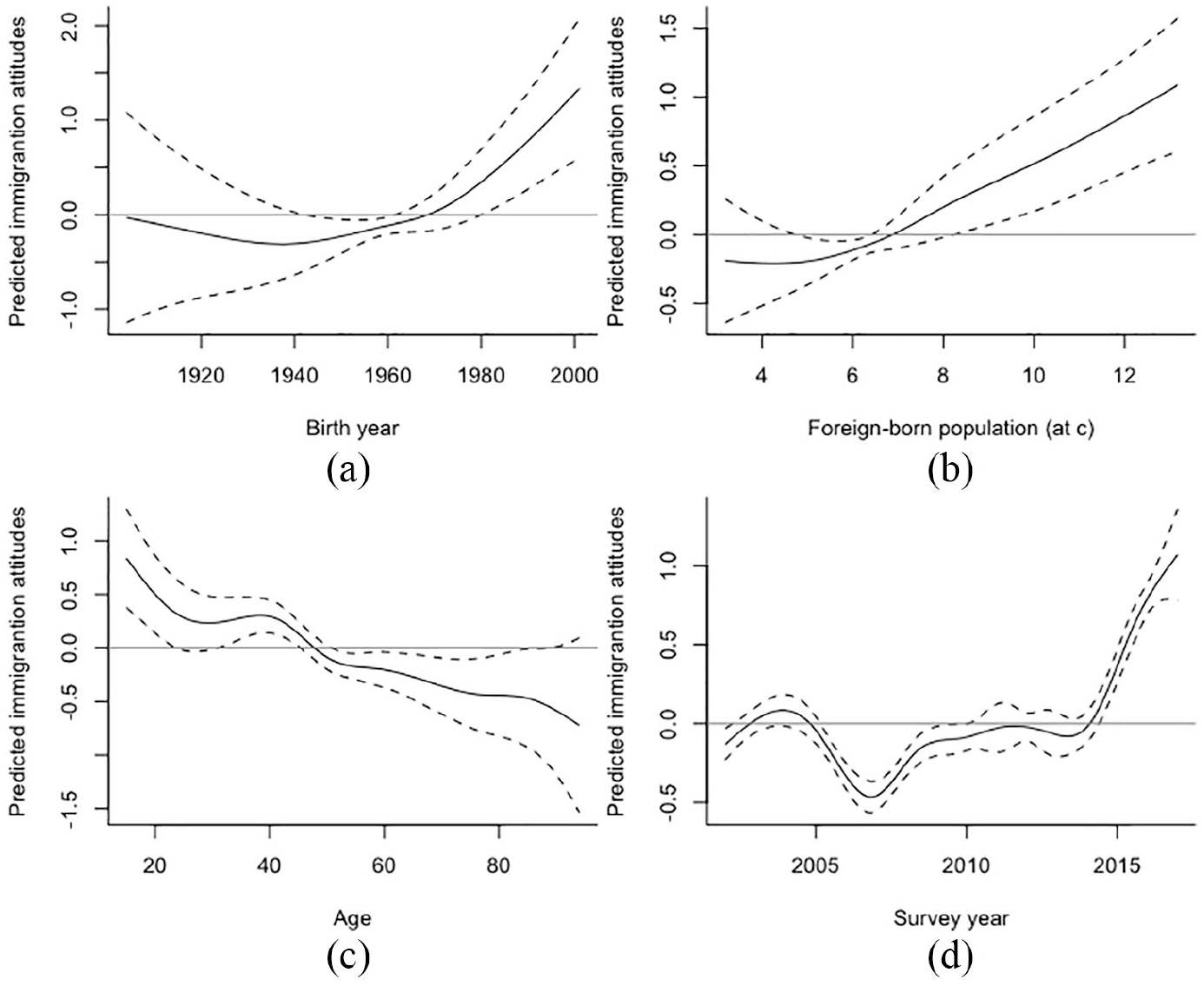
Smooth Functions Based on GAM (incl. 95% c.i.) (a) Cohort Effect (Birth Year), (b) Foreign-Born Population (at c), (c) Age Effect and (d) Period Effect.
Figure 2(a) illustrates the generational differences in immigration attitudes, controlling for age, survey year, education, gender, and individual economic circumstances. Even under this fairly conservative test, cohort is relevant in explaining differences in attitudes to immigration. Cohorts born between 1940 and 1960 appear to be most negative and cohorts born after 1980 most positive about immigration. The large confidence intervals for cohorts born before 1930 show the sparsity of the data, as we do not have many respondents in these birth groups. Figure 2(b) illustrates the potential impact of the level of diversity in the cohort’s formative years: taking into account individual-level factors (including age and education) and period effects, greater diversity in a cohort’s formative years is related to more positive attitudes to immigration for that cohort. Figure 2(a) and (b) provide empirical evidence that cohorts are indeed relevant to explaining variation in attitudes to immigration and cohort differences may be due to increased early-years diversity.
Figure 2(c) and (d) illustrate age and period effects, controlling for other individual-level variables and cohort and/or period effects as appropriate; these indicate that life-cycle (age) effects are also relevant to attitudes to immigration, though less pronounced once we control for cohort effects. Figure 2(d) reveals clear period effects: attitudes to immigration in the UK generally became relatively more negative in 2008 and a great deal more positive in 2016. 15
Explaining Cohort Differences: HAPC
The Model
We further investigate cohort differences in attitudes to immigration, as well as the interaction predicted by H3, using HAPC models. Yang (2006) suggests using mixed (fixed and random effects) models, allowing random intercepts to account for cross-classified grouping of cohorts and periods (survey years). The advantage of the HAPC model is that it estimates cohort and period effects as random effects, which does not impose linearity, thus solving the APC identification problem. A second advantage is the ability to test why cohorts (or periods) are different from one another. The rationale and detailed description (including critiques such as limited degrees of freedom at higher levels) of HAPC models is provided in Online Appendix 5.
Results
Our HAPC modelling begins by including the age fixed effect and cohort and period random effects in an otherwise null model (see Table 1, M0). As shown in this model, all three of these components – age, cohort and period – are independently relevant to understanding immigration attitudes in the UK. Model 1 adds individual-level control variables, including education, which is likely to be pertinent in understanding cohort differences in attitudes to immigration. As expected, respondents with higher education are more positive about immigration. 16 In fact, when these individual-level control variables are included in the model (M1), the variance component for cohort increases. This is a product of more accurate estimates of cohort effects once we account for societal changes, in particular, education, over the last few decades. The goal of the remaining analyses is to try to explain this residual variance – that is, to account for this variance using measures of the socialisation context. 17
Linear HAPC Model Predicting Positive Immigration Attitudes.
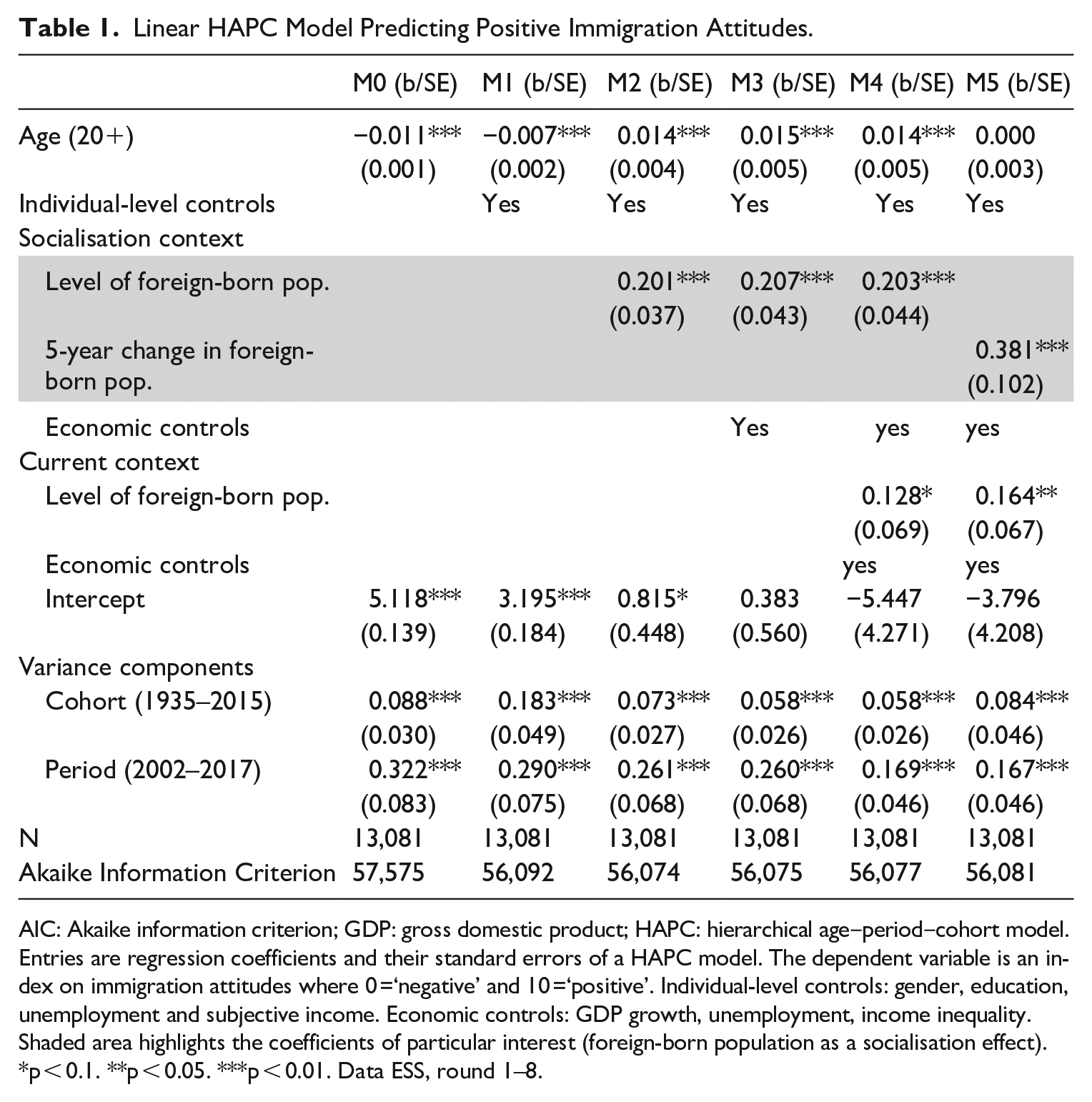
AIC: Akaike information criterion; GDP: gross domestic product; HAPC: hierarchical age‒period‒cohort model.
Entries are regression coefficients and their standard errors of a HAPC model. The dependent variable is an index on immigration attitudes where 0 =‘negative’ and 10 =‘positive’. Individual-level controls: gender, education, unemployment and subjective income. Economic controls: GDP growth, unemployment, income inequality. Shaded area highlights the coefficients of particular interest (foreign-born population as a socialisation effect).
p < 0.1. **p < 0.05. ***p < 0.01. Data ESS, round 1–8.
Model 2 adds the proportion of the foreign-born population during the cohort’s formative years. As was the case with the GAM results, these results indicate that level of diversity in the formative years is significantly related to contemporary attitudes to immigration, even controlling for individual-level age, education, and the other factors shown in Table 1. The variance for the cohort component also reduces by approximately 60%. Model 3 adds the economic circumstances cohorts faced during their formative years, which further reduces the variance in cohort variation slightly. Even with these macro-economic controls in the model, higher levels of diversity in the formative years continues to be related to attitudes to immigration in the expected direction according to H2b.
Controlling for individual-level and macro-level factors, if a generation is exposed to 1% higher levels of foreign-born population, immigration attitudes are 0.2 points higher (i.e. more positive) on a 0–10 point scale. This is equivalent to a 1/10 standard deviation change in the dependent variable (SD = 2.21). To put this into perspective, let us take an example. Generations that grew-up in the 1930s were exposed to only a 3% level of diversity. In the early 2000s, this proportion increased to about 10%. This 7% increase in exposure to diversity is comparable to getting a university degree rather than only having only primary education (b = 1.527; p < 0.001).
Model 4 controls for potential period effects and indicates that contemporary levels of diversity are only weakly associated with more positive immigration attitudes (b = 0.128; p < 0.1). Moreover, the results of M4 suggest that the levels of immigration during one’s formative years are more strongly related to immigration attitudes than current levels of foreign-born population. This confirms the arguments and findings of political socialisation literature, which stresses the importance of early socialisation experiences.
Some might argue that the relatively linear increase of the level of the foreign-born population could cause an identification issue for the estimation of the age, cohort and period effects. To mitigate this issue, we use the 5-year change in the foreign-born population during a cohort’s formative years in Model 5. The effect of a 1% (positive) change in immigration leads to a 0.381 increase in pro-immigration attitudes in later life.
Based on Table 1, we can confirm that there is evidence to support Hypothesis 2b, which stated that increased diversity during a respondent’s formative years is associated with more positive attitudes to immigration. However, H3 stipulates that it is possible that the impact of diversity is dependent on whether respondents also faced a threatening economic environment (Coenders and Scheepers, 1998; Quillian, 1995). We have investigated this possibility using our economic indicators, and of these, only income inequality – a previously neglected variable – appeared to moderate the effect of diversity in the early years.
Figure 3 plots the marginal effect of diversity during one’s formative years conditional on unemployment, GDP growth and income inequality. 18 As the results confirm, the general health of the economy does not seem to impact the relationship between immigration levels and attitudes. However, the potential impact of an influx of foreign-born people into the UK is weakly conditional on the level of income inequality: the positive impact of diversity observed in Table 1 appears to vanish as inequality increases. The findings illustrated in Figure 3 generally suggest that immigration and income inequality interact and could offset each other.
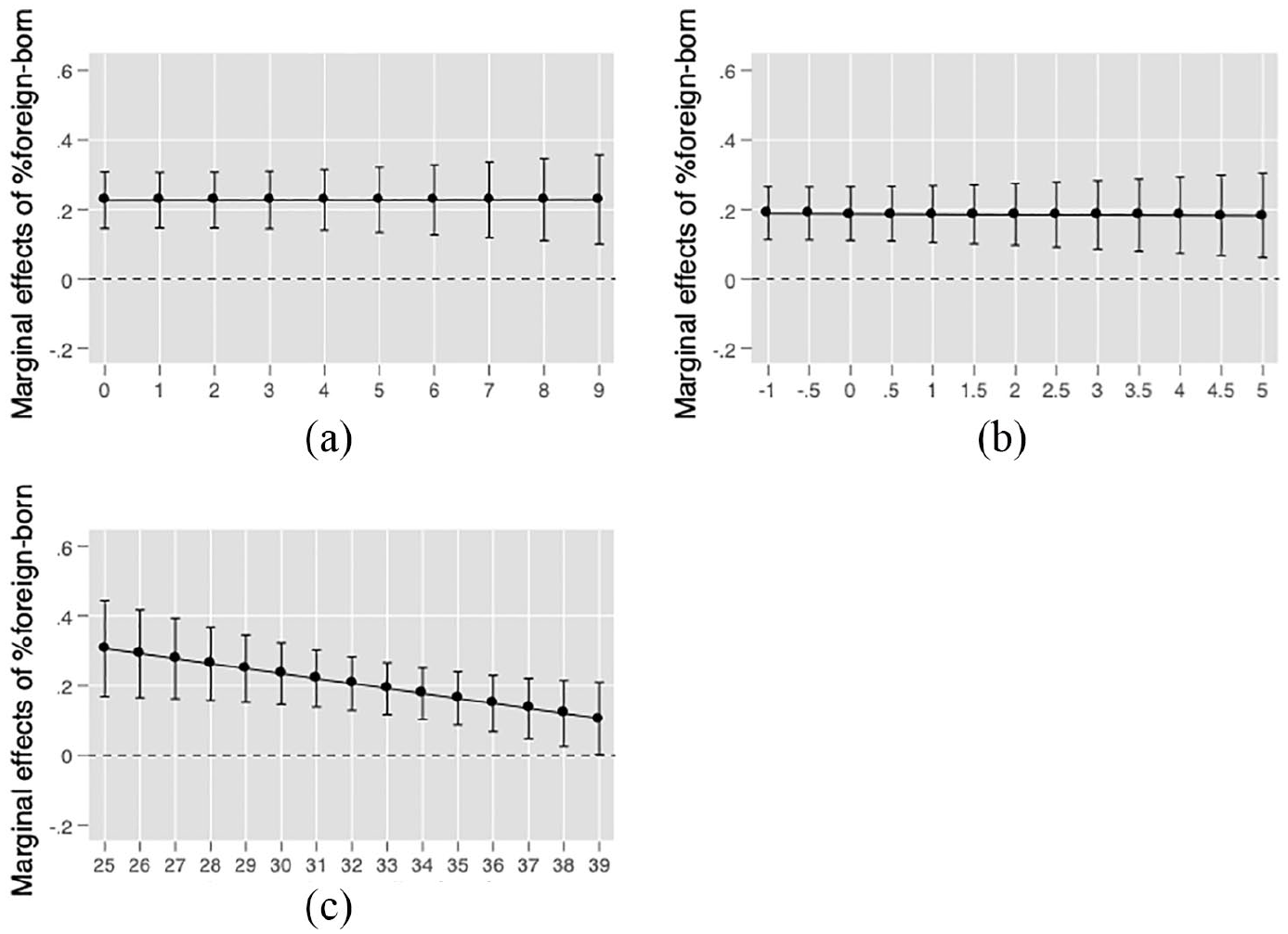
Marginal Effects of the Socialisation Context of Foreign-Born Population (at c) Conditional of Economic Context During the Formative Years (a) Unemployment, (b) GDP Growth and (c) Income Inequality.
Robustness Tests
To investigate the robustness of our findings that higher diversity during one’s youth has a long-term positive impact on immigration attitudes, we estimated several additional models. Results are reported in Online Appendices 8–12.
We make sure the results are not being driven by the specifics of our sample (see Online Appendix 8). We do this by re-running the models (a) dropping the current younger generations (born after 1995) who we have not yet had the chance to follow for a lengthy period of time; (b) dropping the first cohort, which was socialised from 1935–1939; and (c) changing the sample to only include respondents above the age of 20 to not conflate a respondent’s socialisation and period contexts. The results remain robust.
Next, we utilise the richer available data for contemporary immigration by calculating change in immigration, compared to 5 and 10 years prior the survey year (period effect). The potential impact of contemporary change is sensitive to the specification of the length of change, but we do not find a significant effect of net migration. Finally, we substituted ethnic diversity for the percent foreign born (Gorodzeisky and Semyonov, 2016; Kaufman, 2014), which confirm our original results.
We re-estimated M4 (Table 1) for each of the three variables measuring attitudes towards immigration separately, instead of using an index. The results presented in Online Appendix 10 confirm that diversity during a cohort’s formative years has the same relationship to all three items.
We explore whether there is a general cultural shift to more tolerant values that is linked to other outcome variables beyond attitudes towards immigration. To achieve this, we use a placebo test that re-estimates the main model (M4) using support for gay rights as the outcome variable. As we report in Online Appendix 10, diversity levels during a cohort’s formative years do not affect these attitudes. This supports the interpretation of our results that increased immigration-driven diversity is linked to more positive attitudes to immigration, but not necessarily to other cultural values.
We explore the impact of how we have specified the cohort and age variables, crucial parts of the HAPC model (Online Appendix 11). The cohort variable is included in the models as a random effect to capture how cohorts vary in their immigration attitudes. In this fifth set of robustness tests, we change the cohort variable to reduce the number of birth years to 2 years and set the formative years to correspond to the ages 16 and 17. Generally the HAPC model based on these 38 two-year birth cohorts remain unchanged vis-à-vis the main results. Regarding the age variable, we have also estimated M4 (a) omitting age, (b) testing for curvilinearity of age, and (c) using a categorised version of age. These results (Online Appendix 12) further confirm the robustness of the relationship between diversity during socialisation years and current attitudes to immigration.
Finally, we change the definition of the formative years to (a) 10–15 years old, (b) 20–25 years old, and (c) 30–35 years old. Here, we restrict the sample to only ages that are higher than the imposed socialisation age. As Table A11 clearly shows the socialisation effect vanishes with older ages, which confirms previous research that has stressed the importance of late adolescence as the key formative years.
Further Reflection on Macro-Level Diversity and Positive Attitudes to Immigration
Our findings point to the possibility that being socialised in a context in which diversity is relatively high ultimately produces more positive attitudes to immigration. Though it is difficult to determine precisely why socialisation in a context of high diversity might play such a positive role, this may partly be a result of changing norms surrounding immigrant-origin diversity, with very different norms prevailing during early-years socialisation of generations born in more recent decades. Our control for individual-level education should capture some of this change at the individual level, but levels of diversity appear to continue to play an independent role even taking education into consideration.
The impact of early-years diversity may also be a result of increased contact with immigrant-origin minorities. This relationship cannot be systematically investigated due to lack of cross-time indicators of contact, but Round 7 of the ESS did include questions about contact. Based on our hypotheses and findings above, we would expect younger generations that were exposed to higher diversity during their formative years to also have more contact with immigrants. The most relevant type of contact is likely to be friendships (e.g. Hewstone and Swart, 2011; Pettigrew et al, 2011).
As illustrated in Figure 4(a), stark generational differences exist when it comes to having friends from immigrant-origin minority groups: more than 60% of those born before 1940 report having no friends from these groups, whereas approximately 70% or more of those born since 1985 do report have friends from these groups. 19 Even for those born between 1975 and 1985, at least 60% have at least some friends from immigrant-origin minority groups. A similar pattern in generational differences emerges for average weekly contact with minorities (Figure 4(b)). Thus, some of the positive impact of macro-level diversity may be a result of higher levels of contact with immigrant-origin minorities on the part of younger (non-minority) cohorts. 20
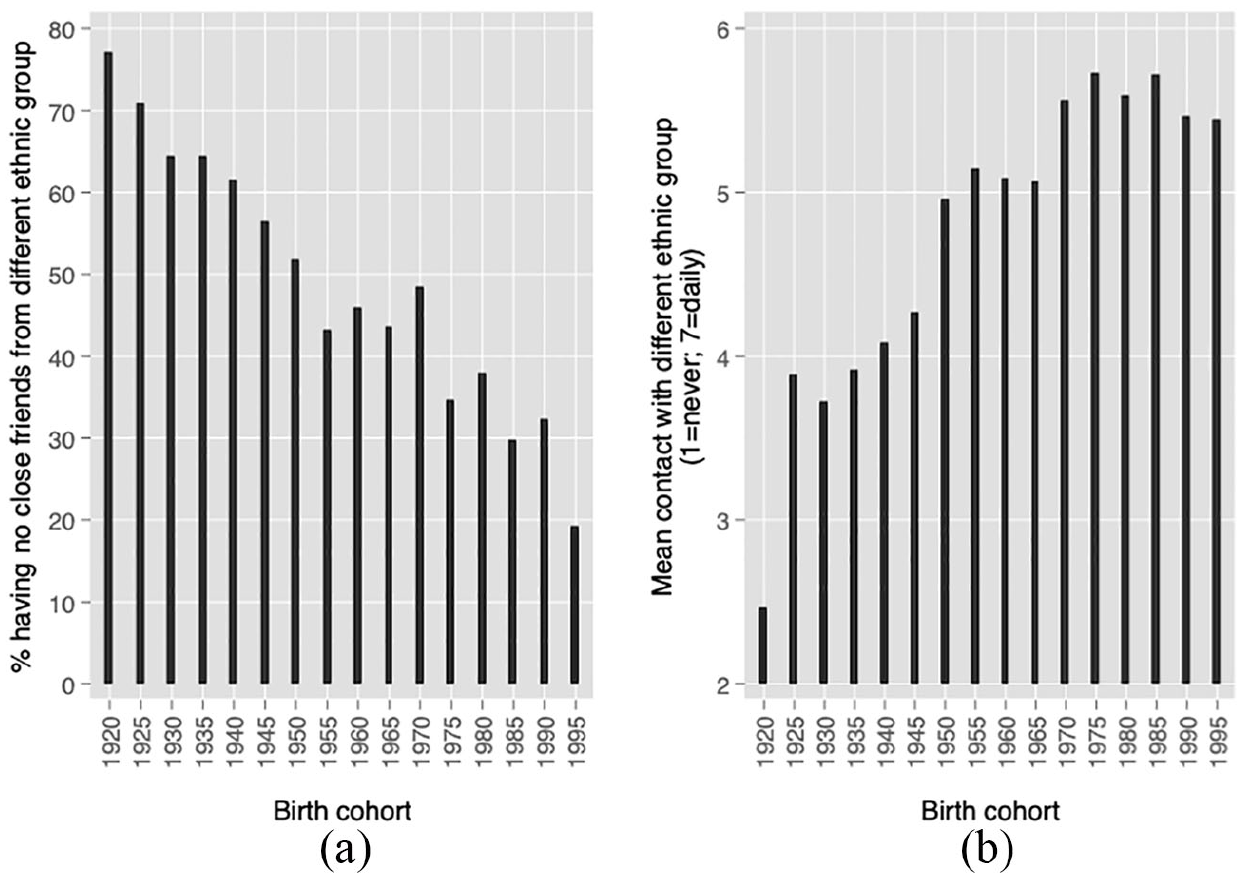
Frequency and Closeness of Contact with Immigrant-Origin Minorities (a) No Close Friends with Minorities and (b) Mean Contact with Minorities.
Conclusion
This paper addressed a crucial puzzle and lacuna in the literature regarding the presence or absence of systematic generational differences in immigration attitudes. The evidence presented here indicates that ceteris paribus, attitudes to immigration are indeed systematically different among older generations. Consequently, our findings imply that public perceptions of immigration and immigrant-origin minorities in the UK may be undergoing a gradual but drastic change as older generations who are less positive about immigration are replaced by cohorts who see immigration in a different light. This paper investigated the proposition that this generational difference is largely a result of different socialisation experiences: large-scale post-war migration to the UK began after the crucial formative years of older cohorts who did not have the opportunity to formulate their attitudes to immigration at a time when the UK was already a country of immigrant-origin minorities.
Very few studies of attitudes to immigration in Europe have investigated the impact of the socialisation environment due to the shortage of cross-time data necessary to follow cohorts over many years and to match these with diversity indicators. This paper, therefore, makes an important contribution to the study of attitudes to immigration, finding that in contrast to conflict theories of prejudice which might predict that rising numbers of immigrants or minorities would produce increased hostility to these groups, rising numbers may actually create the conditions in which increasingly positive perceptions of these groups may thrive (see also, Stein et al., 2000).
Our findings are contrary to earlier work of Coenders and Scheepers (1998) from the Netherlands for the 1979–1993 period, which finds that increasing numbers appear to produce a slight increase ethnic threat. We are thus not contending that our findings are necessarily universal, and it is entirely possible that other contextual factors are important in understanding how increased diversity affects public attitudes to that diversity. Indeed, our results also indicate that the level of economic inequality at the time of increased diversity may moderate diversity’s impact. This finding is especially pertinent considering the COVID-19 pandemic, the economic consequences of which are expected to last for decades. If increased inequality is not avoided, this may contribute to a long-term decline in the tolerance of the citizenry as current economic conditions continue to impact today’s youth for the rest of their lives.
Our results will, of course, need to be revisited as the UK’s own context changes and further survey data become available. The extent to which the effects found here are similar in other European countries facing similar cultural divides over immigration should also be explored in future research. Understanding the impact of immigration on cohorts in different local contexts is also likely to be a fruitful area of research, particularly as more data and techniques for analysing local-level opinion develop. Our findings regarding generational differences are likely to have implications for broader social cohesion issues, another topic which appears to warrant further exploration by social capital researchers.
It is important to acknowledge that the techniques used here do not definitively establish causal links, which would require lengthy panel data following cohorts from their early years to the present. In the absence of such data, this paper has used state-of-the-art techniques to leverage such an analysis from repeated cross-sectional data and conducted multiple robustness tests in order to verify that the connection we find between early-years diversity and contemporaneous attitudes to immigration remains.
The UK’s 2016 Brexit referendum and departure from the EU has made our findings all the more pressing. Immigration was a key motivating factor behind the ‘Leave’ vote (Clarke et al., 2017), but our findings indicate that generational replacement of older, less tolerant generations with younger, more tolerant ones (on average) may mean that a crucial impetus behind Brexit – concern about immigration – will weaken significantly over time (though ever-rising income inequality may thwart this trend). This inference from our research further helps to understand the strong age divide in the Brexit vote – with the older voters supporting leave, while the young predominantly voted to remain in the EU. 21 More generally, our findings indicate that immigration need not inevitably lead to intergroup conflict and that being socialised in a context of high diversity may – in the right conditions – ultimately ameliorate rather than produce anti-immigration hostility.
Supplemental Material
Online_Appendix_v7 – Supplemental material for Diversity and Perceptions of Immigration: How the Past Influences the Present
Supplemental material, Online_Appendix_v7 for Diversity and Perceptions of Immigration: How the Past Influences the Present by Lauren McLaren, Anja Neundorf and Ian Paterson in Political Studies
Footnotes
Acknowledgements
The authors especially thank Michael Donnelly, Simon Ellerbrock, Anastasia Gorodzeisky, Niklas Harder, Eric Kaufmann, and Sergi Pardos-Prado for their extremely helpful comments on earlier versions of the paper. The authors welcome requests for replication files. Please contact Lauren McLaren (
Authors’ Note
Earlier versions of this paper were presented at the Annual Conference of the European Political Science Association, Belfast, 20–22 June 2019, the Annual Meeting of the American Political Science Association, Boston, MA, 30 August 30 to 2 September 2018, and the Annual Conference of the Elections, Public Opinion and Parties (EPOP) group of the Political Studies Association, University of Nottingham, 8–10 September 2017.
Declaration of Conflicting Interests
The author(s) declared no potential conflicts of interest with respect to the research, authorship, and/or publication of this article.
Funding
The author(s) received no financial support for the research, authorship, and/or publication of this article.

Supplemental Material
Additional supplementary information may be found with the online version of this article.
A1: Descriptive Results of Macro Variables. A2: Descriptive Results: Average immigration attitudes by birth cohorts and foreign-born population A3: Smoothing Functions in GAM A4: Additional Results – GAM A5: HAPC Models Explained A6: Additional results main HAPC models A7: Coefficients of Interaction Effects (Figure 3 in Manuscript) A8: Robustness Tests – Different Samples A9: Robustness Tests – Using different Measures to test Immigration Effect A10: Robustness Tests – Single Items of Immigration Attitude Index A11: Robustness Tests – Changing Cohort Specifications A12: Robustness Tests – Changing Age Specifications A13: Civil Society Organisation Environment and Diversity References
Notes
Author Biographies
References
Supplementary Material
Please find the following supplemental material available below.
For Open Access articles published under a Creative Commons License, all supplemental material carries the same license as the article it is associated with.
For non-Open Access articles published, all supplemental material carries a non-exclusive license, and permission requests for re-use of supplemental material or any part of supplemental material shall be sent directly to the copyright owner as specified in the copyright notice associated with the article.
