




Abstract
Between pro-retrenchment politicians and segments of the media, exaggerated claims about the generous benefits enjoyed by those on welfare are relatively common. But to what extent, and under what conditions, can they actually shape attitudes towards welfare? This study explores these questions via a survey experiment conducted in the UK, examining: (1) the extent to which the value of the claimed figure matters; (2) if the presence of anchoring information about minimum wage income has an impact; and (3) whether these effects differ based on egalitarianism and political knowledge. Results suggest that increasing the size of the claimed figure decreases support in a broadly linear fashion, with anchoring information important only when (asserted) benefit levels are modestly above the minimum wage income. Egalitarianism, in turn, primarily matters when especially low figures are placed alongside information about minimum wage, while low-knowledge respondents were more susceptible to anchoring effects than high-knowledge ones.
There is a long history of politicians trotting out claims about the generosity of welfare programmes in order to create public support for retrenching them. Ronald Reagan’s famous ‘welfare queen’, raking in over $150,000 a year, is but one example of this use of massaged or even falsified statistics about welfare benefit levels. Whether these figures are meant to highlight benefit fraud – as with Reagan – or inequities in the welfare system – as with former British Chancellor of the Exchequer George Osborne’s complaint about families receiving ‘£100 000 a year in benefit’ – their persistence as a trope is striking. And not only are these campaigns clearly viewed as vote-winners, but they also often give rise to real policy changes as well: the benefit cap, introduced in 2013 under the Conservative–Liberal Democrat coalition in the UK, was precisely intended to ensure that benefit levels never exceeded a threshold that the government designated the ‘average earned income of working households’ (see Kennedy et al., 2016).
But to what extent do these sorts of claims about welfare generosity actually affect public opinion? Clearly, at least part of the intention in emphasizing overly generous benefits is to generate a reaction among the public, attracting both votes and support for welfare reform. Yet this raises another question: at what point do citizens find benefits to be ‘overly’ generous? To take the British example, £100,000 is obviously a lot of money for someone on social assistance, since it is multiple times larger than the average income in Britain – but how would people react to a more realistic yet still substantial, figure of, say, a quarter of that size?
Drawing theoretical inspiration from existing research on public opinion formation (e.g. Bartels, 2005; Cruces et al., 2013; Petersen, 2015) and attitudes towards the welfare state (e.g. Giger and Nelson, 2013; Jæger, 2012; Wenzelburger and Hörisch, 2016), we explore these questions using an experiment conducted via a nationally representative survey of just under 2000 Britons. In doing so, we investigate: (1) the extent to which claims about benefit levels affect beliefs about whether the welfare system is too generous, and (2) the impact of receiving information about the minimum wage alongside these claims. In combination with validated measures of respondents’ egalitarianism and political knowledge, this survey provides important insights into how numerical information affects attitudes about the right levels of welfare generosity.
We find a number of interesting patterns. First, claims about benefit levels do indeed have an impact on whether or not people think benefits are too generous. Broadly speaking, the higher the claimed level of benefits, the more people believe benefits are too generous. Respondents told that the typical family on benefits get £29,000 per year are notably more likely to think that benefits are too generous than those told that the typical family on benefits get £9000. Second, situating these claims alongside information about the minimum wage matters, but only for those told that benefits were modestly higher than minimum wage income. Third, respondent egalitarianism primarily makes a difference when especially low figures are placed alongside information about minimum wage income. Finally, low-knowledge respondents appear to have been particularly susceptible to anchoring effects.
Our findings, in brief, underscore how powerful using (inflated) figures can be for garnering support for welfare state cutbacks. By contrast, objective reference points – or at least the minimum wage income – matter rather less. These findings add to an emerging literature on ‘benefit myths’ and how these may affect popular attitudes towards the welfare state (Geiger, 2017a, 2017b; Jensen and Tyler, 2015). More broadly, we also contribute to the literatures on information (e.g. Kuklinski et al., 2000; Leeper and Slothuus, 2017) and framing (e.g. Chong and Druckman, 2007) in public opinion formation by indicating how the strategic use of construed information can shift attitudes. As such, our results will be relevant not just for scholars preoccupied with the politics of the welfare state, but for all those concerned with the interaction between elite communication and citizen opinion formation.
Preferences for Benefit Generosity in the Welfare State Literature
The starting point of the contemporary welfare state literature on public preferences dates back to Pierson’s (1994) seminal Dismantling the Welfare State? The core proposition of Pierson is that the welfare state has become hugely popular among the majority of voters, and that politicians have therefore been forced to either hide their cutbacks or refrain from retrenchment altogether. Indeed, assumptions about the welfare state’s broad popularity have been borne out repeatedly by surveys documenting that voters usually prefer increased spending on the welfare state, and that they typically believe it is the government’s responsibility to provide protection in cases of unemployment, sickness, and other misfortunes (e.g. Jæger, 2012; Jensen, 2014; Van Oorschot, 2006). This is frequently the case even when respondents are confronted with trade-offs between social spending and taxation: the British Social Attitudes Survey, for example, documents that the proportion of Britons wanting to spend less on the welfare state in order to reduce taxation has never surpassed 10% since polling began in 1983. By 2016, fully 48% wanted the government to spend more on the welfare state, while less than 5% wanted cuts (Curtice, 2017: 1–2).
Yet the broadly pro-welfare state stance of citizenries has quite obviously not meant that welfare cuts have been off the table, and analysis of large-N datasets has documented the considerable rollback of entitlements in many Western welfare states (Allan and Scruggs, 2004; Korpi and Palme, 2003). The sheer frequency of retrenchment would seem to fly in the face of Pierson’s claim that citizens love the welfare state so much that any attempt at cutting it back will lead to electoral disaster. Giger and Nelson (2010) and Schumacher et al. (2013), moreover, found that governments’ vote shares did not systematically drop from one election to the next in the wake of cutbacks; voters occasionally seem to have reacted to reforms, but much of the time cutbacks had no effect on aggregated vote shares. Yet regardless of the precise extent to which voters are bothered by retrenchment (c.f. Lee et al., 2017), these debates raise the possibility that voters’ preferences might be less one-dimensional than Pierson’s argument suggests. As a consequence, micro-level analysis of welfare preferences offers a particularly valuable route forward.
For our purposes, the key consideration here is that for many citizens, pro-welfare state stances exist in balance with other considerations, often moral or economic in nature (e.g. Ryan, 2014). In a simple but analytically powerful move that highlights this complexity, Giger and Nelson (2013) argue that voters can care both about the welfare state and a sound economy, but that the weight given to each dimension varies among people. Some are ‘unconditional believers’ of the welfare state, while others are more ‘conditional believers’, meaning that they ascribe roughly equal value to the welfare state and the economy (empirically speaking, few individuals ascribe more weight to the economy than the welfare state). The authors find that only unconditional believers punish governments for cutbacks.
The fact that many people cherish multiple goals is important because it underscores the potential impact of using moral or economic cues to shape support for cutbacks. Framing studies have a long history in political science (Chong and Druckman, 2007), and have recently also been employed to study welfare state preferences. Using survey experiments, Slothuus (2007) and Petersen et al. (2011), for instance, show that framing recipients as undeserving (‘lazy’) makes people less supportive of generous welfare state benefits. Similarly, Wenzelburger and Hörisch (2016) and Naumann (2017) find that people become more accepting of cuts if they are framed as economic necessities. And in a related strand of research, authors such as Lergetporer et al. (2016) and Stanley and Hartman (2017) have shown how information about how much is spent on the welfare state – and whether undeserving groups get a comparably large share of that spending – affect public preferences.
This strand of research suggests that voters are open to elite messages that present the social policy programmes as a burden. If voters accept the narrative, they tend to become less supportive of the welfare state (see, for example, Geiger, 2017a). In our reading, this is what politicians, as well as varied media outlets, are trying to achieve when they use inflated figures on benefit generosity (see Baumberg et al., 2012); yet it is, of course, not terribly surprising that people will become more sceptical of the welfare state if they think recipients receive some outlandish amount in benefits. The more interesting question is at what point people find benefits to be overly generous. Benefit levels lie on a continuum of generosity without a clear a priori dividing line between ‘suitable’ and ‘outlandish’. It is an empirical question where, on this, continuum voters think benefits become too generous. At the same time, it may well be that different groups of voters have fundamentally distinct responses to different levels of benefit generosity, as well as the presence or absence of information about relative economic benchmarks like the minimum wage. These questions are far from trivial and have, to our knowledge, not been investigated previously.
Expectations about the Effect of Claimed Welfare Benefit Generosity on Support
It is well established that citizens exhibit substantial biases when processing informational claims. For one thing, they generally possess limited factual knowledge (Delli Carpini and Keeter, 1996), which complicates the assessment and incorporation of new information. Recent research suggests, for example, that citizens are ignorant of both the distribution of income in society and where they themselves might fit into that distribution (Bartels, 2005; Norton and Ariely, 2011). Citizens are similarly in the dark when it comes to issues such as welfare spending, benefits fraud, and the demographic composition of benefit claimants as a group (e.g. (Jacobs and Shapiro, 1999; Kuklinski et al., 2000; Taylor-Gooby et al, 2003). As Geiger (2017a: 17), concludes: [k]nowledge about the benefits system is low, as even where the public are right on average, on almost no measure do more than one-third of individuals provide a correct answer as we define it; and the public are often not right on average (emphasis in original).
But if this is the case, how do people assess when benefit levels are ‘too generous’, and under what conditions can claims about generosity impact people’s preference?
Numbers are, in and of themselves, neutral – so understanding the importance of number-based claims requires us to focus on characteristics of the targeted audience. Existing research suggests that several contextual factors will be central. First, given that citizens have limited knowledge about the distribution of income in society, we assume that they will be uncertain as to how a specific level of benefits compares with the income of the typical employed person. At the same time, there is some research to suggest that providing factual information about the shape of the income distribution, correcting for misconceptions, can change people’s opinions about the appropriate level of redistribution (cf. Cruces et al., 2013; Lawrence and Sides, 2014). To us, this suggests that citizens’ assessments of the appropriateness of welfare benefit levels will, in the absence of any additional information about the income distribution, reflect the level of asserted benefits income, such that greater amounts engender increasingly anti-generous positions (H1). The flipside of this expectation is that respondents may be affected by information about how welfare income compares with well-known yardsticks, such as the income of those working for the minimum wage. Inspired by Petersen (2015), we expect that many individuals will view income levels at the minimum wage as a natural ceiling that benefits should not surpass (H2), as the idea that claimants can make more on welfare benefits than while working will generate perceptions of unfairness and/or economic disincentives - (‘welfare traps’, in common parlance).
Second, as mentioned above, many citizens harbour strong opinions about the welfare state, especially when it comes to programmes aimed at the working-age poor (the ones under study here). Ideologically left-leaning individuals tend to view the jobless as more deserving than right-leaning individuals do (Jensen and Petersen, 2017; Skitka and Tetlock, 1993) and, possibly as a consequence, they are also more supportive of generous welfare programmes (Jacoby, 1994; Zaller and Feldman, 1992). Citizens are also prone to engage in motivated reasoning: information is used not to update pre-existing beliefs, but rather to strengthen them – either by discounting inconvenient information (Taber and Lodge, 2006) or by only seeking out information that fits these beliefs (Druckman et al., 2012).
In particular, we expect egalitarianism to be the key value orientation shaping how citizens evaluate information about welfare generosity. In particular, information suggesting that welfare benefits are relatively high is most likely to play into the predispositions of anti-egalitarians, since the claim aligns with their prior belief that the jobless are relatively lazy and undeserving of the support they receive. Among egalitarians, by contrast, we would expect welfare state support to be relatively less affected by claims about benefit levels, given a higher baseline level of support for social programmes and a likely predisposition to discount assertions about high benefit levels. There are good reasons to expect, in sum, that increasing the claimed level of benefits will have a greater effect on anti-egalitarian individuals than egalitarian ones (H3).
Citizens’ egalitarian orientations and the presence (or absence) of meaningful yardsticks may interact. One expectation, in light of the literature referenced above, is that egalitarianism matters most in the absence of yardsticks (H4). When a yardstick is provided, by contrast, we would expect these patterns to be modified. Assuming that the minimum wage signals some sort of common-sense ceiling for benefit generosity, attitudes of egalitarian individuals should approach the opinions of anti-egalitarians when they are presented with claims that benefit levels are equal to or greater than the income of those working at the minimum wage. On the other hand, we expect much greater divergence when egalitarians are informed that benefit levels are (substantially) below the minimum wage (H5).
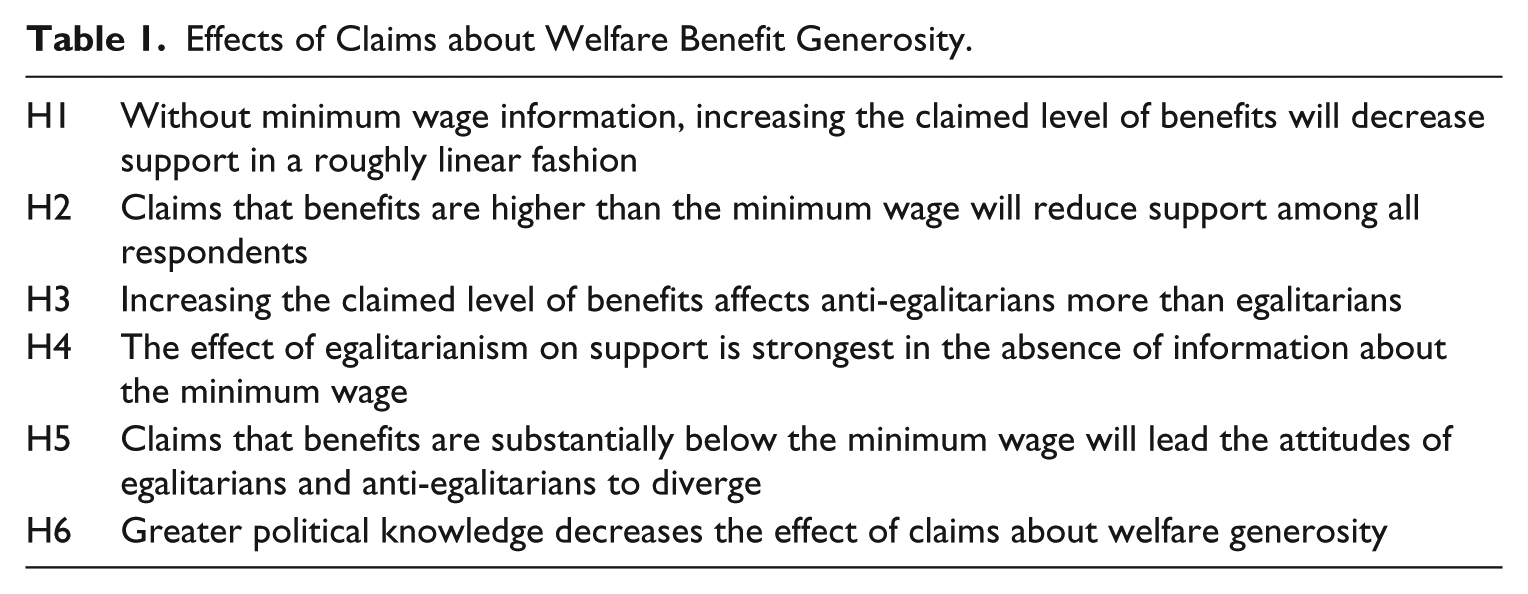
Finally, we started out by noting that people’s knowledge about politics in general and the welfare state in particular is limited. While this is undoubtedly true in the abstract, there is nevertheless substantial variation in how knowledgeable people are. Knowledge, or political sophistication, has been shown to matter for opinion formation in a great many contexts and ways. From this strand of the literature, we draw the expectation that political knowledge will diminish the effect of assertions about welfare benefit levels; we thus expect, that higher levels of political knowledge will lead to smaller differences across the treatment groups, with or without the minimum wage information included (H6). Table 1 summarizes the six hypotheses that lay out our expectations.
Effects of Claims about Welfare Benefit Generosity.
Data and Methods
Our experiment was conducted via a survey carried out by YouGov on 1952 Britons. Data were collected using YouGov’s online panels, with respondents quota-sampled to achieve representativeness in terms of gender, age, education, and geographical region (defined according to the European Union’s NUTS 2 regional classification); in other words, the standard set of socio-demographic variables that most surveys aim to obtain representativeness upon. This approach is of course inferior to the gold-standard random sample, as YouGov’s basin of self-selected respondents may differ in meaningful ways from the general population, and the overall accuracy of the data relies heavily upon the correctness of the survey weights. Nevertheless, Ansolabehere and Schaffner (2014) have shown that conducting online surveys in this way yields similar coefficient estimates and total survey error compared to traditional telephone and mail interviews.
The experiment was set up to assess the extent to which attitudes about welfare generosity are affected by statements about the purported level of current welfare benefits. Specifically, we examine how responses are affected by the two factors discussed in the above sections: (1) the welfare income quoted in the treatment, with monetary values of (approximately) 50%, 75%, 100%, 125%, and 150% of the yearly minimum wage income for a ‘typical family’ and (2) the inclusion of a reference point in the treatment, namely the current yearly minimum wage income for a ‘typical family’. (Note that in no instance were respondents provided with the percentages; all prompts include only amounts in pounds sterling.) In light of our use of deception, all respondents were presented a debrief statement at the conclusion of the survey.
The experiment’s ‘no minimum wage information’ treatments thus took the following form: According to the Office for National Statistics, the typical family on welfare receives about £[amount] worth of benefits per year.
While the ‘minimum wage information’ treatments took the form of: According to the Office for National Statistics, the typical family on welfare receives about £[amount] worth of benefits per year, while the typical family working at minimum wage takes home about £19000.
Respondents were then asked to indicate their agreement with the statement, ‘to what extent do you disagree or agree that benefits for the typical family on welfare are too generous?’ on a five-point scale going from ‘disagree strongly’, ‘disagree somewhat’, ‘neither agree nor disagree’, ‘agree somewhat’ to ‘agree strongly’. Alternatively, respondents could record their response as ‘don’t know’. 1
A couple of points are worth noting here. First, the contrast between welfare benefit levels and take-home pay in the ‘minimum wage information’ treatments is clearly misleading, since low-wage families would in reality also be receiving welfare state support (e.g. housing benefits and child benefits). Second, the use of the term ‘typical family’ in the treatment prompt is purposefully vague, with the intention that respondents would not find the values a priori unbelievable. In both instances, however, these wordings reflect the real-world practices of politicians, think tanks, and journalists, who use these sorts of ambiguities to construct comparisons and ‘typical’ values designed to elicit strong reactions, while at the same time referring to official government sources to obscure their machinations (e.g. Jensen and Tyler, 2015). Indeed, we draw clear inspiration here from debates in Britain around the implementation of the benefit cap in 2013; initially set at £26,000 (for households) and then lowered to £20,000 (£23,000 in London), the policy was justified, in the words of former Chancellor of the Exchequer George Osborne, by the argument that ‘families out of work should not get more than the average family in work’. 2
In calculating our baseline reference value (i.e. the amount the ‘typical family working at minimum wage takes home’), we employed the following parameters: first, we input the current minimum wage (£7.20 an hour); second, we assumed two earners, with one working the national full-time average of 37 hours and the other working the national part-time average of 16 hours; third, we assumed both workers to be under the state pension age; and finally, we situated them outside of Scotland. We then used the UK government’s tax calculator, 3 employing the most common tax code (1150L), to calculate the level of each of the two worker’s take home earnings. To be clear, we do not suggest that this figure actually represents the ‘typical family’s’ income, as all of our specific parameter choices can be debated; rather, what is important here is that respondents are provided with a figure that serves as a believable stand-in for the minimum wage income – not that the figure represents the ‘true’ amount.
The result of these calculations was a net income of £12,702 for the full-time worker and £5990 for the part-time worker, giving us a total of £18,692. (For reference, the median household income in the UK was £26,300 in 2016). The final values employed in the treatments were then rounded to the nearest thousand, giving us values of £9000 (50% of the minimum wage), £14,000 (75%), £19,000 (100%), £24,000 (125%), and £29,000 (150%). Since respondents were randomly sorted into treatment groups receiving one of these five monetary values with or without information about the minimum wage income, this gives us a total of 10 treatments.
As highlighted by our hypotheses above, two additional concepts are central to our analysis: egalitarianism (capturing the value orientation that is most relevant for our purposes) and political knowledge. Both variables are constructed on the basis of Item Response Theory (IRT), which allows us to assess the presence of a latent trait using a series of question responses (see, for example, Treier and Hillygus, 2009). Given our use of ordinal variables (in the case of egalitarianism) and binary variables (in the case of political knowledge), IRT offers a more appropriate approach to estimating latent measures than traditional factor analysis, as the latter assumes a normal distribution of the variables included in the index construction (Kaplan, 2004). 4
For our egalitarianism measure, we use a set of questions validated by previous work (Feldman and Johnston, 2014). Specifically, respondents began the survey by answering the following six questions, all of which could be answered on a five-point scale ranging from ‘strongly disagree’ to ‘strongly agree’ (once again with an alternative ‘don’t know’ category): 5
Our society should do whatever is necessary to make sure that everyone has an equal opportunity to succeed.
We have gone too far in pushing equal rights in this country.
One of the big problems in this country is that we don’t give everyone an equal chance.
This country would be better off if we worried less about how equal people are.
It is not really that big a problem if some people have more of a chance in life than others.
If people were treated more equally in this country, we would have many fewer problems.
Responses to the individual items were then recoded such that stronger agreement with egalitarian viewpoints always corresponded to higher values on the five-point scale. Finally, respondents were then assigned individual IRT scores and divided based on whether they fell below or above the mean (below described as anti-egalitarian and egalitarian groups).
Similarly, our political knowledge index is based off of previous work using the Comparative Study of Electoral Systems (see, for example, Grönlund and Milner, 2006) and testing respondents’ factual knowledge about quantities (e.g. Ansolabehere et al., 2017). Respondents were thus presented the five following questions: ‘Which of these persons was the Chancellor of the Exchequer
As Appendix Table A1 illustrates, each of our treatment groups contained between 179 and 191 respondents, for a total of 1836 in the sample, once we exclude respondents who answered our key question (i.e. regarding benefit generosity) with ‘don’t know’. Responses to our dependent variable have a weighted mean of 3.22 and a standard deviation of 1.31.
Findings
On the basis of these data, we constructed a series of ordered logistic regressions, all of which incorporate survey design weights. We begin by laying out the overall results from the experiment, which allow us to assess H1 (without minimum wage information, increasing the claimed level of benefits will decrease support in a roughly linear fashion) and H2 (claims that benefits are higher than the minimum wage will reduce support among all respondents). At this point, we want to know: (1) did respondents change their attitudes regarding welfare generosity as the claimed levels of benefits increased and (2) did information about the minimum wage affect preferences?
Figure 1 displays the probability of agreement or strong agreement with the statement ‘benefits for the typical family on welfare are too generous?’, broken down for each of the 10 treatment groups and with the associated 95% confidence intervals illustrated in each instance. 6 On the horizontal axis, we see the levels of claimed benefits (ranging from £9000 to £29,000, with intervals of £5000). On the vertical axis, one finds the predicted probability of either agreeing or strongly agreeing that benefits are too generous. Finally, the light grey bars represent those treatment groups that did not receive information about the minimum wage income, while the black bars represent those that did. Given the set-up of the survey experiment, results are best illustrated via figures; here and below, we therefore discuss a set of post-estimation plots, while the tables laying out the ordered logistic regression results that underlie them are relegated to the Appendix (see Appendix Tables A2–A4). Finally, note that pair-wise comparisons are employed throughout the analysis to ensure the statistical significance of the contrasts discussed below, with the results of these tests visible in Online Appendix Tables A1–A3.
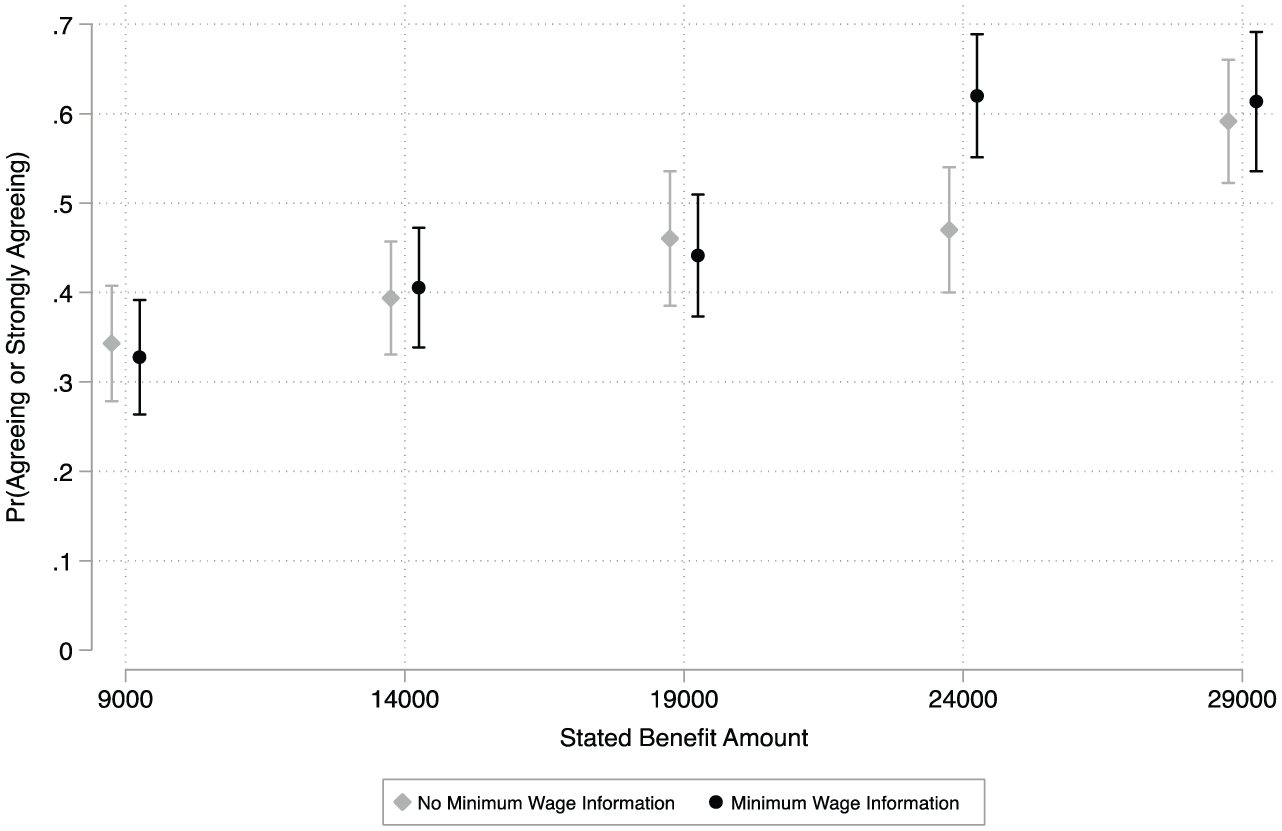
‘Benefits Too Generous’, Overall Treatment Effects.
Several observations are noteworthy. First, across the conditions there is a positive and roughly linear gradient in the predicted probability of feeling that benefits are too generous. In other words, the likelihood of thinking benefits are too generous increases gradually, suggesting that the respondents reflected on the claimed benefits and made up their minds accordingly (as per H1). If numbers had no informational value for respondents, such a pattern would not be visible, but replaced by a flat line (i.e. with high-benefit treatment groups as supportive as low-benefit groups). Instead, we see that the probability of agreement rises from around 0.33 in the £9000 treatment groups to about 0.61 in the £29,000 treatment group. 7
Second, information about the minimum wage income for the ‘typical family’ (here situated at approximately £19,000) does indeed have an effect (as per H2), but only for the £24,000 treatment group: the probability of agreeing or strongly agreeing moves from 0.47 without the minimum wage treatment to 0.62 with it (with the difference statistically significant at the p < 0.01 level). 8 The effect disappears for the £29,000 treatment group, for which the minimum wage and non-minimum wage group responses are statistically indistinguishable. The special character of the £24,000 treatment suggests Britons may be relatively knowledgeable about where low to average income levels lie. This could be driving our results if respondents generally recognize that, regardless of whether minimum wage information is included, the £9000, £14,000 and £19,000 benefit figures are clearly low, while the £29,000 figure is clearly high. (Recall that this latter figure is larger than the median household income in Britain, at about £26,300.) It may be that additional information, such as on the minimum wage income, is only valuable to respondents when the claimed benefit level starts to near assumed low- to average-household income levels (i.e. in the low- to mid-£20,000 range).
It is also noteworthy that respondents do not seem to care if benefits levels are said to be less than half of the minimum wage income, nor are they bothered if they are equally as generous as the minimum wage. This latter finding is particularly interesting, as it suggests that people do not buy into the oft-heard argument that there must be a monetary incentive for the unemployed to accept jobs at the minimum wage, since that would imply that benefits would have to be lower. Rather, Figure 1 suggests that people do not want benefit recipients to earn more than those working for the minimum wage do.
We then break down the treatment effects by egalitarianism. 9 This allows us to test H3 (increasing the claimed level of benefits affects anti-egalitarians more than egalitarians), H4 (the effect of egalitarianism on support is strongest in the absence of information about the minimum wage) and H5 (claims that benefits are substantially below the minimum wage will lead the attitudes of egalitarians and anti-egalitarians to diverge).
Figure 2 lays out the probability of agreement or strong agreement across the treatment groups for egalitarians (on the left panel) and anti-egalitarians (on the right). We begin by noting that we do not find support for H3: the difference between the £9000 and £29,000 treatment groups for both egalitarians and anti-egalitarians is just over 0.2, regardless of whether or not minimum wage information is included. Despite differences in the levels of agreement across the two groups, the slopes are substantively indistinguishable. This is true regardless of whether minimum wage information is included, suggesting a lack of support for H4 as well. Indeed, the presence or absence of minimum wage information makes a limited difference for the effect of egalitarianism, with the exception of the £24,000 figure (where we find a clear effect only among egalitarians).
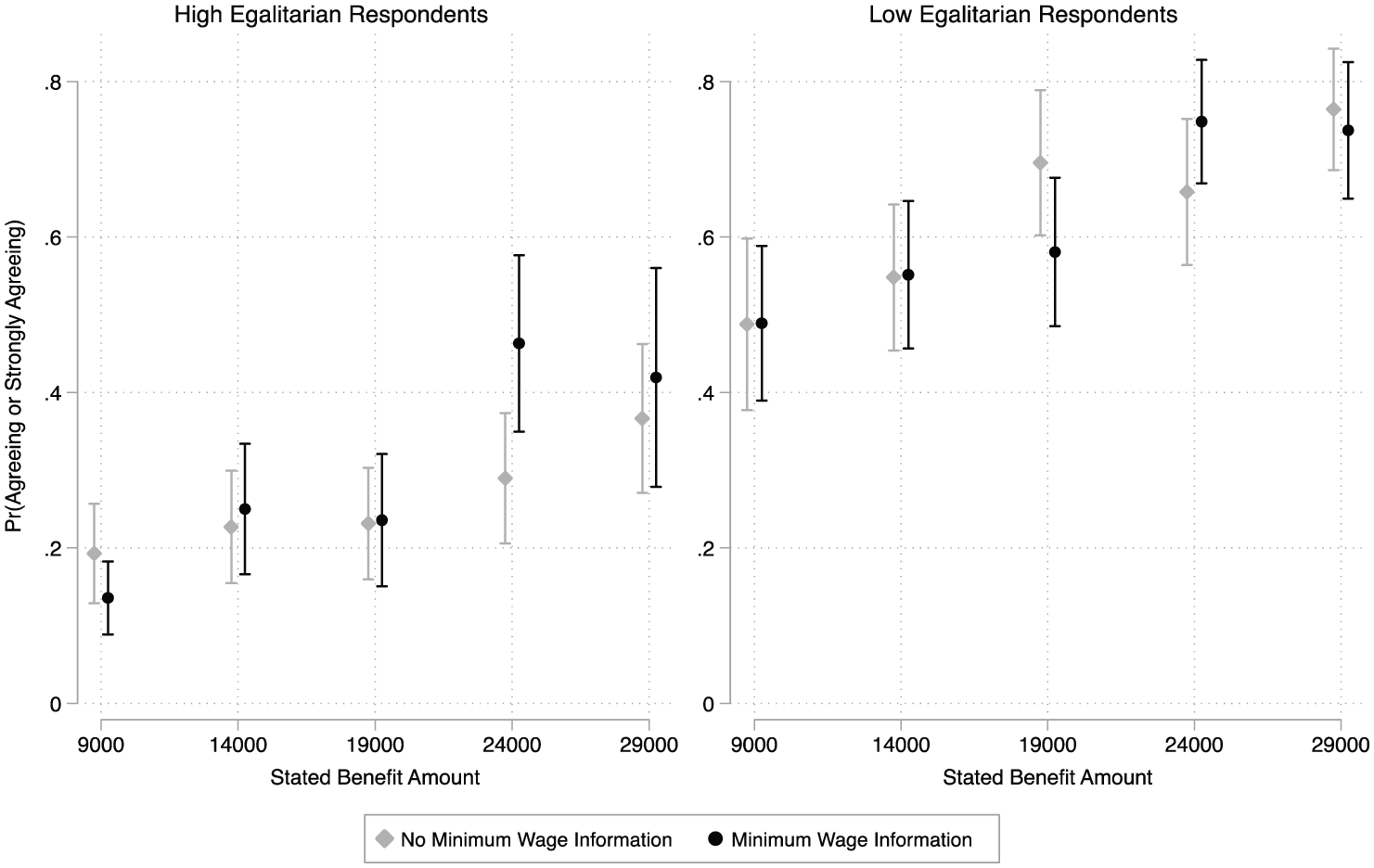
‘Benefits Too Generous’, Treatment Effects Based on Egalitarianism.
Instead, it is primarily when respondents were informed about the minimum wage income that they responded in a non-linear fashion to increases in the claimed benefit income level. For egalitarians, the suggestion that benefit income was only £9000 resulted in a lower likelihood of agreement relative to all other treatment groups when minimum wage information was present. For anti-egalitarians, by contrast, such a bump occurred only where the asserted benefit levels were above the minimum wage income (i.e. with the £24,000 and £29,000 amounts), with respondents considerably more likely to agree that benefits were too generous – but a similar effect is also noted among egalitarians. (See Online Appendix Table A2 for full details.) On the whole, then, the results offer partial support for H5.
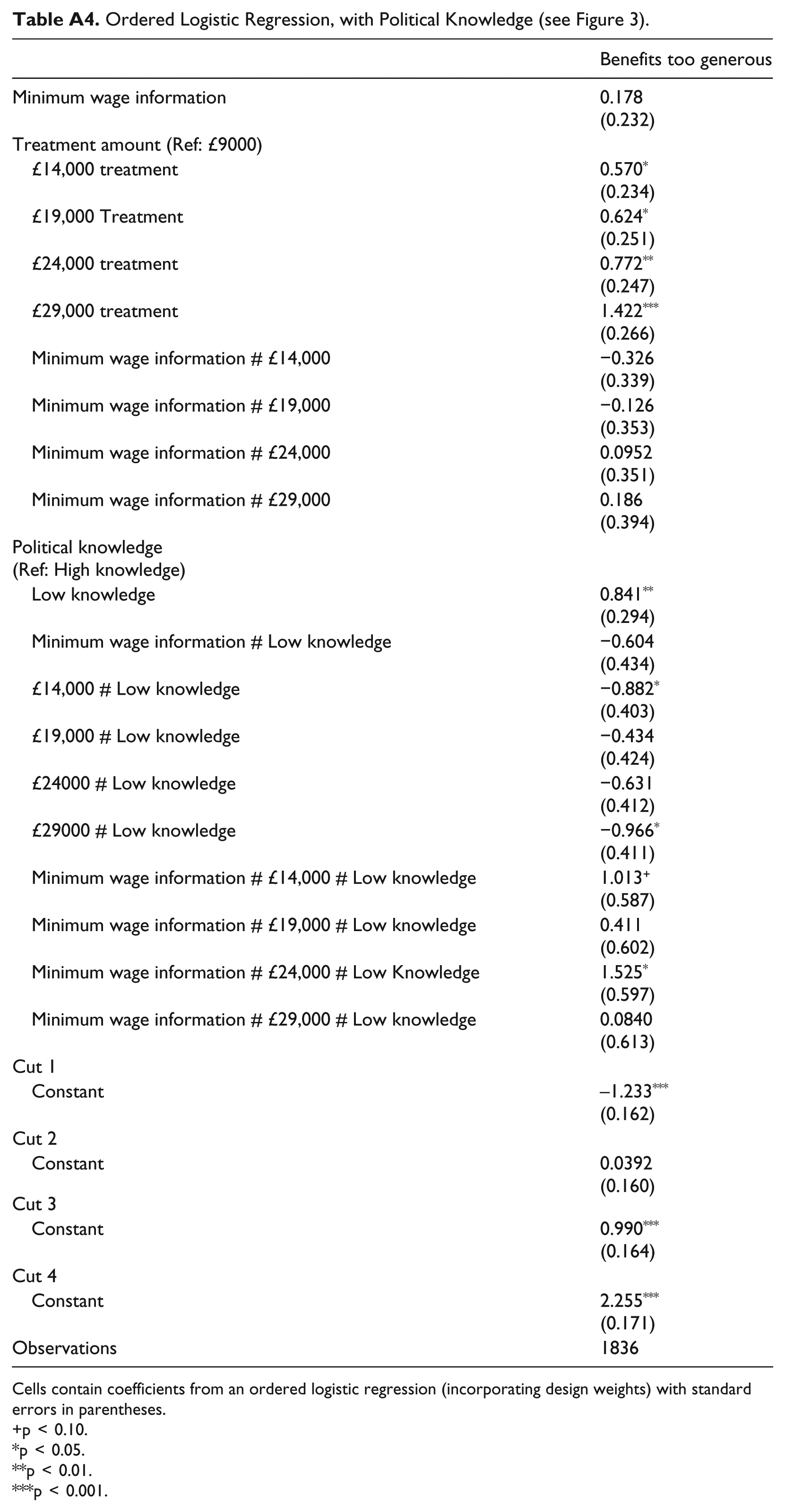
Finally, we turn to examine how political knowledge conditions the effect of our treatments, 10 with Figure 3 illustrating the probability of feeling that benefits are too generous among high- and low-knowledge respondents. Recall that the goal here is to assess whether greater political knowledge decreases the effect of claims about welfare generosity (H6). Results instead highlight that low-knowledge respondents are driving the anchoring effects noted in Figure 1: they are much more likely to agree or strongly agree that benefits are too generous when presented with the £24,000 figure alongside the minimum wage information (at 0.77) than without it (at 0.50). 11 Those with high knowledge, by contrast, respond to increasingly large amounts of asserted benefit income in a roughly linear manner, with no real signs that minimum wage information had an effect.
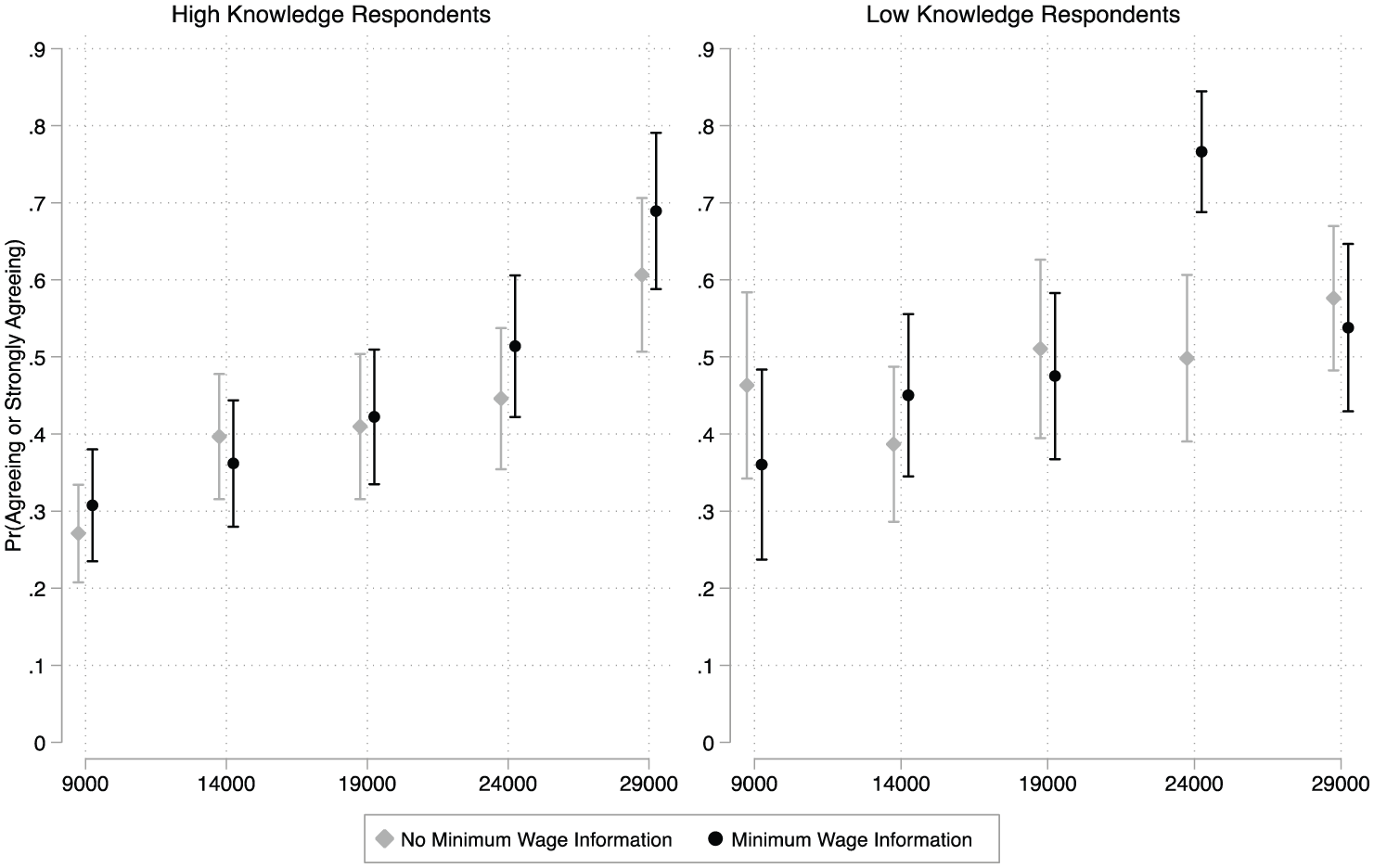
‘Benefits Too Generous’, Treatment Effects Based on Political Knowledge.
In sum, we find at least partial support for four of our hypotheses. First, our findings suggest that in the absence of information about the minimum wage income, responses do indeed broadly reflect the level of asserted benefits income, with greater amounts associated with increasingly anti-generous positions (H1). Second, we find that claims that benefits are higher than the minimum wage reduce support among all respondents (H2), but that this effect is present only with the £24,000 figure. Third, claims that benefits were substantially below the minimum wage do indeed appear to lead the attitudes of egalitarians and anti-egalitarians to diverge, though we only see evidence of this effect with the £9000 figure (H5). Finally, the analysis suggests that high political knowledge decreases the effect of anchored claims about welfare generosity (H6).
More generally, our results also indicate that information about the minimum wage income primarily made a difference only with the £24,000 treatment. As highlighted above, one explanation for this finding could be that Britons on the whole may be capable of assessing the generosity of a given level of welfare benefits, perhaps because they have a reasonably good sense of where low- to average-household income levels broadly lie. In support of this interpretation, we observed that the main effect of the minimum wage information treatment was located among less knowledgeable respondents. Yet it is of course also possible that this result is simply the product of random noise in the data, and further research on the matter is therefore required.
At the same time, we find no support for our two remaining hypotheses: increasing the claimed level of benefits does not impact anti-egalitarians more than egalitarians (H3); and the effect of egalitarianism on support is not shaped by the presence or absence of information about the minimum wage (H4). Taken together, the overarching impression is that egalitarianism affects responses to benefit claims considerably less than one might expect. This is arguably because people’s egalitarianism is such a powerful guide for policy preferences to begin with.
To assess the validity of these findings, we performed several robustness checks. First and foremost, in order to minimize the risk that our results are spurious, we reran all of the above analysis on a sample that only included respondents who clearly received the treatment. To do so, we used responses to an open-ended attention check question asking ‘About how much does the typical family on welfare receive in benefits per year?’ This question was presented to respondents four questions after the treatment, and just over 65% of the sample entered the exact figure that was stated in their treatment group. Restricting our analysis to that 65% clearly reduces our power substantially, but it does not notably alter the patterns or results presented above (see Online Appendix, Figures 1–3).
Next, we confirmed that the key results in Figure 1 were unaffected by including controls for factors related to experienced vulnerability, which may shape responses to asserted benefit levels. This led us to reconstruct the models from our main analysis with controls for household income, education levels, geographic region, and having one’s income come primarily from benefits. As Online Appendix Figures 4, 5 and 6 illustrate, doing so has no meaningful impact on the results, save for in one instance: responses among egalitarians exposed to the £9000, £14,000, and £19,000 claims with minimum wage information become statistically indistinguishable – though these treatment responses still remain distinct from those with higher claimed values. Finally, we also ensured that smaller potential changes to the modelling had no impact on the findings. Most notably, this included: constructing the egalitarianism and political knowledge categories using standard factor analysis rather than IRT; and running logistic (rather than ordered logistic models), collapsing the dependent variable’s response categories into a binary variable dividing those who agree from everyone else (leaving aside the ‘don’t know’ category). In no instance were results substantially effected by the changes.
Conclusion
We began this article with the observation that (inflated) claims about benefit generosity appear to be a rather commonplace rhetorical weapon employed by politicians. We speculated that claims such as these are common because politicians and other politically motivated actors expect they can generate a sense of outrage with the status quo that will help justify welfare state cutbacks. For better and for worse, the empirical findings reported above suggest that this is a highly viable strategy: our experiment, conducted on a survey of just under 2000 Britons, indicates that larger figures stimulate increasingly negative sentiments regardless of pre-existing egalitarianism levels. Our results also suggest that claiming that benefits are more generous than the minimum wage may boost scepticism towards benefits where the claimed benefit level is not so high as to already strike citizens as prima facie outrageous (in our study, at £24,000). On that point, it is worth noting that the highest asserted figure used in the experiment (£29,000) is much lower than some of the real-life values put forth by prominent politicians such as Ronald Reagan and George Osborne; to the extent that the public is indeed relatively cognisant of where low- to average-income levels approximately lie, it seems likely that extremely exaggerated figures may have a limited influence on attitudes.
From the perspective of the welfare state literature, our findings help us to understand a long-standing tension drawn out by existing research: the welfare state remains highly popular (e.g. Jæger, 2012; Jensen, 2014), yet retrenchment has long been a government practice that very frequently goes unpunished (e.g. Giger and Nelson, 2010; Schumacher et al., 2013). Rather than suggesting a disconnect between public opinion and welfare reform (c.f. Brooks and Manza, 2007; Soroka and Wlezien, 2010), our results point to one route politicians may take – despite broadly pro-welfare state popular preferences – to garner support for their desired reforms. It is clearly wrongheaded to equate general expressions of support for the welfare state with support for benefits no matter their (real or asserted) generosity. In particular, our findings suggest that many people believe benefits should not be more generous than the minimum wage. The flipside of this result, however, is that there is limited support for reining in benefits if these are below or even approximately equal to the minimum wage. One potential explanation for this may be that the minimum wage, at least in a British context, signals the lowest income upon which people can maintain a decent standard of living.
Overall, our results point to several potentially valuable avenues for future research. On one hand, studies might seek to unpack the mechanism(s) driving the effects behind our analysis. Doing so could involve exploring the economic and/or moral dimensions of citizen preferences that seem to be in tension with their generally pro-welfare state stances, applying related research (e.g. Giger and Nelson, 2013; Ryan, 2014) to discussions of political discourse. Such work might also tap into existing research on labour market vulnerability (e.g. Kevins, 2017, 2018), as an individual’s risk of going on benefits may well shape their response to asserted benefit levels. Finally, research in this vein might also help to uncover the explanation behind the seemingly distinct character of the £24,000 treatment.
On the other hand, our study also highlights the value of research examining the effects of political rhetoric on these sorts of preferences in the ‘real world’. In that regard, it could be especially valuable to investigate the over-time relationship between media discourse and public opinion, in the process building upon studies focused on popular welfare myths (e.g. Geiger, 2017a; Geiger and Meueleman, 2016). Such research could also help to address real-world questions that our experimental set-up does not allow us to answer, in the process establishing the external validity of the findings presented here (see Gaines et al., 2007). Just how durable are the effects we uncover, for example, and are they robust to the presence of counter-arguments and counter-frames (e.g. Jerit, 2009)?
Supplemental Material
PSX780516_Supplementary_Material – Supplemental material for Numbers and Attitudes towards Welfare State Generosity
Supplemental material, PSX780516_Supplementary_Material for Numbers and Attitudes towards Welfare State Generosity by Carsten Jensen and Anthony Kevins in Professional School Counseling
Footnotes
Appendix
Ordered Logistic Regression, with Political Knowledge (see Figure 3).
| Benefits too generous | |
|---|---|
| Minimum wage information | 0.178 (0.232) |
| Treatment amount (Ref: £9000) | |
| £14,000 treatment | 0.570
*
(0.234) |
| £19,000 Treatment | 0.624
*
(0.251) |
| £24,000 treatment | 0.772
**
(0.247) |
| £29,000 treatment | 1.422
***
(0.266) |
| Minimum wage information # £14,000 | −0.326 (0.339) |
| Minimum wage information # £19,000 | −0.126 (0.353) |
| Minimum wage information # £24,000 | 0.0952 (0.351) |
| Minimum wage information # £29,000 | 0.186 (0.394) |
| Political knowledge (Ref: High knowledge) |
|
| Low knowledge | 0.841
**
(0.294) |
| Minimum wage information # Low knowledge | −0.604 (0.434) |
| £14,000 # Low knowledge | −0.882
*
(0.403) |
| £19,000 # Low knowledge | −0.434 (0.424) |
| £24000 # Low knowledge | −0.631 (0.412) |
| £29000 # Low knowledge | −0.966
*
(0.411) |
| Minimum wage information # £14,000 # Low knowledge | 1.013
+
(0.587) |
| Minimum wage information # £19,000 # Low knowledge | 0.411 (0.602) |
| Minimum wage information # £24,000 # Low Knowledge | 1.525
*
(0.597) |
| Minimum wage information # £29,000 # Low knowledge | 0.0840 (0.613) |
| Cut 1 | |
| Constant | −1.233
***
(0.162) |
| Cut 2 | |
| Constant | 0.0392 (0.160) |
| Cut 3 | |
| Constant | 0.990
***
(0.164) |
| Cut 4 | |
| Constant | 2.255
***
(0.171) |
| Observations | 1836 |
Cells contain coefficients from an ordered logistic regression (incorporating design weights) with standard errors in parentheses.
p < 0.10.
p < 0.05.
p < 0.01.
p < 0.001.
Acknowledgements
This paper benefitted from helpful feedback provided by Troels Bøggild, Kristina Jessen Hansen, Lasse Laustsen, Brian Schaffner, James Wilhelm, four anonymous reviewers and the editors of Political Studies.
Funding
The author(s) disclosed receipt of the following financial support for the research, authorship, and/or publication of this article: The project was made possible thanks to funding from the Department of Political Science at Aarhus University and the Independent Research Fund Denmark (4003-00013). A.K. received financial support from a Marie Skłodowska-Curie Individual Fellowship (750556).
Supplementary Information
Supplementary material for this article is available online. Data and do file are available at the Harvard Dataverse.
Notes

Author biographies
References
Supplementary Material
Please find the following supplemental material available below.
For Open Access articles published under a Creative Commons License, all supplemental material carries the same license as the article it is associated with.
For non-Open Access articles published, all supplemental material carries a non-exclusive license, and permission requests for re-use of supplemental material or any part of supplemental material shall be sent directly to the copyright owner as specified in the copyright notice associated with the article.
