



Abstract
Phone-use by drivers contributes to increasing numbers of collisions and deaths worldwide. Despite clear evidence for the equal dangers of handsfree phone-use, most jurisdictions only prohibit handheld use. This mixed-methods study provides an in-depth analysis of police officer attitudes and experiences in dealing with phone-using drivers. 411 officers completed a survey and interviews on their interactions with mobile phone offenders and their understanding of the dangers of handsfree phone-use. Three key themes emerged: (1) officers focused on handheld phone-use predominantly, associating the dangers with visual and manual distraction, while advising handsfree as a legal alternative; (2) officers use discretion in their considerations for prosecution, dependent on the context of phone-use and attributes of the offender; (3) officers wish to appear fair, and are keen for a positive relationship with the public, which impacts how they negotiate encounters with offenders. Results highlight the need for targeted education for officers on the dangers of handsfree phone-use, specific guidance on negotiating officer-offender interactions, and a change in practice to ensure handsfree phone use is not routinely recommended to offenders as an alternative to handheld use.
Introduction
The effects of phone-use on driving performance
Phone-use by drivers remains a significant road safety concern, contributing to incidents and injuries across the globe (European Commission, 2022; NHTSA, 2024). It is now extremely well documented that phone-use leads to deteriorated driving performance: drivers using a phone are four times more likely to be involved in a collision than undistracted drivers (Carid et al., 2008; Choudhary and Velaga, 2017), and often demonstrate poor hazard anticipation (Ebadi et al., 2019) and detection (Atchley et al., 2017), to the extent that drivers can look directly at hazards yet fail to see them (Briggs et al., 2016; Hyman et al., 2010). Phone using drivers take longer to react to any hazards they detect (Briggs et al., 2018), look around the driving scene less (Tejero and Roca, 2021) and demonstrate poorer vehicle control (Ortega et al., 2021) and safety relevant decisions (Useche et al., 2024). Together, these factors explain why phone-using drivers consistently demonstrate decreased situational awareness (Strayer and Fisher, 2016), which in turn contributes to increased crash risk.
These factors are common to both handheld and handsfree use, due to the cognitive workload imposed on a driver who attempts to multitask (Strayer et al., 2022). While physically holding and looking at a phone diverts attention from the driving task (i.e., taking your eyes off the road and your hands off the wheel), removing the need to look at or touch a phone, by using a handsfree kit, does nothing to reduce the cognitive workload required to concurrently process both the driving and phone tasks. When talking on the phone, a driver is forced to share the attentional resources needed for accurate visual perception of the driving scene with the phone task (Kahneman 1973; Wickens, 1984) 1 . This competition for limited resources results in decreased performance in one or both tasks (Young and Stanton, 2023). The cognitive distraction caused by phone-use persists for around 30 seconds after phone-use has ended, highlighting the attentional cost of multitasking (Strayer et al., 2022). Notably, drivers often appear to prioritise maintenance of a phone conversation (Useche et al., 2024), at the cost of increased driving errors (Ortega et al., 2021). Moreover, in the absence of any salient incident which alerts the driver to their inattention while using their phone, many are unaware of their diminished driving performance (Sanbonmatsu et al., 2016), forcing other road users to take mitigating action to avoid incidents (Li et al., 2020).
A lack of awareness of the negative effects of handsfree phone-use on driving performance makes it likely that the behaviour continues in future: every journey completed apparently without incident confirms to a driver that phone-use is ‘safe’ and unproblematic (Wells et al., 2021). This makes it challenging to communicate the documented dangers of handsfree phone-use to drivers: if they have not experienced the effects of their distraction, they may not acknowledge its existence.
Policing phone-use by drivers
Despite evidence of the dangers of handsfree phone-use, most global geographies only prohibit handheld use 2 . The UK Parliament has acknowledged the dangers of handsfree phone-use (Transport Select Committee, 2019), yet governments have remained reluctant to change legislation, due to the challenges posed for enforcement 3 (Wells et al., 2021). In the UK, therefore, it remains the legal, though equally dangerous, ‘alternative’ to handheld phone-use. Other laws may be used in respect to handsfree phone-using drivers, although they do not explicitly prohibit using a hands-free phone. For example, Section 3 of the Road Traffic Act 1988 outlines offences of careless driving and inconsiderate driving, which are committed when driving a vehicle on a road or other public place without due care and attention, or reasonable consideration of others. Legislation of this type relies on driving being impaired, and observed, so does not offer any potential for pre-emptive deterrence of drivers who may not believe that their performance will be impaired.
Without bespoke legislation targeting handsfree phone-use, alternative approaches are needed to reduce legal forms of distraction, particularly as self-reported phone-use is increasing (RAC, 2023). In the absence of widespread opportunities for driver diversionary education (Savigar-Shaw and Wells, 2023), police officers should be viewed as at the frontline in terms of interactions with phone-using drivers. Every roadside ‘stop’ of a handheld phone-using driver is an opportunity to impart information about the relative dangers of different behaviours. Alternative methods such as AI cameras and ‘dash cam’ reporting of offences do not contain any such timely opportunity for education. Additionally, diversionary courses for phone use have not been available in the UK since 2017, having been removed as an alternative to prosecution as they were deemed to be a ‘soft option’ (DfT, 2016). As such, police officers can have a vital role in both enforcing the law and providing advice which is conducive to increased road safety.
To understand the potential impact of enforcement of current UK law on future driver behaviour, Briggs et al. (2023) surveyed 1550 motorists on self-reported phone-use and future intentions for behaviour should they be caught using their handheld phone. Over half (54%) of respondents claimed not to use their phones. A further 35% said they made handsfree calls, while 17% admitted to various forms of handheld phone-use. These findings are in line with other self-report measures of phone-use by drivers (RAC, 2023), demonstrating that a significant proportion of drivers engage in handsfree use. When asked how they would behave following apprehension by the police, for handheld phone-use, 31% of those who used their phones said they would stop any type of phone-use, and 33% said they would switch to handsfree use. The remaining respondents said they would continue with handheld use, perhaps while also attempting to hide or limit it, indicating adaptation rather than cessation (Wells, 2015).
These findings suggest that a prosecution for handheld phone-use would not necessarily deter phone-use in the future and could further displace drivers from an illegal form of the behaviour (handheld) to a legal, yet equally dangerous form (handsfree). They also support the need to understand officer interactions with phone offenders, with a view to identifying if these interactions could be more productive in promoting safety rather than just legality. This study addresses the need to understand police officer interactions with mobile phone offenders, their attitudes to enforcement of mobile phone law, and their knowledge and awareness on the dangers of handsfree phone-use. By investigating the challenges of these interactions, and the views of enforcing officers, we then explore the opportunities to ensure that such interactions are evidenced-based and focused on safety.
Methodology
Design
The study used a mixed-methods approach comprising of an online survey (quantitative measures) and individual interviews (qualitative measures). Full ethical approval was gained from the Open University ethics panel (for the survey aspects of the research) and the University of Staffordshire's ethics panel (for the interviews).
Participants
411 participants (81% male, 16% female, 3% did not specify) from 28 of the 43 police forces across England and Wales were recruited to participate 4 . They ranged in age from 20 to 64 yrs (M = 39.42 years, SD = 8.78 years). 89% of participants were White, 1.4% were Asian and 1.7% were of mixed/multiple ethnicities. 6.6% did not provide their ethnicity. Officers had an average of 14 years work experience (SD = 7.91 years, range 1–34 years) and 64% of participants worked in a dedicated Roads Policing Unit (RPU). 72% were trained to advanced standard police driving, 18% were trained to response level and 10% were trained to standard level. 75.4% of respondents were ranked as Constable, 17.5% as Sergeant, 3.3% as Inspector, 2.3% as Special, fewer than 1% were Police Community Support Officers (PCSOs), and fewer than 1% were ranked as Chief Inspector. The sample included a range of force sizes and geographies, including both urban and rural areas, distributed across the entirety of England and Wales. Of the 28 forces represented in our sample, 10 had a headcount of 3–7k officers, 17 had a headcount of 1–2k officers and one had fewer than 1k officers.
Ten participants (9 male, 1 female; all ranked as Constable) from two police forces in England participated in interviews. Eight worked in dedicated RPUs and two were response officers with experience with stopping drivers for phone-use. Experience in their current role ranged from 2 to 25 years, with an average of 11.6 years.
Materials
Survey and interviews
A 32-question, online survey was used. Questions used a mixture of multiple choice and free-text responses, with most items requiring participants to rate their agreement with a provided statement on a five-point Likert scale (strongly disagree - strongly agree). Questions measured attitude, behaviour, knowledge and awareness of enforcing mobile phone law and the dangers of handsfree phone-use. The survey asked questions relating to experience of interacting with mobile phone offenders, views on the importance of enforcing mobile phone law, and the advice officers provide to offenders. The survey was built and hosted using Qualtrics and it was shared with all UK police forces via email. Participation was voluntary for all officers and all data collected were anonymous. Completion of the survey took approximately 20 minutes.
Interviews followed the thematic structure of the survey but allowed for deeper exploration and discussion of those topic areas using related open questions. Interview participants were recruited via internal email adverts sent by partner forces. Participation was voluntary and open to all officers. Interviews were carried out in-person, and all interviewees were interviewed by the same member of the research team. Interviews lasted approximately 1 hour each.
Procedure
Survey participants were recruited via email invitation from the National Roads Policing Operations Intelligence and Investigation team (part of the National Police Chief’s Council Roads Policing portfolio). The email provided a link to the survey which started with information on the survey’s aims before requiring consent to participate. Respondents then completed the survey online, in a self-paced manner, with their responses being automatically saved on completion. At this point, a full debrief of the study was provided.
Interviews were undertaken at two police forces, one primarily urban and one primarily rural. Sergeants of the Roads Policing Units (RPUs) in those force areas invited the police constables of their teams to take part in the research. For 1 day, one of the researchers attended the police station that those teams were based and used a private office space to interview officers according to their availability. In addition to the eight roads policing officers that were recruited, an additional two response officers working closely with those teams offered to take part after being informed of the research. Interviewees provided informed consent before being guided through the interview questions by the interviewer, in a semi-structured fashion. Interviews were carried out individually and were digitally recorded for later analysis. Interviewees were then fully debriefed.
Results
The survey questions were subject to descriptive statistical analysis
5
. The qualitative data were analysed using thematic analysis, whereby each of the interview transcripts were coded and themed by one of the research team, before being reviewed, revised and written up by the wider research team (Braun and Clarke, 2006). This, combined with the survey data, resulted in the identification of three core themes. As summarised in Figure 1, the three identified themes are interdependent, highlighting the complexity of officer-offender encounters. Summary of officer views organised by qualitative themes identified.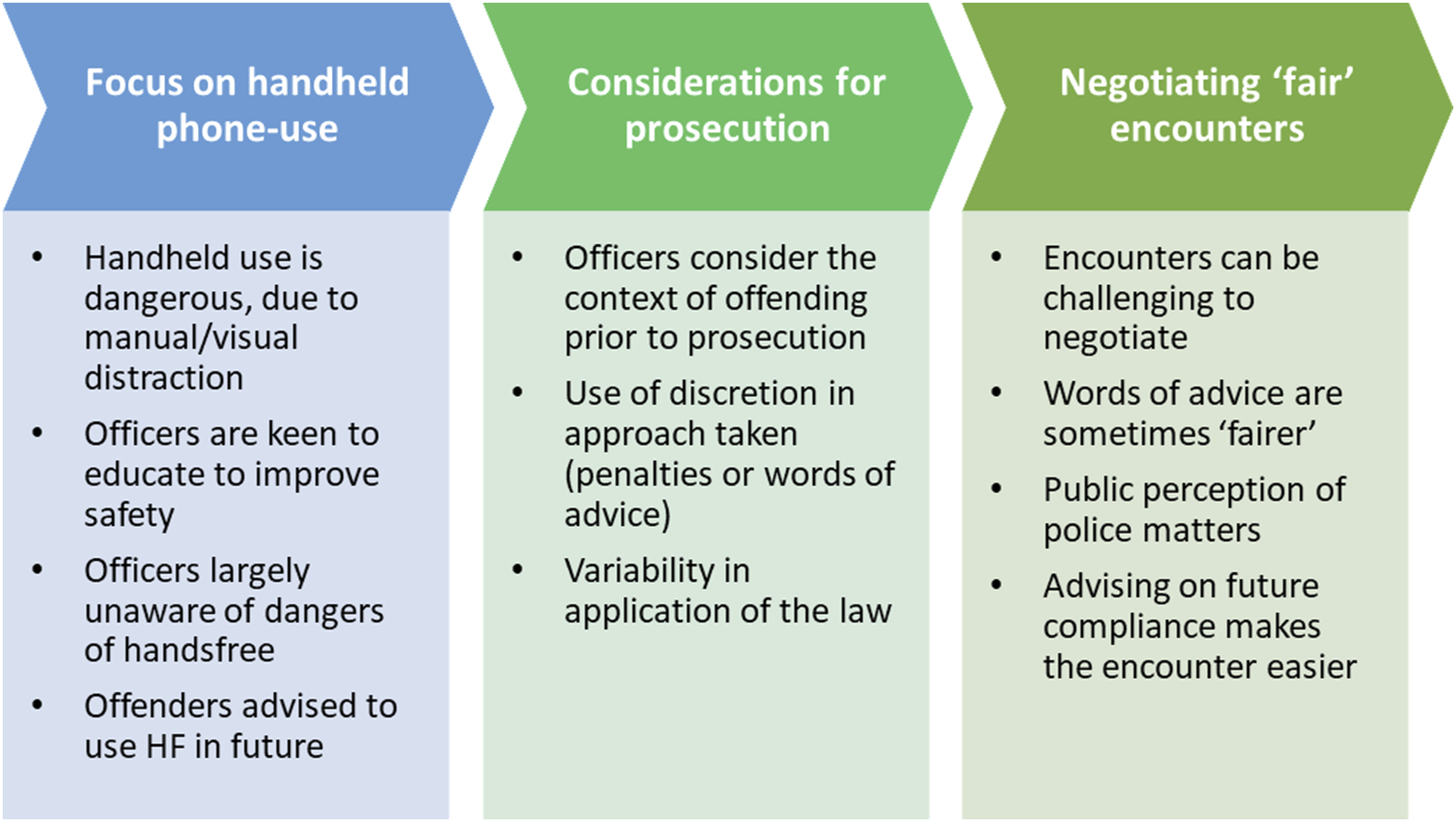
Theme 1: A focus on handheld phone-use: A partial understanding of distraction
Survey responses showed strong agreement amongst officers that illegal phone-use by drivers represents a serious safety issue (97% agreement, n = 398), the main issue being that drivers fail to look at the road (85% agreement, n = 324). Most agreed that illegal phone-use should always be prosecuted (76% agreement, n = 292) and the current law improves road safety (68% agreement, n = 245). There was therefore general support from officers that handheld phone-use is problematic.
However, not all phone-use was seen as equally problematic. While texting (causing visual and manual distraction) was considered more dangerous than phone conversation (87% agreement, n = 332), many officers agreed that handsfree phone-use is safer than handheld use (72%, n = 259). There was less consensus regarding the seriousness of handheld phone-use whilst stopped in traffic: while 56% (n = 210) agreed this was dangerous, 24% (n = 91) disagreed, and a further 21% (n = 81) neither agreed nor disagreed. This was echoed in interviews, where officers emphasised the dangers associated with manual and visual phone distraction and considered stationary phone-use to be less problematic: “The most dangerous one is when they've got it on their lap and they're constantly looking down at that, and you can see it all the time.” (RPU officer, 15 years’ experience). “There's more people now you see… they don't even see you, because they're too busy doing that - flicking their eyes up, back down to the lap.” (RPU officer 7 years’ experience). “That would probably just be a bit of verbal advice because whilst you can't use your mobile phone when stopped at traffic lights, if that's the only time you're using it, the chance of you killing someone... [is less]” (RPU officer, 12 years’ experience).
In contrast, officers rarely voluntarily described any concerns with cognitive or handsfree distraction. Rather, they outlined expectations for handsfree phone-use in drivers and the ‘privilege’ of having opportunities to use handsfree devices: “There’s no need for people to be using the phone these days when they're driving, you know? Most people have got Bluetooth.” (RPU officer, 7 years’ experience). “Mobile phone-use really does annoy me. There's so many devices that you can buy now to avoid that hand to the face, isn't there?” (Response officer, 8 years’ experience).
Survey responses showed there was strong agreement amongst officers of the public’s need for more education on the dangers of phone-use (88% agreement, n = 279). When stopping an offender, most officers claimed they offer education on why phone-use is distracting (91% agreement, n = 340) and advice on how to be compliant with the law in future (90% agreement, n = 335). Furthermore, 82% (n = 306) routinely advise offenders to use handsfree in future. Indeed, when describing what roadside education constitutes, some officers described recommendations to switch to handsfree phone-use as an alternative to handheld: “They’ve all got Bluetooth capabilities now, so if I stop someone for using the mobile phone, my first question is ‘why aren't you using Bluetooth?’” (RPU officer, 12 years’ experience). “Yeah, with this guy in particular, I just said “you know, you have got Bluetooth facility in your van?!”. So I do kind of go down that route first and he did have Bluetooth, it just failed to connect, so he just thought he'd pick up the phone. So, I do kind of give a bit of education about distracted driving.” (Response officer, 8 years’ experience).
As such, the advice given to offenders appears to be focused on the possible dangers of the behaviour, but this is tied specifically to the law’s focus on manual and visual distraction. Officers therefore appear to be advising offenders on future compliance with the law which (as the survey data has shown) they believe contributes to safer driving practices.
While officers are keen to educate, they seem to be communicating erroneous information relating to handsfree phone-use being safer than handheld. This may result from a lack of knowledge in this area. For example, 52%, (n = 189) of officers agreed that handsfree phone conversation is similar to talking to a passenger, and 17% (n = 33) disagreed that handsfree phone-use represents a serious safety issue, with a further 42% (n = 182) neither agreeing nor disagreeing. Other evidence emerged of a general resistance to educating handheld offenders on the dangers of handsfree use. Resistance stemmed from a range of different (and sometimes overlapping) beliefs. These include the belief that drivers will not listen/believe that it is dangerous; that denial of handsfree phone-use would take away a freedom drivers valued; and that a handsfree ban is unenforceable. The following quotes evidence the range of issues officers identified: “If you try and have that conversation with someone, you will end up getting lip service and a nodding dog. Because you know full well, they probably won't do that again, or for a few months, but for some they’ve got a long journey home, they’ve got another phone call… So, let's not waste their time or my time.” (RPU officer, 29 years’ experience). “So, I've stopped you and you’re trundling along on your phone, talking about whatever, and I stop you and say, ‘Why haven't you got it connected to Bluetooth? Connect it up to Bluetooth’. And they go ‘oh, sorry, officer’. And then you go, ‘However, don't connect stuff to Bluetooth because Bluetooth is dangerous as well’. It's like they're gonna go… ‘make up your mind’.” (RPU officer, 12 years’ experience). “It's like taking away people's freedoms, isn't it? Their luxury of, you know…initially when they’re stopped, they made an offence to use a hands on mobile phone. They've still then got their luxury of using their phone, but it's in the cradle and they can still talk, and it isn't taken away.” (RPU officers, 20 years’ experience).
These findings highlight some of the challenges of communicating seemingly inconvenient safety-related information, which is difficult for the officer to explain, and they consider would likely be received negatively by drivers. This then feeds into a reluctance to discuss the dangers of handsfree use at all. Indeed, it appears that being able to offer handsfree use as the ‘safe and legal’ alternative to handheld use, makes interactions between officers and offenders easier.
Theme 2: Considerations for prosecution: Context and discretion
While survey findings suggest strong support for prosecuting phone-use, evidence also emerged that officers felt that it was up to them to decide what constituted law breaking and hence what the appropriate response was. This understanding helps to reconcile the apparently contradictory data showing that most officers think phone-use should always be prosecuted, with findings revealing that a proportion of officers agree that prior to using a mobile phone charge they think carefully about the situation and level of danger involved (47% agreement, n = 159). This suggests that many officers use their own judgment and discretion when encountering offenders and whilst handheld use is considered dangerous, not all handheld use will attract officer attention or prosecution. This is because officers report valuing their discretion, which ties in with responses to other survey items showing that 20% (n = 73) of officers agree that they sometimes use another charging option when they think a driver’s mobile phone offence was not serious enough to warrant six points and a £200 fine. Variability in discretion is evidenced by response to offenders caught using their phones while stationary in traffic: 23% (n = 87) agreed that they give offenders the benefit of the doubt in this situation, and 34% (n = 127) were not sure (neither agreed nor disagreed) if they would prosecute someone in this situation. Various variables were reported to be considered in deciding if drivers were stopped or not and whether they were given words of advice, or prosecuted: “A lot of the time it depends what environment you're in. So, like if they're outside of school, it’s kicking out time or something like that. Well, to me, sorry, you know it’s an offence… especially when you've got an increased risk of the kids and parents, and there's a lot going on. So, in my view, they're going to get a ticket all day long. They ain't gonna get educated because they're blatantly posing a danger to the people around them.” (RPU officer, 20 years’ experience). “If it's blatant... if you're following somebody while we're doing the checks, and they're quite clearly on the phone, nattering away, oblivious to everything around them, it does change things. If you’re driving past and you're going to another job, or driving down the motorway patrol, and somebody very quickly you can clearly see it's on a holder, they'll pick it up and then put it back, it does change things.” (RPU officer, 7 years’ experience).
Within this theme of discretion around prosecution, further evidence emerged of a reluctance by some officers to prosecute drivers for a phone offence which would then result in them losing their licence. This is interesting, given that survey data showed very strong agreement (82%, n = 308) that the penalties associated with mobile phone-use are appropriate. Nevertheless, some officers reported a preference for using a charge with a lower penalty: “Personally, I'm not in the business of taking away people's driving licences. If I've got someone new in front of me who's got maybe six points three or four years ago for a different offence, and if I deal with them for mobile phone, it's gonna lose them their licence, and they’re a plasterer by trade for example. If they seem genuine, and as I’ve just mentioned, they’ve picked up the phone off the cradle, I would, personally, deal with them for the not in proper control offence, which is 3 points instead of 6”. (RPU officer, 2 years’ experience). “It can be a little bit more difficult when you know somebody's going to get penalty points and then the insurance goes up, or whether there's a licence for something or other and it can pull on your heartstrings a little bit.” (RPU officer, 4 years’ experience).
Officers also reported use of discretion when they felt education was the ‘fairer’ option for the offence they had witnessed. However, others also suggested that they would resort to prosecution where they considered roadside education to be ineffective for a specific driver based on their assessment of the offender, and whether they passed ‘the attitude test’: “A lot of people are receptive to education. [If they are] I'm more than willing to give them advice and education at the roadside, but if they're not receptive, then I think sometimes you've got no choice other than to go down the prosecution route.” (RPU officer, 20 years’ experience). “One thing they haven't quite taken off us yet is discretion and that discretion, it's probably more available to us in the road policing sphere... And so, if I see an offence, I'm not necessarily always gonna go for that [prosecution]. When you get [them] in the back of the car, or on the road, so predominantly the back of the car, that's when you're making a full evaluation, who they, what they are.” (RPU officer, 29 years’ experience).
While officers highlighted the importance of, and need for, discretion, it appears that there is considerable variation in how this discretion is applied, dependent on subjective judgments on the seriousness or inappropriateness of the action and providing a response they consider adequate, i.e., letting off with a warning or ticket. This is demonstrated by evidence of inconsistencies in responses to the same behaviour: “Certainly, if I see somebody on their mobile, I'll always pull them over and certainly have a stern word with them. I'm not very traffic orientated, so I will give most people the benefit of the doubt…So, I've given them some strong words and they're on their way. I know some colleagues are probably a bit more stringent than me and a bit more to the letter of the law, but I do try and be quite fair with people and deal with them all as I see fit.” (Response officer, 2.5 years’ experience). “A warning may work for a couple of days, but they'll go back there, we're creatures of habit, aren't we? They'll go back to it. A ticket, I think, is more substantive and they'll think “Oh God, it's £200, six points” because another one of those will put them in the ban category, then totting up so they think… and that's what I always sort of say to them “Just don't get caught again, because you'll be then onto a ban. So just be very careful because you don't want another one of these.” (RPU officer, 15 years’ experience).
This points to ‘fairness’ being equated to different outcomes, depending upon perceived seriousness/deliberateness of action, rather than to consistent application of the law.
Theme 3: Negotiating encounters and public perception of the police
In line with officer discretion in relation to considerations for prosecution, further evidence emerged regarding the challenges of interacting with mobile phone offenders. 86% (n = 162) of officers agreed that offenders often challenge them, by claiming that they were not using their phone, when they are pulled over. Responses regarding the interactions with offenders were, however, mixed, with 35% (n = 65) agreeing that interactions are sometimes difficult to manage, 31% (n = 58) neither agreeing nor disagreeing and 34% (n = 65) disagreeing. This perhaps points back to discretion and individual interpretation of fairness: officers who regularly defer to advice instead of prosecution may have more amiable interactions with offenders.
Education was, however, seen to be ‘deserved’ by some drivers, and on occasion made the interaction easier for both parties, as well as being seen to offer longer term benefits around the maintenance of policing by consent: “You're gonna go knock the door and go “You're a witness to X,Y,Z offence, can I have a statement please?” and they go, “no, you took my driving license off me 6 years ago because I was on my mobile phone”. The knock-on effects of dealing with people harshly, I think, are quite harmful”. (RPU officer, 2 years’ experience). “I don't tend to prosecute what I perceive to be the law-abiding folk cause when I'm in a sticky situation, and I'm wrestling around on the floor with someone, experience tells me that, for want of a better phrase, Middle England, who perceive they've just been persecuted on the motorway for doing 80, they're still gonna come and help the police, however, they might just think twice before they do”. (RPU officer, 29 years’ experience). “We have such like a… such a bad relationship with the public at the moment… where you can try and be fair with people, the next time that person then has any kind of dealings with the police, will he think back like ‘oh, actually that one bobby was alright with me and, you know, he's done a bit of a solid there where he could have given me a ticket’.” (Response officer, 2.5 years’ experience).
This suggests a trade-off between direct enforcement activity, aimed at deterring future phone offending, and the need to manage interactions with offenders for the greater good of the police’s relationship with the public.
Discussion
Findings demonstrate that police officer interactions with mobile phone offenders are impacted by officer attitude and knowledge, the context of the offence, subsequent application of discretion, and the need for continued positive engagement with the public. Many officers conveyed a strong desire to educate offenders on the visual and manual distraction caused, in the hope of improving subsequent road safety. This is a logical focus given its illegality and clear dangers (Choudhary and Velaga, 2017). Officers work within the parameters of the law, making use of the tools available to them, to manage encounters with offenders. This includes using alternative prosecution options, substituting prosecution with warnings and education, and offering direct advice on how to be compliant with the law in future, by reverting to handsfree use. This approach presents the officer as a reasonable and fair individual: they have detected offending, dealt with it with discretion, and provided a solution for future behaviour which maintains the driver’s freedom to use their phone. However, it ignores the equally problematic risks of the advised action (Ortega et al., 2021) and that individuals perceive fairness in interactions that are procedurally just and outcomes that are distributively fair, not merely lenient in outcome (Tyler, 2003). Importantly, the data show that most officers believe their advice meaningfully improves future road safety, highlighting the need for education for officers on the dangers of handsfree use.
Officer reluctance to offer education on avoiding handsfree use fits with the understandable foregrounding of the law in their thought processes: their role as law enforcers, rather than as road safety advocates, makes them reluctant to give advice or guidance that seemingly transcends their legal ‘toolkit’. As such, officers are content to educate by providing information that dovetails with the messaging communicated by the law, namely that handheld phone-use is dangerous, and handsfree use is the safe and legal alternative. The ability to recommend handsfree use to offenders, rather than discussing its dangers, has the benefit of making the encounter more straightforward. In this sense, the police are operating in a manner that emphasises shared norms and behaviours between themselves and offending drivers, which can be beneficial to generating compliance (Bradford et al., 2015), albeit with the law, not safety.
This feeds into the use of discretion in enforcement decisions and the apparent higher-level motivation to maintain a positive relationship with the public. A clear narrative of the need to appear fair, reasonable and proportionate emerged from the data. This accords with previous literature (Elder, 1964), but appears to result in some variability between officers in enforcement decisions. Some of this variability might be explained by a lack of confidence in, or knowledge of, policing specific types of phone-use (e.g., the varied responses to phone-use while stopped in traffic), but in other cases this appears to be due to the context of the situation (e.g., whether the offender’s driving was noticeably affected) and the individual officer’s attitude to phone-offending. This variability in attitude and discretion requires careful consideration, particularly as it points to the potential for inequity of outcome for the same offence, with potential implications for perceived police legitimacy (Tyler and Wakslak, 2004). This is nuanced further by data which point to variability in who is offered education, rather than a ticket (e.g., the desire to keep ‘middle England’ happy), and reluctance by some officers to prosecute drivers who may resultantly lose their licence. As such, using discretion is a means of negotiating difficult encounters with otherwise law-abiding citizens involved in what is often considered ‘not real crime’ (Corbett, 2013).
These findings highlight how complex interactions between the police and the public are managed in relation to driver phone-use. Problematically, they emphasise a push towards encouraging a legal yet dangerous form of phone-use, that will not improve road safety (Briggs et al., 2023). While it is promising that officers recognise a value in educating drivers regarding the risks of phone-use, it is apparent that their interactions are not currently communicating messages that will improve safety.
Recommendations
Our findings point to the need for education for officers on the dangers of handsfree phone-use. This education should contain evidence-based information on the dangers of different forms of phone-use, including the cognitive distraction it imposes, which can then inform the advice officers provide to handheld mobile phone offenders they interact with. Crucially, the role of this education would be to first convince officers of the dangers of handsfree phone-use, prior to supporting them in sharing this message with offenders. This approach would shift police focus from solely visual and manual distraction and would demonstrate the disparity between legal- and safe behaviour.
National guidance for officers is needed, endorsed at a force level, which advises against routinely recommending handsfree phone-use to offenders. In the absence of such instruction, officers will continue to advise the use of handsfree to help negotiate potentially challenging encounters with offenders. The benefit of a directive is that it helps empower officers to promote safer practices. To achieve this effectively, officers should be provided with guidance and resources on how to respond to resistance from offenders. Given the potential delegitimising effects of inconsistent policing (Tyler and Wakslak, 2004), better education of officers about the risks of all forms of phone use, combined with clear endorsement from their seniors, should produce more consistent frontline practice. This should be attractive to officers and their supervisors given the links between legitimate police practice and public cooperation and compliance (Sunshine and Tyler, 2003). Furthermore, officers who are convinced by the logic of the disposals and education that they use, and are invested in them as legitimate policing outcomes, are more likely to use them with confidence and be prepared to defend their decisions if challenged by drivers.
Finally, due to the challenges of negotiating encounters with offenders and reluctance to advise against handsfree use, the re-introduction of educational diversionary courses should be considered. Such courses need to be based on contemporary research findings to effectively educate offenders on the impact of cognitive distraction (Savigar-Shaw et al., 2022). Of course, they should be implemented only with piloting and evaluation to ensure they provide a beneficial impact on driver knowledge, attitudes and behaviour. Diversionary courses were removed to help communicate the seriousness of mobile phone offending (DfT, 2016). However, phone-use is increasing (RAC, 2023) and prosecutions are decreasing (Home Office, 2022), suggesting that education may be of added value to both officers and road safety more generally.
Future research
Future work could usefully focus on effective approaches to education for officers and offenders. Any intervention designed to educate officers should be evaluated for effectiveness in achieving attitude change. Simply highlighting the risks of a particular behaviour is ineffective in changing attitudes (Box, 2023), meaning more creative, experiential approaches may be more effective. In this context, education for officers will need to support them in developing strategies for interactions with offenders, while also highlighting what is likely to be unhelpful. For example, discussing potential crash risk and associated outcomes with drivers is often ineffective (Guttman, 2015), compared with approaches which highlight the potential benefit of avoiding phone-use to the individual driver (Shoots-Reinhard et al., 2021), alongside practical strategies to avoid phone distraction, such as drive-mode apps.
Research should further explore the issue of discretion versus consistency in prosecution decisions of officers. While valuable, discretion needs to be understood in the context of the provision of the right advice and education, for the right reasons. Our findings demonstrate some officer reluctance to prosecute is based on drivers being ‘law abiding citizens’, some inaccurate views about what ‘really’ constitutes problematic behaviour and being motivated by concerns around police legitimacy and ‘fairness’. If these issues are not directly addressed, continued efforts to enforce the law against handheld phone-use will not reduce the number of distracted drivers on the road, or the number of distraction-related collisions.
Footnotes
Declaration of conflicting interests
The author(s) declared no potential conflicts of interest with respect to the research, authorship, and/or publication of this article.
Funding
The author(s) disclosed receipt of the following financial support for the research, authorship, and/or publication of this article: The authors received funding for the research summarised in this paper from The Road Safety Trust.
