




Abstract
This study examines how the spread of the Internet has affected Japanese people’s information acquisition from traditional media or via traditional information channels. In particular, this study focuses on displacement and complementary effects and on devices for Internet access. Using representative data from Japan (N = 1,179), the results show that Internet use via mobile phone has complementary effects on information acquisition from traditional media, while Internet use via personal computers does not. In addition, the results show that Internet use via personal computers has a displacement effect on information acquisition from radio. These findings are discussed with regard to communication means, social contexts, and media interfaces.
Introduction
The use of information sources is a widely investigated topic in various areas of research. In consumer research, various studies (Berger & Messerschmidt, 2009; Labuschagne, van Zyl, van der Merwe, & Kruger, 2012; Rijnsoever, Castaldi, & Dijst, 2012) have been conducted on prepurchase information searching. News media consumption is one of the most important research themes in media research (cf. Ksiazek, Malthouse, & Webster, 2010; Strömbäck, Djerf-Pierre, & Shehata, 2012; Strömbäck & Kiousis, 2010). Since the emergence of the Internet, which has affected people’s media environment, a number of studies have been conducted on the effects of Internet use on the use of traditional media or traditional information channels (Huang, Lurie, & Mitra, 2009; Klein & Ford, 2003; Loibl, Cho, Diekmann, & Batte, 2009; Zander & Hamm, 2012).
Although the personal computer was the initial way that people accessed the Internet, the use of mobile phones to access the Internet has increased rapidly in recent years (Horrigan, 2009; Ministry of Internal Affairs and Communications, Japan, 2008; Rainie, 2010). The implications of mobility have attracted the attention of communication researchers (Donald, Anderson, & Spry, 2010; Katz, 2008; Ling & Campbell, 2010; Rainie & Wellman, 2012).
However, the effects of Internet use via mobile phone on the use of traditional information sources have not been examined adequately. Previous studies (Ishii, 2004, 2006; Jung, 2009; Miyata & Kobayashi, 2008) on Internet use via mobile phone have emphasized the social difference between Internet use via mobile phone and that via personal computer. There may be differences between Internet use via mobile phone and Internet use via personal computer in terms of how the mode of access affects the use of traditional information sources.
This study divides Internet use into Internet use via mobile phone and that via personal computer, and it examines the effects of Internet use via mobile phone and via personal computer on the use of traditional information sources, using Japanese national survey data from 2009. The results of this research show that Internet use via mobile phone has complementary effects on the use of traditional media, whereas Internet use via personal computer does not.
Information Acquisition Behaviors and the Internet
The existing studies (Huang et al., 2009; Klein & Ford, 2003; Labuschagne et al., 2012; Loibl et al., 2009; Rijnsoever et al., 2012; Zander & Hamm, 2012) on information acquisition belong to a research field closely related to the use of information sources. In Bettman’s (1978) framework, information acquisition consists of search and being confronted. “Being confronted” refers to the acquisition of information in the form of accidental contact with the information while engaged in other acts. “Search” is divided into two parts: internal and external. Internal search refers to information acquisition from a person’s own memory, while external search refers to information acquisition from external sources (Blackwell, Miniard, & Engel, 2006; Rijnsoever et al., 2012). When sufficient information is not obtained internally, external search is performed (Blackwell et al., 2006).
In Bettman’s (1978) framework, being confronted and external search are both closely related to the use of information sources. In the fields of consumer research and health communication research, a number of researchers have studied external search; many of these have focused on the Internet and the ways in which its use has spread (Huang et al., 2009; Klein & Ford, 2003; Loibl et al., 2009; Zander & Hamm, 2012). The Internet has also attracted considerable attention in the field of health communication research as a means to improve health and health care delivery (e.g., Heaton, 2011; C. J. Lee, 2008; C. J. Lee & Hornik, 2009; Park, Chung, & Yoo, 2009; Rains, 2008; Tian & Robinson, 2009). Indeed, because a lot of people search online for information about specific diseases or medical problems, web queries can be used for syndromic surveillance (Hulth, Rydevik, & Linde, 2009) or detecting influenza epidemics (Ginsberg et al., 2009).
When addressing the usefulness of the Internet from the viewpoint of information acquisition behavior, the following two points may be mentioned. One is the Internet’s usefulness as a source of low-cost access to information. Jepsen (2007) studied low costs and benefits as factors affecting consumer use of the Internet for information searches. The results of her analysis showed that perceived low search costs positively affected the use of the Internet for prepurchase information searches. The perceived low cost of using the Internet for information searching is caused by the comparison of the Internet with other information channels. In this view, the superiority of the Internet to other channels is an important factor.
The other key point is that the Internet is a useful way to obtain information that cannot be obtained from traditional sources. The advances of the Internet have transcended the traditional limitations of word-of-mouth (Duan, Gu, & Whinston, 2008). The Internet provides an opportunity for users to share a variety of information (Chen & Xie, 2008; Steffes & Burgee, 2009).
Internet and Other Media: Displacement and Complementary Effects
The ways in which a new medium affects traditional media has been a recurring topic for researchers studying mediated communication (e.g., Chyi, Yang, Lewis, & Zheng, 2010; Grotta & Newsom, 1982; Ha & Fang, 2012; Liebowitz & Zentner, 2012; Waal & Schoenbach, 2010). Some scholars have specifically studied how the Internet affects traditional communication channels.
Consistent results about the relationship between television viewing and Internet use have not yet been obtained. Robinson, Kestnbaum, Neustadtl, and Alvarez (2002) compared the time-diaries of Internet users and nonusers in a combined 1998-2001 national telephone diary study. Their results showed that there were consistent declines in television viewing and sleep times among Internet users, but no consistent declines in reading or other activities. Nie and Hillygus (2002) examined the displacement theory of time utilization using the 2002 Stanford Institute for the Quantitative Study of Society (SIQSS) time-diary data. The results showed that time spent on the Internet was negatively related to time spent on social activities, hobbies, reading, and television viewing.
However, some studies (Hashimoto, 2009; Saito, Takeshita, Kawakami, & Midooka, 2004) do not support the decline of television viewing as caused by Internet use. Using time-diary data, Hashimoto (2009) compared the time-diaries of the days in which Internet users accessed the Internet at home and the days in which they did not. His results showed that Internet users spent a longer time watching television on the days when they accessed the Internet at home than on the days when they did not. Saito et al. (2004) also found that use of the Internet did not decrease television viewing, using a survey conducted in Tokyo in November 2003. Outside of Japan, Kraut, Kiesler, Boneva, and Shklovski (2006) found that people who used the Internet for entertainment watched television more frequently than those who did not.
There are different views on how the use of the Internet to obtain news information affects traditional news media. For instance, Ha and Fang (2012) found that the Internet had a displacement effect on traditional media, including television and newspapers, in the daily news domain. However, several researchers have argued that the use of the Internet for news information has complementary effects on traditional news media (e.g., Nguyen & Western, 2006). Dutta-Bergman (2004a) reported that users of online news media were more likely to seek out news from traditional media outlets. Althaus and Tewksbury (2000) suggested, based on a survey of undergraduate students, that the use of the Internet as a news source was positively related with the reading of newspapers, but had no relationship with the viewing of television.
In the domain of consumer information searches, researchers have discussed whether the Internet has complementary or displacement effects on traditional media. Ratchford, Lee, and Talukdar (2003) examined the effects of the Internet on consumer information searches by comparing data from surveys of automobile buyers collected in 1990 and 2000 in a natural experiment setting. Their results indicated that the Internet had led to reduced searching for information on automobiles. On the contrary, Tsao and Sibley (2004) suggested that Internet advertising has complementary effects on billboards, direct mail, magazines, and television, but displacement effects on free community papers and weekly paid papers as advertising sources. In addition, Klein and Ford (2003) investigated Internet users’ information searching behavior when buying an automobile, and they showed that hours per week of Internet use are positively related to total hours spent searching for automobile information and the total number of sources used to obtain that information. The above examples indicate the findings of previous research prove to be inconsistent.
Whether the Internet has complementary effects or displacement effects on traditional media can be discussed via the concept of functional alternatives. For instance, Flanagin and Metzger (2001) showed that the Internet’s information retrieval and information giving features are used in ways similar to mass media channels including newspapers, television, and books and magazines.
Several studies (Ferguson & Perse, 2000; P. S. N. Lee & Leung, 2008; Lin & Salwen, 2006) have examined functional alternatives to media through the uses and gratifications theory. Ferguson and Perse (2000) examined the world wide web as a functional alternative to television using this theory. They suggested that the web might be functionally similar to television, especially in its use for diversion, but might not be a similarly relaxing way to spend time. Lin and Salwen (2006) compared online and offline news access through the uses and gratifications theory. They pointed out that Internet news websites serve a purpose for “information seeking,” while print news media, which serve a purpose for “information scanning,” have a different role.
Dutta-Bergman (2004b) argued that interpersonal communication, print readership, and Internet communication are active communication channels, while television and radio are passive consumption channels. Based on 1999 HealthStyles data, he demonstrated that active communication channels serve as primary health information sources for health information–oriented individuals, but passive consumption channels serve as primary health information resources for individuals who are not health-oriented. Based on these previous studies (Dutta-Bergman, 2004b; Ferguson & Perse, 2000; Flanagin & Metzger, 2001; Lin & Salwen, 2006), it can be asserted that the Internet does not simply displace traditional media such as television and newspapers but also complements them in various ways.
Internet Use Via Personal Computers and Mobile Phones
Since the advent of Japan’s i-mode service (Ishii, 2004; Tee & Gawer, 2009), accessing the Internet via mobile phone is a common activity in Japan. Japanese mobile phone users are forming a unique culture (Ito, Okabe, & Matsuda, 2005). With respect to Internet access, several studies have found that there are sociocultural differences between Internet use via personal computer and via mobile phone (Boase & Kobayashi, 2008; Ishii, 2004; Jung, 2009; Miyata & Kobayashi, 2008).
According to Jung (2009), about 90% of Internet users via personal computer and about 40% of Internet users via mobile phone obtain information such as weather, traffic, or movies. The Internet via mobile phone is less used for information seeking than the Internet via personal computer.
In addition, Internet use via mobile phone is a more time-enhancing activity, while Internet use via personal computer is a more time-displacing activity (Ishii, 2004). Owing to the time-enhancing quality of Internet use via mobile phone, it has no displacement effect on traditional media. We predict that Internet use via mobile phone in fact has complementary effects on traditional media.
In Japan, the most important activity performed on the Internet via mobile phone is sending and receiving emails. There appear to be sociocultural differences between emails sent via personal computer and via mobile phone: emails sent via mobile phone are typically used for communication with one’s close friends and family, whereas emails via personal computer are used for communication with people with whom one is less familiar (Ishii, 2006; Miyata & Kobayashi, 2008). Thus, the Internet, a network of networks, is considered not only a mass medium but also a personal communication medium (Morris & Ogan, 1996).
The effects of the Internet on the use of information sources include effects on the use of other people as sources of information. Email via mobile phone is used for communicating with others (Campbell & Kwak, 2012; Ling, 2008; Ling, Bertel, & Sundsøy, 2012). Emailing via mobile phone supports existing supportive relationships (Miyata, Boase, & Wellman, 2008). These findings indicate that the use of emails via mobile phone can facilitate informational support from close relationships. We predict that Internet use via mobile phone has an effect on the use of interpersonal resources.
In this article, we operationally define “complementary effect” as a positive effect and “displacement effect” as a negative effect of Internet use on information acquisition from traditional media. Based on the previous discussion, we propose the following hypotheses.
Hypothesis 1: Internet use via mobile phone will have complementary effects on the use of traditional media as information sources.
Hypothesis 2: Internet use via mobile phone will have complementary effects on the use of interpersonal communication channels as information sources.
Previous studies (e.g., Althaus & Tewksbury, 2000; Dutta-Bergman, 2004a; Ha & Fang, 2012; Nguyen & Western, 2006; Tsao & Sibley, 2004) have examined the effects of Internet use via personal computer on the use of other information channels for information seeking. However, there are no consistent results regarding the displacement and complementary effects in media use. Because of media use as a sociocultural phenomenon, sociocultural factors affect the displacement and complementary effects in media use.
Previous studies (Ishii, 2004, 2006, 2010; Jung, 2009; Matsuda, 2010) indicate that, in Japan, Internet access via mobile phones is used widely and quite differently from Internet access via personal computers. Therefore, the effects of Internet use via personal computer might be different from the effects of Internet use via mobile phone on the use of traditional information sources. Regarding Internet use via personal computer, we form hypotheses that are the opposite of the hypotheses regarding Internet use via mobile phone.
Hypothesis 3: Internet use via personal computer will have displacement effects on the use of traditional media as information sources.
Hypothesis 4: Internet use via personal computer will have displacement effects on the use of interpersonal communication channels as information sources.
Method
Research Design
To examine the hypotheses, this study analyzes Japanese national survey data. Based on the sampling survey data that is representative, it is possible to show the effects of Internet use on the use of traditional information sources in a society. This ensures the external validity of the findings of this research.
In a representative national survey, respondents consist of several social groups. Because sociodemographic characteristics are key determinants of Internet use (Katz & Rice, 2002), the characteristics may affect the correlations between Internet use and information acquisition. Therefore, it is necessary to examine not only the effects of Internet use but also those of demographic factors. This study statistically controlled the effects of demographic factors using regression analysis and examined the effects of Internet use via mobile phone and via personal computer.
Sampling
In June 2009, our research group carried out a Japanese national survey using a two-stage stratified random sampling method based on Japan’s Basic Resident Register. At the first stage, 157 survey areas were selected by the stratified random sampling method. At the second stage, 14 to 17 people aged 13 to 69 were randomly selected from each area. Self-administered questionnaires and diary-style questionnaires were distributed to the homes of the 2,500 respondents by a research company and were collected following completion. A total of 1,490 respondents (59.60%) were surveyed, but the analyses included only the data of respondents with no missing values in the dependent, independent, and control variables (N = 1,179; 47.16%). The average age of the respondents was 45.3 years, and 46.90% of the respondents were male.
Measurement: Dependent Variables
The respondents were asked what sources of information they had used during the last month to acquire information on nine topics: news, weather, travel or tourism, shopping or products, health or medicine, TV programs, music or concerts, food, and local businesses. Six information sources other than the Internet—television, radio, newspapers, magazines, flyers, and friends or family members—were presented as options in multiple-choice questions.
In the analysis, the sums of the topics researched through each source of information were used as dependent variables (minimum = 0, maximum = 9). Table 1 shows the descriptive statistics of these variables.
Descriptive Statistics of Dependent Variables.

Measurement: Independent Variables
In this study, Internet use was divided into two types (computer use and mobile use) and the variables of Internet use were weighted by the amount of Internet use. Using a diary-survey method, respondents recorded their use of media over a designated 2-day period. The variables of Internet use via personal computer and mobile phone were weighted by the number of days on which each respondent used the Internet (no use = 0, no access on either day = 1, access on one day = 2, access on both days = 3). Figure 1 shows the distributions of the independent variables.

Distribution of Internet use via personal computer and mobile phone.
Measurement: Control Variables
To control the effects of demographic factors, the following variables were included in the analyses: gender (male = 0, female = 1), age, age squared, education (junior high school = 1, high school = 2, junior or technical college = 3, university or graduate school = 4), work (full-time = 1, other = 0), student (student = 1, nonstudent = 0), and household income (8-point scale).
Results
The results are divided into two sections: correlation analysis for dependent variables and independent or control variables, and regression analysis in testing hypotheses.
Correlations Between Dependent Variables and Independent or Control Variables
Before performing a detailed analysis, we examined the correlation between dependent variables and independent or control variables. The dependent variables are count variables, so I used Kendall’s tau rank correlation coefficients (see Table 2).
Correlation Between Dependent Variables, and Independent and Control Variables.

Note: PC = personal computer; MP = mobile phone.
p < .05. **p < .01.
Internet use via personal computer had a significantly positive correlation with information acquisition from magazines and negative correlations with information acquisition from radio and newspapers. On the other hand, Internet use via mobile phone had significantly positive correlations with information acquisition from television, magazines, flyers, and friends and family, and negative correlations with information acquisition from newspapers.
Hypotheses
To examine Hypotheses 1, 2, 3, and 4, an analysis with regression models was conducted. In the analysis, demographic variables were added as control variables. As the dependent variables were count variables, negative binomial regression analysis was used for the estimation of coefficients.
In the analysis, Internet use via personal computer and mobile phone, as well as the interaction of the two variables, were used as independent variables. Gender, age, age squared, level of education, household income per year, work, and student were used as control variables. Table 3 shows the results of this analysis. The effects of gender on the use of information sources other than radio were positively significant (television: b = .11, z = 3.24, p = .00; newspapers: b = .10, z = 1.98, p = .048; magazines: b = .29, z = 3.48, p = .00; flyers: b = .48, z = 5.79, p = .00; friends and family: b = .43, z = 4.97, p = .00), while the effect of gender on the use of radio as an information source was negatively significant (b = −.31, z = −2.34, p = .02). These results indicate that females are more likely to use multiple information sources than males, but males prefer radio more than females do.
The Results of Estimation by Regression Models.
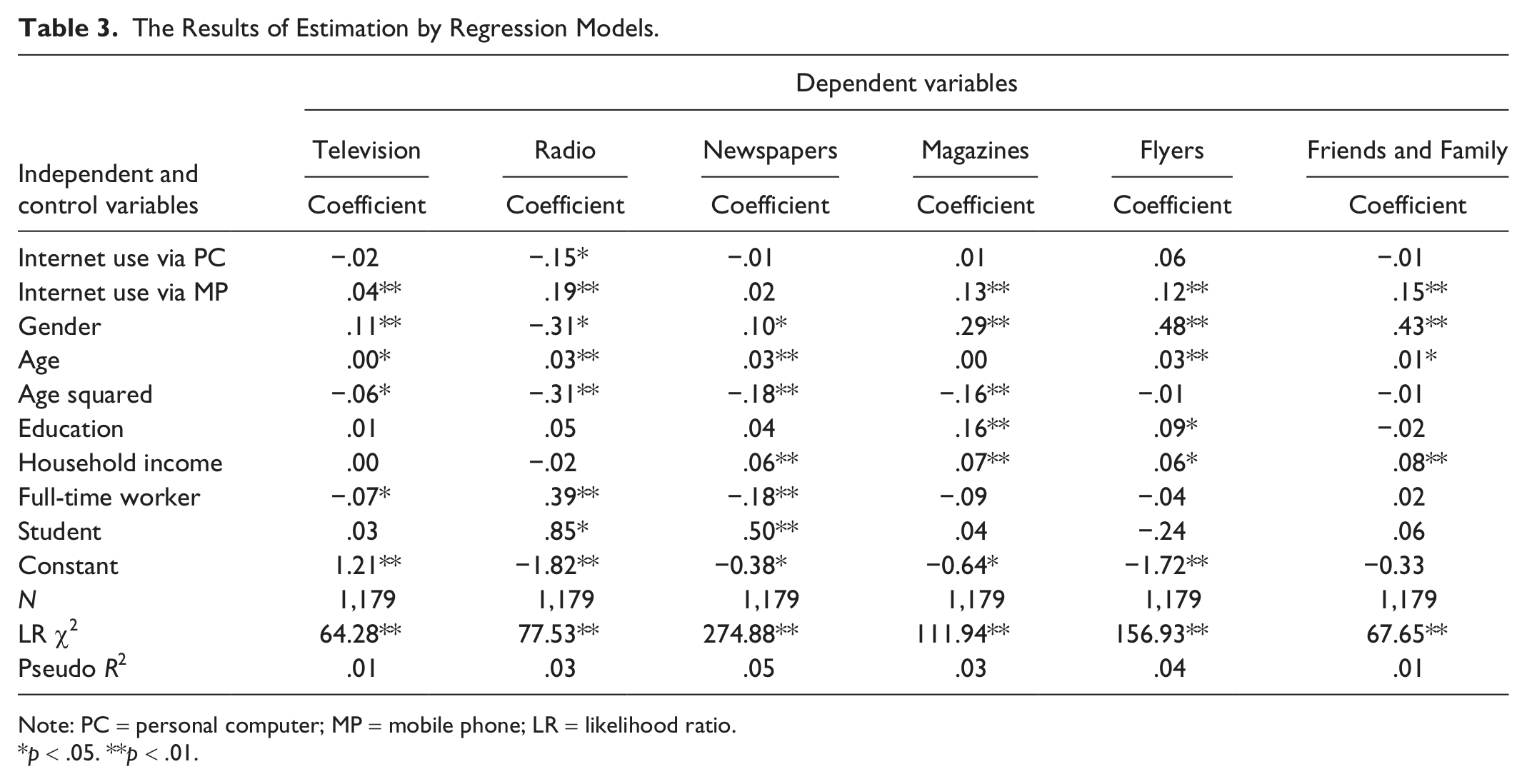
Note: PC = personal computer; MP = mobile phone; LR = likelihood ratio.
p < .05. **p < .01.
Age had significantly positive coefficients with television (b = .003, z = 2.50, p = .01), radio (b = .03, z = 5.93, p = .00), newspapers (b = .03, z = 12.32, p = .00), flyers (b = .03, z = 7.88, p = .00), and friends and family (b = .01, z = 2.39, p = .02), while age squared had significantly negative coefficients with television (b = −.06, z = −2.45, p = .01), radio (b = −.31, z = −3.18, p = .00), newspapers (b = −.18, z = −4.51, p = .00), and magazines (b = −.16, z = −2.87, p = .00). These results suggest that older people get more information from flyers and friends and family than younger people, while middle-aged people get more information from television, radio, newspapers, and magazines than young and elderly people.
Education level had significantly positive effects on the use of magazines (b = .16, z = 3.71, p = .00) and flyers (b = .09, z = 2.05, p = .04) as information sources, while household income had significantly positive effects on the use of newspapers (b = .06, z = 3.39, p = .00), magazines (b = .07, z = 2.68, p = .01), flyers (b = .06, z = 2.26, p = .02), and friends and family (b = .08, z = 2.67, p = .01). With respect to work, being a full-time worker had significantly negative effects on the use of television (b = −.07, z = −2.01, p = .04) and newspapers (b = −.18, z = −3.20, p = .00) and positive effects on the use of radio (b = .39, z = 2.74, p = .01), while being a student had significantly positive effects on the use of radio (b = .85, z = 2.05, p = .04) and newspapers (b = .50, z = 3.02, p = .00) as information sources.
For Hypothesis 1, Internet use via mobile phone had significantly positive effects on the use of traditional media other than newspapers (television: b = .04, z = 3.12, p = .00; radio: b = .19, z = 3.37, p = .00; magazines: b = .13, z = 3.78, p = .00; flyers: b = .12, z = 3.42, p = .00). The use of mobile Internet had no significant effect, however, on the use of newspapers as information sources. These results almost completely support Hypothesis 1.
For Hypothesis 2, Internet use via mobile phone had significantly positive effects on the information acquisition from friends and family members (b = .15, z = 4.14, p = .00). This result indicates the positive effects of Internet use via mobile phone on the use of interpersonal communication channels for information seeking, and supports Hypothesis 2.
The results concerning the Hypotheses 3 and 4 were as follows. The effects of Internet access via personal computer on the use of information channels were different from the effects of mobile Internet access via those channels. Internet access via personal computer had a significant negative effect on the use of radio as an information source (b = −.15, z = −2.58, p = .01), while it had no significant effect on other information channels. The results indicate that Internet use via personal computer has a displacement effect only on the information acquisition from radio. These results do not support Hypotheses 3 and 4.
Discussion and Conclusion
First, this study examined the effects of Internet use via mobile phone on information acquisition behavior toward traditional media and interpersonal communication channels. The results almost completely supported Hypotheses 1 and 2, demonstrating that people who use the Internet via mobile phone frequently acquire information from traditional media and interpersonal communication channels as well. These results indicate that Internet use via mobile phone has a complementary, not a displacement, effect on information acquisition from traditional media and interpersonal communication channels.
Next, this study examined the difference between the effects of Internet use via personal computers and via mobile phone on information acquisition behavior toward traditional media. The results demonstrate that Internet use via personal computer did not have positive effects on information acquisition behaviors from traditional media, unlike Internet use via mobile phone. In addition, this study showed that Internet use via personal computer had a displacement effect on information acquisition behavior toward one medium: radio. These results are consistent with arguments that point to the social differences between Internet use via personal computer and via mobile phone (Ishii, 2004, 2006; Miyata & Kobayashi, 2008).
The results indicate that Internet use via personal computer has a displacement effect only on the information acquisition from radio. This might be related to the location where radio and Internet via personal computer are used. Many Japanese people who listen to radio programs are mobile listeners (Video Research, 2008). In contrast, many Japanese people who use the Internet via personal computer are not on the move (Hashimoto, 2011).
The correlation coefficient between the information acquisition from newspapers and Internet use via mobile phone was negatively significant, but the results of regression analysis showed that the regression coefficient of Internet use via mobile phone was not significant when demographic variables were controlled. This result indicates that, in recent times, the demographic factors mainly affect newspaper reading in Japan.
Internet access via mobile phone is not a sufficient source of information and cannot replace the roles that traditional media have historically played. Rather, the results of this study indicate that people who frequently use the Internet via mobile phone are actually more likely to utilize traditional media than those who do not. These results are consistent with previous studies, one of which pointed out that people use mobile phones to extend their active time (Ishii, 2004). Another previous study, performed from a social networking perspective, suggests that the number of text messages sent via mobile phone increases with the expansion of personal relationships (Miyata & Kobayashi, 2008). These studies indicate that Internet use via mobile phone does not displace existing modes of communication, but supplements or complements them. The results of the present study support this theory. However, these same results showed that Internet use via personal computer had a displacement effect only on information acquisition from the radio. With computers, television, and newspapers, most information is transmitted by visual means, including letters or pictures; in contrast, radio is a communication medium that uses sound only and has no means of visual communication. The results of this study may suggest that the transmission of information by visual means plays a key role in information circulation.
On the Internet, there is much information corresponding to various needs. If all Internet users could effectively use the information for their needs, the Internet could be the most useful source of information, so that the Internet would have displacement effects on the traditional information sources. However, this study shows that the displacement effect of the Internet is not very significant.
The present study suggested that there are social differences between Internet use via personal computer and via mobile phone with regard to information acquisition behavior. In future research, it will be necessary to consider the factors that cause these differences. If sociocultural factors are to be considered, a social history approach (cf. Kortti, 2010) could be an effective research method.
The differences of Internet use via personal computers and mobile phones include a difference of interfaces for Internet access. Therefore, it is also important to discuss access to the Internet in the context of interface technology. In recent years, the spread of smart phones such as iPhones and Androids has progressed worldwide. Most smart phones have a touch-screen interface, an attribute that feature phones do not have. This means that the use of mobile phones with interfaces is advancing.
If the use of interfaces to access the Internet could cause a difference in the social consequences of Internet use, it could also cause a difference between the social consequences of the uses of feature phones and smart phones. The smart phone market in Japan has grown rapidly since 2009 (Ministry of Internal Affairs and Communications, Japan, 2012). In future research, it will be necessary to consider the differences between the social consequences of the use of feature phones and smart phones.
This study has some limitations. First, this study found no evidence of causal relationships between the use of the Internet and traditional sources of information, although it did find some significant cross-sectional associations. Thus, future research should examine these causal relationships. Another limitation is the examination of cultural factors. This study was not designed as a cross-cultural comparison. However, previous studies indicate that it is important to examine whether cultural factors affect media usage (Donald et al., 2010; Jung, Lin, & Kim, 2012; Katz, 2008). The findings of this study should therefore be examined using cross-cultural survey data in future research.
Footnotes
Declaration of Conflicting Interests
The author(s) declared no potential conflicts of interest with respect to the research, authorship, and/or publication of this article.
Funding
The author(s) disclosed receipt of the following financial support for the research, authorship, and/or publication of this article: The survey for this study was carried out in Professor Hashimoto’s laboratory at the Interfaculty Initiative in Information Studies at the University of Tokyo, as well as Dentsu Innovation Institute. The author was allowed to use the data by them. The author thanks Professor Yoshiaki Hashimoto, Yoshihide Nagao, and Toru Shono for their valuable support. This study was partly supported by Tokyo Keizai University, Research Grant 12-10.
Author Biography