




Abstract
Human source intelligence (HUMINT) practitioners are concerned with detecting informant deception, and previous research indicates that the verbal content of an informant’s narrative can be used to identify potential deceit. The current study extends previous research by analysing the narrative structure and narrative identity of accounts provided by 22 participants undertaking the role of a mock-informant. Results indicate that deception affects the structure of a mock-informant narrative, with deceptive mock-informants employing abstract introductions and evaluative remarks to withhold information and to distract their listeners with emotional content. Additionally, deceptive mock-informants are more likely to express a low potency narrative role, such as a victim or tragic hero. Furthermore, there is tentative evidence to suggest that an analysis of narrative identity can also provide an indication of varying levels of motivation and cooperation among truthful mock-informants. These findings have implications for HUMINT practitioners in the field and add to the wider body of deception detection research.
Keywords
Introduction
On 9th July 2017, following a spate of terrorist attacks across the United Kingdom (UK) the then head of Counter Terrorism policing Mark Rowley (now the Commissioner of the Metropolitan Police) oversaw the introduction of polygraph testing for police informants, also known as Covert Human Intelligence Sources (CHIS; Wilford, 2017). This was done to support human source intelligence (HUMINT) practitioners with detecting informant deception. However, the polygraph has not only been widely criticised by the academic community as lacking any empirical support (e.g. see Howitt, 2009; Iacono, 2008, 2012; Vrij, 2008) but also by police practitioners who report that use of the polygraph disrupts rapport building with their informants (Moffett, 2021). Perhaps more worryingly for police, a polygraph interview may actually breach the ethical standards laid out by The Mendez Principles (Mendez, 2021) on Effective Interviewing for Investigations and Information Gathering, as such interviews often involve a misrepresentation of capability and evidence (Howitt, 2009). It would appear then that informant handlers require an ethical and effective means of detecting informant deceit that does not hinder their other objectives, such as maintaining rapport and gathering accurate information.
One particular focus within investigative interviewing is to obtain checkable details (Nahari et al., 2014), as the ability to corroborate and verify the information provided during interview often provides practitioners with the best opportunity to identify deceit. However, this option may not always be available when interviewing informants. Indeed, the informant’s value is derived from their unique access to otherwise unobtainable information (Dabney & Tewksbury, 2016; Moffett et al., 2021). Furthermore, a deceptive informant may be able to embed a lie within an otherwise truthful (or verifiable) account, thereby convincing practitioners of their overall veracity (Drogin, 2007; Secretary of State for Foreign and Commonwealth Affairs, 2005). Consequently, the interview itself may provide practitioners with their best opportunity to detect informant deceit.
One potential method of detecting informant deception that enjoys strong empirical support is the cognitive approach (Vrij et al., 2017) which is based on the assumption that increasing the amount of mental effort required to provide an interview account produces more observable cues to deceit among deceptive interviewees. However, the paradigms employed to date fail to accurately replicate the situational dilemma of an informant as an individual who has been tasked to obtain information regarding the actions or intentions of someone other than themselves and is subsequently reporting this information to a government agency with an expectation of confidentiality. Consequently, the transferability of the cognitive approach to an informant interview cannot be assumed. Indeed, DePaulo et al. (2003) found that lies that do not concern a personal transgression, such as those regarding the actions or intentions of a third party, rarely produce any observable cues. Furthermore, when examining the effects of embedded lies (i.e., a single lie within an otherwise truthful account), Strofer et al. (2016) found no differences in cognitive load between these types of liars and truth-tellers. In addition, there is evidence that merely undertaking the role of an informant increases cues associated with cognitive load (Taylor, et al., 2013), in which case a truthful informant could be classified as being deceptive if cognitive load was taken as an indication of deceit. Therefore, rather than focusing on presumed cues to deceit elicited through increased cognitive load, informant handlers may be better advised to attend to the verbal strategies employed by their informants (Dilman, 2009; Hazlett, 2006) – in other words, the way in which they present their narrative.
A narrative theory of deception
A narrative can be understood as any story involving a sequence of events linked by causality (Reissman, 2008) with one particular form of narrative being ‘gossip’ (McAndrew and Milenkovic, 2002) which is conceptualised as an ‘… exchange of information about absent third parties’ (Foster, 2004: 81), or information, ‘… concerning the personal matters of a third person who is not present’ (Wert and Salovey, 2004: 122). This is very similar to the definition of an informant as someone who is covertly providing information to a government agency about the actions or intentions of someone other than themselves (Moffett et al., 2022a). Thus, it seems reasonable to assume that an informant might be expected to naturally produce a gossip narrative when being de-briefed by their handlers. Whilst there are many forms of narrative analyses available, there are two particular forms that have been used in other forensic situations that have provided indicators of potential deceit: (i) Narrative Structure Analysis and (ii) Narrative Identity Analysis.
Narrative Structure Analysis
Functional sections of a normal narrative.
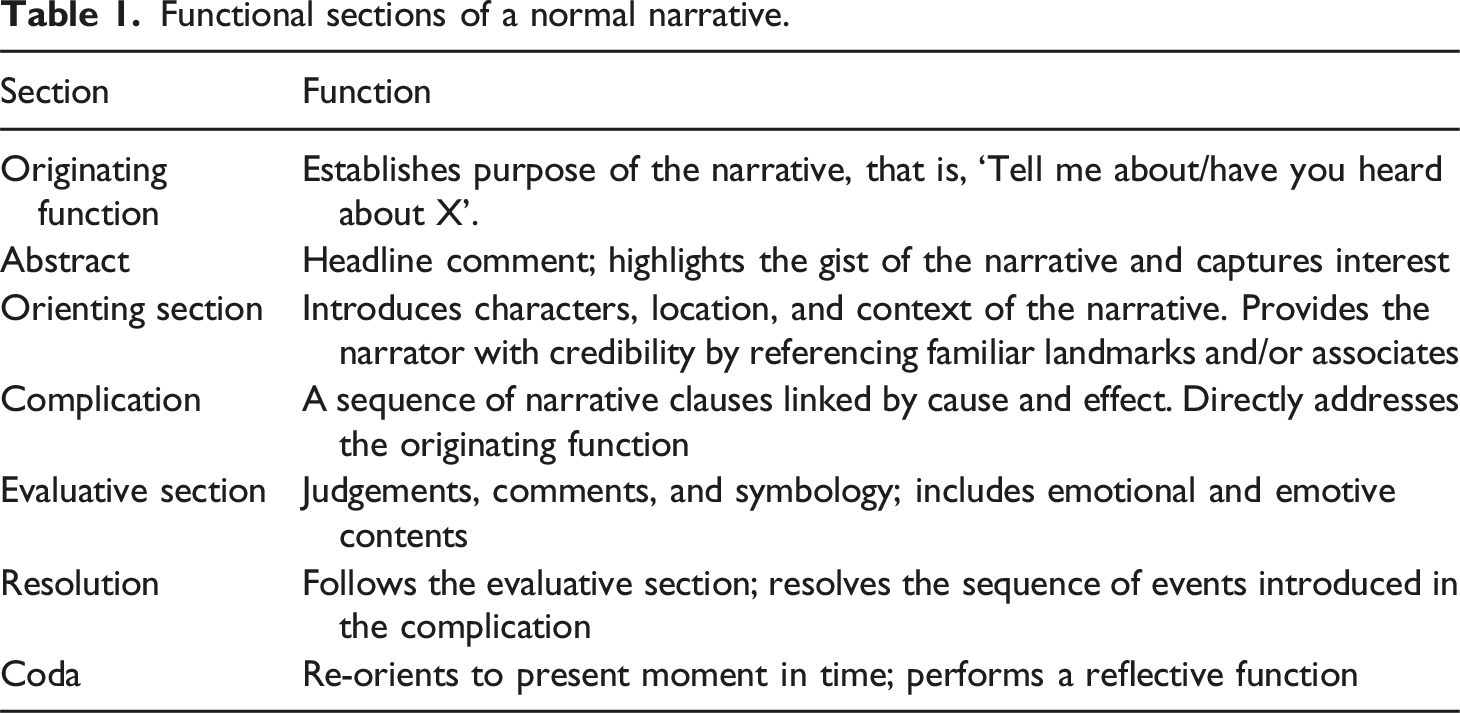
Whilst this represents the usual sequence of a normal narrative it should be noted that not every section is always present (e.g. abstract and coda sections are often excluded) and individual clauses, such as orienting, narrative, or evaluative clauses, can often occur in other sections (see Goddard and Carey, 2017; Reissman, 2008, for further details).
Narrative Identity Analysis
Interaction of intimacy and potency on narrative identity.
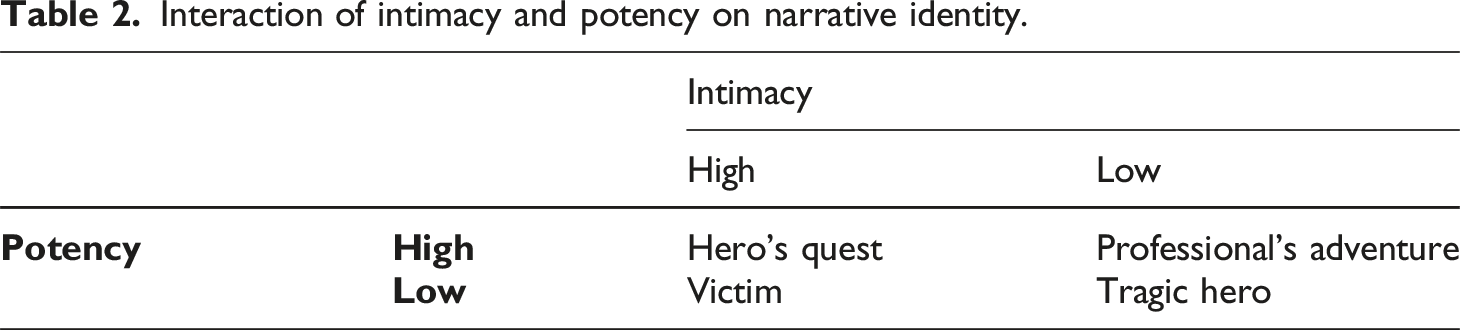
Moffett et al. (2022a) found that participants adopting the role of an informant in an experimental procedure tended to express content consistent with a low potency role (i.e., victim or tragic hero) alongside deceptive content. However, their study utilised Thematic Content Analysis as part of a Smallest Space Analysis to produce a content map. Whilst this may indicate an overall tendency of deceptive informants to adopt a low potency narrative role, it does not explain the underlying psychological processes that are operating within the situational dilemma of a deceptive informant (i.e., an individual who is expected to provide information to their handler whilst purposely misleading them).
The current study
The aim of the current study was to conduct a combined analysis of the Narrative Structure and Narrative Identity of accounts provided by both truthful and deceptive participants in a mock-informant dilemma. Based upon previous research, it was hypothesised that (i) accounts provided by deceptive informants will have an overstated evaluative section (as a proportion of their overall account) than those provided by truthful informants and (ii) deceptive informants will express a low potency narrative identity.
Method
A total of N = 22 mock-informant accounts were subjected to a combined narrative analysis (Narrative Structure and Narrative Identity Analyses). Of these, n = 11 provided truthful accounts of a mock-criminal conspiracy to enter and graffiti a warehouse supposedly belonging to a company that conducted animal testing, whilst n = 11 provided deceptive accounts of the same conspiracy. Specifically, deceptive mock-informants were instructed to inform their mock-handler that the conspirators intended to conduct a terrorist attack at the warehouse, rather than the minor act of criminal damage that was actually discussed. The procedure used in this experiment followed that of Moffett et al. (2022b); participants were tasked to adopt the role of an informant before joining a group of three other co-conspirators in a role play scenario to discuss plans to commit criminal damage at a fictional warehouse supposedly engaged in animal testing. Following these discussions, informants were allocated to either the truthful or deceptive condition before being de-briefed by their mock-handler. For further information, see Moffett et al. (2022a).
Interview protocol
Mock-interviews were conducted by the lead author (a PEACE trained interviewer) in accordance with the PEACE model of interviewing (College of Policing [CoP], 2019). PEACE is a mnemonic of the five stages of the investigative interview model used in England and Wales (and many other countries) – Planning and preparation, Engage and explain, Account, clarify and challenge, Closure and Evaluation.
The Account phase of the PEACE model is instigated with an open-ended question (i.e. ‘Tell me everything that happened’) to prompt an uninterrupted narrative account. This was followed by a series of probing questions to elicit further detail. In the current study, to maintain consistency across interviews, a series of pre-scripted questions were employed. These questions focussed on the other people involved, any locations that were discussed, and the group’s intentions. Because these were pre-scripted and not responsive to the initial uninterrupted account, responses to the questions were not subjected to subsequent analysis. All mock-interviews were audio-recorded using a digital voice recorder and transcribed for analysis.
Analysis
Analytical procedure applied to mock-informant accounts.
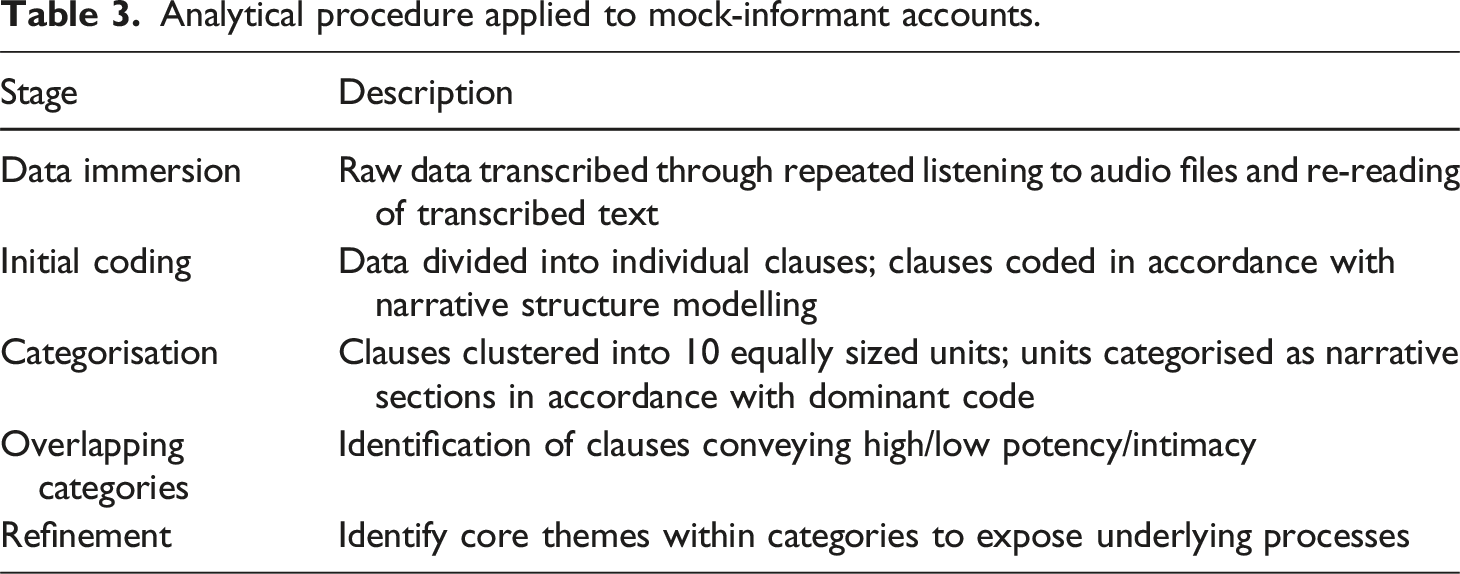
In relation to coding narrative identity, potency was defined by how well the mock-informant was able to achieve their objective, specifically, how they used their role (as an informant) to obtain information. If they portrayed themselves as being pro-active in eliciting information, manipulating their environment and associates, and were successful in their enterprise, then this was coded as demonstrating high levels of potency. However, if the mock-informant reported a sense of confusion, passivity, or failure then this would represent low levels of potency. With regards to intimacy, if the mock-informant appeared concerned for, or particularly affiliated to, their associates, then this was classed as a high level of intimacy. However, if their primary concern appeared to be their own well-being and their own emotional state, then this was categorised as being low in intimacy. It was foreseeable that levels of potency and intimacy would vary throughout an individual narrative; in these instances, the most dominant feature determined the categorisation of being either high or low.
Finally, mock-interviews were transcribed, with a mean number of 671.05 words (SD = 372.25). As analysis progressed, it became clear that one particular transcript (#4) was unsuitable for analysis as the participant did not appear to understand the role play instructions. Thus, the final analysis was conducted on 21 transcripts, with 10 truthful and 11 deceptive mock-informant accounts.
Results and discussion
Categorisation
Each individual narrative was divided into 10 equally sized units, each categorised in accordance with one of the functional sections of a normal narrative (e.g. abstract, orienting, complication, evaluation, resolution, and coda; Labov and Waletzky, 1997). This process revealed that there was a variation within the structure of a narrative account between truthful and deceptive mock-informants. Results indicate that for unit 1, 90.0% of truthful mock-informants began their account with an orienting section, whereas only 54.5% of deceptive mock-informants began with this section, with the remaining 45.5% using an abstract. Analysis of unit 3 revealed that 100.0% of truthful mock-informants had progressed into a complication section by that stage of their narrative, compared to only 45.5% of deceptive mock-informants. The remaining deceptive mock-informants produced either an orienting section (45.5%) or an evaluative section (9.1%). For unit 9, most mock-informants either expressed a complication section or an evaluative one; however, more deceptive mock-informants produced an evaluative section (45.5%) than a complication (36.4%), whereas more truthful mock-informants produced a complication section (50.0%) than an evaluative one (30.0%).
In relation to the categorisation of narrative identity, 60% of truthful participants expressed a high potency role, comparative to 18% of deceptive participants coded as being high in potency. The breakdown of the different narrative identities expressed by truthful and deceptive mock-informant participants can be seen in Figure 1. Bar chart showing the percentage of truthful and deceptive participants expressing each narrative identity.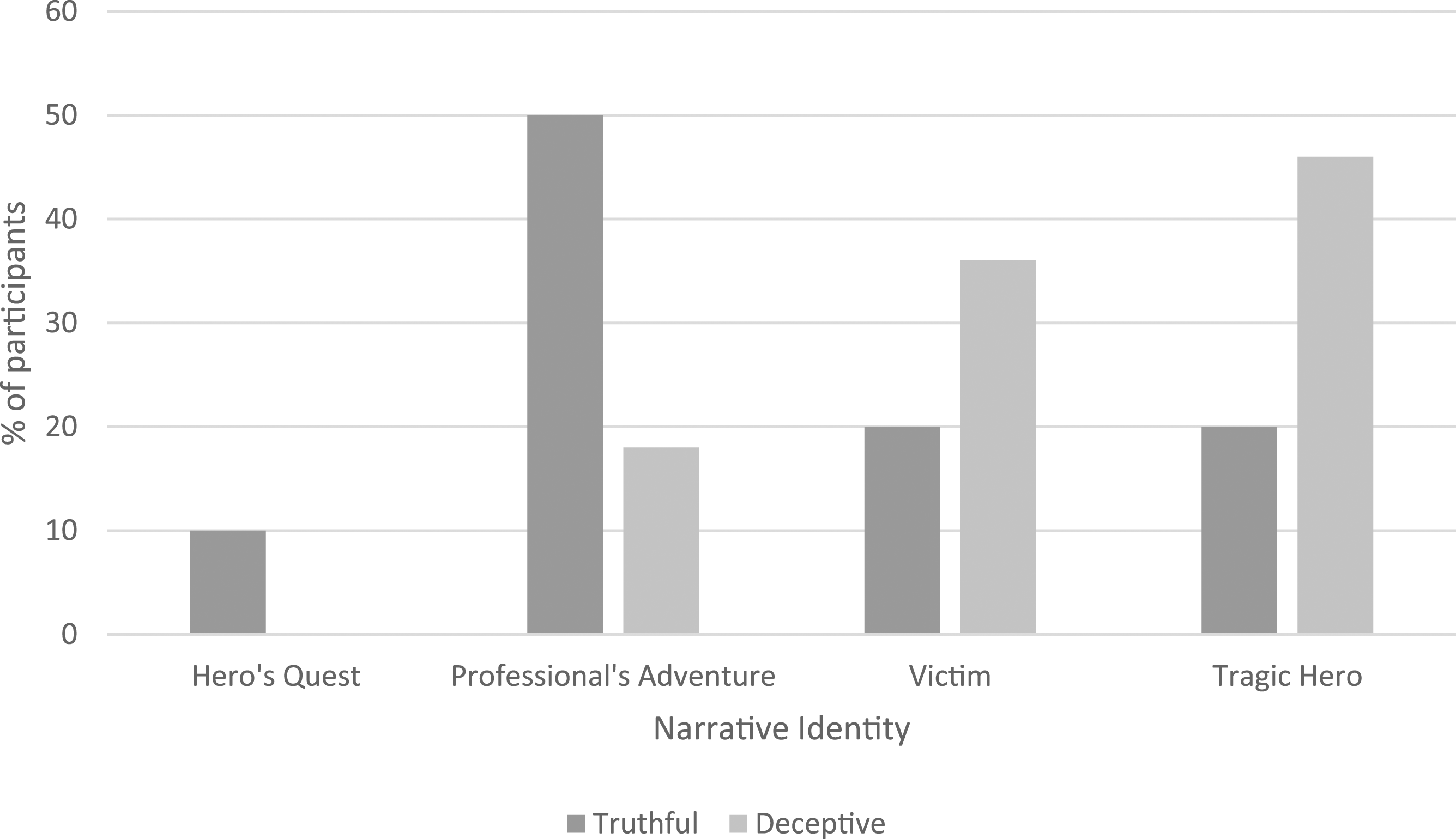
Refinement
The process of refinement is conducted to identify any core themes that emerge from the categorisation of the data with the aim of inductively assessing any underlying processes that may have influenced the data (Thomas, 2006). The current study benefitted from the fact that this evaluation was informed by previous research (i.e. Guan and Zhang, 2018; Youngs and Canter, 2012) examining how deception influences narrative structure and identity. The following themes were identified as a result of this process: (i) withholding information; (ii) emotional distractors; (iii) divided loyalties; and (iv) lack of motivation.
Withholding information
Withholding information can be conceived as a form of deception (Vrij, 2008), albeit a relatively passive one. When examining narrative accounts of a personal experience, Labov and Waletzky (1997) found that the desire to withhold information often manifested itself in a relatively short or absent orienting section. However, this was not the case with the current sample of mock-informant participants, as deceptive participants tended to produce more orienting sections than truthful ones (as a proportion of their overall account). For Labov and Waletzky, orienting clauses increase credibility by referencing identifiable landmarks and other potential corroborating witnesses. Consequently, the tendency for deceptive mock-informants to produce a longer orienting section at the outset of their narrative may indicate an attempt to garner greater credibility before practicing their deception in the complication section. There are other possible explanations though. By dedicating more of their account to abstract, orienting, and evaluative remarks, deceptive mock-informants produce fewer narrative clauses as a proportion of their account. In other words, they are spending less time addressing the originating function (to provide information of investigative value), potentially reflecting the different agendas between the handler and a deceptive informant. This is an important finding for practitioners because it indicates that a desire to withhold information does not necessarily result in an abbreviated account; the account may still be relatively lengthy without the informant actually disclosing the pertinent information that the handler may have expected.
However, some deceptive mock-informants did appear to provide an abbreviated account. One method that was used to achieve their intended brevity was to begin their account with an abstract. Not a single truthful participant began their narrative with an abstract clause, whereas 50% of deceptive participants opened their narrative with an abstract. The following quotations exemplify how abstract clauses were used by deceptive mock-informant participants: “Okay, so the meeting was brought together to discuss an attack on the animal rights building” (Participant #12). “There was this terrorist” (Participant #13). “The group are planning a terrorist attack” (Participant #20).
What is perhaps noteworthy from these examples is that the abstract clause, whilst providing an abbreviated summary of the meeting that took place, also includes a deception (or at least, an initial deception). The words ‘terrorist’ and ‘attack’ are not representative of the protest activity and minor criminal damage that was actually discussed, and no truthful participants used either of these words.
One particular narrative that highlights both the use of an opening abstract, and a disproportionately lengthy orienting section to restrict the amount of pertinent detail that is communicated, was provided by Participant #22. Their narrative began with an abstract that also contained a deceptive comment, that the group were planning a ‘terrorist attack’. They follow the abstract with a large orienting section, much of which refers to the roles adopted during the meeting, in particular their own role and that of the ‘main organiser’. This orienting section is interrupted by another deceptive comment, mentioning that the group intends to ‘…blow the place up’. This clause contains more detail than the abstract, consequently, it could be interpreted that the abstract is an initial attempt by the participant to test their deception and observe any adverse reaction from the handler. Indeed, mention of an unspecified ‘terrorist attack’ allows the narrator to back-track if challenged; however, having gained confidence from the lack of challenge, they are able to follow it up with further details four clauses later. In contrast to the lengthy orienting section, the complication section consists of a single clause and provides very little detail regarding the actual conspiracy.
Overall, it would appear that abstract clauses were used by deceptive participants to affect their deception, either through a direct lie or by seeking to restrict the length and content of the overall narrative. Where participants felt compelled by their role (as a source of information) to provide further detail, they tended to do this through the use of orienting remarks, rather than addressing the originating function through a detailed complication section.
Emotional distractors
Deceptive participants tended to use more evaluative comments (as a proportion of their account) than truthful ones. The narrative accounts provided by participants 12 and 18 are good exemplars of how evaluative remarks were used by deceptive mock-informants. Participant 12 employs a lengthy evaluative section near the beginning of their account: ‘I think they’ve probably been quite good at maybe covering some of their tracks and maybe what their real intention is. So what you might, what we all probably thought, was maybe like domestic extremism, that type of activity, how like, that’s not what they’re about, they’re using that as a front really, to sort of keep us off what they’re really up to, and I fear that there’s probably going to be quite a significant attack on that building, and I don’t think that it’s about the animals, I just think they’re using that as a front really’ (Participant #12).
This section precedes the first orienting remark. Labov and Waletzky (1997) observe that an evaluative section often serves to delay the resolution, with its primary function being to generate tension and engage the listener. The first evaluative section of this narrative appears to serve similar functions, by delaying the revelation of any meaningful detail. Additionally, the participant uses this opening evaluative section to introduce some powerful emotionality. Towards the end of the section, after a number of suppositions and assumptions typified by the repeated use of ‘I think…’ and ‘…maybe’, the participant reaches the predominant purpose of this evaluative section, introducing the phrase ‘…I fear’. Towards the end of their account, the participant introduces another lengthy evaluative section. Again, this section can be seen as an attempt to increase the tension and the sense of urgency. Not only does the participant reference their own concern (‘my worry’), but they also portray the conspirators as being reckless and volatile – ‘…they don’t care’, ‘…they’re quite hot headed’, and ‘…quite impulsive’.
Participant 18 presents an interesting strategy for practicing deception. Initially, they begin with an apparently true account of what occurred during the meeting. This makes up approximately half of the overall narrative. The second half of the narrative would appear to be an almost complete fabrication. Such a strategy can fulfil two functions for the deceiver. Firstly, it allows them to monitor the interviewer for any signs of incredulity or doubt before choosing whether or not to progress with the actual deception (Burgoon and Buller, 1994). Secondly, it allows the narrator to establish a baseline of behaviour consistent with truthfulness that may serve to bolster their credibility (Vrij, 2008), especially if the interviewer is able to verify any of the account – they would find at least 50 per cent of the account to be verifiable and may therefore be more likely to accept the parts that cannot be proven (Nahari et al., 2014).
On first examination, the narrative would appear to lack a definable evaluative section. By contrast, there is a large number of orienting clauses. However, the strategy adopted by participant 18 presents opportunities to observe any changes between truthful and deceptive themes within an account (Palena et al., 2019). Interestingly, the majority of the orienting clauses occur in the first half of the narrative, the truthful half, whilst the majority of evaluative clauses occur in the second half of the narrative, the deceptive half. In a real-world situation, it could be assumed that a practitioner would not expect or seek to compare two halves of a single narrative; however, in this instance it seems a natural thing to do as the first half is a perfect example of a normal narrative (Labov and Waletzky, 1997). However, the second half of the narrative does not adhere to a normal narrative structure. The deceptive half of the narrative begins with a cluster of evaluative clauses, and the first deception – that the conspirators ‘…want to make a bit of a splash’ – is introduced in their midst. This half of the narrative then ends with another rather compelling evaluative section, with the mock-informant telling their handler that ‘…something needs to be done’. Given the overall lack of evaluative clauses, this summarising comment seems particularly forceful.
It can be seen from these examples that evaluative comments can be used, at least within the context of a deceptive mock-informant account, to increase emotionality and a sense of urgency. This may add support to the observations made by Peace and Sinclair (2012), that deceivers use emotional content to distract the listener and to engage their sympathies but, by emphasising the need for urgency, mock-informants also seem to employ evaluative comments to engage the handler’s emotional processing, rather than a more critical thought process.
Divided loyalties
As seen in Figure 1, only 18% (n = 2) of deceptive participants produced a high potency narrative account. One of these (#18) produced a particularly unusual narrative consisting of a completely truthful first half followed by a deceptive second half. To some extent, this strategy confounds the narrative identity. In other words, there is a clear sense of the participant’s high level of potency during the early stages of the narrative. They unequivocally place themselves within the meeting in the opening sentence and progress to outline their role as an ‘undercover plant’ – and apparent success at fulfilling this role. However, this seems to lessen somewhat in the second half of the narrative. Although the participant still uses phrases such as ‘I managed’ and ‘I established’, there is far greater use of the phrase, ‘I think’, emphasising that there is some doubt in the information they are reporting and, by implication, their success. Despite this, the overall impression is of someone with a high degree of potency. Participant 21 produced the other deceptive narrative that was coded as being high in potency. This was expressed in their opening sentence, ‘I got involved in that group, the animal activists, as I was meant to’, and whilst the remainder of the account is relatively ambiguous, it is the opening comment that emphasises the participant’s perceived levels of potency.
In contrast, only 40% (n = 4) of truthful participants produced a low potency narrative. Of those, two truthful participants expressed a victim narrative identity (#2 and #5). A victim identity occurs when the narrator expresses low levels of potency and high levels of intimacy. Participant 2 adopts the victim identity at the outset of the narrative when they say ‘Well look, I’ll be totally honest, I’m quite worried about what we discussed at the meeting … I don’t want any kind of part really’, and again, when they end their account by saying, ‘I’m in a very delicate situation okay, so I’m letting you know what the score is, but again I can’t have anything coming back to me otherwise it’s not going to work, do you understand?’ (participant 2). There are aspects of a victim identity running throughout the narrative, with the participant consistently portraying themselves as a powerless victim of their situation, concerned by their own reputational standing within the group and the consequences of anything ‘coming back’ on them. A further interesting feature of this narrative are references to ‘the girl’, who is first mentioned at the end of a long, highly emotive section of the account; something mirrored towards the end of the narrative. The fact that ‘the girl’ is mentioned in such proximity to the two most emotive sections of the narrative perhaps indicates a high level of intimacy towards her.
The participant’s obsession with their standing in the group and their concern for one of their fellow group members raise a further potential influence not previously considered as part of the truthful-deceptive dichotomy. Whilst the participant is being truthful in relaying the sequence of intended actions, the narrative identity they adopt may be the result of divided loyalties. In essence, the participant may feel more loyalty to the group than to the handler. The final reference to ‘the girl’ perhaps serves to highlight this; not only does the positioning of the sentence draw the listener’s attention back to her situation, but the participant minimises her role in the intended incident – whilst the others will be involved in cutting holes in fences and spray painting a building, she will simply be the lookout throughout.
The potential influence of divided loyalties re-occurs in the truthful narrative produced by Participant 5. The participant’s low levels of perceived potency are evident in the opening comment which begins with the words ‘we agreed’, before they continue to outline their own agreed duties as part of the conspiracy – the impression being that, because it was agreed, the participant was powerless to affect the situation. The participant also expresses high levels of intimacy; they name ‘Laura’, and although the other group members are simply referred to as ‘the other two’ the participant often uses the term ‘we’ and ‘everyone’, indicating that they identify themselves as part of the group. However, what this particular narrative indicates, and what an analysis of the narrative identity acknowledges, is the nuanced dilemma that could be faced by a real-life informant, namely, the requirement to be truthful whilst protecting their friends (Granhag et al., 2015). It is clear that the participant is uncomfortable in their role and feels a greater sense of loyalty to the group than to their handler; consequently, despite being asked to provide a truthful account, they practice a mild form of deception (i.e., withholding information; Vrij, 2008) by producing an abbreviated narrative, resulting in a low-potency high-intimacy narrative identity.
Lack of motivation
The remaining truthful participants who produced a low potency narrative role (#6 and #7) expressed the narrative identity of a tragic hero, which is exemplified by both low potency and low intimacy.
The narrative produced by participant 6 could be read as a type of tragedy, in that despite all their discussion and debate, the group still failed to reach any firm conclusions. This is perhaps best exemplified when the participant refers to their own cognitions, stating ‘…my impression was that we didn’t really reach a conclusion’. However, it is difficult to conclude that the participant comes across as a tragic hero; rather, they come across as a tragic comrade, someone whose fate is bound to a group that they do not identify with but are somehow inextricably part of. As with the victim narratives of participants 2 and 5, this narrative identity may indicate a participant who is not particularly enamoured with their role (as a mock-informant), but unlike the truthful participants who produced victim narratives, participant 6 is nonetheless cooperative and generally fatalistic.
The narrative produced by participant 7 highlights a different dilemma and could be interpreted as an account of the participants own capability as a source of information. As such, the narrative is very low in intimacy; very little of the group is revealed, other than the name of the supposed leader. Instead, the participant’s pre-occupation is with their own performance. However, despite the strong focus on themselves, the participant does not display high levels of potency; quite the opposite, this mock-informant appears to doubt their memory and fills in the gaps with vague speculation. Consequently, participant 7 can be seen to possess the identity of a tragic hero; they aspire to fulfil their duty as a source of information, but they are repeatedly thwarted by their failing memory, resulting in constant speculation and self-doubt.
In summary, whilst low potency high intimacy victim narratives may indicate an affiliation to the group they are reporting on, informants who express the low potency and low intimacy tragic account may simply not want to be (or be capable of being) an informant at all.
General discussion
The aim of the current study was to conduct a combined analysis of the Narrative Structure and Narrative Identity of accounts provided by both truthful and deceptive participants in a mock-informant dilemma. Two hypotheses were proposed on the basis of previous research that analysed the effect of deception on narrative structure (Guan and Zhang, 2018) and narrative identity (Moffett et al., 2022a) in forensic situations: (i) accounts provided by deceptive informants will have an overstated evaluative section compared to those provided by truthful informants and (ii) deceptive informants will express a low potency narrative identity. We found support for both hypotheses in the current study.
Whilst mock-informant accounts contained the functional elements of a recognisable narrative and tended to adhere to a normal narrative structure, the majority of truthful participant accounts did not contain an evaluative section. This is perhaps indicative of the forensic situation they are confronted with. The mock-informant is being asked to provide information about their associates that may be of investigative value. This may cause them to self-monitor their accounts and to consciously reduce the number of opinionated comments that they include, to ensure that their account is predominantly factual. It is noteworthy then, that the narratives provided by deceptive mock-informants do tend to have an evaluative section immediately prior to the resolution. This is consistent with research by Guan and Zhang (2018) who found a deceptive suspect used an overstated evaluative section to falsely apportion blame to their victim. It is also consistent with Moffett et al. (2022a) results which showed that emotive content co-occurred with deceptive content. Additionally, the majority of deceptive participants produced a narrative with a low-potency identity. This finding further supports Moffett et al. (2022a) who identified that deceptive content featured in the low-potency region of a common space map.
However, the general inductive approach (Thomas, 2006) adopted during the current study also revealed some unexpected findings. In particular, the combined narrative analysis employed identified that participant accounts were not solely influenced by the imposed dichotomy of truth and deceit. What became evident is that participants brought their own agendas, pre-conceptions, experiences, and interpersonal relationships into the laboratory, and these also impacted their narratives. For example, participants 2 and 5 appear uncomfortable with their task to provide a truthful account of their associates’ conspiracy, resulting in a victim narrative. Whilst these two participants could be considered uncooperative mock-informants, participants 6 and 7 faced a different dilemma; they did not care for the other group members, they just did not want to be a source of information. Consequently, they expressed the narrative identity of a tragic hero. Therefore, a more nuanced understanding of narrative identity reveals personal agendas beyond that imposed by the experimental design.
Strengths and limitations of the study
As with all experimental research, there are both strengths and limitations of the current study. Our study is believed to be the first to examine the potential benefits of a narrative analysis approach to detecting informant deception. We have demonstrated that the situational dilemma faced by an informant is a complex one, and the traditional concept of deception as being a dichotomous relationship between truth and lie may be too simplistic. Indeed, Moffett et al. (2021) found that practitioners are as concerned with the dangers presented by an uncooperative informant as they are with a fabricating one, and findings from the current study suggest that narrative analysis may be able to provide insights into levels of cooperation and motivation, as well as deception.
One potential limitation is that it could be argued that the findings of this research are non-falsifiable. In particular, transcripts were coded for the presence of potency and intimacy, as well as the pre-determined Labovian categories of a normal narrative structure. However, both forms of analyses have been established through previous research in similar contexts, such as offender profiling (see Youngs and Canter, 2012) or accounts of a criminal event (see Guan and Zhang, 2018). As such, there is a strong theoretical underpinning to support their application to the analysis of informant narratives. Additionally, the combined analysis of both narrative structure and identity appears to provide support for the more quantifiable smallest space analysis conducted by Moffett et al. (2022a). Furthermore, despite finding evidence of narrative identity and structure in the current sample, this does not imply that any other form of analysis would be any more or less valid, simply that a combined analysis of narrative identity and structure may prove fruitful when examining informant accounts.
Finally, a further limitation is that this study utilised a relatively small sample obtained in a laboratory environment. The complex psychological dilemma involved in producing a mock-informant account resulted in a number of truthful accounts being produced which could have been categorised as deceptive. Certainly, an affiliation towards the group resulting in an uncooperative mock-informant narrative, such as those produced by participants 2 and 5, may well result in a real-life informant being categorised as malicious or deceitful by practitioners who need to consider their own personal safety and the reputational risk to themselves and their organisation (Dabney and Tewksbury, 2016; Yousef and Brackin, 2010). Consequently, whilst such anomalies serve to skew the results and weaken the conclusions of any subsequent analysis, they highlight the potential benefits of a combined narrative analysis in an applied setting where the definitive division of truthful versus deceptive informant may indeed be more blurred (Moffett et al., 2021). Therefore, a further strength of this research is that a unique informant-specific paradigm was employed, with participants being active not only in the dissemination of information (i.e., the interview phase) but also in the collection of information (i.e., the conspiracy phase).
Implications for practice and research
It may not always be possible to corroborate the information provided by an informant, especially where this involves social and conversational information (Secretary of State for Foreign and Commonwealth Affairs, 2005). Additionally, the use of forensic interventions (such as the polygraph or cognitive interview) may hamper other handler objectives, such as building rapport (Moffett et al., 2021). However, the current study provides further support for the application of a non-interventionary technique for detecting informant deceit (Moffett et al., 2022a). Informants, such as CHIS (as defined in England and Wales in the Regulation of Investigatory Powers Act, 2000; Home Office, 2018), can be expected to provide confidential information about known associates, having obtained such information through social interaction. This situational dilemma is consistent with the academic conceptualisation of gossip (Foster, 2004; Wert and Salovey, 2004) and the current study demonstrates that by allowing informants to produce a naturalistic gossip narrative, practitioners may provide themselves with an opportunity to discern not only deception but also levels of informant motivation and cooperation.
The interview protocol employed as part of this study was modelled on the current PEACE model of interviewing (CoP, 2019). However, a recent study by Moffett et al. (2022b) has demonstrated the benefits of employing a bespoke informant interview model (the RWITS-US model). This model capitalises on the informant’s tendency to gossip and to produce a narrative account; consequently, use of the RWITS-US model may exaggerate differences between truthful and deceptive informants in terms of their narrative structure and identity. This should be subjected to future research both in the laboratory and in the field. Practitioners are therefore recommended to encourage their informant to produce a gossip narrative by utilising a bespoke informant interview protocol such as the RWITS-US model Moffett et al. (2022b). Furthermore, the analyses outlined in the current article could form part of the understanding context stage of that model, and practitioners would be advised to record and transcribe their informant interactions so that a subsequent narrative analysis of their informant’s accounts can be conducted.
However, it should be borne in mind that these recommendations are being made on the basis of a single laboratory study; therefore, further field research should be conducted with real-world informant narrative accounts to establish the transferability and generalisability of these initial findings.
Conclusion
Practitioners have highlighted the importance of detecting informant deception (Moffett et al., 2021), and this is perhaps evidenced by the introduction of polygraph interviews for counter-terrorism informants (Wilford, 2017). However, use of the polygraph lacks academic support (Howitt, 2009; Iacono, 2008), could compromise trust and rapport, and could be deemed unethical (Mendez et al., 2021). The current study demonstrates that such an intervention may not be necessary. By allowing informants to produce a naturalistic gossip narrative, practitioners can employ a combined analysis of narrative structure and identity to potentially detect informant deception. Additionally, this form of analysis could provide practitioners with further insights into their informant’s levels of motivation or any potential divided loyalties. Importantly, obtaining an initial account from an informant in the form of a gossip narrative does not preclude practitioners from then deploying other psychological tools, such as the Cognitive Interview (Bull, et al., 2009; Fisher and Geiselman, 1992; Leins et al., 2014) or the Timeline Technique (Hope et al., 2013, 2019) to further enhance their intelligence objectives if necessary. Overall, the current study highlights a non-interventionary technique that could be readily employed by practitioners to provide insight into the psychological processes affecting their informants.
Footnotes
Declaration of conflicting interests
The author(s) declared no potential conflicts of interest with respect to the research, authorship, and/or publication of this article.
Funding
The author(s) received no financial support for the research, authorship, and/or publication of this article.
