




Abstract
Recent research in England and Wales indicates that there may be a significant proportion of social embeddedness within policing recruitment. This suggests that there is a significant amount of support sought by potential recruits through their existing social networks. Existing studies have been qualitative and therefore do not assess scale. This study aims to address this research gap by gathering data from a single cohort n = 987 of police recruits in 2017. The recruit’s success was tracked throughout the process, resulting in comparative data that illustrates whether prior social contacts should be considered as a potentially causal variable in that success.
Recent research in England and Wales indicates that there is a significant proportion of social embeddedness that exists within the policing recruitment context. The current evidence suggests that there is a significant amount of support sought by potential recruits through their existing social networks. This social contact results in instrumental coaching and identity transition assistance for those with access to serving officers within their social contacts. These studies have been qualitative in nature and therefore do not assess scale; they also do not contain any statistical comparison between those that do have social contacts, and those who do not.
This study aims to address this research gap by gathering data from a single cohort n = 987 of police recruits in 2017. Everyone who applied for the role of police constable was asked to fill in a survey that assessed whether they had access to existing police officers socially prior to applying. Their relative success was tracked throughout the process, resulting in a comparative result that illustrates whether prior social contacts could be considered as a causal variable in that success. The measurement of this social embeddedness was grounded in theory from Granovetter (2017).
The results from this study illustrate that social contacts play a significant part in a candidate’s chance of success in researched constabulary. They also illustrate that particular types of social contact are more instrumental than others. This is in line with existing theory and suggests that positive action design in police recruitment should contain tailored approaches for those candidates without existing social contacts in policing. The results contribute to an increased understanding of how to address disproportionality in police recruitment in England and Wales.
Police recruitment in England and Wales
Police recruitment research has been in flux for several decades. There is an eclectic collection of research that has been developed with differing focuses over time. The first main focus revolved around the concept of the police personality (Adlam, 1982; Evans et al., 1992; Gudjonsson and Adlam, 1983; James et al., 1984; Lorr and Strack, 1994; Twersky-Glasner, 2005; Vastola, 1978), which ran tangentially alongside research on police socialisation (Bennett, 1984; Fielding, 1988; Van Maanen, 1973, 1975). This pairing was useful, as it centred the debate of importation versus socialisation (Charman, 2017), a debate which to some extent is still ongoing today.
The importation argument involves the qualities that a police officer brings into the service with them that then influence their practice, whilst the socialisation argument centres upon the power of influencers such as culture to develop a police officer’s behaviours over time. There is no clear delineator in this debate, as there is no way to prove that a particular quality that a police recruit imports with them – such as their personality traits – then directly influences their choices as an operational officer. Similarly, the tracking of cultural exposure to behaviours over time is immensely complex. Despite this ambiguity, governmental reports often turn to the factors rooted in socialisation to explain police wrongdoing (Casey, 2023; MacPherson, 1999; Scarman, 1981). In these reports, procedural errors and inefficiencies are overlaid with cultural behaviours, often supported by powerful anecdotal operational or real life examples. More recently however, vetting and recruitment standards have come under particular scrutiny (Casey, 2023; HMICFRS, 2022), both of which can be important elements with regards to importation at the point of recruitment.
Over recent years, police recruitment research has begun to focus upon characteristics that have replaced personality as the primary imported characteristic, instead choosing to focus upon identity, race and ethnicity. This may be because of a process of steady racialisation that has been ongoing since the 1990’s (Holdaway, 1991b, 1994, 1997), where race became a far more salient focus for policing. This has more latterly developed into wider aspects of diversity such as gender (Aiello, 2019; Raganella and White, 2004; Spence et al., 2017; Zhao et al., 2014) and sexual preference (Belkin and Mcnichol, 2002; Colvin, 2014; Jr et al., 2008; Miller et al., 2003). The recent review into vetting by His Majesty’s Inspectorate of Constabulary and Fire Services (2022) points this out, noting that existing vetting procedures were created primarily to prevent those associated with crime becoming police officers, they were not meant to filter out homophobia, misogyny or racism.
This has created a research landscape in policing recruitment that has become increasingly complex. A previous focus on the filling of a vacancy with an appropriate person has been replaced by a more developed level of importation. In practice, this has meant a growing focus on representative recruitment, one which has received a great deal of political support from government (Home Affairs Select Committee, 2016; House of Commons, 2017). This support has also subsequently been bolstered by the College of Policing’s Race Action Plan (College of Policing, 2023), which has set a national expectation in addition to existing police service’s approaches to increasing diversity. These plans point out the disparity between the existing level of diversity in society and the police service’s inability to reflect that level in its recruitment. This is fundamentally a reliance upon the Theory of Representative Bureaucracy (Krislov, 2012: 1974), a theory that posits that decisions made by a bureaucracy that better reflects its constituents will make decisions that are more suited to a wider proportion of them.
The Casey Report (2023: 77) also discusses representation remaining a priority for the police, and notes that the London residency requirement for the Metropolitan Police has now finished in order to prioritise the sheer numbers that are required by the National uplift program (National Audit Office, 2019). There is also a danger identified in the report that discusses volume of recruitment remaining a priority in order for police services to meet government targets on police recruitment and thus secure further government funding (77). This particular state of affairs may leave police services in England and Wales in a quandary; following a period of lengthy austerity (HMIC, 2012), the sheer need for funding is actively competing with the sustained requirement to diversify the service. It may be impossible for services to settle on a more complex and developed system of police recruitment to fulfil the need for improved representation, when their much needed, future funding rests on pure volume.
This political and operational picture is joined by a veritable panoply of diversity related police data. The National Workforce Statistics (National Statistics, 2022) indicate that the representation ‘gap’ currently rests at 7.1% when compared to the 2011 census data. This figure has perpetuated the drive for increasing representation, alongside the salience of race as a defining problem discussed in the Scarman (1981) and MacPherson (1999) reports. Each police service however has their own particular approach to recruitment, meaning that only broad inferences can be made from the nationally collated data on the workforce itself. Most services employ a mix of locally generated and designed recruitment stages, collocated with the national assessment centre provided through the College of Policing. This study is situated at the end of the in-person ‘SEARCH’ assessment centres (College Of Policing, 2017; College of Policing, 2020a), which have since evolved into a wholly online process due to Covid 19 (College of Policing, 2021b).
Overall attainment from the college of policing assessment centre.
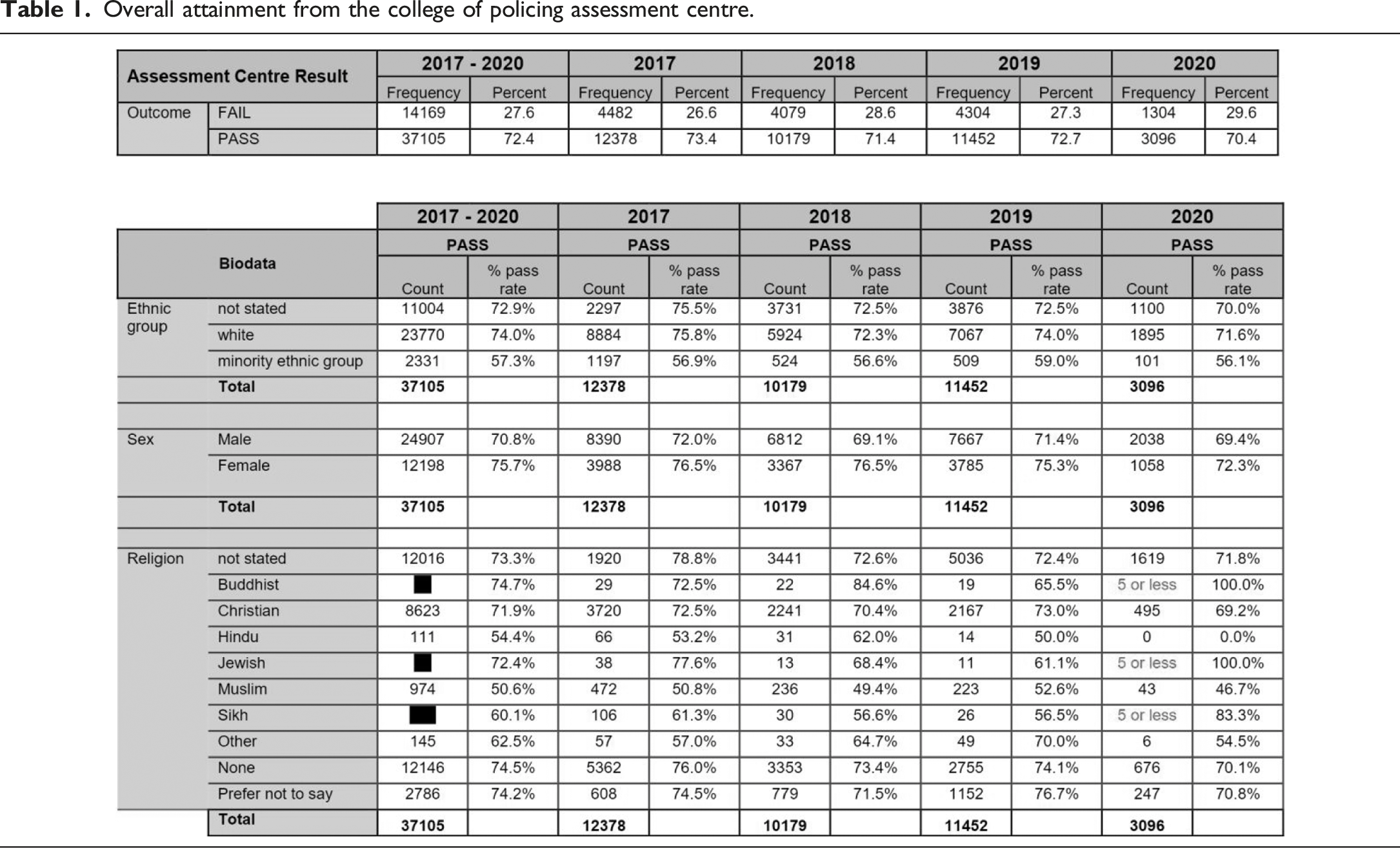
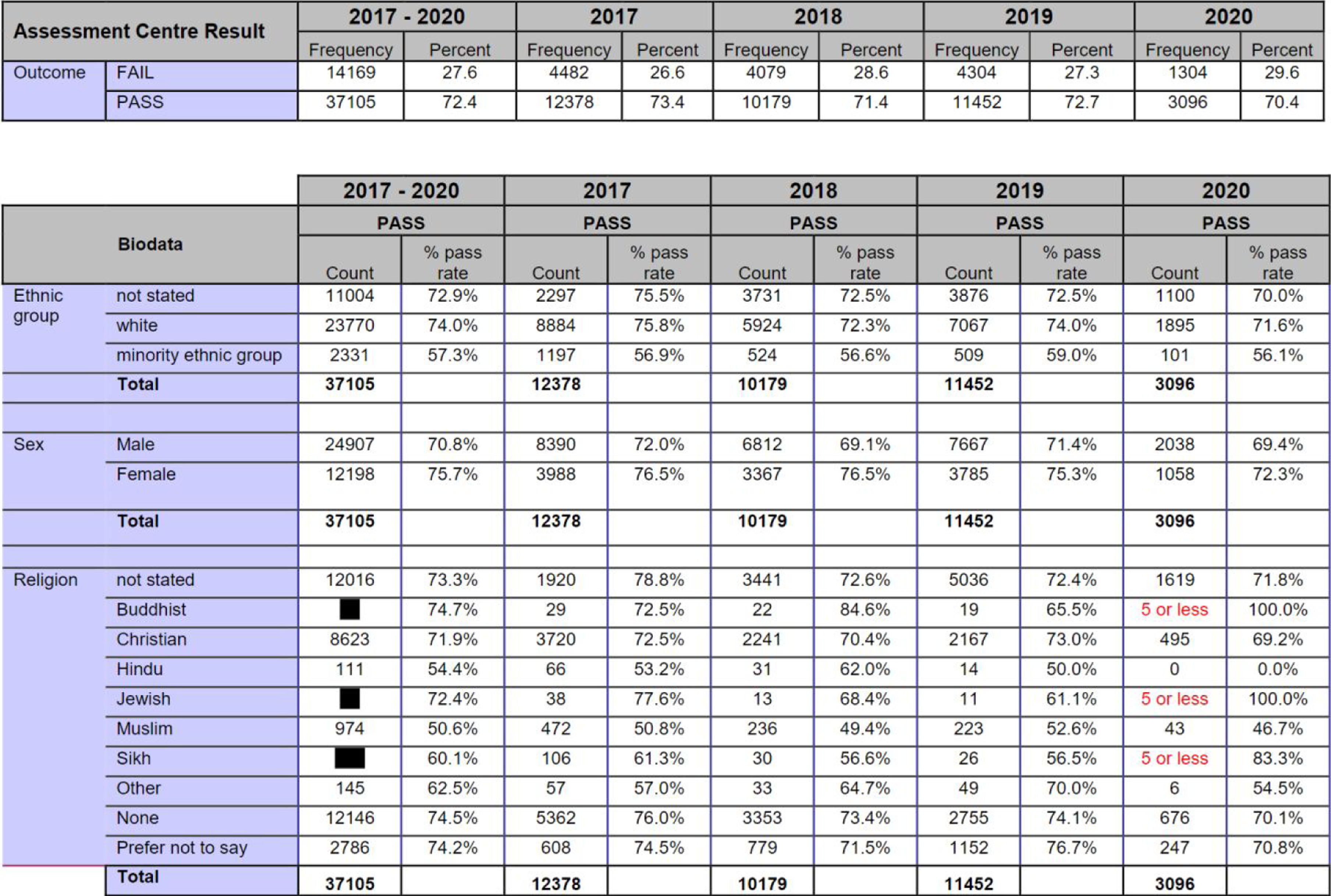
This indicates a 16.7% attainment gap between white candidates and those from a minority ethnic group from 2017 to 2020. This gap is significant enough to sustain the political pressures to become more representative, yet the fact that this source is from a Freedom of Information Request points to a level of obscurity in the sharing of data. This is compounded by the local nature of the stages either side of this particular recruitment stage; they will reside in individual police services and are very rarely open to scrutiny. This gap is closing, as the latest data release from the College of Policing indicates (College of Policing, 2020b, 2021b, 2021a).
The data overall for whether a particular recruitment stage is having disproportionate effects upon under-represented groups is therefore obscured. Individual services will hold data on their chosen stages, and the College of Policing will hold data on their assessment centre. As an example, due to each force having considerable autonomy in this area, it is difficult therefore to judge whether the application form filtered out under-represented candidates disproportionately, nationally. This would rest upon each individual service publishing their statistics for each recruitment stage, something which is absent in almost every instance nationally. It is likely that the disproportionality that may be evidenced should this information be released will be politically and reputationally sensitive, and therefore it is to almost every extent, hidden.
Curiously, within this morass of research and political wrangling, there is a distinct lack of research into why police recruitment may be disproportionate. Recent research from Linos et al. (2017) in a service in England found that they could lift the attainment of some under-represented candidates via the use of Nudge techniques (Halpern, 2015; Lin et al., 2017). This study focused on the online text used to prepare a candidate for situational judgement tests, and was found to be a success within the stages where interventions were present, yet overall they did not affect the attainment of under-represented recruits throughout the whole of the process. This suggests that other stages within the recruitment process may subvert focussed interventions; the change is likely therefore, to be required to be more holistic in order for it to have a tangible impact.
Social embeddedness in police recruitment
In more recent research, Hesketh and Stubbs (2023a, Under Review) put forward an argument that policing recruitment may be socially embedded, resting upon theory from Granovetter (2017). This argument focuses in on some of the stages that recruit experience being subject to a great deal of assistance from the social networks of the potential recruits. This research provides some theoretical support for existing disproportionality in police recruitment and also provides some indication of where the social support appears most frequently. This research however, does not measure the instrumentality of the social embeddedness; in other words, does it meaningfully change the recruits’ chances of becoming a police officer?
If social embeddedness is instrumental in affecting the chances of candidates in the police recruitment process, this can have significant consequences with regards to diversity of policing in England and Wales as a whole. The theory of homophily (Lawrence and Shah, 2020; Mcpherson et al., 2001) puts forward empirically based assertions that ‘birds of a feather flock together’. This theory states that someone’s friendship groups are more often representative of their dominant demographics. If the police force is a largely white police force (National Statistics, 2022), homophily states that those officers are more likely to have friends that are white. This isn’t through a definitive assertion of any level of racism, although that may of course contribute, it is simply a matter of application of the theory into the realm of policing. It has been measured in multiple settings and cultures over time with very similar results, and is likely to be generated through very complex, embedded, social interactions over time.
The consideration of homophily, alongside the developing evidence based for social embeddedness in police recruitment therefore results in the hypothesis that friendship-based social contact may be instrumental for potential police recruits, and as a result, the next tranche of any recruitment window of police officers, may represent the previous ones’ demography. This can be result in what is referred to as an extended internal labour market (Manwaring, 1984), and is often prevalent in professions that maintain higher levels of social embeddedness (Grieco, 1987).
This logically results in a hypothesis displayed in Figure 1. Hypothesis.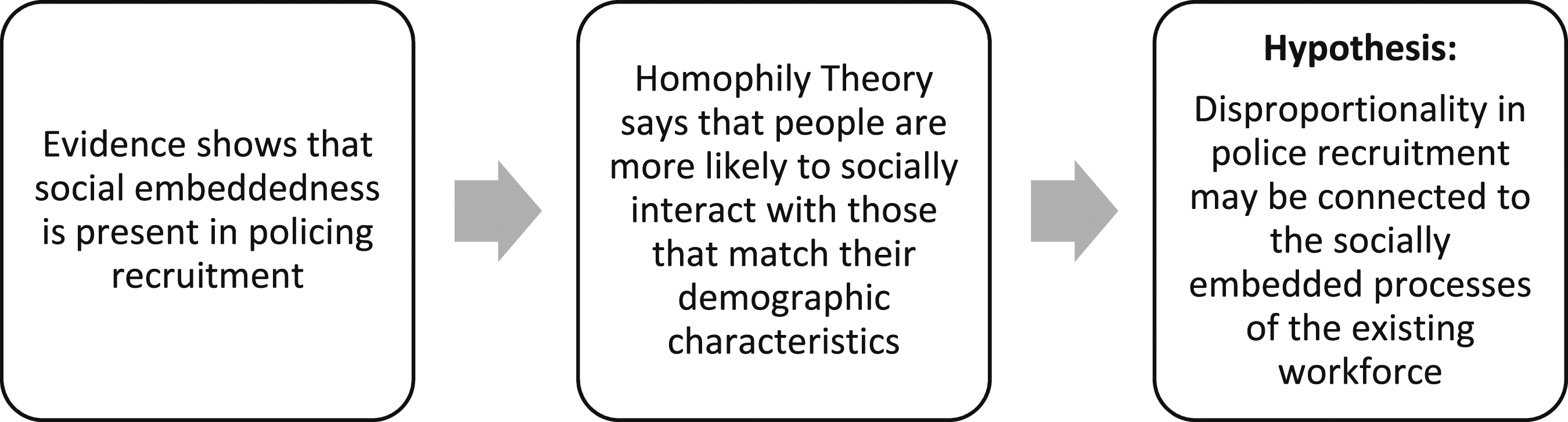
This hypothesis utilises homophily as the theoretical bridge between social embeddedness and the statistics showing police representation. It provides a framework that could begin to explain why representative recruitment is so challenging nationally, and why there still exists disproportionality in standardised approaches such as the new online assessment centre (College of Policing, 2021c). It would also support the rate of progress of police workforce diversity nationally, as illustrated in the data from the government on the Police Workforce (Gov.uk, 2023). The growth in representation is very slow and incremental, suggesting that any progress via the changing of individual service or national processes is limited.
The above hypothesis hinges upon social embeddedness being instrumental for police recruits. It is therefore essential to explore not just the nature of social embeddedness (Hesketh and Stubbs, 2023a, 2023b) in policing, but also its scope and its efficacy. Unlike Hesketh & Stubbs (ibid), this will require a quantitative approach, rooted in the theory of Granovetter (2017). The objective of exploring the scope and the efficacy is to judge whether or not the social embeddedness present in the researched constabulary, affected the recruitment of new police officers in the researched constabulary.
This resulted in the following research question:
If you know or are able to connect to a cop, is it easier to become one?
Method
The access to conduct the study itself was facilitated through insider knowledge (Dwyer and Buckle, 2009; Westmarland, 2016). The researcher was working within the Human Resources department on Organisational Development within the Constabulary. Permission was sought directly from chief officers due to daily contact with them, with the study then initiated through several short meetings with the head of Human Resources. This access was a research privilege and allowed for direct email contact to all candidates in the recruitment process. Ethics permission was gained through Warwick Business School.
Level of social tie used.


Although simplistic, these measurements are in keeping with existing social tie-based literature (Granovetter, 1973; Grieco, 1987; Parnes and Granovetter, 1976) and roughly estimate the length of time spent with the social contact over long periods. This delineation was stipulated to candidates, who were able to judge using the measurement of ‘time spent in contact with’ to judge whether a friend was ‘close’ or not. The simplicity of the measure was a conscious choice to prevent attrition during the survey itself, and allow for the survey to provide an indication of the scope with which to direct further study. The variable of ‘time spent with’ simply acts as a vector through which relevant information can be passed from one party to another. There are no details from within the study that look at the physical expression or nature of these ties, this lies in qualitative research previously discussed (Hesketh and Stubbs, 2023; Hesketh and Stubbs, Under Review; Stubbs and Tong, 2023; Under Review).
The recruitment window itself took place in late 2016 and had a total of n = 2795 applications. This was in order to reach an initial recruitment target of n = 120 new police officers. This target was later lifted to a total of n = 160 places following a review of funding by central government. The recruitment window was opened for only 2 weeks, with the job applications completed remotely, online by potential police recruits. The method of advertisement for the window was typical; the Human Resource department did not change anything about their usual recruitment practices.
Contact was made through email, with a link sent out to all of the n = 2795 applicants after the initial application had been received. The survey was optional, and this was directly stipulated in the initial contact. The survey allowed for a 2-week window, resulting in n = 981 responses. Of the eventual n = 160 successful applicants, n = 141 provided a response to the initial contact and filled out the survey, resulting in a return rate of 88%. Of the remaining potential recruits (n = 2635), there were n = 840 responses, representing a 31.9% return rate. 34% were female respondents, and 66% were male, with a negligible (n = 7) respondents choosing not to disclose.
Wunsch (1986) describes two persistent problems in this area as a) the disregard for sampling error, and b) the disregard for response or non-response bias (31). In order to use the results from this study for future inference, it is important to address them. There is an increased risk of non-response bias within the unsuccessful cohort due to the higher non-response rate. This risk is mitigated in the successful cohort. The overall number of respondents does mitigate for this, with a total potential for bias of 3.6%–3.2% (Weisberg et al., 1989) for the entire cohort, which could only be dropped to 1% with a doubling of the overall sample. Roscoe et al. (1975) suggest as a ‘rule of thumb’ that a sample of approximately 10% should be sought in order to provide some level of reliable generalisability from the sample set. Within this context, the received sample size represents a solid base from which to glean some insight.
To investigate the effect of each type of acquaintance on the probability of participants being accepted or not in the police force, they were compared and tested against not having any acquaintance. The sample of participants with no acquaintance was considered a baseline sample with which any existing effect of any type of acquaintances on the probability of being accepted in the police force can be measured. It was assumed that each applicant (whether accepted or not) comes from a sample with a specific conditional probability defined by the type of acquaintance the applicants of that specific sample have. For example, an applicant with the ‘parents’ type of acquaintance belongs to the sample whose conditional probability is conditioned by the ‘parents’ type of acquaintance and so on. The effect, on the probability of acceptance, of one acquaintance type would be considered significant if it is different from the effect of not having any acquaintance type, against the overall probability of acceptance by the police force. This formulated the following hypothesis, named H0, and its alternative H1, and for all types of acquaintance:
There’s no difference in the success probability between no acquaintance and acquaintance type A
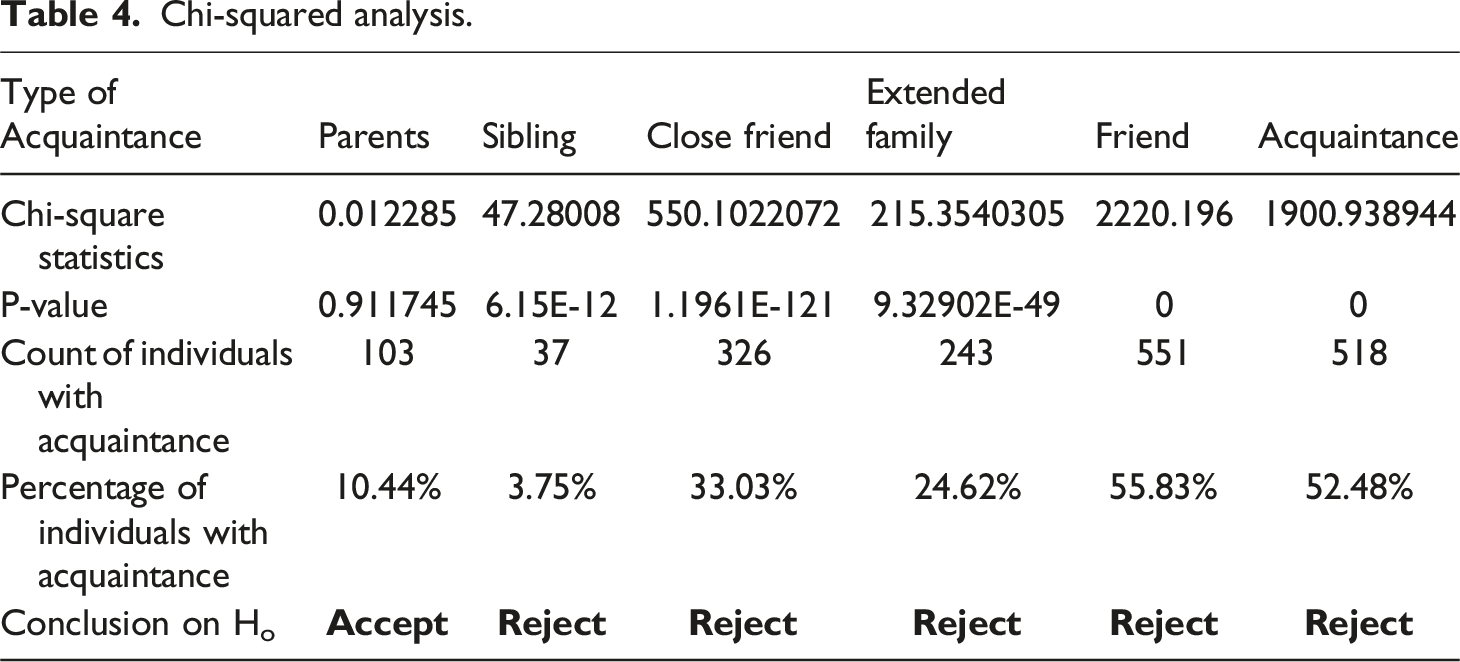
There’s a difference in the success probability between no acquaintance and acquaintance type A A represents: Parents, Sibling, Close Friends, Extended Family, or Friend. The statistical hypothesis testing relied upon the two-sample t-test two-tail to check if the mean’s difference is statistically significant or not, and the two-sample t-test one-tail to check whether or not a given type of acquaintance will impact the chances for an applicant to be accepted in the police force. For the conducted t-test, the assumption of equal variances is violated, since the ratio of each type of acquaintance population’s variance to the variance of the population with no acquaintance is larger than 2. Therefore, a two-sample t-test with unequal variances was adopted. For further investigation of the effect that each type of acquaintance might have, a Chi-square test of independence between the binary variable of being accepted or not and each of the acquaintance types (also binary variables) was performed.
T-test results.
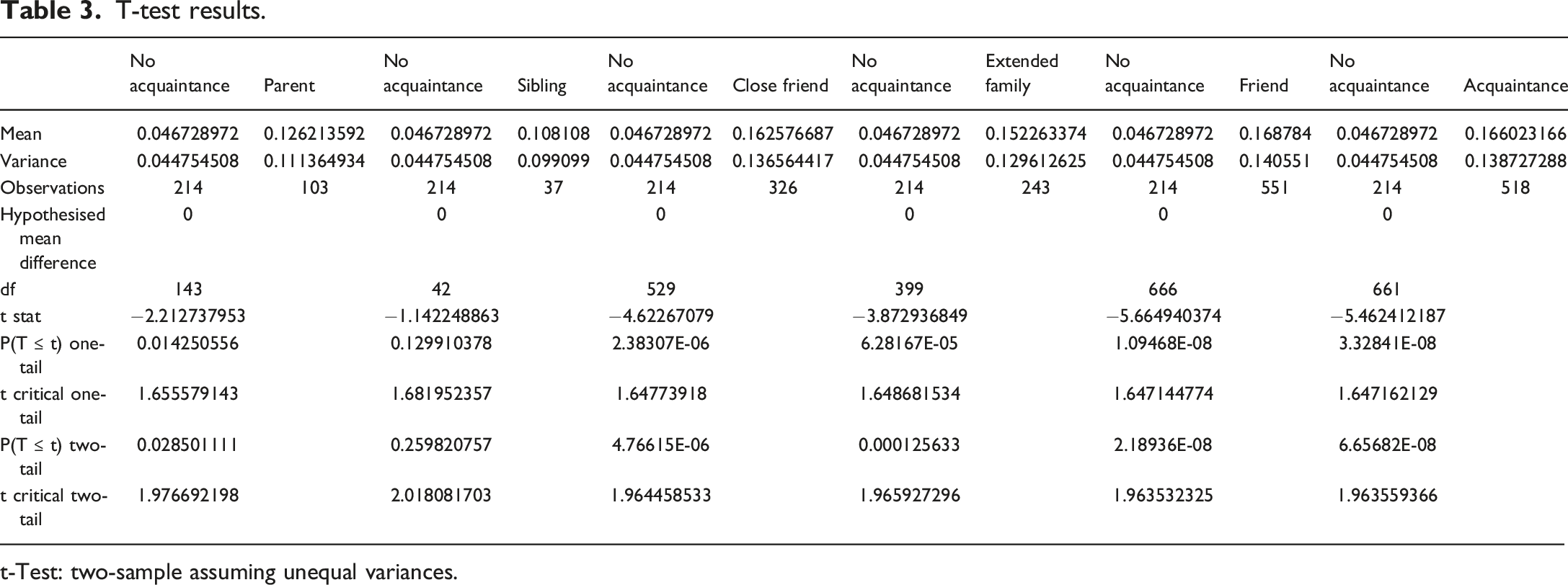
t-Test: two-sample assuming unequal variances.
Results
The application of the two-sample t-test
Parents
A two-sample two-tailed t-test with a significance level of 5% was conducted to investigate whether the means of two groups of applicants differed significantly in terms of their scores Table 3. The first group consisted of applicants with no acquaintance, while the second group consisted of applicants with the ‘parents’ type of acquaintance. The null hypothesis stated that the mean score for both groups was equal, while the alternative hypothesis stated that the means of the two groups were not equal. The critical t-value for a two-tailed test with a significance level of 5% and 143 degrees of freedom was 1.9767, which was exceeded by the absolute value of the t-value obtained from the test. Therefore, the null hypothesis was rejected in favour of the alternative hypothesis. Moreover, and based on the results of the one-tailed t-test with 143 degrees of freedom, there was a significant difference in the mean scores of the two groups (t-stat = −2.2127, p-value = .0285). This indicates that applicants with ‘parents’ type of acquaintance had significantly higher mean scores compared to applicants with no acquaintance. These findings suggest that having parents’ type of acquaintance may have a positive impact on the applicants’ chances of being recruited by the police force.
Siblings
A two-sample t-test was conducted to compare the means of the groups of applicants with no acquaintance and the groups of applicants with sibling type of acquaintance. The aim of the test was to test the hypothesis of whether the means of the two groups were equal or not. The results showed that the mean score for applicants with ‘sibling’ type of acquaintance (M = 0.108) was lower than the mean score for applicants with no acquaintance (M = 0.047), but the difference was not statistically significant (t-stat = −1.142, p = .260). The critical t-value for a two-tailed test with a significance level of 5% and 42 degrees of freedom was 2.018. Since the absolute value of the t-value obtained from the test was less than the critical value, we failed to reject the null hypothesis. These results suggest that there is no significant difference in the acceptance rate between applicants with no acquaintance and those with ‘sibling’ type of acquaintance. However, it should be noted that the sample size for the second group (n = 37) was relatively small compared to the first group, which may have limited the statistical power of the analysis. Further research with larger sample sizes may be needed to confirm these findings.
Close friends
A two-sample t-test was conducted to check if the means difference between the group of applicants with no acquaintance and the group of applicants with a ‘close friend’ type of acquaintance, are equal or not. The sample size for the first group was 214, while the second group had 326 participants. The mean score for the first group was 0.0467, with a variance of 0.0448. On the other hand, the mean score for the second group was 0.1626, with a variance of 0.1366. The calculated t-statistic was −4.623, with a degree of freedom (df) of 529. The alpha level used in this analysis was 0.05, and the critical t-value at two tails was 1.964. The p-value for the two-tailed test was found to be 0.000005, which is less than the chosen p-value of 5%. Therefore, we reject the null hypothesis that the means of the two groups are equal. These results suggest that the type of acquaintance (no acquaintance vs ‘close friend’) has a significant impact on the applicant’s performance in the evaluation process. Moreover, the applicants with ‘close friend’ type of acquaintance seem to have better chance to be hired than the ones with no acquaintance.
Extended family
Based on the results of the two-sample two-tailed t-test performed between the applicants with no acquaintance and those with extended family type of acquaintance, the mean proportion of the two groups was found to be significantly different from each other (t = −3.8729, p = .0001). The mean proportion of the applicants with no acquaintance was 0.0467, while it was 0.1523 for the applicants with ‘extended family’ type of acquaintance. The variance of the two groups was 0.0448 and 0.1296, respectively, the sample sizes were 214 and 243, respectively, and the degrees of freedom were calculated to be 399. The critical t-value at 5% level of significance and 2-tailed test was 1.9659, and the calculated t-value (−3.8729) was found to be less than the critical t-value. Therefore, we reject the null hypothesis that the means of the two groups are equal. Moreover, and based on the two-sample one-tailed t-test, we conclude that the mean proportion of applicants with ‘extended family’ type of acquaintance is significantly higher than those with no acquaintance.
Friend
A two-sample two-tailed t-test for the equality of means between two groups: applicants with no acquaintance and applicants with the ‘friend’ type of acquaintance was conducted. The obtained t-test result shows that the mean for applicants with no acquaintance (M = 0.047) is significantly different from the mean for applicants with friend type of acquaintance (M = 0.169), t-stat = −5.665, and the p-value <.001. The result suggests strong evidence to reject the null hypothesis that there is no significant difference in means between the two groups. The results based on the two-sample one-tailed t-test suggest that the ‘friend’ type of acquaintance could play an important role in predicting the success of job applicants.
Acquaintance
Based on the t-test results, the mean scores of two groups of applicants, those with no acquaintance and those with acquaintance, were compared to determine whether they were significantly different. The sample sizes of both groups were substantial, with 214 and 518 observations for the no acquaintance and acquaintance groups, respectively. The variances of the two groups were 0.0448 and 0.1387, respectively, indicating that the groups had different variances. The t-test one-tail analysis revealed that the mean score of applicants with no acquaintance was significantly different from the mean score of applicants with acquaintance (t-stat = −5.46, p-value <.0001,). The mean score of the applicants with no acquaintance was 0.0467, while the mean score of applicants with acquaintance was 0.1660. These results suggest that having an acquaintance may have a positive impact on the applicant's chances of being accepted. The results of this analysis suggest that having an acquaintance may significantly influence an applicant's chances of being accepted.
The chi-square test of independence
Chi-squared analysis.
Of note, the above analysis did not consider the gender and ethnicity potential effects since the conducted statistical tests (statistical results are reported in the tables in the Appendix) found no significant difference between male and female applicants. The same results were found for potential gender difference between white British and non-white British applicants – there is not enough data to elaborate in more detail based on ethnicity. Finally, our results included findings about the potential effect of the cumulative number of acquaintances on their chances of being accepted. The findings show no significant effect of the number of acquaintances (see statistical tables in the Appendix).
Discussion
The Chi-square test of independence results confirm the results of the two-sample t-test as they suggest that having acquaintance types of ‘close friend’, ‘friend’, ‘extended family’ or general acquaintance type in the researched police service significantly influences the chances of being accepted; this suggests a causal relationship. However, the reported results from the tests are different for the parents and sibling type acquaintances, as the Chi-square test results indicate that having a parent or a sibling in the police does not influence their chances of success. These contradictory results could be related to the zero-inflated count in the values of both parent and sibling variable, since their respective percentages of individuals with such types of acquaintances are 10.44% and 3.75% which is relatively low compared to other types of acquaintances in the collected sample.
The study and findings overall therefore suggest that the chances of being accepted in the police force are significantly influenced by particular types of acquaintances, with the exception of the ‘parents’ and ‘sibling’. Individuals who applied to the researched police service tend to rely upon acquaintances that are outside of their immediate family circle, or individuals that they developed relationships with personally such as ‘friends’, ‘close friends’ or ‘extended family members’. This could be explained by the hypothesis that applicants seek more objective advice and opinion, or could be reluctant to discuss joining the police with individuals with whom they have close familial relationships like ‘parents’ or ‘sibling’.
The reason for these findings is unclear, but they do begin to paint a picture of the social embeddedness that existed in recruitment in the researched service. The influence of having an acquaintance of any sort who was a police officer upon the chances of successful recruitment was significant, and this indicates that there is some value in those social connections. The null hypothesis can be reasonably rejected; if you know a cop, it is more likely that you can become one. If these social connections have some value with regards to the recruitment process itself, then they may be utilised by the candidate in some way; indicating some exchange of information between those social contacts (Granovetter, 1973). The nature of this usage should be a priority for police services attempting to understand their recruitment processes and outcomes, as it is clear from qualitative research in this area (Hesketh and Stubbs, 2023; Hesketh & Stubbs, under review; Stubbs and Tong; under review) that the contact itself involves elements of social coaching, pastoral support and instrumental guidance around the recruitment process itself. The existing social connection clearly does matter – it can influence the candidate’s chance of becoming successful.
With regards to existing work in other labour markets discussed by labour market scholars, there is something ‘particular’ about the social embeddedness in this case. It is well represented in friends, close friends and acquaintances, which are both weak (acquaintances) and of moderate/strong relative strength in terms of time spent with friends and close friends. Homophily theory (Mcpherson et al., 2001) suggests that these contacts are more likely than not, to represent the demographics of the applicants. From national data discussed earlier, the majority of applicants are white, and if social embeddedness is a causal variable, they are likely to be accessing and passing information between their existing friendship groups that assists with their application to become police officers. Utilising homophily theory therefore, we can posit that the majority, existing white police force will have social groups representing their demographic which then limits the flow of beneficial recruitment based information through natural social processes. This is important, as this study illustrates that the existence and type of social embeddedness is potentially causal to a potential recruit’s success in recruitment; if your workforce is majority white, and social embeddedness is important for recruitment, then white candidates are likely to be receiving a level of benefit not afforded to other candidates. Other important variables such as age, social class and gender may also influence this important flow of information, but in this case, gender was found to be non-significant (see Appendix). This invites further research in this area.
Implications, limitations and further research
With regards to theoretical development, this study indicates that social embeddedness in police recruitment is significant in the researched service. This assists with the understanding of police recruitment as a process in England and Wales, and informs upon the design of positive action initiatives and the recruitment processes themselves. It is fair to say that within the studied context, embeddedness is both present and particular to police recruitment. This adds to the rich picture of labour market research and actually presents social embeddedness as a theory of worth in police recruitment study. The nature of the information passed through the social contacts themselves will develop understanding with regards to the theoretical application within practice, and although this has recently been studied qualitatively (Hesketh and Stubbs, 2023. Hesketh & Stubbs, Under Review; Stubbs & Tong, Under Review), the development of further research in this area would be highly valuable to understanding how recruitment processes for under-represented candidates can be improved.
This study also suggests that existing police recruitment processes may be either assisting, or facilitating social embeddedness to thrive. In practical terms, this would represent processes that have been used over time, repeatedly, lifting the value of the personal knowledge gained by navigating those processes themselves. This may take the form of application forms that are used repeatedly, or a format of answering questions (such as the S-T-A-R model) that is not only recommended, but actually expected during recruitment. The S-T-A-R (Situation, Task, Action and Result) model is not widely supported by research but is widely used in police recruitment and promotion. Repeated usage of assessment centre scenarios, particular questions on interview, or of standards with regards to expected dress and behaviour may also be consciously, socially transmitted during anticipatory socialisation (Bennett, 1984; Scholarios et al., 2003; Van Maanen, 1973, 1975). Curiously, the more intense social ties in this case (parents, siblings) were not supported by the second performed test, suggesting that the value of the information transmitted may be temporal in nature; the more recent the recruitment experience, the more valuable the information. This is supported by the qualitative study (Hesketh and Stubbs, 2023) but requires further investigation. Possible solutions to minimising the strength of temporal social embeddedness include the rotation of exercises and subject matter used in recruitment, evolving methods of assessment on a rolling basis, and building wider awareness of the processes themselves. The more the information about the recruitment process itself is made visible, the more this limits the power of socially transmitted information about the process.
This study was limited by the fact that it was conducted within a single constabulary, and may in turn not be generalisable to other police services in England and Wales without further investigation. The survey also relies on self-reported data that can be subject to inaccuracy or bias. Future research should seek to widen participation in this research to investigate the phenomena on a larger scale, so that these limitations can be reduced. The subject also took place over a single, large recruitment window, so longitudinal study would allow a greater level of analysis to take place. It is possible that embeddedness is mediated by factors other than those studied as variables, and situating embeddedness alongside other measurable factors may add further depth of understanding to the relative causes of success in police recruitment.
Supplemental Material
Supplemental Material - Understanding the nature of social embeddedness in police recruitment in England and Wales
Supplemental Material for Understanding the nature of social embeddedness in police recruitment in England and Wales by Gareth Stubbs, Elarbi Ben Ayed Elkaroui and Irianto Harny in The Police Journal.
Footnotes
Declaration of conflicting interests
The author(s) declared no potential conflicts of interest with respect to the research, authorship, and/or publication of this article.
Funding
The author(s) received no financial support for the research, authorship, and/or publication of this article.

Supplemental Material
Supplemental material for this article is available online.
References
Supplementary Material
Please find the following supplemental material available below.
For Open Access articles published under a Creative Commons License, all supplemental material carries the same license as the article it is associated with.
For non-Open Access articles published, all supplemental material carries a non-exclusive license, and permission requests for re-use of supplemental material or any part of supplemental material shall be sent directly to the copyright owner as specified in the copyright notice associated with the article.
