




Abstract
Police agencies implement a variety of strategies for recruiting, promoting and retaining police officers with diverse backgrounds. Changes have however been difficult to attain. We expand research on representative bureaucracy by investigating diversity perspectives in a case study of the Norwegian Police Service (NPS). Using mixed-methods we investigate the diversity perspectives of ethnic minority and majority students and employees in the NPS, focusing on the interplay between educational and work experiences, recruitment practices and diversity policies. We found that ethnic minorities were still underrepresented, and their cultural competence was not fully recognized by other students, teachers, colleagues and leaders. Interview and field-work findings were corroborated by surveys among NPS employees documenting that competence development was perceived as the least emphasized justification for diversity management. Despite focusing on a single case, the NPS, we argue that the processes we describe may be operating also in other multicultural societies.
Keywords
Police agencies in many countries are implementing a variety of strategies for recruiting, promoting and retaining police officers with diverse backgrounds (van Ewijk, 2012). Despite national differences in societal diversity, a common characteristic of police organizations in advanced multicultural democracies is a longstanding ambition to increase diversity among employees and the implementation of a variety of reforms to achieve this end. Norway is no exception; educational and political aims for more diversity at the Norwegian Police University College (NPUC) and in the Norwegian Police Service (NPS) have been set since the early 2000s (Bjørkelo et al., 2015).
Changes, however, have been difficult to achieve. Studies have documented the difficulties, obstacles and barriers incurred in the implementation of police reforms targeting the recruitment and retention of minorities. Key obstacles are related to the organizational culture, racism, and lack of leadership (McMurray et al., 2010; Metz & Kulik, 2008, van Ewijk, 2012). Studies directed at removing organizational cultural barriers have investigated the effect of diversity plans and diversity awareness training e.g., targeting prejudice and commonly held negative beliefs among majority officers (Cashmore, 2001; Ishaq & Hussain, 2001). This strand of research has relied largely on studies of documents, official statistics and interviews with key informants. Less emphasis has been placed on the work experiences of majority and minority officers and their perspectives on diversity, diversity policies and consequences of diversity (with some notable exceptions; Cashmore, 2001; Loftus, 2008).
Research on the outcomes of (increased) minority representation in the police has largely drawn on the theory of representative bureaucracy (Lim, 2006), addressing whether differences in passive representation of women and ethnic minorities (i.e., the degree to which police employees within a force or district mirror the society they serve), translate into differences in active representation (i.e., advocacy and positive outcomes for the segment of the population represented). With respect to race and ethnicity, previous work has addressed the impact of representation on community crime rates, racial disparities in “stop-and-search”, and police misconduct (Hong, 2016, 2017a, 2017b), racial profiling (Wilkins & Williams, 2008, 2009), crime clearance and officer turn-over (Hur, 2013), police homicide of Black citizens (Nicholson-Crotty et al., 2017), and citizen’s perceptions of performance, fairness and trust (Riccucci et al., 2018). Across these studies, the results are equivocal with respect to the effect of minority representation on outcomes, although several studies report positive relationships.
There is detailed theorizing in the representative bureaucracy literature on the processes through which the passive representation of minorities translates into advocacy for minority citizens. Lim (2006) emphasizes how positive outcomes for minority citizens may come about through mechanisms relating to minority bureaucrats’ identification, shared values and beliefs, empathic understanding, communication quality, and striving for impartiality in their dealings with minority citizens (direct effects). He also describes how minority bureaucrats may impact outcomes for minority citizens though their impact on majority colleagues. The presence of minority bureaucrats may induce majority colleagues to refrain from acting on their own biases, and over time majority bureaucrats may experience changes in their own values and believes (indirect effects, Lim, 2006). What was not emphasized by Lim (2006), is the conditions under which active representation may follow from the passive representation of minorities. This, however, is addressed by Ely and Thomas (2001) in their work on diversity perspectives. The core of their argument is that the outcomes of diversity in a workgroup depends on the perspective on diversity held by its members; realizing the benefits of diversity (i.e., active representation) is closely aligned with the way diversity is thought of within the group.
Diversity Perspectives
Diversity perspectives are a person’s “normative beliefs and expectations about cultural diversity and its role in their work group”. Such perspectives can be “explicit, as in verbal or written statements or policies, and implicit, as in the unstated assumptions that underlie the way a person manages his or her subordinates or the way a group structures its work” (Ely & Thomas, 2001, p. 235). Complementing the representative bureaucracy literature and the focus on how passive representation of minorities translates into advocacy for minority citizens, Ely and Thomas (2001) proposed that the mechanisms through which this process takes place is dependent upon diversity perspectives. These perspectives take on (at least) three forms. From the discrimination-and-fairness perspective, the rationale for diversifying is to ensure justice and equality, and eliminate discrimination, but diversity is not seen as having a strong connection to work processes. From the access-and-legitimacy perspective, the rationale for diversifying is to gain access to, and ensure legitimacy among, specific groups in society (e.g., ethnic minorities). Diversity is indirectly related to work through an ethnicity-based division of labor (i.e., minority employees are assigned to work with minority clients/customers). Finally, from the integration-and-learning perspective, the rationale for diversifying is to inform and enhance work processes. Cultural identities are seen as a resource for learning and change, and the aim is to integrate cultural differences into core and mainstream work processes (Ely & Thomas, 2001). In their empirical analyses, Ely and Thomas (2001, p. 229) found that “All three perspectives on diversity had been successful in motivating managers to diversify their staffs, but only the integration-and-learning perspective provided the rationale and guidance needed to achieve sustained benefits from diversity”.
Previous research on diversity perspectives among prospective police officers indicate that ethnic minority individuals may enter the police with the expectation that their minority background will contribute to both access and legitimacy, as well as problem solving. Todak et al. (2018) studied what prospective police officers perceived as benefits and drawbacks of ethnic diversity in police agencies. They found that both minority and majority participants thought that ethnic minority police officers would be especially effective in establishing trust with minority citizens and work better in diverse neighborhoods. This can be an indication of an access-and-legitimacy perspective on the role of diversity in policing. However, the minority interviewees also believed that being bilingual, and having knowledge of other backgrounds and cultural practices, would be beneficial in problem solving. This may reflect an integration-and-learning perspective. Other research has showed that also working officers emphasize access to minority civilians and cultural learning as benefits of ethnic diversity (Andersen et al., 2017; De Vries & Pettigrew, 1998).
In contrast, research among Norwegian police students indicate that they come to see ethnic diversity as less important to fulfill the societal mandate, and to a lesser extent see ethnic minority officers as important for legitimacy among ethnic minority civilians, during their three years at the NPUC (RECPOL, 2013). Among working officers, Cashmore (2002) found that ethnic minority British police officers expressed serious doubt as to whether the official policy of increasing diversity would lead to any change in how police work was done. Assimilation into the professional (White) culture was seen as incompatible with ethnic affiliation. In the extreme, the power of socialization was described as so strong as to lead minority officers to adopt the biases of their White colleagues. As these studies illustrate, diversity perspectives may change over time from initial recruitment into police education in light of experiences in the study environment, and on the job. The studies also indicate a complex interplay between ethnic identity, perceptions of policy, work experiences and diversity perspectives (see also Wieslander, 2020).
Based on the widespread implementation of reforms to diversify police services, and the difficulties encountered in achieving change (van Ewijk, 2012), we are particularly interested in whether and how the stated objectives and pro-diversity arguments expressed in diversity reforms (e.g., recruitment and organizational policies) correspond with or diverge from police students’ and staff’s own diversity perspectives. Specifically, drawing on Ely and Thomas (2001) analysis, our conjecture is that reaching policy aims for ethnic minority representation, and reaping the anticipated benefits of increased diversity, depend on how policies and associated practices are interpreted and embedded in police students’ and staff’s diversity perspectives. We investigate this in a case study of the NPS and the NPUC. By providing a detailed case study, we also contribute to the literature on representative bureaucracy in the police, in which there has been calls for research involving “in-depth case studies or qualitative interviews. These methods would provide even further insight into the mechanisms through which passive representation yields active representation in police organizations.” (Hong, 2017a, p. 560).
National, Educational, and Organizational Context
The Norwegian population (5.3 million) comprises 17.7 percent immigrants and individuals who are Norwegian-born to immigrant parents (Statistics Norway, 2019a, 2019b). In the NPS, this group made up 5% of employees in 2018 (Statistics Norway, 2019c). The official percentage from Statistics Norway, however, includes all NPS employees (i.e., everyone from personnel providing cleaning, canteen and IT-services to police chiefs), and does not enable the extraction of the number of police educated employees with ethnic minority backgrounds, their rank or representation across districts. Due to legislation regulating the right to private data, it is illegal in Norway for employers (such as the NPS) to register employees’ racial or ethnic background (with very few exceptions), which is why this is not routinely done. Thus, while it is the case in many countries that ethnic minorities are underrepresented among police employees, how well (or poorly) ethnic minorities are represented within the uniformed part of the NPS is unknown.
In Norway, police education is provided through one national institution, the NPUC. The number of campuses and admitted students to the different educational programs depend on political decisions. The last ten years, the admission rate has been 720 students across four campuses (located in the south, east and north of Norway). In 2018 it was reduced to 550, and as of autumn 2020, 400 students will be admitted across three campuses per year. There are massive efforts in attracting applicants and only about 16% of those who apply are admitted. In order to be admitted, students must satisfy extensive entrance requirements (Bjørkelo et al., 2015), including measures of physical, mental, collaboration, and academic skills.
To be a police officer in Norway, the bachelor program in Police Studies is the minimum requirement (Hove, 2014, cited in Aas, 2016). The first and third year consists of in-school education, while the second year is in-field training (Hoel, 2019). The in-field training takes place across the 12 police districts (East, South-East, Midland, Oslo, Agder, South-West, West, Møre and Romsdal, Trøndelag, Nordland, Troms and Finnmark). The NPUC also offers master’s degrees (e.g., in police science, criminal investigation, digital forensics, and cybercrime investigations) and more than 90 post graduate study programs (e.g., in leadership, education, investigation, forensic science, operative work and multicultural understanding and diversity). The master programs aim at increasing the level of analytical competence and strategic work, and to develop knowledge-driven work (Andresen & Jon, 2018).
In addition to the 12 districts, the NPS is organized in specialist agencies (the Norwegian Police University College, the Norwegian Criminal Investigation Unit, the National Authority for Investigation and Prosecution of Economic and Environmental Crime, National Mobile Police Service, the National Police Immigration Service, the Police Security Service, and the Norwegian Border Commissioner for the Norwegian-Russian Border). Each police district is led by a Police Chief who is responsible for services, budget and results, with their own administration and police control room. To advance to the rank of police officer 2 and 3, national competence criteria must be fulfilled. Advancement generally happens either through promotion or through applying for vacant positions at higher levels. The NPS is governed by the Ministry of Justice and Public Security, and the National Police Directorate (NPD). As a specialist agency the NPUC is equally regulated by rules set for higher educational institutions in Norway by the Ministry of Education and Research.
Since the 2000s there has been a strategic decision to work for increased diversity at the NPUC and in the NPS (Bjørkelo et al., 2015). The NPD has had two main strategic plans outlining the NPS’ diversity strategy (NPD; 2003, 2008). We focus on the most recent plan, which addresses diversity along several axes (gender, ethnicity, age, sexual orientation and disability). The plan is anchored in various white papers, laws and official guidelines (e.g., Ministry of Children and Equality, n.d., 2018), which serve as a backdrop for the arguments used and the targets set. With respect to diversity in general, the plan emphasizes moving beyond legal requirements of non-discrimination, recognizing differences among employees and putting them to use. Representing the population with respect to demographic characteristics is foregrounded, especially to ensure trust among the public. Diversity is also described as central to the police’s competence and problem-solving abilities. However, most current recruitment attempts have been directed at the bachelor level (i.e., Police Studies).
With respect to ethnic diversity in particular, the key challenges are described as 1) recruiting ethnic minorities to the NPUC and the NPS, 2) educating NPS employees on why ethnic diversity is important both from a work environment/ethical perspective, and in police practice, 3) retaining employees with ethnic minority backgrounds, 4) securing the public’s trust in the police via representation, 5) ensuring that the specific (i.e., cultural) competence held by minorities is recognized in the organization and put to use, and 6) indirect discrimination and lack of trust as barriers for minority employees’ career progression. In sum, the key line of argument in the policy is that diversity is desirable and necessary to fulfil the police’s societal mandate, ensure trust among the public, and equal treatment. The cultural competence held by ethnic minority employees is explicitly pointed to as a resource that is important in modern policing.
Whereas the plan did not state a specific target for the percentage of ethnic minority officers that should be recruited to the NPS, the aim for recruitment to the NPUC (2012) was that five percent of the bachelor students should have an ethnic minority background before 2013 (NPD, 2008). The NPUC’s current strategic plan similarly emphasizes the importance of recruiting students with varied linguistic and cultural competence (NPUC, 2017). To reach the aim of increased representation and broader competence, the NPUC has applied recruitment campaigns and various information channels to reach potential minority applicants. Recruitment efforts have included placing posters in strategic places in different towns, advertisements in social media, visiting schools with many ethnic minority students, holding information meetings for potential applicants and their parents/guardians, as well as establishing a recruitment team (since 2017). The team employs bachelor students as recruiters, and the students are diverse in terms of gender, age, geographical affiliation and ethnic origin. About half of the recruitment team comprises ethnic minority students who speak several languages. In sum, a lot of effort, energy and time has been put into recruiting ethnic minority students into the bachelor program.
The Present Study
In this case study, our main objective is to explore the diversity perspectives of ethnic minority and majority students and employees in the NPS, focusing on the interplay between educational and work experiences, recruitment practices and diversity policies. Through this we contribute to the larger literature on work experiences of majority and minority officers, as well as how diversity reforms are perceived and translated into practice by police students and employees.
We begin by establishing the degree to which ethnic minorities are represented in the NPUC student body and among police-educated and civilian employees in the NPS (i.e., representative bureaucracy). As described above, although Statistics Norway provides overall figures for the entire NPS, they do not distinguish between civilian and sworn staff. This lack of data hampers the possibility to study changes in the NPS, and the impact of diversity reforms on minority representation. Providing such statistics will increase national knowledge about how the police organization mirrors society, as well as enable cross-national comparisons on diversity reform and representation in the police. Establishing the numerical representation of ethnic minorities at the NPUC and in the NPS is also important as a backdrop to understand students’ and officers’ experiences and reflections about diversity. Research question 1. To what extent are ethnic minorities represented in the NPUC student body and among police-educated and civilian employees in the NPS? Research question 2. Which perspectives on the meaning and value of ethnic diversity are present in ethnic minority and majority students and police officers’ accounts of their educational and on-the-job experiences? Research question 3. To what extent are the arguments of the societal mandate, equal rights, competence, and trust within the society seen as justifications for NPS’s diversity strategy among ethnic minority and majority police employees?
Method
Overall Design
To address our research questions, we conducted a mixed-methods study (Creswell, 2003), employing both qualitative and quantitative data from several sources. The representation of ethnic minority students was established from archival data in the form of an existing student admission survey conducted by the NPUC student admission office. Students’ diversity perspectives were investigated through in-depth interviews with students. Similarly, the diversity perspectives of working police officers were studied by means of in-depth interviews and field work. Finally, we conducted two surveys among all police employees to address the representation of minorities within the NPS and to assess perceived underlying justifications for the NPS’s diversity strategy.
Participants and Procedures
Student Admission Survey
Information about NPUC students’ ethnic backgrounds was extracted from the 2018 voluntary and confidential online survey among new bachelor students conducted by the student admission office at the NPUC and the associated admissions report (NPUC, 2018). The survey had 383 participants (response rate 69%) and covered several topics, including the students’ and their parents’ national origin and the students’ language competence. Access to the data from the survey was approved by the NPUC.
Interviews With Police Students
To address students’ perspectives on ethnicity and the role ethnic diversity plays in the study environment we conducted in-depth interviews with 24 students (18 men and 6 women). 17 students had immigrant background (immigrants or Norwegian-born to immigrant parents), six had one Norwegian-born and one foreign-born parent, and one had Norwegian background. The interviewed students had backgrounds from Asia, the Middle East, South America and Europe. Potential participants were identified from the above-mentioned student admission survey from the period 2013 to 2016. The student admission office provided us with a list of students with minority backgrounds and we sent out a formal request to each one of them. The interviewees were all first- or third-year bachelor students from the four NPUC campuses. Participation in the study was voluntary and respondents were assured confidentiality. The interview guide was semi-structured, with open-ended questions that opened up for dialogue about views and experiences. The interview guide focused on topics ranging from study motivation, admission experiences, study environment (especially diversity-related experiences) and how cultural competence was understood and valued. On average, the interviews lasted 1 ½ hours. The interviews were recorded, transcribed, coded and thematically analyzed.
Interviewees With Police Officers
To capture the perspectives on ethnic diversity held by police officers, semi-structured interviews with police employees currently or previously working in patrol services were conducted in 2017. Participants were 12 men and 2 women. Five participants were recruited for interviews and fieldwork through the leader of the patrol service at two police stations. In these cases, perceptions of whom the leaders considered to be ethnic minorities affected recruitment. The others were recruited through snowball sampling. The ethnic minority participants were Norwegian-born to immigrant parents (n = 10) with backgrounds from Asia, Africa and East- and South-East Europe, or had another immigration background (n = 2). In addition, interviews were conducted with two ethnic majority officers. The semi-structured interview guide consisted of questions regarding the interviewees’ experiences of how ethnic resources within the patrolling service were perceived, how such resources were utilized, and perceptions of inclusion and exclusion of ethnic minorities within the police organization. On average, the interviews lasted for two hours. The interviews were recorded, transcribed, and coded by hand. The data were then reduced and sorted into a data matrix. Next, a thematic analysis was applied (i.e., sorting themes into codes; Kvale & Brinkmann, 2009). In this article, interview codes such as the meaning of diversity within the police; ethnicity as a resource, and the utilization of ethnic competencies are analyzed and presented.
Field-Work in the Patrol Service
In addition to the interviews with police officers, we conducted field-work within the patrol services at two urban police stations, in 2017. Five ethnic minority participants were followed across 2 day-shifts, 10 evening-shifts, and 7 night-shifts. These five participants were also included among the 14 interviewees described above. The minority officers had in total 18 ethnic Norwegian partners (10 men, 8 women) across the shifts studied, and data from these majority officers were also included. In addition, field conversations among the five ethnic minority officers and other police personnel they encountered during the shifts (e.g., leaders and police officers of Norwegian origin other than their partners) were included. Field notes were taken during and after each shift. In the analysis, they were used to supplement the interpretation of the interviews. The interviews and the fieldwork were approved by the Data Protection Services at the Norwegian Centre for Research Data (project number 49021), as well as the NPD.
Surveys of All NPS Employees
To address the ethnic composition of the NPS and perceptions of the NPS diversity strategy among both minority and majority members, we conducted two surveys. The first survey was conducted in 2016/2017 and targeted police employees with police education. The survey was carried out with the help of the HR-department in the NPD which provided us with postal addresses of all relevant employees. We sent out 9524 paper-and-pencil questionnaires along with a pre-paid return envelope by mail. Information about the survey was published in relevant venues (e.g., the NPS intranet, the Police Union magazine, the Police Leader magazine) to increase the response rate. A total of 2956 questionnaires were returned (response rate 31%).
The second survey targeted police employees with other educational backgrounds (i.e., civilian employees) and was conducted in 2018. We employed an online survey tool (NSD web survey) provided by the Norwegian Centre for Research Data. The NPD assisted us in obtaining the encrypted email addresses of all police employees with other educational backgrounds than police education (N = 6156). One email invitation with a link to the survey and two reminders were sent out. In addition, information about the survey was published in relevant venues. The response rate was 26% (N = 1629). Both surveys were approved by the Data Protection Services at the Norwegian Centre for Research Data (project numbers 48860, and 58485), as well as the NPD.
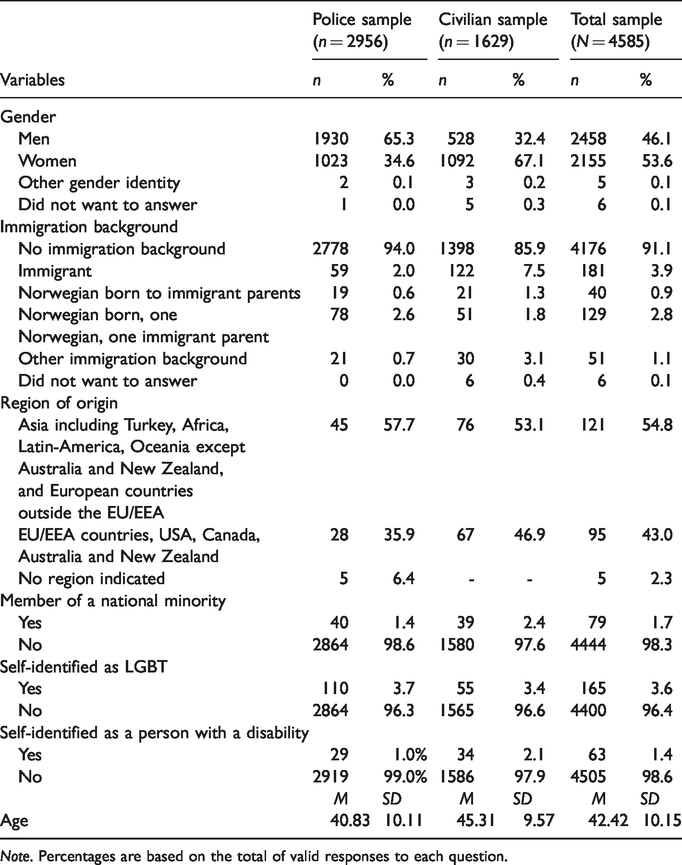
The response rates for both samples are lower than would be desired. However, compared to the official 2017 figures for the entire NPS (Statistics Norway, 2020), our combined sample appears to be close to representative of the population in terms of the gender balance (53.6% women in the sample vs. 45.7% in the NPS population) and the proportion of immigrants and Norwegian born to immigrant parents (4.8% in the sample vs. 5% in the total NPS population). Demographic information for the two samples is provided in Table 1.
Demographic Information for the Police, Civilian and Total Samples.
Note. Percentages are based on the total of valid responses to each question.
Ethnic minority employees were across the two samples underrepresented in leadership positions (most pronounced among police educated, 17% vs. 35%) and had shorter tenure compared to employees without any form of immigrant background.
Survey Measures
The two surveys were identical and included a range of questions about work environment experiences, career paths and views of diversity at work. In this paper, we focus on ethnic background and views on the NPS’ diversity strategy. Ethnic background was assessed with two questions. First respondents were asked to indicate whether they themselves had immigrated to Norway or had parents who were immigrants. The response categories were “No”, “I have immigrated to Norway”, “I was born in Norway and both my parents have immigrated”, “I was born in Norway and have one Norwegian-born parent and one parent who immigrated”, “I have another background (e.g., adopted, born abroad to Norwegian parents), and finally “I do not wish to answer this question”. If the respondents indicated that they themselves or both parents had immigrated to Norway, they were asked to indicate which of two groups of countries/geographical areas best described their origins based on Statistics Norway’s division of the world into two groups: (1) Asia including Turkey, Africa, Latin-America, Oceania except Australia and New Zealand, and European countries outside the EU/EEA” and (2) EU/EEA countries, USA, Canada, Australia and New Zealand.
To measure perceived justifications for the NPS diversity strategy, we developed the following text: “The NPS has a strategy to increase and maintain diversity among the employees in the organization. To what extent do you experience that the elements listed below are emphasized as justifications for this work?” and the alternatives “The Police’s societal mandate”, “Equal treatment”, “Competence development”, “Trust among the public”, and “Other”. These items were aligned with the arguments applied in the NPS’s diversity plan and response categories ranged from 1 (Not at all) to 4 (To a large extent), including “Don’t know”. Participants who ticked the “Other” response could make written comments. Because the NPS diversity strategy was not specific to ethnic diversity, although it is a main issue in the plan, we asked about perceived underlying justifications for diversity management in general.
Results
Representation of Ethnic Minorities at the NPUC and in the NPS
Representation at the NPUC
The student admission office classify new police students into three categories: (1) students with an immigrant background, including both students who have immigrated themselves and those born in Norway to two immigrant parents, (2) foreign-born students with one or two Norwegian-born parents, and (3) Norwegian-born students with one foreign-born parent. At the time of the study, all these students were considered ethnic minorities by the NPUC. Based on the admission survey, the total percentage of ethnic minority students was 13.1%. Students with an immigrant background comprised 4.2%, while 2.1% were foreign born with one or two Norwegian born parents. The largest group of minority students admitted to the police bachelor program were Norwegian born with one foreign-born parent (6.8%).
The total percentage of minorities (13.1%) is higher than the NPUC’s official target of 5%. However, NPUC’s definition of minority students was quite broad and has been quite recently changed. As previously described, the NPUC’s strategic plan emphasizes varied linguistic and cultural competence as the reason for recruiting from a more diverse student population. The admission report released by the student admissions office at NPUC emphasizes that the group of students who possess the strongest and most varied skills in languages other than Nordic languages and English are those with two parents born abroad (NPUC, 2018). The size of this group of students (4.2%) is below the NPUC target and it is substantially smaller than the percentage of immigrants and their children in the Norwegian population (i.e., 17.8%, Statistics Norway, 2019a, 2019b).
Representation in the NPS
Similar to what the admission survey demonstrates for the NPUC students, most of the respondents (91.1%) in the two NPS surveys did not have any form of immigrant background. This pattern is especially pronounced in the police-educated sample, in which immigrants and persons who are children of immigrants make up 2.0% and 0.6% of respondents, respectively. In the civilian sample, the proportions of respondents who are immigrants (7.5%) and Norwegian born to immigrant parents (1.3%) are notably higher. These figures demonstrate why it is useful to consider ethnic minority representation among police-educated and civilian employees separately and extends existing official statistics. The underrepresentation of ethnic minorities is particularly substantial in the uniformed part of the police. Our results show that students and NPS employees with ethnic minority backgrounds are few and underrepresented, both in an absolute sense and compared to the composition of the Norwegian population. This provides an important backdrop to the interviews with NPUC students, and interviews and fieldwork among NPS officers, addressing perspectives on ethnic diversity.
Diversity Perspectives
Students
From the interviews with NPUC students, three clear findings emerge. First, through the college’s recruitment campaigns and information channels, potential ethnic minority applicants were told that linguistic and cultural competence is highly sought after and valued, and that their competence has an important role to play in policing. This created high expectations, which were not met after enrollment. As one student pointed out: “The NPUC desires to include diversity, but they somehow fail … they admit minority students without following them up.” Rather than allowing for students to foreground and value their ethnic identities and cultural competence, the NPUC study environment was seen as allowing little room for differences. One student stated: “one accepts differences, but you have to adapt to the team”, another said: “to show who I am, there’s no room for it”. This limited space for differences also extends to the discussion climate among the students, which one interviewee described: “there’s quick consensus on issues that are complex to understand. There is no room for disagreement or different viewpoints”. This does not mean that ethnic majority students are necessarily negative towards diversity. As was mentioned by one of the participants when talking about his class: It’s both a pity and loss that there were no students with ethnic minority backgrounds in my group. These students often have other views and reference points and contribute to diversity … and may contribute to tolerance … in that people can be different. I have some understanding of other groups in Norway that maybe others do not have as I have grown up with Latin American parents …in a neighborhood with a number of ethnic minorities and experienced conflicts since I was a child. I noticed when I was in my practice year that sometimes people [with an ethnic minority background] would talk to me, probably because they felt an affiliation. During my practice year, I had to use my language to help solve some problems. My colleagues around me were so enthusiastic about it and this gave me a feeling of being really appreciated. I had this great feeling that I can use my competence in a very positive manner. Such contributions make you feel that you are needed and that you can make a difference.
Officers in the Patrolling Service
Among the officers in the patrolling service, most argued that diversity in general is important for the representation of different groups in society, which in turn was seen as important for maintaining the public’s trust in the police. They also recognized that the NPS is far from reflecting society’s ethnic composition. Although representation was seen as a value in itself, some ethnic minority officers also explicitly underlined that the knowledge or competence they bring extends beyond representation alone.
When ethnic minority police officers described what kind of resources they possess that were specific to their ethnic background, it was evident that this differed between individuals. They also differed in their reflexivity, and some of them gave more detailed accounts of what they bring in and how they may utilize it in police practice. Cultural competence took some time to pinpoint, and several of the interviewees had difficulties giving examples without the researcher asking thorough follow-up questions.
Despite this intangibility of cultural competence, a number of different skills were described across interviewees. Manifestations of cultural competence entailed understanding cultural scripts and codes (e.g., understanding cultural variations in the expression of emotions and practices), non-verbal cultural competence (e.g., understanding and enacting culturally relevant gestures), specific language competence (i.e., speaking a specific language), and general language competence. The latter indicates the ability to understand broken Norwegian due to familiarity with the speakers’ region of origin, despite not necessarily mastering the same language. All of these elements are central in what we may call “knowledge of street- and multicultural youth culture”.
As an example of this, several interviewees emphasized that their experiences as adolescents in multi-ethnic communities constituted a resource in communicating with ethnic minority youths and young adults. This resource was hard to pinpoint, not necessarily due to a lack of relevant experiences, but may be explained by the fact that such practices are socialized or “naturalized”, as this quote illustrates: I don’t think that I’m conscious about it, it comes naturally for me, the way I conduct myself when approaching them [ethnic minority youths and young adults], being able to have that loose talk, it’s difficult for me to go into details, because I feel it’s a part of who I am.
How this plays out was also illustrated during a night shift. While searching for minority youths reported for tossing stones, the police patrol stops and checks out a group of minority males. The police patrol quickly understands that these young men are not responsible. One of the ethnic minority officers, although asking “control questions”, spoke in a relaxed and friendly manner. He opens the conversation with “Hi guys, what’s up?” and follows up with explaining why the police are stopping them. Later he changes his sociolect somewhat, speaking with a touch of “minority youth slang”. The atmosphere is good, there is idle talk, joking and laughing in the conversation between the young males and the police. Talking about the incident in the car later on, the minority officer argues that his informal manner and idle talk is important, but he believes that his ethnic Norwegian colleague also masters this. His colleague agrees. However, the colleague believes his fellow minority officer’s ethnicity allows him to act in a certain way that he himself cannot and that this creates trust in the relationship between the police and the minority youth.
From the perspective of ethnic Norwegian officers in this type of police work (patrolling), ethnic minority colleagues primarily bring in competence by speaking different languages and being able to communicate with minority groups in society. However, some, as in the patrolling example above, also view cultural skills and input more generally as a resource. In general, ethnic majority officers found cultural competence difficult to define and describe. Examples of minority and majority officers discussing cultural/religious issues at work (e.g., the five pillars in Islam) did appear in the interviews, but this does not appear to be part of everyday practice, which may be related to the fact that ethnic minority officers are numerically few. This point is illustrated in the following manner by an ethnic minority officer: Most police officers have little knowledge, in general, about other cultures and stuff like that (…) I would gladly brief my colleagues … on different cultural issues, but it’s not normal, we’re so few … that it would be odd … but if there were more of us, it would be more common.
Several interviewees suggested that different types of competence - not just cultural competence - should be mapped, made available, and utilized more. According to the interviewees, mapping of officers’ competence only exists in relation to “harder” competences, such as skills in martial arts or belonging to a “tactical police unit”. At the same time, ethnic minority interviewees also described how colleagues and/or leaders had utilized their competence in the form of language skills too much in some instances (i.e., being asked to interpret a lot). This was viewed as unfair, because their efforts were left uncompensated while other colleagues’ skills and competencies were being rewarded.
Several field conversations unveil traces of a “culture of resentment” among ethnic Norwegian police officers. One of these officers asked about the topic of the research project and thereafter critiqued the research question. In his opinion, the question should have been whether cultural competence is a resource or not. Another police officer reflected upon her experienced difficulties with ethnic minority police officers and students; in her opinion they lack Norwegian skills. These perspectives represent a skepticism towards ethnic minorities within the NPS – ranging from “they don’t bring any extra competence” to questioning their capabilities.
Justifications for the NPS’s Diversity Strategy
Our qualitative material showed that a range of diversity perspectives were present among students and officers in the NPS. Both ethnic minority and ethnic majority members emphasized minority representation as a source of trust among (specific groups of) the public, but ethnic minority members gave a stronger voice to the notion of cultural competence, also beyond language skills, as a resource in policing. Here the views expressed by the interviewees parallel two of the core arguments (i.e., trust and competence) put forward in the NPS diversity strategy. The notion of diversity as central to the police’ societal mandate and to ensure equal rights, also emphasized in the strategy, was less pronounced in the qualitative material. To supplement these findings, we now move on to address the extent to which the four arguments detailed in the strategy were seen as justifications for the NPS’ work to increase and maintain diversity by larger samples of NPS employees. Following up on the findings in the qualitative material that the views of minority and majority members somewhat diverged, and addressing our third research question, we also explicitly compare perceived justifications among ethnic minority and majority employees.
In the combined civilian and police-educated sample, the percentage of respondents who indicated that an argument was used to justify the NPS’ diversity strategy to a large extent was 44.0% for trust among the public, 38.2% for equal treatment, 31.0% for the societal mandate and 19.9% for competence development, respectively. These numbers resonate well with the qualitative findings – diversity as important to gain the public’s trust was perceived as a clear justification for the diversity strategy, whereas competence development was less emphasized. Among those who chose “Other” and provided a written response (n = 25), various other perceived justifications for the NPS diversity strategy were mentioned. Particularly interesting is that some of these indicated a perception of inauthenticity; that diversity was sought after due to political correctness or that it represented an imposed change based on political goals, aims, or concerns with society’s impression of the police.
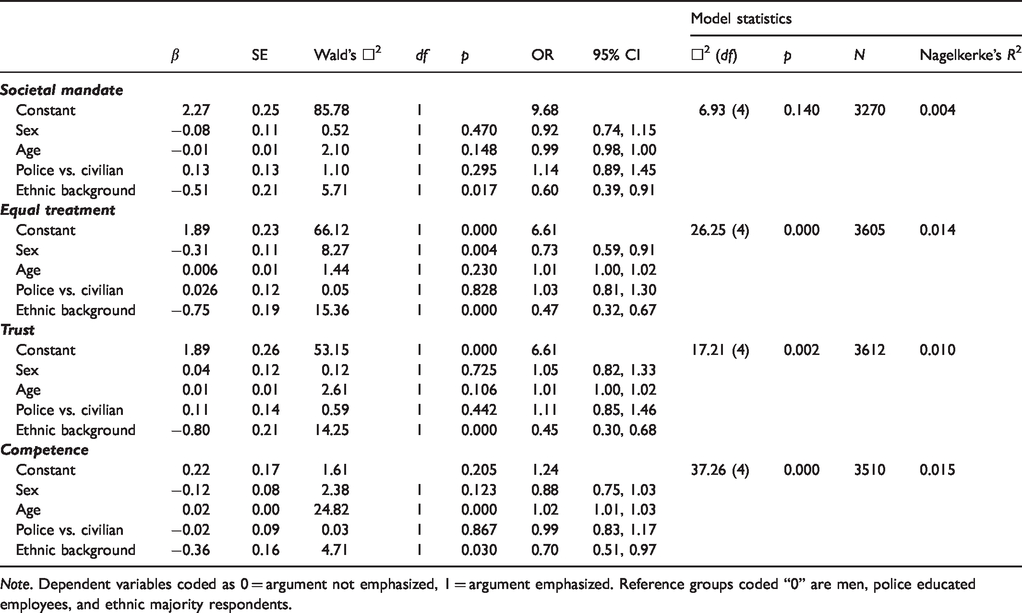
To address our third research question, we compared the responses of ethnic minority and ethnic majority participants. Ethnic minority participants were defined as respondents who had either immigrated themselves or were born in Norway to immigrant parents. In four logistic regression analyses, we assessed whether ethnic background could predict perceiving a justification for diversity management as emphasized or not. For these analyses, the response categories “Not at all” and “To a small extent” were combined (i.e., to indicate that a justification was not emphasized), and the categories “To some extent” and “To a large extent” were combined (i.e., to indicate that a justification was perceived as emphasized). In addition to ethnic background, participant sex, age and position as a civilian or police educated employee were included as controls.
Full results from the logistic regression analyses are presented in Table 2. The demographic controls were generally unrelated to perceiving the four arguments as justifications for the NPS’ diversity efforts. What we consistently found, however, was that ethnic minority NPS employees had lower odds of perceiving each of the four arguments as justifications for the organizations diversity efforts than ethnic majority police employees; societal mandate (OR =0.60 [95% CI = 0.39, 0.91]), equal treatment (OR= 0.47 [95% CI = 0.32, 0.67]), trust in society (OR = 0.45 [95% CI = 0.30, 0.68]), and competence development (OR = 0.70 [95%CI = 0.51, 0.97]).
Logistic Regression Analyses Predicting Perceived Justifications for NPS Diversity Management.
Note. Dependent variables coded as 0 = argument not emphasized, 1 = argument emphasized. Reference groups coded “0” are men, police educated employees, and ethnic majority respondents.
Discussion
Broken Expectations and Little Room for Difference
Despite prolonged recruitment efforts over years, we document that the NPS has not achieved a representative bureaucracy, as numbers of NPUC students and police educated personnel with immigrant backgrounds in the NPS are low. With respect to admissions into NPUC bachelor education, we see that students with a clear family connection to the Norwegian majority (i.e., students born abroad to Norwegian parents, students with one Norwegian parent) make up the largest part of the ethnic minority group (as defined by the NPUC). These students’ may have experiences and skills that differ from those of their peers who were born in Norway to Norwegian parents. However, the group that brings the most variation in languages and cultural competence, immigrants and children of immigrants, remain small at the NPUC and within the NPS.
From the interviews with ethnic minority students, we see that through the NPUC’s recruitment practices they were told that they fit in because they are different; that their background provided a complimentary fit (Piasentin & Chapman, 2007) to the police organization. The reality of being a minority student at NPUC, however, was that the promises from the recruitment process were broken. There are exceptions to this more general pattern, however, the main point is a policy – practice disconnect. When the recruitment phase was over, there was substantially less focus on diversity and several students perceived that there was little room to be different. This may reflect the assimilation pressures described by Ely and Thomas (2001), but may also be an indicator of the strong socialization process that becoming a police officer entails more generally (Peterson & Uhnoo, 2012; Wieslander, 2018).
The restricted space provided for difference may be linked to ethnic minority students being numerically few, as also illustrated in the interviews with the police officers. Before reaching a point of critical mass, it appears difficult for ethnic minority students and officers to have substantial impact (i.e., critical acts, Dahlerup, 2006) on learning and work processes as described by Ely and Thomas (2001). As argued by Garces and Jayakumar (2014), however, numerical representation is necessary, but not sufficient, to gain the educational benefits of diversity. The described lack of perceived institutional and teacher support of diversity, and a consensus-oriented discussion climate among students, may not automatically change with future increases in the representation of ethnic minority students. Rather, active institutional efforts may be necessary to spur organizational change.
Competing Diversity Perspectives
Based on the interviews and fieldwork among patrol officers we see that the dominant diversity perspectives are those of representation and competence, paralleling Ely and Thomas' (2001) access-and-legitimacy and integration-and-learning lenses. Both minority and majority officers emphasized the importance of representation, but through their stories, most ethnic minority police officers underlined that the competence they bring was more important. The integration-and-learning perspective, however, appeared to be an ideal among the ethnic minority officers, rather than a description of the current situation. This interpretation is corroborated by the NPS survey results, which showed that diversity, as a way to develop competence in the police organisation, was perceived as the least emphasized justification for the NPS diversity strategy, particularly among ethnic minority employees. Rather, the perceived emphasis was on diversity as a source of trust and equal treatment, corresponding to Ely and Thomas' (2001) access-and-legitimacy and discrimination-and-fairness perspectives. Our quantitative data shows that in the broader layers of the organization it is this argumentation employees perceive predominately underpin diversity efforts, not the perspective that ethnic minorities contribute competence beyond representation.
We are not suggesting that representation and trust are unimportant. These arguments for diversity are explicitly outlined in the NPS diversity strategy and are included in the “ten basic principles for the Norwegian Police” (NOU, 1981, p. 35), which are taught as part of the curriculum at the NPUC. However, given the fact that the NPS policy explicitly describes ethnic diversity as a source of cultural competence, why is the competence perspective not more apparent? Our data points to at least two interconnected explanations: the fact that ethnic minorities are numerically very few (as discussed above) and the intangibility and invisibility of cultural competence.
Intangible Cultural Competence
Our qualitative material depicted how cultural competence was perceived as an intangible construct, especially among ethnic majority members. Whereas cultural competence in the form of language skills were easily observed and mentioned, other manifestations of cultural competence were not equally discernible. The tacit knowledge that cultural competence entails is not easily described or demonstrated. This is perhaps one of the reasons that it sometimes goes unnoticed and unrecognized by police leaders, as described by the patrol officers. At the same time, it is important to acknowledge the specific work organization of the patrol service where we collected our data. The patrols are assigned to work tasks by the police communication center. A number of laws and regulations regulate officers’ solutions to incidents at hand, but besides this, they are autonomous. This discretionary power opens up for cultural competencies being used (see Andrews et al., 2014, for a similar argument for UK fire services), but it also entails that the details of how a situation is handled are neither observed nor necessarily discussed with leaders. From a leadership perspective, it is arguably difficult to recognize and show appreciation for what you do not see. However, given the long-standing aim of the NPS to increase the representation of minorities and putting their cultural competence to use, the lack of examples of perceived encouragement, praise and responsibility from police leaders and educators is discouraging.
Resisting Diversity
Leirvik (2019) documents how minority police students and officers in Norway are sometimes met with stereotypical expectations of incompetence (e.g., ethnic minorities are expected to lack important policing capabilities, and when they do not, their colleagues are puzzled). Similarly, Bjørkelo and colleagues (2015) describe how early diversity efforts at the NPUC resulted in an organizational narrative in which all ethnic minority students were portrayed as lacking Norwegian language skills. Thus, still when the predominant part of admitted police students are born and raised in Norway, our results point to the impact and sustainability of organizational narratives once set. We also found that a few Norwegian majority members expressed skepticism towards ethnic minorities within the police service – with views ranging from “they don’t bring any extra competence” to questioning ethnic minorities’ capabilities. From the open response categories on perceived argumentations for the diversity strategy, we saw how some respondents perceived the NPS’ work for increased diversity as inauthentic, as a result of political correctness, or an imposed change. Here our findings parallel those of Loftus (2009, p. 63). She shows how an emphasis on diversity in the police was considered excessive and unwarranted by majority members, and at times it was vehemently resisted and resented. We stress that this skepticism was not the main perspective on diversity among the Norwegian majority students and employees. However, its presence in our material is not unimportant. Leslie (2019) argues that diversity initiative in organizations may backfire and have unintended consequences. For example, the very presence of an organizational diversity initiative signals to organizational members that the targets of the initiative (e.g., ethnic minorities) need help to succeed due to their lack of competence (Leslie, 2019). Thus, the skepticism we observed may indicate the presence of an unintended backfire effect against the NPS’ diversity reform and initiative.
Implications and Conclusions
We argued initially that diversity perspectives may be key to understanding how the passive representation of minorities translates into active representation in bureaucracies. The theoretical processes outlined by Lim (2006) describing how positive outcomes for minority citizens may come about through minority bureaucrats’ identification, shared values and beliefs, empathic understanding, communication quality, and impartiality in dealing with minority citizens, can also be found in our material. From minority bureaucrats’ own perspectives, these processes are involved in their dealings with minority citizens. Bringing about active representation through impact on majority colleagues (e.g., reduced bias and changes in values and beliefs, Lim, 2006), however, is less pronounced in our material. This suggests that some processes (e.g., communication quality) may contribute to active representation even before the numerical representation of minority bureaucrats reaches a substantial number, but that other processes (i.e., impact on colleagues) do not transpire before minority representation reaches critical mass.
The present study has several potential implications for practice. Firstly, we have showed that diversity reform and targeted recruitment of ethnic minority students into police education is not in itself enough to create a learning environment where diversity is experienced as valued. Rather, the student interviews point to the importance of teachers actively engaging with issues relating to diversity to create more space for difference in police education. Creating a wider space for diversity (communication, values and behaviors) may thus potentially influence the ability to utilize ethnicity as a resource (e.g., indirect effects). Others have for instance indicated the importance of having colleagues that value and express police work in a more diverse way (Leirvik et al., 2020). It would be very interesting to know whether the perceived lack of room to be different leads to ethnic minority students changing their minds about becoming officers and drop-out at higher rates. Further, The NPS strategy explicitly mentions retaining minorities as a goal, but our study did not address that issue. This is an important avenue for future research. Because of the tight link between the NPUC and the NPS, the non - civilian part of the NPS will not become more ethnically diverse unless the NPUC succeeds in recruiting and retaining ethnic minority students.
Similarly, turnover among the very few ethnic minority officers is a threat towards the aims of achieving a representative bureaucracy. Lack of official statistics has hampered the possibility to assess whether the NPD’s aim of retaining employees with ethnic minority backgrounds has been accomplished. We therefore support previous studies that recommend including the monitoring of turnover in diversity policies and during diversity reform (Hur, 2013). In addition to the fact that monitoring turnover yields knowledge about the composition of the police organization per se (Hur, 2013), it may also elucidate whether police students and employees who quit studies and/or police work “migrate” to similar types of studies or workplaces or are permanently lost to policing as such (see e.g., Etzkowitz & Ranga, 2011).
Secondly, our results also indicate that the perspective of diversity as important for representation is more easily adopted than that of diversity as a source of competence, which is primarily (but not exclusively) the perspective of the ethnic minority students and officers themselves. In part, we trace this divergence to the intangibility of the cultural competence construct. How colleagues and police leaders, who almost exclusively are ethnic majority members, may become more perceptive of the cultural competence ethnic minority officers bring into their job performance is another important avenue for future research.
We have addressed the interplay between diversity policy, representation and diversity perspectives within a specific national, educational and organizational context. Therefore, it is important to highlight differences between Norway and other national contexts. In the UK and the US, diversity reform has developed in close relation to or as a direct response to ethnic conflicts in society that have led to public hearings and reports after police inflicted deaths (Martin, 2005; Rowe, 2007). In Norway there are occasional incidents of conflicts between ethnic minority youth and the police (NEWSinENGLISH.no, August 5, 2019), as well as racial profiling (Sollund, 2006) and micro aggression (Haller et al., 2018). There have also been significant police violence events (Espeland & Rogstad, 2013) and debates about cases from the eighties (Bratholm, 2005) even run today (newsbeezer, March 19, 2019). However, diversity reform in the NPS seems to have been built primarily in parallel with institutional developments such as the establishment of the NPD, where the first director was Ingelin Killengreen (a woman). This may indicate that in Norway, gender could have been central in early diversity reform, as described in the case from the Victoria Police Force (Metz & Kulik, 2008).
Our results, however, do not merely provide a rich depiction of the Norwegian situation. Despite differences in societal and organizational contexts, our results regarding the ethnic composition and challenges in increasing diversity correspond well with findings from other European countries (van Ewjik, 2012) and expands current research. This may indicate that the processes we have described may be operating also in other advanced multicultural societies.
Footnotes
Acknowledgments
The authors acknowledge the support provided to Mariann S. Leirvik from the Norwegian Institute for Urban and Regional Research, Oslo Metropolitan University. The present research would not have been possible without the help and assistance of Ann-Lisbeth Framaas, Sarah Abraham, and Thale Kvaal Dunker at the student admission office (NPUC), the dialogue group with representatives from police education and the police organization (employer and employee representatives), and Trine Hinna, Monica Tara Kiil, Cristin Bråthen, and Espen Frøyland at the Norwegian National Police Directorate. Finally, we wish to thank all the participants who shared their experiences and took the time to take part in our studies.
Authors’ Note
Mariann S. Leirvik worked at the Norwegian Police University College when the study was initiated and is now at the Norwegian Institute for Urban and Regional Research, Oslo Metropolitan University.
Declaration of Conflicting Interests
The authors declared no potential conflicts of interest with respect to the research, authorship, and/or publication of this article.
Funding
The authors disclosed receipt of the following financial support for the research, authorship, and/or publication of this article: This research was supported by financial grants from the Norwegian Police University College and the Department of Psychosocial Science, University of Bergen.
