



Abstract
Little is known about how the effects of moral injury and trauma manifest amongst police Internet Child Abuse Teams. This article reports on the impacts of organisational role and environmental factors on moral injury and trauma amongst this population. Six participants were recruited from two police constabularies in the United Kingdom. Data were analysed using interpretative phenomenological analysis. Findings indicated that the participants’ moral injury and trauma were predominantly attributable to excessive workloads and stigma in relation to mental health within policing. Generic psychological interventions were insufficiently responsive to the complex needs of the police investigators.
Keywords
Introduction
This article presents and discusses the organisational and environmental factors on trauma and moral injury amongst Internet Child Abuse Team (ICAT) investigators. The following sections include an outline of the methods used, evaluation of the findings and a concluding discussion where relevant literature is considered in light of the findings.
Viewed within the context of individual morbidity, the mental and physical ill health experienced by ICAT investigators is found to adversely affect workplace performance, future career prospects (Heffren and Hausdorf 2016) and premature retirement (Collins and Gibbs 2003; Summerfield 2011). Such evidence suggests a two way process, where the organisational environment effects ICAT investigators, who are subsequently affected, emphasising its importance as a focus for research.
Additionally, radical increases in internet use have enabled heinous crime such as online child abuse. In the United Kingdom (UK), during the first month of lockdown (April 2020), 8.8 million attempts were made at accessing child abuse content online (Grierson, 2020, 20 May 2020), demanding intensive investigations from ICAT investigators. Unless managed correctly, the complex and demanding tasks undertaken by ICAT inevitably contribute to increased levels of stress and burnout, higher levels of psychological risk (College of Policing, 2018: 5), physiological ill health (Han et al. 2018; Garbarino, 2019; Zimmerman, 2011) and complex trauma (Blumberg et al., 2018).
(A) Trauma needs to be defined and explained in a little more detail as does.
(B) Why moral injury is likely to be high with those charged with investigating ICA (i.e. that they could not intervene and help the children).
(A) According to the DSM V(The Diagnostoc and Statistical Manual of Mental Disorders) (American Psychiatric Association, 2013), trauma is the direct personal experience of an event (e.g. naturel disaster, involvement in warfare and rape) that involves actual or threatened death or serious injury. Trauma can be grouped into four main categories; acute (exposure to a single traumatic event), chronic (repeated and prolonged exposure), complex (multiple exposures) and vicarious (development of trauma symptoms from close contact with someone who has experienced a traumatic event). Effective trauma processing depends upon factors including; an individual’s mental health, previous exposure to traumatic events and their emotional self-awareness, which, in turn, moderate recovery (Goff et al. (2007).
The long-term sequelae of traumatic events include functional, quality of life impairments, occupational and psychological (Resnick and Rosenheck, 2008; Sayer et al., 2010). It is these latter two which bear particular relevance to the current article as, unsurprisingly, viewing multiple video images of online child sexual abuse places ICAT investigators at high risk of developing complex and vicarious trauma. The nature of their work has also been found to violate deeply held moral beliefs about what investigators hold as right (Bourke and Craun, 2014; Kamkar et al., 2019), thus causing enduring psychological damage that is known as moral injury (Jones, 2018).
Moral injury was first identified amongst Vietnam veterans (Shay, 2002, 2010). It was found to occur when an individual perpetrated, failed to prevent or witnessed events that contravened foundational moral beliefs and values (Litz et al., 2009: 695). Such violations to moral identity could destabilise belief in one’s own humanity and ability to safeguard it in others, a breach leading to guilt, frustration, depression, self-harm, shame and a sense of rejection (Ellner, 2017). Moral injury is characterised by intrusive thoughts, negative appraisal and emotional distress (guilt, shame and disgust) (Bourke and Craun, 2014; Burns et al., 2008), such that individuals avoid cues that serve as reminders of a traumatic experience, a coping strategy known as cognitive avoidance (Farnsworth et al., 2014).
How moral injury manifests amongst ICAT investigators and the impact of the organisational role and environment in modifying its influence, is less well understood (College of Policing, 2018: 5; Kamkar et al., 2019). This gap in knowledge may be down to a scarcity of literature on the prevalence of moral injury within contemporary policing, possibly, since only two measures of moral injury exist, and these are designed for veterans and healthcare professionals (Richardson et al., 2020). Hence, moral injury is not uniformly quantified within this occupational setting.
(B) An alternate hypothesis may rest with the foundational elements of moral injury originally identified by Litz et al. (2009), of witnessing or failing to prevent events that violate fundamental moral beliefs and values. Not only do ICAT investigators experience repeated exposure to distressing images but the virtual nature of their role and the uncertainty of convicting perpetrators disempowers their core ideals of protecting the vulnerable (Stratton, 2018).
Where studies of moral injury amongst online child abuse investigators do exist (Bourke and Craun, 2014; Burns et al., 2008; Kamkar et al., 2019), these have not been framed within the context of the impact upon organisational role and environment.
Thanks to this literature however, the role of ICAT investigators is becoming better understood. The work can be intense and concentrated, directly exposing officers to extreme trauma, with few breaks to allow time for recovery (Blumberg et al., 2018). For example, ICAT investigators perform a number of tasks which include watching videos of young children being sexually assaulted and tortured and viewing graphic images, so as to identify the victims and locate the perpetrators (Burns et al., 2008). In addition, they are tasked daily with reviewing multiple (several thousand) suspect chat logs, the web history and technical data that have been extracted (Perez et al. 2010). The evidence would therefore suggest that the need for moral injury management amongst this occupational group has long been clear.
Yet the impact of moral injury upon ICAT investigators may have been masked by several factors. Attitudes to disclosing mental health disorders amongst police officers is still considered a sign of weakness by police officers, a stigma risking dishonour that may disadvantage their vocation and career prospects (MacEachern et al., 2011). Such reluctance is compounded by the risk of displaying feelings that run counter to prevailing organisational norms (Glomb and Tews, 2004). Lastly, there is acceptance that the role inevitably leads to burnout (Perez et al. 2010). Overcoming such inhibitions is seemingly essential given that witnessing abuse to children is rated in the top four of the 60 most stressful events for police officers (Simmons 2018; Violanti et al., 2016).
Further compromise emanates from organisational and bureaucratic stressors that contribute to existing tensions (Bourke and Craun, 2014; Powell et al. 2013; SHIFT Wellness, 2016). These include pressurised workloads, inadequate training to undertake the task and inhibitive administration (Bourke and Craun, 2014; Powell et al. 2013), rated by online child abuse police officers above the stressors directly associated with their work (McCreary and Thompson, 2006; Shane, 2010). Such findings imply the significance of broader workplace considerations and reinforce the premise of preventative tactics grounded in organisational frameworks (Arnetz et al., 2011).This approach would simultaneously benefit policing organisations since the debilitating consequences for police involved in online surveillance of child abuse are associated with significant absenteeism, high staff turnover and reduced job performance (Bennett et al., 2005; Russ et al., 2009; Strand and Dore, 2009).
Contemporary police campaigns offering psychological intervention and attempting redress of embedded organisational attitudes to mental health do exist (College of Policing, 2020: 15; The Police Federation, 2020). Despite such attempts, few significant changes are occurring, especially in relation to moral injury (Kamkar et al., 2019). Findings suggest limited trust in some of the services available (Blumberg et al., 2018). This evaluative study explored what was needed, based on the experiences of the ICAT investigators who took part.
Method
Research question
This qualitative study aimed to evaluate the effect of moral injury and trauma-related stress as experienced by online investigators of child exploitation and sex crimes, how these can be alleviated and how beliefs change as a result of moral injury. 1 As the enquiry evolved, data highlighted particular concerns relating to the impact of the organisational role and environment upon the psychological wellbeing of ICAT investigators. These latter form the focus of the current article.
Participants
A cohort of six participants took part in the study, based on homogenous purposive sampling. This non-probability approach was used in order to reach a targeted sample of ICAT investigators in keeping with the study objectives. Original intentions had been to recruit between 7 and 10 ICAT investigators from one constabulary in the South-West of the UK. However, because the research was undertaken at the height of the first Coronavirus lockdown, police resources were demanded elsewhere resulting in five of the original eight employees to express an interest, withdrawing. A further three participants were therefore recruited from a constabulary in the North of England, making a total of six: five males and one female. This number complemented our methodology of choice, interpretative phenomenological analysis (IPA) which is ideally suited to purposive and small samples (typically 1–5 participants) from a homogenous group (Smith and Osborn, 2008).
Inclusion Criteria included any police officer or employee with direct exposure to child abuse images collected from electronic sources, who had worked in this area for a period longer than 6 months. Police investigators receiving therapeutic support for ongoing mental health conditions, and those who had recently finished receiving support, were excluded.
Recruitment
An invitation email was sent to 14 Digital Forensic Group and 16 ICAT members by an independent administrators, to minimise compliance pressure. An embedded link directed them to the recruitment documents and a list of supporting organisations which could be accessed and returned using the same online system. The participants’ written consent was also returned using this portal. The email also advised that reasonable paid time off (subject to operational considerations) would be allowed for interviews. Before accessing the documents, respondents were directed to undertake a brief demographic questionnaire with the intention of gathering generic information including: name, email address and contact phone number. These were needed both to arrange interviews and to offer participants the opportunity to review their transcripts following recording. All personal information was destroyed following a 2-week period for review to take place.
Data gathering
Data were gathered using semi-structured interviews, lasting between 70 and 122 min. Due to the constraints of coronavirus, the face-to-face approach planned was replaced by video interviews. Since no ethics approval had been granted for video capture, this facility was turned off and the interviews recorded using audio only. It is possible that using only audio may have facilitated disclosure of what transpired to be highly emotional interviews; however, no data were captured to this effect. The interviews were transcribed verbatim, each participant ascribed a pseudonym to avoid identification and protect anonymity. Given the sensitivity of the research topic, the interview schedule was emailed to participants in advance, allowing them time to consider sensitive questions, or those they may wish not to answer (Smith, 1995).
Open-ended questions were used to avoid leading participants, with prompts should they struggle to answer. During the interviews, the questions were flexibly adapted to context, facilitating each participant’s narrative. The questions were formulated based on an extensive literature review and the key themes to emerge from a prior moral injury-focused analysis of 10 interviews undertaken with Reaper Drone crew (Lee, 2018).
Data analysis
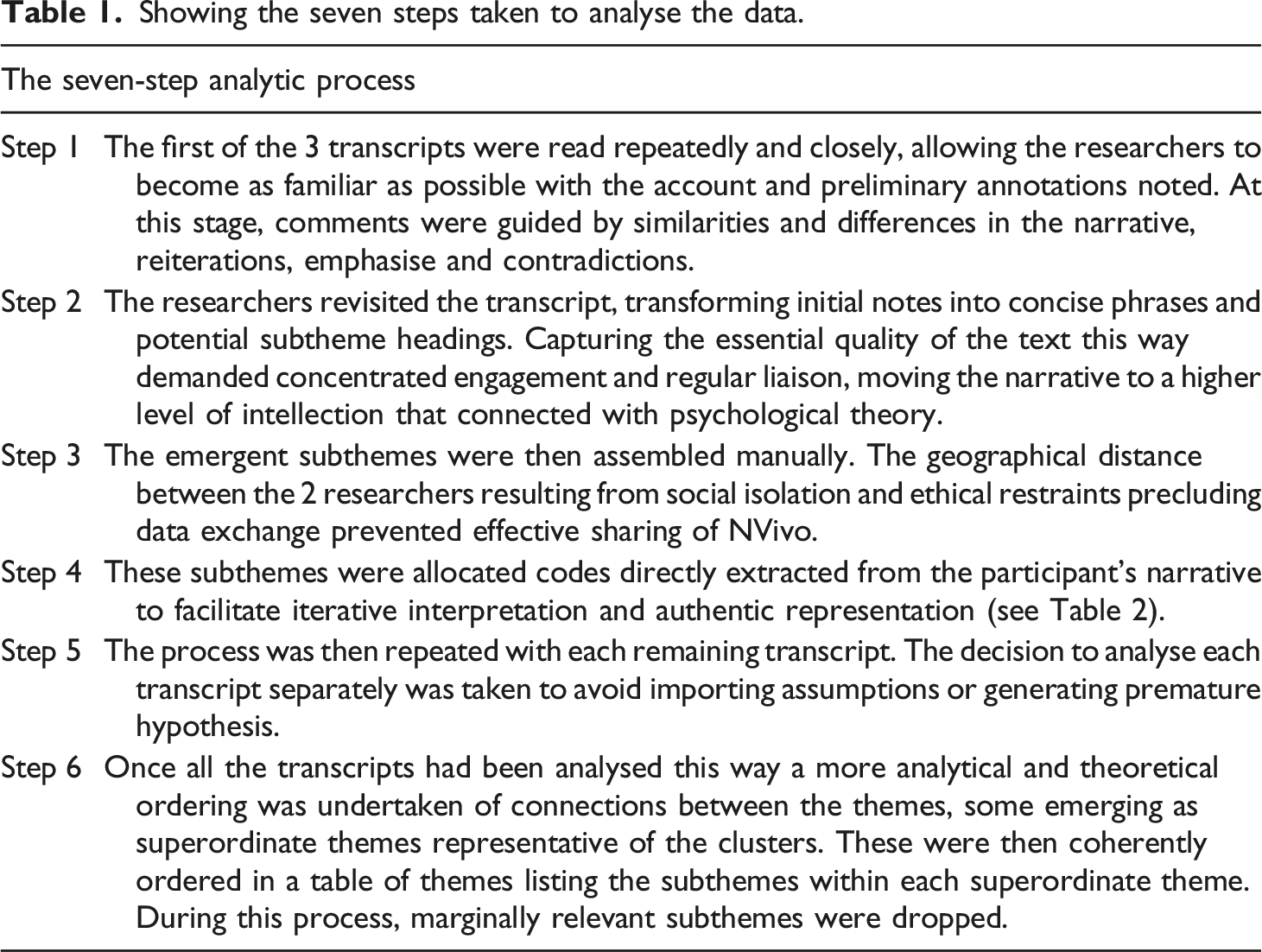
Showing the seven steps taken to analyse the data.
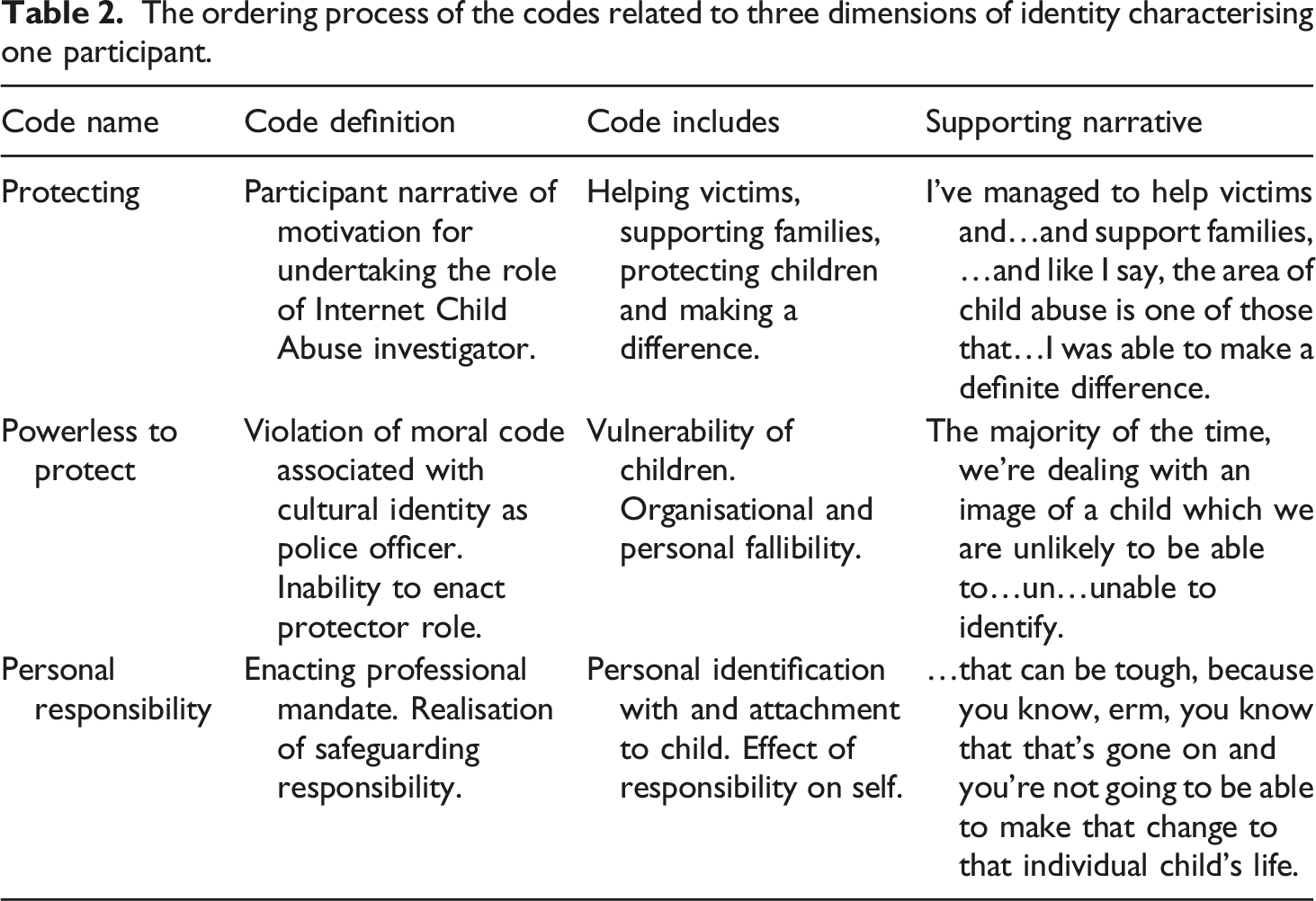
The ordering process of the codes related to three dimensions of identity characterising one participant.
Coding
When using IPA, Smith and Osborn (2008) advocate that validity demands that the ‘core essence’ of the participants’ lived experiences are encapsulated. This was achieved through populating a coding table using direct participant quotes to exemplify the emergent themes. Through regular discussion, the researchers documented and standardised coding decisions by assigning top-level codes to one transcript. These were ordered in a coding table.
The researchers met several times to discuss and consider their coding selections, until discrepancies were resolved and consensus reached. These subcodes were then assigned to the remaining five transcripts with frequent meetings to further consider discrepancies. This iterative process resulted in each transcript being reviewed four times, a process which also illuminated areas of convergence and divergence in the participants’ narratives such as the different coping mechanisms used to manage their distress.
Ethics
A favourable ethics opinion was granted by the University of Portsmouth Humanities and Social Sciences Research Ethics Committee and the Centre for Research and Evidence on Security Threats Security Research Ethics Committee. Because of the highly sensitive nature of the data in relation to policing and consequent security risks, additional clauses were requested by the funding organisation removed for blind review, in alignment with their own ethical conditions. Before the research could commence, the approved ethics application was appraised by removed for blind review and recommendations incorporated.
Findings
Of the four superordinate themes to emerge from the current research (see appendix 1), it is the impact of organisational role and environment that are developed below, in particular, how these relate to and effect practice. Included within this superordinate theme were the subthemes: psychological review and professional support, responsibility/agency over job, positive aspects of the work, and workplace environment and archetypal masculinity.
Psychological review and professional support
Whilst the participants acknowledged that practice support services were available through the police force, there was considerable scepticism not only about their effectiveness but also that these existed to satisfy occupational health requirements rather than the genuine wellbeing of employees. ‘… [A]bout eighty per cent of us go in, and tick those boxes, and walk back out, because we just don't find it […] fit for purpose at all’ (MI7541).
Uncertainty was commonly voiced that if accessed, professional support may jaundice future career prospects, particularly roles with a stressful or intensive focus. ‘I also don’t completely believe or trust that it wouldn’t […] come back to haunt you […] in the future if you went for promotion or another high-risk stressful role’ (866MI). Such fears also transferred to concerns that admitting to a mental health condition through official support channels would undermine the police officers’ professional profile in a way that prejudiced opinion. ‘I think it could affect peoples’ […] opinion of me in terms of my professionalism and how good a detective I am’ (1391MI).
Amongst the six participants, one individual expressed positive experiences that had reduced their anxiety, resulting from the counselling they received through organisational provision. Such positivity was not widely acknowledged, however, as typified by the scepticism of MI0122. …we are supposed to get a mandatory six monthly…face to face counselling session. […] in fifteen years, in this department, I have had four […] sessions. […] my boss and his […] boss, are both utterly dismissive of the value of counselling and they consider it to be…a complete waste of time.
Such managerial cynicism about the benefits of counselling was levelled in challenging language that may understandably have contributed to the reticence voiced above to access support. ‘[The manager] was very confrontational to [colleague] and [the manager] said…what did you have that you had to take forty five minutes to speak about?’ (MI0122)
Yet the interviews suggested that not only was there much to speak about, but the effect of the participants’ exposure to screen-mediated, graphic injuries caused specific, complex and serious psychological responses that were hinged on personal experience, particularly parenting. An example of this came through an excerpt from one police officer with young children. I just feel myself kind of being a bit more disturbed when the images come up in front of me […] particularly seeing just, little girls’ genitalia. [W]hen I didn’t have my own kids, I could just do the task at hand, and […] didn’t really think about them too much, because I didn’t deal with, I didn’t see those things in my house (MI022).
The plight of the children whose images they viewed appeared to effect the participants’ parenting styles, specifically in relation to their own children’s safety. ‘[My child] is not going on…anything network based, anything that can communicate with anyone, [my child] is going to be very much locked down’ (036MI).
Notably, when interviewed, several participants were reduced to tears whilst recounting their experiences, testimony to their intense anxiety. Many exhibited significant psychological damage consistent with secondary trauma (Luyten et al., 2020) and moral injury (Blumberg et al., 2018), that highlighted their need for specialist therapeutic support. However, it seemed this was not always available. One excerpt in particular captured the severity of the damage the ICAT officers faced on a regular basis, this individual’s breaking point consistently triggered by a particular image.
Participant: It [the image] was a torture and, err, rape and mutilation of…a couple of months old, I think [crying].
Interviewer: It does sound so terribly distressing.
Participant: It was done with such malice, hate and you just...[crying]…I couldn’t get my head around it at all, not at all… [crying] Yeah, that one did [coughs], I couldn’t, erm, [coughs], I had…I had to go home and I, err, I couldn’t go to work the next day. I remember just waking up and I actually cried and I didn’t know why I was crying in the morning, when I got up to work and it took me a minute to realise that’s what it’s about and I couldn’t…I couldn’t go to work.
Interviewer: Did you have any therapeutic support for it?
Participant: No, no I had a day off (MI036).
The participant’s trauma was so great that it had prevented processing and left them with just raw emotions and violated senses. Yet this critical event was not picked up on, with the participant resorting to just 1 day off for recovering from this. The quote suggests that such profound psychological damage may well fall beyond the remit of existing support systems within policing, which the participants considered insufficiently responsive in moments of dire need.
Responsibility/agency over job
In this subtheme, there was consistent evidence supporting the participant’s motivation and dedication to the role, particularly in relation to protecting vulnerable children. Such obvious commitment brought with it considerable anxieties relating to responsibility that were realised by the participants as personal accountability. ‘So if something’s wrong with me and I can’t fix it, it worries me’ (183 MI). The worry caused by such feelings of liability contributed to controlling behavioural patterns that one police officer jokingly referred to as ‘a bit OCD’ (Obsessive Compulsive Disorder) (183MI), but which impacted their professional interaction with peers. …and some people that you work with, you just, err, worry sometimes that they’re going to make a poor decision or they’re going to miss something…[which] can have a massive impact. …[I]f it’s somebody else’s job, I end up…not taking over, but […] involuntarily [laughs]… get too involved (183MI).
The unremitting workload placed the police officers under constant pressure, a factor they articulated as amplifying their sense of responsibility to susceptible children since the number of paedophiles they sought always outstripped capacity. ‘[O]ut there, there are thousands, if not millions, more that we still can’t get hold of’ (183 MI).
Apart from the significant psychological and physiological injury that unrelenting exposure to graphic images of child abuse caused the ICAT officers, they appeared stripped of self-agency, passively accepting the inevitability of burnout that their role would bring. ‘..it will come to a point where I’ll have another one of these [traumatic images] and I think I’ll be incapacitated again… there’s nothing you can do about it, you carry on I suppose’ (MI036)
A by-product of such powerlessness was the use of ineffective coping mechanisms to block challenging emotions which then, in turn, prevented effective processing and assimilation into existing personal belief systems. The data suggested that these challenging feelings inevitably surfaced later and in some other emotional guise, further compromising feelings of self-agency. ‘…there are some [images] that you just try and block out and just put to the back of your mind and hopefully they don’t surface too…too often’ (866MI).
Positive aspects of the work
Of all topics to emerge from the data, this subtheme provided evidence that the participants’ primary motivation and reward was a shared desire to protect the vulnerable children who fell victim to paedophile activities, as captured by 866MI. ‘[…] protect the…the vulnerable people that, erm, or children, that they [paedophiles] may well have been in contact with’.
This desire to safeguard the vulnerable was iterated as a core personal and professional value informing the participants’ moral framework. Personal reward was not confined to post-abuse protection but also derived from preventative education, with for example, ‘a teenage boy who [was] going through puberty, not had many relationships [,,,] and [who had] strayed into an area and maybe looked at a couple of images’ (183MI). Then, satisfaction came from utilising their professional experiences to exchange learning as a deterrent. ‘[It] allows you to then give your experiences across to people to educate them, so their kids don’t end up getting abused’ (183MI).
A source of considerable satisfaction arose from getting ‘a genuine result’ (183MI), an end point achieved, not by attaining a conviction, but from removing perpetrators from ‘the supply and demand chain for online sexual material’ (183MI). Such gratification may also help balance the sense of responsibility induced by the police officers’ overwhelming workload.
Workplace environment and archetypal masculinity
In addition to their role-related trauma, the participants articulated how the workplace environment compounded their anxieties, for example, workload pressures. ‘[W]e have six weeks in which to review the data and that’s not only doing the grading of the images, but it’s reviewing the chat logs, the web history, all the technical data that’s been extracted as well’ (183MI). A solution, according to the ICAT officers, was the provision of additional staff as this would enable ‘a bigger break in the middle, time to decompress, you know’ (036MI), by reducing the time spent viewing images.
There was consensus amongst the participants that exercise played an important role in defusing emotional energy and anxieties. ‘… to relieve myself from[…] work burdens […] I go out hillwalking and cycling all the time, just because I enjoy it… (MI022). The need to break from work was not just about decompression but also about gathering together their sense of identity since unremitting exposure to traumatic images fragmented normal baselines. ‘When I'm doing a workout, [I] kind of refocus myself, get my own identity back, before I go home’ (MI7541).
The findings suggested that there was little positive acknowledgement of the work undertaken, either verbally, through overt appreciation, or practically, in terms of pleasant working environments. ‘Our offices are atrocious, err, it’s cramped, it’s horrible, erm, they won’t move us into the bigger office’ (866MI). Simple and inexpensive practice solutions may come from award ceremonies that recognise and reward contribution, or wall posters featuring the constructive outcomes of the police officers’ work by way of affirmation. Further acknowledgement came from supportive managerial strategies that helped to communicate compassion. [T]he manager […] kind of, understands, […]because he tells… when you’re going in a low and they will offer you […] a different job for a bit or go for a walk or do this, they will interact with you, they won’t just let you go down the rabbit hole (MI036).
Sensitive management appeared an important practice consideration as it helped stabilise the stigma and fears articulated by the participants about seeking support. Notably, it may go some way towards defusing the masculine narratives pervading the findings and policing culture about men’s identity with mental health, as captured below. [P]olice officers who are good police officers, who…who really want to do their job properly…they deal with things on their own, they make decisions on their own, they don’t want to appear to be vulnerable or incompetent, or whatever, they don’t open up (183 MI).
Findings from the current study highlighted the diversity of experiences in relation to environmental and organisational influences and the complex phenomenological reactions to these by ICAT investigators. As such, they emphasise their importance in relation to practice.
Discussion
The aim of the research was to understand moral injury and belief change of investigators of online child sexual exploitation through an in-depth exploration of their lived experience. Within this IPA, four subthemes have been presented: psychological review and professional support, responsibility/agency over job, positive aspects of the work, and workplace environment and archetypal masculinity.
Previous researchers (Kamkar et al., 2019) have highlighted the increased risk of psychological work related injuries for police officers because of regular exposure to specific challenges that can exacerbate mental health disorders. Whilst this article has detailed the organisational support mechanisms already in existence within policing, as yet, these do not appear as effective as anticipated (Kamkar et al., 2019), suggesting that modifications to practice interventions may be needed.
In the subtheme Psychological Review and Professional Support, the participants’ narrative suggested that present support systems were not ‘fit for purpose’ (MI7541), advocating the need for change. One specific issue centred on fears that seeking help for mental health disorders may bias future career opportunities. This is of importance to the cultural environment, as stigmatisation is recognised as one of the primary deterrents to disclosing mental health conditions (Bullock and Garland 2018; Kurtz, 2008). This tendency was captured in the participants’ avoidance of seeking help and was evidenced to be amplifying individual reactions to trauma.
What operational barriers would participants like to see removed so that they feel more supported and valued? If they do not have faith in existing services available to them then what do they need?
A significant operational barrier in this regard was perceived by the participants to be the inauthenticity of the psychological review system, where, rather than an effective assessment of their existing and past mental health concerns being evaluated in depth, participants professed cynicism and suspicion of the system as designed to meet political mental health requirements within policing. This narrative suggests a fundamental omission in current psychological support provision, namely, trust. Brennan et al. (2013) highlight how the concept of trust is predominantly associated with situations of uncertainty and risk, exacerbated by asymmetric relationships between provider and recipient.
Given the tendency for ICAT investigators to disclose primarily to colleagues, one way of restoring symmetry may be peer supported mental health systems, as these have shown significant promise in other organisational settings, particularly high risk (Agarwal et al. 2020; Creamer et al., 2012) Apart from the obvious advantages of greater perceived empathy and respect this approach might offer, it could also reduce the fear of career prejudice and stigma that disclosure of mental health concerns to senior management and occupational health incurs.
Such disquiet resonates with other research (Stuart, 2017), flagging environmental stigma as central to the quest in advancing attitudes to the mental wellbeing of ICAT investigators. Concerns expressed by the participants that disclosure would undermine their professional profile, also implied that stigma was pervasive amongst colleagues, a problem peer support is known to improve (Corrigan et al., 2008). Further, officers seeking counselling can be viewed as weak and lacking resilience (Toch and Bailey, 2002). This suggests that overcoming stigma requires interdepartmental, as well as organisational education, about the emotional, behavioural and psychological conditions characterising the traumas and moral injury typifying ICATs’ work, a step perhaps towards stabilising a mental health agenda.
Much could be done is this respect. One option is accessible, TRIM trained representatives, whose contact details are openly available within ICAT offices, known and promoted by senior managers. Preventative and interventional measures such as these have been found to facilitate coping and prevent mental health concerns from escalating (Summerfield, 2011) by encouraging a proactive approach to mental health. Moreover, by involving managers, attitudinal change about mental health would be addressed at an organisational level, an essential according to Bell and Eski (2015). This approach could be enhanced through education programmes that enlighten managers about the moral injury and complex trauma characterising the work of ICAT investigators, enabling early identification of the triggers and warning signs of mental health conditions.
The findings underlined the devastating and diverse impact upon the ICAT investigators, inherent in their role, ranging from disrupted emotional and cognitive processing, through to burnout. Whilst various mental health support programmes are already available within policing, these are generic and intended to address the wide spectrum of policing challenges. Screening for the specific factors characterising complex trauma and its consequences may help identify bespoke support that targets the specific needs of ICAT investigators (Kamkar et al., 2019). Ideally, this would be provided independently, negating any connections between disclosure and career prospects.
From the data, it emerged that a key concern exacerbating ICAT investigators’ existing anxieties and contributing to their moral injury and complex trauma, was the psychological profile of being a parent. This compromised emotional processing and amplified psychological injury. Whilst existing psychological screening includes preliminary assessment of trauma, the effects of this as exposure to graphic images intensifies with time, is not measured. Longitudinal screening that includes in-depth and psychometrically validated measures of trauma and moral injury, would provide baseline statistics for comparison over time. Evidence suggested that their work as ICAT officers also impacted on protective parenting behaviours. Whilst there appears no discernible literature focusing on parenting in relation to ICAT investigators, previous findings into the effect of child abuse on parenting styles suggests similarities, in that confidence in childrearing and the ability to manage the demands of parenting are diminished (DeLillo and Damashek, 2003), leading to symptoms associated with depression and anxiety. In the current study, this was exemplified as a tendency for participants to compromise their children’s need for autonomy. At least therefore, some screening would ideally be available for parents at the recruitment phase to the role. Possibly, parents may not even be suited to the post.
The participants exhibited diverse and maladaptive strategies for preventing the effects of their traumas from being effectively processed, placing themselves at increased risk of developing a range of psychological disorders.
More detail needs to be given about the ‘failing coping’ methods employed by ICA team personnel. Why do they fail? Are they all negative (e.g. drinking more alcohol and socially withdrawing) or are some positive yet still fail to help them cope with the onslaught on their wellbeing (e.g. regular exercise and support of colleagues).
An important question is why their coping mechanisms fail. Previous authors (Anshel, 2000; Balgaonkar et al., 2014; Roach et al., 2018) have identified positive coping mechanisms utilised by police investigators in other stressful settings which bear similarities to the tactics employed by the ICAT investigators in the current study (exercise, collegial support and social support). However, several divergent factors exist which potentially contribute to the failure of the coping strategies utilised by ICAT investigators. Firstly, unlike the ICAT investigators, the participants in the study by Roach et al., 2018, for example, articulated awareness of the heightened stressors conditional with their role. Conversely, five of the six interviewees in the current study professed little or no negative impact from their work. Of these, four were reduced to tears several times before the interview concluded, suggesting denial as a fragile platform for successful repair.
Secondly, three of the six participants disclosed developmental abuse during childhood. It may be that, as with other helping professions (Tillett, 2003) some individuals are drawn to investigating online child abuse in an attempt to repair personal and historic damage, raising the question as to whether successful coping mechanisms can ever, or should ever, be successfully built upon damaged scaffolding.
Lastly, unlike their peers from other divisions, ICAT investigators seldom deal with individual cases, with time to reflect and assimilate coping strategies into their defences. Exposure to graphic images is continual, repeated (up to four thousand images viewed daily by each investigator) and relentless, assaulting their personal barricades without reprieve. The beneficial effects of positive coping mechanisms have no time to take effect.
Peer supervision groups may provide part of a solution, with research by Lepore (2001) highlighting the positive effect of supportive peer networks in facilitating discussion of trauma-related thoughts and feelings and therefore processing these more effectively. Whilst such measures may contribute to the processing of traumatic memories the apparent and inevitable articulation of eventual burnout suggests that the role is time-limited. Regular rotation of roles may go some way towards minimising the impact of exposure to graphic images.
Given the critical role of ICAT officers, practice has a duty of care to understand and support the individuals assuming these roles. Cognitive behavioural-based interventions offer a potential model for psychoeducation programmes aimed at understanding the cognitive and affective experiences connected to trauma and how to manage these. Content for future trialling may be enhanced by drawing on the development of a model for dealing with secondary traumatic stress in mental health workers in Rwanda. This included preventive, evaluative and curative strategies to manage trauma-related symptoms at an individual, social and organisational level, which may meaningfully transpose to the current context (Iyamuremye and Brysiewicz, 2015). Whilst such strategies would go some way towards reconciling the psychological damage incurred by ICAT investigators and inform organisational practice, applied changes such as improved decompression facilities and proper breaks could also contribute. Exercise, for example, was cited by participants as intrinsic to stress relief and their suggestions included on-site gyms and relaxation facilities such as sensory rooms.
The participants articulated disappointment and despondency that their efforts were neither acknowledged, nor appreciated either within their own department or by others within the police force. Simple strategies to redress this deficiency could include posters displaying statistics of those perpetrators removed from the chain, in addition to award ceremonies that recognised the essential and onerous work of ICAT investigators. One participant expressed much satisfaction in using their skills to educate young people, both from a preventative and informational perspective, regarding the risks surrounding online sex crimes against children. Whilst this tactic is not currently standard practice, utilising their skills this way would reinforce professionality and endorse the ICAT investigators’ contributions.
Perhaps the biggest impediment to gaining traction for any mental health programme however is culture, a factor within the police force that, according to Deschênes et al. (2018) has more influence in determining an officer’s mental wellbeing, than the nature of the job itself. Based on a form of stoicism, this attitude was expressed by the participants as the endurance of adversity without a display of feelings or complaint. Whilst extolled by some as a virtue, such stoicism was realised as distrust and scepticism of organisational leaders that led to survival attitudes to work. Educational, training and screening activities could contribute towards normalising the language of mental health within the workplace through accommodation and understanding of the impact the work undertaken by ICAT investigators is having upon their wellbeing.
Limitations
Due to lockdown restrictions associated with COVID 19, the focus of police work was directed at upholding Government related guidelines meaning the anticipated sample of 7–10 reduced to six participants. Whilst IPA is suited to small samples, generalisations could not be made from the findings. In addition, the interviews had to take place using video conferencing. The effect of this and COVID 19 upon participant responses is unknown. The lack of video-camera may have impeded the relationship between interviewer and participant or, given confidence to individuals to discuss sensitive issues. Key concerns highlighting the severity and frequency of certain phenomena could have been developed in more depth and these will form the focus of future research.
Conclusion
This exploration of the lived experiences of ICAT investigators highlighted their key concerns in relation to the impact of organisational role and environment, upon moral injury and trauma. The ICAT officers suggested that current provision of psychological review did not meet their needs, a situation attributed to the generic nature of existing support systems and the culture within which it operates. The complex nature of both the moral injury and secondary trauma they experience may benefit from targeted approaches specific to their mental health needs.
Those at particular risk included individuals with prior trauma and parents. Suggestions for potential solutions to explore in the future include psychoeducation and peer support groups, underpinned by the availability of specialised interventions. Practice-based solutions such as longer breaks, decompression facilities and rotational duties could also ameliorate the impact upon the wellbeing of ICAT officers in this role. In addition, improved recruitment strategies, ongoing support of staff, training suggestions, and targeted evidenced-based psychological training and intervention would meaningfully inform the focus of future research.
Footnotes
Declaration of conflicting interests
The author(s) declare no potential conflicts of interest with respect to the research, authorship, and/or publication of this article.
Funding
This work was supported by The Centre for Research and Evidence on Security Threats, grant number ES/N009614/1.
