



Abstract
“Especial skills” exist in learned skills with regulated execution distances (e.g., basketball and baseball); however, no study has explored this effect for non-distance regulated skills. Therefore, this study explored whether the especial skill effect exists for actual versus predicted performance outcome variability (i.e., precision) or accuracy measures when executing golf pitch shots to an individually-preferred distance, based on the outcomes from four non-preferred distances. Ten skilled male golfers were recruited (three PGA Professionals and seven amateurs, Mage = 24.6 ± 5.0 years, Mhandicap = 2.1, SD = 3.2) and executed 50 quasi-randomly ordered shots using their own preferred “wedge” club (e.g., pitching, gap, sand, and lob wedges). Ten shots were executed to each target distance at 10-yard intervals from an artificial turf mat into an indoor net 4.5 m away without any outcome feedback. Performance outcome was measured using a photometric-based golf launch monitor. Precision was ≥10% improved when compared to the predicted value at the preferred distance for half of the participants. However, the prevalence of this effect was limited when considering accuracy measures. Data showed initial support for investigating the especial skill effect in non-distance regulated skills since there were positive effects for some but not all golfers. Future research would benefit by considering contemporary motor control theories and interdisciplinary applied factors to extend investigations of especial skills.
Keywords
Lewin’s (1952) statement that “there is nothing more practical than a good theory” (p. 169) provides an approach to evaluate scientific principles in applied contexts. In this regard, Christina (1987) proposed that evidence from, and understanding of, sport could inform “basic” theories. In motor learning and control, this has been demonstrated when studying the linear force × variability hypothesis (Schmidt et al., 1979), which states that performance outcome variability should increase (i.e., decreased precision) with greater force application. Therefore, when hitting/throwing/jumping with greater force, the outcome precision should decrease. However, this hypothesis has been falsified in basketball free throwing by players demonstrating superior performance at the 15 ft. free throw distance than predicted based on results at nearer and further distances. Indeed, not only have studies shown better performance than expected based on linear predictions, basketball free-throwing success is often better than from closer distances (i.e., 13 ft. and 11 ft.; Keetch et al., 2008; Keetch et al., 2005). Keetch et al. (2005) termed this phenomenon the “especial skill”, referring to a specific learning effect within a general class of movement. In the original study of the especial skill, these authors elaborated on their choice of the term as meaning “distinguished among others of the same class” (p. 976), thus elevating this skill to a higher performance status and making it stand out by comparison with other adjacent members of the same movement class. Since then, studies in other sports have also shown the same effect when executing learned skills at a specific regulation distance (e.g., baseball and archery; Nabavinik et al., 2018; Simons et al., 2009). Extending this research to sports whereby skills are performed at unregulated distances (e.g., golf) could further evaluate this practice effect and lead to novel insight for wider application by players/coaches.
Mechanistically, theorists investigating this effect agree that the especial skill relates to accumulating very large amounts of specific execution experience. Two ideas on what underpins the especial skill are available in the learned-parameters and the visual-context hypotheses. The learned-parameters hypothesis suggests that players develop more accurate motor memory recall for the task (i.e., force output for a specific distance). In contrast, the visual-context hypothesis proposes that performance is facilitated by stereotypic visual information (e.g., the consistent court lines in basketball) that provide specifying information pertaining to the execution. An example of a study that supported the learned-parameters hypothesis is by Breslin et al. (2010) who found that using a heavier basketball from 15 ft. did not produce the especial skill effect. In contrast, Czyż et al.’s (2015) study found support for the visual-context hypothesis in that blurring the vision of basketball players removed the especial skill effect from 15 ft.. Following a literature review, Breslin et al. (2012) proposed “the learned-parameters explanation for the especial-skill effect is perhaps additionally moderated by the visual sensory context” (p. 346). Whether the balance of these different mechanisms’ prominence (i.e., internal memory recall or perceiving specifying visual information) depends on the type of task and experience of the performer are areas that could extend current research. Golf as a context, where task execution is not from a universally pre-determined distance by the sport’s regulations, therefore, could be used to explore such ideas underpinning performance effects.
Golf short-game skills such as putting, chipping, and pitching require different swing amplitudes and impact forces to propel the ball various distances. Within these skills, pitching requires a longer swing amplitude and generates higher clubhead speeds, thus making consistent and accurate force production more demanding. Pitching is defined by the use of a high-lofted club (i.e., wedge) to propel the ball on a high trajectory with a large amount of backspin to get the ball as close to the hole as possible on the shorter-grassed “green” (Kim et al., 2017). Crucially, because pitching occurs relatively close to the hole, the golfer uses different variations of swing length that are all less than a full swing to regulate the force needed depending on the distance (Pelz, 1999). Force is generated by the upper (arms) and lower (golf club) “levers” being moved by the torso as a swing. Greater force applied through the levers leads to higher clubhead speed which, together with the ball–club contact quality, affects the initial ball speed and most strongly determines the distance hit (Betzler et al., 2014; Sweeney et al., 2013). Importantly, the distance that a golfer must perform from when pitching is not regulated by the rules of the game. In this case, the distance and club may reflect the player’s strategy and/or their potential training preferences to consistently achieve desired distances. It is possible that golfers in such cases will engage in disproportionately greater amounts of practice from this distance to promote consistency of action on the course. Therefore, a skilled and experienced golfer may have developed an especial pitching skill at a preferred distance with a club that they most favor. Importantly, current research has not investigated such an unexpected especial skill in golf when compared to sports such as basketball, baseball, and archery where massive amounts of practice are known from a set distance.
Given the variation in force production demanded of the pitching skill and its association with technique, an initial extension of the especial skill research in unregulated distance sports could explore ideas proposed regarding learned-parameters. Indeed, previous research suggests that more skilled athletes’ execution relies less on visual stimuli (i.e., the visual-context) and more on kinaesthesis as a source of information after learning has occurred. For example, Bennett and Davids (1995) investigated the positional accuracy and timing consistency of less skilled, intermediate, and skilled weightlifters executing the powerlift squat under full, ambient, and no vision conditions. Data revealed only the skilled group to be unaffected by the diminished information afforded under the ambient and no vision conditions. These data suggest that the execution of a learned (very) closed and self-paced skill, at least, is not dependent on the specific environmental stimuli in which acquisition has occurred. Instead, practice at retrieving the desired movement form from memory becomes more reliable and established, making the process less susceptible to interruption when presented with different external conditions. As such, the present study explores the initial premise of such learned parameters as a possible explanation, if there is enhanced control in golf pitching.
Whereas previous literature has determined the especial skill by percentage success and various error scores (e.g., hitting the basketball rim), the criterion outcome measure in golf must be adapted for the variable task characteristic, as the ball rarely finishes in the hole when pitching. Also, Fischman (2015) stressed that points-based scoring systems consisting of concentric circles around the target centre are problematic because trials can score equally but be a considerable distance apart (e.g., Singh & Wulf, 2022). In these cases, the scores do not accurately reflect consistency, nor demonstrate an especial skill effect. Accordingly, performance precision, as determined by the ball dispersion area, would be a more novel and appropriate measure as an addition to similar error-based derivatives within the literature. Referring back to the force × variability hypothesis, shot outcome precision would, therefore, be expectedly lower as the distance hit increases. Such a relationship would represent a generalized learning strategy for pitching. In contrast, better than predicted precision at an individually preferred distance would suggest an especial skill effect in golf.
Therefore, this study aimed to explore whether an especial skill effect existed within a sample of skilled golfers performing pitch shots. Specifically, we were interested to assess whether this would be present for the actual versus predicted performance precision and/or accuracy when executing to a preferred distance, based on a linear relationship between the outcomes at four non-preferred distances, using participants’ self-selected club for pitching. The presence of an especial skill effect in golf pitching would be revealed by improved levels of precision or accuracy (or both) than predicted at the preferred distance.
Materials and Methods
Participants
Ten right-handed male golfers (Mage = 24.6 ± 5.0 years) volunteered to take part in this study. To ensure that participants were sufficiently experienced at the task, all were long-standing players with a handicap of ≤7 (three PGA Professional coaches with handicaps of ≤4 upon turning professional and seven amateurs; Mhandicap = 2.1 ± 3.2; playing experience M = 12.5 ± 5.7 years).
Ethical Considerations
Before data collection, participants read an information sheet and provided signed informed consent to take part and to have their data published in an open access repository that is associated to a published work. Ethical approval was awarded by the Moray House School of Education and Sport’s Ethics Committee at The University of Edinburgh (Ref: HCAR30092021).
Procedure
Participant Preferences for Club and Distance
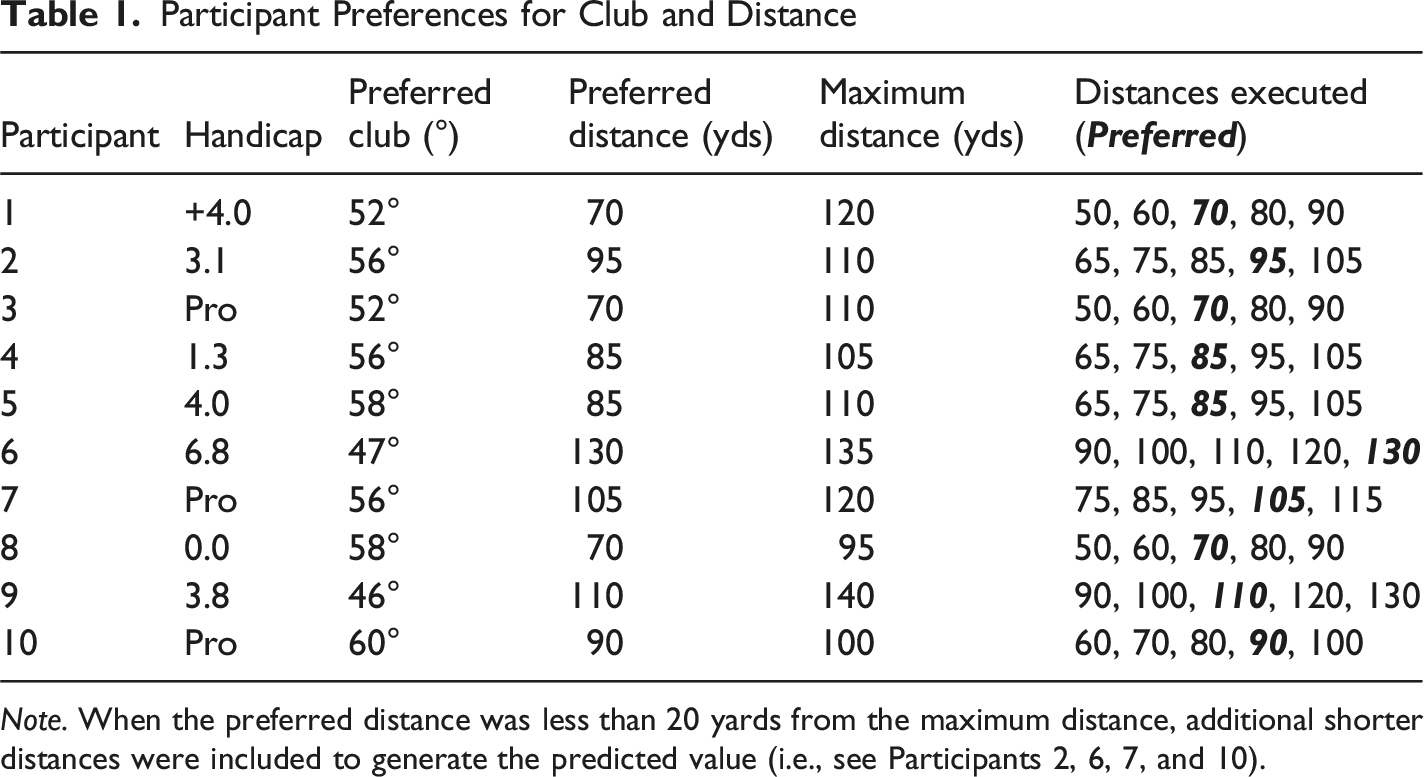
Note. When the preferred distance was less than 20 yards from the maximum distance, additional shorter distances were included to generate the predicted value (i.e., see Participants 2, 6, 7, and 10).
Three minutes following the warm-up, participants executed 50 shots from a 1.5 m2 artificial turf mat (HUX-BASE-350-SYSTEM, Huxley, UK) towards a vertical line fixed onto an indoor net (Golf Swing Systems, UK) approximately 4.5 m away (see Figure 1). It is acknowledged that this setup is not representative of actual golf course playing conditions, however, that was not our intention at this initial exploratory stage of investigation. In addition, minimal visual information was provided in the form of a vertical aim line (in part for safety reasons) to guide shot direction, although this did not offer any contextual visual information pertaining to the manipulated target distances, which would have compromised our intention to probe the learned-parameters idea. By employing the use of an indoor setup, it ensured that any between-distance effects were not due to environmental differences between participants or trials (e.g., the wind, hitting surface, and temperature were all the same). Each shot was executed with the participant’s chosen wedge and legally conforming golf balls (Titleist PRO V1X, Acushnet, USA). Selected distances were 10 yards apart (yards are the standard unit of measurement for golf in the UK), with the preferred distance ordered centrally and two longer/shorter distances either side unless the preferred distance was closer to the maximum, in which case additional shorter distances were chosen. Shot order to each distance was quasi-randomized, whilst being balanced across the participants. Specifically, there were five blocks of 10 shots in a randomized order, with two shots to each distance per block. Each trial was separated by 30 s and a 1 min break was offered after each block to avoid tiredness. A trial required executing the shot as accurately as possible towards the vertical line in their own time and to achieve the required distance that was called by the researcher. No augmented feedback was provided (i.e., distance hit or lateral deviation from the target), nor was any verbal feedback (e.g., “good shot”) given relating to other aspects of the performance. The absence of augmented feedback, in combination with hitting into a net, ensured that any study effects could only be attributed to a difference in learned parameters and not the visual context since each specified distance was environmentally identical. Indoor experimental setup showing the net, target location (fixed vertical line), artificial golf mat, ball, and ball tracking equipment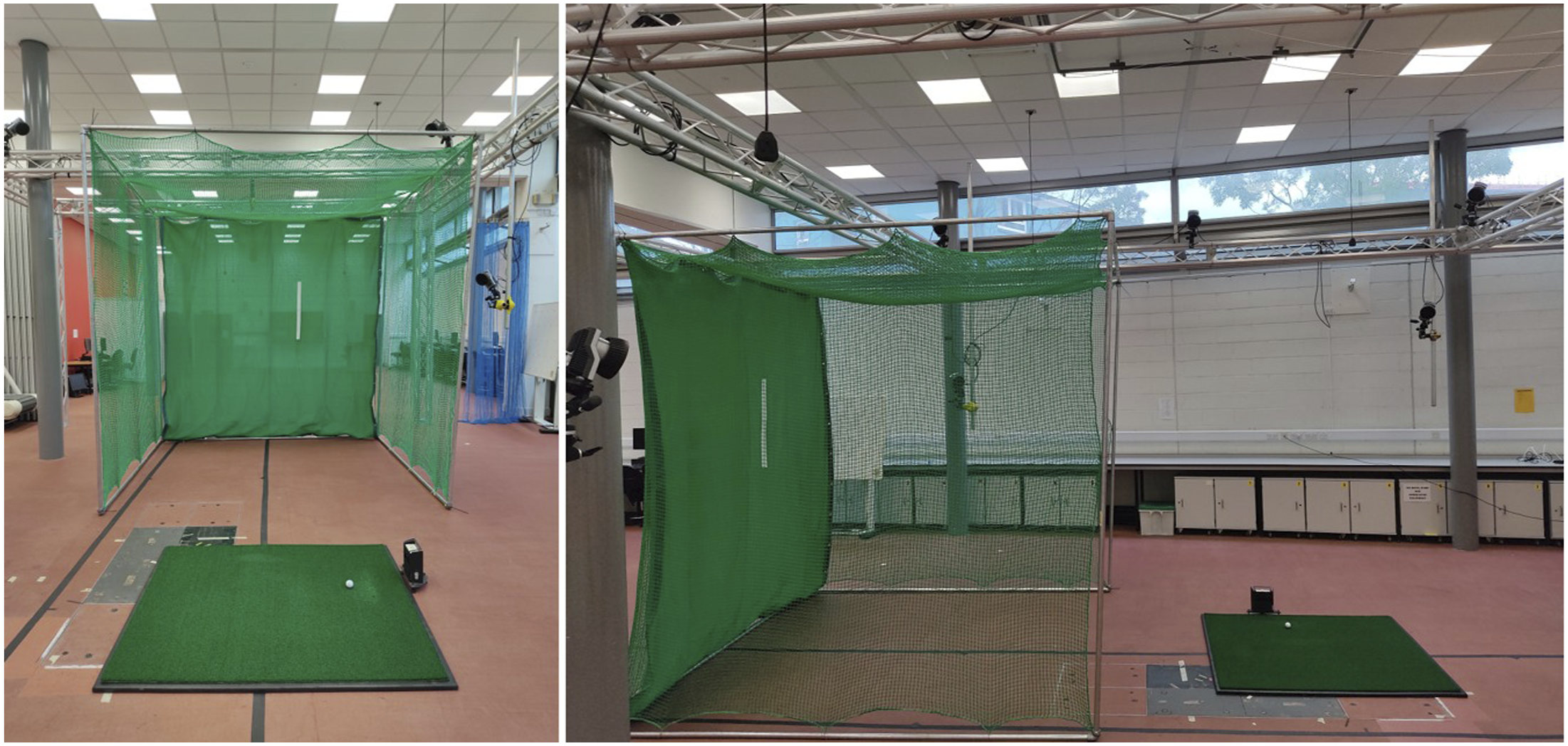
Apparatus
Performance outcome was measured using a photometric-based golf launch monitor SkyTrak (Model REE 2.0, USA), which has previously been used in golf biomechanics research (Joyce et al., 2022). Specifically, the photometric system takes precise measurements of the ball movement immediately after impact to provide shot outcome data (i.e., distance and direction) and is generally accepted to deliver accurate results in an indoor environment.
Data Processing and Analysis
Carry distance and lateral error (both in yards) of 10 shots at each distance from SkyTrak software were exported to Microsoft Excel (Redmond, USA). Carry distance was defined as negative if the ball landed short of, and positive if the ball landed beyond, the target distance. Lateral error was defined as positive if the ball landed to the right of target as seen by the golfer, and negative if the ball landed left of target.
To analyse the 10 shots at the five distances for each player, the concepts of precision and accuracy were used. Specifically related to performance outcome variability, Challis (2008) showed that high precision gives a small dispersion around the mean values whereas low precision indicates a wide dispersion. Therefore, decreased precision would infer increased variability and vice versa. Precision was calculated using a relatable metric for golf coaching; shot ellipse area. In this method, a best-fit ellipse was applied to all 10 shots at each distance, with smaller ellipse areas indicating greater precision.
The best-fit ellipse algorithm used was that of Halir and Flusser (1998) and a program in Python (Python Software Foundation, USA) was written to determine the five ellipse parameters (carry centre, lateral centre, semi-major axis [a], semi-minor axis [b], and tilt angle) and the ellipse area (Area = πab) was then calculated. These were then incorporated into a Microsoft Excel spreadsheet to plot the best-fit ellipses (e.g., Figure 2). The use of this best-fit algorithm also reduced the effect of any severe outlier in the data. Ellipse areas exemplar data for four non-preferred (A, B, C, and E) and one preferred (D) distance for Participant 10. Point (0, 0) on graphs represents target centre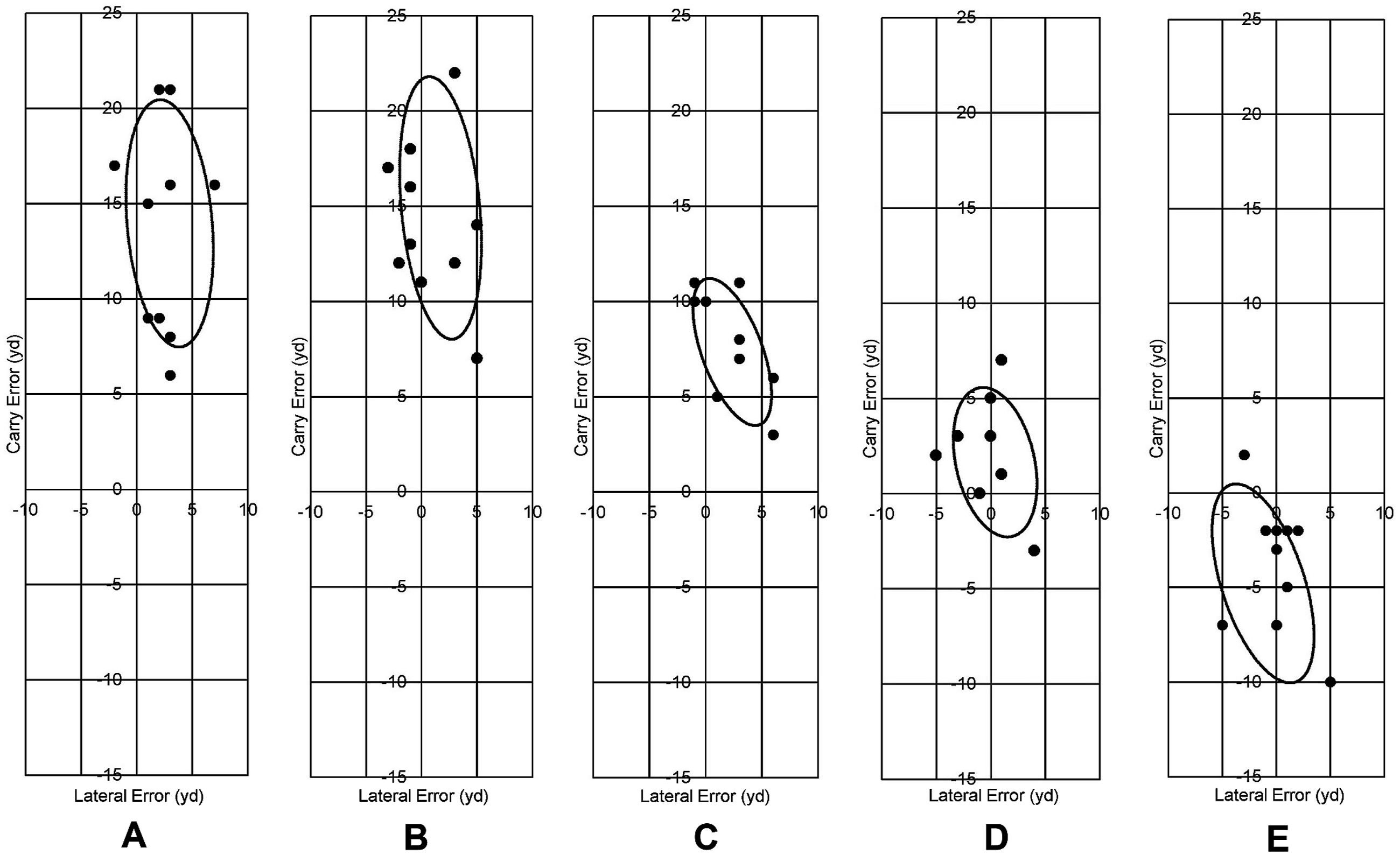
In addition, the bivariate variable error at each distance was determined by calculating the mean of the radial distances of each shot from the mean carry distance and lateral error values at that distance (see Frank et al., 2016). A small bivariate variable error indicates high precision and a large value indicates lower precision.
Accuracy was defined by Challis (2008) as the difference between a true value and an observed value, so for the current research the mean carry distance from the target and the mean lateral distance (from 0, the target line) were used, as it was important to include both positive and negative values (long/short and right/left).
Simple linear regression analysis for each participant was performed using the four non-preferred distances to generate an equation of line of best fit. Indeed, individual data analyses are common in such studies due to recognized inter-individual differences (e.g., Dicks et al., 2017) and are recommended within fundamental motor control research (Pacheco & Newell, 2018). A predicted value for the preferred target distance was then calculated and compared to the actual mean value calculated from the 10 preferred distance trials. An actual value lower than the predicted would thus indicate an especial skill effect as precision or accuracy at the preferred distance would be better than predicted. This analysis was performed for the following dependent variables; best-fit ellipse area, bivariate variable error, carry distance error, carry distance error as a percentage of the target distance (as these varied in size), and lateral error. The first two variables denote precision, with the other three representing accuracy.
To assess the accuracy of the predicted values for the dependent variables at the preferred distance, the standard error of the estimate (SEE) was calculated for each regression line. Then, 95% lower and upper limits were calculated from the SEE (Howell, 1992) to define a 95% confidence interval (CI) around the predicted value. If the actual value for any precision or accuracy variable at the preferred distance lay outside the 95% confidence interval, the actual value was considered meaningfully different to the predicted value. If the actual value was also lower (closer to zero) than the predicted value, this would suggest support for an especial skill effect.
Results
Percentage Difference Between Actual and Predicted Scores of Precision (Ellipse Area and Bivariate Variable Error) and Accuracy (Carry Error, Carry Error as Percentage of Target Distance, Lateral Carry Error) at Preferred Pitching Distance
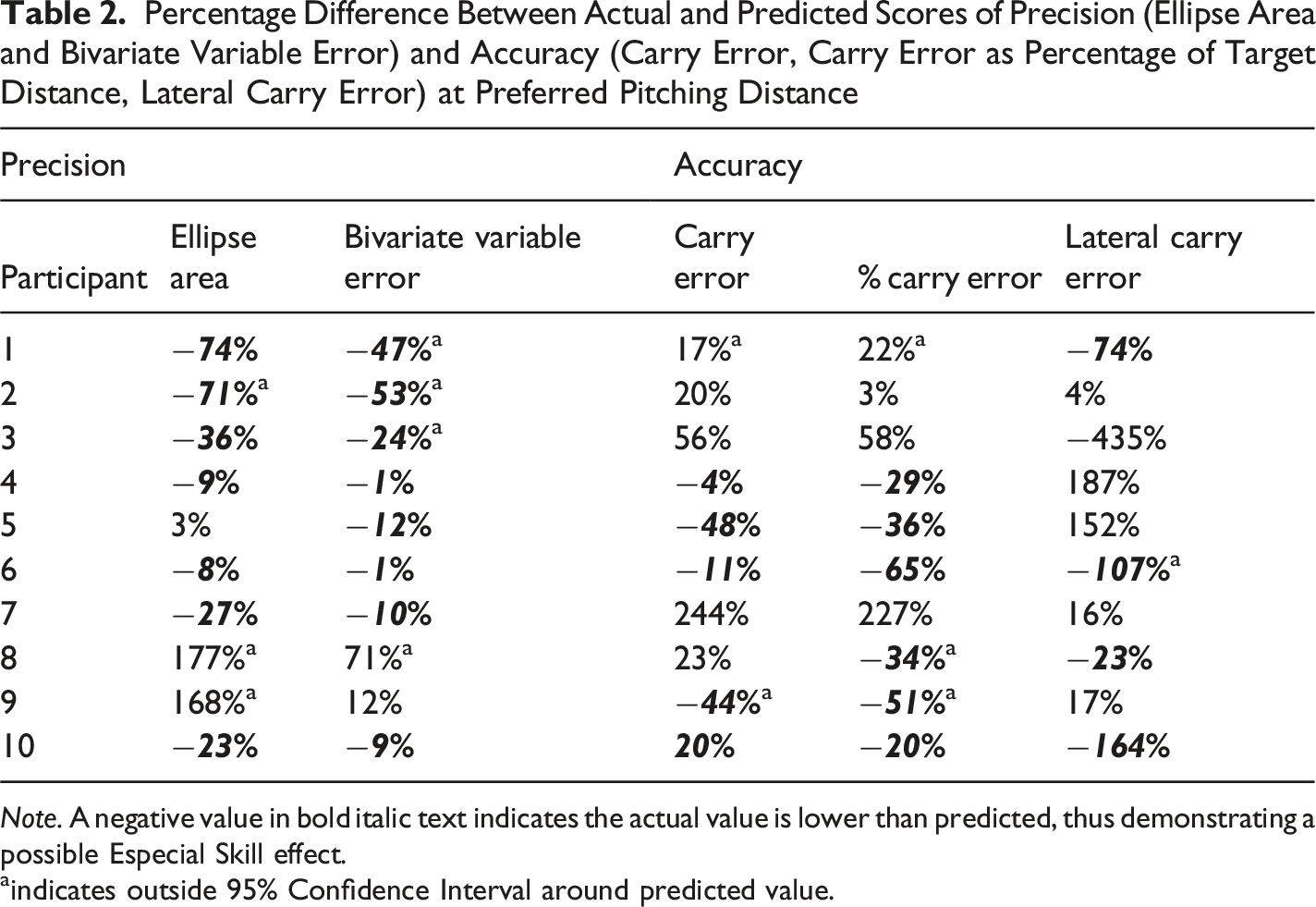
Note. A negative value in bold italic text indicates the actual value is lower than predicted, thus demonstrating a possible Especial Skill effect.
aindicates outside 95% Confidence Interval around predicted value.
Precision
Ellipse area results did not clearly show decreased precision with increasing distance for any participant. For seven out of the 10 participants, outcome precision was higher than predicted at the preferred distance. Specifically, for five participants, the actual value was ≥10% lower, for three participants, the actual value was within 10% difference, and for two participants the actual value was over 10% higher than predicted.
Figure 3 demonstrates the outcome performance precision, as revealed by the area ellipses, at preferred distances and the linear regression line from non-preferred distances for all participants. Those participants (1, 2, 3, 4, 6, 7, and 10) with values lower than predicted from the regression line, and thus greater precision than expected, can be contrasted with Participant 5 whose actual value is on the regression line, and with the two participants (8 and 9) whose outcome performance precision ellipse areas at the preferred distance were higher than predicted and therefore showing lower precision. Linear regression lines from non-preferred distances, outcome performance precision results (ellipses) and predicted results for all participants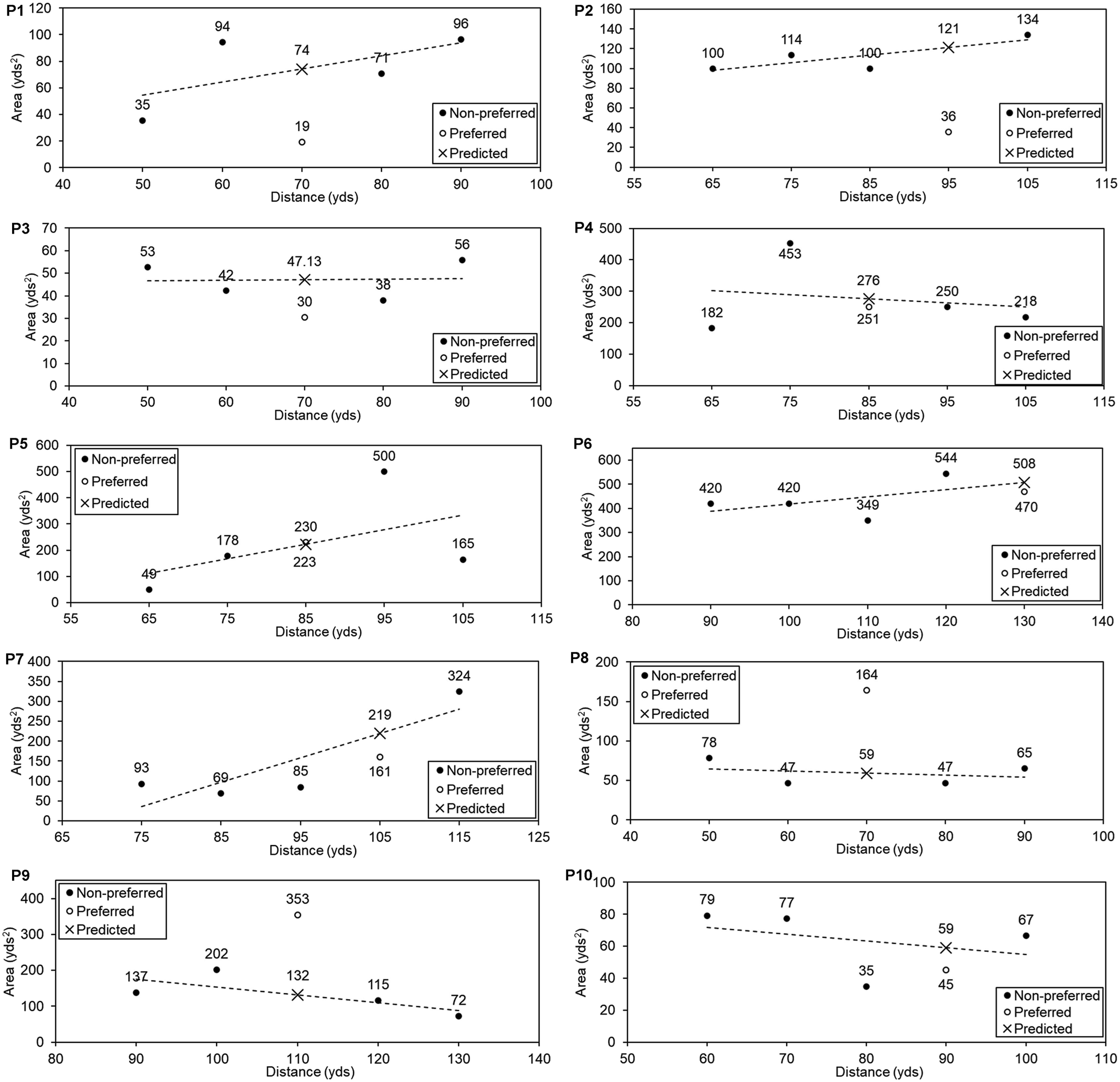
Using the 95% CIs to assess the differences between the actual and predicted values at the preferred difference, it was found that three participants (2, 8, and 9) showed statistically stronger results. Participant 2 showed a greater level of precision than predicted at the preferred distance, suggesting an especial skill effect. In contrast, Participants 8 and 9 demonstrated lower precision than that predicted for their preferred distance.
The bivariate variable errors showed lower values (i.e., greater precision) than predicted for eight of the 10 participants, with five participants being ≥10% lower, three participants with an actual value within 10% difference, and two participants having an actual value over 10% higher than that predicted. When considering the 95% CIs around the predicted value, there were lower values for actual compared with predicted values (greater precision) for three participants (1, 2, and 3), again suggesting stronger statistical effects. Participant 8 again showed lower precision at preferred distance using the bivariate variable error.
Accuracy
For some participants, results showed an increase (Participants 1 and 5) or a decrease (Participants 2, 4, 6, 9, 10) in carry error with an increasing target distance. Linear regressions for carry error found that four participants showed smaller carry errors than would have been predicted, and six showed larger values than predicted.
Only Participant 9 showed greater accuracy than expected when the 95% CI was included in the predicted value calculations. Participant 1 showed lower accuracy than was predicted by the regression.
As the targets ranged from smaller to larger distances, the same carry error in yards produced larger percentage differences at the shorter targets than the farther ones; therefore, it was also important to consider the carry errors as a percentage of the target distance. Similar patterns as in the raw carry error data were shown with Participants 1 and 5 showing increasing and Participants 2, 4, 6, 9, and 10 showing decreasing percentage carry errors as target distance increased. Linear regressions again found that six participants had smaller carry errors and four had larger carry errors than predicted. When including the 95% CI of the regression, Participants 8 and 9 showed statistically greater accuracy than predicted whereas Participant 1 again showed lower accuracy than predicted.
There were fewer linear patterns between lateral error and target distance with only Participants 6 and 7 showing an increasing and Participants 5 and 10 a decreasing trend with an increase in target distance. When analysing the distribution of the actual−predicted differences, it was found that there were five positive and five negative values. Only Participant 6 showed a greater lateral accuracy than predicted when 95% CIs were included, and no participants showed a lower lateral accuracy than expected.
Discussion
In exploring whether there is an especial skill effect in golf pitching, we proposed that if this was to be the case, there would be higher precision or increased accuracy (or both) when executing from the preferred distance compared to that which would be linearly predicted from outcomes at four non-preferred differences. Overall, our results suggest some partial evidence toward identifying an especial skill effect for higher precision but less so for increased accuracy. Most notably, consistent with the views of Pacheco and Newell (2018), data indicate a need for inter-individual analyses, as recommended by previous motor control research concerning movement variability (Carson et al., 2014), eye gaze (Dicks et al., 2017), and body sway and aim point (Ball et al., 2003). Reflecting mixed findings in the current study, particularly that not all participants demonstrated evidence of an especial skill effect, the following discussion addresses key analytical, theoretical, and applied considerations at this current stage of investigation with the view to informing future research.
Analytical Reflections
There are several points to consider when discussing the analysis methods used in this study. Firstly, linear regressions were used to predict the expected values for precision and accuracy variables at the preferred distances, which were then compared to the actual values achieved. The reasons for using a linear regression were twofold. The linear force × variability hypothesis (Schmidt et al., 1979) suggested that precision and accuracy would be lower at greater distances and thus we used a linear regression. Also, any more complex relationship between force and variability relating to an especial skill effect in golf was unknown, so a simple relationship was tested first. However, it could be that an especial skill effect might produce a “U”-shaped curve with the nadir at the preferred distance. It is suggested that further research might explore more complex relationships between variables to examine in more detail how especial skills in non-distance regulated sports might be identified on an individual basis. In this way, an especial skill could still be defined as “distinguished among others of the same class” (Keetch et al., 2005, p. 976), but present differently compared to distance-regulated skills.
Secondly, some of the percentage actual−predicted differences presented in Table 2 are very large, particularly in the lateral carry error data. This is mainly because the raw values (yds2 or yds) in these cases are very small and so even minor differences between actual and predicted values will result in large percentages.
Lastly, although seven out of ten participants showed smaller than expected ellipses (and thus greater precision) at the preferred distance, only one of these was present when the 95% CI around the predicted value was included. The bivariate variable error showed similar data with eight participants showing greater precision but only three being lower than the 95% CI. Accuracy data were more equivocal in percentage differences but showed similar results to precision when including the 95% CI of the predictions. Some large percentage differences did not lie outside the 95% CI, due to the poor fit of the regression line and thus high SEE. This leads to a discussion about whether 95% CIs are suitable for exploratory studies such as this one. The consideration of the errors in the predictions made from regression lines is undoubtedly necessary, but which CI to use (e.g., 90% or 95%) will depend on the level of Type 1 errors deemed acceptable in the experiment. It might be argued that for exploratory, applied research 95% might be too strict. This is why the percentage actual−predicted differences values as well as those relating to the CIs were presented to allow the reader to assess the relative magnitudes as well as the statistical results.
Theoretical Explanation and Suggested Developments for Especial Skill Research
Reflecting Lewin’s (1952) pragmatic statement that “there’s nothing more practical than a good theory”, mixed and non-generalizable findings should still be important to theoretical discussions through efforts to understand why and extend ideas accordingly (see Christina, 1987), especially when sound methodological judgments have been made. To this end, an explanation may be informed by the two hypotheses suggestively underpinning the especial skill phenomenon; namely the learned-parameters and visual-context hypotheses. When a golfer plays a pitch shot on the golf course, s/he looks at the flagstick to predict the distance and assess environmental variables (e.g., the direction, distance, wind, hazards) before addressing the ball. Once having finalized the address position over the ball, with the selected target no longer in their visual field, the golfer then executes their swing. Accordingly, it might be suggested that in golf, the two mechanisms offer benefits on a temporal basis, with the visual-context mechanism being of greater relevance when the golfer looks at the target and then, once the ball is addressed, the learned-parameters mechanism predominates (see Collins et al., 2023; Loze et al., 2001, for occipital EEG data of the switch between visual to internal processing). Within the current experiment, however, the participants did not view a real or simulated flagstick for each distance prior to execution, so had no context-specific visual information to help inform memory recall of movement parameters to achieve the different distances. Since participants had to rely entirely on internal memory recall processes to plan and execute their movements for each distance (i.e., learned-parameters), it is possible to test the idea that both precision and accuracy results could be improved when both sources are present. To address this potentially sequential mechanism, future research should repeat this experiment using an indoor virtual golf simulated environment with the addition of visual targets (see Kim & Ridgel, 2019, Figure 2 for illustrative purposes) to examine whether more participants show an especial skill effect in the presence of such specifying information.
Despite recruiting “highly skilled” or even “expert” (e.g., Beilock et al., 2004) golfers, there were clear psycho-behavioral differences observed across participants. In particular, Participants 1–3 demonstrated a well-practiced preperformance routine, intense concentration towards rehearsing their swings, and commitment across all distances, perhaps indicative of their efforts to adjust a generative model using prior knowledge of expected perceptual effects for the different target distances. These participants, showed the especial skill effect for precision at their preferred distance and included the highest accuracy overall from Participant 3. Research with international level golfers by Cotterill et al. (2010) supports the essential use of motor imagery during the preperformance routine to consciously predict the perceptual effects of specific learned movement parameters (Frank et al., 2024). Hitting the ball to a target distance without context-specific visual information is more demanding on imagery processes to predict perceptual sensory effects that informs the movement planning and execution (see Collins & Taylor, 2025; Harris et al., 2022; Parr et al., 2022). Players’ ability to visually simulate a given target distance, the ball flight, and task-relevant environmental stimuli in their preperformance routine may therefore have accounted for inter-individual differences within the study (see Carson et al., 2014).
Notably, the two largest actual−predicted residuals across all participants were positive (i.e., greater than predicted) with extremely large values. The explanation for this is not clear, but might be due to a different interpretation of the task demands. It has been reported within motor learning research that some participants interpret instructions differently (see Bobrownicki et al., 2019). As such, it is possible that these participants selected a preferred distance that they find challenging on the golf course and that this forced a necessarily high concentration level, or that these participants had a preferred ‘span’ or range of preferred distances, a less well-defined distance, or variable preference structure, and by forcing them to choose one single distance, they had greatly reduced precision than expected. At this early stage of investigation, however, we cannot be certain and there is clearly a need for further research to better understand these data.
Future research is required to closely examine the exact reason(s) for these differences but, our data, combined with observations within testing, suggest that psychological, perceptual, and motoric processes, addressed by predictive and active inference theories, may interact to demonstrate more robust especial skill effects (Carson & Collins, 2016; Czyż et al., 2015; Thomas et al., 2011).
Applied Considerations
Based on this study’s findings, there are several noteworthy applied considerations. Since some participants showed evidence of an especial skill effect, it could be advantageous for players (who may not already have done so) to assess for the same effect as a reflection of their practice regimen and, if so, use this knowledge for strategic game planning. Practically, this requires knowledge of both the distances hit for different swing lengths and the playing distance as accurately as possible (e.g., using a rangefinder or a ball tracking device). To best exploit an especial skill effect, golfers and coaches should ensure that realistic environmental and task demands affecting the force required for a particular distance are addressed within practice designs. For instance, on-course demands concerning the lie condition (e.g., rough grass or fairway), desired shot trajectory (e.g., depending on hole placement), and weather conditions (e.g., wind). Consequently, one should emphasize on-course/training exposure and decision-making skills, since players must calculate the relative “playing distance” by being situationally aware of and integrating both top–down and bottom–up information relevant to the shot and not solely rely on the measured distance. So, utilizing knowledge of especial skills requires motoric, tactical, and cognitive considerations on the player’s behalf.
In extending the application of potential especial skill effects in golf pitching, it could be that such effects exist for other golf skills. For the full swing, this may relate to a specific golf club (e.g., a 7-iron) for fairway shots as a result of disproportionate practice with that club at the driving range and/or when warming up. From our own experience as golfers and PGA Accredited golf coaches (first two authors), it is very common during golf lessons for players to utilize even just a single club and have preferred “go to” clubs—which could feasibly be measured in the future using commonly available electronic golf club “tags”. Indeed, this strategy may help by enabling management of cognitive and functional task difficulty, and promote repeatable execution, maintain motivation, and avoid punishing frustration resulting from training regimens that are overly challenging and taxing (Hodges & Lohse, 2022). Likewise, for putting many players “drill” short putts due to their frequent occurrence under pressure to win or close out a hole and therefore might have an especial skill for putting stroke length (not necessarily length of putt due to differences in green conditions). By definition, one cannot have an especial skill for every club or distance and we strongly advise players and coaches to carefully consider the extent to which their training schedule balances the need for enhanced precision over adaptability in view of golfing demands.
Lastly, it is worth highlighting an important consideration for when implementing a small technical refinement to a player’s long-practiced, learned, and well-established skill. Indeed, making refinements can be extremely challenging to athletes due, in part, to the high degree of automaticity exhibited following years of execution experience (Carson et al., 2013; Giblin et al., 2015; Jenkins, 2008). By considering the especial skill, it is expected that an ability to bring about long-term permanent and pressure resistant change would be even more challenging when compared to non-preferred (and therefore less well-established) distances. Subsequently, coaches need to check that any refinement is consistent across different pitching distances (or clubs) for the most optimal transfer onto the golf course (Carson & Collins, 2011).
Conclusion
This study showed partial, tentative indication of an especial skill effect in golf pitching by better than predicted outcome variability (increased precision) at golfers’ preferred distances for some participants. However, the fact that this was not present for all participants, nor replicated for accuracy measures still means that further investigation should be conducted with the aim to understand why. Furthermore, while some golfers demonstrated an especial skill effect, the fact that data from non-preferred distances was not always linear, also needs to be taken into account when classifying the pitch skill as being especial in nature. Discussion of statistical, theoretical, and applied considerations, lead us to advocate for a more pragmatic and integrated approach to addressing this important and interesting topic, with a particular emphasis on avoiding dichotomous hypotheses and considering more interdisciplinary mechanisms. Moving forward in this endeavor, this study supported the continued need for individualized analyses when addressing non-distance regulated sports at least, alongside the inclusion of more contemporary motor control approaches to explain inconsistent effects, and applied knowledge to designing future investigations. Practically, our findings further promote the endorsement owed to Christina (1987) when proposing to test basic theory in determining its relevance for sport performers. This first study into especial skill effects of a non-distance regulated sport skill has possible future potential to inform practitioners when implementing skills tests and when designing strategies for optimal performance with players.
Supplemental Material
Supplemental Material - Does the Especial Skill Exist Amongst Skilled Golfers?
Supplemental Material Does the Especial Skill Exist Amongst Skilled Golfers? by Howie J. Carson, Matěj Brožka, and Simon G. S. Coleman in Perceptual and Motor Skills
Footnotes
Ethical Considerations
Ethical approval was obtained from the Moray House School of Education and Sport’s Ethics Committee at The University of Edinburgh (Ref: HCAR30092021).
Consent to Participate
Participants in this study all provided signed informed consent prior to data collection.
Consent for Publication
As part of the process of providing signed informed consent, participants all agreed for their data to be used in a published work and for their anonymised data to be held on an open access repository.
Funding
The authors disclosed receipt of the following financial support for the research, authorship, and/or publication of this article: This study was self-funded.
Declaration of Conflicting Interests
The authors declared no potential conflicts of interest with respect to the research, authorship, and/or publication of this article.
Data Availability Statement
The data that support the findings of this study are openly available in Edinburgh Data Share at https://doi.org/10.7488/ds/3824 and additional results are available in the Supplementary File,  .
.
Supplemental Material
Supplemental material for this article is available online.
Author Biographies
References
Supplementary Material
Please find the following supplemental material available below.
For Open Access articles published under a Creative Commons License, all supplemental material carries the same license as the article it is associated with.
For non-Open Access articles published, all supplemental material carries a non-exclusive license, and permission requests for re-use of supplemental material or any part of supplemental material shall be sent directly to the copyright owner as specified in the copyright notice associated with the article.
