



Abstract
Background
Footwork choices in épée fencing shape distance management, action initiation and load tolerance, yet empirical guidance on stepping versus bouncing footwork is limited. This study elicited expert consensus on definitions, coaching progression and competitive application of these footwork methods.
Methods
A two-round, internet-based Delphi was conducted with Olympic-level épée coaches recruited via purposive sampling (Round One n = 26; Round Two n = 21). Round One open responses underwent inductive thematic analysis to generate statements. Round Two presented concise, operationalised items (single-choice/yes–no). Consensus was pre-specified as ≥70% agreement. For each item, the modal percentage and exact 95% binomial confidence interval (CI) were reported; margins over the runner-up quantified concentration of views.
Results
Two items reached consensus: (i) teaching sequence: teach stepping first, introduce bouncing later (76.2%; 95% CI 52.8–91.8); and (ii) en garde across development: begin static/comfortable, add bouncing later (71.4%; CI 47.8–88.7). Two items showed near-threshold majorities with large margins: bouncing faster for attack initiation (66.7%; CI 43.0–85.4), and typical attack distance has decreased in modern épée (66.7%, CI 43.0–85.4). Confidence intervals were wide because items were rated by approximately 21 coaches; exact binomial 95% intervals for proportions near two-thirds typically span ∼±20 percentage points, reflecting panel size rather than disagreement.
Conclusions
Expert coaches supported a progressive footwork movement pathway (step → bounce) and indicated context-sensitive deployment: bouncing likely affords time-based advantages for attack initiation, whereas defence/change-of-direction benefits from a repertoire that includes both modes. Findings bridge practitioner knowledge with motor-learning theory and promote studies linking footwork type to kinetics and kinematics, bout outcomes and tests of moderators such as athlete characteristics and opponent tempo.
Introduction
Modern épée places continuous demands on perception, decision making and rapid whole-body coordination within an open skilled environment. Across long competition days, athletes must repeatedly produce and absorb high forces while maintaining technical precision and economy of effort (Roi & Bianchedi, 2008; Yang et al., 2022). Footwork choices are central to these demands because they shape how fencers manage distance, initiate actions and tolerate load. For example, distinct plantar loading patterns have been observed for advance, retreat and lunge, with implications for both performance and overuse risk (Trautmann et al., 2011). Distance is a critical parameter in épée, shaping when and how athletes can initiate, counter or evade opponent actions (Roi & Bianchedi, 2008). Effective distance regulation is influenced by athletes’ anthropometric characteristics, which affect reach and the viability of attacking opportunities (Tsolakis et al., 2010), and by tactical intentions such as acting in preparation or in tempo, which determine whether distance must be created or collapsed (Turner & Harmenberg, 2018). Because these elements interact under time pressure, understanding how coaches conceptualise distance management provides important context for interpreting contemporary footwork choices in modern épée.
There are two broad movement modes in stance and preparatory movement: the traditional ‘stepping’ footwork, characterised by heel first ground contact and midfoot balance (Evangelista, 1996; Garret et al., 1994; Gaugler & Nadi, 1997) with minimal visible elastic recoil and lead leg moving independent of trail leg. This method has supported early-stage learning by promoting constrained, explicit movements aimed at consistency and coordination (Schmidt, 2019), for example using a static stance position when repeating arm movements with the weapon to develop technical weapon accuracy and efficiency of movement. An alternative footwork style, described in the literature as ‘bouncing’ footwork is characterised by rhythmic ball-of-foot floor contact with noticeable elastic recoil, with both lead and trail legs moving together (Bottoms et al., 2013; Turner & Harmenberg, 2018). Proponents have stated that bouncing may facilitate rapid acceleration, timing and readiness through utilisation of the stretch shortening cycle at patellar and Achilles tendons (Cormie et al., 2011; Komi, 2000; Turner & Harmenberg, 2018), required at the elite end of the performance spectrum where movement reaches mastery. This bouncing technique has been increasingly observed in other fast paced combat sports such as boxing and taekwondo (Bridge et al., 2014; Ojeda-Aravena et al., 2022; Santos & Franchini, 2021). However, this mechanistic rationale in fencing remains largely inferential. Direct experimental work on bouncing footwork in fencing is also scarce, and most biomechanical studies have focused on the lunge and upper–lower limb coordination rather than footwork actions during bout phases (Bottoms et al., 2013; Chen & Liu, 2015; Guilhem et al., 2014). This leaves a clear gap concerning how different footwork modes are expressed in competition and how they might relate to success in performance terms.
Recent time-motion evidence addresses part of this gap by comparing stepping and bouncing footwork utilisation during Olympic épée competitions. Analysing bouts from the London 2012 and Tokyo 2020 Games, Cree et al. (2026) report sex specific usage and associations with attack success: female fencers more often used bouncing footwork and achieved higher attack success with it, whereas male fencers more often used stepping footwork and achieved higher success with that style. Two thirds of medallists used bouncing across the tournaments, although gold medals were more frequently won with stepping techniques (Cree et al., 2026). This is the first direct study of athletic fencing movements, showing that both styles can be effective at the elite level. Their use may reflect tactical choices, interactions with opponents, and individual athlete traits. The study is observational, so causal mechanisms remain to be established, but it provides an empirical foundation for studying how coaches think about deploying these modes.
Distance management is central to épée performance, with athletes continually regulating the gap between blades and bodies under changing temporal pressures. Match play evidence shows that attacking distance often increases with performance level, suggesting that skilled fencers can recognise and act on opportunities from further away because their physical capabilities allow them to do so (Turner et al., 2017). These opportunities are shaped by factors such as reach, acceleration and change of direction ability. When athletes perceive that they can successfully launch an action from a given distance, the choice between stepping and bouncing will depend on how they interpret blade cues, bout tempo and openings to initiate or retreat. Understanding how coaches view these distance dependent demands is therefore important for designing effective training. Because fencing requires tight perception–action coupling in variable contexts, experiential insights from elite coaches can complement the limited experimental evidence available (Krause et al., 2018; Ramos et al., 2021; Renshaw et al., 2009). Representative learning design provides a way to shape training tasks so that the information athletes use and the movements they produce closely match those found in real competition (Pinder et al., 2011). A structured expert consensus approach therefore provides clarity on definitions, preferred uses and developmental timing for stepping and bouncing footwork.
Furthermore, much of the current research has emphasised laboratory based biomechanical analysis, often overlooking the experiential knowledge of elite coaches who operate in complex, real world environments (Bottoms et al., 2013; Guilhem et al., 2014). In open skilled sports such as fencing, coaching expertise plays a pivotal role in guiding motor learning through adaptive pedagogies and scenario-driven practice (Orth et al., 2019; Wood et al., 2023). Capturing this tacit knowledge is essential for translating theory into practice and informing performance analysis models that reflect the flexible, non-linear nature of skill execution in competition (Orth et al., 2019; Schröder, 2025). While this study focuses on épée fencing, the sport provides a valuable model system for examining adaptive footwork in other open-skill sports more broadly. Fencing requires athletes to regulate movement under constantly changing spatial and temporal pressures, and similar adaptive movement demands are seen in sports such as football and basketball during changes of direction and in racket sports during anticipatory positioning.
The Delphi method provides a structured means of generating expert consensus in areas of sport performance that remain underexplored or are not yet amenable to controlled experimentation (Hasson et al., 2000; Iqbal & Pipon-Young, 2009; Zambaldi et al., 2017). By accessing the insights of elite coaching practitioners, this study aims to examine how footwork techniques are conceptualised, applied, and taught within high performance épée fencing. Because instrumented biomechanical studies rely on clear and consistent definitions of the movements under investigation, establishing expert consensus on stepping and bouncing footwork is an essential precursor to ongoing 3D motion capture and force plate research on their mechanistic characteristics.
Accordingly, the aim of this study was to use a Delphi methodology to investigate elite coaches’ views on the technical application, coaching progression, and performance implications of stepping and bouncing footwork. These findings aim to bridge the gap between theoretical perspectives and applied performance practice in fencing and other open skilled sports.
Materials and Methods
Experimental Approach to the Problem
A two round Delphi was used to gather expert consensus on the technical application, coaching progression and performance implications of footwork in elite épée fencing. A Delphi method is appropriate when practical knowledge is rich but experimental benchmarks are limited and is widely used in sport and exercise science to develop definitions and practice guidance (Bell et al., 2021; Robertson et al., 2017; Slade et al., 2016). The process incorporated the core Delphi features of anonymity, iteration, controlled feedback and statistical aggregation of responses. A consensus threshold of at least 70% agreement was specified in advance, in line with previous research (Heyward et al., 2022; Jones et al., 2025). The study received ethical approval from London Sport Institute Research Ethics Sub-Committee (UK); all participants gave informed consent prior to study commencement.
Participants
Purposive sampling was used to recruit international épée coaches with Olympic level experience. Fifty-seven coaches were invited, thirty-five consented and twenty-six completed at least Round One and formed the panel. Inclusion criteria were at least five years in high performance technical coaching and sufficient English proficiency to complete surveys. Invitations, completions and retention were recorded by round, and demographics were summarised by region, sex, role, years coaching and Olympic cycle involvement, consistent with sport science consensus reporting (Bell et al., 2021; Robertson et al., 2017).
Procedure
Round One: Establishing Terminology Used Regarding Footwork Techniques
An online questionnaire collected brief demographics and open and closed responses regarding: (i) technical coaching explanations of advance, retreat and changes of direction footwork movements; (ii) explanation of how footwork is developed as athlete level increases; (iii) whether they believe the fencing distance at the elite level has increased or decreased in recent times. The questionnaire was piloted with professional coaches not in the main study to check clarity. The survey remained open for 20 weeks, with periodic reminders sent to participants to encourage responses.
Qualitative Analysis of Round One Responses
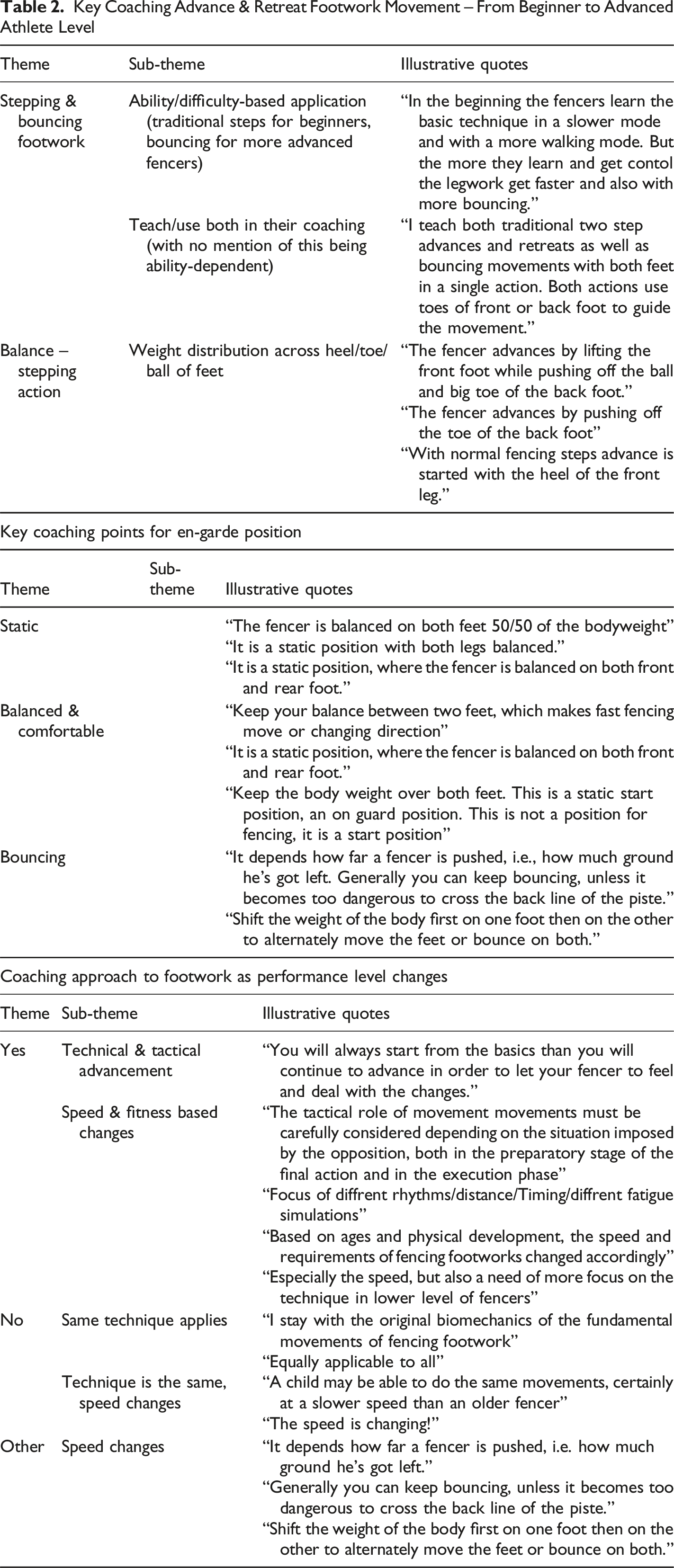
Open responses were analysed using a pragmatic, inductive thematic analysis in line with Braun and Clarke (2006). The closed answer question was collated and presented as percentage result. Two experienced researchers coded open ended responses developing themes and sub-themes and reconciled codes by discussion before finalising themes. Themes were traced to exemplar quotations to support transparency. A concise keyword tree was produced to show how attributes clustered into higher order themes and where constructs overlapped, including illustrative quotes. This approach is consistent with recent sport and exercise Delphi work, that uses reflexive or content based thematic procedures to generate statements for rating (Robertson et al., 2017; Slade et al., 2016). Thematic analysis of Round One open responses identified recurring descriptions of stepping and bouncing footwork, along with comments regarding en garde stance and distance management. Codes were grouped into higher order themes that reflected how coaches defined these movements, applied them in training and understood their tactical function. A keyword tree was produced to summarise themes by question topic, and a conceptual map was generated to illustrate how related constructs clustered within and across themes. These visual summaries informed the development of concise items for Round Two.
Round Two: Establishing Consensus on Technical Footwork Movements
A second online questionnaire was developed based on themes identified in Round One, presenting concise items with operational definitions to minimise ambiguity. These items explored key aspects of footwork development, including: progression from beginner to advanced styles; execution of attack and retreat from both static and dynamic positions; and preferred methods for changing direction, specifically comparing stepping versus bouncing techniques. Additional items addressed definitional features, bout contexts, developmental timing, and perceived changes in typical attack distance at the elite level. Response formats included single-choice and binary (yes/no) options, selected according to item type. Controlled feedback was provided in the form of anonymised group summaries from Round One, supplemented with brief illustrative examples. Participant anonymity was preserved by collecting responses without personal identifiers and reporting only aggregated data. The response window and reminder schedule mirrored those used in Round One.
Stopping Rule
A third round was planned only if Round Two indicated insufficient stability or if fewer than half of items approached the consensus threshold. Stability was judged at the item level from changes in distributions after feedback; when item distributions were stable and a majority of items approached or met the threshold, further rounds were deemed unnecessary (Bell et al., 2021; Hasson et al., 2000).
Data Analysis
Data were exported to Microsoft Excel and analysed in SPSS version 27 (IBM, USA). Consensus was defined in advance as at least 70% agreement on an item, in line with established Delphi standards in sport and health research (Bell et al., 2021; Von Der Gracht, 2012). For each Round Two item, the percentage choosing the modal option was reported with an exact 95% binomial confidence interval. For single choice items, the margin of the modal option over the runner up was also reported to indicate concentration of views. Figures include a 70% reference line.
Stability Across Rounds
Where a Round One construct mapped directly to a Round Two item and coach identifiers aligned across rounds, within coach positions were compared descriptively to assess stability after feedback. When positions were unchanged or changes were trivial at the item level, viewpoints were interpreted as stable and an additional round was unlikely to alter distributions (Bell et al., 2021; Hasson et al., 2000).
Triangulation and Reflexivity
Panel perceptions were juxtaposed descriptively with external time motion observations from elite épée to provide context for convergence or divergence; these comparisons did not imply causality. The team recorded short positionality notes and discussed how disciplinary backgrounds might influence coding and interpretation, in line with recommended qualitative practice.
Results
Panellist Characteristics
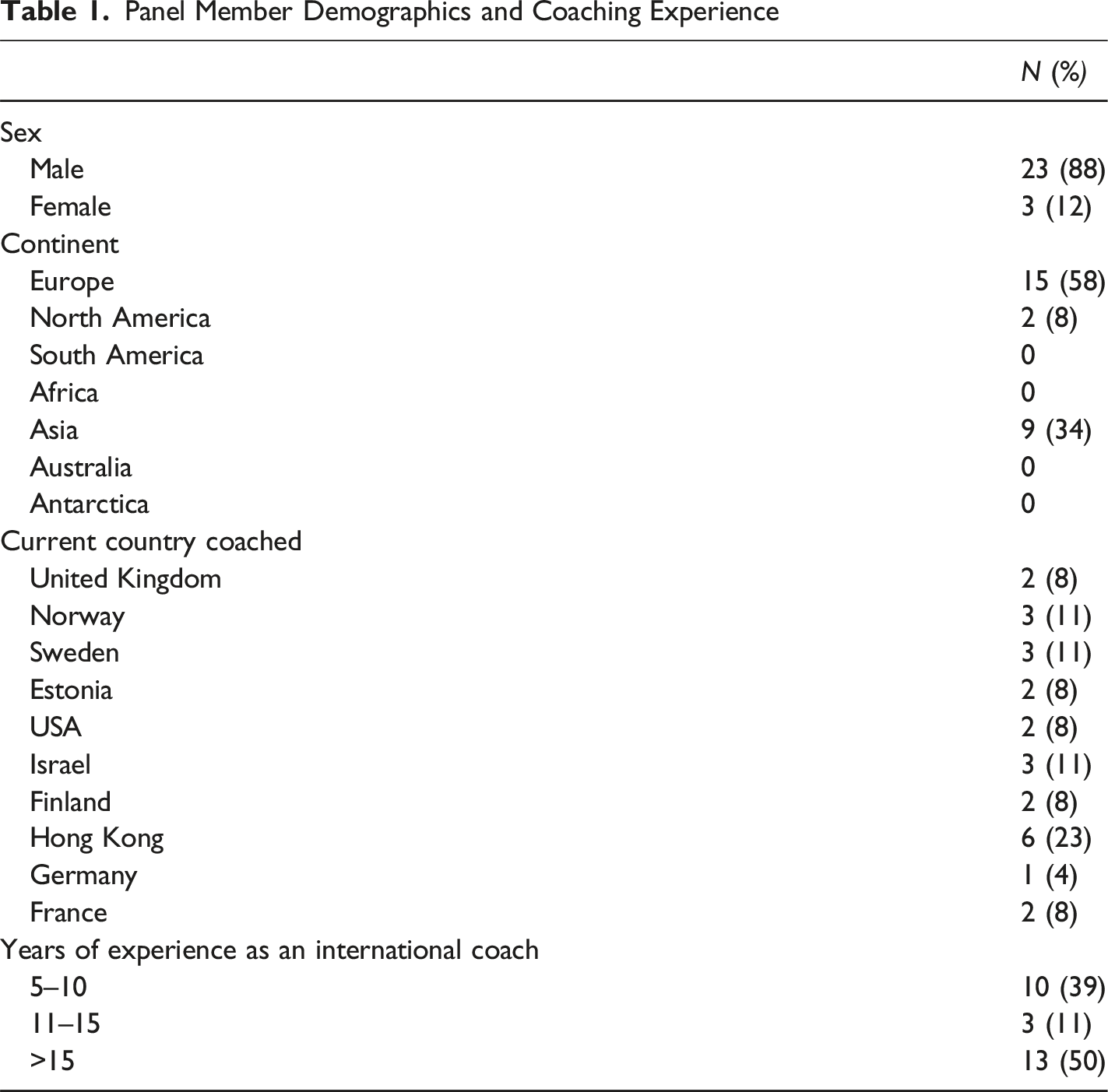
Twenty-six international épée coaches completed Round One. The panel spanned eleven countries across Europe, North America and Asia. Most panellists were male (88%), and half reported more than fifteen years of international coaching experience. All met the inclusion criteria of Olympic level technical coaching experience and at least five years in high performance roles. This study used the same expert cohort as a companion Delphi on physical attributes; however, the question set, analyses and submission are independent of that work.
Panel Member Demographics and Coaching Experience
Round One: Qualitative Synthesis
Round One responses showed that coaches consistently described two primary footwork styles, stepping and bouncing, and highlighted how these were taught and applied across training and competition. Coaches also discussed variations in en garde stance and approaches to managing distance. Figure 1 presents a conceptual map of how related constructs clustered within these themes, while Table 2 summarises the main themes and provides anonymised illustrative quotations. Conceptual map of round 1 responses, overlapping constructs Key Coaching Advance & Retreat Footwork Movement – From Beginner to Advanced Athlete Level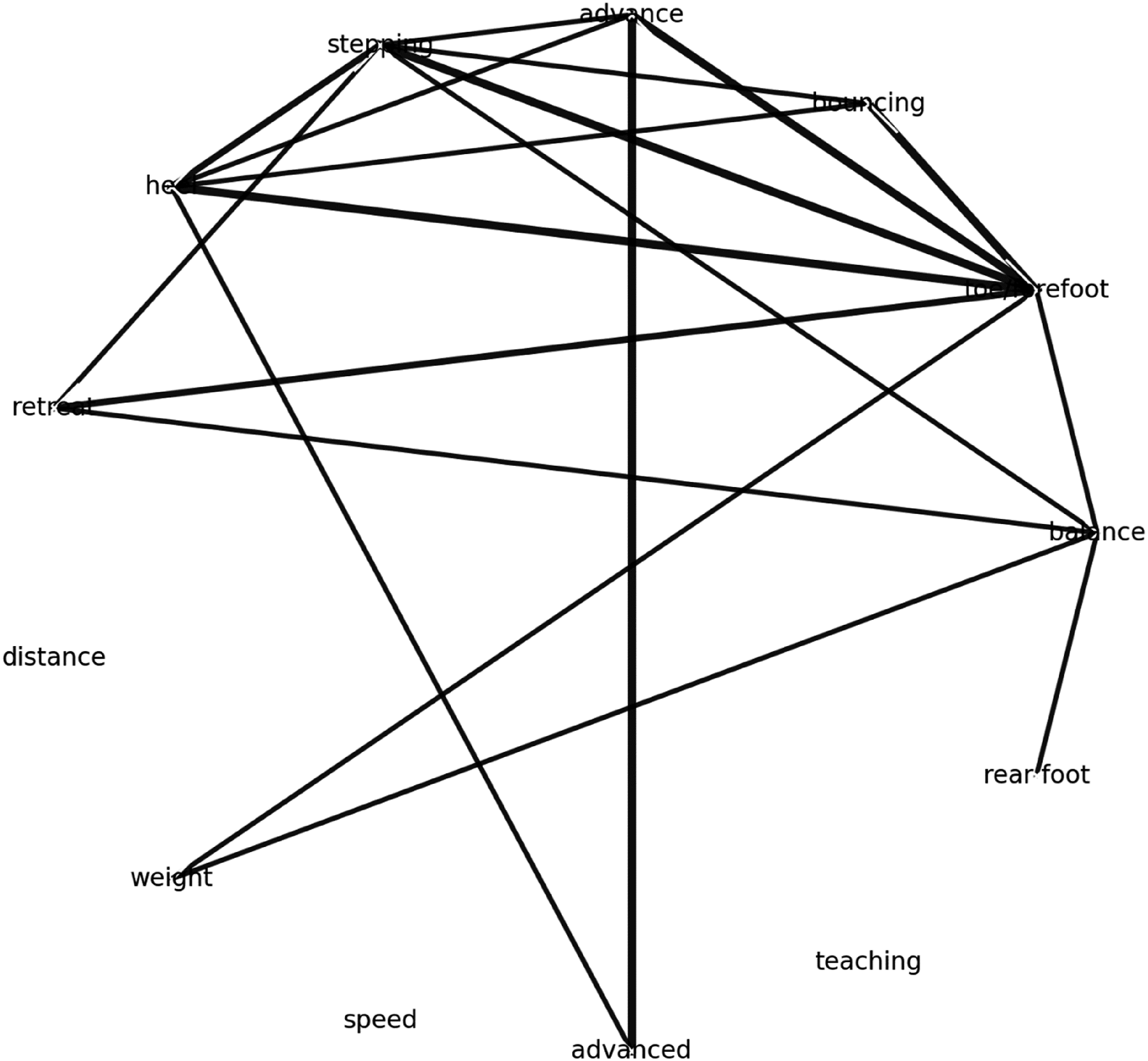
Round Two: Item Level Agreement and Consensus
Table 3 reports the percentage selecting the modal option for each item with exact 95% binomial confidence intervals, the margin over the runner up, and whether the pre specified 70% threshold was met. Figure 2 shows the same results as bars with confidence intervals and a 70% reference line. • Teaching advance and retreat method. Most coaches preferred a progressive pathway that teaches stepping first and introduces bouncing later (76.2%, 95% CI 52.8–91.8; large margin over the runner up). • En garde across development. Most indicated starting with a comfortable or static stance and introducing bouncing later (71.4%, 47.8–88.7). • Attack initiation speed. A clear majority judged bouncing faster than a static en garde (66.7%, 43.0–85.4), narrowly below the threshold. • Perceived change in attack distance. Most reported that typical attack distance has decreased in modern épée (66.7%, 43.0–85.4), narrowly below the threshold. Round Two Item Level Agreement With 95% Confidence Intervals CI = exact binomial 95% confidence interval. pp = percentage points. Round two item-level agreement with exact 95% binomial confidence intervals
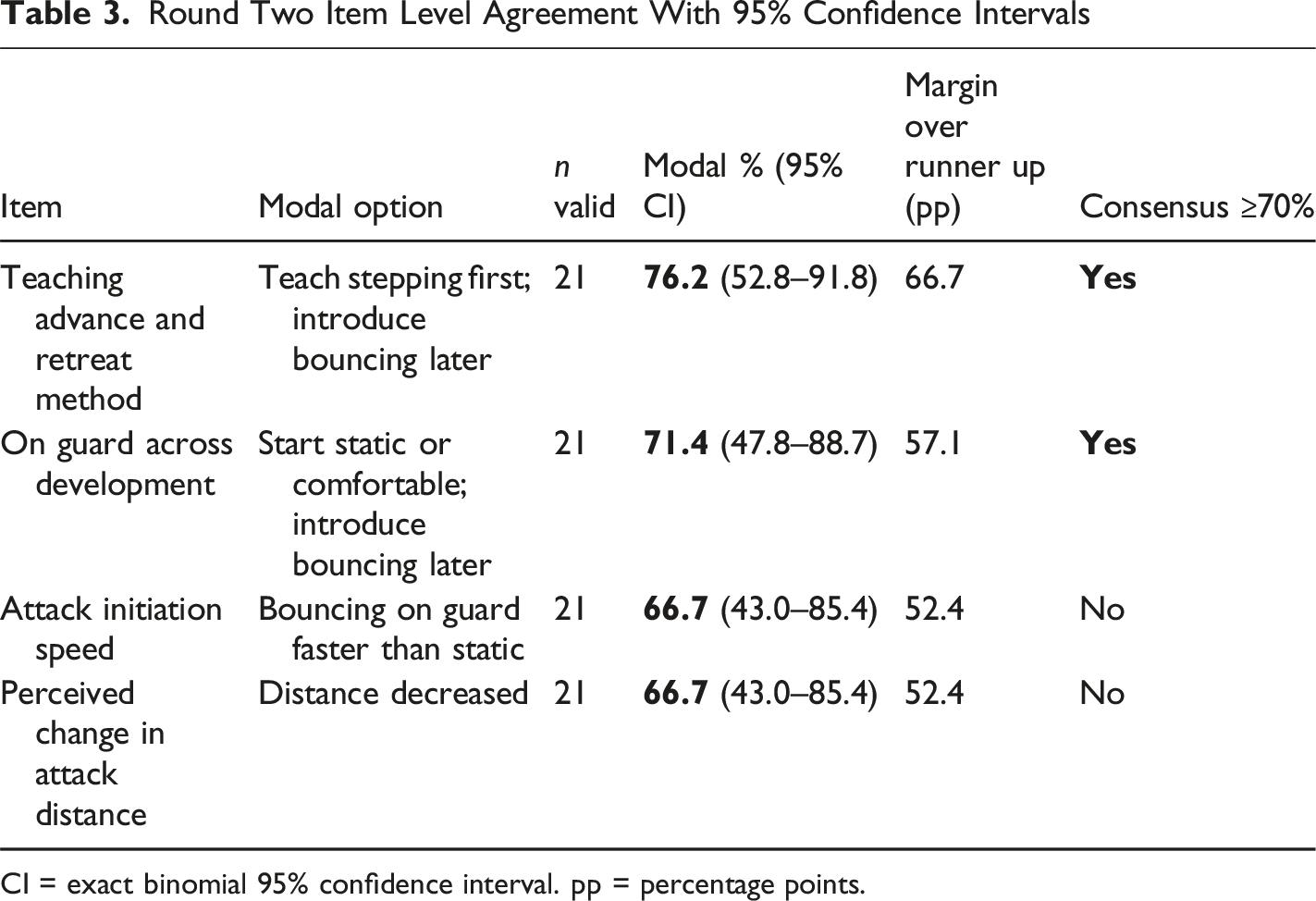
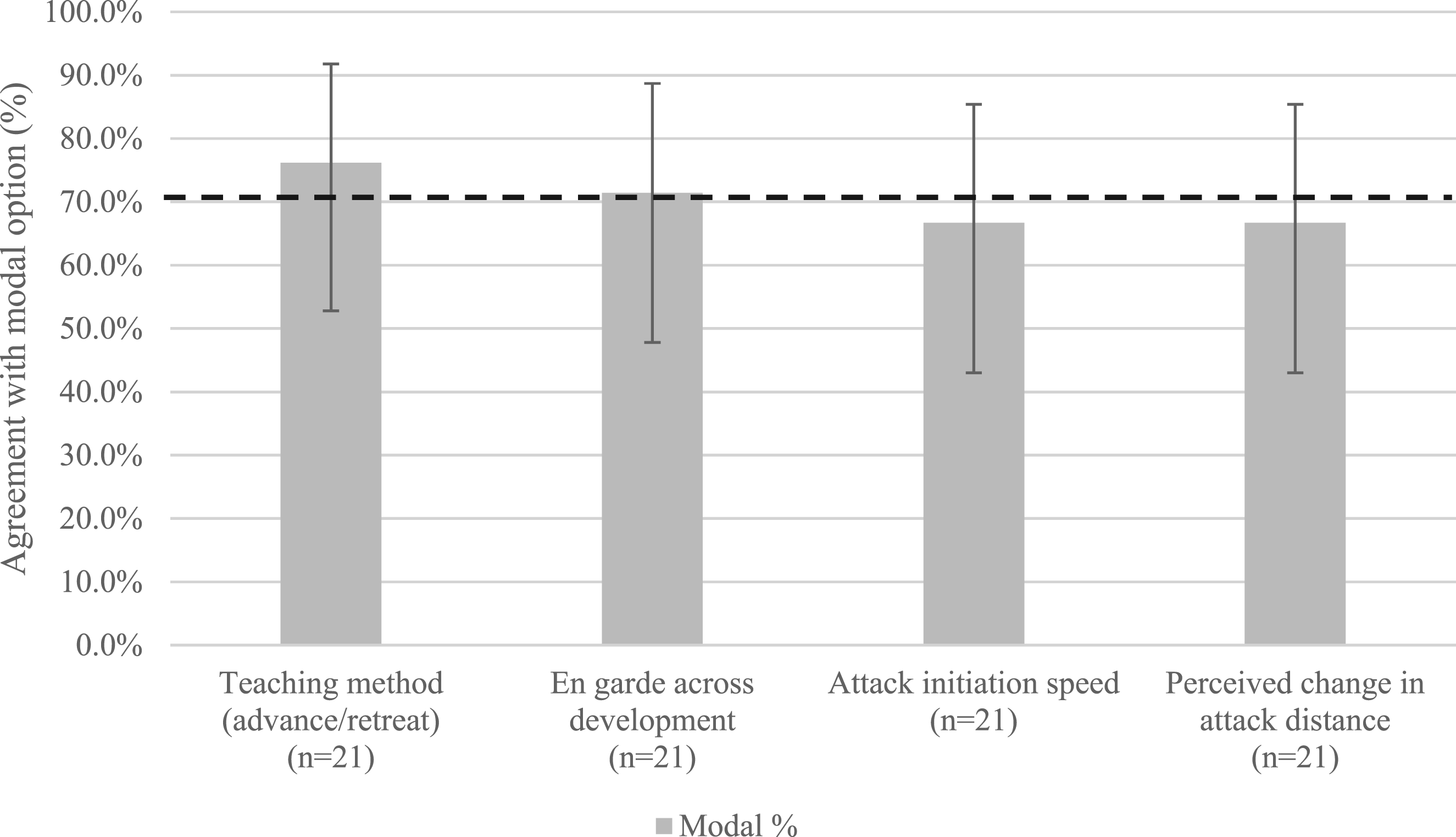
For the remaining items, percentages, confidence intervals and margins are shown in Table 3. Where items did not meet 70%, the modal choice still held a large margin over alternatives, indicating concentrated views rather than two evenly split positions.
Triangulation With Observational Data
Panel perceptions were juxtaposed descriptively with Olympic time motion analyses of stepping and bouncing in elite épée. Both sources indicated that stepping and bouncing are viable within elite performance, with expression shaped by bout context and athlete profile. These comparisons are contextual and do not imply causality.
Discussion
This Delphi study is the first to systematically examine Olympic-level épée coaches’ views on how stepping and bouncing footwork are defined, taught and applied in training and competition. Two items reached the pre-specified 70% consensus threshold: teaching sequence (teach stepping first; introduce bouncing later) and en garde posture across development (start static/comfortable; introduce bouncing later). Two further items were just below the threshold, yet showed large margins over the runner-up option: bouncing judged faster for attack initiation and typical attack distance judged to have decreased in modern épée. Importantly, confidence intervals were wide because items were rated by ∼21 coaches; exact binomial 95% intervals for proportions near two-thirds typically span ∼±20 percentage points. This reflects panel size rather than disagreement. Therefore, the pattern is one of clear Tendencies, not polarised camps.
Bouncing Footwork for Attack Initiation: Why Coaches Favour it and When it May Fail
The near-threshold majority for bouncing being faster than a static en garde supports the coaching intuition that ‘rhythmic’ forefoot loading can shorten the time from intention to movement. Mechanistically, a light bounce can pre-tension the Achilles complex and facilitate stretch–shortening cycle (SSC) behaviour, reducing electromechanical delay and enabling rapid anterior translation when distance collapses (Tsolakis et al., 2010; Turner & Harmenberg, 2018). Similar “priming” strategies are noted in boxing and taekwondo, where bounce-type rhythms are used before explosive entries or counters (Bridge et al., 2014; Brown et al., 2021; Ojeda-Aravena et al., 2022). Comparable adaptive locomotor strategies are evident in other open-skill sports such as football and basketball, where rapid changes of direction and anticipatory positioning demand similarly flexible movement solutions (D’Isanto et al., 2021; Ramos et al., 2021). This situates fencing as a useful model for examining how athletes exploit biomechanical and perceptual resources to optimise movement choices under dynamic constraints.
From an ecological dynamics perspective, this pattern fits the idea that skilled actions are self-organised, perception–action solutions under task constraints (Renshaw et al., 2009; Seifert et al., 2016). Bouncing may afford time-based advantages when opponent cues (blade displacement, shoulder rotation, distance cues) signal opportunity. That said, a bouncing rhythm might telegraph intent in some contexts, or increase metabolic cost over long exchanges, especially for athletes with lower plantar-flexor stiffness or after fatigue. Floor surface, footwear, and injury history could moderate whether the same “bounce affordance” is available to all fencers; these moderators merit targeted study.
Defence and Change-of-Direction (COD): Functional Variability, Not One “Best” Technique
Coaches were more divided on retreat and COD, with a modal preference for bouncing that did not reach 70% agreement. While a majority favoured bouncing, others reported no significant difference or emphasised the importance of situational factors. Defensive actions in fencing demand braking, postural control and re-orientation under time pressure; these demands often favour precise heel–forefoot braking and short step sequences in other open-skill games, such as invasion or racket sports (Krause et al., 2018; Paterson et al., 2013). The concentrated but sub threshold results therefore suggest not indecision, but movement flexibility, meaning that more than one technique can achieve the same defensive outcome depending on factors such as distance, tempo, opponent intent and referee interpretation (Seifert et al., 2016). Practically, this argues against prescribing a single defensive footwork mode; instead, coaches should cultivate a repertoire and train switching between stepping and bouncing footwork as bout constraints shift. This suggests a higher level of expertise, where motor responses are guided by perceptual information rather than conscious control (Balagué et al., 2019; Renshaw et al., 2009).
Developmental Pathway: Why “Step First, Then Bounce” Reached Consensus
The panel’s consensus for teaching stepping first and introducing bouncing later reflects a pragmatic motor-learning progression: secure balance, orientation, and distance control before layering in rhythmic elasticity and higher-tempo decisions. This is compatible with staged skill models (Fitts & Posner, 1967; Gentile, 1972) and with contemporary approaches emphasising implicit learning, variability of practice and representative learning design (Kraeutner et al., 2017; Renshaw & Chow, 2019; Ste-Marie et al., 2013). In practice, novice and pathway fencers can begin with discrete stepping tasks that stabilise posture and distance; bouncing technique is then added within representative tasks that preserve opponent interaction, variable distance bands and time pressure so that perception–action coupling is not lost (Krause et al., 2018). This may also include varying bout tempo, opponent proximity, and engagement scenarios in training to simulate competitive uncertainty and enhance adaptive footwork expression. The transition from stepping to bouncing footwork can therefore be understood not only as a technical upgrade, but as a self-organised shift in coordination dynamics resulting from increased perceptual attunement and strategic flexibility. Coaches noted that bouncing footwork becomes viable only when athletes can manage its demands within the competitive environment. This highlights the need for training conditions that replicate the cognitive and physical challenges of real bouts.
Has Attack Distance Decreased? Interpreting A Near-Threshold Majority With Stable Pairing
A near majority (66.7%, CI 43.0–85.4; n = 21) judged that typical attack distance has decreased in modern épée. This aligns with observational analyses reporting contextual use of stepping and bouncing footwork and recent shifts in bout distance management, triangulating with the panel’s perception (Cree et al., 2026). Potential drivers for this could be suggested to include changes in refereeing emphasis, opponent tempo and athletes’ speed–power profiles. However, because this study did not link footwork mode to scoring outcomes, causal claims cannot be made; such inference would require concurrent kinematic and outcome coding.
Practical Implications for Coaching (With Boundaries of Inference)
Attack initiation
Where the tactical goal is to seize time, encourage bounce-ready postures that preserve forefoot stiffness and rhythm, especially at launch distances where rapid anterior translation is decisive for actions such as lunge or flèche. Balance this against potential telegraphing and fatigue costs.
Defence/COD
Coach both discreet stepping brakes and bounce-through recoveries. Use constraints (space, timing, opponent pressure) to teach when to switch rather than enforcing a single default.
Progression
Introduce bouncing footwork after athletes show consistent balance, distance control and decision quality with stepping footwork. Advance via representative tasks that embed opponent behaviours and variable tempo.
Monitoring
Track context (distance, piste position, the tactical moment of the exchange and score state) alongside footwork choice; this is more actionable than a blanket “bounce or step” rule.
These recommendations are descriptive, reflecting expert consensus and concentrated tendencies; they do not imply that bouncing footwork is universally superior or that stepping is obsolete.
Methodological Considerations: Strengths, Limits and Why the CIs are Wide
The study followed established sport-science Delphi practice: purposive expert sampling, a pre-specified 70% threshold, controlled feedback, and transparent Round-One qualitative synthesis (Bell et al., 2021; Heyward et al., 2022; Jones et al., 2025; Robertson et al., 2017; Slade et al., 2016). Two features temper interpretation: • Panel size and intervals. Items in Round Two were rated by ∼21 coaches; with proportions near two-thirds, exact 95% binomial CIs typically span ∼±20 percentage points. This is a property of small-n inference, not of disagreement. Reporting valid n, exact CIs and margins over the runner-up (52–67 percentage points) mitigates misinterpretation. • Panel composition. The panel was predominantly male with limited representation from South America, Africa and Oceania; cultural coaching traditions and competitive calendars may influence footwork preferences, limiting generalisability. • Self-report vs behaviour. Coaches reported perceptions of efficacy and usage. Behavioural validation (time–motion plus outcomes) is needed to link footwork mode to scoring success under specific constraints.
Future Research: What Would Most Improve Inference
Future research should prioritise mechanistic work that quantifies stretch–shortening cycle use, ankle stiffness and tendon behaviour across footwork modes, cadences and attack capabilities in fencers (Tsolakis et al., 2010), develop performance linkages by combining 3D motion-capture and force plates with notational analysis to relate footwork mode and launch distance to hit probability and time-to-action in elite bouts; conduct moderator analyses to test how anthropometrics, injury history, footwear/surface and opponent tempo alter any bounce–step advantage; run developmental trials comparing “step-first-then-bounce” against earlier bounce exposure within representative learning tasks to assess retention, transfer and decision quality; and replicate the Delphi with broader panels (regions and sexes) and potentially dual cohorts (coaches and athletes) to contrast perceptions with behaviour.
Conclusion
This study synthesised Olympic-level épée coaches’ perspectives on footwork, namely stepping and bouncing variants, in definition, coaching progression and competitive application. Two statements reached the pre-specified 70% consensus: teaching stepping first and introducing bouncing footwork later, and beginning with a static/comfortable en garde before adding bouncing footwork with development. This indicates clear agreement on an incremental pathway. Two further statements showed near-threshold majorities with large margins over alternatives: coaches commonly judged bouncing footwork faster for attack initiation and perceived that typical attack distance has decreased in modern épée, signalling strong tendencies rather than polarised views. Confidence intervals were wide because items were rated by ∼21 coaches; exact binomial 95% intervals for proportions near two-thirds typically span ∼±20 percentage points. This reflects panel size rather than disagreement.
Taken together, the findings support an interpretation of footwork as functional and context-sensitive, consistent with ecological and nonlinear perspectives of skill acquisition in open-skill sports. Bouncing footwork appears to afford time-based advantages for initiating actions in specific distance–tempo windows, whereas defensive and change-of-direction behaviours likely benefit from a repertoire that includes both stepping and bouncing footwork styles, with switching governed by bout constraints. The panel’s views also align with a progressive coaching model: stabilise balance, distance control and decision quality through stepping, then integrate bouncing within representative tasks that preserve opponent interaction and timing demands.
These conclusions bridge expert practice with contemporary theory while respecting the study’s boundaries: they describe what experienced coaches tend to do and why, not causal performance effects. Future work should couple kinematics and outcomes to test when each mode confers advantage, and examine mechanistic underpinnings (for example, stretch–shortening behaviour and Achilles function) alongside moderator effects (athlete characteristics, footwear, opponent tempo). Broadening panel diversity will also strengthen generalisability. In the meantime, coaches can apply these insights by sequencing learning from stepping to bouncing footwork and by designing practice that elicits adaptive footwork selection under realistic bout constraints.
Footnotes

Ethical Considerations
This study was approved by the Middlesex University Research Ethics Sub-Committee, UK, and was conducted in line with the principles of the Declaration of Helsinki.
Consent to Participate
Informed consent was obtained from all individual participants included in the study.
Author Contributions
Jon A. Cree led the study conception and design, carried out the material preparation and data collection, performed the data analysis, and wrote the first draft of the manuscript. Hannah J.H. Newman and Luke A. Norris assisted with data analysis and contributed to the interpretation of findings. Luke W. Oates and Anthony N. Turner provided supervision and critical guidance throughout the project. All authors commented on and revised previous versions of the manuscript, and all approved the final version.
Funding
The authors disclosed receipt of the following financial support for the research, authorship, and/or publication of this article: This research was supported by a PhD studentship funded by Dr. Johan Harmenberg (MD, PhD). The funder had no role in study design, data collection, analysis, interpretation, or the decision to publish.
Declaration of Conflicting Interests
The authors declared no potential conflicts of interest with respect to the research, authorship, and/or publication of this article.
Data Availability Statement
The datasets generated and analysed during the current study are available from the corresponding author on reasonable request.