



Abstract
There are two strategies for scheduling personal goals: (i) clock-time, based on time passage; and (ii) event-time, based on the progress made. Neither strategy is always superior to the other; rather it is necessary to consider the environment and other conditions such as whether the goal is long or short term. We focused on goal lengthas an important factor for determining the best scheduling strategy, hypothesizing that clock-time and event-time strategies would differentially activate higher performance for long-term and short-term goals, respectively. Thus, we conducted a two-part laboratory experiment (Part 1: n = 63, Part 2: n = 86 ) in which we manipulated both goal length and scheduling strategy. Subsequently, we examined the effects of each combination of goal length and scheduling strategy on task performance (i.e., completion of a mathematical problem). Although our two studies were designed identically in most respects, they differed in the number of task problems, task time limits, and question content. Our data supported our hypothesis that clock-time scheduling was optimal for long-term goals while event-time scheduling was optimal for short-term goals.
Introduction
Strategies of scheduling for goal achievement have been mainly addressed through a cross-cultural psychology perspective with the two most representative distinctions made between clock-time and event-time strategies (Fulmer et al., 2014; Levine, 1997). In the clock-time strategy, an individual is cued by time passage (e.g., engage in task A from 9:00 to 12:00, take a break from 12:00 to 13:00, and engage in task B from 13:00 to 16:00) or date (e.g., finishing tasks by March 1). In contrast, in event-time scheduling, an individual is cued by degree of progress made on the task (e.g., an individual may start on task A, take a break when task A is completed, and then engage in task B).
Most prior investigators considered the differences between clock-time and event-time strategies to be culturally influenced in terms of how work is done, how people interact, and what values are held (e.g., Alon & Brett, 2007; Levine, 1997; Levine & Norenzayan, 1999). However, scheduling strategy may also be determined by individual differences in the “self-regulation” of personal goals (Avnet & Sellier, 2011; Sellier & Avnet, 2014, 2019). A pioneering study illustrating the importance of self-regulation (Avnet & Sellier, 2011) examined the relationship between goal scheduling strategies and regulatory focus. A regulatory focus toward goal promotion emphasizes internal ideals and growth rather than extrinsic gains (Higgins, 1997), while a prevention focus emphasizes duty and responsibility and whether there is personal loss (Crowe & Higgins, 1997; Molden et al., 2008). Avnet and Sellier (2011) hypothesized that each regulatory focus would be associated with a matched scheduling strategy such that individuals with either a promotion or preventive focus would prefer either the clock-time or event-time strategies, respectively. Results from three experiments supported the investigators’ hypothesis and showed that no single scheduling strategy was always superior to the other; rather, there were conditions under which each scheduling strategy led to optimal results. Subsequently, Sellier and Avnet (2014) examined the relationship between scheduling strategies and variables related to self-regulation and found that individuals who were more likely to use clock-time scheduling were less likely to recognize an internal locus of control and more likely to make external causal attributions. However, individuals who were more likely to use event-time scheduling were more likely to make internal causal attributions and were also more likely to savor the activities they performed and experience positive emotions in goal pursuits.
Beyond a self-regulatory focus, many other factors may be relevant to the relationship between task performance and scheduling strategies. Different types of goals are expected to have different optimal processes for task performance (Locke & Latham, 2006). Among goal types, long-term versus short-term goals are important to consider for individual motivation and performance (Bandura & Schunk, 1981; Latham & Seijts, 1999). While traditional goal-setting theory (Latham & Locke, 1991) has focused mainly on short-term goals, a recent study focused on ways to achieve long-term goals (Höchli, et al., 2018), assuming that performance would be enhanced when clock-time scheduling was matched with a long-term goal and when event-time scheduling was matched with a short-term goal.
As clock-time scheduling seeks efficiency while event-time scheduling seeks quality (Fulmer et al., 2014), the clock-time strategy should be most suitable for advancing multiple assignments simultaneously, while the event-time strategy should be most suitable for thoroughly advancing a single assignment. This could lead to a difference in whether the individual using each strategy is aware of multiple tasks at the same level or only of the task at hand. Fishbach et al. (2006) showed that the number of goals one could hold in simultaneous awareness depended on whether the goal being activated was a long- or short-term goal. Specifically, when a long-term goal was being activated, participants were more likely to be aware of multiple short-term goals that would achieve that goal. Furthermore, when they were aware of a short-term goal, they were less likely to be aware of other short-term goals. This was because the temporal stratification of long- and short-term goals corresponded to the higher-level and lower-level interpretations of construal level theory, respectively (Fujita, 2008). Construal level theory (Trope & Liberman, 2003, 2010) divided the level of an individual’s interpretation into two categories: high and low. Psychologically distant and close objects are interpreted as high (abstract) and low (concrete), respectively. Goals were perceived hierarchically (e.g., Carver & Scheier, 2001; Shah & Kruglanski, 2003) with multiple short-term (mainly concrete) falling goals under a long-term (mainly abstract) goal. When one short-term goal is active, it is difficult to be aware of other short-term goals. This is consistent with the characteristics of the clock-time and event-time scheduling strategies.
Another study showed that the relationship between goals and motivations was moderated by regulatory focus (Pennington & Roese, 2003). Specifically, promotion-focused individuals were more likely to prefer a more distal future as they emphasized ideal images and acquisitions. In contrast, prevention-focused individuals were more likely to prefer a more proximal future as they emphasized their current obligations and responsibilities. Furthermore, Avnet and Sellier (2011) showed that the clock-time and event-time styles best fit, respectively, the promotion and prevention focus.
Consequently, based on Avnet and Sellier’s (2011) work, we experimentally examined the effects on goal performance of varied combined scheduling strategies and goal lengths on performance. Previous studies suggested that clock-time and event-time scheduling best fit long-term and short-term goals, respectively (Fishbach et al., 2006; Fulmer et al., 2014). The efficient clock-time strategy is likely to direct attention to distal events and is assumed to be more appropriate when long-term goals are activated. The event-time strategy emphasizes quality and directs attention to proximal events, and it is more appropriate when short-term goals are activated. Avnet and Sellier (2011) mentioned that fit of regulatory focus and scheduling strategy led to higher task performance. When a fit was achieved, task engagement increased, or task performance improved (Higgins, 2000; Higgins et al., 2010). Thus, we expected to find a higher performance by fit, and we examined the effects on task performance of combining goal length (long-term/short-term) and scheduling strategy (clock-time/event-time).
First, in Part 1, we examined the effects of combining goal type and scheduling strategy on a calculation task that was like the task used in Avnet and Sellier (2011). In Part 2, we examined whether the results of Part 1 could be replicated. We also considered “confidence in performance for the task” as a covariate when we analyzed task performance because self-assessed confidence or ability has seemed to be inextricably linked to cognitive performance (e.g., Keller & Bless, 2006). Prior research on scheduling strategies (Avnet & Sellier, 2011) has treated confidence as a predictor of task performance. We also measured engagement and examined the impact of this fit. For this purpose, we used emotional engagement, which reflects the participant’s interest and concern for the issue. Emotions were frequently discussed as a strong factor that drove behavior during tasks (Pekrun et al., 2009). We hypothesized that there would be no differences in performance and engagement between scheduling strategies or goal length except that, when clock time scheduling and long-term goals were paired and event time scheduling and short-term goals were paired, higher performance and engagement would be obtained.
Method
Part 1
Participants
In total, 69 volunteer Japanese college students (34 males, 35 females; M age = 19.86 years, SD = 1.18) were recruited from the university. Participants took part in the experiment in exchange for a reward (a 500-yen voucher or about $3.35). We obtained informed consent from all the participants prior to their participation in the experiment. In addition, our research protocol was approved by the university’s Institutional Ethics Board.
Six participants were excluded from the study, as they either did not have goals or did not follow the instructions (e.g., described long-term goals in the short-term goal condition). The final analysis included 63 participants (30 males and 33 females; M age = 19.83 years, SD = 1.16). We determined the sample size based on a previous study (Avnet & Sellier, 2011). Also, a power analysis using G*power 3.1 (Faul et al., 2007) indicated a required sample size of 52 to detect a large effect size (f = .40) with a .05 alpha level and .80 power.
Calculation Task
The calculation task we used was the same as the one used by Toyama et al. (2018). This task consisted of four numbers in an equation with only an “ = ” sign, but with squares to the right of each number to represent symbols for three unknown mathematical operations the participant was to discern and then insert to make the math equation correct (e.g., 2 □ 5 □ 3 □ 4 = 0). Participants were asked to place symbols of one of four operators (+, −, ×, ÷) in each of the three squares. Each operator could be used as many times as desired. Participants were also allowed to use parenthetical brackets, but the use of these brackets was only allowed across two numbers (e.g., (2 + 4)/6 + 3 = 4), not across three numbers (e.g., (8 − 4 + 3) × 2 = 14). While participants were asked to solve 20 of these calculation tasks, the method of solving the problem differed according to the scheduling style conditions described below.
Procedure
Participants were tested individually in a laboratory. They were first asked to write down their current academic goals. Subsequently, they were randomly assigned to either the long-term or the short-term goal condition, following Fishbach et al. (2006). In the long-term goal condition, the participants were instructed to “think about one long-term academic goal that you currently have. A long-term goal is a goal that you will take a lot of time (e.g., one year) to achieve. After giving it some thought, please write below the long-term goal you have.” Furthermore, to activate additional higher-level thinking, we asked them: “Please also think about why you want to achieve this goal.” In the short-term goal condition, participants were instructed to “think about one short-term academic goal that you currently have. A short-term goal is a goal that can be accomplished in a short span of time (e.g., 1 week). After giving it some thought, write down below the short-term goal you have.” Moreover, to activate additional lower-level thinking, we asked them, “Please also think about how you think you can achieve that goal.” Examples of long-term and short-term goals were “complete my graduation thesis” and “finish this week’s report,” respectively.
Our experimental task was associated with primed goals. Specifically, participants were first briefed on the assignment, by being told that “the performance of the task you are going to do predicts higher academic achievement.” After explaining the rules of the calculation task, participants were asked to solve one example problem. All the participants were able to solve the example. Afterward, as a covariate, we measured the participants’ confidence for being able to solve the task with one item, “Compared to others, I think I am better at this task” (1: not at all, 7: strongly agree).
Subsequently, participants received explanations for the main task, and they were randomly assigned to either the clock-time or event-time scheduling condition. The setting of the conditions was based on Avnet and Sellier (2011) and Sellier and Avnet (2014). First, in the clock-time condition, the time limit (10 minutes) was clearly stated, and the questions could be solved in any order. Participants were also provided stopwatches so that they could see how much time remained. Subsequently, they were instructed to solve as many problems as possible. In the event-time condition, the time limit was not specified, the questions were numbered from Q1 to Q20, and participants were instructed to solve as many questions as possible in sequential order. Participants were not provided a stopwatch; however, they were forced to stop answering immediately after 10 minutes. Problems were printed on a sheet of paper. Each sheet had 10 questions, the questions were divided into two sheets for Part 1 and three for Part 2. Hence, participants in the event-time condition could not see all the questions initially.
Participants were then asked about the five items of emotional engagement (Toyama, 2018), which asked them to express their interest in and concern for the task on a 7-point scale (1: not at all to 7: strongly agree). Items were, “I enjoyed this task,” “I like this task,” “I was excited when doing this task,” “This task was interesting,” and “This task was exciting” (α = .946). We used the total score in the analysis. In addition, there were two items that served as a manipulation check (“I was aware that the task had a 10-min time limit” and “I solved the tasks in the order in which they were easy to solve, regardless of the order of the tasks”; 1: not at all to 7: strongly agree). The higher and lower the scores on these two items, the more the participants were clock-time oriented and event-time oriented, respectively. Finally, the experiment was terminated after the participants were rewarded and asked if they had any doubts about the experiment.
Statistical Analysis
We used SPSS (Statistical Package for the Social Sciences, Version 27) software for all statistical analyses. Descriptive data were presented as means (and standard deviations), and inference testing for group and condition differences was based on t-tests, analyses of variance (ANOVA), and analyses of covariance (ANCOVA). All data distributions were tested for assumptions of normality using the Shapiro-Wilk test. Based on suggestions from prior studies (Avnet & Sellier, 2011; Keller & Bless, 2006), we conducted an ANCOVA with performance as a dependent variable and task confidence as a covariate in the analyses. However, because we could not make a clear assumption about the association between confidence for the task and emotional engagement, we conducted a standard ANOVA with emotional engagement as the dependent variable without task confidence as a co-variate. We used a t test to ascertain that instructions for clock-time and event-time goal scheduling were followed. We planned post-hoc analysis with Bonferroni adjusted comparisons for any significant ANOVA or ANCOVA results to make pair-wise comparisons. Statistical significance was set a p < .05.
Part 1 Results
Participants’ Confidence for the Task and the Manipulation Check
A t test to determine any difference between the long-term (M = 3.33, SD = 1.29) and the short-term (M = 3.37, SD = 1.87) goal conditions for the covariate of task confidence, revealed no significant difference (t (61) = .083, p = .934, d = .03). We also conducted a t test to determine any difference between the clock-time (M = 3.19, SD = 1.49) and event-time (M = 3.52, SD = 1.67) scheduling conditions for the covariate of task confidence. Again, no significant difference was observed (t (61) = .824, p = .413, d = .21).
Manipulation Check
We also conducted a t test on the participants’ ratings of the instructions for the clock-time and event-time scheduling conditions to assess whether the manipulation related to the scheduling strategy was successful. Since the two manipulation check items were significantly correlated (r = .614, p < .001), these scores were combined into a single score for this analysis. A high and low score on these combined items indicated that the instructions in the clock-time condition and event-time condition were followed, respectively. There was a significant difference, t (61) = 8.689, p < .001, d = 2.19 between instruction ratings, with higher clock-time scores in the clock-time style (M = 5.36, SD = .99) than in the event-time style (M = 2.61, SD = 1.48). Based on these results, we concluded that our manipulation had been successful.
Goal Performance: Number of Correct Calculation Answers
To examine whether the combination of the activated goal length and scheduling strategy predicted goal performance (i.e., the number of correct answers on the math calculation task), we conducted an analysis of covariance (ANCOVA) with two Goal lengths (long-term and short-term) and two Schedule strategies (clock-time and event-time) (see Figure 1). We used participants’ confidence in problem solving as a covariate. This analysis revealed a significant effect of confidence in problem solving (F (1, 58) = 15.310, p < .001, ηp2 = .209), but there was no significant main effect for either Goal types (F (1, 58) = .549, p = .462, ηp2 = .009) or Style types (F (1, 58) = .973, p = .328, ηp2 = .016). There was a significant two-way interaction effect between Goal types and Style types (F (1, 58) = 5.483, p = .023, ηp2 = .086). Task Performance by Varied Combinations of Goal Length and Scheduling Strategy (Part 1 study). 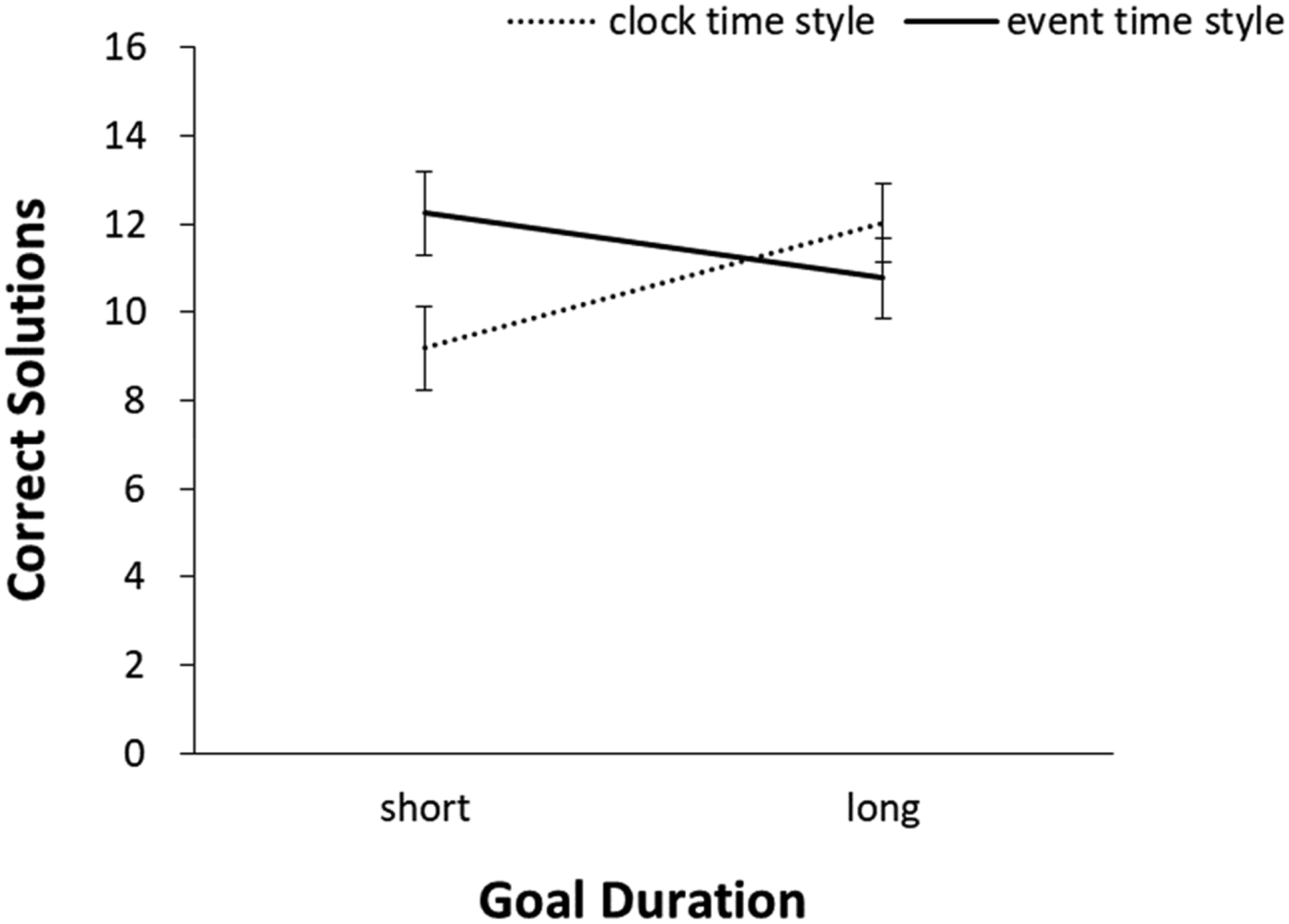
We conducted a post-hoc analysis to further examine significant interactions. In the short-term goal condition, the event-time scheduling strategy (M = 12.24, SE = .94) was associated with more correct answers than the clock-time strategy (M = 9.18, SE = .94) (p = .026). Meanwhile, in the long-term goal condition, no significant difference was observed between the clock-time and event-time strategies (p = .332). Additionally, the clock-time strategy was significantly influenced by the variation in goal duration. The long-term goal (M = 12.01, SE = .88) was associated with more correct responses than the short-term goal (M = 9.18, SE = .94) (p = .032). Meanwhile, no significant difference was observed in the scores generated by the variation in goal duration in the event-time scheduling strategy (p = .266).
Emotional Engagement
To examine whether goal lengths and scheduling styles or their interactions differentially predicted participants’ emotional engagement in task performance, we conducted a two Goal length (long-term and short-term goal) by two scheduling strategies (clock-time and event-time) analysis of variance (ANOVA) (see Figure 2). These results showed a significant main effect of Goal length on emotional engagement (F (1, 59) = 6.602, p = .013, ηp2 = .101) with the long-term goal (M = 25.85, SD = 6.12) associated with higher emotional engagement than the short-term goal (M = 21.63, SD = 7.29). The main effect of Scheduling strategies was not significant (F (1, 59) = 1.621, p = .208, ηp2 = .027). The two-way interaction of goal Length by Scheduling strategy was significant (F (1, 59) = 5.213, p = .026, ηp2 = .081). Post-hoc analyses further examined the significant interaction effect. In the short-term goal condition, the event-time strategy (M = 24.53, SD = 1.67) was associated with higher scores than the clock-time strategy (M = 18.73, SD = 1.67) (p = .017). Meanwhile, in the long-term goal condition, no significant difference was observed between the clock-time and event-time strategies (p = .467). Additionally, the clock-time strategy was significantly influenced by the variation in goal duration. The long-term goal (M = 26.65, SD = 1.57) was associated with higher scores than the short-term goal (M = 18.73, SD = 1.67) (p = .001). Meanwhile, no significant difference was observed in the scores generated by the variation in goal duration in the event-time strategy (p = .841). Emotional Engagement by the Combinations of Varied Goal Lengths and Scheduling Strategies (Part 1 study). 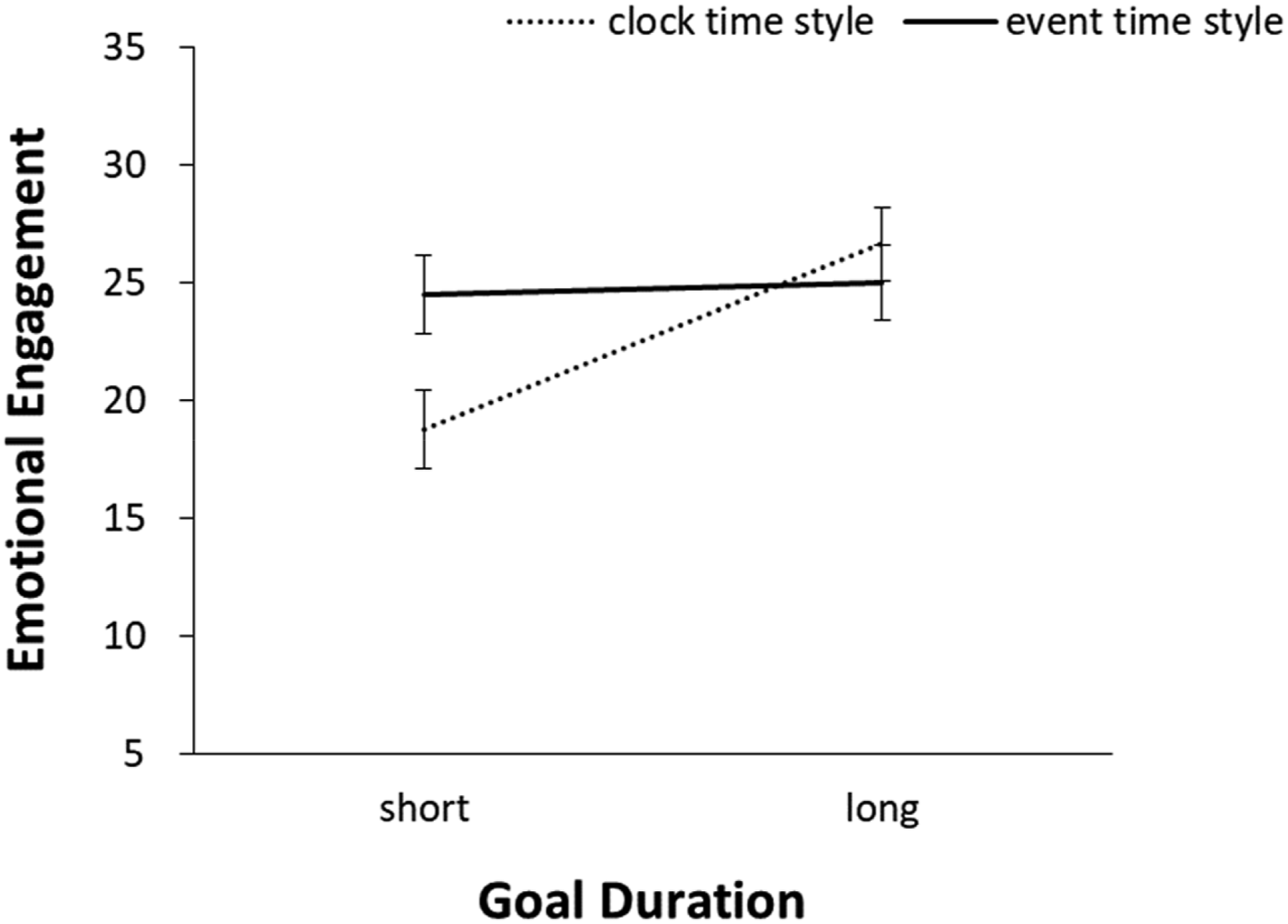
Part 1 Discussion
The results of Part 1 supported our hypothesis regarding an expected interaction between goal length and scheduling strategy. In the pursuit of a short-term goal, participants performed the math calculation task with fewer errors when they also employed event-time rather than clock-time scheduling. Although there was no difference in the number of correct answers among scheduling strategies for the long-term goal, our results partially supported our hypothesis that the number of correct math answers was higher when the long-term goal (and not the short-term goal) was associated with the clock-time condition. These results were similar for emotional engagement, indicating that matching goals and scheduling strategies affected both performance and perceived engagement for the task.
However, since the above results were from a single experiment, their robustness should be confirmed with cross-validation. In addition, the fact that our hypothesis was only partially supported may be because the task used in Part 1 was a relatively short task, which made it difficult to demonstrate the association between goal length and scheduling strategies. Therefore, in Part 2, we increased the number of tasks and time limit.
Part 2
Participants
For Part 2 of this experiment, 93 volunteer Japanese college students (36 males, 57 females; M age = 20.23 years, SD = 1.38) were recruited from the university. As in Part 1, students participated in the experiment in exchange for a reward (a 500-yen voucher). Seven were excluded for not following instructions, leaving 86 respondents (33 males and 53 females; M age = 20.23 years, SD = 1.36) in the final analysis. We obtained informed consent from all the participants prior to the experiment, and, as before, our research protocol was pre-approved by the university’s Institutional Ethics Board.
Calculation Task
We used the same calculation task as in Part 1, but we increased the number of questions from 20 to 30 and increased the time limit from 10 to 15 minutes. Avnet and Sellier (2011) found that 20 minutes was sufficient time to complete a task in a clock-time scheduling strategy, though Avnet and Sellier (2011) used GMAT math problems. Since the calculation tasks in this study were monotonous and 20 minutes could cause boredom and lack of concentration, the time limit was set to 15 minutes, and the number of questions was set to 30. In addition, to prevent participants from finishing the task within the time limit, only Q30 was made unsolvable.
Procedure
The basic flow of the procedure was the same as in Part 1, but the explanations of the long-term and short-term goals were changed in the conditions for manipulating the goals. Specifically, the long-term goal was explained as “a goal with a long-time span that takes a lot of time (e.g., several months to a year),” and the short-term goal was explained as “a goal with a short period that takes only a little time (e.g., one day to one week).” These instructions were to set the duration of the goals more broadly than in Part 1 and make it easier to visualize the goals. The operations related to the scheduling strategy in this task were the same as in Part 1, except that the explanations of the time limit and the number of tasks were changed. As in Part 1, participants were asked to indicate their confidence in the task in advance of performing it. After the task, they were asked to respond to the manipulation check items and make ratings of their perceived emotional engagement. The content of the manipulation check items was changed such that two items corresponded to the clock-time condition (“I was aware that the task had a time limit” and “I was aware of the remaining time during the task”) and two items corresponded to the event-time condition (“I was aware that I had to finish the previous question before moving on to the next question,” and “I thought I could not decide the order in which to solve the questions”). As in Part 1, all responses were rated on a 7-point scale (1: not at all to 7: strongly agree).
Statistical Analysis
As in Part 1, we used SPSS software version 27 for all statistical analyses. Descriptive data were presented as means (and standard deviations), and inference testing for group and condition differences were based on t-tests, ANOVA and ANCOVA. All data distributions were tested for assumptions of normality using the Shapiro-Wilk test. We planned post-hoc testing with Bonferroni adjusted comparisons for any significant ANOVA or ANCOVA results. Statistical significance was set a p < .05.
Part 2 Results
Participants’ Confidence for Performing the Task and the Manipulation Check
As in Part 1, the t test to determine if there was any significant difference in confidence ratings for the task between the long-term (M = 3.33, SD = 1.49) and the short-term (M = 3.20, SD = 1.40) conditions revealed no significant confidence difference according to goal length (t (84) = .442, p = .660, d = .10). We also conducted a t test to determine any difference between the clock-time (M = 3.23, SD = 1.39) and event-time (M = 3.30, SD = 1.50) strategy conditions for the covariate of task confidence. Again, no significant difference was observed (t (84) = .223, p = .824, d = .05).
Manipulation Checks
Regarding the t test conducted to check whether the manipulation regarding scheduling style was successful, we first found a significant correlation between the two items for the clock-time condition (r = .619, p < .001) and for the two items related to the event-time condition (r = .302, p = .005), and so we merged these two clock-time items into a single score and the two event-time items into another single score for this analysis. As expected, the t test comparing the participants’ views of the conditions revealed a significantly higher clock-time score, for the clock-time scheduling strategy (M = 4.66, SD = 1.44) than the event-time strategy (M = 3.83, SD = 1.69), t (83) = 2.393, p = .019, d = 1.61. Similarly, there was a significantly higher event-time manipulation score (M = 4.01, SD = 1.30) than the clock-time manipulation score for the event-time scheduling condition (M = 3.35, SD = 1.54), t (82) = 2.147, p = .035, d = 1.42. Based on these results, we concluded that our manipulations had been successful.
Goal Performance: Number of Correct Calculation Answers
To examine whether the combination of activated goals and scheduling strategy predicted the number of correct answers on the math calculation task, as in Part 1, we conducted an ANCOVA with two goal Length types (long-term and short-term) and two Schedule styles (clock-time and event-time) (see Figure 3). This analysis revealed a significant effect of confidence in problem solving (F (1, 81) = 23.269, p < .001, ηp2 = .223), but there were no main effects for Length types (F (1, 81) = .392, p = .533, ηp2 = .005) or Scheduling types (F (1, 81) = .020, p = .889, ηp2 = .000). There was a significant two-way interaction effect between goal Lengths and Scheduling strategies (F (1, 81) = 8.650, p = .004, ηp2 = .096). Task Performance by the Combinations of Varied Goal Lengths and Scheduling Strategies (Part 2 study). 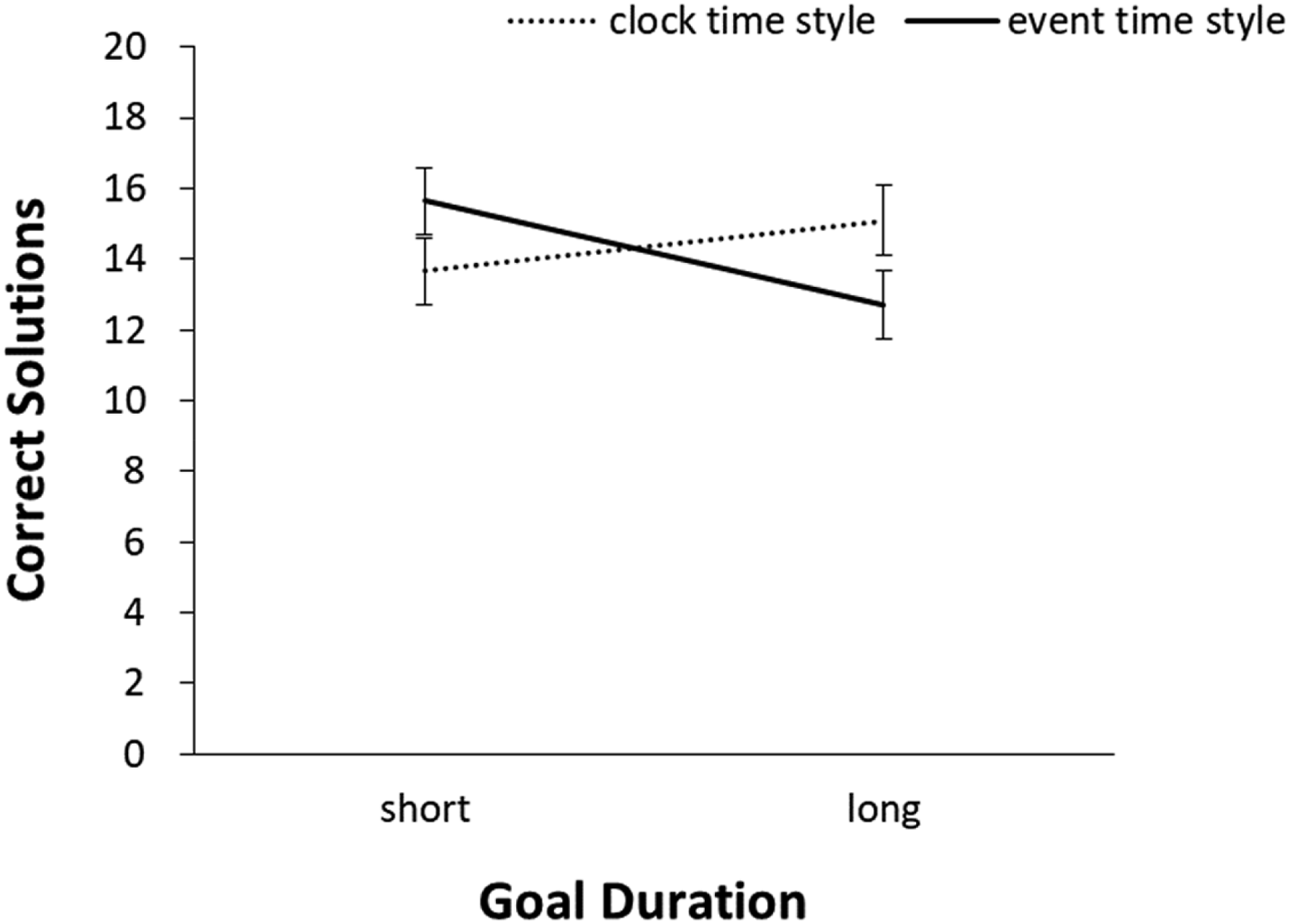
Post hoc analysis revealed that, in the short-term goal condition, the event-time strategy (M = 15.34, SE = .89) was associated with more correct answers than the clock-time strategy (M = 12.69, SE = .87) (p = .036). Furthermore, in the long-term goal condition, the clock-time strategy (M = 15.76, SE = .84) was associated with more correct answers than the event-time strategy (M = 13.35, SE = .83) (p = .046). Additionally, the clock-time strategy was significantly influenced by the variation in goal duration. The long-term goal (M = 15.76, SE = .84) was associated with more correct responses than the short-term goal (M = 12.69, SE = .87) (p = .013). Meanwhile, no significant difference was observed in the scores generated by the variation in goal duration in the event-time strategy (p = .106).
Emotional Engagement
As in Part 1, to examine whether the combinations of goal length and scheduling strategies or their interactions differentially predicted participants’ emotional engagement (α = .905) in task performance, we conducted a two goal Lengths (long-term and short-term) by two Scheduling strategies (clock-time and event-time) ANOVA. These results showed that neither goal Length (F (1, 81) = 1.767, p = .188, ηp2 = .021), nor Scheduling strategy (F (1, 81) = 1.642, p = .204, ηp2 = .020), nor a two-way interaction (F (1, 81) = .092, p = .762, ηp2 = .001) were significant.
Part 2 Discussion
These results supported our hypothesis for the short-term goal, that performance would be higher in event-time scheduling than in clock-time scheduling, under conditions in which the short-term goal was activated. Notably, our hypothesis was also supported for the long-term goal, which showed that performance was higher in the clock-time scheduling strategy than in the event-time strategy under conditions in which the long-term goal was activated. In the clock-time condition, the number of correct answers was higher when the long-term goal was activated than when the short-term goal was activated, as in Part 1. Furthermore, this result was also confirmed to be robust. This convergence of data across Parts I and II helps to establish the robustness of the interactions. However, the results of Part 1 were not replicated for emotional engagement. This point will be discussed in the General Discussion below.
General Discussion
In this study, we aimed to examine the effects of the combination of activated goals and scheduling strategies on task performance. Specifically, our hypothesis was that using the clock-time scheduling strategy when the long-term goal was activated and the event-time strategy when the short-term goal was activated would result in higher performance. On our calculation tasks, the results of the two studies supported our hypothesis that the combination of short-term goals and event-time strategy would lead to higher performance. Thus, the results suggested that the effect of the event-time strategy when short-term goals were activated was robust and independent of the number of problems.
The results for the combination of long-term goals and clock-time strategy were not supported in Part 1; however, they were supported in Part 2. Thus, the results suggested that the clock-time strategy was more likely to function effectively when long-term goals were activated and when there was a certain amount of time range, and time-based scheduling was easy to perform. Therefore, our hypothesis was generally supported for the clock-time strategy. In contrast, these results suggested that the clock-time strategy may be more limited than the event-time strategy regarding the conditions under which its effects are exerted. In other words, the clock-time strategy may not work effectively unless there is a certain amount of time for time-based scheduling, even under the condition that there are suitable environments and conditions. Event-time scheduling is a strategy that allows the participants to start with what is before them initially, while clock-time scheduling requires them to look at the task holistically and calculate how to allocate their time in advance before engaging in it. Future examination of such asymmetry in scheduling style characteristics is necessary.
In addition, although the results were not directly related to our hypotheses, the simple main effect of goals in the clock-time strategy was robustly demonstrated in the two studies. The clock-time strategy was significantly influenced by the variation in goal duration. In addition, performance was higher when the long-term goal was activated than when the short-term goal was activated. This result partially supported the finding that the clock-time strategy was compatible with the long-term goal. However, the simple main effect of goals was not significant in the event-time strategy. A possible reason for these asymmetries could be the effect of goals. Long-term goals correspond to the higher level of interpretation in construal level theory (Trope & Liberman, 2003), while short-term goals correspond to the lower level of construal. Prior research has shown that higher-level construal generally leads to more successful self-control and higher performance than lower-level construal (e.g., Fujita et al., 2006). Therefore, it may be that the combination of long-term goals and event-time scheduling also tended to show a somewhat higher performance.
Overall, our hypothesis was generally supported in the two studies with different details. This supported Avnet and Sellier’s (2011) assertion that neither the clock-time nor event-time strategy is always superior to the other; rather, use of the appropriate environment and conditions for either strategy is important to optimize performance. Therefore, this study made a certain contribution to goal scheduling research. In addition, especially for the combination of short-term goals and the event-time strategy, the same results were replicated, regardless of the number of questions in the task, the time limit, and whether the task contained unanswerable questions or not. This could lead to the introduction of an intervention perspective, such that the event-time strategy is recommended when the short-term goal is activated.
Moreover, we also measured emotional engagement in the present study as a complementary measure. The performance results were similar to the findings in Part 1, with higher interest and engagement in the task when the event-time strategy was used with the short-term goal activated. However, this result was not replicated in Part 2. In Part 2, the number of problems and time limit was increased compared to Part 1, and only one unsolvable problem was set, which increased the subjective difficulty level. As feared, an increase in the number of problems generated feelings of boredom and exacerbated fatigue. In future studies, it will be desirable to examine the role of boredom or the extent of fatigue in the effect of the combination of goals and scheduling style on emotional engagement (interest in the task). This study has several implications for future scheduling strategy research. First, we examined the effects of goal activation in combination with scheduling strategy on the performance of tasks in a laboratory setting. However, goal scheduling in everyday life is not limited to goals related to execution planning within a single assignment. Rather, real life goal scheduling may also include a long-term perspective on ways to proceed with multiple tasks and within what period to proceed with them in sequence. Therefore, examining the combination of the types of goals individuals have and the scheduling strategies they use in their daily goal pursuits would make it possible to examine whether this study leads to more successful goal attainment in their daily lives.
Second, this study could be planned as an intervention. Our results revealed that the clock-time strategy led to higher performance when the participants had long-term goals, while the event-time strategy led to higher performance when the participants had short-term goals. This result may be applied to a practical intervention for individuals with low performance or motivation to achieve goals in their daily lives, in which the recommended scheduling style is used according to their goals. However, it is unclear to what extent the intervention can be applied to participants since the scheduling style, especially the clock-time style, may require relatively high-level cognitive activities, such as how to proceed with the task most efficiently. Although this study mainly focused on university students, it will be necessary to confirm whether similar results can be obtained with younger participants (e.g., elementary and junior high school students) when considering the possibility of applying the results in practical interventions.
Limitations and Directions for Further Research
Among this study’s limitations was that our participants were limited to Japanese university students. A larger and more diverse sample would help determine whether these results extend to other ages, cultures, or social groups. Second, our performance task only dealt with calculation problems. In addition to calculation tasks, there are various experimental tasks, such as anagrams and typing tasks. Moreover, since it is assumed that in everyday situations, scheduling is based on how to proceed with multiple tasks, further research might use multiple experimental tasks simultaneously and focus on the progress of actual assignments in daily situations.
Also of note, we classified goals into long-term and short-term goals but did not use such other goal categories as personal or social goals. Future investigators might examine whether the clock-time or the event-time strategy is more appropriate for these other goal categories. For example, the clock-time strategy seeks efficiency and maximization of personal outcomes, while the event-time strategy prioritizes maintaining interpersonal relationships and social bonds rather than personal outcomes (Fulmer et al., 2014; van Eerde & Azar, 2020). This suggests that the clock-time strategy may be more compatible with personal goals and the event-time strategy with social (collective) goals.
Conclusion
We conducted two goal scheduling strategy experiments and found that the event-time goal strategy led to higher performance in situations in which a short-term goal was activated, while the clock-time strategy led to higher performance in situations in which a long-term goal was activated. While neither scheduling strategy is always superior to the other; goal scheduling that is optimal for performance should be based on the characteristics of one’s own goals and the environmental conditions at the time. Such flexible scheduling will help individuals achieve goals more realistically.
Footnotes
Acknowledgements
The authors thank Mr. Akira Asayama (Graduate School of Comprehensive Human Sciences, University of Tsukuba) for his valuable contribution.
Declaration of Conflicting Interests
The author(s) declared no potential conflicts of interest with respect to the research, authorship, and/or publication of this article.
Funding
The author(s) disclosed receipt of the following financial support for the research, authorship, and/or publication of this article: This work was supported by the Center for Research on Educational Testing. The funding source had no involvement in study design, in the writing of the report, in the decision to submit the article for publication, or in the collection, analysis and interpretation of data.
