




Abstract
There has been growing interest in the Conference of Parties (COPs) meetings of the United Nations Framework Convention on Climate Change (UNFCCC) in food systems, which account for a third of global emissions and are heavily impacted by climate change. While there has been much rhetoric about the need for transformation at recent COPs, we examine whether this solely remains at the level of rhetoric and ambition or is likely to deliver the climate action that is needed. Based on literature, documentation of UNFCCC meetings, and our own participation, we observe that progress in the past on agriculture has been extremely slow and has led to limited action, while the recent verbiage on food systems has not been matched by significant progress in the negotiations. The urgent action needed is not realised through the UNFCCC processes. New and radically different ways to catalyse action are needed, and the UNFCCC process urgently needs reform as part of wider multilateral reforms. We propose that the scale of the COPs is reduced and that the focus shifts to the results delivered through rigorous evaluation, accountability and transparency, and a shift towards less consensus-based approaches to drive action and ambition.
Keywords
Introduction
The 28th annual UNFCCC COP meeting concluded last year; some termed it a defining moment for climate action in food systems (Bauck, 2023; Win, 2023). One-hundred fifty-nine countries signed a declaration which called for climate action in food production and consumption (COP28, 2023). In addition, around 200 non-party stakeholders signed a call to action for food systems transformation (Climate Change High-Level Champions, 2023b). Between 700 and 800 side events were organized on different aspects of food systems transformation, multiple pavilions were set up on food systems topics, and various reports and communication efforts highlighted the relationship between food systems and climate change.
This high level of interest in food systems issues is not new in the UNFCCC processes and has been building for nearly two decades. In this paper, we seek to show the path that food and agriculture have travelled in the UNFCCC process, examine whether this path has resulted in impact or remained at the level of rhetoric, and set out ways in which the processes can be more beneficial towards the dual goals of climate action and food systems transformation (i.e. a change of at least 33% in the inputs or outputs from the system (Vermeulen et al., 2018)). We base our analysis and discussion on literature, documentation of UNFCCC meetings, and our own participation in all COPs since 2007 where we worked at the boundary between science and policy. 1
The history of agriculture and food in the UNFCCC processes
Article 2 of the UNFCCC, written in 1992, emphasizes that food production should not be threatened due to climate action, and Article 4 on commitments refers to agriculture as a sector for climate action (UNFCCC, 1992). Article 2 also places the onus on countries to take sector specific policies and measures to mitigate climate change and periodically report on progress. The Paris Climate Agreement from 2015 also recognizes the need to safeguard food security and food production systems from the impacts of climate change (UNFCCC, 2015), and the Nationally Determined Contributions, which have been submitted by countries as their contributions to achieving the Paris Climate Agreement, contain many elements of food system transformation (Rose et al., 2021).
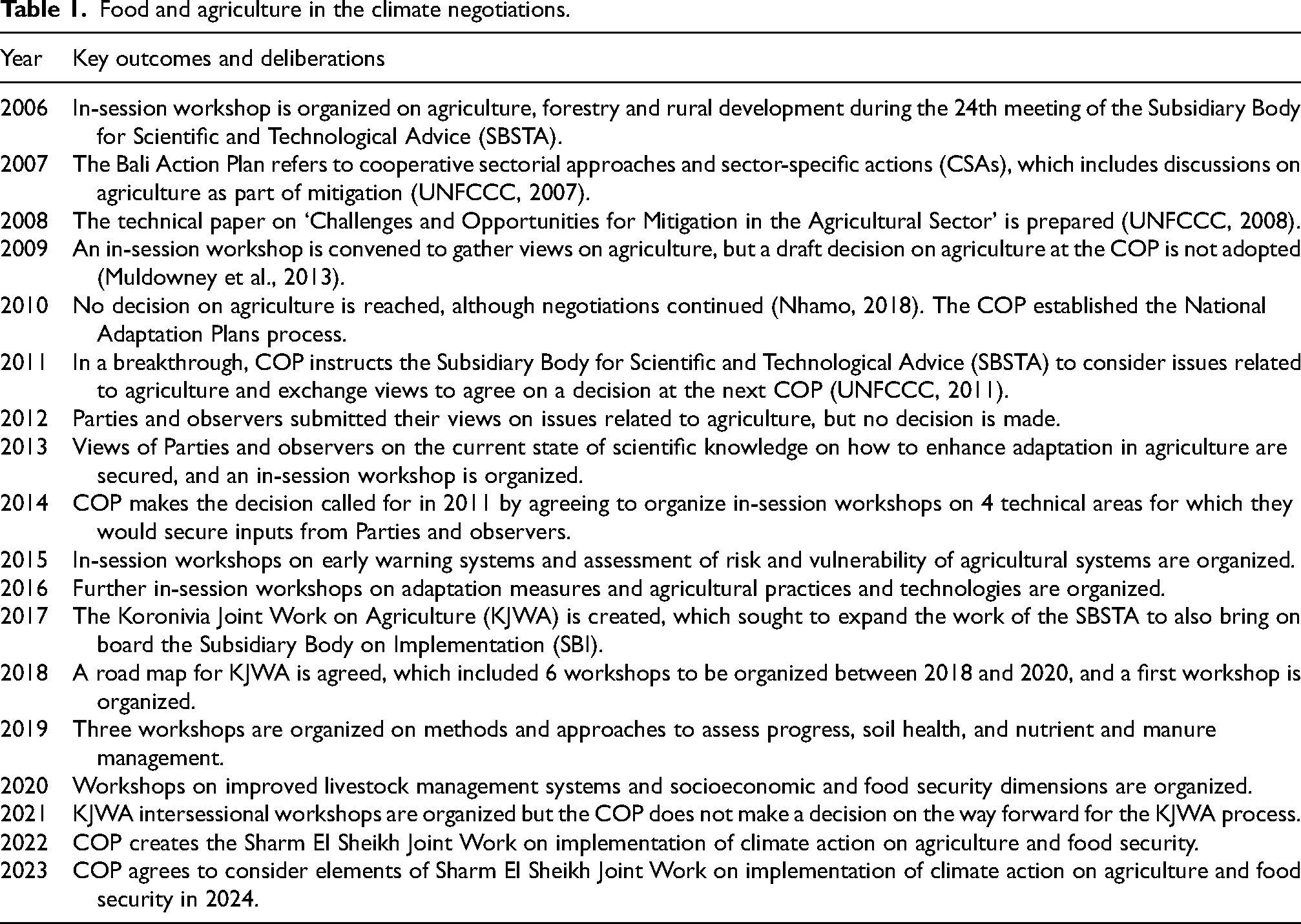
Negotiations on agriculture have been progressing since 2006, when an in-session workshop was organized on agriculture, forestry, and rural development during the 24th meeting of the Subsidiary Body for Scientific and Technological Advice (SBSTA). SBSTA is the technical body of the UNFCCC, while the Subsidiary Body for Implementation is responsible for implementation. This meeting initiated thinking around the mitigation of emissions from the agricultural sector and its challenges and opportunities (Kumarsingh, 2006). Following this initial workshop, the 13th COP in Bali a year later saw the reference to cooperative sectorial approaches and sector-specific actions for mitigation, and based on a request from Uruguay and New Zealand, discussions on agriculture were included therein. However, this focus on mitigation also prevented progress in the agriculture discussions, as some countries were nervous that mitigation actions in agriculture would impinge on commodity trade and/or food security.
Thereafter, food and agriculture have made a slow but ongoing journey through UNFCCC meetings. Table 1 shows how COPs and intersessional meetings over the years have incorporated food and agriculture through formal negotiation processes.
Food and agriculture in the climate negotiations.
Even as food and agriculture continue to be discussed in the UNFCCC over the past 17 years, the resulting action in the real world has been slow. Emissions from the sector have grown (Crippa et al., 2021) and there are growing concerns over the impacts of climate change on food production (Lee et al., 2023). Figure 1 shows the growth in emissions since 1992, when the Rio Summit led to the creation of the UNFCCC. The figure also shows the estimated temperature change on land, which affects the lives and livelihoods of farmers and threatens food production. Negotiations continue, while emissions and temperatures rise.
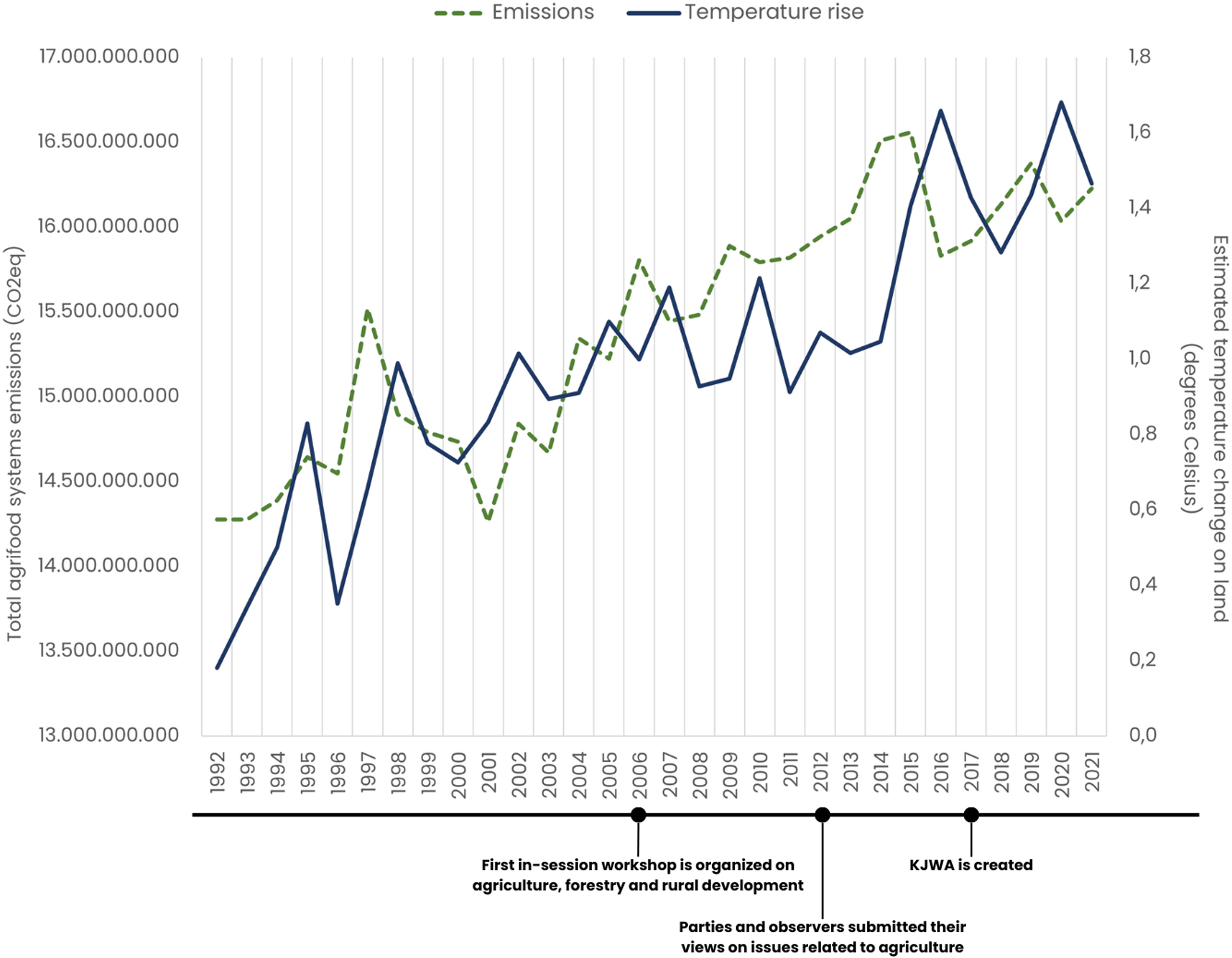
Global GHG emissions from agrifood systems and temperature change on land (1992–2021).
In spite of ongoing negotiations and interest, the realization of climate action in the agricultural sector has been slower in comparison to other sectors such as power, cement, buildings, hydrogen and road transport (Climate Change High-Level Champions, 2023a). In this context, where progress is not matching the rhetoric or proclaimed ambition, we find the global climate change process providing false optimism and deviating attention from the real-world need for ambitious action in the sector. Below we identify the key challenges which we believe need honest reflection to deliver the action needed.
Challenge 1: dichotomy between the COP Presidency and negotiation outcomes
Each COP is hosted by a country (the President), who in turn, appoints an individual to act in that physical capacity. Over the years we have seen greater focus on Presidency-led special initiatives on food and agriculture. This generally involves the Presidents spearheading a special initiative with the support of multiple countries and multilateral organizations. These Presidency-led special initiatives are often accompanied by a series of consultations and preparatory meetings that require significant resources in terms of diplomacy, finance, expert and consultant time (and fees), as well as travel costs. The promise of these initiatives is that they can help build political momentum. While formal UNFCCC negotiated decisions require a consensus among all parties, these Presidency-led initiatives do not need the buy-in of all countries. In addition, these initiatives serve to spotlight the green ambitions and efforts of the host country. Most host countries also seize the media moment to showcase initiatives, business opportunities and tourism possibilities not linked to climate action. Some of the major media-catching activities around food and agriculture at recent COPs have come via Presidency initiatives, including the Food Systems Declaration at COP28 in the United Arab Emirates, which was highlighted as a success in many top-tier news outlets. However, we find that while Presidency-led efforts can garner political momentum in the short term, these initiatives tend to have a short shelf life, resulting in a significant waste of funds and energy. In Table 2, we map the current status of different Presidency-led initiatives on food and agriculture over the years.
Presidency initiatives on food and agriculture at the COPs.
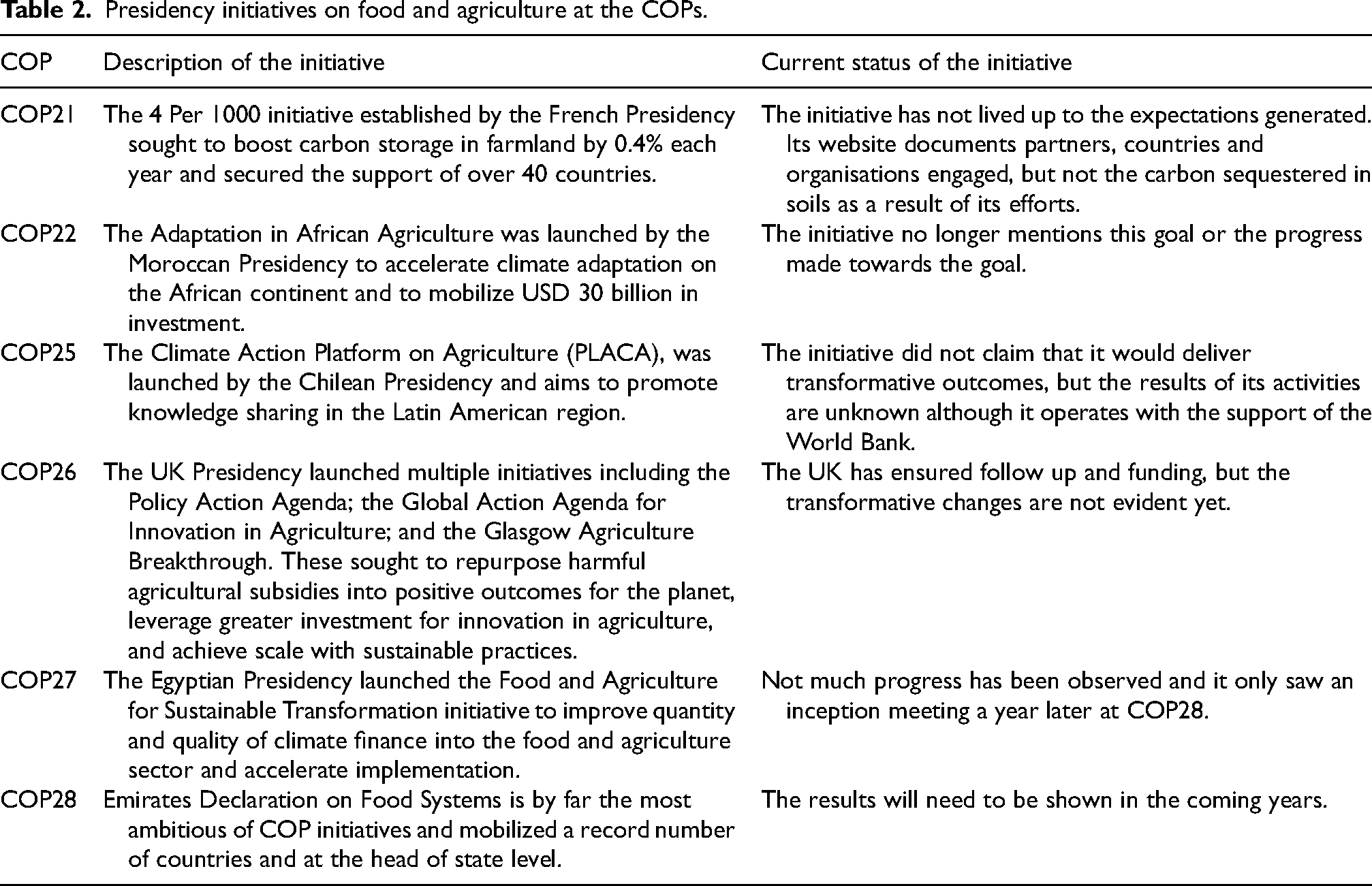
These Presidency initiatives are usually launched with much pomp and show, but over time their relevance declines as political priorities change, resources are deployed elsewhere, and the attention shifts to the next COP. In some cases, actual funding commitments are not even established before launch, diminishing any potential clout that these initiatives might have. Some of the initiatives still exist, but they have not delivered the massive transformation which they promised. For example, the 4p1000 initiative was launched at COP21 with much publicity and the then French Minister of Agriculture, Stephane Le Foll saying, ‘this initiative can reconcile aims of food security and the combat against climate change’ (Ministry of Agriculture, 2021). However, the initiative has been critiqued on many fronts (Rumpel et al., 2020) and there has been a push to change the name to reframe the goal as aspirational and not to provide false optimism. None of these initiatives is systematically reporting on the results they deliver in terms of mitigation and adaptation.
These well-branded Presidency initiatives with ambitious wording are often in stark contrast to the conversations in the official UNFCCC negotiations. It illustrates a dichotomy between the Presidency initiatives and the outcomes of the formal negotiations. This was particularly shown at COP28, where 159 countries signed onto the Emirates Declaration on Food Systems, while at the same time, the formal negotiations on agriculture could not acknowledge the declaration, and its priorities were not reflected in the negotiations, which merely concluded by agreeing to continue considerations in June 2024 (UNFCCC, 2023b).
The creation of these special initiatives is consistent with the concept of ‘empty institutions’, which are created not to deliver action but as a way to hide failure in negotiations, distract the public and avoid scrutiny (Dimitrov, 2020). Over the years, significant amounts of resources and capacity have been allocated to create these initiatives, which has protected the formal process from criticism of its slow progress and helped Presidencies and countries announce ‘breakthrough’ outcomes without having to take or fund meaningful action. In some cases, funds for special initiatives are diverted from other climate action initiatives which may be more worthy.
Challenge 2: reconciling narratives with funding and results
The UNFCCC COPs are an important place for narrative building; they are highly visible moments that shape funding priorities and agendas, even beyond the UNFCCC, the UN is recognized as an important space to shape the narrative on food and farming (Anderson and Maughan, 2021). Those narratives are important to acknowledge problems, the need and avenues for action, and showcasing commitment. But often the level of ambition that is communicated in these narratives is not translated into real-world action. Take, for example, COP22, where the need for adaptation in African agriculture was a prominent narrative (Nhamo, 2018). This is a hugely important topic, and the narrative is legitimate. However, despite the prominence of this narrative in the media, the much-needed and promised action has not happened, and the adaptation finance gap for Africa remains ever present (GCA, 2022). Another narrative concerns the need for more finance for the agricultural sector, as was the case at COP27. Unless the sector shifts from narrative building to results (and finance) delivery, these narratives will remain empty promises.
Narrative building efforts also make the space contested, with different interest groups promoting their narratives over those of others to lobby for resources. This often results in the formation of new concepts which form the basis of lobbying efforts. In our COP engagements, we have seen terms including climate-smart agriculture, agroecology, regenerative agriculture and food systems transformation be the source of contention and the focus of lobbying, as opposed to a focus on results. This also opens the COP space to specific interest groups and offers the opportunity for agenda capture. In recent years, we have seen an increasing role played by consultancy groups in these processes, which at COP28 culminated in a consultancy leading a COP28 Presidency initiative on regenerative landscapes (COP28 Presidency, 2023). The role of private consultancies in weakening governments has been highlighted as a risk (Mazzucato and Collington, 2023), and COPs are blatantly facilitating it. In addition, big emitters in the agriculture sector – meat and dairy companies – have also been sending record numbers of participants to these conferences (Sherrington et al., 2023), lobbying to protect their interests.
We acknowledge that part of the purpose of the COPs process is to develop narratives. Kinley et al. (2021) distinguish seven functions for this kind of multilateral processes: (1) developing international law and setting rules and standards; (2) establishing globally-agreed goals and sending signals; (3) enabling data sharing, promoting transparency and encouraging accountability; (4) promoting awareness and learning; (5) facilitating the provision of means of implementation and support; (6) building engagement of stakeholders; (7) contributing to raising global ambition. However, in our experience, specifically on food and agriculture topics in the COP process, most recognizable progress is linked to those related to building narratives (4, 6 and 7), but very little is delivered in terms of the functions linked to concrete action (1, 2, 3 and 5). This is a result of the process, which makes it impossible to achieve sector-specific rules, standards, laws, data sharing etc., amidst a contested political environment.
So far, the negotiations, as well as the initiatives, at the COPs have not been able to set enforceable rules, laws and standards, agree on concrete goals (e.g. in the food system), or make meaningful progress on the sharing of data and transparency, while means to implementation remains a stumbling block for many negotiations. While this is not a sectoral issue, as Kinley et al. (2021) point out the system must shift towards full implementation of commitments. Unless such a shift occurs, we will be left with a struggle over narratives, false optimism and agenda capture by private consultancies or major emitters, but with no dent on emissions or on the impacts of climate change on food systems.
Challenge 3: addressing systemic failure of conferences and summits
Some of the problems are not exclusive to the UNFCCC COPs. Other summits, such as the summits convened by the UN Secretary-General, are also susceptible to the challenge of furthering rhetoric without concrete action. The UN Climate Action Summit in 2014 resulted in only 52% of the agriculture related actions producing relevant follow-up outputs (Chan et al., 2018). The UN Food Systems Summit in 2021 also launched a number of coalitions, many of which are inactive today. Essentially these examples show that the process of summits does not lead to change and transformation. Still, the yearly calendar of food and climate summits continues to expand. At least in part, participation in these summits is driven by a fear of not being seen by funders, governments, partners or media, which drives the continuous flow of empty commitments and impotent coalitions.
Meanwhile, these summits consume considerable resources. For example, COP26 costs were estimated by the UK Government to be £290.73 million (Cabinet Office, 2021). In comparison, COP23 which was under the Fijian Presidency but hosted in Germany, cost the German Government an estimated €117 million (BMU, 2018). These costs show the financial commitment that the conferences require. Unfortunately, the costs of most COPs are not readily available.
The number of participants in these meetings is also growing: COP28 saw 83,884 participants with official badges to attend the conference (UNFCCC, 2023a). There were 49,704 badges issued for COP27, and 38,457 for COP26. In comparison, COP1 only had 3969 participants. In Figure 2, we show the growth in participation over the years, based on the information available from the UNFCCCC.
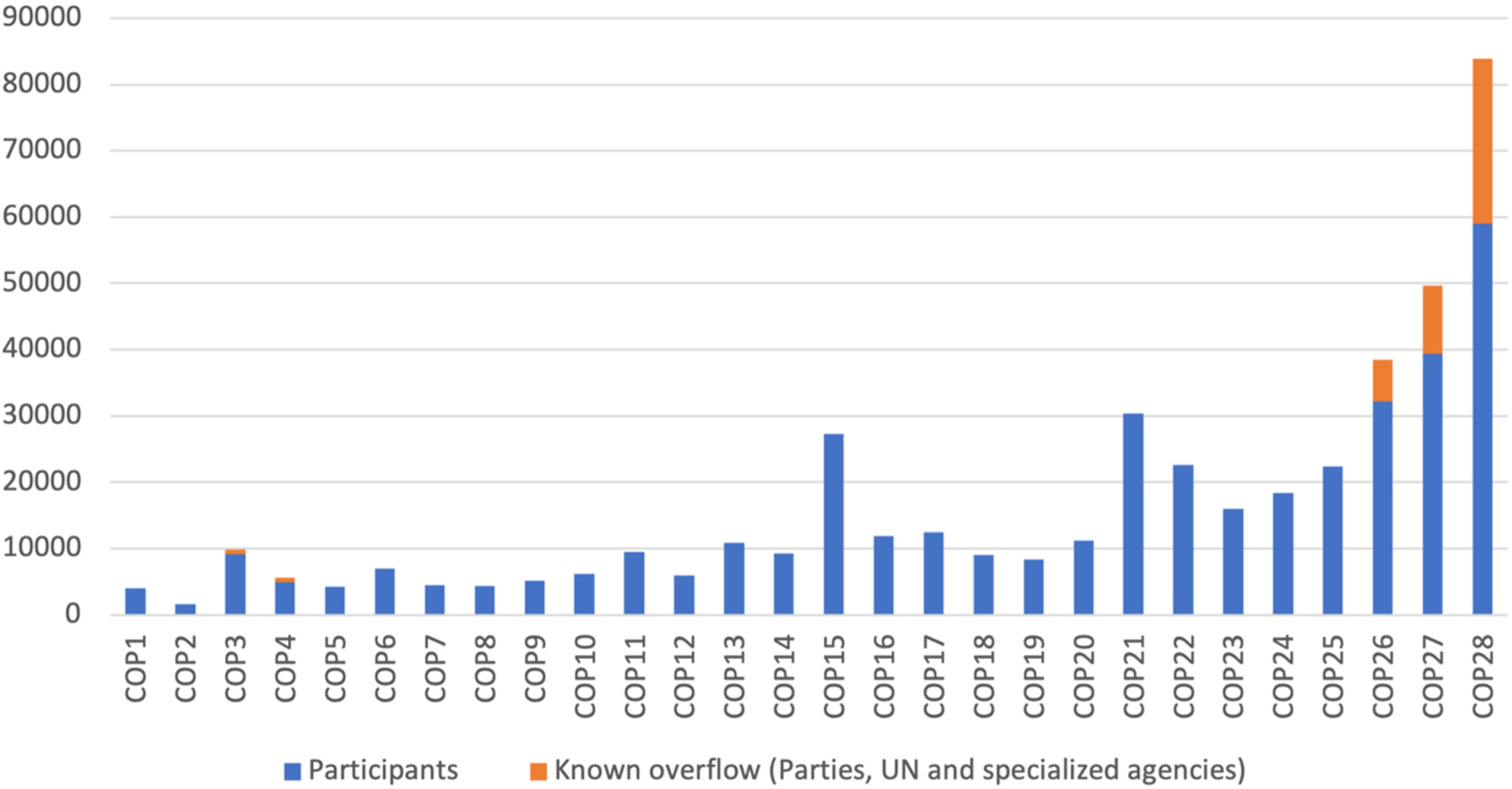
Attendance at the COPs over the years.
This growth in participants is partly deliberate with the development of the Global Climate Action Agenda, that is, a series of linked summits and orchestration efforts in parallel to the UNFCCC negotiations. However, the increasing size of the COPs and increasing amounts of resources are not delivering the results needed for climate action and food systems transformation. The increasing size raises serious questions about the cost- and emission-effectiveness of the process of summits in driving climate action and food systems transformation, especially when contrasted with Figure 1, which shows the growth in emissions from food systems and temperature increases over land over the past three decades. Many of the participants (ourselves included) are mostly at the summits to promote their work, link their work to policy, and to network. However, to frame these summits as transformative is an obvious overstatement: there is no evidence that they are delivering the results urgently needed. The argument that people at the COPs are influencing a larger reduction in emissions than those expended to travel to them (mostly by air) cannot be taken seriously: the concrete outcomes of the COPs are indeterminable, and many of the participants are not taking part in emissions reduction activities in the first place.
The failure of the COPs process has been studied and highlighted (Maslin et al., 2023). It is evident that the COP process is not designed to catalyse the change and ambition which we urgently need. This failure reflects the prevailing culture in international cooperation, where it is easier to organize meetings about solving the problem than actually solving it. There is a need to learn from the failure and create something better; literature on failure management and learning from failed examples of science-policy engagement can help rethink this approach (Dinesh et al., 2021). Previous heads of the UNFCCC themselves have been critical of countries not delivering the change promised and called it ‘unthinkable’ to continue at the pace of the past three decades (Kinley et al., 2021). The consensus-based approach that the UNFCCC adopts holds back the ambition level. Furthermore, the influence of incoming Presidencies, the lobbying by those with vested interests, and the influence of private consultancies all make the process a highly contested space to showcase efforts, without any mechanism to hold any of the actors to account for promises made.
However, the fault does not remain only with the UNFCCC process: the food and agriculture sector has a longer history of multilateral processes, and there is a well-established international, regional and national architecture. Arguably, the food and agriculture sector is better organized than other sectors, and should not have to wait for an outcome under the UNFCCC to act. At the global level, the Food and Agriculture Organization of the United Nations is responsible for providing technical assistance for countries and had annual revenues of $1.8 billion in 2021 (Dag Hammarskjöld Foundation, 2023). Similarly, the International Fund for Agricultural Development for long-term financing had revenues of $720 million and the World Food Programme had a budget of $9.8 billion for providing emergency assistance (Dag Hammarskjöld Foundation, 2023). The CGIAR system, designed to provide the science needed for countries, had a budget of $771 million in 2022 (CGIAR, 2023). Collectively, the multilateral system for food and agriculture has greater resources, institutional history and capacity than the UNFCCC. The global architecture is complemented by regional and national systems with further resources and capacity. However, cross-agency coordination and institutional directionality continue to be major challenges for the implementation of climate actions in the food and agriculture sector, together with the lack of consensus amongst countries.
Farmers around the world experience the impacts of climate change (IPCC, 2023). As the impacts continue to worsen, the current approach of organizing summits, which consumes significant investments, financial, diplomatic and political, is not sustainable. Many organizations spend significant time and resources preparing for their participation at the COPs; this includes travel (often flights), accommodation, events, staff time and so on. For instance, Clim-Eat, a small and new entrant, spent in excess of $100,000 on COP28 engagement. Such participation and engagements are often counted as outputs or deliverables for funding, which means that funding for climate action gets diverted to COP participation and engagement as opposed to financing actual climate action activities.
It is hard to avoid the conclusion that this system is fundamentally flawed and stands as an example of systemic failure. Climate diplomacy in its present form (Harris, 2022) is not delivering change, and the same applies to the multilateral system for food and agriculture, which is well positioned but not stepping up to deliver the transformation needed in food systems in response to climate change.
Way forward
We need to fundamentally change climate diplomacy to tackle climate change in food systems. Organizing more meetings and inventing new terms will not solve the problem. The three challenges discussed above serve as the starting point for the critical and honest (self-)reflection needed by all those participating – including ourselves – and contributing to the yearly carousel of COPs and summits. Here, we identify three possible ways in which these challenges can be addressed.
A first step is an honest reflection and accepting the failure of the process thus far. Only then will radically different alternatives be imagined and considered—more of the same has clearly not been delivering results. However, there will be much resistance to change due to entrenched interests in the incumbent system (Conti et al., 2024). Therefore, we recommend conducting impact evaluations of the negotiations process on agriculture, including the key decisions and workshops, as well as that of the Presidency-led initiatives (Table 1 and Table 2). Such evaluations will help determine the value of these summits and processes in an objective manner. Metrics which can be considered for such evaluations include estimates of actual investments mobilized, positive shifts in some of the key Sustainable Development Goals, estimates of emissions reduced linked to specific actions, and the number of farmers and other food system actors who have become more resilient as a result. The data for estimating some of these metrics are admittedly not easy to come by, and an important activity is to search for adequate proxies that are relatively straightforward to collect in a timely manner. Credible metrics are likely the only way in which we can steer away from a fixation on process towards a focus on impact. This can be a way to refine the objectives and scope of the COPs, enabling more focussed action and limiting the room for contestation and co-optation of the agenda.
Second, there is the need to reform the UNFCCC to make it fit for purpose. Currently there is very little incentive for countries or non-party stakeholders to keep to the promises they make in these meetings. We suggest that the UNFCCC adopts a watchdog type function, exposing inaction by countries and non-party stakeholders. This should go hand in hand with a reform to the annual cycle of COPs, making it leaner. The results on climate action should be central, rather than the explosive growth in attendance, new Presidency priorities, and money channelled to conference organization. We suggest that the COPs are hosted on a multi-annual basis to reduce their frequency, and that an increased emphasis is placed on inter-sessionals and working meetings. To deliver, the independence of the UNFCCC also needs to be protected from fluctuating annual and presidency priorities, private consultancies and lobbyists. We also need transparency on the costs of the COP meetings; year on year, these meetings are becoming bigger in scale, and there is a lack of clarity as to what the actual costs are, how these costs are covered, and whether the benefits for the climate make these investments worthwhile. This information can form the basis of efforts by civil society to hold the UNFCCC, member states and non-party stakeholders accountable.
Third and finally, the failure of the UNFCCC and the wider multilateral system to realise actions is a symptom of a wider system failure. We cannot wait for a COP decision on food and agriculture to guide action. The consensus-based nature of the COP process creates too large a risk that the food and agriculture agenda gets hijacked as a bargaining chip for negotiations in other sectors such as energy. We thus need to rethink the system for realizing climate action in food and agriculture. The international food and agriculture agencies such as FAO, IFAD, WFP, and CGIAR could be a key part of that if they succeed in rapidly aligning their efforts to climate action. Resources allocated to these agencies need to demonstrate results on climate action, and these need to be measurable using a common set of results-based metrics. Such efforts need to go beyond climate projects or initiatives, making climate action core to their efforts. This may mean creating new divisions or departments, getting rid of redundant functions, and reorienting parts of these agencies to make them more fit for purpose. At the same time, we should accelerate efforts to imagine new systems that can rapidly deliver the action needed. The UN system may be a part of this, but unless radically reformed, the changes are not coming from there. Ultimately, the needs of farmers and others taking climate action are the same as when the negotiations on food and agriculture began: the provision of finance and incentives, technologies and capacity, and the ability to achieve scale with new practices and technologies. The false optimism created by the existing COPs process will not deliver any of these. Stronger accountability to commitments made, and alternatives to muddling through with a consensus-based process will be fundamental to preventing further failure. A combination of critical self-reflection and rethinking the current processes and mechanisms to provide these things, summit or no summit, should be the priority.
Footnotes
Declaration of conflicting interests
The authors declared no potential conflicts of interest with respect to the research, authorship, and/or publication of this article.
Funding
The authors received no financial support for the research, authorship, and/or publication of this article.
