




Abstract
The agricultural sector faces multiple challenges linked to increased climate uncertainty, causing severe shocks including increased frequency of extreme weather events, new pest and disease risks, soil degradation, and pre and postharvest food losses. This situation is further exacerbated by geopolitical instability and volatility in energy prices impacting on fertiliser supplies and production costs. Net zero strategies are vital to achieve both food security and address negative environmental impacts. This perspective paper reviews and assesses the most viable options (actions) to achieve net zero with a focus on the arable/livestock and protected cropping sectors in the UK. The methodology was based on a synthesis of relevant literature, coupled with expert opinions using the holistic PESTLE (Political, Environmental, Social, Technological, Legal and Environmental) approach to categorise actions, leading to formulation of a roadmap to achieve net zero. The PESTLE analysis indicated that there are technically and economically viable actions available which need to be prioritised depending on the ease of their implementation within the two crop sectors investigated. These actions include (i) policy changes that are better aligned to net zero; (ii) circular economy approaches; (iii) connectivity and accessibility of information; (iv) increased resilience to shocks; (v) changing diets, nutrition and lifestyles; (vi) target setting and attainment; and (vii) farm economics and livelihoods. The outputs can be used by stakeholders and decision makers to inform policy and drive meaningful changes in global food and environmental security.
Introduction
Continued transformation of the agricultural sector is essential to ensure that sufficient, safe and nutritious food is produced to meet the needs of a growing global population, which is expected to reach 10 billion by 2050 (United Nations, 2019). Agriculture is both a sink and a source of greenhouse gas (GHG) emissions with the OECD estimating that the agricultural sector can make a net carbon (C) sequestration of 4% of global GHG emissions by the end of the century (Henderson et al., 2022). Coupled with socio-economic development and the need to meet the UN Sustainable Development Goals (SDGs), there is a societal urgency to transition towards a more sustainable food industry, with reduced GHG emissions and increased C-sequestration, whilst also protecting and enhancing biodiversity, soil health (Pawlett et al., 2021), water resources and air quality. Agricultural activities not only contribute to global GHG emissions but are also responsible for c70% of freshwater consumption, loss of biodiversity and declining soil quality (Zhou et al., 2021). The UK was the first major economy to implement a legally binding commitment to achieve ‘Net-Zero’ GHG emissions by 2050 (HM Government, 2021). Ortiz et al. (2021) report that approaches for agriculture in the UK to achieve Net Zero includes a combination of actions to reduce emissions and also capturing carbon both on-farm and through societal changes towards greater sustainability. This requires technological innovation, public and private funding, public support, behaviour change and policy drivers to implement it. However, the agricultural sector faces many challenges with changing weather patterns and increased climate uncertainty causing severe shocks including increased frequency of extreme rainfall and drought events, new pest and disease risks, and increased levels of soil degradation due to reducing levels of soil organic matter and soil biodiversity (Rickson et al., 2015). To exacerbate the situation, geopolitical instability has resulted in increased volatility and rising energy prices impacting on fertiliser supplies and production costs, and highlighted the risks associated with our dependence on importing key commodities. Recent changes in immigration legislation have negatively impacted on the sectors’ ability to recruit and retain labour to harvest high-value crops, notably soft fruit. The UK agricultural sector is therefore undergoing a period of profound change in response to these so-called ‘drivers for change’. Whilst some of these challenges are not necessarily new and have occurred in the past within certain sub-sectors, it is the combination of these externalities and the critical need to reduce emissions and meet stringent environmental targets that represent a raft of major challenges facing the UK agricultural industry.
According to the Intergovernmental Panel on Climate Change (IPCC) (Matthews, 2018), net-zero emissions are achieved when anthropogenic emissions of GHG to the atmosphere are balanced by anthropogenic removals over a specified period. The IPCC notes that where multiple GHGs are included, the definition will depend on the emissions metric to use to balance emissions of one gas with removals of another. Globally, food production is responsible for approximately 34% of anthropogenic GHG emissions (Crippa et al., 2021). The livestock sector is a significant contributor to GHG emissions, mainly as methane (CH4), with emissions from beef being particularly intensive (Lynch 2019). Livestock currently provides approximately one third of the protein consumed in the human diet (Suryawanshi et al., 2017), so the sector's contribution to global nutrition is evident. However, reducing the sector's contribution to GHG emissions, will require investment in innovations for breeding coupled with new technologies to enable reductions in emissions per unit output, and thus bring the livestock industry closer to net zero, are required (Kanter et al., 2020).
The production of inorganic fertilisers for arable production is also highly dependent on fossil fuels, producing at least 3.0 t of CO2 per t of fertiliser. Changes in domestic land use and agriculture could deliver GHG savings of over 40 Mt CO2 equivalent per year by 2050 (compared to today) (Climate Change Committee, 2020). The protected cropping sector (or greenhouse horticulture) also has high energy inputs, but provides a significant contribution to the rural economy (Defra, 2016). In the UK, the soft fruit sector has experienced a strong and sustained period of expansion over the last decade, with soft fruit increasing in popularity each year due to its nutritional benefits, dietary changes and advances in post-harvest storage and processing (Nour et al., 2011). Strawberries represent one of the highest-value crops cultivated in the UK with most production grown at field-scale and under protected (polytunnel) conditions (Morris et al., 2017). Strawberry production has increased by over 30% since 2000, exceeding 4500 ha and producing about 115,000 t of marketable fruit. Nationally, the soft fruit sector is a major contributor to the UK economy and horticultural industry with farm-gate production contributing approximately £695 million in 2015, of which strawberries represented approximately 40% (£284 million) of the total value of national fruit sector production (Defra, 2016). These farm-gate estimates exclude the significant uplift in added value once the crop is sold by retailers.
The main components of a typical arable/livestock system are summarised in Figure 1. It shows the full extent of the main stages of production ranging from land preparation, soil management practices, agrochemical and fertiliser application, through to crop harvest and postharvest. Figure 1 also shows the interactions between the livestock and arable sectors where the output from one sector becomes a resource to the other. The arrows in Figure 1 show the possible GHG emissions from the various stages and diffuse pollution sources which can be minimised to contribute towards net zero (HM Government, 2021). By way of contrast, the main components of a typical protected cropping system assuming strawberries grown under polytunnels and the interventions known to contribute towards GHG emissions are summarised in Figure 2. At the field/farm scale, five principal sources of GHG emissions are identified in Figure 2, including those from the application of mineral fertilisers and the generation of high leachate discharges due to irrigation. Modern soft fruit systems now involve the use of raised ‘table top’ production with the crop grown in soil-less media or substrates (e.g., coir). These ‘closed loop’ systems require high fertiliser inputs and high irrigation applications to avoid the build-up of salts or nutrients in the rootzone, resulting in concentrated runoff or leachate (required to control salinity levels in the growing media or substrate), with volumes typically representing 10%–15% of the irrigation applied (Defra, 2016). The heating and cooling of polytunnels or glasshouses can also be a significant component of energy use to maintain optimum conditions for crop growth, avoiding high humidity (increased disease risk) or low temperatures, as well as for postharvest storage and distribution. Most polytunnels have disposable plastic covers fitted in early spring and removed in late autumn; these are usually replaced on an annual basis, although new polytunnel designs are moving towards multi-year covers to reduce installation and disposal costs. Soft fruit production systems are also intensive users of packaging for the supply of transplants, containers for disinfection treatment of harvested rainwater and postharvest packaging prior to distribution to the retail sector.
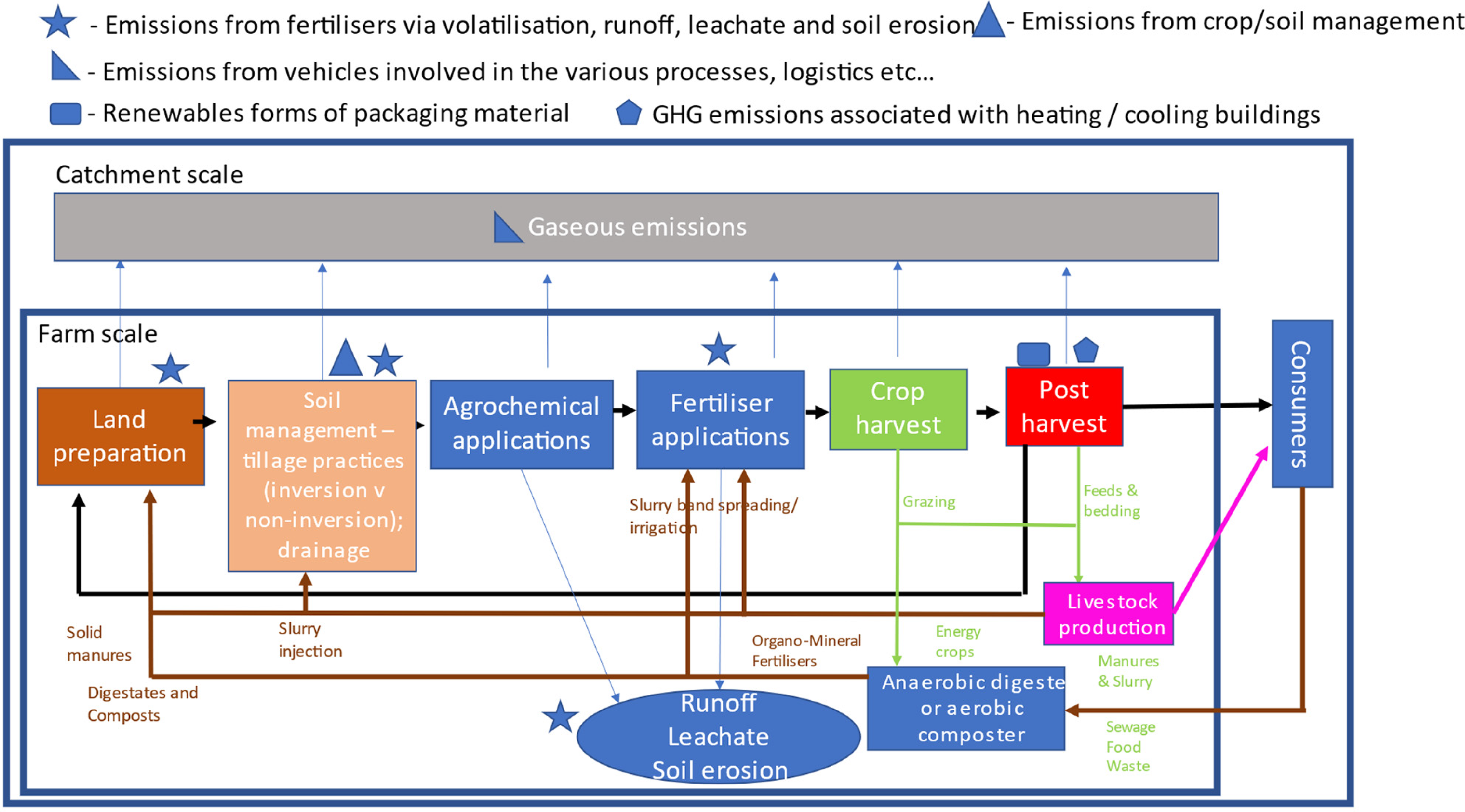
Interventions within an arable/livestock system which contributes towards GHG emissions.
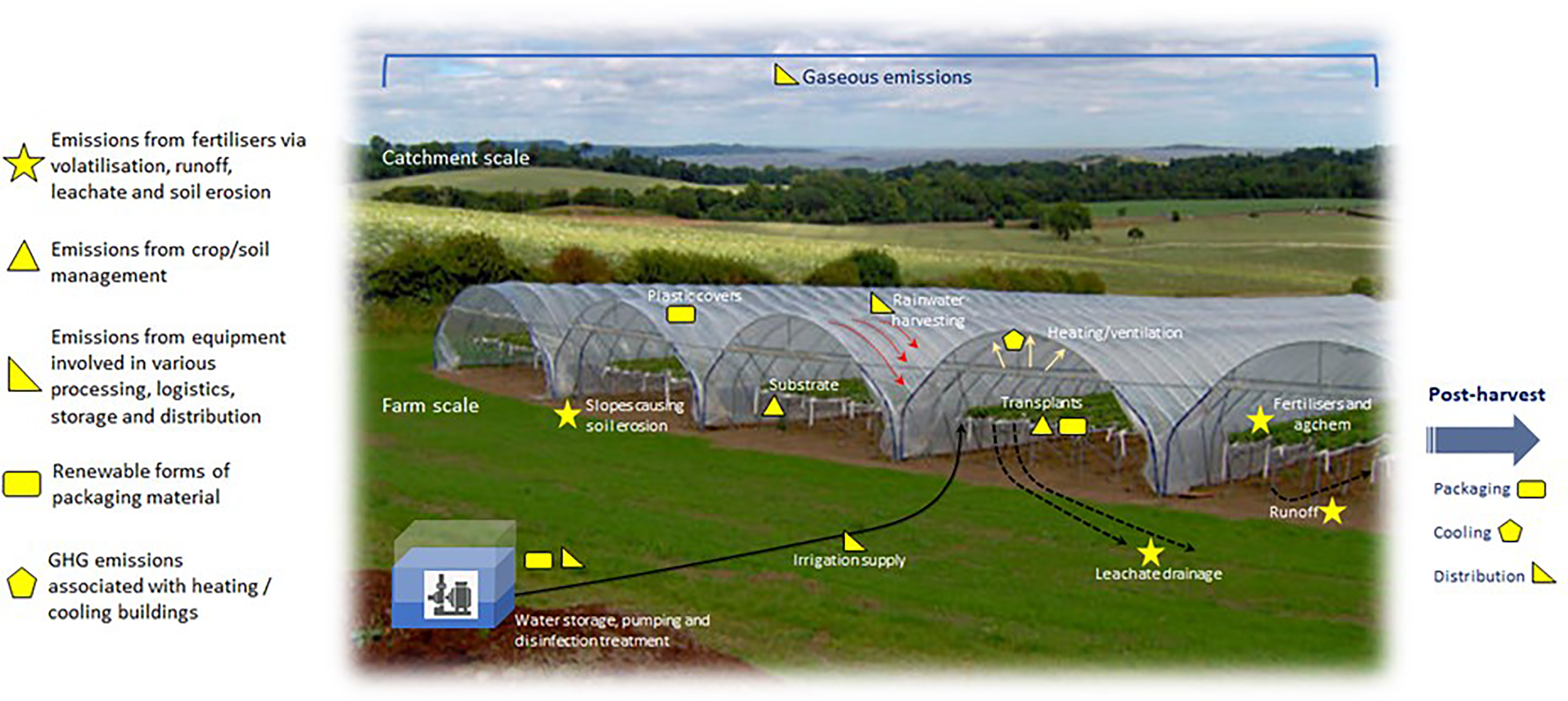
Interventions within a protected cropping system which contributes towards GHG emissions.
Despite the acknowledged regulatory landscape, and climate, energy, and water-related risks facing UK agriculture, there remains a relatively low awareness and slow adoption of so-called ‘climate smart’ approaches. This is possibly due to the diversity of actors involved, their varying opinions and motivations, and the institutional forces acting on them (Barnes et al., 2022), combined with the lack of economic incentives to drive the uptake of innovations in technology and changes in farm management practice. Given the importance of UK government targets to reduce GHG emissions, the aim of this paper was therefore to illustrate how a multi-disciplinary perspective could be adopted for assessing the most viable actions available to achieve net zero GHG production. Using a holistic approach, the analysis was based on a synthesis of relevant literature, coupled with expert opinion, to categorise actions that will inform the formulation of a roadmap to achieve net zero agriculture. The focus was on two key food production systems: arable/livestock and protected cropping which represent the majority of UK agricultural production. Both systems provide many opportunities for possible interventions that can drive progress towards net zero.
Approach
In this study, a PESTLE (Political, Environmental, Social, Technological, Legal and Environmental) analysis (Brown, 2007) was undertaken, using a policy-relevant horizon scanning technique developed by Garnett et al. (2016) to elicit expert opinion regarding the salient and emerging issues, and trends shaping UK agriculture. The approach focused on identifying:
New or emerging agricultural issues or trends around net zero (e.g., novel fertilisers, drought and heat tolerant crops, alternative protein sources, regenerative agriculture and “(re)wilding”), and; New technologies and actions that could be implemented to move towards net zero (e.g., biodegradable packing and sensors to minimise food loss, decision support tools to implement precision fertiliser application, green energy actions to reduce C-footprint in fertiliser production, gene editing).
A workshop was organised comprising of a team of fifteen academics across the School of Water, Energy and Environment at Cranfield University with broad expertise across relevant domains, including agricultural systems (agroforestry, soil science, economics, life cycle analysis, crop physiology, postharvest technology), environment (ecology, water management) and agricultural futures (horizon scanning). Experts were split into two mixed groups, with a facilitated discussion and brain-storming exercise framed by the different PESTLE categories. During the discussions, we considered a wide range of issues and trends shaping agricultural practices and the potential consequences of future events as potential triggers for change. Emphasis was placed on the need to look beyond existing challenges and paradigms to identify issues and trends that describe the ‘present future’ (i.e., the future state of agriculture in the UK). Both macro and micro-level factors driving change in the UK agricultural sector were debated, taking note of current and potential activities, trends and developments related to high and low carbon agricultural practices including for example, lower energy fertilisers, adoption of smart farming technologies, improved measurement, and validation of GHG emission reduction technologies.
The outputs from each group were then collated to produce ‘meaningful clusters’ of emerging agricultural issues and trends, as well as new technologies and actions for achieving net zero. Participants reflected on topics ‘already known / certain’ and those of ‘importance’ to net zero agriculture, applying a simple voting technique. While a scoring system is a convenient way to assign priority, it can sometimes be distracting and time-consuming to force participants to assign values (e.g., a score or rank) to an issue where it is often more beneficial for them to review and discuss their meaning (i.e., novelty and uncertainty vs. level of impact and importance). Hence, an intuitive voting technique was adopted (i.e., five votes per person, where all could be placed on one cluster or spread across a number of clusters), resulting in the selection of the top seven clusters.
Outputs from the focus group discussions were synthesised using evidence-based analysis (existing literature and expert judgement) to explore novel impacts and offer different perspectives on possible opportunities and risks. This included a distillation of how the agricultural community (including farmers, businesses, academia, policymakers) may respond to new or emerging challenges facing the sector. The top seven clusters were distributed among a group of academics with relevant expertise on, and interest in a topic. Each group then carried out a review of the literature including peer-reviewed journal papers, industry and government reports. The literature was synthesised, focusing on describing (i) how an issue or trend is emerging, (ii) the main underpinning drivers and (iii) the implications for the UK agriculture community. An initial draft of each issue was reviewed by the lead author to assess the quality and comprehensiveness of the review.
Synthesis
The PESTLE analysis revealed that whilst many challenges face the UK agricultural sector, there are nevertheless a range of actions available that are technically and economically viable which can support transition to net zero and which need to be prioritised, depending on the ease of their implementation within the arable/livestock and protected crop sectors. The key themes that were identified are briefly summarised below.
Aligning the challenges and potential actions to net zero policies
The UK government published its Net Zero Strategy (Build Back Greener) in 2021, with the aim of reaching net zero emissions by 2050 (HM Government, 2021). This report acknowledged the difficulties in completely decarbonising agriculture, with the sector being one of the ‘hardest to decarbonise’. The strategy also recognised the critical need for monitoring, reporting and verification of GHG emissions from the agriculture sector to better understand where the greatest decarbonisation opportunities might lie. Government policy for net zero agriculture is to reduce emissions that lead to global warming through improved and innovative farming practices. The aim is to capture and store carbon to offset any residual emissions arising from agriculture. The strategy also recognised that a ‘systems approach’ that drives innovation was needed to achieve net zero but did not attempt to predict what the perfect net zero economy might look like.
During the transition away from the EU Common Agricultural Policy, the UK Government recognised the need for technological solutions that reduce emissions and increase the C-sequestration potential of land, as outlined in their 25 Year Environment Plan (Defra, 2018). New farming schemes will enable more opportunities for farmers and landowners to help deliver net zero through land use change. For example, the new Environmental Land Management Scheme (ELMS) in England and Sustainable Farming Scheme in Wales, were designed to provide powerful vehicles for facilitating actions to move towards achieving net zero, where public money would reward farmers and land managers for environmentally sustainable actions (so-called ‘public goods’). Net zero actions included trebling woodland creation rates by 2025 (reflecting England's contribution to meeting the UK's overall target of increasing planting rates to 30,000 ha per year by 2025) and restoring peatland. It was anticipated that the Food Strategy (2022) would also support the delivery of net zero agriculture and incentivise farmers to reduce GHG emissions associated with food production and to change land use to increase C-sequestration. Further details of how the UK Government plans to meet climate and biodiversity targets are due to be published in a new Land Use Framework in 2023. Ultimately, the policy aim was for 75% of farmers in the UK to be engaged in low-carbon agricultural practices by 2030, rising to 85% by 2035, with adoption of new GHG emission-saving technologies, lower-carbon foods and new ways of land stewardship (HM Government, 2021). The intention is to enable agricultural land to sequester emissions while producing food and co-delivering other environmental benefits such as improved air quality, water regulation and biodiversity.
Using circular economy approaches
According to Khalifa et al. (2022), there is no consensus in the definition of circular economy due to its continued evolution. Nevertheless, it can be broadly based on the principles of designing out waste and pollution, keeping products and materials in use, and regenerating natural systems (Ellen MacArthur Foundation, 2022). However, according to Nobre and Tavares (2021) after an extensive review, a circular economy was defined as an economic system that targets zero waste and pollution throughout materials lifecycles, from environment extraction to industrial transformation and final consumers, and applied to all involved ecosystems. Upon its lifetime end, materials return to either an industrial process or, in the case of a treated organic residual, safely back to the environment as in a natural regenerating cycle. It operates, creating value at the macro-, meso-, and micro-levels and exploiting the sustainability nested concept to the fullest.
The circular economy concept as applied to the UK agricultural sector strives to close nutrient, energy and water cycles to minimise the use and loss of expensive inputs such as fertilisers and fossil fuels. It has been estimated that reduction in carbon emissions could reach 45%, which would be significant for net-zero emissions by 2050 (Ellen MacArthur Foundation, 2016). The circular economy is intentionally regenerative, that is, as much as possible, the materials that would previously have been lost to the system as waste are returned to it as resources, thus continually replenishing the system's ability to support itself (Yuille et al., 2022).
One key aspect that does not receive sufficient attention within the regenerative nature of a circular economy is the return of nutrients to land, including for example, the recycling of biowastes and renewable fertilisers derived from them in ways which maintain soil health and fertility and help to rebuild natural capital (Ellen MacArthur Foundation, 2016). This is vital to avoid (i) nutrient deficits in agricultural land where they are essential for food production and (ii) nutrient escape and accumulation as air, water, and soil pollution, with significant consequences for ecosystem (and human) health (Withers et al., 2014). However, there remains the challenge in managing nutrients in agriculture in terms of its losses from the system through leaching, runoff and volatilisation which challenges the ‘circularity’ and establishes a more ‘linear’ economical approach. Innovation is key to tackling this challenge and options such as use of biostimulants, carbon capture technology (Lake et al., 2019), plasma technology, and minimising mineral fertilisers through formulation of organo-mineral fertilisers (Deeks et al., 2013; Pawlett et al., 2015; Antille et al., 2017) are some of the key approaches that are now being implemented to tackle this challenge.
To exert more emphasis on the need and importance of managing nutrients optimally, there is also a drive towards a circular nutrient economy (CNE) which is broadly defined as “the reduction of nutrient losses – during agricultural production, processing, distribution, and consumption – along with comprehensive recovery of nutrients from organic residuals, for reuse in agricultural production” (Harder et al., 2021). According to Yuille et al., (2022), there is an acute under-representation of the circular nutrient economy concept in UK government strategies as well as the potential to reorient current policies towards its development. Thus, to transition to circularity, government policy would require reorientation and reframing, explicitly integrating departments and strategies, and adopting a systemic approach rather than being primarily confined to just one strategy.
Providing connectivity and accessibility to relevant information
Enhanced communications and connectivity can support the sector in reaching net zero targets, through a combination of smart farming technologies, improved measurement and validation of GHG emission reduction technologies, and the timely sharing of information with and between farmers. The expansion of “smart farming” approaches has the potential to bring sustainability benefits including GHG emission reductions to farming systems through various approaches. For example, this may include allowing the use of sensors connected through the internet of things (IoT) using wireless sensor networks which facilitate digital transmission of sensor data and have low power requirements are crucial for such applications. Examples of IoT technology used in GHG emission reduction include crop, soil and water monitoring (e.g., timely water and fertiliser applications to meet agronomic demands (González Perea et al., 2017)); precision planting, fertiliser and pesticide applications (to reduce chemical application rates); running autonomous machinery (e.g., increased energy efficiency over human operators (Villa-Henriksen et al., 2020)), and improved livestock tracking and monitoring to inform grazing management (Zhang et al., 2021). At present, 10%–15% of US farmers are estimated to be using IoT approaches across 250,000 farms (Saiz-Rubio and Rovira-Más, 2020), but no such equivalent data is currently available for UK farming. Alongside collecting and transmitting data, the capability to rapidly analyse information is also important. Most research to date has focussed on the former, without considering processing requirements or how the accessibility of such data can inform on-farm management (i.e., net zero outcomes) (Kamilaris et al., 2017). However, one of the main barriers to uptake is that rural areas in the UK often suffer from relatively poor connectivity compared to urban areas. The National Farmers Union (NFU) 2021 broadband and mobile survey showed that less than 20% of respondents were able to receive reliable mobile signal across all outdoor locations on their farm, and less than 50% believed the signal they received was sufficient for their business needs (NFU, 2022).
Increasing farm connectivity can also improve the accessibility of information for farmers and managers to better inform management decision-making. For example, farmers are increasingly using online sources to access soils information and to inform their current practice, including following farmer “influencers” and a growing reliance on peer-to-peer knowledge networks, with evidence of farmers moving away from traditional experts (Rust et al. 2022). Therefore, better infrastructure must be made available by regional and national governments in the UK so that farmers receive improved access to technologies in order to remain competitive in terms of agricultural production whilst also making progress towards net zero targets.
Building resilience to shocks
Systems with complex structures, a high number of components, and a high level of connectivity and buffering capacity are often able to sustain high levels of production in response to external perturbation (Weise et al., 2020). By contrast, less biodiverse systems where these components are narrowed, by utilising highly bred monocultures and inorganic substitutes, such as mineral fertilisers and biocides, can be more susceptible to single points of failure (Puma et al., 2015). Increasing soil organic matter is one way of restoring some buffering capacity, and regenerative practices may provide longer term stability in yield (Renard and Tilman, 2019), eventually leading to increased farm performance and input self-sufficiency (Nilsson et al., 2022). There have been numerous calls for this type of approach and increasing interest in farming communities putting it into practice, especially in the light of increasing climate change pressures (Urruty et al., 2016; Altieri et al., 2015). Diverse, multi-cropping systems can also sequester carbon at a higher rate than monoculture systems, as in natural ecosystems, whilst simultaneously reducing and de-risking single points of failure.
Planning and implementing these changes needs to occur over three time-frames (Weise et al., 2020). These include (i) reactive (short term response to an immediate event), (ii) adjustive (building capacity to known shocks due on the mid-term) and (iii) provident (building buffering capacity for long-term, unpredictable shocks). The latter includes carbon sequestration, diversity of crops at farm and landscape scales, and reversing biodiversity loss. Therefore, to improve resilience, both complexity and buffering capacity need to be increased, initially by building organic matter in soil and promoting biodiversity, sequenced to deal with (i) immediate risks, (ii) known changes in climate in the medium term, and (iii) long-term sustainability.
Changing diets, nutrition and lifestyles
The food supply chain is facing serious challenges related to climate (e.g., extreme weather events impacting crop productivity and degrading the soil and water resources that underpin agriculture) and non-climate stressors (e.g., increased food, fodder and fibre demand, changes in diets, consumer income, disruptions in supply chain logistics) that jeopardise food security in its four dimensions: availability, access, utilisation and stability (FAO, 2021). Currently, crop and livestock activities for food production within the farm gate are responsible for 9%–14% of global anthropogenic GHG emissions (Mbow, 2019), to which must be added emissions attributed to food loss and waste, transport, processing, storage and retail. In the UK, Ward (2022) reported that nearly a quarter (23%) of emissions were attributed to agrifood systems. Here, we focus on three main aspects: food loss and waste, change in diets and ‘food miles’.
Feeding the world cannot be achieved by solely increasing food production, as this rise will exhaust the currently deteriorated natural resources available. Hence, it is fundamental to make better use of the food already being produced, by reducing food losses and waste in line with UN SDG 12.3. The term ‘food loss’ does not only apply to physical losses, but also nutritional properties and the waste of resources dedicated to the production of that product. Currently, 40% (1.3 billion t per year) of food is lost from the farm to the consumer, which is linked to 8% of GHG emissions (World Resource Institute, 2019). In the UK, 70% of food waste (post-farm gate) comes from households, equivalent to a value of over £14 billion a year and 20 million tonnes of GHG emissions (WRAP, 2021). By reducing these losses, there are better opportunities to increase food availability, provide more nutritious food to the consumer and decrease the pressure being exerted on our land and production systems. Innovative postharvest technologies must also be developed and implemented to extend both storage and shelf-life of fresh produce, while maintaining food quality and safety. Strategies for food loss reduction are particularly important for those food groups with high perishability, such as fresh fruit and vegetables, which are essential components in healthy diets.
A healthy diet is one that prevents malnutrition and other noncommunicable diseases and conditions (WHO, 2020) and in developed countries it is generally associated with a decrease in meat consumption. The shift to less meat consumption per capita implies a greater focus on crop than livestock production. Fruit, vegetable, and legume production result in less GHG emissions per calorie than meat and dairy production (Vieux et al., 2018). For this reason, moving to flexitarian, vegetarian, vegan, or more plant dominated diets (e.g., Mediterranean) can have a significant positive effect on health and the environment (Mazac et al., 2022). However, it is important to consider the environmental impacts of increased fresh fruit and vegetable consumption on the environment, particularly water resources given that the UK imports nearly half its fresh produce from drought stressed countries (Hess and Sutcliffe, 2018). In addition, it is also important that the food we eat is safe and free from pathogens and chemical residues (Alamar et al., 2017). Although there is pressure to reduce the reliance on chemical compounds to grow, process and preserve fresh produce, without them there is a risk of increased pest and diseases (Simoglou and Roditakis, 2022), postharvest disorders (Tosetti et al., 2021) and associated food loss and waste. Innovative cost-effective solutions are therefore needed to find more sustainable and safe alternatives to chemical compounds.
In addition, the global population is concentrating within urban areas, with estimates that 2.5 billion people will live in cities over the next 30 years (Mahtta et al., 2022). This distribution implies an increase in food miles and a detachment between consumers and their food production systems. A way to reduce the transport distance and associated GHG emissions is via urban agriculture, which is reported to increase food security and access, support production in traditional agricultural systems, and motivate healthier dietary choices (Mead et al., 2021). Tomeet consumers’ dynamically changing needs and demands, integrated solutions that overcome the challenges of food production, sustainability targets and climate change need to be developed.
Setting and achieving targets
When setting national targets, it is important to have a clear definition of what is being sought, for example, which emissions are included and the rules for offsetting or removals. Secondly, a clear definition of what contribution agriculture is expected to play would help the sector better understand the scale of the ambition required. A national target for net zero GHG emissions does not necessarily mean every sector achieves net zero. There will also be implications for emissions accounting, for example, if afforestation contributes net CO2 removals to the forestry, even if the land was previously used for farming.
Given the multifunctional characteristics and complexity of agriculture and food systems, national targets would ideally be set following a systems approach, so that multiple goals (e.g., levels of domestic production, GHG emissions reductions, water usage, air quality, biodiversity, human health) can be simultaneously targeted (McGonigle et al., 2021) and the most adverse trade-offs avoided. For example, it can be relatively easy to move to net zero GHG emissions on a farm by reducing food production, but consequential life cycle analyses (that assume constant food consumption by a population) highlight that this can result in greater GHG emissions elsewhere (Smith et al., 2019). This is a process known as carbon leakage (Climate Change Committee, 2020). When reducing agricultural GHG emissions, it is important to think about these effects systematically to minimise perverse effects. Hence, it has been useful for the UK Government to recently announce that the UK will “broadly maintain the current level of food we produce domestically” (UK Government 2022), as this reduces the risk of simply exporting our emissions associated with agriculture. Hence targets should be based on both the underlying scientific evidence base, and a consideration of local knowledge and the wider context, including societal, and economic costs and benefits. The UK has an opportunity to develop coherent, systems-based targets for agriculture, food, land, health and environment. Unfortunately, the UK Government's current Food Strategy does not achieve this (Doherty et al., 2022), but the Land Use Framework planned for 2023 provides an opportunity to adopt such an approach.
Once a target is set, measurement, monitoring and verification challenges remain. Knowing whether the target has been achieved, requires appropriate measurements to be undertaken. There may be many benefits to introducing on-farm interventions, including net C-sequestration (above and below ground), reduced CO2 emissions from machinery, reduced N2O emissions from fertiliser and manures, and reduced methane emissions from livestock and manures. The introduction of a new measure to reduce GHG emissions will require regular and accurate measurements to evaluate whether net emission reductions are achieved in practice. In the absence of adequate measurements, modelling could be applied for actions which are sufficiently well understood. However, the total GHG emissions from many actions implemented in the UK (e.g., zero or reduced tillage) are currently not sufficiently quantified or understood to model these interventions with confidence. Finally, the UK Food Strategy includes a food data transparency partnership, which is an opportunity for outlining guidelines on data requirements and methodologies related to GHG emissions. However, at present, there is no public information on this initiative. Key issues relate to the paucity of agricultural monitoring, and the barriers to improving this, which include costs (capital and ongoing) and infrastructure (internet connectivity for sensors, capacity for lab-based testing).
Enabling farm-level decisions
Ultimately, the implementation of actions to reduce GHG emissions in UK agriculture will need to be taken by individual farmers and landowners. The decisions taken at farm-level can be driven by many factors including the effects of the considered action on profitability and the environment, socio-cultural drivers, willingness to change, legislation and regulation.
In recent years, purchasers of farm products including retailers are increasingly specifying that products should achieve minimum levels of animal welfare and environmental standards. For example, the Morrisons supermarket chain plans to only purchase produce from UK farms that are net zero by 2030 (Morrisons, 2022). This places pressure on producers to move towards and achieve net zero GHG emissions as a minimum standard for some supply contracts. In turn this requires farmers to fully understand the balance of GHG emissions within their farm business. There is understandably an increasing level of interest from the farming community in GHG calculation tools. Some tools, such as the Farm Carbon Calculator (Farm Carbon Calculator, 2022) and Agrecalc (Agrecalc, 2022) are designed to estimate net GHG emissions within a single farm business, considering GHG emissions and levels of C sequestration by hedges and woodland. Other tools, such as Cool Farm Tool (Cool Farm Alliance, 2019) are primarily designed to estimate emissions per unit of product, a process which can become complicated on mixed-enterprise and most livestock farms. Using these tools requires substantial time and effort, and limited work has been undertaken to analyse and compare their applicability (Bokhoree et al., 2021). Hence research and governmental support to enable farmers, or groups of farmers, to calculate their GHG emissions and farm-level rates of C sequestration, and methods to standardise those measurements, would be very helpful in the drive to achieve net zero.
Conclusions
Over coming decades, all those involved in agriculture and food production face the trilemma of how to sustain profitable food production, whilst enabling a reduction in GHG emissions, and avoiding further damage to the environment and biodiversity. At global and national levels, the task is further exacerbated because climate change is already disrupting weather patterns, resulting in increased climate variability, the emergence of new pests and diseases, and shifts in land suitability for cropping. Based on the PESTLE analysis developing a roadmap to balance profitable food production alongside net zero emissions will require (i) improved monitoring, reporting and verification of GHG emissions from the agriculture sector to better understand where the greatest decarbonisation opportunities exist so that net zero policies can be aligned (ii) adopting a circular nutrient economy through use of innovative technologies to optimise soil/crop interactions and minimise pollution (iii) providing farmers with improved access to technologies to remain competitive in terms of agricultural production whilst moving towards net zero targets (iv) improving resilience, complexity and buffering capacity by building organic matter in soil and promoting biodiversity(v) reducing food miles by local sourcing and promoting healthier dietary choices (vi) target setting supported by suitable measurement, monitoring and verification to achieve identified goals and (vii) developing and implementing methods to standardise farm level GHG and C sequestration measurements so that benchmarks can be set to achieve net zero. Achieving net zero remains a significant but achievable target for the agricultural sector but will only be achieved through the collective efforts and engagement between research, industry and government.
Footnotes
Author contributions
Equal contribution: These authors contributed equally to this work.
Author note
Kumar Patchigolla is currently affiliated with Net Zero Industry Innovation Centre, Teesside University, Middlesbrough, UK.
Data availability statement
Data sharing is not applicable to this article as no new data were created or analysed in this study.
Declaration of conflicting interests
The author(s) declare that the research was conducted in the absence of any commercial or financial relationships that could be construed as a potential conflict of interest.
Funding
The author(s) disclosed receipt of the following financial support for the research, authorship, and/or publication of this article: This work was supported by the Higher Education Innovation Funding (HEIF) provided by UKRI and facilitated through Cranfield University.
