




Abstract
This study is in ethnolinguistics, the interface between culture and linguistics. It provides an ethnography (detailed description) of post-funeral death practices among Maronite Christians in Jish, a small village in northern Israel. It also linguistically analyzes some concepts and cultural norms related to these practices and explicates (i.e., defines in simple, universal terms) them using the Natural Semantic Metalanguage (NSM) approach. At the micro-level, this study provides a precise description and analysis of post-funeral death practices in one community sharing the same linguaculture (i.e., the same ways of speaking and living). This precise description and analysis can, in turn, provide an opportunity for a precise comparison between these Jish death practices and their counterparts in other micro-communities. Additionally, this study provides cultural outsiders (those who are outside the culture) with insights into some aspects of the Jish linguaculture; thus it may be of interest to linguists and anthropologists.
Introduction
Background and Aims of This Article
Exploring the ethnolinguistics of death practices has several benefits. Firstly, it documents them. Linguacultural 1 documentation is important because languages and cultures are not constant. They gradually change, and, while this change may appear to be negligible between any two adjacent moments of time, it can look colossal between two very distant moments. If the linguaculture goes completely undocumented, the norms and practices that it encodes through its vocabulary and grammatical constructions can slide into oblivion. If they do, future generations speaking this linguaculture (let alone cultural outsiders, i.e. those who are outside the culture) would never have access to them. Secondly, studying death practices can reveal the similarities and differences between how human beings perceive death events and how they deal and cope with them. It is to be hoped that the similarities can help different people from different cultures see what they have in common, and that the differences can help them conceive some of their cultural norms as culture-specific, rather than universal, norms. This, in turn, can help reduce ethnocentrism. Thirdly, studying and describing death practices in a certain culture can make cultural outsiders who (intend to) live in that culture aware of these practices and can help them know how to behave in death rituals involving their friends or colleagues. This would help them avoid cultural misunderstanding and miscommunication.
Death practices have been investigated in many cultures (Abu-Lughod, 1993; Corr et al., 2019; Hänggi & Diederich, 2017; Hertz, 1960; Hidalgo et al., 2021; Hijiya, 1983; Parkes et al., 2015; Racy, 1969; Selin & Rakoff, 2019; Tien, 2017). One such culture is that of Jish, a small village in northern Israel. Habib (forthcoming/2025) has investigated the funeral death practices and examined what happens during a Maronite Christian funeral in Jish. He, however, has not investigated death practices following the funeral. Hence, the aim of this article is to investigate the post-funeral death practices among Christians in Jish.
Jish
Jish is a relatively small Arabic-speaking village in the north of Israel. It has a population of around 3000 people; about 65% are Catholic Christians and 35% are Sunni Muslims. The Christians belong to two Eastern Catholic Churches (see next section), Maronite and Greek Roman Catholic (otherwise known as Melkite). Approximately 80% of the Christians are Maronites and 20% are Melkites. The Melkites have one church, St Peter and Paul, which was inaugurated in 1906. The Maronites have two churches: The Church of Our Lady, rebuilt a year after the 1837 massive earthquake, and St Maroun’s Church, which was inaugurated in 1996.
The Melkites in Jish did not have a parish priest from 1975 to 2000. This led to the Maronite parish priest, Fr. Bishara Soliman (who served as Parish Priest from 1971 to 2023), to take care of their ecclesial needs during these years. This led to a feeling that the two parishes were one parish. Today, some Melkites still come regularly to the Maronite Church, and the Apostolic Movement in Jish—which is based at the Maronite Church—has Maronite and Melkite leaders and members, who take part in all the liturgical (e.g., the Good Friday procession) and non-liturgical events (e.g., the annual summer camp). Furthermore, because the area of St Maroun’s Church is much bigger than that of St Peter and Paul’s Church and has relatively big halls and yards, Melkite funerals and condolence reception sometimes take place in the Maronite Church. Except for the liturgical differences, all the other death practices of Melkites in Jish are the same as those of the Maronites.
The Maronites
To understand who the Maronites are and what unique features they have, it is necessary to provide a brief overview of the structure of the Catholic Church. While the Catholic Church is one unified entity, it comprises 24 Churches. All 24 Churches are under the jurisdiction and leadership of the Pope of Rome. The largest of these is the Latin-Rite one (otherwise known as the Roman Catholic Church), which includes about 98.6% of the approximately 1.3 billion Catholics in the world (Annuario Pontificio 2024 [Pontifical Yearbook 2024], 2024). The rest are called “Eastern Catholic Churches,” and they include the Armenian Catholic Church, Chaldean Catholic Church, Coptic Catholic Church, and the Maronite Church, among others.
These 23 Eastern Catholic Churches enjoy a significant degree of autonomy. While each of them is totally subject to the Pope of Rome, it elects its new bishops from among its priests by its episcopal synod, has its own first and second instance tribunals (Church courts), and has the authority to revise its liturgical prayers and ceremonies. In contrast, in the Latin-rite Church, new bishops are appointed (not elected) directly by the Pope from among the priests, and any liturgical revision must be initiated, overseen, and approved by the Pope.
While the 24 Churches share the same faith, they can differ significantly in several aspects. Each of them has its own liturgy (i.e., community prayers). To the average Catholic belonging to one of these Churches, attending a liturgical celebration from a different Catholic Church can be disorienting. Each Church also has its own liturgical calendar. For example, Advent (the liturgical time preparing for Christmas) is four weeks in the Latin-rite Church but eight weeks in the Maronite Church. Each Church has its own lectionary (the Sunday and daily readings of the Mass) and its sacred language. For instance, the Latin-rite Church uses Latin, the Armenian Catholic Church uses Armenian, and the Catholic Coptic Church uses Coptic (Dalmais, 1987; Martimort et al., 1986).
While 21 of the 23 autonomous Churches entered into full communion with the Pope of Rome only from the 15th-century onward, the Maronite Church has been in communion with the Pope since its inception. St Maroun (died 410) is its spiritual father, and St John Maroun is its first Patriarch (elected in 685). Since St John Maroun, there have been 77 Patriarchs, with the incumbent Patriarch being Bechara Rai. The Maronite Patriarch is the head of the Maronite Church. His See is in Bkerke, Lebanon, and he is assisted by more than 40 Maronite bishops, each overseeing a diocese within or outside Lebanon. The number of Maronites stands at around 3.5 million, most of whom are outside Lebanon. The Maronite Church has Syriac (north-western dialect of Aramaic) as its sacred language. Its liturgical calendar is unique in having a liturgical time called the Cross Time, not found in other Catholic Churches. It also has its own liturgical ceremonies, music, and vestments for its clergy (Dibs, 1905; Habib, 2008; Moosa, 1986).
Methodology
In exploring the post-funeral death practices in Jish, I draw on two approaches, ethnography and the Natural Semantic Metalanguage (NSM). I employ the former in the description of these practices and the latter in the semantic and pragmatic analysis of concepts and expressions related to them.
Ethnography
Ethnography is a descriptive approach that aims to provide a detailed account of a certain cultural phenomenon. Researchers observe, experience, and document this phenomenon while they are living in the community they are investigating (Hammersley & Atkinson, 2007, p. 3).
In the Study Section, I provide a detailed general account of the death rituals that follow a Christian funeral in Jish. This account is detailed in the sense that it provides as much information as possible about what happens after a Christian funeral in Jish. It is general in the sense that it is not a case study. It is not describing a specific event (i.e. what happened after the funeral of a certain Christian in Jish) but rather describes the post-funeral death practices typically observed by Christians in Jish.
This description is based on my observation of many Christian funerals and death practices in Jish. I was born, grew up, and am living in Jish. Additionally, I participated in 99 out of the 101 Maronite funerals and condolence receptions that took place in Jish from October 13, 2015, to March 24, 2024. I had the opportunity to pay close attention to the details of the social and religious norms that accompany these death rituals and the different memorial ceremonies that follow them. In addition to my own observation, I spoke to 28 Christians of different ages from Jish regarding these norms, as well as the concepts/expressions used in death rituals; the youngest was 16 and the oldest 96.
Natural Semantic Metalanguage
Describing the post-funeral concepts and practices in Jish requires a method that relies on words found in Jish Arabic and also in English. Otherwise, the description that is written in English might not be fully translatable into Jish Arabic. This, in turn, might prevent the verification of the analysis and description with native Jish Arabic speakers. One method (if not the only one) that offers such words is the Natural Semantic Metalanguage (NSM).
NSM is an approach that has been developed by Anna Wierzbicka, Cliff Goddard, and colleagues for more than 50 years (Goddard, 2021; Goddard & Wierzbicka, 2014; Habib, 2022a, 2022b, 2023, 2024; Levisen, 2024; Wierzbicka, 1972, 1980, 1985; Ye, 2017). Four key constructs of NSM are semantic primes, semantic molecules, explications, and cultural scripts. 1. Semantic primes are 65 concepts that are simple (in the sense that they cannot be defined further) and universal (in the sense that they have exact equivalents in (nearly) all languages). Examples of these primes include the English words someone, body, want, and think. Their simplicity has been proven by the inability to define them using simpler concepts, and their universality has been demonstrated by identifying them in languages coming from distinct language families (Habib, 2011, 2019, 2020, 2021; Amberber, 2008; Gladkova, 2010; Goddard & Wierzbicka, 1994, 2002; Levisen, 2012; Peeters, 2006). See, in the Appendix, the Jish Arabic exponents (exact equivalents) of these 65 semantic primes. 2. Semantic molecules are concepts that are relatively complex. Their use in the explications of certain words is nevertheless necessary, as the meanings of these words can be explicated only in stages (Bromhead, 2011, p. 60). Some of these molecules are universal (like child and mother) while the others are language- and culture-specific (like God). But even the latter can be defined using semantic primes only or semantic primes and simpler semantic molecules. Thus, the use of language- and culture-specific molecules would not lead to ethnocentrism. In explications, a semantic molecule is followed by an ‘m’ in square brackets (Goddard, 2021). In this article, I will employ the following molecules (in order of their appearance in the Discussion section): family, get married, Christian, ground, church, God, priest, we, woman, man, child, sit, color, white, black, leg, and soul. 3. Explications are definitions that are worded in semantic primes and molecules. Unlike dictionary definitions, which are compact, NSM explications are detailed, aiming to reflect the knowledge that the native speaker has about the explicated concept or expression (Goddard, 2011). 4. Cultural scripts are relatively short texts describing cultural norms and written in semantic primes and molecules (Goddard & Wierzbicka, 2004).
Study
In this section, I shall provide an ethnographic description of (1) the first three days after the funeral, when condolence reception takes place, (2) the 40th-day memorial, when a Mass is offered for the repose of the deceased’s soul, (3) the 180th- and 360th-day memorials, when two more Masses are respectively offered, and (4) the practice that follows the Easter Sunday Mass.
Days 1–3
Early in the morning of the day after the funeral, the female members of the deceased’s family, accompanied by many other women, visit the cemetery to pray for the repose of the deceased’s soul. This is reminiscent of the visit paid by the three Marys to Jesus’ tomb. When they arrive, they say a short prayer (normally the Lord’s prayer and one or more Hail Marys) followed by a Marian song. Afterward, each woman goes to pay a short visit to the tomb of her relative(s) and says a short prayer there. Then, the female members of the deceased’s family stand next to each other, and the rest of the women offer them their condolences. This is followed by all the women going to the deceased’s house; there, they are offered bitter coffee and tea, as well as plane biscuits and/or khubiz raḥmi (خبز رحمة) ‘lit. mercy bread.’ This bread is known in English as antidoron, and it is a type of bread used in the Byzantine Church’s Eucharist but also offered to condolence-givers (henceforth, condolers) by Christians in northern Israel during mourning times. It should be pointed out that, in the last fifteen-or-so years, more things have been introduced, such as savory and sweetened pastry, but the priests of the parish have recently encouraged the parishioners to shun such a practice and stick to simplicity, and most parishioners seem to follow this advice.
The three days that follow the funeral day witness another round of condolence-giving, known as il-ʾakhid (or il-ʾakhadān) bilkhāṭir (الأخد/الأخدان بالخاطر) ‘lit. taking psyche/heart’ or il-ʿazā (العزا) ‘lit. consoling.’ It is the fifth round for members of the extended family and also for close friends and neighbors (the first round was the day before the funeral day; the second and third were on the funeral day before and after the funeral, respectively, and the fourth was at the cemetery; see Habib (forthcoming/2025)). It is the second, third, or fourth round for all the other people and the only round for those who could not make it beforehand for whatever reason. Note that acquaintances are expected to give their condolences at least once; relatives, close friends, and neighbors, on the other hand, are expected to do so more than once.
During these three days, the deceased’s family (without children) come to one of the church’s halls from 16:00 to 21:00 to receive condolences. They are dressed in (1) black, (2) white shirts/sweatshirts/blouses/T-shirts and black pants/skirts, or (3) dark colors. The attire is not necessarily formal; it can be ordinary. Also, based on my observation, men seem to have more liberty than women when it comes to colors; women seem to stick to black and white colors more than men do.
The condolence-receivers (henceforth, condolees) sit next to each other in one line in the same hall with men sitting near the entrance and women farther from it. Thus those who come to offer their condolences, offer them first to the men and only then to the women. Male condolers sit opposite the male condolees, and the same is true of female condolers and condolees.
When condolers come, the condolees stand up. The condolers enter the hall and pass by the condolees while saying to each one of them ʾalla yirḥamu (الله يرحمه) ‘May God have mercy on him’ or salāmit raskon (سلامة راسكن) ‘lit. the safety of your heads’ (metaphorically, it means ‘May you be protected from death’). The condolees reply by saying tʿīshū (تعيشوا) ‘lit. may youpl live’ and/or yirḥam mawtākun (يرحم موتاكن) ‘May he [God] have mercy on your deceased ones.’ When condolers come as a group (say, a family or a group of friends), men typically enter first followed by women, in order of age. As they enter, and while uttering the condolence phrases, each condoler raises their right hand to their chest; alternatively, they shake hands with the condolees or give each of them a hug and a kiss on the cheek. When the last condoler passes by the last condolee, the condolees can sit. When the condolers sit, a person (usually a young man and almost never a woman) from the deceased’s extended family approaches them with a tray on which are placed small disposable cups of bitter coffee. The condolers have the choice to take or not take the coffee; in either case, they have to utter one of the two aforesaid condolence phrases. The condolers sit in the hall for about 10 minutes; then, they stand up, and go out as they entered, i.e. uttering the condolence phrases and women typically following men.
Offering condolences is a social obligation. This can explain why people are willing to travel long distances (say 1.5 hours from Haifa to Jish) just to spend about 10 minutes in il-ʾakhadān bilkhāṭir. This obligation stems from the concepts of mushāraki (مشاركة) ‘roughly, taking part’ and wājib (واجب) ‘roughly, duty,’ which urge (if not force) people to participate in weddings (if invited) and funerals (without a need to any invitation).
At 21:00, the deceased’s nuclear family returns to the deceased’s house; close relatives (the deceased’s siblings and their children, the siblings of the deceased’s spouse and their children, the spouses of the deceased’s children, and the deceased’s grandchildren, if relevant) would accompany them; they eat sandwiches prepared on the spot, chat for a while, and then the relatives take leave.
On the third day, a Mass is celebrated and is attended by the deceased’s family and other people. Unless the third day is a Sunday, the Mass lasts for about 30 minutes (from 17:00–17:30), in order to allow the deceased’s family to go back to the hall for condolence reception.
It is worth mentioning that, according to Fr. Bishara Soliman, this three-day practice began in Jish in the 1980s, when he completed building the parish halls. Before then, people used to receive condolences at their houses for about a week with no designated times. On the Sunday closest to the completion of the “condolence week,” a shōtafi (شُوتَفِي/شُوتَفِة) ‘funeral Mass’ was held. The family of the deceased would attend the Sunday Mass, which was offered for the repose of the deceased’s soul. They would bring with them ʾulbi (قُلْبي/قُلبْة) ‘sweetened boiled wheat,’ which the priest blessed at the end of the Mass and of which each parishioner took a little to eat while uttering one of the condolence phrases mentioned above. Afterward, men belonging to the immediate and extended family of the deceased go home, shave their beards (which—as a sign of ḥdād (حداد) ‘mourning’—they hadn’t shaven since the death occurred), and eat kubbi (كُبِّي/كُبِّة) ‘Kibbeh’ (a food made of bulgur wheat and minced meat and regarded as a sign of happy events or the end of mourning for extended family members). According to Fr. Soliman and other consultants from Jish, this practice seems to have ceased sometime in the 1980s.
I should note that the words shōtafi andʾulbi do not seem to be Arabic words. The former is obsolete and not known to the younger generations (aged 40 and below); it seems to derive from the Syriac noun shawtofūtō ( ) ‘participation/giving the Holy Communion’ or the verb shawtef (
 ) ‘to participate/to give the Holy Communion’ (cf. Manna, 1975, p. 780). The word ʾulbi seems to derive from the Greek word kollyva (κόλλυβα), which refers to sweetened boiled wheat kernels used in Greek memorial liturgies (see Antonaras, 2018, p. 217).
Another practice that used to be in Jish but ceased to exist sometime in the 1970s was shēl il-bakhkhūr (شيل البخور) ‘lit. carrying the incense.’ According to Marūn ʿalam (born in 1936), the priest used to come with a thurible to the deceased’s house for the three consecutive evenings that follow the funeral. He would say a short prayer and incense the house.
Day 40
A second Mass for the repose of the deceased’s soul is celebrated on or around the 40th-day memorial; this Mass is called ʾuddās/junnāz il-ʾaribʿīn ‘lit. the Mass/funeral of the 40th’ or for short il-ʾaribʿīn ‘lit. the 40th.’ Since the weekend in Israel is Friday and Saturday, this Mass is often celebrated on Friday afternoon or Saturday morning or afternoon, to allow as many people to take part in it as possible. About a week before, and after coordinating the matter with the parish priest, a note (similar to the death notice) is prepared and posted on social media. In addition, since many people who are originally from Jish live in Haifa and Akko, Maronite parish priests there are asked to announce the date and time of il-ʾaribʿīn, which they do during the Sunday Mass. The Maronite parish priest in Jish does the same.
Holding this event is not socially or religiously obligatory but rather highly preferable. However, when it is held, attending it is socially obligatory. The overwhelming majority of the families in Jish who went through a death event have held il-ʾaribʿīn. The reason for which a few families opted not hold it is that they did not want to “force” people from outside Jish to travel especially for the purpose of attending il-ʾaribʿīn.
On the day of il-ʾaribʿīn, close relatives and friends come to the deceased’s house to stand by the grieving family. About half an hour before the Mass, they go to church, and they take with them a photo of the deceased and khubiz raḥmi ‘antidoron.’ The antidoron is bought as laminated triangle-shaped pieces and is put in baskets. In the 1980s and earlier, ʾulbi (قُلْبي/قُلبْة) ‘sweetened boiled wheat’ was offered instead of khubiz raḥmi ‘antidoron.’
As the deceased’s family enter the church, they place the photo and the antidoron on a table close to the sanctuary. The parish priest celebrates the Mass, which is attended by relatives and acquaintances from Jish and from outside Jish. In the church, men and women can sit next to each other. The Mass is very similar to a Sunday Mass, with two exceptions: the homily and the presence of the antidoron.
As in any service, the homily is centered around the New Testament readings, but, in il-ʾaribʿīn (as well as the funeral), the priest is expected to also mention a number of the merits of the deceased. While talking about the deceased is not a religious obligation, it is a social one in Jish (as well as in many other Arabic-speaking places). In addition, and on behalf of the deceased’s family, the priest thanks all those who took part in the funeral and (if the family wants) invites them for luʾmit mjābara ‘lit. a bite of consolation’ (the funeral food) in either the church’s hall or at the deceased’s home; offering this food was socially obligatory for many years, but, at the request of the parish priests in Jish, this custom is gradually disappearing.
At the end of the Mass, the priest blesses the antidoron, and four young men take the baskets and stand at the door of the church. As the Mass ends and people start going out, they pass by the four young men, and they say one of the condolence phrases mentioned above; they can choose to take or not take the antidoron.
People gather in the hall (or the church yard, weather permitting), waiting for the priest and the deceased’s family to come out of the church. When they are out, the priest and the deceased’s family adult members stand next to each other, with the priest standing first followed by male members and then female members, in order of age. People would then pass by them to offer them condolences. When this is finished, everyone goes back home.
Generally, it is considered socially (not religiously) unacceptable to hold any faraḥ ‘happy event’ before the 40th-day memorial is commemorated. Happy events do not only include weddings but also baptisms or any family event with manifestations of joy. Thus any family gathering to celebrate a birthday or Christmas or Easter will be shunned. If the deceased was a young man or woman, such celebrations would be avoided for a whole year. In addition, women belonging to the nuclear family of the deceased person would avoid dyeing their hair; the same goes for women in the extended family if the deceased is young. Such a practice is found elsewhere in the Arab world (Abu-Lughod, 1993, p. 190).
It is to be noted that il-ʾaribʿīn has been held in Jish since 1937. One of my informants, Badīʿ Dāher (born in 1931) has told me that—according to his late mother—when his father, Kamāl Dāher died in 1937, their relatives from Lebanon came and introduced the 40th-day memorial Mass. Another informant, Yisfiyyi Jubrān (born in 1944), has confirmed this based on what she heard from her late father, Yūsif Jubrān (born in 1918).
Days 180 & 365
A third Mass is celebrated some six months after a person’s death, and a fourth one a year after their death. Each one is announced to the community a week before. These two Masses are normally celebrated on a Sunday, and they are attended by the deceased’s immediate family and parishioners who regularly go to church on Sundays. Extended family members, friends, and acquaintances who work on Sundays are not expected to come, as in the funeral and il-ʾaribʿīn. Also, unlike in the funeral and il-ʾaribʿīn, the priest does not have to enumerate the deceased’s good traits, and the deceased’s family members do not stand next to each other after the Mass to receive condolences. Having said that, after the Mass, the Mass attendees who see the deceased’s family members would approach them to greet them and offer them their condolences using the condolence phrases mentioned above.
Easter
Following the Easter Sunday Mass, the parish priest and two or three representatives from each bereaved family line up in the church yard to receive condolences. The representatives come from families who lost a member from the previous Easter onward. To exemplify, on Easter day, April 9, 2023, all those families in Jish who lost a beloved from the previous Easter, April 17, 2022, to the day before the 2023 Easter, stood in line for condolence reception in the church yard after the Easter Mass. The parishioners would then go one by one greeting and consoling the bereaved family representatives by saying al-masīḥ qām (المسيح قام) ‘lit. Jesus rose.’ The priest and the representatives reply by saying ḥaqqan qām (حقاً قام) ‘lit. he truly rose.’
According to the previous Maronite parish priest in Jish, Fr. Bishara Soliman, this practice began in Jish in the 1980s. Before that, the priest and several men used to pay very short visits to the houses of the bereaved families on Easter day to greet and console them with the aforementioned phrase.
Discussion
The ethnography above has shed light on a number of concepts/expressions and norms, some of which may not have equivalents in many languages and cultures, respectively. In this discussion, I will unpack these concepts/expressions and norms using NSM (see the Methodology Section above).
A key cultural concept in Jish is mushāraki (مشاركة) ‘taking part.’ This concept refers to taking part, not only in death rituals (funerals, condolence reception, and memorial Masses), but also in the weddings of people whom one knows well. This concept is not restricted to the Jish Arabic-speaking culture; it may have a counterpart in almost every (Arabic-speaking) community where people know each other well; but this is a matter that needs further investigation. Here is a cultural script for mushāraki ‘taking part’: (A) A cultural script for mushāraki ‘taking part’ a. If I am from Jish, it is good if I think like this: b. ‘I know many people well. Some of them live in Jish, others live in other places c. I want these people to be with me for some time when someone of my family [m] gets married [m] d. I want these people to be with me for some time when someone of my family [m] dies e. When these people are with me, I can feel something good f. Because of this, i. When someone of these people gets married [m], I cannot not be with this someone for some time if this someone wants me to be with them; at the same time, I cannot not be with this someone’s family [m] for some time ii. When someone of these people dies, I cannot not be with this someone’s family [m] for some time iii. If I do not do this, this someone’s family can feel (very) bad because of this. This someone’s family will not be with me when someone of my family [m] gets married [m]. This someone’s family [m] will not be with me when someone of my family [m] dies. I do not want this’
Components (b-f) underline the motivation behind mushāraki ‘taking part’; a person will feel good if the many people they know participate in wedding ceremonies and funerals of members of their family. Component (f) shows the result of this motivation, i.e. the social obligation of this person to participate in the wedding ceremonies and funerals of those many people; note the difference between the wājib (واجب) ‘duty’ of taking part in weddings and that of funerals; the former requires a formal invitation. Still, the expectation is that, like in funerals, in wedding ceremonies, there should be a large number of people. Component (f.iii) specifies what happens if this person does not take part in wedding ceremonies and funerals. The adverb very is placed in parentheses because the family’s feeling depends on their social/biological proximity to the person who decided to deliberately not participate in a funeral or wedding.
The Jish Arabic concept of wājib ‘duty’ (also found in many other Arabic varieties) refers to the social duty of a person to participate in the weddings and death events of their community members and also to communicating with and/or visiting them if they become very sick, undergo serious surgery, or have been involved in a serious accident. (B) The meaning of wājib ‘duty’ a. It is like this in Jish: b. If I know someone well, I cannot not: i. Be with this someone for some time when this someone gets married [m] if this someone wants me to be with them ii. Be with this someone’s family [m] for some time when this someone dies c. If I know someone very well, I cannot not be with this someone for some time if something very bad happens to this someone’s body d. If I do not do this, this someone (’s family [m]) can feel (very) bad. This someone (’s family [m]) will not be with me when the same happens to me. I do not want this
Two comments are in order. First, weddings and funerals are communal events where so many people (relatives, friends, and acquaintances) participate, while visiting the sick is restricted to relatives and close friends. Second, in the past, wājib ‘duty’ (as understood and used by Jish Arabic speakers) also included the practice of visiting someone before they traveled abroad and after they came back. This practice, however, started to diminish some twenty years or so ago and has now ceased to exist. This seems to stem from the fact that traveling abroad was somehow rare in the past but is now very common in Jish. Another practice that was seen as wājib ‘duty’ in the 1990s and earlier but is not so anymore is mʿāyadāt (معايدات), i.e. visiting extended family members and acquaintances at their homes during Christmas and Easter to extend to them seasonal wishes.
The three death rituals that require mushāraki ‘taking part’ are the funeral, il-ʾakhadān bilkhāṭir ‘giving condolences’ (explicated by Habib (forthcoming/2025)), and il-ʾaribʿīn ‘40th-day memorial Mass.’ Unlike holding the funeral and il-ʾakhadān bilkhāṭir (which is obligatory), holding il-ʾaribʿīn in Jish for someone who is a Christian is socially highly preferable. Even if this person was an atheist or converted to a non-Catholic church, the three events are held if the family of the deceased insists on holding them; put differently, in this case, the priest is socially obliged to hold them. In addition, it is socially obligatory for the parish priest to eulogize the deceased if il-ʾaribʿīn is held. Here is a cultural script that couches this norm: (C) A cultural script for praying for the deceased and eulogizing them a. It is often like this in Jish: b. When a Christian [m] dies, sometime after the body of this someone is in the ground [m], it is very good if something like this happens: i. This someone’s family [m] wants many people to be in the church [m] for some time; these people know this someone’s family [m] ii. This someone’s family [m] does something, because of it, these many people can know what the family [m] wants iii. These many people want to be with the family [m] iv. Because of this, after some time, these people are in the church [m] with this someone’s family [m] for some time v. The priest [m] is there vi. These people say things to God [m], like they often do in the church [m] when they want God [m] to do good things for them vii. When they say these things to God [m], they want God [m] to do good things for this someone; because of it, this someone can be with God [m] c. When it is like this, the priest [m] cannot not say a few good things about this someone
Component (a) has the word often and component (b) has the words very good because holding il-ʾaribʿīn is not obligatory but highly preferable; only occasionally has it not been held. Component (b) specifies that il-ʾaribʿīn is held after a Christian in Jish dies, his/her family wants to hold it, and the family announces holding it to relatives and acquaintances (b.i-ii). These people gather in the church (b.iv) and pray, together with the priest (b.v) and the deceased’s family, for the repose of the deceased’s soul (b.vi-vii). Component (c) states that the priest has to eulogize the deceased.
When people attend the funeral and il-ʾaribʿīn in Jish, men and women can sit next to each other in the church. This is in contrast to many other Greek Roman Catholic (Melkite) and Orthodox parishes in Israel. In Fassuta—a village which is about 20 km west of Jish—men sit at the front of the Melkite church and women at the back in all liturgical celebrations. In Mghar—a village which is around 20 km south of Jish—only men enter the Melkite church during funerals. In simple language, this norm can be spelled out as follows: (D) A cultural script for sitting in the church in Jish a. In Jish, it is like this: b. In the church [m], a woman [m] can sit [m] near a man [m] in any place, if this man [m] is not a priest [m]
It is worth noting that component (b) has the words woman and man in the singular rather than in the plural form because, as I argue, this makes the component clearer. Stating this in the plural form (viz. that women can sit near men) can also refer to the example of how men and women sit in the church in Fassuta, i.e. men at the front and women at the back (but still, they are near each other). In the singular form, the sentence would unambiguously mean that any woman can sit next to any man in the church. The phrase ‘if this man [m] is not a priest [m]’ is necessary because women (and laymen) in Jish cannot sit in the sanctuary (the part of the church where the altar is).
On the other hand, when people attend il-ʾakhadān bilkhāṭir, they need to observe gender, as well as age, distinction. This norm can be spelled out in simple terms as follows: (E) A cultural script for gender and age distinction in il-ʾakhadān bilkhāṭir ‘giving condolences’ in Jish a. It is like this in Jish: b. When someone dies, many people want to be with this someone’s family [m] for some time because i. they know them well ii. they want them to feel something good c. In the place where people of this someone’s family [m] sit [m], it is like this: i. If someone of these people has lived for a long time, this someone sits [m] before someone else, if this other someone has not lived for a long time like this someone ii. All men [m] sit [m] before all women [m] iii. Children [m] cannot be in this place d. When people want to be with this someone’s family [m], these people move into the place where this someone’s family [m] are e. If some of these people are a family [m], they move like this: i. If someone of these people has lived for a long time, this someone moves before someone else, if this other someone has not lived for a long time like this someone ii. Often, all men [m] move before all women [m]
Component (a) points out that this norm is followed in Jish. In other places—it should be noted—how men and women can go about sitting for il-ʾakhadān bilkhāṭir can be different. Component (b) refers to the desire of many people who know the deceased or his/her family to stand by the family. Component (c) describes how the adult members of the deceased person’s family sit in the place where il-ʾakhadān bilkhāṭir is held: men sit next to men, and women to women in order of age; in addition, men sit closer to the entrance, so that they are always the first to be given the condolences. Component (d) refers to the coming of different people to offer their condolences, and component (e) describes how a family of condolers enter the place where il-ʾakhadān bilkhāṭir is held. Notice that, unlike component (c.iii), component (e.ii) has the word often, because I have noticed that, at times, a mother can go after her husband but before her eldest son.
The obligation to participate in death rituals is accompanied by a restriction on the clothes that the condolers and condolees have to wear. Attending il-ʾakhadān bilkhāṭir and il-ʾaribʿīn in Jish requires people to wear white and dark colored clothes. Here is a cultural script for this custom: (F) A cultural script for wearing white and dark colors a. It is like this in Jish: b. A short time after someone dies, many people want to be with this someone’s family [m] for some time because they want them to feel something good c. The color [m] of the clothes [m] of these people can be like this: i. It can be black [m] ii. Part of it can be white [m], the other part can be black [m]; this other part is where the legs [m] are iii. It can be like the color [m] of things when there is no sun [m] d. At the same time, when someone sees these clothes [m], this someone can think: ‘people can often wear [m] these clothes’ e. When people do this, this someone’s family [m] can think like this: i. ‘Because this someone died, these people feel something (very) bad like we feel something (very) bad’ f. It is good when something like this happens
Component (b) refers to the recent death of a person and the desire of many people who know him/her or his/her family to be with the family. Components (c) and (d) refer to their clothes, which can be ordinary (hence the word often in component (d)); it is worth mentioning that wearing ordinary clothes during death rituals is not acceptable in all Arabic-speaking communities; among many Christians in Lebanon, for example, the family of the deceased have to wear formal attire. The clothes worn by the family of the deceased have to be of the following colors: (1) totally black, (2) black pants/skirts and white shirts/sweatshirts/blouses/T-shirts, or (3) dark colors. Components (e) and (f) refer to the idea that the color of the clothes expresses solidarity, which is desirable.
A number of utterances are used in Jish before, during, and after the funeral. Most of them have been investigated and explicated by Habib (forthcoming/2025). One utterance that is used, but has not been explored, is al-masīḥ qām (المسيح قام) ‘lit. Jesus rose.’ The utterance is used mostly by Arabic-speaking Catholic and Orthodox Christians as a greeting on Easter. In Jish, this utterance is also used in death rituals. On the day of the funeral, it is mainly used by the priest. On Easter day, when condolences are offered to all the bereaved families in Jish, everyone uses it. In Lebanon, on the other hand, it is employed as a condolence greeting by clergy and lay people before, during, and after the funeral and not only during Easter. Further, most Christians in Jish whom I asked did not know why this utterance is used in death rituals; therefore, I will explicate its meaning based on how priests in Jish use it: (G) A priest telling people al-masīḥ qām ‘Jesus is risen’ in death rituals a. When a Christian [m] dies in Jish, the priest [m] can say to this someone's family “al-masīḥ qām ‘Jesus is risen’.” When he says it, he thinks like this: 'When Jesus [m] died, his soul [m] didn't die; his body died, as it happens when anyone dies b. After some time, the body of Jesus lived c. Now, I want you to think like this: i. This someone died before now ii. After some time, this someone’s body will live, like Jesus’ body lived'
As noted above, consulting a number of Christians of different ages in Jish, I have found out that most of them find it hard to explain why this interjectional phrase is uttered in death rituals. The reason behind this difficulty apparently lies in the theological nature of component (c). From my consultation, Christians in Jish seem to be well familiar with the belief that, when a person dies, the body is buried but the soul departs to the afterlife. They, however, do not seem to be familiar with the belief that, on the Day of Judgment, the bodies of all the deceased are going to be resurrected, in a similar fashion to the body of Christ on the day of his resurrection.
The mourning of the family of the deceased is not over after the burial. It can last between a few weeks to a whole year. As mentioned in the ethnography, during this time, the family does not hold or participate in any faraḥ ‘happy event,’ such as baptisms, weddings, and parties; in addition, they abstain from any manifestation of joy, like setting the Christmas tree and preparing kaʿk il-ʿīd (كعك العيد) ‘lit. the holiday cake,’ i.e. the Easter cookies. This norm is couched in the following cultural script: (H) A cultural script for not holding “happy events” after the death of a family member in Jish a. It is like this in Jish: b. When someone dies, this someone’s family [m] cannot do some things because they do not want to feel something very good, like people often do when they want to feel like this c. If this someone did not live for a long time, this someone’s family [m] cannot do these things for a long time d. If this someone lived for a long time, this someone’s family [m] cannot do these things for some time
One term that was once used frequently in the 1990s and earlier with a meaning related to death rituals is yimsik maʿ (يمسك مع) ‘lit. to hold with.’ This verb has at least two meanings: (1) to reserve a place, especially in the context of weddings, (2) to be in solidarity with another person. These two meanings are still used; however, in the 1990s and earlier, when ḥdaād ‘mourning’ was more popular than nowadays, this verb with its second meaning used to specifically refer to abstaining from shaving one’s beard during the period of il-ʾakhadān bilkhāṭir ‘condolence reception,’ from turning on TV for some time, from showing any manifestation of joy during Christmas and Easter (such as buying awāʿī il-ʿīd (أواعي العيد) ‘holiday clothes’ and preparing Easter cookies), and from participating in any faraḥ ‘happy event.’ The verb was used by extended family members, neighbors, and close friends to express solidarity with the immediate family of the deceased. Consulting people of different ages in Jish, I have found out that people who were under the age of 20 appeared to be familiar with the first meaning only, whilst those who were above 20 seemed to know both meanings, though their first reaction with regard to the second meaning was that it refers to expressing general solidarity.
Conclusion
This article has delved into death practices that follow the funeral of a Christian in Jish, northern Israel. Using the ethnographic approach, it has described in detail (1) the three days that immediately come after the funeral and during which the family of the deceased receives condolences, (2) the 40th-, 180th- and 360th-day memorials, on which Masses are celebrated for the repose of the deceased’s soul, and (3) the practice of consoling the bereaved families on Easter Sunday.
Using NSM, the article has explicated the cultural norms that govern these death practices, and presented them in a relatively simple, semi-universal language. The explications are therefore readily translatable into different languages, giving cultural outsiders insights into the Jish linguaculture that is related to death practices.
Not only can cultural outsiders (experts and non-experts) benefit from this study but also cultural insiders, that is native Jish Arabic speakers. In documenting post-funeral death practices among Christians in Jish, access to these practices will remain even after these practices cease to exist. As has been argued in the introduction, when a linguaculture (like that of Jish) is not documented, its speakers may lose access to some of its aspects that change over the course of time. When certain vocabulary and language structures of this linguaculture cease to be used and even known to this linguaculture’s speakers, some windows into this culture’s norms and practices are forever closed, and neither cultural insiders nor outsiders will be able to look through them to see the ancient richness of this culture.
It is hoped that this micro-level study will trigger other such studies that investigate post-funeral death practices in other adjacent and distant communities. This will enable linguists, historians, and anthropologists, inter alios, to conduct contrastive studies of these practices and learn about the uniformity and diversity of our humanity when it comes to death and mourning.
Footnotes
Acknowledgment
I wish to thank Dr. Michelle Kinsbursky and the anonymous reviewers for their input.
Declaration of conflicting interests
The author(s) declared no potential conflicts of interest with respect to the research, authorship, and/or publication of this article.
Funding
The author(s) received no financial support for the research, authorship, and/or publication of this article.

Note
Appendix
Jish Arabic Exponents of Semantic Primes, With English Equivalents (Goddard & Wierzbicka, 2014; Habib, 2011). Notes: • Exponents of primes can be polysemous, i.e. they can have other, additional meanings • Exponents of primes may be words, bound morphemes, or phrasemes • They can be formally complex • They can have language-specific combinatorial variants (allolexes, indicated with ∼) • Each prime has well-specified syntactic (combinatorial) properties.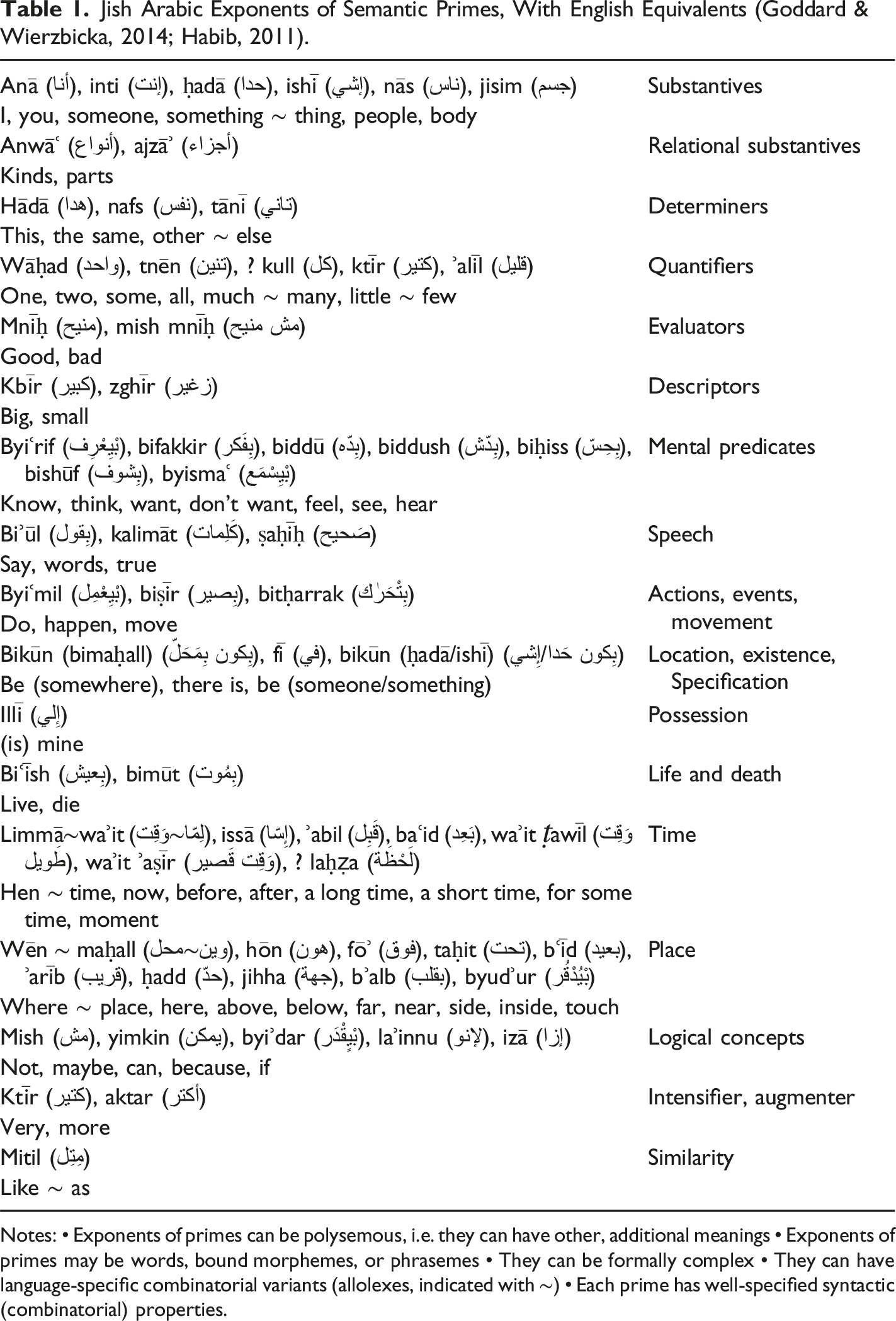
Anā (أنا), inti (إنت), ḥadā (حدا), ishī (إشي), nās (ناس), jisim (جسم)
Substantives
I, you, someone, something ∼ thing, people, body
Anwāʿ (أنواع), ajzāʾ (أجزاء)
Relational substantives
Kinds, parts
Hādā (هدا), nafs (نفس), tānī (تاني)
Determiners
This, the same, other ∼ else
Wāḥad (واحد), tnēn (تنين), ? kull (كل), ktīr (كتير), ʾalīl (قليل)
Quantifiers
One, two, some, all, much ∼ many, little ∼ few
Mnīḥ (منيح), mish mnīḥ (مش منيح)
Evaluators
Good, bad
Kbīr (كبير), zghīr (زغير)
Descriptors
Big, small
Byiʿrif (بْيِعْرِف), bifakkir (بِفَكِّر), biddū (بِدُّه), biddush (بِدُّش), biḥiss (بِحِسّ), bishūf (بِشوف), byismaʿ (بْيِسْمَع)
Mental predicates
Know, think, want, don’t want, feel, see, hear
Biʾūl (بِقول), kalimāt (كَلِمات), ṣaḥīḥ (صَحيح)
Speech
Say, words, true
Byiʿmil (بْيِعْمِل), biṣīr (بِصير), bitḥarrak (بِتْحَرَّك)
Actions, events, movement
Do, happen, move
Bikūn (bimaḥall) (بِكون بِمَحَلّ), fī (في), bikūn (ḥadā/ishī) (بِكون حَدا/إِشي)
Location, existence, Specification
Be (somewhere), there is, be (someone/something)
Illī (إِلي)
Possession
(is) mine
Biʿīsh (بِعيش), bimūt (بِمُوت)
Life and death
Live, die
Limmā∼waʾit (لِمّا∼وَقِت), issā (إِسّا), ʾabil (قَبِل), baʿid (بَعِد), waʾit ṭawīl (وَقِت طَويل), waʾit ʾaṣīr (وَقِت قَصير), ? laḥẓa (لَحْظَة)
Time
Hen ∼ time, now, before, after, a long time, a short time, for some time, moment
Wēn ∼ maḥall (وين∼محل), hōn (هون), fōʾ (فوق), taḥit (تحت), bʿīd (بعيد), ʾarīb (قريب), ḥadd (حدّ), jihha (جهة), bʾalb (بقلب), byudʾur (بْيُدْقُر)
Place
Where ∼ place, here, above, below, far, near, side, inside, touch
Mish (مش), yimkin (يمكن), byiʾdar (بْيٍقْدَر), laʾinnu (لإنو), izā (إزا)
Logical concepts
Not, maybe, can, because, if
Ktīr (كتير), aktar (أكتر)
Intensifier, augmenter
Very, more
Mitil (مِتِل)
Similarity
Like ∼ as