




Abstract
Directive 2010/63/EU of the European Parliament and the Council of 22 September 2010 states that at the end of a procedure, the most appropriate decision on the future of an animal previously used or intended for use in scientific procedures should be taken on the basis of animal welfare and potential risks to the environment. Member States may allow animals to be rehomed provided the health of the animal allows it, there is no danger to public health, animal health or the environment and if appropriate measures have been taken to safeguard the wellbeing of the animal. In countries where rehoming is permitted, it is the responsibility of the Animal Welfare Body to advise on a rehoming scheme which must include appropriate socialization in order to help facilitate successful rehoming, avoid unnecessary distress to the animals and guarantee public safety. This paper reviews the EU legislation, existing guidance, current literature and best practice to define rehoming, sets out general considerations for rehoming laboratory animals including socialization and provides practical advice on the steps required in a rehoming scheme. For those species most frequently rehomed, more detailed species-specific sections are included.
Introduction
Directive 2010/63/EU of the European Parliament and of the Council of 22 September 2010 on the protection of animals used for scientific purposes 1 highlighted the requirements for rehoming schemes at breeders, suppliers and users of animals used or intended to be used for scientific purposes (Article 291) and the task of the Animal Welfare Body to advise on these schemes, including appropriate socialization (Article 27). 1 The term ‘rehoming’ is defined as a change in location for an animal previously used or intended to be used for scientific purposes where the animal spends the rest of its life at a location suitable for its needs without undergoing any further scientific procedures. 2 Rehoming results in a change in legal ownership and the Directive 2010/63/EU no longer applies to the animal (Article 1.2). 1 The term ‘internal rehoming’, where an animal is removed from any scientific protocol but remains at the institution, cannot be considered rehoming according to the Directive, as the animal is still being covered by the Directive but not reported as used according to EU statistical reporting. Setting free can be another type of fate for an animal after its life as a research animal, but it is outside of the scope of this paper.
Member States may allow animals used or intended to be used in procedures to be rehomed, provided that the state of health of the animal allows it; there is no danger to public health, animal health or the environment; and appropriate measures have been taken to safeguard the wellbeing of the animal (Article 19). 1 The breeder, supplier or user must have a scheme in place to provide appropriate socialization to enable successful rehoming, to avoid unnecessary distress to the animals and to guarantee public safety (Preamble 26). 1 Socialization will also facilitate handling in scientific procedures and secure more reliable scientific data because animals are less stressed.3,4 This is also relevant to human welfare, since animal caregivers are more likely to experience compassion fatigue when the animals they care for are more stressed. 5
At the end of a scientific procedure, the most appropriate decision should be taken regarding the future of the animal on the basis of animal welfare and potential risks to the environment. Any animals whose welfare would be compromised should be euthanized. In some cases, animals should be allowed to be rehomed as there is a high level of public concern as to the fate of such animals (Preamble 26). 1 If rehoming occurs, a written agreement between the institution and the potential adopter should be issued. To limit the scope of this paper, we exclude the specifics linked to the practice of fostering when we discuss rehoming, whereby animals are temporarily relocated before being permanently rehomed. Therefore, rehoming involves change of ownership.
Rehoming has been practised on a voluntary basis by many institutions. It not only offers the opportunity to provide a better level of welfare to animals formerly used or intended to be used for research, it may also enhance animal caregiver morale and wellbeing. 6 Specifically, rehoming offers an alternative to the contrasting emotions of the caring–killing paradox, that is, when caring for animals is followed by having to kill them, that research animal caregivers are often exposed to, and which is known to be very stressful in different types of caregivers and to contribute to compassion fatigue.5,7 Rehoming practices differ between countries and institutions, depending on national legislation, with several comprehensive European guidelines available2,8–15 and a comprehensive questionnaire. 6 Where National Guidelines exist, these should be followed.
The Federation of European Laboratory Animal Science Associations (FELASA) rehoming recommendations provide guidance on rehoming practices for breeders, suppliers and users of animals used for or intended to be used for scientific or educational purposes. The recommendations define the meaning of ‘rehoming’ according to the European ‘Directive 2010/63/EU of the European Parliament and of the Council of 22 September 2010 on the protection of animals used for scientific purposes’, 1 provide general and species-specific considerations for animals to be rehomed and for those who want to adopt/host an animal, and an overview of steps to take. The species-specific sections were included based on the results of a survey of FELASA members, examining which species were commonly rehomed in the past and likely to be rehomed in future. The results of this survey are available as a separate publication in the Laboratory Animals journal. 16
General Protocol for rehoming of former research animals
The purpose of rehoming is to offer an animal a life worth living beyond its use as a research animal. Following the instructions in the EU Directive 2010/63/EU1 rehoming should occur only if it is in the best interest of the animal. Animal welfare can be defined in many ways, but most authors agree that it centres around the subjective experience of the animal.17–19
General considerations for rehoming former research animals (A) and the steps involved (B–G) are described below, according to best practice. The General Protocol applies to all research animal species, although some sections are less applicable to reptiles, amphibians, fish and some small mammals. The working group which created these guidelines examined the possibility of creating a set of criteria for when an animal can be rehomed or for a suitable adopter but now strongly holds the opinion that it is not appropriate to provide such criteria. The situation should be evaluated on a case-by-case basis, by experts such as veterinarians, animal caregivers and (consulting) animal behaviourists, advised on by the Animal Welfare Body and the Designated Veterinarian, and ratified by the competent authority involved (the latter may vary between countries). Instead, we provide considerations to take into account, that is, a framework within which to consider: the species and the individual animals available and the potential adopters, including the provision of a suitable physical and social environment for the adopted animal.
The EU Directive 2010/63 mandates that the Animal Welfare Body ‘advise on rehoming schemes, including the appropriate socialization of the animals to be rehomed’ (Article 26, (e)). 1 National legislation may provide further detail, for example, Belgium 20 and UK. 8 The Designated Veterinarian (EU Directive 2010/631) has advisory duties regarding the welfare and treatment of animals, and therefore should be involved in rehoming decisions. If a research institution decides to work with a third-party organization for rehoming, the considerations and steps described below still apply.
General and species-specific legal requirements must be met when rehoming former research animals, for example, for farm animals, mandatory prophylaxis, or the permission to keep certain species (e.g. camelids; primates). Genetically altered and/or immunodeficient animals cannot be considered for adoption. 21 Animals which could enter the food chain should not be used for human consumption but, as a precaution, for prescription drugs, regulations for withdrawal periods should be completed before adoption.
A. General considerations
A.1 Key issues for animal welfare when rehoming
To promote animal welfare when rehoming, four key issues need to be considered:
The physical and mental health of the animal must allow rehoming. It is preferable to rehome healthy animals, but an animal with a health condition or an implant may still be considered for rehoming, following veterinary examination and assessment. In such a case, it is important that the adopter is thoroughly informed in advance about possible consequences (also costs), symptoms to look for and action to undertake in the case of symptoms and/or progression of a condition. Provision of a letter for the adopter’s veterinarian is also advised. An acute medical condition should be resolved before the animal is made available for rehoming, unless rehoming will be beneficial for recovery. Along with animal welfare, zoonoses and the risk to public safety need to be assessed and potential adopters fully informed of any risks beforehand. If long-term medications or treatment are necessary, animals should be trained to accept these procedures (e.g. swallow tablets, blood collection).
Animals with behavioural issues may be rehoming candidates, but careful evaluation by an animal behaviourist is essential. An animal showing anxiety, for example, could be successfully rehomed with an adopter who is knowledgeable and willing to give the animal plenty of time to acclimatize and able to quickly establish routines. If a facility has access to a veterinary behavioural specialist, screening the animal is likely to be optimal. If a non-veterinary behaviour specialist examines the behaviour of the animal, they should work closely with the facility veterinarian.
2. The difference between environments pre and post rehoming. The social environment includes contact with humans and non-human animal species, the non-social environment includes all other visual, auditory and olfactory stimuli that the animal may encounter indoors and/or outdoors. The greater the difference between pre- and post-rehoming environment, the more care is required to avoid welfare problems for the animal and safety issues for the adopter and their property. In this sense, dogs and cats may need a greater adjustment than, for example, rodents or horses. Social species should be rehomed in a setting with at least one other conspecific, with planning for appropriate introductions for unfamiliar animals. Dogs could be an exception, if they are well socialized to and comfortable with humans. A programme to prepare animals for the new environment must be in place with enough information gathered from potential adopters to assess the suitability of the home environment and identify and address any areas of concern. 3. The expectations of the potential adopter. Expectations of the adopter in relation to the behaviour of the animal post rehoming, the transition and adaptation phase and the time investment required for a particular animal or species must be managed. Sometimes adopters have unrealistic expectations,22,23 either too high (e.g. the animal will adapt immediately into their lifestyle, will be ‘grateful’ and will behave perfectly) or too low (when adopters underestimate the commitment required). In addition to screening whether a potential adopter can provide a suitable home, adopter expectations, animal needs and required time investment (also for the transition and adaptation phase) must be explained.
24
If expectations are unrealistic, significant welfare problems could result for the animal. 4. The cost of rehoming. There are several costs involved in rehoming to ensure the continued welfare of the animals when they are retired as research animals. Institutions must carefully consider those and who will be responsible for these costs for the rest of the animal’s life, which may be short or long depending on the species. Costs prior to rehoming include those for maintaining the animal until it leaves the facility (food, water, housing, animal care staff, veterinary care) as well as any medical procedures that may need to be carried out before the adopter takes the animal (e.g. tooth care, neutering, vaccination and worming …). After the animal is rehomed, the costs to be considered are for maintenance (food, water, appropriate housing and environmental conditions, enrichment) and preventive care (vaccinations, worming, tooth care) and veterinary care. Depending on the species, this cost will vary greatly. Ideally, rehoming is considered in the study planning and cost estimate for any scientific project and clarification provided on whether post-rehoming funding or costs will be covered. When owners will be responsible for all costs for the animal after rehoming, they should be informed of the estimated yearly cost in advance.
A.2 Decision to rehome
Ideally, the decision on whether an animal will be rehomed when it is no longer needed for experimental procedures (whether it has actually been used or was intended to be used) is taken when a study is designed. This approach will allow inclusion of measures to facilitate the transition to the new environment (socialization, training, and securing a pool of potential adopters) into the study design. If such measures are implemented during the life as a research animal, this will also facilitate handling during routine husbandry procedures and during experimental procedures. Legally, it is required to indicate the fate of the animal in the project application that is submitted to the ethical review body. The suitability for rehoming, physically and mentally, should still be assessed at the end of the study.
A review of the conditions set out by the supplier when the animal was acquired is recommended as the purchase agreement may not permit rehoming or may impose conditions on rehoming (e.g. the animal must be neutered prior to rehoming).
If an animal is found not suitable for rehoming or being kept alive at the facility, euthanasia or inclusion in a terminal experiment may be appropriate. For animals that are likely to not adapt to a new environment or with difficulty over a long period of time, or for animals that are difficult to introduce into a new group, internal rehoming (as defined in the introduction) may be considered.
The decision of when to rehome should take into account the age of the animal and its reduced appeal to potential adopters,25–27 its suitability as a research animal on further studies, the current and expected health and mental state of the animal and the cost of keeping or rehoming the animal. When applying for experimental procedures using these animals, the option for rehoming should again be considered. When an animal is assigned to be rehomed, all experimental procedures and medical treatments for acute conditions (excluding preventative care, e.g. vaccinations and oral care) should have been completed and cannot recommence whilst a suitable adopter is being sought.
A.3 Socialization
The term ‘socialization’ as mentioned in the EU Directive 2010/631 and for the purpose of these guidelines involves both learning about species and individuals (this is in fact the pure meaning of socialization) as well as learning about the environment. There is a sensitive period, identified for many species, which is optimal for socialization. The result of appropriate socialization is an animal that can be relaxed in the presence of and during interactions with conspecifics, people and possibly other species that it may encounter later in life. Good socialization also means the animal can cope with its environment and any changes therein.
Contrary to what seems to be implied in the Directive 2010/63/EU 1 , socialization should occur at an early age in an animal’s life.28–30 For research animals, this starts at the breeding facility and should continue at the establishment. Individuals responsible for animal socialization should have received appropriate training. Breeders should ensure that animals experience positive interaction with people and exposure to relevant stimuli (those likely to be encountered at the future research institution and in the environment post rehoming). The quality of the socialization procedure is an important consideration when purchasing animals. Socialization should continue at the research facility, for facilitation of experimental procedures and in preparation for potential rehoming. The format of the socialization programme will depend on the species.
When socializing an animal, it is important to present the stimuli in a non-threatening way. It is also important to give the animal a choice to move away from the stimulus (also a person). Unescapable exposure to unpleasant stimuli may cause stress for the animal and an undesirable learning effect.31,32 The type of stimulus intensity an animal can cope with may vary between individuals. An approach to socialization tailored to the individual is therefore recommended. It is essential that body language (including facial expression) is observed to assess the animal’s emotional state and to adjust stimulus exposure accordingly.
Several learning processes are involved in socialization. Classical conditioning (making associations between events and outcomes, e.g. food treat) is preferred over habituation (repeated exposure with the aim of decreasing the response by the animal) since it forms associations in all contexts whereas habituation is a non-associative learning process and is more easily overturned by exposure to aversive stimuli. It is also advisable to install a level of training in the animal using operant conditioning (the animal learns that its behaviour has a consequence) which will prepare the animal for re-homing and facilitate housing, handling and working with the animal during its career as a research animal. When using operant conditioning, positive reinforcement should be used. A prerequisite is to identify a reward (reinforcer) for each animal that it will be motivated to obtain and willing to accept. Accepting a food reward from the hand of the trainer has the advantage that the animal can be trained to remain nearby for a visual health inspection and/or conducting health or experimental procedures.
B. Checking the suitability of the animal for rehoming
An animal should have a health examination by a veterinarian. Any required interventions (e.g. tooth care, vaccination, worming, possibly neutering) should be completed prior to rehoming. The life expectancy should be reasonable compared with the expected acclimatization period and the welfare of the animal when rehomed must be good. The acclimatization time depends on the species, the individual animal (personality, socialization status) and the difference between the research and rehoming environments.
A behaviour specialist, preferably a veterinary behaviour specialist (or at least someone specialized in particular species-specific behaviour) should determine that the animal shows adequate normal individual and species-specific behaviour. The person most familiar with the animal should provide detailed information about the (social) behaviour of the animal towards people and/or other animals. The behaviourist should also screen for an animal’s individual preferences, behavioural capabilities and stress-coping strategies and for the potential presence of anxiety, fear and frustration, observing the animals carefully in a variety of situations. This step is particularly important for animals that will be kept as pets and/or for those species where the expectations of the adopter, for interactions and activities with the animal, may be high. If necessary, additional training may be required. Some of the findings of the behavioural assessments are likely limited to the context of the research environment.
Neutering of the animal prior to rehoming must also be considered at this point. For some species, it is less common to do this for females. However, to avoid breeding excess animals that may end up in rescue centres, neutering or the use of contraceptives is advisable. Also, in order to allow social housing in some species (e.g. horses, pigs), neutering of males is required. However, neutering can also have an effect on behaviour and health, so it should be considered according to the species.
C. Recruiting potential adopters and verifying their suitability and the future home environment
Rehoming destinations can include private homes, animal welfare organizations, sanctuaries, parks and zoos. When a research facility adopts a rehoming policy, animals may be transferred to the general public. Generally, rehoming by research institutions is considered to be a favourable act and in the interest of the animal. However, because of the common negative perception of the use of animals in research, anecdotal evidence suggests (according to the authors’ experience) there is a risk of adopters and people in their social circle attributing problems (physical or behavioural) of the adopted animal to its past life as a research animal. The concern for negative publicity was also present in the outcome of the survey we conducted prior to formulating these recommendations.
16
Some institutions may prefer to rehome to staff or volunteer caregivers of the animals when this is not incompatible with the health status of the facility. The negative perception can also happen if animals are rehomed to staff of the facility, although they are better positioned to provide the proper context, depending on how well they have been informed previously about the use and care of the animals kept as research subjects. For internal adopters, it is also likely that they are already familiar with the animal and its behaviour, have established a bond with the animal and/or have realistic expectations about the rehoming process. However, there is no research documenting whether internal or external adopters are more suitable and, regardless, it is imperative to:
properly screen the animal for its suitability for rehoming; discuss adopter expectations and which ones are realistic or not (also explaining why); be transparent about potential problems that may occur and how they may or may not be linked to the way the animals were previously housed or involved in procedures.
Honest communication about how animals have been cared for during their life as a research animal helps the adopter to develop trust in the concern and efforts for animal welfare undertaken by the research facility, and will reduce the risk of negative perceptions.
Recruitment of adopters can be done through the (internal) network of the research facility, via social media and/or via other announcements. If a third-party organization is responsible for rehoming, they will most likely use their own network. When searching for adopters, the content of the communication should be carefully considered, to provide a balance between transparency and divulging information. It is always possible that information shared in the context of rehoming could be used for other purposes. But an honest advertisement about the characteristics of the animal and which specific adopters are sought is an efficient way of finding a suitable match.
Depending on the species and the resources available, a (home) visit with the potential adopter may be appropriate for screening. Alternatively, a questionnaire can be sent to a potential adopter requesting detailed information, followed by a discussion either in person or by phone/online, during which the expectations, knowledge and skills relevant to owning an animal must be explored. It should also be checked whether a potential adopter has identified a veterinarian for the future healthcare of the animal. If a potential adopter lacks knowledge of or experience with a species, it must be decided whether providing information about keeping this species will be enough to guarantee the welfare of the animal after rehoming. If aspects of the future environment are not entirely clear to the institution, images or video footage may provide answers more effectively than long-winded discussions. At the time of screening, the potential adopter must be informed of the current health of the animal (and possible diseases linked to a particular strain or expected conditions, for example, those that may appear earlier than expected through normal ageing, as a result of experimental procedures or restricted movement). The potential adopter must also be informed of their responsibilities and any costs involved with adopting and/or caring for the animal.
D. Deciding on the match between animal and adopter
The match between 1) the results from the health and behavioural screening and 2) the rehoming environment and potential adopter should be carefully examined by the Animal Welfare Body, Designated Veterinarian and other relevant bodies.
E. Transferring the animal to the adopter
For cats, dogs and primates, a history of veterinary care and social behaviour of an individual must be transferred to the adopter. For other species, it is also advisable to give as much information on past health and behaviour as possible. This will not be possible for species where individuals are visually identical, unless another means of identification was already present. It is also not common practice for a social behaviour history or information about socialization and housing to transfer from the breeder to the research facility, although this would be very useful to facilitate the transition for the animal. Information about social behaviour will then only be available from the time at the research facility.
Prior to transferring an animal, it should be at least habituated and preferably trained for transport using positive reinforcement training. When several animals are rehomed to the same location, they must be transported in suitable transport boxes and in compatible groups, if appropriate. Where relevant, an object or substrate with a familiar scent (animal housing area at the research facility) must be transferred with the animal to facilitate habituation to the new environment after rehoming. Ideally, the adopter will collect the animal(s). If this is not possible, the institution must transport the animal(s) in accordance with European regulation (EC 1/2005). 33
If the biosecurity and other measures at the facility allow it, for some species (e.g. dogs and cats) it may be beneficial for the adopter, once this person has been selected, to spend some time on different occasions with the animal prior to the transfer to the new home, to facilitate familiarization.
The adopter should receive written instructions on how to care for the animal. They should be informed of the importance of control (having a choice to move away from unpleasant stimuli) and predictability (building a daily routine, using the same words for announcing particular activities) for the animal, 31 which will help create a bond between the animal and the adopter and allow acclimatization to the environment. The adopter should be taught about body language and stress signalling of the animal, and how to respond when an animal experiences stress. Advice on what to do when adaptation problems occur (health- or behaviour-related) and contact information of someone at the research institution or of the third-party rehoming organization (in that case the research facility may be anonymous) should be provided. If it is decided by the facility that the animal requires support to assist acclimatization, for example, a behaviourist or trainer for dog, cat or horse, the names of recommended professionals should be provided. Who will bear these costs should be clearly specified beforehand.
To avoid sudden change in nutrition, a sample of the current diet must be provided and the adopter should be given instructions on when and how to change to a new diet, if this person so desires. For animals that are fed individually at the facility or where it is possible to do so, the diet change should occur after an animal has been assigned to an adopter and before leaving the facility. In this way, the change in diet does not have to occur simultaneously with the stress of adapting to the new environment.
Records of the animals and the rehoming destination must be kept in accordance with the European Directive 2010/631 and the General Data Protection Regulation. 34
F. Contract
The following items should be considered and the appropriate clauses incorporated in a contract for the adopter to sign when the animal is transferred: which animal is being rehomed (species, name, identification, possibly a picture of the animal), the conditions of the change of ownership, whether there is a fee to be paid, who will bear costs for the maintenance of the animal after rehoming, that the adopter should care for the animal appropriately, whether the adopter has to give updates to the facility about the animal and the timing and frequency of these, whether and what should be communicated in the case of death of the animal or change of ownership, what guarantees are given and/or what liability is accepted by the institution about physical or mental health of the animal and damages caused by the animal, whether breeding is allowed with the animal, whether there is a return policy and a statement about the adopter agreeing that he/she has received the necessary information about the animal. The contract should be reviewed by the institution’s legal department.
G. Follow-up
When rehoming constitutes the legal transfer of ownership (as determined by the rehoming contract), the opportunity to follow up on an animal after rehoming or to intervene is limited, emphasizing the need for a good screening procedure prior to rehoming. However, in most cases, voluntary contact with the adopter after rehoming to check on the animal and its adaptation to the new home, as well as adopter satisfaction with the entire rehoming process, will be possible. A follow-up protocol should therefore be part of the rehoming scheme for each animal. It must include items that should be checked and the timeframe within which to check them. The successes and failures will help to identify areas for improvement of the process.
When there is a large difference between the research environment and the new home (e.g. for cats and dogs), the follow-up should happen earlier and occur more frequently. Particular attention must be paid to the behaviour of the animal, how well it is adapting and, if appropriate, integrating with other animals. To evaluate post-rehoming welfare, objective indicators are preferred. In theory, questionnaires could be used, but they will not allow for the same level of detail in the information collected as a personal interaction via phone call or visit on site.
Questions for follow-up may include, but are not limited to: how the animal behaves towards people and animals (familiar and unfamiliar), how the animal behaves when inside and/or outside the home and whether the animal is eating well, whether it shows normal species-specific behaviour, whether it is fearful or anxious, whether it looks healthy and whether it has visited a veterinarian since rehoming occurred and the reason for that visit. Keep in mind that adopters may not be skilful at reading animal body language at first, for example, recognizing expressions of stress. 35 Asking for some video footage of the animal during its everyday activities can be informative.
A contingency plan should be in place in case rehoming is unsuccessful. The facility or third-party organization should be the first point of contact and adopters should be encouraged to reach out in case of problems with the animal. It is possible that animal caregivers and others specialized in the specific species can help with basic problems. In the case of more complex behaviour problems (e.g. fear, anxiety, aggression), it is preferable that a trained behaviour expert is consulted if behaviour problems are identified; particularly for cats, dogs, horses and primates but also for other animals like rodents, rabbits and birds this may be the best option. Possible outcomes of a problematic rehoming situation are return to the facility, rehoming to a different adopter or euthanasia.
When rehoming of an animal has been unsuccessful, the facility or the third-party organization should examine for each case what went wrong and what could have been done differently. This information can be used to modify the rehoming scheme, if appropriate. Sharing information about successes and failures in rehoming within a network of institutions rehoming the same species is advisable, to increase the knowledge base.
The accompanying flowchart (Figure 1) provides an overview of the rehoming process, which includes some references to specific sections from the General Protocol as described above. Detailed species-specific information can be found in the Supplementary material online.
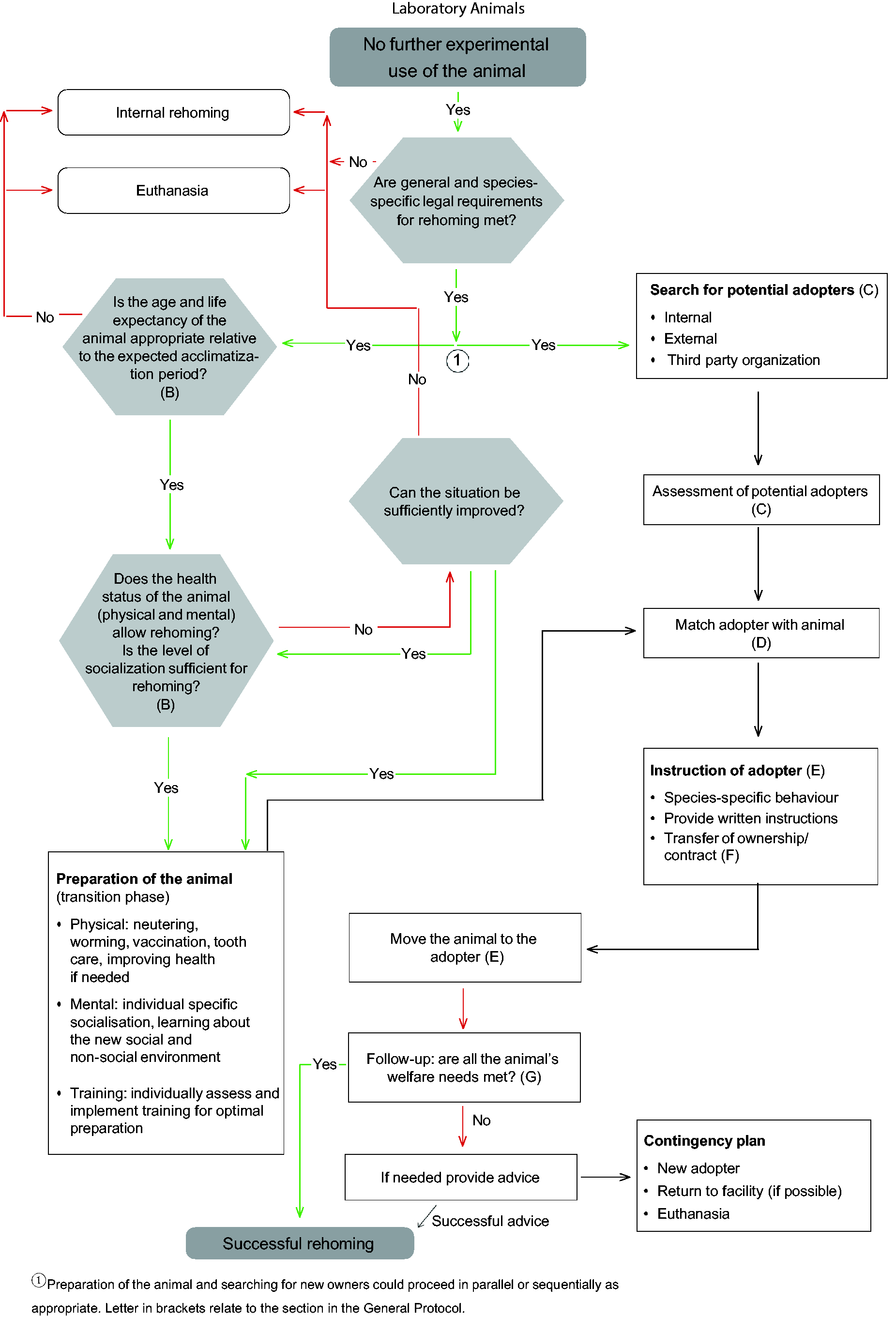
Flowchart of the rehoming process.
Conclusion
Rehoming, if successful, can result in an extremely positive outcome for an animal, adopter, animal caregivers and the institution, but we recommend careful planning and consideration when developing a rehoming protocol. This will help optimize the rehoming outcome by ensuring the animals are prepared for their new homes and matched with suitable adopters whose expectations are realistic. Support and contingency measures should be in place in case problems arise in the new home and appropriate follow-up will facilitate continued improvement of the scheme.
Supplemental Material
sj-pdf-1-lan-10.1177_00236772231158863 - Supplemental material for FELASA recommendations for the rehoming of animals used for scientific and educational purposes
Supplemental material, sj-pdf-1-lan-10.1177_00236772231158863 for FELASA recommendations for the rehoming of animals used for scientific and educational purposes by Emilie Ecuer, Jackie Boxall, Annet L Louwerse, Lars F Mikkelsen, Christel PH Moons, Mirjam Roth, Andrea M Spiri in Laboratory Animals
Footnotes
Acknowledgements
The authors thank the Vetcom of the Vetsuisse Faculty, University of Zurich for their help with the design of the flowchart.
Declaration of conflicting interests
The author(s) declared no potential conflicts of interest with respect to the research, authorship, and/or publication of this article.
Funding
The author(s) disclosed receipt of the following financial support for the publication of this article: Publication of our work was supported by a grant from Laboratory Animals Limited (grant number BA503 2022).

Supplemental material
Supplemental material for this article is available online.
References
Supplementary Material
Please find the following supplemental material available below.
For Open Access articles published under a Creative Commons License, all supplemental material carries the same license as the article it is associated with.
For non-Open Access articles published, all supplemental material carries a non-exclusive license, and permission requests for re-use of supplemental material or any part of supplemental material shall be sent directly to the copyright owner as specified in the copyright notice associated with the article.
