




Abstract
Rehoming is an important fate, which should be considered for animals used for scientific and educational purposes, and which is highlighted in the European Directive 2010/63 EU. In 2018, the Federation of European Laboratory Animal Science Associations (FELASA) convened a working group to review current literature and identify existing practices with the aim of issuing general recommendations on the rehoming of research animals. In order to understand the number and species of animals being rehomed and which species and information to include in the recommendations, the working group launched a survey that was distributed among FELASA members, yielding 97 valid records for analysis. Most respondents of the survey considered the rehoming of cats, dogs, mice, rats, rabbits, pigs and minipigs. The most important issues reported by the respondents were related to availability/suitability of animals, availability of adopters and legal issues. Based on the data and information collected in this survey, the working group decided on the format and content of the future recommendations: a first section containing a general protocol for rehoming, addressing the issues raised by the respondents, and a second section containing species-specific information and advice about cats, dogs, small prey mammals, equines, primates, camelids and minipigs.
Introduction
Although the rehoming of laboratory animals had already occurred prior to 2010, the publication of the European Directive 2010/63 EU provided a first official framework to support this activity and assigned a new responsibility to institutions using animals for research and educational purposes. 1 Article 19 of the European directive 2010/63/EU states that ‘Member States may allow animals used or intended to be used in procedures to be rehomed, or returned to a suitable habitat or husbandry system appropriate to the species, provided that the following conditions are met: (a) the state of health of the animal allows it; (b) there is no danger to public health, animal health or the environment; and (c) appropriate measures have been taken to safeguard the wellbeing of the animal’. 2 Article 29 of the European directive 2010/63/EU further states: ‘Where Member States allow rehoming, the breeders, suppliers and users from which animals are intended to be rehomed shall have a rehoming scheme in place that ensures socialization of the animals that are rehomed’. 2 As European Member States ratified this Directive into national legislation, they translated the framework to a local level.
In 2018, the Federation of European Laboratory Animal Science Associations (FELASA) convened a working group to review current literature and identify existing practices with the aim of issuing general recommendations on rehoming research animals. The working group immediately decided that priorities for the recommendations needed to be set, based on input from FELASA members. This input related to the species focus and difficulties encountered when rehoming, particularly since there were already publications providing rehoming recommendations at the time (e.g. the Dutch NCad opinion Rehoming of former laboratory animals, 3 the UK Advice Note on rehoming and setting free 4 and the French GRAAL Guide on the rehoming of laboratory animals 5 ). Consequently, the working group launched a survey to determine which animal groups and/or species had been and were likely to be rehomed in the future by respondents and to examine different aspects of the rehoming process, in order to clarify the focus of the FELASA recommendations that the working group members were asked to prepare. This paper describes those results and the choices made for the FELASA recommendations.
Methods
An anonymous online survey (in English) was developed by the FELASA Working Group on Rehoming of Animals Used for Scientific and Educational Purposes using Survey Monkey®. The survey was distributed by FELASA to its members by email and responses were collected from end of July until mid-October 2019.
The survey consisted of six items, three of which were open-ended questions and three of which were multiple choice questions, with the option to elaborate (open-ended) if the ‘Other’ answer option was selected:
How many animals of the following species do you rehome on average each year (for the past three years)? (Open-ended, numerical; a predefined list was provided, with the option to add and define other species.) How many animals of the following species do you plan to rehome in the near future (next three years)? (Open-ended, numerical; the same list as for question 1 was provided.) What difficulties do you experience when rehoming? (Multiple choice and multiple mention possible.) Is an external organization involved in the rehoming of your animals? (Multiple choice.) Is a person with a degree in animal behaviour and/or welfare (BSc, MSc, Postgraduate) involved in the rehoming process? (Multiple choice.) If you would like to comment or elaborate on any of your previous answers, please do this now. (Open-ended, free text.)
The answer options for the third question were: We are not finding sufficient, suitable adopters; We are experiencing a lack of time/personnel; Our animals are not suitable for rehoming; There is a lack of interest in rehoming by the management of the institution; There is a lack of interest in rehoming by the animal caretakers of the institution; There is no rehoming protocol available or it is not appropriate; There is no rehoming contract available or it is not appropriate; We are not sure what good practices are regarding rehoming for one or more species we rehome; There are legal issues preventing rehoming of the species we use; There are ethical issues preventing rehoming of the species we use; There are no surplus animals to rehome; We do not experience any difficulties; I do not know; Other (please explain).
The answer options for the fourth and fifth questions were: Yes, always; Yes, for certain species; Yes, for certain individual animals of a species; No, never; I do not know; Other (please explain).
To avoid inflation of the data, respondents belonging to the same institution who would be providing information on the same group of animals were asked to coordinate and have only one person complete the survey. To keep the survey brief and focused for its purposes, no demographic data were collected.
Respondent data were included if at least one of the questions 3, 4, 5 and 6 was answered and if valid answers had been given for questions 1 and 2.
Responses from multiple choice questions were tallied per answer option. When respondents elaborated on their ‘Other’ answer option and for the last question of the survey, thematic analysis was used to identify themes that would be useful to include in the recommendations. 6
Results
A total of 113 entries were received, of which 100 remained after blank entries and those with invalid answer formats were removed. Another three entries were removed because the respondents did not rehome research animals currently, resulting in 97 records. The dataset, excluding the answers to two open-ended questions to avoid risking a breach in anonymity of the respondents, is available at https://data.mendeley.com/datasets/b6z5f3r6y8/1.
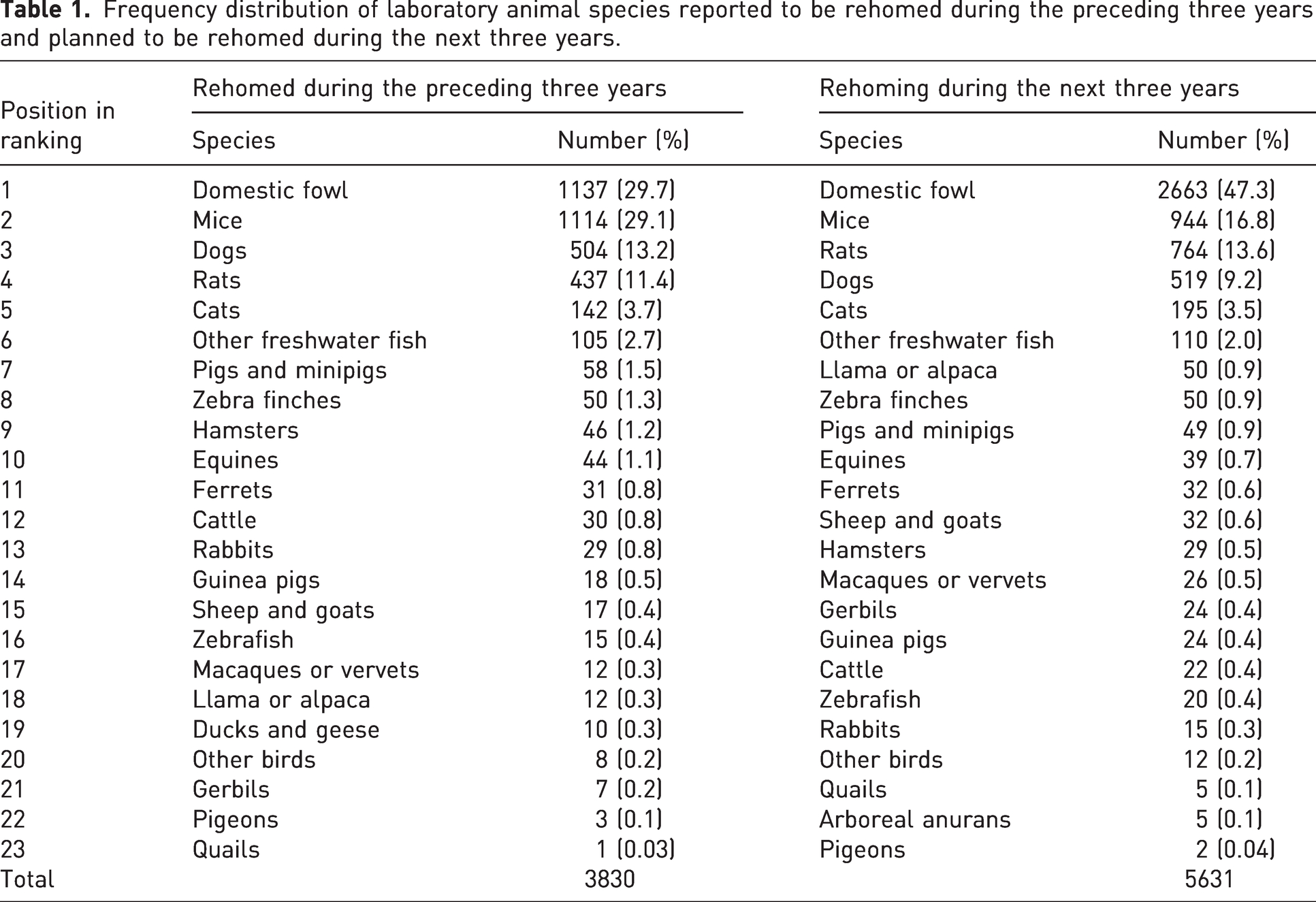
Based on respondent answers, a total of 3830 animals had been rehomed over the preceding three years and 5631 animals would be rehomed over the next three years, with domestic fowl, mice, rats, dogs and cats being most common. Table 1 provides a frequency distribution of the different species that have been and were planned to be rehomed.
Frequency distribution of laboratory animal species reported to be rehomed during the preceding three years and planned to be rehomed during the next three years.
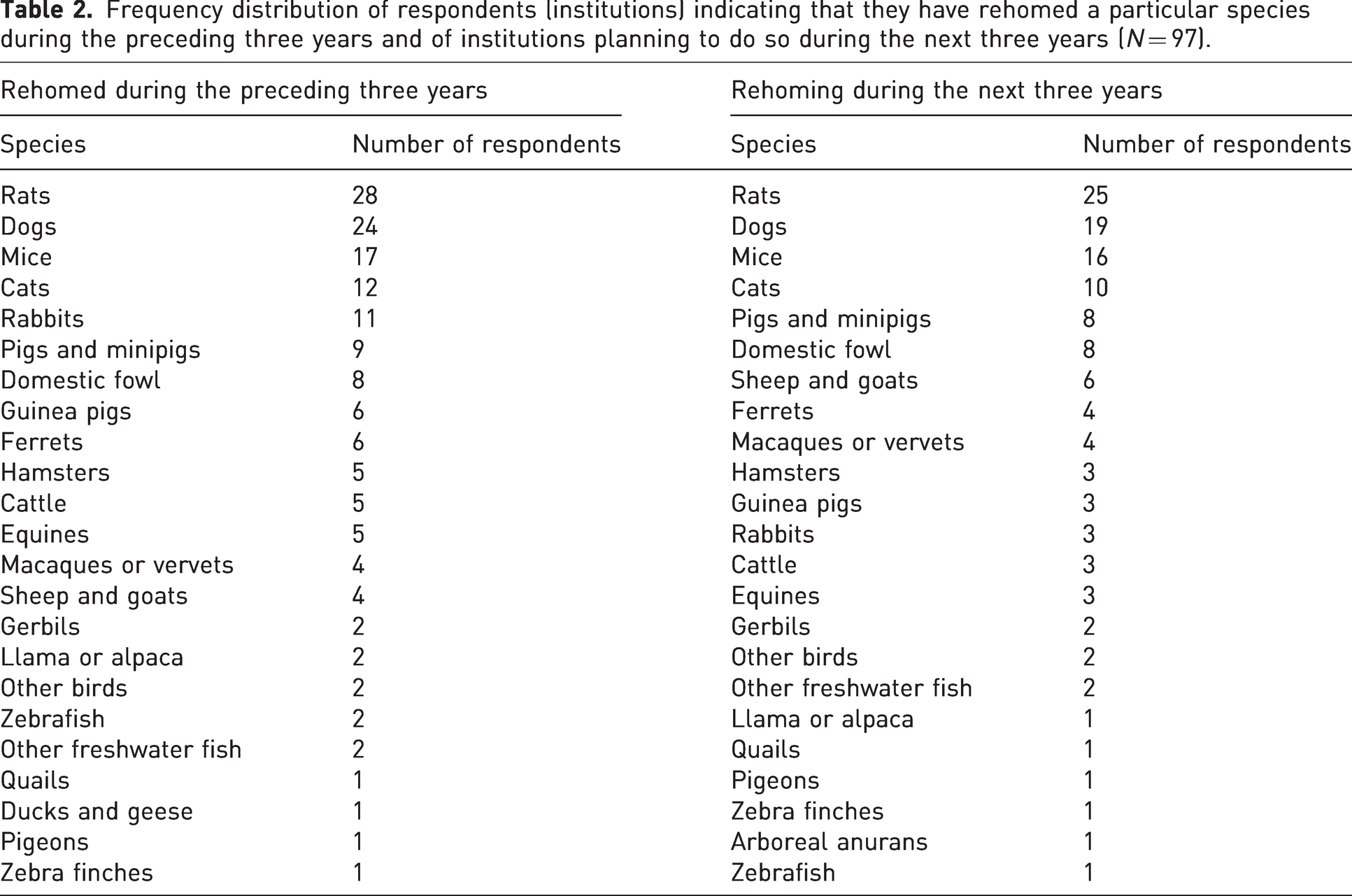
The number of respondents having rehomed a particular species during the preceding three years or planning to do so in the next three years was highest for rats, dogs, mice and cats. Table 2 shows a frequency distribution of the number of respondents having rehomed or planning to rehome a particular species.
Frequency distribution of respondents (institutions) indicating that they have rehomed a particular species during the preceding three years and of institutions planning to do so during the next three years (N = 97).
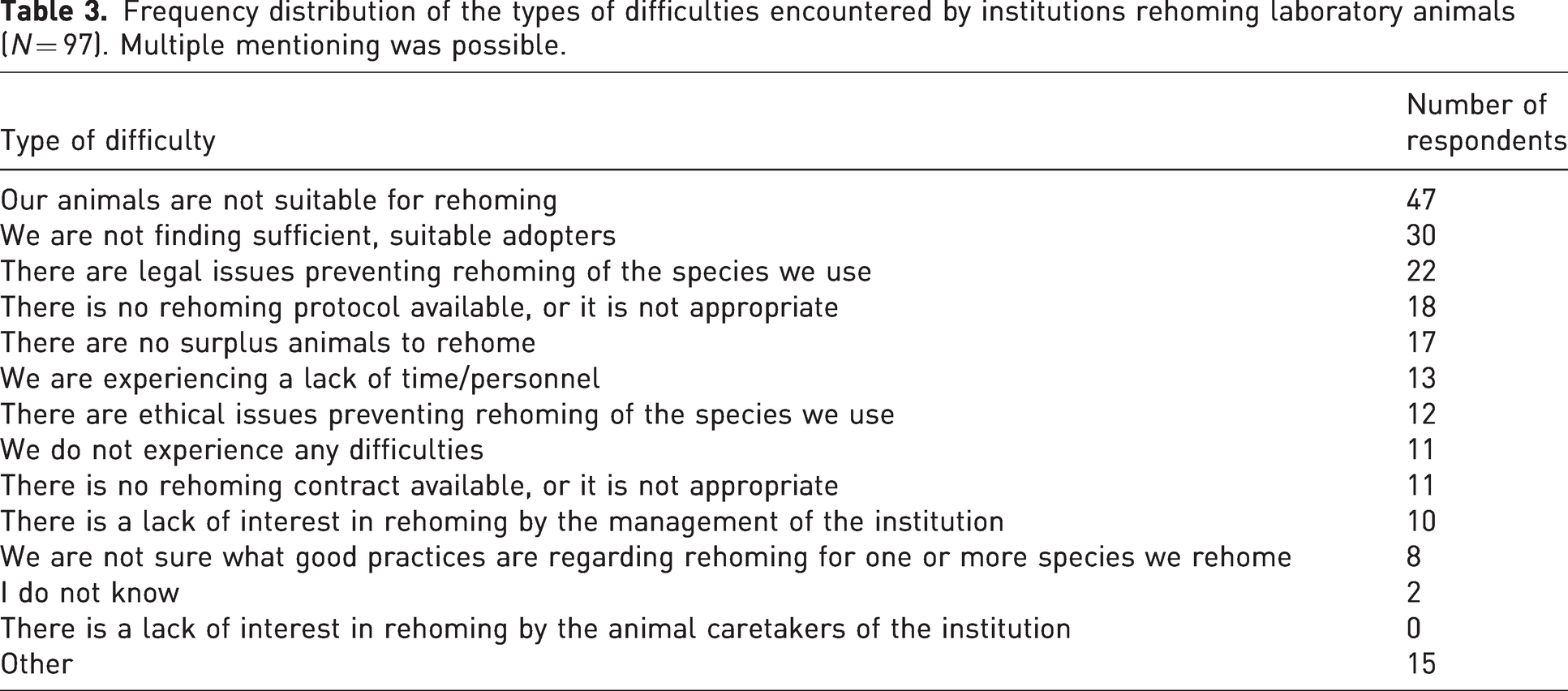
The difficulties encountered during rehoming are presented in Table 3. Themes (and number of times mentioned) extracted from the ‘Other’ answer option were: rehoming process (n = 5), low interest by adopters for particular species (n = 5), national legislation (n = 3), administrative burden (n = 3), negative publicity (n = 2), Specific Pathogen Free (SPF) animals (n = 1), cost for adopters (n = 1).
Frequency distribution of the types of difficulties encountered by institutions rehoming laboratory animals (N = 97). Multiple mentioning was possible.
When asked whether an external organization participated in the rehoming of laboratory animals, six respondents did not answer this question. Of the remaining 91 respondents, 47 indicated that they never did, 13 said they did for certain species, 11 indicated they always did, eight said they did for certain individuals and four stated that they did not know. An additional eight respondents added information via the ‘Other’ answer option, of which four stated that they planned to do this in the future and one respondent indicated that they had worked with an external organization before but had stopped the collaboration. Additional themes extracted were: rehoming to staff (n = 2) and return to supplier (n = 1).
A total of eight respondents did not answer the question whether a person with a degree in animal behaviour (BSc, MSc, Postgraduate) was involved in the rehoming process. Of the 89 respondents who did give an answer, 39 said they always involved one, 29 said they never did, four said they did for species, two said they did for individuals and six respondents said they did not know. Nine respondents gave information via the ‘Other’ answer option, from which four themes arose: involvement of the (designated) veterinarian (n = 6), involvement of technical staff (n = 2), involvement of animal welfare body (n = 1) and years of experience in the industry (n = 1).
The following themes were identified from the final question where respondents could elaborate on the answers given: clarification on numbers given for questions 1 and 2 (n = 10), working with third party organization (n = 6), rehoming process (n = 5), legislation (n = 4), motivation to rehome (n = 3), availability of adopters for particular species (n = 3), rehoming costs (n = 3), rehoming outcome (n = 2), food animal species (n = 2), administration (n = 1) and SPF animals (n = 1).
Discussion and conclusion
The purpose of this survey was to acquire information to help focus the recommendations requested by FELASA on the rehoming of animals used for scientific and educational purposes, in terms of both species and issues encountered during rehoming.
FELASA currently has 21 member associations, which are national Laboratory Animal Science Associations (https://felasa.eu/about-us/members, last consulted on 8 March 2022). It is difficult to appraise the response rate of our survey based on this information, since we do not know the total number of research institutions each national association has reached. A survey about rehoming by UK research facilities between 2015 and 2017 resulted in a 25% response rate (41 institutions out of approximately 160). 7
Out of 100 valid records, three responses were from respondents indicating that they did not currently rehome. This number is quite low compared with 22 out of 41 facilities not rehoming in the UK. 7 We assume that survey respondents who did not perform rehoming were not answering the survey because of our specific request for cooperation from facilities that did rehome. This explains the high rate of respondents who indicated that they have rehomed.
In our study, domestic fowl, mice, rats, dogs and cats were most frequently mentioned as being rehomed or planned to be rehomed. Cats and rats were also among the most popular species to rehome in the UK during the 2015–2017 period. 7 For dogs, the UK survey distinguished between beagles and dogs other than beagles (the latter having been rehomed more), but our survey did not make this distinction. Mice represented a group that was highest in numbers kept according to the UK survey while very few were rehomed, 7 whereas in our study mice were a popular species to rehome by a relatively large number of respondents. The animal group that was most commonly rehomed in the UK was fish, but these numbers were not as high in our study and rehoming was performed by only a small number of respondents. Domestic fowl were rehomed in the highest number according to our data, but by a relatively small number of respondents (n = 8) compared with animal groups that were less commonly rehomed or were planned to be rehomed. Due to the low number of respondents rehoming domestic fowl this species is most probably overrepresented in the absolute number of animals, because fowl are likely to be rehomed as large groups. Domestic fowl are often kept in large flocks in contrast to other species such as cats or dogs. Therefore, the working group combined the information on the number of animals rehomed or planned to be rehomed, the number of respondents indicating they have rehomed or are planning to rehome a particular species or animal group, and the available expertise among the members of the working group, in order to decide the species on which to focus. Consequently, the focus of the recommendations with regard to the type of animals included was dogs, cats, mice, rats, rabbits, primates, pigs and minipigs, and horses and camelids.
In our study, the main reported difficulty when rehoming was that animals are not suitable for rehoming. Because we deliberately kept this survey succinct for our purposes, we do not have further information to show which species are less suitable for rehoming. Several possibilities are suggested in the literature, such as legal restrictions (e.g. in the case of genetically modified animals), biosecurity concerns and the inability to safeguard the wellbeing of the animals.7,8 For the latter, providing information on the importance of previous socialization of animals as juveniles, how to prepare animals for rehoming, how to screen adopters to ensure an appropriate match and try to ensure they have realistic expectations are important considerations to address this concern.9–11 Several other concerns were related to the different steps in the rehoming process, including recruiting suitable adopters, developing a rehoming protocol supported by good practices and devising a rehoming contract. The lack of interest from management in rehoming animals may partly explain why there is insufficient time/personnel to engage in rehoming. Why rehoming should be considered as an option, as well as how to account for costs in order to provide appropriate resource, were also retained as elements to include in our future recommendations. A particular issue was the option to work with a third-party organization for rehoming. Several respondents indicated that they did this already and others were hesitant or had worked with such an organization previously but decided to stop. When discussed as a theme in the ‘Other’ answer options, the main concern reported was that working with a third-party organization may cause or already has caused problems regarding public perception or confidentiality, which is in line with the results from the UK study. 7
Based on the data that were collected in this survey, the working group decided on the format and content of the recommendations: a first section containing a general protocol for rehoming, addressing the issues raised by the respondents, and a second section containing species-specific information and advice, which was added as supplemental material.
Footnotes
Acknowledgements
The authors wish to thank all respondents for their valuable input, and FELASA for facilitating the communication of the survey to their members and for supporting this publication by covering the open-access publication costs.
Declaration of conflicting interests
The author(s) declared no potential conflicts of interest with respect to the research, authorship, and/or publication of this article.
Funding
The author(s) disclosed receipt of the following financial support for the research, authorship and/or publication of this article: Meeting attendances and Open Access publication were supported by FELASA.
