



Abstract
Despite the recognised need for education and training in laboratory animal science (LAS) and ethics in Africa, access to such opportunities has historically been limited. To address this, the Pan-African Network for Laboratory Animal Science and Ethics (PAN-LASE) was established to pioneer a support network for the development of education and training in LAS and ethics across the African continent.
In the 4.5 years since the establishment of PAN-LASE, 3635 individuals from 28 African countries have participated in our educational activities. Returning to their home institutions, they have both established and strengthened institutional and regional hubs of knowledge and competence across the continent. Additionally, PAN-LASE supported the development of guidelines for establishment of institutional Animal Ethics Committees, a critical step in the implementation of ethical review processes across the continent, and in enhancing animal welfare and scientific research standards.
Key challenges and opportunities for PAN-LASE going forward include the formalisation of the network; the sustainability of education and training programmes; implementation of effective hub-and-spoke models of educational provision; strengthening governance frameworks at institutional, national and regional levels; and the availability of Africa-centric open access educational resources.
Our activities are enhancing animal welfare and the quality of animal research undertaken across Africa, enabling African researchers to undertake world-leading research to offer solutions to the challenges facing the continent. The challenges, successes and the lessons learnt from PAN-LASE’s journey are applicable to other low- and middle-income countries across the world seeking to enhance animal welfare, research ethics and ethical review in their own country or region.
Animals are commonly used for scientific purposes in Africa, in a search for solutions to some of the major challenges facing the continent, including the prevention and treatment of human and animal diseases, food safety and security, climate change and nature conservation. Despite the widespread use of animals for scientific, medical (pre-clinical regulatory assessment) and educational purposes, there have been limited opportunities available for education and training in animal welfare and laboratory animal science (LAS) in many African countries. 1
The governance framework for the care and use of animals for scientific and medical purposes is highly variable across Africa, with some countries 2 –5 or institutions employing legislation or standards that are harmonised with contemporary international standards 6 –10 while others broadly lack applicable laws, standards or guidelines.1,11 The lack of such high-level guidance in many regions impacts on the inappropriately low level of priority that has historically been afforded to education and training in animal research, animal ethics and welfare and the responsible conduct of research in many African institutions. These aspects may similarly not be prioritised in regions affected by instability, poverty, disease, food insecurity or other resource constraints. 11 Several notable exceptions do, however, exist in individual countries or institutions where ethical review, the overseeing of animal welfare, education and training, and associated scientific standards are appropriately overseen. For example, Uganda recently developed National Guidelines for Use of Animals in Research and Teaching, 12 overseen and regulated by the Uganda National Council of Science and Technology. The first Institutional Animal Care and Use Committee (IACUC, Makerere University) in Uganda is currently being reviewed for accreditation. These nodes of expertise could act as platforms of support and exemplars of good practice for surrounding regions. 11
African LAS associations have played important roles in creating Communities of Practice to promote standards for the care and use of animals for scientific and medical purposes by hosting national or regional education and training events. These include the South African Association for Laboratory Animal Science (SAALAS, established 1978),13,14 the Tunisian Association for Laboratory Animal Science (ATSAL, Association Tunisienne des Sciences des Animaux de Laboratoire, established 2007),15,16 the Moroccan Association for Laboratory Animal Science (AMSAL, established 2009), Animal Care and Use in Research, Education and Testing (ACURET, established 2014), 17 the Algerian Association for Experimental Science (AASEA, Association Algérienne des Sciences en Expérimentation Animale, established 2015)18 and the Egyptian Association for Animal Research Advancement (EAARA, established 2018).19,20 Several of these associations are members of, and involved in, the International Council for Laboratory Animal Science (ICLAS) 21 and its African Regional Committee.
Whilst previous education and training initiatives have historically strengthened capacity in LAS and ethics in Africa, they have consisted largely of separate projects, for example, the FELASA-accredited Introductory Course in Laboratory Animal Science at the University of Cape Town,22,23 the Animal Ethics Course at Cairo University, 24 a workshop on good practices for laboratory animals at Algiers USTHB University 25 and the IUPHAR/Pharmacology for Africa’s (PharfA) Integrative and Organ Systems Pharmacology (IOSP) programmme. 26 Whilst all have made, and several continue to make, important contributions, course organisers and other stakeholders across Africa increasingly recognised that improved coordination and integration of activities will stimulate synergism in the standards of science, animal welfare and animal research ethics across the African continent. 27
A collective decision was taken by these stakeholders to form the Pan-African Network for Laboratory Animal Science and Ethics (PAN-LASE) to pioneer a support network for the development and provision of education and training in LAS and ethics across the continent. This commentary draws on the collective experience of PAN-LASE partners in the progressive creation and delivery, across Africa, of educational and life-long learning opportunities for persons involved in the care and use of animals for scientific, medical and educational purposes. The challenges, successes and the lessons learnt from this journey may more broadly be applicable to other low- and middle-income countries (LMICs) globally.
Establishment of PAN-LASE
PAN-LASE was formally established on 3 November 2017, as part of the programme of the international conference jointly convened between SAALAS and ICLAS (including the ICLAS Annual General Assembly) in Stellenbosch, South Africa. Attended by 143 delegates from 23 countries, the conference theme ‘One Africa, one world’ signified unity among African countries and unity between Africa and the global community, and celebrated collaboration towards the common good and harmonisation of standards. 28
There was unanimous recognition among network partners that individual countries, associations or institutions would be significantly empowered through membership of this collaborative partnership, where expertise, resources and interventions could be shared amongst stakeholders, and where individual countries, associations and institutions could be supported throughout all stages of their developmental journey. The agreed priorities of the network were:
Promote good practices in the care and use of animals for scientific, medical and educational purposes, and enhance the welfare of animals used for such purposes in Africa. Create accessible, sustainable, Africa-centric education, training and life-long learning opportunities for all persons involved in the care and use of animals for scientific, medical and educational purposes in Africa, including scientists, animal caretakers, animal facility personnel, technicians, veterinarians, para-veterinary professionals and animal ethics committees. Establish and enhance sound ethical review and approval systems for the care and use of animals for scientific, medical and educational purposes, including the establishment of Animal Ethics Committees, that is, IACUCs. Support the development of appropriate governance systems for animal care and use for scientific, medical and educational purposes, including regulations, standards and policies. Establish Africa-regional Communities of Practice to share experience and resources, provide mentorship and to support colleagues, institutions and associations across the region. Empower the African research community to be better equipped to undertake world-class research, and to provide solutions for complex African challenges. Reconvene after a period to re-prioritise the network’s structure and aims.
Successes achieved
Network partners recognised that whole-scale implementation of good practice from other world regions would not be appropriate for the African context. Furthermore, different countries and institutions were at very different stages of the developmental journey, so one package of interventions would not suit all. To succeed in creating a self-sustaining and evolving programme of activities, mechanisms for sustainability, growth and development would have to be embedded throughout the process. In addition, animal research is a collaborative partnership between many parties. To fully realise the benefits to animal welfare and ethics, and to create continent-wide change through the collective implementation of good practice, would thus require the provision of Africa-centric approaches, tailored to Africa- and region-specific needs, for all parties who are involved in the care and use of animals for scientific and medical purposes.
PAN-LASE collaborative pan-African educational activities and partnerships
Funding is a major challenge in educational development and delivery in resource-constrained regions. Crucial to our success was the ability to secure, in partnership with the University of Leeds (UK), substantial funding from the UK Research and Innovation (UKRI), the Higher Education Funding Council for England (HEFCE), the Biotechnology and Biological Sciences Research Council (BBSRC) and other educational and animal welfare charities (see Funding section below for full list). Armed with this funding, PAN-LASE was empowered to form collaborative partnerships with local associations, institutions, animal welfare organisations or regulatory bodies in seven African countries (i.e. Botswana, Egypt, Kenya, Nigeria, South Africa, Tunisia and Uganda) to co-create and co-deliver professional educational activities in these countries (see Table 1 and Figure 1 for details). These local collaborations were crucial, since local knowledge enabled the content of each course or intervention to be tailored to the specific needs of the attendees, whilst co-delivery with local educators and leaders expanded credibility and trust. The courses, whilst delivered locally, were open to participants from across the continent, thus creating opportunities to share good practice more widely (Figure 1).
Progressive creation and delivery of educational activities in laboratory animal science and ethics across Africa.
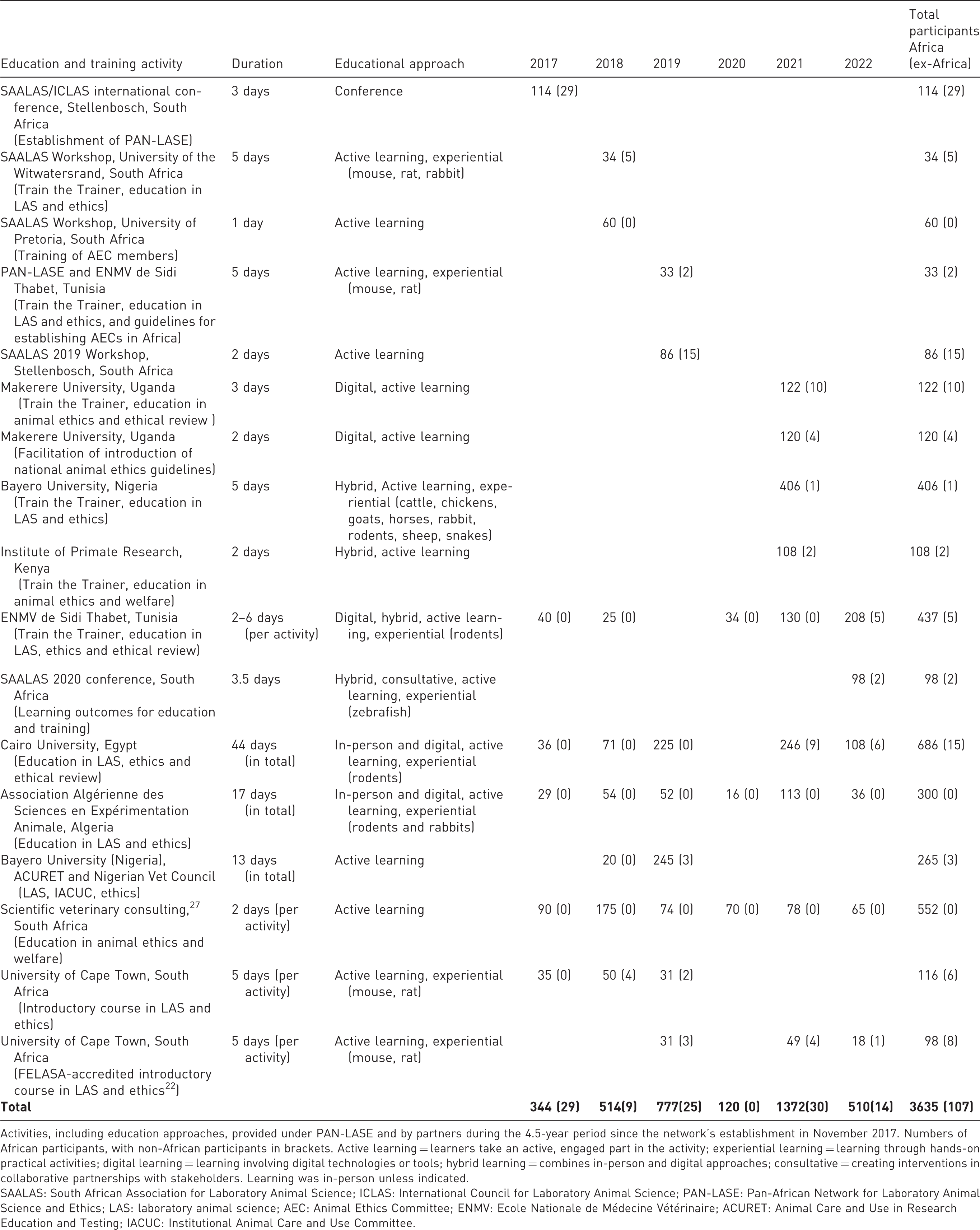
Activities, including education approaches, provided under PAN-LASE and by partners during the 4.5-year period since the network’s establishment in November 2017. Numbers of African participants, with non-African participants in brackets. Active learning = learners take an active, engaged part in the activity; experiential learning = learning through hands-on practical activities; digital learning = learning involving digital technologies or tools; hybrid learning = combines in-person and digital approaches; consultative = creating interventions in collaborative partnerships with stakeholders. Learning was in-person unless indicated.
SAALAS: South African Association for Laboratory Animal Science; ICLAS: International Council for Laboratory Animal Science; PAN-LASE: Pan-African Network for Laboratory Animal Science and Ethics; LAS: laboratory animal science; AEC: Animal Ethics Committee; ENMV: Ecole Nationale de Médecine Vétérinaire; ACURET: Animal Care and Use in Research Education and Testing; IACUC: Institutional Animal Care and Use Committee.
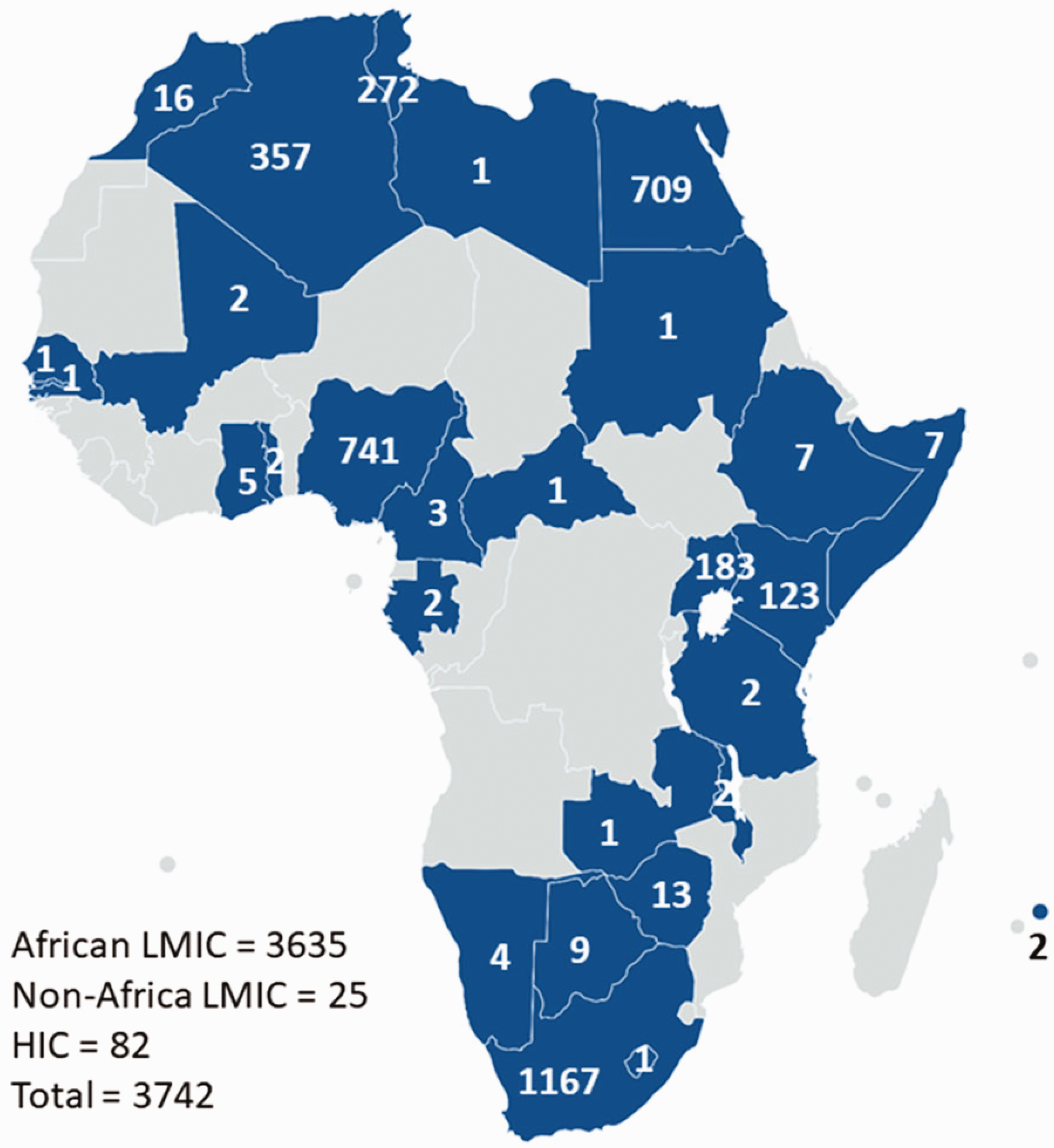
Pan-African Network for Laboratory Animal Science and Ethics (PAN-LASE) provided laboratory animal science (LAS) and ethics educational opportunities for stakeholders from across Africa. Map of Africa showing number of participants per country at LAS and ethics education, training and professional education opportunities created and delivered in Africa by PAN-LASE partners during the 4.5-year period since the network’s establishment in November 2017. Non-Africa LMIC and HIC, not shown. See Table 1 for details.
We recognised that to truly support change, we would need to provide professional educational opportunities for all parties involved in the care and use of animals for scientific and medical purposes. The events were therefore open to researchers, students, veterinarians, para-veterinary professionals, animal caregivers, animal facility managers, technicians, animal ethics committee members and members of professional, statutory and regulatory bodies.
The first PAN-LASE-organised Train the Trainer course was delivered, in partnership with SAALAS and the University of The Witwatersrand, in South Africa in 2018 (39 participants, 35 of them from South Africa and Nigeria). Recognising the need to expand our reach across Africa, particularly northern Africa, the second Train the Trainer course was in Tunisia in 2019 (Ecole Nationale de Medecine Veterinaire de Sidi Thabet, 35 participants from 12 African countries). In this course, we also co-created the first, by Africans for Africans, guidelines for the care and use of research animals (see below).
To promote higher levels of learning, all courses were delivered predominantly using active learning approaches. 29 We built in sustainability and growth by designing and delivering activities as ‘Educate the Educator’, aka ‘Train the Trainer’, courses. All educational resources and approaches were shared with participants, in the hope that this would encourage and support them to deliver similar educational activities in their own institutions, networks or counties.
The award of a substantial BBSRC Strategic Training Award for Research Skills in 2019 provided the opportunity and resources to significantly expand PAN-LASE activities and broaden our reach across Africa, by co-creating and co-delivering courses in six African countries (Botswana, Kenya, Nigeria, South Africa, Tunisia, Uganda) and in supporting the development of a LAS Association in Ethiopia. The Covid-19 pandemic meant we were unable to realise many of these ambitions until 2021–2022. We eventually delivered two courses in Uganda, one each in Kenya, Nigeria and Tunisia, and a curriculum development workshop in South Africa. This was a major collective success, providing educational opportunities for 1062 colleagues from 20 African countries (Table 1). Due to expiry of the grant, we were unable to deliver planned activities in Botswana.
The necessity of delivering Covid-19 secure activities meant that we had to switch from in-person to digital and later hybrid (simultaneous digital and in-person) delivery for courses. Whilst this switch to digital education brought new challenges, it also realised substantial new and unexpected benefits, that is, massively increasing the number of participants that could be accommodated on a course, and the consequent reach and impact of the activities. Digital education, particularly in Africa, has constraints (e.g. IT infrastructure, internet connectivity, cost of data) and is not suitable for hands-on skills training. However, it is an extremely low-cost and efficient way of delivering education over large geographical areas and in many resource-constrained regions.
To truly cement these activities into practice, and to support and mentor colleagues going forward, participants from the five courses were invited to join Communities of Practice, one per course. These comprised of Google or WhatsApp groups to facilitate networking and communication, and Google Drives to enable the sharing of resources. The collective membership of these groups is 450 persons from 20 African countries.
Activities within African countries
In parallel with these PAN-LASE-led educational activities, PAN-LASE partners created and delivered additional interventions in their own institutions, countries or regions, thus building further pan-African capacity, while enabling the creation of activities specially tailored to address their country’s and/or region’s particular needs. These activities provided professional educational opportunities for 2573 participants from 28 African countries (see Table 1 and Figure 1 for details). The intention has been that these tailored initiatives could be modified as appropriate, and adopted more broadly across Africa going forward.
For example, in South Africa, following previous scoping of educational needs in LAS, 30 the national training programme for the para-veterinary profession of laboratory animal technologist was re-initiated in 2022, following 25 years of inactivity. 31 At the SAALAS 2022 Conference, the creation of Learning Outcomes for the education and training of laboratory animal caretakers was facilitated 32 and the life-long learning needs of veterinary and para-veterinary professionals in the LAS sector defined. 33 In Uganda, a PAN-LASE partner at Makerere University led the creation and implementation of national animal research ethics guidelines, 12 with PAN-LASE contributing to the creation and delivery of courses in animal ethics to support the implementation of these guidelines. In Egypt, Nigeria, South Africa and Tunisia, PAN-LASE partners and their institutions have become regional centres of excellence, by sharing their knowledge and expertise, and mentoring and supporting individuals and institutions in their own and neighbouring countries to establish educational programmes and robust ethical review structures and procedures. 20 In Tunisia, the Ecole Nationale de Médecine Vétérinaire de Sidi Thabet (ENMV), in partnership with the French (AFSTAL), Belgian (BCLAS) and Canadian (CAALAS) laboratory animal associations and institutions (IRESA Tunisia, INSERN France, ENV Nantes), has provided education and support for colleagues from 18 French-speaking African countries. They have led the creation of a Tunisian LAS association, institutional and national animal ethics committees. In Egypt, PAN-LASE partners at Cairo University created and shared a Standard Operating Procedure for establishment and functioning of IACUCs, provided education and support to enable the establishment of IACUCs at many Egyptian institutions and the promotion of the Culture of Care among the researchers. 20 The Introductory Course in Laboratory Animal Science at the University of Cape Town22,23 has trained, since the establishment of PAN-LASE, 228 persons from 23 countries, including 13 African countries, thus strengthening capacity more broadly.
Guidelines for the establishment and functioning of Animal Ethics Committees [Institutional Animal Care and Use Committees] in Africa
Critical to successfully embedding good practice in LAS and ethics across Africa has been the parallel promotion and implementation of sound ethical review processes and structures, that is, interventions that are still lacking in many parts of Africa. To rectify this, PAN-LASE brought together 32 African experts from 12 African countries in a workshop at the Ecole Nationale de Médecine Vétérinaire de Sidi Thabet, Tunisia. Delegates shared experiences and expertise from across Africa to co-create Guidelines for the establishment and functioning of Animal Ethics Committees [Institutional Animal Care and Use Committees] in Africa. 34
The guidelines were produced with consideration of existing legal frameworks, standards and policies relating to the care and use of animals for scientific purposes in Africa; with regard for the cultural, religious, political and socioeconomic diversity in Africa; and with reference to relevant aspects of international recommendations.9,10
Challenges encountered
Many PAN-LASE partners faced considerable challenges from the outset. Given the substantial challenges faced by LMICs in Africa, a focus on animal welfare, research animal sciences, and related education, training and life-long learning may not be prioritised. Weak governance frameworks, and early or absent ethical review systems, contribute to a lack of institutional commitment and availability of funding in relevant regions. In contrast to many other world regions, significant research is undertaken involving wild, captive, agricultural or domesticated animals, or higher order species, which may not be owned by the researcher. There are cultural differences as to how different communities view animals and different species. Africa is a vast continent, often resource constrained, with significant distances between institutions, making travel to educational interventions challenging. Language complexities create challenges. IT constraints (e.g. access to computers, internet access or interrupted internet connectivity, instability of electricity supply networks, expense of data) hinder digital delivery and the use of, or access to, courses or digital resources offered in the high income countries is prohibitively expensive and beyond the means of the vast majority.
Critical to our success in overcoming these challenges has been the formation of strong, inclusive, collaborative partnerships with stakeholders across the continent and beyond, a core of individuals committed to driving forward positive change, a clear plan with objectives and milestones, and a willingness to collaborate with individuals and institutions globally.
It has not, however, always been plain sailing. Some challenges were imposed by circumstances, for example, the switch to digital delivery during the initial stages of the Covid-19 pandemic, then, more recently, the hybrid delivery of courses. Other challenges were discovered as we went along, for example, the need to modify course content to more appropriately reflect the animal research activities and animal species used in a particular country or region, IT and infrastructure issues associated with digital delivery in Africa and improved cultural awareness of the rich diversity that is Africa. Looking back, it would likely have been advantageous to have engaged at an earlier stage with some national and pan-African professional, statutory and professional bodies.
Recommendations for others
Based on our experience, we offer the following recommendations for others who may be seeking to develop comparable programmes within their own LMIC countries:
Establish a strong steering group who are committed to contributing significant time to the project, with a wider advisory group comprising representatives of all relevant stakeholders and professional, regulatory and statutory bodies (PRSBs). Collaborative, inclusive partnerships throughout the process are critical to success. Establish a society, association or non-governmental organisation to bring together all the different stakeholders and interested parties. Identify the region-specific needs at the outset, encompassing the needs of all stakeholders. Create a developmental plan, recognising that different countries and institutions will have different needs, with clear objectives and milestones. Include mechanisms for the sharing of activities or practices, evaluation and embedding thereof into national and/or regional practice or standards. Recognise that many other LMICs are in a similar situation. Reach out to these countries to share ideas and resources, and to support each other. Include collaborations across the globe, including high-income countries. Gather good practice and resources from around the world and re-purpose these to suit your local needs. Include sustainability and growth as design principles for educational activities from the start of the process. Be flexible, willing to adapt to changing circumstances, opportunities and priorities. Recognise that it will be a progressive, developmental journey. Realise the quick or easy wins, in parallel with developing those that will take significant time or resources to create and implement.
The way forward for Africa
We have successfully created and delivered a portfolio of educational opportunities in nine African countries, with a wider community of colleagues equipped with the knowledge, expertise and educational resources to deliver these interventions in their own countries and networks. However, there are still gaps in provision across the continent (Figure 1). Four and a half years after PAN-LASE’s creation, it is an opportune time to convene a meeting of key stakeholders to reflect on successes and challenges to date, to re-imagine priorities and needs and to map out a strategy to continue broadening our reach and impact across Africa.
Strengthening the cohesiveness of the network is essential for continental momentum to continue and to allow for growth and expansion of activities. The formalisation of PAN-LASE therefore presents a rational next step, including consideration of the most appropriate vehicle for continuing the network’s activities going forward, defining a constitution and establishing an appropriate leadership team, with due consideration of balanced representation from the various African regions and interest groups. Defining a funding mechanism will be essential to maintain the sustainability of education and training programmes beyond the period of the depleted start-up funding.
In addition to the PAN-LASE steering group overseeing developments from a pan-African perspective, the establishment of regional sub-groups or Communities of Practice within the network may present an effective approach to develop activities which better address region-specific needs. Building on our experiences in South Africa, Tunisia, Nigeria and Egypt, these regional Communities of Practice could implement hub-and-spoke models of educational provision in which the nodes of greatest knowledge, competence and activity within the relevant Community can support the surrounding areas, including the extension of educational and training activities. Effective partnerships with national LAS associations will be critical in driving this forward. To take this devolved model forward, we have recently launched a Southern African Development Community 35 countries’ Community of Practice, with similar Communities of Practice being considered for the four other regions of Africa.
Critical to the continued growth of education in LAS and ethics across Africa will be the creation of a shared open-access digital repository of Africa-centric educational resources, in formats accessible to African educators, to empower educators to expand the content of existing courses and to establish additional courses. The provision of resources tailored to African settings, cultures and research activities, created by Africans for Africans, will be essential to promote the greatest acceptance and adoption by the user communities. This production of shared educational resources would ideally include consensus by network partners on the content of materials, drawing on and re-purposing excellent exemplars of currently available global resources, 36 – 40 as well as the development of appropriate quality-assurance mechanisms for created content. Any increased delivery of workshops in digital formats will require training and hands-on experience in the use of digital educational tools for both educators and participants, particularly if one continues to use active rather than passive learning approaches.
For education and training to be truly embedded into national and regional practice, it will be essential for PRSBs across the continent to formally require education and training for persons involved in the care and use of animals for scientific and medical purposes. In addition, ethical review and approval should be a prerequisite for initiating scientific activities using animals. 34 We will therefore need to work with the appropriate agencies to strengthen supportive governance frameworks at institutional, national and regional levels. Engagement with PRSBs will be required both on the national level (e.g. the development of National Guidelines for the care and use of animals in research and teaching in Uganda, 12 overseen by the National Council of Science and Technology) and on the international level (e.g. the African Union, World Organisation for Animal Health, African Academy of Sciences, etc.), to enable incorporation into regulations, national standards and guidelines. Ultimately, harmonisation, rather than standardisation, should be the goal for the African continent, where each country remains able to maintain an overseen system that reflects its own cultures, traditions, religions, laws and regulations. Harmonisation of requirements would also facilitate the free movement of individuals between countries and remove barriers to research collaborations across Africa. 11
Creating career paths and opportunities for life-long learning in the field of laboratory animal science is critical to attract and retain professionals and promote satisfaction. To recruit individuals into the profession will require educational opportunities and engagement at multiple levels, for example pre-matriculation for animal caregivers, in undergraduate and postgraduate degree programmes for researchers and within veterinary curricula for veterinarians. Once recruited, retention of these individuals requires formal training programmes, life-long learning opportunities and pathways for career progression for all persons involved in the care and use of research animals. Such examples are starting to emerge, for instance in South Africa, the national training programme for the para-veterinary profession of laboratory animal technologist has been re-initiated following 25 years of inactivity, 31 a Framework of Learning Outcomes for the education and training of laboratory animal caregivers has been created 32 and the LAS life-long learning needs of veterinary and para-veterinary professionals has been identified. 33
We are progressively creating educational and life-long learning opportunities for all persons involved in the care and use of research animals across Africa, and facilitating the introduction and strengthening of robust ethical review processes. These activities are enhancing animal welfare and the quality of the research undertaken, which in turn increases the reproducibility, reliability and translatability of the data obtained, thus enabling African researchers to more competitively undertake world-leading research, to create solutions to the many health and wellbeing challenges facing the continent. The challenges, successes and the lessons learnt from PAN-LASE’s journey may be applicable to other LMICs across the world seeking to enhance animal welfare and ethics in their own country or region.
Footnotes
Acknowledgements
The authors gratefully acknowledge all those who have contributed to the development of PAN-LASE and its activities, course participants, professional, regulatory and statutory bodies across Africa, and funding agencies (see Funding below). In addition, we acknowledge the in-kind contributions of AAALAC International (USA), Aachen University (Germany), AFSTAL (France), Bayero University (Nigeria), CAALAS (Canada), Cairo University (Egypt), Ecole Nationale de Medecine Veterinaire de Sidi Thabet (Tunisia), Houari Boumedienne University of Sciences and Technology (Algeria), Institut national de la santé et de la recherche médicale (France), Institute of Primate Research (Kenya), Institution de la Recherche et de l'Enseignement Supérieur Agricoles (Tunisia), International Union of Basic and Clinical Pharmacology, L'École nationale vétérinaire de Nantes (France), Makerere University (Uganda), Nordic Consortium for Laboratory Animal Science Education & Training, University of Cape Town (South Africa), University of Leeds (UK), University of the Witwatersrand (South Africa),University of Zurich (Switzerland) and Utrecht University (Netherlands).
Data availability

Declaration of conflicting interests
The author(s) declared no potential conflicts of interest with respect to the research, authorship, and/or publication of this article.
Ethics statement
All studies which used live animals for education and training were approved by the relevant Animal Ethics Committee: Bayero University (Nigeria) Animal Care and Use Research Ethics Committee (approval no: BUK/ACUREC/21/09/B-C/0001); Cairo University Faculty of Science Institutional Animal Care and Use Committee (Egypt) (approval number: CU/I/F/42/18); Ecole Nationale de Medecine Veterinaire de Sidi Thabet (Tunisia) Comité d’Ethique en Expérimentation Animale-CEEA (approval no: 41.2021 ENMV-ICLAS); University of Cape Town (South Africa) Faculty of Health Sciences Animal Ethics Committee (approval numbers: 015/025 and 019/003); University of Science and Technology Houari Boumediene (Algeria) Institutional Animal Care & Use Committee (approval no: 45/DGLPAG/DVA/SDA/14); University of the Witwatersrand (South Africa) Animal Ethics Committee (AREC 2018-02-12B). Animals were used only for the non-regulated provision of skills training in animal handling and restraint. Animals were housed and cared for in line with international good practice and guidelines, and in accordance with relevant legislation, regulations and guidelines of the host country. To minimise distress, groups of animals were rested, in rotation, throughout the skills training sessions, with them been given appropriate treats during these rest periods.
Funding
The author(s) disclosed receipt of the following financial support for the research, authorship, and/or publication of this article: Biotechnology and Biological Sciences Research Council (grant number BB/T017287/1); Biomedical Education Research Trust; British Pharmacological Society; Higher Education Funding Council for England (University of Leeds QR Allocation); International Council for Laboratory Animal Sciences; Laboratory Animals Ltd (grant numbers 280 2015, LAL LP 297 2017, LP381 2017, LAL LP 397_2018, LP 446 2019); South African Association for Laboratory Animal Science (SAALAS); South African Medical Research Council (SAMRC) Strategic Health Innovation Partnerships (SHIP); South Africa-Sweden University Forum (SASUF); UK Research and Innovation (grant number EP/S516016/1); University of Leeds; World Universities Network.