




Abstract
The term Culture of Care, within the scientific community using laboratory animals, is being used more and more frequently after it was introduced in the EU Directive 2010/63/EU, where it is phrased as a ‘climate of care’, which became effective in national legislation from January 2013. However, there is a risk that the term could become a meaningless phrase if no agreed local definition of the term exists at the animal facility (called establishment in the EU Directive). This paper presents a comprehensive survey tool that provides a means to describe what the Culture of Care in an establishment looks like. The tool is one of the elements that can contribute to the overall picture of the culture; however, it cannot stand alone. Together with an evaluation of the effectiveness of the Culture of Care (e.g. key performance indicators) and a description of the outcomes and achievements in terms of animal welfare and the 3Rs (Replace, Reduce, Refine), the survey tool will constitute a comprehensive picture. The survey tool offers a multilevel and comprehensive view of different subcultures, presenting details on mindset and behaviour of the employees and the different relations within the culture, thus enabling the initiation of improvement projects if required. The tool addresses essential elements of a co-operative culture in terms of what we think, what we do and how we work together.
Introduction
The use of the term ‘Culture of Care’ in relation to the use of live animals in the scientific community is relatively new. Two of the first publications to present the concept of a Culture of Care in this context were A Culture of Care: A guide for people working with animals in research, testing and teaching by the New Zealand National Animal Ethics Advisory Committee in 2002 1 and the article ‘Ethical aspects of relationships between humans and research animals’ by Harold Herzog also in 2002. 2
For many years, the concept of a Culture of Care has existed in nursing and health professions where it has been widely applied. 3 However, the concept of a Culture of Care within laboratory animal science has gained much traction since in the EU Directive 2010/63/EU on the protection of animals used for scientific purposes, 4 it appeared in recital 17 – ‘The [animal welfare] body should … foster a climate of care and …’; albeit stated as a climate of care, the idea is the same as a Culture of Care. In the EU Commission Guidance document ‘A working document on Animal Welfare Bodies and National Committees to fulfil the requirements under the Directive’ from 2014, 5 it is called ‘Culture of Care’ and is exemplified in statements such as ‘appropriate behaviour and attitude towards animal research’, ‘staff who work diligently, accept individual responsibility’ and ‘an attitude that is not based on complying with the rules alone but on an individual’s positive and proactive mindset and approach to animal welfare and humane science’. This positive and proactive mindset and approach require that staff are empowered within an agreed framework, have influence on matters that relate to animal welfare 6 and have the opportunity of expressing their empathy with the animals.7,8 If not, there is a risk that the staff experience compassion fatigue, that is they develop a reduction or absence of empathy for the animals that are in their care. Frequently being exposed to witnessing or participating in procedures causing harm to animals and not being able to moderate this harm is stressful for the employee.6,9,10
It is conceivable that the concept was introduced in the belief that progress in animal welfare and the 3Rs (Replace, Reduce, Refine) driven by culture, on top of legislative requirements and standard operating procedures, would be a strong and efficient enabler of these goals – a belief that is endorsed by the authors of this concept article.
The authors of this article believe that three major components are essential when conceptualising the general picture of animal facilities’ efficient endeavours to achieve the above-mentioned goals: (a) the culture itself, (b) the supporting structures and deployed tools vital to making the culture operational and (c) the desired outcomes and achievements in terms of animal welfare and the 3Rs. These three components are linked to each other in a way that can graphically be displayed as a house (see Figure 1): the foundation is the culture– what we think and do and how we work together; the walls (or pillars) are our tools to support and link the culture with outcomes. The figure shows hypothetical examples of supporting structures as these will be different for each establishment according to their actual existence. The roof is the purpose of it all: the desired outcomes in terms of animal welfare and benefits to the society.
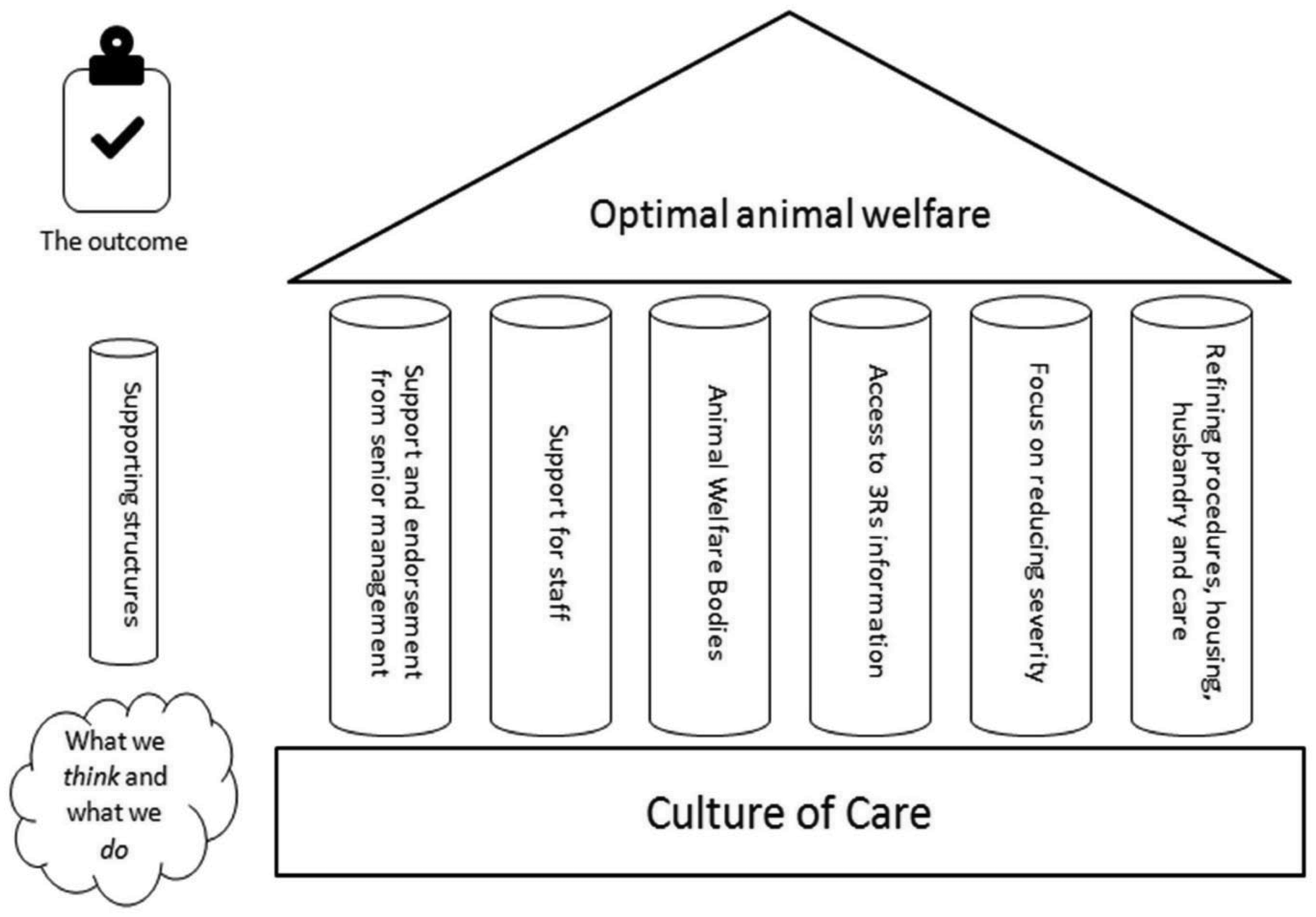
The Culture of Care house.
The tool described in this article (first presented orally at the he European Society for Alternatives to Animal Testing) 12 addresses the first element – the culture itself – ‘what does it look like?’, a measurement of the current state in an establishment.
To be able to work with the culture in relation to the use of laboratory animals, it is necessary to identify and understand what the culture looks like to set direction and to follow up on progress. One way of doing this is by conducting a survey.
This article will present a Culture of Care survey tool that, with relatively few questions, makes it possible to analyse the many elements and levels of Culture of Care within an animal facility. The tool was devised, designed and tested by employees in the Laboratory Animal Science unit at Novo Nordisk. The tool provides insights into ‘what does the culture look like’; however, it does not address an equally important issue: ‘how well does the culture work’. The latter is typically addressed by implementing performance standards, which have been described in other publications.13,14
The survey design is heavily inspired by the principles of ‘social capital’ described by Robert D. Putnam; Bowling Alone, 15 which in a laboratory animal setting can be described as a form of viable and cultural capital in which collaborative networks are fundamental. 16 Their (trans)actions are characterised by justice, trust and co-operation 17 and their work is not for themselves per se, but for a common good, that is ensuring animal welfare and contributing to new patient solutions. It addresses tangible resources (money and time) as well as intangible resources (staff competence and commitment) and the relationships among these resources.
The authors find that the validity of designing the questionnaire based on the principles of social capital is justified, because these principles address the two major aspects of the above-mentioned definition of Culture of Care: our behaviour and mindset – what we do and what we think – and how we collaborate when we are working with laboratory animals.
Surrogate markers help as substitutes in describing what an employee feels and thinks about an abstract term such as culture, which evidently has many individual perceptions.
There are three value-based characteristics:
Collaboration. You depend on collaboration with your colleagues within and between groups, your manager, etc. Trust. Questions, concerns and disagreements can be voiced without fear of retributions. Integrity (Justice). This is essentially the animal facilities’ ‘Walk the Talk’ – ‘We do what we say we will do’.
There are six operational topics:
Influence. The individual or a group of employees actually has the possibility of changing things and also of challenging the status quo. Empowerment is a key point, and this empowerment will naturally have to be within an aligned framework of resources and mandates. Meaning. It is evident for the employee(s) that what they do makes sense on a higher level, for example ‘my efforts to improve animal welfare will help develop new medicines/generate new knowledge/assess the safety of new substances and thus help patients’. Predictability. Knowing what will happen if you as an employee brings forward a new animal welfare initiative or raises an animal welfare concern, gives a sense of reassurance and control. Social support. How will you be met by colleagues and managers when you bring up your new animal welfare initiative? It is important to know if you will be met with indifference or with a listening and appreciative attitude. Rewards/recognition. Do you get positive feedback and are your animal welfare efforts noticed? Or are there other kinds of rewards? (E.g. 3R award, caretaker of the month, presentation of your idea at a meeting.) Resources. This concerns both time and money. Are the necessary resources such as man-hours and/or in terms of budget available for implementing ideas?
Materials and methods
The survey has 39 quantitative questions (with tickboxes for ‘Strongly agree’, ‘Agree’, ‘Disagree’, ‘Strongly disagree’ and also ‘Don’t know’) and was built to provide a multi-tier approach. The different components were:
Job function: Animal Care Technician, Laboratory technician/Veterinary nurse, Animal license holder, Scientist or Study Director/Study Responsible, Manager, Laboratory Animal Veterinarian and ‘Other’. Relations and behaviours between and within groups consisting of employees from different functions: the 39 questions had four sections related to: the individual (I) – the individual employee; the group (G) – the group of, for example, animal care technicians; the leadership (L) – relations to immediate superior; the organisation (O) – knowledge about organisational structures.
The nature of these relations will be addressed in the Discussion section.
Surrogate markers as substitutes for more tangible descriptions of what an employee feels and thinks about ‘culture’ and how they collaborate on this. The deployed surrogate markers were: Three value-based characteristics: Collaboration, Trust and Integrity Six operational topics: Influence, Meaning, Predictability, Social support, Rewards/recognition and Resources
A detailed description and the choice of surrogate markers will be addressed and justified in the Introduction section.
Each of the 39 questions addresses one of the surrogate markers. Most of the surrogate markers make sense to be addressed on each of the four levels (the individual, the group, the leadership and the organisation), but some do not.
Relations that are constructive and effective are essential for a collaborative way of working together. Different types of relations are in play in a complex organisation such as laboratory animal facilities. To understand and address potential issues related to, for example, Culture of Care, it is important to recognise and understand the nature and dynamics of these different relations.
When initiated, the survey was anonymous and launched as an online tool (Google docs). It was sent to 343 potential respondents within Novo Nordisk research and development. The response rate was 44%. Accessibility for responses was open for 1 month. The estimated time to complete the survey was 15 minutes.
Prior to the launch of the survey, the questions were tested in a pilot-survey on a limited number of respondents to avoid ambiguity and to ensure that the meaning of the questions were correctly understood. Furthermore, the online features and functionality of the tool were assessed.
Results
In summary, we were able to outline directions on where and how to initiate potential actions.
Figure 2 shows an example of how the replies to the individual questions were presented. The example shows that:
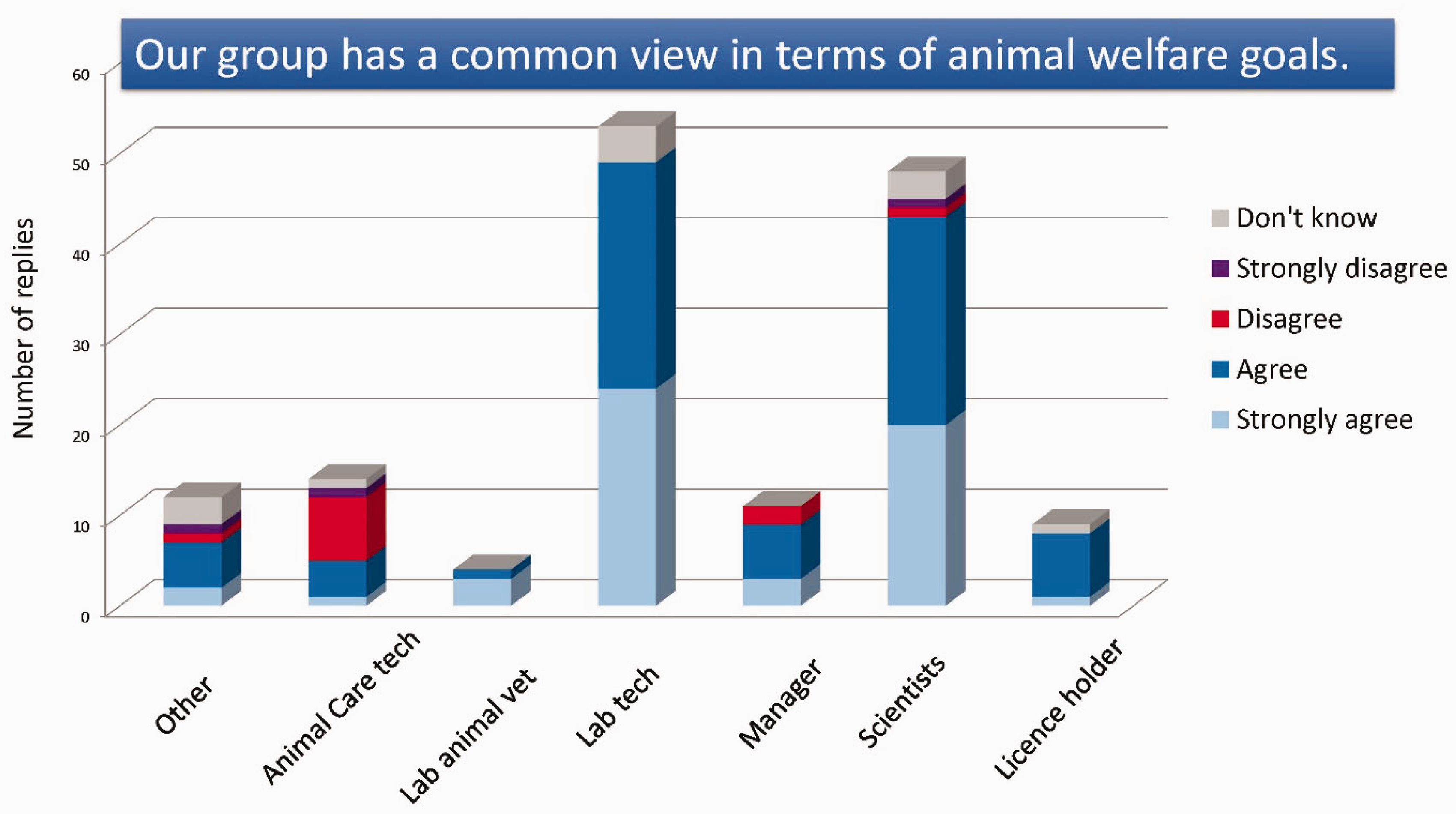
An example of visualisation of a reply to one of the 39 questions. The x-axis shows different job functions: ‘other’; animal care technicians; veterinarians; in-vivo laboratory technicians/vet nurse; animal licence holder; study responsible; manager.
the question addresses relations within the group (the G in the IGLO) (‘Our group has…’);
it concerns the surrogate marker ‘Collaboration’;
at least one of the job-function groups (animal care technicians) has a large proportion of employees who do not agree with the statement, whereas others agree to a very large extent.
Likewise, the questions were also addressing the individual aspect (the I in the IGLO model) as well as the G, L and O. This is further presented in Table 1.
The 39 survey questions addressing the individual (I), group (G), leadership (L) or organisational (O) dimensions; the relevant surrogate marker addressed in the question is also indicated.
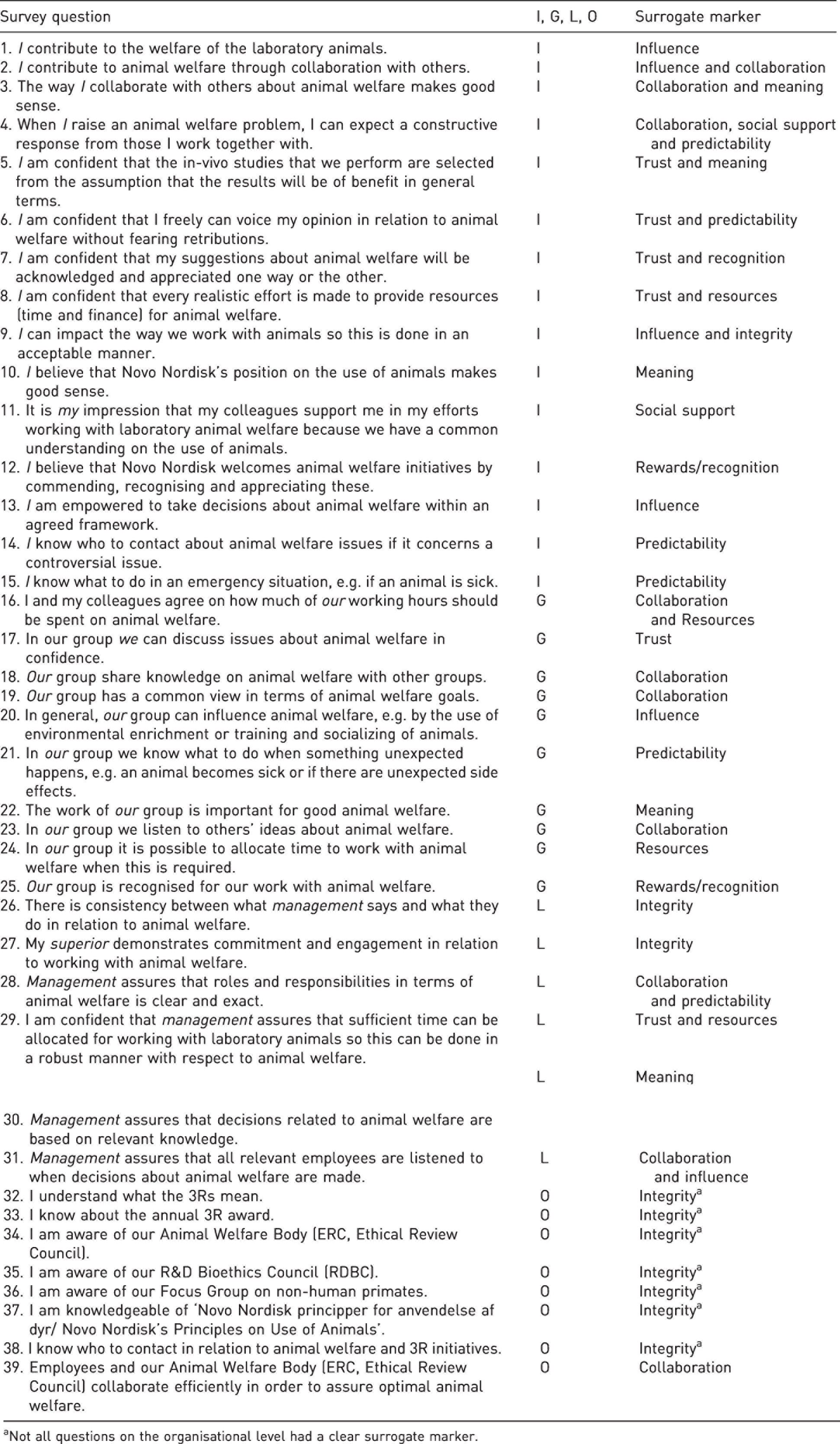
aNot all questions on the organisational level had a clear surrogate marker.
Discussion
Many scientific disciplines offer different definitions of the term culture. In broad terms, culture can be described as the characteristics and knowledge of a particular group of people, encompassing language, religion, cuisine, social habits, music and arts. Narrowing this down to the scientific community and its use of live animals, it can be described as our behaviour and mindset – what we do and what we think – and how we collaborate when we are working with laboratory animals.
At Novo Nordisk, we frequently apply the IGLO-perspective, representing the individual, the group, the leadership relations and also their connection to organisational structures (e.g. the Animal Welfare Body, corporate policies and statements, 3R Award, statistically counselling, help on study design) to evaluate and optimise relations when needed. This model is a frequently used tool in Denmark when working with occupational, health and safety, and it has also shown to be of value in the context of Culture of Care.
Relations between individuals within a group (bonding) and relations between groups (bridging) are different in their nature and their dynamics. They are also different from the relations between group(s) and the leadership/management level (linking) 18 and very different from the way that these three are connected to the different organisational structures within the animal facilities. It is important to acknowledge and understand these differences as handling of potential dissonances requires different approaches. 19
The survey tool does not directly address the extensively described links or bonds that are established between the animal care personnel and the animals.2,20 –24
The authors would like to emphasise that the presented tool does not pretend to apply methodologies used in, for example, anthropology, sociology or psychology. Nor should the numerical data shown in the graph (Figure 2) be subject to the traditional scientific rigour of p-values and standard variations, since they are only indicative of a general picture. The authors also acknowledge that other surveys and other tools25,26 to assess Culture of Care in animal facilities can provide similar insights. Just like the initial concept of a Culture of Care originated from the nursing sector, this sector has also developed a tool – the Culture of Care barometer designed to gauge the Culture of Care. 27
The use of surrogate markers and the relations between and within groups addresses the essential elements of a Culture of Care and also the aspects of empathy and compassion fatigue which are discussed in the Introduction section.
The survey tool is generally applicable across individual establishments, different countries and national cultures in terms of the structure (the IGLO model addressing the different levels) and the use of the surrogate markers (these are frequently seen in similar surveys and international workshops, etc.). Likewise, many of the survey questions have a general applicability, for example the questions relating to the individual level as in ‘I am empowered to take decisions about animal welfare within an agreed framework’, ‘I am confident that I can freely voice my opinion in relation to animal welfare without fearing retributions’ and ‘In our group we know what to do when something unexpected happens, e.g. an animal becomes sick or if there are unexpected side effects’.
Some of the survey questions have a specific relevance to Novo Nordisk and will not be meaningful if replicated verbatim, for example ‘I am aware of “Novo Nordisk’s Principles on Use of Animals”’.
However, the authors believe that the power of the tool is its general applicability for almost any establishment after paying due attention to modest revisions relevant for the individual differences in each establishment, thus also providing a framework for facilitation of internal discussions on the aim and purpose of the desired Culture of Care.
To do so, a stepwise approach should be applied:
Discuss and decide on the ambition level of the establishment’s own Culture of Care. What is the desired outcome? Perform a pre-assessment of the current Culture of Care. Identify potential challenges. Identify useful tools/supporting structures. Assess the relevance of the surrogate markers. Adjust the questions to accommodate and reflect the points above.
Another strength of the tool is its capacity to facilitate a dialogue that addresses awareness on how to work with animals. The example in Figure 2 shows that there are differences within the groups in terms of how much the bar for animal welfare should be raised, and the figure is a good starting point for a dialogue to align these differences.
Conclusions (how to proceed with the work ahead)
After organising, analysing and presenting data, we can conclude that with relatively few questions, we are able to establish an overall picture of our current Culture of Care and to identify a handful of matters on different organisational levels that potentially would require attention and improvement initiatives.
We are also able to discriminate between matters related to different professional groups and to validate the nature of the matters by looking at the surrogate markers.
In the authors’ opinion, the way forward is to strive for going beyond and above a Culture of Compliance – to quote the EU Commission Guidance document on Animal Welfare Bodies and National Committees: ‘Simply having animal facilities and resources which meet the requirements of the legislation will not ensure that appropriate animal welfare, care and use practices will automatically follow’. 5 In addition, a Culture of Challenge must be encouraged. 28 A Culture of Challenge represents an encouragement to investigate if there are better solutions instead of choosing the current solutions by default. A statement such as ‘We have always done it in this way’ should automatically prompt a response to see if better alternatives are available. A Culture of Challenge naturally requires a meaningful, respectful and positive approach.
The authors believe that it is important to acknowledge that differences between various animal facilities exist, but all employees should be working for and share the common goals in terms of achievements within animal welfare and the 3Rs. Consequently, a wide interpretation of Culture of Care should be allowed. The legislative approach from authorities should be supportive, not prescriptive. The texts in rules and regulations will describe how you should do things right, but the approach and support from the authorities should also be how you could do the right things, and not to prescribe what the culture should look like. The EU Commission Guidance document on Animal Welfare Bodies and National Committees is a good example of this approach.
Communicating and disseminating an abstract concept as Culture of Care with its outcomes that are not easy to quantify can be a challenge, but some recent publications suggest ways to do this.11,29,30 Furthermore, an International Culture of Care Network has been established with the intention of sharing practical approaches for working with Culture of Care in an easy and non-formalised way.31,32
The survey tool presented in this article does not address a description of the outcome of the animal facilities’ Culture of Care. The outcomes, results and achievements are of course the entire purpose of working with Culture of Care – to ensure optimisation of the 3Rs and animal welfare, leading to minimal stress in animals and generating more robust scientific results. The use of key performance indicators that are tailored to the individual animal facilities may be a useful way of describing this.
As a concluding remark, the authors would like to advocate for an approach that is based on sharing, learning and transparency.
Footnotes
Declaration of conflicting interests
The author(s) declared no potential conflicts of interest with respect to the research, authorship, and/or publication of this article.
Funding
The author(s) received no financial support for the research, authorship, and/or publication of this article.
