




Abstract
We report a morphometric evaluation of α1,3-galactosyltransferase knockout (GTKO) pig heart and kidney (n = 9) at the end of one, three and seven months. Organs parameters gradually increased with the age (p < 0.05) and body weight (p < 0.05) of the pigs. Organs morphometries were significantly correlated to the age and body weight of the animal. We were able to conclude the average size of GTKO pig heart and kidney based on age and body weight, which could be helpful in estimating the size of these organs non-invasively for transplantation.
Introduction
Xenotransplantation (XTx) is considered a potential solution for patients with acute organ failure. 1 Due to the anatomical and physiological similarities, pigs have been considered as ideal organ donors and are most frequently used in biomedical research. 2 In particular, GTKO pigs became a first-line choice for XTx and related studies. Non-human primates (NHPs) transplanted with GTKO pig hearts or kidneys survived for several days, and with additional gene modifications and advancements in immune suppression, xenograft survival now greatly increased and can be achieved beyond two years.3–7 Physical parameters such as size, weight and morphology also have a substantial impact on the functionality as well as the success of cardiac and renal graft transplantation. However, the literature on the morphometries of the GTKO pig is scarce. The aim of this study was to evaluate heart and kidney morphometries of GTKO pigs.
Methods
The protocol and standard operating procedures for the treatment of the pigs used in this study were reviewed and approved by the Institutional Animal Care and Use Committee of the National Institute of Animal Science, Rural Development Administration of Korea (approval number: NIAS2015-142). GT–/– (GTKO) generation 5 (G5) pigs which were inbred descendants of G1 between a cloned GT+/– Chicago mini male pig and a wild-type Landrace female pig were used in this study. Pigs were housed in a room (2.5 × 1.6 m2 per animal) equipped with a slatted floor and with temperature and ventilation controls. Each animal was fed twice a day (125, 230, 475 and 950 g for 1–5, 5–10, 10–20 and 20–50 kg of body weight, respectively; Chunhajeil, Daejeon, Republic of Korea) and free accesses to water.
Anaesthesia and euthanasia
Pigs were anesthetised at 9:00am with an intravenous injection of 2 mL medetomidine hydrochloride (anaesthetic/analgesic; Domitor®; Orion Pharma, Espoo, Finland) and alfaxalone (Alfaxan®; Jurox Pty Ltd, Rutherford, Australia; 1:5). To maintain anaesthesia and achieve euthanasia, animals were maintained with isoflurane 2% (Piramal Critical Care, Inc., Bethlehem, PA) and a respiratory device.
Surgical procedure
Surgical procedures were performed by the team of surgeons experienced in experimental transplant surgery, with all experiments performed under general anaesthesia. The anesthetised donor pig was placed on the operating table in a dorsal recumbent position. A full-length midline incision was made to open the abdomen, and the kidneys, ureter, adjacent aorta and common iliac artery were exposed and immobilised. Then, the kidneys were excised and collected. Further, the chest was opened by median sternotomy, and the heart was collected from the thoracic cavity. 8 After the experiments, the animals were euthanised.
Morphometric analysis of heart and kidney
Animals were separated into three groups (1st month, n = 3; 3rd month, n = 2; and 7th month, n = 4). The collected heart or kidney was placed on the board with a scale mark (including main and middle). Physical dimensions such as the length (heart: base to apex; kidney: pole to pole), width (heart: transverse; kidney: lateral) and thickness (heart and kidney: anteroposterior) of kidney and heart were measured using Scientific Traceable Digital Calipers (3415; Control Company, Webster, TX). Organs weights were measured using a TAG3001F (Ohaus, Parsippany, NJ).
Statistical analyses
Each parameter is presented as the mean and standard deviation (SD). Correlation data were obtained using Pearson’s correlation test using IBM SPSS Statistics for Windows v22 (IBM Corp., Armonk, NY). Two-tailed tests were conducted for statistical significance (p < 0.05).
Results and discussion
The body weight of the GTKO pigs gradually increased with age (p < 0.05; Table 1). The average heart weights at the first, third and seventh month were 33.3 ± 5.8, 67.9 ± 11.0 and 197.5 ± 18.5 g, respectively (Table 1). The GTKO pig heart had an average growth rate of ∼5.4 g/kg body weight increase. Similar heart growth rates (5.3–5.6 g/kg body weight) have been observed in qualified pathogen-free (QPF) pigs, 9 GTKO pigs 5 and GTKO-CD46 pigs, 5 suggesting that body weight is a trustworthy physical parameter to estimate heart size.
Heart and kidney morphometries of GTKO pig at first, third and seventh month.
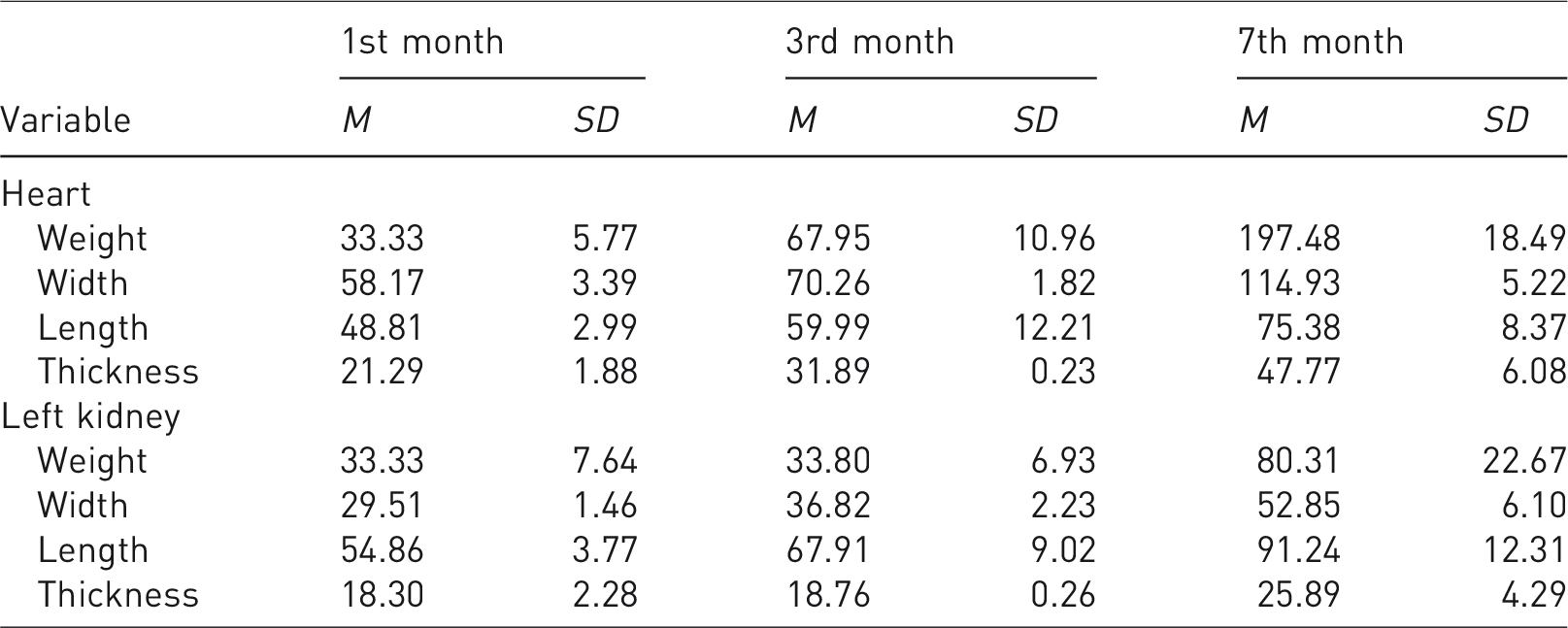
In our experience, the heart (∼1 month) and kidney (1–3 months) of GTKO pigs are appropriate to transplant into cynomolgus monkeys (unpublished data). The weight of the GTKO pig heart at the seventh month was found to be 197 ± 1.8 g, which can provide adequate cardiac output, 10 as it is comparable adult to the weight of a human heart (279 ± 44.9 g). 11
The GTKO pig kidney at the first, third and seventh month weighed 33.3 ± 7.6, 33.8 ± 6.9 and 80.3 ± 22.7 g, respectively (Table 1). The GTKO pig kidney showed an average growth rate of ∼2.8 g/kg body weight, which is similar to QPF pig kidney (∼2.5 g/kg body weight), 9 suggesting that body weight can be a reliable parameter to estimate donor renal graft weight. At the seventh month, the GTKO pig left kidney weight is about 80.3 ± 11.3 g, which is around 70% of that of an adult human male (∼117 ± 27.4 g). 11 Hence, the pig heart at the seventh month might be adequate to provide optimum functionality and graft survival in adult humans. 12
The morphometric parameters such as width, length and thickness of the heart and kidney gradually increased from the first month to the seventh month (Table 1). The width, length and thickness of the heart increased from 58.1 ± 3.4 to 114.9 ± 5.2 mm, from 48.8 ± 3.0 to 75.4 ± 8.4 mm and from 21.3 ± 1.9 to 47.8 ± 6.1 mm, respectively. Likewise, the width, length and thickness of the kidney increased from 29.5 ± 1.5 to 52.8 ± 6.1 mm, from 54.8 ± 3.8 to 91.2 ± 12.3 mm and from 18.3 ± 2.3 to 25.9 ± 4.3 mm, respectively.
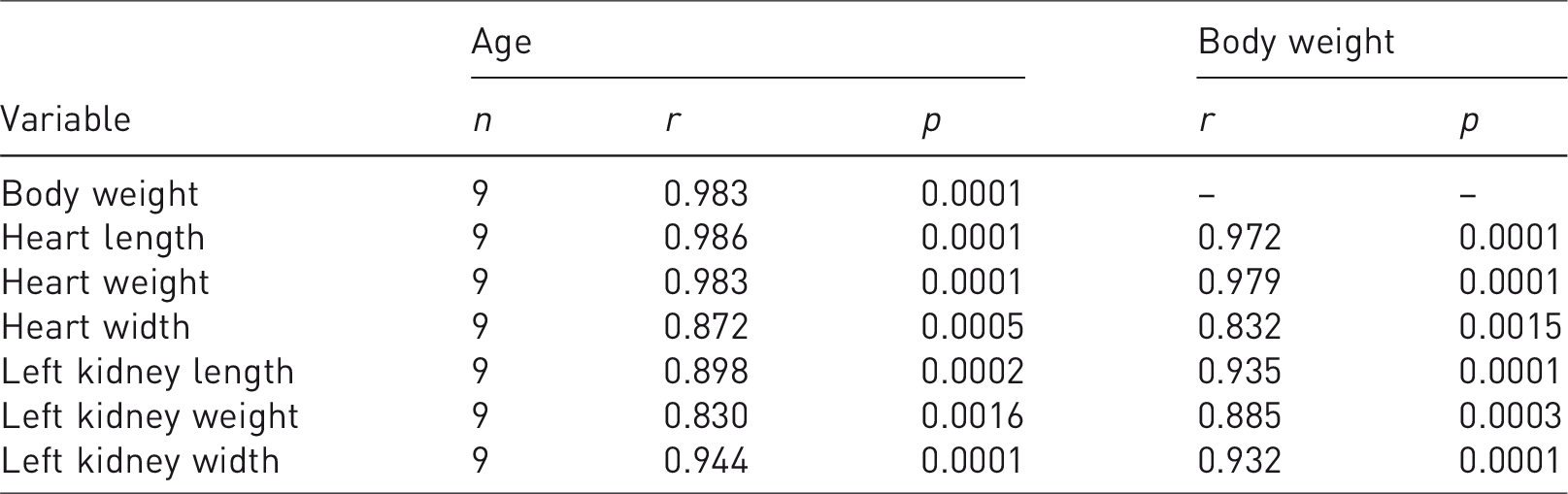
Pearson’s correlation analysis showed a positive correlation between age and other parameters such as body weight (r = 0.983), heart weight (r = 0.983), heart length (r = 0.986), heart width (r = 0.872), kidney length (r = 0.898), kidney width (r = 0.944) and kidney weight (r = 0.830; Table 2). A positive correlation was also observed between the pig’s body weight and heart length (r = 0.972), heart weight (r = 0.979), heart width (r = 0.832), kidney length (r = 0.935), kidney weight (r = 0.885) and kidney width (r = 0.932; Table 2).
Correlation values of kidney and heart morphometries to age and body weight.
Conclusion
This study indicates that body weight and age are reliable parameters to estimate the organ morphometries of animals reared under a controlled environment. The strong correlation achieved between body weight and the size of the organs avoids the challenges associated with traditionally used morphometric correlates such as determining the body surface area of the animal. Moreover, these observations would help to determine the approximate time of graft harvest non-invasively in order to match the size of the recipient.
Footnotes
Declaration of Conflicting Interests
The author(s) declared no potential conflicts of interest with respect to the research, authorship and/or publication of this article.
Funding
The author(s) disclosed receipt of the following financial support for the research, authorship and/or publication of this article: Cooperative Research Program for Agriculture Science and Technology Development (Project No. PJ PJ01384202) and 2019 Postdoctoral Fellowship Program of National Institute of Animal Science, Rural Development Administration, Republic of Korea.
