




Abstract
Different online courses and training programs in Laboratory Animal Science (LAS) have emerged across Europe in recent years. E-learning appears to be a promising solution to achieve flexibility in training while meeting the quality criteria of demanding programs in short training periods. However, little is known about how students perceive e-learning in this context, and there is also a lack of specific and valid instruments to measure this perception. Within an exploratory study framework, the e-learning perception of 229 participants in 15 courses in Portugal using two different online training formats, flipped classroom and full online theoretical training, was assessed. For this purpose, the Questionnaire of E-learning Acceptance (QELA), a 32-item accordance Likert-type scale comprising five subscales was developed to explore the following: how participant perceive e-learning, satisfaction with organization and contents, perception of e-learning relevance for the time management, and its influence for practical training. In general, e-learning was well accepted and perceived to work well and be useful by the majority of courses participants, independently of the course level and e-learning format approach. These results indeed suggest that integration of e-learning is useful in LAS training. We also propose the QELA as a starting point for development and implementation of specific instruments to assess e-learning acceptance in LAS across a wider range of geographical and training contexts.
Introduction
The traditional learning model based on classroom lectures has changed radically with the emergence of technology-supported learning approaches. Online education has expanded dramatically over the past decade, 1 and, as a consequence of the wide and fast development of internet access and multimedia technologies, e-learning is already considered a real alternative to face-to-face classes in many situations, redesigning through which channels, and at what time, knowledge is delivered.2–4
Conceptually, e-learning is the process of extending learning or delivering instructional materials by using telecommunication technology (such as internet, intranet/extranet, audio, video, satellite broadcast, interactive TV, and CD-ROM). 5 In the last 20 years, progress in the web and multimedia areas has fostered the growth of different teaching formats employing technology.3,6 Within the wide concept of e-learning, more specific terms have emerged. Blended learning refers to a specific format that combines elements from e-learning and traditional lectures, resulting in a hybrid/mixed learning system. 7 Flipped learning, or flipped classroom, refers to a format where students have the first contact with the didactic material outside the class, usually via reading or online presentations, and then use class time to do the harder work of knowledge assimilation, through problem solving, discussion, debates, etc. 8
The term e-learning suggests a radically different type of learning. This is not the case: technology supported training relies on the same educational principles as more traditional formats. 9 E-learning is, however, particularly well suited to overcome some of the presently limiting issues of the traditional lecturing formats, such as time management difficulties originating in extensive and inflexible curricula where teachers and students face time constraints and schedule overlap. Unlike traditional lecture-centred models, where teachers and students need to be at the same place at the same time, e-learning makes it possible to train people anywhere and anytime, “on the go”, while assuring that knowledge delivery is consistent.4,10,11 The inclusion of an online component also promotes the active role of educators and learners, allowing teachers to be more than the content distributors, enhancing students’ attitude, and promoting a dynamic and interactive learning.12,13
Against this background, the integration of e-learning seems to hold the potential to overcome many of the specific challenges of training in laboratory animal science (LAS). Specialized training in how to use animals in research is a legal obligation across Europe and in many countries worldwide. 14 In combination with increasing researcher mobility and decreasing availability of research support personnel, this presents challenges for both institutions and students. Research institutions have to make such training available frequently in order to enable new researchers to get started with their work. 15 Students on the other hand will have to make time for training in busy professional schedules. Indeed, e-learning is already considered the key to meet training requirements in a related situation, training of veterinary professionals, allowing users to manage their learning through the optimization of time availability and overcoming spatial constraints.16,17 At our institution, we run two different training courses, each with its own particular instructional design challenges. The introductory course is for researchers and technicians about to start their work with animals. It is based on former (FELASA Category B) and present (Directive 2010/63/EU Functions A and D) recommendations for training for carrying out procedures on animals, and focuses on animal biology and experimental procedures. The advanced course has a wider coverage (based on former FELASA Category C recommendations and present Directive 2010/63/EU Functions A, B and D), targets more experienced researchers, and, in addition to biology and procedures, includes a large component on how to design and plan experiments with animals.18–20
Taking into account the training content and the educational level of students and teachers, LAS training seems particularly well suited for the variations on the flipped classroom format. Training is typically given in the context of second (MSc) and third (PhD) cycles of higher education, where students expect advanced-level training content and the possibility of interacting with teachers who are recognized experts in the respective discipline. 21 However, the nature of the course means that some rather basic content must also be learned.
Around 2010, we faced two distinct challenges for these two courses, both of which seemed possible to address by incorporating e-learning. For the introductory course, the challenge was to make the course available frequently enough that training could be made a requirement for access to the animal facility. For the advanced course, both students and teachers had difficulties making time for the 80 or more hours of training within the 2 weeks of the concentrated course. Of the many teaching methodologies using online approaches, the blended learning format seemed most appropriate. The combination of online teaching with classroom sessions, allows the delivery of more basic concepts before students have the opportunity to discuss and engage in face-to-face interactive activities to consolidate knowledge.22–24 Successful results have been reported after e-learning implementation in veterinary education,25,26 such as its use to complement ruminant endoscopy training, 22 farm animal clinical rotation, 23 or anatomical learning. 27 Moreover, research has highlighted the relationship between the flipped classroom format implementation and the use of online materials with better learning and performance.28,29 This also includes practical skills, as demonstrated in a study where online learning resources were introduced to support the development of veterinary and animal science students’ proficiency in safe and effective handling of livestock. 30
An important aspect when evaluating teaching methods is to explore how they are perceived by students. A study investigating student perceptions of online lectures reported that the more satisfied the students are with online classes, the more the positive learning experience, 31 and a positive relation has also been found between the student satisfaction with e-learning, particularly the flipped learning format, and examination scores and performance.32–34
Globally, the present study investigated e-learning acceptance among participants in introductory and advanced training courses in LAS, using a cross-sectional approach focusing on students after introducing the blended learning model. For this purpose, a questionnaire was developed on basis of existing instruments for e-learning evaluation.2,35 In particular, the following different aspects of e-learning acceptance were studied: personal perception of the use; satisfaction with e-learning content, particularly with the online classes; satisfaction with e-learning organization and how the platform is organized concerning e-lectures, supplementary literature and other platform features; and the perception of time management and influence of the e-learning method on practical sessions.
Materials and methods
Type of courses
Comparative description of the program of LAS training courses – Advanced and Introductory.
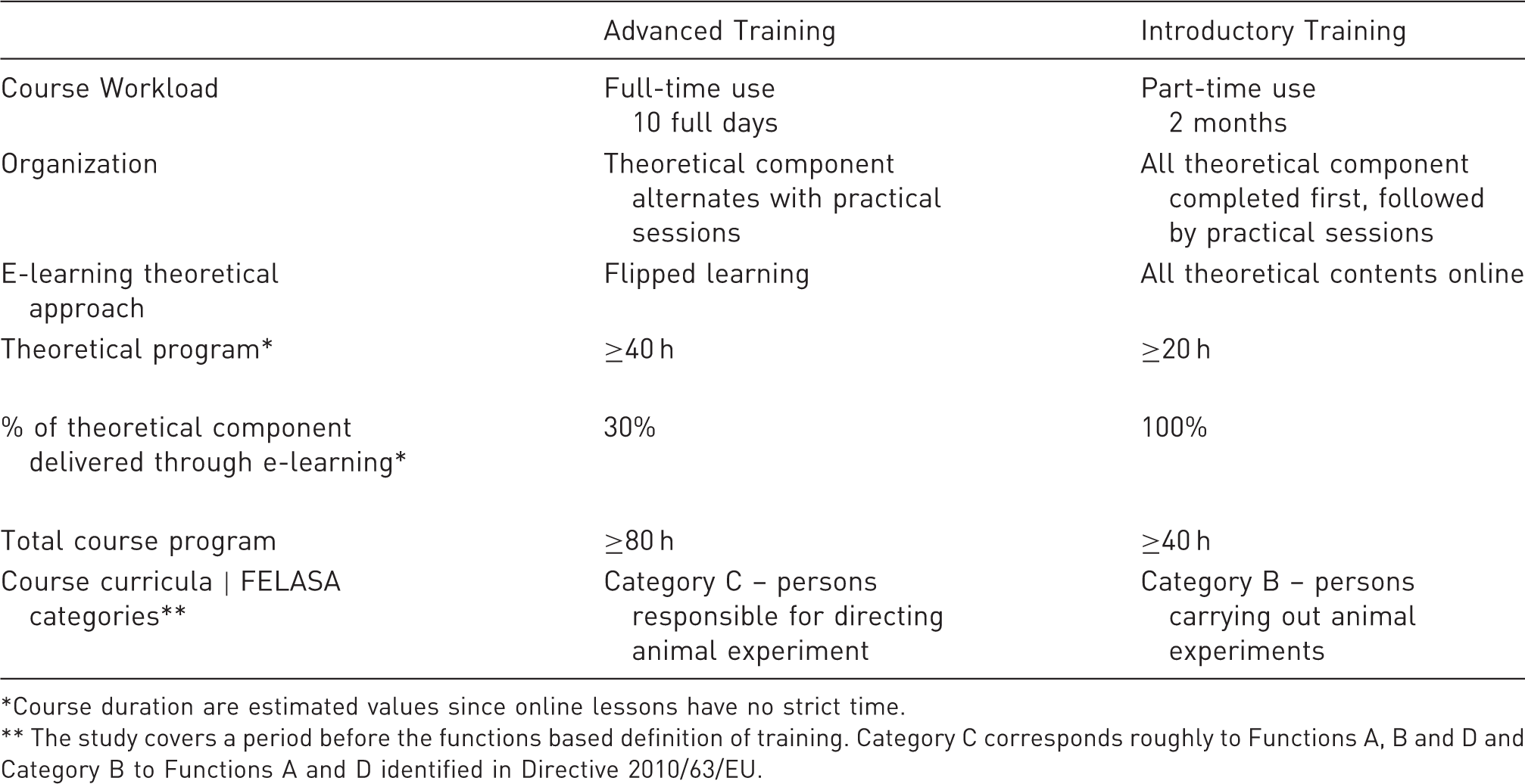
Course duration are estimated values since online lessons have no strict time.
The study covers a period before the functions based definition of training. Category C corresponds roughly to Functions A, B and D and Category B to Functions A and D identified in Directive 2010/63/EU.
E-learning platform
We implemented our learning environment based on the open source Moodle Learning Management System (LMS) version 2.6.11. Two separated e-learning course pages were developed at Moodle, one for the introductory and one for the advanced course. E-lessons were self-explanatory, including shorter videos, images, graphs and clinical cases and discussion/reflective slides (Figure 1). Formative and interactive quizzes were also included in order to facilitate the theory consolidation. The platform was further used as support throughout the courses for supplementary literature and students’ forum.
Example of e-lessons slides, with illustrative images and explanatory videos.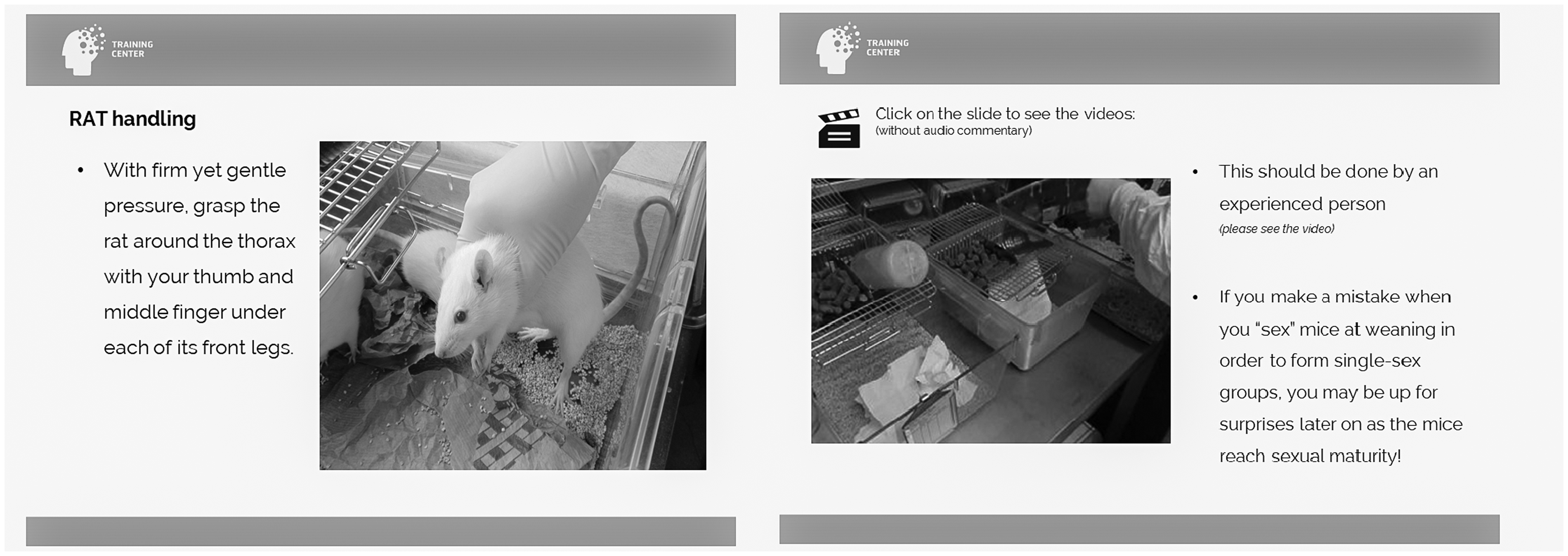
The pedagogical approach integrating e-learning method was explained and clarified to the students before starting the course, by email and reinforced in the first lectures, and their e-learning participation was monitored over the training period. The students were free to work on e-learning when it suited them but had to comply with deadlines for completing it. In the introductory course category modules/e-lessons had to be completed by a certain deadline, at which time there was a final quiz. In the advanced course, deadlines were established to guarantee that students had completed the online content prior to the classroom session.
Instruments
Data collection comprised three questionnaires specifically developed for this study: a Sociodemographic and Professional Questionnaire (SDPQ), a Students’ Expectations of E-learning in Laboratory Animal Science (SEELAS), and a Questionnaire of E-learning Acceptance (QELA):
SDPQ is a 5-item closed question questionnaire that explores relevant data on the respondents’ demographic information such as gender, age, highest level of education completed, area of specialization, and current position/occupation. SEELAS is a 7-item closed question questionnaire that provides information about respondents’ expectations of the use of e-learning at the start of the LAS course (e.g., difficulty, efficacy) and their previous experience with e-learning platforms. QELA is a 32-item self-report measure that assesses students’ acceptance of e-learning on the Moodle platform. QELA comprises five subscales: Personal perception of the e-learning use (PP; 10 items; “The e-learning platform is user-friendly”; “The e-learning platform works well”), Satisfaction with the e-learning contents (SC; 7 items; “Online quizzes helped me to learn effectively”; “The e-lesson quizzes are easy to understand”), Satisfaction with the e-learning organization (SO; 5 items; “When I needed help to use the e-learning platform I knew where to find it”; “The e-lessons are well structured and are easy to follow”), Time management (TM; 5 items; “The e-learning system enables me to invest more time in topics that interest me more”; “The e-learning system enables me to control my learning progress, and invest more time in topics I find more difficult”), E-learning practical influence (PI; 5 items; “The videos shown in the e-learning helped me to prepare for practical classes of animal handling”; “The videos shown in e-learning lectures helped me to deal with my possible animal fears”), answered according to a 5-point Likert scale. General acceptance score was calculated using the items of the five subscales. In this study, this instrument showed positive correlations between the dimensions (between 0.28 and 0.49) and proved to have high internal consistency (α = 0.94). The exploratory factorial analysis (EFA) extracted five factors consistent with the theoretical dimensions and explained 53.4% of variance. Globally, all the items presented good communalities and factor loading values.
A 28-item QELA version was administered to students in the introductory course, excluding four items related to the flipped classroom approach (one item of Personal perception of the e-learning use, and three of Time management dimension) and thus not applicable. Therefore, for any statistical analysis including this group of students only these 28 items were included.
Participants and procedure
The developed instruments were administrated to 229 LAS course participants in a total of 15 courses run between 2012 and 2015: 9 introductory (B) course editions, with a total of 90 participants mainly from our institution, and 6 advanced (C) course editions, with a total of 139 participants, with half of course participants originally from our institution and the other half from national and European research institutions.
Respondents were invited to participate in this study and completed the questionnaires in collective administrations on the last course day (after examination) in the presence of the researcher. Prior to each administration, the objectives of the study were explained to the participants, as well as the guarantee of anonymity and confidentiality, and that participation was voluntary. On average, it took 10 min to fill in the questionnaires.
Data analysis
To determine frequencies of e-learning users’ satisfaction the global acceptance scale score and the subscales score were codified into three categories of satisfaction/usefulness (unsatisfactory, satisfactory, and very satisfactory). The distribution of the total scale variable had a negative-skewness (left-skewed), with almost no respondents classifying e-learning acceptance as unsatisfactory/unhelpful; therefore, the percentile method to define groups was not applied. Considering the minimum and maximum possible total scores based in the 5 points answering items scale (1 = “Strongly disagree”; 2 = “disagree”; 3 = “neutral”; 4 = “agree”; and 5 = “Strongly agree”), the mean cutoff point dividing the negative and positive experience of users was established for the total scale and each dimension: Total acceptance scale (min:28; max:140; Mean:84), Personal perception (min:9; max:45; Mean:27), Satisfaction with contents (min:7; max:35; Mean:21), Satisfaction with organization (min:5; max.:25; Mean:15), Time management (min:5; max:25; Mean:15), and Practical influence (min:5; max:25; Mean:15). As the majority of the sample considered e-learning as satisfied/useful, the positive pole was also divided into satisfied/useful or very satisfied/very useful.
Inferential statistics were used to explore the overall acceptance of the e-learning use for different groups (course B and C). One-way ANOVA was the main statistical procedure to examine the effect of different sociodemographic, professional, and previous experience variables on acceptance issues: total acceptance score, personal perception, satisfaction with contents, satisfaction with e-learning, time management, and practical influence. Post hoc analyses with Bonferroni corrections were conducted to explore the differences between the subgroups. In all the statistical procedures, a p-level of 0.05 or below was considered to be significant. The data analyses were conducted using IBM SPSS (25.0 version).
Results
Sample characterization
Of the 229 respondents, 39.3% participated in the introductory (B) and 60.7% in the advanced (C) course. Respondent age ranged from 21 to 41 years old (mean (M) = 26.31; SD = 4.67) for the B course, and from 22 to 50 years old (M = 30.1; SD = 6.32) for the C course. In both courses, there was a female majority (B: 76.7%; C: 76.3%). Background training was primarily in biology (B: 50.0%; C:37.7%) and biochemistry (B:18.6%, C:23.2%). Highest level of education was, for the majority of B course participants, a master degree (58.4%) followed by a bachelor degree (24.7%), whereas among C course participants a master degree was most common (47.1%) followed by a PhD (37.0%). Professionally, the B course participants were PhD students (27.3%), undergraduate students (25.0%), or technicians (19.3%). C course participants were, as expected, at a different stage of career development and comprised PhD students (39.6%), post-doctoral fellows (34.3%) and principle investigators (PIs) (6.0%).
More than half of the total responders indicated no previous experience with e-learning resources (60.7%), with very similar distribution in the two training categories (B, 58.9%; C, 61.9%).
Concerning experience with laboratory animals, the majority of B participants indicated no experience (40.4%), while the majority of C participants indicated having more than 1 year of experience (47.8%). It was found that more respondents from the C course acknowledged a fear of laboratory animals (20.3%) than from the B course (11.1%) (Supplementary material Table S2).
Descriptive analysis
To assess students’ e-learning global acceptance (QELA) and satisfaction with the different dimensions (personal perception of e-learning, satisfaction with contents, satisfaction with organization, time management, and practical influence), descriptive statistics were performed for all the participants and for each course group.
Globally, the general acceptance of the e-learning resources by LAS courses participants was very positive (62.1% classified as satisfactory and 30.4% as very satisfactory, with C course participants showing higher levels of satisfaction (94.2%) when compared with B participants (89.9%) (Figure 2).
Acceptance of e-learning in LAS training courses by the participants of both courses (C + B). Participants of advanced (C) and introductory (B) courses categorized from very satisfactory to unsatisfactory and plotted as a diverging stacked bar chart.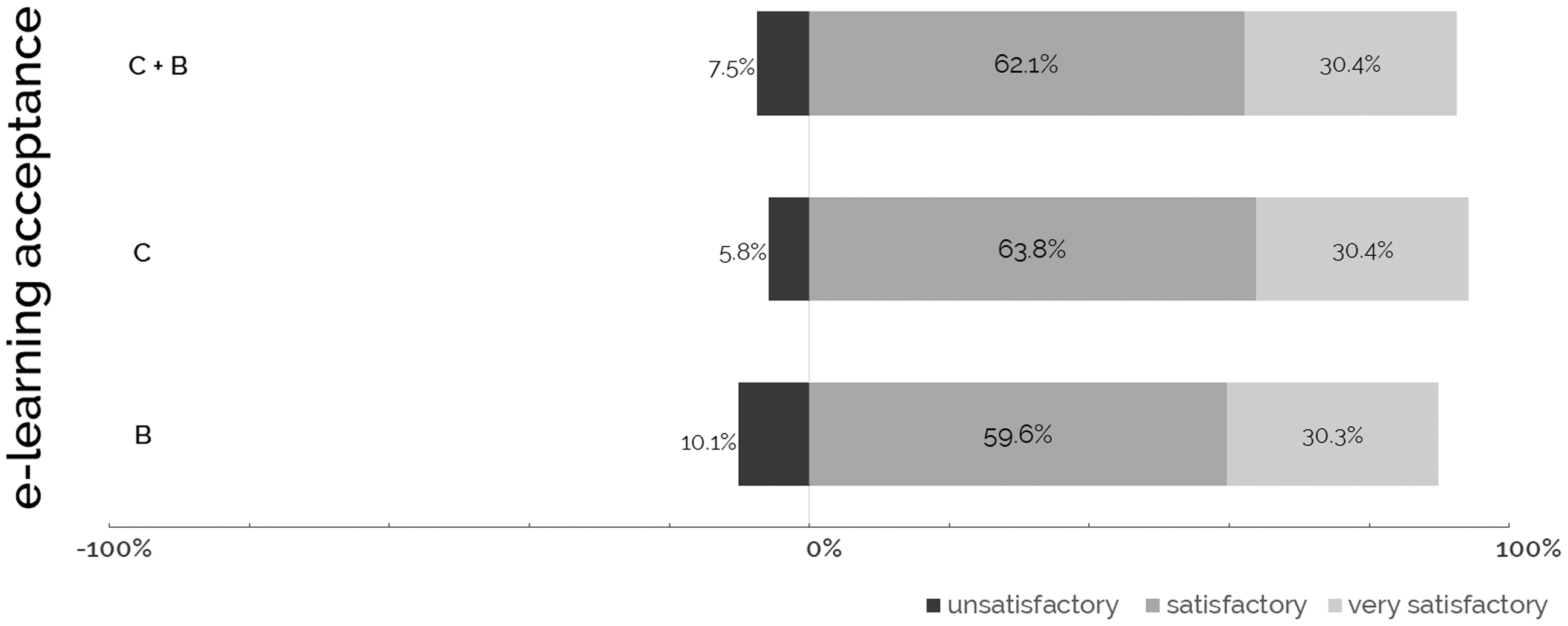
Analyses of participants’ personal perception of e-learning use showed high percentages of acceptance (C + B, 96.5%; C, 97.1%; B, 95.5%). Globally, and concerning satisfaction with the e-learning contents, course participants were satisfied (31,1%) and very satisfied (67.4%). Similar results were verified for e-learning organization, with courses participants considering it satisfactory (38.2%) and very satisfactory (60.1%).
The e-learning approach was considered useful (28.2%) and very useful (66.1%) concerning time control during the courses. Independently, B and C participants classified e-learning as useful (29.2% and 27.5%, respectively) for time management, while the majority of B and C participants considered it very useful (62.9% and 68.1%, respectively).
The results also showed that, globally, only a small percentage of both courses participants (4.4%) considered that e-learning was unhelpful and had no influence in practical sessions (B, 7.9% and C, 2.2%). The majority of participants (56.4%) classified the influence of the e-learning approach on practical sessions as helpful (B, 35.9% and C, 41.3%) or very helpful (B, 56.2% and C, 56.5%) (Figure 3).
Analysis of participant acceptance of different e-learning features: personal perception of e-learning use, satisfaction with e-learning contents; satisfaction with organization; e-learning time management influence and e-learning practical training sessions influence. Bars represent answers from both course participants (C + B), advanced course participants (C), and introductory course participants (B), categorized from very satisfactory to unsatisfactory or very helpful to unhelpful, and plotted as a diverging stacked bar chart.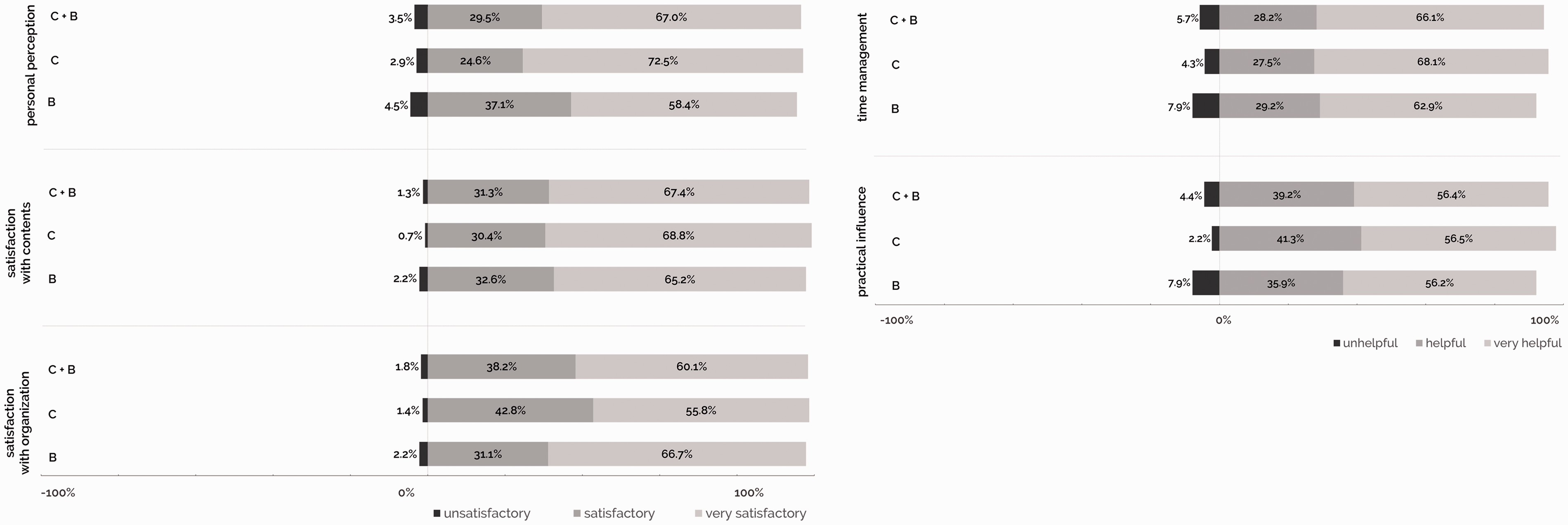
Differential analyses
General acceptance
Results showed that previous experience with laboratory animals affected general acceptance. Results indicated that advanced course participants with 1 year or more of previous experience with laboratory animals showed less acceptance of e-learning than students with no experience (Mnone =129.05, SD = 11.84; M≥1year = 118.43, SD = 18.03; F = 5.37, p < 0.01). The same was verified for introductory course participants (Mnone = 108.50, SD = 12.07; M≥1year = 95.75, SD = 28.69; F = 3.12, p = 0.05). Gender, age, level of education, professional position, previous e-learning experience, and fear of laboratory animals did not influence the general acceptance of e-learning approach.
Personal perception of e-learning use
Previous experience with laboratory animals affected the C course participants’ perception of e-learning use, with participants with no previous experience showing a more positive perception of e-learning when compared with participants with 1 year or more of experience (Mnone = 40.00, SD = 5.14; M≥1year = 36.38, SD = 7.01; F = 3,97, p = 0.02). Sociodemographic and academic variables did not affect participants’ perception of e-learning use.
Satisfaction with e-learning content
For C course participants, satisfaction with the e-learning contents was affected by their position: PIs were more satisfied with content than technicians (MPI = 29.86, SD = 2.67; MTech = 24.00, SD = 4.57; F = 3.17, p = 0.02). Also, specifically for C group students, previous experience with laboratory animals affected the satisfaction with e-learning content, revealing that participants with no experience were globally more satisfied than participants with 1 year or more of experience (Mnone = 28.79, SD = 2.75; M≥1year = 26.18, SD = 3.97; F = 6.48, p < 0.01).
Satisfaction with e-learning organization
Advanced course participants with more experience with laboratory animals were less satisfied with organization of e-learning. (Mnone = 19.92, SD = 2.85; M≥1year = 18.02 SD = 3.25; F = 4.37, p = 0.01).
Time management
None of the evaluated factors affected the different groups’ satisfaction levels with time management.
E-learning practical classes’ influence
Among C course participants, educational background affected how useful participants considered e-learning to be for practical training sessions. Participants coming from a biomedical sciences field consistently recognized a more positive influence of e-learning on practical classes than participants from biology (MBiomed =20.81, SD = 2.77; MBiology = 18.19, SD = 3.50; F = 4.48, p = 0.01) and veterinary backgrounds (MBiomed = 20.81, SD = 2.77; MVet = 16.67, SD = 3.20; F = 4.48, p = 0.01) (Supplementary material Table S3).
Discussion
The present study explored the general acceptance and satisfaction with the implementation of e-learning among participants in LAS training courses. In general, the results showed high levels of acceptance, both for the flipped classroom approach in the advanced training, and for the approach with all theoretical contents online that was used in the introductory training. Particularly, the results of the domains personal perception of e-learning use, satisfaction with content, and satisfaction with platform organization presented satisfaction percentages over 95.5% in the different courses. Our findings are consistent with several studies in other related fields reporting students’ positive perception of e-learning resources.24,25,36
Time management is considered one of the most valuable aspects that e-leaning brings to educational context, allowing students to control their study time and content progression, and this was also recognized by the students in the present study, with 94.3% of the respondents classifying e-learning as useful for time management.
Another relevant aspect explored was the influence of e-learning in practical sessions, since e-lessons included didactic figures, schemes/graphics, videos of rodent behaviour, handling, and practical procedures. An overwhelming majority considered e-learning to be helpful/very helpful as a preparation for the practical classes. Indeed, the e-learning platform seems to have been perceived by students not only as a way to deliver theoretical content, but also as an instrument that influenced their practical learning positively. This fact may be related with the opportunity that online learning provides to learn and review the execution of practical procedures as many times as needed. Advanced course participants with a background in biomedical sciences had a more positive perception of e-learning as useful for practical classes as compared with participants with a veterinary or biology background, who, due to their previous academic training, are possibly more comfortable with the manipulation of living animals. Among the respondents, 32.6% had no previous experience and 16.7% indicated fear of working with laboratory animals; however, previous experience and fear did not affect how useful the e-learning was perceived to be for practical classes.
Indeed, acceptance of the e-learning approach seems to be highly influenced by whether students have previous experience with laboratory animals. Participants from the introductory (B) and the advanced (C) training showed the same consistent difference – participants with more experience (1 year or more) showed less acceptance of the e-learning approach than participants with no previous experience with laboratory animals. Similarly, and particularly in the C course students, previous experience affected personal perception of e-learning, and satisfaction with e-learning organization and e-learning content, with inexperienced students showing a more positive perception and higher levels of satisfaction. It is possible that this reflects an overall more positive attitude to laboratory animal science teaching among students who have less experience and hence may feel that they have more to gain from the course. Several factors may have contributed to this difference; factors such as motivation, age, and maturity have been reported to affect the learners’ satisfactions with e-learning.37,38 Additionally, it is possible that experienced participants also have less e-learning expectations, which can lead to low levels of satisfaction.39,40
Background also influenced the acceptance of the e-learning, with students with a biomedical sciences background showing greater e-learning acceptance than participants with a biology background. This is likely to be because students from biomedical areas are not entirely familiar with the contents addressed in the field of laboratory animal training, whereas participants from biology background are. The expectation and the novelty of the content may positively influence e-learning acceptance of this particular subgroup of participants, which have never studied similar subjects. This hypothesis is corroborated by the differences found in the satisfaction with e-learning content (higher in biomedical sciences than in students with biology background) and also the differences found in the positive e-learning influence on the practical components (higher in biomedical sciences than in students with a biology or veterinary background). The hypothesis that participants from a biomedical sciences background could be more experienced in e-learning was also explored but the results found did not corroborate this possibility.
Generally, our results show that acceptance of e-learning was not dependent of sociodemographic or academic variables such as gender, age, education, professional position, or previous e-learning experience.
This study explored the use of e-learning in two categories of training with different designs of e-learning use. Our results show that both e-learning formats, flipped and e-learning as the only vehicle for the theoretical component, are accepted in LAS courses. However, the results are limited, and more studies will be required to explore whether there is a preferable course design to include e-learning. Also, the fact that no group underwent classroom sessions only is a study limitation, because it limited the possible comparison between e-learning and classroom learning.
Measurement of psychometric properties such as perception and satisfaction requires appropriate instruments that are developed and adapted to the specific context of analysis and meet standard psychometric validity. Although exploratory, this study addresses the lack of measurement in the field and constitutes a precursory effort to develop a measure (QELA) to explore and assess student perceptions of the e-learning approach in a LAS context. The fact that the results distribution of the total acceptance variable presented a negative skewness, suggests that the instrument needs further adjustments in order to better reflect the less helpful or useful aspects of the e-learning approach, leading to the scale yielding overall very positive satisfaction outcomes. Further research should continue to develop, explore, and refine suitable measures to confirm the instruments’ psychometric properties in different academic, professional, and cultural contexts in order to evaluate different e-learning strategies and their implementation in LAS training worldwide.
Conclusion
E-learning has been suggested as a useful resource to train people that carry out procedures or design experiments with laboratory animals. In this study we found e-learning to be well accepted by students in LAS courses at different training levels, who considered it enjoyable, useful, and effective in this specific context. Together with the finding that e-learning was accepted independently of sociodemographic, academic, and professional features, this suggests that incorporating e-learning into training programs is beneficial.
Supplemental Material
LAN879170 Supplemental Material1 - Supplemental material for Students’ acceptance of e-learning approaches in Laboratory Animal Science Training
Supplemental material, LAN879170 Supplemental Material1 for Students’ acceptance of e-learning approaches in Laboratory Animal Science Training by Andreia Costa, Ana Costa and I. Anna S. Olsson in Laboratory Animals
Supplemental Material
LAN879170 Supplemental Material2 - Supplemental material for Students’ acceptance of e-learning approaches in Laboratory Animal Science Training
Supplemental material, LAN879170 Supplemental Material2 for Students’ acceptance of e-learning approaches in Laboratory Animal Science Training by Andreia Costa, Ana Costa and I. Anna S. Olsson in Laboratory Animals
Footnotes
Acknowledgments
The authors would like to thank André Torres (IBMC / i3S) for the implementation and development of e-learning platform on open source Moodle Learning Management System and all course participants who collaborated in this study.
Declaration of Conflicting Interests
The author(s) declared no potential conflicts of interest with respect to the research, authorship, and/or publication of this article.
Funding
The author(s) disclosed receipt of the following financial support for the research, authorship, and/or publication of this article: This work is a result of the project funded by Norte-01-0145-FEDER-000008 – Porto Neurosciences and Neurologic Disease Research Initiative at I3S, supported by Norte Portugal Regional Operational Programme (NORTE 2020), under the PORTUGAL 2020 Partnership Agreement, through the European Regional Development Fund (FEDER).
Supplemental Material
Supplemental material for this article is available online.
References
Supplementary Material
Please find the following supplemental material available below.
For Open Access articles published under a Creative Commons License, all supplemental material carries the same license as the article it is associated with.
For non-Open Access articles published, all supplemental material carries a non-exclusive license, and permission requests for re-use of supplemental material or any part of supplemental material shall be sent directly to the copyright owner as specified in the copyright notice associated with the article.
