




Abstract
Although inbred domesticated strains of rats and mice serve as traditional mammalian animal models in biomedical research, the nocturnal habits of these rodents make them inappropriate for research that requires a model with human-like diurnal activity rhythms. We conducted a literature review and recorded locomotor activity data from four rodent species that are generally considered to be diurnally active, the Mongolian gerbil (Meriones unguiculatus), the degu (Octodon degus), the African (Nile) grass rat (Arvicanthis niloticus), and the antelope ground squirrel (Ammospermophilus leucurus). Our data collected under 12-hour light/dark cycles confirmed and expanded the existing literature in showing that the activity rhythms of antelope ground squirrels and African grass rats are stronger and more concentrated in the light phase of the light/dark cycle than the activity rhythms of Mongolian gerbils and degus, making the former two species preferable and more reliable as models of consistent diurnal activity in the laboratory. Among the two more strongly diurnal species, antelope ground squirrels are more exclusively diurnal and have more robust activity rhythms than African grass rats. Although animals of these two species are not currently available from commercial suppliers, African grass rats are indigenous to a wide area across the north of Africa and thus available to researchers in the eastern hemisphere, whereas antelope ground squirrels can be found throughout much of western North America’s desert country and, therefore, are more easily accessible to North American researchers.
Domesticated and inbred strains of rats (Rattus norvegicus) and mice (Mus musculus) are the most extensively used mammalian animal models in biomedical research. These standard laboratory rodents are considered to be suitable animal models because they share with humans many aspects of mammalian physiology. They are convenient substitutes for humans or other primates because of their small body size and the ease and low cost of their housing and maintenance. Nonetheless, rats and mice are nocturnal (active at night), whereas humans are diurnal (active during the day).
Every biological process shows a pattern of circadian rhythmicity, with organisms exhibiting clear differences in their physiology between day and night.1–3 For this reason and because humans are diurnal, diurnally active rodent species should potentially be more appropriate models for biomedical laboratory research than rats or mice. Thus, substitution of diurnal rodents for nocturnal rodents may constitute a significant advance in the contribution of animal research to human health.
Several rodent species that are reportedly diurnal in the field have been tested in the laboratory and found to show alternative patterns of activity. These species include the fat sand rat (Psammomys obesus), 4 the Catamarca tuco-tuco (Ctenomys knighti), 5 and the golden spiny mouse (Acomys russatus). 6 We are aware of four rodent species that are diurnally active in the field and have been described as diurnal in the laboratory. These are the Mongolian gerbil (Meriones unguiculatus), the degu (Octodon degus), the African grass rat (Arvicanthis niloticus), and the antelope ground squirrel (Ammospermophilus leucurus). Here, we review the literature on field and laboratory studies on these species and present original experimental data comparing their daily temporal patterns of locomotor activity.
Materials and methods
Bibliographic research
Literature searches were conducted in October 2017 in two main databases: BIOSIS (Clarivate Analytics, formerly Thomson Reuters) and PubMed (United States National Library of Medicine). The two databases contain approximately 26 million records each, with BIOSIS focusing on field life-science studies and PubMed focusing on biomedical studies.
Searches were conducted for the species name (genus plus species). In BIOSIS, the search was restricted to Taxonomic Data so as to avoid spurious retrieval of species names appearing in reference lists rather than being the subject of a study. PubMed does not index the references cited in an article, so we were able to include All Fields in the PubMed search. PubMed was queried also for species name AND “circadian”, so that articles dealing specifically with daily/circadian rhythmicity could be retrieved separately from articles dealing with all other biological processes such as seed dispersal or snake predation.
Animals
The experimental part of the study involved 24 individuals (12 males and 12 females) of each species, all adults between the ages of 3 and 5 months. This number of subjects was calculated to be sufficient to attain statistical power of 0.8, based on the variances of the means in preliminary studies.
Mongolian gerbils (Figure 1a) were purchased from Charles River Laboratories (Wilmington, MA), with a mean body mass of 88 g. Degus (Figure 1b) were purchased from Sandy’s Lakeside (Gaffney, SC), with a mean body mass of 237 g. African grass rats, also called Nile grass rats (Figure 1c), were bred in a local colony with founders originally trapped in Kenya
7
and weighed 119 g. Antelope ground squirrels, occasionally also called white-tailed antelope squirrels (Figure 1d), were born in captivity from pregnant females trapped by us in the field in Owyhee County, Idaho, and weighed 121 g.
The four species compared in the present study. (a) Mongolian gerbil (Meriones unguiculatus) photographed by Stefan Köder. (b) Degu (Octodon degus) photographed by Arjan Haverkamp. (c) African grass rat (Arvicanthis niloticus) photographed by Roberto Refinetti. (d) Antelope ground squirrel (Ammospermophilus leucurus) photographed by Roberto Refinetti.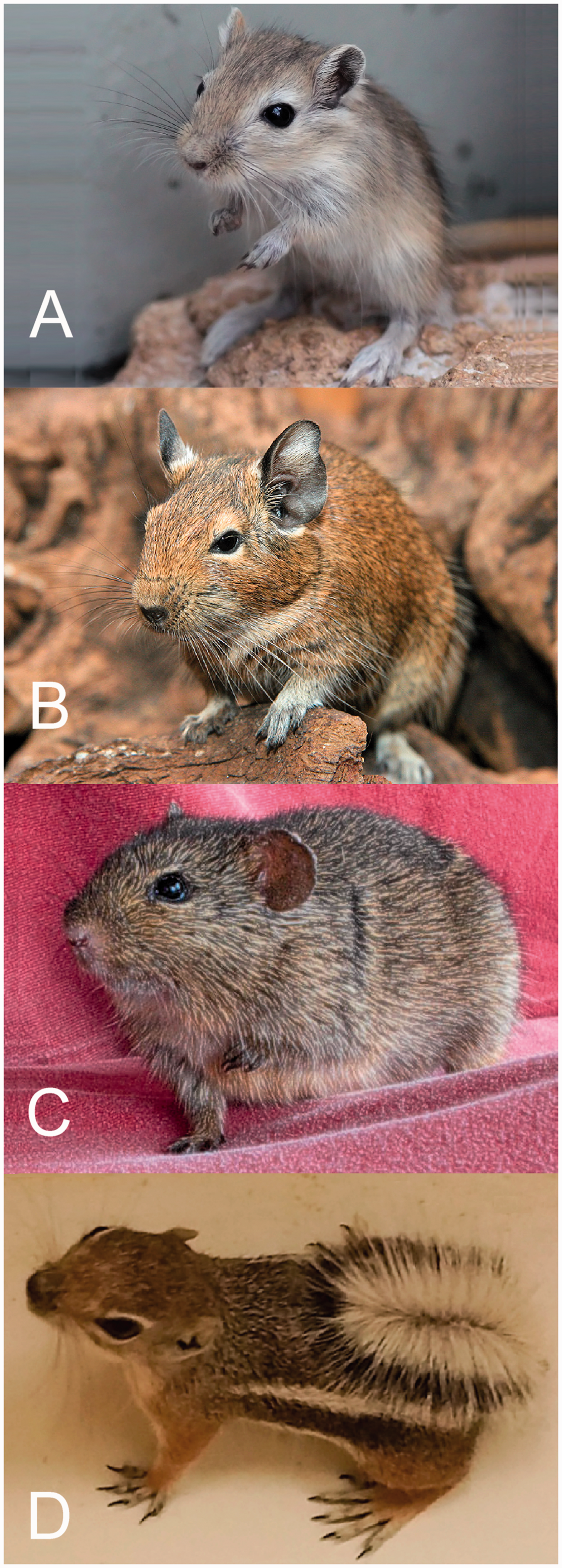
The conservation status listed by the International Union for Conservation of Nature for all four species is “Least Concern.” Mongolian gerbils are indigenous to China and Mongolia, 8 but are easily available from commercial suppliers. Degus are indigenous to Chile 9 and, although not available through major animal suppliers, are available from pet stores in many countries. African grass rats are indigenous to much of northern Africa 10 and are not bred commercially. Antelope ground squirrels are also unavailable commercially but are indigenous to much of western North America, 11 which makes them accessible with relative ease to researchers in North America. Most ground squirrel species are hibernators, 12 but antelope ground squirrels remain active on the surface in the field throughout the entire year.13–16
Procedures
The experimental procedures were approved by the institutional animal care and use committees of the University of South Carolina (Mongolian gerbils, degus, and African grass rats) and of Boise State University (antelope ground squirrels) in accordance with the guidelines of the United States National Research Council’s Guide for the Care and Use of Laboratory Animals.
All animals were housed individually in polypropylene cages (36 cm length, 24 cm width, 19 cm height) lined with wood shavings, and kept at 24℃ under a light/dark cycle with 12 hours of light per day (360:0 lux). For reference, the illuminance provided by a full moon is about 0.1 lux, that of the average human indoor working space is 200 lux, and outdoor daylight exceeds 1000 lux. 17 Purina rodent chow was provided ad libitum on the metal cage top, which also held a water bottle with a sipping tube.
Each cage was equipped with a metallic running wheel (18 cm diameter for degus or 15 cm for the smaller species). A small magnet attached to the wheel activated a magnetic switch affixed to the top of the cage and connected to data acquisition boards, and activity counts were saved at 0.1 hour intervals. We monitored activity with running wheels because they are a traditional apparatus in research on circadian rhythms and also because they provide the animals with the opportunity to engage in physical exercise.
The raw data reported in this article were deposited in the Open Science Framework archives at osf.io/a7kjc.
Data analysis
After stable synchronization of the activity rhythm to the light/dark cycle (defined as 14 consecutive days with less than 30 minutes of variability of daily activity onsets), 10 day segments of the activity records of each animal were selected for analysis. The time series were analyzed with computer programs written specifically for this study or with standard programs from the Circadian Physiology software package. 3 Analysis involved the computation of six parameters: diurnality, acrophase, daily onset, alpha, robustness, and distance traveled.
Diurnality was computed as the number of wheel revolutions during the light phase of the light/dark cycle divided by the total number of revolutions for the whole day. The acrophase (center of gravity of the activity rhythm) was computed by the single cosinor procedure.18,19 The daily onset of activity (initiation of running-wheel activity) was computed by an algorithm that smoothed the daily rhythm with an 8 hour moving-window filter and then identified the onset of activity as the time when the smoothed curve rose above the daily mean. Alpha (duration of the activity phase of the daily cycle) was calculated as the difference between the end (offset) and the beginning (onset) of activity, with the end computed similarly to the beginning but using the time of the descent of the smoothed curve below the daily mean. Robustness (strength of rhythmicity) was computed as the QP value of the chi-squared periodogram statistic as a percentage of the maximal QP value for the dataset. 20 The distance traveled (km/day) was computed from the number of wheel revolutions and the circumference of the wheel. Differences between group means were evaluated by factorial analyses of variances (ANOVAs), with species and sex as the factors, followed by pairwise comparisons with Tukey’s test, using OpenStat. 21
Results
Literature review
Quantitative results (number of published studies) from the literature search.
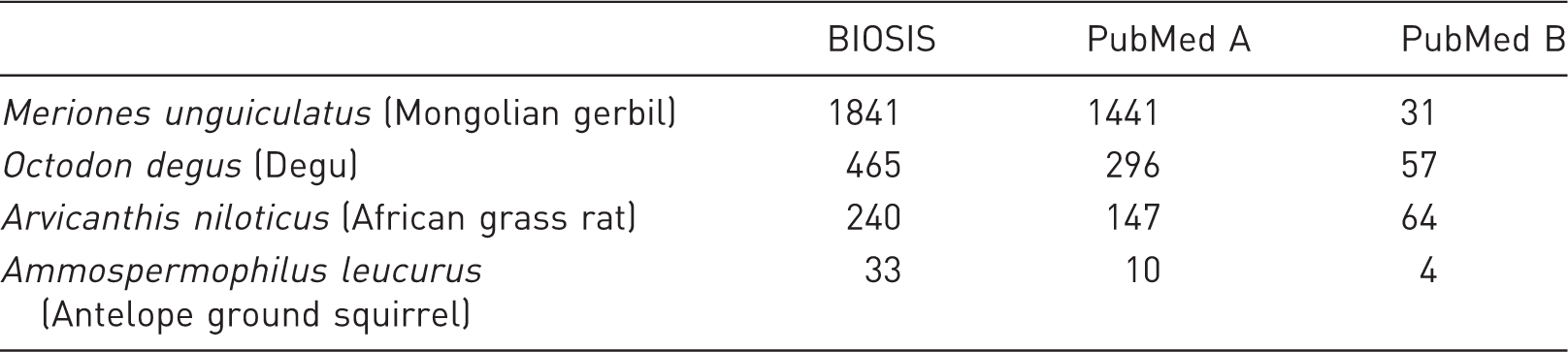
PubMed A: search for species name only; PubMed B: search for species name AND circadian.
The literature indicates that Mongolian gerbils are active during the day in the wild.22,23 Some laboratory studies reported the activity rhythm as crepuscular, with peaks at dawn and dusk and perhaps a slight diurnal preponderance of activity,24,25 whereas others described gerbil activity in the laboratory as nocturnal.26,27 One study showed that the activity pattern of gerbils was diurnal when measured with motion detectors, but nocturnal when measured with running wheels. 28 Two other investigations using running wheels exclusively found that some individual gerbils were diurnal while others were nocturnal.29,30 It seems, therefore, that the activity rhythm of the Mongolian gerbil in the laboratory is not robust and may be expressed as either diurnal or nocturnal, depending on the method used to record activity, and furthermore that different individuals may simply express either diurnal or nocturnal activity as a matter of individual peculiarity.
Degus in the wild are diurnal, exhibiting a bimodal pattern of intensity with prominent peaks at dawn and dusk during the summer and with a continuous pattern throughout the midday during the shorter days of winter when environmental temperature does not inhibit midday activity.31,32 Laboratory studies show similar patterns,33–38 with some studies demonstrating bimodality 39 and others reporting predominantly unimodality. 40 Similar to observations on Mongolian gerbils, at least two investigations have reported degus to become nocturnal in the laboratory simply upon gaining access to a running wheel.41,42 However, approximately half of the degus in two other studies were diurnal and half were nocturnal regardless of the presence or absence of running wheels, apparently as a matter of individual peculiarity.30,41 Thus, although degus appear to be more diurnal than Mongolian gerbils, they do not seem to be reliably and consistently diurnal under laboratory conditions.
African grass rats are diurnal in the wild, 43 and most laboratory studies have shown this species to be predominantly diurnal.44–49 Two studies reported a switch to nocturnality in African grass rats with access to running wheels,50,51 but animals studied with running wheels in two other laboratories were found to be predominantly diurnal.52–54
Antelope ground squirrels are diurnal in the wild. 55 Eight investigations all demonstrate that the species is unquestionably diurnal under laboratory conditions.56–62
Experimental findings
All four species were easily maintained in the laboratory. The animals could be routinely moved and weighed with the help of a 600 ml plastic cup. Manual handling of individually housed rodents is often difficult, although even species not traditionally kept as pets, such as the African grass rat, can be handled if suitably trained. 63
The most compact and exclusively diurnal running pattern among the four species was that of the antelope ground squirrel, followed in rank by the African grass rat, the Mongolian gerbil, and the degu (Figure 2). The selected actograms show the records of strong and consistent runners that exhibited robust rhythmicity, rather than “average” runners. Most individuals of all four species ran on their wheels more than 1 km per day. Although the actograms of gerbils and degus showed a strong component of daytime activity, they also showed considerable nighttime activity (Figure 2), resulting in a lower fidelity of their overall activity to the daytime.
Actograms of the locomotor activity records of representatives of each of the four species tested. Actograms are plotted with the time of day on the horizontal axis and successive days on the vertical axis.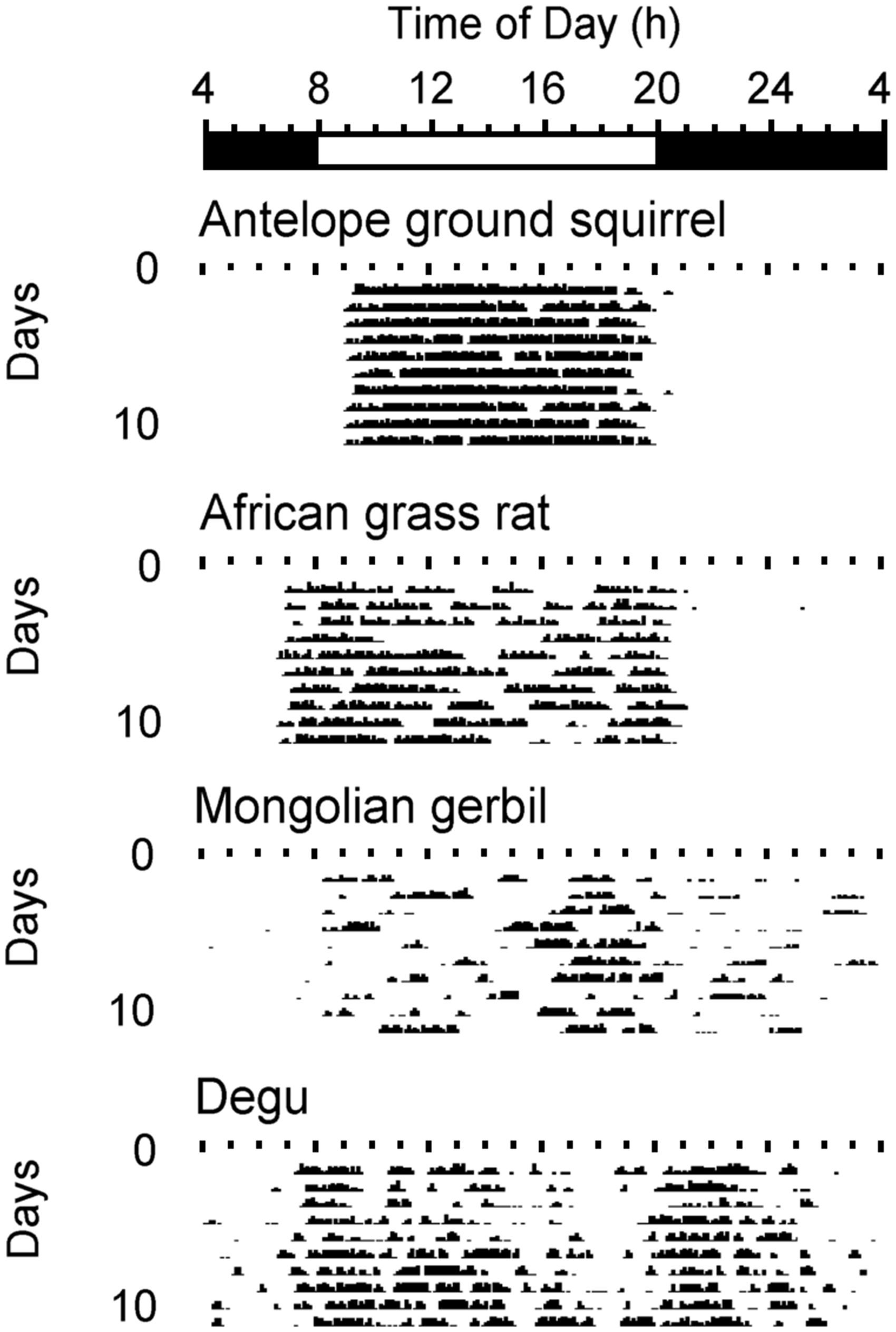
Antelope ground squirrels and African grass rats showed the smallest range of variability in the distribution of individual daily onsets of activity (Figure 3). Individuals of these two species consistently started activity about the time of lights-on, for a uniform diurnal pattern. In contrast, about half of the gerbils and degus started activity about the time of lights-on (consistent with diurnal activity) and the other half about the time of lights-off (consistent with nocturnal activity).
Frequency distributions of the daily onsets of activity for the four species (n = 24 individuals per species). The value for each individual is the average onset over 10 days.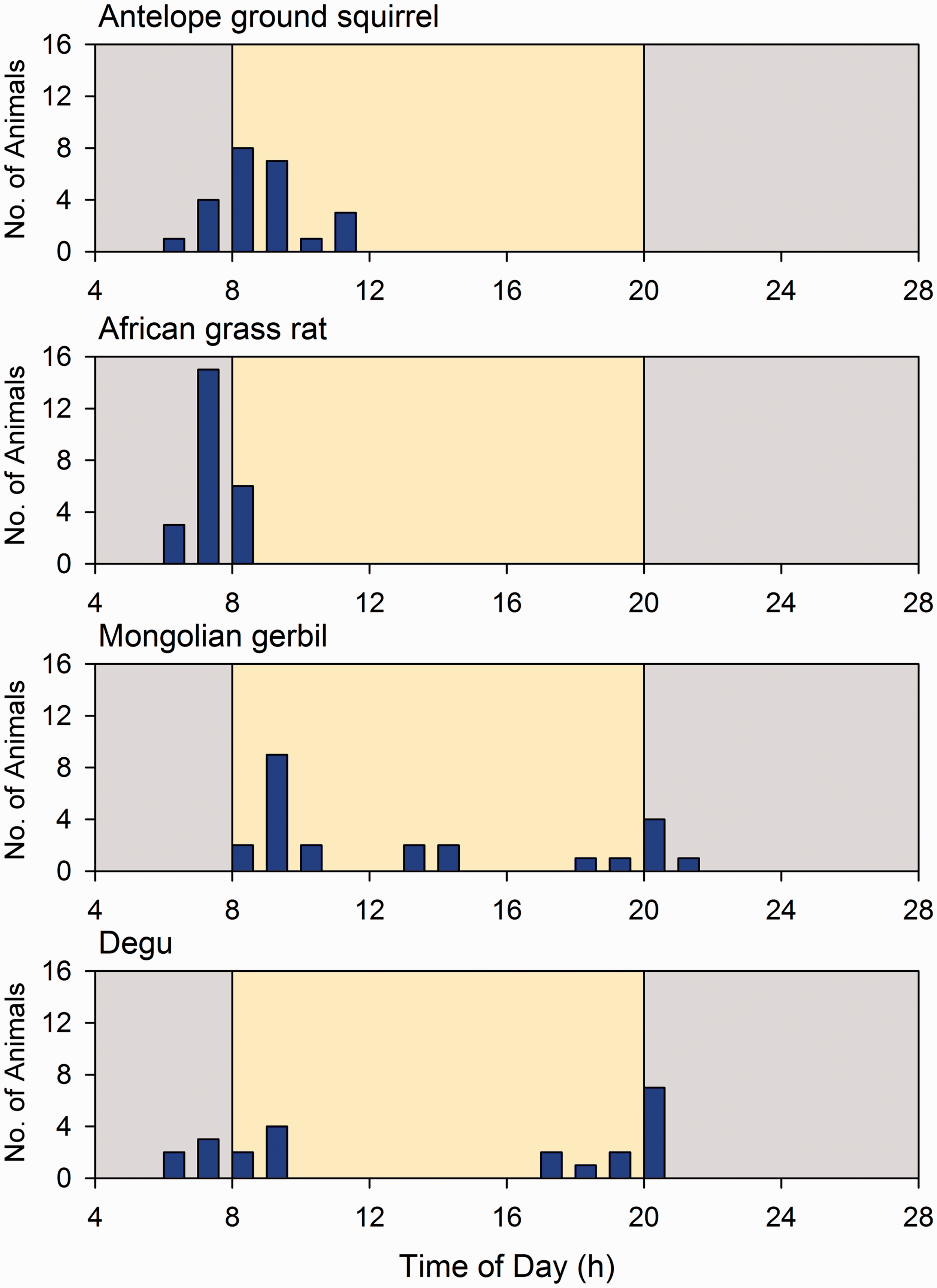
We compared six aspects of daily running-wheel activity in the four species (Figure 4). Diurnality varied significantly among species, with antelope ground squirrels and African grass rats showing the greatest diurnality, Mongolian gerbils intermediate diurnality, and degus the least diurnal (Figure 4a; ANOVA effect of species: F3, 88 = 69.889, p < 0.001). There were no significant effects of sex (F1, 88 = 2.004, p = 0.157) or the interaction of species and sex (F3, 88 = 1.671, p = 0.1776).
(a–f) Mean values (±SEM) of each of the six computed statistics for each of the four species studied. In each panel, bars with dissimilar letters are significantly different from each other, as determined by post hoc Tukey’s tests (p < 0.05). The dashed lines in (b) and (c) indicate the daily time of lights-on (08:00).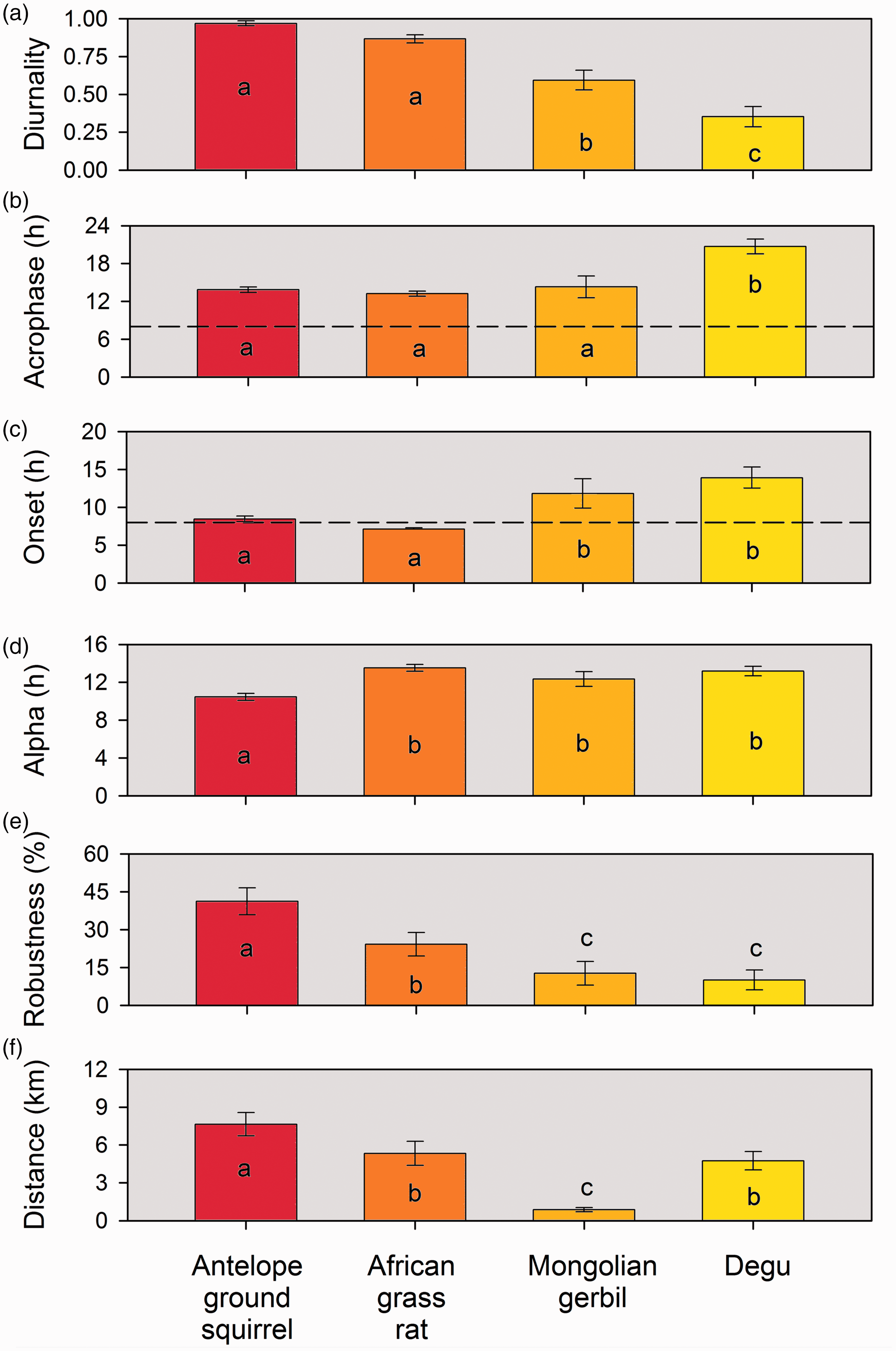
As expected for diurnal animals, the acrophase of the activity rhythm occurred on average during the light phase of the light/dark cycle in three of the species, but not in degus, for which the mean acrophase occurred at the beginning of the dark phase (Figure 4b). This divergence of degus from the expected pattern yielded a significant difference between species means (F3, 88 = 32.481, p < 0.001). There were no significant effects of sex (F1, 88 = 0.014, p = 0.904) or the interaction of species and sex (F3, 88 = 0.958, p = 0.582).
Antelope ground squirrels and African grass rats showed the expected pattern for onset of activity in diurnal animals with activity beginning at or near the time of lights-on (Figure 4c). Plots of the onsets of activity for Mongolian gerbils and degus were obscured because about half the individuals of each of these species showed diurnal activity and half showed nocturnal activity, thus producing a later hour in the day for mean onset. Accordingly, ANOVA indicated a significant effect of species (F3, 88 = 14.693, p < 0.001), although no significant effects of sex (F1, 88 = 0.944, p = 0.665) or the interaction of species and sex (F3, 88 = 0.144, p = 0.933).
The duration of the active phase of the circadian cycle (alpha) was similar across the species, with an overall mean of approximately 13 hours (Figure 4d). Activity duration was shortest in antelope ground squirrels (mean: 10.5 hours), which is reflected by a significant effect of species in the ANOVA (F3, 88 = 13.727, p < 0.001). There were no significant effects of sex (F1, 88 = 0.533, p = 0.526) or the interaction of species and sex (F3, 88 = 2.023, p = 0.115).
All individuals of all species showed statistically significant robustness of the activity rhythm, and antelope ground squirrels showed the greatest robustness of all four species (Figure 4e). ANOVA confirmed a significant effect of species (F3, 88 = 18.264, p < 0.001) but no significant effects of sex (F1, 88 = 1.276, p = 0.260) or the interaction of species and sex (F3, 88 = 0.683, p = 0.568).
Distance traveled (Figure 4f) was the only parameter that showed any differences between males and females. These effects occurred in only two of the four species: female African grass rats ran less than males and female antelope ground squirrels ran slightly more than males, as reflected by a significant interaction of species and sex (F3, 88 = 3.346, p = 0.022) without a main effect of sex per se (F1, 88 = 0.756, p = 0.609). Regarding species differences in amount of running, antelope ground squirrels showed the greatest amount of running, Mongolian gerbils the least, and the other two species were intermediate (F3, 88 = 30.094, p < 0.001).
Discussion
Our literature review revealed various degrees to which diurnality is expressed by each of the four species, and our quantitative experimental comparisons demonstrated marked differences among the species in their suitability as model species based on substantial differences in the consistency and relative exclusivity of their daytime activity. Antelope ground squirrels showed the strongest, most robust, and most consistent patterns of diurnal activity, followed by African grass rats, which had consistent diurnal activity, and finally by Mongolian gerbils and degus, both of which were only partially diurnal.
We suggest four primary considerations that should be taken in the choice of a diurnal laboratory animal model: the degree of exclusivity of diurnality, the availability and cost of the animals, their laboratory suitability (particularly body size), and the breadth and depth of the scientific literature about the species.
We have shown that the problem with Mongolian gerbils is their poor degree of diurnality, in that about half of them are not consistently active during the day. Mongolian gerbils are the most easily available of the four species, as they are sold by many suppliers of laboratory animals and are quite suitable for the laboratory, weighing about 90 g. These gerbils have been the subject of more previous research than the other three species combined. Taking into account that individual gerbils may vary considerably in the degree of their diurnality,4,34,52 selective breeding for a diurnal disposition could be attempted, although there is no guarantee that selective breeding would be successful or that it would not unintentionally affect other traits.
As with Mongolian gerbils, degus are not reliably diurnal in the laboratory, and the robustness of their activity rhythm is the lowest of the four species we studied. Degus are not available from major suppliers of laboratory animals but can be obtained from pet stores in many countries. They are larger than Mongolian gerbils, at approximately 240 g, but still small enough for convenient housing in the laboratory. Degus have not been used as research subjects as much as Mongolian gerbils, but considerable knowledge has accumulated about their physiology.
African grass rats are consistently diurnal and exhibit robust rhythmicity of activity. Considerable knowledge has accumulated about their anatomy and physiology, particularly neuroanatomy and neurophysiology. African grass rats are smaller than laboratory rats but larger than laboratory mice, at approximately 120 g. The availability of African grass rats, especially for researchers in North America, is not good. Unless one can obtain breeding pairs from a researcher who already has an African grass rat colony, a new investigator would need to travel to Africa to trap animals for research.
Antelope ground squirrels are the most strongly and consistently diurnal of the four species (diurnality index: 0.97, rhythm robustness: 41%). The duration of the active phase of the daily cycle is shorter in antelope ground squirrels (α = 10.5 hours) than in African grass rats (α = 13.5 hours), which raises the diurnality index of the antelope ground squirrel but makes its activity duration less similar to that of humans (α = 15.5 hours). On the other hand, the free-running period of the antelope ground squirrel (τ = 24.2 hours) 62 matches the human free-running period (τ = 24.2 hours). 64 Like African grass rats, antelope ground squirrels are smaller than laboratory rats but larger than laboratory mice, weighing approximately 120 g. Although antelope ground squirrels are not currently available from major suppliers of laboratory animals or from pet stores, they can be trapped in the field over a large part of western North America, where they are often the only diurnal rodents inhabiting desert areas. 11 Additionally, although most laboratory rodents have a short life of only two or three years, antelope ground squirrels have been reported to live up to 8 years in captivity. 60 Given all of these advantages and a recent call for increased diversity of animal models, 65 the antelope ground squirrel seems to be a particularly valuable option for a diurnal rodent for laboratory research.
Although we housed all four species under the same conditions to avoid the confounding effects of uncontrolled variables, we recognize that different species of laboratory rodents may thrive under distinct housing conditions. We did not observe abnormal behavior in individuals of any of the four species, but stereotypies have been described in laboratory-housed Mongolian gerbils66,67 and have been attributed to impoverished housing conditions. 68
The matter of procurement of animals is worthy of emphasis. Although the growing use of genetically modified rodents or rodents raised under special conditions has led many research facilities to breed their own animals rather than buy them from commercial breeders, the introduction of wild rodents into a vivarium would meet with some initial challenges. Animals captured in the field would have to be held in quarantine and bred to the next generation before they could be introduced into a pathogen-free facility, and protocols for breeding them outside the main facility to develop clean animals would have to be developed on a case-by-case basis. Thus, the adoption of a species such as the antelope ground squirrel would require a significant investment in animal facilities, presumably justified by the value of its extreme and exclusive diurnal activity pattern. Compared to establishing a primate colony, the investments required for a new rodent model species would likely be much less.
Also of importance regarding the adoption of a new model species is the matter of methodological resources for research. At the present time, methodological resources for research on diurnally active rodents are far fewer than for the nocturnally active mouse and rat. The availability of stereotaxic atlases for neuroscience research,69,70 for example, is only one such resource. Sequencing of the mouse and rat genomes in the early 2000s71,72 opened the door to unprecedented advances in rodent genomics, but fortunately with ongoing advances in genomics the sequencing of new genomes becomes easier with each passing year. Thus, we can be encouraged with the possibility that these resources could also be developed in order to facilitate the advances in biomedical research that could be made with diurnally active rodents taking into account their greater validity and relevance as models of the circadian organization of physiology and behavior. The award of the 2017 Nobel Prize in Physiology/Medicine to circadian biologists 73 may have marked a turning point in the attention that biomedical science will pay in the future to the importance of biological clocks.
Footnotes
Declaration of Conflicting Interests
The author(s) declared no potential conflicts of interest with respect to the research, authorship, and/or publication of this article.
Funding
The author(s) received no financial support for the research, authorship, and/or publication of this article.