



Abstract
The purpose of this study is to evaluate the accuracy of an oscillometric blood pressure monitor in anesthetized pigs. Invasive blood pressure (IBP) and noninvasive blood pressure (NIBP) measurements were taken using a DRE Waveline Pro multiparameter monitor at four different time points in 17 pigs undergoing injectable anesthesia. NIBP measurements were taken on both the thoracic and pelvic limbs. Bland Altman analysis was used to assess agreement between methods and a linear mixed-effects model was used to evaluate the effect of cuff position and blood pressure on bias. Invasive systolic arterial pressure (SAP) ranged between 112 and 161 mmHg (mean ± SD: 138.8 ± 13.3; median: 139.5). Invasive diastolic arterial pressure (DAP) ranged between 60 and 104 mmHg (mean ± SD: 86.0 ± 9.1; median: 87.0). Invasive mean arterial pressure (MAP) ranged between 79 and 121 mmHg (mean ± SD: 103.2 ± 9.3; median 103.0). Only the diastolic and mean measurements obtained from the pelvic limb met criteria outlined by the American College of Internal Medicine for required accuracy of NIBP monitors. Bias was significantly higher in the thoracic limb in comparison to the pelvic limb and was significantly higher at blood pressures above median. In general, NIBP measurements underestimated IBP measurements. In conclusion, the use of the DRE Waveline Pro to assess NIBP in anesthetized pigs may be useful in monitoring trends in mean and diastolic blood pressure and is most accurate when used on the pelvic limb.
Introduction
Pigs are a valuable animal model in human medical research because of similarities in cardiovascular anatomy and physiology. 1 As such, they are frequently anesthetized for research-related interventions. A common adverse effect of anesthetic drug administration is the development of hypotension (mean arterial blood pressure less than 60 mmHg) due to vasodilation2,3 and reduction of cardiac and vascular contractility. 4 Prolonged hypotension can lead to damage to vital organs that may or may not be reversible, most notably the kidneys and heart. 5 Appropriate management of anesthetic-related hypotension might reduce associated morbidity and mortality but requires accurate blood pressure monitoring.
The gold standard for blood pressure measurement in humans and animals under anesthesia is an invasive blood pressure (IBP) technique via arterial cannulation. 6 Unfortunately, because of the challenging vascular anatomy of the pig, this method often requires surgical cut-down to large arteries or percutaneous placement of an arterial catheter in a superficial vessel like the auricular or femoral arteries. Successful performance of both techniques requires skill and knowledge of porcine anatomy. Additionally, placement and maintenance of arterial catheters are associated with adverse effects including hematoma formation, hemorrhage, ischemic injury to the extremity, bacterial infection, and permanent arterial occlusion.7–9 Owing to these obstacles, using alternative monitoring, such as oscillometric blood pressure monitoring, is desirable.
Oscillometric blood pressure measurement, a form of noninvasive blood pressure (NIBP) monitoring, is a method of measuring blood pressure noninvasively via inflation of a cuff placed circumferentially around an extremity. This device detects oscillations in cuff pressure caused by the arterial pulsations against the cuff surface. The pressure at which these oscillations are maximal is the mean arterial pressure (MAP). The systolic pressure is approximately the pressure at which the oscillations begin and they continue as diastolic pressure is reached. Different proprietary algorithms are used to calculate systolic and diastolic pressure based on this information. 10 Different manufacturers use different algorithms, thus each model must be validated individually in each species.
NIBP monitoring via oscillometry has many advantages in comparison to IBP measurement as it requires less skill, knowledge, equipment, and expense, and is less invasive leading to fewer adverse effects on the patient. These features are particularly desirable in a research setting to provide humane care and minimize undue suffering in study subjects. However, accuracy of these units is dependent on the monitoring device, the species studied, and the cardiovascular state of the animal.11–16 Validating oscillometric blood pressure monitoring in pigs is necessary to allow use of NIBP for monitoring pigs undergoing biomedical procedures.
Standards of accuracy for validation of oscillometric blood pressure monitors exist both in human and veterinary literature. The Association for the Advancement of Medical Instrumentation mandates human standards, stating that the bias for systolic and diastolic should not be greater than 5 mmHg with a standard deviation (SD) no greater than 8 mmHg. 17 Conversely, the American College of Veterinary Internal Medicine (ACVIM) mandates veterinary standards in dogs and cats. Currently, the bias of a monitor must be ± 10 mmHg or less, with an SD of 15 mmHg or less. Additionally, 50% of systolic and diastolic measurements should be within 10 mmHg of the actual blood pressure and 80% should be within 20 mmHg. 18
The purpose of this study is to evaluate the accuracy of noninvasive oscillometric blood pressure measurement via a multiparameter monitor at two different locations in comparison to measurement via invasive arterial catheterization. The hypothesis was that the accuracy of the DRE Waveline Pro for oscillometric blood pressure monitoring in pigs would meet ACVIM standards for both locations analyzed.
Materials and methods
Animals
Seventeen 10 - to 14-week-old commercial-line pigs were used in the study, five male and 12 female. The animals were a composite breed from Choice Genetics, incorporating York, Landrace, Large White, Duroc, and Pietrain breeds bred at the University of Georgia, Athens, GA. The average weight was 45.92 ± 2.87 kg. The animals were housed at the Rhodes Center for Animal and Dairy Science Large Animal Research Unit, Athens, GA. These facilities are in accordance with The Guide for the Care and Use of Agricultural Animals in Research and Teaching. The housing facility employed a 12:12 light cycle with individual pens. Animals had visual contact with conspecifics. A seven-day acclimatization period was allowed prior to the start of the study. The animals were being anesthetized for jugular catheter placement as part of a separate study. Group size and demographic was dictated by the requirements for this separate study. The study was approved by the Institutional Animal Care and Use Committee at the University of Georgia.
Study design
Anesthesia and monitoring
All animals were deemed healthy on the basis of a normal physical exam. Following a fast of at least 12 hours, anesthesia was induced with 2 mg/kg xylazine hydrochloride (AnaSed, Akorn Animal Health, Lake Forest, IL), 0.2 mg/kg midazolam hydrochloride (Midazolam, WestWard, Eatontown, NJ), and 5 mg/kg ketamine hydrochloride (VetaKet CIII, Akorn Animal Health, Lake Forest, IL), given intramuscularly in the lumbar epaxial muscles. Approximately 5–10 minutes after injection the subjects were in a light plane of anesthesia, assuming lateral recumbency and unresponsive to external stimuli. At this time, the pigs were hoisted onto a surgical table and administered an additional 2.5 mg/kg ketamine and 1 mg/kg xylazine intravenously in the auricular vein to deepen the anesthetic plane. Oxygen was administered via a tight-fitting facemask during the procedure. All subjects were positioned in dorsal recumbency for the duration of the study. A 20-gauge, 31.75 -mm (1¼-inch) catheter (Terumo, Sureflo, Somerset, NJ) was placed in the saphenous vein for administration of additional anesthetics and resuscitation drugs if necessary.
Animals were instrumented with pulse oximetry, thermistor probe (placed in the lower third esophagus), lead II electrocardiography, IBP, and NIBP (see below) using a multiparameter monitor (Waveline Pro, DRE Inc, Louisville, KY). Heart rate, SpO2, temperature, respiratory rate, and blood pressure were noted on the anesthetic record every five minutes throughout the procedure. Core body temperature was maintained within normal limits using a forced air warming device as needed. After all data were obtained, the animals were allowed to recover quietly under observation. The effect of xylazine was reversed with 1 mg/kg tolazoline (Tolazine, Akorn Animal Health, Lake Forest, IL) intramuscularly and midazolam was reversed with 0.005 mg/kg flumazenil (APP Pharmaceuticals, Schaumburg, IL) intravenously via the implanted jugular catheter to speed anesthetic recovery. Each study subject received 2.2 mg/kg flunixin meglumine intramuscularly prior to surgery and an additional dose of 2.2 mg/kg intravenously eight hours postoperatively for provision of analgesia.
IBP measurement
After aseptic preparation, a 20 gauge 31.75 mm (1¼ inch) catheter (Terumo, Sureflo, Somerset, NJ) was placed percutaneously in the femoral artery and secured with tape and skin staples. The catheter was connected to a transducer (Edwards Lifesciences LLC, Irvine, CA, USA) via a 152.4 cm non-compliant tubing flushed with heparinized saline. Inclusion of a three-way stop-cock and heparinized saline flush allowed for intermittent flushing of the catheter to maintain patency. The transducer system was connected to a multi-parameter monitoring system (Waveline Pro, DRE Inc, Louisville, KY). The transducer was placed at the level of the right atrium of the heart, estimated externally at the level of the manubrium, and the system was calibrated via mercury manometer and zeroed according to the manufacturer’s recommendation. A rapid flush test was performed using heparinized saline to ensure an appropriate level of damping within the system. IBP values were recorded at times 0, 5, 10, and 15 minutes after instrumentation. Three measurements were taken over the period of time in which the oscillometric monitor was working. The mean of these three measurements were taken as the invasive pressure for that time point. If an invasive pressure varied by more than 5% from the other measurements, then a fourth pressure was included. Normal reference ranges of arterial blood pressure in the pigs used in this study were systolic 112–139 mmHg, mean 86–123 mmHg, and diastolic 72–98 mmHg. 19
NIBP measurement
Oscillometric blood pressure cuffs (Classic-Cuf, Criticon, GE Healthcare) were placed around the circumference of the left thoracic limb distal to the elbow and right pelvic limb distal to the hock. A cuff size was chosen with width of approximately 40% the circumference of the limb. The artery indicator was placed over the radial and dorsal pedal arteries, respectively. The cuff was at the level of the heart for all measurements. Blood pressure cuffs were connected via non-compliant tubing to a multiparameter monitor with oscillometric blood pressure monitoring capabilities (Waveline Pro, DRE Inc, Louisville, KY). After selecting the adult setting (blood pressure range 50–280 mmHg) and allowing time for the module self-check protocol, NIBP was measured and recorded on the thoracic and pelvic limbs at times 0, 5, 10, and 15 minutes after instrumentation. Three measurements were obtained for each time point and the mean of these measurements were taken as the noninvasive pressure for that time point. If a measurement varied by more than 5% from a previous reading, a fourth measurement was obtained.
Data analysis
Statistical analysis was performed using MedCalc, version 17.9.7 (MedCalc Software bvba, Ostend, Belgium) and SPSS, version 24 (IBM Corp, Armonk, NY). Agreement between indirect and direct arterial blood pressure measurements was determined using the method for repeated measures reported by Bland and Altman. 20 Bias was calculated as the difference between direct and indirect arterial pressures. A positive bias reflected underestimation of direct blood pressure whereas a negative value indicated overestimation of direct blood pressures. To investigate a potential effect of the arterial blood pressure value on bias, direct blood pressure measurements were dichotomized as high or low using the median as a cut point. Linear mixed-effects models were used to evaluate the effect of site of cuff placement (thoracic versus pelvic limb) and level of direct blood pressure (high versus low) on bias. Pig was modeled as a random effect, and site and level of blood pressure as fixed nominal effects. Two-way interactions were also evaluated in the initial model. Model fit was assessed using Akaike’s information criterion values. The limits of agreement were reported as mean bias ± (1.96 × SD of the bias). For effects found to be significant by an overall F-test, pairwise comparisons were made using the method of Šidák. For all analyses, p < 0.05 was considered statistically significant.
Results
All animals remained cardiovascularly stable throughout anesthesia. Hypotension (MAP less than 60 mmHg) or hypertension (MAP greater than 130 mmHg) did not occur at any time. Arterial catheter placement was successful in all pigs and no associated complications were noted. Recoveries were smooth and without complications.
Summary statistics of the differences between direct blood pressure measurements from the femoral artery and by indirect measurements obtained from the thoracic or pelvic limb in 17 pigs under general anesthesia.
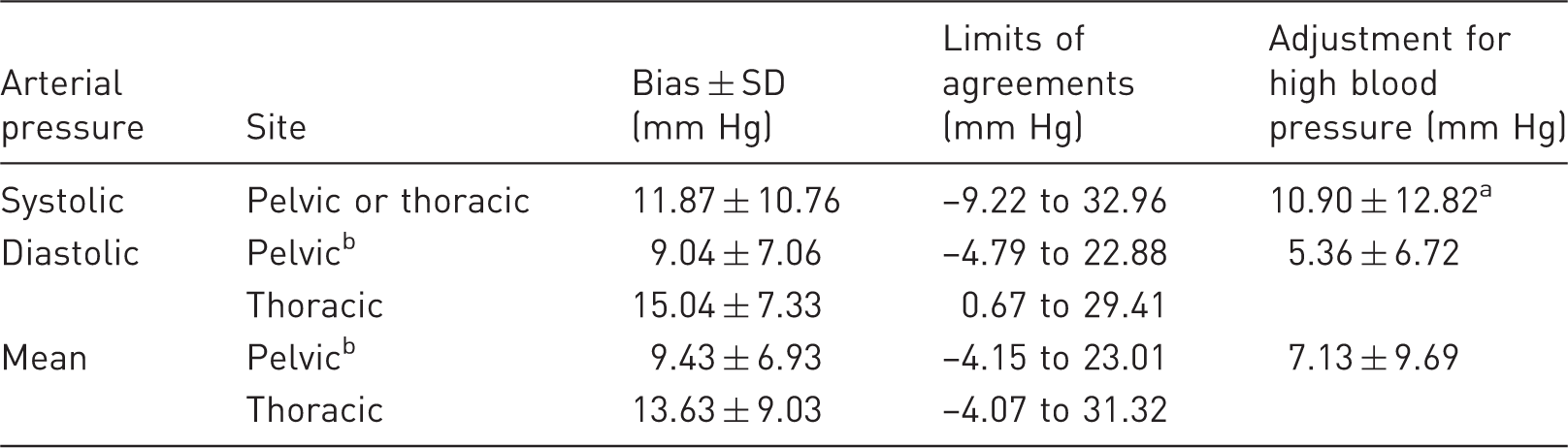
Bias significantly higher at high (above median value) relative to low (below median) direct arterial pressure.
Bias significantly lower when measurement taken on the pelvic relative to thoracic limb.
For the thoracic limb, noninvasive systolic and diastolic measurements were within 10 mmHg of IBP values 33.8% and 32.3% of the time, respectively. They were within 20 mmHg of invasive 61.7% and 67.6% of the time, respectively. For the pelvic limb, noninvasive systolic and diastolic measurements were within 10 mmHg of invasive values 25.3% and 58.8% of the time, respectively. They were within 20 mmHg of invasive 69.1% and 89.7% of the time, respectively.
Discussion
The purpose of this study was to evaluate the accuracy of the Waveline Pro DRE multiparameter monitor in oscillometric blood pressure measurement in pigs. To the authors’ knowledge, there is no other published study evaluating the accuracy of this NIBP monitor in veterinary species. The study design satisfied all recommendations outlined by the ACVIM for validation of a blood pressure measurement device. 18
The mean and diastolic pressures obtained from the pelvic limb met the criteria defined by the ACVIM with bias less than ± 10 mmHg. Bias obtained from pelvic limb measurements were significantly lower than those taken from the thoracic limb. Measurements for the thoracic limb did not meet the ACVIM criteria for systolic, diastolic, or mean blood pressures. Diastolic pressures from the pelvic limb met the criteria of being within 10 mmHg of actual blood pressure 50% of the time and within 20 mmHg of actual 80% of the time. Neither systolic or diastolic for the thoracic limb nor systolic for the pelvic limb met these criteria.
There are several potential explanations for the lack of accuracy of NIBP measurements of the thoracic limb observed in this study. First, the anatomy of pigs makes appropriate fitting and application of oscillometric blood pressure cuffs difficult. The forelimbs proximal to the carpus and the hindlimbs proximal to the hock are often tapered so blood pressure cuffs are difficult to apply uniformly around the circumference of the limb. Also, pigs often have a high percentage of body fat, making pulsations of the artery difficult to detect via oscillometry. Indeed, human studies have found that blood pressure in overweight individuals is often underestimated by oscillometric monitors. 21 Last, the pigs used in this study received a high dose of the alpha-2 adrenergic agonist xylazine prior to measurement of blood pressure. Alpha-2 adrenergic agonists are known to cause significant peripheral vasoconstriction. Extensive vasoconstriction can lead to inaccuracy in oscillometric blood pressure measurement as oscillations in the cuff will not be created by the vasoconstricted vessel. 22 The injectable anesthesia protocol used in this study was chosen because it is a common anesthetic protocol used in research pigs. Therefore, any effect of these drugs on accuracy of blood pressure measurement would be observed commonly in research scenarios.
In a study by Ypsilantis et al., the accuracy of an oscillometric blood pressure device was assessed in inhalant anesthetized pigs. 23 Interestingly, the results obtained in that study showed greater accuracy when the cuff was placed on the thoracic limb. However, the cuff placement on the pelvic limb in that study was proximal to the stifle over the tibia. The difference in anesthetic technique, monitor used, and placement of cuff on the pelvic limb likely contributed to the differences obtained between the studies.
In the study reported here, NIBP measurements underestimated invasive measurements. This effect was also observed in another study evaluating the accuracy of a Surgivet oscillometric monitor in pigs 24 and is consistent with findings of studies evaluating the accuracy of oscillometric devices in other anesthetized animals.25–29 Noninvasive measurements of diastolic and mean in the pelvic limb were found to better agree with invasive pressures than did noninvasive systolic pressures in the pelvic limb. This was also observed in similar studies evaluating the accuracy of Surgivet oscillometric blood pressure monitors in pigs and dogs.24,27,28 However, the current study is the first to report these findings in pigs anesthetized with injectable agents only.
There are several limitations to this study. First, hypotension and hypertension were not induced in the study subjects and therefore it is not possible to say if the results would have been the same with abnormalities of blood pressure. However, it was noted that bias was significantly higher in individuals at higher blood pressures (above median) meaning that the monitor was less accurate, further underestimating the actual blood pressure, in patients with higher blood pressure. Studies evaluating the accuracy of oscillometric devices in hypotensive states have shown that accuracy decreases as blood pressure decreases below normal.14,28 Additionally, oscillometric blood pressure measurements were not obtained from the tail, which may have provided more accurate blood pressure measurements in comparison to the thoracic and pelvic limb. The tail has been shown to provide reliable oscillometric blood pressure readings in awake pigs 30 and a study of anesthetized pigs revealed that the tail provided more accurate readings than the pelvic limb. 23 However, because of the small size of the pigs used in this study, oscillometric measurement of blood pressure via the tail was not possible. Owing to the fact that only one monitor was used, as opposed to several of the same model, and only one cuff design was utilized, it is impossible to conclude with complete confidence that the results obtained in this study would apply to every Waveline Pro monitor and cuff design. Last, the pigs used in this study were of fairly uniform size and conformation. It is possible that accuracy may be different in very large or very small pigs. Additionally, the authors were unable to dictate the sex of the pigs (12 female, five male) and this may have affected the results as it is unknown whether there may be a gender bias in oscillometric blood pressure monitoring in pigs.
In conclusion, this oscillometric monitor did not completely meet the criteria outlined by the ACVIM for validation of blood pressure devices in the pigs studied. However, measurements taken from the pelvic limb resulted in a smaller bias relative to IBP than did those taken from the thoracic limb. Based on these findings, the DRE Waveline Pro can be used to monitor blood pressure in anesthetized pigs, with the pelvic limb being preferred over the thoracic limb. The anesthetist should keep in mind that mean and diastolic pressures are likely to be more accurate than systolic pressures. Additionally, the results obtained in this study may not accurately reflect the accuracy of this monitor in pigs of different size or conformation. Invasive arterial blood pressure measurement during anesthesia, as the gold standard of blood pressure monitoring in pigs, should be pursued in scenarios in which blood pressure must be precisely monitored or in which large variations or abnormalities in blood pressure are expected.
Footnotes
Declaration of Conflicting Interests
The author(s) declared no potential conflicts of interest with respect to the research, authorship, and/or publication of this article.
Funding
The author(s) received no financial support for the research, authorship, and/or publication of this article.