



Abstract
This paper responds to calls for new theoretical frameworks within which to examine transport history and bring it into contact with other disciplines with a view to overcoming some of its alleged previous preoccupations with Anglocentric economic data. It offers three interconnected ideas from other fields, historical institutionalism, hybridity and institutional logics and it proposes that these tools can assist historians in making sense of the qualitative material from archival records. The paper also suggests that by explicitly framing the history of public transport as a political process, historians can engage with a wider social ecology of interest groups than those represented by economic interests. Whilst recognising the assumptions inherent in an institutional approach and the limitations of the scope of the author's own research, the paper argues that these frameworks can nevertheless be used widely and effectively.
Introduction
This article explores new avenues in transport history research. It brings transport history into contact with other more theory driven disciplines through the use of paradigmatic thinking. 1 I begin by outlining the debates within transport history regarding the limitations of some previous research. I look at historical institutionalism as a means to overcome such limitations through an emphasis on the role of politics. I discuss hybridity theory and an associated perspective, institutional logics, as theoretical frameworks facilitating research beyond econometrics. For the purposes of this article, I use these concepts to offer an explanatory framework identifying the key clashes in transport between the market, the state, democratic participation, and consumer choice in Britain. I chart their progress over time and account for their influence on policy and events in transport history. I take my material from the twentieth century Anglosphere however I see no reason why the underlying principles and frameworks explained here could not be applied to other countries in modern times. I explore hybridity and institutional logic's links to other disciplines in order to enhance their validity and reliability as research methodologies.
A cultural turn in transport history?
There is an on-going debate in transport history about how to maintain modern relevance. 2 Transport history has been criticised for being too wedded to economic data, too Anglophile, too pre-occupied with railways, and too focussed on the nineteenth century. 3 The argument runs that it has directed insufficient attention to social and cultural developments in understanding and interpreting history. 4 It has been suggested that this may have led to a narrow engagement with the technicalities of movement rather than an exploration of a more holistic understanding of mobility enabled by taking a “cultural turn”. 5 This view has been criticised for insufficient explanation of its own frameworks of reference and neglect of extant scholarship addressing cultural issues. 6
I propose historical institutionalism as a theoretical context within which to locate a more expansive, sociological view of transport history. In particular I understand transport history to be informed by conflicting goals, values and interests expressed through politics and policy making. I suggest hybridity and its associated analysis of blended institutional logics can offer an additional refinement when seeking to understand historical context. Hybridity and institutional logics provide useful theoretical assistance because they are apposite to organisations, such as transport, resting on the political fault line between state and private sector interests.
I acknowledge that much previous work has already moved in this direction, and few transport historians would argue that the influence of politics on transport is anything other than pervasive. 7 Cresswell, for example, explicitly theorises mobility and power relations. 8 Nevertheless, I suggest that historical institutionalism offers three useful contributions. Firstly, it can make the link between relatively abstract conceptions of how power relations operate and how they manifest themselves in terms of the every-day realities such as fares, congestion, infrastructure and the provision of service over time. Secondly, it provides a useful qualitative revision or counter point 9 to earlier transport history where the quantitative analyses found in economic history often prevailed. 10 Thirdly, historical institutionalism accentuates particularized truths, complex rather than unitary causality. The theory explores empirical phenomena and examines endogenous explanations of institutional behaviour. 11
I argue that these approaches enable transport historians to challenge generalist economic assumptions and explore the origins and consequences of power dynamics in transport policy making. Moreover, there is no barrier to their application in relatively under researched countries and localities where the politics of their transport development and provision is comparatively poorly understood. I suggest that the emphasis in this approach on the particular rather than the general, lends itself to this endeavour.
Historical institutionalism
Historical institutionalism assumes that institutions are the outcome of past events, underpinned by the actions of individuals, and are open to changing significance over time. This process allows habituated actions and meanings become reified as objective social structures. 12 It emphasises asymmetries of power, path dependence and the influence of ideas in the operation and development of institutions. 13 In contrast to rational choice and sociological institutionalism, historical institutionalism allows for a combination self-interested rationality and social norm-following in explaining an individual's actions. I suggest this offers a powerful explanatory advantage when interpreting overtly or implicitly politicised decision making in transport policy and the creation of transport organisations. 14
Studies such as Vigar's “The Politics of Mobility” already provide clear sociologically based examinations of the relationship between power dynamics and the formation of transport institutions and policy. They propose examination of the past linkages, connections and associations in order to more widely understand the politics of transport policy networks, discourses and communities. 15 Thus transport historians may systematically assess the fruits of archival research into the diffusion of institutional characteristics and transport policies within and between different jurisdictions. Furthermore, the role of individual actors in policy making and the degree of agency they enjoyed can be considered. 16 Historical institutionalism by its nature tends to favour larger organisations which are more likely to leave more extensive documentary traces over time and have wider applicability. Nevertheless, Vigar enjoins transport researchers to seek out local case studies and make explicit the link between transport planning and politics at the provincial level which he sees as having been underplayed in research. 17
Numerous journals, often outside the field of transportation or history, do publish examples of the history of transport planning and policy making at the regional or city level as well as on the national stage. 18 However, in the UK the number of unexplored local authority or individual institutional archives remains considerable. Where the literature does exist, the history can be made up of accounts commissioned via the organisation in question, sometimes written by former officials and designed to commemorate and celebrate projects, locales and former glories. 19 The insider knowledge allows them to be meticulous accounts with the caveat that they can lapse into parochial or technical detail. Though the limitations of my own research confine my examples to the UK, it seems reasonable to assume that this state of affairs exists abroad too. Some academic analysis of the history of transport at a national level in other countries also calls for more local case studies to reduce the over-reliance on foreign (i.e. European) examples. 20
In summary, historical institutionalism is a well-established field that recognises social pressures and influences in organisations that are distinct from material and technical factors. 21 I suggest that this lends itself to addressing, in general sense, some of the criticisms which have been levelled at Transport History that we saw earlier in the introduction. I now turn to two further frameworks of analysis which, accepting the wider premises of historical institutionalism, deal in greater detail with the evolving form of individual organisations responding to market and state pressures.
Hybridity and institutional logics
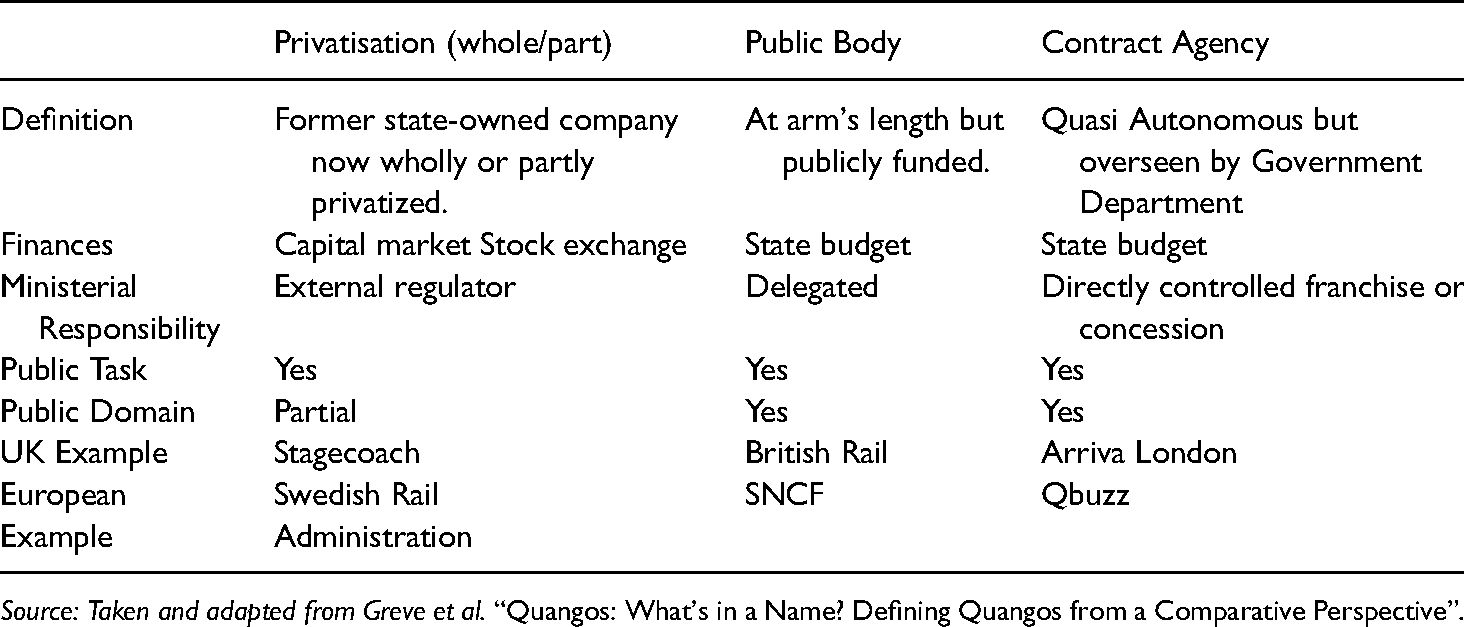
Hybrid organisations combine the functions and characteristics of private, public and charitable bodies. 22 Their multi-faceted and abstruse nature, combining multiple organisational forms, diverse origins and varying blends of institutional logics permits some limited generalisable definitions (Table 1). However, more importantly, this diversity lets the researcher draw on a wide evidential and comparative span as well as being able to offer precise explanations rooted in specific circumstances. 23
Taxonomy of hybridity.
Source: Taken and adapted from Greve et al. “Quangos: What's in a Name? Defining Quangos from a Comparative Perspective”.
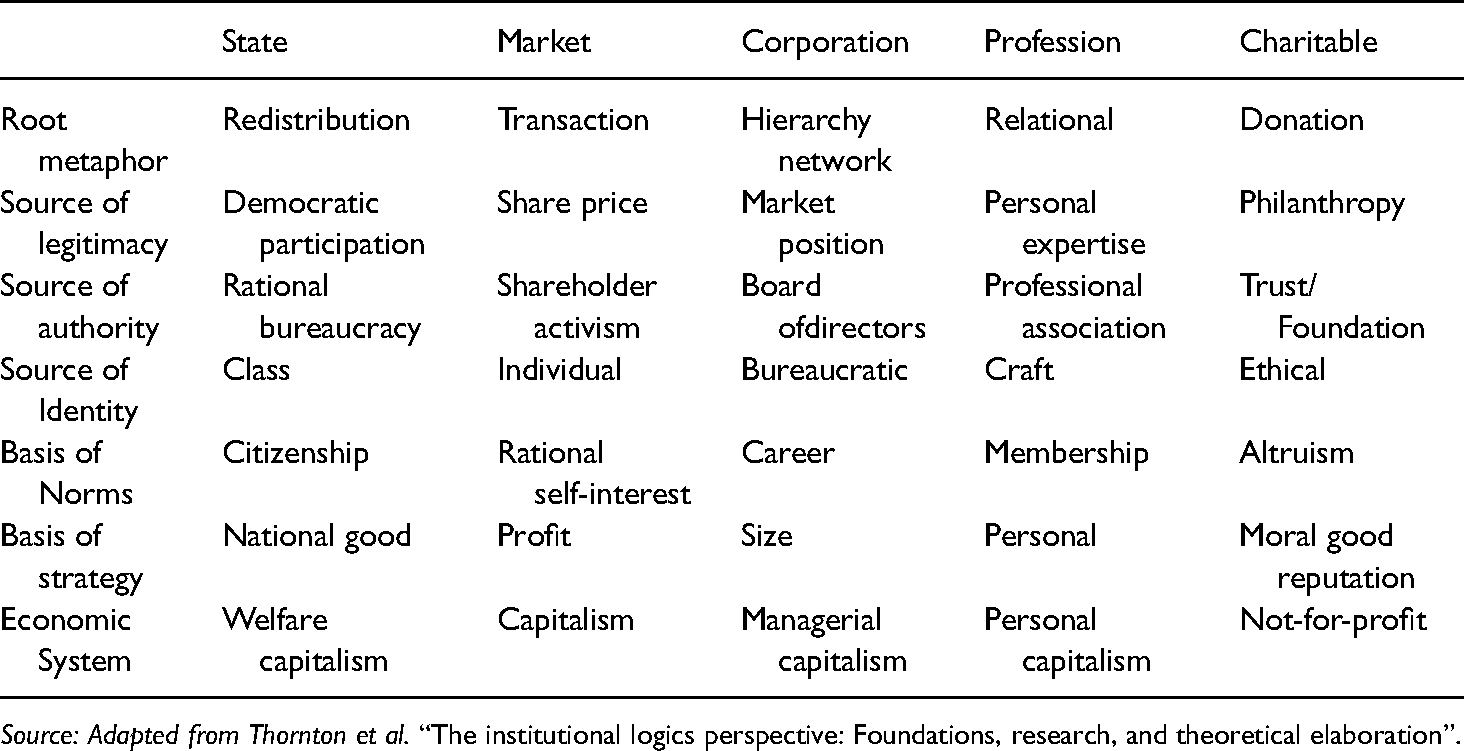
Hybridity is helpful in breaking down the nature of organisations that sit at the awkward interstice between public and private, a dilemma frequently encountered in transport. On the other hand, it would be a mistake to assume that organisations which sit in the same category are therefore identical. This would ignore the influence of history in their structures, processes and cultures. Institutional logics are held to be the dominant norms, values and behavioural expectations enforcing legitimacy, authority and identity. 24 They exist within different institutional orders: family, religion, state, market, profession and corporation. I suggest the latter four are of more interest to transport history, and further propose that family and religion may be replaced with a charitable logic in some instances (Table 2). Each present unique organising principles, practises and symbols influencing conditions and explaining actors’ decisions. This paper will principally deal with the state, market and corporation in its main discussion, although professional and charitable logics may represent avenues for future research.
Modern institutional logics.
Source: Adapted from Thornton et al. “The institutional logics perspective: Foundations, research, and theoretical elaboration”.
Four assumptions underlie institutional logic making it useful in the discussion of the history of hybrid organisations. First, such logic disputes the primacy of rational choice, thus allowing actors partial autonomy. It seeks to explain their actions through bounded intentions rather than bounded rationality. Intentions are bounded not just by personal cognitive limitations but by the nature or contradictions in an actor's goals and identity. These are shaped by an individual's social, cultural, and for the purposes of this paper, political preconceptions. 25
Secondly, it allows for micro analysis at the organisational level. This means very intensive research of a particular area of an organisation's activities is enabled, such as analysis of a restricted portion of large organisation's activities or perhaps the entire record of a smaller organisation. Third, the integration of symbolic and material evidence found in archives is facilitated. Fourth, historical contingency is accepted. As relatively little research has been done in this area, I see this as a promising theoretical space for transport historians. 26
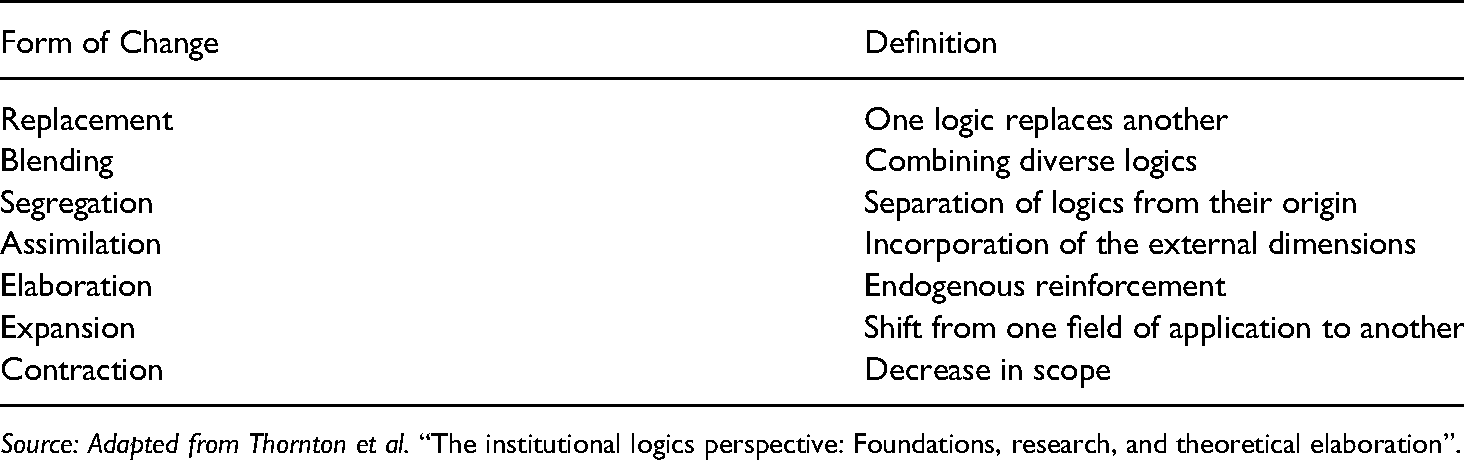
One of the many tasks for a transport historian is to account for the changes in modal choices, ridership, infrastructure etc. Behind these surface realties lies the changing nature of transport organisations and conceptions of mobility. Whilst transport may retain consistent commitments and appearances, its true nature can begin to differ from the beliefs of those charged providing it and the wishes of the travelling public. Charting the evolving balance of institutional logics through archival micro research allows the researcher to plot both organisational changes and also deeper shifts in attitudes and intentions prefiguring them (Table 3).
Typology of change in institutional logics.
Source: Adapted from Thornton et al. “The institutional logics perspective: Foundations, research, and theoretical elaboration”.
The use of historical institutionalism, hybridity and institutional logic as conceptual frameworks enables a mass of qualitative data from the archive and the political status of transport institutions to be explicitly rationalised rather than worked out by implication from economic data. Understanding the political parameters of the authorising environment in terms of policy networks, arena and discourses, we can then delve into the detail of the organisations themselves at managerial level and pick apart the interplay of institutional logics in terms of goals, values and interests. Struggles for legitimacy, strategies and norms have real world consequences such as new infrastructure, patterns of service provision and fares. These themselves can be observed over long, periodised, histories. 27 History contextualised in such a way links commuters’ daily reality to managerial decision making and then on further to political environments. As the borders of state and market are always shifting, extensive archival historical sources exist both within and outside the context of transport history. Moreover, these are generated constantly and accumulate extended antecedences. 28 These records may be situated within the historical context of institutional transport policy and the associated power relations. Historical institutionalism, hybridity and institutional logics lend credence to thick historical description, accentuating realism over elegance and difference and detail over formulas. 29
Limitations
Historical institutionalism and the associated frameworks of hybridity and institutional logics come with constraints. Clearly, they presuppose the existence of institutions and accentuate their role. The concepts they employ to analyse their development, such as the state, markets, professions etc. are themselves open to different interpretations in different periods. 30 Framing transport within an institutional setting, they place ethnographic research concerning the individual experience of mobility at a discount. 31 Furthermore, the archival research on which this approach relies requires the existence of quotidian data gathering mechanisms within organisations. This restricts research to certain time periods and, even within those periodisations, relies on the consistency of record keeping. It also privileges larger organisations that generate a volume of records, have the means to store them and are perceived as important enough to be worth keeping.
There is no way of avoiding the silences within the archives which exist as the product of both constructed absences through decisions by the researcher and the objective absence of material. 32 However, I suggest that these issues do not invalidate this type of archival research, or the use of theoretical frameworks based upon it, provided that they are acknowledged and elucidated. The call for historians to offer more clarity and explanation of their methods has been made for some time in business and management history. 33 Historians, by means of acknowledging their source work openly and the use of theoretical context, have been able to successfully marry historical craft to social scientific theory to offer a dual integrity to their research. 34
Transport history: A political turn?
In 1959 Barker and Savage published “An Economic History of Transport in Britain”. 35 In this section I speculatively outline what a contrasting book “A Political History of Transport in Britain” might contain: changing policy, organisational form and provision in transport linked directly to political interactions. Such changes would be presented as the result of political confrontations over ownership, participation, planning and accountability, and be engaged with through the interpretive framework of historical institutionalism, hybridity and institutional logics.
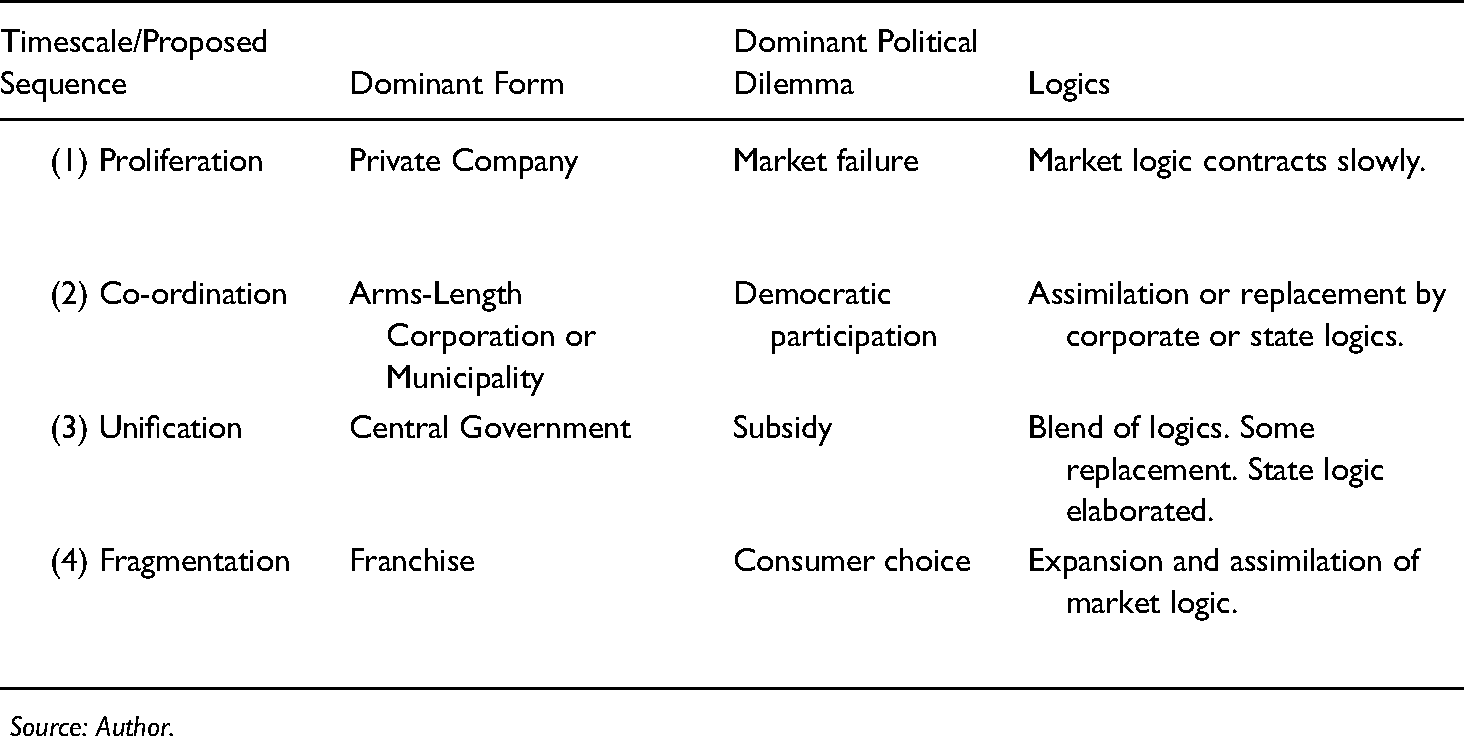
In Table 4 below I give a putative generic blueprint for the evolution of transport organisations in the Britain over time. Using this, I discuss clusters of existing transport history literature from the Journal of Transport History and other journals which relate to the particular political dilemmas created by the chronological development This taxonomy is not designed to be universal or exhaustive. I acknowledge that many transport providers did not originate as private companies, and the historical pattern of ownership seldom follows a neat linear path from proliferation to fragmentation. The political dilemmas indicated were almost always present to some degree simultaneously rather than discretely. Every organisation has charted its own course in the way it blended, assimilated, replaced, expanded or even segregated its logics in day-to-day managerial practice. Nevertheless, I argue that historians can pinpoint distinct transport policy choices that were made and influenced by a variety of identifiable individual actors. The historical institutional, hybridity and institutional logics perspectives allow us to refine those discussions by accepting individual choices as being both rationally and socially influenced, historically contextualised, and by directly recognising their political dimensions.
The evolution of transport organisation in Britain.
Source: Author.
In Britain, most, though not all, transport provision originated privately. 36 In keeping with the market logics of share price and profitability, much of the literature primarily uses economic units as the framework of analysis. 37 If the hand of the state is visible, then it is discussed in terms of safety or financial regulation. 38 However, from some political perspectives these solutions to market failure were sticking plasters. There was a fundamental problem with transport's organisational form as a private company operating in shareholders’ interests meaning that certain important types of social failure were inevitable. 39 Such discourses tend to characterise the history of private transport in this period as a political struggle between private interests and a growing regulatory state. This found expression in the idea that travellers had rights over transport extending beyond their identities as customers and shareholders. 40
In the early 20th Century, a strong municipal movement in the UK and the influence of the “efficiency craze” in organisational management from America challenged the assumptions of market logics in transport. Where there were large numbers of pre-existing small transport firms the trend was towards consolidation, and where new systems were created, they were envisaged from the outset as co-ordinated rather than competitive. 41 The intervention of the state and municipalities, the creation of quasi-public corporations and the private consolidation and amalgamation between different companies oblige us to think more in terms of hybridity. Here, the supporting literature combining theory, politics and history becomes denser. 42 I argue that at that heart of these changes in organisational form lie not just efficiency arguments as understood in economic terms, but the issues of democratic participation, consumer choice, subsidy via taxation and accountability in transport. 43
Transport changed, not just in terms of what and how much it carried and what it cost, but in terms of what the public wanted from it and what those who controlled it believed it existed to do. In Britain there was a drawn-out struggle to unify and socialise transport, but wherever possible without actually democratising powers over its control. 44 Other jurisdictions have similar histories of swings between privatisation, municipal and state control. 45 The role of politics is self-evident, and the use of hybridity and institutional logics as frameworks is of considerable use in picking apart clashes of interest, values, continuity and change.
These debates evolved. In the 1980s, after decades of state orientated centralisation, there was a resurgence of interest in many countries in applying market logics to transport organisations. In simple terms “the market” needed to be restored to transport in order to achieve greater consumer choice, which would in turn drive efficiency and reduce subsidy. 46 Analysis using hybridity as a framework shows that the return to pure free markets was illusory. Instead, governments sub-contracted delivery to private organisations but the costs were still met by the state. 47 A superficial market logic disguised actual state control, but with the corollary that any lingering democratic participation via a direct connection between elected representatives and actual ownership was expunged. Fragmentation obfuscated accountability and ostensibly attempted to remove politics from transport, 48 outcomes that have been explicitly and tacitly acknowledged in the British Government's most recent White Paper on the future of the railways. This White Paper now seeks to reverse the breakup of responsibility for the service whilst still trying to avoid direct political involvement. 49
Conclusion
I have offered a very brief perspective of transport history in Britain above without relying on economics or economic data. I express the problems of market failure, state failure, democratic accountability and consumer choice as a series of political clashes with clear impacts on transport organisation and provision. 50 I rationalise these through general schemas of hybridity and institutional logics (Tables One and Two) which allow historical change to be systematically researched, charted and analysed (Tables Three and Four).
Therefore, despite the limitations discussed earlier, I make the following claims for these structures of reasoning: Firstly, that they offer an alternative analytical framework to universal economic laws and locate transport in diverse social and political circumstances which differ across the globe. Secondly, that they facilitate historical analysis of transport and mobility through wider cultural or social understandings such as power relations. Thirdly, that they build on the wide but scattered body of extant literature, refining and coalescing its evidence and claims. Fourthly, that they present transport historians with an opportunity to make use of a wealth of archival material via business and civic institutions. Fifthly, that they are credible and widely employed conceptual frameworks which would bring transport history into contact with public administration, management and organisation studies, politics and institutional history. I recommend them to transport history.
Footnotes
Declaration of Conflicting Interests
The author(s) declared no potential conflicts of interest with respect to the research, authorship, and/or publication of this article.
Funding
The author(s) received no financial support for the research, authorship and/or publication of this article.
