




Abstract
This study examines the potential of peer mentoring conversations through the use of a video-based learning design in Norwegian teacher education. Student-teachers used classroom videos of their own teaching as a basis for reasoning about the core practice of classroom discourse. The study adapts an existing framework to measure the quality of student-teacher reasoning in six peer mentoring groups, and the same framework is utilized as an analytical stance in the micro-analyses of selected excerpts. The findings show that student-teachers are able to conduct high-quality conversations during peer mentoring and point to the important role of structural and conceptual support.
Keywords
For the past decade, teacher education programs have focused on providing student-teachers with opportunities to learn in arenas that resemble authentic classroom contexts (Grossman et al., 2009), often by using videotaped classroom situations as a basis for observation, analysis, and reflection (Gaudin & Chaliès, 2015). Indeed, literature reviews have suggested that video-based teacher learning shows promise (Gaudin & Chaliès, 2015; Kraft et al., 2018), offering an authentic inspection of real teaching from different perspectives.
The use of video in teacher education often implies that student-teachers are involved in more or less structured conversations with teacher educators, mentor teachers, or peers, here with the aim of analyzing the video and learning from the practices they observe. Certainly, conversations are frequently used as a tool for student-teacher reasoning and learning (Knezic et al., 2019; Tripp & Rich, 2012; Weber et al., 2018), often based on the assumption that dialogue is an essential medium through which learning occurs (Horn et al., 2017; Horn & Kane, 2019; Lefstein et al., 2020). Research has explored the significance of conversations for teacher learning within professional development programs (Horn et al., 2017; Horn & Kane, 2015), finding that teachers’ conversations are often surface-level, consensus-driven, and frequently more evaluative than inquiry-based (Horn et al., 2017; Horn & Kane, 2019; Zhang et al., 2011). For instance, in their research on teachers’ workgroup conversations, Horn et al. (2017) find that the most productive meetings, which they name collective interpretation meetings, are infrequent even in carefully selected best-case scenarios. Moreover, they point to learning opportunities in workgroup conversations reflecting an “accumulated advantage phenomenon,” meaning that skilled teachers find more to discuss than less skilled colleagues when inquiring into problems of practice, thereby fostering a more sustained focus on collective inquiry.
The assumption that novices in particular have difficulty conducting productive discussions has led to a focus on the need for expert facilitation and support structures for teachers to achieve the desired results of high-quality conversations in video-based settings (Gaudin & Chaliès, 2015; Mitchell et al., 2020; Peralta et al., 2021; Prilop et al., 2021; Weber et al., 2018). Expert facilitators (e.g., a teacher educator, mentor teacher, or experienced teacher) can influence discourse by structuring and concentrating discussions related to instructional practices, thereby avoiding evaluative dialogues and keeping participants focused on student thinking, content, and instructional elements (van Es et al., 2014). Although research highlights the importance of facilitation for productive discourse and enhancing teacher learning, there is a paucity of studies investigating the effects of different facilitation strategies, for instance, expert facilitation versus participant-led discussions (Mitchell et al., 2020). Moreover, there is a lack of empirical studies specifically addressing the role of conversations in the learning processes of student-teachers, as well as the quality of such interactions (Jenset, 2024; Knezic et al., 2019; Lefstein et al., 2020), although some notable exceptions exist. Some investigations have examined the quality of conversations between expert teachers or teacher educators and groups of student-teachers as reported by Jenset (2024), a study conducted in the Norwegian context, while others have focused on dialogues as reflective tools within field-based learning contexts (Knezic et al., 2019).
In a review of research on peer coaching in teacher education, Lu (2010) identifies several impacts of peers, including the facilitation of professional conversations through relevant feedback and emotional support that fosters confidence and relaxation (p. 751). Similarly, Soini et al. (2015) find that the quality of peer relationships significantly influences student-teachers’ sense of professional agency early in their training, suggesting that student-teachers value peer conversations as a key source of support.
Peer mentoring conversations in student-teacher learning thus show promise. By providing support structures and preparing student-teachers for such conversations, it is possible to improve learning outcomes, even without expert facilitation (Knezic et al., 2019; Lu, 2010; Mitchell et al., 2020). However, research has largely overlooked the quality of professional conversations among student-teachers (Jenset, 2024), indicating a need to further investigate how student-teachers engage in such conversations without the assistance of facilitators, with the purpose of learning from their own and their peers’ classroom practices.
The aim of the current study is to address this research gap by providing insight into the quality of student-teachers’ conversations when analyzing their own and peer classroom videos in peer mentoring groups. In this regard, we recognize the importance of using student-teachers’ competence and collaboration as resources in teacher education (Lu, 2010). We draw on several perspectives to inform our work, including research focusing on how student-teachers learn from their practice through individual and collective analyses of enacted teaching (van der Linden et al., 2022; van Es et al., 2014), and literature on the relationship between teacher discourse and professional learning (Horn et al., 2017; Horn & Kane, 2019). We pose the following research questions:
RQ 1: How can student-teachers conduct high-quality peer mentoring conversations?
RQ 2: What characterizes student-teachers’ peer mentoring conversations based on their own and peers’ classroom videos?
The present study examines conversations among six groups of student-teachers from a Norwegian teacher education program participating in a learning design that involved peer mentoring based on participants’ classroom videos. By adapting criteria developed by Sherin et al. (2009) and Jenset (2024) to map quality in peer mentoring conversations and as analytical lenses in the microanalysis (Jordan & Henderson, 1995) of two episodes of high quality, we investigate student-teachers’ collaborative explorations of content pertaining to classroom discourse when analyzing videos.
Conceptual Framework
Conversations as Tools for Learning
One of the primary objectives of teacher education is to bring student-teachers’ personal conceptualizations into closer alignment with the teacher education program’s conceptualization of high-quality teaching. How these conceptualizations become more aligned is part of a complex process in which language is considered a primary tool that mediates collaborative and social activities and an individual student-teacher’s process of learning and development (e.g., Rogoff et al., 1995; Vygotsky, 1978). By engaging in dialogues, student-teachers can exchange different viewpoints, question each other’s understanding, and provide feedback, which holds the potential for student-teachers to collaboratively develop their professional competence.
The central role of dialogue in learning has been recognized by numerous scholars (Mercer & Littleton, 2007; Michaels & O’Connor, 2015; Zhang et al., 2011). However, various terms have been used to describe the significance of conversation for learning, such as dialogic discourse (Scott et al., 2006), generative dialogue (Little & Horn, 2007), and progressive knowledge-building discourse (Scardamalia & Bereiter, 2006). Despite conceptual diversity, Zhang et al. (2011) contend that two key aspects have emerged as central to determining the quality of teachers’ conversations: content and participation.
Content
Content pertains to the topics being discussed in conversations and the refinement and sophistication of concepts and ideas (Zhang et al., 2011, p. 348). Thus, engaging in meaningful conversations allows student-teachers to explore and refine their teaching concepts. Horn and Kane (2015) and Horn et al. (2017) build on Vygotsky’s framework and argue that concept development serves as a generative lens to explore teacher learning within workgroup conversations. Moving from Vygotsky’s (1934/1986) notion of concept development, teachers’ understanding is perceived as emerging from the interplay of formal (scientific) concepts and lived (spontaneous) concepts (Horn & Kane, 2015). Formal concepts serve as generalizable abstractions about teaching, while lived concepts are rooted in personal experiences. In order for student-teachers to cultivate robust teaching concepts, these two must align: without formal concepts, teachers often find it challenging to derive meaning from their experiences, and without lived concepts, formal abstractions can become hollow. Thus, pedagogical understanding emerges when teachers connect generalizable ideas about students, teaching, or content with specific details of their practice.
For meaningful integration to occur, both types of concepts must be actively engaged in dialogue (Horn & Kane, 2015). Conversations that primarily focus on replays of classroom events or demonstrate instructional techniques prioritize lived concepts, while those that emphasize abstract theories favor formal concepts. When participants successfully bring together general and specific contributions—by articulating the formal aspects of lived concepts or providing lived illustrations of formal concepts—such conversations can foster more profound learning opportunities for student-teachers. In our study, we operationalize principles established by Horn et al. (2017) by examining how formal and lived concepts converge in student-teachers’ peer mentoring conversations.
Participation and Joint Sensemaking
Participation refers to the number of participants, who initiates discussions, the number of conversational turns generated, and the extent to which participants respond to and build upon each other’s ideas, hence resulting in a cohesive and meaningful discussion around video events (Sherin et al., 2009; Zhang et al., 2011). The importance of fostering participation and joint sensemaking among student-teachers is widely acknowledged in the literature, emphasizing the value of collaborative professional development that encourages knowledge sharing among teachers (Hiebert & Stigler, 2000). However, Horn and Kane (2019) and Horn et al. (2017) find that the broader cultures of language use within which teaching occurs may limit teachers’ sensemaking. This is because teachers’ conversations are often characterized by what Horn et al. (2017) refer to as monologic—conversations marked by statements, presentations, or demonstrations that can be clarified but are seldom questioned or explored in depth. This type of conversation is characterized by teachers largely seeking superficial clarifications regarding their colleagues’ decision-making and, to a lesser extent, questioning the meaning of the statements made. Horn et al. (2017) argue that monologic talk constrains teachers’ sensemaking and assert that a dialogic discourse, in which meanings are conveyed through dialogic exchanges among teachers, is necessary for sensemaking and collective concept development to occur. Similarly, scholars such as van Es et al. (2014) and Sherin et al. (2009) differentiate between evaluative and inquiry-based stances in teachers’ conversations, arguing that joint sensemaking takes place in dialogues where an inquiry-based stance is maintained, through teachers requesting rationales, challenging viewpoints, and refining ideas.
Focus
If teachers lose focus on the object of discussion, it will be challenging to sustain a deeper inquiry into the relevant classroom practices. In our study, the content of conversations is student and teacher classroom discourse and how knowledge of classroom discourse emerged in the discussions among student-teachers. As mentioned, extensive research shows that professional development is most effective when teachers engage in sustained inquiry (Horn et al., 2017; Horn & Kane, 2019; Sherin et al., 2009). Moreover, Horn et al. (2017) emphasize that an inquiry-based approach is central to the development of teaching. Therefore, a critical question is whether teachers apply such an approach when exploring classroom discourses and whether they maintain a focus on understanding various aspects of these discourses during group discussions in which they participate (Jenset, 2024; Sherin et al., 2009).
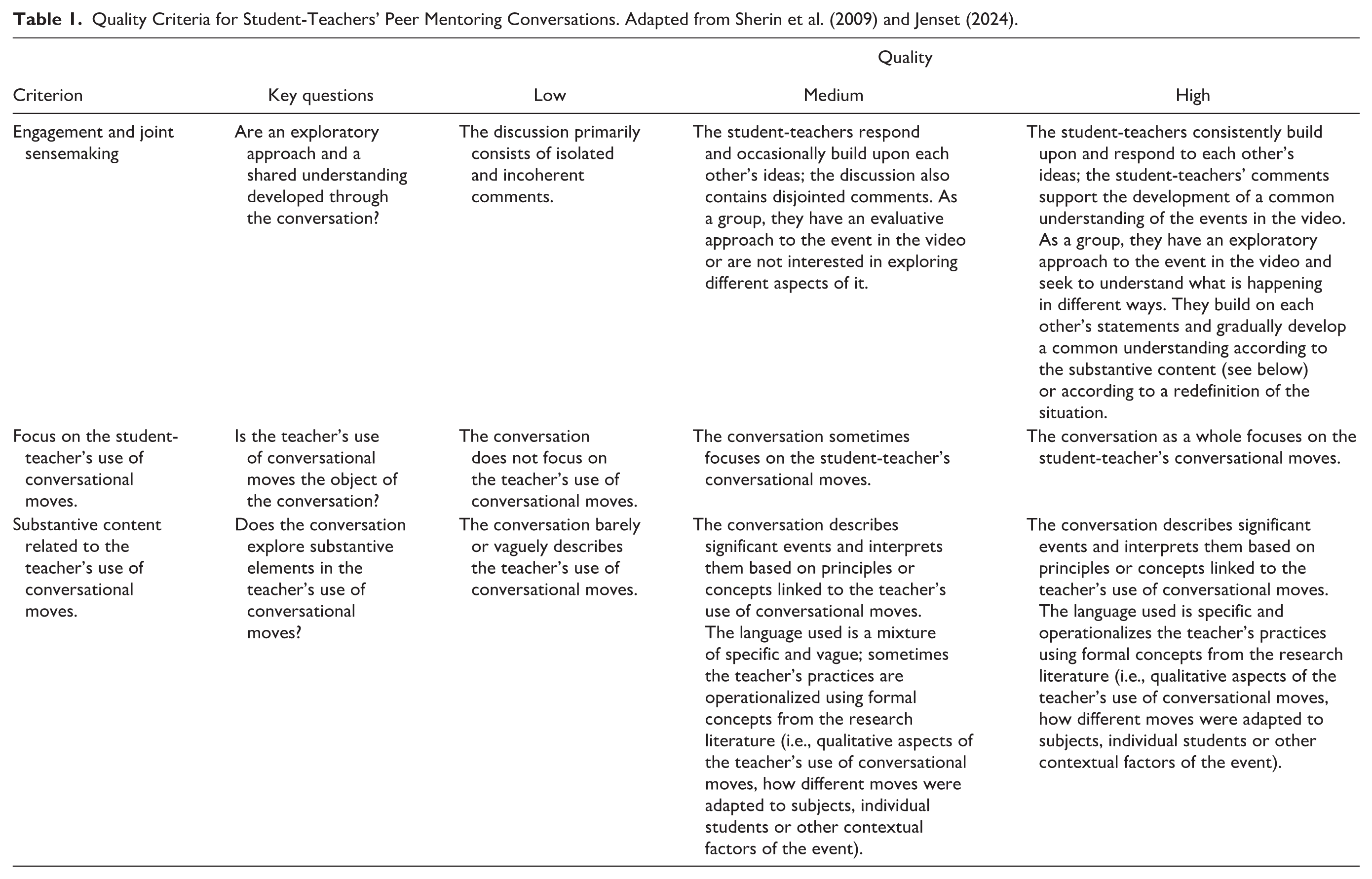
In sum, to achieve high-quality conversations among student-teachers, they should sustain a focus on the practice observed on the video, engage in joint sensemaking, and inquire into the significant pedagogical events in the video using a language that operationalizes the teaching practice observed using concepts from the research literature. This conceptual framework, which is the starting point for our analyses of the conversations between the student-teachers with the aim of differentiating high-quality conversations from less productive ones, is presented in Table 1. Next, we examine previous research on the role of video-based discussions in teacher learning.
Quality Criteria for Student-Teachers’ Peer Mentoring Conversations. Adapted from Sherin et al. (2009) and Jenset (2024).
Video-Based Conversations and Peer Mentoring in Teacher Education
An examination of studies focusing on video-based discussions in teacher learning reveals a focus on external facilitation as vital for productive discourse (Amador et al., 2023; Jenset, 2024; Peralta et al., 2021; van Es et al., 2014). The facilitator supporting video-based discussions could be a mentor teacher (Amador et al., 2023), a university-based teacher educator (Jenset, 2024), an experienced teacher, or a researcher (van Es et al., 2014). Supporting discussions based on classroom videos, the facilitator helps the teachers keep a focus on the content and student thinking and maintain an inquiry stance (van Es et al., 2014); they promote reflection, help address misunderstandings, and support the development of new skills and knowledge (Horn & Kane, 2019; Zhang et al., 2011).
Although research has pointed to the importance of facilitation practices in discussions about classroom videos, few studies have investigated the effects of different facilitators on conversation quality (Mitchell et al., 2020). Accordingly, there is also a notable lack of attention to the quality of video-based conversations led by participants, such as student-teachers, yet a few exceptions exist. van Es and Sherin (2006) compared two groups conducting video-based discussions, finding that both facilitator-led and participant-led groups conducted productive discussions, albeit in different ways. While the facilitator-led group was more focused on discussions about students’ mathematical thinking, the participant-led group adopted broader and different perspectives. The study also shows how, as an artifact, the video provided opportunities for more focused or broader discussions; in the facilitated group with focused discussions about the pupils’ mathematical thinking, all the videos showed clips where the pupils shared thoughts and ideas about mathematics. In the participant-led group, students’ sharing of substantive ideas was less visible in the videos, which instead showed pedagogical approaches such as brainstorming in whole-class conversations.
Another study comparing expert facilitator- and participant-led group discussions is that of Mitchell et al. (2020); the authors found that participant-led groups focused on key aspects of teaching practices in video clips displaying rich, exploratory conversations. They discovered that the participants recognized central and important events in the video clips without guidance from an experienced facilitator. In contrast, in groups led by a facilitator, there were instances where the facilitator would occasionally take over the conversation and conduct the analytical work, limiting the teachers’ participation in developing a shared understanding.
Similarly, Knezic et al. (2019) compared three types of dialogues as reflective tools in student-teachers’ field-based learning: supervisory dialogues, peer dialogues, and self-dialogues. The study found that the various dialogues could all be beneficial in different ways: Self-dialogues showed significant limitations in substantiating appraisals and facilitating reflection compared with the other two, however, providing greater freedom for student-teachers to navigate various I-positions while addressing reflective questions, and according to Knezic et al. (2019) resulting in more cohesive discourse and potentially firmer conclusions (p. 551).
In the supervisory dialogues, advice-giving predominated as a form of support, overshadowing reflective questions, although supervisors also enriched the dialogue by challenging novices and encouraging exploration. This aligns with prior research showing that supervisors often dominate conversations with their student-teachers without necessarily enhancing the sophistication of student-teachers’ learning (Bjørndal et al., 2024).
According to Knezic et al. (2019), peer dialogues displayed a similar pattern, with most appraisals supported by multiple arguments provided without solicitation, indicating a need to justify outcomes. Peer dialogues fostered diverse perspectives and deeper engagement among student-teachers, though they occasionally limited dialogic space. Notably, peer dialogues also effectively opened dialogic space through probing, similar to supervisory dialogues, with novices often adopting an expert perspective to enhance reflection.
To summarize, several studies have investigated student-teachers’ video-based discussions facilitated by a teacher educator or another expert (i.e., van Es et al., 2014); however, few studies have focused on such discussions facilitated by the student-teachers themselves (i.e., Mitchell et al., 2020). Furthermore, as there is a lack of research on the quality of student-teachers’ professional conversations (Jenset, 2024; Soini et al., 2015), it is timely to investigate how student-teachers engage in professional conversations without the assistance of facilitators, with the aim of learning from their own and their peers’ classroom practices. The present study explores the potential of peer mentoring conversations in teacher education by focusing on student-teachers’ reasoning processes when analyzing videos of their own and peers’ classroom teaching in peer mentoring groups.
Method
The current study draws on sociocultural design-based research (DBR) principles (Collins et al., 2016; Strømme & Furberg, 2015). The core of DBR is the aim of developing theory and at the same time achieving a practical learning outcome. We attempt to achieve this aim by basing the research on a theory-based learning design that is tested in the authentic setting of peer mentoring in teacher education. The design principles in the current study are presented in the section outlining the study context.
Study Context
The context for this study is a teacher education institution in Norway. Like other Scandinavian systems, Norwegian educational policy is oriented toward a comprehensive educational framework characterized by inclusive, non-streamed schooling and smooth transitions between levels (Blossing et al., 2014). Students usually remain in the same class throughout primary (Grades 1–7) and lower secondary (Grades 8–10) school, yielding considerable heterogeneity in ability and interest. Tracking into academic or vocational routes occurs at the upper secondary level (Grades 11–13).
Norway has in recent years implemented extensive nationwide reforms to strengthen teacher education, investing significant resources in this effort. Since 2019, all K–12 teachers have been required to hold a master’s degree. The 5-year, research-based teacher education program prepares teachers for the three-level school system—based on the principle of nondifferentiated classes while adapting to individual needs.
The data for this study come from peer mentoring seminars developed to provide student-teachers with opportunities to learn about classroom discourse through video analysis of their own teaching practices. The seminars were conducted in a large university-based teacher education program educating teachers for Levels 11 to 13. In the peer mentoring seminars, the participants—student-teachers and a teacher educator—met digitally for 3-hr sessions. The authors of this article acted as teacher educators for the student-teachers. Prior to the seminars, the student-teachers video recorded a small sequence of their own instruction during practice placement. The seminars introduced the student-teachers to a predefined pedagogical theme; the thematic focus was the core practice of classroom discourse. To make classroom discourse observable to the student-teachers, classroom discourse was operationalized in terms of (a) Mortimer and Scott’s (2003) four approaches to classroom talk—that is, interactive-authoritative, noninteractive-authoritative, interactive-dialogical, and noninteractive-dialogical (p. 51); (b) Mercer and Littleton’s definitions of types of talk, namely disputational, cumulative, and exploratory; and (c) Michaels and O’Connor’s (2015) talk moves, which are “. . . tools that help teachers respond to specific challenges they face facilitating discussion” (p. 334).
The peer mentoring seminars began with the campus-based teacher educator holding a short lecture on the topic of classroom discourse before the student-teachers worked in groups (without the support of the teacher educator), reflecting on one another’s videos and discussing the theory linked to one another’s experiences from practice. The student-teachers worked in groups of three or four. They watched each other’s videos, discussed the teaching performances based on a task anchored in a peer mentoring guide (see further description below), and spent approximately 20 min on each video-based discussion. The peer mentoring seminar ended with a plenary session in which the teacher educator consolidated the concepts and themes into focus by reflecting on and making links to theory.
In an attempt to scaffold the collective analysis of teaching, we developed a peer mentoring guide to support conversations and help the student-teachers notice relevant aspects of their peers’ (and their own) videos (Santagata et al., 2021), and a guide for the selection of video clips. The guides were developed based on previous research (Kang & van Es, 2019; van Es & Sherin, 2021) and were shared with the students when they were introduced to the task of video recording as well as in the lecture opening the peer mentoring seminar. The guide for choosing video clips gave the student-teachers a framework for what was to be filmed; the clip should contain the student-teacher in interaction with one or more pupils, show indications of the pupils’ thinking and/or learning, and contain a dialogue about central academic ideas.
The peer mentoring guide contained a set of exploratory questions focusing on theoretical concepts of classroom discourse, general feedback on the peer’s teaching, and suggestions for improvement. Examples of exploratory questions in the current guide were as follows: (a) How were the students supported in developing their thinking? (b) Which talk moves (Michaels & O’Connor, 2015) were used to facilitate participation in the video clip, and how did these talk moves support students’ learning processes? and (c) Do you have suggestions for improving your peers’ teaching? Regarding the peer mentoring guide, the student-teachers were urged to use questions that were relevant to the situation.
Sample and Data
The participants were 23 student-teachers in a postgraduate certificate in education program (PGCE). The data were collected during the fall semesters of 2021 and 2022. The student-teachers volunteered to participate and conducted digital peer mentoring conversations during their first practice period approximately 8 weeks into the teacher education program. In the peer mentoring seminar, the participants were divided into groups of three to five students each: two groups in 2021 and four groups in 2022. In total, 11 male and 12 female student-teachers participated. The conversations lasted from 55 to 75 min, with an average of 61 min. The six peer mentoring conversations were recorded on Zoom and later transcribed. The data consisted of approximately 8 hr of transcribed recordings.
Analysis
In Phase 1 of the analysis, we identified episodes in the conversations where the student-teachers discussed each other’s videos. We focused on the pedagogical reasoning of the student-teachers regarding how they conducted discussions about classroom discourse, and thus, we did not include other non-disciplinary topics that students may have raised during these conversations. Inspired by Horn (2007) and Jenset (2024), we defined an episode as a sequence in the conversation in which the student-teachers showed their understanding of a problem. Specifically, episodes of pedagogical reasoning can be seen as moments in teachers’ interactions where they describe problems or raise questions about teaching practices that are accompanied by some elaboration of reasons, explanations, or justifications (Horn, 2007, p. 46). The episodes can be single-turn utterances or joint constructions between participants over several turns of speech. Following Horn (2007), our decisions on locating episodes were topical: An episode was delineated whenever the conversation shifted to a new question, problem, or challenge related to the observed video-based practices. Thus, when participants began to address a distinct issue—for example, a student-teacher expressing concern about how to pose questions in class to increase student participation, or when another student-teacher raised a concern about which conversational moves (e.g., asking for justification or elaborations) are most appropriate for teaching different subjects—we treated this as the start of a new episode. We identified 62 episodes in total. Both authors identified episodes individually, and the few discrepancies that occurred were discussed and resolved.
In the second phase of analysis, we employed three criteria to assess the quality of the student-teachers’ conversations in the identified episodes. These three criteria are grounded in the conceptual framework presented above. Table 1 presents the criteria utilized in our analysis, which are inspired by the work of Jenset (2024), Sherin et al. (2009), Horn et al. (2017), and Horn and Kane (2015; 2019). Although a primary emphasis in Jenset’s (2024) study is on instructional scaffolding, we have adapted the criteria to foreground classroom discourse as our central focus. The second criterion pertains to the degree to which the student-teachers concentrated on classroom discourse as a theme within their dialogues. This criterion has been further refined from the original framework proposed by Sherin et al. (2009). We interpret this second criterion as an indication that student-teachers transition from having no focus on classroom discourse to intermittently addressing it during the conversation, culminating in the conversation as a whole being centered on classroom discourse. In Sherin et al. (2009), the description of the medium level is articulated as follows: “Student ideas identified as objects of inquiry, but little attempt to figure out the meaning of student comment or method” (p. 2199). We have made the necessary adjustments to create a clear distinction between focus and substantive content in our criteria.
Both authors double-coded all 62 episodes for the quality of reasoning in the peer mentoring conversations based on the three quality criteria, and any disagreements were resolved. To convert the three criterion scores into a single overall quality score, we proceeded as follows: episodes that received high scores on all three criteria were classified as high quality (9). Episodes classified as medium quality (37 in total) comprised those that scored three medium criteria, as well as episodes with mixed profiles. Episodes classified as low quality (16 in total) comprised those that scored three low, as well as two low and one medium (see Table 2).
Episodes Distributed at the Quality Level, Including Average Length.

In the third phase of analysis, we selected the episodes in the material in which the groups scored highly on each of the three criteria. We were interested in exploring how the student-teachers managed to conduct high-quality peer mentoring conversations, because this can provide important knowledge that can be used in the preparation of such types of conversations in teacher education. To form a picture of what characterizes such conversations and unpack what these conversations look like, we selected two episodes from two different groups that illustrate typical high-quality conversations in the material. The two episodes are the result of deliberate, information-oriented selection intended to capture the phenomenon of high-quality conversations. Thus, the episodes serve as empirical carriers of these characteristics, which can serve as a guide to professional action (Bassey, 2001).
Findings
Episodes—How Many and How Long
We present our findings by first explaining the occurrence of episodes of different quality in the material before we examine in more detail what characterized the high-quality episodes. Table 2 shows the occurrence of episodes of different qualities. In addition, we examined the lengths of the episodes.
As shown in Table 2, in total, we identified 62 episodes in the six group conversations. Of these, 16 episodes were considered to be of low quality, 37 episodes were categorized as medium quality, and nine episodes were considered to be of high quality. Five of the six groups conducted episodes of high-quality conversations. One of the groups had no low-quality episodes (and two of high quality). In the following, we present further analysis of the episodes of high quality, as illustrated by two episodes that are typical of the material.
High-Quality Episodes
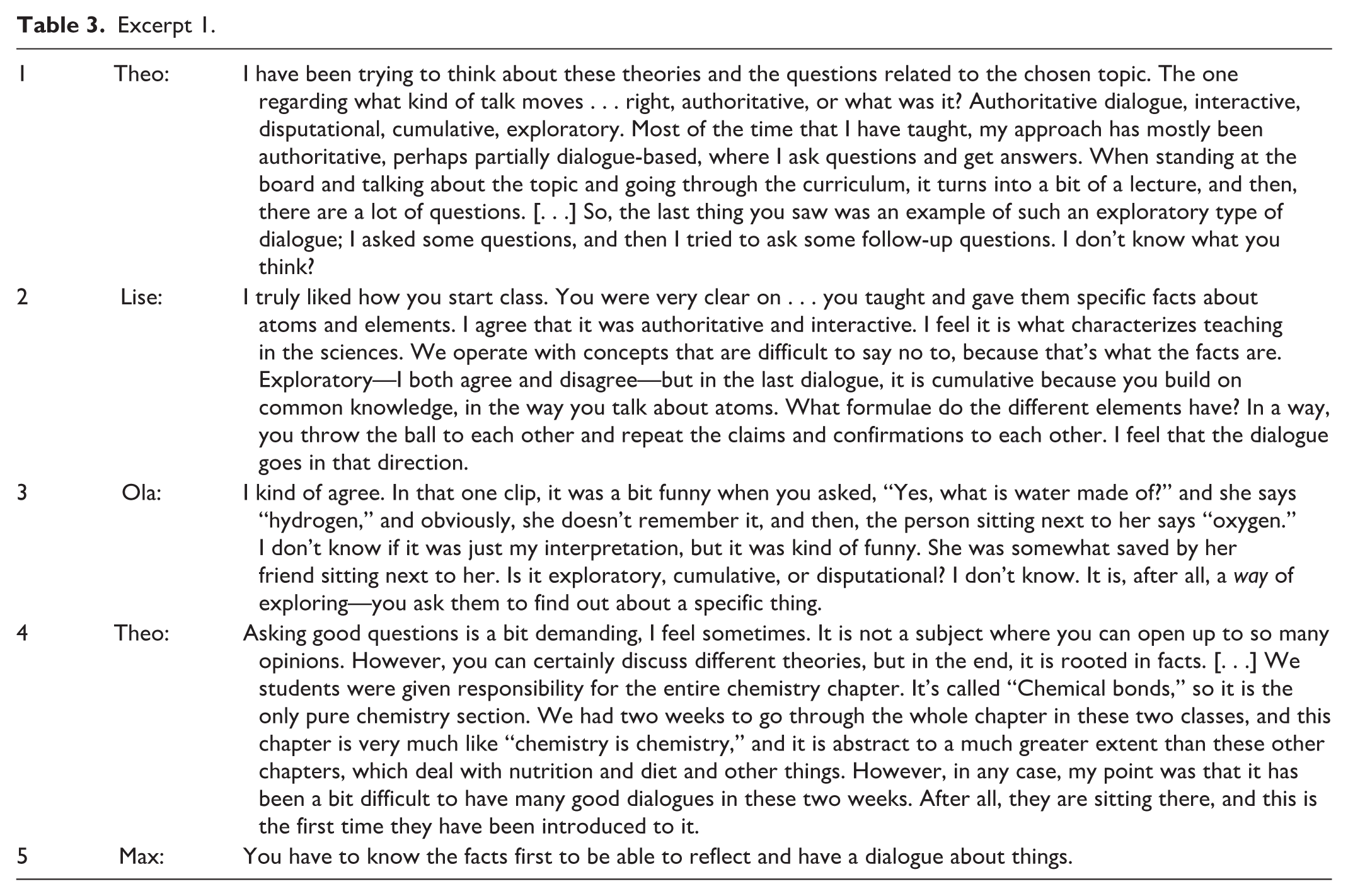
The first episode takes place after Theo shows his classroom video and the group starts discussing its content. Theo receives feedback on his video based on topics from the peer mentoring guide. After a few minutes, he says that he is finding it difficult to facilitate high-quality dialogues in the classroom. Just prior to Excerpt 1 (see Table 3), the group participants discuss their experiences from their practicum classrooms, and Theo then says, “but back to these questions [the guide] then.”
Excerpt 1.
Focus and Sensemaking—A Collective Exploration of Theoretical Concepts
In this excerpt, the students activate a set of theoretical concepts related to classroom discourse that they have explored during lectures, including authoritative, interactive, disputational, cumulative, and exploratory. The students maintain a shared focus on the classroom dialogue depicted in the video clip, building on each other’s utterances. They collectively recognize that the theoretical concepts discussed in relation to the video serve as the focal point of the conversation, as they all actively utilize a variety of these concepts in joint sensemaking, working toward a shared understanding of the classroom episode.
Substantive Content—Understanding Classroom Dialogues Through Theoretical Concepts
Focusing on the role of the theoretical concepts in the dialogue, we see that the students are attempting to grasp what is happening in the clip by employing theoretical concepts. Theo describes his teaching as authoritative, dialogue-based, and exploratory (1), and Lise describes Theo’s teaching as authoritative, interactive, and cumulative (2). In this sense, the concepts serve as tools for understanding and communicating what occurs in the clip. In addition, we observe that the students primarily employ these concepts in a way that indicates an assumed shared understanding of the concepts among the group, without providing explicit explanations of the concepts themselves. However, when the students advocate for their opinions on which pedagogical concepts to use when describing the teaching in the video clip, their understanding of the concepts is displayed in their arguments. For example, when Theo argues for his teaching being exploratory, he says “. . . I asked some questions, and then I tried to ask some follow-up questions” (1). Similarly, when Lise advocates for the teaching as cumulative, she remarks “In a way, you throw the ball to each other and repeat the claims and confirmations to each other” (2). When working with these concepts, the students are situated in the tension between using theoretical concepts that they are not very familiar with and using their own language to describe the situation. We argue that these two processes occur simultaneously: (a) the student-teachers using theoretical concepts when trying to achieve a mutual understanding of what is happening in the video clip and (b) the students exploring their use of theoretical concepts when applied to the situated setting in the video clip.
Substantive Content—The Interplay Between the Epistemic Nature of Science and Classroom Dialogues
Shifting the attention to the students’ focus on facts in science, we see that Lise introduces this topic by stating “We operate with concepts (in science) that are difficult to say no to, because that’s what the facts are” (2). Here, Lise conceptualizes science as inherently fact-based. Ola further emphasizes this fact-oriented focus when providing an example from a dialogue in the video clip where the teacher, Theo, asks a closed question that demands a factual answer: “What is water made of?” (3). In response to this, Theo reflects on the fact-based nature of the topic (chemical bonds) and explains why teaching this section of the science curriculum made it challenging for him to facilitate “good dialogues” during his practicum (4). Max concludes the conversation on facts and dialogues by saying, “You have to know the facts first to be able to reflect and have a dialogue about things.” Thus, the underlying argument emerging from the students’ discussion is that facilitating exploratory dialogues in science classrooms is challenging due to the fact-based nature of the subject. Furthermore, it seems that the theoretical concepts at play, applied to a real-life classroom scenario, fostered a discussion within the group about the epistemic nature of science and its impact and limitations for facilitating specific types of dialogue in teaching.
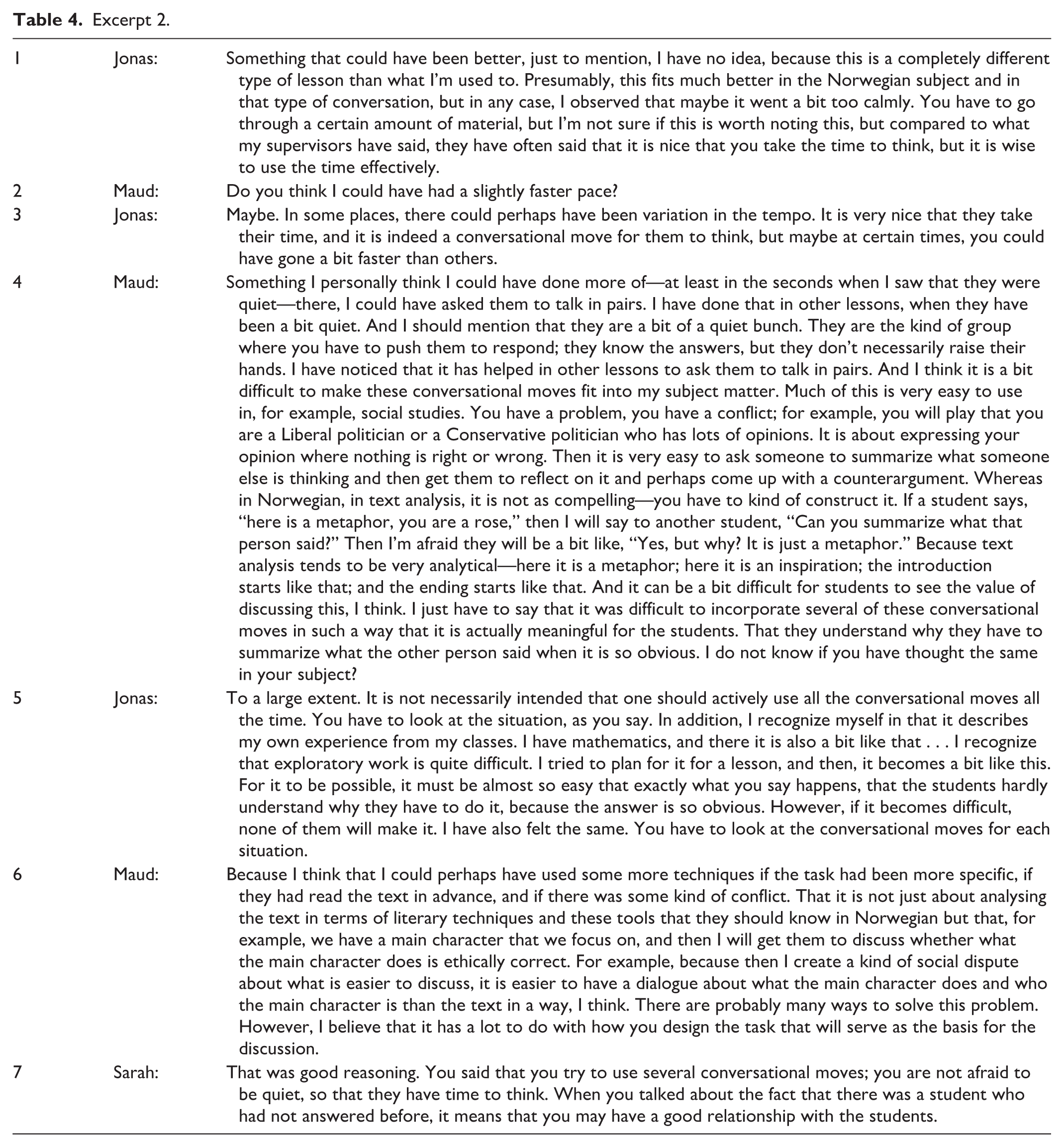
The second episode is selected from Group 2 and takes place after Maud has shown her video. Ahead of the episode, the group has discussed Sarah’s video, which is approximately 30 min into the peer mentoring conversation. In the excerpt (see Table 4), the group discusses Maud’s classroom video based on one of the last questions in the guide: “What could your fellow student have done differently?” Jonas is the first to talk.
Excerpt 2.
Focus and Joint Sensemaking—Collaborating to Explore the Applicability of Conversational Moves
Throughout the last excerpt, all of the students have a common focus on the question raised by the guide: “What could your fellow student have done differently?” However, while starting out with a shared attention on the video clip and conversational moves for improving dialogic teaching, Maud and her fellow students delve deeper into how these conversational moves apply across different subjects. Through this joint sensemaking, Maud ultimately realizes that it is not necessarily the inherent nature of the subject that limits the conversational moves’ applicability; rather, adjusting the task formulation could enhance dialogic teaching and the effective use of conversational moves within her subject (6).
Substantive Content—Theoretical Concepts as Tools for Gaining Situated Insights to Enhance Teaching Practice
Directing the attention to the role of the theoretical concepts and principles utilized by the students in the excerpt, we observe that the students make use of several of these in their conversation. Jonas begins by providing feedback on Maud’s dialogue with her students, noting that “the pace” is too slow (1). He then contrasts the conversational move of allowing students sufficient “time to think” with the pedagogical principle of “using time effectively,” emphasizing the importance of balancing these two elements for effective teaching. Jonas’ feedback prompts Maud to reflect on her use of conversational moves, leading her to consider suggestions for what she could have improved in her teaching, such as making use of the conversational move of “talking in pairs” (4). This demonstrates that the students initially concentrate on the past—examining what occurred in Maud’s video—before shifting their attention to the future—offering advice and reflecting on ways to enhance her teaching. However, the advice and reflection should not be regarded as generalized guidance; rather, they should be understood as situated insights that address what could be improved in this particular teaching sequence, considering the unique students and classroom dynamics depicted in the video clip. In discussing both the past and the future, the students draw upon theoretical concepts related to teaching. This illustrates that theoretical principles and concepts may not only aid in interpreting and understanding the enacted teaching but may also prompt students to activate new concepts that express ideas about how they can enhance their own situated teaching. Based on this, we argue that theoretical principles and concepts serve as a tool for potentially enhancing students’ teaching practice and, thus, for professional development.
Substantive Content—Applying Conversational Moves Within the Pedagogical Principle of Situatedness
Focusing on how the students explore the application of conversational moves across various subjects, we see that this discussion originates in Maud’s statement regarding her experience of finding it “difficult to make these conversational moves fit into her subject matter” (4). She argues that utilizing these conversational moves is easier in social studies than in Norwegian language arts and provides examples to support her view. In addition, she prompts Jonas to reflect on the applicability of conversational moves in his subject, maths, where he acknowledges that exploratory work can be challenging. He concludes that one must consider the conversational moves in relation to each specific situation (5). This illustrates that when students are encouraged to reflect on their use of conversational moves in the classroom and consider ways to improve their teaching, they may seek reasons for the challenges they encounter, grounding their reflections in the nature of specific subjects. In doing so, they indirectly engage with the pedagogical principle of situatedness.
Discussion
Through video observation of six groups of student-teachers, we explored student-teachers peer‑mentoring conversations about practice videos. By attending to the quality in these conversations, our study sheds new light on learning opportunities for student-teachers, addressing the call for research on participant-led groups by Mitchell et al. (2020) and quality in video-based discussions in teacher education by Lefstein et al. (2020) and Jenset (2024). Encouragingly, we found that student-teachers were largely able to conduct peer mentoring conversations with medium and high quality (only 21% rated as low), in part evidenced by their use of a specialized language incorporating formal concepts (Horn et al., 2017; Horn & Kane, 2015) during the discussions. The predefined pedagogical theme (classroom discourse) and the related conversation guide prompted the student-teachers to consider aspects of their teaching that they might not have otherwise reflected upon and explore and negotiate concepts that are not universally fixed but possess “meaning potential” (Horn & Kane, 2019; Linell, 2009).
One might object that this finding is circular: the learning design’s predefined pedagogical theme and the conversation guide provide student-teachers with the very concepts they subsequently reproduce in their dialogues. We contend, however, that the analytical framework’s emphasis on joint sensemaking transcends a reductive interpretation treating the conversations as mere superficial repetition of instructional terminology. In the episodes of medium and high quality, the student-teachers deploy both formal and lived concepts to interpret the video-recorded practice they themselves selected for analysis.
Struggling with theoretical concepts and principles is an essential part of professional development in teacher education. As student-teachers engage with concepts and principles, they find themselves situated in the tension between employing formal concepts with which they are only somewhat familiar and articulating the teaching practices they observe in their own language. As such, we contend that two simultaneous processes take place: (a) the student-teachers using formal concepts when striving to reach a shared understanding of the events depicted in the video clip, and (b) the student-teachers exploring how to apply formal concepts within the specific context in the video. Consequently, while the formal concepts act as a means to comprehend and articulate the occurrences in the video clip, the video clip functions as a tool to foster a developing understanding of the formal concepts being explored (Horn et al., 2017; Horn & Kane, 2015). Thus, the role of formal concepts extends beyond only interpreting teaching practices. They can also stimulate innovative ideas for improving student-teachers’ own situated practice.
The formal concepts afforded by the learning design and guide are crucial for enabling students to engage in high-quality conversations about teaching practices (in our case, the practice of classroom discourse). This is evidenced by our findings showing that low-quality episodes are more monological (Horn et al., 2017), characterized by participants’ personal experiences and spontaneous language (lived concepts; Horn & Kane, 2015) featuring superficial comments without elaboration or justification rather than connecting observations to generalized ideas about students, instruction, or content. The integration of a predefined theme, conceptual guides, and targeted questions alongside video clips of student-teachers’ own teaching practices played a crucial role in promoting focus and joint sensemaking in the peer discussions, fostering critical discussions connecting theoretical knowledge and students’ own experiences from practice.
This aligns with prior research that highlights the importance of a shared professional language and conceptual supports for making sense of complex instructional practice and for talking about it with specificity (Horn et al., 2017; Jenset, 2024; Zhang et al., 2011). The risk of relying on a loosely focused, everyday language using lived concepts is that precision diminishes, and it becomes harder to ascertain whether interlocutors are referring to the same phenomena. Employing a common language of formal concepts can facilitate focused, exploratory dialogue, which is essential for teachers’ learning. Providing student-teachers with learning opportunities that foreground the development of competence in engaging in such dialogical conversations (Horn et al., 2017) is therefore central to teacher education; without mastery of these dialogical practices, student-teachers will miss out on profound learning opportunities (Horn et al., 2017; Horn & Kane, 2015).
Given the multiple knowledge domains encompassed by teacher education and the complexity of learning to teach, it is unsurprising that high-quality professional conversations are difficult to master (Jenset, 2024). Still, the presence of numerous high and medium to high episodes in our data material demonstrates what student-teachers can achieve within the given conditions.
We argue that with the aforementioned support structures, the presence of an external facilitator in the form of a mentor teacher, teacher educator, or experienced teacher is not necessary to ensure that the conversations are focused on relevant events in the classroom (Knezic et al., 2019; Mitchell et al., 2020).
Although the affective and relational dimensions of video-based peer mentoring were not the primary focus of this study, they warrant consideration as potential obstacles to engagement. In our learning design, participation was voluntary, and the student-teachers therefore accepted a potential emotional risk. Voluntary participation also signaled a genuine interest in the video-based design, providing a constructive foundation for collaborative inquiry (van Es, 2012). We took several measures to reduce potential emotional barriers; participants retained full control over which video segments to share; the design promoted joint planning and explicit discussion of individual goals prior to recording. Furthermore, the peer mentoring conversation guide likely supported trust among participants (Kleinknecht & Schneider, 2013).
Implications
The findings of this study have implications for teacher education in several ways. First, steps should be taken to facilitate the ability of student-teachers to engage in high-quality conversations (Jenset, 2024; Sherin et al., 2009) in peer mentoring groups (or pairs) when analyzing classroom videos. Our study points to the importance of creating a coherent video-based learning design supporting the specific conceptual language use desired for student-teachers (Kang & van Es, 2019). The learning design should involve student-teachers being exposed to lectures and texts that introduce them to theoretical concepts they can employ to analyze classroom practice and ensure that they have access to structures and resources (e.g., a peer mentoring guide) that support the use of concepts in the peer mentoring conversation itself. Moreover, it is crucial that student-teachers are prepared for the task of peer mentoring, including the conduct of inquiry-based, dialogic conversations (Horn et al., 2017; Jenset, 2024; Sherin et al., 2009). Given the centrality of such interactions to professional learning, teacher education programs should offer opportunities to develop the processual competence required to facilitate them, with explicit instruction and guided practice in framing high-quality conversations, selecting productive foci, and constructively challenging and building on peers’ claims (Horn et al., 2017).
Peer mentoring holds considerable promise for teacher education institutions. Although the research on peer mentoring shows positive effects; these benefits are not yet widely realised in teacher education programs (Lu, 2010; Mitchell et al., 2020). Thus, our study therefore aligns with, and adds to, existing work calling for its more systematic and frequent use.
Limitations and Further Research
Like other studies, the current study has some limitations. First, we have data from one time point. Further research could include data from two or more time points to measure the development of student-teachers’ abilities to conduct high-quality conversations in peer mentoring arrangements. Second, the participants were candidates who had a master’s degree in a teaching subject and who participated in a 1-year teacher education program to become teachers. This suggests that our participants were highly educated and therefore likely to be relatively mature and competent, which may have influenced how they conducted peer mentoring conversations. Less experienced student teachers might have approached the task differently, and this remains an area for further research. In addition, we have extended and refined a framework introduced by Jenset (2024), originally designed to capture student-teachers’ conversations about instructional strategies, modifying it to target classroom discourse. A productive avenue for future research would be to adapt this framework to other aspects of instructional quality—for example, teachers’ feedback or classroom management.
Concluding Remarks
The present study points to some promising results regarding peer mentoring conversations in teacher education, indicating the importance of structural and conceptual support for student-teachers participating in peer mentoring conversations and showing that such support can be provided through a video-based learning design with related guides. The key contribution of the current study is that high-quality conversations can be conducted in participant-led groups and do not need to involve expert facilitators.
Footnotes
Declaration of Conflicting Interests
The authors declared no potential conflicts of interest with respect to the research, authorship, and/or publication of this article.
Funding
The authors disclosed receipt of the following financial support for the research, authorship, and/or publication of this article: This research received funding from the Norwegian Directorate for Higher Education and Skills, grant number AKTIV-2019/10253.
