




Abstract
Milner advances curriculum punishment as a tool to describe how students may be harmed with policy and practice moves in education. Curriculum punishment pushes students and curriculum apart—where practices do not connect with and align with rich and robust diversity among young people, families, and communities. Although curriculum practices should honor, reflect, speak from the point of view of, deepen knowledge about, nuance myopic and mundane notions of, and enhance student identity, motivation, interests, and needs, curriculum punishment does the opposite by presenting one-dimensional, under-substantiated, and untruthful narratives and themes of individuals, communities, and nation-states. Tenets that explicate practices that Milner describes through curriculum punishment are (a) Avoiding, (b) Scripting, (c) Narrowing, (d) Distorting, and (e) Banning. Although some of these practices are beyond the control of teachers, teachers are encouraged to Study, Collaborate with others about, Reflect on, Advocate against, and Transform (SCRAT) Curriculum Punishment.
Building on the work of others (Anderson, 1988; Banks, 2016; Duncan-Andrade, 2016; Eisner, 1994; Irvine, 1990; Ladson-Billings, 2000; Lee, 1995; Noguera, 2003; Siddle Walker, 1996; Tillman, 2004), I am introducing curriculum punishment 1 as a tool to understand, name, nuance, and describe how students and teachers may be harmed through intentional, unintentional, implicit, and overt policy and practice curriculum moves in districts, schools, and classrooms. In this commentary, my hope is that the language of curriculum punishment and related tenets of it can be a heuristic for teachers, teacher educators, researchers, and theorists interested in elucidating and transforming unjust curriculum practices. My motivation in advancing curriculum punishment is not meant to present teachers and teaching from a deficit perspective as most teachers do their best to meet the needs of an increasingly diverse community of learners. My aim is to provide a critical perspective on what some students experience; if teaching and curriculum practices are overly romanticized and not called out for how they may not work from some students, it can be difficult to co-construct spaces where all young people succeed in education. Curriculum practices should honor, reflect, and speak from the point of view among young people and their communties (Banks, 2016). Moreover, curriculum practices should deepen knowledge about, nuance myopic and mundane notions of, and enhance student identity and motivation. Curriculum punishment does the opposite by reifing injustice and maintaining an equitable status quo based.
Curriculum punishment is a dangerous practice that can penalize students (and teachers) whose worldviews and actions do not align with dominant values, attitudes, beliefs, worldviews, and dispositions. What makes curriculum punishment so pernicious is the sometimes-hidden nature of it. Teachers may not well be aware of how they are reifying harmful practices because they are so deeply ingrained in their everyday way of living, learning, and engaging the world. In this way, like racism in society (Bell, 1980), curriculum punishment is a normative feature of classroom life that is perpetuated by individuals who make systems designed to “keep classrooms safe” for dominant communities only. Moreover, curriculum punishment pushes students and learning opportunities apart through stale, under-substantiated, untruthful, and missed narratives that force young people to adapt to a curriculum that (a) does not meet their needs, (b) is dull and stress-induced, and (c) forces students to relinquish or at best negotiate aspects of their interests and identities daily in districts, schools, and classrooms. In short, curriculum punishment is a practice where young people (and teachers) are penalized for not being White, financially resourced, first language speaking, heterosexual, male, Christian, U.S.-born, formally educated, and generationally privileged.
Teachers engage in curriculum punishment intentionally and unintentionally. Curriculum punishment involves mishandling of power related to what students do and do not have an opportunity to learn. Power is mishandled among teachers even when they are practicing curriculum punishment unintentionally because as adults, they have a responsibility to critically examine their mindsets and beliefs to not harm young people through actions. Curriculum punishment can occur when teachers are not deliberately conscious of and deeply committed to co-constructing with students learning opportunities that cultivate and “unearth” joy (Muhammad, 2023) and reject spirit-murdering 2 (Love, 2019) among young people.
Because of the potential hidden nature of curriculum punishment practices, it is essential for teacher educators in preservice learning and school leaders in inservice professional learning to help teachers examine their mindsets, values, beliefs, attitudes, dispositions, and positions to recognize when, where, why, and how they are potentially contributing to the punishment of young people through curriculum practices. Such reflective processes are necessary because we know teachers’ beliefs about curriculum, instruction, assessment, and relationships can improve and change their practices (Gay, 2010; Howard, 2024; Lupo et al., 2024; Milner, 2008, 2012, 2020b, 2020c; Milner et al, 2019; Nasir, 2024).
As one way to contribute to the work of helping teachers and teacher educators address implicit and covert practices of curriculum punishment, I offer reflective questions we may consider in deepening knowledge and understanding about what we do and do not forward through curriculum. While I realize these reflective questions cannot solve deep-rooted attitudes, beliefs, mindsets, dispositions, and ultimately practices that penalize students for not being part of a dominant way of engaging in the world, I argue reflective questions can be one way to help them improve (Milner, 2003). Rather than solely engaging the questions herein, I am hopeful the questions will open the door for the posing and engagement of deeper, more context-specific questions among teachers, teacher educators, and researchers. To be clear, rather than outlining a range of recommendations detached from sociopolitical contexts to address curriculum punishment, instead, I believe we (researchers, theorists, teachers, and teacher educators) must engage in evolving questions that allow spaces of inquiry to address and disrupt curriculum punishment and our roles in perpetuating it. Indeed, educators are professionals, who when provided with tools they need, can (and should) make professional decisions and judgment in the best interest of all young people (Milner, 2024). Thus, these questions provide a framing mechanism for revised, more context-specific, questions as educators develop them with their own students, in their particular contexts, and within instutional structures specific to them.
Positionality
I argue researchers, commentators, theorists, and practitioner positionality is essential to the work of teaching and teacher education. Consumers and engagers of research, theory, policy, and practice need to know from whom findings, insights, critiques, and recommendations are emerging (Milner, 2007). As researchers are constructing and attempting to add to our knowledgebase, readers have a chance to assess, question, and confirm what is being forwarded as researchers share aspects of their identity, worldview, experiences, and contexts in relation to what is being addressed. In this way, positionality can be seen as a datapoint within itself for readers (Milner et al., 2024). Through rich and robust positionality, readers are able to make judgements about how and why research tools are used to gather data and how findings and interpretations are framed based on worldviews of researchers.
I am a Black man, husband, father, son, brother, and professor of education. As a former high school English teacher, substitute teacher across PreK–12, and community college instructor in Developmental Studies, I have spent hundreds of observing and interviewing teachers, young people, caregivers, policymakers, and leaders about their work in education since 1998. The very core of my doctoral studies at The Ohio State University was in curriculum studies; thus, the foundation of my inquiry has been curriculum and the role of educators—especially teachers in making decisions about what students have an opportunity to learn inside and outside of school, particularly those most marginalized and minoritized. It is from my years of systematically studying curriculum and curriculum practices through document analyses, interviewing and observing educators, and from the work of others as described above that I developed and advance this framework and tenets of curriculum punishment. My experiences as a practitioner and working with educators in schools and communities have shaped my desire to not only critique current realities but provided recommendations for transformation. In the final sections of this article, I encourage teachers and teacher educators to study, collaborate with others about, reflect on, advocate against, and transform (SCRAT) curriculum punishment to address the proliferation of punishment practices in education and the United States of America.
Proliferation of Punishment Practices
Punishment practices are commonplace in education although they are often masked with the language of attempts to build discipline (Duncan-Andrade, 2016; Milner, 2020a; Noguera, 2003). For instance, punishment is pervasive in pushout practices (Bell & Puckett, 2023; Morris, 2016; Snapp et al., 2022) where young people, particularly students of color (Johnston-Goodstar et al., 2022; Losen & Martinez, 2020; Marcucci & Elmesky, 2023; Owens, 2022; Williams et al., 2023), girls (Annamma et al., 2019; Farinde-Wu et al., 2022), and those with disabilities (Jenkins et al., 2022; Welsh, 2022) are referred to the office and subsequently suspended (Chu & Ready, 2018) and expelled (Owens & McLanahan, 2020; Pigott et al., 2018). Other examples of punishment practices are detention practices (Welsh, 2023; Wiley et al., 2022), and punishments where students must miss recess, and receive point and percentage deductions on class assignments for a range of reasons (Milner, 2023). It is well established that so many punishment practices contribute to what has been described as a school to prison pipeline (Gardner, et al 2024; Milner et al, 2019; Sealy-Ruiz, 2011).
Haberman (1991) in discussing what he called “pedagogy of poverty” explained how and why punishment practices abound, particularly in urban schools with large numbers of young people living below the poverty line. Punishment and rewards were described as a tool students and teachers used in hopes of maintaining order. For instance, noncompliance—that is, not following rules and predetermined expectations—was punished while compliance was often viewed as behavior to be rewarded. Haberman (1991) is clear that pedagogy of poverty reinforces power to control bodies and minds of young people in schools through unresponsive curriculum and teaching practices. In my view, Haberman was describing what might be called pedagogical punishment practices with his description of harmful teaching practices of pedagogy of poverty. Building on Haberman’s work, Hill-Jackson et al. (2019) have forwarded disposition recommendation that support student learning and development. Clear and logical connections can be made about intersections of teaching and curriculum. While pedagogy is a conceptual tool to describe teaching practices—that is how curriculum is taught, in this commentary, I am focused squarely on curriculum practices—what students are taught or exposed to in districts, schools, and classrooms over time and space.
While practices described above are well-documented in extant literature, curriculum 3 practices are also sites of punishment. Although teachers tend to have good intentions, unexamined beliefs, mindsets, dispositions, and attitudes can result in curriculum punishment in practice. Some aspects of curriculum punishment are proliferated on a macro-level and are beyond the scope of teachers’ power and control. For instance, mandates and policies of book banning rarely fall under the authority of teachers’ control on a micro (classroom) or meso (school) level. In this sense, when teachers are forced to adhere to book bans outside of their own control, curriculum commitments, decisions, and judgments, these teachers are experiencing a form of punishment themselves. However, some of the practices I describe herein are in fact within the control of teachers.
In short, at times, teachers may ban books through curriculum practices because they do not align with their worldview or belief system about what should and could be part of curriculum. Rather, than pretending that all teachers are against the banning of developmentally appropriate books, curriculum punishment can also be described as one that manifests through teachers and teaching practices that support and advance book banning. Haberman (1991) and Hill-Jackson et al. (2019) point to teacher disposition—their mindsets about what should and should not be taught and enacted in districts, schools, and classrooms.
When policies are passed down to teachers that promote curriculum punishment, teachers must be aware of the potency of such practices that may result in curriculum punishment—practices that may be (a) violent and traumatizing to young people, (b) dehumanizing and demoralizing, (c) marginalizing, disrespectful, disregarding, and degrading, and (d) unaligned with diverse and dynamic assets, values, worldviews, needs, and experiences of minoritized communities. These minoritized communities tend to be those of color, those living below the poverty line, those with disabilities, those whose first language is not English, those who are LGBTQIA+, and those who are Muslim and immigrant students. Next, I reiterate what curriculum punishment is and describe five tenets of it.
Curriculum Punishment Framework
Curriculum punishment happens when Black and other students of color are punished for being partially and fully outside of dominant communities. Curriculum punishment demands that students assimilate, erase their identities and worldviews, change themselves, code and culture shift, and negotiate what matters most to them in what they have an opportunity to learn. Rather than only describing what curriculum punishment is, I attempt to capture features of curriculum punishment next as a way to illuminate the ways in curriculum punishment may manifest: avoiding, scripting, narrowing, distorting, and banning.
I share interrelated questions intended to help teachers and other educators, who are professionals, engage in aspects of introspection that can lead to opportunity-centered decision-making. Rather than teachers being told what to do, they should develop a framework for interrogating their practices in context to develop the kinds of practices that align with what students deserve (and need) to learn. I attempt to capture elements of the tenets I describe in this commenatary in Table 1. I am hopeful that this table is used to help educators, especially teachers and teacher educators think through their work and how they will examine and more deeply understand what they do and not in curriculum practices. In addition to practitioners, researchers of curriculum, punishment, and equity might draw from this framework and features of it to describe policy and educator practices. Ultimately, I am hopeful that describing curriculum as a site of punishment might bring to the fore what is implicit and covert in practices that need to be illuminated and transformed. Furthermore, I hope Table 1 helps teachers think about their role and authority in mandated decision makers that may feel outside of their control. Teacher educators, too, may find the table helpful in examining their own practices and use the table in discussions and engagement with pre- and inservice educators.
Curriculum Punishment Tenets and Reflective Questions.

Avoiding
Although aspects of curriculum punishment may occur on a macro-level where teachers have little control over what is being taught, avoiding occurs when curriculum is available and perhaps even expected to be taught but is circumvented. This avoidance may be deliberate or not. Eisner (1994) has described a null curriculum—what is not covered as learning opportunities for students. Eisner stressed students are learning when teachers avoid curriculum content. Curriculum practices are sites of punishment when they are void of potentially transformative learning opportunities for any group of students. For instance, when teachers deliberately or unconsciously avoid teaching books, essays, or short stories in English Language Arts or sections in a history text with themes of race, racism, slavery, sexism, women’s suffrage, islamophobia, Black Wall Street and the Tulsa, Oklahoma Massacre, or the holocaust, they are potentially engaged in curriculum punishment because students’ whose identities align with these themes are being punished by such avoidance. In my own research, I have found powerful benefits of learning about such issues, not only for those whose identities are most connected to avoided curriculum practices but for others as well (Milner, 2020a, 2023).
To address curriculum punishment as avoiding, teachers and teacher educators might consider grappling with questions like:
What content do I feel most efficacious about and comfortable with teaching and why?
How much time (if any) do I spend on content and subject matter that I do not feel most knowledgeable about or that I do not believe is most important?
As I examine and study available and/or expected curriculum, what content has not been covered and why?
How do I hold myself more accountable in understanding and addressing content that has been avoided in the past?
In what ways do the contexts of my teaching, as well as identity and demography of my students connect to avoided curriculum practices, and how do I address avoidance and potential punishment with the power that I do have?
Scripting
Districts across the United States continue developing and enforcing policies where teachers are expected to follow scripted curriculum. By scripted curriculum, I am referring to a predeveloped set of managed curriculum tools and guidelines that explicitly direct teachers on what to teach, when to teach it, how to teach what is taught, and how to assess and evaluate learning from a standardized curriculum (Ede, 2006; Milner, 2012). The belief is that scripted curriculum practices can ensure all students are exposed to the same practices regardless of where they live, what they already know and are able to do, their interests, their experiences, their motivations, their needs, or their propensity to deepen their knowledge in one subject area over another. Scripted curriculum is especially common and pervasive in urban and high-poverty schools, where a central aim is to increase student test score performance (Mathis, 2012; Milner, 2023). As noted, students in these schools are typically students of color, students whose first language is not English, and/or students who live below the poverty line. Scripting can be seen as a form of curriculum punishment because others (policymakers who are too often disconnected from young people and their contexts) script what is taught. However, what about learning opportunities that students deserve that never show up or are not prioritized on standardized tests where scripted curriculum is commonplace? Ede (2006) cautioned against “test-driven” [scripted] curriculum approaches where “rote memorization” takes precedence over critical thinking, creativity, innovation, and other forms of expression among students. Furthermore, teachers are not given autonomy or professional authority to make decisions necessary to meet the needs of their students. To be clear, teachers know their students and their needs in ways that a committee outside of a particular school could ever know in deciding what should be taught. In this sense, scripting is a dimension of curriculum punishment not only for students but teachers, too. Thus, teachers must rely on their own professional judgment to address this type of punishment as they are working through scripting.
Scripted curriculum can suggest to the public that teachers are automatons rather than professionals able to solve complex problems of teaching and learning they encounter. In other professions, such as medicine, engineering, and law, professionals are expected to be able to learn from the particulars of their working conditions and use their professional knowledge and judgment in responding to strengths and challenges they encounter. When educated and supported with relevant supports, teaching should be trusted to move beyond scripts and rely on their professional judgment for curriculum practices.
To address curriculum punishment as scripting, teachers and teacher educators might consider grappling with questions like:
Who decides the content of the scripts and what can, cannot, will, or will not be covered in a curriculum?
How do I study curriculum scripts to consider how they may or may not be relevant to or respond to idiosyncrasies of my teaching context?
What do I need to negotiate and discuss with leadership in my school to revise scripts to best meet complex needs of my students?
What level of authority and control do I have to improve, revise, and adapt scripts for the benefit of my students?
In what ways do the contexts of my teaching, as well as identity and demography of my students connect to scripted curriculum practices, and how do I address scripting and potential punishment with the power that I do have?
Narrowing
Narrowing of the curriculum refers to the reduction of curriculum content covered to focus in more specifically on subject areas to the decrease or exclusion of other areas. Curriculum narrowing tends to lean heavily toward mathematics and language arts to the possible exclusion of other important subjects and areas of focus such as music, art, social studies, and physical education. However, narrowed curriculum practices can be a form of punishment for students as they are not able to grapple with and address deeply troubling issues that can help improve human conditions, particularly communities they align with and care deeply about. Curriculum narrowing can serve as a punishment site for students and teachers as students miss learning opportunities and teachers are not able to maximize a fuller range of curriculum content. Notably, curriculum narrowing can be a function of policymakers as well as teachers in the decision-making process—as teachers may also decide that certain content areas are not important for students, particularly if they are not well connected with standardized testing or if teachers do not feel prepared to cover particular content.
To address curriculum punishment as narrowing, teachers and teacher educators might consider grappling with questions like:
In what ways can I use my professional judgment and power to resist curriculum narrowing in my work with students to develop wider, more diverse and inclusive access to subjects?
In what ways does curriculum narrowing de-professionalize and de-skill my work as a teacher and the teaching profession more broadly?
How might I create learning opportunities that students miss via narrowed curriculum in content allowed to teach?
What are potential consequences (such as high blood pressure and high cholesterol among youth) of curriculum narrowing that may emerge due to decreases in health education, physical education, and recess?
In what ways do the contexts of my teaching, as well as identity and demography of my students connect to narrowing curriculum practices, and how do I address narrowing and potential punishment with the power that I do have?
Distorting
Curriculum punishment can also manifest through misrepresentation and manipulation of curriculum. Such practices—where young people experience curriculum that misrepresents history, for instance, punishes students and may send the message that somehow their community or ancestors are to blame for horrific historical or current realities. Distortion can manifest in how the curriculum itself is written; for instance, when enslaved Africans are portrayed as joyful or when women are viewed in texts as jovially working in servitude to men, there can be a level of psychological punishment for students whose identities connect with such harmful representation. Teachers play an enormous role in how established, written curriculum in texts and other curriculum documents such as movies and artifacts are presented and represented with students. For instance, distortion as a site of punishment may intensify when teachers do not help students critically examine what they read, see, or hear in curriculum. But to be sure, all students are punished when curriculum practices advance lies.
To address curriculum punishment as distorting, teachers and teacher educators might consider grappling with questions like:
What role do I play in ensuring that truth remain central to curriculum practices?
How do I help students develop analytic and critical thinking skills to examine what they read, see, and hear and not accept and embrace untruths that perpetuate and maintain an unjust status quo?
How do I build my own knowledge and understandings so that I am able to recognize when lies are being advanced through curriculum?
What is necessary for students to bridge and counter troubling curriculum practices with their own accounts, worldviews, and experiences?
In what ways do the contexts of my teaching, as well as identity and demography of my students connect to distorting curriculum practices, and how do I address distorting and potential punishment with the power that I do have?
Banning
Curriculum punishment is also pervasive in banning practices. While banning decisions may be decided outside of the control of practicing teachers, we all need to be mindful of how bans may punish students. Punishment is especially prevalent when books are banned, for instance, that help minoritized students find identity connections, build self and community affirmation, and develop insights about historical and contemporary perspectives that they may not have considered, been taught, or been exposed to through curriculum practices. In this way, teachers must understand what curriculum is being banned away from curriculum and how that subject matter and content may adversely impact students placed on the margins of learning and development. Of course, students who are most negatively impacted by banning are students of color, girls, and LGBTQIA+ students.
To address curriculum punishment as banning, teachers and teacher educators might consider grappling with questions like:
In school communities, who decides what can, cannot, will, or will not be banned?
How can I work with young people, parents, families, and communities to receive their feedback on books and curriculum-related bans?
How do I work with colleagues to study how book bans (and censorship) impact student learning and development?
What is my role, if any, as teacher in understanding and promoting potential salient and developmentally appropriate themes and curriculum not included in curriculum due to bans?
In what ways do the contexts of my teaching, as well as identity and demography of my students connect to banning curriculum practices, and how do I address banning and potential punishment with the power that I do have?
Recommendations for Teaching and Teacher Education
Teacher education and teacher educators play an important role in helping teachers understand potential curriculum punishment—both preservice and inservice. As individual teacher educators and as collective teacher educators who design policies and enact practices in teacher education programs, I recommend five ongoing, iterative, and dynamic practices to address curriculum punishment: (a) Study, (b) Collaborate, (c) Reflect, (d) Advocate, and (e) Transform (SCRAT).
Study: teacher education programs have an opportunity to cultivate teachers who study their work (their curriculum practices, teaching practices, assessment practices, relationships with students and families, and their intersections). Furthermore, teachers need to continuously investigate what we know about good teaching across diverse learning spaces from extant literature throughout the course of their careers. For instance, because curriculum punishment is pervasive but sometimes covert and not named, developing mechanisms to study how curriculum impacts students is essential. Developing tools and habits of asking students how they are experiencing learning opportunities is a foundational aspect of studying their work.
Collaborate: because teachers tend to do their work in their own classrooms with students, teacher educators must help teachers cultivate collaborations with their teacher colleagues as well as families and communities who care about their students. Collaboration and partnership, where trusting relationships are developed and carried forward allow teachers to solicit and hear feedback from others who may see potential damaging curriculum practices, without teachers feeling vulnerable to administrative retribution.
Reflect: teacher education should also model and encourage reflective practices among teachers. Providing teachers with opportunities to think about how they may have experienced curriculum punishment as students themselves in PreK–12 spaces is an important aspect of the kinds of introspection that can lead to change. In addition, providing teachers opportunities to examine their own practices in practicum and student teaching experiences in preservice teacher education and P-12 in inservice can help them be deliberate about and consistent in ensuring all students experience the types of learning opportunities they deserve. Reflection is not only about what teachers do but what they believe: their values, political positions, and preferences. Questions similar to those posed herein can be important tools for teachers to reflect and get better.
Advocate: teacher educators must also help teachers learn how to advocate for what they know is necessary for students to experience a robust, powerful, engaging, and opportunity-centered curriculum. Teachers also need to know what (and when) to advocate against – such as curriculum punishment. In climates where teachers are increasingly being ostracized and criticized, teachers may believe their voices are not heard, respected, or accepted. Teachers need tools to understand how to navigate tough political ecosystems while advocating for students to learn and develop over time.
Transform: as teachers are developing new ways of knowing and understanding their work through studying, collaborating, reflecting, and advocating, they must also develop insights about how to change curriculum work. Teachers—particularly early career ones—must be equipped to know what to do with new and expanded knowledge about curriculum in practice. For instance, discussions about curriculum punishment go for naught if teachers do not change what they do, by transforming how they think about and what they do in curriculum work.
While I present these recommendations as those that should be conceptualized and forwarded in and through teacher education programs, SCRAT is also essential for teacher educators themselves. In short, teachers can experience curriculum punishment even in teacher education programs as well. Although some of the issues related to curriculum punishment I share in this commentary are decided by policymakers and decision makers other than teachers, teachers do have some control and authority over what happens in their classroom. Teacher education programs must help teachers use their professional judgment in traversing these very difficult times in education. Figure 1 shows a flow of what teacher educators can do to help teachers build tools to disrupt curriculum punishment, both preservice and inservice. These recommendations in SCRAT are not linear but should be considered as iterative, interconnected, and dynamic—all with a commitment to better understand and disrupt potential curriculum punishment.
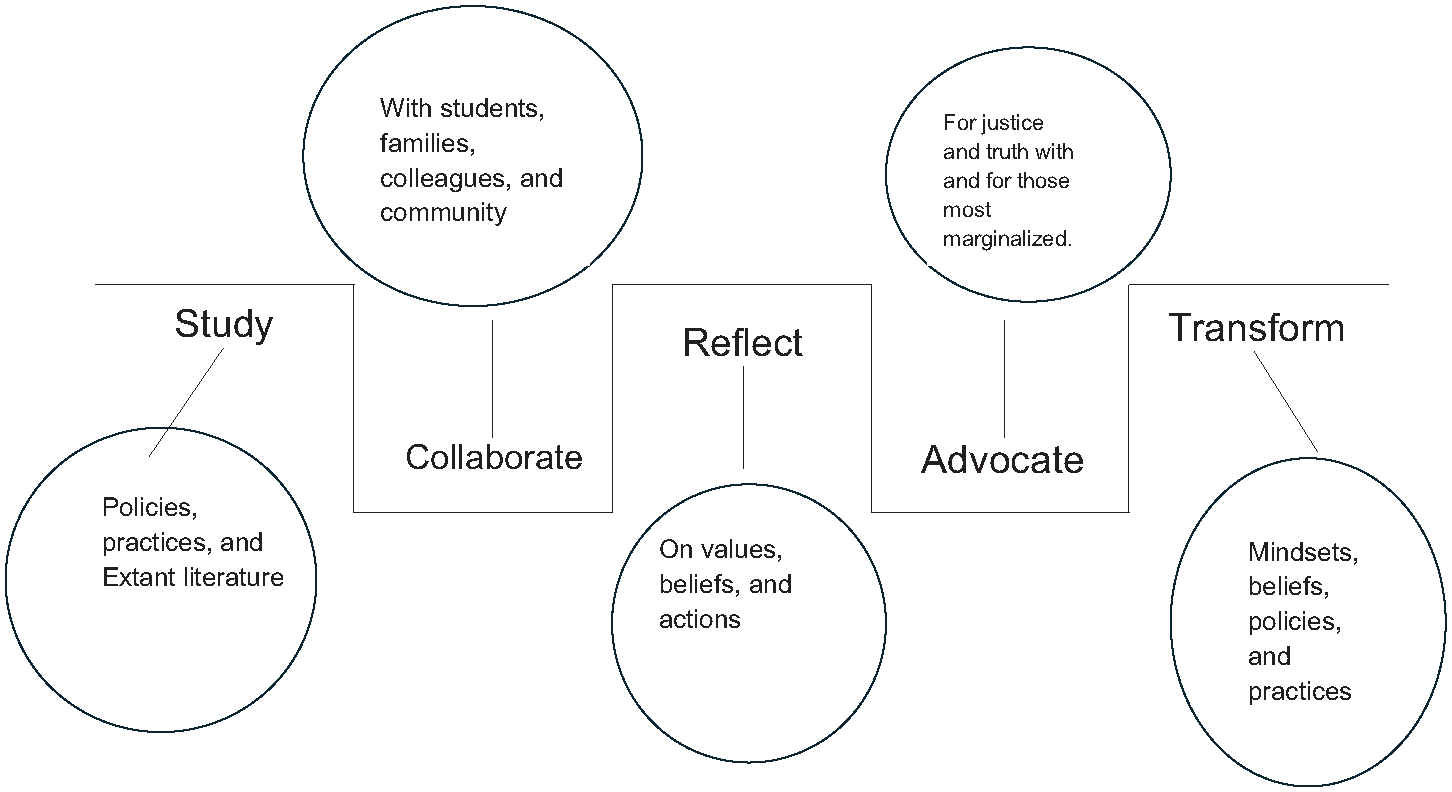
Study, Collaborate, Reflect, Advocate, and Transform (SCRAT) Curriculum Punishment.
Summary and Conclusion
What I am describing in this commentary may be used as analytic frameworks to support teachers, teacher educators, and those studying teaching and teacher education in their work of understanding, naming, and addressing curriculum punishment. I argue we must continue naming curriculum practices that ostracize, undermine, devalue, and marginalize individuals and communities not to present teachers and teaching as deficit but to be critical of practices that can have lasting effects on young people. As we work to identify and stop curriculum punishment in all forms, I hope this framework contributes to deep introspection and reflection for teachers, teacher educators, researchers, and theorists as McDonough et al. (2023) reminded us: “hindsight is instructive, and time will demonstrate that teacher education’s turn to embrace equity places the field on the right side of history” (p. 297).
Footnotes
Declaration of Conflicting Interests
The author(s) declared no potential conflicts of interest with respect to the research, authorship, and/or publication of this article.
Funding
The author(s) received no financial support for the research, authorship, and/or publication of this article.
