




Abstract
This critical qualitative inquiry employed a Disability Critical Race Studies Counter-Narrative framework (DCCN) to explore the contrast between educator and Black student understandings of the special education placement process and their implications. Interviews with 21 members of school personnel and 20 Black students between the ages of 14 and 18 were cross-referenced to narratively reconstruct the special education placement process in Quebec, Canada. Analysis of the results reveals a striking gap between educator and student understandings of the process, which can be linked to adverse student experiences. Subsequently, implications for enhancing educators’ knowledge of diverse learners and professional practices are discussed.
Keywords
Introduction
A fundamental purpose of special education is to deliver adapted educational services that produce equitable outcomes for students designated with “special needs,” yet it is unclear whether this goal is being met for all students (Harry & Klingner, 2022). In Quebec, students designated with special needs persistently experience challenges when it comes to academic performance, high school graduation and drop-out rates, as well as postsecondary access and options (Ministère de l’Éducation [MEQ], 1999; Ministère de l’Éducation et de l’Enseignement Supérieur, 2017; Tremblay, 2017). In parallel, racially minoritized students, who face similar academic challenges, are overrepresented among the special needs population (Livingstone & Weinfeld, 2017; Mc Andrew & Ledent, 2008), a trend that coincides with international findings (Cooc & Kiru, 2018; Gabel et al., 2009). The overlap of these two postulates may serve as a reliable indicator of educational inequity. However, whereas “disability has been [relatively] excluded from discussions concerning unequal and discriminatory treatment” (Liasidou, 2014, p. 724), in Quebec, the consideration of race has been neglected in a similar fashion, especially in contrast to the U.S., where comprehensive theoretical frameworks have been developed.
With the purpose of better-understanding inequities based on race and disability, the global phenomenon of racial disproportionality in special education, and enhancing professional practices when it comes to fostering safe spaces for all students, the aim of this critical qualitative study is to explore the special education placement process in Quebec, with a focus on the Black student experience. A Disability Critical Race Studies-Counter-Narrative (DCCN) theoretical and methodological framework guided the inquiry involving 21 members of school personnel and 20 students who self-identified as Black. These anchors made it possible to account for the interdependence of race and disability absent from the Quebec body of educational research, to highlight the convergences and divergences between personnel and student understandings of the special education placement process and the associated implications, and to identify avenues for improving educators’ knowledge of diverse learners and equitable professional practices. Prior to detailing these elements, a general socio-political contextualization of special education will be presented, as well as a brief overview of special education disproportionality in Quebec.
Special Education and the Placement Process in Quebec
From a socio-political perspective, special education in Quebec is conceived as a means of promoting and ensuring common educational opportunities and services for all students, including those with disabilities. It is achieved through a “mainstreaming” (intégration) policy (MEQ, 1999), reliant on a psycho-medical approach, which advocates the most beneficial educational learning environments for students with disabilities. The options for such educational learning environments include (1) integrated and (2) non-integrated settings. Integrated settings consist of schooling in regular schools and classes, with accommodations and adaptations provided according to student needs. Non-integrated settings include home schools, hospitals, as well as “special classes” (classes spécialisées) contained in regular schools and “special schools” (écoles spécialisées) which are entirely designated to students with special needs as institutionally determined. Special schools tend to have significantly lower staff–student ratios, more specialized services (e.g., psychoeducational specialists, speech and language therapists, and behavioral technicians), and a generally more intimate and controlled environment.
In compliance with the Adapting Our Schools to the Needs of All Students special education policy (MEQ, 1999), which promotes fostering success through integration, prevention, early intervention, and evaluation practices, placement in both integrated and non-integrated environments is deployed as a complex process involving multiple school actors. Four placement phases have been identified: (1) the referral phase, which corresponds to requests made by school personnel for complementary educational services based on their own observations; (2) the implication of (at least one) complementary services professional, typically involving the assessment of student needs and the related procedures; (3) the professional reports phase, in which various evaluation conclusions are made; and, (4) the decision-making phase, which concerns student identification as having special needs, and the mobilization of support services and/or placement options (Collins & Borri-Anadon, 2021). While special education and the associated placement process are conceived as equity and inclusivity ensuring, many researchers have consistently raised concerns about whether this is achieved or even negated (Dunn, 1968; Skiba et al., 2016), notably as it relates to the overrepresentation of Black students in special education programs (James & Turner, 2017; Mc Andrew & Ledent, 2008).
Overrepresented Students in Special Education
Special education overrepresentation involves identification rates of specific social groups that are proportionally higher than expected based on their overall representation in the student body (Gabel et al., 2009). It constitutes a complex international phenomenon (Cooc & Kiru, 2018) that “provides the opportunity to examine educational inequities for particular groups of students that are shaped by macro and micro forces” (Waitoller et al., 2010, p. 29). More specifically, racially minoritized groups tend to be overrepresented in certain special needs categories, resulting in their unjustified exclusion from mainstream education.
In Quebec, the research aligns with the international portrait, though documented to a much lesser extent. According to data from one of the only statistical studies ever conducted concerning Black students in special education, they are overrepresented in terms of special needs designation, placement in non-integrated special classrooms, as well as placement in non-integrated special schools more than any other group (Mc Andrew & Ledent, 2008). Since educational data is organized linguistically and collected based on immigrant status—in the French sector—Black students (an inferred category based on the Caribbean and/or sub-Saharan African country of origin) were represented at a rate of 14.8% in special education, which is not significantly different from the general population (12.6%). However, Black Creole-speaking students from the Caribbean specifically were represented at a rate of 17.8%. These students also made up the largest group to be placed in non-integrated settings (14.8%) compared to the general population (8.9%) and immigrant groups combined (6.4%). In the English sector, the representation of Black students in special education was relatively more significant. They were represented at a rate of 19.8%, in contrast to the total population and the combined immigrant population, with representation rates of 16.3% and 10.8%, respectively (Mc Andrew & Ledent, 2008).
The effect of this overrepresentation qualifies them as the most “at-risk” student group for high school non-completion (Mc Andrew & Ledent, 2008) and is equally associated with a perceived sense of discrimination and exclusion (Magnan et al., 2019), relegation to the general adult education sector (Potvin & Leclercq, 2014), and underrepresentation in terms of access to, and completion of postsecondary education (Kamanzi & Collins, 2018). Although partial, these findings are also consistent with federal data on the graduation rates of these groups (Turcotte, 2019) and demonstrate the importance of better understanding the special education placement processes when it comes to Black students.
Toward a Transborder DisCrit Counter-Narrative Framework
Since race-based data is limited in Quebec, it is unsurprising that a related theoretical framework is non-existent. Drawing from critical theories from the United States and other parts of Canada, this analysis of the special education placement process is inspired by those applied to education, with an accentuated focus on disability, race, blackness, and their intersections including disability studies (Connor et al., 2008), critical race theory (Ladson-Billings & Tate, 1995), intersectionality theory (Crenshaw, 1991), and critical Black theory (Dumas & ross, 2016). I specifically use an amalgamated Disability Critical Race Studies Counter-Narrative (DCCN) framework (Annamma et al., 2016; Solórzano & Yosso, 2002), an original combination within the context of Quebec, to meet the objectives of foregrounding Black students’ experiences and analyzing them in interaction with institutional, systemic, and structural barriers throughout the special education placement process.
In a very general sense, disability studies seek to understand and challenge social, political, cultural, and historical aspects of disability and how they relate to the lived experiences of people with disabilities (Oliver & Barnes, 2012). While one of the key areas of questioning within disability studies is the ideology of normalcy (Wolbring, 2008), critical scholars have in turn critiqued the normalization of whiteness within the field and the marginalization of the experiences and scholarly contributions of people with disabilities who are not white (Bell, 2010; Schalk & Kim, 2020). Hence, Disability Critical Race Studies (DisCrit) facilitates an intersectional approach to analysis by addressing how disability and race mutually inform and reinforce each other, how ableism and racism are insidiously embedded into institutional policies, practices, procedures, and discourses, and how students with disabilities or designated as having special needs are affected in their everyday lives (Annamma et al., 2016). Along the same lines, counter-narration restores storytelling traditions among racially minoritized communities and repositions “othered” types of knowledge from unscientific or folklore to a valid contribution to research and theory (Dei, 2013; Solórzano & Yosso, 2002). Both frameworks recognize the historical and ongoing repression and erasure of the individuals and communities concerned, as well as the necessity of creating an arena to question dominant assumptions and offer alternative explanations to prevailing issues.
Therefore, from a DCCN lens, the special education placement process constitutes a series of dislocating practices (Adams & Erevelles, 2016) that conceal dominant ideologies and enable deficit-perspectives, cultural and racial biases, and “othering” to pass as normal everydayness carried out by well-intended practitioners. According to Harry and Klingner (2022): . . .the process of determining children’s eligibility for special education is anything but a science. Rather, it is the result of social forces that intertwine to construct an identity of “disability” for children whom the regular education system finds too difficult to serve (p.9).
The acts of referring, assessing, identifying, and placing students in special education, and mobilizing services for them, all reflect social processes that reinforce each other while reifying a newly constructed identity of difference for students, based on dominant ideologies that present these social constructions as biological facts based on credible evidence. This is not very different from how race has been historically broached and thus points to the interdependence of these two social constructions of inferiority and how they meld to sustain racial and ability hierarchies.
Further, in light of the historical invalidation and exclusion of those positioned as “other” in academic research, DCCN underscores the importance of recognizing that members of minoritized communities are indeed carriers of knowledge and valid points of view. This notion holds regardless of their national or racial origin, social class, level of education, or their mastery of an official language. Yosso (2005) argues that marginalized communities have cultural capital that is often underestimated and devalued. In fact, very often historically excluded communities are not consulted and their conceptions of social and political issues are considered insignificant and sidelined. Even when forums for dialogue are set up, their voices carry little weight, and their perspectives are often diluted in decision-making processes, or are invalidated entirely (Kozleski et al., 2020). We are therefore invited to understand “ways students respond to injustices (i.e., being constructed as deficient, or being segregated and stigmatized) through fostering or attending to counter-narratives and explicitly reading these stories against the grain of master-narratives” (Annamma et al., 2016, p. 13) without paternalistically “giving voice.” We are also encouraged to highlight student interpretations of their own counter-narratives. Solórzano and Yosso (2002) suggest that counter-narratives serve this purpose as a theoretical framework based on “(a) the data gathered from the research process itself, (b) the existing literature on the topic(s), (c) our own professional experiences, and (d) our own personal experiences” (p. 34). DCCN can also serve as a research method, which will be elaborated in the following section.
Methodology
In coherence with the theoretical anchors of this research, a critical qualitative approach was employed to explore the experiences of Black students throughout the special education placement process. Critical researchers are called upon to undertake a continuous self-reflexive process regarding the role of their own beliefs, experiences, and social location in the research project, to conduct the research from deeper levels of consciousness and care, even when they belong to the community concerned in the research (Jean-Pierre & Collins, 2022). As an Afro-descendant researcher with a background as an educator in special education, I consider my position to be that of both insider and outsider. I therefore recognize that my position of authority comes with privileges and resources that may be inaccessible to others in the Black and disability communities. Accountability and reciprocity have therefore been at the forefront of every decision made regarding this research, notably as it pertains to freedom from harm, extraction, and exploitation. It is my belief that a DCCN method is one tool that supports this reflection.
Counter-narratives as a method within the scope of DisCrit facilitate the questioning of dominant assumptions that invalidate or exclude the knowledge and experiences of minoritized groups, and uphold and legitimize unequal, inequitable, and unjust social power relations, which manifest as a master-narrative (Solórzano & Yosso, 2002). This research method made it possible to (1) contextualize the study based on institutional accounts, thus constituting a master-narrative, (2) document the placement process from Black students’ point of view, and (3) draw a contrast between the dominant and minoritized perspectives of the placement process. As such, the research was conducted in four “regular” schools and seven “special” schools across English-language school boards in Montreal, Quebec, and its suburbs.
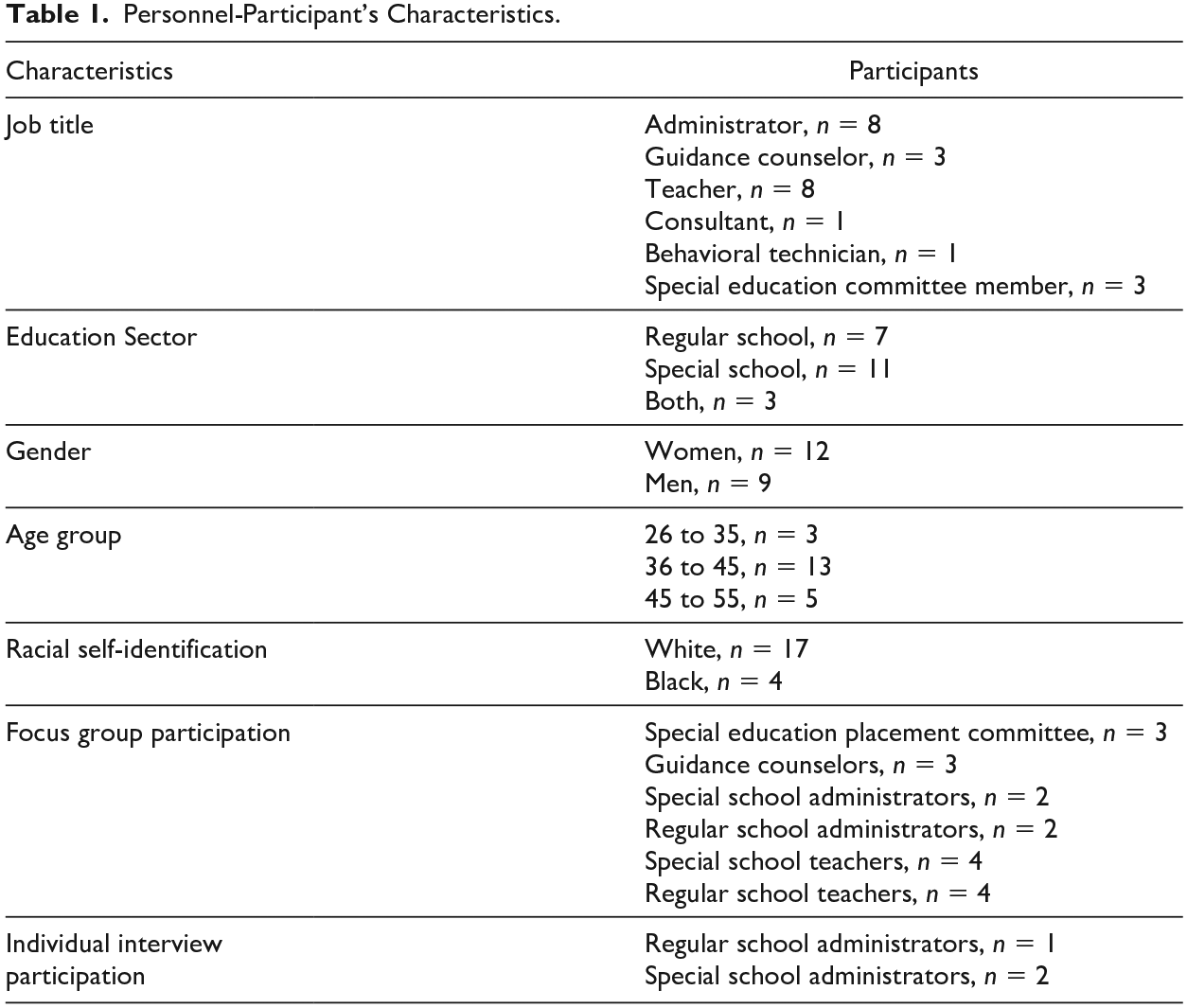
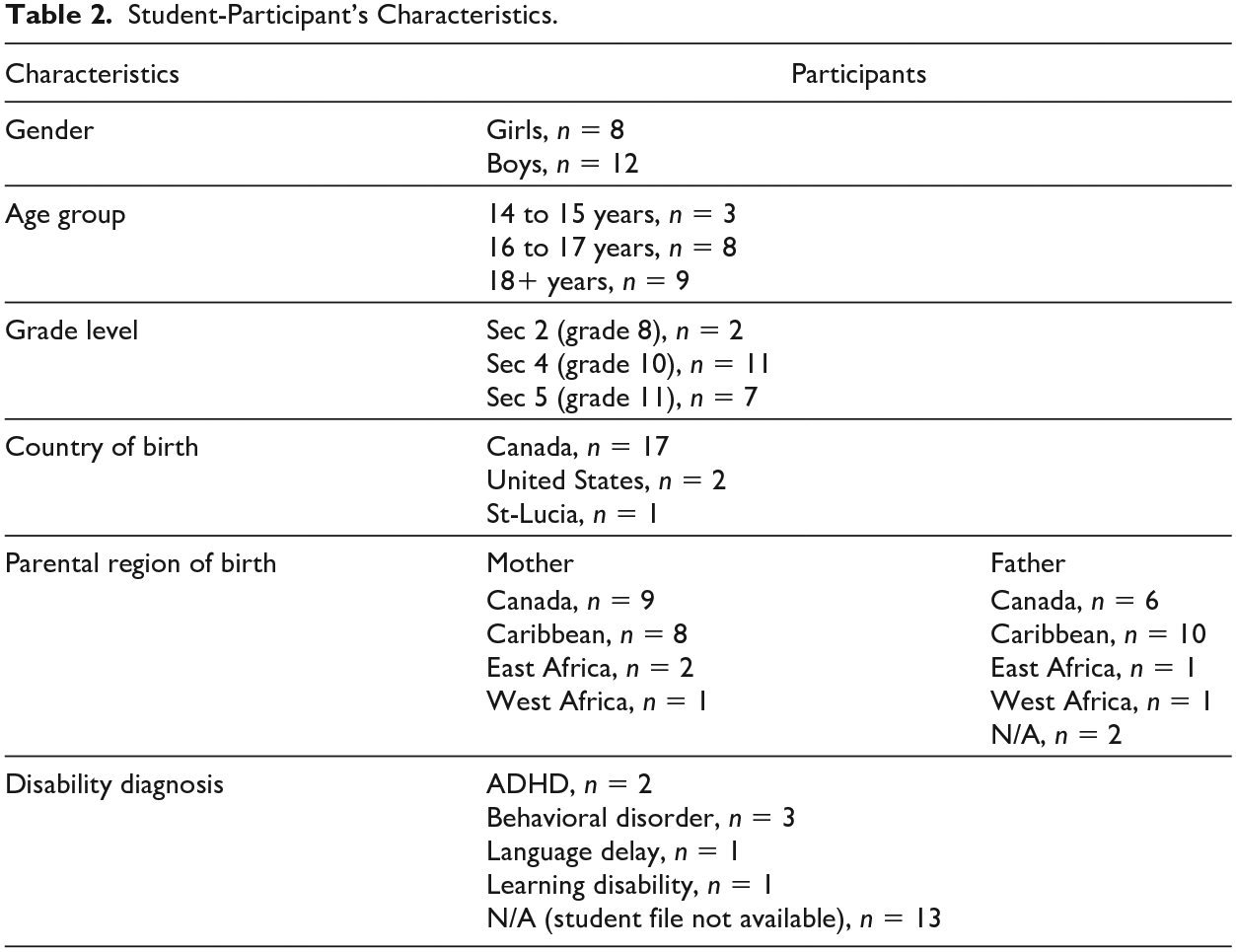
Participants consisting of school board personnel and students were recruited through a call to participation distributed by principals through an email request and progressed using a snowball strategy. The selection criteria for the school personnel were (1) employment in the youth sector of an English school board and (2) participation in the process of placing students in a special school. For the students, the selection criteria were (1) self-identification as Black and (2) enrollment in a special school at some point during the school year. Self-identification made it possible to avoid assigning a socially constructed label to individuals, and for the same reason, enrollment in a special school implied that the student had gone through or was going through a special education placement process. In total, the groups of participants consisted of 21 educators and 20 students, as indicated in Tables 1 and 2.
Personnel-Participant’s Characteristics.
Student-Participant’s Characteristics.
The ethical aspects of the research were approved by the research ethics board of the University of Montreal. The majority of the data was collected through semi-structured interviews with the participants. In certain cases, focus groups were conducted with personnel due to personal and professional constraints. They were organized among common groups of professionals to minimize the effects of institutional power differentials, which may cause some participants to temper their responses or result in others dominating the exchange (Heck, 2011). This also proved to be a convenient solution as common groups of professionals often had similar availabilities. In total, six focus groups took place (see Table 1). The interviews lasted between 45 and 90 minutes and were mostly carried-out in private rooms in the schools the participants worked at or attended.
The personnel and student-generated data were first analyzed thematically as separate components, and then cross-referenced to reveal the convergences and divergences between the two. All the interviews were coded using the QDA Miner software, version 5. The data generated from the personnel were coded deductively according to the phases of the special education placement process that were documented in the literature reviews: referrals, assessments, identification, placement, and service delivery (Collins & Borri-Anadon, 2021). Given that the various groups of educators occupied specific roles at specific periods of the special education placement process, this analysis allowed for a detailed reconstitution and description and thus, establishing a master-narrative of the process. The student interviews were coded inductively. Distinct themes emerged concerning each phase of the student educational pathway (elementary, high school, transitions to special schools, and special school placement) as storied by the participants, which established a counter-narrative. Finally, the master-narratives and the counter-narratives were analytically contrasted from a DCCN perspective, which allowed first and foremost, for the student-participant experiences to be foregrounded, especially in light of how their voices were consistently silenced throughout the placement process, and in conjunction with multiple hidden forms of ableism and racism, that pass as benevolent and beneficial components of the special education placement process.
Master and Counter-Narratives of the Special Education Placement Process
Based on both the master and counter-narratives, the special education placement process in Quebec can be described as a complex process that begins in regular schools and is triggered by students’ behavioral and/or academic “difficulties” as perceived by the personnel. Referrals tend to be made by regular school personnel, a placement committee is implicated to facilitate the transfer whether the student has been formally assessed or not, culminating in placement in a special school.
The DCCN approach facilitated the identification of convergences and divergences between the educator and student perspectives. This contrast will be illustrated here through a chronological reconstitution of the process according to both groups of participants. This reconstitution makes it possible to apprehend the process holistically while distinguishing the dominant assumptions from the actual experiences of the students who were placed. Overall, educators and students tend to agree on the general reasons for special school placement; however, their perceptions of how the placement process unfolds diverge in many ways.
Regular Schools (Referral Phase): Student Well-Being vs. Socio-Academic Neglect
The analysis of the results revealed the tendency for the student-participants to have repeated a grade or to have experienced a struggle with French, English, and especially with math, beginning in elementary school. In regular schools, the personnel participants communicated a concern for student well-being and self-esteem as they relate to academic success. They believed that responding to the students’ academic needs was beyond their capacity, and thus more achievable in special schools, as explained by an administrator in a regular school: If [a failing student] had stayed at our school, they would have maybe had failed multiple grades and just been pushed up, and then spent their academic career at a below standard success rate, whereas they are transferred to a [special] school, they can be with a cohort and an experience that reflects some sort of successful process for them instead of just always being in a failing position (Theo, admin, regular school).
In contrast, while students acknowledged their own difficulties, they perceived that they were being disregarded in terms of academic support and their well-being. Most of the student-participants perceived their difficulties as unaddressed for the entire regular school segment of their pathway, and worsening over time, especially when it came to math: Honestly, I hated that school. . .I was still bad at math and I got this really strict teacher and it was really hard for me to cope in the class, so I just wouldn’t talk or ask questions cause like, if you asked a question that was, I would say, “stupid” to her, she’d kind of scream at you. . .If I asked something, I’d kind of feel dumb for asking it, cause it’s like: “Oh, you should know that.” So, I wouldn’t ask for help [. . .] I was just fed up of it, cause I wasn’t getting the help I needed (Raquelle, student).
This brings into question what kind of support measures were offered to students before referrals were made, how the difficulties were understood by school personnel, and how the personnel–student interactions impacted referral decisions. Raquelle went on to share insights about why she believed such classroom dynamics were related to her being Black: Sometimes people think Black people aren’t smart and it’s really, like why? You know? I know a lot of Black people that are really smart, so it’s like why are you degrading Black people and putting Black people down? [. . .] Because it’s just the fact that normally in classes, you don’t really see, like a Black person raise their hand and be like: “Oh, I know the answer.” Or something like that, it’s usually someone else that’s not Black and I don’t know, it just makes people feel some type of way.
Linking this excerpt to Raquelle’s previous statement about being made to feel “dumb” for asking a question, it is reasonable to assume that her lack of class participation could be the result of negative and perceived racist interactions with personnel, ultimately leading to personnel-perceived “learning difficulties” and special school referral. Along similar lines, Karyn explained the difficulties she had accessing academic support in a regular school: Some of the teachers were very close-minded. . . Like I don’t know, they don’t help you as much, they’re just like “figure it out on your own” type of thing, “just do it” like, so I don’t know. Teachers were like. . .they weren’t really as sociable as they should be, cause you know teachers talk to the students and like get to know everyone or whatever, but it wasn’t like that at Beaver Lake Academy (Karyn, student).
From the students’ point of view, relationships with teachers were cold and impersonal, to the point that they did not feel comfortable asking questions, out of fear of being humiliated in front of the whole class. This sense of unease coupled with a sense of incompetency, left students feeling hopeless and alienated, which impacted their motivation despite their strong desire to succeed, graduate, and find a sense of belonging to the larger school community, as described by Jeremy (student) just before he got “kicked out” of a regular school: “I felt mad and disappointed. . . worthless, like I was never gonna graduate and just fail everything.”
Similar patterns exist in terms of student behavior. Regular school personnel highlighted their efforts to exhaust all resources before making referrals, and the benefits of special schools, when it comes to behaviors that were perceived unmanageable in regular schools: There are mechanisms at our school to try to help the students with [behavioral] issues, but if there is a failure of our system, sometimes it’s viewed as we are doing a disservice to the student. . .everything that we can provide has failed, so perhaps another institution can be more successful then, because with what we have, our wheels are spinning and we can’t make the structural change to kind of match what the student needs (Justin, admin, regular school).
In contrast, the students reported the personnel as using referrals to special schools as a threat, punishment, or a consequence to their “bad” behavior. In other words, the students reported being told that if their behavior didn’t improve, they would be sent to a special school: They were like threatening us with it. Like “you’re gonna go to [a special school],” like “we’re going to kick you out if you don’t focus on your work” [. . .] Like the school board, they send you there because you’re doing bad things (Laura, student).
Furthermore, while regular school personnel communicated referrals to special schools as necessary when the safety and security of the larger school community was at stake, the student-participants did not feel like they benefited from this sense of protection as members of the student-body, as they endured various forms of intimidation from their peers, notably as it related to race: [White Quebec-born students] were always just racist, like let’s say I wouldn’t be able to say some words in French, they’d just call me like. . .“you don’t know French stupid [n-word]..” . .I would just get into fights all the time [. . .] I’d get suspended and come back, it would just be the worst [. . .] they told my mom to send me to another school, that’s when they were like “yeah he has behavioral problems” (Marcus, student).
The student-participants of this study were forced to contend with various intersecting forms of intimidation based on race, gender, and language, with minimal to no response from school personnel. Not only did the student counter-narratives demonstrate that they were unprotected by any antibullying endeavors, but the predominant institutional intervention seemed to be simply removing student-victims of bullying from the school they were experiencing it. For example, in schools where girls reported forms of sexual harassment, referrals to special schools were initiated as a “protective” measure: There was a situation with me and this guy, I’m not going to say much that happened, but he has a picture of me and he decided that it was ok to spread it around the school even though I didn’t give him my consent, and then after that it just started this whole thing where everybody was just against me, calling me names like slut, whore and all that kind of thing, so then I don’t know, it just got too out of control [. . .] I struggled a lot, like I need extra help and I need to be away from kids [. . .] And then that’s when the school suggested [a special school] (Juliette, student).
Similarly, when boys encountered anti-Black racial bullying, they were met with indifference from personnel if they reported it, and decidedly, did not tend to report such incidents. However, when they acted in self-defense within their own means, they were reprimanded without any consideration for the events leading up to the behaviors deemed unacceptable and were also referred out. While the referrals concerning girls were presented to them as an act of protection, these referrals in both circumstances, indicate that bullying is handled as an individual issue rather than systemic, very similar to how racism has been predominantly framed in schools in Quebec to date. They also illustrate the institutional strategies employed to evade complex cases, to avoid accountability, and to silence youth, while reifying perceived “special needs”.
Transitions to Special Schools (Placement Phase): A Caring and Regulated Practice vs. Getting Kicked Out and Waiting in Limbo
The manner in which the students are transferred from regular schools to special schools also manifested differently according to the various actors that were consulted. Generally, regular school personnel, especially teachers, perceive transfers to special schools as a helpful and caring practice that benefits students they believe are having “difficulties”: There’s some students that we’re like “we’re not helping you” and it’s very frustrating to us, like when we’re not helping. We want them to succeed. . .but if I can’t help you, I can’t help you, and I feel like we’re torturing them sometimes by holding on to them (Shayna, teacher, regular school).
Once the transition is initiated, the regular school staff’s involvement ceases; at this juncture, the special education placement committee is perceived as taking over: So, sometimes we have students who are really struggling and repeat or fail a year twice in a row, and then we don’t keep them at the school, we refer them out at that point, and they would go through the [placement] committee at that point and. . . I mean they come up with their own way of deciding where a student would go (Justin, admin, regular school).
However, members of the placement committee did not indicate that they had any deciding power pertaining to whether a student gets placed or not: We don’t make the decision as to whether the student is no longer able to stay in their regular schools, that’s really up to the regular school to make that decision, and sometimes it involves the regional director or whoever, if it’s a contentious case and the parents are not in agreement, or if it’s a severe behavior case. . .we don’t make that decision (Linda, admin/placement committee member).
In addition, the placement committee underscored the important role families play in the placement process: Once the family has been informed that there’s going to be a meeting. . .to see what school would be recommended, [the committee] meet[s] with the family again to inform them of the recommendation, if the family is not happy, they don’t agree with the recommendation, then they can resort to the regional office and everything gets discuss again (Rita, guidance counselor/placement committee member).
In contrast, there were no incidents of students resorting to any recourse or contesting the placement in any way. The student-participants appeared generally unaware that they were actually being placed. In fact, the placement process was interpreted by the students as simply being “kicked out” of regular schools because of their behavior or because of their academic performance: “I just got a whole bunch of detentions, of suspensions, and it was just not working well, anyways, I just had to. . .well, they kicked me out!” (Chris, student). Similarly, Kevin (student) explains his removal and that of his peers from a regular school as a consequence of perceived petty issues: Most of [my friends and I] got kicked out. Some of them was for their grades [. . .] they were just getting kicked out, for like getting in trouble, but not like seriousness. It was just like little things and then they just got expelled.
In fact, the severity of the consequences for “unserious” events tended to take the students by surprise: “I guess I was kind of giving [my teacher] attitude, I don’t know, I don’t remember, and then she’s like: ‘Ok, that’s it, I’m kicking you out.’ And I was just like, are you serious? For just saying something? (Khamiah, student).
Thus, students considered their transition to a special school as the result of (sometimes culminating) events resulting in their removal from the regular school environment. In addition to not taking part in any of the decision-making, in some cases, students were left waiting for weeks before they were informed of what school they would be transferred to: I got kicked out of school. I actually remember that. I got kicked out of school at the end of September. The whole of October I was home and then the first week of November I started at [a special school], cause I remember, my birthday was on the Saturday (Elijah, student).
This transition phase of the placement process was disorienting and destabilizing. In addition to being held in limbo for indefinite periods of time before the transition occurred, students were blindsided by the news of their placement: Like they didn’t ask me any questions or anything [. . .] They just told me I was suspended and I didn’t go to school for the next 2 weeks, maybe 3 and yeah [. . .] I just stayed home. . . It was just like my dad was making me study. . .Then after that I came to [a special school] . . . Like I didn’t want to go to this school, I just wanted to go to a normal school but then I was like ok, I knew I had no other choice. There’s nothing I could really say (Duane, student).
Officially, there are laws and procedures that regulate special education placement. The Quebec Education Act (1988) and the Policy on Special Education (MEQ, 1999) advance an individualized approach entailing mandatory assessment of student needs prior to enacting any specialized interventions, including transfers to special schools. For the participants in this study, the guiding principles of this approach were not adhered to.
The tendency manifested as news of their transfer to a special school delivered as a surprise phone call or a letter insert with the report card at the end of the school year: “Ok, so end of school year, it’s time for everyone to get their report cards, and at the report card distribution they’re just like: ‘by the way, you’re going to [a special school]’!” (Karyn, student).
Not only did the students report being taken by surprise when they finally received the notification that they were required to change schools, but their absence from any school (regular, or special) produced many negative consequences in terms of their academic and social integration, thus compromising their well-being emotionally, socially and academically. This was also underscored by special school teachers who felt like they had to “perform magic” (Kristian, teacher, special school) in terms of helping the students integrate the special school environment and fostering socio-academic success.
The inconsistent and inconsiderate manner in which the student-participants are transferred from one school system to the next would appear better framed as a displacement from regular schools through a process that does not fully respect their educational rights and allows schools to remain unaccountable for the students they are responsible for. While the regular school personnel purport an inability to meet the student’s needs, these needs do not appear to be assessed, identified, or understood prior to the displacement, beyond the stipulation that they are too grave to be managed in a regular school.
Similarly, while schools are legally required to organize interventions and adaptations before recommending any specialized services, such as special schools, there is little to no trace of such endeavors occurring. This is also made evident through the students’ and their parents’ exclusion from meaningfully contributing to their own individualized education plans and placement decisions. In fact, all participants were on record as having an Individualized Education Plan (IEP), yet an overwhelming number of them either didn’t know what it was, whether they had one, or they did not, or could not remember contributing to it. When asked about their IEP they provided answers like: “I don’t really know what that is” (Anthony; Raquelle), or “What is that?”(Kevin), “I’ve never heard of the word IEP” (Andy), “I don’t think I have one” (Juliette), “I don’t remember it” (Khamiah), “I think I do, but I don’t know it personally” (Chris). Similarly, students and their parents appear to be unaware of the rights accorded to them, and thus are not positioned to contest any decisions, nor advocate for services they may be entitled to. In the following excerpt, Karyn demonstrates the need to take initiative regarding the lack of information she and her family were coping with: So, I ended up calling my guidance counsellor at [my old school], I was like I just want to know why you guys switched me. . .because you guys never gave me a reason? Like you told my mom, you just gave her an address, ok, “just take her to this school” that’s it, that’s all, so I was like, no! I want an answer! (Karyn, student).
In sum, these displacements from regular schools are misaligned with educational policy as they manifest as school-centered rather than the student-centered principles that anchor provincial and local educational policies. For the students, these transitions manifested as one of the most challenging and ambiguous phases of the process, that evoked deep insecurities and anxieties.
Special Schools (Service Delivery Phase): Fostering a Welcoming Alternative Environment vs. Replication and Aggravation of Punitive Discipline
Special school staff demonstrated an awareness of the destabilizing displacement process the students endured, as well as a commitment to offsetting the associated negative effects by creating a warm, welcoming process and environment for students. Both special school staff and students found tremendous value in a small school or low student–teacher ratio setting. The staff highlighted benefits such as intimate environments, easier applicability of differentiation, individualization, and other support practices, more effective communication and classroom management, as well as positive relationships with students: I think all of our schools work very hard to make going to school and being in school a positive experience, a place where [students] can feel safe. We nurture them, we tend to the other needs as well, and we’re so very lucky that the ratio of teachers to students is all about building relationships with these kids (Clarice, admin, special school).
Student-participants echoed these sentiments emphasizing their appreciation for the flexible and relaxed environment, the access to academic support that eluded them in regular schools, improved relationships with peers, an increased sense of belonging and community, and overall sense of relaxation where they could just be themselves. In particular, they were able to build relationships with teachers who they perceived as nice, caring, friendly and genuine. According to Savannah (student): “It feels like a community, not like a school.” Ryan (student) emphasized that his relationships with his teachers surpassed his expectations: “No, I love my teachers, they’re not just teachers, they’re family too, that’s how I feel.” Students also reported experiencing academic success for the first time: I really liked it there and I had a good math teacher, and I started understanding math, and I was like wow! I could have understood this at [a regular school] if I had this kind of help, and I looked at them and this is so simple, you know what I mean? And I was like oh, my god! Like why couldn’t I get this help before, you know? So, I was really happy that I changed schools (Raquelle, student).
They also reported positive impacts on their self-esteem: My life changed because I just got more confidence in myself, I actually was able to sit down, it was way easier for me to learn about myself compared to being in like [a regular school], and I feel more comfortable with my surroundings and myself, so [the special school] kind of boosted up my self-esteem a lot, because I got a lot of praise and a lot of love which I didn’t get at [a regular school] (Karyn, student).
These results converge with numerous studies that have demonstrated that nurturing student–teacher relationships correlate with social–emotional and academic success (e.g., Forman, 2018; Jean-Pierre & Parris, 2018). In this light, while policy recommends integration in regular school settings, small schools have significant benefits that would not be otherwise accessible.
Unfortunately, these positive aspects dissipate where disciplinary issues are concerned. Special school personnel believe that students are often transferred out of regular schools in haste, because of punitive discipline. Consequently, they believe they employ non-punitive discipline, in coherence with an attachment-based approach: Whereas in the bigger [regular] schools, things are a bit more black and white, here I’m dealing with the emotions, the happiness, the sadness, the extremes of how a person may feel, and so basically what it means is that I like to bring it in and have a sit-down or the support staff has a sit-down and says: “Ok, what happened? How?” You know? So, you can’t punish or discipline something, when something’s in pain and feeling bad (Hugh, admin, special school).
In fact, special school staff employed alternate positive language such as “rights and responsibilities” in lieu of “code of conduct” or “reset” in lieu of “suspension.” However, internal name-changing does not seem to lead the students to perceive the disciplinary measures as non-punitive. Although special schools are deemed by the personnel-participants as better equipped to deal with behavioral issues than regular schools, the student-participants felt otherwise: I was told. . .this [special] school is basically, like, they’re there to help you regulate your behavior and everything, but I didn’t find they did anything to help me regulate my behavior [. . .] What I mean by that is like you have regular classes, like you don’t do nothing different from [regular school], like yes, it’s different in the sense, but I mean like you would think [special schools] would help you with behavior. They have more support. They would have more people like psychologists and people to talk to, or like have like one period of the day to like sit there and relax. Have like an [anger management] class or something like that, but they don’t, they don’t do that. I mean, the only thing they’ll do is if you get into an argument, they’ll say it’s you know, it’s not right. “You have to work on your goals, you have to do this.” But I mean, how is it helping me? It really doesn’t (Jeremy, student).
Ultimately, unlike the student-participants who were happy to receive more academic support, and see their academic performance improve subsequently, those who acknowledged they had “behavioral problems” did not believe they accessed any meaningful associated support measures in special schools. Furthermore, punitive approaches to discipline tended to be reproduced. In Marcus’ case (student), the attendance contract he was on paradoxically resulted in his expulsion: I was late sometimes and like the lates, like I said, it got stricter for me, so I couldn’t be late a certain amount of times and I was late two more times and I got put on a contract and yeah. I remember like once, the contract was like I can’t be late more than twice a week. If not, I’ll get expelled and I was late for like maybe two seconds, two minutes after. . .That was my last chance, so I got expelled (Marcus).
In fact, despite special schools’ specialization in behavioral issues, expulsions emerged as a disciplinary trend that had both academic and socio-emotional consequences. In Amiyna’s case (student), she recounted having an outburst because she believed a staff member called her “a beggar.” Following the outburst, she attempted a restorative act to no avail: It hurts me that I actually did the right thing for the first time, and they expelled me. I actually asked to have a meeting [. . .] Like I’m trying so hard not to cry but it’s coming out. I’m trying to be strong and they’re just there staring at me. . .I’m telling them my pain and [the principal] just looks at me, he’s like “I appreciate it Amiyna, but you’re not coming back to this school” [. . .] Yeah, they expelled me because I was on a contract and they gave me way too many chances, which clearly they didn’t give me any chance at all (Amiyna, student).
Students who were expelled from special schools, ended up in a different special school, not for any reason related to any further specialization in behavior, but seemingly without any rationale besides punishment. Any relationships of trust that were established were ruptured and the integration process had to be recommenced: Like, I’m a new kid. And it’s all the way [on the other side of the city]. . .I don’t know nobody. You know what I mean? I’m in my corner 24/7 alone, alone like that whole month being there. All the kids don’t wanna come talk to me. You know what I mean?[. . .] like there’s some days after school I’d cry and I was like, I just don’t want to be here, like all the kids knew I was depressed (Amiyna, student).
School alienation, anxiety, depression, and exacerbated behavioral “difficulties” emerged as key themes for students who were expelled. In special schools, even when students seemed to form meaningful relationships with personnel, the benefits of these relationships and interactions were nullified through harmful disciplinary actions. If the students didnot not meet the school behavioral expectations, the welcoming climate reverted to one that was as hostile as regular schools, or even worse. Students were penalized for the very labels they were institutionally assigned regarding behaviors deemed beyond their control.
Hence, students who were placed in special schools for behavioral “difficulties” who continued to exhibit them were in turn placed in other special schools. Since special schools can be considered a sort of “last stop” in an educational pathway, these practices raise concerns as they sometimes lead to students being placed in juvenile detention centers, a situation that seems to affect Black students more than others: We have four students in lockdown right now and four of them are of color [. . .] They are placed there by the court, so we’re not involved in their placement, but many of them have come from [special] schools often. . .I would say that they are a disproportionately represented group (Linda, admin/placement committee member).
Based on this administrator’s account, there appears to be a link between special school placement, race, and the criminalization of Black youth worthy of further exploration.
Discussion
While the DCCN approach has accorded due prominence to Black student perspectives regarding special education placement, it has simultaneously revealed how Black students are silenced throughout, obstructed from, and excluded from every stage of the process. As such, it is pressing to center marginalized voices and to acknowledge the reciprocal relationship between ableism and racism and their camouflaged circulation that bolsters ideologies of normalcy (Annamma et al., 2016; Gill & Erevelles, 2017). From this lens, regular schools emerge as an institutional entity of white able-bodied normalcy, where non-accountability to Black students and ableist views are concealed and/or legitimized through a discourse of psychologization, predominantly serving the needs of the regular school. In fact, this discourse, whether it involves purported concerns for student academic success, self-esteem, or socio-emotional well-being, positions “the problem” within the student, as it does not stem from the regular school’s inability to help (with academic difficulties, or racial and gender-based harassment, for example), but rather the perceived students’ inability to meet the norms established by, and engrained in, the regular school. This discourse is consistent with a medical model of disabilities that has been critiqued by disabilities scholars for failing to capture the complexities of disability and disablement, mainly by neglecting to account for social factor dynamics (Oliver & Barnes, 2012).
Further, this discourse operates as a clandestine exclusionary argument that produces practically opposite results to the claimed intents, which forces Black students to activate self-protection measures such as “laying low” or taking problematic matters into their own hands. The psychologizing master-narrative justifies attributing ableist labels, such as learning difficulties and behavioral problems, to these self-protection measures and ultimately renders Black students as outputs of a system that does not value them, a system that Annamma and Morrison (2018) define as a dysfunctional ecology.
Similarly, a posture of disregard, dismissal, and silencing of Black students can be further illustrated through their hindrance from participating in any of the decision-making concerning their own placement. The transition component of the placement process manifested as a tunnel of displacement that prevented them from accessing a detailed understanding of their socio-academic portrait and the associated implications, including the specific support measures that are available to them by law. Whether it concerned a transition from a regular school to a special school, or from one special school to another, it was a highly unregulated and exclusionary process, which a DCCN perspective recognizes as the obvious physical consequence of the dynamics between Black students and manufactured white, able-bodied socio-academic and behavioral norms (Adams & Erevelles, 2016; Annamma et al., 2016). The student-participants of this study also bore the weight of the associated psychological consequences (Annamma et al., 2016) such as grappling with feelings of uncertainty, anxiety, anger, insecurity, hopelessness, depression, and fear.
The disempowerment and trauma invoked through this process could be avoided or, at the very least, mitigated through simple small acts of care and consideration. In light of the very positive aspects of special schools highlighted by student-participants, transitions should not arrive as a surprise, nor should they be utilized as a punishment, or a time-biding strategy. They are an opportunity to review, with the students, their global profile, their strengths and areas of improvement, and resources that are available to them, thus, keeping them involved in crucial decisions pertaining to their own lives, that have a direct impact on their future success and well-being.
Indeed, the student counter-narratives indicate that special schools can be effective support ecologies through intimate environments, low teacher–student ratios, individualized instruction, and differentiated pedagogy otherwise inaccessible in regular schools. These conditions facilitate a sense of belonging and self-efficacy among students, thus suggesting the value of small schools within a system. Special school personnel have the opportunity to establish and sustain relationships of trust, and to deconstruct ableist views of differences by facilitating a clear understanding, and non-deficit view of disability, that should be further cultivated. However, when it comes to Black students, these opportunities are often derailed, as punitive and exclusionary discipline takes precedence over compassion and care.
As in the United States, discipline disparities between Black and non-Black students, whether they have a disability or not, have been extensively documented in Canada and Quebec (CDPDJ, 2011; James & Turner, 2017). Critical scholars attribute these disparities mainly to systemic anti-Black racism and discrimination, which sustain dominant representations of Black children as threats, thus exposing them to harsher forms of discipline (Maynard, 2017). As rules of conduct in schools are dictated by white able-bodied norms (Annamma et al., 2016), punitive discipline would appear to “stem more from issues related to power and control than from the need to socialize students to become productive citizens” (Townsend, 2000, p. 385). Therefore, when students demonstrate acts of resistance and agency, notably by using their voices, institutionally, it is perceived as a threat that must be neutralized, rather than a valid contribution the students make to their own education.
Further, the prevalence of the “well-being” discourse extends to the “safety” of the whole school community. “Goodness” then operates as a vehicle for disabling students, mainly through the overvaluation of whiteness and the undervaluation of blackness (Broderick & Leonardo, 2016). In this light, school personnel’s perceptions of goodness, such as behavioral compliance on any scale, become associated with perceived smartness. Thus, institutionally scorned behavior that is psychologized, pathologized, and overapplied to Black students, reinforces the dominant representations of both individuals with behavioral or emotional disabilities and Black people as threatening, while penalizing students at these intersections for behaviors institutionally determined beyond their control.
While the analysis of the results of this study is particularly pertinent within the context of Quebec, where race-based data is limited, and the existence of systemic racism is widely contested, the implications for teacher education informed by DisCrit extend beyond regional and racial boundaries. Understanding the complex dynamics between ableism and racism throughout the special education placement process from a DCCN lens helps advance socially just special education in teacher education programs for all students, notably by providing important insights for enhancing educators’ knowledge of diverse learners and their professional practices. More specifically, the stark contrast between student and educator understandings of the special education placement process revealed in the analysis underscores the need for teacher education programs to address the disconnect between theory and practice, as well as the power dynamics inherent in special education decision-making.
Integrating a DCCN framework in teacher education programs will disrupt the conventional acceptance of silencing, disregarding, or overriding student voices throughout their educational trajectories, repositioning students as experts of their own socio-academic progress and well-being, whose input should be actively solicited in all special education decision-making. Similarly, training on how to effectively engage with and include parents and caregivers in decision-making is another equity-advancing practice that can be enhanced through a DCCN approach. This involves facilitating reflective practices that help teachers examine their beliefs and attitudes toward parents from diverse backgrounds; promoting respect for parental perspectives through thoughtful, reliable, and culturally responsive, family-centered means of communication; and providing parents with information and resources while avoiding assumptions, and confirming their understanding about the decisions impacting their children.
Finally, disciplinary practices are a significant consideration in terms of the implications for teacher education in special education at the intersection of race and blackness. The relevance of Annamma and colleagues’ (2016) call to challenge Western norms, especially considering their material and psychological consequences for Black students, is amplified by the stark contrast between their perceptions of how discipline is deployed in special education settings and those of the personnel. To address this disvergence, student-driven approaches to discipline should be foregrounded in teacher education programs. Such approaches involve shared power between students and educators in terms of school rules and consequences, thus encouraging students “to promote the changes they want by assuming responsibility for their ideas” (Jean-Pierre & Parris, 2018, p. 422). Moreover, the analysis of the results reveals that personnel’s understanding of alternative disciplinary models, such as a restorative approach, appears to be limited to adding a positive connotation to existing punitive measures. Given the prevalence and persistence of punitive discipline, and the trauma it causes Black students, long-term training involving addressing the root causes of behaviors, the deconstruction of what discipline means, and how it can align with an attachment-based approach should be prioritized.
Conclusion
The DCCN approach made it possible to better understand the special education placement process in Quebec. Although this was an exploratory study based on a limited number of cases, it provides evidence of how the special education placement process unfolds in a unique Canadian context, notably from a Black student perspective. It supports a race-conscious understanding while establishing grounds to question dominant standards for normalcy steeped in ableism and racism, as it relates to the principles of equity and inclusion championed by special education. While the DCCN approach effectively showcases an important contrast between personnel and student perspectives, the goal is not to deprecate individual or even groups of educators as “racist” or “ableist,” nor is it to place the burden of establishing fair and non-discriminatory practices solely on their shoulders. Rather, it draws attention to how complex systemic and structural aspects are still very poorly understood, such as how race is invalidated through special education processes and business-as-usual practices, and how disability is decontextualized from the social processes that contribute to exclusion and reproducing social inequities and on a larger scale. The practical insights gleaned from this study shed light on the potential benefits for teacher education programs in special education of incorporating a DCCN approach to promote re-imagined practices that denormalize long-standing racist and ableist practices and prioritize social justice.
Footnotes
Declaration of Conflicting Interests
The author(s) declared no potential conflicts of interest with respect to the research, authorship, and/or publication of this article.
Funding
The author disclosed receipt of the following financial support for the research, authorship, and/or publication of this article: This work was supported by the Social Sciences and Humanties Research Council (grant number 752-2018-1068) and the Fonds de recherche du Québec – Société et Culture (grant number 2018-B2Z-204903).
