




Abstract
Research has demonstrated that pre-service teachers (PSTs) can learn to notice students’ thinking in sophisticated ways by analyzing videos of classroom interactions. What is less clear is how PSTs use what they notice about student thinking to inform how they respond. Secondary math and science PSTs from three teacher preparation programs were invited to analyze a video clip identifying noteworthy moments of student thinking and describing an instructional move they might make and why. A qualitative analysis of their responses indicates that the PSTs overwhelmingly noticed both the substance and the source of students’ ideas. However, the patterns in their responses to these moments varied. These findings suggest that PSTs would benefit from spending more time unpacking what it means to respond to students’ thinking. The study provides implications for teacher education with respect to the careful selection of classroom clips and tools to support novice teachers developing responsive teaching practices.
Keywords
Introduction
Supporting pre-service teachers (PSTs) learning to attend to and interpret the substance of students’ disciplinary ideas has become central to science teacher education (Kang & Anderson, 2015; Luna, 2018; Richards et al., 2014). A growing body of research suggests the importance of noticing student thinking to enact science instruction that is responsive to students’ ideas, cultures, and experiences (Robertston et al., 2016). With this goal in mind, as teacher educators, we design experiences to develop PSTs’ attention to and sensemaking around students’ ideas and experiences as assets to inform their instructional moves and promote students’ identities as knowers.
Through engaging with representations of practice, such as video clips of instruction, teacher educators can scaffold PSTs’ learning to notice by slowing down interactions that happen during classroom activity (Grossman et al., 2009). Noticing involves attending to and interpreting the substance of students’ ideas (van Es & Sherin, 2021). Prior research shows that teacher preparation programs can support PSTs to develop their capacity in attending to factors that influence a specific teaching moment and to interpret what they think is going on in that moment (Barnhart & van Es, 2015; Johnson & Cotterman, 2015; Levin & Richards, 2011; Wiens et al., 2021). However, how teachers respond to what they notice about student thinking is an underexplored aspect of teaching (Luna, 2018; Schwarz et al., 2020).
Responding is a challenging and distinct skill from noticing student thinking (Harris et al., 2012; Luna & Selmer, 2021). It is also arguably the most important—taking up and pursuing students’ ideas is what makes teaching responsive (Robertston et al., 2016). Robust learning sequences are not sustained without responsive teaching (Thompson et al., 2016), but responsive teaching requires more than noticing student thinking or knowing certain teaching moves. Instructional goals shape teachers’ facility to work with students’ ideas. So once a teacher attends to a moment of student thinking, how they interpret that moment and align it with their instructional goals can shape how they respond. In this study, we seek to understand how PSTs responded to specific moments of student thinking and why they did so. Through a video analysis task in which PSTs were asked to examine an instructional episode, we explored the following:
Literature Review
Noticing and Responding: Two Interrelated Aspects of Teaching
Responding to student thinking is paramount for ambitious teaching and learning (Singer-Gabella et al., 2016). We draw a distinction between simply reacting to students’ ideas and carefully responding in ways that account for the disciplinary substance of students’ thinking, what this means about their evolving thinking, and how instruction centered around those ideas can meaningfully advance those ideas (Barnhart, 2022). To be able to respond, teachers must first be able to attend to and interpret student ideas made visible through student talk and student work (Ruiz-Primo & Furtak, 2007). In the moment of teaching, teachers may notice various forms of student thinking, but it is not easy for many teachers to respond to student ideas to help students make progress in their thinking (Larkin, 2012; Stein et al., 2008). Video analysis allows for representations, decomposition, and approximations of practice as teachers view examples of teachers engaging in target practices, slows down these examples for close examination, and permits incremental practice of both noticing and responding to student thinking appropriate for early fieldwork (Gaudin & Chaliès, 2015; Grossman et al., 2009; Sherin & Linsenmeier, 2011). When PSTs are able to pause and reflect on these moments, they are able to generate multiple interpretations for moments they noticed in practice, which can then help them consider alternative ways to respond. In this way, student talk is an entry point for analyzing teaching and learning, and it starts with noticing how talk makes student thinking visible.
Teacher Noticing of Student Thinking
Teaching involves the coordination of “interactions among teachers and students around content, in environments,” (Cohen et al., 2003, p. 122). The relative importance of each of these components has shifted in the past 20 years. Teaching is more than enacting a list of strategies or employing a series of moves. Neither is it merely the transmission of a body of knowledge for students to memorize. Rather, the goal of teaching is to develop students’ reasoning and knowledge-using skills such as problem-solving and explanation-building (Bransford et al., 2004; Windschitl et al., 2018). To do this complex work, a teacher must pay attention to students and their thinking. One line of scholarship that seeks to develop this aspect of teaching is teacher noticing.
Mason’s (2002) early definition of noticing refers to it as “a collection of practices both for living in, and hence learning from, experience, and for informing future practice,” (p. 29). He elaborates that disciplined noticing requires effort to foreground some elements of one’s environment and background others. Other scholars have identified components of teacher noticing that can be developed with structured practice. van Es and Sherin (2021) proposed that teacher noticing is comprised of attending (identifying noteworthy features of classroom interactions) and interpreting (reasoning about what was observed to make connections to broader principles of teaching and learning).
The Act of Responding to Student Thinking
What a teacher sees (or not) in the classroom shapes what a teacher acts on (Erickson, 2011). For example, Jacobs and her colleagues (2011) considered teachers’ decisions about how to respond based on students’ understanding as an important component of professional noticing. They claimed that attending and interpreting “are not ends in themselves but are instead starting points for making effective instructional responses” (p. 100). Although noticing does not include the act of responding, how teachers respond is largely shaped by what they see and how they interpret what they see (Richards et al., 2020). In their investigation of PSTs’ capacities to attend to, analyze, and respond to student thinking, Barnhart and van Es (2015) considered deciding how to respond as a critical component to determine sophistication in noticing. Informing the connection between noticing and responding, their findings indicate that sophisticated responses to student ideas require high sophistication in attending to student ideas.
In this study, we consider noticing to consist of attending and interpreting (van Es & Sherin, 2021) and deciding how to respond as a separate but tightly related aspect of teaching. Some advocate for noticing students’ thinking to increase the responsiveness of teachers’ proposed moves (Jacobs et al., 2011; Levin et al., 2013). Others advocate for utilizing teacher moves to “make space” for students to make their thinking visible so teachers can then become more sophisticated in how they notice ideas (Haverly et al., 2020). Still others view the role of the teacher as a facilitator of the conversation who uses discourse moves to focus and draw attention to particular ideas, press for the elaboration of those ideas, and make connections among ideas in ways that open up opportunities to expand and maintain student sense-making in ways that evaluations of the correctness of students’ ideas do not (Cartier et al., 2013; Hagenah et al., 2018; Schwarz et al., 2020). Considering the growing emphasis in teacher education literature on responsiveness to students’ ideas (e.g., Levin et al., 2013; Robertston et al., 2016; Windschitl et al., 2018), understanding and supporting these two interrelated aspects of teaching, noticing and responding, together is important for preparing PSTs to be responsive to different facets of student thinking in science classrooms.
Supporting PSTs’ Noticing of Student Thinking Using Video Analysis
A growing body of research has documented ways to improve teacher noticing (Chan et al., 2021; Sherin et al., 2011). Nearly all utilize classroom artifacts to support teacher noticing. Video, in particular, has been noted to have numerous affordances as it allows viewers to pause and reexamine the same moments of instruction for deep analysis (Sherin & Linsenmeier, 2011). In the context of teacher education, in which PSTs participate in many different communities of practice through their coursework and fieldwork, video allows a window into practice that can be closely examined using different lenses for different purposes. Teacher educators have found that when a specific goal for video analysis is identified, facilitators can help deepen conversations around that goal (van Es et al., 2014, 2020) and tools can provide structured support for teachers to connect moments in the video to the identified goal (Johnson & Mawyer, 2019; Tekkumru-Kisa & Stein, 2017). Video clips with particular combinations of features (windows into as well as depth and clarity of student thinking) can promote a more productive discussion of students’ ideas (Sherin et al., 2009). With the pervasive use of video analysis in teacher preparation, Kang and van Es (2018) offer a framework of decision points for teacher educators to consider when deciding how to use video to advance PSTs’ learning about practice. This Principled Use of Video Framework includes identifying the broad worthy goal of PST learning, setting specific learning objectives for a video-based task, selecting a clip that aligns with the objectives, designing a task, selecting a tool to support PST interaction with the video, and deciding how to facilitate the conversation. These design decisions can guide supporting PSTs in attending to and interpreting student ideas in the video clips of classroom interactions.
While research has shown that teacher educators can productively support PSTs in noticing student thinking, what is less clear is how PSTs learn how to respond to what they notice (Richards et al., 2020). Analyzing video clips in teacher preparation often focuses on an accomplished teacher (e.g., ATLAS video library) or a short video clip from the PSTs’ classroom for the purpose of understanding the significance of particular moments within the clip. There has been less attention on how PSTs use information from these moments to think about how to respond to student thinking (Luna & Selmer, 2021). This study examines how and why PSTs plan to respond to moments they notice in a video clip of a science classroom episode.
Method
Context and Participants
Participants of the study include 41 math and science PSTs from three university-based teacher preparation programs in the United States. The shared emphasis across the three university programs was a focus on high-leverage practices such as facilitating productive discourse and using student thinking as a resource for sense-making. All three programs included the structured use of video to provide representations of practice and for analyzing practice during in-class microteaching events. The participants were part of a larger study on noticing among secondary pre-service math and science teachers. Data collection for this study took place in the semester prior to their formal student teaching assignment. Some PSTs had substantial prior fieldwork experience and others had very little. Similarly, some PSTs had some prior experience analyzing classroom video and others had none. Due to the COVID-19 pandemic, some coursework and fieldwork assignments and sessions were conducted online. The study authors, all of whom were methods instructors in their programs, did not know who consented to their coursework data being studied until after the conclusion of the credential program. At two institutions, credential candidates participate in an informed consent process and may opt in or out of permitting their coursework to be used for both program improvement and research as part of their admissions paperwork. At the third institution, the study was described to participants the last week of class and informed consent forms were returned to another faculty member (not the instructor) and held until the completion of the program. Participants were not compensated for their participation.
Data Collection
During their one-semester combined secondary math and science methods course, we asked PSTs to individually analyze video clips of classroom instruction. The clips were pulled from the Ambitious Science Teaching website (Gas Laws and Population Dynamics) and the National Council for Teachers of Mathematics website (The Case of Peter Dubno and the Counting Cubes Task). Each clip was 3 to 5 min long and featured student sensemaking in a classroom setting and modeled forms of instruction we promoted in our methods courses. As part of the video analysis PSTs were directed to describe at least two moments they noticed about students’ thinking, what the students said, did, or wrote in that moment, and what that moment told them about students’ thinking. In a separate question, the PSTs were asked if they could have “jumped in” to respond to a moment in the lesson, when in the lesson might they have done so, what they might have done, and why. PSTs were asked to complete the same video analysis task at the end of the methods course. For this part of the study, we selected responses to one science clip about condensation on a cold Starbucks drink cup. In the video, the teacher elicits students’ ideas in a whole class discussion about why water collects on the outside of the cup and where that water might come from. Responses to this clip were selected for analysis because it featured a science idea that was simple enough to allow for all our PSTs to comment about the content meaningfully but sophisticated enough for those candidates with specialized knowledge of the physical sciences to elaborate on the details of the students’ science ideas.
Data Analysis
To answer the first research question about what PSTs noticed when prompted, we reviewed the responses to the first question from our video analysis task. Each author randomly selected two PSTs from their respective programs and noted preliminary codes informed by prior research (Luna & Sherin, 2017; Tekkumru-Kisa et al., 2018), with respect to what student thinking the PSTs noticed. The preliminary codes were refined by constant comparison through discussion and triangulation among investigators (Lincoln & Guba, 1985) until conceptual saturation of codes and consistency in coding was achieved (Corbin & Strauss, 2015). If multiple topics were addressed in the response, the response was double-coded. This process resulted in codes for what PSTs attended to consisting of three main categories (a) the meaning (i.e., what students could have meant by what they said): Disciplinary ideas students appear to understand or think about, (b) the resources students drew upon to make sense of the phenomenon: What students draw on to inform their thinking, and (c) the sensemaking processes: How students build on understanding (see Table 1). The three authors each coded a third of the remaining cases using the refined framework and met to resolve how to code any responses that were less clear.
Analysis of PSTs’ Noticing of Student Thinking.
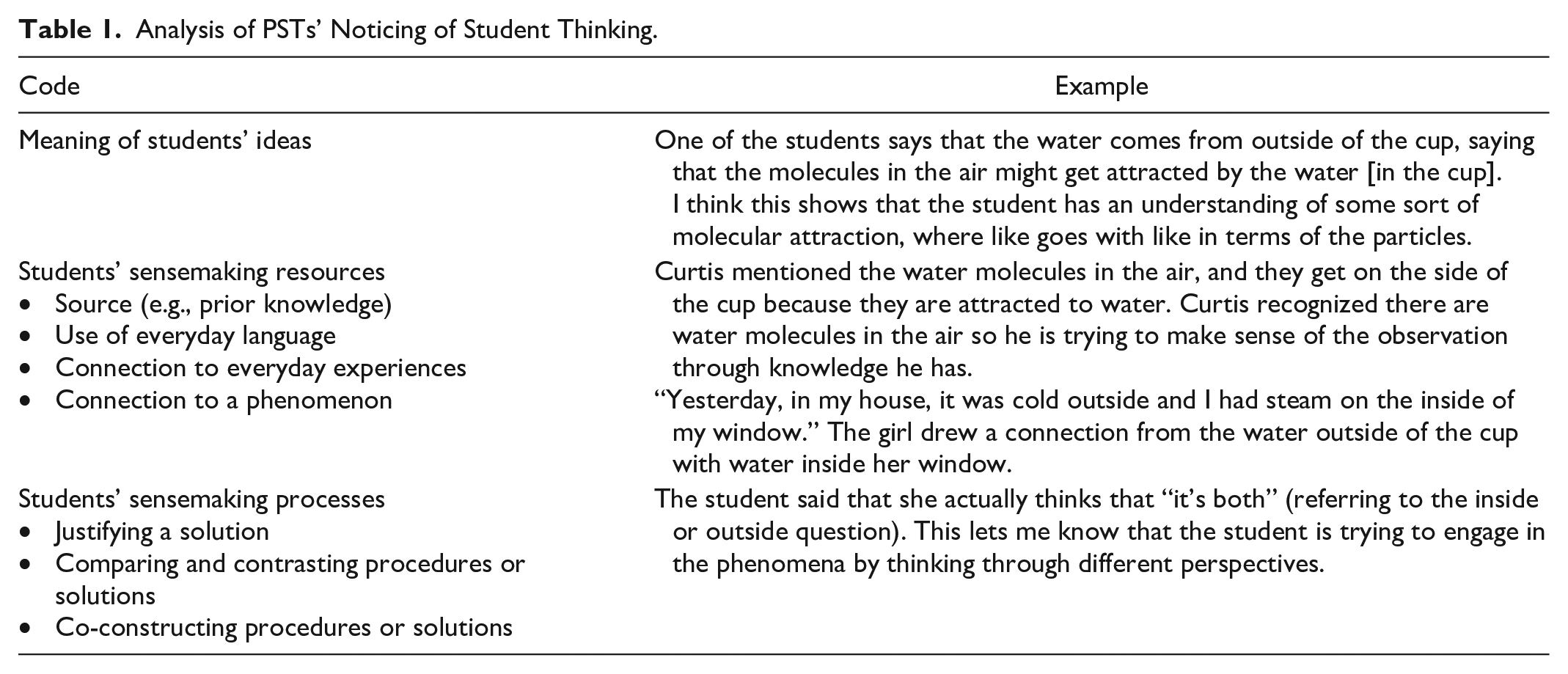
To address the second research question about how PSTs would respond to the moments of student thinking, we selected only the instances in which the PSTs responded to the same moment they noticed in the first question. Knowing that discourse moves to elicit students’ ideas was a common feature in our methods coursework (i.e., Cartier et al., 2013; Smith & Stein, 2018; Windschitl et al., 2018), we drew on a framework for analyzing facilitation (van Es et al., 2014), to categorize what moves the PST proposed to use to respond to the students’ ideas that they noticed (see Table 2). As with the process for Research Question 1, we discussed a subset of two randomly selected responses from each program to refine our coding categories through triangulation among investigators (Lincoln & Guba, 1985). Once coding consistency was reached, each researcher coded a third of the remaining responses and met to discuss unclear responses.
Analysis of PST’s Planned Moves and Underlying Purposes to Respond to Student Thinking.
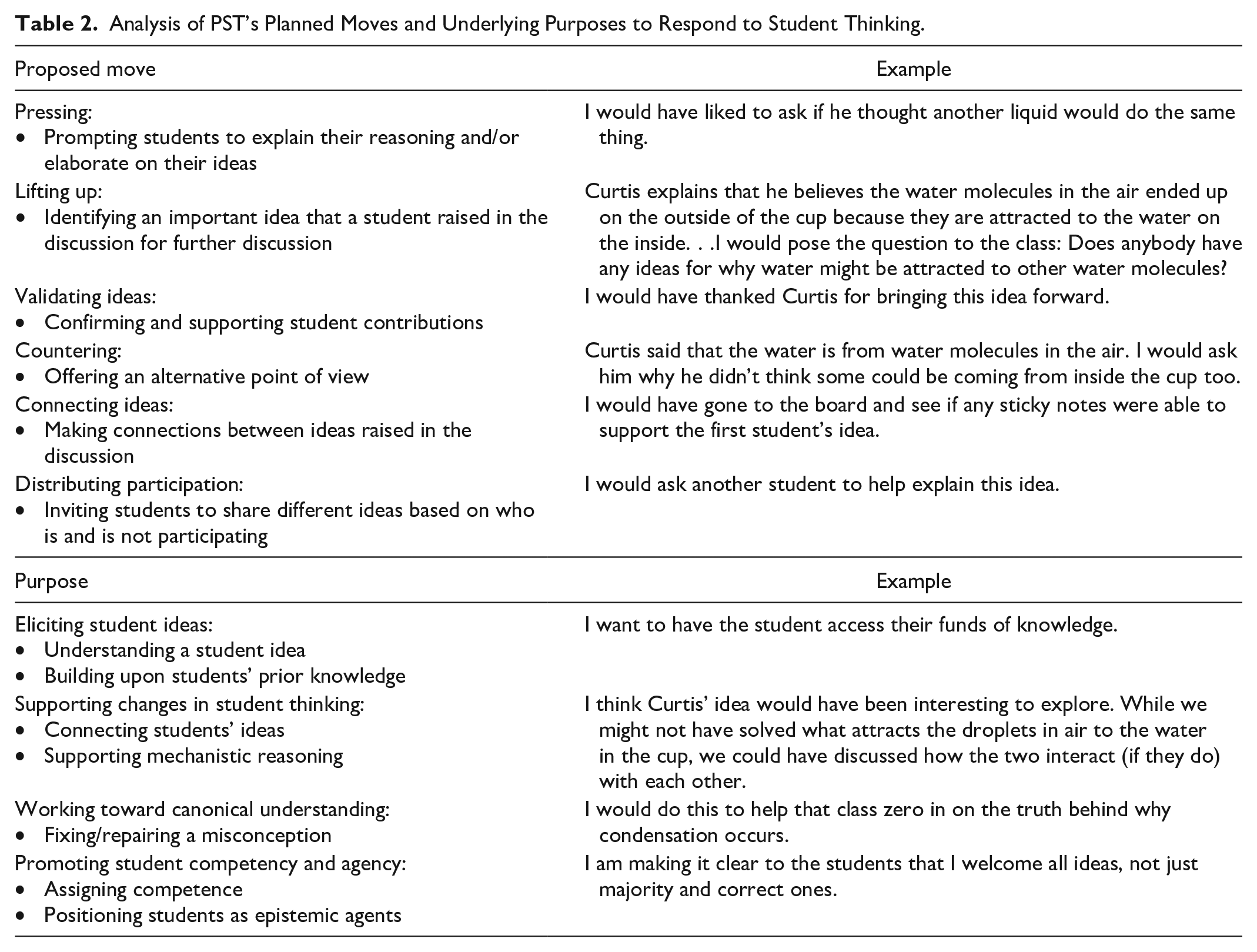
We then inductively analyzed and used the constant comparative method using a subsample of responses (Corbin & Strauss, 2015) to identify patterns in the purposes the PSTs intended these moves to serve. We came to a consensus around four categories (see bottom of Table 2) through triangulation among investigators (Lincoln & Guba, 1985). If multiple moves were proposed or purposes provided, the response was double-coded. Each investigator coded a third of the remaining responses and met to discuss unclear responses.
Findings
Our analysis revealed that when prompted PSTs notice both the meaning and the source of students’ ideas when they are made visible in a video clip. Yet, even when PSTs notice similar noteworthy moments, they exhibit different patterns of responding to these moments. Sometimes, when PSTs propose a similar responsive move, they do this to achieve different purposes and alternately, when they have similar purposes, they sometimes propose different moves. We also find that occasionally, PSTs propose responsive moves to pursue canonical correctness.
Attention to Student Thinking
Addressing the first research question, our analysis revealed what student thinking PSTs noticed in their analysis of a classroom episode. PSTs most commonly noticed the meaning of students’ ideas, followed by their attention to meaning of student’s ideas in combination with their sensemaking resources, and then students’ sensemaking resources alone (see Table 3). This means PSTs could notice the meaning of students’ ideas when they were asked to analyze students’ thinking in the video clip. The combination of “meaning” with “resources” is particularly noteworthy in PSTs’ analysis of the selected classroom episode as it indicates both an attention to what meaning students are constructing and how they are drawing upon their assets to construct meaning.
Source and Object of PST Noticing Across Three Moments.
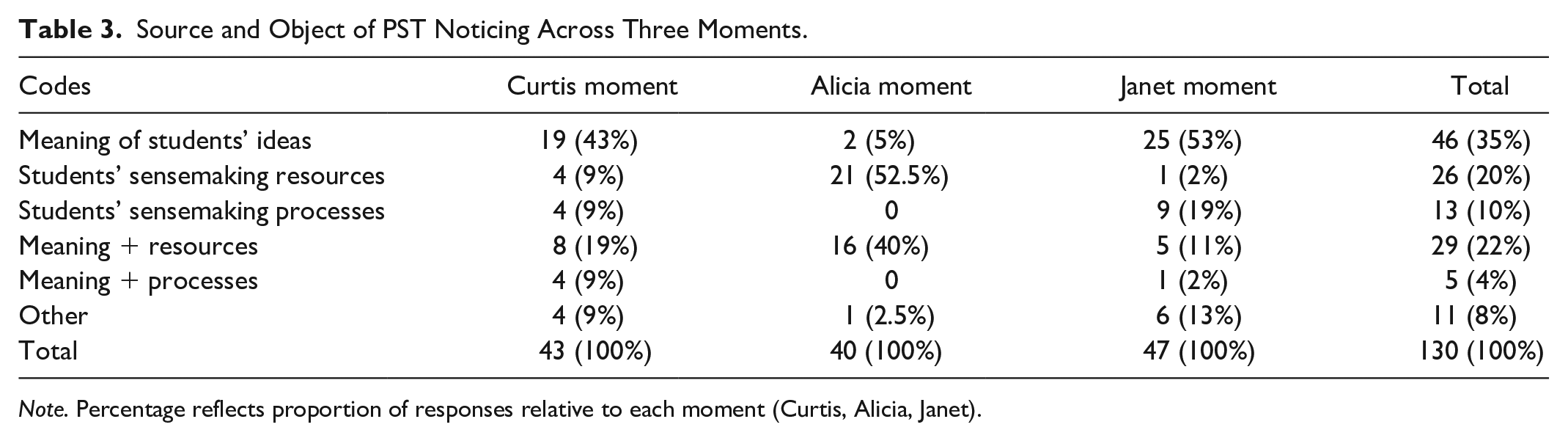
Note. Percentage reflects proportion of responses relative to each moment (Curtis, Alicia, Janet).
Our analysis revealed PSTs’ noticing was focused on three moments: The “Curtis” moment, the “Alicia” moment, and the “Janet” moment. The “Curtis” moment was about a comment that Curtis, one of the students in class, made when the teacher was eliciting students’ ideas about the Starbucks cup phenomenon. Specifically, Curtis said the water came from outside of the cup “because there’s water molecules in the air.” When pressed to explain further he stated that the water in the air gets “attracted by the water in there.” When pressed again about the reason behind that attraction, he shrugged and said he didn’t know. In the “Alicia” moment, another student, Alicia, who thinks that the water came from inside the cup, shared a different idea. She thinks that the water “is from inside the cup because when it is cold, there is like steam.” To explain her reasoning further, she said, “Yesterday, in my house, it was cold outside and I had steam inside of my window.” The teacher replied, “you are talking about a difference in temperature.” The third moment identified by the PSTs was the “Janet” moment. In this instance Janet shared her idea that the water came from both inside and outside of the cup “because it depends on how hot the room temperature is and how cold the water is.” When the teacher prompted her to explain what would be a situation that the water will come from inside of the cup, she responded by saying that “when it has the ice.”
When we look more closely at how PST noticing varied across the moments, we see the meaning code is the most prevalent in both the Curtis and Janet moments. In the Curtis moment, the PSTs often focused on the phrase Curtis used in his explanation for why the water droplets came from outside the cup when he said, “because there’s water molecules in the air.” The PSTs offered multiple interpretations of what Curtis meant when he said this, identifying what it told them Curtis knew about the phenomenon. Emma explained: This student has an understanding of the unobservable components of what he is seeing. He has an idea about molecules in the air around him, and that somehow these water molecules that can’t normally be seen turn into visible condensation on the cup.
Maya had a similar annotation around this moment, “This helps me understand that this student knows there are water molecules in the air. He also knows that water molecules are attracted to other water molecules.” Other PSTs combined their interpretation of what Curtis understood about the content with the source of that knowledge, such as Victoria’s explicit mention of Curtis’ prior knowledge, “This example shows how students tend to use their prior knowledge to understand novel situations. This student definitely knew that water vapor was in the air, but he did not exactly know how it connected to condensation.”
The Janet moment had a similar pattern of noticing as the Curtis moment. PSTs focused mostly on the meaning of Janet’s idea around temperature differences between the room and the liquid in the cup. Foster points out that Janet was introducing a mechanism to explain the phenomenon, “The student was able to identify a mechanism, identify why they thought it fit (conceptual understanding) and interpret that into a realistic context (application).” Several PSTs also noticed Janet’s sensemaking process, recognizing that she was listening to her peers’ ideas and allowing her thinking to change as the discussion unfolds. Heidi noted: This shows that the student’s thinking has changed due to the discussion. She chose “inside” to begin with, but her opinion has morphed to “both.” As she has heard arguments for outside the cup, she has started to understand that both play a part, but she doesn’t really know which one the water actually comes from.
PSTs focused less on meaning in the Alicia moment, and more on the sensemaking resource that was leveraged in the classroom discussion. Some PSTs focused solely on the resource, such as JR’s elaboration that Alicia, “brought outside life into science. She talked about how yesterday’s temperature allowed her to view steam. She is connecting science with real life!” Other PSTs took this a step further and connected the student’s resources to their sensemaking about the science. Tanya included this annotation, “The student is using personal experience to answer the question. The student knows there is something about different temperatures that triggers condensation.” While meaning was still noticed in this moment, it was most often noticed in combination with Alicia’s pulling in of her experience as a resource to make sense of the phenomenon.
Planned Responses to Student Thinking
Addressing the second research question, we focused on how PSTs planned to respond to what they noticed in the video. Our analysis paints a complex picture. As summarized in Table 4, they planned to enact different kinds of moves in response to the student ideas that they noticed. The most commonly planned moves were pressing (n=19) and lifting up (n=14), accounting for two thirds of all proposed moves. They planned to use the “pressing” move more frequently in the Curtis and Janet moments. For example, Zan planned to respond to what Curtis said by pressing him to clarify his thinking. She said: He thinks the water inside the cup is attracting the water molecules in the air. . . I might ask which “water” he was referring to. . .I would like to figure out how he got his answer. I wonder if he meant the water in the cup or other water molecules in the air.
Frequency of Moves Planned by the PSTs.
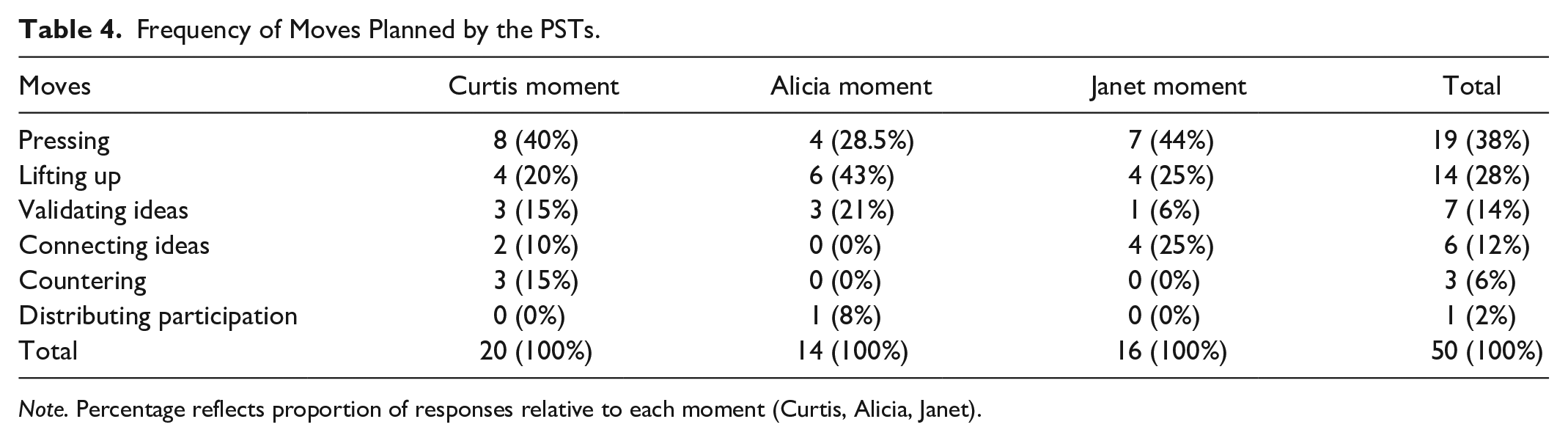
Note. Percentage reflects proportion of responses relative to each moment (Curtis, Alicia, Janet).
Zan thought that by pressing Curtis, she could better understand what he was thinking.
While the pressing move was frequently proposed in the Curtis and Janet moments, the most frequently planned move in PSTs’ responses to the Alicia moment was lifting up. The student idea that they wanted to lift up was the connection that Alicia made between what she saw in the Starbucks cup and what she saw in the windows of her house. It is apparent that PSTs identified Alicia’s idea as important and wanted to invite other students in class to think about and discuss this idea further. For example, Whitney planned to ask the following questions to the class: Can anyone else think of any other situations that are similar to the water showing outside of the cup? Can anyone think of how the steam on her window is similar or different from the steam on the outside of the cup?
She thought asking these questions would allow students to also draw on their experiences to make sense of and reason about the Starbucks cup phenomenon.
Purposes for Planned Responses
When asked to provide a rationale for these moves, the PSTs described a variety of purposes (see Table 5). We identified four purposes for PSTs proposed instructional moves: supporting changes in student thinking (n=17), promoting student competency and agency (n=15), pursuing canonical understanding (n=5), and eliciting student ideas (n=12). We then mapped proposed moves and responses backward to their original noticing code (meaning, source, process, or other). When we linked together what PSTs noticed, what they proposed to do, and why, different patterns emerged for each moment. These patterns are illustrated in, Figures 1 to 3. An obvious relationship among what is noticed, the proposed move, and the purpose is not apparent when the data are aggregated across all three moments in the clip. However, some moments did appear to provoke particular PST choice patterns. We present each moment in turn.
Frequency of Proposed Teaching Moves and Purposes in PSTs’ Planned Responses.
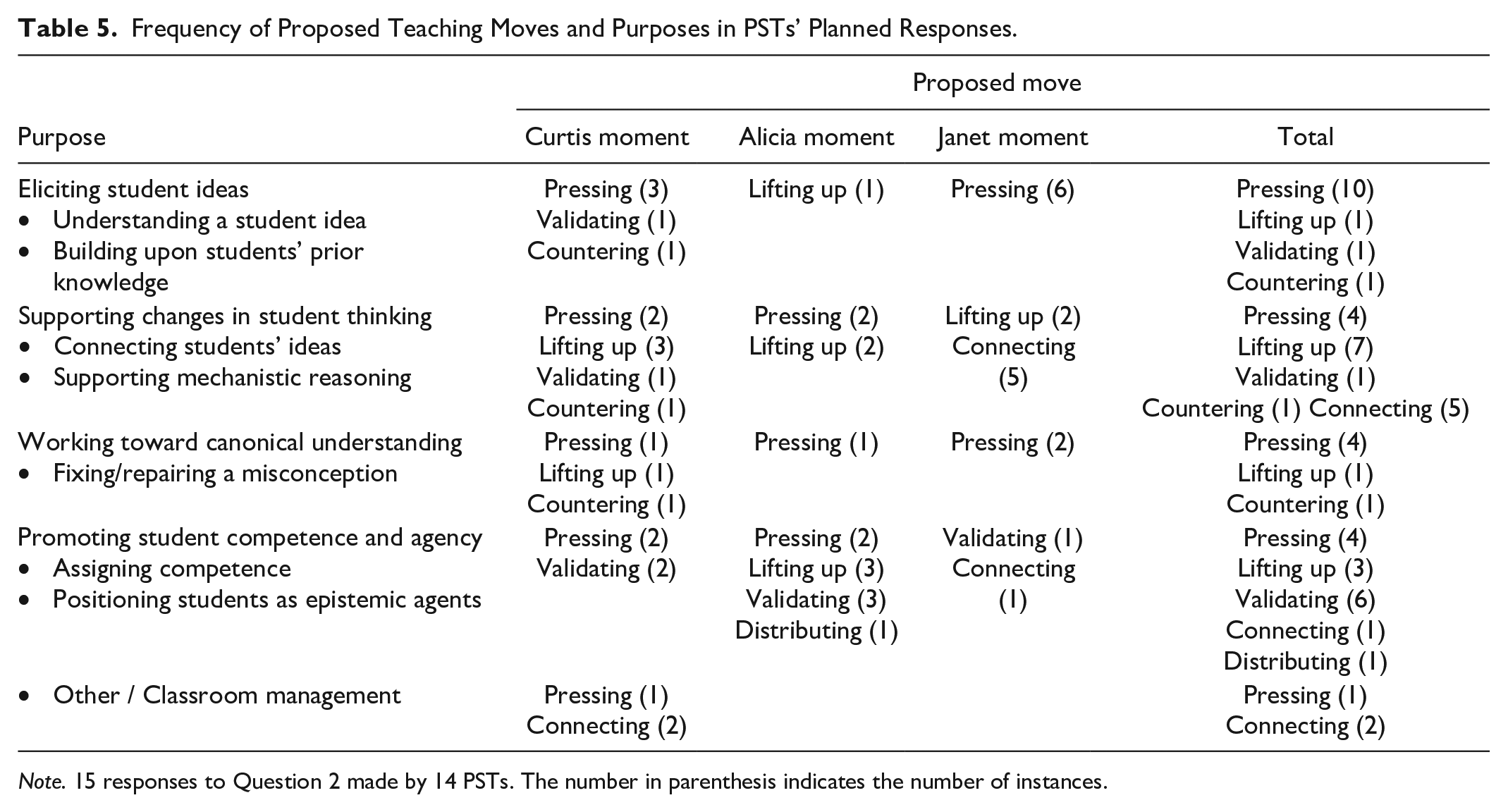
Note. 15 responses to Question 2 made by 14 PSTs. The number in parenthesis indicates the number of instances.
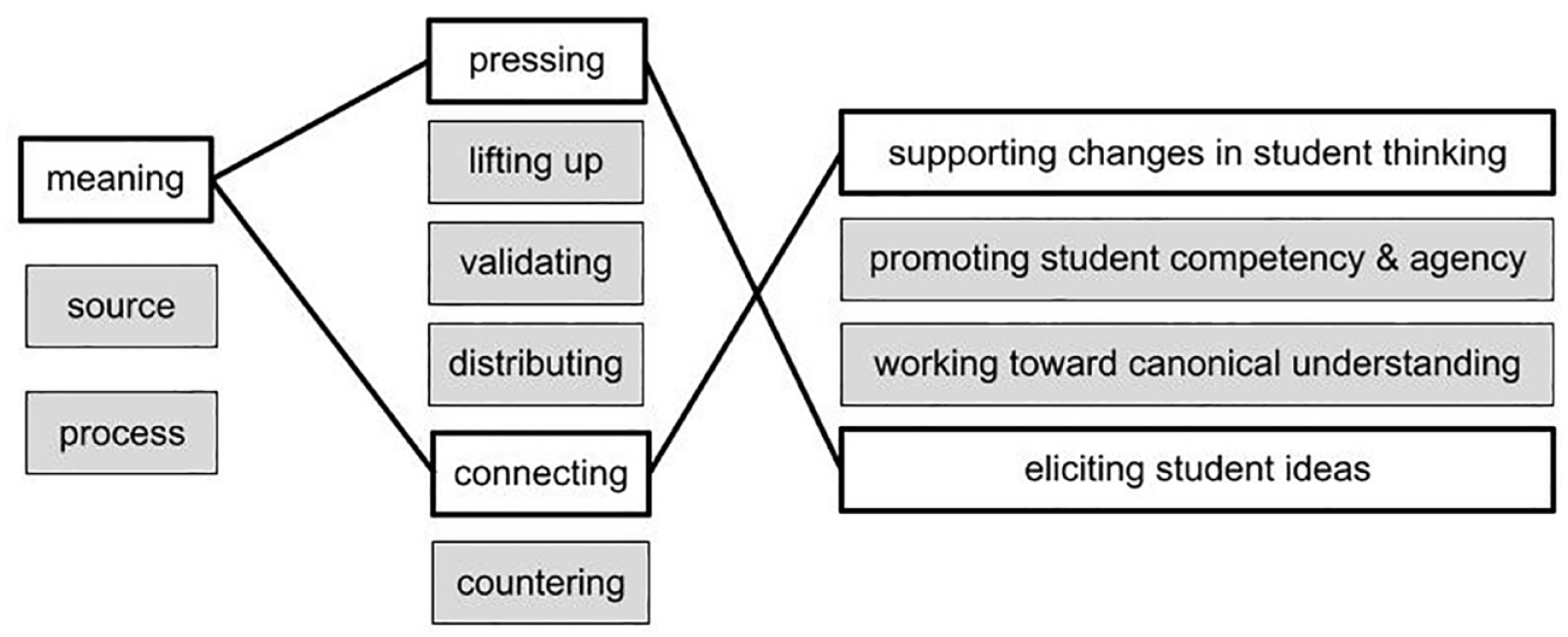
Most Prevalent Janet Notice, Move, and Purpose Patterns
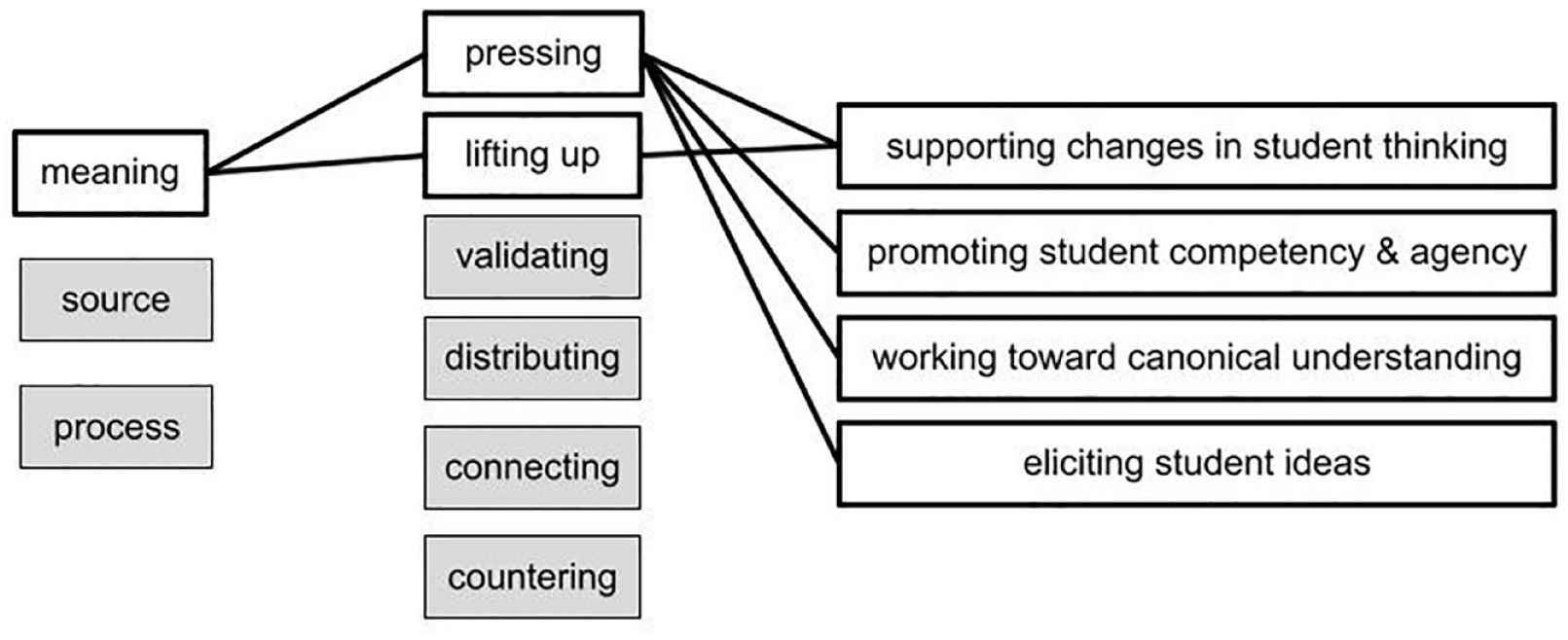
Most Prevalent Curtis Notice, Move, and Purpose Patterns
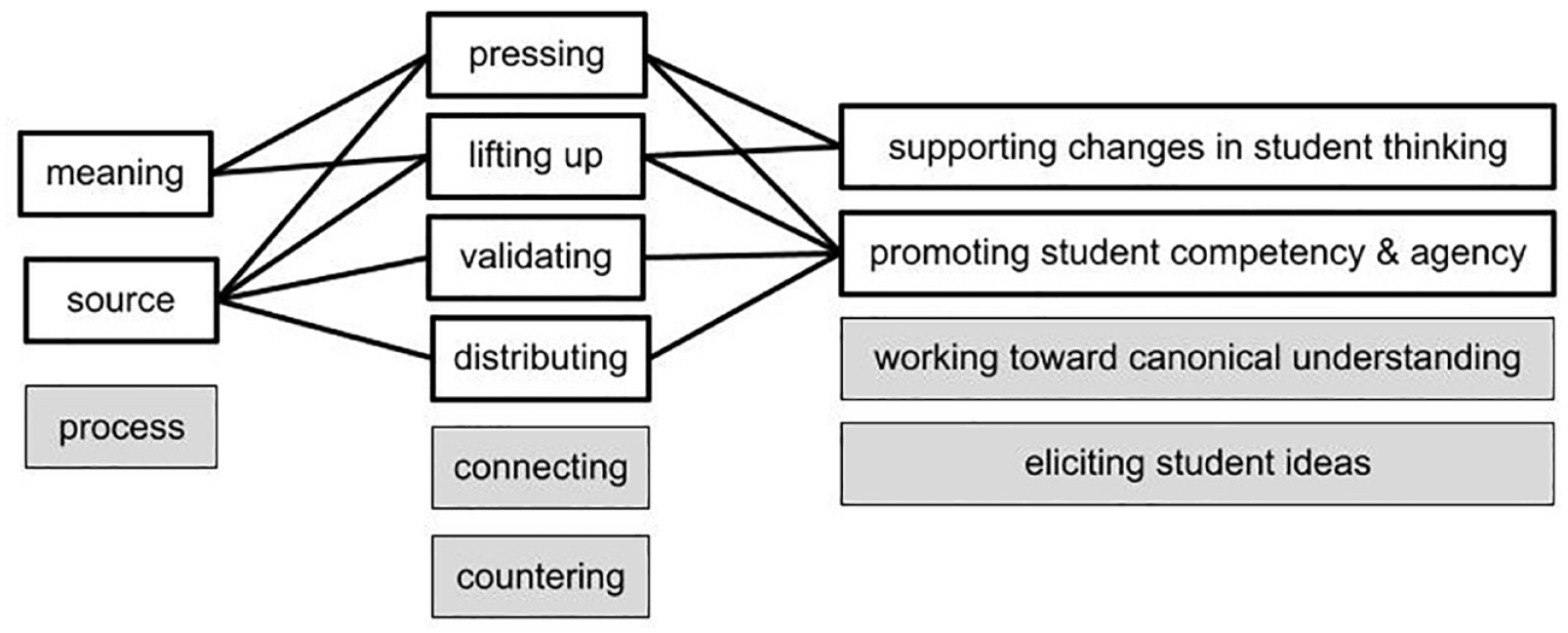
Most Prevalent Alicia Notice, Move, and Purpose Patterns
Janet: Two Main Pathways
One clear pattern that our analysis of the “Janet” moment revealed was that PSTs overwhelmingly noticed the meaning in Janet’s idea about the Starbucks cup (13 of 18 responses) (see Figure 1). PSTs predominantly proposed either pressing (n=6) or connecting (n=6) as their next move. PSTs who proposed a pressing move in response to noticing the meaning in Janet’s thinking almost exclusively did so for the purpose of eliciting further ideas. The PSTs saw this idea about temperature as interesting and were curious about her idea that water was coming from both inside and outside the cup. An example of this is in Kim’s description of what she would do with Janet’s steam idea: I would prompt her to further elaborate on the idea, and ask about why the temperature difference matters to see where her reasoning lies, or ask her of any experiences she has that would help justify her reasoning. I would like to draw further on her ideas that it could be both to understand more of the context of her answer and also maybe draw out ideas from other students who may also have similar lines of thinking.
Kim expects her pressing move to clarify Janet’s reasoning, set Janet up to leverage her life experiences as evidence, and also draw other students into the discussion. Kim’s focus was beyond the science of this moment and includes eliciting ideas from the broader group.
PSTs who proposed a connecting move in response to Janet’s thinking nearly always did so to promote changes in student thinking. JC notes an opportunity to start a conversation among the students about their ideas and pursue the idea of evidence in an explanation: A student says that they think the water came from inside the cup because of a difference in temperature between the cup and outside. That was the same reasoning for another student arguing that the water came from outside. I would highlight this and try to put the two opposing ideas in dialogue. Since students were using the same justification for different arguments, I think it would be useful to flesh that point out for the whole class.
Here, JC’s intention is for students to both understand this particular phenomenon but also explore argument construction. There is also a recognition of the potential of this science idea to draw the whole class into the conversation. What is noteworthy is that the rationales for both pressing and connecting moves serve multiple purposes at different grain sizes—understanding a specific disciplinary core idea and a science and engineering practice as well as supporting individual students and the whole class simultaneously.
Curtis: Same Move, Different Purposes
Similar to the “Janet” moment, the “Curtis” moment overwhelmingly attracted PSTs’ attention to the meaning of his idea about water from the air collecting on the cup (14 of 15 responses) (see Figure 2). PSTs overwhelmingly proposed pressing (n=8) and lifting up (n=4) moves. Reasons for pressing varied evenly across the four purposes. Curtis’ idea was the most canonically correct, but his terse response in the clip did not reveal much about his reasoning. Unlike the “Janet” moment, this moment did not telegraph a clear path for PSTs to pursue. Zan addressed the uncertainty in a straightforward way by pressing to seek more information. As previously noted, she proposed a pressing move to ask Curtis which “water” he was referring to. Other pressing moves, like Tracey’s, dealt with the dilemma about what to do with Curtis’ idea in a more complex way: Curtis explains that he believes the water molecules in the air ended up on the outside of the cup because they are attracted to the water on the inside. I would ask another follow-up question to see where Curtis’s reasoning for the attraction in the water comes from. If Curtis seems unsure, I would pose the question to the class: Does anybody have any ideas for why water might be attracted to other water molecules? I would ask this question because it would help Curtis and the other students to bridge concepts that they have learned/heard about previously, even if they aren’t 100% sure what they mean. This question would get students to start thinking about the ways that the cohesivity of water relates to this problem as well as other properties of water.
As with proposed responses to the “Janet” moment, Tracey’s response attempts to engage both Curtis and his classmates in a discussion about this particular event as well as the properties of water more generally. They also seek to position students as capable knowers who have past experiences that they can bring to bear on the current problem.
Alicia: Different Moves, Same Purpose
The “Alicia” moment split the groups’ attention between the meaning of Alicia’s comment about the water on the Starbucks cup being like the steam on her window (n=6) and the fact that the source of her idea came from her lived experience (n=11; see Figure 3). Those PSTs who noticed the meaning of the window idea either proposed a pressing or lifting up move, primarily to support changes in student thinking. PSTs who noticed the source of the window idea proposed a variety of moves (pressing, lifting up, validating, and distributing) primarily to promote student competence and agency (n=7) but also to support changes in student thinking (n=4). Some PST responses, such as Nicole’s, acknowledged the opportunity to build on students’ experiences but privileged making sense of the science: Student tells teacher about the steam in her window. I’m really struck with the difference between steam and condensation, so I wonder if there would be a way to ask about ever having seen steam rise from a pot of boiling water and then seeing fog in the morning when it’s cold. Are the two the same? Are they different? How are they different? I feel like there may be a better time (i.e., not when starting the lesson and getting initial ideas), but the thought is that they are two different processes on opposite sides of the heating and cooling curves.
Other responses, such as Wai’s, sought to give equal privilege to the science and the learner’s identity as a scientist: After the student gave the example of the steam on the inside of her house window when it was cold outside, the teacher seemed to rephrase what the student said. . .If I were the teacher, I might have said, ‘I think this example is very nice, and very similar to our Starbucks cup case, right? Let’s have a close look at the example Alicia provided. Which side of the window could be the counterpart of the outside of the cup?’ I like how students could put forward examples from their life experience that have the same underlying theories with what we are discussing about. I feel like if we could emphasize a little bit on what students bring forward, they could get a feeling that their ideas matter.
Like the Curtis moment, many PSTs identified Alicia’s observation as noteworthy but were not in agreement about how to respond. This moment perhaps represented a perceived tension between two worthy goals—promoting the pursuit of students’ science ideas and promoting the development of students’ identities as agentic thinkers.
Responding to “Wrong” Answers
Despite the overwhelming attention to student ideas and the source of those ideas (41 of 45 total annotations), a few PSTs proposed moves to pursue canonically correct answers (5 of 54 proposed moves and purposes). Leah’s reaction to Janet’s idea about water coming from inside and outside the cup reflects this adherence to correcting “wrong” ideas: At this moment I would continue to ask the student more probing questions. I think that asking questions like “how does the water from the ice melting get on the outside of the cup?” or “does anyone else have similar thinking to __?” I would ask these questions because it would allow for more discussion and more ideas to be brought about if/why this student is wrong in her thinking. It is equally as important to address misconceptions during discussion as well as the right answer.
Here, Leah proposes pursuing Janet’s idea and endeavors to pull other students into a discussion about a mechanism for the cup phenomenon. Each of these aims are what we encourage our PSTs to do as responsive science teachers. But Leah’s intention for the discussion seems to be to involve others in correcting rather than exploring Janet’s “wrong” idea. Despite a course and program focus on taking an asset-based lens to view students and their thinking, these results indicate that concern with canonical correctness continued to influence PSTs’ instructional moves.
Similarly, multiple PSTs noticed a moment in the clip in which Curtis states that condensation comes from outside the cup, from water molecules in the air, and proposed a lifting up move to elevate this idea for further discussion. Maya explains that she: would do this to help that class zero in on the truth behind why condensation occurs. At some point the lesson is going to have to go towards a temperature difference, and this is a good place to debunk a common misconception.
Here we see Maya lifting up a student idea and presenting a counterargument to that idea with the purpose of fixing a misconception tied to mechanistic reasoning. Jan identified the same moment and explained that she would ask: how water in air would be attracted to the outside of the cup and how temperature difference may cause that change. I would do this to tie the different thought processes and responses together to get the students to make the connection between temperature change and water phase change.
In this case, her purpose is less about getting to the “right idea” and more about connecting student ideas to support mechanistic reasoning. By pulling different student ideas together, the PST is supporting equitable sensemaking by co-constructing a storyline with student ideas about the cup phenomenon (Haverly et al., 2020). The moves proposed by Leah, Maya, and Jan appear responsive on the surface, but their purposes vary—Leah and Maya value “correct” science ideas and Jan values students’ ideas as resources for developing science understanding.
Discussion
We started this investigation to seek the ways in which PSTs work with students’ ideas. In our analysis, we focused on what PSTs noticed about student thinking in an instructional episode from a science classroom and how they planned to respond in the context of a noticing task. Our analysis revealed the nuances in PSTs’ noticing and responding to students’ thinking and the complexities in the association between noticing and responding. The following sections further explore the noticing-responding relationship and raise implications for teacher education.
Noticing Student Thinking
Our detailed analysis of the moments identified by the PSTs in the video clip indicated that PSTs notice the meaning of students’ ideas. This finding indicates, as previous work has shown, that novices, given an appropriately structured and supported task, are adept at noticing students’ thinking and viewing students as capable knowers (Barnhart & van Es, 2015; Johnson & Cotterman, 2015; Kang & Anderson, 2015).
We also see that PSTs can notice different aspects of students’ thinking, not just the meaning of the disciplinary ideas that they grapple with. Some of this could be attributed to the focus of the respective teacher education programs that engaged PSTs in the tool-supported analysis of video and student work throughout coursework and field experiences to slow down, attend to, and interpret student thinking (Johnson & Mawyer, 2019). The results indicate that PSTs noticed students’ ideas, the source of their ideas, or combinations of these in various classroom moments. It is promising that PSTs frequently noticed the combination of the meaning of students’ ideas with students’ sensemaking resources such as students’ everyday language and experience. We believe this to be a particularly noteworthy combination as it indicates both an attention to what meaning students are constructing and how they are constructing meaning. It shows that PSTs are noticing that students are full human beings with resources that can differentially support their sensemaking. On the surface, this appears to be very much in alignment with the dispositions needed for responsive science instruction because responsive teaching requires orienting to and recognizing students’ ideas and experiences as assets (Kang, 2022; Richards et al., 2014). This pattern in their noticing is encouraging as it shows their potential to begin to appropriate an anti-deficit frame as they observe classroom interactions Louie et al., 2021).
Responding to Student Thinking
Our analysis of PSTs’ plans for how to respond to students’ thinking depicted a more complex picture. Although PSTs overwhelmingly noticed the meaning of students’ ideas and proposed moves that appeared to center students’ ideas, their purposes for doing so were not always consistent with models of responsive science teaching. Given how challenging and context-dependent skilled noticing is even for experienced teachers (Barnhart & van Es, 2020; Richards & Robertson, 2016), it is probably not surprising that clear patterns of responding in relation to what PSTs noticed were not always apparent. This finding is also consistent with literature around novice teachers’ irregular attention and responsiveness to student thinking (Richards et al., 2020). PSTs may know how to notice students’ ideas but need support to develop a facility with what to do with them.
These results could also be an indication that PSTs treat each moment from the classroom episode differently, recognizing that the ideas contributed by the students in each situation are unique, and therefore their responses must adjust to the affordances of that particular moment. Although PSTs marked the same three moments of student thinking from the same video clip as noteworthy (Curtis’ idea, Janet’s idea, Alicia’s idea), they varied in their approach to those moments. In some cases, PSTs highlighted the same instance of student thinking but planned different responses to work with students’ contributions. For example, with the Alicia moment, PSTs were intrigued by the connection Alicia made between the science in the classroom and her life outside the classroom and the potential of her idea to start a discussion about temperature and states of matter. Two objectives seemed clear to the PSTs—to recognize Alicia as an agentic thinker and to pursue the science of her idea. How PSTs proposed to accomplish these objectives was less clear. Some thought to press or praise Alicia, some lifted up her idea for further discussion, and some overtly invited others to share their reaction to her idea.
In other cases, PSTs utilized similar moves but for very different purposes. Curtis’s idea about water in the air, for example, was the most “canonically” correct, but his reasoning was not very visible (Sherin et al., 2009). With little information to go on, some pressed Curtis in an attempt to acknowledge his idea, some pressed to get more information about his reasoning, and some pressed to encourage others to consider his idea. The variation in the nature of the responses to what Curtis said is an example of how PSTs’ responsive moves seem similar on the surface but are in fact different when we consider PSTs’ purposes for using a particular move.
Implications for Teacher Education
Our findings bring attention to the nature of videos that teacher educators use to support PSTs’ learning. In examining the patterns of what PSTs noticed, we found that different moments afforded different opportunities for noticing within a single clip. This was particularly salient in the “Alicia” moment when the student made a connection between steam on her window at home and the classroom discussion about condensation. PSTs marked this as a key moment and privileged attention to the source of Alicia’s idea rather than the meaning of her idea. In the other two moments, no explicit references were made to examples or ideas from outside the classroom so it’s not surprising that PSTs did not attend to “source” in those moments as frequently. The implication of this finding is that we, as teacher educators, must consider the features of particular clips for particular purposes (Kang & van Es, 2018; van Es et al., 2020). When particular features of classroom interactions are made visible (e.g., the source of a student’s idea), PSTs will talk about them; but if these features are not made visible, we cannot assume PSTs are not thinking about them. In assignments of the type described in this study, PSTs choose to unpack what is there, not what is missing.
In addition, despite encouraging indications that PSTs were developing asset-based orientations toward students and their thinking, PSTs’ concern with the correctness of students’ ideas and the desire to “fix student misconceptions” are reminders that PSTs enter programs having been enculturated into math and science as the pursuit of facts (Braaten & Sheth, 2017; Louie, 2017). How their beliefs interact with elements of their professional programs—are they strengthened, negotiated, or modified—will influence their future teaching decision-making (Min et al., 2019). Explicit exploration of beliefs about teaching, learning, and students’ thinking are also worthy topics of discussion with PSTs as they engage in sense-making about what they notice and how they choose to respond.
Furthermore, in our study, the video cases came from classrooms that were not familiar to our teacher candidates. Not knowing the students or the curriculum could be one reason we saw the teacher candidates take varied approaches to respond to what they noticed. It is also possible that students other than Alicia introduced linguistic or cultural resources to support their sensemaking that went unnoticed by our teacher candidates because they were not able to connect the idea to what they know about the students. If responsive teaching hinges on recognizing the humanity of the students in front of them and that their students bring a wealth of knowledge, skills, and experiences into the classroom, examining videos of classroom interactions of students who are not known to the PSTs may be useful for introducing responding but may have limited affordance on its own for practicing responding in equitable ways (Kang, 2022). Consequently, teacher educators need to be intentional about using additional tools that can help PSTs to think with the rich affordances of the video.
Future research could explore how a more nuanced understanding of how the classroom context in the clips influences how teacher candidates respond to what they notice. Teacher educators can then be thoughtful about how clip selection, and video analysis tasks and tools work together at various points in the PST noticing and responding trajectory (Kang & van Es, 2018; Tekkumru-Kisa & Stein, 2017; van Es et al., 2020).
We recognize that this small study of three groups of PSTs is limited in its generalizability however, our detailed analysis suggests that teacher educators should be more intentional about including opportunities for PSTs through decompositions and approximations of practice to learn to respond to what they notice in addition to the opportunities typically created for them to learn to notice student thinking. Providing them with the opportunities to learn to how to be responsive to students’ thinking is essential if the eventual goal is to help PSTs to know how to work with students’ ideas in the moment of teaching. Luna and Selmer’s (2021) framework for decomposing responding is an important step in clarifying how teacher educators can help PSTs to think about and enact ways to use students’ ideas to support their learning. To be clear, we do not view this work as teaching PSTs specific, prescriptive sets of moves to use in particular circumstances. Instead, PSTs need support in clarifying and considering their instructional purposes to navigate tensions or “decision points” during the act of teaching (Coles, 2013; Thompson et al., 2016). As PSTs are placed in teaching contexts for practicum or student teaching experiences, a framing-anchored approach that is contextualized within their instructional settings and constraints could be productive in supporting their noticing and responsiveness to student thinking (Richards et al., 2020). We, as teacher educators, must facilitate conversations with our PSTs in which we examine both what responses could occur and different reasons for why these responses might make sense for these students at this moment.
Conclusion
Our analysis of PST noticing and responding in this study begins to illuminate the seeds of PSTs’ adopting asset-based orientations in their noticing of student thinking. These PSTs were able to notice the substance, source, and ways in which students were thinking about science. However, the various purposes PSTs identified for how they planned to respond to what they noticed speaks to the need for teacher education programs to provide opportunities for PSTs to think about and examine students as resources for productive sensemaking. Teacher educators need to design coherent opportunities that support PSTs in noticing students’ resources, including everything from their prior knowledge to their lived experiences, to their everyday language. Then, once those resources are noticed, teacher educators can help PSTs learn to respond in ways that make space for students to explore these resources to support equitable sensemaking (Haverly et al., 2020). It also makes clear that just as we encourage our PSTs to be dissatisfied with “correct” answers as the only evidence of student understanding, we should engage in the same level of healthy skepticism ourselves about the purposes behind our PSTs’ proposed moves. Further empirical work is needed to explore the relationship between noticing and responding to better understand teachers’ reflection-in-action (Schön, 1987).
Footnotes
Author contributions
All authors contributed equally to this work.
Declaration of Conflicting Interests
The author(s) declared no potential conflicts of interest with respect to the research, authorship, and/or publication of this article.
Funding
The author(s) received no financial support for the research, authorship, and/or publication of this article.
Ethics Approval
IRB approval was granted for this multisite study by all three participating institutions. Chapman IRB-21-18.
