



Abstract
Teaching practices that are responsive to student thinking are complex and challenging to learn, particularly for novice teachers. Skilled responsive teaching involves adaptive expertise, or the ability to deliberate about and respond to students’ emergent ideas. This study explored the learning of early-career teachers through participation in a video-feedback inquiry group around the enactment of a number talk routine introduced in preservice teacher education. Conceptualizing teacher learning as socially situated within a discourse community, we consider how participation in the asynchronous inquiry group supported both collective interpretations and individual growth in implementing responsive instructional practices. Findings suggest that giving and receiving asynchronous feedback provided novice teachers with opportunities to engage in dialogic conversations that involved several types of deliberation related to responsive teaching and the development of adaptive expertise. This study provides evidence of the potential of asynchronous teacher inquiry groups and the importance of giving, as well as receiving, feedback on practice.
Keywords
Teachers can foster deep and lasting learning when they elicit, make sense of, and respond to students’ ideas in ways that connect developing understandings to key disciplinary concepts—an approach referred to as teaching responsively (Robertson et al., 2015). Responsive teaching, however, is complex and challenging to learn. Making instructional decisions in response to emergent student ideas means that each act of teaching is contingent on multiple factors (Kavanagh, Conrad et al., 2020) involving “in flight decisions” to adapt instruction to what learners know, think, and do at any given moment (Borko & Livingston, 1989). A growing body of work explores approaches to supporting preservice teachers to develop the kind of adaptive expertise needed for responsive teaching (e.g., McDonald et al., 2013). Extending the learning from preservice teacher education into the first years of teaching, however, is a significant challenge. Responsive teaching runs counter to the didactic approach commonly used in U.S. schools (Hiebert et al., 2005; Hill et al., 2018), and many new teachers find themselves “frustrated novices,” equipped with a vision of responsive teaching but lacking the proficiency to pull it off (Bransford et al., 2005).
Responding to these challenges, we set out to extend novice teachers’ learning of responsive math teaching practices in a 1-year masters-level preservice program into the early years of teaching through a video-feedback inquiry group. A subset of early-career graduates of our program agreed to facilitate Number Talks—an instructional routine that involves responsive teaching practices—and post videos of their practice to an online platform that allowed for commenting by peers and teacher educators. In addition, they posed questions about their practice and responded to others’ videos by making comments tagged to specific moments, positioning each teacher as both a giver and a receiver of feedback. This structure provided an opportunity to explore how participation in an asynchronous video-feedback inquiry group supported early-career teachers’ ongoing learning of responsive teaching practices.
Our approach was grounded in a view of teacher learning as socially situated within a discourse community with both collective and individual components (Wenger, 2010). From this perspective, individuals contribute to the development of the group’s shared understandings through deliberating with others about instructional episodes and problems of practice (e.g., Horn et al., 2017). In addition, the negotiation of ideas and practices within the community helps individuals internalize and transform shared understandings for use both within and outside the community. Existing studies of synchronous teacher communities suggest that reflective and deliberative conversations among teachers can be generative for teacher learning (Lefstein et al., 2020), particularly when they support collective interpretations of pedagogical episodes (Horn et al., 2017).
Drawing on this perspective, we were interested in whether an asynchronous video-feedback structure could support early-career teachers to engage in such deliberations around videos of practice. Questions guiding our research included the following:
Our study builds on existing research on novice learning of responsive teaching practices, the use of video in professional development, and the design of video feedback platforms that support collaborative inquiry, which we review in the following section. We then offer a conceptualization of adaptive expertise, which we later use to frame the knowledge and skills that undergird responsive teaching.
Supporting Novice Learning of Complex Practice
In designing the video-feedback inquiry group, we were guided by existing research on supporting the learning of complex teaching practice. In our methods course, we support preservice teachers’ learning of responsive teaching through repeated opportunities to practice and get feedback on Number Talk facilitation. The Number Talk 1 routine involves posing a string of related problems, eliciting and representing student strategies, and then helping students to understand each other’s thinking, see connections between approaches, and make connections to key mathematical concepts. Repeated practice enacting instructional routines can support the development of responsive teaching practices because there is a clear and identifiable structure designed to surface children’s thinking, providing opportunities for teachers to interpret and respond to students’ mathematical ideas in the moment. As such, it offers both a powerful student learning experience and an opportunity for teachers to practice and improve responsive and improvisational moves (Kavanagh, Metz et al., 2020; Lampert & Graziani, 2009; McDonald et al., 2013).
Many studies have explored the use of videos of classroom teaching in synchronous professional development, finding that viewing videos of instructional practice can promote self-reflection and growth (e.g., Sherin, 2004; Tripp & Rich, 2012). By providing an unfiltered record of teaching, video can slow instruction down, helping teachers see things they may have missed and giving them time and space to reflect on and consider new approaches (Borko et al., 2008; Brouwer et al., 2017; Sherin & Han, 2004). Teachers reflecting on videos of their instruction are more inclined to identify gaps between how they envision their teaching and their actual practice (Koh, 2015; Sherin & van Es, 2009; Tripp & Rich, 2012) and monitor their own professional growth (Struyk & McCoy, 1993). Furthermore, the process of previewing and selecting a video from one’s own classroom can be a rich site for teacher learning in and of itself (Richards et al., 2021). Weber et al. (2018) found that preservice teachers receiving video-based feedback developed more robust professional visions than those receiving feedback from live observations. There is also a growing body of evidence that videos of practice can be used productively in asynchronous professional development, especially when engagement with the videos is structured (Seago & Knotts, 2021; Watkins & Portsmore, 2022).
In this study, we leveraged the benefits of repeated practice with instructional routines and reflection on videos to structure an inquiry group to support early-career teachers’ implementation of responsive math teaching. The use of an asynchronous online platform for sharing and commenting allowed for teaching peers to view, select, and comment on specific moments in their own and each other’s teaching practice, opportunities that are not typically present in school-based work environments. Others who have used video-sharing platforms with teachers have found that these environments increase motivation and capacity to reflect on one’s practice (Lee & Wu, 2006; Rich & Hannafin, 2009; So et al., 2009). Walkoe et al. (2020) argue that the multimodal features of video-commenting platforms, which allow for tagging specific instances and commenting in different ways, make visible multiple interpretations of the same episode, inviting reasoning and discourse that is dialogical (Horn et al., 2017) or generative (Lefstein et al., 2020).
In a review of research on teacher learning communities, Lefstein et al. (2020) conclude that productive teacher discourse includes “revealing and probing problems of practice, providing evidence or reasoning, making connections to general principles, building on others’ ideas, and offering different perspectives” (p. 8). Horn et al. (2017) highlight an additional characteristic of “high-depth” meetings that provide opportunities for teacher learning: collective interpretation that is oriented toward teachers’ future work in the classroom. In contrast to much of the research on teacher communities, the discourse community we studied was comprised of early-career teachers, allowing us to examine how these characteristics might support their development of adaptive expertise for responsive teaching. Because participating in the inquiry groups involved both giving and receiving feedback, the study also allowed us to examine the role that these dialogic conversations played in teachers’ learning. While some researchers argue that peer feedback lacks “knowledge authority” (Gielen et al., 2010, p. 305) needed to foster joint meaning-making and deeper understanding (Topping, 2005; Yang et al., 2006), much of the research on peer feedback focuses on its impact on the recipient (Prilop et al., 2021). This study, in contrast, examines what teachers learn from both giving and receiving feedback on videos of practice in an asynchronous online community.
Adaptive Expertise for Responsive Teaching
We draw on the concept of adaptive expertise, or the ability to use one’s knowledge and reasoning to make sense of and respond to novel problems in flexible ways, to frame the type of learning needed to develop responsive math teaching (Ghousseini et al., 2015). In contrast to routine experts, who are skilled in addressing recognizable problems in consistent and efficient ways, adaptive experts possess the knowledge and reasoning capacities needed to deliberate about and modify their practices within complex environments (Hatano & Inagaki, 1986). Teachers with adaptive expertise in responsive mathematics teaching can use these capabilities, in conjunction with well-developed professional judgment, to adapt instructional decisions to the needs of their students. Based on a review of the literature (Goldsmith-Markey, 2023), we conceptualize adaptive expertise for teaching mathematics responsively as having four primary components.
First, adaptive experts have a fluent repertoire of responsive teaching practices—moves, language, and routines—each of which can be articulated, explained, selected, and enacted (Hammerness et al., 2005; Hatano & Inagaki, 1986). In mathematics teaching, such practices include being able to ask students many different types of questions, for a variety of reasons (e.g., to press students to explain their thinking or to help the whole class understand one student’s ideas), and to strategically select when to use each type.
Other components of adaptive expertise involve specific types of reasoning that support the flexible use of these repertoires. The ability to see structure and recognize patterns within and across complex situations allows teachers to parse the elements of responsive teaching in useful ways and recognize connections between the how and the why (Hatano & Inagaki, 1992; Schön, 1983). An expert teacher might have a mental model to categorize different types of questions (e.g., scaffolding, probing, or clarifying) and would not only understand the purpose, but also be able to offer specific scenarios in which a question might be used, identify examples of these questions in other teachers’ practice, and identify missed opportunities in their own or others’ practice.
Adaptive experts in responsive teaching are also able to use pedagogical reasoning to deliberate about novel instances of practice and to do so efficiently and effectively (Kavanagh, Metz et al., 2020). They can identify and define problem spaces, hypothesize about instructional dilemmas, consider possible courses of action and their consequences, and engage in reflective experimentation around specific instances of practice (Hatano & Inagaki, 1992; Kennedy, 1987; Schön, 1983).
Finally, adaptive expertise in responsive teaching involves self-reflection to identify the limits of one’s knowledge (Hatano & Inagaki, 1992) and the gaps between one’s vision and practice (Smith & Starmer, 2017). Self-reflection requires that teachers: (a) have a well-articulated vision of what responsive teaching looks and sounds like, as well as the broader goals and principles that shape those practices (Munter & Correnti, 2017), (b) are able to recognize when their practice falls short of that vision (Timperley, 2013), and (c) are motivated to figure out how to bridge that gap by seeking new knowledge and experimenting (Hatano & Inagaki, 1986).
Adaptive expertise develops over time, through repeated participation in practices that require the learner to meet variable demands, apply prior knowledge flexibly, and reason and innovate when prior knowledge is insufficient. Studying the learning that takes place along this “trajectory towards expertise” (Hatano & Oura, 2003, p. 28) requires finding opportunities to observe teachers’ repeated participation in practices that call for deliberation around complex practices as well as tracking their growth over time. Discourse communities and online platforms that make teachers’ individual and collective deliberations visible can be especially fruitful in capturing this development. Examining how teachers give and respond to feedback on videos of practice offers an opportunity to see their deliberations, which are most often invisible to an observer, and explore what influence, if any, they have on individual and collective interpretations as well as on subsequent practice.
Research Design and Methods
Context and Participants
The context of this work was a yearlong video-feedback inquiry group with 11 participants and three teacher-educator-researchers (the authors). The participants were recruited from the list of recent graduates of our teacher education program: five were first-year teachers and the other six had between 1 and 5 years of experience in the classroom. All participants volunteered but were given a small stipend for their participation. The participants were divided by grade level into two smaller groups to engage in four inquiry cycles over one school year.
As our goal in this article was to explore the giving and receiving of feedback in the inquiry group, we used intensity sampling (Patton, 2002) to construct a case study of the group that had the most consistent asynchronous participation across the year. This group (hereafter referred to as “the inquiry group” and shown in Table 1) consisted of four early-career PreK-Grade 1 teachers and one more experienced Grade 1 teacher who had served as a mentor in the teacher education program.
Inquiry Group Participants and School Demographics.
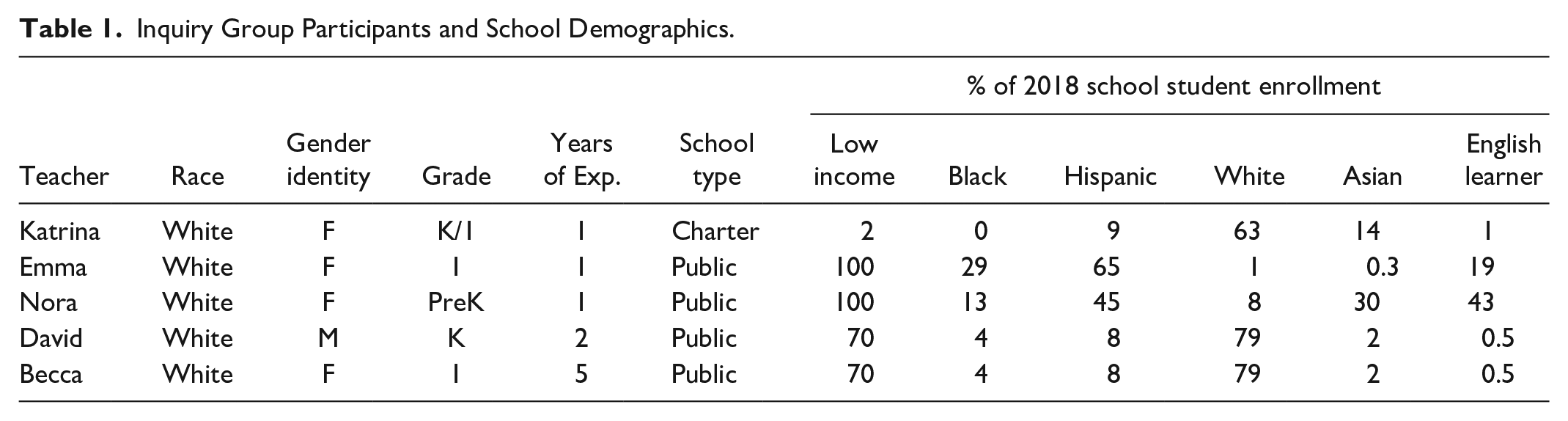
Four of the teachers taught in the same East Coast urban school district in elementary schools that served predominantly low-income families; one taught in a more affluent, progressive charter school in California. The teacher-educator-researchers are mathematics educators who identify as White, cis-gender females from the same teacher education program, located in a historically white institution; two are faculty members and one was an advanced doctoral student and teaching assistant. Our dual roles as teacher-educators and researchers required us to acknowledge and hold in check the biases and expectations we held in relation to the participants and consider potential pressures they might experience to perform when observed by former instructors. Furthermore, as representatives of a wealthy institution that wields substantial power, we are keenly aware that studies like this one can be extractive. We sought to maintain strong personal relationships with each participant and remained responsive to their interests, needs, and the pressures they faced.
We structured the inquiry group into four scheduled cycles, each consisting of (a) recording a 10 to 20-min Number Talk, (b) posting the video with a focusing question on the Vosaic online platform, (c) posting comments on videos from two other teachers in the group, and (d) receiving comments from peers and teacher educators. 2 Participants were sent email reminders and assigned to comment on two peer videos during each cycle. Teacher educators waited until at least one peer had commented before posting comments to avoid influencing the feedback given by participants.
Data Sources
Our analysis was based on three primary data sources: participants’ online interactions in the video-feedback environment, videos of their practice, and a series of semi-structured interviews.
Over the year, each participant posted four videos to the Vosaic platform. The 20 videos ranged from 10 to 24 min in length. As Figure 1 shows, participants could leave comments or questions attached to specific moments or segments of the video, and these were marked on the video timeline and visible in a sidebar. They also had the option to reply to an existing comment or question, visible to all in the inquiry group. A total of 350 inquiry group comments on the 20 videos were downloaded into Excel so that each row contained the text of the comment along with the username, timestamp, duration, and sequence.
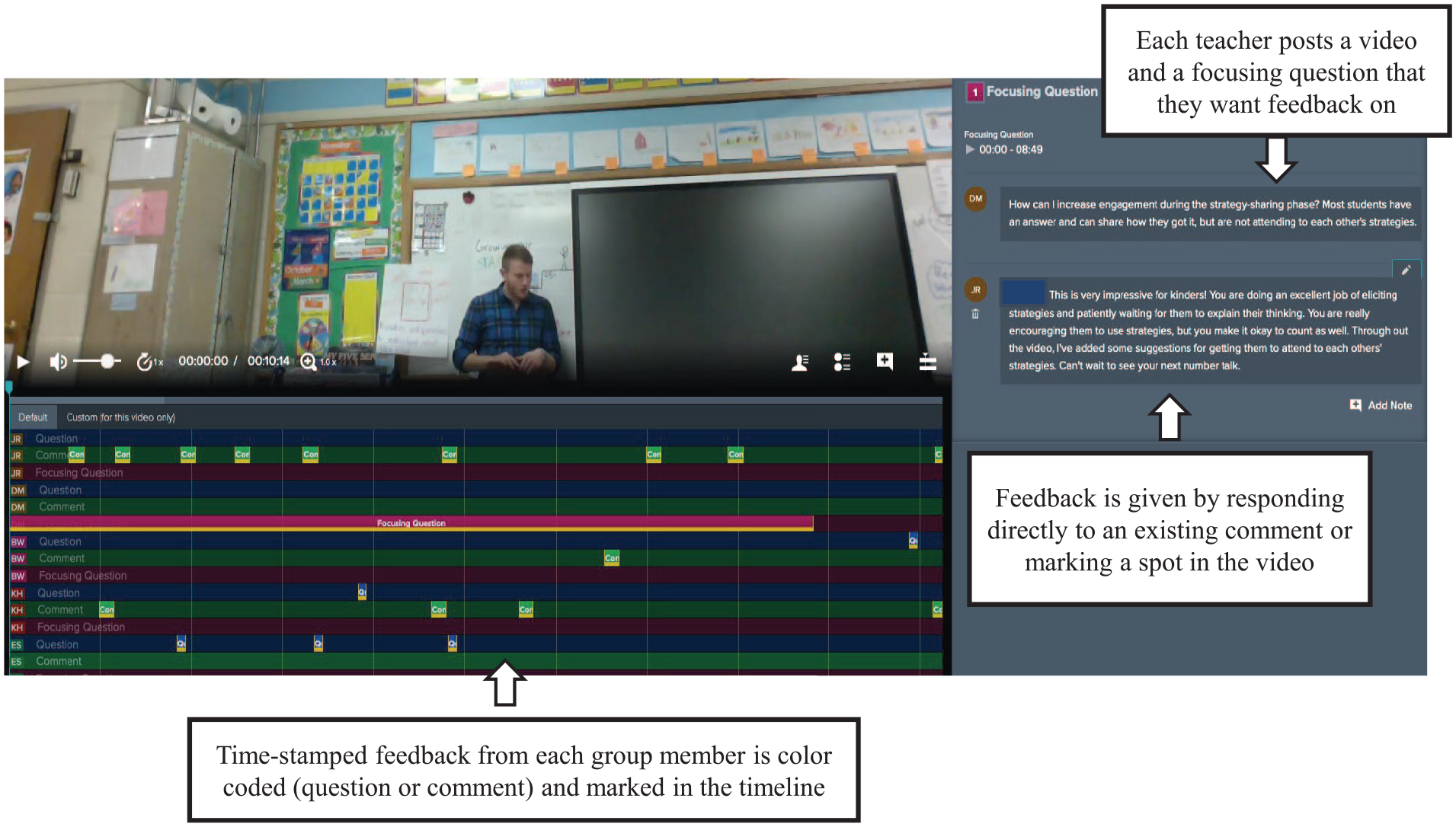
Commenting on the Vosaic Video Feedback Platform.
The four early-career teachers were interviewed three times: before the inquiry group started, after two cycles, and after it concluded. Semi-structured interviews were designed to elicit participant perspectives on their facilitation of Number Talks and their experiences participating in the inquiry group.
Data Analysis
The analysis reported here is part of a broader study of teachers’ learning through participation in the video-based inquiry group. Elsewhere (Remillard et al., 2021), we present evidence, based on analytic coding of video data, that each early-career teacher made advances in their use and depth of responsive teaching practices, although to differing degrees. In this article, we focus on how teachers’ interactions with peers through the video-feedback platform were related to subsequent efforts to enact new practices.
As part of the larger study, we used deductive coding to develop a coding scheme for responsive math teaching practices around five dimensions: (a) behavioral norms, (b) sociomathematical norms, (c) eliciting student thinking, (d) representing student thinking, (e) orienting students to each other’s thinking, and (f) orienting students to the mathematics. We then used open coding on a subset of videos to identify inductive sub-codes for each dimension (Ebby et al., 2020). The code list was refined through several rounds of double-coding and discussion among researchers to resolve any disagreements. Once coders reached 80% agreement in each dimension, coding proceeded by individual researchers.
To analyze the asynchronous discussions, we added codes on our spreadsheet of inquiry group interactions to indicate the type of participation (question, comment, and suggestion), and whether it was related to the poster’s focus question. We then examined the nature of the interactions among the participants within each category, and as we discuss in the results section, identified several subcodes for the types of deliberations that teachers were engaged in when participating. These codes were then applied to the spreadsheet of interactions.
For the next level of analysis, we looked through the comments and videos, across participants and over time, to trace the relationships between types of participation, deliberations, and evidence of efforts to enact new responsive teaching practices in subsequent videos. We added a code to the spreadsheet to indicate whether we found evidence that the content of the question/comment/suggestion had been considered or taken up in any subsequent video from the poster. We then looked for patterns within each participant between feedback received and feedback given to trace collective deliberations, changes in participation, and changes in responsive teaching practices over time. During this stage we also analyzed the interviews, focusing specifically on instances where participants discussed their learning from enactment, giving feedback to others, and receiving feedback on their practice, and used this evidence to further triangulate the relationships we were identifying within and across participants.
Results
Teachers participated in the inquiry group in four different modalities, closely aligned with the structure of the inquiry group: posing questions, receiving feedback, giving suggestions, and making noticing comments. In the following section, we briefly describe the characteristics of each modality and illustrate how each supported different types of deliberation, including decomposing and seeing models of decomposed practice, identifying space between vision and practice, grappling with instructional dilemmas, seeing and articulating pedagogical rationales, and drawing on developing expertise. We then illustrate how participation generated asynchronous dialogic conversations, which supported collective interpretations and experimentation with new responsive practices over time (Horn et al., 2017).
Opportunities for Deliberation Through Participation in the Inquiry Group
Figure 2 summarizes the relationships we found between the four types of participation and opportunities for deliberation. The first two types (receiving suggestions and posing questions) were focused on teachers’ own practice and opened modest opportunities for deliberation. The second two types (noticing comments and giving suggestions) involved attending to others’ practices and generated more extensive and robust deliberations. Although we present these as distinct modes of participation, these categories were not mutually exclusive and were sometimes coexistent in a single comment.
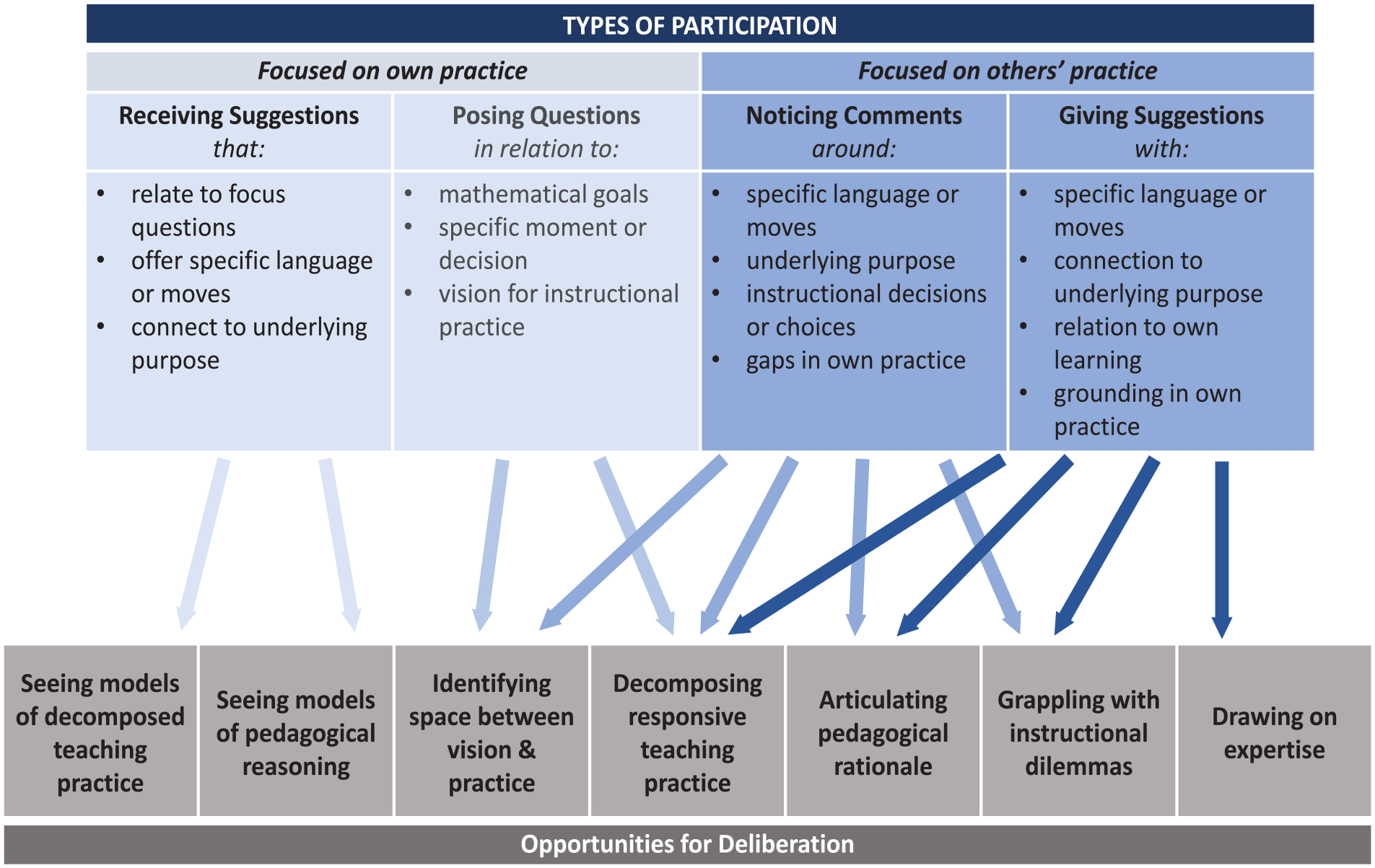
Relationships Between Types of Participation and Opportunities for Deliberation.
Posing Focusing Questions
After recording and uploading a video, participants were asked to post a focusing question to guide viewers’ responses. As we had intended, these questions set participants on a path of inquiry about their own practice, sometimes around one aspect of the routine (e.g., representing student thinking) and other times around specific instructional moves or decisions.
For example, Katrina tagged a specific moment in her video and asked: What is a better way to explain this? He is saying, “I know 30 + 20 is 50 because I know that 3 + 2 = 5.” I am trying to encourage him to name that he is adding 3 tens and 2 tens together to make 5 tens, but I’m having a hard time trying to explain it. Am I overthinking the importance of this distinction? Is it okay that they are saying they know because 3 + 2 = 5? (Post, Cycle 4)
The questions posed by participants identified ways they felt their practice could improve; for novice teachers who believed there were many things to work on, posing a question helped them narrow the focus. Emma, who struggled with classroom management throughout her first year of teaching, explained that coming up with the focusing question helped her to identify “lever points” that she could address: It forces me to think about, if I were going to change one thing about, or kind of look for lever points, what would be the most useful thing right now? Or not necessarily the most useful, but what’s something that I could take a different approach to, as opposed to looking at the whole thing and being like, “That was messy, and this was sloppy.” (Interview, 2/19/19)
In constructing focusing questions, the teachers were seeing and naming aspects of their own practice in relation to their vision for responsive teaching, to set a goal for their own learning. In other words, the process of watching their own videos and crafting questions supported engagement in two types of deliberation: (a) examining and decomposing components of practice and (b) identifying space between developing visions and practice.
Receiving Suggestions
Once teachers posted a video and focusing question, they received feedback from peers and teacher educators, often in the form of specific suggestions. Slightly more than half of the suggestions were related to the focusing question, supporting the poster’s path of inquiry into their own practice. Many were presented in the form of specific language or moves the teacher might deploy, and as illustrated in the next section, about a third of the time included underlying purposes, introducing pedagogical rationales to the interactions. Each teacher in the inquiry group received between 6 and 15 suggestions for each video and they took up at least a third of these suggestions in subsequent videos, often trying out the precise phrase or technique offered.
For example, in David’s Cycle 3 video, he received the following suggestion from one of the teacher educators: What if you asked right here—“Does anyone think they understand _____'s strategy? Could you explain it to us in your words?”
Several times, in his subsequent video, David asked his kindergartners to consider and explain others’ strategies, in one instance using the exact wording from the suggestion: “Does anyone think they can use their own words to explain that . . . Repeating is cool and all, but who can use their own words?”
Receiving specific suggestions, from a teacher educator or a peer, especially when presented in a usable form, provided recipients new ideas for experimentation with responsive teaching practices. The specificity and targeted nature of the suggestions also modeled two important types of deliberation in ways that made them accessible to novice teachers: (a) decomposing of responsive teaching practices and (b) articulating a pedagogical rationale. Furthermore, when connected to their focusing questions, these suggestions further extended novices’ inquiry into their own teaching.
Giving Suggestions
Giving a suggestion had its own unique benefits for early-career teachers; it provided opportunities to make connections between specific components of practice and larger aims or rationales. More than one-third of all comments made by the first-year teachers included suggestions; this proportion was more than 50% for the two teachers with more experience. Most of the suggestions offered were tagged to particular moments in the video and, between a third and two-thirds of the comments offered by each participant involved specific language or moves to try. A third of the suggestions made by participants included connections to underlying purposes for such moves. In the following comment, Katrina started by complimenting the way Emma chose a student who had an incorrect answer to share her thinking, then made a suggestion, and followed with her reasoning for this recommendation: I feel like this is such a great example of taking an answer that seems wayyy out in left field seriously, and then having her share her thinking actually did help her identify her mistake and give her a chance to revise her thinking! . . . Even to push it one step further, you could maybe say something like, ‘We found your mistake in counting, but you’re right, counting by ones is one way to find the answer.’ Just to also give some value to her strategy. (Post, Cycle 2)
In this example Katrina, as the giver of feedback, decomposed a practice she noticed Emma using, offered specific language for an alternative response, and articulated a pedagogical rationale (to communicate the value of the student’s counting strategy).
When offering suggestions, teachers frequently referenced their own efforts to develop responsive teaching practices. In Cycle 1, Katrina offered, “I haven’t actually done this yet, but I’m thinking about . . . introducing the idea of efficiency” and went on to describe the pros and cons of this move. She continued to work on this issue over the year, making comments and suggestions on her peer’s videos around the strategies students were using, and ultimately experimenting with more strategically highlighting efficiency in her own Number Talks.
Making suggestions on someone else’s practice also provided opportunities for teachers to name and work through instructional decisions. In one instance, Becca responded to David’s focusing question about having students pay attention to each other’s thinking by suggesting that he could have another student restate a strategy rather than restating it himself: Could you have another student, instead of you, restate Gregory’s strategy to build your expectation that students are attending to each other? You calling it out at the end does reinforce the focus strategy though, if that’s more what you are going for. (Post, Cycle 1)
Importantly, Becca framed the moment as a decision and named two moves as legitimate choices with different purposes. Asking another student to explain addressed David’s focus question, while restating it himself could serve to “reinforce the focus strategy” of the Number Talk. Giving feedback in this form allowed Becca, as a more experienced teacher, the opportunity to practice the contingent work of deliberating about a pedagogical choice and model this type of deliberative work.
As the year progressed, we found increased instances where the early-career teachers drew on their own experiences to provide suggestions for peers. For example, during Cycle 4, Katrina gave the following suggestion to Nora, who had asked how she could move her preschool students, “further along on the continuum towards thinking in terms of addition”: Here, maybe you could add onto his strategy, by counting the four again like this, “one, two, three, four, and one more is . . . five.” In Kindergarten, we ask them to find one more/one less than a number fluently up to 12 . . . This language also might help with getting them to think of breaking the numbers into parts. (Post, Cycle 4)
In this instance, Katrina was drawing on her own expertise and using pedagogical reasoning to apply that knowledge to a novel situation she identified in Nora’s practice.
As these examples illustrate, putting suggestions into words pushed participants to engage in several types of deliberation, including (a) decomposing responsive teaching practices, (b) articulating pedagogical rationales, (c) grappling with instructional dilemmas, and (d) drawing on their own developing expertise.
Making Noticing Comments
Teachers also made comments in which they named and reflected on aspects of responsive teaching that they saw in their peers’ videos. Drawing on Sherin and van Es’s (2009) concept of teacher noticing as a means to identify and interpret critical components of practice, we call them noticing comments. Like giving suggestions, this type of participation involved attending to others’ practice, identifying specific language or instructional moves, and making connections to underlying purposes. In addition, participants’ noticing comments involved making teaching decisions or choices explicit and allowed for reflection on their own practice in relation to their colleague’s.
The three first-year teachers made noticing comments more frequently than their more experienced peers. As with giving suggestions, one of the most common ways that teachers expressed their noticing was by naming and describing specific language and moves they saw their peers using that they wanted to try. As Emma explained, she picked up a useful phrase from Katrina: I got specific little ideas from watching other people’s videos. You know, even just things to say, like. . .‘use your big math voice.’ You know? Just certain little things that I was like oh, that’s helpful, let me try that. (Interview, June 11, 2019)
When Emma tried this language out in her next Number Talk, she even added a comment to her video with the attribution: “Thanks Katrina! Trying out your ‘big math voice’ phrase here” (Post, Cycle 3).
Participants also frequently surfaced and provided pedagogical rationales for decisions that they watched their peers make. Approximately one-third of the noticing comments highlighted a specific move and then articulated the affordances of the move in relation to the overarching goals of responsive instruction. In these cases, noticing comments served as an opportunity to attach underlying purposes to teaching actions or decisions as well as recognize structure within a complex practice.
At times participants used noticing comments to identify gaps between their visions and their own practice. Watching peers, teachers sometimes saw scenarios that helped them become aware of something they had not been attending to in their own teaching or realize a way in which they could improve. As Katrina explained, When you see the other teachers’ Number Talks and you really sit down and watch them . . . I was like “Oh, my god. This is really wonderful” or “I need to try this” or “Why can’t I do this?” (Interview, June 28, 2019)
As these examples illustrate, making noticing comments on their peers’ videos offered opportunities for early-career teachers to engage in several types of deliberation, including (a) decomposing their peers’ responsive teaching practices and (b) articulating underlying rationales. They also used their noticing comments to (c) grapple with their own instructional dilemmas and (d) identify the limits of their own knowledge and skills in relation to their developing visions and practice.
Developing Adaptive Expertise Through Asynchronous Dialogic Conversations
By tracing the community members’ participation in response to multiple videos over time, we also identified a series of asynchronous conversations that took place among the group around different threads of inquiry. Through these conversations, the early-career teachers used videos of one another’s number talks to collectively interpret and deliberate about responsive teaching practices and discuss strategies for experimenting with new ones. We illustrate the dialogic nature of these conversations (Horn et al., 2017) through two examples. In each case, we represent the content of the teachers’ interactions over time and use annotations to show connections to different types of deliberations as well as instances of experimenting with responsive teaching practices.
David’s Learning Around Orienting Students to Each Other’s Thinking
A conversation between David and his peers about strategies for helping students attend to the ideas of their classmates is illustrated in Figures 3 to 5. The question, initially raised by David about his own practice in Cycle 1 (Figure 3), became a focus of deliberation and experimentation for him and other members of the group over four video-posting cycles.
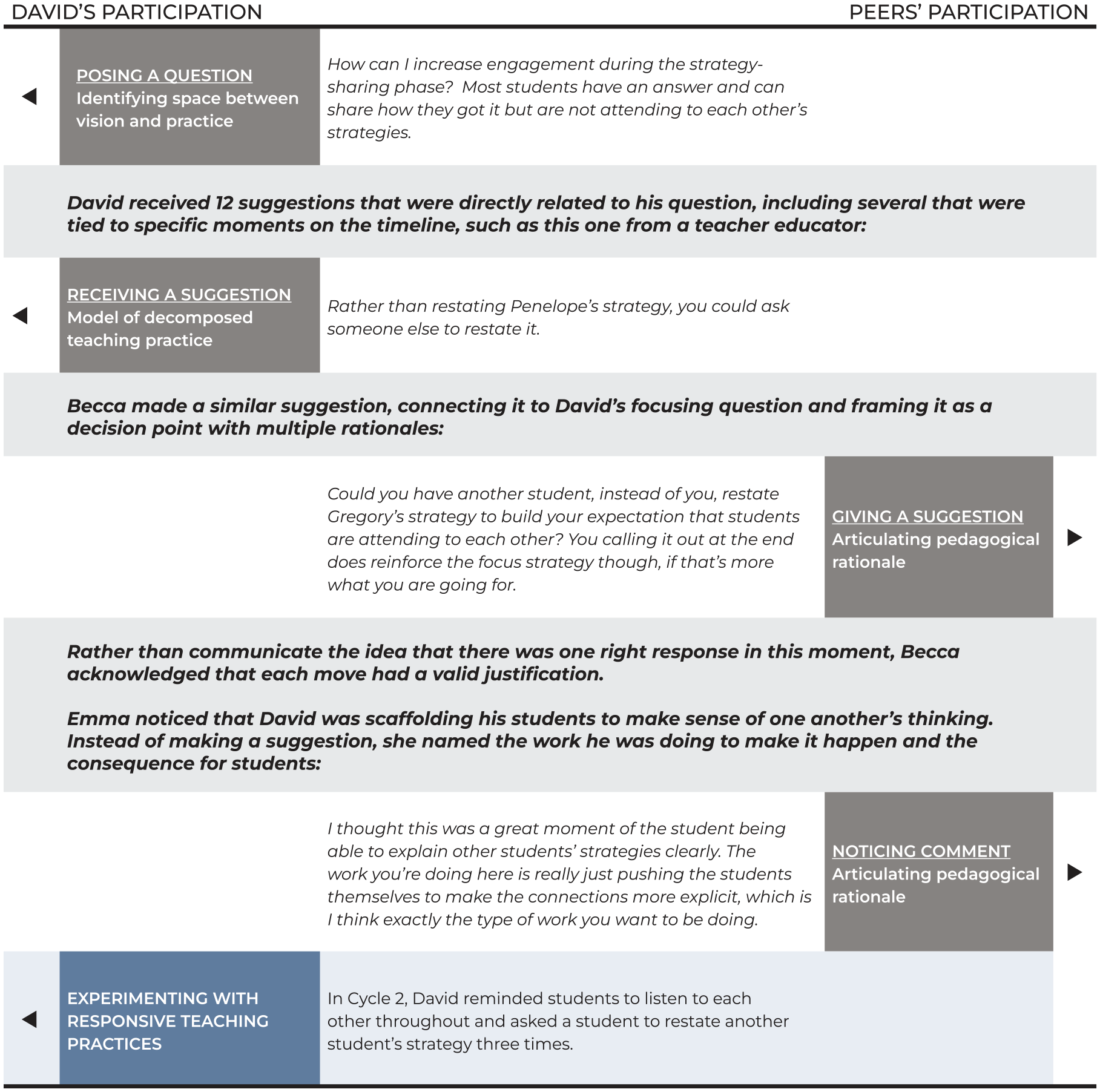
David and His Peers Discuss His Question About Helping Students Attend to Each Other’s Thinking in Cycle 1.
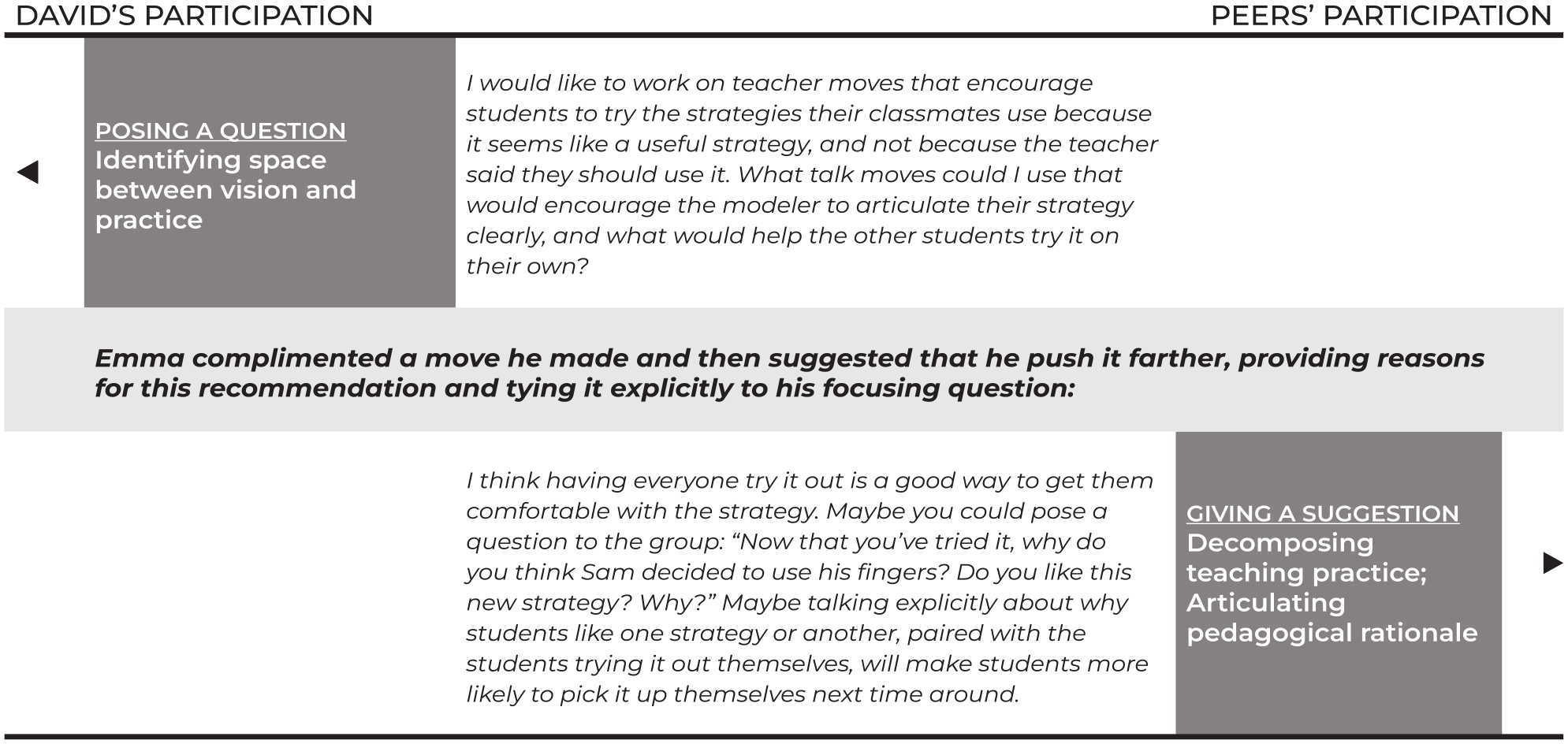
Participants Discuss Connections Between Pedagogical Moves and Purposes in Cycle 3.
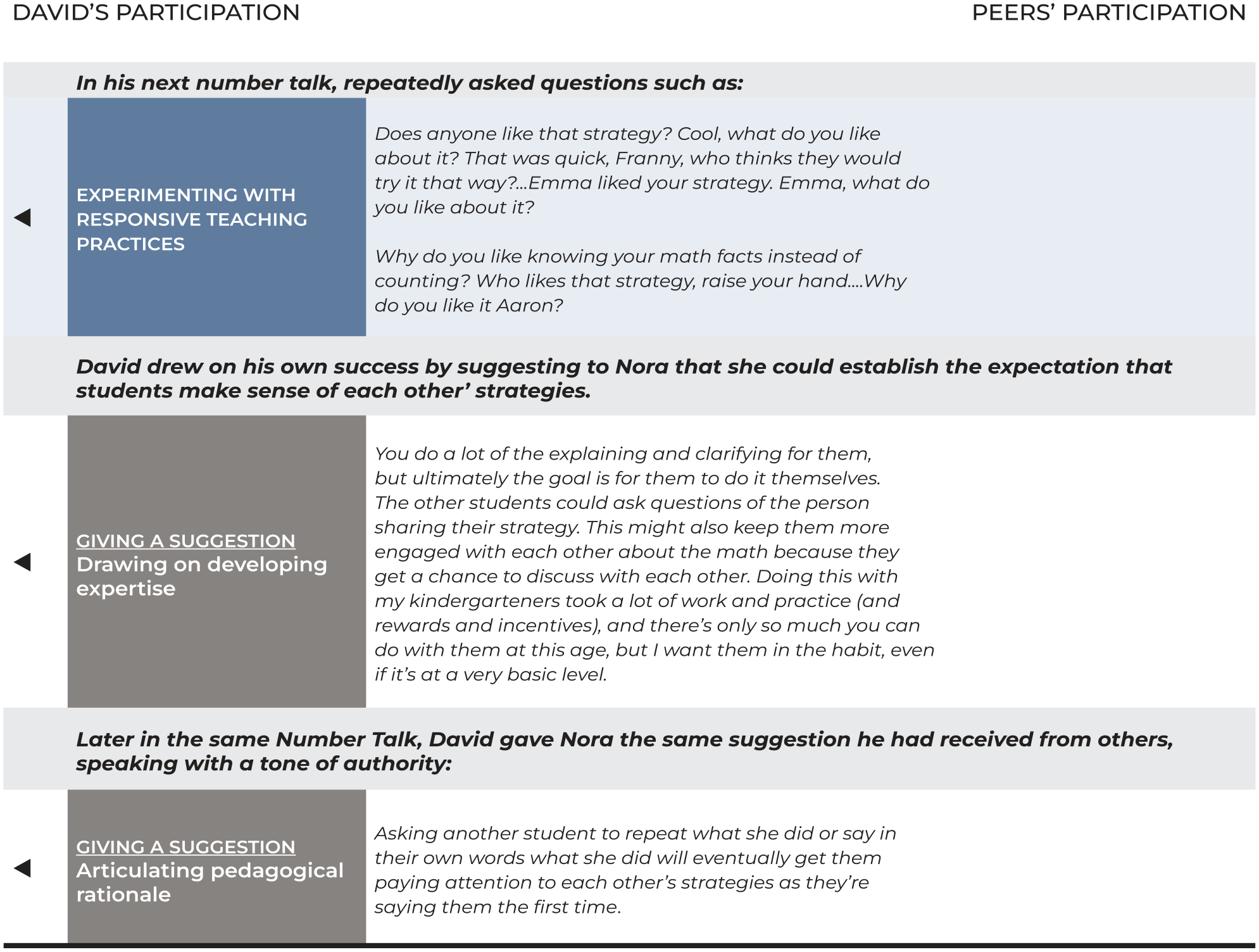
David Shares His Developing Expertise in Cycle 4.
By Cycle 3, David’s focusing question went deeper into the idea of student engagement and reflected the connection between pedagogical moves and purposes (Figure 4).
In Cycle 4, David took up Emma’s suggestion from Cycle 3, as shown in Figure 5.
This conversation illustrates the interplay between multiple types of participation across the group: (a) watching, reflecting on, and raising questions about one’s own practice; (b) receiving feedback and suggestions from others; (c) noticing and making suggestions about another person’s practice; and (d) experimenting with new practices in the next Number Talk. David’s practice and his inquiry around orienting students to one another’s thinking are at the center of this conversation. Through posing questions and receiving suggestions, David opened his practice to collective reflection, decomposition, and pedagogical reasoning. This thread illustrates how this conversation may have supported his subsequent experimentation with responsive teaching. Later he deliberated about others’ practices, drawing on his developing expertise to make suggestions and articulating a pedagogical rationale. We identified similar dialogical conversations in which each participant’s practice was open to collective inquiry and deliberation, focused on different components of responsive teaching.
Emma: Using Peer’s Videos to Explore Ways to Respond to Students
As discussed earlier, participants often connected comments to things they were working through or struggling with in their own teaching. Figures 6 and 7 illustrate the interplay of different types of participation around Emma’s focusing question, which then launched a dialogic conversation through which the teachers collectively explored related dilemmas. In Cycle 1, Emma posed a question about a specific moment in her own video where a student offered a calculation that produced the correct numerical answer, but was not actually a strategy for solving the problem (Figure 6). Through watching both David and Katrina’s videos, she expanded her repertoire of ways to think about responding to students to initially respond with incorrect answers (Figure 7).
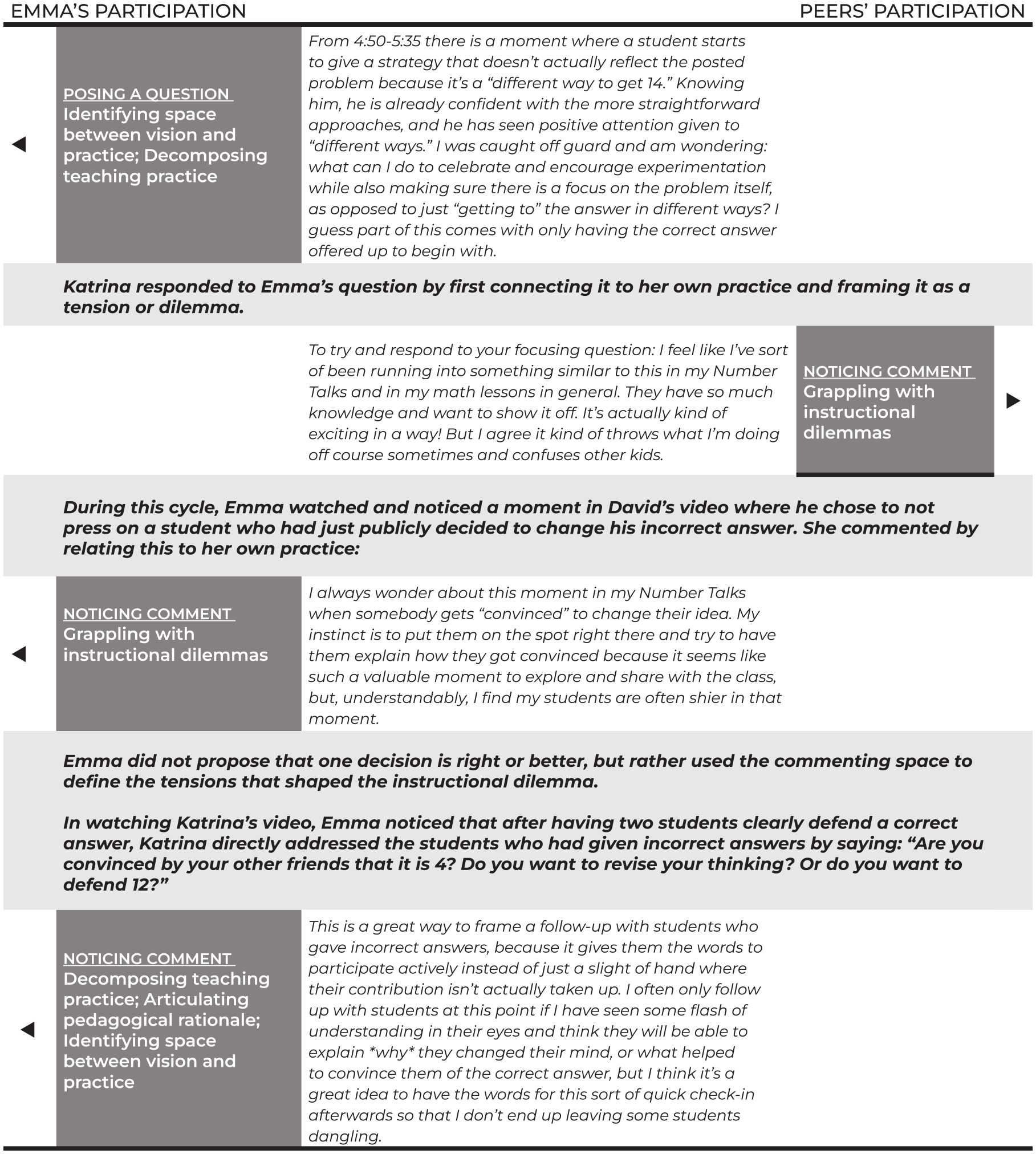
Emma Poses a Question and Learns from Watching and Reflecting on Her Peers’ Videos.
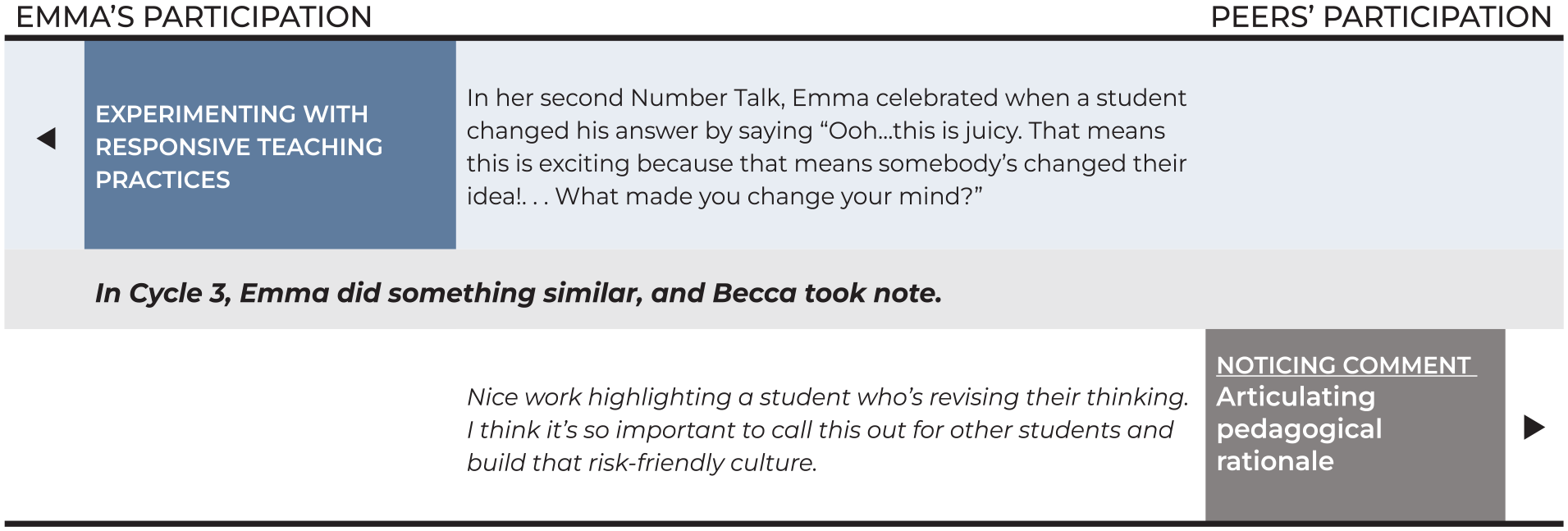
Emma Experiments with New Responsive Teaching Practices and Becca Takes Note.
In this example, Emma used her peers’ videos as tools for reflection. Once she named the gap she was struggling with and had it acknowledged and renamed by a peer, she began to make noticing comments related to that challenge in her peer’s videos. Through comments made on David’s and Katrina’s videos, Emma had opportunities to grapple with instructional dilemmas, decompose teaching practice, and articulate rationales. In doing so, she continued to develop her own vision for her teaching and identify space between this vision and her own practice. By her second video, we saw evidence that Emma was transitioning from observing and deliberating about new practices to experimenting with them. Her efforts did not go unnoticed. Becca complimented Emma’s move and named an additional pedagogical rationale, building a “risk-friendly” classroom culture.
Throughout the year, Emma struggled to keep her students engaged during Number Talks, especially when it came to sharing strategies and listening to other students’ ideas. Through her participation in the inquiry group, she was able to experiment with specific language offered by peer to address this challenge. Moreover, seeing videos of other classrooms reassured her that her challenges were shared by others. At the end of the year, she reflected: Seeing other teachers and just being like, oh yeah, that’s what first graders look like on the carpet. It’s not just my lack of classroom management skills. They’re going to be squirming, so that sense of comfort of like, okay, it’s not just me, and also seeing, getting ideas for phrasing things, and ideas for asking questions from other first year teachers has been cool. (Interview, June 11, 2019)
These examples offer just two illustrations of how different types of participation in the video-feedback inquiry group coalesced into dialogic conversations that provided opportunities for teachers to engage in deliberative work related to the development of responsive math teaching. In addition, these examples suggest that engagement in these processes is linked to, and can precede, more visible experimentation with new practices.
Discussion
In the previous section, we show how giving and receiving asynchronous feedback provided novices opportunities to engage in dialogic conversations involving several types of deliberation related to responsive teaching. We now connect these types of deliberations to the central components of adaptive expertise summarized at the beginning of the article and consider how participation in the asynchronous inquiry group supported both collective interpretation and individual growth in the take-up of responsive practices.
Figure 8 illustrates how the categories of deliberative work (illustrated earlier in Figure 2) reflect central components of adaptive expertise for responsive teaching found in the literature.
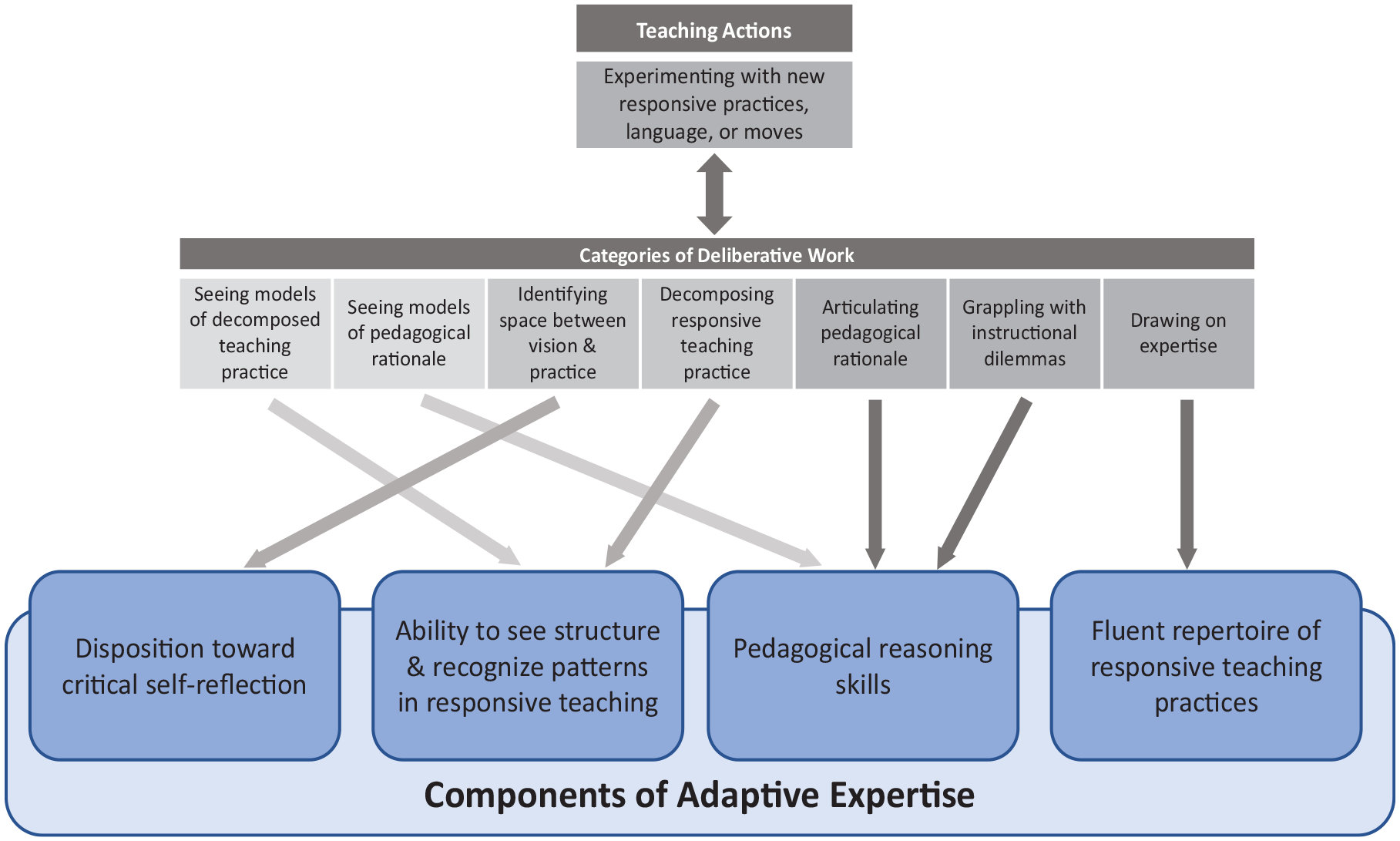
Connections Between Categories of Deliberative Work and Components of Adaptive Expertise.
Through participation, teachers regularly described, named, and analyzed their own and their peers’ teaching, decomposing practice into its constituent parts (Grossman, 2018); at the same time, they accessed models of decomposed practice in the feedback they received from others. These dialogic conversations provided opportunities to see the structure and recognize patterns within their own and others’ practice (Hatano & Inagaki, 1992). When posing questions about their own practice and commenting on peers’ videos, novices identified space between their developing vision and current practice, supporting the development of the type of critical self-reflection that enables experts to identify limits of their knowledge and focus on areas of needed growth (Hatano & Inagaki, 1992; Smith & Starmer, 2017; Timperley, 2013). Commenting on peers’ practice also gave them opportunities to generalize and grapple with various instructional dilemmas, their own and others, and connect instructional choices to pedagogical rationales, developing skills in pedagogical reasoning to deliberate about novel instances of practice (Hatano & Inagaki, 1992; Kavanagh, Conrad et al., 2020). Finally, novices drew on their growing expertise to both experiment with new moves in their own Number Talks and give suggestions to each other, illustrating that they were developing a fluent repertoire of responsive teaching moves, language, and routines that they could articulate and employ (Hatano & Oura, 2003).
By tracing the dialogical conversations that incorporated multiple group members participating in different ways and invoking both their own and their peer’s practice, we see a more complete depiction of the collective nature of these deliberative processes and how, over time, they guided early-career teachers along a “trajectory toward expertise” (Hatano & Oura, 2003). Through interacting around their own and others’ videos, over multiple cycles, participants had numerous opportunities to engage in increasingly sophisticated instances of deliberative work related to responsive teaching. Thus, participation in the asynchronous inquiry group not only provided opportunities for repeated practice of responsive teaching in their own classrooms but also multiplied their opportunities to reason about teaching episodes, with an eye toward future work (Horn et al., 2017).
Our analysis of the dialogic conversations makes visible the interaction between individual and collective learning, where individuals contribute to the ongoing deliberations of the group and these collective efforts support individual’s understanding of their own work (Wenger, 2010). Importantly, for the participants, these deliberations frequently began as a negotiation of ideas related to others’ practice before being directed to their own teaching. This pattern of collective to individual meaning-making reflects Vygotsky’s (1978) notion of internalization: Understandings are first developed on the social plane among people and then taken up by individuals, as demonstrated by their experimentation with responsive teaching practices in future number talks. This experimentation became fodder for future collective deliberation. Thus, this process was mutually reinforcing and generative.
This process also supported varying levels of participation among the teachers in the inquiry group. Emma, who struggled with classroom management, used her commentary on peer’s practice to interpret what she saw as her own shortcomings, gather specific ideas, and think through approaches she had yet to try. Our analysis of her participation helped us see moves she was trying out in her own practice, which were often masked by a noisy and seemingly disorganized classroom environment. As we looked at the pathways of development for each participant, we found the suggestions given to others often preceded or occurred in parallel with efforts to try out those practices. This suggests a need to reframe the giving of feedback as both a critical component of developing adaptive expertise and as a potential indicator of development to come. A gap between vision and enactment is common for teachers learning new practices (Munter & Correnti, 2017). Giving feedback may offer an important mechanism for working to close that gap.
Our findings offer strong evidence of the value of engaging novices in the process of giving feedback, counter to some common assumptions about how novices learn new practices. Typically, video feedback platforms are used for experts to provide feedback to teachers who are learning new practices. The early-career teachers in our study did in fact identify the feedback from teacher educators as influential for their growth, but it is also evident that giving others feedback supported them to reason about others’ teaching. Doing so, we believe, served as an entrée into collective deliberation within the entire inquiry group.
Despite the insights and possibilities our findings offer for video feedback inquiry groups to support ongoing teacher development, they must be understood within the limitations of the study. We studied a single inquiry group of five teachers over 1 year, and while not necessarily a representative sample, it gives us insight into what is possible. Additional groups need to be studied to refine our understanding of different types of participation, the connections to deliberative processes, and ways in which participation is influenced by features of the inquiry group. Moreover, research is needed to consider the impact on novice teachers’ development of adaptive expertise over a longer time frame. Finally, our analysis focused on the group that maintained the most consistent engagement throughout the year. Analysis of less active inquiry groups would shed light on factors that influence teachers’ ability to engage in such a group despite the other demands they confront.
Conclusion
Our findings offer an expanded understanding of teacher learning in a video-based asynchronous community by accounting for the discursive work teachers engage in that supports and may precede actual shifts in practice (Horn & Little, 2010). The different types of deliberations offer a framework for identifying evidence of developing adaptive expertise in professional learning communities that are focused on artifacts of practice. The fact that this work occurred asynchronously allowed researchers and facilitators to see it happening in ways that often get overlooked in studies of teacher development. Future research might expand our understanding of this framework and identify additional indicators.
Our findings also offer insights into the design of professional learning opportunities. This study confirms that video can be used to support concrete and focused self-reflection on practice (Lee & Wu, 2006; So et al., 2009), as well as collective discourse, even in an asynchronous format. These interactions were supported by the structure of the online platform, which allowed participants to watch the videos and comment on their own schedule and at their own pace. Because all comments became reified as part of the record, novices were able to see and participate in deliberations about teaching associated with adaptive expertise, which typically remain invisible, including their colleagues’ pedagogical reasoning and decision-making. These types of interactions among teachers are hard to replicate in methods courses, professional development, and on-site coaching that occurs at the moment.
Furthermore, we posit that video-feedback inquiry groups focused on both giving and receiving feedback around instructional routines have the potential to extend the impact of learning begun in preservice teacher education or professional development. The adaptive and discursive nature of the dialogic conversations supported by such a structure can also help prevent practice-based approaches from becoming overly prescriptive or reductive (Kavanagh, Conrad et al., 2020; Zeichner, 2012). The teachers in the inquiry group were extending practices learned in preservice education by modifying them for different contexts and continually adjusting their own teaching based on feedback. The video feedback inquiry group supported them to embrace the improvisational nature of teaching within a constrained routine instructional activity.
Finally, this work illustrates that the kind of dialogic and productive teacher conversations that Horn et al. (2017) and Lefstein et al. (2020) found most associated with learning opportunities can take place in online environments. Through asynchronous interactions, our participants engaged in the collective interpretation of pedagogical concepts from their own and each other’s practice with an eye toward their future work. This suggests that carefully structured, asynchronous communities that engage teachers in giving and receiving feedback on videos of practice can provide ongoing support for novices, as well as more experienced teachers, in an economical and practical format. As such, it is a promising model for ongoing learning that requires fewer resources than other models (e.g., classroom-based coaching or synchronous professional development). Furthermore, it can be accommodated into teachers’ schedules, allowing them to participate in professional discourse at their own pace and on their own time.
Footnotes
Acknowledgements
The authors would like to thank Snigdha Baduni, Sydney Dinenberg, and Lara Condon for their contributions to the analysis reported in this paper and the teachers who participated in the inquiry group and allowed us to observe their learning.
Declaration of Conflicting Interests
The author(s) declared no potential conflicts of interest with respect to the research, authorship, and/or publication of this article.
Funding
The author(s) disclosed receipt of the following financial support for the research, authorship, and/or publication of this article: This study was supported by a grant from the Spencer Foundation and the University of Pennsylvania Research Foundation.
