



Abstract
We set out to investigate preservice teachers’ beliefs about sources of teaching knowledge and their motivation to learn from practice and theory in teacher education in a longitudinal study (n = 96, at the beginning of the study). Participants placed more trust in experiential knowledge sources compared with formalized sources and participants’ beliefs about sources of teaching knowledge generally predicted their motivation to learn from different sources. Quantitative results were further supported and elaborated by qualitative interview data that suggested development of preservice teachers’ beliefs about sources of teaching knowledge and their understanding of the relation between theoretical and practical knowledge over time. The findings extend existing literature by providing a window on how (preservice) teachers may articulate their views about sources of teaching knowledge and relations between theory and practice, with expected consequences for teaching practice. Implications for teacher educators’ practice are also discussed.
Keywords
Introduction
The “what works agenda” in education focuses on evidence-based practice, with the goal of narrowing the gap between research and practice in schools (Kvernbekk, 2013, p. 19). This trend has taken on many forms that aim to promote best practice in teaching (Kvernbekk, 2016). For example, a central component of the Norwegian strategy has been the introduction of master-level education for teachers. In increasing teacher education programs from 4 to 5 years, the aim has been to provide teachers with insight in scientific methods, as well as understanding of and ability to use relevant research (Norwegian Ministry of Education and Research, 2014; implemented 2017). Within such goals lies an assumption that access to and understanding of educational research will lead to an increased use in classrooms that will benefit students. Presently, however, teachers tend to engage in practices stemming from sources of knowledge that are not theoretical and research-based, but rather experiential or testimony-based (Bråten & Ferguson, 2015; Joram et al., 2019). The what works agenda has therefore given new life to the long-standing discussion of the theory-practice divide in education (Kvernbekk, 2016; Yeazell, 1971).
The theory-practice divide has been explored from several angles, including the perceived lack of relevance of educational theory among teachers and a mismatch between teachers’ epistemic beliefs and the knowledge they are required to learn (Bråten & Ferguson, 2015; Kessels & Korthagen, 1996). One promising avenue of research has been the role of teachers’ epistemic beliefs about teaching knowledge (Ferguson, 2021; Fives & Buehl, 2016; Thomm et al., 2021). Researchers have especially targeted the role of teachers’ epistemic beliefs in terms of the types of knowledge sources they engage with and how this might influence their growing knowledge base (Bråten & Ferguson, 2015; Buehl & Fives, 2009; Joram et al., 2019; Kiemer & Kollar, 2021; Thomm et al., 2021). For example, Buehl and Fives (2009) found that preservice teachers and teachers believed that knowledge about teaching could come from a range of different sources, including books and articles describing theory and research, observations, personal and social experiences, and self-reflection. Focusing on first-year preservice teachers’ endorsement of sources derived from theory versus sources derived from practice, in particular, Bråten and Ferguson (2015) found that participants believed sources derived from theory to be much less useful than sources derived from practice. More recently, Kiemer and Kollar (2021) corroborated this finding by showing that preservice teachers believed educational research to be less useful in the classroom than anecdotal evidence. These authors also found that participants’ beliefs about sources of teaching knowledge predicted their selection and use of sources when faced with a challenging classroom situation. Specifically, more positive beliefs about educational research were associated with more selection and use of educational theory and research as sources of knowledge.
In this study, we continued this line of research by focusing on preservice teachers’ epistemic beliefs about sources of teaching knowledge in relation to their motivation to learn from theory and practice. We did this by combining quantitative and qualitative approaches in assessing the strength of possible relations between preservice teachers’ beliefs about sources of knowledge and motivation to learn from different aspects of teacher education, as well as trying to explain these relations by means of in-depth interview data over time.
Theoretical and Empirical Background
Identifying a knowledge base for teachers has concerned researchers for over a century and has led to different conceptualizations of the sources of said knowledge. Shulman’s (1987, pp. 8–11) influential conceptualization included a mix of “basic skills, content knowledge, and general pedagogical skills” attainable from scholarship in content disciplines. Furthermore, he included “educational materials and structures,” formal educational scholarship derived from literature (and principles) on schooling, teaching and learning, and wisdom of practice, covering “the maxims that guide (or provide reflective rationalization for) the practices of able teachers” in his conceptualization. This codification highlights the need for a mix of formal and experiential sources of knowledge, and for knowledge of theory as well as practical skills.
As noted earlier, sources of teaching knowledge have also been investigated from the perspective of teachers’ epistemic beliefs (Ferguson, 2021). Together with other aspects of teachers’ professional lives, such beliefs can be assumed to shape their practice by merit of their “filter[ing], fram[ing], and guid[ing]” roles (Fives & Buehl, 2016, p. 114). Teachers’ epistemic beliefs may influence not only planning but also teachers’ classroom practice and their receptiveness to and motivation to engage with new ideas (Bråten et al., 2017; Fives & Buehl, 2016; Muis, 2007).
Beliefs about sources of knowledge constitute one of the four dimensions of epistemic beliefs in the framework proposed by Hofer and Pintrich (1997), which was based on an extensive review of theory and research focusing on beliefs about the nature of knowledge and the process of knowing. Specifically, beliefs about sources of knowledge were defined on a continuum, ranging from reliance on authoritative, external sources to personal sources of knowledge. Although dimensional views of epistemic beliefs have been less concerned with changes over time than developmental models of personal epistemology (e.g., Kuhn, 1999), it may also be assumed that there is development within the dimensions of epistemic beliefs (Greene et al., 2008; Hofer & Pintrich, 1997).
In a seminal theoretical paper, Chinn et al. (2011) suggested that researchers broaden the range of sources of knowledge they investigate in epistemic belief research to include those referred to in the philosophical literature, for example, perception, introspection, memory, reasoning, and testimony, as well as intuition, research findings, and literature. Those authors also maintained that methods for measuring epistemic beliefs should be reconsidered to allow for examination of beliefs in different contexts and at a finer-grained level than that allowed by quantitative measures, a view echoed by Mason’s (2016) review of epistemic belief measures and call for more mixed methods studies.
Conceptualizations focusing on epistemic beliefs may also ground efforts to link epistemic beliefs and motivation to learn. For example, Muis (2007) proposed that learners’ perceptions and interpretations of different tasks may activate their epistemic beliefs, which, in turn, may influence their motivational approach to those tasks (see also Barger & Linnenbrink-Garcia, 2017; Gregoire & Hardin, 2015). While several forms of motivation may be influenced by learners’ epistemic beliefs, such as their self-beliefs (e.g., self-efficacy), values, and achievement goals (Muis, 2007), forms of motivation figuring within the expectancy-value theory of motivation have been considered particularly relevant to teacher motivation (Watt & Richardson, 2015). Expectancy-value theory describes two motivation components: the expectancy component addresses how well individuals believe they can do on tasks, and the value component addresses the value of these tasks (Wigfield & Eccles, 2000). In accordance with expectancy-value theory (Wigfield & Eccles, 2000), we focused on the extent to which preservice teachers valued the learning tasks that they encountered in teacher education, in terms of attainment (i.e., importance), relevance, and intrinsic interest.
In sum, we built on existing theoretical frameworks of epistemic beliefs about knowledge and knowing and the motivational implications of such beliefs, focusing on the dimension of beliefs about sources of knowledge within conceptualizations of epistemic beliefs and on the construct of task value within motivation theory. Based on these frameworks, we assumed that epistemic beliefs about sources of knowledge may frame learners’ interpretation of what they need to learn and why, and guide them to hold some learning tasks as more valuable than others. While prior research has revealed relationships between epistemic beliefs and various motivation constructs (for review, see Chen & Barger, 2016), the relationship between epistemic beliefs about sources of knowledge and motivation to learn has not been investigated in a long-term perspective within teacher education (Bråten & Ferguson, 2015). By focusing on preservice teachers’ epistemic beliefs about sources of teaching knowledge in relation to their motivation to learn from theory and practice over time, this study has the potential to contribute uniquely to the areas of epistemic beliefs, motivation, and teacher education. In particular, investigating potential contributors to preservice teachers’ valuing of theory- and practice-related learning tasks is an important agenda for teacher education research because such motivation may have implications for engagement and effort, regarding teachers’ own learning as well as their ambitions on behalf of their students (Buehl & Fives, 2016; Fives & Buehl, 2016).
The Present Study
Given this background analysis, the purpose of our study was to investigate preservice teachers’ beliefs about sources of teaching knowledge and motivation to learn from theory and practice. We used a sequential explanatory mixed methods design (Creswell & Plano Clark, 2017), enabling examination of participants’ beliefs using both quantitative and qualitative methods over time, and providing further insights into findings than merely quantitative design can reveal. The guiding research questions were as follows:
Based on previous research, we expected that participants would display a preference for experiential, rather than formalized, sources of teaching knowledge and display stronger motivation to learn from practice than from theory. Furthermore, we expected that sources of knowledge beliefs would predict motivation to learn and that this relation would likely hold over time (Bråten & Ferguson, 2015).
Design, Methods, and Results
Design
Questionnaires were used to gather quantitative data about participants’ beliefs about sources of teaching knowledge and their motivation to learn from theory and practice at three different time points (viz., in the first, second, and third year of teacher education). Focus group and individual interviews were used to gain further insight into participants’ beliefs about teaching knowledge and motivation, with these interviews conducted in the first and third year of teacher education and 2 years after completion of the 4-year teacher education program, respectively.
Data analyses
We used a correlational design and performed multiple regression analyses on the questionnaire data to investigate the unique predictability of beliefs about sources of teaching knowledge for different aspects of motivation to learn, while we performed thematic analyses of the interview data to gain more nuanced insights about the quantitative findings.
The Quantitative Phase
Participants and setting
Participants were teacher education students at two teacher education programs at a university college in southeast Norway. The 4-year programs (undergraduate plus 1 year) focused on teaching in Grades 1 to 7 and 5 to 10, respectively. Thus, in accordance with the structure of teacher education in Norway, the two programs focused on different grade levels, but were highly comparable in terms of the entry requirements and the educational subject matter covered in the programs (see below). Ninety-six of 106 students who were enrolled in the programs at Time 1 volunteered to participate (66 females, 30 males; mean age 21.72 years, min. = 18, max. = 47, SD = 5.2). 1 Ninety-one percent of participants were Norwegians, and all non-Norwegian participants were proficient in Norwegian language. The number of participants at Times 2 and 3 was 68 (41 females, 26 males, one not reported; mean age = 22.0) and 62 (39 females, 22 males, one not reported; mean age = 22.9), respectively. Participation was rewarded by entry into a prize draw for one of two gift cards at each data collection time for local shopping centers (US$85).
Participants were attending a state university college 2 where programs followed the national guidelines for 4-year teacher education for elementary and lower secondary schools and consisted of 240 European Credit Transfer and Accumulation System (ECTS) credits, of which 60 ECTS credits related to Pedagogy and Pupil-Related Skills (PEL) class. A major aim of PEL class is to help students integrate theoretical knowledge and practical experience. The remaining 180 ECTS credits focused on subject-specific knowledge, skills, and general competences; in accordance with Norwegian national guidelines for teacher education, these are research-based and grounded in active research environments (Thorsen, 2019). Participants completed 20 weeks of practical teaching experience in different schools during the 4-year period (see Afdal & Spernes, 2018, for a more detailed account of the programs).
Materials
We used the following questionnaires at Times 1, 2, and 3.
Background information
We used a short demographic questionnaire to assess background information.
Beliefs about sources of knowledge
These beliefs were assessed using a 10-item questionnaire where participants were asked to rate the extent to which they believed that different knowledge sources were useful for themselves as preservice teachers. This questionnaire was based on prior qualitative research (Buehl & Fives, 2009) and was previously used by Bråten and Ferguson (2015). Several potential sources of knowledge about teaching were taken into consideration in constructing this questionnaire. One such source is formal education, generally referring to learning within an organized and systematic educational program in which students’ acquired competencies are evaluated and recognized, and in this particular context referring to the teacher education programs attended by the participants. Other potential sources of teaching knowledge can be considered formalized in the sense of being official and approved textual sources. Yet, other sources of teaching knowledge can be regarded as experiential in the sense of being derived from one’s own experiences, that is, from relevant personal observations and actions. In relation to formalized sources of knowledge, which are more theoretically oriented or theory-based, experiential sources of knowledge can be considered more practically oriented or practice-based, that is, derived from observing and doing rather than from reading or studying. Finally, knowledge about teaching knowledge might be based on social and popular media, that is, on information shared on online communication platforms and encountered in media resources created to engage a broad audience (rather than professionals).
In the questionnaire, we operationalized these potential types of knowledge sources in the following way: One item asked participants to rate the usefulness of formal education (teacher education) as a source of teaching knowledge. Four items asked them to rate the usefulness of formalized bodies of knowledge, with one item asking them to rate the usefulness of the syllabus from the PEL class, one item asking them to rate the usefulness of research articles and professional literature (e.g., teaching journals), and two items asking them to rate official and other responsible websites (e.g., Norwegian Directorate for Education and Training website). Three items asked participants to rate the usefulness of different types of experiences as sources of teaching knowledge. Specifically, one item asked them to rate observation of other teachers’ practice (e.g., practice teachers), one item asked them to rate collaboration and interaction with other students (e.g., within groups), and one item asked them to rate their own personal experience (e.g., experience as student). Finally, there were two items asking participants to rate the usefulness of social (e.g., Twitter) and popular media (e.g., television) as sources of teaching knowledge. All 10 items on the sources of knowledge questionnaire are shown in Supplemental Appendix A (available with the online version of this article). For all items, participants used a 7-point Likert-type scale with “to a very little extent” (1) and “to a very large extent” (7) as anchor points.
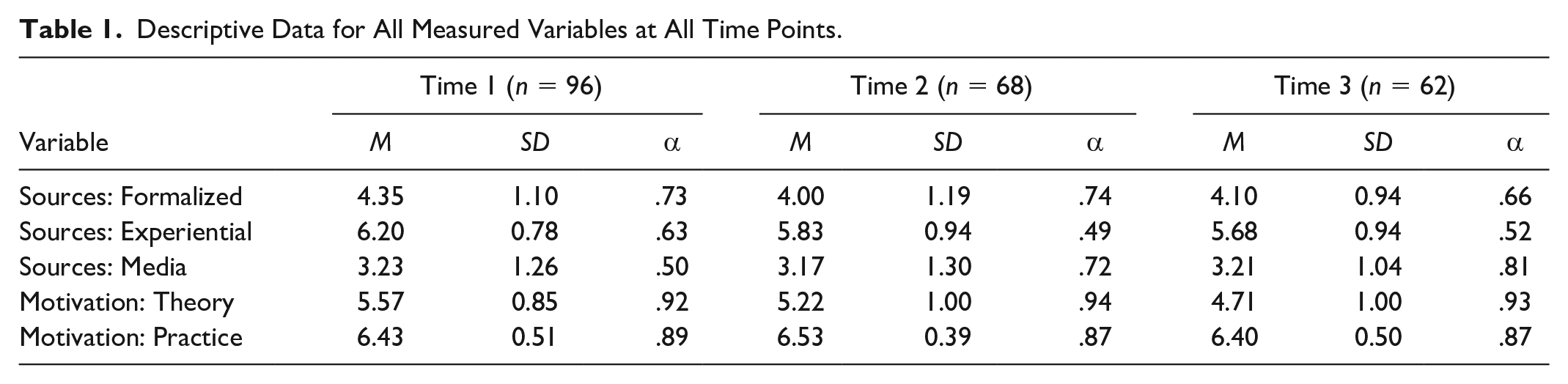
A principal component analysis with oblique rotation was performed on participants’ scores on this measure at Time 1 (Bråten & Ferguson, 2015). The item targeting formal education did not load unambiguously on any factor and was therefore removed from further analysis. When the other nine items were included, the principal component analysis yielded three factors with eigenvalues 2.76, 1.55, and 1.17, respectively, which explained 60.82% of the total variation. Moreover, all nine items had high loadings (>.50) in their respective factors and there was no overlap for any item. The three factors were labeled formalized sources (α = .73), experiential sources (α = .63), and social and popular media sources (α = .50). The formalized sources factor included four items and tapped endorsement of bodies of knowledge including textbooks, research articles and professional literature, and official websites. The experiential sources factor, consisting of three items, captured reliance on experiences as sources of knowledge, including observational experiences with other teachers, collaborative experiences with other preservice teachers, and personal experiences as a student. Finally, the third factor, which was termed the social and popular media sources, consisted of two items concerning participants’ endorsement of social media, such as Facebook, and popular media, such as television, as sources of knowledge about teaching and learning. This factor analysis speaks to the construct validity of our measure of beliefs about sources of knowledge and, as such, provides empirical support for the notion that the constructs of beliefs about formalized sources, experiential sources, and social and popular media sources were captured by this questionnaire. Reliabilities for the three measures based on these factors at Times 2 and 3 are included in Table 1.
Descriptive Data for All Measured Variables at All Time Points.
Motivation to learn from theory and practice
We used two questionnaires to assess participants’ motivation for learning from theory and practice, respectively. The questionnaires each contained 18 items that were identical except for their focus on theoretical learning tasks encountered in the PEL class or practical learning tasks encountered in teaching practice periods at schools, as indicated by the written instruction for both questionnaires. Items were adapted from a questionnaire developed by Anmarkrud and colleagues (Bråten et al., 2014) to measure the task-value component of motivation in the domain of science and were previously used by Bråten and Ferguson (2015). In accordance with the expectancy-value theory of motivation (Wigfield & Eccles, 2000), three different aspects of task value were captured by the items, specifically concerning the importance of doing well on the learning tasks, the perceived relevance of the learning tasks in relation to current and future goals, and the intrinsic interestingness of the learning tasks, respectively. For example, an item pertaining to the aspect of perceived relevance read “I do not think it is possible to become a skilled teacher without a solid theoretical foundation from the PEL class” in the questionnaire assessing motivation for learning from theory. In the questionnaire assessing motivation for learning from practice, this item read “I do not think it is possible to become a skilled teacher without a solid practical foundation from practice periods” (Bråten & Ferguson, 2015). Both the questionnaire measuring motivation to learn from theory and the questionnaire measuring motivation to learn from practice included five items focusing on the importance of doing well on the learning tasks, five items focusing on the perceived relevance of the learning tasks in relation to current and future goals, and eight items focusing on the intrinsic interestingness of the learning tasks. All items on the motivation for learning questionnaires are shown in Supplemental Appendix B (available with the online version of this article).
Participants rated each item on the two motivation for learning questionnaires on a 7-point Likert-type scale ranging from “not at all true for me” (1) to “completely true for me” (7). Reliability estimates (Cronbach’s α) are included in Table 1.
Of note is that the constructs measured by the beliefs about sources and the motivation for learning questionnaires can be considered distinct because the items on the beliefs questionnaire explicitly focused on beliefs about the usefulness of different sources of knowledge about teaching, whereas the items on the motivation questionnaires explicitly focused on participants’ valuing of learning in the education courses taught at the college (i.e., in the pedagogy and pupil-related skills class) or in the practice periods at schools outside the college. Furthermore, although five of the 18 items on the motivation questionnaires concerned relevance (i.e., items 3, 7, 11, 14, and 17; see Supplemental Appendix B, available with the online version of this article), which may correspond to “usefulness” on the beliefs questionnaire, the motivation items, in accordance with the task value construct within expectancy-value theory (Wigfield & Eccles, 2000), also assessed valuing of learning tasks in terms of importance and intrinsic interestingness. Finally, the correlations between beliefs in formalized sources of knowledge and motivation to learn from theory ranged from .28 to .44 (shared variance 7.8%–19.4%) at the three time points, and the correlations between beliefs in experiential sources and motivation to learn from practice ranged from .21 to .45 (shared variance 4.4%–20.3%) at the three time points, indicating that we, indeed, were investigating relationships between distinct constructs in this study (see Table TS1, available with the online version of this article, for correlations among variables).
Procedure
Participants were recruited through information letters sent via the professors responsible for teaching PEL class (T1, Supplemental Figure 1, available with the online version of this article, depicts data collection). At that time (i.e., the fall of the first year), the first author group administered the materials to participants during regular lectures. Participants had completed 12 weeks of coursework and 3 weeks of teaching practice. Each participant received a folder containing the questionnaires. Although the demographic information sheet was always first, the source of knowledge belief questionnaire and the motivation for learning questionnaires were presented in random order. Participants were instructed to pay attention to the written instructions for each questionnaire and complete them in the order they were presented. Participants also answered the questionnaires on beliefs about sources of knowledge and motivation for learning in the fall of the second (Time 2) and third year (Time 3) of the teacher education program. Data collection was carried out by the first author at T1 and 3 and the third and fourth authors at T2.
Results
Descriptive statistics and reliability estimates for all three time points are reported in Table 1. Addressing our first Research Question 1a, we examined participants’ assumed preference for sources of teaching knowledge throughout teacher education. At Time 1, a repeated-measures analysis of variance (ANOVA) showed that participants endorsed the three types of sources of knowledge differently, with F(2, 186) = 253.97, p = .000, partial η² =.847. Follow-up paired-sample t-tests with Bonferroni adjustment showed that participants scored statistically significantly higher on experiential sources of knowledge (M = 6.20, SD = .78) than on formalized sources (M = 4.35, SD = 1.10), with t (93) = 15.07, p = .000, Cohen’s d = 1.94. Participants also relied much less on social and popular media sources (M = 3.23, SD = 1.26) than on experiential sources, t(93) = 21.58, p = .000, Cohen’s d = 2.83, and on formalized sources, t(95) = 8.13, p = .000, Cohen’s d = 0.96.
Likewise, a repeated-measures ANOVA showed that participants endorsed the three types of sources of knowledge differently at Time 2, with F(2, 136) = 140.87, p = .000, partial η² =.808. Follow-up paired-sample t-tests with Bonferroni adjustment showed that participants scored statistically significantly higher on experiential sources of knowledge (M = 5.83, SD = .93) than on formalized sources (M = 4.00, SD =1.19), with t(69) = 10.82, p =. 000, Cohen’s d = 1.71. Again, participants also relied less on social and popular media sources (M = 3.17, SD =1.30) than on experiential sources, t(71) = 16.92, p = .000, Cohen’s d = 2.36, and on formalized sources, t(70) = 5.10, p = .000, Cohen’s = 0.67.
Finally, a repeated-measures ANOVA performed at Time 3 indicated that participants endorsed the three types of sources of knowledge about teaching differently, with F(2, 108) = 136.00, p = .000, partial η² =.811. Follow-up paired-sample t-tests with Bonferroni adjustment showed that participants still scored statistically significantly higher on experiential sources of knowledge (M = 5.68, SD = 0.94) than on formalized sources (M = 4.10, SD = 0.94), with t(55) = 10.66, p = .000, Cohen’s d = 1.68. Again, participants also relied less on social and popular media sources (M = 3.21, SD =1.04) than on experiential sources, t(55) = 14.98, p = .000, Cohen’s d = 2.48, and on formalized sources, t(55) = 6.24, p =. 000, Cohen’s d = 0.88. Throughout teacher education, then, participants seemed to consistently rely more on practically oriented, experiential sources than on theoretically oriented, formalized sources of teaching knowledge, also relying less on social and popular media than on both practical experiences and formalized sources of teaching knowledge.
Addressing Research Question 1b, we compared participants’ motivation for learning from theoretical and practical parts of the teacher education programs at each of the three time points. At Time 1, a paired-sample t-test showed that participants valued practical learning tasks (M = 6.43, SD = 0.51) more than theoretical learning tasks (M = 5.57, SD = 0.85), with t(88) = 8.69, p = .000, Cohen’s d = 1.23. Likewise, at Time 2 participants valued practical learning tasks (M =6.53, SD = 0.39) more than theoretical learning tasks (M = 5.22, SD = 1.00), with t(74) = 11.37, p = .000, Cohen’s d = 1.73, as was also the case at Time 3: practical learning tasks: M = 6.40, SD = 0.50; theoretical learning tasks: M = 4.71, SD =1.00; t(58) = 13.04, p = .000 Cohen’s d = 2.14. Thus, participants valued practical learning tasks more than theoretical learning tasks years 1 through 3 of teacher education. Moreover, the effect sizes showed that this difference was larger at Time 3 than at Time 1.
In addressing our Research Question 2, we performed three simultaneous multiple regression analyses with participants’ valuing of theoretical and practical learning tasks as dependent variables and their beliefs about sources of teaching knowledge as predictors. Zero-order correlations among these variables at each time point are displayed in Table TS1 (available with the online version of this article), and the results of the regression analyses are displayed in Table 2. 3 At Time 1, the three predictors together explained a statistically significant amount of the variance in motivation to learn from theory, with F(3, 86) = 4.40, p = .006, R2 = .13. Reliance on formalized knowledge sources was a unique positive predictor (β = .32, p = .004) and reliance on social and popular media sources was a unique negative predictor (β = −.25, p = .023). At Time 1, the three predictors together also explained a statistically significant amount of the variance in motivation to learn from practice, with F(3, 86) = 9.30, p = .000, R2 = .25. Belief in experiential sources of knowledge was a unique positive predictor (β= .49, p = .000) and reliance on social and popular media sources a unique negative predictor (β = −.23, p = .025).
Results of Multiple Regression Analyses for Variables Predicting Motivation for Learning From Theory and Practice.
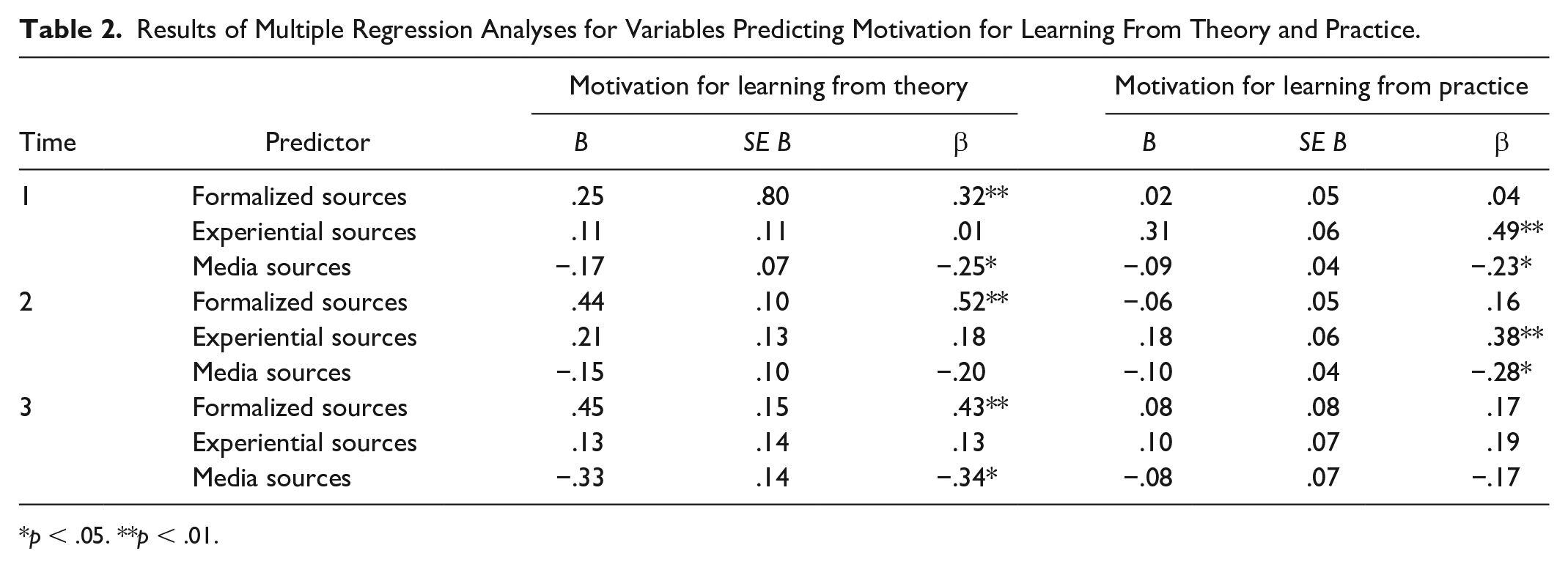
p < .05. **p < .01.
At Time 2, the three predictors together explained a statistically significant amount of the variance in motivation for learning from theory, with F(3, 64) = 7.47, p = .000, R2 = .26. As at Time 1, reliance on formalized knowledge sources was a unique positive predictor (β = .52, p = .000), but unlike at Time 1, reliance of social and popular media sources was not a unique predictor of motivation for learning from theory at Time 2 (β = −.20, p = .108). For motivation for learning from practice, the three predictors explained a statistically significant amount of the variance, with F(3, 64) = 4.08, p = .010, R2 = .17. As at Time 1, beliefs in experiential sources of knowledge were a unique positive predictor (β = .38, p = .002) and reliance on social and popular media sources a unique negative predictor (β = −.28, p = .033).
At Time 3, the three predictors together explained a statistically significant amount of the variance in motivation for learning from theory, with F(3, 50) = 4.35, p = .008, R2 = .21. Reliance on formalized knowledge sources was a unique positive predictor (β = .43, p = .004) and reliance on social and popular media sources was a unique negative predictor (β = −.34, p = .020). Regarding motivation for learning from practice, the three predictors together failed to explain a statistically significant amount of the variance, with F(3, 50) = 1.30, p = .28. Moreover, none of the source of knowledge beliefs uniquely predicted motivation for learning from practice at Time 3 (formalized knowledge sources, β =.17, p = .275; experiential knowledge, β =.19, p = .205; social and popular media sources, β = −.17, p = .261).
Summary
To summarize the quantitative results, participants relied more on practically oriented experiential sources than on theoretically oriented formalized sources throughout 3 years of teacher education, and consistently valued practical more than theoretical learning tasks. Reliance on formalized sources consistently predicted motivation to learn from theory, indicating that the stronger participants’ beliefs in theory-based teaching knowledge, the higher their valuing of the theoretical component of the teacher education programs. Moreover, reliance on experiential sources continued to predict motivation for learning from practice during the first 2 years, with stronger beliefs in practically derived sources associated with more value put on learning from practice. This relationship was not found in the third year, however. Finally, beliefs in social and popular media as sources of teaching knowledge were least endorsed by participants at all time points, and such beliefs tended to be negatively related to motivation for learning regardless the type of motivation.
The Qualitative Phase
We carried out qualitative follow-up phases to improve our understanding of the sources of knowledge participants were referring to and how they expressed their motivation to learn. Furthermore, we were interested in exploring how the themes mentioned by participants might help explain the nature of these beliefs and motivations, their relations and development over time (RQ3). Thus, we conducted interviews concerning participants’ beliefs about sources of knowledge and motivation for learning, with a focus on theoretical knowledge and practical experiences.
Participants
Two focus group interviews were carried out half a year after the first quantitative data-collection point and followed up two years later (i.e., springs of first and third year). One of the focus groups consisted of the same three females and two males at both time points, and the other focus group consisted of five females the first time and of three of these females 2 years later. Although focus group interviews typically have more participants in each group (e.g., 7–10 participants; Krueger & Casey, 2014), one reason we included three to five participants in our focus groups was that we wanted to interview students in already established “basis groups” within the teacher education class. These were groups in which the students worked throughout the year, and these groups were sent to the same schools for the practice periods. We therefore considered it likely that participants in these groups would feel comfortable discussing together and have common points of reference for the discussion. Individual interviews were conducted with four members of the focus groups (three females, one male) when they had been working as teachers (two primary school, one middle school, and one teacher at a school for adult learners with minority backgrounds) for around 18 months. Interview participants were paid a token sum and received a certificate for participation while they were students (and not when they were working as teachers).
Interview protocol
A semi-structured interview protocol 4 (see Supplemental Appendix C, available with the online version of this article) probed the core issues of teaching knowledge and motivation. This approach was chosen to address central issues while allowing for closer investigation of specific topics that might arise in specific interview situations (Patton, 2002). The interviewer rehearsed questions in the order of the interview protocol, but deviated from the guide as needed to follow-up on participants’ responses. The interview protocol was developed by the first and second authors based on existing literature (Fives & Buehl, 2008; Woolfolk-Hoy & Murphy, 2001). We posed broad questions targeting motivation, such as asking participants to identify particularly interesting, useful, and important experiences, as well as to compare differences and similarities of the components of the teacher education programs. Likewise, the questions that addressed teaching knowledge were broad, for example, “What is ‘good’ teaching?” and “Where did you get ideas for your lessons?” We expected that having participants talk about their experiences in detail would unearth explicit and implicit beliefs. Finally, the teaching metaphor task (see Supplemental Appendix A, available with the online version of this article) asked participants to choose a word that best described teaching from their perspective (Woolfolk-Hoy & Murphy, 2001).
Procedure
After the first quantitative data collection, participants were invited to volunteer in existing groups to be interviewed the following semester. We chose to conduct focus group interviews since participants had worked together in formally organized groups since the start of the first semester, and they were comfortable discussing issues related to teacher education together. We considered that this would allow us to gain different perspectives on similar experiences that might stem from individual participants’ underlying beliefs. In trying to limit the number of unexplained variables by choosing participants who had encountered similar experiences (Stewart & Shamdasani, 2015), we hoped to elicit richer answers than would have been likely with first year students alone in a one-to-one interview setting. The individual interviews were carried out with four teachers from the focus groups. The interviews were conducted by the first author at the university college in rooms chosen by the participants (lasting approximately 45 min), except for the individual, final interviews that were carried out at the teachers’ schools (lasting approximately 1 hr).
Analysis of interviews
The audio recordings from each of the interviews were transcribed, imported to NVivo 12, and coded using a stepwise approach. Step 1 entailed the first author identifying salient utterances relating to (a) epistemic beliefs and (b) motivation to learn. An “utterance” was conceived of as a unit of analysis that consisted of a comment or set of comments referring to a distinct idea or issue concerning sources of teaching knowledge or motivation to learn from theory and practice. Thus, utterances varied in length from a short sentence or part of a sentence to several sentences. Identification of utterances was achieved through several careful readings of the transcripts, with the first reading used to establish overall patterns in the data and pick out potentially telling verbal expressions, and with subsequent readings used to identify remaining relevant responses. In the Step 2, themes were distinguished within each of these two dimensions (“nodes” in NVivo). Since the focus of this study was sources of teaching knowledge and motivation to learn from theory and practice, only utterances relating to these aspects were included in the analyses. In Step 3, the themes within the two dimensions were labeled according to content. After this thematic analysis had been completed and discussed with the second author, the first author engaged in temporal comparison of identified utterances to investigate signs of change in beliefs relating to sources of teaching knowledge and motivation to learn from theory and practice. Throughout the analysis of the interviews, a constant interchange between data and theory was ensured as the first author constantly consulted the emerging themes, as well as the literature on sources of knowledge and motivation to learn. The qualitative data analysis resulted in two main themes relating to sources of knowledge and motivation to learn, respectively, being identified in each round of interviews. Each of the themes is described and exemplified in Table TS2 (available with the online version of this article).
Results
Sources of teaching knowledge
In the first group interviews, participants seemed to display a preference for external authoritative sources of knowledge, in particular experienced teachers. Although participants knew that other sources of teaching knowledge might be useful, experienced and knowledgeable authorities were viewed as ultimate and definitive sources of teaching knowledge. Even when participants acknowledged that practice teachers had attended teacher education programs themselves, they underlined that most of their knowledge stemmed from subsequent practice. As an example, inspired by the question of where practice teachers gain knowledge, in an exchange two participants reminded one another that the teachers must have completed teacher education at some point, but anyway, they were convinced that the teachers’ knowledge stemmed from experience (“I think it’s mostly experience. They [the practice teachers] have been teachers for quite a long time” and “They learned from experience . . . somewhere or other, but most from experience”). There were sparse exceptions to this finding regarding reliance on authority, such as vague references to what seemed to be dawning use of introspection as a source of knowledge, described as an examination of the contents of one’s mind, “thus produc[ing] knowledge of one’s own internal experiences” (Chinn et al., 2011, p. 152). For example, “We discussed and reflected” . . . “It comes from somewhere back there.” But it seemed that this cognition and the beliefs they may have stemmed from were so tacit that the participants were not able to verbalize them, choosing to express more faith in external authorities.
By the third year of the teacher education programs (the second round of group interviews), participants seemed to display a dawning, perhaps grudging realization of the need to integrate different knowledge sources (e.g., “Yes, the foundations of adaptive education, or teaching, I suppose they come from teacher education, but different varieties, or values of it come from practice . . .” and “. . . I feel that it’s when you are in practice that you see how things actually are, and learn from that”). Perhaps with the exception of theoretical perspectives on learning, which were still seen as largely irrelevant, this need to integrate formalized sources with experiential ones signaled a growth in the participants’ valuing of different knowledge sources, as well as a budding sense of autonomy in which participants viewed themselves as able to make choices about what sources of knowledge to trust and use. That said, this need for integration and sense of autonomy was still overshadowed by an overall preference for experiential sources (e.g., “through experience . . . watching each other teach . . . we were often several [preservice teachers] together . . . First, we worked together, but also watching how the others are when they are with students and talking and . . . yes, through experience”) and testimony (e.g., “take up all experiences from others really”).
In comparison, there was a pronounced increase in participants’ trust in self as knowledge synthesizer 2 years after the completion of teacher education, in the individual interviews. Although participants still preferred experiential knowledge sources, they seemed to be willing to draw on more sources of teaching knowledge, including formalized sources, and they expressed more confidence in their own ability to combine sources of knowledge and diminished fear for asking colleagues direct questions. They also pointed out that they were better able to evaluate the answers they received and consider how these fit with their own views (e.g., “There are no limits to what I can and can’t do. I choose how I want to adapt my teaching. So, I use everything. Everything I’ve learned earlier. Experiences, or thoughts about those, yes, so I can use everything”). Finally, it is worth noting that participants were not always aware of the sources of their teaching knowledge, consistent with the view that such epistemic beliefs may be tacit (Mason, 2016), and even claimed that they relied on their instincts. As one teacher said, “I am at square one . . . I use my social intelligence . . . and love for the students . . . honestly I think it [teaching ability] is just something you are born with.” However, the same participant also made references to concepts such as adaptive teaching, learned in teacher education, and agreed that teacher education was useful as it laid ground for reflection (e.g., “I see the value of having it [learning theories] at the university college, because it creates some reflection”).
Motivation for theory and practice
The first group interviews revealed that participants viewed theory and practice in teacher education to be in sharp contrast, expressed as a preference for one or the other. For example, when describing a situation in practice where there was a conflict between what the students were required to do by the teacher education program and the demands of the practical context, the students chose to ignore the theoretical requirements (e.g., “We just gave a damn”). Participants seemed so enamored with the practical part of the program that it was difficult for the teacher education class to compete, and the reason seemed to be the inability of theoretical knowledge to account for the complexities of practical settings. This interpretation is consistent with the following comment, “We haven’t used so much more from Pedagogy and Pupil-Related Skills class” . . . “you can’t use that kind of thing” . . . “you don’t get so far with that kind of information.” This view of the lack of relevance of teacher education may be summed up by the comment, “That’s why practice is important . . . not just sit and read in books, in theory books here.”
Participants started to express their motivation to learn from different sources in their third year. At this time, there still seemed to be a strong preference for experiential learning tasks, however, as exemplified by the following comments: “It’s actually just practice for me too. That’s what, when I think about the last years, it’s practice that stands out a bit more”; “It is practice that motivates me most.” At the same time, their motivation to learn from formalized sources was not extremely low in these interviews, and this was especially true when they were able to see the usefulness of what they were learning in class (e.g., “. . . so I am very satisfied with English. I feel kind of like it helps. Because I can use it in teaching English during the practice period”; “I also think that it is absolutely practice, but it’s also . . . I’ve got a lot of useful tips and learned loads during lectures”). In fact, by the third year of teacher education there seemed to be a will to bridge experiential and formalized sources that was hampered by a lack of ability to do so, as well as frustration in the teacher educators’ teaching, illustrated by the following comments: “Theories are here. And practice is here. But there is not a bridge in the middle . . . . We can’t build the bridge”; “. . . when I am in practice, a bit like, oh yes, that’s why we learned about that. And then in a way, I build my own bridge, by having this at the back of my mind.” And, when expressing dissatisfaction with variation in the teacher educators’ teaching, “maybe this is a great irony, and then we will be very good at it . . . Yes, it’s reverse psychology.”
Two years after the completion of teacher education, when the individual interviews were conducted, there were more signs of skill and will to apply theoretical knowledge. Comments that exemplify this are: “Through experience, I’ve tried it out. Like ok, that was a bit too much theory, a bit too little practice. That didn’t work . . . I have to adapt this in another way”; “The didactic model is very little concrete . . . but it’s in the back of my mind now when I am planning . . . It’s kind of imprinted . . . as a given. Nothing we’ve learned has been unnecessary”; “Theories are there in the base and are good to have. But I notice, there are very many other things that take my focus.” Not only did the participants understand the need to combine theory and practice but also they seemed to be confident in their ability to do so. Interestingly, at this time, participants also expressed ideas about how theory might be better connected to practice in teacher education. “You need a knowledge base . . . make it more realistic. Show how you work”; “No one said to me ’you have to do it like this, because research says so’”; “Oh! Yes. Concrete, concrete, concrete . . . it’s great with theory, and lots of it. But don’t stop at the abstract. Use competency goals and the national curriculum and dive down into it”; “Make it more realistic . . . show how you work” were some suggestions for teacher educators, whom were those the participants believed were responsible for this bridging of theory and practice.
Possible changes in over time
Our analysis of the qualitative data suggested some changes in participants’ beliefs over time. This was mainly revealed by comments about sources of teaching knowledge that referred to specific sources beyond theory on the one hand and practice on the other, though these terms were used throughout. For example, “I use those booklets and things like we had during teacher education . . . And I use a lot of Internet . . . and a lot of ‘my section’ [referring to the other teachers in participant’s team]” and “I use ‘my rock’ [reference to mentor] . . . and I sit and search on the Internet for new lesson ideas. And I sit and see what others do. I’m a member of a group on Facebook. In a way I’m re-educating myself.” There were also some signs of evaluative and reflective knowledge stances in relation to external sources, such as: “. . . and I know that I am sometimes inspired by her [mentor] and then I get new ways to think” and “I don’t just say ‘ok, I’ll do it like that’ [when receiving tips from other teachers]. Some things I say ‘hmm, that’s a good way to do it’. But I think more, maybe, ‘if I want, if I can’. It’s more of a discussion now maybe” and “Everything is combined . . . .[referring to a learning theory] It’s a very good foundation . . . It forms a reflection.” However, the longitudinal data suggested that epistemic change relating to sources of knowledge was not linear, but rather somewhat recursive. That is, some earlier signs of epistemic change toward more adaptive views about knowledge sources seemed to be diminished in their second year of work, with participants, for example, being unable to account for where the knowledge sources were taken from and recursing to a view of teaching knowledge as innate. However, it is somewhat unclear whether this change might reflect an internalization of teaching knowledge, making teachers unaware of the original sources of their thinking and practice, or rather a period of uncertainty and pressure that promotes a reversion to reliance on their own experiences. It may also be conceived of as a confirmation of the young teachers’ earlier inability or lack of motivation to engage with the theoretical part of the teacher education course.
Combining Quantitative and Qualitative Results
The qualitative data seemed to support the quantitative data, but, in addition, they provided elaborations of and possible explanations for the consistent preference for experiential sources and learning from practice. For example, it seemed that a growing frustration and a lack of ability to see the applicability and practical implications of theory in teacher education gave more credence to practicing teachers and motivation to learn on the job. Moreover, we could see that participants used and contrasted theory and practice in ways that might not align with researchers’ understanding. For example, in the last interview, one participant referred to his own work as having been “too theoretical” when he seemed to mean too “book-based” and with too little activity, whereas “practice” was taken to mean movement and participation.
Another insight from combining quantitative and qualitative findings concerned the difference between a belief in innate knowledge (stemming from personal sources) and viewing oneself as a knowledge synthesizer. Although both these beliefs may have resulted in reporting a trust in self as a source of knowledge, a qualitative difference comes to light in these findings. All told, combining the quantitative and qualitative findings allowed us to gain more insight into participants’ reasoning underlying their previous responses.
Discussion
In this study, the quantitative data provided a backdrop, revealing an overall preference for practical, experiential sources of teaching knowledge compared with formalized sources and more motivation to learn from practice compared with theory, with reliance on particular sources of knowledge also predicting motivation to learn from tasks perceived to provide corresponding knowledge. While these findings were not unexpected given prior research discussed in the “Introduction” section, our data, taken together, extended existing literature by providing insight into how (preservice) teachers may articulate their views on sources of teaching knowledge and relations between theory and practice over a period of 6 years using a mixed methods approach. Moreover, our study provided new insight about the continued relationship between (preservice) teachers’ epistemic beliefs about the sources of teaching knowledge and their motivation to learn from theory and practice during and after teacher education, with this finding supporting the view that teachers’ epistemic beliefs may matter for their endorsement and development of evidence-based practice (Ferguson, 2021; Thomm et al., 2021).
For our participants, it appeared that they were initially so enamored with the practical part of teacher education and the practice-teachers that it was difficult for the “theoretical” teacher education class to compete. Our findings suggest that integration of theory and practice in teacher education programs may still be fragmented, that is, despite recent efforts to narrow the gap between theory and practice (Norwegian Ministry of Education and Research, 2014). Also, preservice teachers may learn as much about teaching from observing how teaching takes place in an auditorium as they do from listening to what is being presented (Loughran & Berry, 2005; Yeazell, 1971). Consistent with this view, participants commented on lack of varied teaching methods in the teacher education programs, suggesting that preservice teachers may perceive conflicting messages about teacher educators’ views of “good teaching” and their teaching. This underlines a need for teacher educators to base their own teaching on research (Korthagen et al., 2006), as well as articulating this for students (Ferguson, 2021). This could be done through explicit teaching and metacommunication about methods and how the teacher educators have arrived at and selected sources of teaching knowledge, as well as by having preservice teachers reflect (collaboratively, or in journals) on observed teaching, with reflections shared with the teacher educators. Openness around teacher educators’ own epistemic beliefs and processes might further serve to influence preservice teachers’ beliefs and motivation to engage with different sources (Diery et al., 2020).
The participants’ reported preference for learning from practice might also be due to their inability to see the relevance of what they were learning in class for more concrete classroom situations, in which theories were not considered useful. Thorsen (2019) noted that practice teachers in Norway tend to take distance from teacher education and, together with teacher education students, view tasks from teacher educators as extra work that gets in the way of practical experience, rather than opportunities to bridge theory and practice. Relatedly, there may be a frustration over the perceived lack of connection between theory and practice and the lack of concrete scaffolds. In any case, these findings highlight the need for greater collaboration between university college professors and practice teachers and ways of integrating supervision and reflection around theory and practice (Cohn, 1981).
This study was contextualized in Norwegian teacher education where preservice teachers are required to complete 60 ECTS credits in Pedagogy and Pupil-Related Skills, a subject with responsibility for integrating practice and theory in teacher education. Interestingly, the relations between trust in sources of knowledge and motivation to learn held until the third year of teacher education, when the relation between trust in experiential sources of knowledge and motivation to learn from practice failed to reach significance. Among the possible reasons why reliance on experiential sources did not uniquely predict motivation to learn from practice at Time 3 is a higher intercorrelation between reliance on experiential and formalized sources at this time point, as well as smaller sample size resulting in reduced statistical power compared with Times 1 and 2. Of note is also that this result coincides with the time when the students were focusing on research methods and understanding research-based knowledge in preparation for work on their bachelor theses. At that time, the students were also required to complete tasks during practice periods that encouraged more reflection on practice in light of theory (Afdal & Spernes, 2018). Increasing students’ knowledge about research and how it can be used may be a profitable starting point for teacher educators trying to improve students’ understanding of different sources of teaching knowledge and help them (re)consider the roles of those sources. For teacher educators, this might mean helping students develop their ability to read research articles and develop an understanding of research methods (“research literacy”; Lillejord & Børte, 2017), as well as developing epistemic beliefs that help them recognize the importance of grappling with inconsistent research findings and theoretical knowledge (Lunn Brownlee et al., 2017). Both competencies may be aided in Norway by the new requirements for master-level education for teachers, and by having students develop and conduct their own research.
Our finding that participants’ source beliefs predicted their motivation to learn during teacher education is noteworthy not only from the perspective of motivation research but also with respect to its practical implications. Indeed, this finding suggests that promoting more adaptive epistemic beliefs may help preservice teachers develop their motivation to learn from different knowledge sources. However, our study targeted only the task-value aspect of motivation to learn (Wigfield & Eccles, 2000). Yet, results from the qualitative phase may suggest that it is also important to consider and help young teachers develop their self-efficacy for acquiring research literacy (see also, Thomm et al., 2021).
The quantitative data also indicated that our participants relied least on social and popular media as sources of teaching knowledge. Thus, despite much use of social and popular media as information sources in daily life, students do not necessarily regard such sources as useful or authoritative in regard to central aspects of teaching knowledge, or at least they may not be willing to admit this on a researcher-administered questionnaire. Several of the participants mentioned social media groups as important knowledge sources in the interviews, however, and the degree to which participants endorsed social and popular media as sources of teaching knowledge negatively predicted their motivation to learn from both theory and practice. These findings suggest that more research should be directed toward understanding teacher students’ reliance on social and popular media as knowledge sources and the role their attention to such sources may play in their efforts to learn about educational issues, both during teacher education and afterward.
Limitations and Future Directions
Whereas longitudinal studies are much needed in the fields of epistemic beliefs and teacher education alike, such studies may also come with the cost of some methodological limitations, and this study is no exception. Attrition is a problem that faces both teacher education programs and longitudinal researchers (Norwegian Educational Association, 2017; Young et al., 2006), and it is also the case that we lost participants over time, which may have influenced the power of our statistical analyses, especially in the final round of the quantitative part of the study. Accordingly, this should be viewed as a limitation of the study, and future longitudinal research in this area should try to recruit more participants at Time 1 to avoid ending up with so few participants in the later stages of studies. Furthermore, it could be regarded as a limitation that the qualitative data were based on interviews with only two focus groups with few members, and on only four interviews at the final data collection point, which took place 3 years after the final quantitative data collection point. The small number of participants in the focus groups was due to our choice of preexisting groups to facilitate group discussions based on common experiences. However, another possibility might be to select groups of students based on particular belief profiles at Time 1, which might lead to larger groups and more variation in the qualitative data. Although our reason for conducting the individual interviews so much later was partly pragmatic, we also considered that new teachers may need time to adjust to their new realities (Voss & Kunter, 2019). Furthermore, there were no major or surprising changes in the data and, although we cannot be certain, we have no grounds to believe that the results would have been very different if collected 1 year earlier. That said, more data points are obviously preferable in future longitudinal mixed methods research in this area.
Taken together, the outlined limitations preclude determination of the data’s representativeness and generalizations cannot be drawn with any degree of certainty. Rather, our findings should be considered to paint a picture of possible patterns of development (Creswell & Creswell, 2018) that may form the basis for future longitudinal research.
Conclusion
This study represents a unique contribution in terms of providing longitudinal mixed methods data on preservice teachers’ beliefs about sources of teaching knowledge and their motivational implications. Although it seems that there may be some development in preservice teachers’ beliefs over time, there is a need for explicit teaching about the nature and role of preservice teachers’ epistemic beliefs as a way to help scaffold development (Hofer, 2001; Rebmann et al., 2015; Wolfe & Griffin, 2018) and help them align their epistemic beliefs and teaching practice (Bråten et al., 2017; Lunn Brownlee et al., 2017). For teacher educators, there may be a need to help students focus on how to learn from experience as well as on how to build professional knowledge (Korthagen et al., 2006, p. 1025), including discussions about how teaching knowledge is created and justified and how it may inform practice (Afdal & Spernes, 2018). For educational researchers, an important task might be working with “practitioners to develop codified representations of the practical pedagogical wisdom of able teachers” (Shulman, 1987. p. 11). This is dependent on greater collaboration between teacher educators and practice teachers than was evidenced in this study. Particularly, practice teachers might try to view practice periods as opportunities for students to reflect on theory in practice and focus on their own role in “legitimizing” the relevance of theory in practice.
The results of this study may also help shed light on differences between adaptive, research-informed practice and reproduction of teaching practice. If teacher educators and researchers want to achieve the goal of helping educate teachers with a sense of agency who are able to synthesize best practices from formalized and practical sources of knowledge, and who also know “where to go” and “whom to ask” to reliably ascertain useful and research-informed knowledge, then more work is needed to help preservice teachers understand relations between theory and practice. In light of the goal of increasing evidence-based practice, this may require heightened efforts to educate about and help further develop teachers’ epistemic beliefs, as well as their sense of agency, or self-efficacy for research literacy (Andreassen & Bråten, 2013, Bråten, 2016; Wolfe & Griffin, 2018).
Supplemental Material
sj-docx-1-jte-10.1177_00224871221105813 – Supplemental material for A Longitudinal Mixed Methods Study of Norwegian Preservice Teachers’ Beliefs About Sources of Teaching Knowledge and Motivation to Learn From Theory and Practice
Supplemental material, sj-docx-1-jte-10.1177_00224871221105813 for A Longitudinal Mixed Methods Study of Norwegian Preservice Teachers’ Beliefs About Sources of Teaching Knowledge and Motivation to Learn From Theory and Practice by Leila E. Ferguson, Ivar Bråten, Magne Skibsted Jensen and Ulf Rune Andreassen in Journal of Teacher Education
Footnotes
Declaration of Conflicting Interests
The author(s) declared no potential conflicts of interest with respect to the research, authorship, and/or publication of this article.
Funding
The author(s) received no financial support for the research, authorship, and/or publication of this article.

Supplemental Material
Supplemental material for this article is available online.
Notes
Author Biographies
References
Supplementary Material
Please find the following supplemental material available below.
For Open Access articles published under a Creative Commons License, all supplemental material carries the same license as the article it is associated with.
For non-Open Access articles published, all supplemental material carries a non-exclusive license, and permission requests for re-use of supplemental material or any part of supplemental material shall be sent directly to the copyright owner as specified in the copyright notice associated with the article.
