



Abstract
Strong evidence exists for the high vocational calling reported by candidate teachers, but also for the high rates of attrition early in the profession. Current approaches often explain this paradox by the stress associated with first teaching experiences (i.e., vocational stress processes). By contrast, the present study focuses on the stress experienced during teacher education (i.e., academic stress processes), by analyzing the sources of stress and motivation described in writing by French preservice teachers. Using systematic procedures for content analysis (N = 106 autobiographical texts), major results suggest that preservice teachers are mostly motivated by their positive views of the teaching profession, but that the academic demands they face during teacher education challenge their motivation to pursue the career. Implications are drawn on ways to analyze and tackle academic stress processes, in an effort to support candidate teachers’ wellbeing and thus limit attrition rates.
Introduction
For many preservice and beginning teachers, the pathway to the teaching profession begins with a vocational call to contribute to society and, in particular, to youth development. Indeed, as reviews (Fray & Gore, 2018; Heinz, 2015) and international surveys have reported (e.g., Teaching and Learning International Survey [TALIS] OECD, 2020), choosing to enter the teaching profession is primarily motivated by intrinsic or altruistic goals (e.g., enjoying teaching, seeking to contribute to children and adolescent learning), whereas more instrumental or extrinsic goals appear secondary (e.g., social or employment benefits of teaching). Yet, the high rates of attrition from teacher education (e.g., 25%–42% of teacher candidates in the United States; Kim & Corcoran, 2018) and from the profession (e.g., 15%–50% of beginning teachers in industrialized countries; den Brok et al., 2017; Viac & Fraser, 2020) show that something happens during the training phases (i.e., academic training, practicum, and first years as a teacher) that undermines the call for teaching. What can be so damaging about teacher education that it threatens the motivation to become a teacher?
Preliminary studies have shown evidence of the role-played by initial teaching experiences in creating stress processes that can facilitate teacher dropout, notably during the “vocational” phase of teacher education (i.e., the practicum, consisting of teaching practices carried out in a school as part of the training, usually with the support of a mentor) in the form of a gap between candidate teachers’ expectations and actual stressors encountered on the job (Dicke et al., 2014; Klassen et al., 2013; Paquette & Rieg, 2016). This has led researchers to investigate what happens during apprenticeships and mentorships that might foster or undermine supportive first teacher experiences (Ingersoll & Strong, 2011; Krieg et al., 2020; Stanulis et al., 2018). By contrast, little research has been conducted on the experiences associated with the “academic” phase of teacher education (i.e., non-practical phase), whereby prospective teachers acquire subject-matter and pedagogical course material, prior to entering practicum. Preliminary findings indicate that this academic phase may play a decisive role in student teachers’ motivation because of its numerous stressors (e.g., writing essays, taking examinations, learning abstract theories) and of the apparent disjunction between these stressors and students’ call for teaching (Clarke et al., 2012; Deasy et al., 2016; Hobson et al., 2009). Investigating further these academic experiences is warranted to shed light on the circumstances that might put pressure on preservice teachers’ motivation to graduate from teacher education and to stay in the profession. The present study responds to this research need by asking a sample of French student teachers (N = 106) to report, in their own words, their experiences of the first year of teacher education, which is dedicated to academic training. Building on theories of stress processes, systematic procedures for content analysis are then used to identify the most common sources of stress and motivation among student teachers.
Stress Processes Associated with Teacher Education
In social sciences, “stress” is defined as the mediating process by which a state of imbalance in person-environment transactions causes responses in the individual (e.g., physiological, psychological, behavioral) so as to regain a state of balance (Aldwin, 2007; Dupéré et al., 2015; Lazarus, 1999; Núñez-Regueiro, 2017, 2018; Núñez-Regueiro, Archambault, et al., 2022; Núñez-Regueiro, et al., 2021; Núñez-Regueiro & Núñez-Regueiro, 2021; Wheaton et al., 2013). In this context, “stressors” are defined as environmental events that cause such a state of imbalance (stimuli or sources of stress), whereas “distress” refers to the responses resulting from the impact of stress (responses to stress). Moreover, research concurs that the development of stress processes depends on the existence of motivational resources that qualify the impact of stressors, either by adding compensatory effects (i.e., additive effects), by moderating the impact of stressors (i.e., moderation effects), or by transmitting their impact on distress (i.e., mediation effects; (Dupéré et al., 2015; Núñez-Regueiro, 2017; Núñez-Regueiro, Jamain, et al., 2022; Pearlin & Bierman, 2013; Wheaton et al., 2013).
In sum, to understand the development of stress processes among preservice teachers, one must analyze stressors and, concomitantly, the motivational resources that enable coping with the impact of stressors (e.g., personal, academic or social resources). Given the double status of preservice teachers as college students and future professionals, we argue that such stressors and motivational resources can be found both in the vocational and academic domains of teacher education, but that previous research has predominantly focused on the vocational domain. Other stressors and resources can also be found in the personal domain of preservice teachers, but have received little attention as well (for an overview, see Table 1).
Overview of Preservice Teachers’ Stressors and Resources According to the Literature.
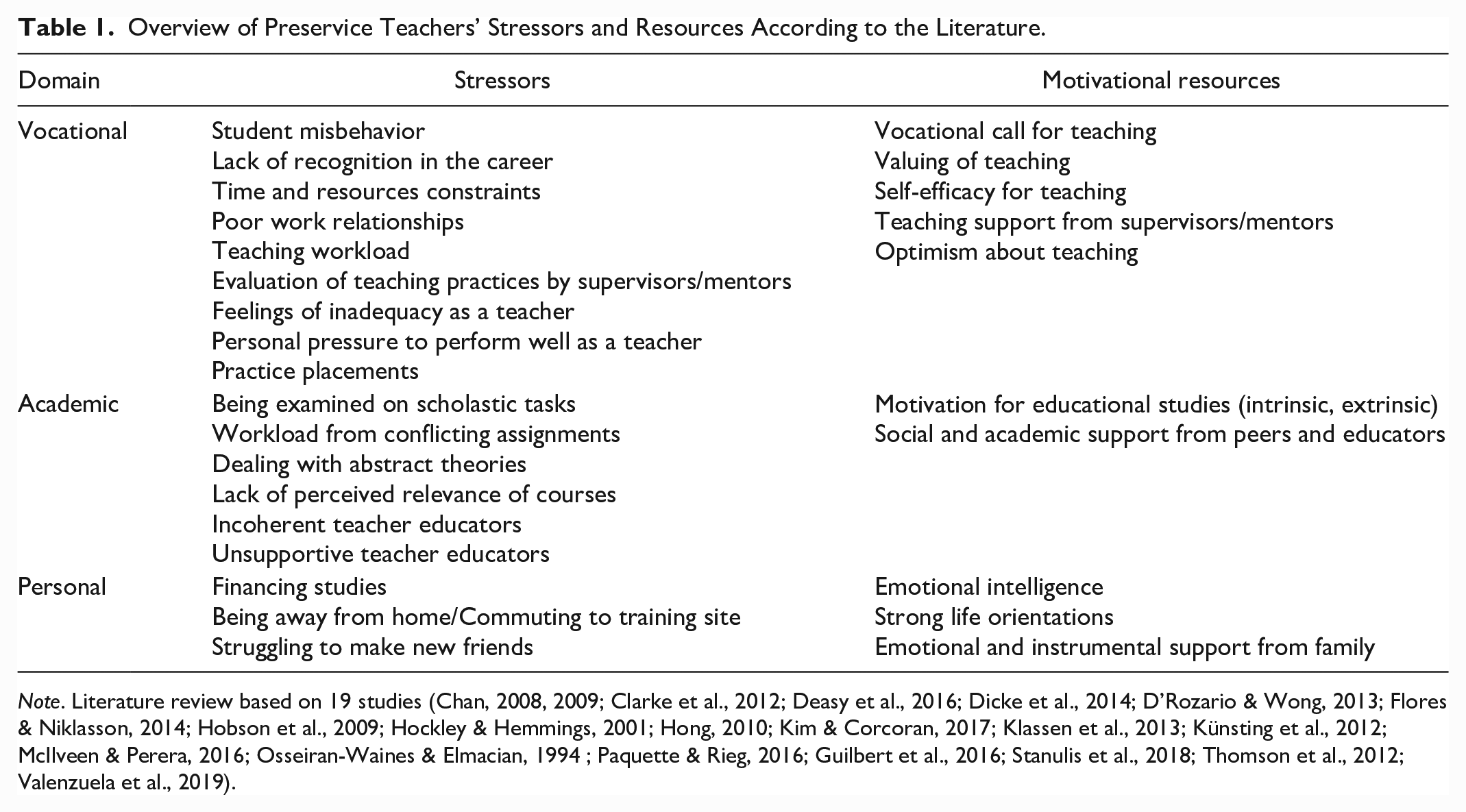
Note. Literature review based on 19 studies (Chan, 2008, 2009; Clarke et al., 2012; Deasy et al., 2016; Dicke et al., 2014; D’Rozario & Wong, 2013; Flores & Niklasson, 2014; Hobson et al., 2009; Hockley & Hemmings, 2001; Hong, 2010; Kim & Corcoran, 2017; Klassen et al., 2013; Künsting et al., 2012; McIlveen & Perera, 2016; Osseiran-Waines & Elmacian, 1994 ; Paquette & Rieg, 2016; Guilbert et al., 2016; Stanulis et al., 2018; Thomson et al., 2012; Valenzuela et al., 2019).
Preservice Teachers’ Stressors: Shifting the Focus from First Teaching Experiences to the Academic Struggles of Teacher Education
Research on preservice teachers’ sources of stress has focused on the vocational domain and, more precisely, on job stressors associated with first teaching experiences during practicum. Part of this research has been conducted by asking preservice teachers to take stressors scales developed for in-service teachers that measure job stressors such as student misbehavior in the classroom, lack of recognition in the career (e.g., in terms of salary, competency), time or resources constraints (e.g., inadequate equipment, ill-defined curriculum, insufficient time for individualized teaching, large class size) and poor work relationships with educational authorities, parents, or others teachers (Dicke et al., 2014; Klassen et al., 2013). Studies using scales specifically developed for preservice teachers identified additional practicum stressors such as teaching workload (e.g., lesson planning and delivery), evaluation of teaching practices by university or school mentors (Clarke et al., 2012; Hockley & Hemmings, 2001; Paquette & Rieg, 2016), feeling inadequately prepared to teach (Clarke et al., 2012), personal pressure to perform well as a teacher (D’Rozario & Wong, 2013) or fearing practice placement in an unfavorable working environment (Deasy et al., 2016). In terms of intensity, existing studies concur that the strongest practicum stressors relate to managing the workload and time constraints, getting good evaluative reports, as well as handling student misbehavior effectively (D’Rozario & Wong, 2013; Hockley & Hemmings, 2001; Paquette & Rieg, 2016).
Although practicum stressors are an important component of stress processes in teacher education, their relevance may be limited for preservice teachers in the academic phase of teacher education. During this phase, one might expect them to experience more personal and academic stressors, such as those reported by college students. According to a systematic review of qualitative research (Hurst et al., 2013), college students most often report being stressed out by general academic life (studying, attending classes, passing exams; 40% of studies), lack of time to meet social or academic demands (38%), lack of money (18%), and managing changes in family (38%), romantic (33%), and peers relationships (33%). Some studies show indeed that some of the latter social and personal factors (i.e., struggling to make friends, financial difficulties associated with living away from home) are a source of stress for some preservice teachers (Deasy et al., 2016; Hockley & Hemmings, 2001). Yet, preliminary evidence also suggests that what characterizes most preservice teachers’ stress is the way teacher education is conducted in terms of learning content (i.e., lack of perceived relevance of course, lack of professional opportunities), assessment modalities (e.g., scholastic dissertations, cumulative demands), and teaching quality (i.e., lack of consideration or coherence in the discourse of teacher educators). More precisely, an Irish study found that preservice teachers, especially those from Science undergraduate degrees, found it difficult to incorporate and find meaning in abstract theories and concepts from educational sciences (e.g., philosophy, sociology, psychology) not directly related to teaching practices, and were also confused by examinations based on scholastic exercises they were not familiar with (e.g., writing essays, being rated on grammar, punctuation, etc.), which some deemed not relevant for teaching their discipline (Clarke et al., 2012). The perceived dissociation between academic learning in teacher education and the teaching profession—an ongoing issue made salient over 100 years ago (Dewey, 1904)—was also found to contribute to feelings of unpreparedness among preservice teachers in the United States (Coronado, 2011, as cited in Paquette & Rieg, 2016) and among preservice teachers in Portugal and England, who regretted the lack of professional experiences and were critical of the content of the curriculum (Basit et al., 2006; Flores & Niklasson, 2014). Related to this, Irish and English student teachers found that teacher educators gave contradictory information depending on their education- or subject area-orientation, and showed little consideration for conflicting demands between academic assignments (e.g., conducting a research project or handing a dissertation) and practical assignments (e.g., preparing a class, teaching practice; (Basit et al., 2006; Clarke et al., 2012; Deasy et al., 2016).
The above research therefore suggests that preservice teachers encounter a variety of academic stressors (and, second, of personal stressors) before even beginning the stressful experiences of the practicum. The specificity of this academic stress seems related to the perception that teacher education embraces too many contents at once (academic examinations, educational knowledge, conflicting demands between theory and practice of teaching), the relevance of which is not evident to all student teachers. Perhaps as a consequence, preliminary data have shown that preservice teachers in France show lower levels of satisfaction with the content of their curriculum (51.2% satisfied), than their peers in other training programs (64.5%; Farges et al., 2019). Lower satisfaction levels in education studies relative to others fields of study have also been reported in various European countries (e.g., Czech Republic, France, Italy, Norway, Sweden; García-Aracil, 2009). Although the evidence is suggestive, the number of studies in this domain is limited and calls for complementary research to reveal these themes more distinctly, using systematic techniques to identify major academic stressors in teacher education.
Preservice Teachers’ Motivational Resources to Cope With Stressors
According to theories of stress (Aldwin, 2007; Lazarus, 1999; Núñez-Regueiro, 2017; Núñez-Regueiro, Jamain, et al., 2022; Pearlin & Bierman, 2013; Wheaton et al., 2013), the impact of stressors on preservice teachers’ distress depends on the personal, contextual or social resources that are available to cope with such stressors. To date, this issue has been mostly investigated in relation to vocational resources that prevent teacher distress (e.g., teacher burnout or turnover) or that foster engagement in teacher education (e.g., commitment to teaching, satisfaction with career choice, engagement in teacher education). Such resources include having a strong vocational call by cumulating multiple reasons for choosing the teaching profession (i.e., intrinsic, altruistic and extrinsic reasons (Künsting et al., 2012; Thomson et al., 2012; Valenzuela et al., 2019) and, relatedly, having a strong motivation to teach by valuing the teaching profession (e.g., in terms of intrinsic, altruistic or extrinsic benefits; (Hong, 2010; Valenzuela et al., 2019). Vocational resources also include self-efficacy for teaching (Chan, 2008; Dicke et al., 2014; Hong, 2010; Klassen et al., 2013; Valenzuela et al., 2019), social support from supervisors or from school mentors during apprenticeships (e.g., teaching advice, emotional, and organizational support; (Paquette & Rieg, 2016; Stanulis et al., 2018) and being optimistic about the teaching career, that is, expecting positives outcomes on the job (McIlveen & Perera, 2016).
By contrast, non-vocational resources appear to have received limited attention, but a few studies on preservice teachers point to the protective effects of psychosocial resources and of social relationships in the personal and academic domains. In the psychosocial domain, a study conducted by Chan (2008) found that Chinese preservice teachers were more likely to resort to adaptive coping strategies (e.g., seeking support and focusing on problem solving to overcome difficulties, as opposed to resigning or resorting to wishful thinking) when they enjoyed high levels of emotional intelligence, that is, the capacity to understand and manage emotions in oneself and others. Having a strong life orientation (i.e., toward personal meaning, pleasure and engagement) was also found to contribute to student teacher well-being in terms of satisfaction with life and positive affect (Chan, 2009). From a more sociological perspective, one study found that receiving instrumental support (e.g., in terms of financing, everyday tasks, commuting) and emotional support (e.g., in terms of expression of affection, encouragement, attention) from parents or siblings contributed to diminish feelings of anxiety among Bahraini preservice teachers, both with regards to teaching anxiety and to general anxiety (Osseiran-Waines & Elmacian, 1994).
Concerning resources in the academic domain, Guilbert and colleagues (2016) found that Australian preservice teachers who were intrinsically motivated by their studies (e.g., being inherently interested by the content of studies), as opposed to extrinsically motivated (e.g., being interested in studies for the purpose of obtaining a qualification), had more positive views about the training program and, more specifically, about courses on educational research. Finally, another academic resource concerns the social support received from teachers and peers in the training program, which is conceived as an important component of student engagement (Kim & Corcoran, 2017).
In summary, as reported in Table 1, preservice teachers are confronted with a variety of stressors (i.e., vocational, academic, and personal) that can undermine their levels of success and engagement in teacher education, notably in the absence of compensatory resources (also vocational, academic, and personal). The bulk of the research appears to have focused on studying preservice teachers’ stressors and resources during practicum, and little is known about their influence during the more academic phase of teacher education. As we explain next, the French context—where the present study takes place—has specificities that render the academic phase particularly stressful.
Context of Study: The First Year of Preservice Teacher Education in France
With declining ratios of teacher candidates to teacher positions since the late 1990s and difficulties recruiting new teachers (e.g., 13% of new positions not provided for in the last decade), concerns have been raised about the attractiveness and the future of the teaching profession in France (CNESCO, 2016). According to this report, this situation needs to be addressed by increasing the number of student teachers that are “ready” to take a teaching position (i.e., students with vocational experience) while raising the competencies of recruited teachers to revalue the social standing of the profession (i.e., students with diversified and elaborate skills). These simultaneous goals pose a challenge to the design of teacher education programs that must find a compromise between skills development at university and on-the-job experiences at schools, which creates a tension during the first year of preservice teacher education.
More precisely, the design of teacher education in France can be described according to three phases (we focus on major pathways of newly recruited teachers; MENJS-DEPP, 2020). First, prospective teachers follow undergraduate studies for 3 years. At this stage, those who envisage teaching in secondary education major in a disciplinary subject (e.g., language arts, mathematics, sciences, history), whereas those who envisage teaching in primary education usually major in educational sciences or other social sciences (e.g., psychology, sociology). Second, those who graduated begin the first year of preservice education, which is academic in nature and includes limited vocational internships. During this academic year, students are trained and examined in educational theories and educational research (e.g., conducting a scientific study), while also preparing a competitive examination for recruitment that conditions their entry into the practicum and their first job placement. This competitive examination consists of written and oral examinations on disciplinary subjects and on hypothetical educational situations (MENJS, 2021a, 2021b). Importantly, rankings on this examination determine the degree to which candidates will be recruited in a school district of their choice, meaning that low-ranked candidates are often constrained to take a position in a non-chosen school district. Third, those who passed the competitive examination (and the academic examinations) begin a 1-year practicum with teaching responsibilities in a local school, under the supervision of a mentor. This practicum completes teacher education.
Because of this design, the first year of preservice education in France (i.e., the academic year) can be challenging. Indeed, students in this year are confronted with the need to comply with academic examinations in abstract theories and research methods (including regular home assignments and pencil-and-paper examinations), while also preparing for the competitive examination that determines their future job placement. What is more, this first year provides limited on-the-job experiences, which means that, after 3 years of undergraduate studies, student teachers must “wait” an extra year before developing their own teaching practices. More precisely, students in the first year are offered an internship consisting of class observations and supervised teaching sessions, which lasts a mere 2 weeks. This combination of strenuous academic stressors and of vocational postponement likely puts to the test the call for becoming a teacher, even among strongly motivated candidates. To date, however, no study has been conducted to shed light on these experiences.
Study Aims and Hypotheses
The present study sought to understand the stress processes associated with the academic phase of preservice teacher education, to see which elements of the training might put pressure on students’ vocational call for teaching. Because the literature on the subject has been limited with regards to academic or personal sources of stress and motivation, a qualitative approach was privileged by asking preservice teachers to recall their experiences after one semester of training and to describe, in their own words, the stressors and motivational resources encountered during this academic phase. Based on stress process theories in the organizational and educational context (Dupéré et al., 2015; Núñez-Regueiro, 2017; Pearlin & Bierman, 2013; Wheaton et al., 2013), this study aimed to answer the following research questions: which sources of stress and motivation were experienced by preservice teachers? And how did they reflect stress proliferation (cumulative stressors) and by person-environment fit or misfit processes between teacher education stressors and coping resources? Based on preliminary research, it was expected that these autobiographical texts would describe multidimensional stressors (Hypothesis 1a) and multidimensional motivational resources (Hypothesis 1b), over and above the vocational dimension associated with teaching. Also, we expected to find reports of academic stressors specific to teacher education (e.g., workload from conflicting assignments, lack of perceived relevance of courses to teaching, incoherent teacher educators) and to the French context of preservice education, notably the need to prepare examinations for both teacher education and the competitive examination (Hypothesis 2). Finally, in a more exploratory approach, the study sought to understand patterns of stress proliferation and person-environment fit processes by analyzing co-occurrences of stressors and motivational resources.
Method
Participants
Autobiographical texts were obtained from 106 student teachers (
Procedure
A call for participation to the study was addressed to teacher educators responsible for the 32 training centers in France (“Institut National Supérieur du Professorat et de l’Education”—INSPE). Teacher educators from 10 training centers agreed to participate by transmitting an invitation mail to the list of students registered in the first year of preservice education. The invitation mail contained a presentation of the study and the link to an online questionnaire (92 items), which comprised questions about students’ background, academic and vocational characteristics. At the end of the questionnaire, an open-ended section offered respondents the possibility to write about their personal experiences, by stating “In what follows, you may express yourself about the questionnaire or the factors of stress/motivation.” Two blank texts then followed, one for the questionnaire (“About the questionnaire”) and one for the stress and motivational factors (“About the factors of motivation and/or stress related to the teaching career or to your personal life”). In total, 340 first year preservice teachers responded to the online survey in March 2020 (93% before the French COVID-19 confinement started, on March 17), 106 of which also completed the last open-ended section by writing their experiences. Texts were 98.1 words on average (median = 74.5 words, SD = 85.3 words), with lengths varying from 7 to 515 words. The results presented hereafter are based on these 106 autobiographical texts.
Analytical Strategy: A Content Analysis of Autobiographical Texts
A content analysis was conducted to recode the 106 autobiographical texts into coherent units of analysis and to describe their structure using quantitative indicators. Quantitative content analysis is defined, first, by the application of systematic procedures for generating replicable and valid units of analysis (Krippendorff, 2004) and, second, by the numerical analysis of the obtained data (Kuckartz, 2014).
Concerning systematic procedures, the present study developed coding instructions for identifying unit of analysis in a reliable manner, before coding the texts into units. More precisely, the units of analysis corresponded to encoding categories (e.g., a specific stressor or resource), which were used to simplify and reduce the contents of texts into pre-established semantic units (i.e., the encoding categories). A defining feature of this design is to make sure that the development of the instructions and coding categories is made independently from the coding itself, and that the reliability of the obtained categories is formally evaluated (Krippendorff, 2004). To do so, the first author, who was familiar with the teacher education literature, stress processes, and content analysis methods, developed the coding instructions by establishing a set of 62 categories of stressors or motivational resources grouped according to three dimensions (i.e., “vocational,” “academic” and “personal”), which served as guidelines for coding (see SM-B for a list of categories, with verbatim examples). More precisely, the categories were established based upon a first reading of the texts, and were then screened for mutual exclusiveness (i.e., avoiding redundancies or overlap) and exhaustiveness (i.e., covering all thematic contents) by refining, merging or adding categories. Next, the first author developed the coding tasks, which consisted in identifying units of analysis in each text and in choosing a single category for each identified stressor or resource. Once the coding scheme was developed, the second and third authors (i.e., experts on student motivation and teacher stress) coded the texts independently, based solely on the aforementioned instructions and categories. On average for each category, agreement in coding the texts was reached 98% of the time. For increased reliability, Krippendorff’s alpha indicator and its bootstrap sampling distribution were also computed, thus identifying categories for which the encoders’ agreement was significantly higher than what could be expected by chance, with a 95% confidence interval (Hayes & Krippendorff, 2007; Krippendorff, 2004). By implementing this technique on the R package irrCAC (Gwet, 2019; R Core Team, 2016), 72.5% of categories were found to be reliable according to Krippendorff’s
Concerning numerical analyses, we computed the number of occurrences of each coding category across texts to identify the most prevalent stressors and motivational resources. Moreover, the number of co-occurrences of each combination of coding categories was also computed to identify patterns of cumulative stressors, cumulative resources, and stressors-resources. Because co-occurrences may erroneously reflect absolute occurrences of each combined unit (as opposed to actual dependencies between units), an interaction parameter
Results
The text analysis of the autobiographical texts (N = 106) resulted in the identification of 34 stressors and 11 motivational resources, and in 58 combinations of stressors and/or motivational resources. The quantitative analyses of occurrences and co-occurrences showed that academic stressors and vocational resources were most prevalent, in what suggests the existence of stress processes where the motivation to teach co-exists with the strain associated with meeting the academic demands of teacher education.
Stressors Reported by Preservice Teachers
Taken together, the 34 stressors were reported 240 times across texts, meaning that each preservice teacher reported an average of 2.3 stressors. As reported in SM-C, the majority of stressors were academic in nature (136 occurrences, 56.5% of stressors), followed by vocational stressors (64 occurrences, 26.5%) and personal stressors (41 occurrences, 17.1%). For parsimony and robustness, we focus our analysis on the 10 most commonly reported stressors by domain of life (see Table 2).
Top Ten Most Commonly Reported Sources of Stress and Motivation, by Life Domain.
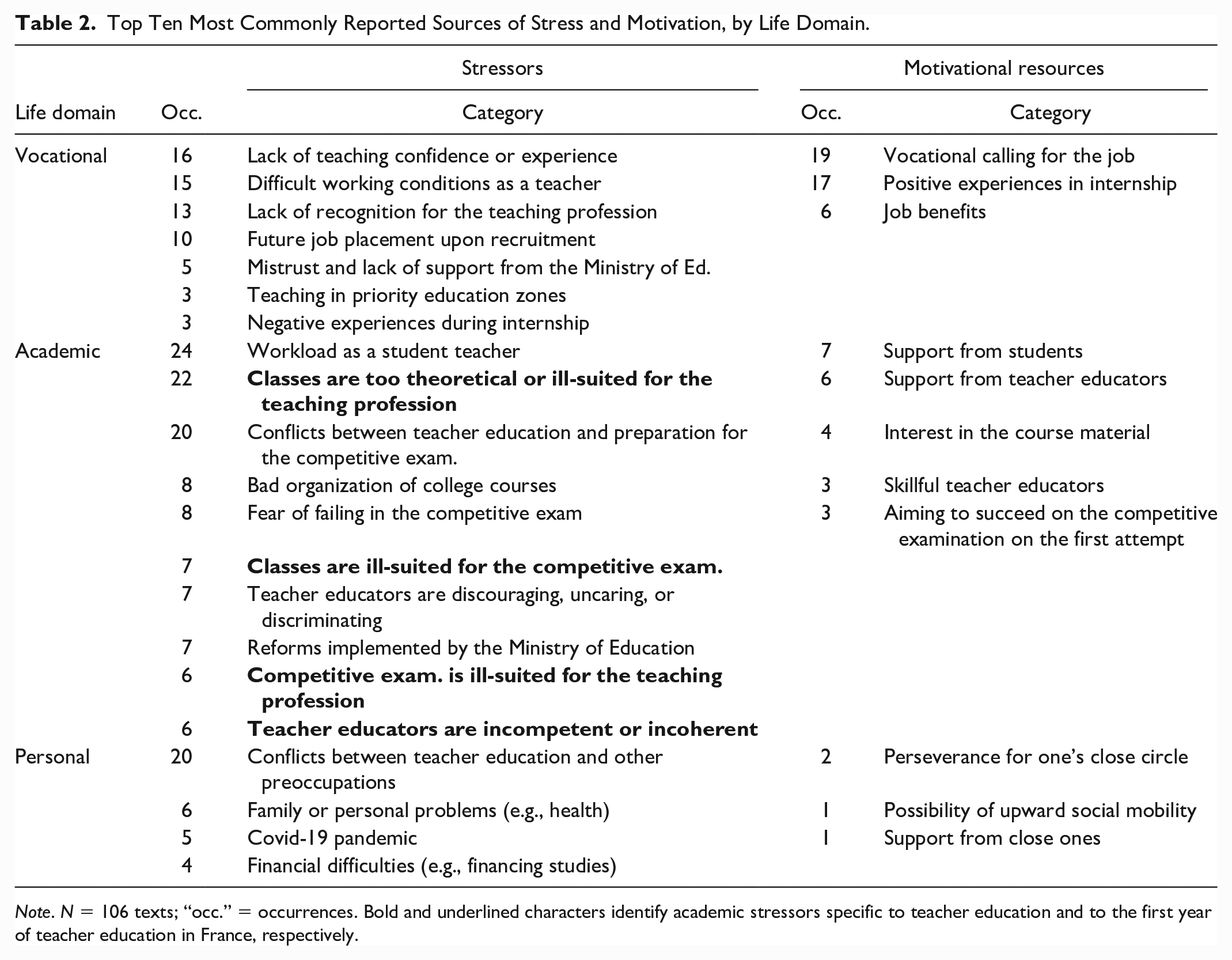
Note. N = 106 texts; “occ.” = occurrences. Bold and underlined characters identify academic stressors specific to teacher education and to the first year of teacher education in France, respectively.
Aligning with previous studies, the most common vocational stressors concerned negative experiences of the working conditions or status recognition in the teaching profession (Dicke et al., 2014; Hockley & Hemmings, 2001; Klassen et al., 2013; Paquette & Rieg, 2016), such as difficult working conditions as a teacher (15 occurrences), lack of recognition for the teaching profession (13 occurrences), teaching in priority education zones (3 occurrences), and negative experiences during internship (3 occurrences); as well as fears concerning one’s preparedness to teach and being placed in an unfavorable working environment during practicum (Clarke et al., 2012; Deasy et al., 2016), as instantiated in the stressors lack of teaching confidence or experience (16 occurrences) and future job placement upon recruitment (10 occurrences; see Table 2). Likewise, the academic and personal sources of stress reported in the present sample were convergent with those identified in previous studies, in particular the workload associated with teacher education (e.g., workload as a student teacher, 24 occurrences; (Deasy et al., 2016; Hobson et al., 2009), the perceived disjunction between teacher education and the teaching profession (e.g., classes (or teacher educ.) are too theoretical or ill-suited for the teaching profession, 22 occurrences; (Clarke et al., 2012; Coronado, 2011, as cited in Paquette & Rieg, 2016), the poor quality of lectures or lecturers in teacher education (e.g., bad organization of college courses, 8 occurrences; teacher educators are discouraging, uncaring, or discriminating, 7 occurrences; teacher educators are incompetent or incoherent, 4 occurrences; Deasy et al., 2016), and difficulties associated with financing studies (4 occurrences; (Deasy et al., 2016; Hockley & Hemmings, 2001), handling family or job responsibilities outside of teacher education (e.g., conflicts between teacher education and other preoccupations, 20 occurrences; family or personal problems, 6 occurrences) or coping with the Covid-19 pandemic (5 occurrences). In sum, these results show that the sources of stress affecting preservice teachers are multidimensional, thus corroborating Hypothesis 1a. Students 9 and 71 provided concise texts recalling these experiences of cumulative stressors: No consideration for the student status, and serious calling into question by society of the status of teachers, unconsidered, underpaid. Training UNFIT for the expectations of the competitive examination, and competitive examination unfit for the job. (Student 9, text translated from French) The fact that I have to validate both the master’s degree [of teacher education] and the competition with all the work that it requires is really stressful and sometimes I feel overwhelmed by this workload. No matter how hard I work and how organized I am, I feel like my results don’t reflect all the work I put in. All this stress is impacting my sleep (quality of sleep, regular insomnia) and my health in general. Personal problems are added to this (death in my family, illness, family conflicts). (Student 71, text translated from French)
Moreover, we found that academic stressors in the form of a perceived gap between theory and practice were most prevalent, ranging from 7 occurrences (stressor classes are ill-suited for the competitive examination) to 22 occurrences (stressor classes are too theoretical or ill-suited for the teaching profession) and totaling in 63 occurrences or one in four stressors (see stressors in bold and underlined characters, Table 2). Their high prevalence across texts thus aligns with Hypothesis 2, according to which the specific demands of teacher education are most stressful for preservice teachers, especially in France due to the combination of college education and preparation for a competitive examination. More precisely, students perceived teacher education as inappropriate for both the teaching profession [classes are too theoretical or ill-suited for the teaching profession, 22 occurrences] and the competitive examination [conflicts between teacher educ. and preparation for the competitive examination, 20 occurrences, classes are ill-suited for the competitive examination, 7 occurrences], and also considered the competitive examination as inappropriate for the teaching profession (competitive examination is ill-suited for the teaching profession, 6 occurrences). In other words, the analysis revealed that not only were conflicting demands a source of stress, but also the perception that these demands did not contribute to enhance their capabilities as teaching professionals (55 occurrences in total, or 23% of stressors). The texts from students 8 and 34 describe well the latter feelings of inadequacy in the teacher education program: The INSPE [training institution] does not provide concrete lessons related to our future profession, a training that is demotivating. A feeling of being overwhelmed by assignments in each discipline, which makes me put aside the preparation of the competitive examination for example. Internships are very short (first year = 4 weeks, including 2 weeks for each semester)[. . .]. Teachers in the first degree versus teacher educators are very often in contradiction, it is difficult to know what to do, how to do.” (Student 8, text translated from French.) “The expectations for the competitive examination / master’s degree are very intellectualized, complex, rigid (organization of the training), and seem far removed from the reality of the field. As far as the training is concerned, very few courses deal with the question of relationships with students, pedagogy, class management, etc., and when they do, they are always too theoretical and lectured. I feel obliged to absorb a lot of information, procedures, etc. necessary to “fit the mold” and pass the exam, but which are little or not useful for the actual practice of the teaching profession. I have the impression of being “formatted” into a profession. Moreover, it seems to me that the qualities most valued to succeed in the competitive examination (memorization and restitution capacity, great rigor, high intellectual capacity) are not necessarily those of a good teacher. (Student 34, text translated from French)
Motivational Resources Reported by Preservice Teachers
Motivational resources were less often reported than stressors and totaled 68 occurrences across texts, or an average of 0.64 resources per student. Similarly to stressors, they appeared in multiple life domains. However, contrary to stressors, the majority of motivational resources concentrated in the vocational domain (42 occurrences, or 61.5% of resources), followed by academic resources (23 occurrences, 33.3%) and personal resources (4 occurrences, 5.2%; Table 2). This result aligns with previous research attesting to the hypothesis of multidimensional motivational resources (Hypothesis 1b). More precisely, vocational resources concerned valuing the profession both for intrinsic reasons (e.g., vocational calling for the profession, 19 occurrences; positive experiences during the internship, 17 occurrences) and extrinsic reasons (e.g., job benefits, 6 occurrences; Hong, 2010; Künsting et al., 2012; Thomson et al., 2012; Valenzuela et al., 2019). For academic resources, results corroborate the importance of being motivated by the content and quality of teacher education (e.g., interest in the course material, 4 occurrences; skillful teacher educators, 3 occurrences; Guilbert et al., 2016) and of receiving social support in the training (e.g., support from students, 7 occurrences; support from teacher educators, 6 occurrences; Kim & Corcoran, 2017). Echoing a previous study (Osseiran-Waines & Elmacian, 1994), personal resources in the form of social support from close ones were also reported (e.g., perseverance for one’s close circle, support from close ones), but their small number of occurrences (≤ 2 occurrences each, 3 occurrences in total) makes the evidence for these personal resources only tentative and suggests, instead, that the multidimensionality of motivational resources mostly concerns the vocational and academic domains of life. Students 94 and 60 recalled many of these multidimensional resources: I feel very lucky because my first year of preservice education was, overall, very enriching and positive. At the training center of [name of institution], the teachers are very engaged and caring, they prepare us very well for the competitive examination and we have a trusting relationship with them. Moreover, our small group of students was ideally composed, as we got along very well and we appreciate each other very much. The internships have been very enriching and I feel ready to enter the profession. (Student 94, text translated from French) The motivating factors are the prospect of being able to become a teacher, the internships offered and the good atmosphere between the trainers and the students. (Student 60, text translated from French)
Combinations of Stressors and Motivational Resources Reported by Preservice Teachers
The above results show that sources of motivation and stress in the lives of preservice teachers can be found across multiple domains of life (i.e., vocational, academic, personal). To further investigate the relationships between these sources, Table 3 reports the most common combinations (or co-occurrences) of stressors, motivational resources, and stressors-resources found across autobiographical texts (for a complete list, see SM-C). All interaction parameters
Top Ten Most Common Combinations of Stressors, Resources and Stressors/Resources.
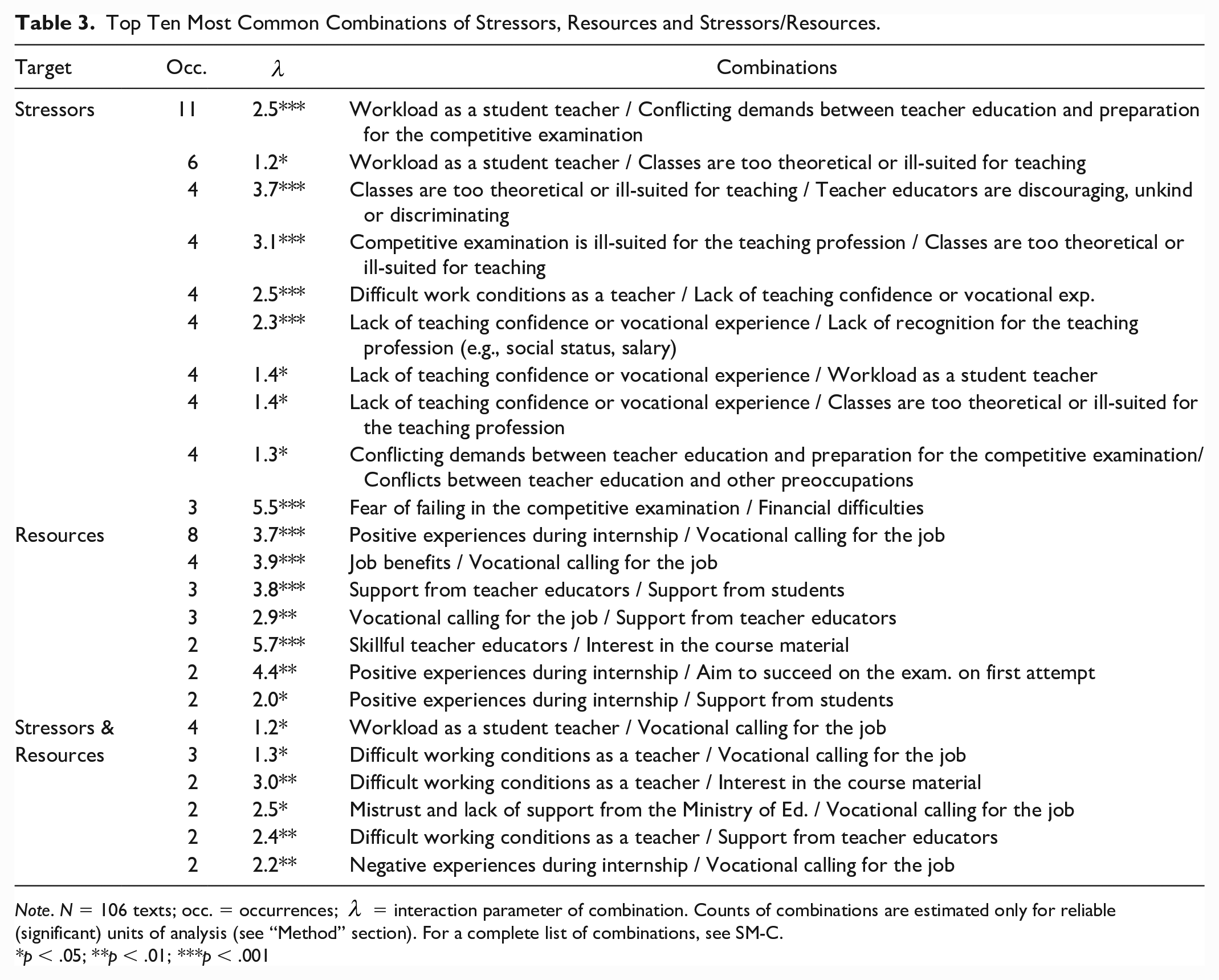
Note. N = 106 texts; occ. = occurrences;
p < .05; **p < .01; ***p < .001
First, one in two stressors co-occurred with another stressor (i.e., 125 combinations of at least two stressors, representing 52.1% of occurrences of stressors). The most common concerned combinations of academic stressors, notably those related to student workload and the apparent lack of fit between the teaching profession and teacher education or the competitive examination (i.e., stressors workload as a student teacher, conflicting demands between teacher education and preparation for the competitive examination, classes are too theoretical or ill-suited for the teaching profession, competitive examination is ill-suited for the teaching profession, which co-occurred 21 times; Table 3). However, combinations of vocational stressors were also often observed (e.g., difficult working conditions as a teacher, lack of teaching confidence, and lack of recognition for the teaching profession, 8 co-occurrences) and, to a lesser extent, other combinations between academic, vocational and personal stressors (Table 3 and SM-C).
Second, one in three motivational resources co-occurred with another motivational resource (i.e., 24 combinations, or 35.6% of total occurrences). Here, combinations appeared to be more prevalent in the vocational domain, especially between valuing and positive experiences of the teaching profession (e.g., positive experiences during internship, vocational call for the job, job benefits, 12 co-occurrences; Table 3). Although less numerous, combinations of academic resources (e.g., support from teacher educators, skillful teacher educators, support from students, interest in the course material, 5 co-occurrences) and of academic and vocational resources were also observed (e.g., vocational call for the job, positive experiences during internship, support from teacher educators, support from students, aiming to succeed on the competitive examination in the first attempt, 7 co-occurrences; Table 3).
Third, stressors and motivational resources also co-occurred, but in very diverse patterns (see Table 3). Some of these patterns aligned with previous findings on occurrences opposing a vocational call for teaching and the hardships associated with workload as a student teacher (4 co-occurrences), but others revealed different processes of stress, such as the realization of the difficulties associated with teaching (e.g., stressors difficult working conditions as teacher, negative experiences during internship) that were opposed to a vocational call for teaching (5 co-occurrences), or to an interest in the course material of teacher education (2 co-occurrences); or the conflict between workload as student teacher and support from students (2 co-occurrences). The texts from student 11 and 46 illustrate many of these diverse patterns of stressors and motivational resources: I have always wanted to be a teacher, and I love History as well as Geography, I really like transmitting my knowledge around me and I have a good human contact with others and notably with children. However, what is difficult about this year is the workload we face, the stress of the competitive examination arriving very soon, and the lack of knowledge in teaching methods of teacher educators. However, some teacher educators dedicate themselves completely to our success, which is very admirable and for which I thank them very much. There are ups and downs in the training phase, which is why it is important to develop working groups that enable supporting our morale and helping each other out as students, it is important to keep a cool head. (Student 11, text translated from French) The first stressor is that of the competitive examination which, in our district, has a very low rate of admission [. . .]. The working conditions in the profession and especially the deterioration of its perception in society, but also of the support provided by the institution, can be a hindrance. On the other hand, the few weeks spent in internship are a great motivating factor, allowing us to see again the goal of our training. The latter is indeed sometimes disconnected from the reality of the schools and can seem meaningless if one does not manage to connect it to the concrete. The friendships that are created within the class of students are also important motivating factors, if not crucial. (Student 46, text translated from French)
In sum, stressors and motivational resources appeared to come in “bundles,” notably academic stressors specific to the first year of teacher education and vocational resources supporting the motivation to teach. These results thus show, in the form of co-occurrences, that the multidimensionality of stressors and resources do not merely reflect the collective accumulation of separate factors experienced by distinct individuals, but are constitutive of the complex, multifactorial stress processes experienced by many preservice teachers.
Discussion
Building on preliminary findings on academic stress processes among student teachers (Clarke et al., 2012; Deasy et al., 2016; Hobson et al., 2009), the present study shows that the experience of teacher education creates situations of unease and strain (i.e., stress proliferation, misfit between stressors and resources) that challenge future teachers’ motivation to pursue in the career, and suggests possible ways to counteract these negative situations.
Summary of Findings
The content analysis of 106 autobiographical texts from first year preservice teachers gave support to three major hypotheses. First, the analysis showed that sources of stress were not limited to the often reported vocational dimension of teaching practicum (e.g., stressors associated with teaching difficulties or with the lack of recognition of the teaching profession; Dicke et al., 2014; Hockley & Hemmings, 2001; Klassen et al., 2013; Paquette & Rieg, 2016), but also involved the academic dimension of teacher education (e.g., student workload, lack of relevance of courses for the teaching profession, bad organization of courses, incompetent or discouraging teachers) and, to a lesser extent, the personal life dimension (e.g., difficulties financing studies, family or personal problems, conflicts between teacher education and other preoccupations). Similarly, we found that student teachers’ motivational resources included both vocational dimensions (e.g., vocational call for the profession, perceived job benefits, positive experiences during teaching; Hong, 2010; Künsting et al., 2012; Thomson et al., 2012; Valenzuela et al., 2019) and academic dimensions (e.g., interest in the course material, skillful teacher educators, support from teacher educators or students). These results support the hypothesized multidimensional view on preservice teachers’ stressors and motivational resources (Hypotheses 1a and 1b), as suggested by previous research (Clarke et al., 2012; Deasy et al., 2016; Hobson et al., 2009; Guilbert et al., 2016; Hockley & Hemmings, 2001; Kim & Corcoran, 2017; Osseiran-Waines & Elmacian, 1994). Second, it was found that the academic stressors most specific to teacher education and to the French context, notably those arising from the perceived gap between theory and practice in the training and from meeting the academic demands of teacher education while also preparing the competitive examination at the end of the year, were most consistently reported across texts (i.e., one in four stressors reported). This observation aligns with the hypothesis that the academic phase of teacher education is particularly challenging, due to its accumulation of academic demands with little perceived relevance to teaching practice (Hypothesis 2). To our knowledge, this evidence is the first to establish the importance of these specific stressors in the context of teacher education in France.
Beyond validating the study hypotheses, the present findings also shed light on novel aspects of stress processes experienced by student teachers. For instance, it was found that the most common motivational resources were vocational in nature (i.e., motivation to become a teacher; 61% of resources), whereas the most common stressors were academic in nature (i.e., stressors related to teacher education; 56% of stressors). Most students therefore shared a genuine interest in the teaching profession, but were challenged by the form of teacher education they received. To the extent that many of these stressors (23%) reflected a gap between the content of teacher education and the actual skills required for teaching, one might argue that this challenge was not always relevant in supporting the vocational training of preservice teachers.
In terms of theoretical processes, the present study also showed that stressors often co-occurred with one another in what is suggestive of “stress proliferation,” according to which stressors are causally related and generate cumulative stress (Pearlin, 1989; Pearlin & Bierman, 2013). Although stress proliferation was known to undermine motivation and resilience in the personal and work context, especially during first teaching practices in practicum (e.g., cumulative stress from student misbehavior, teaching workload and constraints, external evaluative processes; (D’Rozario & Wong, 2013; Hockley & Hemmings, 2001; Paquette & Rieg, 2016), the present findings reveal that a similar phenomenon of cumulative stress occurs during the academic phase of teacher education (e.g., cumulative stress from teacher education classes, competitive examinations, student workload, lack of vocational experiences, perceived gap between theory and practice), which puts considerable pressure on preservice teachers’ well-being. A reverse phenomenon was evident for motivational resources, which also co-occurred in what corresponded to a “resource caravans” process that supported their resilience (e.g., positive experiences during internship, vocational calling for the job, perceived job benefits, support from teacher educators, interest in the course material; Hobfoll et al., 2018). Taken together, stress proliferation and resource caravans phenomena might counterbalance each other in the form of person-environment fit or misfit processes in the educational context (Dupéré et al., 2015; Núñez-Regueiro, 2017). Aligning with this view, the analysis of co-occurrences revealed the existence of multiple combinations of sources of stress and motivation, some denoting the aforementioned paradox between a motivation to teach and a stressful teacher education context, but others (less numerous) suggesting alternative stress processes opposing vocational stressors (e.g., difficult working conditions as a teacher, negative experiences during internship) and different kinds of resources (e.g., vocational call for teaching, interest in the course material, social support). Although the latter stress processes were less prevalent, they nevertheless suggest the existence of multiple profiles of preservice teachers (Chin & Young, 2007; Moses et al., 2017; Thomson et al., 2012).
Limitations
Some cautionary notes are warranted on the limitations of these results. The first concerns its analytic strategy and, in particular, the coding categories used, the quantification of relationships between stressors and motivational resources, and its reliance on self-reported data. Although the majority of coding categories (72%) were shown to be reliable in terms of identification and enabled quantifying their occurrences, other categories remained unexplored due to their low reliability, thus leaving aside potentially relevant information. Low reliability in categories occurs when encoders do not agree on their identification, which might arise from idiosyncrasies during the generation of categories (from the author of categories), unclear texts, or probably a mixture of both (e.g., idiosyncratic categories arising from unclear texts). Future studies using a similar methodology might consider asking participants to clarify their reported experiences via post hoc interviews. Concerning the quantification of experiences, results were descriptive in nature (i.e., co-occurrences of stressors and resources) and did not investigate the actual impact of these experiences on preservice teachers’ wellbeing and adaptation to teacher education. Analyses of complementary data have nevertheless provided evidence that quantitative models of academic stress processes (i.e., moderation-mediation processes between self-reported measures of academic stressors and resources) negatively affected student teachers’ levels of engagement and academic performance (Núñez-Regueiro & Leroy, 2023). Finally, the study might have been influenced by biases associated with self-reported data (e.g., social desirability, recall or confirmation biases; Althubaiti, 2016). However, these biases had probably little incidence on results. Indeed, cross-validating sources of stress and motivation with numerous students (N = 106) limited the risk for recall bias, whereas collecting the data all over France (via an impersonal, online survey across 10 training sites) and with no clear indication on researchers’ expected valence of teacher education experiences (i.e., by asking both sources of stress and motivation), probably prevented situations of social desirability or confirmation bias.
Other limitations of this study concern its sampling design and the specificity of the French context. Concerning the design, study participants were drawn from a non-stratified study sample and were not strictly representative of the French population. That being said, such a sub-sample can be considered quite large for investigating individual experiences, and descriptive statistics have shown that this sub-sample did not differ from the original study sample on any of the measured variables, which was itself very similar to the national population. Concerning specificity, the fact that the study was conducted in France might pose a threat to its external validity regarding other national contexts. As explained in the literature review, the context of teacher education in France is specific due to its combination of conflicting demands between teacher education programs (with their own assignments and examinations) and the competitive examination to become a teacher. However, other academic stressors identified in our study, such as mismatches between course material and teaching practices, student workload, poor quality of lectures or lecturers, closely matched those reported in other national contexts (e.g., Australia, England, Ireland, USA; Clarke et al., 2012; Hobson et al., 2009; Hockley & Hemmings, 2001; Coronado, 2011 as cited in Paquette & Rieg, 2016). This suggests that, over and above stressors more specific to the French context, the present findings shed light on the experiences of preservice teachers in general.
Implications for Practice and Research
The present findings have strong implications for practice and research on teacher education. In terms of research, studies in the field should analyze more systematically the nature and the impact of academic demands on the adaptation of preservice teacher, beyond the current focus on vocational stressors. Besides being future professionals, preservice teachers are also college students who face challenging academic tasks, but this issue has been somehow overlooked in the past. In this perspective, one might consider teacher burnout and turnover as resulting from stress processes carried over longer periods of time than what is commonly assumed, that is, stress processes starting before the first years as a teacher (with its well-known vocational stressors; Dicke et al., 2014; Klassen et al., 2013), notably during the academic phase of teacher education. As the present study has shown, academic stressors are most prevalent during this phase and have the potential to erode students’ motivation to become teachers, before even beginning teaching practicum.
In terms of practices as teacher educators, the present findings also call for a debate on solutions to alleviate situations of student stress, notably by increasing the fit between students’ resources and stressors from teacher education. First, increasing the fit implies developing motivational resources for preservice teachers. For example, enjoying good relationships with the teaching staff and college peers were found to provide relevant motivational resources. Likewise, privileging problem-solving coping strategies (vs. emotional-focused strategies) and conducting stress-reduction interventions (e.g., behavioral, cognitive, or mindfulness-based techniques) has been shown to reduce anxiety and depressive symptoms among preservice teachers (Gustems-Carnicer & Calderón, 2013) and college students (Regehr et al., 2013). Teacher educators can support the development of such resources by showing more explicit signs of emotional support and by organizing workshops informing students on these strategies. Yet, developing resources might prove ineffective in resolving student stress if the context of teacher education remains unchanged. Indeed, poor teacher-student or peers relationships might be conceived as resulting from the stressful environment of teacher education itself, and developing adaptive coping strategies might prove inefficient in the face of conflict tasks and excessive workload.
Second, and relatedly, increasing person-environment fit requires changing the training environment. Teacher education programs cover a lot of abstract knowledge from educational sciences in multiple disciplines (e.g., philosophy, history, psychology, sociology, economy). While relevant for designing and evaluating teaching practices, one might wonder whether this abstract knowledge undermines the actual motivation to pursue a career in teaching, especially when it is given as a complement to the actual teaching knowledge (i.e., basic literacies for primary education teachers, specific disciplinary knowledge for secondary education teachers) that candidate teachers are expected to transmit to future generations. Current evidence suggests that many students view this abstract knowledge as superfluous and as generating an excessive workload (e.g., France, Ireland, Portugal, USA; Clarke et al., 2012; Deasy et al., 2016; Flores & Niklasson, 2014; Paquette & Rieg, 2016), which could explain their lower-than-average satisfaction levels with their training in many countries (Farges et al., 2019; García-Aracil, 2009). Likewise, the evaluative contexts of teacher education (e.g., teacher performance assessment edTPA in the United States, competitive examination in France) generate sources of stress among students that divert their learning processes, undermine their motivation, and appear ineffective in identifying or retaining “good” teachers in the profession (Gitomer et al., 2021; Goldhaber et al., 2017; Greenblatt, 2016). Teacher education programs therefore need adjustments to increase their perceived relevance among students and to diminish cumulative demands. One way to address this issue consists in making teacher education tasks (e.g., assignments, internships, college examinations) arrive successively over the year, instead of cumulatively, and by focusing on skills development rather than competitive or evaluative processes. Complementarily, teacher educators might envisage reinforcing the links between educational sciences and teaching practices, to augment the perceived relevance of this abstract knowledge; and/or augmenting the amount of internships early in the program, to provide preservice teachers with the necessary firsthand vocational experiences to make use of this abstract knowledge in practice. Recent programs have been shown to effectively bridge the gap between theory and practice by using fully integrated school- and university-training in weekly rotational schemes (e.g., “ABC-weeks” program in the Netherlands; Hennissen et al., 2017), but their impact on student stress is unknown.
In sum, by using individual (i.e., motivational resources) and institutional changes (i.e., teacher education programs), practitioners might be able to prevent situations of student stress to support adaptation and motivation to the training, especially in the academic phase of teaching education. Complementary research is nevertheless needed to test the effectiveness of interventions or institutional reforms aimed at curbing the impact of stressors or at promoting motivational resources.
Conclusion
The present research shows that one of the major sources of stress encountered by preservice teachers in France concerns the academic demands of teacher education that, instead of fostering the motivation for teaching, appear to contradict it overall. This conclusion aligns with findings from other countries (e.g., England, Ireland, Portugal, USA) and suggests that one of the obstacles to teacher recruitment and retention concerns the training process itself, over and above first teaching experiences. What seems to characterize student teachers’ stress is the perceived gap between the way teacher education is organized (in terms of learning goals, evaluative processes) and the actual skills deemed necessary to become a proficient teacher. Such stress is bound to generate negative experiences and contribute to harm the reputation of teacher education and, ultimately, to devalue the profession even more (e.g., by deterring candidates from entering or finishing teacher education). To remedy this situation, all actors involved in modeling the academic and practical phases of teacher education (i.e., teacher educators, mentors, district and school leaders) are urged to tackle situations of excessive workload and student stress, notably by supporting motivational resources (e.g., positive interpersonal relationships in the program, coping strategies), while also finding ways to increase the relevance of more abstract kinds of knowledge (e.g., theories and evidence in educational sciences), and to decrease conflicts arising from cumulative tasks during the training (e.g., privileging skills-development over evaluative or competitive assessments). More generally, a research agenda is needed on stress processes that affect preservice teachers to shed light on which kinds of stressors and motivational resources (e.g., academic, vocational) can be targeted, more specifically, to increase their adaptation and commitment to the profession in the long run. Such an agenda is needed to balance the state of research that has predominantly focused on analyzing practicum experiences, at the expense of academic learning in teacher education. We hope this study can serve as a stepping-stone toward meeting these teacher education reform and research goals.
Supplemental Material
sj-docx-1-jte-10.1177_00224871231181374 – Supplemental material for “Motivated To Teach, but Stressed Out by Teacher Education”: A Content Analysis of Self-Reported Sources of Stress and Motivation Among Preservice Teachers
Supplemental material, sj-docx-1-jte-10.1177_00224871231181374 for “Motivated To Teach, but Stressed Out by Teacher Education”: A Content Analysis of Self-Reported Sources of Stress and Motivation Among Preservice Teachers by Fernando Núñez-Regueiro, Géraldine Escriva-Boulley, Soufian Azouaghe, Nadia Leroy and Santiago Núñez-Regueiro in Journal of Teacher Education
Footnotes
Authors’ Note
Part of the results for this study were first presented on June 2022 at the 27th Conference of Longitudinal Data held in Grenoble, France (Núñez-Regueiro & Leroy, 2022).
Author Contributions (CRediT)
Fernando Núñez-Regueiro: Conceptualization, Methodology, Software, Validation, Formal analysis, Investigation, Resources, Data curation, Writing-Original Draft, Supervision
Géraldine Escriva-Boulley: Validation, Resources, Writing- Review and Editing
Soufian Azouaghe: Validation, Resources, Writing- Review and Editing
Nadia Leroy: Funding acquisition, Writing- Review and Editing
Santiago Núñez-Regueiro: Methodology, Software, Writing- Review and Editing
Declaration of Conflicting Interests
The author(s) declared no potential conflicts of interest with respect to the research, authorship, and/or publication of this article.
Funding
The author(s) disclosed receipt of the following financial support for the research, authorship, and/or publication of this article: This work is supported by the French National Research Agency in the framework of the “Investissements d’avenir” program (ANR-15-IDEX-02). The funding source had no involvement in the present article, that is, no involvement in the study design, data collection, analysis and interpretation of data, writing of the report, or decision to submit the article for publication.

Supplemental Material
Supplemental material for this article is available online.
Author Biographies
References
Supplementary Material
Please find the following supplemental material available below.
For Open Access articles published under a Creative Commons License, all supplemental material carries the same license as the article it is associated with.
For non-Open Access articles published, all supplemental material carries a non-exclusive license, and permission requests for re-use of supplemental material or any part of supplemental material shall be sent directly to the copyright owner as specified in the copyright notice associated with the article.
