




Abstract
Worldwide, teacher educators and policy makers have called for teacher preparation that is more deeply linked to practice. Yet we know little about how such linkages are achieved within different international programs. We examine the degree to which programs provide opportunities to learn that are grounded in practice, during university coursework. We report on observation data (N = 104 hr) from the methods courses in six programs in Finland, Norway, and California. Using an analytical framework decomposing the conception of “grounding in practice” in teacher education, this article provides evidence regarding the successes and challenges of incorporating practice in teacher education.
Keywords
Attention to Practice in Teacher Education: Growing Internationally
Around the world, policy makers and teacher educators are paying increasing attention to how teacher candidates learn to teach in practice and how to ground teacher education more deeply in the work of classroom instruction (Ball & Cohen, 1999; British Educational Research Association [BERA], 2014; Conway & Munthe, 2015; Darling-Hammond et al., 2017; Donaldson, 2011; Moon, 2016; National Council for Accreditation of Teacher Education [NCATE], 2010; Zeichner, 2012). Looking across cases of teacher education from countries including Australia, Chile, China, India, South Africa, and Uganda, Moon (2016) noted that basing teacher education within the universities has increased the status and reach of teacher education, but has simultaneously reinforced the divide between theory and practice. Moon (2016) concluded that teacher education needs to embrace practice to enhance its status. Looking across three continents and five countries identified as “high-performing” jurisdictions in terms of student outcomes on Programme for International Student Assessment (PISA), Darling-Hammond et al. (2017) likewise found that increasing linkages to practice in teacher education is a key concern. In response, programs across these jurisdictions are working to connect clinical experiences even more tightly to coursework. These same concerns are also evident in the United States, where a recent Blue Ribbon Panel concluded that the challenges of preparing teachers for 21st-century classrooms require turning teacher education “upside down” so that practice becomes the base for learning to teach (NCATE, 2010, p. ii).
Growing evidence from the United States and the Netherlands has suggested that efforts to tie preparation more closely to practice can have a significant impact on student learning (Boyd, Grossman, Lankford, Loeb, & Wyckoff, 2009; Brouwer & Korthagen, 2005; Darling-Hammond, Chung, & Frelow, 2002). Furthermore, research has indicated that teacher preparation grounded in practice can increase teacher retention (Feiman-Nemser, Tamir, & Hammerness, 2014) and enhance candidates’ future practical competence in the classroom (Brouwer & Korthagen, 2005; Darling-Hammond et al., 2002). Teacher educators around the world have undertaken a variety of efforts to make teacher education more “practice-based” (see Forzani, 2014, for a history of these efforts in the United States).
Internationally, such strategies include extending the practicum or field placement for student teachers (BERA, 2014; Jakku-Sihvonen & Niemi, 2006; Müller, Álamos, Meckes, & Sanyal, 2015; Norwegian Government, 2014) and placing teachers in school residencies to ensure that most of their learning experiences occur in schools (Boggess, 2008, 2010; Hammerness, Williamson, & Kosnick, 2016; Klein, Taylor, Onore, Strom, & Abrams, 2013; Silva, Knechtel, Gleason, & Makowsky, 2014; Solomon, 2009; Taylor & Klein, 2015; Zeichner, 2016). Other efforts include creating explicit partnerships with schools that are specifically focused upon new teachers’ learning such as teacher training schools in Finland (Niemi & Jakku-Sihvonen, 2006), university schools in Norway (Lund & Eriksen, 2016), and professional development schools in the United States (Holmes Group, 1995; Ikpeze, Broikou, Hildenbrand, & Gladstone-Brown, 2012; Martin, Snow, & Torrez, 2011; Pepper, Hartman, Blackwell, & Monroe, 2012) or expanding field placements into community-based organizations (McDonald et al., 2011; Zeichner, 2010). Yet, as many teacher educators have argued, becoming more closely connected to practice should not be restricted to school sites or the practicum (Ball & Cohen, 1999; Britzman, 2003; Kennedy, 1999; Zeichner, 2010). Ball and Cohen (1999) argued for a conception of centering professional learning in practice that expands beyond learning on site in school placements. From their perspective, coursework and university-based experiences are also critical arenas for such linkages.
Despite this growing international emphasis, Boyd et al. (2009) found that candidates’ opportunities to learn were rarely grounded in practice. Few studies have examined this issue, so numerous questions remain: To what extent are teacher education programs in different countries centered in practice? How and where in candidates’ coursework are those connections made? Are there particular kinds of connections that teacher education candidates encounter more often in some programs and national settings than others?
Building upon calls for more international research in teacher education (Cochran-Smith et al., 2016; LeTendre & Wiseman, 2015), this article focuses on the question, In what ways is candidates’ coursework grounded in practice across programs in different national settings? To answer, we provide data regarding how teacher education coursework is grounded in practice in three different national contexts (i.e., Finland, Norway, and California). We use classroom observations of teacher education methods courses 1 of mathematics and language arts in two programs in each context to compare candidates’ opportunities to learn and to explore the ways in which these programs did—or did not—draw upon representations of practice in coursework.
Conceptualizing Coursework Grounded in Practice
What might it look like for programs to ground coursework in classroom practice? In identifying indicators of practice-centered coursework that might be present in these different international settings, we drew upon research that has been investigating ways to help new teachers learn to decompose and enact actual classroom practices (“high leverage” or “core practices” in teacher education; for example, Ball & Forzani, 2009; Grossman, Hammerness, & McDonald, 2009; McDonald, Kazemi, & Kavanagh, 2013) as well as research on specific aspects of classroom work such as lesson planning (Kunzman, 2002). We also drew from research on using artifacts and representations of teaching and student learning in teacher education (Ball & Cohen, 1999; Boyd et al., 2009; Ghousseini & Sleep, 2011; Hiebert, Morris, Berk, & Jansen, 2007; Kazemi & Franke, 2004; Lampert et al., 2013; Windschitl, Thompson, Braaten, & Stroupe, 2012).
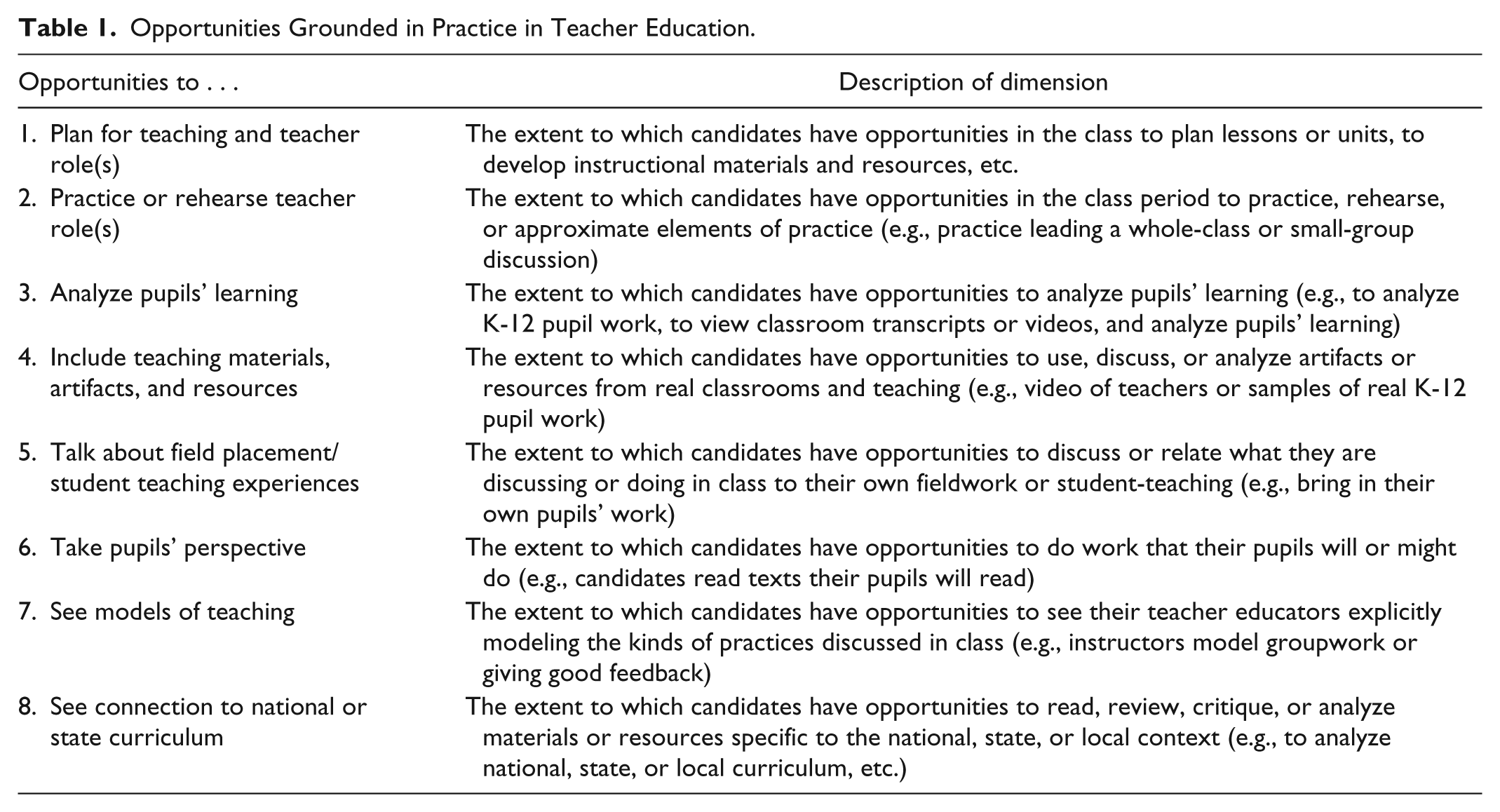
Due to the exploratory nature of our study and questions about how well indicators drawn from scholarship based heavily in the United States might transfer to different contexts, we sought to capture what might be universal representations of practice across very different international settings. For that reason, we chose not to look for specific, finer grained teaching practices such as organizing a whole-class discussion (Edwards-Groves & Hoare, 2012; Grossman, Loeb, Cohen, & Wyckoff, 2013) or setting a classroom climate and conducting behavioral management (Pianta & Hamre, 2009) because they might be more specific to an American context. For an initial, comparative exploratory study, we felt our investigation needed to focus on the features most likely to be shared across settings and that had the most potential to resonate across different programs. The framework we developed rests upon a view of teaching practice as complex, situated, and instantaneous; as such, teaching practice can be learned and developed over time with sufficient scaffolding and support. The eight dimensions that constitute our conceptual and analytical framework are not conclusive, but rather a starting point for examining how teacher education coursework is grounded in practice.
Plan for Teaching and Teacher Role(s)
Scholarship on teacher education has revealed that planning is a key strategy for learning to teach and connecting to practice (Grossman, Compton, et al., 2009; Kunzman, 2002; Windschitl et al., 2012). Windschitl et al. (2012) identified planning as a core practice of teaching, and they developed a tool to guide their candidates’ planning skills, focusing on constructing the big ideas of science teaching. Kunzman (2002) found that teacher preparation helped teacher candidates develop their planning capacities and design their instruction in accordance with their visions of good teaching. Examining preparation for the professions, Grossman, Compton, et al., (2009) found that teacher candidates had several opportunities to enact practices (e.g., lesson and unit planning), but they had fewer opportunities than novices in other professions.
Practice and Rehearse Teacher Role(s)
Several scholars have argued that, to be more centered in practice, courses must provide candidates with opportunities to practice and rehearse teaching, not just read about teaching (Ball & Forzani, 2009; Grossman, Hammerness, & McDonald, 2009; Kennedy, 1999). Potential practices include responding to students’ mathematical ideas (Lampert et al., 2013), engaging students in investigations (Janssen, Westbroek, & Doyle, 2014; Kloser, 2014), reading aloud (Reid, 2011), or modeling historical thinking (Fogo, 2014). These opportunities have been identified as those most often neglected in teacher education, so we wondered whether the programs we examined provided such opportunities.
Analyze Pupils’ Learning
Some of the work on grounding in practice has focused upon providing opportunities for new teachers to look closely at and analyze pupils’ work for trends or patterns (Ball & Cohen, 1999; Boyd et al., 2009; Windschitl et al., 2012). Ball and Cohen (1999) noted that “samples of student work could be used to inquire into what students have learned, and whether it was what the teacher intended” (p. 14). Hiebert et al. (2007) put analysis of pupils’ learning at the core in learning how to teach, arguing that knowledge about pupils’ learning could inform the teacher candidates about the effects of their instructional practices.
Include Teaching Materials, Artifacts, and Resources
Scholars in teacher education have argued that teachers need opportunities to study tasks and teaching materials relevant for prospective classroom teaching and learning (e.g., lesson plans, learning materials, assignments, or textbooks). Examining these materials and “records of practice” can make teaching practice “studyable” and can help new teachers see different versions of teaching and learning (Ghousseini & Sleep, 2011).
Talk About Field Placement/Student Teaching Experiences
Providing opportunities to talk about field placement and connect theories of teaching and learning with real classroom experience is a decisive means of linking coursework and practice. However, teacher candidates must have structure and support when reflecting on their field placement experiences (Darling-Hammond, Holtzman, Gatlin, & Heilig, 2005). The focus on research-based teacher education in Finland (Niemi, 2016), as well as in Norway and Ireland (Conway & Munthe, 2015), has emphasized that teacher candidates should develop an inquiry stance toward their own teaching and make autonomous, professional choices based upon informed reflection. Similarly, reflection on practice has been highlighted in the United States (Valli, 1997) and the Netherlands (Tigchelaar & Korthagen, 2004).
Take Pupils’ Perspective
In New Zealand, teacher educators have described opportunities for candidates to play the role of pupils within a problem-solving approach to teaching mathematics (Bailey & Taylor, 2015). Bailey and Taylor (2015) argued that this experience helped the candidates envision how this “ambitious teaching” (p. 121) could be enacted in the future.
See Models of Teaching
Furthermore, scholars in different international settings have argued that teacher educators should model practice to allow teacher candidates to witness and understand complex and ambitious teaching practices (Bailey & Taylor, 2015; Kvalbein, 2003; McDonald et al., 2014). McDonald et al. (2014) underscored the importance of teacher educators modeling specific teaching practices, before the teacher candidates try them out in what they called “mediated field placements” (p. 501). In the Nordic countries, modeling is also evident in the seminar tradition in which teacher candidates are expected to prepare to become teachers by doing the same tasks and assignments as their prospective pupils will do (Kvalbein, 2003).
See Connection to National or State Curriculum
In the Nordic countries, national curricula represent a long tradition of linking abstract principles with real classroom teaching (Carlgren & Klette, 2008; Niemi, 2016). The New York City Pathways study identified the more influential opportunities grounded in practice as chances to examine state standards or disciplinary standards (such as the National Council of Teachers of Mathematics [NCTM] standards) as well as local curriculum (Boyd et al., 2009).
Table 1 summarizes these eight key indicators, in dimensions that we used when analyzing how the programs provided opportunities grounded in practice.
Opportunities Grounded in Practice in Teacher Education.
Methods and Analysis
Design and Sampling
We designed this study as a multiple-case study, sampling cases we believed would provide information about the phenomenon under investigation (i.e., how coursework is grounded in practice) alongside sufficient diversity and opportunity to learn about complexity concerning this phenomenon across contexts (Stake, 2006). As such, we were interested in the phenomenon of coursework grounded in practice, rather than the individual programs themselves. We thus examined the opportunities to enact practice through observation data from methods courses across six purposefully selected teacher education programs across three national contexts. Purposive sampling is often preferable for multiple-case studies, rather than sampling the most typical cases (Stake, 2006).
Programs 1a and 1b were situated in Finland, Programs 2a and 2b in Norway, and Programs 3a and 3b in California in the United States. We chose national contexts that offered to bring sufficient variation in ways of grounding teacher preparation in practice, while being similar enough for comparison. All programs represented contexts that have worked on redesigning teacher education by strengthening the link to practice. Program 3a has systematically redesigned their program over the last decade to integrate campus courses with field placement (Hammerness, 2006). Program 3b has engaged in substantial reform efforts since 2001 (Sloan, 2015). Finland redesigned their teacher education in 1979, and the country has been highly recognized for its long-standing investment in teacher preparation including teacher training at the master’s level in all subject areas and grade levels (Sahlberg, 2011; Tirri, 2014). Another feature that made Finnish programs relevant was the long-standing tradition of teacher training schools with shared faculty (Uusiautti & Määtä, 2013). Norway has been in the midst of reform nationwide during the past years, investing substantial resources and efforts to improve teacher education (Munthe & Rogne, 2016; Norwegian Agency for Quality Assurance in Education, 2006). Beginning in 2019, all Norwegian K-12 teachers must hold a master’s degree (Norwegian Government, 2014). Program 2a was engaged in a major redesign shortly before our data collection, emphasizing ways of strengthening the links between coursework and field placement (Engelien, Eriksen, & Jakhelln, 2015). Program 2b has employed a cooperative partnership model with their placement schools since 1998 (Haugaløkken & Ramberg, 2007), including experimenting with concurrent versus interval-based practice periods (Wæge & Haugaløkken, 2013). Furthermore, the programs were all (a) university-based teacher education programs that (b) prepared teachers at the secondary level (Grades 8-13), (c) were situated in urban areas, and (d) were seen as rather selective. They all also (e) combined coursework with field placement in schools, but to varying degrees of established collaboration and with variations in the organization of field placement.
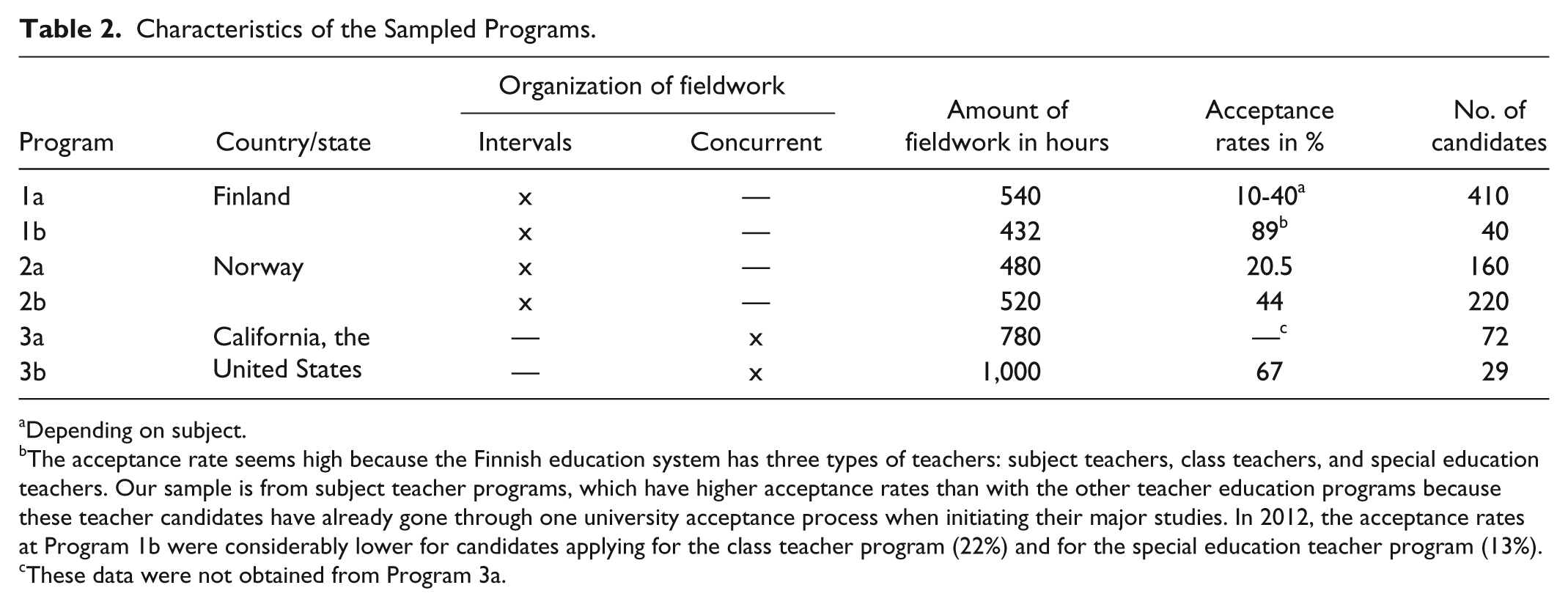
The Californian programs and Program 2a in Norway were 1-year programs candidates attended after obtaining a bachelor’s or master’s degree. The Finnish programs and Program 2b in Norway featured a flexible design, allowing candidates to participate in a 5-year program or a 1-year program. Also, the acceptance rates were fairly low at all programs, except for Program 3b. There were nevertheless important differences between the programs, some of which are summarized in Table 2.
Characteristics of the Sampled Programs.
Depending on subject.
The acceptance rate seems high because the Finnish education system has three types of teachers: subject teachers, class teachers, and special education teachers. Our sample is from subject teacher programs, which have higher acceptance rates than with the other teacher education programs because these teacher candidates have already gone through one university acceptance process when initiating their major studies. In 2012, the acceptance rates at Program 1b were considerably lower for candidates applying for the class teacher program (22%) and for the special education teacher program (13%).
These data were not obtained from Program 3a.
The programs’ sizes varied considerably: The Finnish programs had 40 (Program 1b) and 410 candidates (1a), the Norwegian programs were considered relatively large, with 160 (2a) and 220 candidates (2b), while the Californian programs were both considered small with 29 (3b) and 72 candidates (3a). The Nordic programs were all at public institutions, providing free tertiary education for all candidates. Program 3b was at a public university, while 3a was at a private university; however, both sites not only required tuition fees but also had a long-standing tradition of supporting teacher candidates with generous scholarships. The organization and amount of field placement varied. The Californian programs had more field placement than the Nordic programs, and it was organized concurrently (see Table 2). Despite these differences, all the programs offered a similar program designs, including the composition of courses, the ratio of subject-specific methods courses and foundation courses, and the idea of progression (cf. Hammerness & Klette, 2015). Together, these six programs constituted a sample of assumingly strong programs with certain similarities but with enough variety and contextual differences to make cross-case analysis interesting. 2
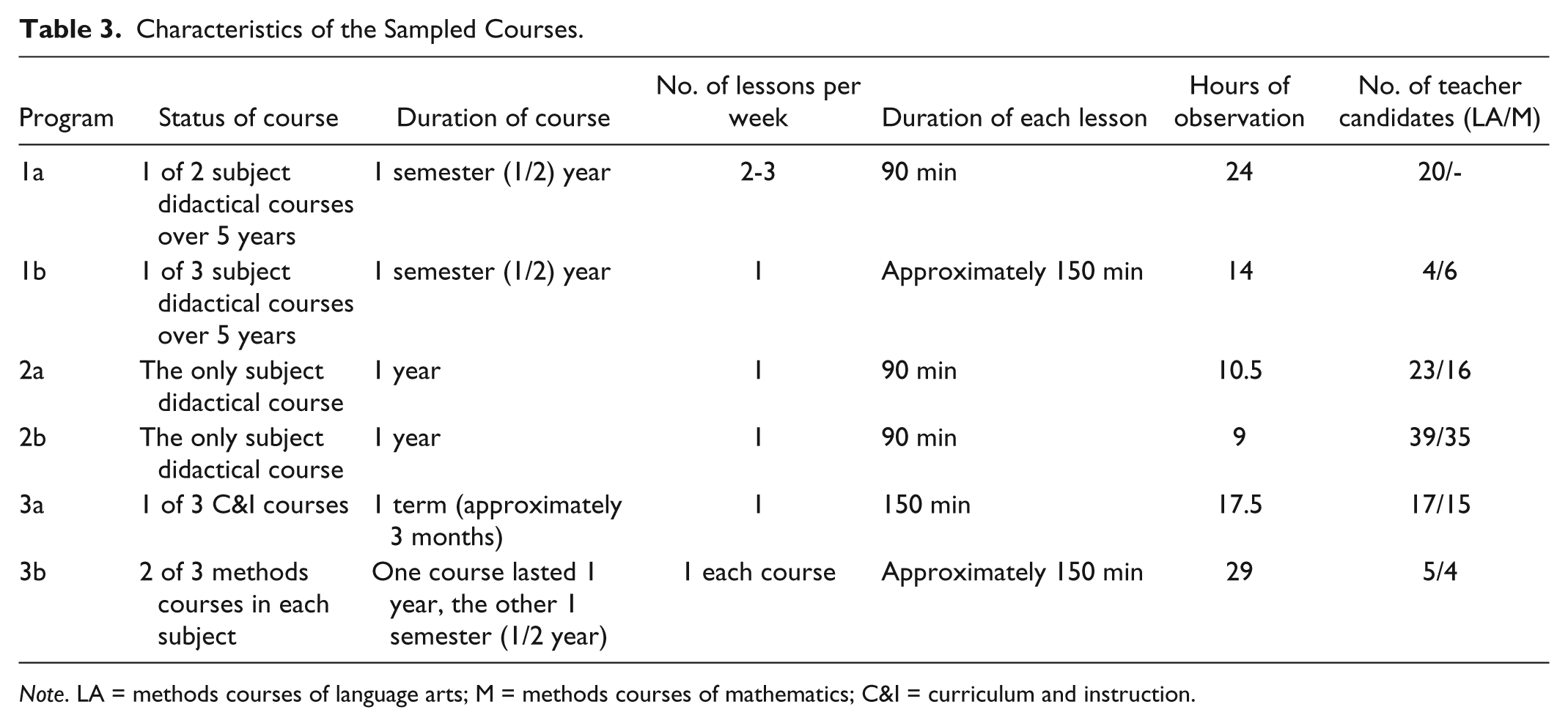
We selected the courses that were most likely to illustrate how coursework was grounded in practice. We thus decided to collect data in the methods courses, in particular language arts and mathematics methods courses, because those subjects are priorities for quality teaching in most countries (Organisation for Economic Co-Operation and Development [OECD], 2014). More information about the courses can be found in Table 3.
Characteristics of the Sampled Courses.
Note. LA = methods courses of language arts; M = methods courses of mathematics; C&I = curriculum and instruction.
In all programs, the candidates took one methods course across the year of teacher preparation (Year 3 or 4 in the Finnish programs), but some programs divided these courses into two or more modules. The duration of the courses varied, but courses typically took place once a week. The exception was Program 1a, which had a more flexible schedule. The lessons lasted about 90 min in the Nordic programs, except Program 1b, which had lessons of about 150 min like the Californian programs. These differences resulted in the variance of hours observed across the programs. The number of candidates enrolled in these courses varied, as displayed in Table 3.
Data Sources
Observations occurred over a 3-week period at each site, consisting of approximately 8 hr of teaching in each course at each program, resulting in 104 hr of observation. During the observations, we found that different teacher educators might teach the classes, while other programs maintained the same teacher educator across all 3 weeks. We recognize that 3 weeks represents a limited period of the time in which teacher candidates have opportunities to make connections to practice in their methods courses; however, observational studies from K-12 classrooms have suggested that four consecutive lessons per classroom provide sufficient information to get a first overview of teaching quality (Ball & Hill, 2009; Klette, 2009). Based on this information, we estimated that approximately 3 weeks of teaching in a teacher education classroom would be sufficient. Altogether, this study covered 18 weeks of observation, offering valuable insight into the teaching practices of these teacher education programs overall.
Data Gathering
The first author was responsible for collecting data at two sites, while four trained research assistants collected data at the other sites (see Hammerness & Klette, 2015, for an overview of the data collection). The authors systematically trained all assistants to take field notes and to capture as much detail as possible, including spoken dialogue and exact quotations. The observations were typed as real-time field notes. On average, we had 10 to 15 pages of observation notes for each class. To support our analysis, our observation data also included a collection of artifacts such as typed or handwritten assignments, PowerPoint slides, and teacher candidates’ work in class. The written notes together with the supportive artifacts constituted the data for our analysis.
Analysis: Coding and Scoring
To analyze the observation data, we engaged in two steps of analysis as depicted in Figure 1:
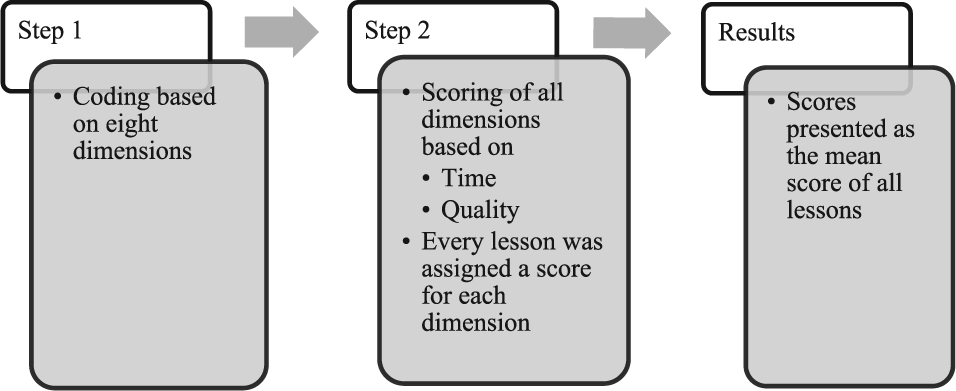
Drawing of the process of analysis.
First, we coded the teacher candidates’ opportunities to enact practice as outlined in our analytical framework using the software HyperResearch 3.5.2. For instance, when a teacher educator explicitly said he or she would illustrate a teaching strategy for teaching literature, we coded this as “models of teaching” (Dimension 7 [D7]).
In this first step of analysis, we noticed that these experiences varied not only in terms of type of opportunity but also their extensiveness (in terms of quality of and time spent on task). For instance, sometimes candidates would mention their field experiences only briefly, and then the instructors would move on. At other times, teacher candidates might be asked to discuss their field experience and connect it to theory or the topic of the class that day in a more specific and detailed way. To capture these aspects of the opportunity, we developed a means of scoring that captured both the quantitative elements (frequency and duration) and qualitative aspects such as depth and level of concreteness. As a second step of data analysis, drawing on similar protocols for scoring observation data (Classroom Assessment Scoring System [CLASS]; Pianta & Hamre, 2009, Protocol for Language Arts Teaching Observations [PLATO] 5.0., 2015), we developed a coding book (see Jenset, Klette, & Hammerness, 2014) that operationalizes each of the dimensions on a 1 to 4 scale using utterances, interaction patterns, and specific, observable behaviors. All scores for all dimensions in our protocol measure time spent on a connection to practice, ranging from very seldom and brief (1) to more frequent or with a duration constituting a main portion of the lesson (4). Time estimates are based upon 10-min time stamps the research assistants made in the field notes. The protocol also measures the quality of the opportunity to enact practice, referring to how general or vague (1) these opportunities were, as opposed to specific and in depth (4). For example, a score of 4 in D1 would indicate that the candidates spent a substantial amount of time during the lesson to plan a unit in detail, perhaps specifically related to different types of pupils or their own pupils in schools, connected to aspects of planning derived from theory or from reading, discussed with others, and/or analyzed. 3
Contrary to studies using intervals of 10 or 15 min for a score (cf. PLATO and CLASS referred to above), we assigned every lesson a score for each dimension. We made this choice because of the current scarcity of research regarding teaching practices in teacher education, and based upon a hypothesis that teaching in teacher education classrooms may be less repetitive than in K-12 classrooms. Scores reported in this article were the average of the scores of all lessons we observed during the 3 weeks in each teacher education program (see Figure 1). We double-coded 8.7% of our data to calibrate the scoring. The strength of agreement was good with kappa = 0.66 (Fleiss, Levin, & Paik, 2003). 4 After interrater reliability was established, the first author coded all lessons and picked excerpts from the data to illustrate the characteristics of a higher score of the dimensions.
Our observations represented a portion of the entire teacher education program. Teacher candidates might have had opportunities, for instance, to analyze pupils’ work or to experience modeling in other courses in the programs that we did not observe, due to the timing of our observations. Similarly, these programs have structural differences, as mentioned in the program descriptions above, that could affect opportunities to connect to practice. Nevertheless, we argue that examining the nature of opportunities that might occur during the coursework is useful and important.
Findings
From our analysis of the observation field notes across all six programs, we found that teacher candidates had extensive opportunities to enact practice by the inclusion of teaching materials, artifacts, and resources (D4) and by taking the pupils’ perspective (D6). They had some opportunities to talk about field placement (D5), plan for teaching and teacher role(s) (D1), and see the connection to national or state curriculum (D8). The teacher candidates had few opportunities to practice or rehearse teacher role(s) (D2), analyze pupils’ learning (D3), or see models of teaching (D7). Figure 2 summarizes these findings across programs.
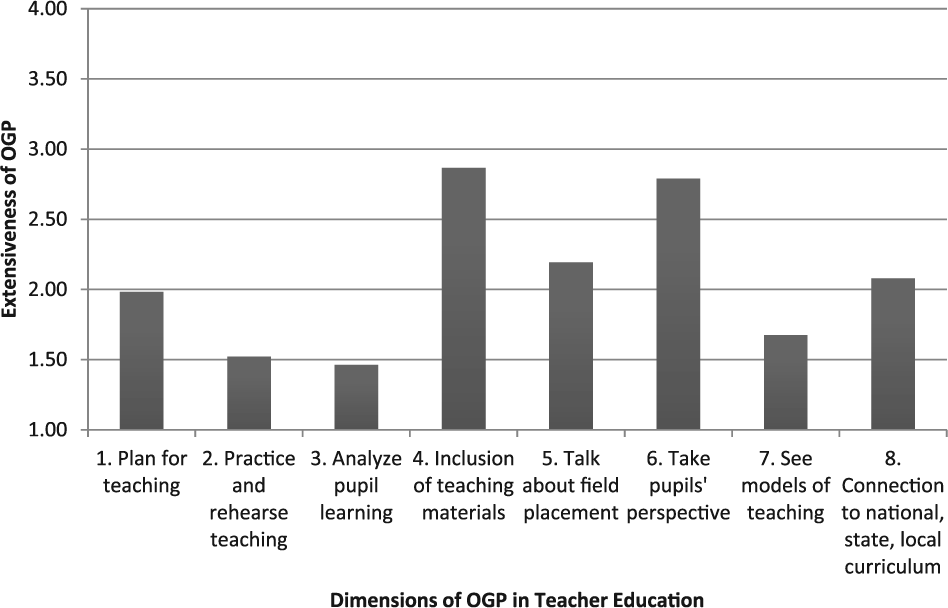
The extensiveness of OGP across all programs, expressed as the mean of scores across all observations.
While our analysis revealed clear similarities and patterns across programs, we also found substantial differences in the extensiveness and quality of how lessons and programs provided opportunities to ground coursework in practice (see Table 4).
Mean Scores for Individual Dimensions Displayed per Program and per Subject.
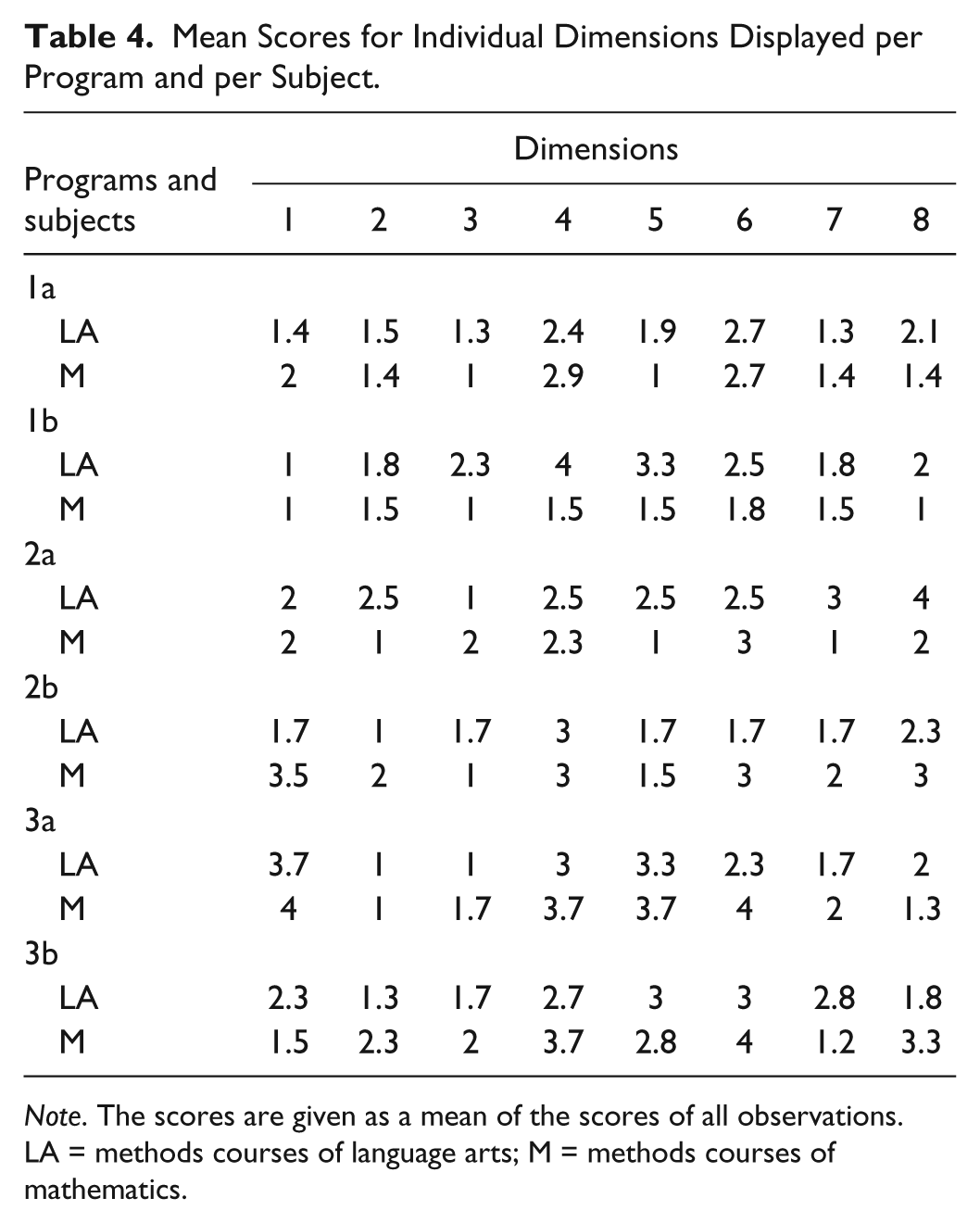
Note. The scores are given as a mean of the scores of all observations. LA = methods courses of language arts; M = methods courses of mathematics.
As the aim of this article was to illustrate what instructional practices grounded in practice might look like, we first share examples of these practices. Because we were interested in the potential of what these opportunities might convey, we have chosen excerpts and illustrations with strong presence of the dimensions (see Table 4).
The candidates had few opportunities to practice or rehearse teacher role(s) (D2) and to see models of teaching (D7) across all programs. However, the candidates in Program 2a had quite extensive opportunities to do so in the language arts methods course (see Table 4). The following excerpt from Program 2a was taken from a lesson where the teacher candidates had the opportunity to both practice and rehearse teacher role(s) and see models of teaching. The topic of the lesson was whole-class literature discussions, and the teacher educator explicitly said he would first model one such discussion. He posed questions to the candidates derived from research on this specific teaching method; in addition, a PowerPoint presentation displayed different types of questions for use in this specific kind of whole-class discussions: “questions of identification, questions for reflection, and questions of transfer.” 5 After he had modeled the teaching activity, he asked the teacher candidates to role-play the same type of practice in groups:
Can you start reading, please?
2. [TC1 reads out loud].
Great, thanks! Have any of you ever been in love?
[not detectable for the observer].
Why do you think she feels that way when the boy enters the shop?
6. [Conversation continues, similar to the one just modeled by the teacher educator, with questions derived from the types of questions on the PowerPoint].
Let’s stop for a minute. How did you as teachers experience this? How was it to use this method?
I think it was really hard since I did not know the text really well.
I actually think that made it easier, because that made the pupils interpret even better than me.
I realized I made the mistake that I was eager to assess the contributions the pupils had, give them feedback.
[Discussion continues].
This instance was scored as a 4 on the dimensions practice and rehearse teacher role(s) (D2) and see models of teaching (D7), as both the time spent on the activity and the quality of the opportunity were extensive. The teacher candidates spent 20 min observing the teacher educator modeling and discussing that experience afterward, as well as 20 min rehearsing (lines 1-6) and discussing the rehearsal in the end (lines 7-10). They rehearsed a specific method of teaching literary discussions, with explicit examples of types of questions that could be used, derived from their readings (lines 3, 5, 6).
The candidates also had few opportunities to analyze pupils’ learning (D3). In the rare cases that we did see analysis of pupils’ learning, candidates often did not spend sufficient time on the analysis to be able to detect the learning that the pupil had demonstrated. Still, we found some instances of more thorough opportunities to analyze pupils’ learning; for instance, candidates had opportunities to compare their assessments of exemplars of Norwegian pupils’ national exams in mathematics or to analyze pupils’ written texts in Finnish according to a specific framework (Jenset, Canrinus, Hammerness, & Klette, 2016).
As already shown, the teacher candidates had extensive opportunities to include teaching materials, artifacts, and resources (D4) and take pupils’ perspective (D6). One excerpt from a mathematics methods course in Program 1a illustrates what that might look like. The candidates were working in groups with tasks their pupils might do. They were asked to look for central issues the pupils should notice in the tasks, and what concepts the pupils would need to know to be able to complete the tasks. In the following excerpt, they discussed the task “Divide a square into two equal parts”:
One needs to know what is meant by isomorphic.
2. [One candidate nods].
And probably you need to know what is a square as well.
But doesn’t this imply that this square must be isomorphic to the original one?
Well squares are always isomorphic so if you divide it.
Then you have two options, either two triangles or two rectangles.
7. (. . .) [Candidate writes on a paper].
I think we are thinking about this in a too complicated way because the point was not to define this in mathematically correct way. If you are teaching this to 11-year-old Pete, it is pointless to define it to him like this.
[Discussion continues].
The teacher candidates had the opportunity to work with the task for an extensive amount of time, about half the lesson, and they worked with and discussed the teaching material in depth. They connected their discussion to principles of the teaching of mathematics while discussing specific mathematical concepts the pupils might need to know to solve the task (line 8). The excerpt therefore illustrates a score 4 on the opportunity to include teaching materials. It received a similarly high score on the opportunity to take the pupils’ perspective, as candidates spent an extensive amount of time doing the tasks that their pupils might do, such as drawing on paper (line 7) and doing the mathematics of the task in depth.
The opportunity to talk about field placement (D5) varied across the programs. During our observation period, the Californian programs tended to provide more extensive opportunities to talk about field placement than the Nordic programs (see Table 4). Many of the instances of talk about field placement that we found were superficial and simplified, but at Program 3a in California there were also instances of more complex and specific talk, connecting the candidates’ practical experiences to theoretical concepts (Jenset, Hammerness, & Klette, 2016).
Similarly, opportunities to plan for teaching and teacher role(s) (D1) and to connect to national or state curriculum (D8) varied across lessons or programs. The candidates at Program 3a had the most extensive opportunities to plan for teaching during our observations (see Table 4). They often formed workshops (smaller groups of four to five teacher candidates and one teacher educator) at the end of their lessons. Here, they would get feedback on the unit planning for their teaching in schools. In the following excerpt from a language arts methods course, one teacher candidate received feedback on a planned unit:
So how long is your unit?
I’m thinking about 2 weeks.
So, in the Common Core, there’s no reading strategy?
I think it’s just reading—there’s no literary.
So, it’s not based on Common Core. Just being familiar with 19th-century texts, or whatever.
[All return to reading for about 2 more minutes].
Comments about the essential questions?
I think they tie together very well and make sense for the reading.
Simple and intriguing. You can’t have a single-word answer.
(. . .)
OK, what were your targets?
I like them generally, but I don’t see how they relate to your essential question. Is that a thing?
Conceptually yes, but we’ll see that in the wording. That might work, but only if we’re inside TC5’s head. So, we’ll need to make that clear.
[Discussion continues].
The candidates spent a great portion of the lesson receiving or giving feedback on unit plans. The feedback was specifically targeted to the individual plan (lines 7, 8, 10, 11), and the teacher educator made sure the comments were related to principles of planning as emphasized in the curricula of the methods course (lines 6, 9). The excerpt is thus an example of a score 4 of planning. The excerpt also illustrates opportunity to connect to state curriculum (lines 3, 4, 5), even though it was only briefly mentioned, as was often the case in our data.
Discussion
Patterns in Approaches to Grounding Coursework in Practice
Using an analytical framework operationalizing the conception of “grounding in practice,” our findings revealed substantial differences in the extensiveness of such opportunities. Across programs, teacher candidates had the fewest opportunities to practice or rehearse teacher role(s), see models of teaching, and analyze pupils’ learning. These findings not only corroborate earlier findings, but they serve to underscore the continued need to provide teacher candidates with opportunities to enact, simulate, and rehearse practice (Darling-Hammond, 2006; Grossman, Hammerness, & McDonalds, 2009; Hiebert et al., 2007). The relatively few opportunities across programs to witness modeling reflects the long-standing separation between practice and coursework on campus (Kennedy, 2008; Zeichner, 2010). It is interesting to note, however, that we found the most instances of rehearsals and modeling in Program 2a, which had just been redesigned to focus upon ways that campus coursework might provide opportunities to test out, rehearse, and model relevant classroom practices. We should be clear that, for something to be coded as see models of teaching, the teacher educator had to explicitly model, as the example from Program 2a shows. Therefore, there might have been instances in our data where the teacher educator intended to model, but where it was not explicitly expressed as such to the teacher candidates or to us as observers.
Conversely, we found that the teacher candidates across the programs had extensive opportunities to take pupils’ perspective and to include teaching materials, artifacts, and resources in their activities. This finding confirmed our expectations based on what we know about the teaching tradition in the Nordic countries (Kvalbein, 2003; Rasmussen, 2008). Scholars have emphasized the importance of incorporating materials and artifacts of real classroom practice in the coursework on campus to help teacher candidates more deeply immerse themselves in the complexity of real practice (Ball & Cohen, 1999; Forzani, 2014). Nevertheless, such artifacts need to be thoughtfully selected, and their use by teacher candidates carefully scaffolded (Ghousseini & Sleep, 2011). Next steps for our work might include a more deep examination of how these artifacts are identified and woven into learning experiences for candidates.
Despite some differences across the programs, we found similar patterns of extensiveness of opportunities to enact practice across these programs. Our findings reveal that some dimensions of practice may be part of the current instructional practices of teacher education (e.g., asking candidates to take the pupils’ perspective or examine teaching materials), while other means of grounding in practice (e.g., examining student work) may require more specific attention. The multiple-case design, looking across different contextual and institutional solutions (e.g., size of the program, organization of practice, redesign efforts), adds strength to this argument. A key question these findings raise across all programs is the question of whether teacher education has overemphasized the role of teaching at the expense of an explicit focus on pupils’ learning. Although teacher candidates have always learned about learning theories in teacher education, the actual learning of the pupils—and how the teacher candidates can analyze, interpret, and diagnose individual pupils’ learning—may not be emphasized enough. Pupils learning should be the core of teachers’ professional repertoire (Hiebert et al., 2007); in turn, providing candidates with competences and tools to interpret and decipher pupils’ learning should be a key aspect of their training.
Differences Across Contexts
Even though we found this pattern of extensiveness across programs on these distinct dimensions of practice, other dimensions (e.g., opportunities to plan for teaching and teacher role(s), to see connection to national or local curriculum, and to talk about field placement/student teaching experience) varied considerably across the programs. Some teacher candidates in our study had almost no opportunities to plan for teaching during our 3 weeks of observation, whereas the candidate in Program 3a spent much time planning. This could be due to the fact that one of the main assignments at Program 3a was to conduct a unit plan, and planning was also essential in the Performance Assessment for California Teachers (PACT). Considering the long tradition in the Nordic countries for using national curriculum as a steering document (Carlgren & Klette, 2008), one might have expected a greater difference between the Nordic and the Californian programs in terms of opportunities to connect to national or state curriculum. However, the introduction of the Common Core in the state of California at the time of our observations might explain why the differences were relatively small (California Department of Education, 2014).It is difficult to say if these variations are due to contextual differences such as national setting or program structure. From Table 4, it seems like these opportunities vary within and across national contexts.
However, we also found that the extent to which the teacher candidates had opportunities to talk about field placement varied considerably across the programs. Interestingly, the Californian programs, which scored higher on this dimension, had more hours of fieldwork and concurrent practice, whereas the Nordic programs all had fewer hours of field placement and organized their field placements in intervals. Field placement is critical to teacher candidates’ learning, but we do not have many studies comparing variations in how the field placement is organized and its implications for prospective teachers. Brouwer and Korthagen (2005) suggested that alternating field placement and periods of coursework may be more supportive of the development of candidates’ teaching competence. Nevertheless, they did not make claims about what kind of alteration would be best. In addition, we do not know whether discussion about field placement enables candidates to connect theory and practice. Our data indicated that there is substantial variation in the quality of the talk about field placement and its role in connecting theory and practice, and we need to examine the nature of this discourse in more depth. Other factors (e.g., smaller program size or timing of the observation period) may have affected our findings on this dimension. The smaller Californian programs might allow the teacher educators to have greater knowledge about the schools and the candidates’ experiences. Likewise, our observations may not have coincided with the field placement periods, which could have resulted in less discussion about these experiences.
Aspects of Grounding in Practice: Some More Established and Others Still Emerging?
Our examination not only illustrates some of the approaches to grounding in practice one might seek to examine programs’ efforts in these areas (e.g., our eight dimensions), but also illustrates patterns around aspects that are potentially more established as well as emerging. While we see some approaches to grounding in practice that appear to be more frequent (e.g., use of teaching materials, taking the pupils’ perspective), we also identified some arenas in which grounding in practice occurred more seldom (e.g., analyze pupils’ learning, rehearse teaching). Indeed, our findings may indicate that efforts to ground in practice reflect a focus upon teaching that has not yet fully expanded to pupils’ learning. Despite differences in program size and organization of field placement, the dimension analyze pupils’ learning had the lowest score across all programs. Our multiple-case design, selecting programs across different national contexts, helps strengthen our examination. However, due to this study’s exploratory character, we see this as a starting point for discussion regarding the many approaches campus courses are taking to be grounded in practice.
Furthermore, we believe that the programs in our sample, due to their own efforts to address practice, may provide a solid ground for learning given their active engagement in this challenge. This study has not considered the fieldwork site of teacher education or outcome measures related to the instructional practices highlighted. This would be an important next step to answer questions about the impact that these opportunities to connect to practice in teacher education could have on the quality of teaching (Boyd et al., 2009). Still, we hope that the features we looked for and the illustrative excerpts in this article can be useful to other teacher education programs. Our approach to operationalizing the concept of grounding in practice may help encourage fruitful conversations among faculty in terms of evaluating their own potential areas of focus within their program. Given the growing understanding of the importance of providing opportunities that are grounded in practice, this work may be helpful to other programs seeking to better meet the challenge of linking to practice through coursework.
Our findings reveal that current efforts to connect to practice are present in these courses, and help illustrate the variety of approaches programs have taken to address some of the long-standing challenges of teacher education. If we continue to support these efforts to ground preparation more deeply in practice, as well as identify even more opportunities to deepen and extend that work, we may be better able to prepare teachers with the kind of practical experience that in turn, will be most likely to support meaningful pupil learning.
Footnotes
Declaration of Conflicting Interests
The author(s) declared no potential conflicts of interest with respect to the research, authorship, and/or publication of this article.
Funding
The author(s) declared receipt of the following financial support for the research, authorship, and/or publication of this article: This work was supported by the Norwegian Research Council (Grant 212289).
Notes
Author Biographies
References
Supplementary Material
Please find the following supplemental material available below.
For Open Access articles published under a Creative Commons License, all supplemental material carries the same license as the article it is associated with.
For non-Open Access articles published, all supplemental material carries a non-exclusive license, and permission requests for re-use of supplemental material or any part of supplemental material shall be sent directly to the copyright owner as specified in the copyright notice associated with the article.
