



Abstract
A substantial fraction of all intrastate conflict onsets are recurrences of previously active conflicts. Recent studies suggest that constitutional arrangements that constrain executive power limit the risk of conflict recurrence. This effect is theorized to be driven by minority and individual-rights protection, in which formal executive constraints act as promises to protect these rights. These promises increase the mobilization costs for any challenger to the regime. However, the promises may no longer be credible at very high levels of formal executive constraints, as excessive promises are often seen as ‘too good to be true’. Consequently, one might expect a curvilinear relationship between executive constraints and conflict recurrence, in which high levels of constraints increase the risk of conflict recurrence. Empirical analysis of post-conflict regimes between 1975 and 2019 shows evidence of such a curvilinear relationship. The effect is further illustrated by a case study of the eastern Democratic Republic of Congo, where the rebel group M23 emerged in the aftermath of unfulfilled government promises of minority and individual-rights protection. This nuances the established relationship between executive constraints and conflict recurrence, provides a cautionary note to designers of constitutional arrangements, and lends support to the theory that mobilization costs drive this relationship.
Introduction
In 2006, as part of the peace process that ended the Second Congo War, the Democratic Republic of Congo (DR Congo) established a new constitution. It was, arguably, a constitution that would have met the approval of Montesquieu. It introduced clear and extensive constraints on the executive. The constitution established a strong legislature, and a constitutional court with the power to review laws proposed by the other branches of government, and even prosecute the executive. According to recent research on the effect of executive constraints on conflict recurrence, such a constitution should reduce the risk of conflict recurrence (Gates et al., 2016a; Walter, 2015). Such an effect would be sorely needed in DR Congo in the mid-00s. The constitution was supposed to put an end to what had been a tumultuous decade in Congolese politics. The conflict-nexus known as the First and Second Congo War, also called the Africa’s World War (Prunier, 2011), began when genocidaires from Rwanda fled into eastern Congo in the aftermath of the 1994 genocide in Rwanda. The arrival ignited ethnic conflict in eastern Congo, and quickly escalated to a country-wide war that drew in interventions from multiple African governments. The dust finally settled in 2001, as then president Laurent Kabila was killed by his own bodyguards. His son, Joseph Kabila assumed power, signed a comprehensive peace agreement, and was eventually elected president in 2006.
Peace, however, did not last long. Since the implementation of the new constitution in 2006, ethnic tensions in eastern Congo have boiled over multiple times and led to three distinct conflict recurrences. First, in 2006, as continued ethnic violence against the Tutsi population fueled the establishment of the CNDP (Congrès national pour la défense du peuple). Then, in 2012 as the group re-emerged as the M23 movement (Mouvement du 23 mars), calling for the implementation of the Goma Peace Accords that ended the last conflict episode on 23 March 2009. And finally, in 2017, when the M23 returned from their exile in Uganda. At the time of writing the conflict is still ongoing.
Evidently, the promises of rights protection implied in the 2006 Congolese constitution and the multiple peace agreements between the parties did not secure the peace in the eastern DR Congo. One might even argue that the promises of minority and individual rights protection implied in the 2006 constitution, and explicitly promised in multiple peace agreements, made matters worse. This is so because they codified expectations of rights protection that the post-conflict Congolese government were unlikely to live up to. Although the promises of minority and individual rights protection inherent in the formalized executive constraints of the Congolese constitution and various peace treaties might have had a pacifying effect if they were seen as credible, the ambition of scope of the promises were of such a magnitude that they were seen as ‘too good to be true’ by key audiences. In other words, regimes emerging from civil war should be careful what they promise, because high levels of formalized executive constraint might be perceived not as signals of future restraint, but as symbols of untrustworthy governments. Put simply, the hypothesis is that while credible promises of rights protection might be pacifying, incredible promises are as bad as no promises.
This article seeks to test this general proposition, by answering the following research question: How does formalized executive constraints influence the risk of conflict recurrence in post-conflict regimes? To do this I compile a dataset of 4,698 post-conflict episode years, covering the 1975–2019 period with a global coverage, and run linear probability models on the relationship between formalized executive constraints and conflict recurrence. Formalized executive constraints are measured by the constraining power-sharing index developed by Strøm et al. (2017) and conflict recurrence is operationalized in line with Kreutz (2010) and based on the latest Uppsala Conflict Data Program (UCDP) data. In contrast to the established literature (Gates et al., 2016a; Walter, 2015) I find that the relationship between formalized executive constraints and conflict recurrence is in fact curvilinear, with low and high levels of formalized executive constraints increasing the risk of conflict recurrence. In line with recent work (Gates et al., 2016a), I explain this relationship with the promises of minority and individual rights protection inherent in formalized executive constraints, and its effect on opposition mobilization costs. However, in order to decrease the risk of conflict recurrence, these promises must be credible. Extraordinarily high levels of executive constraints in post-conflict regimes are not credible promises of rights protection, and as such increase the risk of conflict recurrence by decreasing the cost of mobilization for the opposition.
This article thus constitutes a contribution to the growing literature on conflict recurrence, and enhances our understanding of how constitutional arrangements influence recurrence risk. Empirically, this is a nuanced correction to the established literature, that until now has found the relationship between executive constraints and conflict recurrence to be unidirectional. Theoretically, the article strengthens the notion introduced by Gates et al. (2016a) of executive constraints as promises of rights protection that can influence the cost of mobilization for potential challengers. However, it adds to our theoretical understanding of such processes by uncovering the crucial importance of credibility. Promises of rights protection only decrease mobilization costs for the opposition if they are perceived as credible, and extraordinarily high levels of executive constraints are rarely credible. This constitutes an important step towards understanding why some conflict recur, while others do not, and provide insight to policy makers in the business of designing post-conflict constitutional arrangements.
Theoretical framework
Constitutional arrangements and conflict recurrence
Conflict recurrences, understood here as onsets of previously active armed intrastate conflicts, constitute a substantial and increasing share of the world’s conflict onsets. Of all registered intrastate conflicts since 1945, 45% have recurred at least once. 1 Since the mid-1990s recurring conflicts have been more common than the onsets of new conflicts (Gates et al., 2016b). These recurrent conflicts constitute an extremely costly failure of conflict resolution.
The literature on intrastate conflict recurrence is well established. Studies find that a number of variables affect the risk of conflict recurrence. These variables can be categorized as: (a) the characteristics of the original conflict – such as the duration and destructiveness of the past conflict (Hartzell and Hoddie, 2008; Quinn et al., 2007); (b) the characteristics of the latest conflict termination – whether the conflict ended in a military victory, a peace agreement or just fizzled out (Gromes and Ranft, 2021; Kreutz, 2010; Licklider, 1995; Mason et al., 2011); (c) international intervention and support – both in the peace process and post-conflict environment (Mross et al., 2022; Walter et al., 2021); and finally (d) the post-conflict conditions (Bormann et al., 2019; Brancati and Snyder, 2013; Call, 2012; Cederman et al., 2013; Flores and Nooruddin, 2009, 2012; Gates et al., 2016a; Hartzell and Hoddie, 2003; Hegre and Nygård, 2015; Marshall and Ishiyama, 2016; Mukherjee, 2006; Walter, 2015).
Most of these determinants are outside the control of the post-conflict governments that ultimately need to deal with the issue. However, one factor that can be manipulated by these governments to avoid future conflict is the constitutional arrangements of the state. There are good theoretical reasons to believe that constitutional arrangements influence the politics, and ultimately the risk of conflict recurrence in a state. Constitutional arrangements constitute the governance framework that regulates access to power, and access to power is ultimately what most armed conflicts is about. Constitution-making is considered a key part of many post-conflict transitions, and one in every fourth post-conflict country establishes a new constitution as part of the post-conflict settlement (Fiedler, 2019). Constitutions, and their content, clearly matter for the actors involved. The key question then seems to be what constitutional arrangements a post-conflict government should put in place to reduce the risk of conflict recurrence?
A long tradition in political thought, dating back to Montesquieu’s separation of government power into the legislative, executive, and judicial branches, focuses on the role of executive constraints. Executive constraints are here understood as constitutional rules and regulations that limit the power of the executive, often by increasing the power of the other branches of government. These constraints are formalized in constitutions, and can to a greater or lesser degree be manifest in the actual practice of governance. This leads to a theoretical distinction between formalized executive constraints as written in constitutions and actual executive constraints in the practice of governance.
In this article I am mostly concerned with the formalized executive constraints, rather than executive constraints as manifested in practice. 2 There are three reasons for this. First, formalized executive constraints are much easier to measure with sufficient validity and reliability over several decades and in all countries. This enables a large cross-country study. Second, as we will see below, the literature on the relationship between executive constraints and conflict recurrence explains the relationship with theoretical mechanisms pertaining to signaling and expectations. These mechanisms are produced primarily by the adoption and maintenance of the constitutional rules. In contrast to the effect of implemented executive constraints, the effect of formalized executive constraints should thus be immediate. Third, as advice to researchers and practitioners in the business of constitution writing, advice pertaining to how the rules of the game should be written is more useful than the advice regarding how rules of the game should be followed. In sum, and as I hope to convince the reader further of in the following pages: the rules of the game matter even though they are not always followed.
How do executive constraints influence the risk of conflict recurrence? Fundamentally, unless the executive power of government is constrained by the legislative and/or judicial branch, nothing prevents the executive from acting tyrannically. Even though it is evidently not as simple as tyrannical governments being more prone to civil war (Hegre et al., 2001), the literature on executive constraints specifically is quite clear. Executive constraints generally reduce the probability of conflict recurrence (Cox and Weingast, 2018; Gates et al., 2016a; Walter, 2015).
Both Walter (2015) and Gates et al. (2016a) identify a significant linear negative relationship between executive constraints and conflict recurrence. And Cox and Weingast (2018) finds that this horizontal accountability to other branches of government is even more important than the vertical accountability to the electorate when it comes to political stability at moments of political turnover. Walter (2015) uses a dummy variable for whether a country has a written constitution to proxy for executive constraints, and finds a significant negative linear relationship. Gates et al. (2016a) conceptualize the phenomenon as constraining power-sharing; ‘arrangements [that] limit the power of political office holders, and thereby serve to protect vulnerable groups, individuals, and civil society more broadly against encroachment and abuse’ (Gates et al., 2016a: 516). To measure this concept the authors record the written content of constitutions and peace agreements, and produce a constraining power-sharing index based on a number of input variables such as term limits for constitutional judges and bans of military officers in the legislature (Strøm et al., 2017). They find a significant negative linear relationship between this index and the risk of conflict recurrence.
How can this relationship be explained? According to Walter (2015) the key mechanism is that constrained executives are seen as less able unilaterally to renege on deals struck and settlements made. Consequently, constrained executives are more attractive negotiation partners for potential and current rebels. Moreover, executive constraints create a situation in which rebels need not maintain a threat of violence to keep the executive in line and open multiple non-violent avenues to influence government policy. In essence, executive constraints make the government’s commitment to peace more credible.
According to Gates et al. (2016a), the key mechanism is the promise of minority and individual rights protection inherent in executive constraints. Formalized constraints on the executive, such as a strong constitutional court, or on the political power of the armed forces, such as bans on military officers in the legislature, decrease the ability of the executive to repress, and as such act as credible promises of rights protection. As populations perceive their rights to be protected by the government, the cost for the opposition of mobilizing against the government increases. This makes it harder for any challenger of the government to mount an armed rebellion that would cross the threshold and become an armed conflict. In essence, executive constraints raise the cost of challenging the government.
Incredible promises of rights protection
These findings from the quantitative literature resonate with mainstream perceptions – within what can broadly be described as a liberal peacebuilding paradigm (Paris, 2010) – about how a constitution should look, and how peace should be kept. This manifests in practical advice from non-governmental organizations (NGOs) engaged in peacebuilding efforts (Böckenförde et al., 2011), in UN documents on constitution-making assistance (UN Development Programme, 2014; UN Secretary General, 2009), and in scholarly work (Call, 2012). The advice to post-conflict societies from the international community, civil society and political scientists alike seems clear: constrain your executives.
Nonetheless, there are theoretical reasons to question this apparent consensus. Formalized executive constraints may influence conflict dynamics in two ways. Indirectly, through their effect on executive behavior, and directly, by altering expectations about the future.
If formalized executive constraints lead to a more constrained executive, the indirect effect should be mostly pacifying. First, a constrained executive should be less able to renege unilaterally on settlements and thus be a better negotiation partner. Second, more non-violent avenues to political influence should open (Walter, 2015), and third, the mobilization costs of any potential challenger should be increased because of government protection of minority and individual rights (Gates et al., 2016a). 3
The direct effect is a little trickier. At a superficial level, it should work similarly. By formalizing executive constraints, the executive is signaling to the population that it intends to be constrained. This could alter the population’s expectation about future executive behavior, and thus create the same effects as laid out above. As conflict recurrence is most likely in the first post-conflict years, and implementation of constitutional arrangements tends to take some time, this expectational effect may in fact be the most important part of the effect.
However, if expectations of executive constraints are pacifying, the executive has a clear incentive to appear constrained. Therefore, post-conflict governments might introduce constitutional arrangements – or tolerate existing ones – that on paper are more constraining than what the government intends to implement. Such a move can be thought of as a short term gamble. Promising constraint might create the pacifying effect needed to survive the crucial first post-conflict years. While by the time the government’s true nature is revealed its power will be consolidated, and the opposition’s opportunity to launch a successful rebellion limited.
However, this incentive structure should not be lost on the population. The executive’s promises will not be taken at face value, but appraised against the available evidence. If found less than credible, promises of constraints could be seen as attempts at deception and lead to a backlash. This would make the government seem more likely to renege unilaterally on deals and less likely to protect minority and individual rights, thus decreasing mobilization costs for potential challengers. In other words, very high levels of formalized executive constraints can easily be seen as ‘too good to be true’ by the people whose loyalty the regime needs.
Thus, the direct expectational effect of very high levels of formalized executive constraints should decrease mobilization costs for the opposition. It is easier to mobilize the recruits and resources necessary if a sufficient subset of the population thinks the government’s promises are ‘too good to be true’. The core of the mechanism is that increasingly large commitments are increasingly likely to be seen as ‘too good to be true’, and thus incredible. This mechanism is well established in human behavior across a wide set of social sciences, from theoretical economics (Espinosa and Ray, 2023) and advertising studies (Maslowska et al., 2017) to experimental psychology (Doh and Hwang, 2009). Thus, high levels of executive constraints do not motivate the opposition to take up arms; rather, they provide opportunity to do so. They do so by making mobilization against the regime easier.
This effect should be particularly strong in post-conflict regimes, because these regimes are systematically different from most regimes. First, most countries emerge from conflict with a weakened state apparatus. They are not in the best position to protect minority and individual rights. Second, most countries emerge from conflict with higher than average levels of polarization. Both elites and regime supporters might not be expected to emphasize and prioritize the minority and individual rights of their former belligerents. Consequently, post-conflict regimes are more likely to lack both the capacity and the motivation needed to protect minority and individual rights. This should further weaken the credibility of their promise to do so.
Finally, it is worth emphasizing that it is not the potential gap that might eventually open between promises given and promises held, that creates the reversal of the pacifying effect of executive constraints at high levels. Nor do I argue that it is the change from pre-conflict to post-conflict levels of executive constraints. Rather, the effect arises from the level of formalized executive constraint relative to the credibility of the regime, or in other words: the relative credibility of the implicit promise given to respect minority and individual rights.
In summary, I follow the established literature in that executive constraints should have a pacifying effect and limit the risk of conflict recurrence. However, as governments have the incentive to misrepresent their future levels of constraints, and populations know this, the pacifying effect should reverse at high levels of formalized executive constraints. The more extraordinary the levels of executive constraints promised, the harder they are to deliver, and consequently, the weaker is the marginal pacifying effect.
Empirical implications
The theoretical expectations outlined above have clear observable implications. If excessively strict formal executive constraints constitute incredible promises of constraints, then the pacifying effect of executive constraints should abate at high levels of constraints, or even be curvilinear if the effect is strong. Specifically, the risk of conflict recurrence should be relatively high at low levels of executive constraints, decrease as levels of executive constraints increase, and then stabilize or even increase again at very high levels of executive constraints.
Hypothesis 1: The relationship between formal executive constraints and conflict recurrence should be curvilinear and u-shaped.
Furthermore, the proposed mechanism assumes that increasingly strict executive constraints are increasingly incredible. Therefore, one should expect the curvilinear effect to be stronger among post-conflict regimes that are for some reason seen as less credible. The perceived credibility of a post-conflict regime is hard to measure, especially across counties and time. However, all other things being equal, one should expect governments that have committed violence against civilians during or after conflict to be less credible than governments that have not.
Hypothesis 2: The effect outlined above should be stronger in post-conflict episodes in which the government has committed violence against civilians during or after conflict, than in post-conflict episodes where it has not.
Research design
To test these hypotheses, I run several statistical models on a dataset of all post-conflict years in the 1975–2019 period. The dataset consists of one observation for each year, for each period of peace following each intrastate conflict episode identified in the UCDP data. This constitutes 4,698 observations of post-conflict years, covering 384 post-conflict episodes, for 195 distinct conflicts in 102 countries. The dataset records 225 recurrences, giving a baseline risk of recurrence at around 4.7% in any given post-conflict episode-year. In the following paragraphs I will further detail the data structure, and the operationalization of key dependent and independent variables.
Operationalizing conflict recurrence
A conflict recurrence is here understood as the resumption of a previously active armed intrastate conflict after the conflict has been inactive for at least one calendar year. I use the coding and operationalization of Kreutz (2010), which rely on the UCDP definition and operationalization of a conflict as a ‘contested incompatibility that concerns government and/or territory where the use of armed force between two parties, of which at least one is the government of a state, results in at least 25 battle-related deaths in a calendar year’ (Gleditsch et al., 2002: 619). Consequently, a recurrence is coded when a previously active conflict, identified by the UCDP conflict ID, becomes active after at least one calendar year of inactivity. Or in other words, we need at least one year in which the conflict does not reach the 25 battle deaths threshold to code subsequent escalation as a recurrence. This means that the earliest a conflict can recur is in the second year after the last conflict termination. As these thresholds of 25 battle deaths and one calendar year of inactivity are inherently arbitrary, I run the models on alternative operationalizations as a robustness check.
Intrastate conflicts in the UCDP data come in two varieties. Conflicts over government, and conflicts over territory. A single country can have several ongoing and latent conflicts over territory, but only one over government. This means that a single country can have multiple latent conflicts which theoretically can recur. For example, in 2017, Myanmar has nine latent conflicts in the dataset, two of which are registered as recurring in 2017. Countries with multiple conflicts could be considered over-represented in the data, and as such I do leave-one-out cross-validation to make sure the results hold regardless of the exclusion of any single country (see Online Appendix for all of these robustness tests). I also run the main model in subsets that only contain conflicts over territory and conflicts containing only conflicts over government, respectively. These models show that the results are driven by conflicts over government, not conflicts over territory. I discuss this in the results section, and at length in the Online Appendix.
Moreover, given the inclusion criteria in the UCDP data, some instances are included as intrastate conflicts even if they might not fit intuitively as armed conflicts. These conflict episodes are primarily identified by being very short – registered as one day conflicts – and consist mostly of successful and unsuccessful, but quite violent, coups. As a robustness test, the models are run with these conflict pisodes removed.
Finally, one might question the decision to code conflict onsets occurring two, three or even four decades after the original conflict termination as recurrences, rather than as new onsets. In the data this is mostly the case for conflicts over government, in which any occurrence is coded as the recurrence of the same conflict. The most extreme example of this in the data is the emergence in 2013 of the Kata Katanga rebel group in Katanga in DR Congo, 50 years after the end of the last Katangese insurgency in 1963. The current Katangese secessionists use the same flag, and have the same ultimate goal as the 1960s insurgents, so conceiving of this as a recurrence is not entirely far-fetched. However, to make sure these recurrences do not drive results, I run models in which all post-conflict years more than 20, 30 and 40 years after conflict termination are excluded. The results are reported in the Online Appendix and do not substantially influence the interpretation of the main finding.
Post-conflict episode years as units of analysis
Conflicts can only recur once they have ended. Consequently, the unit of analysis is the post-conflict episode year. Conflict episodes were introduced by Kreutz (2010), and is often used when studying conflict recurrence. My data is slightly altered, and has one observation for each year for each post-conflict episode. Starting with the first whole calendar year after a conflict ended. The unit of analysis is thus the post-conflict episode year. For an example, consider the case of Angola. The Angolan Civil War between the government and UNITA ended in 1995 and enters the dataset from 1996. This conflict is then inactive until 1998, when it recurs. This second episode lasts until 2002 and enters the dataset again from 2003. At the same time, the conflict in Cabinda 4 breaks out in 1991 and ends in 1992. This post-conflict observation briefly enters the dataset in 1993, before the conflict recurs in 1994. It is then considered active until 1998 and re-enters the dataset again in 1999. As such, the dataset consists of one observation, for each year a formerly active conflict could have, or did, recur.
To construct this dataset, I started with the global list of intrastate conflict-episodes 1946–2019 in the UCDP, using the conflict termination dataset at conflict level (Kreutz, 2010). I then generated one observation for each year after the termination of a conflict, starting with the year following the end of active conflict episodes. Finally, variables from other data sources were merged into this dataset.
The post-conflict episode year is preferred over the alternatives of post-conflict country years, and post-conflict dyad years. Country years would make it impossible to distinguish between different over-lapping conflicts within the same country, and as such lose a lot of recurrences. Dyad-years would underestimate the number of recurrences and overestimate the number of new conflicts, as splinter groups and rebranded rebel organizations would be considered entirely new conflicts. Granted, a unit of analysis on a more disaggregated level, such as post-conflict episode months, would have been even better. However, as the data I have available to me are primarily on a yearly level, forcing an episode months structure on the data would artificially inflate the data.
Operationalizing formal executive constraints
To measure formalized executive constraints, this article utilizes the constraining power-sharing index from the inclusion, dispersion and constraint data first coded by Strøm et al. (2017), and updated by Ziff et al. (2024). The index is the result of a weighed latent variable model, which is created to measure ‘[. . . ] constraining arrangements that limit the power of any party or social group and thus protect ordinary citizens and vulnerable groups against encroachment and abuse’ (Strøm et al., 2017: 169). The input variables indicates whether certain indicators are present within the fundamental agreement of the state, embodied in written constitutions, basic laws or peace treaties. The indicators that go into the index are bans on ethnic parties, bans on military legislators, protection of religious practices and various indicators related to the role of judicial checks on executive power. If any of the input variables are coded as missing, the values have been imputed using the Amelia 2 Program. 5 This is the same measure as Gates et al. (2016a) rely on to find the linear negative effect on conflict onset and recurrence. 6
This index constitutes the best available measure of the general level of formalized executive constraints in a way that is comparable across time and space. In my sample of post-conflict episode years the distribution of the variable is slightly left-skewed, with a majority of observations in the range between 0.5 and 1. This is also true for the 225 episode years that experience recurrence (see Figure 1). 7
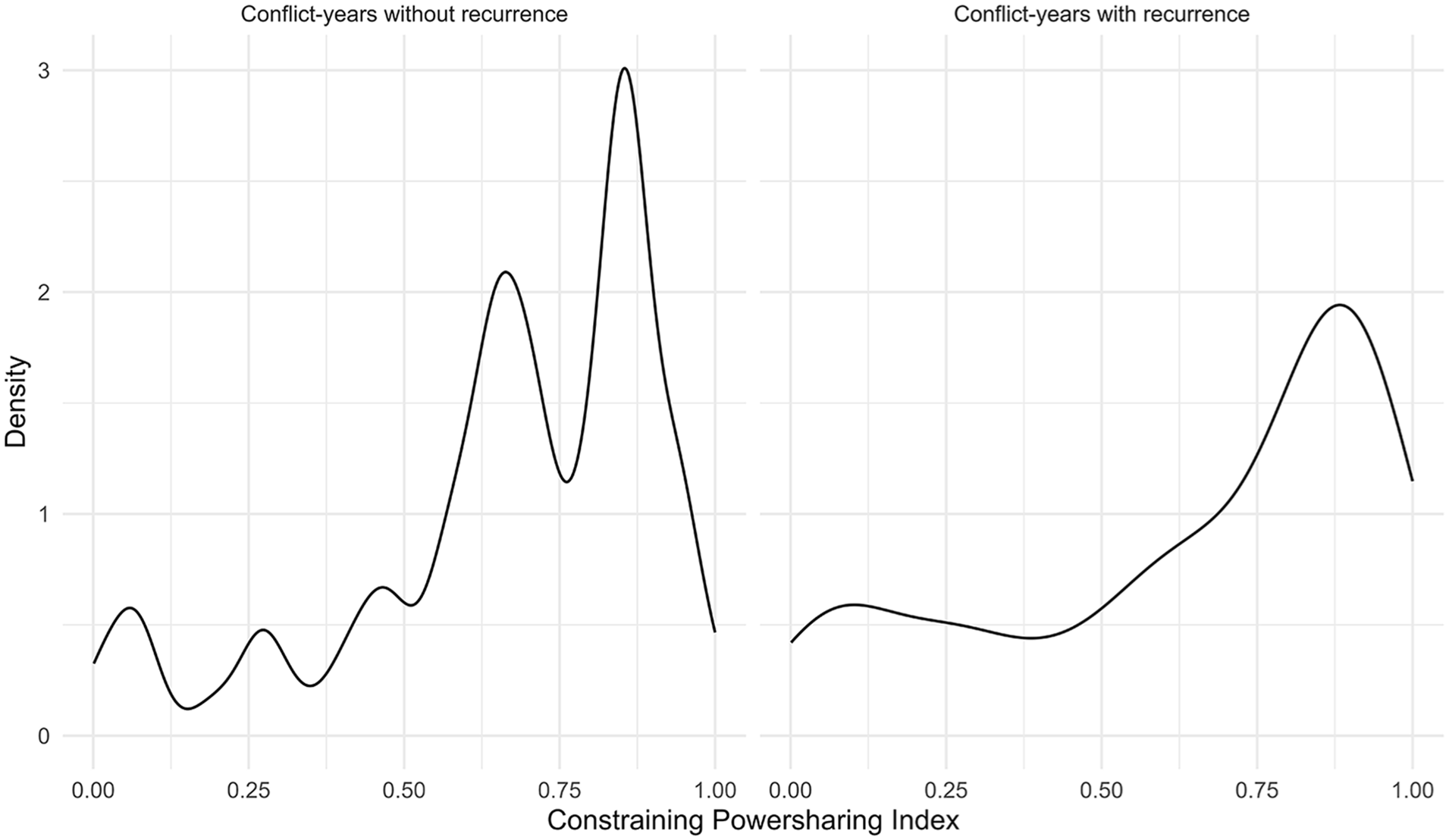
Density plots for formalized executive constraints.
Controls
The three main control variables are the number of years since the conflict was last active, the number of other ongoing conflicts in the country and whether or not the previous year contained a presidential or parliamentary election. The time since termination is crucial, because the risk of recurrence is greatest immediately after the conflict has ended, and then rapidly decreases. The number of other ongoing conflicts in a country in a given year is an important control because it might influence both the institutional arrangements of a state, and the risk of conflict recurrence. Finally, I control for recent elections, as elections can both trigger conflict recurrence (Brancati and Snyder, 2013; Flores and Nooruddin, 2012), and constitutional change. In some models I also control for the presence of United Nations peacekeeping operations and the cumulative number of civilians killed by one-sided violence during and after the conflict in thousands, as proxies for the perceived credibility of the post-conflict regime. The inclusion of these two last control variables restricts the sample, as there is only data for these variables in the post 1989 period. Most other potential confounders are taken care of by country and year fixed effects. 8
Results
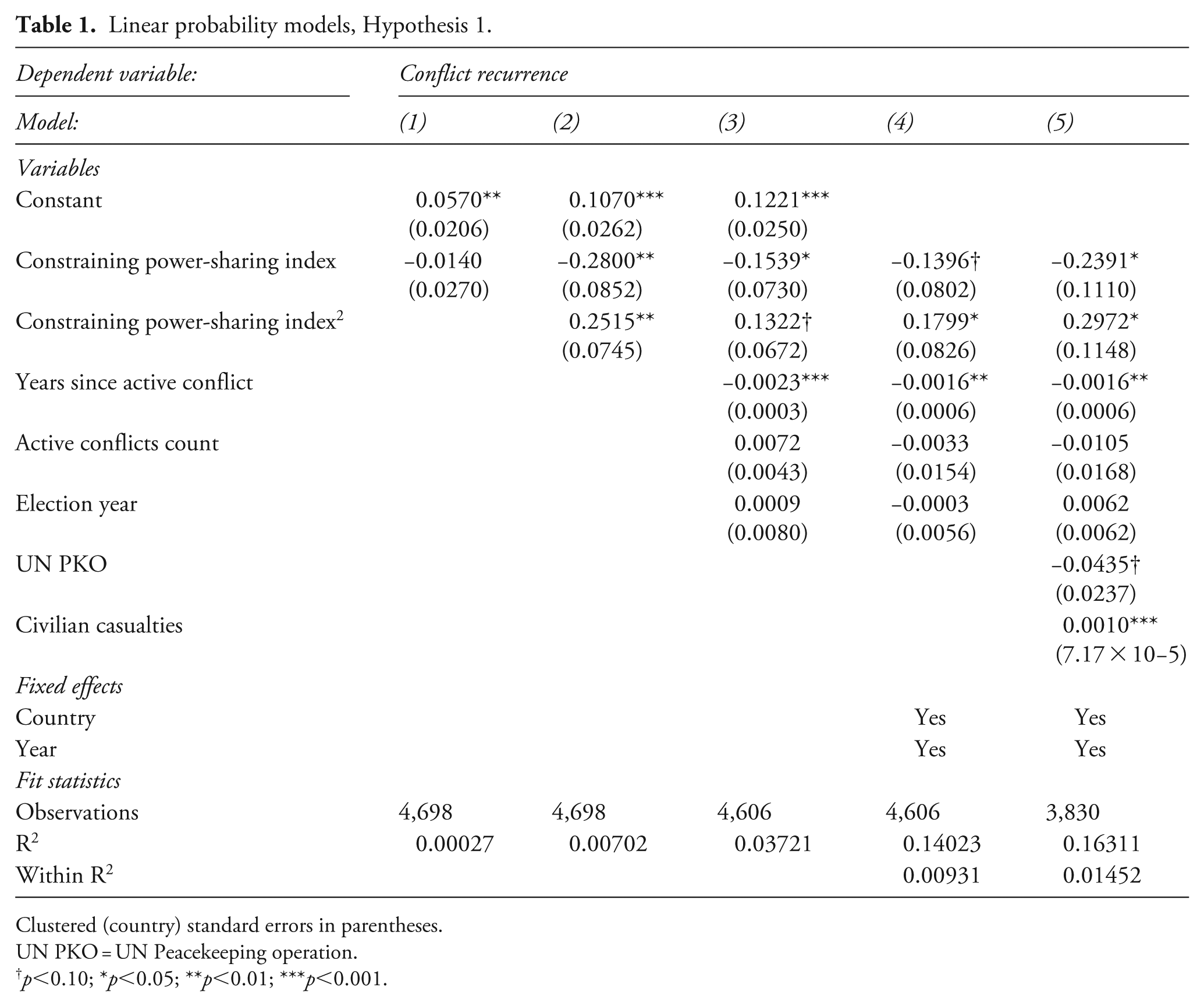
The main results are shown in Table 1. Model 1 shows a negative linear effect of formal executive constraints on the risk of conflict recurrence. This is in line with the findings from the established literature, but the relationship is not statistically significant in my model. Model 2 shows that this relationship turns significant once we look for a curvilinear, instead of a purely linear relationship. In Model 3, I control for the number of years since the conflict was last active, the number of other active conflicts in the country, and for elections. This model shows us that the curvilinear effect of executive constraints stays significant when controlled for these important determinants, although at a slightly lower significance level. In Model 4, I add country and year fixed effects. This in effect controls for all country- and year-specific unobservable variables. Model 5 also includes controls for the presence of UN peacekeepers and the cumulative number of civilians killed during and after the conflict in thousands. The u-shaped relationship between formal executive constraints and conflict recurrence retains statistical significance across increasingly strict model specifications.
Linear probability models, Hypothesis 1.
Clustered (country) standard errors in parentheses.
UN PKO = UN Peacekeeping operation.
p<0.10; *p<0.05; **p<0.01; ***p<0.001.
These results support Hypothesis 1. I do not find support for a strictly linear effect of formal executive constraints on conflict recurrence. However, the negative effect emerges once I control for the squared term. This indicates that more executive constraints indeed do limit the risk of conflict recurrence, but only when moving from low to medium levels of executive constraints. At high levels of executive constraints the effect reverses and more executive constraints increase the risk of conflict recurrence. In other words, I find a curvilinear relationship, in which low and high levels of executive constraints are associated with the increased risk of conflict recurrence. This curvilinear effect holds in increasingly strict model specifications. For a visual representation of the effect see Figure 2, which plots the marginal effect in the left panel, and the conditional effect in the right panel. Note that the marginal effect plot is based on Model 5, while the conditional effect plot is based on Model 3 in which the curvilinear effect is less prominent. This is because the country and year fixed effects of Models 4 and 5 make plotting predicted probabilities that are not country and year-specific non-sensical. Additional robustness tests are reported in the Online Appendix.
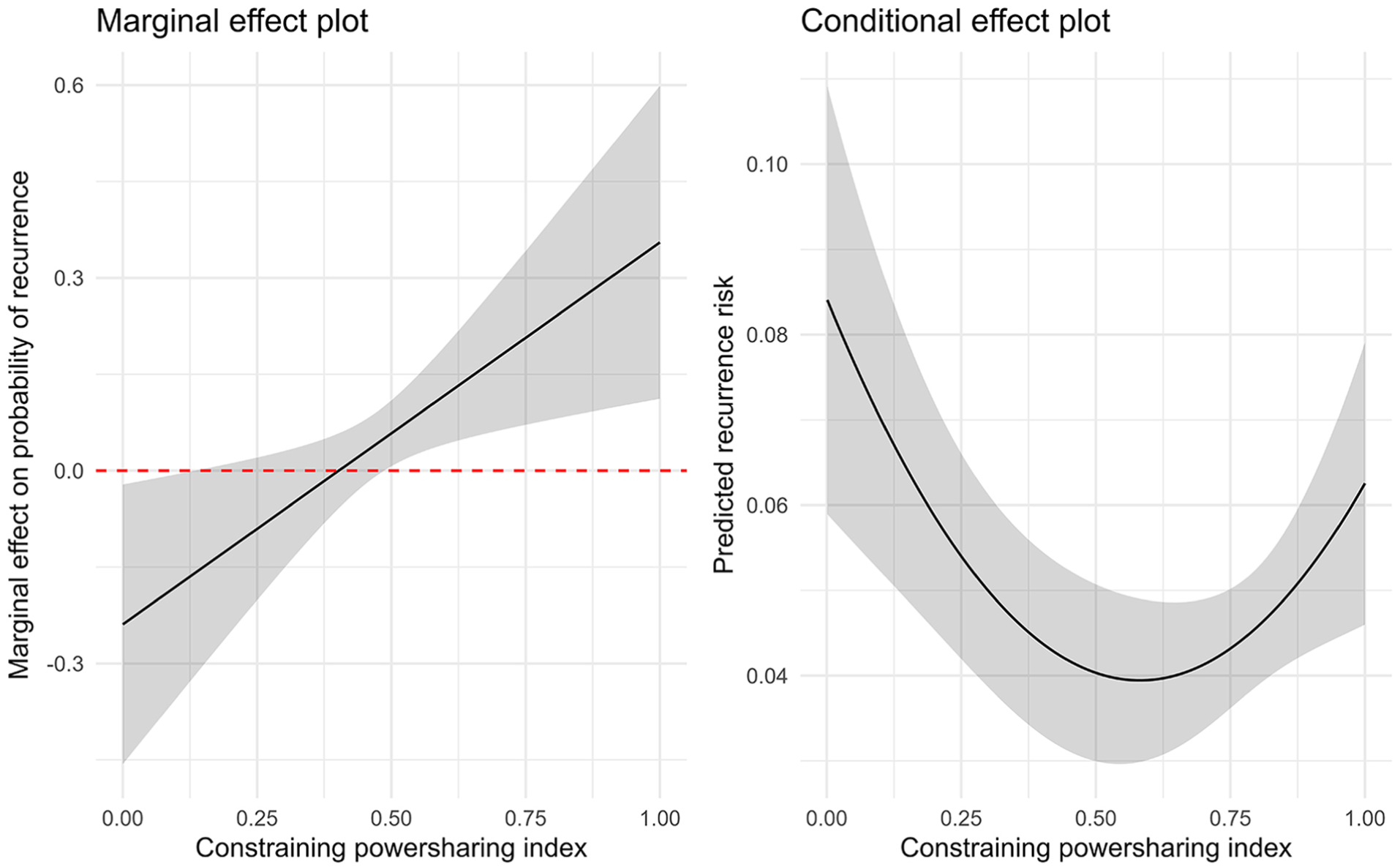
Marginal and conditional effect plots.
Moreover, the effect is substantially relevant. In model 5, a change from 0.1 to 0.5 on executive constraints decreases the risk of conflict recurrence with approximately 3.4 percentage points in any given episode year. A change from 0.5 to 0.9 increases the risk of conflict recurrence with 7 percentage points. In the slightly more conservative Model 4, the same changes lead to a decrease of 1.3 percentage points and an increase in 4.5 percentage points. Regardless of this, relative to the average risk of about 4.6%, this is a substantial effect.
Moreover, the change in effect from negative to positive occurs at a surprisingly low level of executive constraints. The inflection point, the point where the marginal effect changes from negative to positive, is around 0.4 on the normalized 0–1 scale of formal executive constraints. For reference, this is approximately the value given to China in the 1976–1983 period, and to Lebanon since 1978.
The results from Table 1 indicate that the reputation incurred by a government by accepting formal constraints does not hold for the full range of executive constraints. Or in other words, while increased executive constraints decrease the risk of conflict recurrence for low to medium levels of executive constraints, this effect does not hold for high levels of executive constraints. At these levels, formal executive constraints no longer constitute credible promises in post-conflict countries, and in fact increase the probability of conflict recurrence.
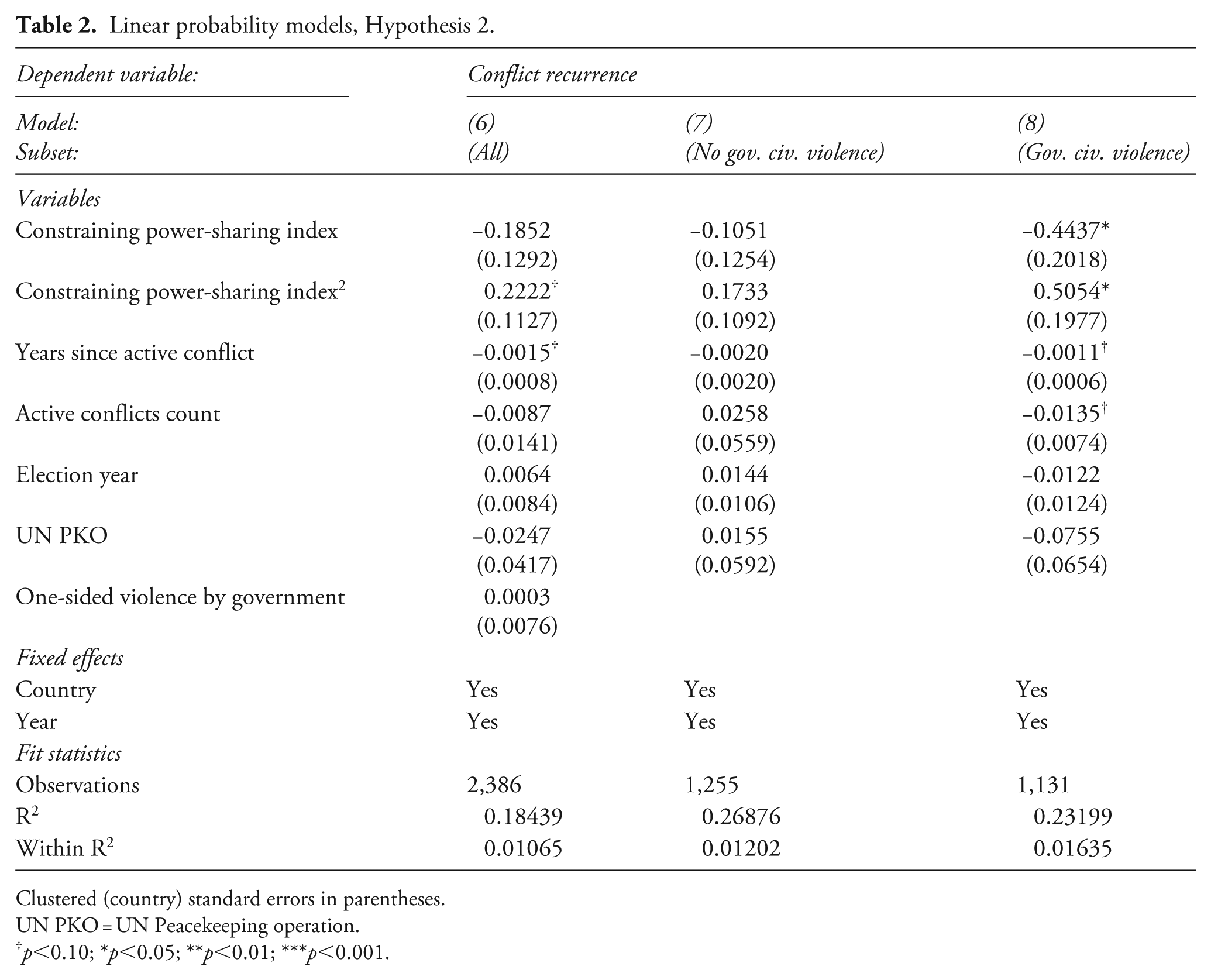
Moving to Hypothesis 2. In Table 2, the analysis is restricted to a subset of data consisting of post-conflict episodes that follow government victories and conflicts that ended due to low activity. Crucially, in these subsets the post-conflict regime was also in power during the last conflict. Moreover, the variable of total civilian casualties (in thousands) from one-sided violence used in Table 1 is swapped with a variable that only counts the one-sided violence carried out by the government. In Models 7 and 8, the subset is further divided between post-conflict episodes in which the government did not commit violence against civilians (Model 7), and post-conflict episodes in which the government did commit violence against civilians (Model 8). In accordance with Hypothesis 2, the now familiar curvilinear relationship between executive constraints and conflict recurrence is clearly driven by post-conflict episodes in which the government did carry out violence against civilians. In other words, by regimes that should be considered less credible.
Linear probability models, Hypothesis 2.
Clustered (country) standard errors in parentheses.
UN PKO = UN Peacekeeping operation.
p<0.10; *p<0.05; **p<0.01; ***p<0.001.
The results in Table 2 show that the curvilinear effect of executive constraints on conflict recurrence is driven by regimes that would struggle to credibly commit to promises of minority and individual rights protection. Post-conflict governments that carried out one-sided violence against civilians during or after the last conflict should be less credible when promising minority and individual rights protection, and the effect of extraordinary promises on mobilization costs should hence be extra prominent for these post-conflict regimes. The results above indicate that this is indeed the case, and thus strengthens the proposed theoretical mechanism.
Finally, and importantly, the results above pertain primarily to conflicts that UCDP categorize as conflicts over government. These are conflicts in which the main stated incompatibility is who runs the government. In conflicts over territory, that is conflicts in which the main incompatibility is the status of a certain territory within the state, the curvilinear relationship identified above is not statistically significant (see Table A3 in the Online Appendix). This limits the scope of the main finding. The central government’s commitment to constraint is important when the central issue of the conflict was the central government. When the central issue was territory, however, the central government’s promise of future constraint is less important. For an in-depth discussion of this scope condition, see the Online Appendix.
Qualitative illustration of mechanism
Specific conflict recurrences are often explained with a host of explanatory factors. I do not claim that the decreased cost of recruitment due to incredible promises of rights protection is the main cause of conflict recurrence, but simply that it is a mechanism which is often at play. For an illustration of this mechanism, consider the emergence of the M23 in eastern DR Congo in 2012, a post-conflict regime with high levels of formal executive constraints.
The case of the M23 in DR Congo
An important part of the recurrence of conflict in the eastern provinces of DR Congo in 2012 was the emergence of the M23 rebel group. The group is the latest in a long line of rebel groups in this region that claim to fight on behalf of the Tutsi minority in the region. The organization, and its predecessors, have received substantial material and logistical support from the Rwandan regime. The group entered the scene in the spring of 2012, quickly gaining territory and successfully occupied Goma, the regional capital, in November 2012. By 2013, however, Rwanda had cut its support after international pressure, and the Congolese Army launched its offensive together with the UN’s Intervention Brigade to defeat the M23 (Koko, 2014). At time of writing, the M23 has re-emerged on the Congolese conflict scene, after being dormant for a few years, and is yet again reportedly backed by Rwanda and claiming to fight for the rights of the Tutsi minority in the eastern provinces of DR Congo (International Crisis Group, 2023).
The group justifies their rebellion with the failure of the Congolese government to implement the Goma Accords, a peace agreement between the CNDP, M23’s predecessor and the government, which was signed on 23 March 2009. The agreement marked a regional rapprochement of DR Congo and Rwanda and forced the CNDP rebel group to integrate into the Congolese army. In return, refugees would be allowed to return and CNDP officials would be included in Congolese governance structures (Stearns, 2012: 41). When the M23 emerged in 2012, the two main issues raised concerned the return of refugees currently in refugee camps in Rwanda, and the general discrimination and insecurity of the Tutsi minority, especially discrimination in terms of job opportunities and justice provision (Alida, 2014: 80). Thus, the government’s failure to live up to previous promises to protect minority and individual rights, was literally the stated reason for the recurrence of the conflict.
Nevertheless, there are good reasons to be skeptical of rebel groups’ own explanations for why they rebel. A variety of other explanations for the recurrence of conflict in 2012 has been put forward by observers of the conflict. Some (Baaz and Verweijen, 2013) point to the failed military integration of the Congolese military and CNDP-rebels, while others (Krüger, 2013) argue that the arrest of former CNDP general Bosco Ntaganda who was indicted for war crimes at the International Criminal Court was the triggering factor. Moreover, a number of observers claim that the deciding factor was shifts in the relationship between DR Congo and its eastern neighbors, Rwanda and Uganda, who have a long history of intervention in the region. Internal splits in CNDP leadership between General Ntaganda and General Makenga may also have been crucial (Stearns, 2012).
The key element of the proposed mechanism is that unfulfilled or incredible promises reduce the cost of mobilization. The narrative communicated by the M23, and the subsequent successful mobilization and recruitment of the Congolese Tutsi minority, indicate that an impression of unfulfilled and incredible promises of minority and individual rights protection did reduce the cost of mobilization. Crucially, the mobilization effect of this narrative holds even if we accept other explanations for the rebel leaders’ individual motivation to rebel. M23’s narrative landed well among the intended audience, and several sources report a burst of recruitment and support after the emergence of M23 (Koko, 2014; Stearns, 2012).
Moreover, interviews conducted among Rwandaphone Congolese refugees in Rwanda conducted in 2012–2013 show an ambiguous but mostly supportive attitude to M23, even after the rebel group had been successfully defeated by the Congolese government (Alida, 2014). The articulated support of M23 was also clearly linked to questions of minority and individual rights. One interviewee states that ‘We have to join those who give us our rights and one day the M23 will make us enjoy our land’, another argued ‘So who else are we going to trust/accept? They are the only ones who dare claim our rights. There is no one else’ (Alida, 2014: 84).
All in all, the case of M23 in DR Congo nicely illustrates how formal promises of rights protection might backfire if perceived to be unfulfilled or incredible, and thereby reduces the cost of mobilization for potential challengers to the state.
Statistical tests of alternative explanations
The argument presented above is that the curvilinear relationship between formalized executive constraints and the risk of conflict recurrence is best explained by the expectations created by the promises inherent to formalized executive constraints, and the incredibility of these promises at high levels. Furthermore, this effect should be especially prominent for post-conflict regimes that for some reason might be perceived as less credible. However, three alternative explanations for the identified relationship needs to be addressed.
Institutional and political gridlock?
First, one might argue that the curvilinear relationship between formal executive constraints and intrastate conflict recurrence does not work through the expectational effects of promises inherent in formal executive constraints, but rather through the mechanism one might call institutional and political gridlock.
The argument is twofold. First, extensive constraints on the executive could make the governance of a state vulnerable to institutional and political gridlock. This phenomenon occurs when strict institutional rules and conventions interact with fiercely contested and evenly matched political competition, resulting in situations when the government is not able to govern effectively. For example, the phenomenon has been described in both contemporary and historical US politics (Binder, 1999; Gerhardt, 2012; Mayhew, 2005; Teter, 2012).
Second, the inability to govern effectively created by institutional and political gridlock could both increase antigovernment grievances and leave the government less able to answer any armed challenge that might emerge. Consequently, institutional and political gridlock could increase both the motivation and opportunity of potential challengers to the state, and could therefore explain the curvilinear pattern observed above.
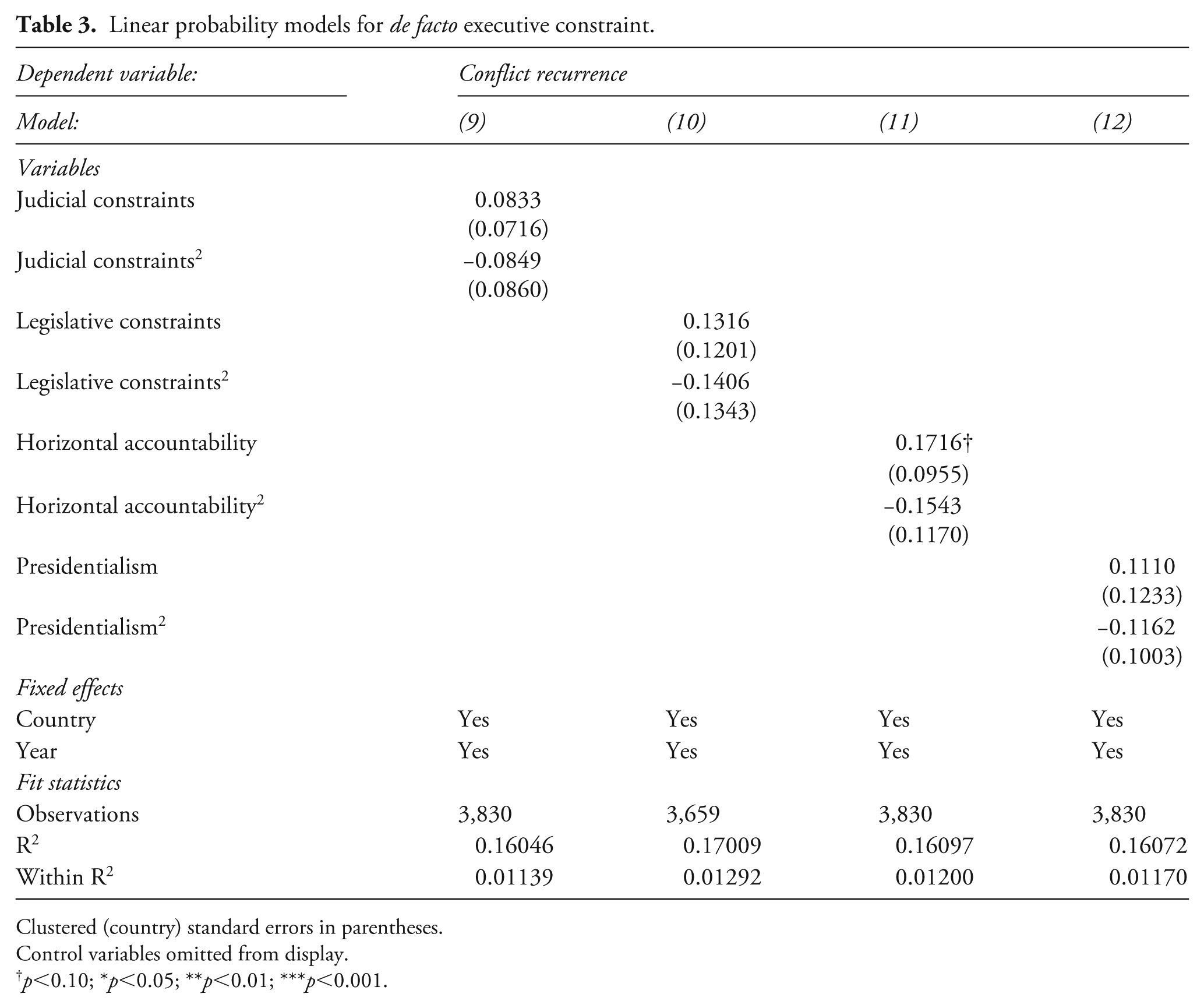
If this is indeed the primary mechanism at play, one should expect more de facto measures of executive constraints to have a similar effect as the more de jure measure of formal executive constraints reported above. However, as reported in Table 2, various measures of de facto executive constraints from VDem, such as judicial constraints and legislative constraints, and various measures of executive strength vis-a’-vis the other branches of government, such as horizontal accountability and presidentialism show a markedly different pattern than the formal executive constraints reported above. Note that the models in Table 3 include the same control variables as Model 5 in Table 1, but these have been omitted from display for simplicity. Not only is the relationship between de facto measures and conflict recurrence not statistically significant, the relationship is also of a different shape, with high and low values associated with a lower risk of conflict recurrence. Although not significant, this looks more like the established inverted-u relationship between democracy and conflict onset (Hegre et al., 2001) than the effect reported above. This significantly weakens the argument that institutional and political gridlock is driving the u-shaped relationship between formal executive constraints and conflict recurrence.
Linear probability models for de facto executive constraint.
Clustered (country) standard errors in parentheses.
Control variables omitted from display.
p<0.10; *p<0.05; **p<0.01; ***p<0.001.
Weak governments, strong constraints?
Another alternative explanation is that the curvilinear relationship between formal executive constraints and conflict recurrence might come about as a selection effect, as exceptionally weak regimes might be more likely to implement exceptionally strict formal executive constraints. Furthermore, it might be this original weakness, and not the expectations created by the formal executive constraints, that makes these post-conflict regimes vulnerable to conflict recurrence. This is in line with theoretical arguments (Meng, 2019) about when authoritarian leaders accept constraints on their power.
If this is indeed the primary mechanism, one should expect the relationship to disappear once we control for the strength of the regime. Unfortunately, regime strength is a famously tricky concept to measure. Here I use the regime support group size variable from VDem as a proxy. This is an expert-coded variable measuring the size of the social groups that support the regime and are considered important for the regime’s hold on power. The assumption is that regimes with large support groups are stronger and to a lesser degree reliant on promises of executive constraints to remain in power.
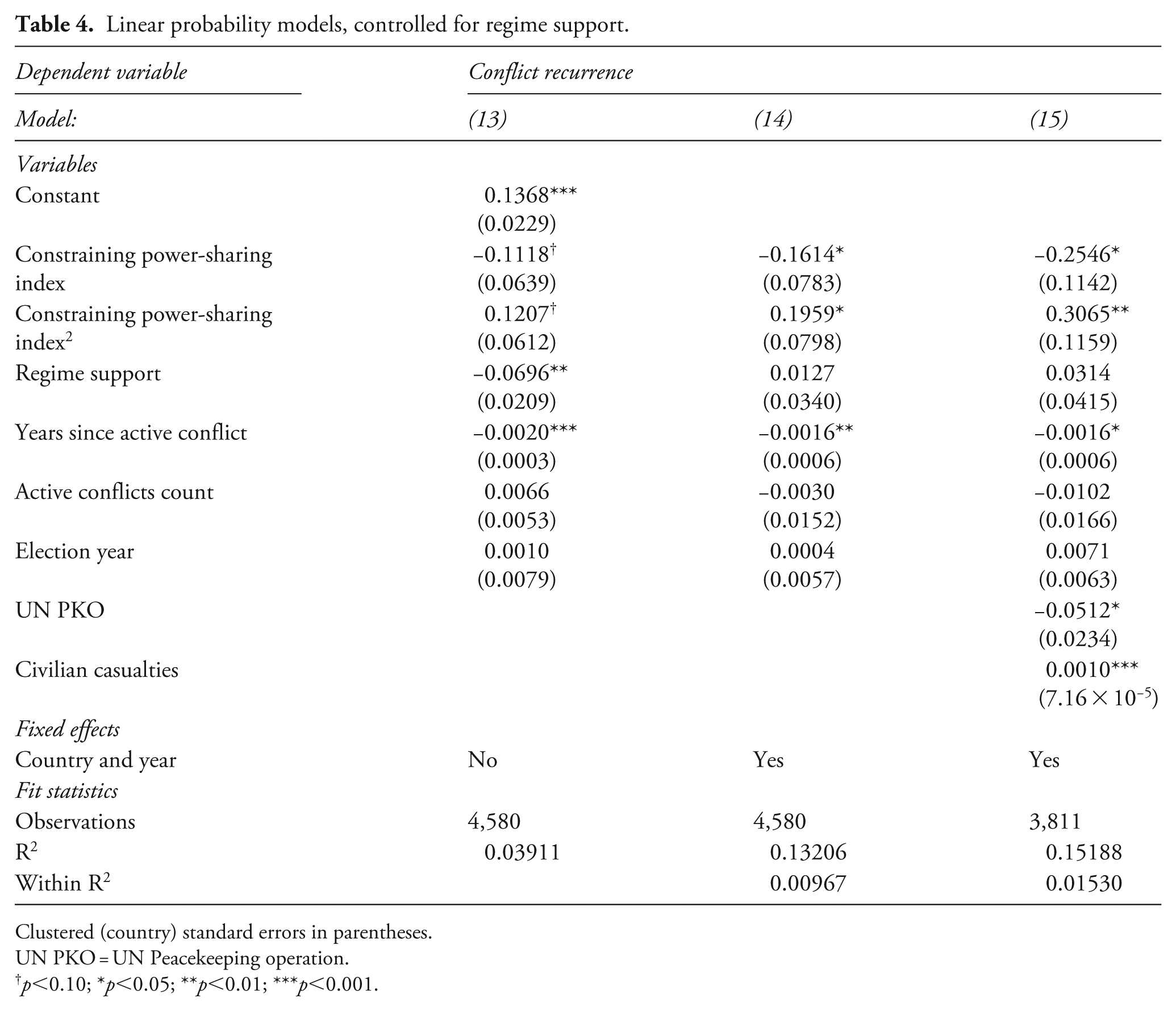
The results in Table 4 indicate that the main finding of this article is not driven by the selection effect described above. The three models correspond to Models 3, 4 and 5 in Table 1. Inclusion of the regime support group size does not substantially alter the size or significance of the curvilinear relationship between formal executive constraints and conflict recurrence. In Model 13, the curvilinear relationship is slightly weaker once regime support is controlled for, but in Models 14 and 15 controlling for regime support increases the curvilinear relationship. There is thus no sign that the relationship is driven by the selection effect described in this section.
Linear probability models, controlled for regime support.
Clustered (country) standard errors in parentheses.
UN PKO = UN Peacekeeping operation.
p<0.10; *p<0.05; **p<0.01; ***p<0.001.
Transitions rather than levels?
Finally, one might argue that whether or not promises of minority and individual rights protection as codified in formal executive constraints are perceived as credible should not depend on the level of formal executive constraints, as I argue, but should depend on the change in the level of executive constraints from the pre-conflict period to the post-conflict period. In other words, whether or not a promise of executive constraints should be seen as credible or extraordinary should depend on the constitutional history of the specific post-conflict country. The expectation would be that transitions toward more strict executive constraints should be less credible, and that the greater the transition the lower the credibility. This alternative explanation is inspired by Flores and Nooruddin (2009), who show that different types of regime-type transitions have vastly different effects on the probability of economic recovery and probability of conflict recurrence.
Taking this approach, all post-conflict episode years can be categorized as one of nine different transition types (see Table 5). The categorization of specific post-conflict regimes will depend on the thresholds between categories. Moreover, subtracting the pre-conflict value of the constraining power-sharing index from the post-conflict value gives us a variable transition which is positive if a country has transitioned into more executive constraints, and negative if a country has transitioned into less executive constraints. The variable thus measures the extent and direction of change from pre-conflict levels of executive constraints to post-conflict levels. 9 If the extent and direction of transitions, rather than the levels, are driving the results, we should find this variable to be a significant determinant of conflict recurrence.
Theoretically possible transition-types.

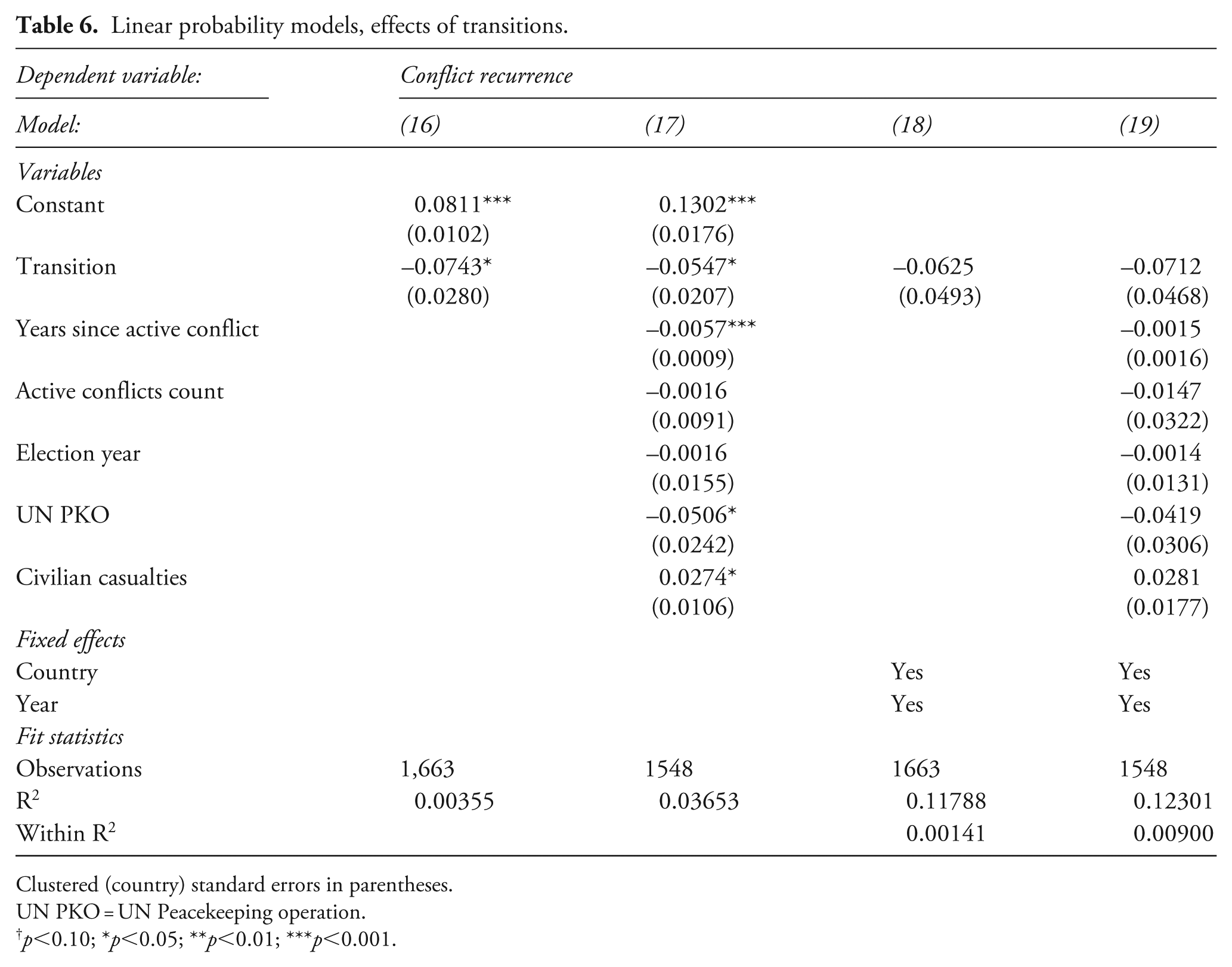
Initially, there seems to be some patterns. 10 Transitions to low levels of executive constraints are the most recurrence prone transition type. Moreover, transitions from low to medium levels are the least recurrence prone. Both of these patterns hold regardless of whether one sets a wide (0.3–0.7) or narrow (0.4–0.6) definition of medium levels of executive constraints. These patterns correspond well with the established relationship in the literature between executive constraints and conflict recurrence, but not so well with the alternative explanation outlined in this section. Moreover, Table 6 show that the extent and direction of transitions does not have a statistically significant effect on the risk of conflict recurrence once country- and year fixed effects are included. In less restrictive models, the effect of transition is negative and significant. These results indicate that the results are not driven by different types of constitutional transitions, but indeed by the direct expectational effect of formalized executive constraints.
Linear probability models, effects of transitions.
Clustered (country) standard errors in parentheses.
UN PKO = UN Peacekeeping operation.
p<0.10; *p<0.05; **p<0.01; ***p<0.001.
Conclusion
Contrary to established findings, formal executive constraints are not uniformly pacifying in post-conflict settings. This article finds a curvilinear effect of formal executive constraints on conflict recurrence, with low and very high levels of constraints associated with an increased risk of conflict recurrence. The lowest risk of conflict recurrence is associated with moderate levels of formal executive constraints. Moreover, following Gates et al. (2016a), this relationship seems to be best explained by the promises of minority and individual rights protection inherent in formal executive constraints, and the corresponding effects on opposition mobilization costs. However, for promises of rights protection to increase mobilization costs, the promises must be credible. Extraordinary levels of formal executive constraints are either ‘too good to be true’, or are easily portrayed as unfulfilled by rebel actors. As such, extraordinarily high levels of formal executive constraints decrease mobilization costs for challengers to the state, and increase the risk of conflict recurrence.
This constitutes an important contribution to the growing literature on intra-state conflict recurrence, and enhances our understanding of the political processes that lead to renewed violence in post-conflict environments. Fundamentally, the theoretical and empirical contributions of this article strengthen the specific theoretical notion in Gates et al. (2016a) that promises of rights protection inherent in formal executive constraints influence conflict recurrence through opposition mobilization costs. The amendment is the emphasis on the crucial element of credibility, and the empirical finding that promises must be credible in order to increase opposition mobilization costs. This constitutes an important step toward understanding why some conflicts recur, and others do not.
Moreover, these findings have crucial implications for post-conflict governments, international organizations and non-governmental organizations involved in post-conflict peace processes in general, and through constitutional design specifically. The key to lasting peace is not necessarily a constitution that maximizes formal adherence to a liberal rights regime. Rather, post-conflict settlements should strike a balance between the ideal and the possible, in order to create credible constitutional commitments. This is further complicated by the suspicion that extraordinary promises of rights protection might play an important role in the negotiation processes that lead to conflict termination in the first place. Although it might be misunderstood as such, this is not an argument for less minority and individual rights protection in post-conflict environments. Rather it is a reminder that incredible promises can be just as detrimental as promises not given.
Footnotes
Acknowledgements
The author thanks Scott Gates, Stian Kjeksrud, Jonas Willibald Schmid, Eric GE Nilsen, Melanie Sauter, Carl Henrik Knutsen, Siri Aas Rustad, Patrick Nyheim Schjølberg, Malika Rakhmankulova, Thomas Sedelius, Jan Hruška and Karina Mross, as well as participants at the PRIO Junior Scholars Symposium 2024, the workshop at the Nordic Political Science Congress 2024, the IR group at the Norwegian National Conference in Political Science 2024, the CoPE – PCD Brownbag Seminar at PRIO November 2023, the CIR Workshop at the University of Oslo 2023 and the Empirical Research on Peace and Conflict Workshop 2023 for commenting on various stages of this article, as well as two anonymous reviewers and the editor of the JPR.
Replication data

Funding
The author received no financial support for the research, authorship, and/or publication of this article.