




Abstract
Conclusions about the potential for peace via power-sharing are mixed. For some, power-sharing does little to overcome the commitment problem characterizing a transition from conflict, while others argue that such concessions provide signals of parties’ willingness to incur costs. This article develops and tests a new theory, aiming to shed light on the mechanisms through which power-sharing bargains help to overcome the commitment problem. I argue that government parties tend to hold an electoral and military advantage, which heightens incentives for rebel leaders to defect from a settlement prior to conceding their capacity to use violence. Where settlements provide discrete guarantees that offset the risks of electoral defeat and the co-optation of forces, these incentives for pre-emptive defection should be mitigated. I offer a novel disaggregation of provisional power-sharing subtypes, distinguishing between long-term and short-term arrangements. The analysis rests on an original, cross-national dataset of government-and-rebel dyads to negotiated settlements signed between 1975 and 2015 (N = 168). The logistic regression results clearly indicate that power-sharing settlements stipulating ‘consociational’-style reforms are significantly more likely to resolve conflict between settlement dyads, all else equal. Meanwhile, standard conceptualizations of power-sharing, which include transitional coalitions and troop integration, appear unlikely to secure rebel commitment beyond the transition period, which helps to explain the contradictory findings in existing research.
Introduction
Recent events in Syria have only reified lessons learned in Somalia, Afghanistan, and elsewhere – military intervention is a costly and often counterproductive strategy, which risks prolonging conflict and entrenching international actors in domestic disputes (Howe, 1997; Luttwak, 1999; Von Hippel, 2000; Fortna & Howard, 2008). There is an emerging consensus that, wherever possible, international efforts should instead focus on convincing belligerent parties to come to the table and reach agreement on the terms of peace. Protracted peace processes in Afghanistan, Libya, Cyprus, and South Sudan are just a few recent examples of the international commitment to brokering negotiated solutions, even when facing highly unfavorable conditions. The result of this normative shift has been a marked increase in the frequency of settlements signed to end intrastate conflict (Fazal, 2014; Toft, 2010; Licklider, 1995), from just 15 prior to the end of the Cold War to more than 80 over the subsequent decade and a half (see Figure 1). At the same time, negotiated settlements have evolved from a tool for conflict resolution to a cornerstone of post-conflict democratization, exhibited by a corresponding transformation in substantive content. While agreements to share power were relatively rare prior to 1990, more than two-thirds of settlements have entailed some form of power-sharing in the period since.
Despite these trends, there is little agreement among scholars and policymakers about the kinds of terms that might increase the prospects for peace. Often, the blame for settlement breakdown is placed on exogenous factors, Frequency of negotiated settlements signed worldwide over five-year periods, 1975–2015 (N = 124)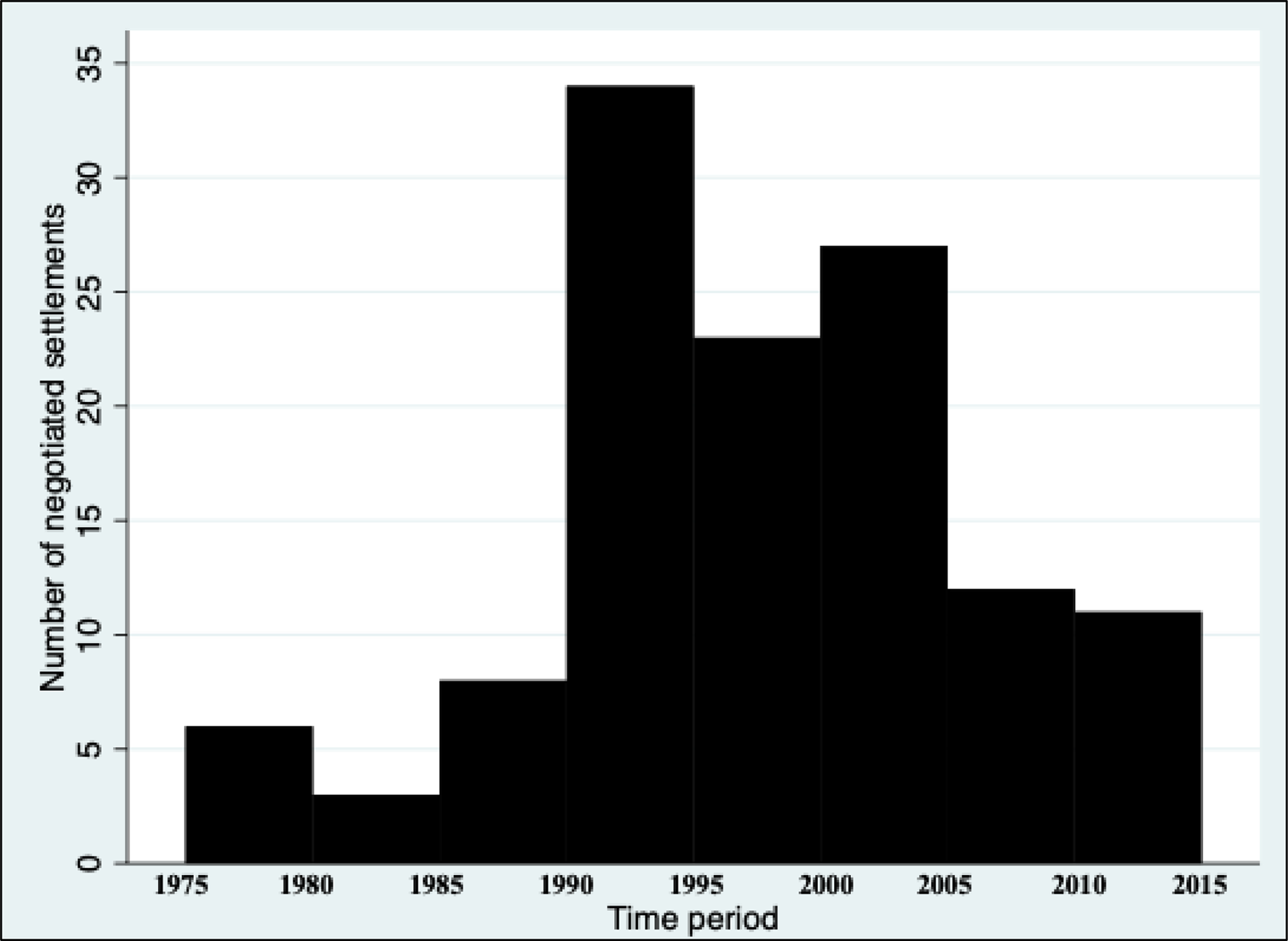
Although a burgeoning literature speaks to this puzzle, few scholars have systematically unpacked the provisional variation that exists within the umbrella category of power-sharing settlements. Among the few exceptions, it is commonly accepted that political power-sharing – or shared rule among belligerents – is unlikely to succeed without additional measures helping to reduce mutual fears (Mattes & Savun, 2009; Schneckener, 2002; Spears, 2000), offset implementation failures (Hartzell & Hoddie, 2007), or devolve power to the group level (Jarstad & Nilsson, 2008; Rothchild & Hartzell, 2014). This study contributes to this field by offering a novel disaggregation of power-sharing subtypes, specifically focusing on the distinction between short-term and long-term solutions, which aims to shed light on the mechanisms that explain why rebels are more likely to comply with certain bargains than others.
Table I provides a cursory illustration of the main axis of variation, focusing on a subset of power-sharing settlements signed in sub-Saharan Africa between 1990 and 2005. It reveals that many of these bargains – including the three ‘cautionary tales’ cited above – are transitional formulas, which fail to stipulate any long-term constitutional changes that would mitigate the electoral advantage enjoyed by incumbents, guarantee representation to opposition groups, or transform the political landscape that initially generated conflict. In other cases, however, agreements involve more sweeping and permanent institutional reforms. Like well-known cases beyond Africa, such as Lebanon and Bosnia and Herzegovina, these settlements entail not just a transition to multiparty democracy, but to a particular form of democracy in which institutions are designed to mitigate conflict tendencies by reducing the stakes of national elections (Lijphart, 2004). For example, unlike the transitional 1993 governing coalition between Rwanda’s Hutu government and Tutsi rebels, whose breakdown resulted in genocide, the proportional representation (PR) system included in Burundi’s 2003 Pretoria Protocol granted an effective legislative veto to its Tutsi minority beyond the transition period.
Provisional variation across African power-sharing settlements, 1990–2005
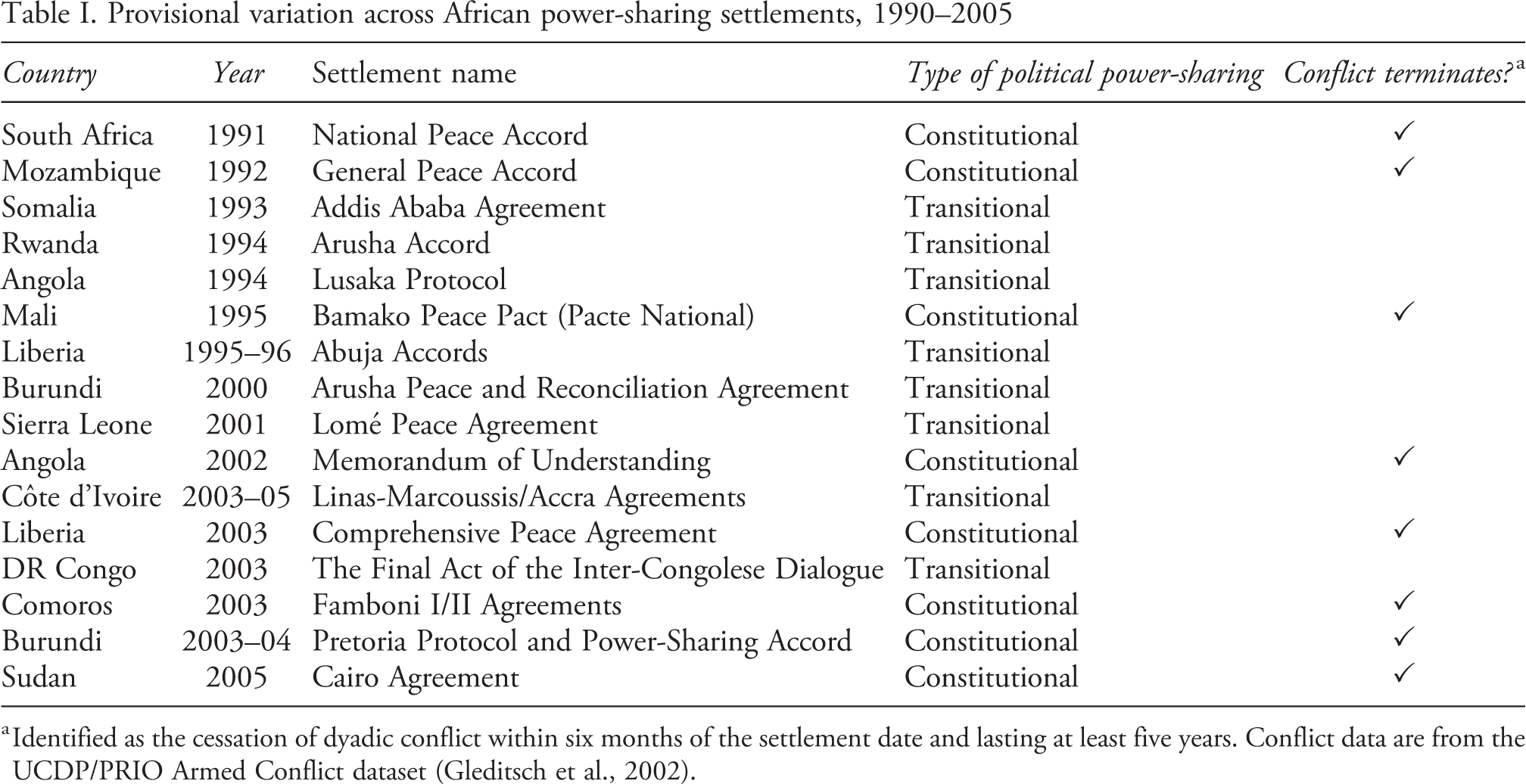
a Identified as the cessation of dyadic conflict within six months of the settlement date and lasting at least five years. Conflict data are from the UCDP/PRIO Armed Conflict dataset (Gleditsch et al., 2002).
The next section provides an overview of the current debate about power-sharing and the commitment dilemma in the conflict literature. In the third section, I present my theory about the ways in which power-sharing can help to overcome commitment problems and achieve a willing buy-in of rebel elites to democratic rules of competition, rather than violence. The following section describes the process of data collection and measurement of key variables used in the empirical analysis. In light of existing data constraints, it rests on an original, cross-national dataset of rebel–government dyads to negotiated settlements signed worldwide between 1975 and 2015 (N = 168). The results of the binomial logistic regression of conflict termination, presented in the fifth section, support the central argument about the role of long-term power-sharing guarantees. The predicted probability of conflict termination is significantly higher where power-sharing agreements entail constitutional reforms, as compared to transitional bargains. The last section concludes, with attention to areas for future research.
Existing research
There are extensive literatures available on bargaining for peace (Licklider, 1995; Mason & Fett, 1996; Mason, Weingarten & Fett, 1999; Powell, 2002) and on institutional variation across power-sharing democracies (Lijphart, 1969, 2004, 2012; Roeder & Rothchild, 2005; Norris, 2008; Gates et al., 2016; Slater & Simmons, 2013). However, the analytical focus of this study is on the role of power-sharing during the intermediary period, when signatory parties make important decisions about whether to comply with their commitments to the terms of peace, or else defect back to the battlefield. It is in this precise arena that approaches from the subfields of international relations (IR) and comparative politics converge, and as a result – and despite significant academic attention and advancement – findings have been much more mixed (Jarstad, 2006).
Due to the literature’s evolution from IR theories of war, the theoretical starting point is a rationalist approach, with settlement breakdown commonly understood as a reflection of bargaining failures under conditions of heightened uncertainty (Fearon, 1995; Powell, 2002, 2006; Werner, 1999; Posen, 1993; Lake & Rothchild, 1996). The seminal model elaborated in Barbara Walter’s (2002) Committing to Peace predicts an equilibrium of mutual defection, since neither party can credibly commit to peace. Beyond a classic prisoner’s dilemma, however, the conditions of the game further reduce the possibility of a best-case outcome since mutual compliance allows ‘nature’ to determine a winner – in the form of post-conflict elections – making parties even less willing to accept the risk of unilateral demobilization. From this perspective, promises to share power should do little to change the prevailing credibility dilemma in the absence of third-party enforcement (Fortna, 2008).
Yet, a wealth of empirical evidence exists to challenge this conclusion; just as international intervention cannot guarantee settlement success, neither is it always necessary to a peaceful transition. Peacekeepers may merely sustain what Galtung (2011) refers to as a ‘negative’ peace – characterized by the absence of violence but remaining highly unstable and prone to breakdown with the inevitable exit of international actors (Downs & Stedman, 2002; De Waal, 2009). Recognizing this, other scholars have proposed that a settlement’s content may play a role in helping to reduce mutual fears and improve credibility. From this perspective, agreeing to share power serves as a signal of parties’ willingness to bear costs and, thus, commitment to abandoning the fight (Mattes & Savun, 2009; Jarstad & Nilsson, 2008; Hartzell & Hoddie, 2007; Mukherjee, 2006; Hartzell, Hoddie & Rothchild, 2001).
While the logic of ‘costly signaling’ provides valuable insights about the ways in which the terms might help to resolve commitment failures, the underlying mechanisms have not been clearly and consistently spelled out in the existing literature. The theoretical implication is that it is rebels’ perceptions about the likelihood that the settlement will be implemented that ultimately predict compliance or defection. In this way, the terms play only an indirect role in decisionmaking, rather than factoring directly into rebels’ calculations about their post-transition payoff. In fact, a range of provisions beyond power-sharing may play a similarly costly and benevolent role in signaling a willingness to comply – from issuing a blanket amnesty, to inviting peacekeepers, to building all-inclusive commissions for oversight or arbitration (Mattes & Savun, 2009).
Moreover, based on extant empirical findings, it remains unclear exactly which kind of power-sharing formulas might prove sufficiently costly to guarantee compliance. Hartzell & Hoddie (2007) propose that more comprehensive power-sharing settlements are significantly more likely to stick, suggesting that the various power-sharing subtypes – political, territorial, military, and economic – should have little effect independently. In contrast, numerous studies have concluded that territorial forms of power-sharing provide the most durable solution to violent conflict among subnational groups (Rothchild & Hartzell, 2014; Jarstad & Nilsson, 2008). Political power-sharing is perhaps subject to the most heated debate – although Mattes & Savun (2009) find some evidence for a positive effect, the vast majority of scholarship suggests that formulas involving shared rule are especially unstable. The next section addresses this impasse.
A theory of pre-emptive defection
While it is widely acknowledged that transition periods are critical to lasting peace (Lyons, 2004; Höglund, Jarstad & Kovacs, 2009), the strategic calculations of signatory parties during this crucial phase remain under-theorized. Walter’s (2002) much-cited model specifies moves to comply – or more accurately, to demobilize – as equally costly for both government and rebel parties, with nature determining electoral victory at random. In reality, however, compliance threatens to place rebels in an especially vulnerable position vis-à-vis the state, for two reasons. First, although the government party may stand down from direct confrontation, it never fully demobilizes. Claiming a legitimate monopoly on the use of violence means that the state remains ‘better equipped to impose [its] most preferred outcome’ (Sawyer, Cunningham & Reed, 2017: 1176). Rebels, on the other hand, have a diminished capacity to ‘induce concessions by inflicting costs on the state’ with each move made towards full disarmament (Sawyer, Cunningham & Reed, 2017: 1178).
Second, although multiparty elections involve some uncertainty, electoral outcomes are not determined by a coin toss. Given its preferential access to state coffers and institutions – and, therefore, the capacity to deploy coercion, patronage, or outright manipulation in order to ensure victory – the incumbent almost always has the upper hand in the electoral arena. In many cases, incumbent entrenchment is a key driver of the initial onset of violence, with opposition groups perceiving conventional avenues to accessing power closed off. Where competing parties have recently been at war, the fear of potential retaliation from rivals may heighten incentives for incumbents to avoid electoral defeat at all costs (Cheeseman, 2015).
Surprisingly few scholars have explicitly recognized the disproportionate leverage enjoyed by the government party in a transition, and the ways in which this raises the stakes of elections (Mattes & Savun, 2009: 739; Sawyer, Cunningham & Reed, 2017; Höglund, Jarstad & Kovacs, 2009; Matlosa & Shale, 2013; Plank, 2017). In contrast to standard rationalist approaches, in which settlement failure hinges on parties’ inability to commit under conditions of uncertainty, this perspective sheds light on the importance of rebel elites’ calculations about the relative profitability of the agreed terms after the end of the transition period, as compared to a return to war. Of course, a signed settlement is never an iron-clad guarantee – the government can always delay implementation or renege on its promises. And yet, a number of notable cases exist in which rebels chose to defect in spite of apparent compliance by the government party. In the oft-cited Angolan example, implementation was proceeding on schedule when the results of first-round 1992 presidential elections – overwhelmingly favoring the incumbent – prompted defection by rebel UNITA leader Jonas Savimbi. As a transition progresses, increasingly less uncertainty remains about which side is likely to win, either electorally or militarily, once rebels demobilize. Unless the settlement provides discrete guarantees that effectively reduce the risk of electoral defeat, political exclusion, and a return to the pre-conflict status quo, the optimal strategy for the likely loser is to defect while the capacity to do so remains. In theoretical terms, therefore, any government concessions likely to be perceived as sufficiently costly to secure rebel commitment must be understood through this lens.
The implications of the theory point to three testable hypotheses. First, given the advantage of incumbency, political power-sharing provisions should only help to secure rebel commitment where they diminish the imperative of mobilizing majority support. That a trade-off often exists in plural societies between electoral accountability and political stability has long been recognized by comparativists (Horowitz, 1993; Andeweg, 2000; Lijphart, 2004, 2012; Slater & Simmons, 2013). The literature on democratic ‘crafting’ and ‘pacting’ reveals case-specific strategies that worked to achieve elite buy-in during Third Wave transitions in Southern Europe and Latin America, which often came at the expense of pure representativeness (O’Donnell & Schmitter, 1986; Di Palma, 1990). Arend Lijphart (1977: 238) has famously argued that the realistic choice for conflict-prone societies ‘is not between the British normative model of democracy and the consociational model, but between consociational democracy and no democracy at all’.
And yet, in the extant conflict literature, the typical approach to political power-sharing is an umbrella concept encapsulating both constitutionalized, consociational-style reforms and transitional coalitions. As an example, the DRC’s ‘1+4’ power-sharing formula was hailed as revolutionary in its distribution of the presidency and four vice presidencies among leaders of rival armed groups (Koko, 2007); yet, both the executive coalition and unity government were disbanded with 2006 national elections, and the 2003 settlement failed to otherwise alter the political landscape of the regime in a way that would improve the position of former rebels or the societal groups they represented. In one insightful account, defection by the Congolese Rally for Democracy (RCD) was a direct response to what was ultimately a poor showing in presidential and parliamentary elections, in which they garnered less than 5% of vote share: ‘[t]he RCD was aware […] [that it] had little hope of winning in the 2006 elections. For the RCD leadership […] the new rebellion was a means of keeping their influence in eastern Congo in the case of electoral defeat’ (Stearns, 2011: 322–323). In Comoros, however, violence was resolved with a permanent institutional solution: a rotating presidency system, which encourages competition within ethnically homogenous islands rather than between them. Meanwhile, in Burundi, an effective solution combined over-representation of minority Tutsis with a two-thirds parliamentary majority required to pass major legislation, which ‘effectively reduced the costs of losing an election and guaranteed Tutsis political representation and jobs whatever the outcome of the polls’ (Cheeseman, 2015: 209). While the possible formulas are as varied as are conflict cases, the common thread is that, in order to improve rebels’ commitment to demobilize willingly, political forms of power-sharing should provide long-term guarantees that offset the risk of competing in elections against an advantaged incumbent. H1: All else equal, political power-sharing settlements that include provisions for constitutional reforms should be positively associated with conflict termination, while transitional coalitions should have a negative effect.
Overlooking the difference between long-term and short-term bargains – and the respective impact on the decisionmaking of signatories – has generated a false dichotomy in the field. There seems to be little debate that territorial forms of power-sharing – Lijphart’s (1969, 1977) ‘segmental autonomy’ of groups – provide more durable and effective solutions to conflict, as compared to political power-sharing at the national level (Rothchild & Hartzell, 2014; Zanker, Simons & Mehler, 2014). Whether the conceptual distinction is between ‘shared rule’ and ‘self-rule’ (Schneckener, 2002), or similarly between ‘power-sharing’ and ‘power dividing’ provisions (Hartzell & Hoddie, 2007; Wolff, 2007), scholars consistently incorporate constitutional and transitional institutional bargains into the category of inclusive solutions, while in contrast, the territorial devolution of power requires constitutional reform by nature. For Jarstad & Nilsson (2008), in fact, the finding in favor of territorial power-sharing rests on the fact that political solutions are less ‘sticky’ and easier to reverse. However, there is no reason to expect that incumbents are any less able to renege on territorial reforms than on national-level reforms, once constitutionalized. In more ethnically fractionalized countries, moreover, the territorial interspersion of groups may preclude segmental autonomy, requiring non-territorial mechanisms to reduce the majoritarian, winner-take-all nature of national elections. H2: All else equal, both inclusive and diffusive power-sharing settlements should be positively associated with conflict termination where provisions entail constitutional reforms
Important advancements in the conflict literature include recognizing that other kinds of bargains, beyond political, may be key to resolving conflict. To date, however, conceptualizing ‘military power-sharing’ tends to misconstrue the role of power-sharing provisions in incentivizing rebel commitment by including troop integration in the definition (Hoddie & Hartzell, 2003; Hartzell & Hoddie, 2007; Jarstad & Nilsson, 2008; Mattes & Savun, 2009). The incorporation of rank-and-file rebels into the national military requires rebel elites to forfeit their most valuable bargaining chip in the run-up to elections: the capacity to inflict costs on the state, or else return to war. According to the logic of pre-emptive defection, doing so risks tipping the scales further in the incumbent’s favor, enabling the ruling party to use its newfound military advantage to manipulate elections or wipe out its rival unilaterally (Höglund, Jarstad & Kovacs, 2009). A Weberian approach to the concept of ‘power’
1
-sharing suggests that rebel leaders should only be willing to forfeit their troops where settlements include additional guarantees about their own co-optation into levers of security sector decisionmaking. It is therefore unsurprising that empirical findings have been inconsistent about the effectiveness of military power-sharing, even as a formal theory about the importance of a ‘robust overhaul of the security sector’ has been clearly and convincingly laid out elsewhere (Wantchekon, 2000). H3: All else equal, settlements involving military power-sharing in the officer corps or Ministry of Defense should be positively associated with conflict termination, while provisions on troop integration should have no effect.
In sum, the theory proposed in this section emphasizes the strategic calculations of rebel signatories during a transition. While the precise power-sharing formula is likely to vary depending on the incompatibility underlying conflict, the key to overcoming the commitment dilemma hinges on whether a settlement reduces the perceived risks associated with rebel demobilization. Without such guarantees, the nexus of conflict merely shifts from the battlefield to the electoral arena, thereby raising the stakes of post-conflict elections and heightening incentives to defect.
Data and methods
The proposed hypotheses rest on the notion that there are deficiencies in the current academic conceptualization of power-sharing, which are also reflected in the existing data. The UCDP Peace Agreement dataset (Högbladh, 2011), for example, provides only a dichotomous measure of the inclusion of power-sharing provisions of any type, while independent attempts to disaggregate provisional subtypes have failed to distinguish between short-term and long-term political bargains, as well as between elite military co-optation and troop integration (Hartzell & Hoddie, 2007; Jarstad & Nilsson, 2008; Mattes & Savun, 2009). The University of Notre Dame’s Peace Accords Matrix provides detailed information on content, but the project focuses only on the most comprehensive peace agreements, lacking clear selection criteria and limiting variation on key variables. The present analysis therefore relies on an original dataset of negotiated settlements signed worldwide between 1975 and 2015. 2
Following Reiter (2016) and others, I relied on a wide range of sources to identify settlements and obtain full texts, especially the UN Peacemaker Library, Ulster’s Transitional Justice INCORE database, and the US Institute of Peace. For comparative purposes, a settlement must meet the following definition to be included: (a) be mutually accepted and signed by at least two actors actively fighting an intrastate conflict, (b) be viewed as a definitive solution, and (c) include substantive provisions intended to maintain the peace. The first criterion excludes cross-border conflicts and those ending in secession, such that signatories expect to coexist in the same political space. It also eliminates settlements involving political entities that are only loosely affiliated with armed militias, such as Northern Ireland’s Good Friday Agreement. I rely on the UCDP/PRIO Armed Conflict dataset (Gleditsch et al., 2002; Themnér and Wallensteen, 2013) to identify rebel signatories as active at the time of signing. To allow for variation in conflict termination both across settlements and across rebel parties, the dataset is structured by government–rebel dyad.
The second and third criteria ensure that the baseline category for analysis – settlements without power-sharing – comprises legitimate attempts to resolve conflict issues, such that rebels agree to disarm in exchange for some package of concessions. This avoids agreements signed where conflicts are dormant or heavily lopsided (Kreutz, 2010), and it excludes ceasefires, which are generally viewed as a temporary hiatus to facilitate negotiations and are, therefore, especially prone to conflict recurrence (Toft, 2010). Where multiple documents are signed as part of the same continuous peace process, they are combined and coded as the same settlement; 3 in contrast, if one settlement degenerates into renewed violence, leading to fresh negotiations and new bargain, the cases are coded discretely. In total, the dataset includes 168 dyads across 124 negotiated settlements signed in 48 counties over the relevant time period.
The analytical goal is to determine whether certain provisions are more likely to definitively resolve conflict by securing rebel commitment. This outcome is likely driven by different mechanisms than the duration of peace, which may be sensitive to the presence of peacekeepers (Fortna, 2008), spoiler behavior (Nilsson, 2008; Reiter, 2016), or the timing of elections (Brancati & Snyder, 2013). The dependent variable is therefore a dichotomous measure of Conflict termination, coded as 1 if the rebel party drops out of the UCDP Armed Conflict dataset within six months of the settlement and remains inactive for at least five years – a standard benchmark for scholars interested in conflict settlement (Walter, 2002: 53). Empirically, it is unlikely that groups will retain or regain the organizational capacity to relaunch rebellion after this point, and this coding strategy limits the censorship of observations to three settlements Frequency of provisional subtypes in the full sample of negotiated settlements, 1975–2015 (N = 124)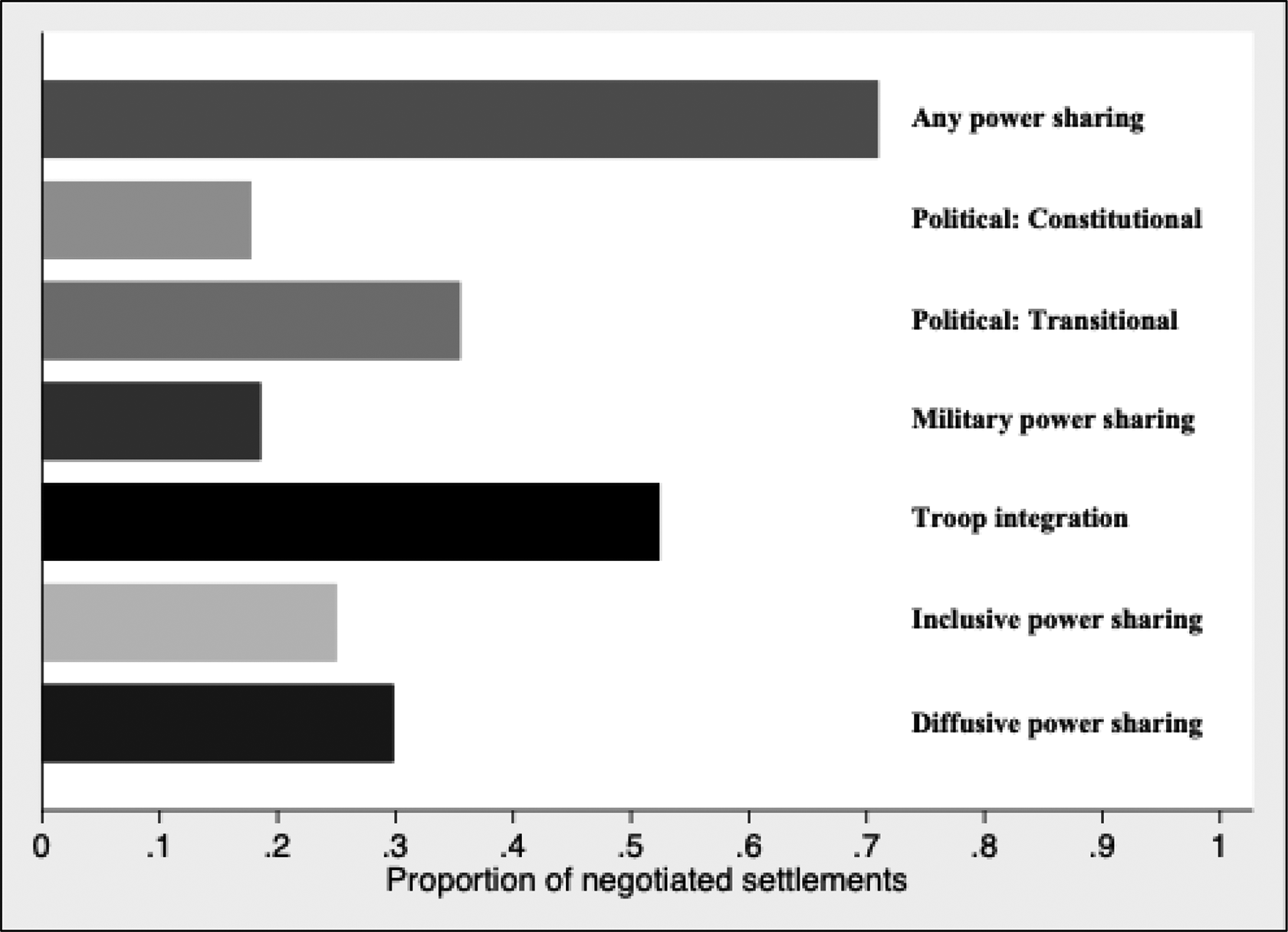
Independent variables
The dataset codifies various provisional subtypes of power-sharing with an updated reading of each settlement text. In a handful of cases, the document could not be obtained, and I therefore relied on a range of media and academic sources to determine content. The Online appendix provides a definition and description of each variable, as well as notable examples, references, and a table of all coding decisions, clustered by settlement. Figure 2 illustrates the comparative frequency of relevant provisional subtypes across all 124 settlements.
In line with existing literature, I identify any terms stipulating the inclusion of belligerent parties in national governing institutions as political power-sharing. Departing from standard approaches, however, I distinguish between Political: transitional provisions, involving inclusive executive coalitions or unity governments designed to expire at the end of a transition period, and Political: constitutional provisions, in which reforms guarantee representation in institutions of governance and policymaking beyond elections. The latter includes a range of possible reforms, which may be addressed either to rebel parties directly or to the societal groups they represent. Electoral quotas, PR rules, or effective legislative vetoes are common solutions in parliamentary democracies, 5 while presidential systems may be more likely to address the distribution of ministerial positions. 6 Both variables are dummies, coded as 1 if relevant provisions are present and 0 otherwise. While 35.5% of settlements include agreement on transitional power-sharing, the proportion falls to 17.7% where the bargain entails long-term constitutional reforms.
Second, in order to improve operationalization of the concept of Military power-sharing, I measure relevant provisions as those involving a restructuring of the high command, officer corps, or Ministry of Defense in order to include rebel leaders. This is clearly distinguishable from provisions on Troop integration, which merely require that ex-combatants be incorporated into the national military. Again, each variable is coded as 1 if provisions are present and 0 otherwise. Unsurprisingly, provisions on the integration of forces are much more common than military power-sharing – at 52.4% and 18.5% of all settlements, respectively.
Next, I use these updated measures to test the validity of my own theory against those who have found territorial solutions to be more durable than those involving shared rule. I follow a number of scholars who, using various conceptual labels, distinguish between inclusive and diffusive mechanisms for sharing power (Roeder & Rothchild, 2005; Schneckener, 2002; Wolff, 2007). The coding of Diffusive power-sharing corresponds to existing definitions of ‘territorial’ power-sharing, in that the settlement stipulates a devolution of resource wealth or political, administrative, or fiscal powers away from the national level: 1 if present and 0 otherwise. In measuring Inclusive power-sharing, however, I depart from existing measures by requiring that either Political: constitutional or Military power-sharing provisions be present, or both, but excluding Political: transitional provisions. Interestingly, the two provisional subtypes appear in the sample in a relatively similar proportion: 29.8% of settlements include diffusive forms of power-sharing, compared to 25% for inclusive provisions. Finally, I code Any power-sharing as 1 if any of the following provisional subtypes is present: Political: transitional, Political: constitutional, Military, or Diffusive. It is 0 otherwise – the baseline analytical category. The majority of settlements (71%) include agreement on some form of power-sharing.
It is possible that warring parties are more willing to accept costly compromises in certain contexts, such as where conflict has reached a hurting stalemate or where rivals have a clear advantage (Mason & Fett, 1996; Mason, Weingarten & Fett, 1999), and that this explains the willingness of signatories to comply rather than risk recurrence. In other words, power-sharing bargains may arise where conflicts are already ripe for resolution. Settlements evolve out of bargaining processes, making it impossible to randomize provisional content. In order to address concerns about spuriousness, I regressed each power-sharing subtype against the range of covariates included in the analysis, while also adding a measure of Relative strength between government and rebel parties, which derives from the NSA’s ‘Rebel strength’ variable (Cunningham, Gleditsch & Salehyan, 2013). Full results are provided in the Online appendix. Consistent with Walter (2002) and Mattes & Savun (2009), I find no clear evidence that a certain set of antecedent conditions helps to predict an agreement to share power. Nevertheless, the empirical analysis controls for a range of structural, conflict- and content-related factors that might have an independent effect on the likelihood of conflict termination, independent of power-sharing. 7
Control variables
Variation in state capacity impacts the ability of the government party to implement concessions, as well as that of rebels to return to the battlefield. The data therefore include the following measures: annual GDP per capita in current USD, from the 2019 World Development Indicators; Military size as soldiers per capita, from the COW2 National Material Capabilities dataset v5 (Singer, Bremer & Stuckey, 1972); 8 and Mountainous terrain as a proportion of land area (Fearon & Laitin, 2003). To combat missing observations, data on income in Afghanistan, Moldova, Lebanon, and Cambodia are imputed from the Maddison Project Database, and a small number of gaps in military size are repeated from the most recent available year.
Certain kinds of conflicts are argued to be more resistant to settlement, such as wars over territory or those in more diverse contexts (Fortna, 2008; Hartzell & Hoddie, 2007; Hoddie & Hartzell, 2003; Doyle & Sambanis, 2000; Kaufmann, 1996; Licklider, 1995). To capture diversity, the dataset relies on Fearon’s (2003) Ethnic fractionalization index. Using UCDP/PRIO data, I include measures of conflict Duration in months (Themnér & Wallensteen, 2013), total Battle-deaths attributed to the conflict dyad (Pettersson, Högbladh & Öberg, 2019), and a dummy variable for Territorial conflicts (Gleditsch et al., 2002). Any groups not included in the UCDP Battle Deaths dataset are considered to be in low-intensity conflicts and are therefore imputed as 25 deaths for each year they are in the Armed Conflict dataset, as this the lowest threshold for inclusion by conflict-year. To address endogeneity concerns, all time-variant indicators are lagged one year from the signing of the settlement. Due to extreme variation, the measures of income, terrain, population, duration, and deaths are logged in order to improve linearity.
Finally, I control for settlement-specific factors. A higher number of ‘veto players’ is presumed to raise the potential for spoiling and cascading defection (Cunningham, 2006, 2013; Downs & Stedman, 2002; Rudloff & Findley, 2016; Bormann & Hammond, 2016). I therefore include a count of Settlement dyads, again relying on the text and inclusion in the UCDP Armed Conflict dataset. Beyond power-sharing, other provisions may improve commitment by helping to assuage fears or imposing additional costs on signatories (Mattes & Savun, 2009). Dummy variables measure the inclusion of provisions to invite international Peacekeepers (Walter, 2002; Fortna, 2008), recognize rebels as Political parties (Matanock, 2017), grant a blanket Amnesty, or establish inclusive commissions for Oversight or Arbitration (Schneckener, 2002). All are measured as 1 if present and 0 otherwise. Since the sample is skewed toward the Post-Cold War period, all models also include a dummy coded as 1 if the settlement was signed after 1989 and 0 otherwise. For reference, summary statistics for all variables are provided in the Online appendix.
Empirical analysis
The full results of the binomial logistic regression analysis of conflict termination are provided in Table II. Coefficients are reported as log odds units, and due to the time invariance of some indicators, robust standard errors are clustered by country. The findings discussed in this section are robust to a number of alternative specifications of the models, the sample, and the dependent variable, which are available in the Online appendix.
Model 1 employs the broadest operationalization of power-sharing, which is consistent with the standard definition in the extant literature. It shows that, while Any power-sharing is positively associated with conflict termination, the correlation fails to meet the p < 0.05 threshold of statistical significance (Table II). When the measure of power-sharing is disaggregated in Model 2, however, the positive effect of Political: constitutional provisions reaches the highest significance threshold (p < 0.01), with the magnitude of the coefficient more than doubling. In contrast, settlements that entail Political: transitional bargains are significantly negatively associated with conflict termination between dyads, all else equal. This finding is robust to the addition of controls capturing the presence of additional ‘fear-reducing provisions’ (Mattes & Savun, 2009) in Model 3, such as those involving amnesty, oversight, or peacekeeping. In fact, none of these content-related factors has a consistently significant effect on the likelihood of conflict termination when robust measures of power-sharing are included in the analysis.
Full results of the binomial logistic regression analysis of conflict termination, N = 168 settlement dyads
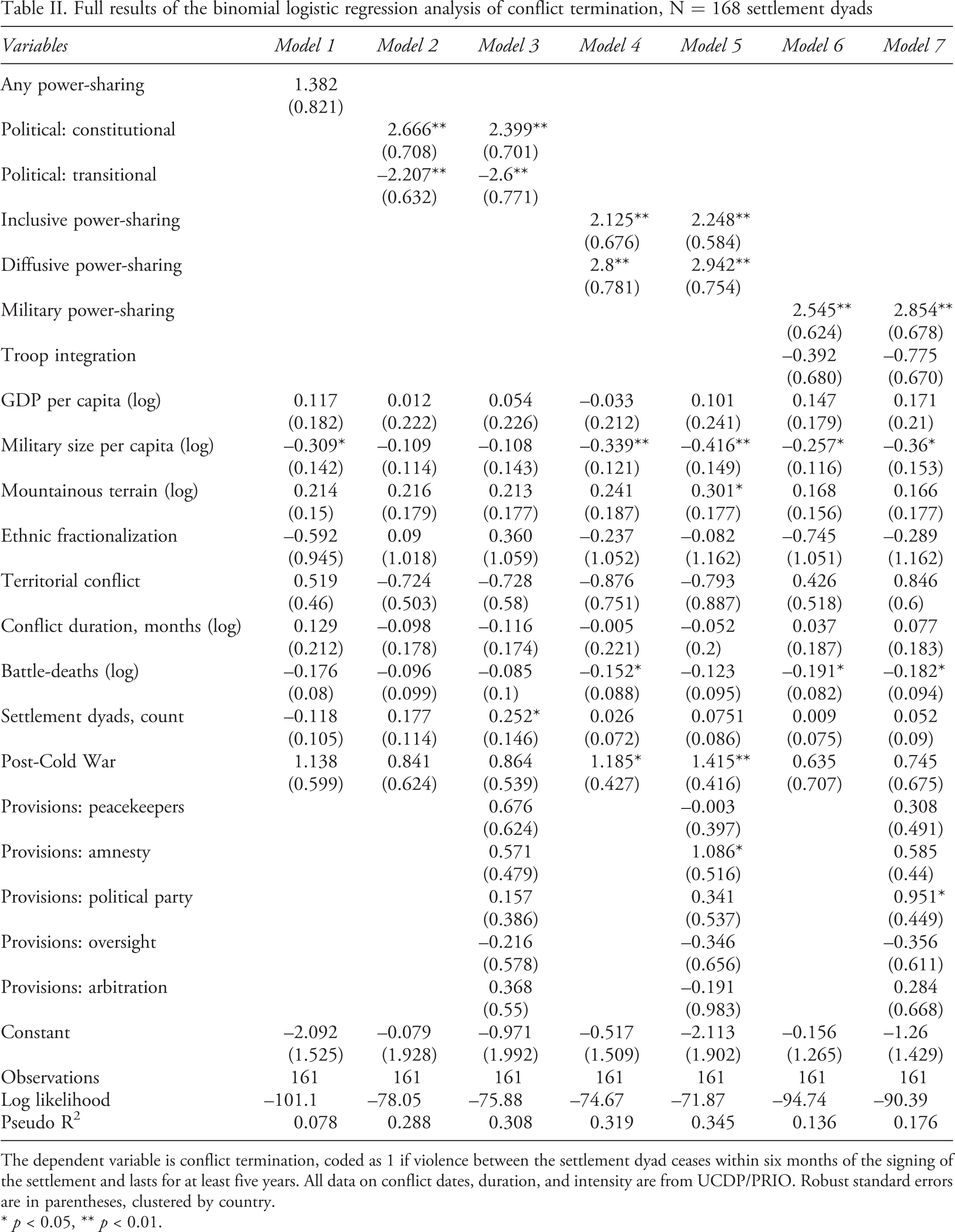
The dependent variable is conflict termination, coded as 1 if violence between the settlement dyad ceases within six months of the signing of the settlement and lasts for at least five years. All data on conflict dates, duration, and intensity are from UCDP/PRIO. Robust standard errors are in parentheses, clustered by country.
* p < 0.05, ** p < 0.01.
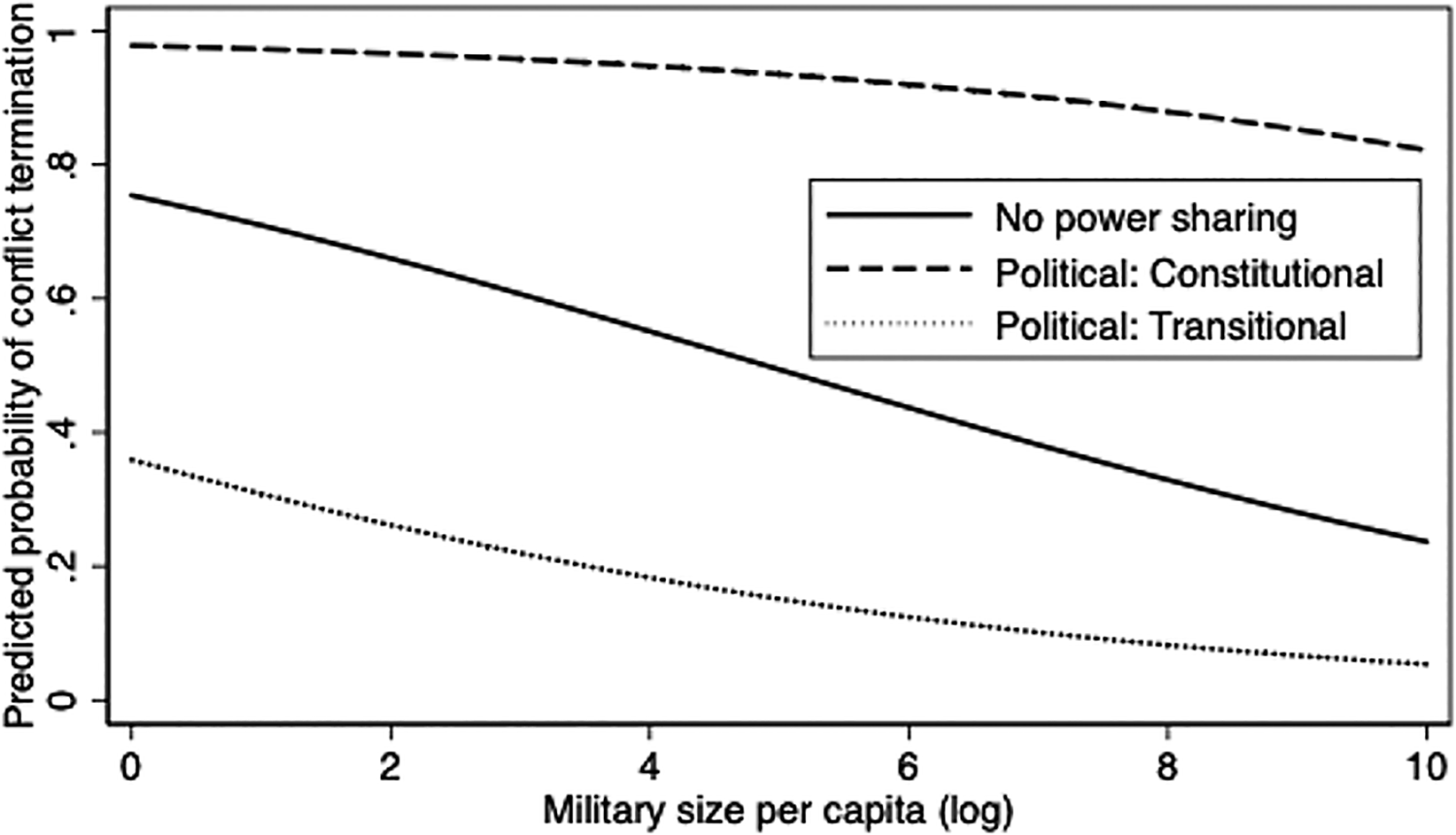
Differential impact of provisional power-sharing subtypes on the predicted probability of conflict termination
To make the differential impact of political power-sharing subtypes more intuitive, Figure 3 compares the predicted probability of conflict termination in the baseline category to those in which settlements include either constitutional or transitional provisions. Again, all variables in Model 2 are set to their mean values, while I allow variation in state military capacity, as it is the only control variable appearing to have a somewhat consistent effect on the prospects of conflict termination across models. Where states are especially weak, the predicted probability of conflict termination is relatively high even without an agreement on power-sharing, but it diminishes rapidly as state capacity increases. This pattern is consistent with the theoretical logic described in the third section, whereby rebels should perceive demobilization as a particularly high-risk gamble as the military advantage of the government party increases, heightening incentives for pre-emptive defection. As Figure 3 illustrates, however, settlements that include long-term constitutional guarantees remain exceedingly likely to overcome these perverse incentives, regardless of the government’s absolute advantage.
Models 4 and 5 test my argument against those who suggest that bargains involving shared rule are inherently fraught, especially as compared to the territorial decentralization of power. Although the magnitude of the effect is marginally larger for Diffusive power-sharing, the findings in Table II reveal that Inclusive power-sharing is also positively and significantly associated with dyadic conflict termination, lending strong support to H2. Setting all variables in Model 4 to their mean, the predicted probability of peace with the inclusion of either inclusive or diffusive power-sharing provisions is 52.53% and 67.46%, respectively. In other words, where formulas for shared rule involve ‘consociational’ institutions that guarantee inclusion over the long term, settlements have similarly positive prospects to those that achieve segmental autonomy of groups. Moreover, when both inclusive and diffusive subtypes are included in a settlement, the likelihood of dyadic conflict termination increases to 92.31%, which lends cursory support to Hartzell & Hoddie’s (2007) argument that more comprehensive power-sharing solutions may have an additive effect, helping to overcome commitment problems.
In order to test H3, Models 6 and 7 disaggregate provisions for power-sharing in the military hierarchy from those stipulating incorporation of rank-and-file troops (Table II). As expected, Military power-sharing is positively associated with dyadic conflict termination, and the effect again reaches the highest significance level (p < 0.01). In contrast, Troop integration does not have a significant effect, although the coefficient is negative. Using Clarify to simulate an average conflict, with all other variables in Model 6 set to their mean, the predicted probability of conflict termination with Troop integration alone is 29.08%. The addition of Military power-sharing provisions, however, increases the probability to 82.15%, from a long shot to a safe bet. This finding validates the notion that, according to the reasoning behind H3, rebel leaders are reluctant to concede their capacity to wage war without additional guarantees that they will have a stake in deciding how that capacity is employed – or deployed – in the future. Furthermore, it suggests that this more robust operationalization has been doing most of the statistical work in previous studies that have found a positive effect for military power-sharing while using integration as a measurement criterion.
In sum, the findings of the logistic regression analysis provide strong support for the three central hypotheses of this study. All else equal, provisions that guarantee inclusion in levers of decisionmaking beyond elections, either in central governance or in the security sector, significantly increase the willingness of rebel signatories to accept the risk of demobilization. Bargains that mitigate incentives for pre-emptive defection are able to overcome commitment problems even in the most difficult contexts, and they appear significantly more effective than other signaling mechanisms intended to improve credibility, such as peacekeeping and oversight.
Conclusion
This study offers new and important insights about power-sharing as a mechanism of conflict resolution and democratization. It relies on a novel disaggregation of settlement provisions to develop and test a theory of pre-emptive rebel defection, which emphasizes the importance of guarantees that offset the risk of competing in elections against an advantaged incumbent. The key axis of variation hinges on whether settlements fall into one of two categories: on the one hand, those that leave the make-up of the post-conflict regime to be decided by electoral victors, even if there is agreement to share power during an interim period; and on the other hand, those that entail robust and long-term changes to the landscape of state power in ways that reduce the imperative of mobilizing majority support and of retaining the option to fall back on strategies of violence, if necessary.
The logic behind this argument is not entirely unique. It draws heavily on conventional wisdom in the comparative democracy literature, which recognizes that institutions can be engineered to change the preference ordering of competing elites and incentivize democratic ‘buy-in’ by reducing the stakes for perennial losers. The distinction between long-term and short-term solutions cuts across the four subtypes of power-sharing – political, military, economic, and territorial – which have been the focus of the current debate in the conflict literature, thus raising the potential for improved coordination between IR and comparative approaches in the future.
Further research is needed in two key areas. First, although testing for conflict-related predictors of power-sharing fails to reveal clear patterns (see Online appendix), recent work shows that group elites may have an incentive to seek ethnic power-sharing configurations in light of demographic realities (Bormann, 2019; King & Samii, 2018). International mediators and policymakers will look for lessons about why governments may be willing to adopt certain packages of concessions. If consociational reforms can be used to entrench a social cleavage structure that grants incumbents the greatest advantage, then power-sharing settlements may provide yet another weapon in the arsenal of political elites seeking to remain in power.
A second and closely related issue has been highlighted by recent episodes of violence in Lebanon, Mali, and Mozambique – cases once considered to be consolidated post-conflict democracies – evoking a long-standing debate about the possible pernicious effects of power-sharing on democratic quality and durability (Norris, 2008). Larry Diamond (2015: 401) aptly points out that, while ‘it is possible to implement peace without democracy […] it is not possible to build democracy without peace’, and power-sharing solutions tend to reflect such exigencies. However, many scholars argue that power-sharing institutions cement wartime divisions into democratic politics by elevating violence entrepreneurs into positions of power and incentivizing them to mobilize support exclusively within their own social groups (Jung, 2012; Horowitz, 1993, 2014). Work by Sisk (2010) and McCulloch (2017) has shed light on potential mechanisms for renegotiation, such as ‘sunset clauses’, but more work is needed to analyse the potential for power-sharing institutions to adapt to the changing realities of a transition, even long after the dust has settled on the original conflict.
Supplemental Material
Online_Appendix - Power-sharing, conflict resolution, and the logic of pre-emptive defection
Online_Appendix for Power-sharing, conflict resolution, and the logic of pre-emptive defection by Chelsea Johnson in Journal of Peace Research
Footnotes
Replication data

Acknowledgements
The author would like to thank Leonardo Arriola, Aila Matanock, Catherine Boone, Nic Cheeseman, Jason Wittenberg, Carlo Koos, John McCauley, and three anonymous reviewers for feedback on previous versions of this article. Christopher Haugh, Derrick Kibisi, and Naomi Potter provided outstanding research assistance.
Notes
References
Supplementary Material
Please find the following supplemental material available below.
For Open Access articles published under a Creative Commons License, all supplemental material carries the same license as the article it is associated with.
For non-Open Access articles published, all supplemental material carries a non-exclusive license, and permission requests for re-use of supplemental material or any part of supplemental material shall be sent directly to the copyright owner as specified in the copyright notice associated with the article.
